Worcester Polytechnic Institute
Digital WPI
Doctoral Dissertations (All Dissertations, All Years) Electronic Theses and Dissertations
2019-04-18
Characterizing Productive Perseverance Using
Sensor-Free Detectors of Student Knowledge,
Behavior, and Affect
Anthony Botelho
Worcester Polytechnic Institute
Follow this and additional works at:https://digitalcommons.wpi.edu/etd-dissertations
This dissertation is brought to you for free and open access byDigital WPI. It has been accepted for inclusion in Doctoral Dissertations (All Dissertations, All Years) by an authorized administrator of Digital WPI. For more information, please [email protected].
Repository Citation
Botelho, A. (2019).Characterizing Productive Perseverance Using Sensor-Free Detectors of Student Knowledge, Behavior, and Affect. Retrieved fromhttps://digitalcommons.wpi.edu/etd-dissertations/523
Characterizing Productive Perseverance Using Sensor-Free
Detectors of Student Knowledge, Behavior, and Affect
by
Anthony F. Botelho
A Dissertation Submitted to the Faculty
of the
WORCESTER POLYTECHNIC INSTITUTE In partial fulfillment of the requirements for the
Degree of Doctor of Philosophy in
Learning Sciences & Technologies May 2019
APPROVED:
Neil T. Heffernan, Ph.D., Major Advisor
Erin R. Ottmar, Ph.D.
Joseph E. Beck, Ph.D.
Abstract
Failure is a necessary step in the process of learning. For this reason, there has been a myriad of research dedicated to the study of student perseverance in the presence of failure, leading to several commonly-cited theories and frameworks to characterize productive and unproductive representations of the construct of persis-tence. While researchers are in agreement that it is important for students to persist when struggling to learn new material, there can be both positive and negative as-pects of persistence. What is it, then, that separates productive from unproductive persistence? The purpose of this work is to address this question through the de-velopment, extension, and study of data-driven models of student affect, behavior, and knowledge. The increased adoption of computer-based learning platforms in real classrooms has led to unique opportunities to study student learning at both fine levels of granularity and longitudinally at scale. Prior work has leveraged ma-chine learning methods, existing learning theory, and previous education research to explore various aspects of student learning. These include the development of sensor-free detectors that utilize only the student interaction data collected through such learning platforms. Building off of the considerable amount of prior research, this work employs state-of-the-art machine learning methods in conjunction with the large scale granular data collected by computer-based learning platforms in align-ment with three goals. First, this work focuses on the developalign-ment of student models that study learning through the use of advancements in student modeling and deep learning methodologies. Second, this dissertation explores the development of tools that incorporate such models to support teachers in taking action in real classrooms to promote productive approaches to learning. Finally, this work aims to complete
the loop in utilizing these detector models to better understand the underlying con-structs that are being measured through their application and their connection to productive perseverance and commonly-observed learning outcomes.
Acknowledgements
I would like to acknowledge and thank the love of my life, Paige, for her continued and unwavering support and assistance and without whom I would not be where I am today. I further extend gratitude to my family - Paul, Donna, Joseph, Elizabeth, Wayne, Esther, and Tara - for their love and support through this period of my life. As I could not hope to list all the ways in which I am grateful for the insights, support, and assistance that my friends and fellow lab-mates, both past and present, have provided to me over the years, I wish to extend my sincerest thanks to those below:
Luke Dan Neil
Megan Avery Erin
Lindsey Taylyn Joe
Meaghan Seth Ryan
Terrasa Korinn Jake
David Doug Ivon
Matthew Siyuan Cristina
Ilir March Tricia
Lia Ashvini JA
Kyle John Emma
Danielle Hannah Cindy
Shawn Chris Katie
Stephanie David Jenny
And while I stop where I have balanced columns, I thank everyone else who has supported and helped me over the years.
Funding
The work presented in the following pages has been supported by a number
of funding avenues. Specifically, my work has been funded by a Graduate
As-sistance in Areas of National Need (GAANN) Fellowship from the U.S. Depart-ment of Education (P200A120238), and the Office of Naval Research (N00014-13-C-0127). More broadly, funding is acknowledged from NSF (grant #’s DRL-1316736, DRL-1252297, DRL-1109483, DRL-1031398, 0742503, ACI-1440753, DGE-1535428, 0231773, 0448319, 1822830), ONR’s “STEM Grand Challenges,” IES (grant #’s R305A120125, R305C100024, R305K03140, R305A07440), The Spencer Foundation, The Bill and Melinda Gates Foundation.
Contents
1 Introduction 1
I
Developing, Improving, and Applying Student Models
to Study Learning
5
2 The Prediction of Student First Response Using Prerequisite Skills 6
2.1 Introduction . . . 7
2.2 Background . . . 9
2.3 Dataset . . . 11
2.3.1 Methodology . . . 12
2.4 Results . . . 16
2.4.1 Comparison of Overall Performance . . . 17
2.4.2 Comparison Over Individual Skills . . . 19
2.5 Contribution . . . 21
2.6 Conclusion and Future Works . . . 23
3 Improving Sensor-Free Affect Detection Using Deep Learning 25 3.1 Introduction . . . 26
3.2 Dataset . . . 29
3.3 Methodology . . . 30
3.3.1 Network Structure . . . 31
3.3.2 Handling Time Series Data and Labels . . . 32
3.3.3 Model Training . . . 34
3.4 Measures . . . 35
3.5 Results . . . 35
3.5.1 Adjusting the Dropout Context . . . 35
3.5.2 Comparing RNN Variants . . . 36
3.6 Discussion and Future Work . . . 38
4 Developing Early Detectors of Student Attrition and Wheel Spin-ning Using Deep LearSpin-ning 41 4.1 Introduction . . . 42
4.2 BACKGROUND . . . 46
4.2.1 Wheel Spinning . . . 46
4.2.2 Student Attrition and Stopout . . . 47
4.2.3 Deep Learning in Educational Contexts . . . 48
4.3 Dataset . . . 50
4.3.1 Features . . . 52
4.3.2 Wheel Spinning and Stopout Labels . . . 52
4.4 Methodology . . . 54
4.4.1 Building Models of Wheel Spinning and Stopout . . . 55
4.4.2 Transfer Learning . . . 57
4.5 Results . . . 60
4.5.1 Metrics . . . 60
4.5.2 Model Performance . . . 62
4.6 Future Work . . . 71
4.7 Contributions and Conclusions . . . 72
5 Machine-Learned or Expert-Engineered Features? Exploring Fea-ture Engineering Methods in Detectors of Student Behavior and Affect 75 5.1 Introduction . . . 76
5.1.1 Expert-Engineered vs. Automatically Distilled Features . . . . 77
5.1.2 Research Questions . . . 79
5.2 Background . . . 80
5.3 Data and Labels . . . 82
5.4 Methodology . . . 84
5.4.1 Utilizing Expert-Engineered Features . . . 85
5.4.2 Deep Learning Models . . . 88
5.4.3 Machine-Learned Expert-Inspired Features . . . 91
5.4.4 Exploring the use of Co-Training . . . 92
5.5 Results and Discussion . . . 94
5.6 Limitations and Future Work . . . 96
5.7 Conclusions . . . 98
II
Using Detectors of Student Knowledge, Behavior, and
Affect to Drive Action
99
6 The ASSISTments TestBed: Opportunities and Challenges of Ex-perimentation in Online Learning Platforms 100 6.1 Introduction . . . 1016.2.1 The ASSISTments Testbed . . . 103
6.3 Video vs. Text Feedback: A Case Study of RCEs within ASSISTments105
6.3.1 Methods to Reduce the Standard Errors of Effects . . . 109
6.4 conclusions . . . 115
7 Putting Teachers in the Driver’s Seat: Using Machine Learning to
Personalize Interactions with Students 117
7.1 The Problem . . . 118
7.2 The Opportunity . . . 121
7.2.1 Results of Prior NSF Support: Heffernan’s ASSISTments and
other CoPIs . . . 121
7.2.2 An Opportunity to Apply Google’s Smart Reply Technique to
the Education Problem . . . 125
7.2.3 ASSISTments currently has detectors that rely on student input127
7.3 The Solution . . . 132
7.3.1 DRIVER-SEAT Vignette: What we want this to look like . . 133
7.3.2 Project Activities . . . 136
7.3.3 Details of the system behind DRIVER-SEAT . . . 140
7.3.4 Experimentation and Exploration . . . 144
7.3.5 Research Questions Addressing Issues in Human Learning . . 145
7.3.6 Research Questions Addressing Issues in Computer Science . . 149
7.4 Broader Impacts . . . 152
8 The HAND-RAISE Intervention through LIVE-CHART:
Direct-ing Teachers’ Attention to Prevent the Loss of Student Interest in
STEM 153
8.2 The Opportunity . . . 155
8.2.1 Results of Prior NSF Support: Heffernan’s ASSISTments and other CoPIs . . . 156
8.2.2 Opportunities through AI-Enhanced Classrooms . . . 159
8.2.3 ASSISTments currently has detectors that rely on student input160 8.3 The Solution . . . 161
8.3.1 The HAND-RAISE Intervention Vignette . . . 162
8.3.2 Project Activities . . . 167
8.3.3 Method of Evaluation . . . 173
8.4 Broader Impacts . . . 179
8.5 Intellectual merit . . . 179
III
Understanding the Role of Student Knowledge,
Be-havior, and Affect in Productive Perseverance
180
9 Studying Affect Dynamics and Chronometry Using Sensor-Free Detectors 181 9.1 Introduction . . . 1829.2 Previous Work . . . 184
9.2.1 Detectors of Student Affect . . . 187
9.3 Methodology . . . 188
9.3.1 Dataset . . . 188
9.3.2 Affect Dynamics . . . 190
9.3.3 Affective Chronometry . . . 192
9.4 Results . . . 193
9.4.2 Observing Affective Chronometry . . . 194
9.5 Discussion and Future Work . . . 197
10 Refusing to Try: Characterizing Early Stopout on Student Assign-ments 203 10.1 Introduction . . . 204 10.1.1 Student Refusal . . . 206 10.2 Background . . . 208 10.3 Dataset . . . 210 10.4 Methodology . . . 213
10.4.1 Characterizing Early Stopout and Refusal . . . 213
10.4.2 Categorizing Stopout Behavior . . . 216
10.4.3 Stopout Behavior by Opportunity . . . 218
10.4.4 Observing Student Confidence . . . 219
10.5 Results and Discussion . . . 220
10.6 Contributions and Future Work . . . 225
11 Identifying the Constructs Underlying Models of Student Knowl-edge, Behavior, and Affect 228 11.1 Introduction . . . 228
11.1.1 Given a variety of commonly used assessment measures of student success, what is the dimensionality of the constructs measured by these assessments? . . . 229
11.1.2 What is the dimensionality of constructs measured by the ob-served detectors of student knowledge, behavior and affect? . . 230
11.1.3 What is the relationship between the learning constructs mea-sured by the observed assessment measures and those con-structs represented by the detectors of student knowledge,
behavior, and affect? . . . 230
11.1.4 Which constructs represented by the detectors of student knowl-edge, behavior, and affect are reliable predictors of short- and long-term outcomes? . . . 231
11.2 Detectors and Outcome Measures . . . 231
11.2.1 Detectors of Student Knowledge . . . 231
11.2.2 Detectors of Student Behavior . . . 233
11.2.3 Detectors of Student Affect . . . 234
11.2.4 Measures of Unproductive Perseverance . . . 236
11.3 Methodology . . . 239
11.3.1 Data . . . 239
11.3.2 Detector Models . . . 242
11.4 Factor Analyses . . . 245
11.5 The Relationship Between Factors . . . 249
11.6 Predictive Models of Unproductive Perseverance and Performance . . 251
11.6.1 Observing Distal Student Performance . . . 257
List of Figures
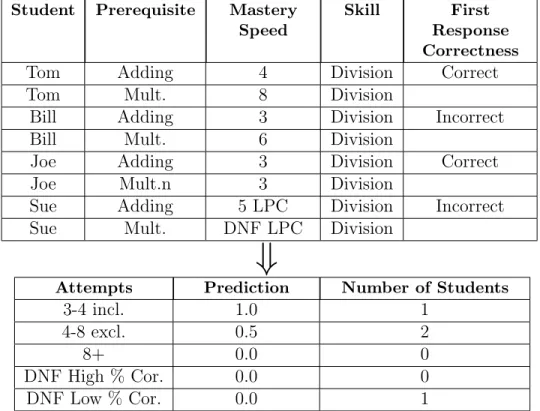
2.1 The hypothetical students and data shown, fabricated to show our
methodology, exemplifies the table creation process. Using a train-ing set, a probability table is created for each skill by categoriztrain-ing
students with similar performance history . . . 13
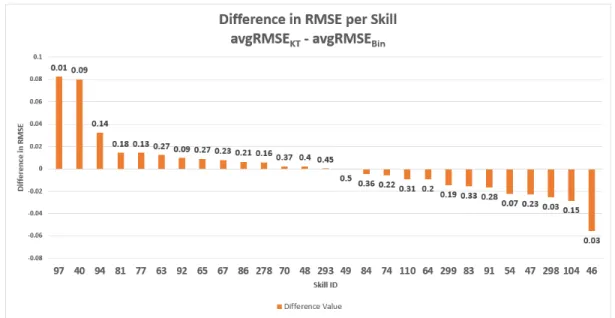
2.2 The difference of RMSE per skill when comparing our method of
binning to standard knowledge tracing, ordered from highest to lowest difference. The number above each skill indicates the p-value of the difference. . . 20
2.3 The difference of RMSE per skill when comparing our method of
binning to majority class predictions, ordered from highest to lowest difference. The number above each skill indicates the p-value of the difference. . . 21
4.1 A simplified representation of the LSTM model structure, illustrating
how information flows from previous timesteps to inform each model estimate. . . 54
4.2 A visual example of the transfer learning procedure. The hidden layer
of the trained LSTM model is used as input to train each a decision tree and logistic regression to predict each wheel spinning and stopout behavior. . . 55
4.3 The performance of the LSTM model in predicting within-assignment
wheel spinning by opportunity. . . 65
4.4 The performance of the LSTM model in predicting next assignment
wheel spinning by opportunity. . . 65
4.5 The performance of the LSTM model in predicting within-assignment
stopout by opportunity. . . 69
4.6 The performance of the LSTM model in predicting next assignment
stopout by opportunity. . . 70
6.1 An example experimental design with ASSISTments comparing
text-based feedback with video-text-based feedback when students request help. 106
6.2 The estimated treatment effects of student completion for each of the
9 experiments across all methods. . . 113
6.3 The estimated treatment effects of student completion for each of the
9 experiments across all methods. . . 114
9.1 The proposed theoretical model of affect dynamics as presented by
D’Mello and Graesser [DG12] . . . 185
9.2 The resulting positive and significant affect transitions as compared
to the D’Mello and Graesser [DG12] theoretical model. . . 191
9.3 The probability of a student persisting in each affective state over time.195
9.4 The plotted exponential decay of each affective state as estimated by
the sensor-free affect detectors. . . 197
9.5 The plotted exponential decay of each affective state as reported in
Table 1 of D’Mello and Graesser [DG11] . . . 198 10.1 The flowchart of possible student actions resulting in either quitting
10.2 The frequency of student stopout by learning opportunity. Stopout on the first opportunity appears to be disproportionately larger than
subsequent opportunities. . . 211
10.3 The exponential curve fit to stopout on the first ten learning oppor-tunities. The line is a poor fit seemingly due to stopout on the first item. . . 213 10.4 The exponential curve fit to stopout on opportunities 2 through 10,
extended to show predicted stopout on the first problem. . . 214 10.5 The resulting clusters of student prior correctness and last action
pertaining to student stopout. . . 218 10.6 The proportional distribution of samples within each cluster over the
first three learning opportunities. . . 220 10.7 The reported confidence of students within each cluster with
associ-ated 95% confidence intervals. . . 222 10.8 The reported confidence of students who stopout on the first learning
opportunity as compared with students who stopout after the first learning opportunity with associated 95% confidence intervals. . . 223 11.1 The resulting structural equation model applied to the third dataset. 251 11.2 The distributions of each factor extracted from the detector models. . 252 11.3 The transformed distributions of each factor extracted from the
List of Tables
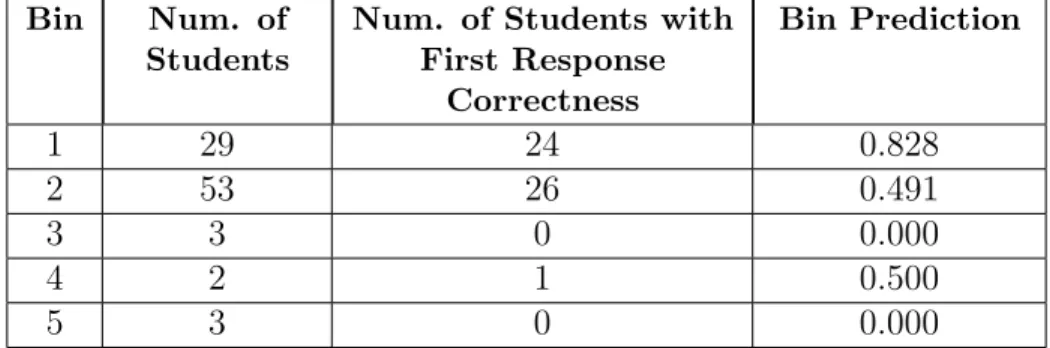
2.1 The bin student distribution and prediction values calculated for Fold
1 of Skill 47 of our dataset. . . 15
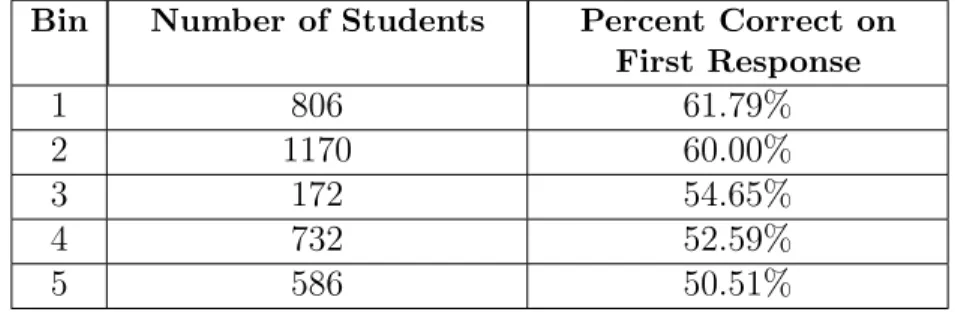
2.2 The overall percent correctness on the first response of all subsequent skills for each of the five bins. . . 16
2.3 Results of our trials over all skills . . . 18
3.1 Comparing locations of dropout within the GRU model. . . 36
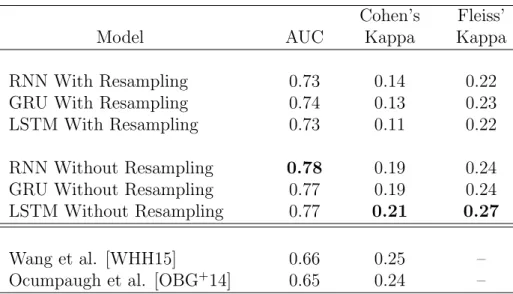
3.2 Three recurrent model variants, trained on both the resampled and non-resampled datasets, are compared to the previous highest re-ported results on the ASSISTments dataset. . . 37
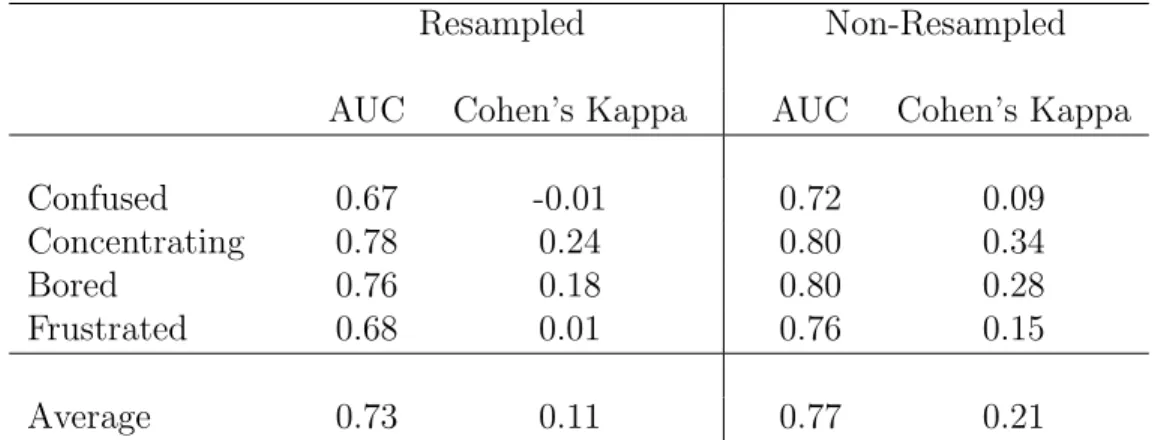
3.3 LSTM model performance for each individual affect label. . . 39
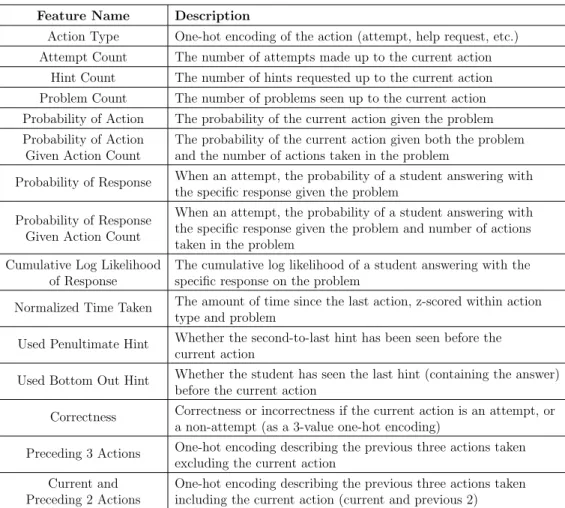
4.1 Description of the generated action-level features. . . 50
4.2 The notable descriptives of the dataset. . . 53
4.3 Predicting Wheel Spinning in current assignment . . . 59
4.4 Predicting Stopout in current assignment . . . 59
4.5 Predicting Wheel Spinning in next assignment . . . 61
4.6 Predicting Stopout in next assignment . . . 61
5.1 The number of instances and distribution of labels across each outcome. 83 5.2 Comparison of feature sets across each of the detector models. . . 90
5.3 Comparison of feature sets across each of the detector models using co-training. All detectors in this analysis uses an LSTM model. *The machine learned model of each detector utilized co-training across
actions and therefore mirrors the respective rows in Table 5.2. . . 93
7.1 Categories of detectors to be utilized by DRIVER-SEAT. . . 128
7.2 Participant timeline. . . 139
7.3 Potential actions to be utilized by DRIVER-SEAT . . . 142
7.4 Conditions within the randomized controlled trial evaluating feed-back development method, time allowed, and students’ perceptions of message origin. . . 146
9.1 The transitions between affective states. D’Mello’sLvalues are shown. Transitions that are statistically significantly more likely than chance, after Benjamini and Hochberg’s post-hoc correction, are denoted *. . 202
11.1 The list of observed detectors of student knowledge, behavior, and affect. . . 236
11.2 The description of outcome measures . . . 238
11.3 Counts of students, assignments, and classes across the three datasets. 240 11.4 The EFA factor loadings observing the student learning assessment measures. . . 246
11.5 The EFA factor loadings observing the detector models. . . 247
11.6 The CFA measures of fit for the EFA observing the detector models. . 249
11.7 The CFA measures of fit for the EFA observing the student assess-ment measures. . . 250
11.8 The beta coefficients, statistical reliability, and variance explained for each multi-level model. . . 255
Chapter 1
Introduction
Failure is a difficult, yet inevitable and necessary step in the process of learning. Perseverance or persistence in the presence of failure is often considered the key to eventual success, having been studied through a myriad of research pertaining
to grit [DPMK07], academic tenacity [DWC14], perseverance [PS+04][FRA+12],
resilience [MW09], productive struggle [War15] and productive failure [Kap08]. In each of these models and theories, persistence alone is not enough to quantify a student’s performance or effectively characterize their behavior. Student success is not simply a measure of whether that student made an attempt or quit, but also incorporates a measure of how much meaningful processing occurred during the learning activity [CGSG04]. This latent construct of learning, commonly described as cognitive engagement [WGM06] is likely a distinguishing factor that separates productive from unproductive persistence, or perseverance as these terms will be used interchangeably throughout this work, exhibited by students on a particular learning task.
But what makes persistence productive? It has become clear in studying learning that not all persistence is beneficial to a student and additional practice,
particu-larly when there is a gap in knowledge, may not help the student to progress toward understanding or mastery of the material. This case has been previously studied through a behavior known as ‘wheel spinning’ and describes when a student ap-plies effort but exhibits little-to-no progress toward mastery of the topic [BG13]. However, it is necessary for students to exhibit some persistence when faced with struggle because giving up too soon may deprive the student of practice opportuni-ties to either remedy the misunderstanding or gap in knowledge or, at the very least, provide assessment to identify the potential causes of the difficulty. This aspect of persistence has been studied through cases of student attrition as either ‘dropout’
[CRK15][XCSM16][YSAR13][RCY+14] describing a course or school-level attrition
or ‘stopout’ [BVIH19] describing a lower, assignment-level attrition.
Wheel spinning and student attrition, henceforth referenced as student stopout to reflect the granularity of measurement observed in the current work, describe two aspects of unproductive persistence, but do not necessarily inversely describe pro-ductive persistence comprehensively. Surely, these two previously-studied behaviors are measures of unproductive persistence, but that does not mean that these are the only measures describing a lack of productivity. By definition, productive per-sistence describes cases where a student benefits from additional practice in regard to future learning, and as such, likely requires some level of cognitive engagement from the student as previously described. In forming the definition of productive perseverance, it becomes clear that there are numerous learning constructs involved and they likely interact in complex ways. Furthermore, the behaviors themselves can be observed at varying levels of granularity as engagement and persistence can be observed within a single learning task, across learning subtasks, or even at more longitudinal granularities across learning tasks.
quantify student engagement and the surrounding behaviors. While the number of learning constructs that could describe student engagement is vast, this work focuses on three identified categories of measures: knowledge, behavior, and affect. While each of these describe inherently latent constructs of learning (i.e. one cannot directly observe the knowledge of a student), these constructs can be operationalized through various measures that are internally and often externally validated.
The adoption of computer-based learning systems in real classrooms has provided invaluable opportunities to study the learning process not only with fine levels of granularity, but also longitudinally and at large scale across multitudinous class-rooms in various geographic settings and urbanicities. The depth and breadth of data recorded as students interact with these systems has allowed researchers to develop and evaluate learning theory in a manner that can help drive intervention and improve instruction.
Detectors of various student knowledge, behavior, and affect have been developed by combining existing learning theory with data collected from students interacting with computer-based learning environments. While some of these detectors are commonly associated with assessment measures of student knowledge (e.g. current or future correctness), others have focused on more behavioral (e.g. taking advantage of, or gaming the system), and even affective (e.g. boredom) attributes. While some research has utilized physiological sensors external to these learning systems
(c.f. [ACB+09]), many instead rely only on the student interaction data and find
patterns of activity that are found to correlate with externally validated measures of these various learning constructs; these later detectors, referred to as
“sensor-free” detectors [PRB+16][BBH17], have greater potential for application at scale
and across learning environments (both in terms of the learning system but also the physical environment in which students work) as they do not require the installation
of additional sensors which may be both costly and also intrusive.
By distinguishing between productive and unproductive perseverance, it is the hope that this dissertation can facilitate much broader impacts in the study of student knowledge, behavior and affect and lead to actionable understanding of these constructs. The concepts that inspire this dissertation follow previous education research and learning theory to develop measures and detectors of student learning. This research promotes a better understanding of the relationship between such measures and detectors, and using these relationships to develop interventions aimed to support positive learning practices.
This dissertation is divided into three parts that address the development of sensor-free detectors of student behavior and affect, the development of tools to support action and intervention, and finally the deeper exploration of the detec-tor models in the context of identifying relationships in the measured underlying constructs of learning. Throughout these parts, the chapters include a collection of publications, manuscripts in submission, two submitted federal grants (one of which that has been funded as NSF #1822830), and in-preparation works. Where applicable, the chapter title is accompanied by the associated abstract and citation with the author listing in acknowledgement of the invaluable contributions of all co-authors.
Part I
Developing, Improving, and
Applying Student Models to
Chapter 2
The Prediction of Student First
Response Using Prerequisite Skills
Botelho, A., Wan, H., & Heffernan, N. (2015, March). The prediction of student
first response using prerequisite skills. In Proceedings of the Second (2015) ACM
Conference on Learning @ Scale, 39-45. ACM.
Abstract
A large amount of research in the field of educational data analytics has focused primarily on student next problem correctness. Although the predic-tion of such informapredic-tion is useful in assessing current student performance, it is better for teachers and instructors to place attention on student knowledge over a longer period of time. Several researchers have articulated that it is im-portant to predict aspects that are more meaningful, inspiring our work here to utilize the large amounts of student data available to derive more substan-tial predictions over student knowledge. Our goal in this paper is to utilize prerequisite information to better predict student knowledge quantitatively as a subsequent skill is begun. Learning systems like ASSISTments and Khan Academy already record such prerequisite information, and can therefore be
used to construct a method of prediction as described in this paper. Using these inter-skill relationships, our method estimates students initial knowledge based on performance on each prerequisite skill. We compare our method with the standard Knowledge Tracing (KT) model and majority class in terms of the predictive accuracy of students first responses on subsequent skills. Our results support our method as a viable means of representing student pre-requisite knowledge in a subsequent skill, leading to results that outperform the majority class and that are comparably superior to KT by providing more definitive student knowledge estimates without sacrificing predictive accuracy.
2.1
Introduction
A large amount of research in the field of educational data analytics has focused primarily on student next problem correctness. Events such as the Knowledge Dis-cover and Data Mining Competition held in 2010 (www.kdd.org), more commonly referred to as the KDD Cup, directs the attention of the field to the prediction of next problem correctness; while perhaps useful in performance evaluation, the abil-ity to predict next problem correctness has certain limitations in regards to utilabil-ity especially when assessing student knowledge over larger periods of time. Others in the field have begun raising other meaningful questions[BmCMC08] [PH10b][WH13], realizing the importance of predicting or observing aspects that are much more sub-stantial. Intelligent tutoring systems (ITS) provide a wealth of student data from which more meaningful predictions and observations can be derived. Our work here aims to utilize this data to provide more significant information pertaining to student knowledge to teachers and instructors.
For our research, we emphasize constructing a more precise prediction on stu-dents’ initial knowledge approaching a new skill. In the general case, students move
gradually from an initial state of knowledge toward mastery, and student models should capture this change. Thus, a more accurate estimation of this initial knowl-edge could lead to a better understanding of a student’s knowlknowl-edge state at any observable time, and consequently, we could use the model’s results to develop more precise predictions of future performance.
In this paper, we utilize prerequisite information to predict student initial knowl-edge on subsequent skills. If a skill ‘A’, is a prerequisite of skill ‘B,’ students should have mastered ‘A’ before proceeding to ‘B.’ The prerequisite relationships used in this work are defined by domain experts. Due to human effect, some skill relation-ships might be overestimated, or they may not exist in other applications. As such, we are seeking to answer the following two questions in this paper:
1. Does prerequisite information really help to improve the estimation of initial knowledge on subsequent skills?
2. Are all prerequisite relationships reliable?
We address these questions through three experiments to first observe trends of distribution across our proposed binning method, and then to compare the predictive accuracy of that method to that of KT and majority class across all skills and at an individual skill level.
The next section will introduce a background of our comparative model, KT, after which we will described the dataset used in our trials. The following section will discuss our proposed binning methodology before illustrating the results of our experiments, and, finally, we state our contributions, conclusions and intended future work in this field of research.
2.2
Background
The knowledge tracing (KT) model [CA95] developed by Corbett and Anderson has long been successful in the field of student assessment. Its implementation and use in tutoring systems and use in performance analysis systems exemplifies its practical applications, scalability, and appropriation across many fields of study. The KT model is widely used in these tutoring systems and the field of educational data analytics due to its accuracy in predicting student correctness by utilizing only a small amount of data.
The KT model gains its accuracy through the training of four parameters rep-resenting students’ prior knowledge, learning rate, probability of guessing, or an-swering correctly while not knowing a skill, and chance of slipping, or anan-swering incorrectly while in a supposed ”learned” state. Knowledge tracing relies heavily on the successful training of these parameters to properly model a student beginning a new skill, and then to build upon that model at a student level given a sequence of responses. For this reason, each student beginning a particular skill receives the same base model. Therefore, each student within a skill will be given the same prediction for the first response. The model could be greatly improved if another prediction procedure, such as the method described in this work, could use a more intelligent approach to predict first response.
In the standard KT model, initial knowledge is represented by a parameter
P(L0), the probability of mastering the skill [CA95]. As such, KT is often used
to estimate each student’s initial knowledge [PH10b]. In the standard KT model,
the parameter P(L0) is trained on all students’ records in the a training set, and
assumes that all students have the same initial state of knowledge. However, this assumption is too strong to use the model to predict each individual student’s first
response. To overcome this drawback, Pardos and Heffernan use three heuristic functions to model individualization in KT [PH10a], and find that the method, setting initial individualized knowledge based on individual students’ performance over all skills, yields superior results. This approach, however, overestimates the relationships between skills. If learning a skill does not promote, or even hinder [CM], learning another skill, then it is not appropriate to use knowledge in one skill to estimate another.
Baker et al. uses another method [dBCG+10] that compares a student’s overall
performance and all other students’ performance on a skill to build an individualized model. Like the standard KT model, this method suffers two major problems: falling into local maxima and the existence of multiple global maxima[BmC07]. Thus, we
cannot know if the value of P(L0) obtained by the model represents true student
initial knowledge.
Knowledge Tracing’s many strengths have made it a kind of comparative model in many works and is used again here as such. Knowledge Tracing builds upon the performance history of each student to calculate a probability that the student will answer the next problem correct. For this reason, it often fails to accurately predict students’ first responses as there is less information for KT to accurately calculate a prediction. The method of prediction proposed in this work focuses entirely on first responses of students undertaking a new skill by observing student performance in prerequisite skills. Using knowledge tracing as a comparative model, our method of prediction aims to outperform KT in terms of accuracy in regard to students’ first responses while providing a more definitive measure of initial knowledge.
2.3
Dataset
The dataset used in our work is comprised of real-world algebra and geometry-based student data from the 2009-2010 academic year taken from the ASSISTments tutor-ing system. This system is administered by teachers to students through assigned problem sets that track student performance in addition to many other features to be used for better assessing each student’s knowledge and understanding of each topic, or skill. It is intended that each student completes problems pertaining to the assigned skill until a status of mastery is reached, which by default is defined as three consecutive correct answers. Each problem, or opportunity as it will be referred to in this work, is recorded by the system and is used to evaluate that student’s overall performance.
Within ASSISTments, skills are arranged in an intended prerequisite-to-subsequent skill structure defined by domain experts as a recommended sequence of topics for instructors. It is the teacher’s choice which skills and problems to assign as well as the order in which to assign them. As will be discussed later, the relationships between skills in this predefined prerequisite structure is worth further inspection, but are trusted for our initial experiments.
It was found that of the 230 skills listed as subsequent skills in our ASSISTments dataset, 28 contained usable prerequisite data; we define student data as usable if the sequence in which students complete skills matches the prerequisite structure defined within the system. The usable dataset consisted of 983 unique students across all skills, providing 3466 rows of response data. We acknowledge that our results may provide more reliable conclusions with a larger dataset, but our work here is intended to be used as initial work from which further research may expand upon and is therefore viewed as sufficient for this paper.
From the student performance, we also calculate each student’s individual speed of mastery, defined as the number of opportunities, or individual problems, com-pleted in order to gain mastery status as described above. We use this mastery speed as a measure of student knowledge and aptitude across skills and is used to calculate predicted responses as described in the next section. For this work, only problem correctness, expressed as binary values in the system, is used to calculate mastery speed and overall student performance, neglecting other features such as time between problems and skills and also partial credit evaluations. Other methods of determining mastery, discussed briefly in a later section, may lead to improved accuracy in our method, but are not the focus of this work; we use the simple ”three right in a row” method of determining mastery for all of our experiments.
2.3.1
Methodology
The method described in this work attempts to better predict student first problem correctness on a subsequent skill by categorizing, or “binning”, students with similar mastery speed in a prerequisite skill; for purpose of clarification, the terms bin and category will be used interchangeably throughout this paper. Such a method has shown success in the past [XLB13] when making other predictions such as next problem correctness using different features from a similar dataset. This method, labeled as ”Prerequisite Binning” (PB), involves categorizing students based on a set of features, such as mastery speed, and inferring a relationship between them. For example, we binned students with similar ranges of mastery speed in order to create a prediction for any student that also could be placed in the same bin. If successfully identified, certain trends may appear within the bins, which are addressed in a later section.
Student Prerequisite Mastery Speed
Skill First
Response Correctness
Tom Adding 4 Division Correct
Tom Mult. 8 Division
Bill Adding 3 Division Incorrect
Bill Mult. 6 Division
Joe Adding 3 Division Correct
Joe Mult.n 3 Division
Sue Adding 5 LPC Division Incorrect
Sue Mult. DNF LPC Division
⇓
Attempts Prediction Number of Students
3-4 incl. 1.0 1
4-8 excl. 0.5 2
8+ 0.0 0
DNF High % Cor. 0.0 0
DNF Low % Cor. 0.0 1
Figure 2.1: The hypothetical students and data shown, fabricated to show our methodology, exemplifies the table creation process. Using a training set, a proba-bility table is created for each skill by categorizing students with similar performance history
mastery speed. For this, we used a 5 fold cross-validation on our dataset, using 80% as a training set to predict performance on the remaining 20%. The training set was used to construct the bins, which splits students based, again, on the number of opportunities needed to master each prerequisite skill. An average mastery speed across all prerequisite skills was calculated, placing students into one of five bins.
The first bin contains those who averaged three to four opportunities inclusively (3 ≤
x≤4) to master all prerequisite skills; as three opportunities is the lowest possible
mastery speed and four opportunities indicates an incorrect response on only the first problem, this bin presumably represents the highest knowledge students. The second bin, following the first in terms of mastery range, contains students who
The third bin encompasses students with an average mastery speed of eight or more (8 ≤ x) across all prerequisite skills. Following this categorizing strategy, a fourth bin would contain those students that did not reach mastery status on prerequisite skills before proceeding to the subsequent skill. However, our dataset shows that a large percentage of students fall into this category, many of which respond to only a small number of problems; the reason for neglecting to finish a particular skill could be explained by boredom, simple negligence, poor time management, or a lack of knowledge. For these reasons, the ”did not finish” (DNF) category, describing students that did not master all prerequisite skills, is represented by two bins. Our fourth bin contains students that did not master at least one of the prerequisite skills with a high percent correctness (HPC) across those skills (greater than or equal to 66.67% correctness), while the fifth and final bin contains such students with a low percent correctness (LPC) across all prerequisite skills (less than 66.67% correctness ). The fourth and fifth bins handle the case where a student began a prerequisite skill, but did not reach mastery status; this means that at least one problem was attempted, but the student either completed less than three or failed to answer correctly on three consecutive opportunities. Bin four is therefore meant to represent students that failed to complete the prerequisite skills for reasons other than lack of knowledge, while the fifth contains students genuinely struggling and are perhaps experiencing “wheel spinning”[BR14].
With students from the training set categorized based on performance in prereq-uisite skills, a prediction value was calculated for each bin by finding the percentage of students in each category to respond correctly on the first opportunity of the subsequent skill. The reasoning for this method of binning, again, stems from the theory that particular trends exist for students in each bin and will extend to other students that also fall into that category. Therefore, it was expected that the
pre-diction value of each bin constructed by the training set would apply to similar students in the test set.
Bin Num. of
Students
Num. of Students with First Response Correctness Bin Prediction 1 29 24 0.828 2 53 26 0.491 3 3 0 0.000 4 2 1 0.500 5 3 0 0.000
Table 2.1: The bin student distribution and prediction values calculated for Fold 1 of Skill 47 of our dataset.
Figure 2.1 exemplifies the bin creation process using a set of hypothetical stu-dents (the names and values do not reflect any real person/dataset and are purely exemplary). In that example, prerequisite information from four students is used to construct the five bins. As Tom averaged a mastery speed of 6 opportunities across all his prerequisite skills, he is placed into the second bin with Bill, who averaged a mastery speed of 4.5 opportunities. Since Tom answered correctly on the first problem of the subsequent skill and Bill did not, the prediction for the second bin becomes 0.5, as half of the students in that bin answered the first problem of the sub-sequent skill correctly. Joe mastered each prerequisite skill with the minimum three attempts and is therefore placed into the first bin. That bin is given a probabilistic prediction of 1.0 due to the fact that all students in that bin answered correctly on the first question of the subsequent skill. Sue is placed into the fifth bin, as she did not master one of the prerequisite skills, and had a low percent correctness (less than 66.67%) across both prerequisites. She did not answer the first problem correct on the subsequent skill, leading to a prediction of 0.0, as no student in that bin answered correctly on the first question of the subsequent skill.
table illustrates the prediction calculation methodology using skill 47 of our dataset corresponding in the ASSISTments tutoring system to the “Conversion of Fraction Decimals Percents.” As described in the earlier example, students in a training set are placed into each bin based on estimated student knowledge. Using this categorization, a prediction is calculated by observing the number of students in each bin to answer the first problem of the subsequent skill correctly.
2.4
Results
The results of our work are exemplified through several metrics. Before compar-ing the predictive accuracy of our binncompar-ing method to any other model, we must verify that each bin represents the intended level of knowledge within our dataset. Our method is able to illustrate this representation by observing the percentage of students within each bin to answer correctly on the first problem of a subsequent skill.
Bin Number of Students Percent Correct on
First Response 1 806 61.79% 2 1170 60.00% 3 172 54.65% 4 732 52.59% 5 586 50.51%
Table 2.2: The overall percent correctness on the first response of all subsequent skills for each of the five bins.
Table 2.2 shows the distribution of knowledge within each bin across all skills in the observed dataset. The values show a distribution of higher knowledge students in the lower bins and lower knowledge students in the higher bins. This result supports the claim that our method is properly representing the intended level of knowledge.
The distribution of the number of students in each bin, particularly the fourth and fifth bin, indicates that our dataset contains a large percentage of students that did not complete prerequisites before attempting a subsequent skill. This was the reasoning behind splitting this ”DNF” bin into a high knowledge and low knowledge bin based on percent correct in the prerequisite skills. Further splitting these bins may lead to better predictive accuracy of our method, but is sufficient for our work in its current state and avoids over-complicating what is meant to be a simple categorization method.
2.4.1
Comparison of Overall Performance
The results of our method, entitled ”Prerequisite Binning” in Table 2.3, was com-pared to knowledge tracing as well as a majority class (MC) prediction to act as a control in our experiment. We chose knowledge tracing as it is widely used and stud-ied in the field of educational data analytics and attempts to learn student initial knowledge for use in its calculation. Through this experiment we are first observing the effectiveness of our model by comparing it to the majority class, a prediction made for all students using the average correctness of the dataset, and then ob-serving the differences in error between our method and KT; results illustrating a comparable error between the two methods supports the use of our binning method over KT, as it provides more definitive estimates of student knowledge without sacri-ficing predictive accuracy. Knowledge tracing was run using Kevin Murphy’s Bayes Net Toolbox for MATLAB [Mur] with initial parameters of 0.30, 0.14, 0.20, and 0.08 for prior, learn, guess, and slip respectively. For our experiment we ran a five fold cross validation on our dataset, using 80% of the data from each skill as a training set to predict the remaining 20%. The results in Table 2.3 represent the averages of all folds for each method.
Each of the three prediction methods are compared using RMSE and AUC two common measurements of error. A low RMSE indicates a more accurate prediction method while a larger AUC indicates higher accuracy. As observed in Table 2.3, the prerequisite binning method outperforms the majority class in both metrics indicating that it is a successful prediction method. When compared to knowledge tracing, however, the results show nearly the same RMSE value, but a superior AUC value.
While the binning method may not outperform knowledge tracing in all met-rics, the predictive accuracy is comparable. The purpose of this work, again, is not to provide a method that outperforms KT, but rather to construct a model-ing method that can provide teachers with more meanmodel-ingful information regardmodel-ing student knowledge. Unlike KT, where the learned parameters such as prior/initial knowledge are unusable metrics in describing true student knowledge due to the identifiability problem [BmC07], our binning method provides an initial knowledge estimate based on previously observed performance; this initial knowledge estimate, represented as the probabilistic prediction calculated for each bin, is shown to be just as reliable as KT in predictive accuracy, while also providing a more definitive metric to describe a bin-wide initial knowledge that avoids problems of identifiabil-ity.
RMSE AUC
Majority Class .496 .570
KT .472 .626
Prerequisite Binning .473 .651
Table 2.3: Results of our trials over all skills
Based on the results of our trial, we can conclude that prerequisite information can be used to predict student performance on subsequent skills in regards to first
re-sponse. This supports our argument that knowledge and learning can be observed between prerequisite and subsequent skills.
2.4.2
Comparison Over Individual Skills
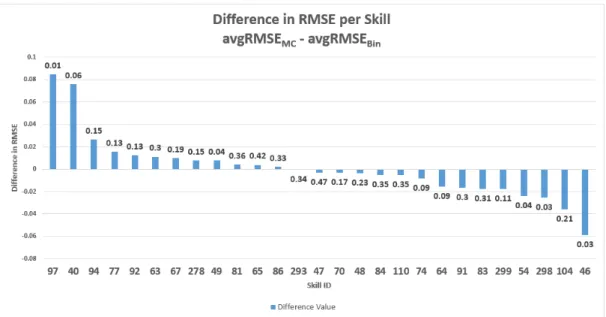
We also compare our method with KT on each individual skill. Figure 2.2 shows the
difference of RMSE for these two models, that is: RMSE(KT) − RMSE(Bin); each
positive difference value, therefore, indicates that our binning method outperforms KT in that skill, while negative difference values indicate KT outperforms binning in that particular skill. Each bar in the figure has an accompanying p-value above. This p-value is computed by applying a statistical T-test on the five-fold cross validation results. From this figure, we observe that our method outperforms KT in 14 of the 28 observed skills. Looking at the T-test results, there is a significant difference
(p-value ≤ 0.05) between the two models on only 3 skills. This statistic further
supports the comparability of the two models in terms of accuracy.
A similar histogram illustrating the difference of RMSE for the majority class and
our binning method, RMSE(MC) − RMSE(Bin), can be seen in Figure 2.3. The
majority class represents a prediction for each student that is equal to the percent
correctness of the training set of students. Again, as we used a five fold cross
validation, 80% of the data from each skill is used as a training set to predict the remaining 20%. Comparing our binning method to the majority class should provide results that take into account the difficulty of each skill, defined by the average correctness calculated in majority class predictions.
This result attempts to answer the second question in introduction pertaining to the reliability of the prerequisite skill relationships. In accordance with our initial thoughts, the stronger the relationship between a prerequisite and subsequent skill,
Figure 2.2: The difference of RMSE per skill when comparing our method of bin-ning to standard knowledge tracing, ordered from highest to lowest difference. The number above each skill indicates the p-value of the difference.
the better we can predict the performance of the subsequent skill from the knowledge of the prerequisite skill. Using Figure 2.3, we can observe significant differences
(p-value ≤ 0.05) in terms of RMSE on a total of 5 individual skills. Therefore, at
least on skills 97 and 49, the skills with better statistically significant results, we have strong confidence that the prerequisite relationships are reliable. For those skills with significantly lower results, skills 54, 298, and 46, the causal relation of the prerequisite skills may not be strong as expected by domain experts. All other skills, however, do not illustrate results significant enough to make a claim. These
particular inconclusive results may be explained by inspecting our dataset. As
indicated in our first observations pertaining to the distribution of students in each bin, a large percentage of students are categorized into bins four and five. Many of those students, as indicated by our dataset, attempt less than three problems, preventing mastery and also making it more difficult to properly estimate knowledge.
Figure 2.3: The difference of RMSE per skill when comparing our method of binning to majority class predictions, ordered from highest to lowest difference. The number above each skill indicates the p-value of the difference.
There may be two reasons for this occurrence. First, the prerequisite skills may too hard for the students to master. This may result from the teacher’s decision not to assign particular prerequisite skills, or the skill relationship graph is incomplete. A second possibility may allude to a case where a teacher does not assign enough questions for students to master the prerequisite skills. As a teacher has control over the administering of skill problems, a number of such scenarios could lead to such results. In summary, these findings potentially indicate a need to further inspect the causal relationships defined by domain experts as they appear in the observed systems.
2.5
Contribution
Our goal in this paper was to utilize the prerequisite information that many systems record to infer aspects of the students in our data. The current predominantly
used knowledge tracing model employed in many learning systems assumes that all the skills are independent of each other. In this work, however, prerequisite information is used to better understand the relationship between the prerequisite and subsequent skills. The added consideration of this relationship in a model can be used to make better statements and inferences about not only the students, but also in the manner that such skills are presented to students.
We have shown here, to our knowledge, the first model that attempts to use the relationships between prerequisite skills to predict subsequent knowledge. This is on its way to make a larger contribution to better personalizing and individualizing student models by acknowledging and utilizing more of the data. We will make note that there are many other researchers that have used aggregate information, but have not paid attention to the prerequisite structure. Many psychometricians have found, for instance, that if students who do well on a topic A tend to do well on a topic B, that information can be used to better predict performance on topic B. In this context, however, we prefer to view such information differently. Our ultimate goal is to be able to make statements to teachers regarding information that is more causally related, and we do not want to influence predictions of future performance for unrelated tasks where there is little knowledge overlap. By imposing this constraint upon us, it will reduce our ability to make predictions, but will increase the significance of our statements to teachers.
The goal of this paper extends beyond the intent to develop a more accurate prediction methodology. We wish to look at the causal effects from which our re-sults derive. It is more of a question of why using this data from prerequisite skills produces the accurate predictions across some skills and not in others. Our find-ings support the intuitive claim that certain skills are related, while others are not. Our trials provide a means of visualizing aspects of such skills to show that, as in
Figure 2.3, prerequisite information does not have the same effect for all subsequent skills. Observing little difference in some skills between a method utilizing prereq-uisite information and a method, such as KT or majority class, that does not use such information may point to several issues in either our dataset or the prereq-uisite graph of the system. It is an interesting observation that some skills, while listed as a prerequisite, may not have as strong a relationship to a subsequent skill, which is vitally important information to teachers who need to consider a sequence to introduce new skills.
2.6
Conclusion and Future Works
The results and observations presented in this paper open new research opportunities in student assessment. Through our results we have observed several factors that help to better model student knowledge and aptitude across skills. The trials of this paper certainly raise some curiosities as to the extent subsequent skills are affected by prerequisite performance. In this paper, we focus exclusively on first responses of subsequent skills and, as the results were successful, we can now look beyond the first response to observe trends in prerequisite influence over an entire subsequent skill response sequence.
With these findings, our method can be adapted and/or appropriated to ben-efit other models like KT. Implementing our method into a modified KT model could lead to more accurate representations of student initial knowledge. As the method we propose here requires little in terms of processing time while providing more definitive student knowledge estimates than other models like KT, we aim to, through similar methods, represent other aspects of student learning such as aptitude and knowledge retention.
The accuracy of this method of binning is largely impacted by the reliability of the method of determining mastery. In our experiments, as it is in ASSISTments, mastery is defined simply as a student answering correctly on three consecutive opportunities; this method, while simple, may not be the best means of representing such a status universally for all students. Further work in exploring more precise methods of determining mastery speed may prove to benefit our method; such a method may include the individualization of mastery speed requirements for each bin, as it is likely that not all student levels of knowledge can be confidently labeled as having mastered a skill with the same number of sequential correct responses.
In this work, we concern ourselves with and direct our attention to the concept of student growth and knowledge over time. We believe that such information iden-tifies aspects of the student more definitively than next problem correctness. In the future, we hope to continue similar work, looking into the influences that prerequi-site skills exhibit in the other student models, like the wheel spinning model [BR14]. We would also like to make further observations and inferences on prerequisite skills, such as their impact on the student learning process itself, or the retention perfor-mance [XBL13] of this prior.
Chapter 3
Improving Sensor-Free Affect
Detection Using Deep Learning
Botelho, A. F., Baker, R. S., & Heffernan, N. T. (2017, June). Improving Sensor-Free
Affect Detection Using Deep Learning. In International Conference on Artificial
Intelligence in Education, 40-51. Springer, Cham.
Abstract
Affect detection has become a prominent area in student modeling in the last decade and considerable progress has been made in developing effective models. Many of the most successful models have leveraged physical and physiological sensors to accomplish this. While successful, such systems are difficult to deploy at scale due to economic and political constraints, limiting the utility of their application. Examples of “sensor-free” affect detectors that assess students based solely using data on the interaction between students and computer-based learning platforms exist, but these detectors generally have not reached high enough levels of quality to justify their use in real-time interventions. However, the classification algorithms used in these previous sensor-free detectors have not taken full advantage of the newest methods
emerging in the field. The use of deep learning algorithms, such as recur-rent neural networks (RNNs), have been applied to a range of other domains including pattern recognition and natural language processing with success, but have only recently been attempted in educational contexts. In this work, we construct new “deep” sensor-free affect detectors and report significant improvements over previously reported models.
3.1
Introduction
While intelligent tutors have a long history of development and use, the most widely-used systems remain less sophisticated than initial visions for how they would op-erate. The systems now used at scale are often cost-effective and have been shown in large-scale randomized controlled trials to lead to better learning outcomes (e.g. [PGMK14],[RFMM16]), but do not reach the full level of interactivity of which hu-man tutors are capable. For example, one positive aspect of huhu-man tutors is the ability to observe student affective state and adjust teaching strategies if students are exhibiting disengaged behavior [LMDP08]. Student emotion and affective state
have been found to correlate with academic performance [CGSG04][PBSP+14] and
can even be used to predict which students will attend college [PBBH13].
With increasing evidence supporting the benefits of utilizing student affective
state to drive tutoring strategies [DLS+10], it is important to develop accurate means
of detecting these states from students working in these systems. While strides have been made to build accurate detectors, many successful approaches include the use
of physical and physiological sensors [ACB+09][DLS+10][PRB+16]. However, it can
be impractical to deploy such sensors to classrooms at scale, both for political and financial reasons. Detecting affect solely from the interaction between the student and learning system, sometimes referred to as sensor-free affect detection, may be
more feasible to deploy at scale. However, while these models’ predictions have been usable in aggregate for scientific discovery, the goodness of these approaches has often been insufficient for use in real-world intervention.
Sensor-free affect detectors have existed for several years and have been used to assess student affective states using low-level student data as students interact with a mouse and keyboard [SMSB14] , but also using features extracted from
a range of learning platforms including Cognitive Tutor [dBGW+12], AutoTutor
[DCW+08], Crystal Island [SML11], and ASSISTments [OBG+14][WHH15]. While
these detectors have been better than chance, their goodness has fallen short of
detectors of disengaged behavior, for example (cf. [PBSP+14]). Increasing the
accuracy of sensor-free affect detectors would lead to higher confidence in their use to drive intervention.
In this paper, we attempt to enhance sensor-free affect detection through the use of “deep learning,” or specifically, recurrent neural networks (RNNs) [WZ89]. Previous affect detectors have utilized a range of algorithms to detect student affec-tive state; we study whether deep learning can produce better predicaffec-tive accuracy than those prior algorithms. We study this possibility within a previously published data set to facilitate comparison with and understanding of the benefit derived from using this algorithm. Recurrent neural networks are a type of deep learning neural network that incorporates at least one hidden layer, but also provides an internal hidden node structure that captures recurrent information in time series data.
RNNs are most appropriately applied to time series data, where the output of the current time step is believed to be influenced or impacted by previous time steps. In this way, it is believed that affect detection could benefit from a model that observes the temporal structure of input data. Several internal node structures have been proposed, yielding variants of traditional RNNs such as Long-Short Term
Memory networks (LSTMs) [HS97] and more recently Gated Recurrent Unit net-works (GRUs) [CVMBB14]. Applications of these deep learning algorithms have been used in other domains for pattern recognition [CGCB14] and improving natu-ral language processing [SLMN11]. Performance in these domains certainly suggest large benefits in using deep learning on temporal or time series information.
Deep learning prediction models have not yet been used extensively in educa-tional domains, but have been studied as a potential method to improve the decisions
of virtual agents in game-based learning environments [MWP+16] and also to
im-prove the prediction of student correctness on the next problem [PBH+15]. However,
the results of the “Deep Knowledge Tracing” (DKT) model presented in [PBH+15]
are as yet uncertain; initial reports suggested profoundly better performance than previous approaches, but later investigation by other researchers indicated that the same data points were being replicated and used to predict themselves, artificially inflating goodness [XZVIB16]. When this error was corrected, performance seemed to be equivalent to previous approaches [KLM16]. Nonetheless, recurrent neural networks may be highly effective for problems with the complexity and the quantity of data available to fully leverage their benefits.
As such, this work seeks to apply deep learning to utilize student information to better detect students’ affective states without the use of sensors. We explore the application of recurrent neural networks for the task of detecting affective states using data collected in the context of the ASSISTments online learning platform.
3.2
Dataset
The dataset1 used to evaluate our proposed deep learning approach to detecting
affective state is drawn from the ASSISTments learning platform [HH14]. ASSIST-ments is a free web-based platform that is centered around providing immediate feedback to the many students who use it in the classroom and for homework daily. ASSISTments also provides on-demand hints and sequences of scaffolding support when students make errors. The system was used by over 40,000 students across nearly 1,400 teachers during the 2015-2016 school year, and has been found to be effective in a large-scale randomized controlled trial [RFMM16].
3.2.1
Data Collection and Feature Distillation
The ground truth labels used in this dataset come from in-class human observations conducted using the Baker-Rodrigo Ocumpaugh Monitoring Protocol (BROMP) [OBR15]. These quantitative field observations (QFOs) were made by trained hu-man coders who observed students using the ASSISTments learning platform in a classroom environment. The coders observed students and labeled their affect as bored, frustrated, confused, engaged concentration, or other/impossible to code. They collected affect observations over 20-second intervals in a round-robin fashion, cycling through the entire class between observations of a specific student. Un-like approaches using video coding or retrospective emote-aloud (e.g. [CDWG08]), this approach inherently leads to missing labels between observations of the same student. These missing intervals for each student are known, as timestamps are recorded for each observation, and will be taken into account when formatting the data for input into the recurrent neural network; this process is described in more
detail in a later section.
A total of 7,663 field observations were obtained from 646 students in six schools in urban, suburban, and rural settings. In prior work [WHH15], a set of 51 action-level features was developed using an extensive feature engineering process; these features consist of within- and across-problem behaviors including response behav-ior, time working within the system, hint and scaffold usage within the system, and other such features attempting to capture various low-level student interactions with the system. As the observation intervals, or clips, often contain more than one student action within the learning system, the features were aggregated within each clip by taking the average, min, max, and sum of each feature. The end result was 204 features per clip.
In this paper we will compare our deep learning-based detectors of student af-fect to two earlier sensor-free models of student afaf-fect within ASSISTments (e.g.
[OBG+14][WHH15]). In doing so, we will use the exact same training labels and
features as in [WHH15], in order to focus our comparison solely on the use of deep learning.
3.3
Methodology
We input these labels and features into three deep learning models representing three common variants of recurrent networks including a traditional recurrent neural net-work (RNN), a Gated Recurrent Unit (GRU) neural netnet-work, and a Long-Short Term Memory network (LSTM). The GRU variant was chosen when exploring net-work structures and hyperparameters for training for both its faster training times in comparison to the LSTM variant and also for its increased ability to avoid prob-lems such as vanishing gradients to which traditional RNNs are more susceptible.
The models explored in this work were built in python using the Theano [TARA+16]
and Lasagne [DSR+15] libraries.
3.3.1
Network Structure
Our implementations each use the same three layer design, with an input layer feeding into a hidden recurrent layer of 200 nodes, progressing to an output layer of four nodes corresponding to each of four classes of affective state. The input layer accepts a student-feature vector of 204 generated covariates per time step normalized using the mean and standard deviation of the training set, and each network ultimately outputs 4 values representing the network’s confidence that the input matches each of the four labels of engaged concentration, boredom, confusion, and frustration. A rectified nonlinear activation function is used on the output of the hidden layer, while a softmax activation function is used for the final model output.
Due to the large number of parameters present in deep learning networks, it is common to implement techniques to avoid overfitting. We adopt the common
practice of incorporating dropout [SHK+14] into our model, which, in a general
sense, sets some network weights to 0 with a given probability during each training step. This creates a changing network structure in terms of its interconnectivity during training to help prevent the model from relying on just a small number of input values. In our three layer model, dropout can be applied before and/or after the recurrent layer, and this is explored to determine which location of placement produces superior performance. We incorporate 30% dropout, such that each weight in the network, in the location dropout is applied, has a 30% chance of being dropped for a single training step; many implementations instead describe dropout in terms of a “keep” probability, but is described here as a “drop” probability to remain
consistent with the library used to build the models. As is standard practice, dropout is not used when applying the model to the test set.
3.3.2
Handling Time Series Data and Labels
The dataset used for the previous detectors in ASSISTments, and again in this work, consists of 20 second interval clips to which an affect label has been applied. The recurrent network takes as input a sequence of these clips to make use of the recurrent information within the sequence. The labeled clips, however, are not consecutive due to the design of the field observations, leading to gaps in student observations; during a gap in one student’s sequence, the human coders present in the classroom were observing other students. It is possible to represent the non-consecutive clips as a full sequence, however, treating clips that are distant in time as consecutive may confuse the network and reduce performance. For this reason, we treat clips as consecutive only if they occur within 5 minutes of the previous labeled clip. Clips that occur beyond this threshold form a new sequence sample, resulting in a larger number of samples consisting of shorter sequences.
Another issue presented by the classification task is the non-uniformity of the distribution of the labels. The vast majority, approximately 80% of the clips, are labeled as engaged concentration, followed by 12% labeled as boredom, and only 4% each of confusion and frustration. While it is perhaps encouraging to know that students are mostly concentrating when working within ASSISTments, a model trained with labels in such non-uniformity may bias in favor of the more frequent labels. While it is often beneficial for the model to understand this distribution to some extent, it is better for the model to learn the trends in the data that correspond to each label rather than simply learn the overall distribution.
![Table 1 of D’Mello and Graesser [DG11] . . . . . . . . . . . . . . . . 198 10.1 The flowchart of possible student actions resulting in either quitting](https://thumb-us.123doks.com/thumbv2/123dok_us/9936039.2486434/15.918.168.788.86.1036/table-graesser-flowchart-possible-student-actions-resulting-quitting.webp)