detection systems: fuzzy logic and classifications. PhD
thesis, University of Nottingham.
Access from the University of Nottingham repository: http://eprints.nottingham.ac.uk/45430/1/e-thesis.pdf
Copyright and reuse:
The Nottingham ePrints service makes this work by researchers of the University of Nottingham available open access under the following conditions.
This article is made available under the University of Nottingham End User licence and may be reused according to the conditions of the licence. For more details see:
http://eprints.nottingham.ac.uk/end_user_agreement.pdf
Doctoral Thesis
Cloud Intrusion Detection Systems:
Fuzzy Logic and Classifications
Author:
SaeedAlqahtani
Supervisor:
Prof. Robert John
Thesis submitted to the University of Nottingham for the degree of Doctor of Philosophy
Lotfi A. Zadah,
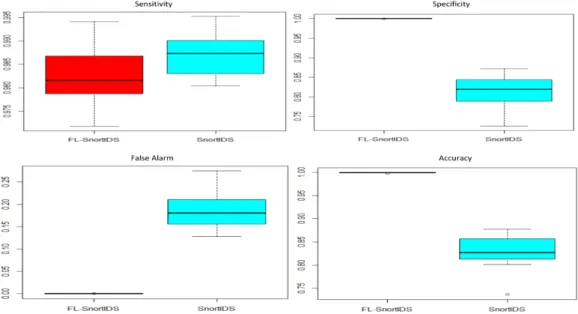
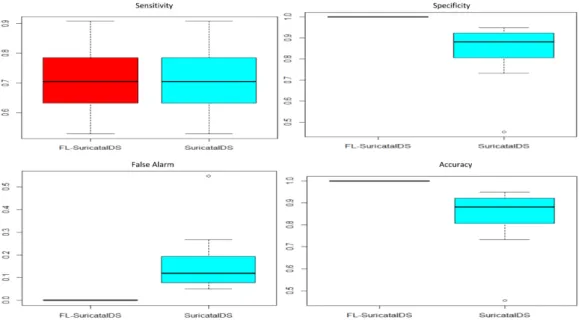
Cloud Computing (CC), as defined by national Institute of Standards and Technology (NIST), is a new technology model for enabling convenient, on-demand network access to a shared pool of configurable computing resources such as networks, servers, storage, applications, and services that can be rapidly provisioned and released with minimal management effort or service-provider interaction. CC is a fast growing field; yet, there are major concerns regarding the detection of security threats, which in turn have urged experts to explore solutions to improve its security performance through conventional approaches, such as, Intrusion Detection System (IDS). In the literature, there are two most successful current IDS tools that are used worldwide: Snort and Suricata; however, these tools are not flexible to the uncertainty of intrusions. The aim of this study is to explore novel approaches to uplift the CC security performance using Type-1 fuzzy logic (T1FL) technique with IDS when compared to IDS alone. All experiments in this thesis were performed within a virtual cloud that was built within an experimental environ-ment. By combining fuzzy logic technique (FL System) with IDSs, namely SnortIDS and SuricataIDS, SnortIDS and SuricataIDS for detection systems were used twice (with and without FL) to create four detection systems (FL-SnortIDS, FL-SuricataIDS, Snor-tIDS, and SuricataIDS) using Intrusion Detection Evaluation Dataset (namely ISCX). ISCX comprised two types of traffic (normal and threats); the latter was classified into four classes including Denial of Service, User-to-Root, Root-to-Local, and Probing. Sen-sitivity, specificity, accuracy, false alarms and detection rate were compared among the four detection systems. Then, Fuzzy Intrusion Detection System model was designed (namely FIDSCC) in CC based on the results of the aforementioned four detection sys-tems. The FIDSCC model comprised of two individual systems pre-and-post threat detecting systems (pre-TDS and post-TDS). The pre-TDS was designed based on the number of threats in the aforementioned classes to assess the detection rate (DR). Based on the output of this DR and false positives of the four detection systems, the post-TDS was designed in order to assess CC security performance. To assure the validity of the results, classifier algorithms (CAs) were introduced to each of the four detection systems and four threat classes for further comparison. The classifier algorithms were OneR, Naive Bayes, Decision Tree (DT), and K-nearest neighbour. The comparison was made based on specific measures including accuracy, incorrect classified instances, mean absolute error, false positive rate, precision, recall, and ROC area. The empirical results showed that FL-SnortIDS was superior to FL-SuricataIDS, SnortIDS, and Suri-cataIDS in terms of sensitivity. However, insignificant difference was found in specificity,
method. The results of these studies showed that FIDSCC model can provide a better alternative to detecting threats and reducing the false positive rates more than the other conventional approaches.
All praise is due to the Almighty God for the countless blessings He showered upon me throughout my journey in life, and for all the physical and mental strength. He be-stowed on me during the activities of preparing this thesis and conducting the associated research.
First and foremost, my deepest gratitude and thanks go to my principal supervisor Prof. Rober John, who guided me through every single step along the way for the last three years, and helped me become the person who I am today. Without his great support, advice and above all the unparalleled patience of Prof. John, this thesis would not have seen the light.
Abstract ii
Acknowledgements iv
Contents v
List of Figures ix
List of Tables xi
List of Abbreviations xiii
1 Introduction 1
1.1 Background . . . 1
1.2 Research Motivation and Hypothesis . . . 3
1.3 Aim and Objectives . . . 4
1.4 Research Question . . . 4
1.5 Research Contributions . . . 5
1.6 Academic Publications Produced . . . 6
1.7 Thesis Structure . . . 6
2 Literature Review 8 2.1 Background . . . 9
2.2 Fuzzy Logic . . . 11
2.2.1 Fuzzy Systems and Uncertainty . . . 11
2.2.2 Basic Concepts of Type-1 Fuzzy Sets . . . 14
2.2.2.1 Properties of Type-1 Fuzzy Sets . . . 15
2.2.2.2 Type-1 Fuzzy Set Operations . . . 17
2.2.3 Brief Review of Type-1 Fuzzy Logic Systems . . . 18
2.2.3.1 Fuzzifier . . . 19
2.2.3.2 Rule Base . . . 20
2.2.3.3 Inference Engine . . . 21
2.2.3.4 Defuzzifier . . . 21
2.3 Cloud Computing . . . 22
2.3.1 Decision Making in Cloud Computing . . . 24 v
2.3.2 Benefits and Challenges in Cloud Computing . . . 27
2.3.3 Deploying IDS/IPS into Cloud Computing . . . 29
2.3.4 Virtual Cloud Computing (vCloud) . . . 31
2.3.4.1 What is VMware vCloud? . . . 31
2.3.4.2 The Components of vCloud . . . 32
2.3.4.3 Why vCloud? . . . 32
2.4 Approaches for Evaluating Cloud Performance . . . 33
2.5 Related Work . . . 35
2.5.1 IDS Techniques in Cloud Computing . . . 36
2.5.2 IDS Based On Fuzzy Logic . . . 38
2.5.3 IDS Based on Data Mining . . . 40
2.5.4 Data Mining and Classification . . . 41
2.6 Summary . . . 42
3 Environment and Experimental Design 43 3.1 Experimental Lab Components . . . 43
3.1.1 The Information Security Centre of Excellence Dataset (ISCX) . . 48
3.1.2 Attack Classes for Evaluation of IDSs . . . 49
3.2 Intrusion Detection Systems (IDSs) . . . 50
3.2.1 IDS Fuzzy Classifiers . . . 50
3.2.1.1 Understanding Alerts of IDS Fuzzy Classifiers . . . 51
3.2.1.2 Alerts Classification of IDS Fuzzy Classifiers . . . 51
3.2.2 How IDS Fuzzy Classifier Works . . . 54
3.3 Experimental Approaches . . . 56
3.3.1 Methodology for The First Study . . . 56
3.3.2 Methodology for The Second Study . . . 58
3.3.3 Methodology for The Third Study . . . 60
3.4 Summary . . . 61
4 A Comparative Analysis for The Alerts of IDS Fuzzy Classifiers Ap-proaches within Cloud Computing 63 4.1 Experimental Results and Analysis . . . 64
4.1.1 Descriptive Statistics . . . 64
4.1.1.1 Intrusion Detection Systems . . . 64
4.1.1.2 IDS Fuzzy Classifiers . . . 66
4.1.2 Overall Approaches’ Descriptive Statistics . . . 69
4.2 Comparative Analysis . . . 71 4.2.1 SnortIDS vs FL-SnortIDS . . . 72 4.2.2 SuricataIDS vs FL-SuircataIDS . . . 73 4.2.3 SnortIDS vs SuircataIDS . . . 73 4.2.4 FL-SnortIDS vs FL-SuircataIDS . . . 74 4.3 Discussion . . . 75
4.3.1 Intrusion Detection Systems . . . 75
4.4 Summary . . . 78
5 A Comparative Analysis of Different Classification Techniques for Cloud Intrusion Detection Systems’ Alerts and Fuzzy Classifiers 81 5.1 Experimental Results and Analysis . . . 82
5.1.1 Snort Results (SnortIDS) . . . 82
5.1.2 Snort Fuzzy Logic Results (FL-SnortIDS) . . . 84
5.1.3 Suricata Results (SuricataIDS) . . . 86
5.1.4 Suricata Fuzzy Logic Results (FL-SuricataIDS) . . . 88
5.2 Discussion . . . 91
5.2.1 Classifier Algorithms vsM yCloud Systems’ Results . . . 91
5.2.2 Performance Metrics vs detection Systems’ Results . . . 94
5.3 Summary . . . 94
6 Security Performance Evaluation Using Type-1 Fuzzy Logic Approach (FIDSCC System) 96 6.1 How Does FIDSCC System Work within Cloud Computing . . . 96
6.2 Modeling FIDSCC System . . . 103
6.2.1 Features . . . 104
6.2.2 Data Analyser . . . 104
6.2.3 Configuration Parameters . . . 105
6.2.4 Pre-Processor . . . 106
6.2.5 Rules . . . 106
6.2.6 Fuzzy Inference Engine . . . 106
6.3 Comparative Analysis . . . 108
6.3.1 DoS Attacks within Detection Systems . . . 108
6.3.2 Probe Attacks within Detection Systems . . . 109
6.3.3 R2L Attacks within Detection Systems . . . 110
6.3.4 U2R Attacks within Detection Systems . . . 110
6.4 Experimental Results . . . 111
6.4.1 Rules . . . 111
6.4.2 FIDSCC Performance . . . 113
6.4.2.1 Membership Functions . . . 113
6.4.2.2 First System: IDS-Evaluation Through Number of Threats Detected . . . 114
6.4.2.3 Second System: Overall IDS-Evaluation withinM yCloud115 6.4.3 FIDSCC Output . . . 116 6.5 Discussion . . . 118 6.6 Summary . . . 120 7 Conclusion 121 7.1 Context . . . 121 7.2 Summary of Contributions . . . 124
Appendices 127
A Experimental Settings 127
A.0.1 Snort (SnortIDS) . . . 127
A.0.2 Suricata (SuricataIDS) . . . 129
A.1 Creating M yCloud . . . 131
A.1.1 vCloud Director: . . . 131
A.1.2 vApps in Organisation: . . . 131
A.1.3 IDS Systems Deployment: . . . 133
A.1.4 Network Pools Between Two ESXis: . . . 133
A.1.5 VMware vCenter Server: . . . 133
A.1.6 The Storage Profiles: . . . 134
A.1.7 vCloud Networking and Security appliance (vShield): . . . 135
A.2 Installation and Configuration ofM yCloud . . . 135
A.2.1 ISP Router . . . 135
A.2.2 Active Directory . . . 136
A.2.3 Service DNS . . . 137
A.2.4 vSphere ESXi 5.5 . . . 137
A.2.5 vCenter Server Appliance 5.5 . . . 137
A.2.6 vCloud Networking and Security appliance (vShield) . . . 138
A.2.7 vCloud Director Appliance 5.5 . . . 138
B The Meaning of IDS Systems’ Alerts 139
2.1 An example of the three types of FSs with view of the secondary MFs. . . 13
2.2 An example of a trapezoidal membership function and some of its properties 16 2.3 Examples of four T1 MFs. . . 17
2.4 Examples of fuzzy operations using two T1 FSs Aand B. . . 18
2.5 A type-1 fuzzy logic system. . . 19
2.6 Examples of the fuzzification of a crisp input. . . 20
2.7 How Cloud Computing Works . . . 23
2.8 Cloud Computing Models . . . 23
2.9 Public Cloud . . . 25
2.10 Private Cloud . . . 26
2.11 Hybrid Cloud . . . 26
3.1 Approaches of Designing Hypervisors [Nunez et al., 2011] . . . 45
3.2 vCloud Lab Environment . . . 46
3.3 A Log of SnortIDS System . . . 51
3.4 A Log of SuricataIDS System . . . 51
3.5 How FL-SnortIDS/FL-SuricataIDS Works within MyCloud . . . 55
4.1 IDS Systems’ Analysis onM yCloud . . . 64
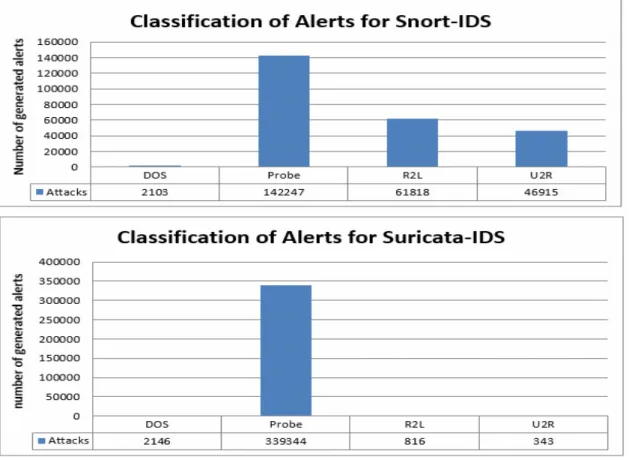
4.2 Classification of Alerts for IDS Systems on M yCloud . . . 65
4.3 Total Alerts’ Types for IDS Fuzzy Classifiers . . . 66
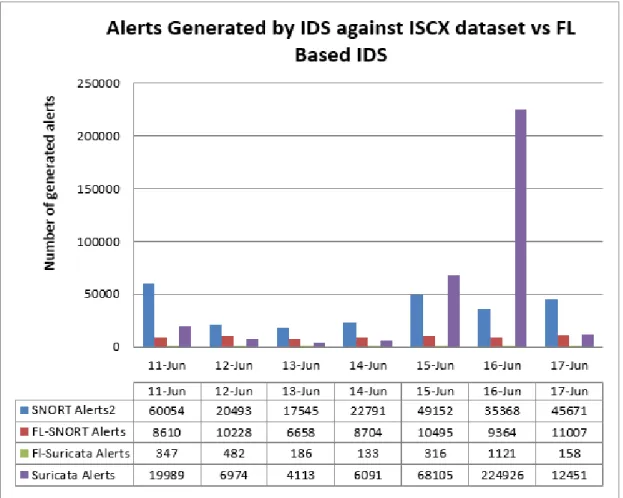
4.4 M yCloud Corrected Alerts Generated by IDS vs IDS Fuzzy Classifiers . . 68
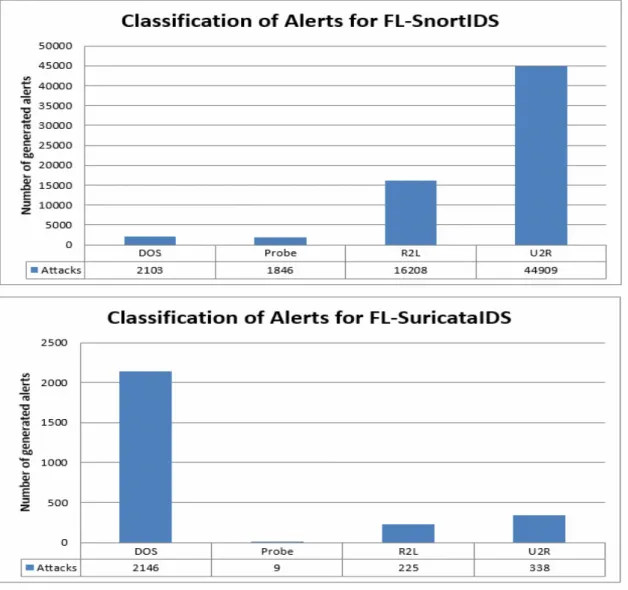
4.5 Classification of Alerts for IDS Fuzzy Classifiers withinM yCloud . . . 69
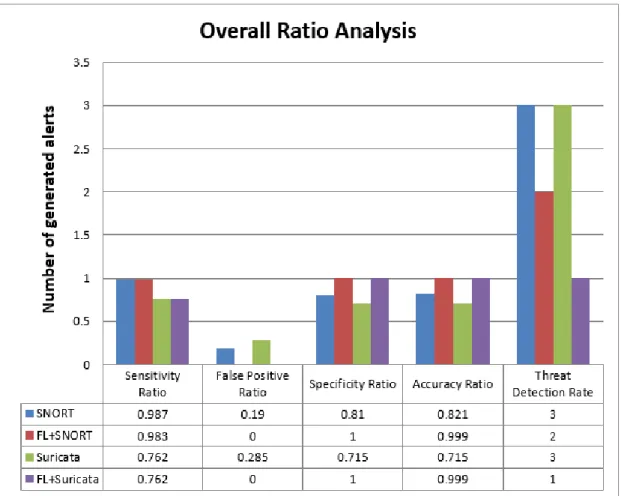
4.6 Overall Ratio Analysis on M yCloud . . . 71
4.7 SnortIDS vs FL-SnortIDS . . . 73
4.8 SuricataIDS vs FL-SuricataIDS . . . 74
4.9 SnortIDS vs SuricataIDS . . . 75
4.10 FL-SnortIDS vs FL-SuricataIDS . . . 76
4.11 Final Results for All Systems . . . 79
6.1 How Fuzzy IDS Reads IDSs’ Alerts . . . 97
6.2 How Fuzzy Classifier Generates Log Files for IDSs’ Systems . . . 98
6.3 Fuzzy Classifier Flowchart . . . 101
6.4 How Fuzzy IDS Removes Unwanted Alerts . . . 102
6.5 Simulation Modeling FIDSCC System withinM yCloud . . . 103
6.6 The First System’s Membership Functions . . . 105
6.7 The Second System’s Membership Functions . . . 105
6.8 The First System’s Rules . . . 107
6.9 The Second System’s Rules . . . 107
6.10 Firing Strength for FIDSCC System . . . 112
6.11 Detection Rate forM yCloudThrough All Approaches . . . 118
A.1 Snort and Suricata Alert Logs . . . 127
A.2 vCloud Management Tool . . . 132
A.3 vApp in Organisation within Cloud Environment . . . 132
A.4 The Lab Deployment inM yCloud . . . 133
A.5 vCloud Network Pools . . . 134
A.6 vCenter Server Environment . . . 134
A.7 vCenter Storage Profile . . . 135
A.8 VMware vShield . . . 136
A.9 The First Command inregedit . . . 136
2.1 Cloud Computing Options . . . 27
2.2 Benefits and Challenges in Cloud Computing . . . 28
3.1 Environment Lab Specifications . . . 44
3.2 Virtual Cloud Login Credentials . . . 47
3.3 Corrected Alerts Classified for SnortIDS System . . . 52
3.4 Corrected Alerts Classified for SuricataIDS System . . . 53
3.5 Corrected Alerts Classified for IDS Systems Including Unwanted Alerts . 54 4.1 Overall Descriptive Statistic for IDS Systems within M yCloud . . . 67
4.2 Overall Descriptive Statistic for IDS Fuzzy Classifiers within M yCloud. . 70
4.3 Overall Statistical Analysis for All Approaches within M yCloud . . . 72
4.4 Mann Whitney Test Result (Based on 95% Confidence Level) . . . 78
5.1 Performance Comparison of Different Classifiers Based on Different Met-rics with 10 Cross Validation for SnortIDS System . . . 82
5.2 Optimising Na¨ıve Bayes Classifier . . . 83
5.3 Results and Ranking for SnortIDS Dataset . . . 84
5.4 Performance Comparison of Different Classifiers Based on Different Met-rics with 10 Cross Validation for FL-SnortIDS System . . . 85
5.5 Optimising Na¨ıve Bayes Classifier with Different Number of Fold Cross Validation for FL-SnortIDS System . . . 85
5.6 Results and Ranking for FL-SnortIDS Dataset . . . 87
5.7 Performance Comparison of Different Classifiers Based on Different Met-rics with 10 Cross Validation for SuricataIDS System . . . 87
5.8 Optimising Na¨ıve Bayes Classifier with Different Number of Fold Cross Validation for SuricataIDS System . . . 88
5.9 Results and Ranking for SuricataIDS Dataset . . . 89
5.10 Performance Comparison of Different Classifiers Based on Different Met-rics with 10 Cross Validation for FL-SuricataIDS System . . . 90
5.11 Optimising Na¨ıve Bayes Classifier with Different Number of Fold Cross Validation for FL-SuricataIDS System . . . 90
5.12 Results and Ranking for FL-SuricataIDS Dataset . . . 92
5.13 Classifiers’ Algorithms vs detection systems’ Results . . . 93
5.14 Performance Metrics vs Detection Systems’ Results . . . 95
6.1 An Example of Analysing The IDS Systems’ Logs . . . 99
6.2 ISCX Dataset Attack Classes . . . 100
6.3 IDS Systems’ Outputs . . . 101
6.4 First System: M yCloud Detection Rate . . . 103
6.5 Second System: EvaluatingM yCloud Performance . . . 104
6.6 DoS Attacks withinM yCloud . . . 108
6.7 Sample Proportion Test Result (DoS) . . . 108
6.8 Probe Attacks withinM yCloud . . . 109
6.9 Sample Proportion Test Result (Probe) . . . 109
6.10 R2L Attacks withinM yCloud. . . 110
6.11 Sample Proportion Test Result (R2L) . . . 110
6.12 U2R Attacks withinM yCloud . . . 110
6.13 Sample Proportion Test Result (U2R) . . . 111
6.14 First System Inputs: IDS-Evaluation Through Number of Threats Detected114 6.15 Second System Outputs: IDS-Evaluation Through Number of Threats Detected . . . 115
6.16 True and False Positives withinM yCloud . . . 116
6.17 First System Outputs: IDS-Evaluation Through Number of Threats De-tected . . . 117
6.18 Second System Outputs: Overall IDS-Evaluation withinM yCloud . . . . 117
6.19 Sample Proportion Test Result (Overall) which represents Method 1 is better than Method 2 . . . 119
6.20 False Positive Ratio forM yCloud Through All Approaches . . . 119
7.1 Final Comparisons . . . 121
Symbol Meaning
AD Anomaly Detection CA Classifier Algorithm CC Cloud Computing DLO DataLocation Options DoS Denial of Service
FIDSCC Fuzzy IntrusionDetection System in Cloud Computing FL Fuzzy Logic
HIDS HostsBased onIntrusionDetection System IaaS Infrastructure as a Service
IDL IntrusionDetectorLearning IDS IntrusionDetectionSystem ILO Infrastructure Location Options IPS IntrusionPreventionSystem
NIDS NetworksBased onIntrusionDetectionSystem PaaS Platformas a Service
Probe Probing: Surveillance and Probing forInformation
R2L Remote-to-Local: Unauthorised Access from aRemote Machine SaaS Software as a Service
SD Signature Detection T1FL Type-1Fuzzy Logic T2FL Type-2Fuzzy Logic
U2R User-to-Root: UnauthorizedAccess toGainLocalRoot
family for their endless love, support and encouragement
Introduction
1.1
Background
The use of the Internet has been increasing day by day and Internet traffic is exponen-tially increasing. The service providers (SPs) such as web SPs, email SPs, cloud SPs have to deal with millions of users per second; yet the level of threats to these services is also very high. To deal with this much number of users is a big challenge but, detection and prevention of such kinds of threats is even more challenging and also vital due to the fact that those threats might cause a severe loss to the SPs in terms of privacy leakage or unavailability of the services to the users. Therefore, IT industry attempts to provide very safe services to the users. For example, since the technology of cloud computing (CC) has been become the most demanding service to consumers, IT indus-try incorporated the cloud security issues by providing the technology of CC alongside Intrusion Detections Systems (IDS) or Intrusion Prevention Systems (IPS) [Mell and Grance, 2009].
CC has been described by Iyoub et al. (2013) as a commodity where it is similar to electricity once connected to the devices [Iyoob et al., 2013]. This is due to the fact that CC is not only a specific technology; but also it is a step in making IT a commodity which is enabled by technological advances. This description shows the value of CC from the following facts;
1. There is a huge prospect for savings in the CC market as it has recently grown to about a billion U.S. dollars a year [Marston et al., 2011, Nair, 2014].
2. The usage of data in CC is often automatically and constantly collected in order to make better decisions [Leavitt, 2009, Nair, 2014].
3. The migration to CC technology has been so active and fast[Jacobson, 2010, Nair, 2014].
As a consequence, there is no doubt that the use of CC has a huge impact on business strategy towards information sharing but some issues regarding its detection perfor-mance still remained such as false alarms. Thus, such issues have urged experts to discover solutions in order to improve security performance. One of these solutions is IDS; yet, such a technique is no longer sufficient to specify and assign the threats within CC accurately; and therefore, Nair [2014] has recommended to incorporate these techniques with some intelligent approaches such as embedded programming approach, agent based approach, software engineering approach, artificial intelligence system and soft computing (SC)1. In this research, Fuzzy Logic (FL) has been used as it is flexible to the uncertainties of intrusions. In this research, Fuzzy Logic (FL) has been used as a SC technique alone.
FL is an effective approach to tackle real-life problems and vagueness in human thinking with the uncertainty in real life [Hosmer, 1993, Zadeh, 2008, 1984, Zimmermann, 1987]. This thesis explored new novel approaches that may uplift CC security performance using Type-1 fuzzy logic (T1FL) technique with IDS when compared to IDS alone. This is because of the fact that T1FL provides a better alternative to detecting threats and reducing false positive ratios than other conventional approaches. All experiments in this thesis were performed within a virtual cloud that was built within an experimen-tal environment. By combining fuzzy logic technique with IDSs, namely SnortIDS and SuricataIDS, SnortIDS and SuricataIDS for detection systems were used twice (with and without FL) to create four detection systems (FL-SnortIDS, FL-SuricataIDS, SnortIDS, and SuricataIDS) using Intrusion Detection Evaluation Dataset (namely ISCX)2. ISCX comprised two types of traffic (normal and threats); the latter was classified into four classes including Denial of Service, User-to-Root, Root-to-Local, and Probing. Sensitiv-ity, specificSensitiv-ity, accuracy, false alarms and detection rate were compared among the four detection systems. Then, Fuzzy Intrusion Detection System model was designed (namely FIDSCC) in CC based on the results of the aforementioned four detection systems. The
1Soft computing techniques are Fuzzy Logic (FL), Neural Network (NN), and Genetic Algorithms
(GAs).
2This dataset is found under the website of university of New Brunswick
FIDSCC model comprised two individual systems pre-and-post threat detecting systems (pre-TDS and post-TDS). The pre-TDS was designed based on the number of threats in the aforementioned threat classes to assess the detection rate (DR). Based on the output of this DR and the false positive of the four detection systems, the post-TDS was designed in order to assess CC security performance. To assure the validity of the results, classifier algorithms (CAs) were introduced to each of the four detection sys-tems and the four threat classes for further comparison. The classifier algorithms were OneR, Naive Bayes, Decision Tree (DT), and K-nearest neighbour. The comparison was made based on specific measures including accuracy, incorrect classified instances, mean absolute error, false positive rate, precision, recall, and ROC area.
1.2
Research Motivation and Hypothesis
The motivation behind this study was the fact that there has been a lack of extensive research in the field of cloud security. For example, based on the literature review, the research in the area of the techniques of cloud security such as IDS/IPS, has not tackled the uncertainties in CC. This is because of the following reasons;
1. majority of the scholars in the industry and publications focused on the short descriptive and practical guidance presented by the perspectives of decision-making [Foster et al., 2009, Jacobson, 2010, Menasc´e and Ngo, 2009, Truong, 2014, Yinglei and Lei, 2011].
2. majority of the studies have been directed towards analysing if the IDS/IPS models should be adopted by the organisation or not, and if yes, then which model would be viable for the organisation?.
3. majority of studies have been focused on the following areas;
(a) Cloud security definition [Iyoob et al., 2013, Lindner et al., 2010, Paulitsch, 2009].
(b) analysing and presenting the challenges and benefits of business solutions in CC [Demirkan et al., 2010, Durowoju et al., 2011, Li et al., 2012a, Singh, 2010, Tsao et al., 2010, YiPeng, 2011].
(c) the adoption of IDS/IPS models into CC [Casey G., 2012, Wu et al., 2013]. (d) cloud environment’s application and architecture [Ferguson and Hadar, 2011,
Consequently, there is a need to focus on cloud security concerns regarding its detection performance. In this thesis, there are three main aspects: CC, IDS, and FL. In order to connect each aspect to others, all experiments were performed within a virtual cloud that was built in an experimental environment. Then we used the combination of FL and IDS as detection systems in order to maximise the accuracy, specificity, detection rate and minimise the sensitivity and false alarms ratios. To assure the validity of the results, some classifier algorithms (CAs), such as Decision Tree (DT), Naive Bayes (NB), OneR and K-Nearest Neighbour (KNN) as stated in [Chauhan et al., 2013], were introduced to each of the four detection systems and the four threat classes: DoS, U2R, R2L, and Probe for further comparison. Therefore, we hypothesised that a better alternative in detecting threats and reducing false positive ratios may be provided by a model of Fuzzy IDS within CC more than conventional approaches.
1.3
Aim and Objectives
The main aim is to explore new novel approaches that can uplift the CC security per-formance using Type-1 fuzzy logic with IDS when compared to IDS alone. In order to achieve that target, the objectives of this study including the following:
1. to propose a Fuzzy-Logic engine based on IDSs (FL-SnortIDS and FL-SuricataIDS) in order to define the uncertainties of intrusions in CC and evaluate the security performance.
2. to compare the four detection systems (SnortIDS, SuricataIDS, FL-SnortIDS, and FL-SuricataIDS) and investigate which of these four detection systems outperforms others.
3. to assure the validity of the results through four classifier algorithms (CAs) so-called OneR, NB, DT, and KNN.
4. to compare these four CAs to each of the four detection systems and the four threat classes (DoS,U2l, R2L and Probe).
1.4
Research Question
The research question for this study was that ”does T1FL system uplift CC security performance compared to the IDS alone?”.
1. Accuracy: The numbers of threats detected
2. False Alarms Ratio: The false positives and false negatives ratio per each de-tection system.
3. Sensitivity Ratio: The true positives and false negatives ratio per each detection system.
4. Specificity Ratio: The false positives and true negatives ratio per each detection system.
5. Threat Detection Rate: The threat categories for a scanning attack of each detection systems
1.5
Research Contributions
This thesis provides the following three contributions;
1. A Comparative Analysis for The Alerts of IDS Fuzzy Classifiers Ap-proaches within Cloud Computing. This contribution was is reported in chapter 4 in order to enhance the security that IDS provides using ISCX dataset. Two IDSs: SnortIDS and SuricataIDS have been developed in which they differ in their detection capabilities, performance and accuracy. SnortIDS and SuricataIDS detection systems were used twice (with/without FL) to create four detection sys-tems (FL-SnortIDS, FL-SuricataIDS, SnortIDS, and SuricataIDS) using Intrusion Detection Evaluation Dataset (namely ISCX).
2. A Comparative Analysis of Different ClassificationTechniques for Cloud Intrusion Detection Systems’ Alerts and Fuzzy Classifiers. This contribu-tion is reported in chapter 5, WEKA was used as a data miner to analyse the data of each detection system from chapter 4. In chapter 5, the most common clas-sification algorithms are utilised: Decision Tree (DT), Naive Bayes, OneR, and K-Nearest Neighbour (K-NN). These algorithms were chosen after investigating the most effective classification algorithms that are widely used. The aim of this study was to present a comparative study for the performance of each detection system: SnortIDS, SuricataIDS, FL-SnortIDS, and FL-SuricataIDS in order to test which classifier algorithm is the best and presents significant results.
3. Security Performance Evaluation Using Type-1 Fuzzy Logic Approach (FIDSCC System). This contribution was conducted in chapter 6 that produces
a model using fuzzy inference engine based IDS to evaluate the security perfor-mance by tracing intruders on CC. This model called FIDSCC system. There were two fuzzy inference systems were created: first is to evaluate the attack classes of ISCX within CC and another is to assess security performance. Certain tests have been made for the comparison purposes amongst IDSs’ systems and Fuzzy classifiers. These were satisfactory tests where the combining results of detection performances of all type of threats based on detection rate and false positive ratio showed that fuzzy classifiers do better than IDSs’ systems within CC.
1.6
Academic Publications Produced
The following publications were produced as a direct result of the work undertaken during the course of conducting this research:
• Alqahtani, S.M., Balushi, M.A., John, R., 2014a. An intelligent intrusion de-tection system for cloud computing (SIDSCC), in: Computational Science and Computational Intelligence (CSCI), 2014 International Conference on, IEEE. pp. 135-141.
• Alqahtani, S.M., Balushi, M.A., John, R., 2014b. An intelligent intrusion pre-vention system for cloud computing (SIPSCC), in: Computational Science and Computational Intelligence (CSCI), 2014 International Conference on, IEEE. pp. 152-158.
• Saeed M. Alqahtani and Robert John, A Comparative Study of Different Fuzzy Classifiers for Cloud Intrusion Detection Systems’ Alerts. published in The 2016 IEEE Symposium Series on Computational Intelligence (IEEE SSCI 2016).
• Saeed M. Alqahtani and Robert John, A Comparative Analysis of Different Clas-sification Techniques for Cloud Intrusion Detection Systems’ Alerts and Fuzzy Classifiers. accepted by Computing Conference 2017 (IEEE SAI2017).
1.7
Thesis Structure
The first chapter introduces the thesis topic and relevant concepts. It also provides a list of the aims of the thesis, as well as the scientific contributions and papers published dur-ing the study. The literature review in the second chapter was presented, highlightdur-ing
the recent developments in IDSs’ systems and fuzzy logic based on IDS systems in CC. The third chapter describes the research problem and all the experimental design ma-terials and proposed methods. In the fourth chapter, a comparative analysis of ranking IDS based on fuzzy classifiers’ approaches was conducted to analytically compare the functionality, working and the capability of the four detection systems (FL-SnortIDS, FL-SuricataIDS, SnortIDS, and SuricataIDS in order to boost the security performance. Then, a comparative study was conducted in the fifth chapter against the results of aforementioned detection systems through classifier algorithms (CAs) that were intro-duced to each of the four detection systems and the four threat classes (DoS, U2L, R2L, Probe) for further comparison. In the sixth chapter, FIDSCC model was designed in order to compare the detection rate and false positive ratio through the results of the aforementioned four detection systems. Finally, the last chapter presents a summary of the work undertaken in this research along with recommendations for future work.
Literature Review
In this modern age, digital communication is no more a big task and thus every sin-gle internet user can have an access to on-line information pool or can interact with anyone without worrying about the distance between them. According to the statistics reported in [Stats, 2016], the total estimated internet users in the year of 2016 are almost 3,424,971,237, which is 46.1% of the world population. Thus, it cloud be concluded that internet has now become a part of modern age human.
Computer networks are attacks prone, unreliable and unsafe, which means that the users may experience malicious activities and lose their privacy, personal data or any other important information that is available on-line, depending on the nature of attacks. Although, domestic users may ignore this insecurity issue, yet it would be a vital problem for most of the people who have privacy issues or who may not be able to recover from any kind of personal data loss. Similarly, corporate offices, banks, hospitals, law enforcement organisations, emails services providers and millions of other organisations take extreme care of their privacy and availability of their services on-line [Talwar, 2015].
This chapter provides an overview of intrusion detection system, fuzzy logic, cloud com-puting and its security techniques such as anomaly detection and signature detection. This chapter also covers some approaches for evaluating cloud security performance, together with related scientific literature review. Moreover, related work on IDS tech-niques, IDS based fuzzy logic, IDS based on data mining , and data mining and classi-fication are given.
2.1
Background
Cyber-attacks have become very crucial and it is now considered that the cyber war has now over taken the nuclear war in this modern age [Shackelford, 2009]. Thus, many international rules have been created by the law enforcement agencies including USA’s [Burkadze, 2016, Graham, 2010, O. A. Hathaway and Spiegel, 2012]. It has also attracted the attentions of many researchers and a great deal of work has been done in literature to protect the systems from cyber-attacks such as, inventory of authorised and unau-thorised software and devices, to make configurations of hardware and software secure, to install intelligent firewalls, to install anti-malware software, to develop intrusion de-tection systems and to develop malware defensive systems. The most followed strategy to prevent such kind of cyber-attacks is the development of intrusion detection system (IDS) [Google Patents, 2009].
IDS systems are basically hardware or software systems that are deployed along with the main systems to monitor all the digital activities and the incoming as well as outgoing network traffic. These systems are made intelligent enough to detect the malware or suspicious activities by monitoring the whole system; and therefore, they produce alarms or reports against such activities. IDS system acts as a firewall and keeps the main system safe from the malwares. Hence, it is deployed along with almost every critical system that is exposed to threats, making the organisation reliable and trustworthy. The capability of IDS systems to detect the suspicious activities depends on how they have been developed. Stronger the IDS system would be, safer the main system would be, leading the organisation to win the trust of its clients. Moreover, IDS systems are consistently upgraded due to the fact that the cyber-attacks are becoming crucial and stronger day by day. A great deal of work has been done in literature in making intelligent and strong IDS systems. For example, Reputation Services have been added in the IDS systems. These services gather information about the suspicious protocols, IP addresses, domains and finally make a decision that either the traffic is malicious or not [Hwang et al., 2009]. Transforming the wired IDS systems to wireless systems has also increased the safety level of the critical systems [Brutch and Ko, 2013]. With the fast growing HTTPS traffic, the SSL traffic inspection feature has also been added in the IDS systems to stay up to date [Augustin and Bal´aˇz, 2011].
There is a big challenge to detect and prevent attacks with a huge number of users. This is due to the fact that the threats might cause a severe loss to the service providers in terms of privacy leakage or unavailability of the services to the users. To incorporate this
issue, several Intrusion Detections Systems (IDSs) such as Snort and Suricata have been developed that differ in their detection capabilities, performance and accuracy along in order to enhances the performance and accuracy of these developed IDSs in terms of increased accuracy, specificity, sensitivity and reduced false alarms. Other different tools are also available that performs Intrusion Detection. For instance, Security Onion system has the capability to monitor vLANs and virtualised networks but it cannot be used as an intrusion prevention system [Burks, 2012]. OSSEC system can generate real-time alarms and has the capability of monitoring the files integrity [Bray et al., 2009]. OpenWIPS-NG system is dependent on network interfaces, devices, servers and other infrastructures [Bezborodov et al., 2016]. BRO system is an alternative to Security Onion but has more defined rules to detect the malicious activities [Paxson et al., 2013]. Among all IDS systems, Snort and Suricata are considered to be the most efficient tool that performs real-time protection, real-time traffic analysis, protocol analysis, content matching, packets logging on IP networks and possesses many kinds of attacks detection capability [Roesch et al., 2009].
Although there are a number of advantages of intrusion prevention systems (IPS), but there is a need for the leak of alarm, the false rate of alarm and delivery in real time [Xin and Yun-jie, 2010]. The IPS classification system depends on the platform of technology and detection system. The operation platform has the general classification of IPS into Network based IPS (NIPS) and Host based IPS (HIPS). Salah et al. [2010] claimed that the NIPS helps the detection of traffic by use of barriers and also deals with issues in detection although there is a relativity of HIPS on the installation of the network hosts and protection against the malwares [Salah et al., 2010].
The role of IDS and IPS is to detect and prevent the network topology against ab-normal activities. IDS can detect abab-normal activities, which are inadequate, erroneous or irregular in a network, and report them to the administrator. In addition to that, IDS also can work in a way that detects an unauthorised intrusion if a network or a server is experienced to do so. IPS is an extension of IDS system where IPS can also block connections or drop abnormal packets if they consist of unauthorised data. The categories of IDS/IPS can be classified in two levels; Network-Based Intrusion Detec-tion/Prevention System (NIDS/NIPS) and Host-Based Intrusion/Prevention Detection System (HIDS/HIPS) [Alqahtani et al., 2014a,b].
NIDS verifies from the network traffic and then observing multiple hosts to identify intrusions. Also, NIDS works on sensors where they capture and analyse each packet of the network traffic and then identify abnormal content. HIDS is circulated in host
machines or a server where its role is to analyse data and identify unusual behaviour. Also, HIDS works as a machine that compares the usual profile of the host with the captured activities to identify potential anomalies [Alqahtani et al., 2014a,b]. NIPS is a system that observes the whole network traffic in order to capture the malicious activities. HIPS is a system that monitors the installed software package of a single host. There are others levels such as NBA1 and WIPS2 but they can be considered under the main categories of IPS [Alqahtani et al., 2014a] and [Alqahtani et al., 2014b].
2.2
Fuzzy Logic
2.2.1 Fuzzy Systems and Uncertainty
in 1965, fuzzy set theory was first introduced by Zadeh [1965]. The field of FSs has evolved over the last 50 years and FSs have been accepted as an adequate methodology for developing systems that are able to deliver adequate performance in the face of uncertainty and imprecision [Feng, 2006, Hagras and Wagner, 2012, Lee, 1990, Sugeno, 1985]. Hence, FLSs have been successfully implemented in many real world applications and are used in many areas. In addition, FS theory provides a simple and efficient method of designing FLSs that is close to human thinking and perception [Zadeh, 1994]. In particular, fuzzy logic control (FLC), as one of the earliest applications of FLSs, has become one of the most successful applications. The first FLC was developed in 1975 by Mamdani and Assilian to control a steam engine in a laboratory [Mamdani and Assilian, 1975]. The first industrial application of fuzzy logic was developed in 1976 by Blue Circle Cement and SIRA in Denmark for a cement kiln controller that went into operation in 1982 [Holmblad, 1982]. In 1987, the Sendai subway system in Japan operated an automatic train controller based on fuzzy logic systems. Since then, FLSs have been applied with great success to many applications. Recently, FLSs have been used in many real-world applications used in people’s daily lives such as washing machines, air conditioners, video cameras, medical diagnosis systems, car braking systems, etc. [Wang, 1999],[Lee, 1990],[Karray and De Silva, 2004].
FLSs are widely accepted for their ability to model and handle uncertainty. Several efforts have been made to define the uncertainties in FLSs and their underlying sets. A
1
NBA is a Network Behaviour Analysis system that tests the flow of network traffic and then detects and prevents the malicious traffic
2
WIPS is a Wireless Intrusion Prevention System that monitors and analyses the abnormal traffic in wireless networks
general discussion about uncertainty was presented by Klir and Wierman [1999] showing three types of uncertainty: fuzziness, strife and non-specificity. Fuzziness (vagueness) results from the imprecise boundaries of FSs [Mendel, 2001]. Non-specificity (impre-cision) is linked to information-based imprecision. Strife (discord) expresses conflicts among the various sets of alternatives [Mendel, 2001].
The T1 FLS is the most common and widely used FLS. T1 FLSs are based on T1 FSs and have been successfully applied in many applications, such as control systems (especially for the control of complex non-linear systems that are difficult to model analytically [Zadeh, 1973],[King and Mamdani, 1977]), decision making, classification problems, system modelling and others [Ross, 2009]. However, it has been shown that there are limitations in the ability of T1 FSs to directly model and minimise the effects of uncertainty [Hagras, 2004], [Hagras, 2007], [Mendel, 2001]. This is because T1 MFs are precise, as stated by Mendel [2001] and their membership grade is a crisp value (see Figure 2.1(a)).
Recently, a significant increase in research has been devoted to more complex forms of fuzzy logic such as IT2 FLSs and, more recently, GT2 FLSs. This advancement is due to the realisation that T1 FSs can only handle a limited range of uncertainty whereas T2 FSs allow for better modelling of uncertainty as they encompass an Footprint of uncertainty (FOU), which, associated with their third dimension, gives more degrees of freedom to the use of T2 FSs in comparison to T1 FSs (i.e., T2 FSs are described by MFs that are characterized by more parameters than are MFs for T1 FSs [Mendel, 2007a]).
In 1975, T2 FSs was introduced by Zadeh as an extension of the concept of T1 FSs [Zadeh, 1975], characterised by MFs that are themselves fuzzy for which the membership degrees are expressed as FSs on [0,1], have been widely accepted as more capable of modelling higher orders of uncertainty than T1 FSs [John and Coupland, 2007],[John, 1998, Mendel, 2007a,b,c, Wu and Mendel, 2009]. Mendel Mendel [2001] argued that T1 FSs are inadequate to model many types of uncertainty that can be present in an FLS, whereas T2 FSs are able to handle them including the three types of uncertainty : fuzziness, strife, and non-specificity. IT2 FSs Mendel [2001] are a special case of GT2 FSs and currently the most widely used due to their great reduction in computational cost. It has been shown in the literature many types of FSs such as interval-valued FSs, gray set, intuitionistic FSs, etc. [Sebastian and John, 2016],[Yang et al., 2014]. Bustince et al. [2016] presents more details about the definitions and the relationships between different FSs.
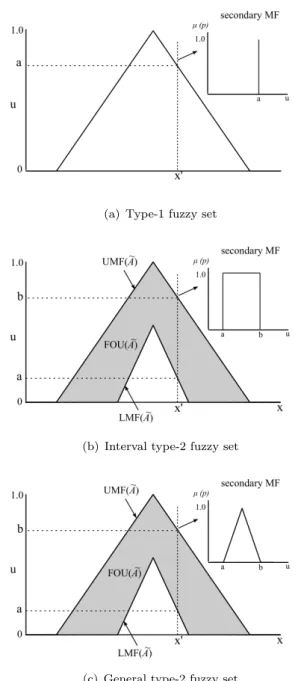
(a) Type-1 fuzzy set
(b) Interval type-2 fuzzy set
(c) General type-2 fuzzy set
Figure 2.1: An example of the three types of FSs with view of the secondary MFs
with same input x0 (a) type-1 fuzzy set, (b) interval type-2 fuzzy set and (c) general type-2 fuzzy set.
Figure 2.1 shows the three different types of fuzzy sets. A T1 FS shown in Figure 2.1(a), an IT2 FS shown in Figure 2.1(b) and a GT2 FS shown in Figure 2.1(c). These figures also show the secondary MFs (third dimension) of the three fuzzy sets using the same inputx=x0. It is important to consider the uncertainty models provided by these three types of FSs. In the T1 FS, the degrees of membership are specified as crisp numbers taking values within the interval [0,1]. In the GT2 FS, the degrees of membership are
themselves fuzzy and each is specified as a T1 FS (a secondary membership function). In a case when the secondary MF is equal to 1, then GT2 FS will reduce to an IT2 FS. The T1 FS is depicted in Figure 2.1(a), showing the value of the primary domain (membership) atx=x0 that takes only one value,a, at which the secondary grade equals 1. So, in the case of the T1 FS, there is no uncertainty associated with the primary membership value at each x value [Mendel, 2001]. For an IT2 FS (as shown in Figure 2.1(b)), the primary domain (membership) at x = x0 takes values within the interval [a,b] and each point in this interval has a secondary membership equal to 1. Hence, an IT2 FS contains a maximum amount of uncertainty that is equally distributed over the interval [a,b] [Mendel et al., 2014]. For a GT2 FS (as shown in Figure 2.1(c)), the primary (domain) membership at x=x0 also takes values within the interval [a,b], but is different from the IT2 FS since each point in this interval has a different secondary membership. Overall, it can be observed that the uncertainty that is associated with a GT2 FS is located between the uncertainty of a T1 FS and an IT2 FS [Mendel et al., 2014].
2.2.2 Basic Concepts of Type-1 Fuzzy Sets
A fuzzy set was defined originally by Zadeh [1965] as an extension of a (classical) crisp set. In crisp sets, the membership of elements is a binary value, which allows an element to either belong (full membership) or not belong to the set (no membership at all). In contrast, FSs permit partial membership so that an element may partially belong to a set. In a crisp set, the membership or non-membership of an elementx in the crisp set
Ais described by the membership function (MF) (also called characteristic function)µA
of A, where [Mendel, 2001],[Zimmermann, 2011],[Klir and Yuan, 1995]
µA(x) = (
1, if x∈A
0, if x /∈A (2.1)
Fuzzy set theory extends this concept by defining partial memberships, which can take values in the interval [0,1]. In a T1 FS (see Figure 2.1(a)) also called simply a FS,A is defined on a universe of discourseX and the MF forAisµA: X →[0,1] [Mendel, 2001]. For each element in the set,x∈X, the value ofµA(x) is the degree of membership of x
in pairs of x and the value of its MF,µA(x) as [Mendel, 2001]:
A={(x, µA(x))| ∀x∈X} (2.2)
If the fuzzy setAhas a continuous universe of discourseX, it can be written as [Zadeh, 1965],
A= Z
X
µA(x)/x, (2.3)
where the integral sign denotes union, and the division sign represents association (the collection of all points x ∈ X with associated MF µA(x)). If the fuzzy set A has a
discrete universe of discourse X, it can be written as [Zadeh, 1965],
A=X
X
µA(x)/x, (2.4)
where the summation sign denotes the set-theoretic operation of union and the division (slash) sign represents association (the collection of all points x ∈ X with associated MFµA(x)).
2.2.2.1 Properties of Type-1 Fuzzy Sets
To describe T1 FSs more specifically, we will define some of their properties [Zadeh, 1975],[Jang et al., 1997],[Klir, 2005].
The ‘support’ of a T1 FSAdefined on X is a crisp set that contains all the elements of
X (x∈X) that have non-zero membership grades inA (i.e., µA(x)>0) and is defined
as:
support(A) ={x∈X |µA(x)>0} (2.5)
A T1 FS that has a single point inXas the support withµA(x) = 1 is called a ‘singleton’ T1 fuzzy set (see Figure 2.3(a)).
Figure 2.2: An example of a trapezoidal membership function and some of its prop-erties
core(A) ={x∈X |µA(x) = 1} (2.6)
The ‘height’ of T1 FS Ais the largest membership value, and it is defined as follows:
height(A) = suppx∈X(µA(x)) (2.7)
A fuzzy set A is called ‘normal’ when height(A) = 1 and it is called ‘subnormal’ when height(A) ¡ 1.
One of the most important concepts of fuzzy sets is the concept of anα-cut. Theα-cut of an FSA is the ‘crisp’ set of all elements that have a membership value greater than or equal to α. A T1 FS A is defined on X and α is a number in [0,1], an α-cut, Aα is
defined by [Klir, 2005]:
Aα={x∈X|µA(x)≥α} (2.8)
These properties are illustrated by the trapezoidal membership functionAin Figure 2.2 The membership functions commonly used in practice are singleton, triangular, trape-zoidal, Gaussian, and bell-shaped [Mendel, 2001]. Generally, MFs can either be chosen by experts (users) or they can be created using optimisation methods [Jang, 1992],[Wang and Mendel, 1992b],[Wang and Mendel, 1992a]. Examples of singleton, triangle, trape-zoidal and Gaussian MFs are depicted in Figure 2.3.
(a) Singleton MF (b) Triangular MF (c) Trapezoidal MF
(d) Gaussian MF
Figure 2.3: Examples of four T1 MFs (a) Singleton MF, (b) triangular MF, (c)
trapezoidal MF and (d) Gaussian MF.
2.2.2.2 Type-1 Fuzzy Set Operations
Corresponding to the crisp set operations of union, intersection and complement, fuzzy sets have the same operations and are called Zadeh’s operations as they were initially defined in Zadeh’s paper [Zadeh, 1965].
Assume T1 FSsA andB are two subsets ofX and are defined by their MFs µA(x) and µB(x). The union of Aand B is defined byµA∪B(x):
µA∪B(x) = max[µA(x), µB(x)], ∀x∈X (2.9)
The intersection ofA and B is defined by µA∩B(x):
µA∩B(x) = min[µA(x), µB(x)], ∀x∈X (2.10)
The product of Aand B is defined byµA∗B(x):
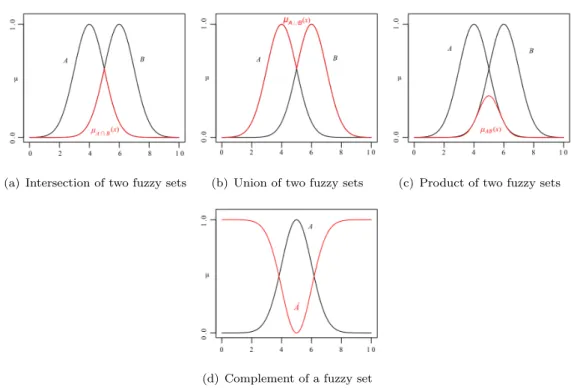
(a) Intersection of two fuzzy sets (b) Union of two fuzzy sets (c) Product of two fuzzy sets
(d) Complement of a fuzzy set
Figure 2.4: Examples of fuzzy operations using two T1 FSsAandB. (a) Intersection
of two FSs, (b) union of two FSs,(c) product of two FSs and (d) complement of an FS.
The complement of Ais defined by µA0(x):
µA0(x) = 1−µA(x), ∀x∈X (2.12)
Thus the intersection, product and union operations are used to combine T1 FSs. They are equivalent to the operators ‘AND’ and ‘OR’ used in classical logic. Examples of the union, intersection, product and complement of the two T1 FSs A and B using (2.9), (2.10), (2.11) and (2.12) are depicted in Figure 2.4. While, different t-norms and t-conorms have appeared in the literature and were developed to generally define the operations,µA∪B(x) andµA∩B(x), in this thesis only product t-norm (2.11) that is used
by the inference engine to combine the firing strengths from multiple antecedents and the maximum t-conorm (2.9) that is used to combined output fuzzy subset by taking the maximum (union) over all of the fuzzy subsets.
2.2.3 Brief Review of Type-1 Fuzzy Logic Systems
T1 FLSs are also known as fuzzy rule-based systems that can be considered as systems that map crisp inputs into outputs by utilising fuzzy sets theory [Negnevitsky, 2005].
Figure 2.5: A type-1 fuzzy logic system.
The main types of FLSs are Mamdani ? and Takagi & Sugeno [Mamdani, 1974, Takagi and Sugeno, 1985]. In this thesis, the Mamdani method is used because the core part of our investigations has been trying to capture the linguistic uncertainty, thus, using FSs in the whole FLS (including in the output modelling) is intuitive and valuable. In the also popular Takagi & Sugeno FLSs, the output is characterised by a function, rather than a FS, thus it is not couched in the context of using linguistic terms. The well-known Mamdani fuzzy model contains four components: fuzzifier, rule base, inference engine and defuzzifier [Mendel, 2001]. Figure 2.5 shows these components. As shown, crisp inputs are first fuzzified into type-1 fuzzy input sets. These activate the inference engine and the rule base to produce output T1 FSs, which are then combined to produce an aggregated T1 output FS. Finally, a defuzzifier produces a crisp output from the fuzzy output set(s) resulting from the inference engine. Further details on T1 FLSs can be found in [Mendel, 2001],[Cox, 1992]. The background and description of each of these components in the context of T1 FLSs are summarised below.
2.2.3.1 Fuzzifier
The fuzzifier maps crisp inputs into a membership grade of one or more T1 FSs, based on the given membership functions. This is achieved by evaluating the crisp inputs and assigning each input a membership degreeµA(x) in its input FS. According to the type of fuzzification in [Mendel, 2001], T1 FLSs can be divided into singleton fuzzy logic systems (SFLSs) and non-singleton fuzzy logic systems (NSFLSs). A non-singleton T1 FLS has the same structure as a singleton T1 FLS, and they share the same type of rules; the only difference is the type of fuzzification. The majority of FLSs are using SFLS because singleton fuzzification is simpler and faster to compute. In singleton fuzzification, inputs are considered to be singleton FSs (see Figure 2.3), while non-singleton fuzzification models the FLS inputs as FSs. Non-singleton fuzzification allows better modelling of input uncertainties by modelling inputs as fuzzy sets and modelling linguistic uncertainty
(a) Singleton fuzzification (b) Non-singleton fuzzification
Figure 2.6: Examples of the fuzzification of a crisp input using (a) singleton and (b) non-singleton fuzzification.
using antecedent FSs in two steps [Wagner and Hagras, 2010]. To better cope with noisy and imprecise input measurements, the non-singleton fuzzifier is an efficient choice [Wang, 1994]. Figure 2.6 shows singleton and non-singleton fuzzification. More details on non-singleton fuzzification can be found in [Mendel, 2001],[Mouzouris and Mendel, 1994, 1997, Sahab and Hagras, 2011]. A rich discussion on fuzzification, membership function creation and desired output can be found in [Sinha and Dougherty, 1993].
2.2.3.2 Rule Base
Fuzzy rule base (set of fuzzy rules) is the core part of an FLS that is used in the inference process. The most commonly used are: Mamdani [Mamdani, 1974], where the rule consequents are FSs, and Takagi & Sugeno [Sugeno, 1985], where the rule consequents are crisp functions of the inputs. The rules can be expressed as a collection of conditional statements in the form IF–THEN statements. Without a loss of generality, the multiple inputs single output (MISO) system with the output variable y is considered here. In Mamdani-type fuzzy rules (first used by Mamdani in 1977), each rule is in the form of (2.13) with ninputsx1 ∈X1, . . . , xn∈Xn and one outputy∈Y.
IF x1 is A1 and x2 is A2 . . . and xn is An THEN y is B, (2.13)
wherex1, x2, . . . , xnare the input variables to the FLSs andA1, A2, . . . , Anare the input
FSs in the antecedent part andy is the output variable and B is the output FSs. A fuzzy rule contains two parts, the IF part called the antecedent part and the THEN part called the consequent part. To generate these rules, many methods can be used such as deriving them from experts or from given numerical data sets as shown by [Wang and
Mendel, 1992c],[Nozaki et al., 1997],[Hong and Lee, 1996] where they generated fuzzy rules from training data. FSs are associated with the terms shown in the antecedent or consequent parts of rules and MFs are used to describe these FSs [Mendel, 2001].
2.2.3.3 Inference Engine
The inference engine in the Mamdani type (Equation (2.14)) provides a mapping of input FSs to output FSs using the rules (see (2.13)) from the rule base and the connecting operators such as the union (OR in classical logic) or the intersection (AND in classical logic). The result is an output fuzzy set by using (2.14), then the defuzzifier converts them to a crisp output. In this thesis, the inference system uses the AND operator for connecting inputs. The Mamdani implication (inference) [Mendel, 2001]:
µA∗→B(x∗∗, y)≡µA∗(x∗∗)FµB(y), (2.14)
where F is product or minimum operation, A∗ ∈ A1, A2, . . . , An, x∗∗ ∈ x1, x2, . . . , xn,
µA∗(x∗∗) is the input MF andµB(y) is the consequent MF.
2.2.3.4 Defuzzifier
Once the inference system has produced output fuzzy sets, the defuzzifier in the Mam-dani model converts them into crisp values. In general, there are many methods (defuzzi-fiers) that have been proposed in the literature for the defuzzification of type-1 fuzzy sets such as centroid (also known as centre of gravity (COG)), centre of sets (COS), height and centre of sums [Mendel, 2001]. The centroid method is one of the most com-monly used defuzzification strategies. It returns the COG value and it is the one used in this thesis. The process to find the crisp output using yCOG(X) is defined using (2.15) [Mendel, 2001]: yCOG(X) = PN i=1yiµB(yi) PN i=1µB(yi) , (2.15)
where µB(yi) is the aggregated value of µB(y), N is the number of discretized points that are used to find the COG of B and yi is the output variable. For more complete
details, sources such as [Mendel, 2001],[Hellendoorn and Thomas, 1993],[Van Leekwijck and Kerre, 1999] have provided comparisons of different methods of defuzzification.
2.3
Cloud Computing
In recent years, the investment demand in the IT sector has increased and become necessary in an organisation’s daily work. In such a manner, networks have expanded and become responsible for (1) the decrement of distance in the organisations, and (2) the requesting response time. Hence, the IT sector considers these two points to provide a very safe network management for their customers. For example, the IT industry invests a great deal of money to tackle the major concerns in cloud computing (CC), e.g easiness of breach, through Intrusion Detections Systems (IDS) or Intrusion Prevention Systems (IPS) [Mell and Grance, 2009]
According to the National Institute of Standards and Technology (NIST),
they stated that the definition of network management is to involve the de-ployment, integration and coordination of all the hardware, software and hu-man elements to monitor, test, poll, configure, analyse, evaluate, and control the network and element resources to meet the real-time, operational perfor-mance and quality-of-service (QoS) requirements at reasonable cost [Cloud, 2011].
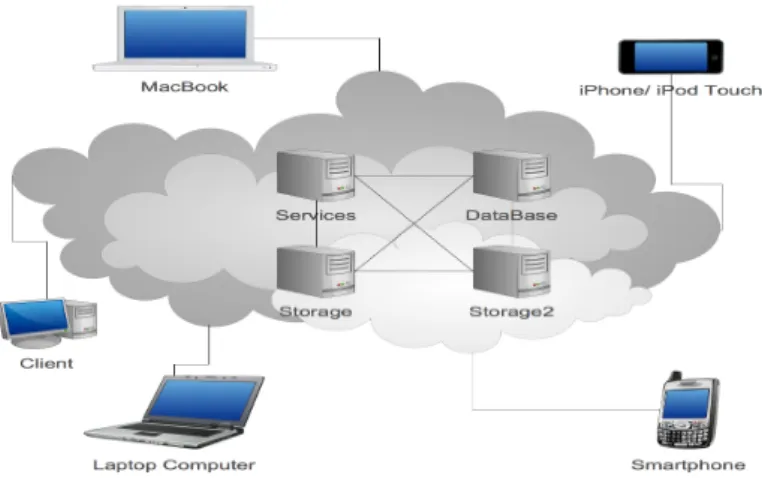
In the 20th century, the idea of cloud computing was taken by J.C.R Licklider and John McCarthy in 1960 [Sumter, 2010]. They stated that CC is not a new idea as the the types of CC services have been taken off from the past and the internet was able to support high bandwidth transmissions [Anonymous, 2012, Mohamed, 2009]. At present, the technology of CC has begun to get the attention of organisation as CC plays an important role to minimise costs and to increase an organisation operational efficiency [Anonymous, 2012, Chen and Deng, 2009]. Nunez et al. [2011] claimed that CC is a technological solution that can be used to increase computer services in the age of different networks, information, and communication revolution [Nunez et al., 2011]. See fig. 2.7.
However, Cai-dong et al. [2009] argues that CC has not been standardised yet, though many researchers have conducted a number of studies in most of CC’s fields [Cai-dong et al., 2009]. Although there is no doubt that CC can provide significant advantages for computers, some of these services are inconsistent with each other as this has been defined by [Popovic and Hocenski, 2010]. Also, CC is still a relatively new and emerging technology for organisations which may not help reduce the cost effectively.
Figure 2.7: How Cloud Computing Works
CC has three main services that are divided into three models. These models are Infrastructure as a Service (IaaS), Platform as a Service (PaaS) and Software as a Service (SaaS). As it can be seen in fig. 2.8, Hwang et al. [2009]) presented a map of CC models to different levels of CC’s operations [Hwang et al., 2009].
Figure 2.8: Cloud Computing Models
Hwang et al. [2009].
1. Infrastructure-as-a-Service (IaaS):
IaaS is considered as fundamental services provided through CC model. IaaS is the ability which provides the fundamental computing resources such as processing,
storage, network to the customers where they eligible to deploy and run applica-tions and operating systems [Dawoud et al., 2010].
2. Platform-as-a-Service (PaaS):
PaaS is the ability which deploys fundamental computing resources onto the infras-tructure of CC to the customers, where the provider supports the customer-created or acquired applications created using programming languages, libraries, services, and tools. Rake-Revelant et al. [2010] said that the typical example of PaaS is Microsoft Azure and Google App as they proposed a common model of PaaS from multiple analysis companies which were based on specific business environmental elements [Rake-Revelant et al., 2010].
3. Software-as-a-Service (SaaS):
SaaS is the ability that utilises the applications of provider, which are running on the infrastructure of CC and supplied to the customer. This service is located on servers, and it is supplied as a service. According to Gagnon et al. [2011], SaaS service is provided through the Internet which allows customer to access via any device without having unparalleled software installed and supplies a device-independent web applications with the extensions of web services [Gagnon et al., 2011].
2.3.1 Decision Making in Cloud Computing
Decision making is an important matter in the management of CC as there are current decisions that come by every now and then. For example, there are various reasons to help motivate people, enterprises and organisations to use CC. One of the most attractive factors for enterprises is elasticity which permits enterprises to scale its IT resources up, and down in a short interval of time. A number of options can be obtained once CC is used by the users, yet some key decisions may be encountered. IT outsourcing level is the 1st key decision for any user. The options are;
1. CC Infrastructure Outsourcing which is known as IaaS from Rackspace, GoGrid, Amazon etc.
2. Development platform and Infrastructure Outsourcing known as PaaS from Google App Engine, Force.com and Microsoft Azure.
3. Entire Software Outsourcing including the Infrastructure and Platform known as SaaS.
On the basis of the above options of service delivery, the consumer has various choices for practicality, preparation, information and infrastructure location as shown in table 2.1. There might be a task to optimise models to specify the simple combination of choices which can run better for the user under budget and satisfying the user. There is a set of services which are compatible to users with respect to their business. These types are Public, Private and Hybrid Cloud. The aim of offering these cloud’s ownership is that the user should have some choices according to their business.
1. Public Cloud: As shown in fig. 2.9, public cloud literally means exchange of in-formation publicly, yet its ownership is limited and it does not permit the users to interact with other consumers. This type of CC might be owned, managed, and op-erated by a business, academic, organisation or government, or some combination of them.
Figure 2.9: Public Cloud
2. Private Cloud: As it can be seen in fig. 2.10, private cloud is operated by the users but it is created for big firms for resource-sharing between departments of their industry. This type of CC might be owned, managed, operated by the organisation or may be run by a third party.
3. Hybrid Cloud: As it can be seen in fig. 2.11, hybrid cloud needs a capital expen-diture as it is a combination of two or more CC types, which sustain unparalleled entities; however, they are restricted together by united or proprietary technology which enables data and possible applications.
On the basis of scale and applications operation, users can take either of the following: 1. Commodity Cloud: It means that if they get charged by hour, their servers will
Figure 2.10: Private Cloud
Figure 2.11: Hybrid Cloud
2. Enterprise Cloud: It means that if they are charged in a month having non-public access of servers that might not be accessible to non-public in general. This is chosen by the users who need high levels of service from CC.
On the basis of Infrastructure Location Operation (ILO), three choices are available to users out of which they can choose any one. These choices are:
1. On-site which means hardware is placed in the users information centre.
2. Off-sitewhich means hardware is placed in the information centre of the provider.
3. Co-location which means hardware is placed in a location which is neutrally secured.
The Data Location option (DLO) and ILO are almost the same; but the DLOs decisions are highly interdependent. If a user choses private deployment of cloud, there will be no
scale/ or operation options because these are applicable to public cloud only. In addition to this, their data and infrastructure can be located only on-site or off-site. If the user chooses public deployment of cloud, then he can either choose an enterprise cloud or a commodity but data and infrastructure may get limited only for off-site locations.
Table 2.1: Cloud Computing Options
Service Development Functionality ILO DLO
1 IaaS Public Cloud Commodity Cloud On-Site On-Site 2 PaaS Private Cloud Enterprise Cloud Off-Site Off-Site 3 SaaS Public-Private Hybrid None Co-Location Co-Location 2.3.2 Benefits and Challenges in Cloud Computing
New technologies affect the economy of the world in many positive ways, yet its negative factors should not be ignored. Moving the process of traditional computing into CC has a great impact on security, increase in efficiency, saving of energy, visibility, flexibility as well as community. However, the challenges that might be faced are privacy issues, cultural issues, reliability, availability and controllability. See table 2.2.
To start with CC advantages, security problems generally come when user does not have back-up and the system crashes resulting in data loss if it is not stored in some other location. CC solves these kind of issues by providing back-up. Sometimes the user may forget to take storage media to store data from home to his office. CC provides access to this data with security to store data in a data centre [Barnatt, 2010]. CC running is independent of location, and hence, another benefit of security is that CC makes the personal computing much safer. CC corporate data centres cannot securely be compromised whereas individual PC always can be [Barnatt, 2010, Catteddu, 2010]. The CC capital investment is minimal as users have multiple organisations available ensuring that competition services for customers are comparatively inexpensive. such an advantage motivates the users to only pay for what they use. Customers also do not need to worry about the updating of software, changing code or hardware capacity that are frequent issues for firms operating their own software. CC permits flexibility for users in other environment; for example, customers can access the files by using different types of devices such as smart-phones, tablets, etc [Catteddu, 2010].
Energy saving means capability of direct instrumental cooling affects the stability and speed of computers, and it is recognised well that computers take a lot of energy for this cooling if hardware has higher temperature. At this stage, vendors of CC keep their
Table 2.2: Benefits and Challenges in Cloud Computing
Benefits Challenges
1 Security In terms of Backup Information Data Security, Privacy, and Trust Issues
2 Capital Investment Saving Cultural Issues
3 Energy Saving Availability
4 Increased Efficiency Reliability
5 Flexibility Controllability
servers in cold environment so that they can perform well. If they use liquid nitrogen method for this process, this can save the energy under some circumstances to run computers [Krutz and Vines, 2010].
Furthermore, efficiency increment in CC environment, people and organisations will likely become greater and therefore, CC provides a reliable and comprehensive set of resources for its users. CC may impose all analysis, development, deployment and mon-itoring to provide the opportunity to increase productivity and reduce risks in business [Catteddu, 2010, Krutz and Vines, 2010].
In the context of flexibility, CC provides the services where the customers can apply the cost-effective applications, hardware, and software. Hence, they do not have to interact with outdated hardware or software. If they still require, it can scale their software and hardware on a regular basis, thereby adding the provided flexibility [Catteddu, 2010]. As it can be see in table 2.2, there are five concerns in CC environment but they are not fixed or limited. The 1st concern is privacy, security and trust issues. Sometimes, CC does not offer certain safety mechanisms that help in tracking the servers of CC. Network and user access inside private cloud is specific and restricted; hence, the processes are handled in the organisations without any restriction of security, bandwidth and legal requirements that using the public cloud services could be needed [Catteddu, 2010, Zhang et al., 2010].
Unfortunately the public cloud is not able to constantly protect the confidentiality of data for all the users because the trust relations have temporary efficiency in cloud; and thus, the users cannot prevent the risk of receiving dangerous actions or malicious data. Additionally, the users may get the illegal data from the cloud. More dangerous is that this technology cannot completely prevent fraud, phishing, exploitation and service-hijacking as generally occurs in IT systems [Krutz and Vines, 2010].
Therefore, government have already taken action against hackers and made a legal ju-risdiction where organisation takes an action to ensure the privacy rights of the users and give permission to appeal against the cloud merchants if required. Researchers have shown the method to handle these problems. They found that some firms in CC should comprehensively provide different levels of protection per degree of trust. Then these firms can manage change in trust with context to time and adjust, to monitor and to reflect properly the trust relation to become dynamic with the time [Zhang et al., 2010]. On the other end, possible protection issues with cloud return within the system. There is multi-instance in multi-tenancy virtual environments where all instances are assumed as completely isolated with one another. This can escape the limits of sandboxed en-vironment, and provide complete access to the hosting system [Catteddu, 2010, Zhang et al., 2010].
As far as the disadvantages of cloud computing is concerned, traditional problems can also be taken as a drawback as the organisation and information need to be shared or manipulated their conventional methods of working, it might be a huge traditional challenge to adopt the CC technology [Catteddu, 2010].
2.3.3 Deploying IDS/IPS into Cloud Computing
CC is limited in terms of control the data and resources where the administrator can see IDS details. Roschke et al. [2009] proposed a solution for an IDS central management within CC. Such a solution focused on integration of sensor outputs on any single type of interface [Roschke et al., 2009].
Karen and Mell [2010] proposed a system consistency of CC application layer in different platform layers such as the system layer, the application layer and the platform layer [Karen and Mell, 2010]. IDS, in this system, generates alerts sent to the event of CC and then stores the data in the repository of the sender, receiver and helper types of plugs. Kozushko [2013] proposed a method of deployment through an analysis of complex components that are monitored by the help of a user [Kozushko, 2013]. Singh and Roy [2012] claimed that the issue of deploying IDS/IPS cloud computing lies on information confidentiality, which is received by the help of SaaS [Singh and Roy, 2012]. They said that all the various information types have to pass through the network with considering the lake of confidential information that need to be monitored. The encryption within the deployment may be considered as an effective method to tackle