Traffic control devices manual
Part 9
Level crossings
© NZ Transport Agency www.nzta.govt.nz
Second edition, amendment 1 Effective from December 2012 ISBN 978-0-478-40712-9 (online)
Contents
Preface iv Record of amendments vi 1.0 Introduction 1 1.1 Purpose 1 1.2 Level crossings 1 1.3 Scope of document 2 1.4 Definitions 2 1.5 Engineering judgement 21.6 Value for money 3
1.7 All practical steps 3
2.0 Responsibilities for level crossings 4
2.1 General principles and powers 4
2.2 What is a level crossing? 4
2.3 Legal status of level crossings 5
2.4 Types of level crossings 7
2.5 New level crossings 9
2.6 Closure of level crossings 9
2.7 Out-of-service railway lines 10
2.8 Reopening of railway lines 11
2.9 Trespass 11
3.0 Risk assessment and ALCAM 12
3.1 Introduction 12
3.2 ALCAM description 12
3.3 Assessment of level crossings 13
3.4 Other considerations 14
4.0 Traffic signs 15
4.1 Introduction 15
4.2 General specifications 15
4.3 Signs used at level crossings 16
5.0 Road marking 38 5.1 Standards 38 5.2 Responsibilities 38 5.3 Requirements 38 6.0 Control devices 43 6.1 Introduction 43 6.2 Types of controls 43
6.3 Railway-activated control devices 44
6.4 Traffic signal integration with level crossing 46
6.5 Locomotive-mounted warning devices 46
6.6 Rail vehicles yielding to road traffic 46
7.0 Road geometry, surfacing and lighting 47
7.1 Introduction 47
7.2 Responsibility 47
7.3 Standard construction requirements for level crossings 48
7.4 Seal requirements 48
7.5 Alignment 49
7.6 Traffic islands 49
7.7 Level crossing in close proximity to an intersection 49 7.8 Level crossing in close proximity to a driveway 50
7.9 Lighting 51
8.0 Requirements for pedestrian and cycle level crossings 52
8.1 Introduction 52
8.2 Pedestrian level crossings 52
8.3 Cycle facilities 54
8.4 Footway and cycleway construction 54
8.5 Pedestrian mazes 54
8.6 Active protection 55
9.0 Requirements for specific road vehicles 56
9.1 Buses and dangerous goods vehicles at level crossings 56
10.0 Requirements for private level crossings 58
10.1 Introduction 58
10.2 Private property access level crossings 58
11.0 Requirements for rail operations level crossings 60
11.1 Introduction 60
11.2 Rail access level crossings 60
11.3 Public access level crossings 60
12.0 Requirements for tramway level crossings 61
12.1 Introduction 61
12.2 Tramway level crossings 61
12.3 Tramways as special vehicle lanes 62
Appendix A - Standard sign and marking layouts 63
Appendix B - Sight distances at level crossings 81
Appendix C - Working on or near level crossings 90
Appendix D - Australian Level Crossing Assessment Model (ALCAM) 92 Appendix E - Installation and maintenance responsibilities around level
Preface
Introduction
The NZ Transport Agency’s Traffic control devices manual (TCD manual) provides guidance on industry good practice including, where necessary, practice mandated by law. The structure of the TCD manual comprises 10 parts as shown in Table A: Planned structure ofthe TCD manual.Each part has been developed under the guidance of a representative working group of practitioners experienced in, and having specific knowledge about, the subject. Interested practitioners and affected organisations were given the opportunity to comment on drafts and their input has been incorporated appropriately in the final document.
The TCD manual will only be published electronically and will be available on the NZ Transport Agency’s (NZTA) website.
Relationship with
other documents
The TCD manual will support and reference:• New Zealand legislation and, in particular Railways Act 2005, Public Works Act 1981, New Zealand Railways Corporation Act 1981, Land Transport Act 1998 and rules made pursuant to that Act, including the Land Transport (Road User Rule) Rule 2004, Land Transport Rule: Traffic Control Devices 2004 (Rule 54002) (TCD Rule) and Land Transport Rule: Setting of Speed Limits 2003.
Note: This manual is subordinate to legislation and any legal access agreements. Professional legal advice should be taken where appropriate
• the detailed descriptions of devices contained in the companion document Traffic control devices specifications
• general polices contained in Austroads guides (in particular, the guides to traffic management, traffic design and road safety) by providing detailed guidance to meet specific requirements of New Zealand law and practices
• New Zealand and, as appropriate, Australian standards
• codes of practice, guidelines and published standards of various authorities. Each part attempts to provide a broad coverage of the subject but avoids duplicating major elements of referenced documents, preferring to direct readers to the source. The TCD manual and Traffic control devices specifications (TCD specifications) will, on completion, replace the joint Transit New Zealand and Land Transport NZ
publication Manual of traffic signs and markings (MOTSAM).
Part 9 Level
crossings
This part was developed with guidance from the Level Crossing Working group, a standing group convened by the NZTA. This group represents rail participants (KiwiRail and Federation of Rail Organisations of New Zealand (FRONZ)), road controlling authorities (RCAs), the Ministry of Transport and the NZTA.Table A: Planned structure of the TCD manual
Part Title Outline of content – may vary as the manual develops
Sign specifications Detailed descriptions of traffic signs including dimensions, colour and layout
Signal specification Detailed descriptions of permitted traffic signal displays and dimensions and colours of signal aspects
Marking specification Detailed description of road markings, including dimensions, colours and layout 1 General requirements for traffic signs Purposes of traffic signs and their legal foundation
Materials and construction
General design principles – size, lettering, legends Installation – location, mounting heights 2 Direction, service and general guidance
signs
Route signing, including state highways, regional roads, bypasses, detours, scenic routes Street name signing, including design and location
Services signing policy, application and design Tourist signing
General information signs, eg public amenities, features 3 Advertising signs Design and location principles
Policies for billboards and other forms of roadside advertising 4 Traffic control devices for general use –
at intersections
Treatments at intersections, including options for traffic control, advance warning, etc 5 Traffic control devices for general use –
sections of road
Treatments between intersections, including delineation, curves, passing facilities, steep grades, etc
6 Speed management Safe system approach to speed Signs and markings for speed limits Temporary and variable speed limits Local area traffic management
7 Parking controls (formerly part 13) Legal framework – implications and responsibilities Design considerations and elements
Linear and zone parking treatments
Parking furniture, eg meters, vending machines 8 Code of practice for temporary traffic
management
Code of practice for temporary traffic management and local body supplement 9 Level crossings Risk assessment (ALCAM)
Design considerations, eg facility types, traffic movements, stacking distance, sight distances
Types of control – passive or active
10 Motorways and expressways Specific signing and marking requirements for motorways and expressways Definitions Definitions of terms used throughout the TCD manual
Record of amendments
Amendment number
Description of change Effective date Updated by
Edition 2 Improvements as recommended by the Level Crossing Working group consultation. July 2011 Bob Gibson Edition 2,
amendment 1
1.0
Introduction
1.1
Purpose
1.1.1
What’s in
this document?
Part 9 Level crossings, is part of a suite of guidelines within the Traffic control devices manual (TCD Manual) prepared by the NZ Transport Agency (NZTA).
The document is intended to provide best practice guidance on the use of traffic control devices related to level crossings to both road and rail practitioners. In particular, it builds on the specifications for approved signs, markings and other traffic control devices approved or mandated for use in New Zealand as set down in the Traffic control devices specifications (TCD specifications).
While the main intent of the document is to provide guidance on the use of traffic control devices, it also provides some guidance on operational policies affecting traffic movement across level crossings and activity (such as road works) on or adjacent to level crossings. In addition, it briefly describes some relevant duties and responsibilities of rail access providers, rail operators, road controlling authorities (RCAs), adjacent landowners and users.
1.1.2
Terminology –
law or good
practice
This document outlines the legal framework and responsibilities for the design and installation of traffic control devices at or near level crossings. This includes the general principles behind their use at the time the document has been drafted. It should not be used in substitution for professional advice as to compliance with relevant central and local government requirements.
The following terminology is used within the document to determine whether an aspect or statement made is a requirement under law or good practice. These terms are:
• must – indicates something that is mandatory or required by law
• should – indicates a recommendation
• may – indicates something that is optional and may be considered for use.
1.2
Level crossings
All level crossings must be protected through the use of appropriate traffic control devices. The devices installed will depend on a range of factors including:
• level crossing type
• volume and speed of rail, and road traffic
• mix of road and rail traffic using the level crossing
• alignment of the approaches to the level crossing
1.3
Scope of document
This document describes traffic control devices used to control and warn traffic at, and in advance of, level crossings. It specifies the way in which these devices are used to achieve the level of control required for the safety of rail traffic and all road users. It also gives requirements and guidelines on the selection of an appropriate device and on their location and installation.
1.4
Definitions
Rail access provider The person who controls the use of a railway line by rail operators (including that person if it is also a rail operator), whether or not that person engages rail personnel to exercise or assist in exercising that control on its behalf, but does not include those rail personnel (Railways Act 2005, section 4). Rail operator A person who provides or operates a rail vehicle, whether or not that person
engages rail personnel to do so or to assist in doing so on its behalf, but does not include those rail personnel (Railways Act 2005, section 4). Rail participant A rail participant may be an infrastructure owner, a rail vehicle owner, a
railway premises owner, an access provider, a rail operator, a network controller, a maintenance provider, a railway premises manager or any other class of person prescribed as a rail participant by regulations (Railways Act 2005, section 4).
Railway premises owner A person who owns, or leases for a period of seven years or more, any railway premises, whether or not that person engages rail personnel to exercise or assist in exercising the rights and duties of ownership on its behalf; but does not include those rail personnel (section 4 Railways Act 2005).
1.5
Engineering judgement
This document provides rules, standards and guidance on the use of traffic control devices. However, practitioners should always apply sound engineering judgement in the use and installation of these devices to ensure they will be effective at any particular site.
1.6
Value for money
The Land Transport Management Act 2003 (LTMA) sets out a framework for planning, programming and funding land transport activities. It encourages
integrated long-term planning and allows funding flexibility to achieve an affordable, integrated, safe, responsive and sustainable land transport system.
The LTMA requires the NZTA and approved organisations which receive payments from the National Land Transport Fund (NLTF) to use this revenue in a manner that seeks value for money. Value for money can be defined in a variety of ways but in general it means selecting the right things to do, implementing them in the right way, at the right time and for the right price.
The NZTA’s Knowledge base describes processes for funding from the NLTF and is aimed at strategic and tactical levels. The value for money concept which drives those processes should be applied to every element of the road network, including the use of the traffic control devices described in the TCD manual and, in particular, this part.
1.7
All practical steps
The Railways Act 2005 has, as its stated purpose, the promotion of rail operation safety and the definition of the duty of rail participants to ensure safety. The Act requires rail participants to take all practicable steps to ensure that no rail activity causes or is likely to cause the death or serious injury of individuals. Thus, there is a duty for rail participants to take all practical steps to provide safety at level
crossings.
The Act allows for cost to be one of the considerations in determining what constitutes ‘all practical steps’. This is consistent with the value for money concept in the LTMA. Participants have limited financial resources and must apply these to manage risks in a cost-effective way. This document describes a risk assessment model , Australian Level Crossing Assessment Model (ALCAM) - see section 3.0 Risk assessment and ALCAM) which utilises the guidelines contained in this document, to determine levels of risk and identify practical and cost-effective remedial measures. ALCAM can then assist in the development and implementation of a prioritised remedial programme for level crossings.
In determining remedial measures the practitioner need to consider, but not solely rely on, conventional cost-benefit analysis. Level crossings are different from roads in that the overall risk profile is skewed toward low-probability but
high-consequence events (particularly on passenger train routes). In this sense, rail is similar to the aviation industry in that a single event has the potential to have catastrophic consequences.
In addition, there are comparatively few accidents at level crossings, meaning that any prioritisation of level crossings needs a more proactive approach (ie ALCAM). As level crossings are the intersection of the rail and road networks their safety requires the integration of ‘value for money’ and ‘all practical steps’. It also requires a partnership between RCAs and rail participants to ensure both are able to meet their statutory objectives.
2.0
Responsibilities for level crossings
2.1
General principles and powers
New Zealand’s rail corporation, KiwiRail, is the primary rail access provider in New Zealand. Much of the rail policy described in this document is based on KiwiRail documentation and should generally be compatible with other access providers. However, there are over 70 licensed rail access providers (or operators) whose policies and operating procedures may differ in detail to some degree.
It is important, therefore, for both the rail access providers and RCAs to understand their respective legal responsibilities, recognise the possibility of differences in procedures and work closely to ensure level crossings and adjacent roadways, and railway lines operate safely and effectively.
Appendix E provides a basic guide to responsibilities of RCAs, rail participants and land owners at level crossings.
2.2
What is a level crossing?
Section 4 of the Railways Act 2005 defines a level crossing: (a) means any place where –
(i) a railway line crosses a road on the same level, or
(ii) the public is permitted to cross a railway line on the same level; and (b) includes a bridge used for both rail vehicles and road traffic on the same level;
but
(c) does not include a railway line on a road that is intended solely for the use of light rail vehicles.
In the Railways Act 2005, a road has the same meaning as in section 315 of the Local Government Act 1974, rather than the meaning described in the Land Transport Act 1998. As a result, the definition of level crossing in the Railways Act 2005 is
narrower than that intended for this document, which includes, eg private and rail operations level crossings. It is important to stress the Railways Act 2005 is not silent on these level crossings and defines a wide range of responsibilities on rail access providers, landowners and users for the safe management of these places. Traffic control devices and road user obligations are defined in legislation made under the Land Transport Act 1998, and, for the purposes of this document, the broader definition of road in that Act is more appropriate. Therefore, a level crossing is defined for the purpose of this document as a place where users of a formed path or road cross a railway line at the same level.
2.3
Legal status of level crossings
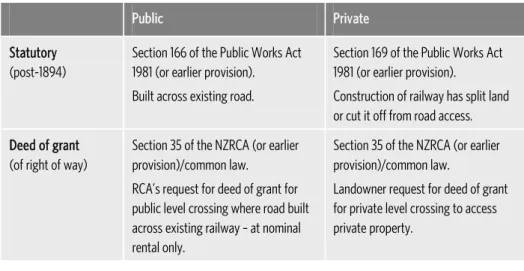
Historically, there have been two situations in which the need for a level crossing has arisen. This has resulted in two broad categories of level crossing – statutory (since 1894) and deed of grant (of right of way).
This document does not deal with any aspect of legal or implied obligations related to cost sharing including construction and maintenance cost.
2.3.1
Statutory
This category arises where the construction of the railway line interferes with the existing rights of a landowner or RCA, and is provided for in two sections of the Public Works Act 1981 (or in similar provisions of earlier statutes after 1894). Section 166(d) provides, in respect of any railway authorised under that or any other Act, the responsible minister may ‘... make the railway on, across, over, or under any road, motorway, access way, service lane, railway, tramway along the defined middle line; and alter the level of any road, access way, motorway, service lane, railway, or tramway for that purpose’.Section 169(1) provides that, where the construction of the railway line has ‘… cut off all access by road to any land other than Crown land; or separated one piece of the land of any person from another piece of land of that person … , the Minister shall provide access to the land so separated’. Access can be provided by constructing a new road, access way or service lane, or by provision of a level crossing.
Where the land has been subdivided after the construction of the railway, there is no obligation under this section to provide access.
2.3.2
Deed of
grant
This category occurs where, sometime after the construction of the railway, an adjacent landowner or RCA seeks the construction of a level crossing. In such cases, level crossings have been created pursuant to a statutory right to grant easements of right of way, as exemplified by section 35 of the New Zealand Railways Corporation Act 1981 (NZRCA) or by exercise of common law powers available to all landowners. Section 35 of the NZRCA allows for the grant by KiwiRail of an easement of right of way across or along any railway owned by KiwiRail. Other operators must rely on common law rights of a landowner for similar powers.
2.3.3
Section 75
Railways Act
2005
The exercise of powers under both statutory and common law easements will be affected by section 75 of the Railways Act 2005 which governs how access to the railway corridor is managed. Section 75 operates to limit the exercise of some rights under easements and provides protection to railway participants (including licensed access providers, railway premises owners and railway operators (all defined in the Railways Act 2005)), by requiring all third parties seeking access to the rail corridor to obtain the consent of the licensed access provider or railway premises owner (through the permit to enter process) before entering the railway to undertake work on or at a level crossing or railway premises.
2.3.4
Maintenance
obligations
With respect to statutory level crossings, the obligation to maintain the level crossing appears to lie with the rail access provider or rail operator. The documents granting the easement of right of way under section 35 of the NZRCA or at common law would normally specify which party has responsibility for maintenance of the level crossing, including the installation and maintenance of any traffic control devices.
2.3.5
Traffic
control devices
at public level
crossings
Section 81 of the Railways Act 2005 provides licensed access providers with the power, but not a duty, to install warning devices at level crossings. The
determination of the exact level of protection to be provided is at the discretion of the licensed access provider after consultation with other affected persons, including (but not limited to) the relevant RCA and adjacent landowners.
Clause 9.2(1) of the TCD Rule imposes a duty on the RCA to install warning signs in advance of a level crossing on a public road, and authorises the installation of such signs on other roads. Clause 9.3(1) imposes a duty to install specified road markings in advance of a level crossing on a road that has a speed limit of 70km/h or more, or that is multilane.
Clause 9.2(2) reflects section 81 of the Railways Act 2005, and provides that a rail access provider, after consultation with the RCA, may install warning signs and other traffic control devices at a level crossing.
Clauses 9.3(4) and 9.4, however, effectively provide that any access provider that does install warning signs or other traffic control devices at a level crossing must ensure that those signs and other traffic control devices comply with the
requirements of the TCD Rule.
Table 2.1 Classification of level crossings
Public Private
Statutory (post-1894)
Section 166 of the Public Works Act 1981 (or earlier provision). Built across existing road.
Section 169 of the Public Works Act 1981 (or earlier provision).
Construction of railway has split land or cut it off from road access. Deed of grant
(of right of way)
Section 35 of the NZRCA (or earlier provision)/common law.
RCA’s request for deed of grant for public level crossing where road built across existing railway – at nominal rental only.
Section 35 of the NZRCA (or earlier provision)/common law.
Landowner request for deed of grant for private level crossing to access private property.
2.4
Types of level crossings
2.4.1
Public level
crossings
Public level crossings can be level crossings on legal roads or on operational railway land. Many of these level crossings are subject to a deed of grant, which sets out the conditions on which each is provided and maintained.
There are two types of public level crossings: 1. Pedestrian level crossings
These level crossings provide for the passage of foot traffic, mobility devices, wheeled recreational devices and, frequently, cyclists. They may be within a road reserve but separated from the roadway (eg by a berm) or they may be isolated, stand-alone level crossings, including level crossings at station platforms.
2. Vehicular level crossings
Vehicular level crossings include all level crossings carrying road vehicles. These level crossings may incorporate adjacent footpaths to cater for pedestrian level crossings of the railway track. Where there are no adjacent footpaths, the vehicular level crossing could also cater for pedestrians, mobility devices and wheeled recreational devices.
2.4.1.1Changes of use or reconfiguration of public level crossings
Any proposed change in the use, location or configuration of a level crossing is subject to both the approval of the rail access provider or railway premises owner and the issue of a deed of grant. Changes required to upgrade a level crossing to a new standard by anybody other than the rail access provider must be referred to the rail access provider for agreement.
2.4.2
Private
level crossings
2.4.2.1Statutory level crossingsStatutory level crossings were provided by statute at the time the railway was constructed and were needed to give legal access to severed portions of private land where no other legal access existed. Only one statutory private level crossing can exist per landholding, unless the original landholding had more than 1.6km (one mile) of railway frontage.
These level crossings have never been systematically recorded and the statutory right can now only be ascertained by reference to the original land title deeds as they applied immediately before and after the creation of the railway.
A private level crossing that may have been a statutory level crossing at the time a particular railway line opened may cease to be so if the severed land it served was later subdivided or had alternative legal access provided to it. In these
circumstances, and if the level crossing is to be continued, it would become a private granted level crossing subject to conditions set out in a deed of grant with the appropriate rail access provider. However, many level crossings in this category have not been properly documented following their change of status.
2.4.2.2Granted level crossings
These are private level crossings that have generally been provided subsequent to a railway’s opening and for which deeds of grant set out the conditions on which each is provided and maintained. In some circumstances, a statutory private level crossing can alter in status to a granted level crossing and be subject to a deed of grant.
2.4.2.3Non-statutory or non-granted level crossings
Private level crossings that are neither statutory nor granted are not legal until formally documented by the appropriate rail access provider.
2.4.2.4Changes of use of granted level crossings
Where a deed of grant has been issued for the use of a private level crossing, the grantee may not change the use of that level crossing without the prior written consent of the rail access provider or railway premises owner and an amendment to the deed issued. Where agreement is denied, the level crossing use cannot be changed.
RCAs must clarify level crossing status with the rail access provider or railway premises owner where applications for subdivision and road access to the same involve level crossings. This applies regardless of whether the intended use is temporary or permanent.
2.4.3
Rail
operations level
crossings
Rail operations level crossings are level crossings located within rail property (eg marshalling yards, depots or the rail corridor) where the road or path is owned and maintained by the rail access provider or rail operator, Rail operations level crossings are used in the operation of rail business and are generally, although not always exclusively, provided for rail personnel. Thus, these types of level crossing are often not available for general public use and commonly have only limited access (see section 11.0 Requirements for rail operations level crossings).
2.4.4
Tramway
level crossings
Tramway level crossings are defined as level crossings that are:
• not in the public domain but are part of heritage or museum operations that are accessible by patrons, or
• part of street infrastructure that by its nature intersects with road and pedestrian level crossings.
It should be noted that tramway level crossings are specifically excluded from the Railways Act 2005 definition of level crossings, as tramways are ‘railway line(s) on a road that (are) intended solely for the use of light rail vehicles’ (see section 12.0 Requirements for tramway level crossings).
2.5
New level crossings
The provision of new level crossings is discouraged. Preferred alternatives are:
• grade separation, or
• closure of one or more existing level crossings where the new level crossing will better cater for the demand and manages risks better than the closed level crossing or crossings.
Where there are believed to be no reasonable alternative solutions, applications should be forwarded to the rail access provider or railway premises owner for consideration. The application would be expected to provide detailed justifications and plans. The application is likely to require future projections of likely traffic movements, particularly as they might affect the provision of active control at the level crossing.
Any new level crossing would be expected to meet the current design criteria of the rail access provider.
The rail access provider may grant temporary (often limited to two years) private level crossings for logging or construction work access, provided design
requirements are met.
If a new or temporary level crossing is approved, a deed of grant would be required before the level crossing is brought into use.
2.6
Closure of level crossings
Many overseas jurisdictions have developed deliberate polices to reduce the number of level crossings. While New Zealand does not have a formal policy to close level crossings, it is clearly desirable to reduce, whenever practicable, the number of level crossings.
2.6.1.1Public level crossings
To close a level crossing built across a pre-existing public road, the rail access provider must have an agreement in writing from the RCA. This would normally have followed extensive consultation. Once it is agreed the level crossing is to be closed, public notification of the closing is arranged and the closure follows. There may be other closure clauses included in respect of a deed of grant crossing.
2.6.1.2Private statutory level crossings
These may be closed when the consent of the adjoining owner or owners has been obtained.
When ownership of land has changed so that there are different owners on opposite sides of the railway line, or where alternative access has become available at a statutory level crossing, the purpose for which the level crossing was originally provided is no longer valid and the level crossing may be closed under section 169 of the Public Works Act 1981.
2.6.1.3Public and private granted level crossings
With granted level crossings, a clause is usually inserted in the deed of grant giving the rail access provider the right to close such level crossings. Where there are valid reasons for closure, the procedure described in the deed of grant is followed.
2.6.1.4Non-statutory or non-granted level crossings
Private level crossings that are neither statutory nor granted are not legal until formally documented by the appropriate rail access provider, and may therefore be closed by the rail access provider unless such a grant is sought and obtained.
2.7
Out-of-service railway lines
Where a railway line ceases to be used and the period of disuse is likely to be of sufficient duration, the RCA should clarify the status of the level crossings with the rail access provider to ensure appropriate and safe use by road users.
When a railway line is unused, regular users may be in the habit of ignoring any warning signs. They are often unprepared for other drivers who slow down or, in the case of passenger service vehicles, actually stop at any level crossing on the unused railway line. For regular users, the warning signs cease to have relevance and their impact when used at other level crossings is reduced, as drivers’ behaviour at the unused level crossing may be transferred to these other sites.
In many cases, traffic will be local only and very low volume, and risks at these sites are extremely low. However, there are implications arising from transferred behaviour patterns or a reduced perception in the value of the standard warning signs. In other more heavily trafficked locations, the behaviour of non-local traffic may lead to increased risks, particularly for local traffic.
Taking no action is inconsistent with principles of sound traffic management and formal identification that the railway line is not in use is recommended.
As long as signs and railway lines are in place, there are legal obligations on RCAs and road users, particularly the drivers of some types of vehicles. Signs could
perhaps be removed but some residual confusion on the part of road users might still persist as long as the railway lines remain. The possibility of the railway line being reopened or some other reason may lead to a reluctance to remove or cover sections of the disused track across roads.
Identification may be achieved by the removal of any signals, warning signs or markings and would largely overcome the issues described above. However, as long as the tracks remain across the roadway, there would remain some potential for confusion. Installing a Railway Not In Use (AX12) sign at the level crossing should help overcome this and reinforce the status of the level crossing. The policy for the use of this sign is detailed in section 4.3 Signs used at level crossings.
2.8
Reopening of railway lines
Where a railway line is to be reopened after a period of disuse the rail access provider should advise and work closely with the affected RCAs where level crossings will be reinstated. Actions required at each level crossing should include the following:
• A risk review and the implementation or programming of appropriate risk
mitigation (eg the imposition of short-term limitation on train speed below the line speed that would be normally applied).
• Installation of necessary signs, markings or other devices including the use of temporary warning signs reminding road users trains are now running (see section 4.0 Traffic signs)
Appropriate publicity to ensure regular users of the road are aware that trains will again be using the railway line.
2.9
Trespass
Trespass is legally defined in section 73 of the Railways Act 2005. It states, in part, that a person must not, without the authority of the appropriate access provider or railway premises owner:
• enter any railway infrastructure or railway premises
• encroach on any railway infrastructure or railway premises by constructing or placing any obstacle
• do any act in which a ditch, drain or watercourse is filled up, diverted, altered, stopped or obstructed
• dig up, remove, alter or undermine the soil or surface of any railway infrastructure or railway premises
• interfere with, change or move a structure or property in a manner that causes damage.
Access to the railway by easements or for works is covered in section 75 of the Railways Act 2005. It states, in part, that no one may exercise a right under an easement or carry out work on, over or under any railway infrastructure or railway premises, without the prior written permission of the appropriate access provider or railway premises owner.
The access provider or railway premises owner must consult with any other rail participants who may be affected by the easement or work and, subject to a
reasonable fee being paid, may issue a permit setting out the conditions under which any permission is granted.
The access provider or railway premises owner may refuse to grant a permit only if it has reasonable grounds in relation to the carrying out or safety of rail activities. See Appendix C - Working on or near level crossings for requirements for working on or near the railway corridor.
3.0
Risk assessment and ALCAM
3.1
Introduction
The Australian Level Crossing Assessment Model (ALCAM) is a safety assessment tool used to help prioritise disparate level crossings according to their comparative safety risk. It provides a rigorous defensible process for decision making for road and pedestrian level crossings, as well as a method to help determine the optimum safety improvements for individual sites.
At the May 2003 Australian Transport Council (ATC) meeting, all state and territory transport ministers agreed to adopt this innovative method of risk assessment. ALCAM is currently applied across all Australian states and territories. ALCAM is overseen by a committee of representatives from these states and territories to ensure its consistency of development and implementation.
ALCAM has been adopted for use in New Zealand. All level crossings throughout New Zealand have undergone an initial ALCAM assessment. These were undertaken through a project jointly funded by KiwiRail and the NZTA.
The ALCAM assessment includes both road and pedestrian level crossings. An outline of the ALCAM process is included in Appendix D - Australian Level Crossing Assessment Model (ALCAM).
3.2
ALCAM description
ALCAM is an assessment tool designed to identify site-specific risks and help the user to identify and prioritise level crossing safety improvement works. It comprises of three separate components:
1. infrastructure model 2. exposure model 3. consequence model.
Each of these models has a single factor as an output that, when combined, produces a risk score for each level crossing:
ALCAM risk score = infrastructure factor x exposure factor x consequence factor
The infrastructure factor is the output of a complex scoring algorithm that considers how physical properties at each site will affect human behaviours. This factor modifies the accident probability per year to reflect unique site conditions. The exposure factor is a function of control type, vehicle (or pedestrian) volumes and train volumes. This is expressed as an accident probability per year.
The consequence factor is the expected outcome in the event of a collision and includes deaths and injuries on both the train and vehicle. This is expressed in terms of effective fatalities per collision. For road level crossings the consequence factor varies between level crossings. However, the factor is fixed for pedestrian level crossings.
The ALCAM risk score is expressed in terms of an expected number of fatalities per year.
The weightings inside the model have been determined through a series of
workshops by an expert group, including representatives from each mainland state of Australia, KiwiRail, the NZTA and with expertise in road and rail engineering. In excess of 100 individuals, primarily from Australasia’s road and rail jurisdictions, have been involved in the development of ALCAM from its conception in 1999 through to the present. The model has been validated against a combined dataset of 10 years of Australian and New Zealand level crossing collision data (~2000–2009). ALCAM can be used to:
• quantify the probability of an accident
• quantify the expected consequences of an accident
• compare the relative risk across crossings within a region or jurisdiction
• carry out a cost-benefit analysis of any improvements
• highlight where specific risks exist
• model the effect of cost-effective treatments to address these risks.
A total data management system is provided (the Level Crossing Management System – LXM) to allow for the effective management of ALCAM data as well as other important information. LXM contains a number of addition reporting and modelling tools to assist with the overall decision-making process. The model should be applied by road and/or railway engineers trained by approved ALCAM
instructors.
3.3
Assessment of level crossings
Appendix A provides a detailed list of characteristics, controls and accident mechanisms used in ALCAM. The following briefly describes some of the more critical elements that must be measured for input into the model.
3.3.1
Level
crossing
geometry and
environs
The geometry and environ elements include:
• number of operational railway lines, including shunting lines
• number of traffic lanes each way – view along the railway line could be obstructed by traffic in adjacent lane
• grade on each approach to the railway line(s) – critical when the railway forms a ‘hump’ in the road affecting the passage of heavy and long vehicles across the railway lines
• skew of the road to railway line – view along railway line affected by degree of skew
• proximity to sidings, road intersections and other traffic generation.
3.3.2
Traffic
characteristics
Traffic characteristics recorded include:
• volumes, by categories, of road vehicles, pedestrians and rail vehicles
3.3.3
View lines/
visibility
Much of the data described above are essential inputs into calculation of the view lines required at the level crossings for both drivers and pedestrians.
For drivers, there are two critical view lines considered:
• the restart view line – the minimum distance , along the railway line(s) from the driver’s eye position in a vehicle at the stop line position of the closest railway line, required to allow the driver to start from a stopped position and clear the railway line before a train arrives
• the road approach visibility line – the minimum distance along the railway line(s) from the level crossing that either:
– a driver is able to see a train and stop before reaching the level crossing, or – a driver continues at the approach speed and crosses the level crossing safely
ahead of a previously unseen train or a train far enough away to be clearly not a collision threat.
The best possible views must be maintained at level crossings. Appendix B - Sight distances at level crossings details the formulae used in determining the views required utilising a range of relevant driver, vehicle, road and rail parameters.
3.4
Other considerations
Although it is a comprehensive tool for the assessment of level crossing hazards, ALCAM cannot be applied in isolation. Any risk assessment and treatment also needs to consider other factors, including:
• collision and near miss history
• engineering experience (both rail and road)
• local knowledge of driver or pedestrian behaviour
• social and economic assessment
• standards and international best practice.
ALCAM does not provide warrants for upgrades or attempt to define a safe or acceptable level of risk. This is a decision for each jurisdiction and will depend on the standard of existing crossings, upgrade budgets and the level of risk that they are prepared to tolerate.
It is also very important to ensure that all stakeholders associated with the particular level crossing are involved with the determination of the final recommended
4.0
Traffic signs
4.1
Introduction
This section provides guidance on the use and placement of approved traffic signs. The responsibilities of the rail access provider and RCA relating to the installation of signs is described in section 2.3.5 Traffic control devices at public level crossings. Section 9 of the TCD Rule details specific legal requirements for level crossings, while schedule 1 in part 3 provides specifications for the signs that may be used. In particular, clause 9.2 of the Land Transport Rule states:
9.2(1) To inform road users of a level crossing and to promote safe responses from road users approaching and crossing the level crossing, a road controlling authority:
(a) must install warning signs on a public road in advance of the level crossing; and
(b) may install warning signs on any other road in advance of a level crossing; and
(c) may provide other traffic control devices in advance of the level crossing.
9.2(2) A rail access provider, after consultation with the road controlling authority, may install warning signs and other appropriate traffic control devices at a level crossing to promote safe responses from road users.
4.2
General specifications
4.2.1
Sign size
For permanent traffic signs on urban roads, the smallest sign plate described in the TCD specifications is normally installed. For example warning signs would be a minimum of 600mm × 600mm. However, 750mm × 750mm or larger signs should be installed where the RCA deems it necessary due to traffic conditions and visibility.On rural roads, the sign size is increased and the largest sign specified would normally be installed where operating speeds are higher than normal
(eg 85 percentile speed exceeds 100km/h). Thus, for warning signs on rural roads operating at normal speeds, the warning sign plate size is 750mm × 750mm, while on roads where speeds are higher, 900mm × 900mm or larger signs should be installed.
Any supplementary sign component of a traffic sign assembly should match the size of the main component of the combination.
All supplementary signs are mounted 100mm below the main diamond sign or 100mm below any other supplementary sign in the order specified.
4.2.2
Placement
and number of
signs
It is important to carefully assess the placement and orientation of signs at level crossings to ensure a driver approaching from any direction receives adequate warning or instruction.
The alignment of the road relative to the railway line and the location of the level crossing in relation to nearby driveways or intersections can lead to unusual driver approach angles that need to be taken into account. However, these alignment and location issues can also lead to a large number of signs in close proximity with the possibility of:
• some signs being obscured by others, or
• drivers being incapable of fully comprehending all of the messages trying to be conveyed.
4.3
Signs used at level crossings
Signs installed at level crossings (ie adjacent to or within the railway corridor) are the responsibility of the rail access provider in consultation with the RCA. Table 4.1 List of signs used at level crossings
Sign code Sign type
RP1 Stop
RP2 Give Way WX6 Crossbuck standard WX61 Crossbuck with target board
WX62 Crossbuck with target board – private level crossing
WX63 Crossbuck plus [number of] Tracks with target board – private level crossing WX7[n] Supplementary [number of] Tracks
AX11 Bells Off
RP61 Stop On Red Signal WX8 Look For Trains
Pole used for sign, signal or barrier arm assemblies RPB Barrier arms
RPX1 Level crossing – Flashing Light assembly RPX2 Level crossing – Stop assembly RPX3 Level crossing – Give way assembly RPX4 Private level crossing – Stop assembly RPX5 Private level crossing – Give way assembly AX12 Railway not In use
4.3.1
Stop (RP1)
or Give Way
(RP2)
RP1 RP2
Policy: A Stop (RP1) sign is installed as part of an RPX2 or RPX4 assembly and a Give Way (RP2) sign as part of an RPX3 or RPX5 assembly, at level crossings not controlled by signals or permanent level crossing keepers. The decision as to whether a Give Way or Stop sign is appropriate is primarily based on the view lines available at a level crossing determined by applying the criteria described in Appendix B - Sight distances at level crossings.
The minimum requirement on any approach to a level crossing is a Give Way control in the following circumstances:
• If the approach visibility (S2) can be met, a Give Way sign must be installed. • If the approach visibility (S2) cannot be met but the restart view (S3) can be met, a
Stop sign is installed.
• If the approach visibility (S2) and the restart view (S3) cannot be met, the crossing will need to be carefully assessed to determine whether active control is justified or changes to the operating conditions (eg restriction on road or rail speeds,
limitations on vehicle length) need to be imposed.
Note: Until a level crossing has been surveyed and assessed using ALCAM, the existing view line criteria described in KiwiRail’s G417 document (previously also incorporated in MOTSAM volume I, appendix A4) will apply.
Location: See details in relation to RPX2 and RPX3 assemblies.
4.3.2
Crossbuck
(WX6 or WX61)
WX6 WX61 [a WX6 with target board]
Policy: Level crossing position indicators or crossbuck signs must be installed at all level crossings. Wherever possible, they should be installed as part of RPX1, RPX2 or RPX3 assemblies.
Installation of a crossbuck (WX6) sign in an RPX1 assembly (ie on poles also mounted with flashing lights and bells (FLB) or half-arm barriers (HAB)), while highly desirable, may be impractical in some cases because the existing poles could require major base stabilisation work.
Additional offsets can also be necessary to avoid fouling a raised barrier arm. Crossbuck signs may, in these circumstances, be mounted on a separate white pole as near as possible to the position indicated for RPX1 signs (figures A6, A7 and A8). Special care will be required to ensure that the visibility of the flashing lights is not obstructed in any way. Where necessary, the crossbuck sign may be mounted at a lower level, or even on the right-hand side of the approach road, to ensure they are clearly visible to approaching drivers.
Where increased conspicuity is required, the crossbuck (WX6) sign may be mounted on a red retro-reflective target board (WX61), to make it more effective when viewed against a visually complex background or a background that is of light colour for a substantial proportion of the time. The size of the crossbuck (WX6) sign should be determined from table 4.2 below.
Table 4.2 Sign size WX6 Speed limit (km/h) Sign size Rural
(≥70km/h)
Standard WX6 (boards 1500mm wide × 300mm high) must be used on all rural roads
Urban (<70km/h)
Standard WX6 should normally be used in all situations but a smaller sign (boards 1000mm × 200mm) may be used at restricted sites
The size of the crossbuck with target board sign (WX61) should normally be 1755mm wide x 1313mm high. In urban and low-speed rural environments a smaller sign (1170 x 875 mm) may be used.
4.3.3
Crossbuck
for private level
crossings (WX62
or WX63)
WX62 WX3
Policy: Where a private level crossing operates with low-road speeds and has a narrow, unsealed road formation, some reduction in the size of the crossbuck can be justified. The crossbuck for private level crossings (WX62 or, where there is more than one railway line, WX63) may be installed alone or preferably above either a Stop sign (RP1) or Give Way sign (RP2). The use of either an RP1 or RP2 sign is based on the sight lines at the level crossing described above.
4.3.4
Tramway
crossbuck
(WXT)
WXT WXT1 [a WXT with target board] Policy: Where a tramway crosses a road and the trams that use it have right of way, similar standards to those applying to railway level crossings apply. In these cases, the standard crossbuck (WX6 or WX61) is replaced by a tramway crossbuck (WXT or WXT1) sign. See also section 12.0 Requirements for tramway level crossings.
4.3.5
Crossbuck
for private level
crossings (WX62
or WX63)
WX7[2] WX7[3] WX7[4]
Policy: An appropriate [number of] Tracks sign must be added to RPX1, RPX2 or RPX3 assemblies and incorporated into a WX63 private level crossing crossbuck where more than one railway line is crossed. The WX7[n] sign is never installed separately.
Sign size: Sign size is determined by the size of the crossbuck (WX6) used, as indicated in table 4.3 below.
Table 4.3 Sign combinations
Size of crossbuck (WX6) Size [number of] Tracks (WX7[n]) sign board 1000mm × 150mm 280mm high
board 1500mm × 200mm 420mm high
4.3.6
Bells Off
(AX11)
Policy: In suburban residential locations, level crossing alarms may have been programmed to alter the ringing of bells outside normal waking hours. Where this is the case, the rail access provider will have installed the Bells Off sign on the FLB pole.
At level crossings equipped only with FLB, the sign will indicate the period that the bells will not operate. At level crossings equipped with barrier arms, the sign indicates the period during which the bells only sound until the barrier arms have lowered fully to the horizontal position. This is necessary to warn cyclists and pedestrians of the hazard of the lowering arms.
4.3.7
Stop on
Red Signal
(RP61)
Policy: A Stop On Red Signal sign may be added to RPX1 assemblies to emphasise the requirements for drivers to stop when the level crossing flashing signals are
operating.
Location: Stop On Red Signal signs must be mounted on RPX1 assemblies with a minimum clearance of 1.m from the underside of the sign to the surface of the adjacent roadway, trafficable shoulder or top of kerb, whichever is the critical dimension.
4.3.8
Look For
Trains (WX8)
Policy: A Look For Trains sign (WX8) may be used on RPX2 and RPX3 assemblies. It may also be used as a supplementary sign below level crossing alignment (WX40–WX42) signs (see 4.4 Signs used in advance of level crossings).
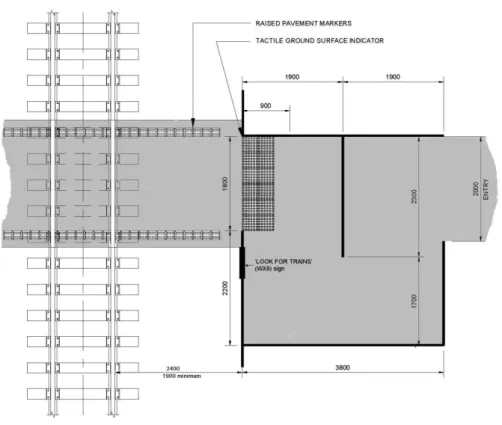
A WX8 sign should be installed separately at a pedestrian maze (refer to section 8.0 Requirements for pedestrian and cycle level crossings). They may also be installed where there is no pedestrian maze at a footpath (separated from a road) crossing the rail corridor.
4.3.9
Poles used for
mounting signals,
barrier arms and
signs
Poles used for mounting signals should have reflectorised red and white alternate bands at least 225mm wide. Poles used to mount signs at level crossings may have similar reflectorised red and white alternate bands but, if not, the pole should be painted white.
Barrier arms may be mounted on separate posts behind but in line with the RPX1 assembly. A separate pole may be used when:
a. it is not practical to mount the flashing signals and WX6 sign on the same pole because of the required angle for the signals and sign, or
b. the barriers have been added to an existing FLB installation.
When the barrier is on a separate pole, the barrier pole is seldom visible to motorists from a distance and thus there is little value in installing reflectorised bands.
4.3.10
Barrier
arms
Policy: A barrier arm must have:
• on the front (traffic side), a strip 50mm high of alternate red (280mm wide) and white (180mm wide) retro-reflective markers, and
• on the reverse (rail side), a pattern of inline, equally spaced red (50mm high, 280mm wide) retro-reflective markers, at least:
– three (on arms up to 10m long), or – five (for arms greater than 10m long).
Any area of the arm not covered by the markers must be white. Barrier arms should be extended to the centreline of the road.
All parts of the barrier arm or, depending on the skew of the railway line relative to the road, the barrier counterweight must be at least 1.7m from the nearest rail.
4.3.11
Level
crossing flashing
light assembly
(RPX1)
OR
Policy: A basic level crossing flashing light assembly (RPX1) consists of a crossbuck (WX6) sign mounted above the signal head on a signal or barrier pole. The pole forms part of the assembly. A supplementary [number of] Tracks (WX7[n]) sign must be added at level crossings with more than one railway line.
An optional Stop On Red Signal (RP61) sign may be added to emphasise the requirement for drivers to stop when the level crossing flashing lights are operating. A Stop On Red Signal (RP61) sign should only be used when a history of non-compliance exists at the level crossing.
If the bells are turned off at night, a Bells Off (AX11) sign must be installed.
Where increased conspicuity is required, the crossbuck (WX6) sign may be changed to a crossbuck with target board (WX61) to make it more effective. No other signs may be attached to an RPX1 assembly or its support.
Location: RPX1 assemblies, normally installed on the left-hand side of the road, must be at least 2.4m clear of the nearest rail edge (3m from the nearest railway line centreline). The limit line indicating the point where vehicles must stop if a train is approaching the level crossing should normally be installed 2m in advance of the RPX1 assembly.
RPX1 assemblies should be clearly visible to approaching drivers for a distance of at least 120m on rural roads and at least 60m on urban roads. The assembly may be placed on the right-hand side if the visibility cannot be achieved by installing it on the left-hand side and may be duplicated where the geometry means drivers approaching will benefit.
Where there are two or more traffic lanes on approaches to level crossings controlled by flashing light signals, a second RPX1 sign combination should, if practicable, be installed on any median island (see figure A8) or on the right-hand side of the road.
Sign size and detail: The normal, larger-sized crossbuck (WX6) and [number] of Tracks (WX7[n]) signs should be used in the RPX1 assembly in most situations. However, in restricted sites on urban roads, the smaller sizes of the WX6 and WX7[n] signs may be used. The gap between individual signs on the RPX1 assembly should be approximately 100mm.
Support poles for the assembly must be fully retro-reflectorised with alternate 225mm wide bands of red and white, as described above.
4.3.12
Standard
level crossing
Stop (RPX2) or
Give Way
(RPX3)
assemblies
RPX2 RPX3Policy: A standard level crossing stop assembly (RPX2) consists of a crossbuck (WX6) mounted above a Stop (RP1) sign, while a level crossing give way assembly (RPX3) consists of a crossbuck (WX6) sign mounted above a Give Way (RP2) sign. A supplementary [number of] Tracks (WX7[n]) sign is added at level crossings with multiple railway lines. An optional Look For Trains (WX8) sign may be added to emphasise the requirement for drivers to check for oncoming trains. The pole used to mount these signs is part of the assembly and may have reflectorised red and white alternate bands at least 225mm wide.
Where increased conspicuity is required, the crossbuck (WX6) sign may be changed to a crossbuck with target board (WX61) to make it more effective. No other sign may be attached to an RPX2 or RPX3 assembly.
Location: RPX2 and RPX3 assemblies, should be installed on both sides of the road, and must be at least 2.4m clear of the nearest rail edge (3m from the nearest railway line centreline). The limit line indicating the point where vehicles must stop if a train is approaching the level crossing should normally be installed 2m in advance of the RPX2 or RPX3 assembly.
RPX2 and RPX3 assemblies should be clearly visible to approaching drivers for a distance of at least 120m on rural roads and at least 60m on urban roads.
Where a level crossing on a side road is within 30m of the through road, the RPX2 or RPX3 assembly must be installed on both sides of the road and oriented toward approaching drivers (see examples for an RPX3 assembly in figures A9.1and A9.2). The recommendation to duplicate stop or give way passive signs was introduced in 2012. Cost considerations mean that it will take a number of years to phase these changes in. As such, duplication should be considered where the level crossing is being upgraded, or as part of a general sign or road maintenance program. This change is intended to apply to passive signs only and should not be used to infer a requirement for signals to be duplicated.
Sign size and detail: The normal, larger-sized crossbuck (WX6) and [number] of Tracks (WX7[n]) signs should be used in the RPX2 and RPX3 assemblies in most situations. However, in restricted sites on urban roads, the smaller sizes of the WX6 and WX7[n] signs may be used.
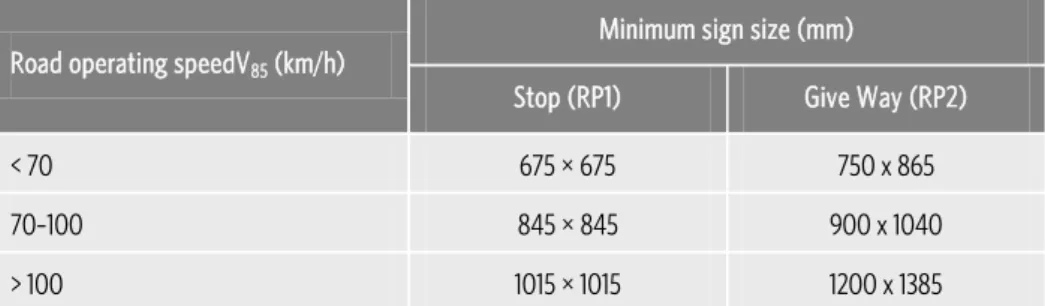
The minimum sizes for the Stop (RP1) on the RPX2 and Give Way (RP2) on the RPX3 assembly are given in table 4.4 below.
Table 4.4 Minimum sizes for Stop (RP1) or Give Way (RP2) signs on RPX2 OR RPX3 assemblies
Road operating speedV85 (km/h)
Minimum sign size (mm)
Stop (RP1) Give Way (RP2)
< 70 675 × 675 750 x 865
70–100 845 × 845 900 x 1040
> 100 1015 × 1015 1200 x 1385
The gap between individual signs on the RPX2 assembly should be approximately 100mm.
4.3.13
Private
level crossing
Stop (RPX4) or
Give Way
(RPX5)
assemblies
RPX4 RPX5Policy: The policy for the use of private level crossing assemblies is described in section 10.0 Requirements for private level crossings.
4.3.14
Railway
Not In Use
(AX12)
Policy: (See also section 2.7 above Out-of-service railway lines.) Where a railway line ceases to be used and the period of disuse is likely to be of sufficient duration, the RCA must clarify the status of the level crossings to ensure appropriate and safe use by road users.
The RCA should only proceed when they have received formal notification that the railway line is out of use and is unlikely to be used for a specified period.
All regulatory signs, ie Give Way (RPX3), Stop (RPX2) and flashing light (RPX1) assemblies, relating to the level crossing should be removed on all road approaches to the disused railway line and a Railway Not In Use (AX12) sign installed at the former positions of the regulatory signs. In the case of flashing light assemblies, the signal heads must be hooded or turned from view as an alternative to immediate removal.
All permanent warning signs and markings relating to the level crossing should be removed on all approaches to the disused railway line.
Railway Not In Use (AX12) signs, maintained by the RCA, should remain in place until the railway lines have been sealed over or removed from the roadway or the railway line reopened.
The railway lines at any level crossing must not be sealed over without the explicit written permission of the rail access provider.
Gates may be installed across the railway line to reaffirm the railway line is disused. Installation is subject to agreement between the rail access provider and the RCA. If installed, the gates should be installed a sufficient distance from the level crossing to allow a rail service vehicle to stop clear of the roadway while the gate is opened or closed, yet remain in clear view of drivers approaching the disused level crossing. The RCA may not carry out any work within the railway corridor, including installation of the Railway Not In Use (AX12) signs or any gate that is installed, without the explicit written permission of the rail access provider.
The former level crossing remains as railway corridor until the land on either side of the road is released from railway designation.
If the rail access provider intends reopening the railway line, the RCA must be given advance notice (at least four weeks) and the Railway Not In Use (AX12) sign must be removed and regulatory signs (depending on available sight distances) must be installed before the level crossing is reopened to rail traffic. Note that, for this purpose, the use of the railway line by HI-RAIL or similar vehicles used for inspection and any routine maintenance of the disused railway line or rail corridor does not constitute a reopened railway line.
The installation of regulatory signs located at, and within, the railway corridor at any reopened level crossing remains the primary responsibility of the rail access provider in conjunction with the RCA.
Once notified that the level crossing is to be reopened, the RCA is responsible for the installation of standard permanent warning signs and markings outside the railway corridor.
4.3.15
Trains
running (T235)
Policy: (see also section 2.8 Reopening of railway lines.) Where a railway line is reopened road users need to be reminded that trains are again running and the trains running sign should be installed for an adequate period after the train use has resumed. This sign may also be used:
• where an event (eg a running or cycle race) may be occurring along the road and participants may believe movement of trains has been controlled for the duration of the event, or
• road works are taking place adjacent to, or including, the level crossing and road users may believe the movement of trains is being controlled or the level of roadwork activity requires reinforcement that trains are operating.
Location: The sign should be installed as near as practicable to the level crossing.
4.4
Signs used in advance of level crossings
Signs installed in advance of level crossings are the responsibility of the RCA in consultation with the rail access provider.
Table 4.5 List of signs used in advance of level crossings Sign code Sign type
WX1L Level crossing ahead steam train facing right WX1R Level crossing ahead steam train facing left WX2L Tramway ahead tram facing right WX2R Tramway ahead tram facing left
WX11 Level crossing ahead exempt supplementary WX3 Level crossing ahead flashing signals
RJ2E Low-overhead clearance at electrified railway assembly WA1 Stop ahead
WA2 Give way ahead
WX40 Level crossing at an acute angle to the left WX41 Level crossing at right angles
WX42 Level crossing at an acute angle to the right WX5 Cyclist take care railway lines
WXR1 Level crossing on controlled crossroad to the right WXL1 Level crossing on controlled crossroad to the left WXR2 Level crossing on controlled side road to the right WXL2 Level crossing on controlled side road to the left
Sign code Sign type
WXR3 Level crossing on uncontrolled side road to the right WXL3 Level crossing on uncontrolled side road to the left WXL4 Level crossing at controlled T-junction to the left WXR4 Level crossing at controlled T-junction to the right WXR5 Level crossing at uncontrolled T-junction to the right WXL5 Level crossing at uncontrolled T-junction to the left WXB1 Controlled intersection beyond level crossing WXB2 T-junction beyond level crossing
WXB3 Short-stacking distance RJ51 Route unsuitable for long vehicles Distance ahead supplementary
WG3 (50) Supplementary 50m ahead WG3(100) Supplementary 100m ahead WG3(150) Supplementary 150m ahead WG3(200) Supplementary 200m ahead
WX31 Active advance warning signal – prepare to stop WX32 Active advance warning signal – hidden queue WX33 Active advance warning signal – queued vehicles WB1A Active level crossing warning sign
4.4.1
Level
crossing ahead
steam train
(WX1R or WX1L)
WX1L WX1R
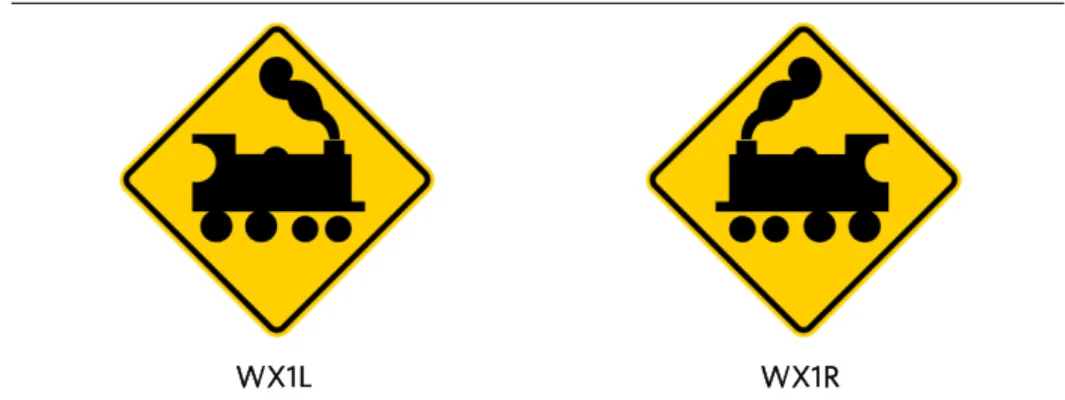
Policy: A level crossing ahead warning sign consists of the steam train symbol displayed on a standard warning plate. The level crossing ahead steam train (WX1R or WX1L) sign is generally installed separately but may also be supplemented by a Look For Trains (WX8) or Exempt (WX11) sign.
A steam train facing right (WX1L) must be installed on the left-hand side of the road on the approaches to level crossings.
It is recommended that, in addition to the WX1L on the left-hand side of the road, a steam train facing left (WX1R) sign is also installed on the right-hand side of the road:
• on roads with an AADT greater than 2000 vehicles per day
• on state highways
• where the level crossing is on a side road and 10–100m from the through road (see figures A9.2, A9.3 and A9.4).
Location: Steam train (WX1R and WX1L) signs should be located where they are clearly visible to approaching drivers for a distance of at least 120m on rural roads and 60m on urban roads.
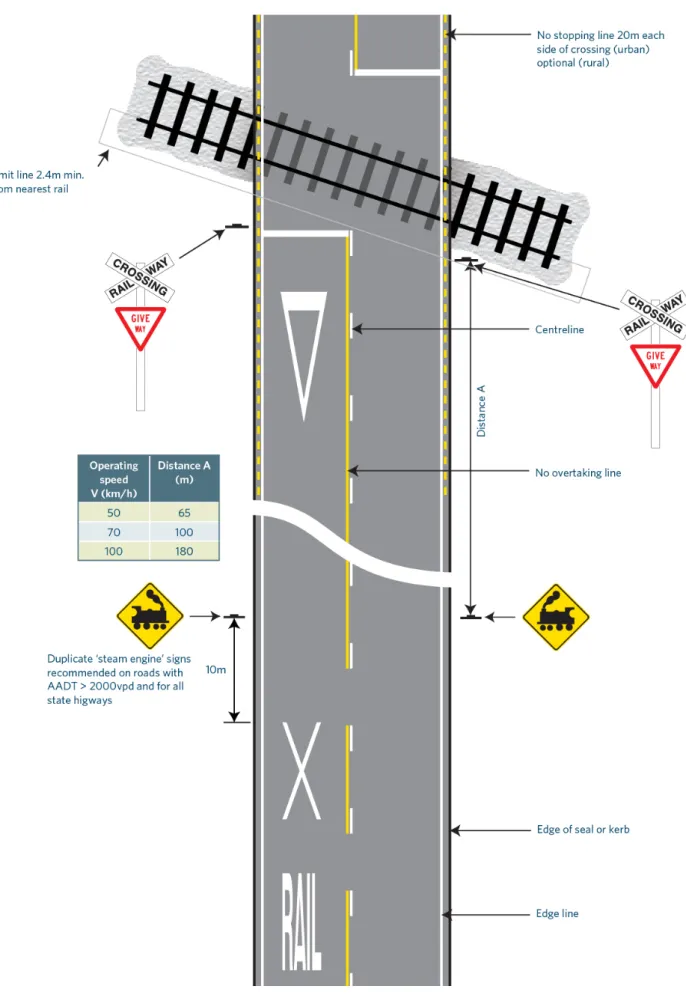
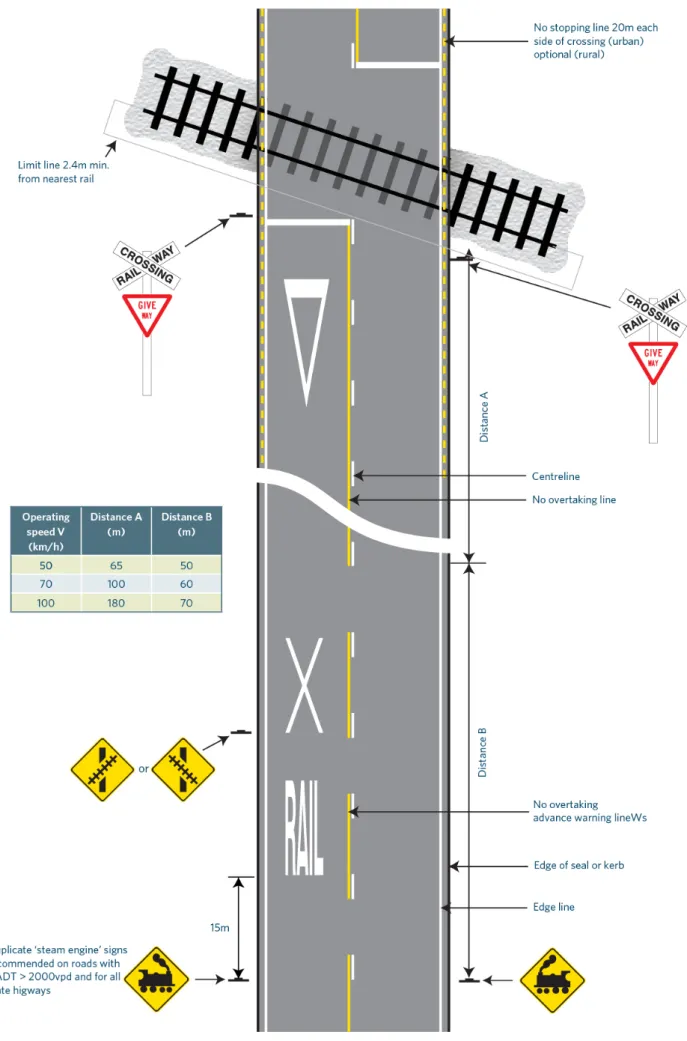
Except as shown in figures A9.2, A9.3 and A9.4 and at level crossings where intermediate signs are not required, the steam train WX1R and WX1L) signs should be installed in advance of the level crossings by not less than the distance A in table 4.6 below.
At level crossings where Stop Ahead (WA1), Give Way Ahead (WA2) or other intermediate warning signs are required, steam train (WX1R and WX1L) signs should be installed in advance of the intermediate warning signs by not less than the distance B in table 4.6 below.
Table 4.6 Minimum distances at which signs should be installed
Distance A: in advance of level crossing where no intermediate sign installed Distance B: in advance of any intermediate sign installed
Road operating speed (km/h) Distance (m)
A B
50 65 50
70 100 70