Porto Institutional Repository
[Doctoral thesis] Stochastic programming for City Logistics: new models and
methods
Original Citation:
Luca Gobbato (2015). Stochastic programming for City Logistics: new models and methods. PhD thesis
Availability:
This version is available at :http://porto.polito.it/2596359/since: March 2015 Published version:
DOI:10.6092/polito/porto/2596359 Terms of use:
This article is made available under terms and conditions applicable to Open Access Policy Arti-cle ("Creative Commons: Attribution 3.0") , as described athttp://porto.polito.it/terms_and_ conditions.html
Porto, the institutional repository of the Politecnico di Torino, is provided by the University Library and the IT-Services. The aim is to enable open access to all the world. Pleaseshare with ushow this access benefits you. Your story matters.
SCUOLA INTERPOLITECNICA DI DOTTORATO
Dottorato in Computer and Control Engineering
Tesi di Dottorato
Stochastic programming for City
Logistics: new models and
methods
Luca Gobbato
Tutore Coordinatore del corso di dottorato
First and foremost, I am deeply indebted to my advisor Professor Guido Perboli. I truly appreciate his guidance, encouragement, patient, and support through my doctorate study. His teaching and influence have been and will be immensely valu-able to me. Last but not least, this collaboration has allowed me to find one of my dearest friends.
I would also like to thank to all members of Operations Research and Optimiza-tion (ORO) group and all my friends of Laboratory 8 at Politecnico di Torino. In particular, Professor Roberto Tadei represents a model to imitate in the research. While, Mauro Baldi and Francesca Perfetti have built a working environment lov-able and full of laughter. This allowed us to express our best every day, overcoming the difficulties.
I have to give a grateful thought also to Professor Teodor Gabriel Crainic and Walter Rei, who welcomed me at CIRRELT research center in Montreal and gave me the opportunity to work with them.
I thank the Scuola InterPolitecnica di Dottorato (SIPD) for its generous financial support of this research.
I want to express my gratitude to my family and to all my friends that brighten my weekends: Massimo, Virginia, Laura, Michele, Enrico and Marcello.
Finally, special thanks to Sara Guagenti, the love of my life. Words can never express my feelings to Sara for her love and sacrifice. It is her love, support, and encouragements accompanying me in walking through the last eleven years of my life.
Acknowledgements ii
1 Introduction 1
2 City Logistics 6
2.1 The concept of City Logistics . . . 6
2.2 Planning issues . . . 10
3 Emerging problems in the City Logistics supply chain 13 4 The Capacity Planning Problem under Uncertainty 20 4.1 Problem description and literature review. . . 21
4.1.1 Literature review . . . 23
4.2 The stochastic VCSBPP model . . . 24
4.3 A lower bound for the SVCSBPP . . . 26
4.4 Heuristic based on progressive hedging . . . 26
4.4.1 Scenario decomposition of the SVCSBPP . . . 27
4.4.2 Obtaining consensus among subproblems . . . 32
4.4.3 Termination criteria . . . 36
4.4.4 Phase 2 of the meta-heuristic . . . 36
4.4.5 Parallel implementation . . . 37
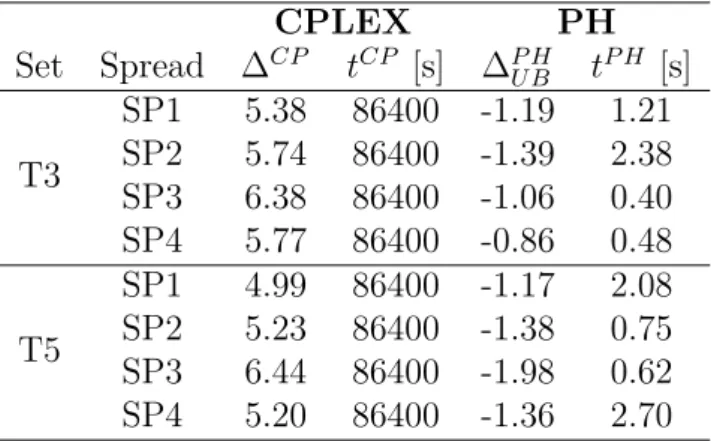
4.5 Computational results . . . 38
4.5.1 Instance set . . . 40
4.5.2 PH algorithm validation . . . 43
4.5.5 Sensitivity analysis . . . 53
4.5.6 Effect of the capacity planning . . . 55
5 The Multi-Handler Knapsack Problem under Uncertainty 62 5.1 Problem description and literature review. . . 63
5.1.1 Literature review . . . 64
5.2 Problem formulation . . . 65
5.3 The deterministic approximation . . . 67
5.4 A two-stage stochastic model with fixed recourse . . . 72
5.5 Experimental plan . . . 74
5.5.1 Instance set . . . 75
5.6 Computational results . . . 77
5.6.1 Calibration of the model . . . 77
5.6.2 Impact of uncertainty . . . 78
5.6.3 Comparison of the two-stage program and the approximation. 79 5.6.4 Usage of the approximated model as a decision tool . . . 81
6 The Multi-Path Travelling Salesman Problem with stochastic travel times 84 6.1 Problem description and literature review. . . 85
6.1.1 Literature review . . . 85
6.2 Problem formulation . . . 87
6.2.1 A sub-tour elimination based two-stage model with recourse for the mpTSPs . . . 88
6.2.2 A flow-based two-stage model with recourse for the mpTSPs . 89 6.3 Heuristic based on progressive hedging . . . 91
6.3.1 Scenario decomposition of the mpTSPs . . . 91
6.3.2 Defining the overall capacity plan . . . 96
6.3.3 Strategies for penalty adjustments . . . 97
6.3.4 Implementation of the methodology . . . 98
6.4 Computational results . . . 99
6.4.3 Impact of uncertainty . . . 107
4.1 Comparison of RP solutions from CPLEX and PH . . . 44
4.2 Comparison of LB and PH solutions . . . 47
4.3 Average computational times for PH algorithm with respect to par-allel threads . . . 48
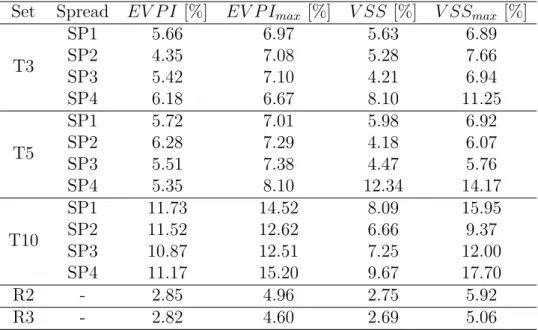
4.4 EV P I and V SS comparison . . . 50
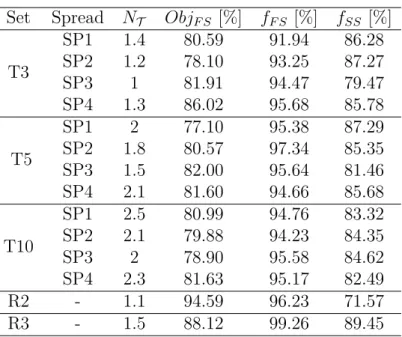
4.5 Structure of solutions . . . 52
4.6 Sensitivity of capacity-planning solutions . . . 54
4.7 Sensitivity of capacity-planning solutions . . . 54
5.1 EVPI comparison . . . 78
5.2 VSS comparison . . . 78
5.3 Optimality gap and solution likelihood of the deterministic approxi-mation . . . 80
5.4 Optimality gap and solution likelihood for the profit correlation rules 80 5.5 Optimality gap and solution likelihood for the maximum profit oscil-lations . . . 81
5.6 Optimality gap with fixed first stage decision . . . 82
5.7 Optimality gap with fixed first stage decision for the profit correlation rules . . . 82
5.8 Optimality gap with fixed first stage decision for the maximum profit oscillations . . . 83
6.1 Comparison of the results between CPLEX and the PH algorithm . . 106
2.1 Relationship between freight transportation features (white blocks)
and negative effects (gray blocks) . . . 8
2.2 Urban freight supply chain model and relationships with the stake-holders . . . 9
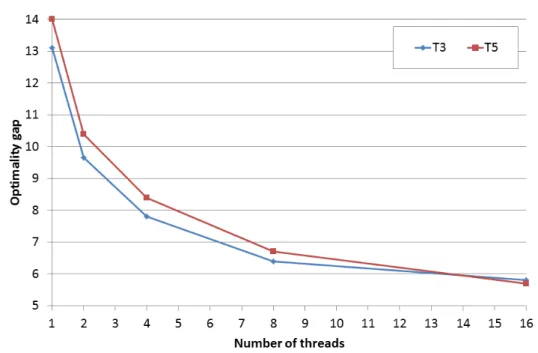
3.1 A representation of the two-echelon distribution with city-freighter vehicles (green vehicles). Yellow vehicles are the urban vehicles that bring freight to satellite facilities (green triangles) from UCCs (black squares) around the city. Dotted lines means that vehicles are empty. 15 4.1 Average relative optimality gap (%) with respect to the number of parallel threads used by CPLEX . . . 45
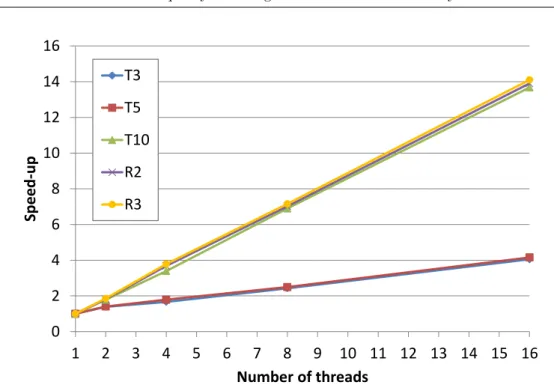
4.2 Speed-up of PH algorithm for different numbers of parallel threads. . 49
4.3 Demand trends for the Monte Carlo simulation . . . 59
4.4 Monte Carlo simulation for a testing instance . . . 60
4.5 Monte Carlo simulation for a realistic instance . . . 61
5.1 Scenario tree generation . . . 75
6.1 Subdivision in neighborhoods and admissible areas (grey) for each distribution strategy . . . 102
6.2 Distribution of central (dark gray circle) and suburban (ligth gray circle) speed sensors in the city of Turin in Italy. . . 104
6.3 Sensitivity of the first stage objective function (solid line) and the total objective function (dotted line) with respect to the number of scenarios . . . 106
and the Recourse Problem solution (b). Figure (c) shows the com-mon arcs (solid line), arcs used only in the Expected Value Problem solution (long-dotted line) and arcs used only in Recourse Problem one (short-dotted line). . . 112
Introduction
The need for mobility that emerged in the last decades led to an impressive increase in the number of vehicles as well as to a saturation of transportation infrastructures. This is particularly true in urban areas whose population has been steadily growing since the 50s. Consequently, traffic congestion, accidents, transportation delays, and polluting emissions are some of the most recurrent concerns transportation and city managers have to deal with (Dimitrakopoulos and Demestichas, 2010). However, just building new infrastructures, as new roads or high capacity highways, might be not sustainable because of their cost, the land usage, which usually lacks in metropolitan regions, and their negative impact on the environment (Crainic et al.,
2009b). Therefore, a different way of improving the performance of transportation systems while enhancing travel safety has to be found in order to make people and good transportation operations more efficient and cost effective and support their key role in the economic development of either a city or a whole country. The concept of City Logistics (CL) (Taniguchi et al.,2001) is being developed to answer to this need. Indeed, CL focus on reducing the number of vehicles operating in the city, controlling their dimension and characteristics, and reducing the number of empty vehicles (Benjelloun and Crainic,2008). CL solutions do not only improve the transportation system but the whole logistics system within an urban area, trying to integrate interests of the several stakeholders (e.g. carriers, shippers, public authorities and citizens) of theSupply Chain (SC).
and Muller, 2008), which consider economic aspects (e.g. cost, performance and customer satisfaction) related to carriers and shippers as well as the environmental sustainability and the efficiency of transport that contribute to preserving the quality of life of citizens. However, more complex SCs require an higher level of cooperation and coordination. Coordination, in particular, becomes a key factor for the success-ful of the new solutions proposed in CL projects. On the other hand, CL challenges researchers to develop planning models, methods and decision support tools for the optimization of the structures and the activities of the transportation system. In particular, this leads researchers to the definition of strategic and tactical problems belonging to well-known problem classes, including network design problem, vehi-cle routing problem (VRP), traveling salesman problem (TSP), bin packing problem
(BPP), which typically act as sub-problems of the overall CL system optimization. When long planning horizons are involved, these problems become stochastic and, thus, must explicitly take into account the different sources of uncertainty that can affect the transportation system. Various sources and type of uncertainty may be defined in the urban system (Klibi et al., 2010), such as time (i.e. service time at customers, the travel time due to traffic congestions) and demand (i.e. the revenue associated with the shipping of the orders, the volume associated with the flows). Due to these reasons and the large-scale of CL systems, the optimization problems arising in the urban context are very challenging. Their solution requires inves-tigations in mathematical and combinatorial optimization methods as well as the implementation of efficient exact and heuristic algorithms. However, contributions answering these challenges are still limited number.
This work contributes in filling this gap in the literature in terms of both mod-eling framework for new planning problems in CL context and developing new and effective heuristic solving methods for the two-stage formulation of these problems. Three stochastic problems are proposed in the context of CL: the stochastic variable cost and size bin packing problem (SVCSBPP), the multi-handler knap-sack problem under uncertainty (MHKPu) and the multi-path traveling salesman
problem with stochastic travel times (mpTSPs).
The SVCSBPP (Crainic et al., 2014a) arises in supply-chain management, in which companies, that want to be competitive in the market and fulfill customers’ requirements in a cost-efficient and flexible manner, outsource the logistics activities
to athird-party logistic firm(3PL). The procurement of sufficient capacity, expressed in terms of vehicles, containers or space in a warehouse for varying periods of time to satisfy the demand plays a crucial role. TheSVCSBPP focuses on the relation between a company and its logistics capacity provider and the tactical-planning problem of determining the quantity of capacity units to secure for the next period of activity. TheSVCSBPPis the first attempt to introduce a stochastic variant of the variable cost and size bin packing problem (VCSBPP) considering not only the uncertainty on the demand to deliver (Crainic et al.,2014b), but also on the renting cost of the different bins and their availability.
A large number of real-life situations can be satisfactorily modeled as aMHKPu
(Perboli et al.,2014), in particular in the last mile delivery. Last mile delivery may involve different sequences of consolidation operations, each handled by different workers with different skill levels and reliability. The improper management of consolidation operations can cause delay in the operations reducing the overall profit of the deliveries. Thus, given a set of potential logistics handlers and a set of items to deliver, characterized by volume and random profit, the MHKPu consists in
finding a subset of items which maximizes the expected total profit. The profit is given by the sum of a deterministic profit and a stochastic profit oscillation, with unknown probability distribution, due to the random handling costs of the handlers. The mpTSPs (Tadei et al., 2014; Gobbato et al., 2014) arises mainly in City
Logistics applications. Cities offer several services, such as garbage collection, peri-odic delivery of goods in urban grocery distribution and bike sharing services. These services require the planning of fixed and periodic tours that will be used from one to several weeks. However, the enlarged time horizon as well as strong dynamic changes in travel times due to traffic congestion and other nuisances typical of the urban transportation induce the presence of multiple paths with stochastic travel times. Given a graph characterized by a set of nodes connected by arcs, mpTSPs
considers that, for every pair of nodes, multiple paths between the two nodes are present. Each path is characterized by a random travel time. Similarly to the stan-dard TSP, the aim of the problem is to define the Hamiltonian cycle minimizing the expected total cost.
These planning problems have been formulated as two-stage integer stochas-tic programs with recourse (Birge and Louveaux, 1997). Discretization methods
are usually applied to approximate the probability distribution of the random pa-rameters using a finite-dimension scenario tree (Mayer, 1998). The resulting ap-proximated program becomes a deterministic linear program with integer decision variables of generally very large dimensions, beyond the reach of exact methods. Therefore, heuristics are required.
For the MHKPu, we apply the extreme value theory and derive a deterministic
approximation, while for the SVCSBPP and the mpTSPs we introduce effective
and accurate heuristics based on the progressive hedging (PH) ideas, initially pro-posed by Rockafellar and Wets (1991) for stochastic convex programs. The PH mitigates the computational difficulty associated with large problem instances by decomposing the stochastic program by scenario. When effective heuristic tech-niques exist for solving individual scenario, that is the case of the SVCSBPPand the mpTSPs, the PH further reduces the computational effort of solving scenario
subproblems to optimality by means of a commercial solver. In particular, we pro-pose a series of specific strategies to accelerate the search and efficiently address the symmetry of solutions, including an aggregated consensual solution, heuristic penalty adjustments, and a bundle fixing technique. Yet, although solution meth-ods become more powerful, combinatorial problems in the CL context are very large and difficult to solve. Thus, in order to significantly enhance the computational efficiency, these heuristics implement parallel schemes.
With the aim to make a complete analysis of the problems proposed, we perform extensive numerical experiments on a large set of instances of various dimensions, including realistic setting derived by real applications in the urban area, and combi-nations of different levels of variability and correlations in the stochastic parameters. The campaign includes the assessment of the efficiency of the meta-heuristic, the evaluation of the interest to explicitly consider uncertainty, an analysis of the impact of problem characteristics, the structure of solutions, as well as an evaluation of the robustness of the solutions when used as decision tool.
The numerical analysis indicates that the stochastic programs have significant ef-fects in terms of both the economic impact (e.g. cost reduction) and the operations management (e.g. prediction of the capacity needed by the firm). The proposed methodologies outperform the use of commercial solvers, also when small-size in-stances are considered. In fact, they find good solutions in manageable computing
time. This makes these heuristics a strategic tool that can be incorporated in larger decision support systems for CL.
This thesis is organized as follows. The Chapter 2 describes the concept of CL, introducing the economic and social aspects considered and the planning issues arising in the urban system.
The introduction of some CL initiatives in the urban SC is discussed in Chapter
3. In particular, we explore the need of new planning models for strategic and tactical decisions.
In Chapter 4, we present a capacity planning application in freight transporta-tion and introduce the SVCSBPP. After introducing the problem, we formulate a stochastic two stage model and propose a meta-heuristic based on the PH algo-rithm. In particular, we show how the model can be decompose in deterministic subproblems and describe the strategies adopted in the algorithm to deal with the existence of multiple equivalent solutions. Then, we present new instance sets for tackling the problem partially derived by real parcel delivery applications and ex-tensive computational results.
In Chapter 5, we present the MHKPu and the deterministic approximation for
the stochastic problem. The accuracy of this deterministic approximation is tested against the two-stage stochastic program of theMHKPu.
In Chapter 6, we present the two-stage stochastic program of the mpTSPs,
where tour design makes up the first stage, while the best paths to use is selected in the second stage. Then, Concorde is combined to the PH algorithm in order to deal with new real instances derived from the speed sensor network of Turin, a medium-sized city in Italy. Extensive computational results are presented to qualify the algorithm and the impact of the uncertainty on the decisions.
Conclusions and future developments of the research activity are reported in Chapter 7.
City Logistics
In this chapter, we recall the fundamental concepts of CL (Section 2.1). In partic-ular, Section 2.2 describes the main planning issues related to this system, which challenges researchers to develop appropriate models that incorporate the sources of uncertainty of the urban context.
2.1
The concept of City Logistics
Before the 90s’, the urban transportation was not managed by public authorities. The only type of interventions from the public authorities were restrictive measures to deal with emergencies (e.g. pricing strategies, regulations of parking area, limited traffic zones). Only in 90s’ and, in particular, at the beginning of the 21th century, the urban traffic problem became relevant and first studies tried to define some common policies for the freight transportation in the urban context. One of first studies isCOST Action 321: Urban Goods Transport that involved twelve European countries. Nowadays, the continuous developments of the urban area are changing the living conditions such as growth in population, increased of urbanization and living standards as well as expansion of Just-In-Time delivery and the growth of home delivery services. Due to the combination of these factors the urban area, on one side, requires large quantities of goods and services for commercial and domestic use, but, on the other side, is affected by a deterioration of the quality of life caused by increasing congestion and pollution. These issues become even more critical
if we consider that, the global proportion of urban population increased from 13 per cent in 1900, to 29 per cent in 1950, 49 per cent in 2005, and 58 per cent in 2013. Seventy per cent of the global population is expected to live in urban areas by 2050 (OECD, 2012). For these reasons, in the last decades, CL has emerged to provide a solution to the negative impacts of freight transportation. Taniguchi et al.
(1999,2001) defined the CL as "the process for totally optimizing the logistics and transport activities by private companies in urban areas while considering the traffic environment, the traffic congestion and energy consumption within the framework of a market economy".
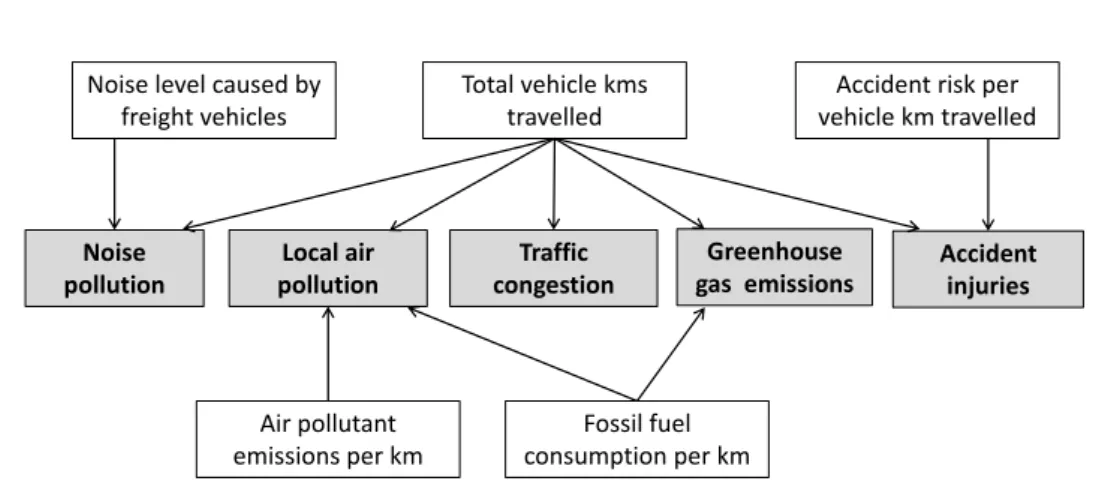
A variety of negative effects can be targeted in the urban freight transportation including to economic, environmental and social factors (see Figure 2.1). One of the main economic factors that is considered is the transportation cost. This cost correspond to the total cost of the vehicles traveling in the city and it is also used to calculate other indicators, such as the pollution or in some cases the noise. The air pollution and the greenhouse gas (GHG) emission need to be reduced in order to mitigate the environmental impacts of the freight transportation. The result of the combustion of diesel fuel is the production of toxic gaseous emissions which include Carbon Monoxide, Carbon Dioxide, Nitrogen Oxides and Particulate Matter. Another factor that has to be considered as an environmental aspect is the traffic noise. Urban freight vehicles produce a significant amount of noise in a city affecting the human health and the city comfort. It is not only produced by the engine, but also by the (un)loading of freight. When considering the social aspects, the safety of the city and the congestion of the streets are the most important effects to be reduced. Citizens do not participate directly to the freight transportation but they divide the same transportation network. With increasing freight transportation activity the problem of safety and accidents become significant in urban areas where pedestrians might be thought to be particularly at risk from freight vehicles. The latter, in fact, frequently stop on-street to load and unload, blocking the flow and causing congestion.
These negative effects and the inefficient activities related to the freight-vehicles movements are the main reasons to carry out urban freight analysis and optimiza-tion. In fact, CL focuses on the improving the efficiency of urban freight trans-portation reducing traffic congestion and lessening environmental impacts without
Noise level caused by freight vehicles Total vehicle kms travelled Noise pollution Local air pollution Traffic congestion Accident injuries Greenhouse gas emissions
Accident risk per vehicle km travelled
Air pollutant emissions per km
Fossil fuel consumption per km
Figure 2.1: Relationship between freight transportation features (white blocks) and negative effects (gray blocks)
penalizing the city social and economic activities. This holistic view leads CL initia-tives to consider the transportation system as a whole. Moreover, they incorporate a row of activities between different actors, from production, commerce and sup-ply of different clients and inhabitants, who appear in form of inner urban goods transport, or distribution of interurban freights, fulfilling a substantial contribution to economy, city life and operation. The frame for CL is given by local and re-gional economy, the transport infrastructure, the surrounding environment, legal and regulatory conditions.
Taniguchi et al.(2001) identified four groups of key stakeholders of the city: ship-pers, carriers, citizens and public authorities. All these stakeholders follow different goals and have therefore different perspectives, too. Public authorities and citizens share some of their problem views regarding externalities like accidents, congestion, noise, air pollution caused by freight vehicles. These impacts are felt to reduce the quality of life and the urban environment substantially. Shippers and carriers have a completely different point of view. They have the goal to deliver/receive goods as cheap as possible to maximize their own profits within a given regulatory frame-work and a given transport infrastructure. Their priorities are therefore to remove costly obstacles, which hinder them to deliver faster and cheaper without taking into consideration externalities. The congestions caused by freight vehicles by load-ing/delivering goods into/on vehicles, are often substantially negatively contributing to air pollution and noise in sensitive living areas.
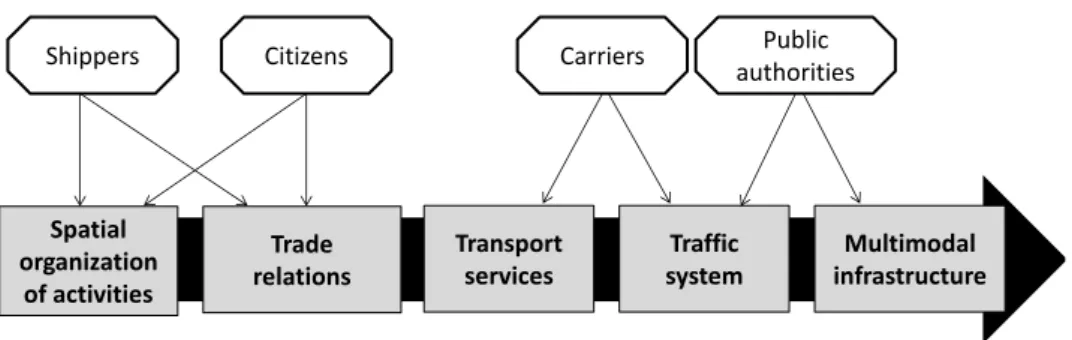
When we consider the urban freight SC (Boerkamps et al., 2000), stakeholders can be grouped by the impacts of their decisions have on the SC . In particular, the stakeholders are closely connected to at least one component of the SC, but loosely connected to whole SC (see Figure2.2). For example, carriers can plan the route in order to avoid the congestion, but they cannot affect the traffic flow. Shippers and citizens represent the demand for urban freight transport. Thus, they are strictly related to the spatial organization (e.g. where people live and work, where facilities are located, and where freight are produced and consumed) and trade activities. On the contrary, carriers and public authorities are involved only in the transportation components of the SC. The transport links demand and supply of transportation services. Vehicle fleet, human resources and infrastructural provisions are important supply aspects. Decisions in the transport market result in traffic flows, which are made on the multimodal infrastructure network.
Spatial organization of activities Trade relations Transport services Multimodal infrastructure Traffic system
Shippers Citizens Carriers Public authorities
Figure 2.2: Urban freight supply chain model and relationships with the stakeholders
In attempting to reduce the scale of negative impacts and to optimize the deci-sions at each level of the urban freight SC, a range of initiatives of CL have been proposed and are actually implemented in several cities by stakeholders in order to alter urban freight operations. Some of these initiatives will only address a single im-pact, while others will address several impacts at the same time. In general, several CL solutions focuses on the consolidation of freight in urban consolidation centers
(UCCs) (Benjelloun and Crainic, 2008; McKinnon et al., 2010), which is a logistic platform located in a strategic node of the city, where the freight to deliver can be consolidated and then performed by envitonmental-friendly vehicles. This initiative needs both the consolidation of loads of different shippers and carriers within the
same delivery vehicles and the coordination of the resulting freight operations within the city. We describe this topic and the impact of UCCs in the urban SC in the Chapter 3.
Finally, we report the most recent CL initiatives and projects, organized for the main goal. Other fundamental concepts, issues, trends, and challenges of CL may be found inTaniguchi et al.(2001),Russo and Comi(2004),Benjelloun and Crainic
(2008) and the proceeding books of the City Logistics conferences available through the Institute of City Logistics (1999) web-site. The latter, in particular, results in the state-of-the-art of city logistics concepts and implementations.
• Researching future urban freight transportation requirements and strategies:
CITY FREIGHT Consortium (2005), CITYLOG Consortium(2010),
BESTUFS Consortium (2008);
• Investigating the feasibility of new logistics concepts for urban distribution and supply (CITYBOX Consortium, 2002);
• Focusing on the application of intelligent transport systems for urban freight transport (eDRUL Consortium, 2004; SMARTFREIGHT Consortium, 2008); • Concerned with freight terminals serving urban areas (FV-2000 Consortium,
1999);
• Investigating changing modal split and encouraging rail use (IDIOMA Con-sortium, 2001; PROMIT Consortium,2009);
• Urban freight demonstration projects intended to improve freight efficiency and reduce energy use (CITY PORTS Consortium, 2005;CIVITAS I Consor-tium,2006; START Consortium, 2009; PIEVERDE Consortium, 2014).
2.2
Planning issues
In urban context, where space is limited and infrastructure expansion can be enor-mously expensive, importance of proper planning becomes essential. Similarly to any complex transportation system, CL systems require planning decisions at strategic, tactical and operational levels (Benjelloun and Crainic, 2008). Strategic decisions
have a long term effect, tactical decisions have an effect over the medium term (monthly or quarterly), and operational decisions have an immediate short-term effect. One more level assumes a key role in the urban system: the real-time.
Individual levels differ by the impact they have on future activities:
Strategic level involves the highest level of management and requires large capi-tal investments over long term horizon. Strategic decisions determine infras-tructure aspects (e.g. location of UCCs), freight distribution networks, vehi-cles and technological aspects and general development policies and strategies. Corresponding decisions are complex and of high risk and uncertainty. These decisions have a key role in the planning process. In fact, they constrain the activities and the decisions made at tactical and operational levels.
Tactical level defines, over a medium term horizon, the usage of the available resources in order to improve the system’s performance. In particular, it con-cerns the efficient and effective use of transportation infrastructure and the alignment of operations according to strategic objectives. Tactical decisions includes the acquisition and replacement of resources (e.g. planning the ca-pacity for freight deliveries), the definition of periodic tours used for the entire planning horizon (e.g. tours of vehicles for the garbage collection service or bike sharing relocation) and costs and performance analysis. In fact, tactical level controls and evidences the strengths and the weaknesses of the strate-gic decisions. On the other hand, decisions made here limit the activities of operational and real-time management level.
Operational level concerns short term decisions, day-to-day operations and the plan of next day activities. The time factor and a detailed representation of the system, facilities and vehicles are essential at these level. The decisions are made in a very dynamic environment. Thus, anticipate the future (e.g. the congestion, the transportation demand) is fundamental. Here, logistic service provider plan the routing, assigning the transportation request to the transportation resources, and the handling operations.
Real-time level reacts on differences between information known at the moment of planning decision and the actual state of the transportation system. Here,
the activities are directly related to operational decisions and aims to mitigate the effects of poor quality and reliability of operational planning. Errors in the forecasting of the future may lead to inferior customer service or higher costs to adjust the planning (e.g. rent one more vehicle for the day at the premium cost).
More in general, planning means a certain level of look-ahead skills. The fore-casting of random events assume a key role in the planning process. The variation of the demand to be shipped or the costs of operations over the horizon of the plan-ning levels, as well as delays at customer locations due to traffic conditions are only some examples of the uncertainty sources in the urban context. They constitutes a particularly important element to consider, as it may be a strong impact on deci-sions and the efficiency of the urban freight transportation service. This information may not be known at the initial planning stage, and/or may change during the plan execution. This means that these events must be included in the decision process at all levels.
Stochastic programming (SP) (Birge, 1982) can be used to model optimization problems that involve uncertainty. The most widely applied and studied SP models are two-stage linear programs. Here the decision maker takes some action in the first stage, after which a random event occurs affecting the outcome of the first stage decision. A recourse decision can then be made in the second stage that compensates for any bad effects that might have been experienced as a result of the first-stage decision. The optimal policy from such a model is a single first-stage solution and a collection of recourse decisions defining which second-stage action should be taken in response to each random outcome.
Solution approaches to SP models are driven by the type of probability distri-butions governing the random parameters. A common approach to handling uncer-tainty is to define a small number of scenarios to represent the future. In this case it is possible to compute a solution to the SP problem by solving a deterministic equiv-alent linear program. These problems are typically very large scale problems, and so, much research effort in the SP community has been devoted to developing algo-rithms that exploit the problem structure, in particular in the hope of decomposing large problems into smaller more tractable components (Ruszczynski, 1997).
Emerging problems in the City
Logistics supply chain
In this chapter, we explore the impacts of urban consolidation centers (UCCs) and environmental-friendly vehicles on the urban freight SC. They affect the "Transport services" and the "Traffic system" blocks (see Figure 2.2). In particular, we discuss the need of new strategic and planning problems for the resulting SC.
A major problem tackled by CL solutions is the inefficient utilization of freight ve-hicles, which contributes significantly to congestion and pollution emissions. Among the various CL initiatives, we investigate the opportunity to use UCCs in the urban system. UCCs are platforms located close to the urban area (e.g. close to the access of the city or ring highways) with the functions of collecting and dispatching goods. They link the city to regional, national and international hubs, and, thus, must be easily accessible and integrated with other logistics platforms. UCCs receive large trucks of logistics companies and smaller vehicles. Logistics companies drop their loads and avoid the need to enter congested urban areas and thereby saving time and costs, while the local distribution is performed by often using environmentally friendly vehicles such as electric and gas-powered light vehicles. Here, the freight to deliver to the city is stored, sorted, and consolidated (de-consolidated) in an in-tegrated way. The UCCs may so be viewed as an intermodal centralized platform with enhanced functionality that efficiently coordinates the supply and the demand to and from the city. They represent the first step toward a better CL organization
and a more efficient freight movements. By improving the lading factor of vehicles making final deliveries in congested locations, UCCs reduce the total distance trav-eled by delivery vehicles in urban areas, as well as reducing GHG emissions and local air quality pollutants associated with these journeys (Browne et al., 2011).
Example of the realization of UCCs can be Padova one in Italy or Brema one in Germany. According to a study done by Gonzalez-Feliu et al. (2010) emissions of GHG in 2008 were reduced of 68% respect to 2003 thanks to the installation of a UCC called Cityporto. Another example is the UCC in Nijmegen which the deliveries from multiple suppliers for the retailer and delivering the goods at the retailer time requirements. Van Rooijen and Quak (2009) show that the UCC, serving 98 retailers, leads to a reduction of the number of trucks and also the number of kilometers.
When a single level of consolidation is considered and the freight distribution starts at an UCC and arrives directly to customers in the urban area, the system is called single-tier CL system. Most CL projects in Europe and Japan involved some form of single-tier system, mostly considering a single UCC and a limited number of shippers and carriers. However, this system does not appear interesting for large urban areas or for cities with strong transportation issues. Indeed, UCCs results in extra costs (e.g. need the support of public authorities), delays in the transportation and limited benefits in term of gas emissions and pollutions. If the aim of UCCs is to minimize the number of trucks in the urban areas, then heavy trucks should be used in order to consolidate on the same vehicle as many orders as possible. This implies that there will be large trucks moving within the urban areas, performing long routes and causing congestion.
One of the trends is to substitute traditional single-tier systems with two-tier ones. (Crainic et al., 2004) proposes an extension of UCCs with a net of smaller facilities closer to the city center respect to UCCs called satellite platforms. Figure
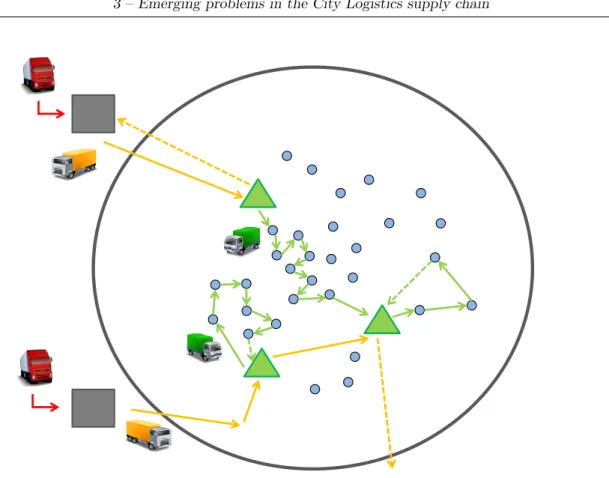
3.1 represents a two-tier distribution system. UCCs (black square in the figure) form the first level of the system and are located on the outskirt of the city (black circle). The second level is constituted of satellites, where the freight, coming from the UCCs or from external points, is transshipped again into vehicles adapted for utilization in dense urban areas. Existing facilities can be used as satellites. Indeed, satellites offer limited logistics services and storing of freight.
Figure 3.1: A representation of the two-echelon distribution with city-freighter ve-hicles (green veve-hicles). Yellow veve-hicles are the urban veve-hicles that bring freight to satellite facilities (green triangles) from UCCs (black squares) around the city. Dotted lines means that vehicles are empty.
Two types of vehicles are involved in a two-tier distribution system: urban-trucks (yellow trucks in the figure) and city-freighters (green trucks in the figure). Freight is moved by urban trucks from UCCs where it has been already consolidated, not directly to consumer destinations, but to satellites. When it is possible, they use streets specially selected to facilitate the access to satellites and reduce the impact on the traffic congestion. Here, freight is transshipped into city-freighters. Both the ve-hicles are supposed to be environmentally friendly, but, especially for city-freighters that move only in the city areas, they must be environment-friendly vehicles, such as electric-vehicles. Van Mierlo et al.(2003) report that electric vehicles, in average, has more than three times lower environmental impact compared to a diesel trucks and twice as low impact compared to liquefied petroleum gas trucks.
This extension of previous system allows more benefits in terms of congestion and emissions, in particular when small and environmental-friendly vehicles are used inside the city. Although, the system increases the costs for the additional trans-shipment operations, these costs will be compensated by the consolidation of the freights, the decrease of empty trips (e.g. reverse logistics) and by the economy of scale. However, two-tier distribution also needs of more complex cooperation and planning decisions. In fact, the transshipment needs integration of different compa-nies requirements and a reliable planning of vehicle routing to deliver shipments on time. Several planning and operative problems arise in this context. The following list briefly describes the main problems that stakeholders and decision makers of CL system must address.
Satellite location problem As inbound flows to UCCs tend to be consolidated in full trucks and outbound flows tend to be in smaller units, the number of UCCs has a large effect on transport efficiency. Moreover, the number of UCCs and satellites to be realized depends primarily on the size and struc-tural characteristics of the urban system or the production chain approach, especially in the case of perishable categories (e.g. food, pharmaceuticals). Within literature there is a whole stream of research on facility location, which mainly deals with the number and location of UCCs and satellites. Environ-mental aspects of supply chain design and facility location in particular have recently received considerable attention (Li et al., 2008; Diabat and Simchi-Levi,2009;Wang et al.,2011;Mallidis et al.,2012). However, only a few papers concerning the location of satellites under uncertainty are currently available (Ricciardi et al., 2002; Snyder et al., 2007; Tadei et al., 2009). For the first time, Baldi et al. (2012b) addressed the congestion effects inside the trans-shipment facilities, leading to a strategic planning location-allocation problem that explicitly considers the fixed cost of locating the satellite, the transporta-tion cost and the cost form handling operatransporta-tions. In fact, they integrated in a comprehensive model the two levels of a two-echelon network (i.e. the design and the management levels).
Two-echelon vehicle routing In two-tier freight distribution system, (1) freight arrives at an UCC where it is consolidated into urban trucks, which, given a
departure time and a first-level route, (2) travel to one or several satellites. At a satellite, (3) freight is transferred to city-freighters, which (4) perform a second-level route to serve the designated customers and (5) return to a satellite (or a depot) for their next cycle of operations.
The two-echelon vehicle routing problems optimizes the routes of urban trucks and city freighters, as well as coordinates the accesses to satellites. The lit-erature on this problem in CL contexts is still somewhat limited. Crainic et al. (2009a, 2010); Perboli et al. (2011); Crainic et al. (2013a) introduced the problem, related issues and formal mathematical models. They also pro-posed heuristic methods for the problem. Here, authors suppro-posed that the demand is known a priori. Thus, the demand consolidated at the first level defines the number of city freighters to use in the second-level distribution. This hypothesis is hard to be met in real application. Crainic et al. (2012a) proposed for the first time a two-echelon CL tactical planning that focuses on the uncertainty related to the variation of volume of demand to be dealt with the day after. Several topics are still open: effective solution methods for the tactical problem and the extension of the model integrating uncertainty related to the transportation network (e.g. transportation cost, congestion, travel and service time).
Capacity and fleet management The introduction of a UCC as additional block in the urban freight SP expects strict compliance of logistics service providers since storage space of UCCs is limited and, in the case of satellites, even not available (or available only for a very short time). City-freighters can travel along any street in the city-center area to perform the required distribution activities, but they are vehicles of relatively small capacity.
Efficient freight distribution requires the management of the capacity within warehouses of UCCs and satellites, as well as the design of different city freighter types (e.g. capacity, power-train, functionality) within a given CL system and the planning of the fleet of vehicles available for the next period of activity. Logistics capacity planning is major challenge in supply chain management (Monczka et al., 2008) that involves tactical planning decisions.
When tactical decisions are made, no detailed knowledge on the future de-mand and, thus, the real needs in terms of loads to be moved or stored, as well as the availability and costs of capacity is available.
Here, the planning addresses the needs for sufficient capacity to store (e.g. space in a warehouse) and move (e.g. dimension of the fleet of vehicles) freight to meet demand in the next cycle of its activities. When logistic operations are outsourced to logistics providers, this process becomes more critical and results in a medium-term contract that ensures sufficient capacity for the plan-ning horizon and a cost-effective logistics service. Chapter 4 introduces the procurement process for logistics capacity and its mathematical formulation, the SVCSBPP.
Handling operators management In the satellites different sequences of consol-idation operations are done by different workers in order to transship freight from urban trucks and city freighters. The different skill levels and reliability of the handling operators can cause delay in the activities reducing the overall profit. More in detail, the single orders can be managed by several handlers (e.g. third-party logistics providers or sub-contractors), whose costs affect the net profit of the item itself. The large number of possible handler cost sce-narios and the difficulty to measure the associated handler costs require the planning of transshipment operations for the future activities.
The capacity, in this case, becomes unique, being the actual capacity of the satellite. Chapter 5 addresses the problem of planning transshipment opera-tions in a multiple handler context with unknown items profit.
Satellite and vehicle replenishment A limited activities (e.g. load sorting, ve-hicle replenishment or cross-docking transshipment) are performed at the satel-lites. Moreover, intermediate storage is allowed at satellites only for a very small time. This point is fundamental for the actual implementation of the two-echelon distribution in the urban freight SC, since satellites do not need special infrastructures and functions have to installed, but existing facilities can be used (e.g. underground parking slots or municipal bus depots, or spaces like city squares). Thus, no high additional costs have to be sustained
for satellite activities (Crainic et al., 2004).
Satellites usually operate according to a vehicle-synchronization model. Urban vehicles and environmental-friendly vehicles meet at satellites at appointed times with only short waiting times being permitted. Here, in order to manage the transshipment of freight and control the arrival time, the uncertainty on traffic congestion have to be explicitly included in the decision process. We address this problem in Chapter 6, where we propose the mpTSPs.
The Capacity Planning Problem
under Uncertainty
In this chapter, we introduce the SVCSBPP together with the stochastic model, a lower bound and the solving strategy. After defining the problem in a formal way, we propose a two-stage stochastic formulation that explicitly takes into ac-count more sources of uncertainty arising in capacity planning problems. We then present a lower bounds that can be easily solved by mean of commercial mixed-integer programming (MIP) solvers and an heuristic based on the PH algorithm for the SVCSBPP. The accuracy and the efficiency of the latter is demonstrated through extensive computational experiments. A large number of instance sets for the SVCSBPP are introduced, partially covering realistic parcel delivery appli-cations with more than 10000 items. The instance sets are designed to challenge the proposed methodology and provide insight into the impact of uncertainty on capacity planning solutions.
This chapter is organized as follows. Section4.1discusses the connection between the capacity planning problem and contract procurement with logistic providers. Section4.2 recalls the formulation of the problem; a lower bound and the heuristic solution method are introduced in Sections 4.3 and 4.4, respectively. Section 4.5
4.1
Problem description and literature review
In this section, we analyze the process of contract procurement between a major retail firm and a third-party logistics service provider (3PL) and its relevance to the capacity planning problem.
The tactical capacity planning problem we address is relevant in many con-texts, e.g., manufacturing firms desiring to secure transportation capacity to bring in their resources or to distribute their products, wholesalers and retailers planning for transportation and storage capacity to support their procurement and sales pro-cesses, and logistics service providers securing capacity contracts with carriers for long-distance, regular shipments. Manufacturing and whole/retail distribution firms may negotiate directly with carriers and owners/managers of storage space but, very often, they do business with a logistic service provider. Consequently, in order to simplify the presentation, but without loss of generality, we describe the problem within the context of the process of contract procurement between a major retail firm and a third-party logistics (capacity) service provider (3PL).
In the contemporary economic and business environment, firms are engaged in a continuous procurement process (Aissaoui et al.,2007;Rizk et al.,2008), and engage in various collaborations with its supply-chain partners. Such inter-firm alliances yield several benefits, including a reduction in inefficiencies, total cost, and financial risks. The greatest advantages result from the outsourcing of logistics activities to a 3PL (Marasco,2008). The overall supply-chain process may then be summarized as follows. The firm regularly orders products from suppliers in a given geographi-cal region, according to current inventories, short-term forecast demand, estimated lead times, and specific procurement and inventory policies (Bertazzi and Speranza,
2005; Bertazzi et al., 2007) The suppliers are instructed to deliver their goods to a consolidation center (Crainic and Kim, 2007; Bertazzi and Speranza, 2012). The 3PL then consolidates the goods into containers and ensures their shipping, by con-solidating these containers with those of other customers into the slots it secured on long-haul cariers, e.g., ships and trains (Chen et al.,2001; Crainic et al., 2013b), which generally operate according to a fixed schedule, e.g., twice a week.
A key factor in this process is the procurement of sufficient capacity, that we express in the following in terms of bins, at different locations in the network and
for varying periods of time, to satisfy the demand. This entails negotiations with the 3PL to book the necessary capacitya priori, before operations start, at the best rate (Ford,2001). The results of these negotiations often take the form of medium-term contracts specifying both the capacity to be used, the quantity and the type
of bins, and the additional services to be performed (storage, transportation, bin operations, etc.) for a given planning horizon, e.g., a semester or a year. These contracts guarantee a regular volume of business to the 3PL (e.g., a fixed number of containers to ship every week for the next semester), which ensures a cost-effective service to the firm.
We refer to the costs of bins selected in advance as fixed costs because they are fixed by the contract and thus represent the specific rates offered by the 3PL for bins of different sizes. The values of the fixed costs are in practice influenced by several factors, including bin size, bin type (e.g., thermal or refrigerated containers), physical handling operations required, the time period for which the bin is to be used, and the economic characteristics of the departure location (e.g., access rules and costs). The result of negotiations and the scope of the capacity planning problem then is a tactical plan defining these quantities for the firm at each location, given the proposed bin types and costs and an estimation of the demand over the planning horizon. The plan thus specifies the set of bins of particular volumes and fixed costs to be made available at each location to ship the estimated items.
Given the time lag that usually exists between the signing of the contracts and the logistics operations, the negotiations are performed under uncertainty, without all the necessary information concerning thedemand, expressed as a number of items of variable sizes to be shipped or stored at the particular locations. At each application of the plan, variations in the demand may thus yield numbers and sizes of items that differ from the estimation used at negotiation. These variations then require further negotiations with the 3PL and an adjustment of the plan when the booked capacity is not sufficient. Extra capacity (additional bins available at the shipping date) must then be purchased, generally at a much higher cost (the so-called spot -market value) than the fare negotiated initially. Moreover, while the 3PL generally ensures the planned capacity for the firm, the extra capacity may not be available when needed. The extra capacity must therefore be considered stochastic as well.
4.1.1
Literature review
While different variants of the stochastic bin packing problem are present in the literature, the strategic and tactical version of the SVCSBPP is recent. Crainic et al.(2014b) introduced thevariable cost and size bin packing problem with stochas-tic items(VCSBPPSI), a stochastic variant of the VCSBPP, that considers not only the renting cost of the different bins, but also their availability. Given a certain number of bin types, their costs when we book them in advance and the costs if we rent them when needed as well as the demand of goods to deliver, the VCSBPPSI decides the capacity planning in terms of bins rented in advance in order to minimize the total cost.
Other variants of stochastich bin packing problem arise mainly when strategic and tactical problems must be solved and, in particular, when one has to plan the capacity of his fleet (Crainic et al., 2012b) or stochastic costs and profits are present in the problem (Perboli et al., 2012, 2014). In (Coffman Jr. et al., 1980;
Lueker, 1983; Rhee and Talagrand, 1993a,b) the source of uncertainty is the item volume and strong hypotheses on the probability distribution of the random terms are usually done. Recently, Peng and Zhang (2012) have studied a more general stochastic variant with both item volumes and bin capacities are uncertain, while
Fazi et al.(2012) have recently studied the Stochastic VCSBPP, with the addition of time constraints.
The mostly part of the literature on packing problems focuses on introducing uncertainty on the arrival of the items, defining the so-called on-line versions of the classic packing problems (Zhang, 1997; Seiden, 2000; Iwama and Taketomi, 2002;
Seiden et al., 2003; Han et al., 2010; Epstein et al., 2011). In particular, a lot of studies focused on the on-line version of the Bin Packing Problem, i.e. the variant of the Bin Packing where the items come one after the other and no knowledge (or a limited one) on the volume of the next items is given to the decision maker. The researchers studied policies for loading the items in the different bins giving results on their absolute or asymptotic behavior.
Regarding the solving strategy, numerous algorithms for solvingstochastic mixed-integer programs (SMIPs) (Kall and Wallace, 1994) are based on decomposition by
time stages of the scenario tree (e.g. vertical decomposition) by complete scenar-ios (e.g. horizontal decomposition). PH algorithm is a horizontal decomposition approach and has emerged as an effective method for solving stochastic linear, non-linear, and linear SMIPs (Silva and Abramson, 1994; Crainic et al., 2011a; Ryan et al.,2013; Watson et al.,2014).
PH is a natural algorithm for solving large-scale SMIPs. By decomposing the
recourse problem (RP) according to scenario, and iteratively solving penalized ver-sions of the sub-problems, the PH gradually enforces implementability. However, non-convergence of solution is possible in the case of non-convex optimization prob-lems such as the SVCSBPP. Integer decision variables render SP problems non-convex and significantly increase the difficulty of solution. For some smaller problem instances, standard MIP solvers can be used (Crainic et al.,2014b) to directly solve the RP. However, standard MIP solvers fail to consistently solve even individual scenario sub-problems in realistic applications in the context of CL. In fact, solving scenario problems separately, PH is particularly appropriate when there exist good, fast heuristics for generating solutions of individual scenarios.
4.2
The stochastic VCSBPP model
We propose a two-stage stochastic programming formulation, where the first stage concerns the selection of bins, and the second stage concerns the acquisition of extra capacity when the actual demand information is revealed.
Let T be the finite set of bin types, which are are defined according to the volume and fixed cost associated with the bins that are available at the first stage. Forτ ∈ T, letVτ and fτ be respectively the volume and fixed cost associated with
bins of typeτ. We defineJτ to be the set of available bins of typeτ andJ =∪ τJτ
to be the set of available bins at the first stage.
Let set Ω be the sample space of the random event, where ω ∈ Ω defines a particular realization. Let vectorξ contain the stochastic parameters defined in the model, and ξ(ω) be a given realization of this random vector. Let the first-stage variables beyjτ = 1 if bin j ∈ Jτ is selected and 0 otherwise. The two-stage model
of the SVCSBPPmay then be formulated as min y X τ∈T X j∈Jτ fτyjτ+Eξ[Q(y, ξ(ω)] (4.1) s.t.yjτ ∈ {0,1}, ∀τ ∈ T, j ∈ Jτ, (4.2)
whereQ(y, ξ(ω)) is the extra cost paid for the capacity that is added at the second stage, given the tactical capacity planyand the vector ξ(ω). The objective function (4.1) then minimizes the sum of the total fixed cost of the tactical capacity plan and the expected cost associated with the extra capacity added during the operation, while constraints (4.2) impose the integrality requirements on y.
To formulateQ(y, ξ(ω)), we consider the following stochastic parameters inξ(ω):
Kτ(ω), the set of available bins of type τ at the second stage; K(ω) = ∪
τKτ, the
set of available bins at the second stage; gτ(ω), k ∈ Kτ(ω), the associated fixed
costs; I(ω), the set of items to be packed; and vi, i∈ I(ω), the item volumes. The
second-stage variables are defined as follows: zτ
k = 1 if bin k ∈ Kτ(ω) is selected,
0 otherwise; xij = 1 if item i ∈ I(ω) is packed in bin j ∈ J(ω), 0 otherwise; and xik = 1 if itemi∈ I(ω) is packed in bin k ∈ K(ω), 0 otherwise.
We now define the functionQ(y, ξ(ω)) as
Q(y, ξ(ω)) = min y,z,x X τ∈T X k∈Kτ(ω) gτ(ω)zkτ (4.3) s.t. X j∈J xij + X k∈K(ω) xik = 1, ∀i∈ I(ω) (4.4) X i∈I(ω) vi(ω)xij ≤Vτyjτ, ∀τ ∈ T, j ∈ Jτ (4.5) X i∈I(ω) vi(ω)xik ≤Vτzkτ, ∀τ ∈ T, k ∈ K τ(ω) (4.6) xij ∈ {0,1}, ∀i∈ I(ω), j ∈ J (4.7) xik ∈ {0,1}, ∀i∈ I(ω), k∈ Kτ(ω) (4.8) zkτ ∈ {0,1}, ∀τ ∈ T, k ∈ Kτ(ω). (4.9)
The objective function (4.3) minimizes the cost associated with the extra bins selected at the second stage. Constraints (4.4) ensure that each item is packed in a
single bin. Constraints (4.5) and (4.6) ensure that the total volume of items packed in each bin does not exceed the bin volume. Finally, constraints (4.7) to (4.9) impose the integrality requirements on all second-stage variables.
4.3
A lower bound for the SVCSBPP
We present in this section alower bound (LB) for theSVCSBPP(4.1)–(4.9), which provides a way to measure the quality of the heuristic proposed in Section4.4.
LB is obtained by removing the item-to-bin assignment constraints (4.4) and aggregating the individual bin feasibility constraints (4.5) and (4.6). The resulting formulation (4.10)–(4.13) is a two-stage stochastic model with fixed recourse, which yields an optimal set of bins, involving both the capacity plan and extra bins, with a total capacity sufficient for the items considered (see constraints (4.11)). Thus, the LB does not guarantee feasibility for individual bins.
min y,z X τ∈T X j∈Jτ fjτyjτ+Eξ[ X τ∈T X k∈Kτ(ω) gkτ(ω)zkτ] (4.10) s.t. X τ∈T X j∈Jτ Vjτyτj + X τ∈T X k∈Kτ(ω) Vkτzτk ≥ X i∈I(ω) vi(ω), (4.11) yjτ ∈ {0,1} ∀τ ∈ T, j ∈ Jτ, (4.12) zτk ∈ {0,1} ∀τ ∈ T, k ∈ Kτ(ω). (4.13)
Note that the LB formulation is independent of the number of items. This reduces the number of variables in the model and makes it possible to find an optimal solution in a reasonable time, (e.g. using commercial MIP solvers).
4.4
Heuristic based on progressive hedging
Algorithm1describes the proposed heuristic for the SVCSBPP, which is inspired by the PH algorithm.
augmented Lagrangian relaxation, which separates the stochastic problem by sce-nario. Here, the Lagrangian multipliers are used to penalize a lack of implementabil-ity due to differences in the first-stage variable values among scenario subproblems. Section4.4.1 describes how the SVCSBPPcan be decomposed into deterministic VCSBPP subproblems with modified fixed costs. Then, the method proceeds in two phases. Phase 1 aims to obtain consensus among the subproblems. At each itera-tion, the subproblems are first solved separately. Their solutions are then aggregated into a temporary overall solution, as defined in Section4.4.2. The search process is gradually guided toward scenario consensus by adjusting the Lagrangian multipliers and the subproblem penalties (Section4.4.2), based on the deviations of the scenario solutions from the overall solution, and by a variable bundle-fixing strategy (Sec-tion 4.4.2). The search process continues until the consensus is achieved or one of the termination criteria is met (see Section 4.4.3). When consensus is not achieved in the first phase, Phase 2 (see Section 4.4.4) solves the restricted SVCSBPP ob-tained by fixing the first-stage variables for which consensus has been reached, e.g., the bins used in all the scenario subproblems. Section 4.4.5 finally describes the parallel implementation of the algorithm solving the subproblems concurrently on multiple processors.
4.4.1
Scenario decomposition of the SVCSBPP
We first reformulate the SVCSBPP stochastic model (4.1)–(4.9) using scenario decomposition. Sampling is applied to obtain a set of representative scenarios, namely the set S, and these are used to approximate the expected cost associated with the second stage.
For the first stage, let yτ s
j = 1 if bin j ∈ Jτ of type τ ∈ T is selected under
scenario s ∈ S and 0 otherwise. For the second stage, define Ks = ∪
τKτ s, where
Kτ s is the set of extra bins of typeτ ∈ T in scenarios∈ S, and let Is be the set of
items to pack under scenarios∈ S. Then, variablezτ sk is one if and only if extra bin
k∈ Kτ s of typeτ ∈ T is selected in scenario s∈ S, and xs
ij and xsik are item-to-bin
assignment variables for scenario s ∈ S. Given the probability ps of each scenario s ∈ S, the SVCSBPP problem (4.1)–(4.9) can be approximated by the following
Algorithm 1 PH-based meta-heuristic for the SVCSBPP Scenario decomposition
Generate a set of scenarios S;
Decompose the resulting deterministic model (4.14)–(4.22) by scenario using aug-mented Lagrangian relaxation;
Phase 1
ν ←0;λτ sν
j ←0; ρτ νj ←fτ/10;
while Termination criteria not met do
For all s ∈ S, solve the corresponding Variable Cost and Size Bin Packing subproblem→yτ sν
j ;
Compute temporary global solution
¯ yjτ ν ← P s∈S psyjτ sν ¯ δτ ν ← P S∈S psδτ sν Penalty adjustment λτ sν j =λ τ sν−1 j +ρ τ(ν−1) j (yjτ sν−yτ νj ) ρτ νj ←αρτj(ν−1)
if consensus is at least σ% then
Adjust the fixed costs fτ sν according to (4.46);
Bundle fixing ¯ δτ ν m ←mins∈S δτ sν ¯ δMτ ν ←max s∈S δ τ sν
Apply variable fixing;
ν←ν+ 1
Phase 2
if consensus not met for a single bin typeτ0 (¯δτ0 m <δ¯τ
0
M)then
Identify the consensus number of binsδof type τ0 by enumeratingδ∈hδ¯τ0 m,δ¯τ
0
M i
(and variable fixing)
else
Fix consensus variables in model (4.14)–(4.22);
equivalent deterministic model: min y,z,x X s∈S ps X τ∈T X j∈Jτ fτyjτ s+X τ∈T X k∈Kτ s gτ szkτ s (4.14) s.t. X j∈J xsij + X k∈Ks xsik = 1 ∀i∈ Is, s∈ S, (4.15) X i∈Is vsixsij ≤Vτyjτ s ∀τ ∈ T, j ∈ Jτ, s∈ S, (4.16) X i∈Is vsixsik ≤Vτzkτ s ∀τ ∈ T, k ∈ Kτ s, s∈ S, (4.17) yjτ s =yτ tj ∀τ ∈ T, j ∈ Jτ, s, t∈ S, (4.18) yjτ s ∈ {0,1} ∀τ ∈ T, j ∈ Jτ, s∈ S, (4.19) zkτ s∈ {0,1} ∀τ ∈ T, k ∈ Kτ s, s∈ S, (4.20) xsij ∈ {0,1} ∀i∈ Is, j ∈ J, s∈ S, (4.21) xsik ∈ {0,1} ∀i∈ Is, k ∈ Ks, s∈ S. (4.22)
Constraints (4.18) are referred to as the non-anticipativity constraints. They ensure that the first-stage decisions are not tailored according to the scenarios con-sidered in S. Indeed, all the scenario solutions must be equal to produce a single implementable plan. Thus, the non-anticipativity constraints link the first-stage variables to the second-stage variables, and so the model is not separable.
To apply Lagrangean relaxation and make the model separable, we need a differ-ent expression of the non-anticipativity constraints. Let ¯yjτ ∈ {0,1},∀τ ∈ T, j ∈ Jτ,
be the global capacity plan (i.e., the set of bins selected at the first stage). The fol-lowing constraints are equivalent to (4.18):
¯ yτ j =yjτ s τ ∈ T, j ∈ J τ, s∈S (4.23) ¯ yτj ∈ {0,1} τ ∈ T, j ∈ Jτ. (4.24)
Constraints (4.23) force the first-stage solution of each scenario to be equal to the global capacity plan. Constraints (4.24) are simply the integrality conditions on the selection of the bins. With this formulation of the non-anticipativity constraints, when we apply Lagrangean relaxation to (4.23), we can penalize individually the