DigitalCommons@Molloy
DigitalCommons@Molloy
Faculty Works: Nursing
Nursing
10-2016
Biostatistics Course in Postmaster Doctor of Nursing Practice
Biostatistics Course in Postmaster Doctor of Nursing Practice
Programs
Programs
Aliya Kuerban PhD, FNP-BC, MS, MA, RN
Molloy College, [email protected]
Follow this and additional works at: https://digitalcommons.molloy.edu/nur_fac Part of the Nursing Commons
DigitalCommons@Molloy Feedback
Recommended Citation
Recommended Citation
Kuerban, Aliya PhD, FNP-BC, MS, MA, RN, "Biostatistics Course in Postmaster Doctor of Nursing Practice Programs" (2016). Faculty Works: Nursing. 10.
https://digitalcommons.molloy.edu/nur_fac/10
This Peer-Reviewed Article is brought to you for free and open access by the Nursing at DigitalCommons@Molloy. It has been accepted for inclusion in Faculty Works: Nursing by an authorized administrator of
ORIGINAL RESEARCH
Biostatistics course in postmaster doctor of nursing
practice programs
Aliya Kuerban∗
Molloy College, New York, United States
Received:August 4, 2016 Accepted:October 20, 2016 Online Published:October 27, 2016
DOI:10.5430/jnep.v7n3p26 URL:http://dx.doi.org/10.5430/jnep.v7n3p26
A
BSTRACTBackground: The number of doctor of nursing practice (DNP) programs in the United States has increased dramatically in the past few years. However, few studies have been done to provide a comprehensive view of program structures and curricula offered.
Methods:This study explored differences in entry pathway, admission statistics skills requirement, and whether a program offered a Biostatistics course in its curriculum by investigating the websites of DNP programs listed on the American Association of Colleges of Nursing (AACN) DNP directory.
Results and conclusions:This study found no regional differences in these three areas: type of program offered, statistics course as a prerequisite, and whether Biostatistics is offered. Overall, more schools have started to require a graduate level statistic course in their admission requirement and more schools offered a Biostatistics course in their DNP curriculum. However, 25% of schools did not request for specific statistics skills prior to admission, nor did they incorporate a Biostatistics course in the program.
Key Words:Doctor of nursing practice, Biostatistics, Prerequisite
1. I
NTRODUCTIONSince the American Association of Colleges of Nursing (AACN) published its position paper regarding the need for the nursing profession to develop a new practice focused terminal degree for advanced nurse practitioners in 2004, the doctor of nursing practice (DNP) programs have grown in great number from the original 20 programs in 2006 to more than 240 programs in 2013.[1] At the time of this research,
there were 264 programs listed on the DNP program direc-tory at AACN’s website. The enrollment of these programs increased dramatically. In 2006, there were 862 students enrolled in DNP programs; however, in 2013, the enroll-ment reached 14,699,[1] a growth of more than 17 times.
This growth was facilitated by the publication of The Essen-tials of Doctoral Education for Advanced Nursing Practice
(Essentials)[2]and The DNP Roadmap Task Force Report
(Roadmap) by the AACN in October 2006.[3] The above
pub-lications outlined a workable framework for the DNP entry pathway, curriculum, and competencies. The development of a practice doctorate was also supported in the National Re-search Council’s report titled Advancing the Nation’s Health Needs: NIH Research Training Programs.[4]
Although there were two possible entry pathways of DNP programs, bachelor of science in nursing to DNP (BSN-DNP) and master of science in nursing to DNP (MSN-(BSN-DNP), MSN-DNP was still the predominant entry path, and such programs enroll about two times more students than their BSN-DNP counterpart.[1]Due to the high demand of
MSN-DNP route, most of the schools who adopted the BSN-MSN-DNP entry pathway still retained their postmaster option to DNP ∗Correspondence:Flávio L. C. Pádua; Email: [email protected]; Address: Molloy College, New York, United States.
programs.[1]
The Essentials provided by the AACN serves as the guide for programs leaders throughout the nation to develop their cur-ricula. In the Essentials, Essential III, IV, and VII described the importance of biostatistics courses as an integrated part of DNP curriculum to prepare DNP graduates with the skills they need. Since the program focus of DNP was specifically on the practice aspect, the courses offered should be fun-damentally different from the traditional research oriented doctor of philosophy degree (PhD) program. The Essentials did not specify the exact courses and the sequence an in-stitution was required to adopt. Each school is responsible in designing its own curriculum based on the recommenda-tions specified in the Essentials, which inevitably creates variations in the interpretations of the method of delivery. The course of Biostatistics is not only a critical component of the Essentials, but also a core element of evidence-based practice. It sets the foundation for information synthesis, data interpretation, appraisal of existing research outcomes, and evaluation of the implementation of newly produced knowl-edge. Although statistics in nursing education is important, a panel of statistics experts who actively teach, consult, and collaborate in the academic nursing field noted “ironically. . . little is known about the state of the science of statistics education in the nursing field. For example, no known pub-lications describe the amount and level of statistics training offered in nursing schools.[5]”
A survey on medical professionals, such as medical students, internal medicine residents, and internal medicine teaching faculty at Mayo Clinic College of Medicine in Rochester, Minnesota, found clinicians from all levels of training felt they did not have enough knowledge in biostatistical con-cepts, although they all recognized the importance of this knowledge in their practice.[6] A program evaluation on giving continuing education courses to public health and mental health professionals found that basic biostatistics and epidemiology were the courses demanded the most.[7] The above studies indicated the self-awareness of an insuffi-ciency of quantitative data analysis skills among clinicians. According to the Essentials, the DNP curriculum should ade-quately prepare graduates in analyzing data and predict out-comes to fill the gaps between original research and evidence-based practice.[2] The competence in translating research requires future healthcare leaders to be proficient in using data to make programmatic decisions.
Purpose
There is a lack of systematic analysis on how the Biostatistics course is offered in DNP programs in the United States. Two
pioneer studies completed in 2012 provided benchmark data regarding DNP program attributes and admission criteria.[8, 9]
However, both studies were done a few years ago and the DNP programs have increased from 137 to 264 at the time of this study. New and current benchmark data is needed and a closer look at a specific course of DNP curriculum, such as Biostatistics, is also important in helping schools design, redesign, evaluate, and improve their DNP programs. This study provided a contextual analysis of DNP programs by investigating the regional differences in the implementation of teaching biostatistics at graduate level, which is valuable for the evidence-based improvement of the quality of DNP programs. This study is the first study to present aggregate data on the topic of statistics course offered at the DNP level national wide, which was a data gap identified by experts in teaching statistics to nursing students.[5, 10]
2. M
ETHODQuantitative content analysis of DNP programs’ curriculum and admission criteria posted on schools’ websites was con-ducted. No information was gathered through other methods, such as telephone interviews or emails. Collecting informa-tion only through the content analysis of the websites reduced the bias created by the inconsistency of the responses pro-vided by different individuals who answered the request. When looking at the Biostatistics course, this study empha-sized the programs offering the course at a graduate level. Concerning schools with both BSN-DNP and MSN-DNP tracks, information regarding graduate level Biostatistics as a prerequisite, and whether Biostatistics was offered as an individual course in the curriculum plan were collected only from the MSN-DNP track of the program.
2.1 Sample
The AACN DNP website maintains a current list of DNP programs in the United States, which served as the sampling frame of this study. Previous studies had also used the same sampling frame with reliable results.[8, 9, 11] At the time of
this study (July 2015), according to the AACN’s website, there were 264 schools listed providing DNP programs. All schools were categorized into four regions based on the cen-sus regions defined by the United States Cencen-sus Bureau:[12]
West, Midwest, South, and Northeast. At the time of this study, there are 38 schools from the West region (Arizona, California, Colorado, Idaho, Montana, Nevada, New Mexico, Oregon, Utah, Washington, and Wyoming), 77 schools from the Midwest region (Illinois, Indiana, Iowa, Kansas, Michi-gan, Minnesota, Missouri, Nebraska, North Dakota, Ohio, South Dakota, and Wisconsin), 91 schools from the South region (Alabama, Arkansas, Delaware, District of Columbia,
Florida, Georgia, Kentucky, Louisiana, Maryland, Missis-sippi, North Carolina, Oklahoma, South Carolina, Tennessee, Texas, Virginia, and West Virginia), and 58 schools from the Northeast region (Connecticut, Maine, Massachusetts, New Hampshire, New Jersey, New York, Pennsylvania, Rhode Island, and Vermont).
Among the 264 schools studied, nine schools did not have sufficient information listed to indicate the exact type of pro-grams they offered and therefore were eliminated. Twenty-four schools did not have enough information in their ad-mission requirement section to specify whether they had a graduate level statistics as a prerequisite for graduate admis-sion and therefore were not included in the data presented in Figure 1. Forty-four schools were eliminated from Figure 2
due to the lack of detailed curriculum information.
2.2 Variables
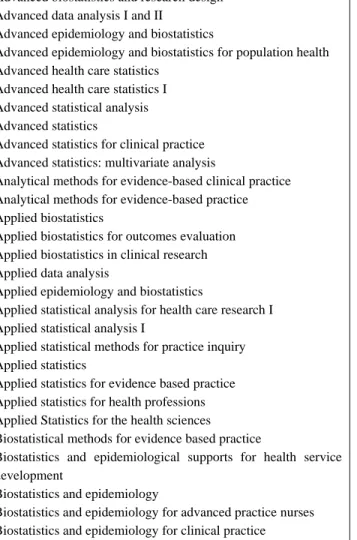
The following information was extracted from the individ-ual program’s website: type of program the school offered, whether a graduate level statistics course was a prerequisite for the MSN-DNP track, and whether a Biostatistics course or biostatistics related course was offered as an individual course listed in the curriculum plan. Any course with the indication of the inclusion of quantitative data analysis was considered as a biostatistics related course as in the instance of quantitative methods for evaluating health care practice, clinical data management and analysis, and analytical meth-ods for evidence based practice (see Table 1).
Table 1.List of different quantitative analysis courses evaluated as Biostatistics course Advanced biostatistics and research design
Advanced data analysis I and II
Advanced epidemiology and biostatistics
Advanced epidemiology and biostatistics for population health Advanced health care statistics
Advanced health care statistics I Advanced statistical analysis Advanced statistics
Advanced statistics for clinical practice Advanced statistics: multivariate analysis
Analytical methods for evidence-based clinical practice Analytical methods for evidence-based practice Applied biostatistics
Applied biostatistics for outcomes evaluation Applied biostatistics in clinical research Applied data analysis
Applied epidemiology and biostatistics
Applied statistical analysis for health care research I Applied statistical analysis I
Applied statistical methods for practice inquiry Applied statistics
Applied statistics for evidence based practice Applied statistics for health professions Applied Statistics for the health sciences Biostatistical methods for evidence based practice
Biostatistics and epidemiological supports for health service development
Biostatistics and epidemiology
Biostatistics and epidemiology for advanced practice nurses Biostatistics and epidemiology for clinical practice
Biostatistics for advanced practice in health care Biostatistics for APN
Biostatistics for clinical practice Biostatistics for evidence based practice Biostatistics for healthcare professionals Biostatistics for outcomes evaluation
Biostatistics for outcomes management and evaluation Biostatistics for the advanced health practitioner Clinical data management and analysis
Comparative quantitative research design and methodology Data analysis II
Design and statistical methods for advanced nursing practice EBP methods and techniques
Educational statistics and data processing Epidemiology and Biostatistics
Graduate statistics for advanced practice and research Health statistics and another course advanced statistics Inferential statistics
Integration of healthcare research & statistics Intermediate biostatistics
Stat theory & comp. application I
Intermediate stats for translational nursing research Introduction to biostatistics
Management of health data
Meeting population demands through biostatistics Multivariate Analysis
Nursing Statistics
Practical application of statistics in healthcare Principles of epidemiology and biostatistics Qualitative methods and biostatistics
2.3 Analysis
Analyses was conducted with SPSS version 22.0. Four bi-variate cross-tabulations were produced for the exploration of regional differences. Chi-square testing was performed
for each bivariate relationship. An odds ratio analysis was performed to discover the chance for a program to offer Bio-statistics to DNP students when the program did not request for a graduate level statistics course as a prerequisite.
3. R
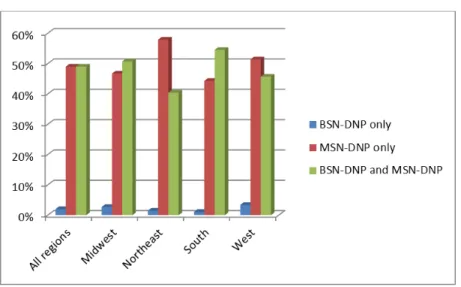
ESULTSFigure 3 shows the type of program by region. At the time of the study, only just five schools (2%) did not offer any other tracks except offered only BSN-DNP; the rest of the schools all offered MSN-DNP track to their prospective students. Among the schools offering MSN-DNP tracks, half of them also provided BSN-DNP track as an option. Schools from the Northeast had a highest percentage of offering MSN-DNP track (57.9%); schools from the South region had the lowest
percentage of offering MSN-DNP track (44.3%).
Among schools with MSN-DNP track, 68.8% of them did not require a graduate level statistics course as a prerequisite for admission (see Figure 1). Schools from the Northeast region (41.5%) were more likely than schools from other regions to require students to take a graduate level statistics course prior to admission. Schools from the South region were the least likely (23.8%) to request a graduate level statistics course as a prerequisite.
Figure 1.Statistics as a prerequisite by region
Throughout the country, there were more schools that offered a Biostatistics course than schools that did not (see Figure 2). Again, schools from the Northeast region had the high-est percentage (69.2%) of programs offering a Biostatistics course to their students compared with schools from other regions. Schools from the Midwest region were least likely
to offer Biostatistics course.
Chi-square analysis was carried out and revealed that there was no significant association between region and type of program offered (Chi-square 3.632, p= .726), region and statistics as a prerequisite (Chi-square 5.358,p= .147), and region and Biostatistics offered (Chi-square 4.308,p= .230).
Figure 2.Biostatistics course offered by region
Figure 3.Type of program by region
Table 2 indicates that 37 out of 220 (17%) programs required students to take a graduate level statistics course prior to ad-mission, and the program also offered a Biostatistics course in the MSN-DNP curriculum. On the contrary, 54 programs (25%) not only did not have a graduate level statistics course as a prerequisite, but also did not have Biostatistics in their DNP curriculum.
Table 2.Graduate level statistic course as a prerequisite by Offering Biostatistics course
Graduate level statistics as a prerequisite Offering Biostatistics Yes f (%) No f (%) Yes 37 (28) 30 (35.7) No 95 (72) 54 (64.3) Total 132 84
Odds ratio was calculated based on the data indicated in Table 2. The odds of offering Biostatistics class were 1.15 (CI 0.902-1.478) times more likely among the schools that did not require graduate level statistics as a prerequisite than those that did have the requirement.
4. D
ISCUSSION AND CONCLUSIONNo statistically significant regional differences in type of program offered, statistics as a prerequisite, and Biostatistics offered were found in the bivariate relationships. This lack of regional differences reflected a uniform presentation of above benchmarks throughout the country. Regardless the origin of the schools, they all moved toward the direction led by both the Essentials and the Roadmap in a coherent manner. Given the newness of this degree program, the even development of DNP curriculum was positive. This lack of regional differences could also further ensure a more reliable
and consistent overall student learning outcome.
Compared with previous study,[9] more schools started to
provide the option of BSN-DNP track, an increase from 59 schools[9] to 125 schools in three years (at the time of this study). The momentum of this transition is clearly evi-denced. The direct pathway from BSN to DNP, eliminating the middle step of MSN, enables schools to implement more vigorous curricula for the students and train them with a higher standard toward the ultimate goal of completing a DNP degree.
The core purpose of the DNP program is to prepare students to be able to translate existing research into practice. Beyond graduate level quantitative analysis skill is critical for DNP students to master. Although compared with three years ago, the percentage of schools requiring students to take graduate level statistics course before admission to DNP program in-creased from 19.9%[9]to 31.3% at the time of this study; the majority of the schools (69.0%) still do not have the specific requirement regarding statistic skills on admission.
According to the odds ratio analysis, schools that did not request graduate level statistics as a prerequisite were more likely to offer Biostatistics course to their DNP students. However, the finding might not be meaningful as the odds ratio included 1. It is possible schools that do not require a graduate level statistic course as a prerequisite for incoming graduate students might make extra effort to equip students with statistics skills through offering their own Biostatistics course; 44% of schools did fit into the above description. However, there were still 54 schools that did not do both. In other words, 25% of the schools not only did not request their students to take a graduate level statistics course prior to admission, nor did they offer a Biostatistics course in the
curriculum.
A prerequisite course itself can add an additional burden to students. Students might have to spend extra money and time to meet the requirement before they apply for the pro-gram. At the same time, there is no clear evidence to support better outcomes for those who have completed a statistic course prior to admission than those who have not.[13] A
general statistics course without emphasizing practical ap-plication and translation analysis might not be relevant to DNP students. Therefore, schools might start to loosen the requirement for a graduate level statistics course as a pre-requisite for their DNP students. However, schools must be creative in weaving quantitative analysis skills into their curricula to meet the requirements listed in the Essentials by AACN if they do not offer a separate Biostatistics course.
Experts involving in statistics education and consulting in nursing programs recommended DNP degree programs to offer their students a course focusing on statistical literacy and reasoning.[5, 14]
This study is limited to the information collected through content analysis of DNP programs’ websites. Details such as whether the program imbedded the skills taught in the course of Biostatistics into courses named implicitly were not reflected in this study. Meanwhile, this study also did not include the programs not having their curriculum available online, which was an inevitable bias of the sampling method chosen.
C
ONFLICTS OFI
NTERESTD
ISCLOSUREThe author declares that there is no conflict of interest.
R
EFERENCES[1] Auerbach DI, Martsolf G, Pearson ML, et al. The DNP by 2015: A study of the institutional, political, and professional issues that facil-itate or impede establishing a post-baccalaureate doctor of nursing practice program. 2014. Available from:http://www.aacn.nche. edu/dnp/DNP-Study.pdf
[2] American Association of Colleges of Nursing. The essentials of doc-toral education for advanced nursing practice. 2006a. Available from: http://www.aacn.nche.edu/dnp/pdf/Essentials.pdf [3] American Association of Colleges of Nursing. DNP roadmap task
force report. 2006b. Available from:http://www.aacn.nche.ed u/dnp/pdf/DNProadmapreport.pdf
[4] National Research Council. Advancing the nation’s health needs. 2005. Available from:https://grants.nih.gov/training/na s_report_2005.pdf
[5] Hayat MJ, Eckardt P, Higgins M, et al. Teaching statistics to nursing students: an expert panel consensus. Journal of Nursing Education. 2013; 52(6): 330-334. PMid:23621121http://dx.doi.org/10. 3928/01484834-20130430-01
[6] West CP, Ficalora RD. Clinician attitudes toward biostatistics. Mayo Clinic Proceedings. 2007; 82(8): 939-943. PMid:17673062http: //dx.doi.org/10.4065/82.8.939
[7] Beebe LA, Neas BR, Asal NR. The health agency training program: Continuing education courses in biostatistics and epidemiology. Pub-lic Health Reports. 2000; 115(4): 370-377.http://dx.doi.org/1 0.1093/phr/115.4.370
[8] Mancuso JM, Udlis KA. Doctor of nursing practice programs across the United States: A benchmark of information: Part II:
Admis-sion criteria. Journal of ProfesAdmis-sional Nursing. 2012; 28(5): 274-283. PMid:23006649http://dx.doi.org/10.1016/j.profnur s.2012.01.002
[9] Udlis KA, Mancuso JM. Doctor of nursing practice programs across the United States: A benchmark of information: Part I: Program characteristics. Journal of Professional Nursing. 2012; 28(5): 265-273. PMid:23006648http://dx.doi.org/10.1016/j.profnur s.2012.01.003
[10] Hayat MJ, Schmiege S, Cook PF. Perspectives on statistics educa-tion: observations from statistical consulting in an academic nursing environment. Journal of Nursing Education. 2014; 53(4): 185-191. PMid:24641080http://dx.doi.org/10.3928/01484834-201 40321-01
[11] Fulton CR, Meek JA, Walker PH. Faculty and organizational charac-teristics associated with informatics/health information technology adoption in DNP programs. Journal of Professional Nursing. 2014; 30(4): 292-299. PMid:25150414http://dx.doi.org/10.1016 /j.profnurs.2014.01.004
[12] United States Census Bureau. Regions and Divisions. 2015. Available from:https://www.census.gov/econ/census/help/geogra phy/regions_and_divisions.html?cssp=SERP
[13] Grace JT, D’Aoust, R. Evidence-based program requirements evalua-tion of statistics as a required course. Nursing Educaevalua-tion Perspectives. 2006; 27(1): 28-33.
[14] Hayat, M. J. Guidelines for assessment and instruction in statistics ed-ucation (GAISE): extending GAISE into nursing eded-ucation. Journal of Nursing Education. 2014; 53(4): 193-198.