Feasibility study on data collection and
analysis in the cultural and creative
sectors in the EU
September 2015
1
This document has been prepared for the European Commission however it reflects the views of the authors only, and the Commission cannot be held responsible for any use which may be made of the information contained therein.
2
Table of Contents
ABSTRACT ... 4
EXECUTIVE SUMMARY ... 5
RESUME ... 12
INTRODUCTION ... 20
CHAPTER 1 - CCS DATA SOURCES: AN OVERVIEW ... 24
1. Introduction ... 24
2. Analysed data sources ... 25
2.1. Official statistics ... 25
2.2. Alternative data sources ... 26
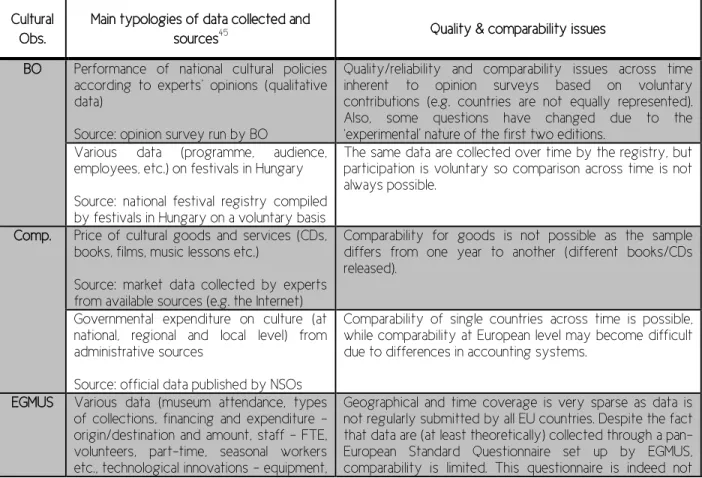
2.3. A focus on Cultural Observatories ... 30
CHAPTER 2 – CCS DATA MAPPING ... 37
1. Introduction ... 37
2. Official statistics: state-of-the-art ... 38
2.1. Data available ... 38
2.2. Major needs and gaps ... 39
3. Mapping of alternative data per sector ... 44
4. Alternative sources for cross-sectoral data ... 60
4.1. Cultural capital ... 60
4.2. Cultural participation ... 61
4.3. Cultural diversity ... 67
4.4. International Trade in Services ... 68
4.5. Finance ... 68
5. Official statistics and alternative sources to fulfill Creative Europe’s indicators requirements ... 69
6. Conclusions ... 72
CHAPTER 3 - CONCLUSIONS, RECOMMENDATIONS AND SCENARIOS ... 82
1. Introduction ... 82
2. Proposed measures ... 86
3. Possible scenarios ... 93
3.1. Scenario 1 – Ensure the sustainability of Eurostat’s work programme on CCS’ statistics ... 93
3.2. Scenario 2 – Capacity building, a CCS Virtual Platform and a Creative Leadership Board ... 95
3
RESOURCES ... 106
1. Consulted experts ... 106
2. Participants to the focus group ... 107
3. Bibliography ... 107
APPENDIX ... 115
1. List of abbreviations ... 115
2. Questionnaire sent to Cultural Observatories ... 116
3. Information sheets on Cultural Observatories ... 122
4. Data on Museums and Libraries, and Publishing from BACH ... 144
4
ABSTRACT
EN - In the last twenty years, significant efforts have been made at the European level to improve statistics for the cultural and creative sectors (CCS). Yet, there remains no systematic means to fully comprehend the value of CCS and their contribution to the European creative economy and knowledge society. This study explores the data available from both Eurostat and ‘alternative’ sources including administrative registers, professional associations and rights management bodies, business registers, ‘big data’ from the Internet and Cultural Observatories. Whilst alternative data do not follow the same quality standards as official statistics, they may help obtain ‘market intelligence’ for a better understanding of the sector’s performance, evolution and competitiveness. Three scenarios are proposed to make the most of existing data: Scenario 1 proposes continuing the work that Eurostat is currently carrying out on CCS to ensure that a minimum number of high quality statistics on these sectors are regularly produced and delivered; Scenario 2 suggests setting up a capacity building scheme to collect more and better quality data from alternative data providers on the basis of identified policy priorities (e.g. promotion of cultural diversity). This scenario foresees also the creation of a Creative Leadership Board acting as an incentive for industry representatives to engage in data collection and a CCS Virtual Platform as a ‘one-stop-shop’ for CCS data; Scenario 3 – the most ambitious one - recommends establishing a CCS Observatory with the mission of improving the collection and comparability of alternative data as well as developing new ‘big data’ methodologies to measure the creative economy. FR - Au cours des vingt dernières années, des efforts substantiels ont été consentis à l’échelle européenne afin d’améliorer les statistiques sur les secteurs culturels et créatifs (SCC). Cependant, il n’existe à ce jour aucun moyen systématique d’appréhender pleinement la valeur des SCC et leur contribution à l’économie créative et à la société de la connaissance au niveau européen. Cette étude recense les données disponibles d’Eurostat ainsi que de sources « alternatives » incluant les registres administratifs, les associations professionnelles, les sociétés de gestion des droits, les registres d’entreprises, le « big data » et les Observatoires Culturels. Bien que les données alternatives ne suivent pas les mêmes standards de qualité que les statistiques officielles, elles peuvent toutefois permettre une meilleure connaissance et compréhension du marché ainsi que de la compétitivité, des performances et évolutions du secteur. Trois scénarios sont proposés afin de mieux exploiter les données existantes : le Scénario 1 propose de poursuivre le travail actuellement effectué par Eurostat dans les SCC afin de s’assurer qu’une somme minimum de statistiques de haute qualité sur ces secteurs est régulièrement produite. Le Scénario 2 suggère la mise en place d’initiatives de renforcement des capacités des fournisseurs de données alternatives afin de collecter plus de données sur les SCC et de meilleure qualité, sur la base de politiques identifiées comme prioritaires (i.e. la promotion de la diversité culturelle). Ce scénario prévoit également la création d’un Conseil de Direction Créatif qui inciterait les représentants de l’industrie à prendre part à la collecte de données, et une plate-forme virtuelle en guise de guichet unique pour les données des SCC. Le Scénario 3 – le plus ambitieux – recommande la création d’un Observatoire des SCC ayant pour missions d’améliorer la collecte et la comparabilité des données alternatives ainsi que de développer des nouvelles méthodologies relatives au « big data » pour mesurer l’économie créative.
5
EXECUTIVE SUMMARY
Context
In the last twenty years, efforts have been made to improve the volume, range and quality of statistics on the cultural and creative sectors (CCS) at European level. In 1995, the first resolution on the promotion of statistics concerning culture and economic growth was adopted (Council of the EU, 1995). Since then, various technical groups have taken the lead to review methodologies and definitions.
Despite these efforts, the economic and social value of the CCS remains largely underestimated due to the sectors’ specificities: culture and creativity is often embedded in manufactured products (design in a garment or a car) or in popular new media services (digital delivery platforms making available creative ‘content’ such as music, games or films); creative enterprises or cultural entrepreneurs are not satisfactorily captured by statistical tools due to their size, the project-based nature of their activities or their social value (a major feature of cultural activities); furthermore, international classification codes developed since 1950s are often not adapted to capture the CCS and their contribution to innovation, social capital and the immaterial economy. Thus technological and societal evolution questions the validity of systems established to grasp the development of a knowledge society, led by creative talents, intangible values and non-technological innovation.
Methodology
To ‘provide the European Institutions with the necessary information to build sustainable mechanisms for data collection, analysis and delivering with regard to the CCS other than the audio-visual sector in the EU1’ (from
the Terms of References), the following main tasks were undertaken:
- Screening of official statistics from Eurostat and analysis of major needs and gaps;
- Mapping of alternative sources (other than Eurostat’s) as a possible way to address data limitations in European official statistics;
- Benchmarking of Cultural Observatories including the analysis of data collected and their modus operandi as a source of inspiration for future data collection mechanisms;
- Preliminary assessment of needs and gaps as regards data from alternative sources, including Cultural Observatories;
- Development of policy recommendations and three possible scenarios of data collection mechanisms.
6
Main findingsThe scrutiny of Eurostat sources shows that the European Union still has an incomplete and narrow picture of its creative capacity and the contribution of its cultural and creative sectors to its economic and social achievement. As a result, citizens and their political representatives often take the view that investment in culture is not a priority and have difficulties in linking culture and innovation.
The world envies European nations’ abilities to nurture such a large amount of talents and creative businesses or cultural institutions in architecture, fashion, music, design, publishing, advertising, performing arts or animation. They embody Europe’s quality of life, diverse cultures, values and aspirations. This richness drives exports of our intellectual property-based industries (luxury brands and copyright industries) or cultural tourism, for example contributing to Europe’s attractiveness.
Whilst the world increasingly relies on the creative economy to drive sustainable growth, EU- wide statistics on CCS provide an incomplete picture. This makes it difficult to consider appropriate policies. Do the CCS contribute to value -creation and jobs? Is Europe competitive in the CCS and well positioned to develop a creative economy? Can we measure CCS’ contribution to innovation? Does the EU do enough to stimulate culture-based creativity? Is the Digital Single Market supporting the development of CCS in Europe and what is its impact on the cultural offer and the diversity of this offer or cultural participation?
A reliable set of data is important to build policies, as this enables the EU to identify the competitive strengths of its CCS and develop a better understanding of market evolution. This is required if the EU is
7
willing to support the development of a creative economy and gain a better understanding of the next generation of industrial activities. It also serves, for instance, to conduct more meaningful trade negotiations or trade promotion activities in third countries.
The study shows that unless more resources are devoted to collect better CCS’ data, at both European and national levels, it will be difficult to achieve a better understanding of CCS and their potential. Mobilisation of financial and human resources is rather challenging as CCS is generally not considered as a priority area of activities by statistical bodies.
In 2014, Eurostat started a four-year work plan (European Commission, 2014c)aimed at the development and regular dissemination of culture statistics taking into account, wherever possible, the recommendations proposed by ESSnet-Culture (2012)2. Under this work plan Eurostat will mainly:
- Open a dedicated section in the Eurostat website (already in operation3);
- Develop routines and estimation procedures for employment4, international trade in cultural goods
and business data;
- Produce and disseminate thematic tables with statistics on employment, international trade in cultural goods and business;
- Identify challenges and possible solutions for the production of continuative culture statistics on international trade in cultural services, cultural participation, private expenditure and public spending in culture;
- Release a new ‘Culture statistics’ Pocketbook (in December 2015).
It is important to provide Eurostat with adequate resources to enable the continuation of its work plan after the 2018 deadline. This work, however, is only a first step towards addressing the main European statistics challenges, namely:
- CCS’ estimates are rarely comparable as EU Member States are still using different definitions of CCS or interpretations of statistical classifications (e.g. NACE classification for economic activities). - Capturing the activities of a very large number of small and micro-companies is statistically
problematic.
- It is notoriously difficult to measure the value of the output of non-industrial sectors such as museums, galleries and libraries but also performing arts.
- Copyright and neighboring rights royalty collection and intangible assets in general (including brand value) are not clearly identifiable from official statistics.
- Detailed data on new distribution and sales patterns or innovative forms of cultural engagement simply fall outside the scope of Eurostat’s surveys;
- European official statistics do not provide a way to measure cultural diversity (whether in production, distribution or consumption).
- Statistical bodies have yet to make the most of exploiting ‘big data’ from Internet activities to map the sector better and fully comprehend the value of the creative economy.
2 The European statistical system network on culture (ESSnet-Culture) was initiated in September 2009 for a two-year period. It was
financed by the European Commission. ESSnet-Culture proposed for the first time a harmonised methodological framework to guide the production of cultural statistics (ESSnet-Culture, 2012).
3http://ec.europa.eu/eurostat/data/database: Database by themes --> Population and social conditions Culture. 4 Already developed and approved for employment by the Cultural Statistics Working Group on 28-29 April 2015.
8
The availability of alternative data sources suggests that there is scope to improve the understanding of the CCS:
Alternative sources explored Examples of potentially retrievable data
Administrative sources Admissions to cultural sites/museums/performing arts
venues.
Business registers Detailed financial data such as Gross Value Added
(GVA) and % of intangible assets in companies. Professional associations
(including rights management bodies)
Sales of ‘mainstream’ and local contents, revenues from digital services (e-sales, downloads, streaming, etc.), copyright royalty collection and distribution.
‘Big data’ providers (Internet) Data on digital ‘practices’ and ‘transactions’ (e.g. social
media statistics, web search trends, etc.).
Cultural Observatories Detailed data on specific sectors (e.g. audiovisual) or
topics (e.g. cultural policies, digitisation of cultural heritage, museums’ staff, admissions and financial structure, etc.).
Alternative data sources would not necessarily help address the ‘structural gaps’ identified in official statistics, but may help obtain ‘market intelligence’ on the sector, its evolution and performance. Alternative sources would help gather data on issues relevant to policy making. Data collection would be driven by policy objectives and priorities rather than by exhaustiveness and comparability objectives which are difficult to achieve. Such policy-led approach presents advantages for justifying the mobilisation of financial and human resources.
However, when implementing alternative data collection mechanisms several limitations have to be taken into account5.
Firstly, geographical coverage will often be limited to some countries as data collection resources greatly vary from one EU Member State to another.
Secondly, as data are not necessarily produced for statistical purposes, internationally agreed definitions, standards and quality criteria (such as the Quality Assurance Framework of the European Statistical System) are often not applied by alternative data providers.
Thirdly, alternative data are often not comparable with official statistics, and not even between countries within the same dataset.
5It is very important to collect reliable and comparable data from the perspective of complementing official statistics with alternative
sources. In the context of this study, however, it was not possible to fully assess important aspects including accessibility, coverage, bias, confidentiality, etc. of alternative sources. Moreover, further research would be needed to verify the sustainability and continuity of data supply.
9
Finally, accessibility is an issue for various kinds of data sources. Business registers, in particular, are only accessible against payment of a fee.
Recommendations
The report proposes measures to address and remedy the main shortcomings identified in the study with a view to providing European institutions with more and better data on CCS, on a regular basis. The objective is to build on the statistical work already achieved while taking into account budgetary constraints. They mainly aim at:
- Reconsidering CCS in international statistical classifications; - Better measuring the sector and capturing its specificities;
- Collecting statistical data from alternative data sources, such as sectoral and trade associations, right management bodies, business registers and the Internet ‘big data’ to help gain a better understanding of the sector;
- Refining the quality and comparability of data from alternative sources;
- Providing EU institutions with new collection tools to complement Eurostat’s activities and regularly provide policy-related statistical evidence (notably on cultural participation and diversity).
Considering EU’s global competitive position in the CCS there is a strong case for improving statistical information at EU level.
Two categories of proposals are put forward:
- Measures to get more detailed statistical data and data relevant to market development;
- Measures to gather alternative data and develop indicators to serve the implementation of cultural policy priorities.
For the second set of measures, two policy priorities are used as a way of illustrating how policy objectives would help prioritise and limit data collection. The priorities would be, on the one hand, the increase in cultural participation and, on the other hand, the promotion of cultural diversity. The setting of priority policy objectives is a convenient way to limit and prioritise resources invested in data collection.
10
1. Improve overall statistical information on CCS1.1. Improve coverage of
CCS in
economic statistics
Invite Eurostat in coordination with NSIs to propose amendments to existing international codes in relation to video games and music, when a revision of this classification will take place in the relevant international bodies (notably the UN Expert Group on international statistical classifications and United Nations Statistics Division (UNSD) for ISIC/NACE)6; Engage with national institutions, foundations and trade associations to work out more and
better statistical definitions with a view to addressing statistical gaps (e.g. in the fashion and crafts industry, and the rapidly evolving sectors of music and video games);
Encourage and support NSIs as well as Eurostat’s efforts to enter into dialogue with the museums’ and libraries’ representatives (e.g. EGMUS and EBLIDA) to develop appropriate definitions and data collection capacities;
Commission the development of relevant methodologies to gather key economic data from major art festivals in Europe (film, music, performing arts);
Entrust a specialised research centre or ad hoc structure to be set up to develop ‘big data approaches’ to improve the mapping of the sector.
1.2. Improve data on cultural employment
Invite Eurostat in coordination with NSIs to propose amendments to existing ISCO codes, for example in relation to art crafts, when a revision of this classification will take place in the relevant international bodies (notably the International Labor Organisation (ILO))7; Gather data on volunteers in museums with the help EGMUS, and build on EGMUS’ initial
cooperation with Eurostat to adopt appropriate methods to attach a monetary value to volunteers’ time and better assess the GVA of the museum sector.
1.3. Improve coverage of sales and usage patterns linked to digital delivery methods
Engage with European trade and professional associations, rights management bodies but also foundations and public institutions such as Cultural Observatories, to get economic data, especially on sectors which have been particularly affected by the digital shift (i.e. music, publishing and video games);
Engage with large companies and private data providers such as Nielsen (which owns a rich database on music sales including online), or e-commerce and streaming platforms to obtain more in depth data on the sector’s new sales patterns (e.g. downloads, streaming, etc.) and cross-border trade of cultural products and services.
2. Development of data sets to address policy priorities
2.1. Data to
measure cultural participation
Regularly gather data on attendance at a sample of major European museums and heritage sites across the European Union, from NSIs or museums/heritage sites themselves;
Engage with relevant organisations in Europe to measure cultural participation in the field of performing arts (e.g. European Festival Association (EFA), Culture Action Europe (CAE); International Network for Contemporary Performing Arts (IETM); Creative-Europe projects); Make use of social media and Internet data (e.g. search trends data on Google) to monitor
new forms of engagement in cultural activities within the limits of confidentiality and data
6 NACE classification is fully compatible with the UN ISIC (International Standard Industrial Classification, in custody of United
Nations). A revision of NACE can be started only after revision of ISIC, managed by UN. For the moment there are no plans of revision for this classification. Such amendment processes would require several years before an agreement is reached.
7 The custodian of ISCO is ILO and Eurostat has no power of decision on starting a revision of this classification. For the moment
there are no plans of revision for this classification. Such amendment processes would require several years before an agreement is reached.
11
protection rules; Build capacities amongst alternative data providers, including the beneficiaries of the Creative Europe programme, to collect more and better data on cultural participation with a view to fulfilling Creative Europe’s indicators requirements.
2.2. Data to
measure cultural diversity
Agree on a common definition of diversity and list of key indicators through more research in the domain;
Make use of Eurobarometer surveys to collect a minimum amount of regular data on diversity (e.g. European citizens watching films in original language);
Collect potentially retrievable data on produced diversity, distributed diversity and consumed diversity from alternative data sources;
Engage with private companies to obtain additional data on the topic (e.g. Nielsen, Spotify or iTunes and geographical distribution of music downloads/streaming);
Ultimately mandate an ad hoc institution (e.g. a CCS Observatory) to regularly measure cultural diversity in Europe through the agreed indicators and existing data sources.
The study proposes three scenarios intended as a plan of action to improve collection, analysis and delivery of CCS data.
Each scenario addresses a number of gaps, adding each time a level of ‘improvement’:
- Scenario 1 addresses the sustainability of Eurostat’s current work and proposes to continue such work beyond 2018 to ensure that a minimum amount of high quality statistics on the sector are regularly produced and delivered;
- Scenario 2 answers capacity building needs with a view to enable usage of alternative data sources. This scenario proposes the setting up of a CCS Virtual Platform as a ‘one-stop-shop’ gathering data on a voluntary basis, and the establishment of a Creative Leadership Board composed mainly of trade organisations to work with the European Commission on data collection related to identified policy themes;
- Scenario 3 proposes the setting up of a dedicated CCS Observatory to improve data collection and comparability from alternative data sources as well as make use of ‘big data’ for the development of new methodologies to improve the mapping of the creative economy and measure new forms of cultural participation (e.g. through social media).
The three scenarios are not exclusive but are considered as three-steps of a process to collect a more comprehensive set of data on CCS. They are inspired by existing and successful schemes managed at European level for some years.
12
RESUME
Contexte
Au cours des vingt dernières années, des efforts importants ont été consentis afin d’accroître le volume, la diversité et la qualité des statistiques sur les secteurs culturels et créatifs (SCC) à l’échelle européenne. En 1995, fut adoptée une première résolution portant sur la promotion des statistiques concernant la culture et la croissance économique (Conseil de l’UE, 1995). Depuis lors, de nombreux groupes de travail ont pris l’initiative de réviser les méthodologies et définitions applicables.
En dépit de ces efforts, la valeur économique et sociale des secteurs culturels et créatifs demeure en grande partie sous-estimée, du fait des spécificités propres au secteur : la culture et la créativité sont souvent intrinsèques aux produits manufacturés (i.e. le design d’un vêtement ou d’une voiture) ou aux nouveaux services de medias (i.e. des plates-formes numériques fournissant un « contenu » créatif comme de la musique, des jeux vidéo ou des films). En conséquence, la valeur des entreprises culturelles et créatives n’est pas capturée en manière satisfaisante par les outils statistiques, en raison de leur taille, de leur nature basée sur des projets, ou de leur valeur sociale (une caractéristique fondamentale des activités culturelles). En outre, les classifications internationales, développés depuis les années 1950 ne sont pas toujours en mesure d’’apprécier’ les secteurs culturels et créatifs dans leur contribution à l’innovation, au capital social et à l’économie immatérielle de manière générale. Les évolutions technologiques et sociétales posent un défi à la pertinence des systèmes statistiques adoptés pour saisir le développement d’une société de la connaissance, dépendante de talents créatifs, de valeurs intangibles et de l’innovation non technologique.
Méthodologie
Afin de « fournir aux institutions européennes les informations nécessaires à la conception de mécanismes durables de collecte, d’analyse et de livraison des données relatives aux SCC (exception faite du secteur audiovisuel) dans l’UE8 » (issu des termes de références), les tâches principales suivantes ont été entreprises:
- L’analyse des statistiques officielles d'Eurostat et l’analyse des besoins et des lacunes majeures ; - le recensement (mapping) de sources alternatives (i.e. outre celles d’Eurostat) comme recours aux
limites des données issues des statistiques officielles européennes ;
- l’étude comparative (benchmarking) d’Observatoires Culturels incluant l’analyse des données collectées et leur fonctionnement comme source d’inspiration pour les futurs mécanismes de collecte ;
- l’évaluation préliminaire des besoins et des lacunes en ce qui concerne les données provenant de sources alternatives, y compris les Observatoires Culturels ;
- l’élaboration de recommandations stratégiques et de trois scenarios possibles de mécanismes de collecte de données.
8 Le secteur audiovisuel est déjà largement couvert par l’Observatoire européen de l’audiovisuel (OEA) :
13
Principales conclusionsL’examen des sources d’Eurostat montre que l’Union Européenne dispose d’un aperçu encore incomplet et limité de sa capacité créative et de la contribution de ses secteurs culturels et créatifs à sa performance économique et prospérité sociale. En conséquence, les citoyens et leurs représentants politiques estiment que l’investissement dans la culture n’est pas une priorité et peinent à concevoir un lien entre la culture et l’innovation.
Pourtant, le monde entier envie aux nations européennes leur capacité à cultiver un si grand nombre de talents et à générer autant d’entreprises créatives et d’institutions culturelles dans l’architecture, la mode, la musique, le design, l’édition, la publicité, les arts du spectacle ou l’animation. Ceux-ci incarnent la qualité de vie en Europe, la diversité des cultures, mais aussi les valeurs et aspirations européennes. Cette richesse est à l’origine des succès commerciaux de nos industries fondées sur la propriété intellectuelle (les marques de luxe comme les industries du droit d’auteur) ou le tourisme culturel, par exemple, qui contribuent grandement à l’attractivité de l’Europe.
Tandis que le monde repose de façon croissante sur l’économie créative afin de générer une croissance durable, les statistiques européennes sur ces secteurs n’offrent qu’un reflet incomplet de la réalité, compliquant de fait l’élaboration de politiques appropriées. Les SCC contribuent-il à la création de valeur et à l’emploi ? Les SCC sont-ils compétitif et l’Europe est-elle à même de développer une économie créative ? Peut-on mesurer la contribution du secteur culturel et créatif à l’innovation ? L’UE déploie-t-elle assez d’efforts pour stimuler la « créativité culturelle » ? Le marché unique numérique soutient-il le développement des secteurs culturels et créatifs en Europe ? Quel est l’impact du marché unique numérique sur l’offre culturelle et sa diversité ou la participation culturelle ?
14
Ressembler un ensemble fiable de données est important afin de pouvoir concevoir des politiques, dans la mesure où il permet à l’UE d’identifier les atouts concurrentiels de ses secteurs culturels et créatifs et de développer une meilleure compréhension de l’évolution du marché. Ceci est indispensable si l’UE est déterminée à soutenir le développement de l’économie créative et à mieux appréhender la prochaine génération d’activités industrielles. Il s’agit également, par exemple, de mener des négociations commerciales ou des actions de promotion commerciale dans les pays tiers de façon mieux informée.
Sans davantage de ressources allouées à la collecte de données de qualité sur les secteurs culturels et créatifs, tant au niveau national qu’au niveau européen, il sera difficile d’obtenir une meilleure compréhension de ces secteurs et de leur potentiel. La mobilisation de ressources financières et humaines est d’autant moins aisée que les secteurs culturels et créatifs ne sont généralement pas considérés comme un domaine d’activité prioritaire par les organismes statistiques.
En 2014, Eurostat a lancé un programme de travail quadriennal (European Commission, 2014c) dans le but de développer et diffuser de manière régulière des statistiques culturelles en tenant compte, autant que possible, des recommandations suggérées par le groupe de travail ESSnet-Culture (2012)9. Le plan de travail définit
l’action d’Eurostat comme suit:
- L’ouverture d’une section consacrée aux secteurs culturels et créatifs sur le site Internet d’Eurostat (déjà opérationnelle) ;
- Le développement de procédures d’estimation pour les données sur l’emploi, le commerce international des biens culturels et les entreprises ;
- La production et la diffusion de tableaux thématiques de statistiques portant sur l’emploi, le commerce international des biens culturels et les entreprises ;
- l’identification des défis et possibles solutions pour la production continue de statistiques culturelles sur le commerce extérieur de services, la participation culturelle, et les dépenses culturelles publiques et celles des ménages ;
- La publication d’un livre de poche « Statistiques culturelles » (en décembre 2015).
Il est important de fournir à Eurostat des ressources adéquates pour permettre la pérennisation de son programme de travail après la date butoir de 2018. Cependant, ce programme n’est qu’une première étape dans l’optique de relever les défis propres aux statistiques européennes, à savoir :
- La comparabilité des estimations statistiques relatives aux secteurs culturels et créatifs entre Etats membres, lesquels utilisent des définitions différentes ou des interprétations divergentes des codes statistiques internationaux ;
- Les limites posées par la mesure des activités d’un grand nombre de petites et microentreprises ; - La mesure problématique de la valeur créée par des secteurs non industriels tels que les musées,
galeries, bibliothèques, mais aussi les arts du spectacle ;
- Les difficultés à faire apparaître les redevances de droit d’auteur et de droits voisins ainsi que les actifs incorporels en général (valeur de la marque incluse) dans les statistiques officielles ;
- La difficulté tient à l’obtention de données détaillées sur les nouveaux modèles de distribution et de vente ou sur des formes innovantes d'engagement culturel via les enquêtes Eurostat (qui ne les prennent pas en compte);
- L’incapacité à mesurer la diversité culturelle (tant en termes de production que de distribution) dans les statistiques officielles ;
9 Le réseau du système statistique européen sur la culture (ESSnet-Culture) a été lancé en Septembre 2009 pour une période de
deux ans. Il a été financé par la Commission européenne. ESSnet-Culture a proposé pour la première fois un cadre méthodologique harmonisé pour guider la production de statistiques culturelles (ESSnet-Culture, 2012).
15
- L’exploitation limitée, par les organismes statistiques, de « big data » dérivé des activités en ligne afin de mieux couvrir le secteur et appréhender pleinement la valeur de l’économie créative.
La disponibilité des sources de données alternatives suggère qu’il est possible d’améliorer notre compréhension du secteur culturel et créatif.
Sources Alternative explorées Exemples de données potentiellement accessibles
Sources administratives Fréquentation des sites culturels/ musées/ salles de
spectacle.
Répertoires d’entreprises Données financières détaillées telles que la valeur ajoutée
brute ou le pourcentage d’actifs incorporels des sociétés.
Associations professionnelles (sociétés de gestion des droits incluses)
Ventes de contenus « grand public » et local, revenus générés par les services numériques (ventes en ligne, téléchargements, streaming, etc.), collecte des redevances de droit d’auteur et distribution.
Fournisseurs de « big data » (Internet) Données sur les pratiques et transactions numériques (i.e.
statistiques sur les réseaux sociaux, tendances de recherches en ligne, etc.).
Observatoires culturels Données détaillées sur des secteurs spécifiques
(i.e. audiovisuel) ou des sujets (i.e. politiques culturelles, numérisation du patrimoine culturel, ressources humaines des musées, fréquentations et structures financières, etc.).
Les sources de données alternatives ne serviraient pas nécessairement à combler les lacunes structurelles identifiées dans les statistiques officielles, mais permettraient de développer une meilleure connaissance du marché de l’économie créative, ainsi que son évolution et ses performances. La collecte de données serait guidée par des objectifs et des priorités politiques définies plutôt que par des objectifs d’exhaustivité et de comparabilité difficiles à atteindre: la collecte motivée par des priorités présente l’avantage de faciliter la justification de la mobilisation des ressources financières et humaines.
Néanmoins, plusieurs limites doivent être prises en compte dans la mise en œuvre de mécanismes alternatifs de collecte de données10.
Premièrement, la couverture géographique sera souvent limitée à quelques pays, du fait de la variabilité des ressources allouées aux activités de collecte de données d’un Etat membre à un autre.
Deuxièmement, les données n’étant pas nécessairement produites à des fins statistiques, les définitions, standards et critères de qualité (tels que le Cadre d'assurance qualité du Système Statistique Européen) ne sont souvent pas mis en œuvre par les fournisseurs de données alternatives.
10 Il est très important de recueillir des données fiables et comparables dans la perspective de complémenter les statistiques
officielles avec des sources alternatives. Cependant, dans le cadre de cette étude, il n’a pas été possible d’évaluer pleinement des aspects important comme l’accessibilité, la couverture, le biais, la confidentialité, etc. des sources alternatives. En outre, des recherches supplémentaires seraient nécessaires pour vérifier la pérennité et la continuité de la fourniture de données.
16
Troisièmement, les données alternatives ne sont souvent pas comparables aux statistiques officielles ni entre les Etats au sein d’un même ensemble de données.
Enfin, l’accessibilité demeure un obstacle pour une variété de données. L’accès aux registres d’entreprises, en particulier, est souvent payant.
Recommandations
Le rapport propose des mesures pour remédier aux principales faiblesses identifiées dans l’étude, dans l’optique de fournir aux institutions européennes de meilleures données sur les secteurs culturels et créatifs, qualitativement comme quantitativement, et sur une base régulière.
L’objectif est de s’appuyer sur les travaux statistiques déjà réalisés tout en tenant compte des contraintes budgétaires. Ces mesures ont pour objectif de :
- Reconsidérer la classification des secteurs culturels et créatifs dans les systèmes statistiques internationaux ;
- Améliorer les statistiques officielles afin de mieux mesurer ces secteurs et en identifier les spécificités ;
- Collecter des données statistiques issues de sources alternatives en provenance des associations et organisations professionnelles, des sociétés de gestion des droits, des registres d’entreprises et le « big data » dans le but de mieux comprendre le secteur ;
- Affiner la qualité et la comparabilité des sources de données alternatives ;
- Fournir aux institutions de l’UE de nouveaux outils de collecte aptes à compléter les activités d’Eurostat et fournir des preuves statistiques en lien avec les politiques menées (notamment sur la participation et la diversité culturelle).
Au regard de la position concurrentielle de l’UE au niveau international, l’amélioration de l’information statistique sur les secteurs culturels et créatifs est un objectif évident.
Deux catégories de propositions sont avancées :
- Des mesures destinées à obtenir des données statistiques plus détaillées et pertinentes au regard de l’évolution du marché ;
- Des mesures pour rassembler des sources alternatives et élaborer des indicateurs à même d’assister la mise en œuvre des priorités de la politique culturelle.
Pour le second groupe de mesures, deux politiques prioritaires servent à illustrer comment les objectifs des politiques aideraient à prioriser et limiter la collecte de données. Les priorités seraient, d’une part, l’augmentation de la participation culturelle et, d’autre part, la promotion de la diversité culturelle. Fixer des politiques prioritaires est un moyen pratique de limiter et prioriser les ressources investies dans la collecte de données.
17
1. Améliorer l’ensemble des informations statistiques sur les SCC
1.1. Mieux couvrir les SCC dans les
statistiques économiques
Inviter Eurostat, en coordination avec les instituts nationaux de statistique (INS), à proposer des amendements aux systèmes de classification existants pour les jeux vidéo et la musique quand la révision de ces systèmes aura lieu au sein des organismes internationaux pertinents (notamment le Groupe d'experts sur les classifications statistiques internationales des Nations Unies et la Division de statistique des Nations Unies (DSNU) pour CITI/NACE)11 ; Mieux collaborer avec les institutions nationales, les fondations et les associations
professionnels afin de rassembler de meilleures données statistiques qui combleraient les lacunes existantes notamment dans l’industrie de la mode et de l’artisanat, et dans les secteurs en rapide évolution tels que la musique et les jeux vidéo ;
Encourager et soutenir les efforts des INS et d’Eurostat dans leur dialogue avec les représentants de musées et de librairies (i.e. EGMUS et EBLIDA) afin de développer des définitions pertinentes et leurs capacités de collecter des données;
Commanditer le développement de méthodologies adéquates afin de recueillir les données économiques clés des principaux festivals artistiques en Europe (film, musique, arts du spectacle);
Confier le développement de méthodologies relatives aux « big data » à un centre de recherche spécialisé ou à une structure créée ad hoc afin d’obtenir un meilleur recensement des secteurs en question.
1.2. Améliorer les données concernant l’emploi dans les SCC
Inviter Eurostat à proposer, en coordination avec les INS, des amendements à la Classification internationale type des professions (CITP), par exemple pour l’artisanat, quand la révision de cette classification aura lieu au sein de l’Organisation Internationale du Travail (OIT)12;
Recueillir des données sur le nombre de bénévoles dans les musées, avec l’aide d’EGMUS, et tirer parti de la coopération initiée entre EGMUS et Eurostat pour adopter des méthodologies appropriées afin d’attribuer une valeur monétaire au temps des volontaires et ainsi évaluer plus efficacement la VAB du secteur muséal.
1.3. Améliorer la prise en compte des ventes et des nouveaux usages numériques
Coopérer avec les associations professionnelles européennes, les sociétés de gestion de droits ainsi qu’avec les fondations et les institutions publiques comme les Observatoires Culturels, afin d’obtenir des données économiques, en particulier sur les secteurs principalement touchés par le passage au numérique (musique, édition, jeux vidéo) ; Coopérer avec les grandes entreprises et les fournisseurs de données privés tels que
Nielsen (qui possède une importante base de données concernant les ventes de musique, incluant les ventes en ligne) ou avec les plateformes de commerce électronique et de streaming, pour obtenir des données plus approfondies sur les nouvelles modalités de vente du secteur (téléchargement, streaming, etc.) et sur les échanges transfrontaliers.
11 La classification NACE est compatible avec la CITI (Classification Internationale Type, sous la garde de l’Organisation des
Nations Unies - ONU). Une révision de la NACE ne peut être démarrée qu'après la révision de la CITI gérée par l'ONU. Pour le moment il n'y a pas de plans de révision de cette classification. Ces procédés de modification exigeraient plusieurs années avant qu'un accord ne soit conclu.
12Le dépositaire de la CITP est l’OIT et Eurostat n'a pas de pouvoir de décision pour initier sur le démarrage d'une révision de cette
classification. Pour le moment, il n'y a pas de plans de révision de cette classification. Ces procédés de modification exigeraient plusieurs années avant qu'un accord ne soit conclu.
18
2. Développement de bases de données qui correspondent aux priorités politiques
2.1. Données mesurant la participation culturelle
Rassembler régulièrement des données sur la fréquentation sur un échantillon représentatif des plus importants musées Européens et des sites d’intérêt historique à travers l’Union Européenne sur la base des données éventuellement disponibles via les INS ou les musées/sites eux-mêmes;
Collaborer avec les organismes de référence en Europe pour mesurer la participation culturelle dans le domaine des arts du spectacle (European Festival Association (EFA), Culture Action Europe (CAE); International Network for Contemporary Performing Arts (IETM); projets Europe Créative) ;
Utiliser les réseaux sociaux et les données Internet (i.e. tendances de recherches sur Google) afin de suivre les nouvelles formes de participation culturelle, dans le respect de la confidentialité et des règles de protection des données ;
Renforcer les capacités des fournisseurs de données alternatives, y compris les bénéficiaires du programme Europe Créative, à rassembler plus de données et de meilleure qualité sur la participation culturelle, en vue de satisfaire les exigences des indicateurs d’Europe Créative.
2.2. Données mesurant la diversité culturelle
S’accorder sur une définition commune de diversité et dresser la liste des indicateurs clés par une recherche ultérieure dans ce domaine ;
Utiliser les enquêtes Eurobaromètre afin de réunir un certain nombre de données régulières sur la diversité (ex : citoyens européens regardant les films en v.o.) ;
Recueillir des données potentiellement récupérables sur la diversité produite, la diversité distribuée et la diversité consommée à partir de sources de données alternatives ;
Collaborer avec des sociétés privées afin d’obtenir des données sur ce thème (ex : Nielsen, Spotify ou bien iTunes et la distribution géographique du téléchargement de musique/streaming) ;
Enfin, mandater une institution ad hoc (ex : un Observatoire CCS) afin qu’elle mesure régulièrement la diversité culturelle en Europe à travers les indicateurs convenus et les sources de données existantes.
L’étude propose trois scénarios conçus comme des plans d’action destinés à améliorer la collecte, l’analyse et la livraison des données sur le secteur culturel et créatif.
Chaque scénario vise à combler les lacunes observées, ajoutant à chaque reprise une plus-value :
- Le scénario 1 a comme objectif d’assurer la pérennité du programme de travail actuel d’Eurostat et propose de continuer ce travail au-delà de 2018, afin d’assurer qu’un minimum de statistiques de haute qualité soient produites et mises à disposition.
- Le scénario 2 répond au besoin de renforcement des capacités dans l’optique de permettre l’utilisation de données alternatives. Ce scénario propose la mise en place d’une plate-forme virtuelle pour les secteurs culturels et créatifs destinée à collecter des données sur une base volontaire, ainsi que l’établissement d’un Conseil de Direction Créatif, composé principalement d’organisations professionnelles qui travailleraient avec la Commission Européenne à la collecte de données en lien avec les thèmes de politiques publiques identifiés.
- Le scénario 3 propose la mise en place d’un observatoire dédié aux secteurs culturels et créatifs dans le but d’améliorer la collecte et la comparabilité des données issues de sources alternatives, mais aussi
19
d’avoir recours au « big data » à des fins de développer de nouvelles méthodologies de recensement de l’économie créative ainsi que de mesurer des nouvelle formes de participation culturelle (i.e. par les réseaux sociaux).
Les trois scénarios ne sont pas exclusifs mais sont considérés comme des étapes successives dans une démarche qui permettrait de récolter un ensemble plus complet de données sur les SCC. Ils sont inspirés des mécanismes existants qui ont fait leurs preuves depuis quelques années à l’échelle européenne.
20
INTRODUCTION
Today, culture is widely recognised as a key asset nurturing both economic and social development, including well-being. The cultural and creative sectors (CCS - see Chapter 1 infra-section 1 for the definition) contribute to 3.3 per cent of the European GDP and employ 6.7 million people (3 per cent of total employment) (European Commission, 2010)13. Its contribution is expected to grow due to the declining role of
the manufacturing sector and the gradual shift from an industrial to a knowledge and service-based economy. From a social point of view, culture strengthens individual and collective identities by preserving memories and traditions. It favours social cohesion by promoting dialogue across different cultures.
Reliable and high quality CCS statistics at European level are necessary to monitor the sector’s economic and social trends and develop evidence-based policies in a wide range of areas including innovation policies. 20 years have passed since the adoption of the 1995 resolution of the European Council on the promotion of statistics concerning culture and economic growth. The 1995 resolution led to the creation of various working groups at technical levels on cultural statistics: the ‘LEG-Culture’ group (1997-2000) was set up, then the Working Group on Cultural Statistics (2001-2004) which led to the publication of the first Eurostat Pocketbook on Cultural Statistics in 2007, and finally the ESSnet-Culture group (2009-2011).
ESSnet-Culture was financed by the European Commission (EC), on initiative of Eurostat (the European Commission’s statistical body) and its coordination was entrusted to the Luxemburg Ministry of Culture. Four task forces were established, each one headed by a Member State. Their work led to the following results: definition of a conceptual framework on culture and its economic activities based on the statistical classifications (Task Force 1); delimitation of a framework for culture statistics in the field of public expenditure and private consumption (Task Force 2); definition of a framework and identification of a methodology for the production of culture statistics in the field of business statistics and employment (Task Force 3); and inventories of sources of cultural practices and social aspects of culture (Task Force 4). Various recommendations were also issued to ensure better coverage of the sector in Eurostat surveys (particularly in relation to entrepreneurship, employment and cultural participation) as well as to ensure better harmonisation of existing data (e.g. on public and household expenditure) (Deroin, 2011; ESSnet-Culture, 2012).
Eurostat is working on the development and regular dissemination of culture statistics, taking into account, wherever possible, the recommendations proposed by ESSnet-Culture (2012) as part of a new four-year project initiated in 2014 with the support of DG Education and Culture (DG EAC). The project foresees the development of routines and estimation procedures for the production and regular dissemination of employment, international trade in cultural goods and business statistics, as well as the identification of challenges and possible solutions for the continuative production of statistics on cultural participation, international trade in cultural services, and finance (including both private and public spending on culture). This four-year project also requires Eurostat to provide ad hoc support for statistical projects carried out in Member States such as Satellite Accounts (SAs)14. Eurostat supports inter-country collaboration to share
experience in this area.
13 Similar results are found in the first EU-wide mapping of the sector carried out by KEA in 2006 (2.6 per cent of the EU GDP and
3.1 per cent of the total employed population equal to 5.8 million jobs) as well as in more recent studies on the sector: TERA (2014) finds that the CCS contribute up to 4.4 per cent of total EU GDP and 3.8 per cent of total European employment (8.5 million jobs)
and EY (2014) estimates the sector’s economic contribution at 4.2 per cent of Europe’s GDP and 3.3 per cent of the EU’s active
population in terms of employment (7 million jobs).
14 Generally speaking, a Satellite Account permits all the economic activities related to a sector in particular (CCS in this case) to
show up explicitly, rather than keeping them concealed in deeply disaggregated (low level) classification of the National Accounts. This means that SAs filter the National Accounts for (in this case) relevant activities in order to extract/estimate all
culture-21
In June 2015, a new set of data on employment and international trade in cultural goods became available on the Eurostat’s website – in a new dedicated section. A more comprehensive set of information on culture statistics will be published at the end of 2015, in the new edition of the Cultural Pocketbook including three chapters on: population and socio-economic conditions, the economic dimension of culture, and participation in cultural activities and cultural consumption.
The assignment
The preparation of this feasibility study has been requested in the framework of the Regulation establishing the Creative Europe programme (art. 15) (European Parliament & Council of the EU, 2013). Also, cultural statistics have been identified as a priority field of action in the recently adopted Council of the EU’s Work Plan for Culture 2015-2018 (Council of the EU, 2014).
This study has the objective to ‘provide the European institutions with the necessary information to build sustainable mechanisms for data collection, analysis and delivery with regards to the CCS’ other than the audio-visual sector in the EU15’ (from the Terms of References – TOR) with a view to contribute to the
development of evidence-based CCS policies. The specific objectives are to:
- evaluate the availability and quality of data existing in different data sources at European level, including both Eurostat and alternative data sources (such as business registers, professional associations, etc.), and, when possible, cross map findings against Creative Europe’s indicators (European Parliament & Council of the EU, 2013 - art. 18);
- take stock of the organisation, modus operandi and data collection activities from a sample of Cultural Observatories in Europe and beyond to identify best practices and potential synergies in the implementation of a mechanism(s) to provide data at European level;
- identify the needs and gaps for ensuring the availability of data with the highest possible quality; - propose different scenarios leading to the setting up of a mechanism(s) ensuring that CCS data are
made available at European level. The Methodology
To carry out this assignment, KEA undertook the following activities: - Reviewing existing literature on the topic;
- Screening of official statistics from Eurostat16;
related value added while maintaining the National Accounts structure. Therefore a thorough knowledge of the National Accounts system is needed to correctly set up these structures, and this is not straightforward.
Finland was a pioneer in this area (Ministry of Education of Finland, 2009): in 2008, it set up a Satellite Account aiming to determine the share of culture in the Finnish GDP, export, import and the domestic demand. Other EU countries have then developed Satellite Accounts for culture (Spain) or are in the process of creating one (Portugal, Czech Republic and Poland) (Cultural Affairs Committee, 2015).
15 The audio-visual sector is already extensively covered by the European Audiovisual Observatory (EAO): www.obs.coe.int 16 As requested by the TOR, data (both in official and alternative sources) were in particular identified along the following axes:
cultural capital of Europe (i.e. number of museums and heritage sites, UNESCO sites, etc.), entrepreneurial dimension of CCS in the EU (i.e. number of companies), CCS labour market in the EU (i.e. employment, age and gender, etc.), contribution of CCS to the EU economy (i.e. turnover, value added, trade, etc.), cultural diversity and participation in Europe and (to a lesser extent due to the
22
- Identification of data gaps in official EU statistics;- Mapping data from alternative sources as a possible way to address data limitations in official statistics, while taking into account their quality and comparability limits. For the purposes of this study, alternative sources are intended as sources outside (European) official statistics, ranging from administrative sources, to business registers, to trade and professional associations, to ‘big data’ from the Internet, to Cultural Observatories and Creative Europe projects.
- Preparation of an Excel database containing the main bibliographical resources, going from scientific articles, to methodological reports to documentation concerning Cultural Observatories and Creative Europe-supported projects.
The team also carried out interviews with experts in the field and organised a focus group (26 May 2015) to discuss main findings and preliminary scenarios together with the European Commission and the experts associated to this assignment (see full list of experts consulted and participants to the focus group under ‘Resources’ infra-section 1 and 2).
The KEA team was supported by Simon Ellis, former senior section leader at UNESCO Institute for Statistics, who was in charge of the data mapping. The team also worked with an Advisory Board providing inputs to develop the initial conceptual framework and comment on the final scenarios. The Advisory Board was composed of: Hasan Bakhshi, Director of the Creative Economy in Policy & Research department at NESTA; Enrico Giovannini, former Italian Minister and former Chief Statistician at the Organisation for Economic Co-operation and Development (OECD), and Andreas Wiesand, Executive Director at the European Institute for Comparative Cultural Research (ERICarts).
KEA also worked closely with Eurostat who provided KEA with the necessary updated documentation on official CCS statistics. To complement Eurostat’s work, avoid duplications and maximise synergies, KEA focused its research on the identification and assessment of alternative datasets.
To assess alternative data, the metadata standards provided by Eurostat were used as much as possible. Priority was given to the following: statistical population, statistical unit, type of data/survey (sample-based or administrative), time coverage (reference years available), geographical coverage, time lag, frequency of release (annual, etc.), and sampling design in case of sample-based data. The results of the analysis are contained in a separate Excel file.
Considering the limited timeframe (six months) and resources allocated to this mission, the ‘structural’ limits of this study should be highlighted: first, this study covers only European official statistics from Eurostat, whilst national and sub-national data from National Statistical Institutes (NSIs) and sub-national statistical offices are out of its scope. Second, the study does not provide an exhaustive list of alternative sources. On the contrary, it identifies a number of sources across different categories (professional associations, business registers, etc.) showing their potential in terms of data available and how they could help address gaps in official statistics. It also provides a preliminary quality assessment of such sources. It is indeed very important to collect reliable and comparable data in the perspective of complementing official statistics with alternative sources. However, in the context of this study, it was not possible to fully assess important aspects including accessibility, coverage, bias, confidentiality, etc. of alternative sources. Moreover, further research would be needed to verify the sustainability and continuity of data supply. Finally, an exhaustive analysis of private
lack of valuable alternative sources in this area), financing and expenditure on culture (i.e. public expenditure and household expenditure).
23
databases was not possible due to accessibility restrictions. To overcome these limits, the team has relied on the consultation of experts in the field.
Structure of the study
The report is structured in three chapters:
‘Chapter 1 – CCS data sources: an overview’ presents the main features and limits of the data sources identified and analysed throughout this report, that is both official statistics and alternative data sources, including Cultural Observatories.
‘Chapter 2 – CCS data mapping’ looks more closely at the data identified under the different sources. It first presents the state-of-the-art of Eurostat’s statistics in terms of data available and gaps, and then focuses on data available from alternative sources (per sector and per cross-sectoral axes: cultural capital, cultural participation, cultural diversity, trade and finance). It concludes by showing how alternative data could help address the identified gaps, whilst also presenting their limits.
‘Chapter 3 - Conclusions, recommendations and scenarios’ summarises the main findings of the report, suggests measures to improve the range and quality of CCS data in the EU, and proposes three possible scenarios to collect and deliver more and better CCS statistics at the European level.
24
CHAPTER 1 - CCS DATA SOURCES: AN OVERVIEW
1.
Introduction
In Europe, official statistics on the cultural and creative sectors (CCS) can be obtained from National Statistical Institutes (NSIs) and Eurostat, the European Commission’s statistical body which aims to produce harmonised and comparable statistics at EU level.
However, as explained further in the following chapters, official statistics do present some limits due to statistical classifications which are not adapted or detailed enough to capture the nature of cultural and creative activities, or because a great deal of important information on the sector (e.g. on heritage and museums, cultural production in cinema, publishing, arts, etc.) simply falls outside of their scope or cannot always be singled out (e.g. revenues from e-commerce activities or for different kinds of licensed rights – performance, online sales, etc.).
Beyond official statistics, there is much more data on the market than might be expected. Data on CCS can indeed be extracted from various sources (from administrative sources to professional associations to the Internet) which can provide more comprehensive and in (some cases) timely information about CCS than official statistics. Still, alternative data are often ‘partial’ (e.g. because they do not cover all 28 EU Member States), incomparable as well as difficult to access due to private ownership, confidentiality or privacy restrictions. It is therefore unlikely (and not really desirable) that alternative data sources replace official statistics, which are highly valued for their reliability, EU-wide coverage and comparability across countries and time.
Nevertheless, for policy makers as well as statistical bodies, alternative data represents a valuable tool to get a deeper insight into the CCS and inform evidence-based policy making, especially if their quality and comparability is improved. In the course of this mission we came across various cases of cooperation between official statistical institutions and alternative sources (see Box 1 – Destatis’ project to get more and better CCS data from Cultural Observatories (Germany), Box 3 – UK Music: matching industry data and official statistics to better measure GVA in the music sector, and Box 5 – NESTA: a big data approach to measure the video games sector) which provide inspirational examples to make the most of alternative data to better measure CCS. The translation of national experiences into the European context is certainly challenging but worth exploring, taking into account the diversity of the structures and savoir-faire that could be mobilised across countries as well as national specificities.
This study has identified and examined relevant Eurostat and alternative sources to understand how the two could help policy makers better appreciate the characteristics and competitiveness of the sector.
The alternative sources explored include:
- Administrative sources (mainly Ministry records); - Professional and trade associations;
- Rights management bodies and unions; - Business registers;
- ‘Big data’ providers from the Internet; - Cultural Observatories.
25
Two Creative Europe-supported projects devoted to data collection were also examined (‘Cultural Heritage Counts for Europe’ and the European Jazz Network) as a possible additional source of information on the sector, particularly to feed into Creative Europe’s indicator requirements. These are integrated in Chapter 2. In addition to this, other sources which do not necessarily fall into the above mentioned categories are referred to in the study, when relevant (for instance, international surveys carried out by private companies). Before going into the details of the data available per sector from the identified sources, the main typologies of sources explored in this study (official and alternative) and major limits are shortly presented below.
2.
Analysed data sources
2.1.
Official statistics
At the European level, Eurostat has the responsibility to provide statistical information to the institutions of the EU to promote the harmonisation of statistical methods across its Member States and candidates for accession as well as EFTA countries. Eurostat therefore has a major coordination and harmonisation role, as primary data collection is mainly carried out at national level by NSIs (i.e. Eurostat’s surveys collect data from NSIs who in their turn collect data from national surveys or other sources such as business registers or administrative sources).
Data from Eurostat’s surveys are expected to be the most accurate and comparable on the market. Statistical offices are indeed devoted to producing data following the highest statistical standards as set in the Quality Assurance Framework of the European Statistical System (ESS, 2012).
However, various issues make official statistics on CCS problematic. Needs and gaps will be more extensively presented in Chapter 2, but several points deserve to be highlighted:
- Culture is not a sector from a statistical viewpoint, meaning that the sector and related occupations are not readily sized by international statistical standards: NACE17 and ISCO18 codes often aggregate
too many activities which are only ‘partially’ cultural. Extracting the ‘cultural’ part from each code is a major challenge both for cultural experts and professionals (who should correctly define cultural activities) as well as statisticians (who should make sure that the correct proportion of ‘cultural activities’ is identified and extracted from the relevant statistical codes);
- The sector is composed of a high number of small and micro-companies19 (estimated at 90 per cent
of the sector). These are very difficult to measure statistically as they may be 'informal' and their income may be undeclared to tax regimes. If these issues can maybe be ignored for other sectors, they cannot in CCS as micro-companies represent its ‘core’, and even more with the development of the Internet;
- As culture is rarely a priority for statistical offices (the UK is for instance an exception), statistical bodies have not engaged much in delivering sufficient levels of details for data on CCS (e.g. ISCO
17 NACE is the European industry standard classification system consisting of a 6 digit code.
18 The International Standard Classification of Occupations (ISCO) is an International Labour Organization (ILO) classification
structure for organising information on labour and jobs.
19 “A microenterprise is defined as an enterprise which employs fewer than 10 persons and whose annual turnover and/or annual
balance sheet total does not exceed EUR 2 million”. Source: Commission Recommendation 2003/361/EC of 6 May 2003 concerning
26
should be delivered at least at 4-digit level but not all countries do, see Chapter 2 infra-section 2.2) or in processes leading to the revision of international standards20;
- Estimates from countries are often difficult to compare due to different definitions used, which may cover sectors such as gastronomy (not included in the ESSnet’s definition) or even include the same sectors21 to a different ‘extent’: for instance, whilst ESSnet includes only one NACE code for video
games, UK and Sweden include two. Similarly, whilst UK and Sweden include three NACE codes to measure advertising, ESSnet only includes one22;
- Finally, CCS do not only have economic value. The cultural richness of Europe is also about its greatly diverse offer of museums, theatres, films, concerts, books, etc. which are 'ingredients' contributing to creativity and thus to the development of CCS and the EU innovation capacity. Detailed data on cultural production, genres, etc. that would help measure the cultural capital and diversity of Europe are simply outside the scope of European official statistics.
2.2.
Alternative data sources
Administrative sources correspond to sources arising from the public administration (at natio