i
CALIBRATION OF SOUND SOURCE LOCALISATION FOR ROBOTS USING MULTIPLE ADAPTIVE FILTER MODELS OF THE CEREBELLUM
Mark David Baxendale
A thesis submitted in partial fulfilment of the requirements of the University of the West of England, Bristol, for the degree of Doctor of Philosophy
Bristol Robotics Laboratory, Faculty of Environment and Technology, University of the West of England, Bristol, United Kingdom
ii Abstract
The aim of this research was to investigate the calibration of Sound Source Localisation
(SSL) for robots using the adaptive filter model of the cerebellum and how this could be automatically adapted for multiple acoustic environments. The role of the cerebellum has mainly been identified in the context of motor control, and only in recent years has it been recognised that it has a wider role to play in the senses and cognition. The adaptive filter model of the cerebellum has been successfully applied to a number of robotics applications but so far none involving auditory sense. Multiple models frameworks such as MOdular Selection And Identification for Control (MOSAIC) have also been developed in the context of motor control, and this has been the inspiration for adaptation of audio calibration in multiple acoustic environments; again, application of this approach in the area of auditory sense is completely new. The thesis showed that it was possible to calibrate the output of an SSL algorithm using the adaptive filter model of the cerebellum, improving the performance compared to the uncalibrated SSL. Using an adaptation of the MOSAIC framework, and specifically using responsibility estimation, a system was developed that was able to select an appropriate set of cerebellar calibration models and to combine their outputs in proportion to how well each was able to calibrate, to improve the SSL estimate in multiple acoustic contexts, including novel contexts. The thesis also developed a responsibility predictor, also part of the MOSAIC framework, and this improved the robustness of the system to abrupt changes in context which could otherwise have resulted in a large performance error. Responsibility prediction also improved robustness to missing ground truth, which could occur in challenging environments where sensory feedback of ground truth may become impaired, which has not been addressed in the MOSAIC literature, adding to the novelty of the thesis. The utility of the so-called
cerebellar chip has been further demonstrated through the development of a responsibility predictor that is based on the adaptive filter model of the cerebellum, rather than the more conventional function fitting neural network used in the literature. Lastly, it was demonstrated that the multiple cerebellar calibration architecture is capable of limited self-organising from a de-novo state, with a predetermined number of models. It was also demonstrated that the responsibility predictor could learn against its model after self-organisation, and to a limited extent, during self-organisation. The thesis addresses an important question of how a robot could improve its ability to listen in multiple, challenging acoustic environments, and recommends future work to develop this ability.
iii
Acknowledgements
I would like to thank my Director of Studies, Tony Pipe, along with my other supervisors, Mokhtar Nibouche, Martin Pearson and Emanuele Secco, who were a first class supervision team. Doing a doctorate part time has been very challenging, especially as I live 180 miles from the lab, and their support has been second to none.
I wish to thank Ahmad Sheikh, a graduate of UWE, for his contribution to developing the moving sound source apparatus described in Chapter 6, as part of an internship project. I would also like to thank my line manager, Atulya Nagar, who has supported me throughout the project, providing me generously with time to do the research as well as crucial resources.
I thank my family for their support and encouragement- my wife Sue for her patience and support as I spent any spare moment either away from home doing experiments or sat at the computer; my mother Peggy and my late father Leo, my siblings Martin, Carol, Stephen and Heather as well as my daughter Ellie and son Jacob.
iv
Publications from the thesis
M. D. Baxendale, M. J. Pearson, M. Nibouche, E. L. Secco, and A. G. Pipe, "Self-adaptive Context Aware Audio Localisation for Robots Using Parallel Cerebellar Models," in Towards Autonomous Robotic Systems: 18th Annual Conference, TAROS 2017, Guildford, UK, July 19–21, 2017, Proceedings, Y. Gao, S. Fallah, Y. Jin, and C. Lekakou, Eds., ed Cham: Springer International Publishing, pp. 66-78, 2017.
M. D. Baxendale, M. J. Pearson, M. Nibouche, E. L. Secco, and A. G. Pipe, "Audio Localisation for Robots Using Parallel Cerebellar Models," IEEE Robotics and Automation Letters, vol. 3, pp. 3185-3192, 2018.
Baxendale M.D., Nibouche M., Secco E.L., Pipe A.G., Pearson M.J. (2019), “Feed-Forward Selection of Cerebellar Models for Calibration of Robot Sound Source Localization,” in: Martinez-Hernandez U. et al. (eds) Biomimetic and Biohybrid Systems. Living Machines 2019. Lecture Notes in Computer Science, vol 11556. Springer, Cham
v Contents List of figures ... ix List of tables ... xi Nomenclature ... xii Chapter 1 Introduction ... 13 1.1 Background ... 13
1.2 Novelty of the thesis ... 16
1.3 Aims ... 16
1.4 Objectives ... 16
1.5 Research questions ... 16
1.6 Proposed system and structure of the thesis ... 17
1.7 Publications from the thesis ... 19
Chapter 2 The auditory system and robot audition ... 20
2.1 Introduction ... 20
2.2 The biological auditory periphery ... 20
2.2.1 Modelling the auditory periphery... 21
2.3 Robot Audition ... 23
2.4 Adaptive SSL systems ... 28
Chapter 3 The cerebellum ... 29
3.1 Introduction ... 29
3.2 Structure of the cerebellum ... 29
3.2.1 The “cerebellar chip” ... 30
3.3 Subsumption architecture and the cerebellum ... 31
3.4 The role of the cerebellum in cognition ... 33
3.4.1 The cerebellum and cerebellar-like structures in auditory processing ... 33
3.5 Adaptive filter model of the cerebellum ... 34
3.5.1 Introduction ... 34
3.5.2 Implementation of the adaptive filter model of the cerebellum ... 35
3.6 The cerebellum in motor control ... 36
Chapter 4 Cerebellar calibration ... 38
4.1 Introduction ... 38
4.1.1 Adapted model- whisker map calibration ... 38
vi 4.2 Method ... 48 4.2.1 SSL error ... 50 4.2.2 Ground truth ... 50 4.2.3 Performance measurement ... 52 4.3 Results ... 54
4.3.1 Error introduced by a physical object ... 54
4.3.2 Error introduced with artificial distortion of the SSL output ... 54
4.3.3 Performance with visual feedback ... 55
4.3.4 Performance with pure tone ... 55
4.4 Chapter summary... 62
Chapter 5 Multiple models and internal models ... 63
5.1 Internal models ... 63 5.2 Multiple models ... 63 5.2.1 Introduction ... 63 5.2.2 MOSAIC system ... 66 5.2.2.1 Input/output ... 66 5.2.2.2 Forward model ... 67 5.2.2.3 Responsibility estimator ... 68 5.2.2.4 Inverse model ... 70 5.2.2.5 Responsibility predictor ... 71 5.2.3 Hidden-Markov MOSAIC ... 73 5.3 Chapter summary... 74
Chapter 6 Acoustic context estimation using parallel cerebellar models ... 75
6.1 Introduction ... 75
6.2 Method ... 77
6.3 Results ... 80
6.4 Chapter summary... 82
Chapter 7 Audio localisation using multiple models ... 83
7.1 Introduction ... 83 7.1.1 Responsibility estimation ... 86 7.1.2 System output ... 86 7.2 Method ... 87 7.2.1 Experimental setup ... 87 7.3 Results ... 88
vii
7.3.1 Contexts in which the models were trained ... 89
7.3.1.1 Multiple models versus best single model ... 89
7.3.1.2 Multiple models versus a general single model ... 89
7.3.2 Novel contexts ... 92
7.4 Chapter summary... 93
Chapter 8 Responsibility prediction ... 94
8.1 Introduction ... 94
8.2 Contextual signals ... 95
8.3 RP as part of the overall framework ... 96
8.4 Audio features ... 96
8.5 Method ... 98
8.5.1 Generation of training data... 98
8.5.2 RP simulation ... 99
8.5.3 Function fitting Neural Network implementation ... 99
8.5.4 Feature set reduction ... 100
8.5.4.1 Feature Selection ... 100
8.5.4.2 Manual Feature reduction ... 101
8.5.5 Cerebellum based RP ... 102
8.5.5.1 Parallel fibres ... 104
8.6 Results ... 105
8.6.1 RP simulation ... 105
8.6.2 Performance in contexts in which the models had been trained ... 106
8.6.2.1 Neural network implementation ... 106
8.6.2.2 Cerebellar implementation ... 110
8.6.3 Performance in novel contexts ... 112
8.6.3.1 Neural network implementation ... 112
8.6.3.2 Cerebellar implementation ... 113
8.6.4 Misclassification of the context by the RP ... 114
8.7 Chapter summary... 116
Chapter 9 De-novo learning of multiple models ... 118
9.1 Introduction ... 118
9.2 Method ... 120
9.3 Results ... 121
viii
9.3.2 Three contexts with three models ... 126
9.3.3 RP learning post- de-novo learning... 128
9.4 Chapter summary... 129
Chapter 10 Towards real world environments: bringing it together ... 132
10.1 Introduction ... 132
10.2 Performance in domestic environments ... 132
10.3 Number of models ... 133
10.3.1 Redundant models ... 133
10.3.2 Performance as a function of number of models and contexts ... 134
10.4 Unavailability of the ground truth ... 137
10.4.1 Performance with ground truth missing in one trial... 138
10.4.2 Performance with ground truth missing in the presence of an RP ... 139
10.5 Improving robustness: using other SSL algorithms ... 142
10.6 Chapter summary... 143
Chapter 11 Conclusions and future work ... 144
11.1 Conclusions ... 144
11.2 Limitations of the work ... 147
11.3 Future work ... 148
11.3.1 Development of a practical framework ... 148
11.3.2 Implementation on other platforms ... 148
11.3.2.1 Hardware implementations ... 148
11.3.2.2 Mobile platforms... 149
11.3.3 Extension to 2 or 3 dimensional SSL ... 149
11.3.4 Unavailability of ground truth ... 149
11.3.5 Application of cerebellar calibration to other areas of Robot Audition .. 150
11.3.6 Improving robustness in real-world situations ... 151
11.3.7 Sensor fusion ... 151
11.3.8 Self-organisation ... 151
Chapter 12 References ... 152
ix
List of figures
Figure 1. The overall architecture of the proposed system ... 18
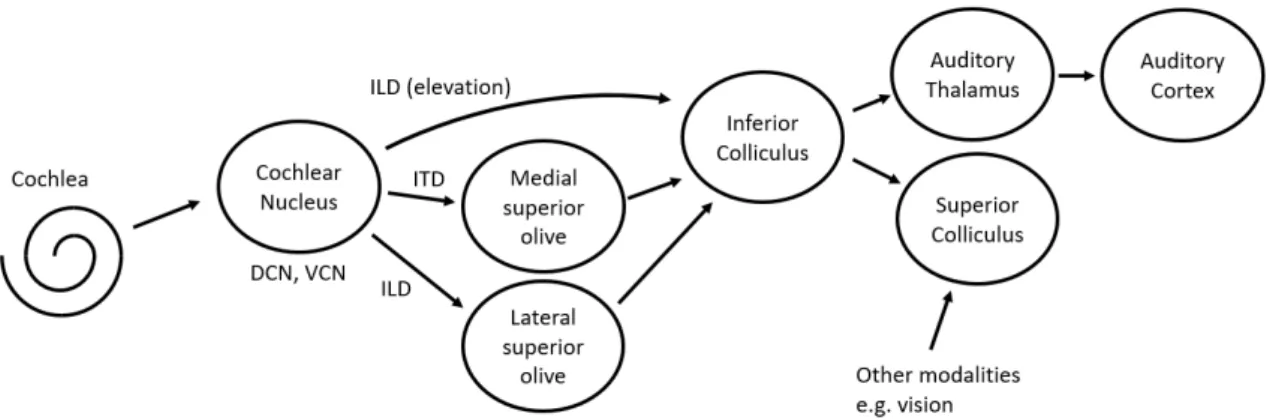
Figure 2. The auditory pathway ... 21
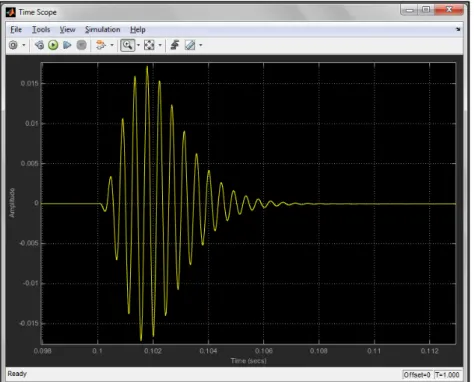
Figure 3. Impulse response of gammatone biquad filter in Simulink. ... 22
Figure 4. Audio map of sound source location in head-centric space ... 25
Figure 5. Determining azimuth 𝜃𝜃 from Inter-aural Time Difference of arrival ... 28
Figure 6. Basic structure of the cerebellar cortex ... 29
Figure 7. Hierarchical layers in subsumption architecture ... 32
Figure 8. Adaptive filter model of the cerebellum ... 37
Figure 9. Bellabot platform ... 39
Figure 10. Architecture of the whisker map calibration system ... 40
Figure 11. Recalibration of a single target map with curvilinear distortion. ... 41
Figure 12. Cerebellar calibration using the adaptive filter model of the cerebellum ... 43
Figure 13. Internal representation of azimuth. ... 44
Figure 14. Parallel fibre activity for two different azimuth errors. ... 46
Figure 15. Cerebellar weights for two different azimuth errors. ... 47
Figure 16. Cerebellar model in learning mode... 48
Figure 17. Experimental apparatus for the cerebellar calibration pilot experiments. ... 52
Figure 18. Experimental arena with obstruction. ... 56
Figure 19. Results of cerebellar calibration in learning mode ... 57
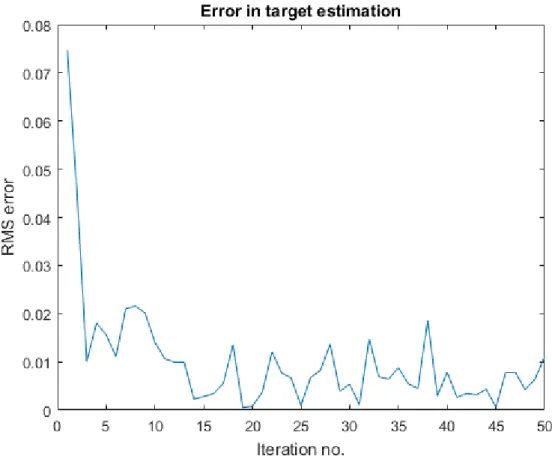
Figure 20. Error in target estimation during learning ... 58
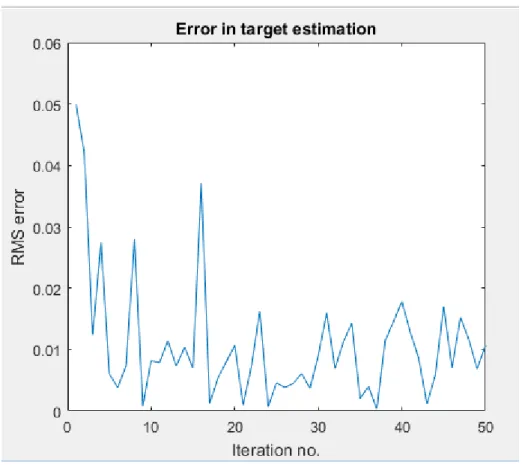
Figure 23. Error in target estimation during learning, using vision ... 61
Figure 24. Image capture from camera during visual ground truth experiment ... 61
Figure 25. MOSAIC framework. ... 67
Figure 26. Multiple models showing only forward models. ... 68
Figure 27. Multiple models showing only inverse models. ... 71
Figure 28. Multiple models showing only responsibility predictors... 72
Figure 29. Multiple-models- inspired context estimation. ... 77
Figure 30. Experimental apparatus using track-mounted sound source. A ... 79
Figure 31. Plan view of the experimental apparatus. ... 79
Figure 32. Plots of sound source azimuth. ... 81
Figure 33. Multiple-models- inspired audio localisation. ... 85
Figure 34. Robot head based on PTU. ... 87
Figure 35. Experimental apparatus using tripod-mounted sound source. ... 88
Figure 36. Responsibility signals as the system progresses through the 15 trials. ... 91
Figure 37. Responsibility signals in novel contexts. ... 93
Figure 38. Responsibility Predictor in the context of the overall system ... 96
Figure 39. The RP NN structure ... 100
Figure 40. Box plot of the mean of zero crossing rate feature in different contexts. .... 102
Figure 41. Cerebellar implementation of the responsibility predictor ... 103
Figure 42. Responsibility signals with simulation of an RP. ... 106
Figure 43. NN RP output using all AAL features ... 107
Figure 44. RP output with 1 audio feature (mean zero crossing rate)... 108
Figure 45. RP output with 6 audio features manually selected. ... 109
Figure 46. RP output with features selected using sequential feature selection. ... 110
x
Figure 48. NN RP output in novel contexts using all AAL features. ... 112
Figure 49. NN RP output in novel contexts using one feature. ... 113
Figure 50. Cerebellar RP output in novel contexts. ... 114
Figure 51. RE posterior correction of RP error ... 116
Figure 52. Cerebellar weights after training in context 1 of two contexts ... 122
Figure 53. Cerebellar weights after training in context 2 of two contexts ... 122
Figure 54. Responsibility signals post- de-novo training ... 123
Figure 55. Responsibility signals after training in slightly less distinct contexts ... 124
Figure 56. Responsibility signals after training in less distinct contexts ... 125
Figure 57. Responsibility signals after training in less distinct contexts with lower range of initial weights ... 126
Figure 58. Responsibility signals post de-novo learning: 3 models... 127
Figure 59. Cerebellar weights post de-novo learning: 3 models. ... 127
Figure 60. Responsibility signals including RP, post de-novo learning. ... 129
Figure 61. Responsibility signals where redundant models are present. ... 135
Figure 62. Performance versus number of models/contexts ... 136
Figure 63. Performance versus number of models/contexts: de-novo models ... 137
Figure 64. Responsibility signals with unavailable ground truth. ... 139
Figure 65. Responsibility signals with unavailable ground truth: using most recent. .. 141
Figure 66. Responsibility signals with unavailable ground truth: RP only. ... 142
Figure 67. Results of cerebellar calibration post-learning: cerebellar calibration versus uncalibrated SSL estimate ... 161
Figure 68. Results of cerebellar calibration post-learning: multiple models versus a single general model: ϕ=-90o ... 163
Figure 69. Results of cerebellar calibration post-learning: multiple models versus a single general model: ϕ=0o ... 165
Figure 70. Results of cerebellar calibration post-learning: multiple models versus a single general model: ϕ=90o ... 167
Figure 71. Results of cerebellar calibration post-learning: multiple models with RP versus multiple models without RP: ϕ=-90o ... 169
Figure 72. Results of cerebellar calibration post-learning: multiple models with RP versus multiple models without RP: ϕ=0o ... 171
Figure 73. Results of cerebellar calibration post-learning: multiple models with RP versus multiple models without RP: ϕ=90o ... 173
xi
List of tables
Table 1. Context identification with multiple models. ... 80
Table 2. Performance of multiple models versus best single model. ... 89
Table 3. Localisation performance of multiple models. ... 91
Table 4. Performance of multiple models with simulated RP. ... 105
Table 5. Localisation performance in domestic contexts ... 133
Table 6. Data set: cerebellar calibration versus uncalibrated SSL. ... 162
Table 7. Data set: multiple models versus single general model, ϕ=-90o. ... 164
Table 8. Data set: multiple models versus single general model, ϕ=0o. ... 166
Table 9. Data set: multiple models versus single general model, ϕ=90o. ... 168
Table 10. Data set: multiple models versus multiple models with RP, ϕ=-90o. ... 170
Table 11. Data set: multiple models versus multiple models with RP, ϕ=0o. ... 172
xii
Nomenclature
α Sound source angle of elevation
αH Hidden-Markov forward probability
β Cerebellar learning rate
βH Hidden-Markov backward probability
γ Responsibility of HMM-MOSAIC module
ξ The set of all possible sequences in HMM-MOSAIC
ϕ Sound source angle of rotation about its vertical axis
θ Azimuthal sound source position
λ Responsibility
σ Softmax scaling factor
ASC Acoustic Scene Classification AAL Audio Analysis Library AEG Auditory Epipolar Geometry
CN Cochlear Nucleus
CASA Computational Auditory Scene Analysis DFT Discrete Fourier Transform
DCN Deep Cerebellar Nuclei, Dorsal Cochlear Nucleus (depending on context) ESR Environmental Sound Recognition
EM Expectation Maximisation FPGA Field Programmable Gate Array
GCC-PHAT Generalized Cross Correlation with Phase Transform HRTF Head Related Transfer Function
HMM Hidden-Markov Model
IC Inferior Colliculus IHC Inner Hair Cells
ILD Inter-aural Level Difference (of sound)
ITD Inter-aural Time Difference (of arrival of sound)
I/O Input/Output
LMS Least Mean Square
LSO Lateral Superior Olive MSE Mean Squared Error MSO Medial Superior Olive
MFCC Mel-Frequency Cepstrum Coefficient
MOSAIC MOdular Selection And Identification for Control
NN Neural Network
OHC Outer Hair Cells PTU Pan-and-Tilt Unit RE Responsibility Estimator RP Responsibility Predictor SFS Sequential Forward Selection SNN Spiking Neural Network SOM Self-Organising Map
ST Scattering Theory
SSL Sound Source Localisation SC Superior Colliculus
SoC System on Chip
SOC Superior Olivary Complex USB Universal Serial Bus VCN Ventral Cochlear Nucleus VLSI Very Large Scale Integration
13
Chapter 1
Introduction
1.1 Background
The main motivation for this thesis was to develop a system that could support a robot in locating sources of sound in its environment, in particular a rescue robot that is attempting to locate survivors in the aftermath of a disaster. Typically, vision is used as the primary sense in the field because it is generally considered to be the most reliable and robust sense available to a robot [1]. However, in extreme or challenging environments such as a disaster site, vision could be impaired by, for example, particles in the air, or the vision sensor(s) could even become impaired through damage. In these situations, other senses, such as audio, could take over, or at least play a more prominent role, until the more reliable sense once again becomes available.
The thesis focuses on Sound Source Localisation (SSL), and in particular, determining the azimuth direction of arrival of sound. The distance to the sound source and its elevation (which, together with the direction of arrival define the location of a sound source in 3 dimensional space; see Figure 4) are not considered. However, as discussed below and later in this thesis, the proposed system should lend itself to including more extensive schemes such as those estimating distance and elevation.
SSL techniques are well established [2] with some quite sophisticated and robust techniques now available. The thesis adopts a basic approach using Interaural Time Difference (ITD) of arrival of sound, which is described in Section 2.3. There are a number of different approaches to SSL and the thesis specifically adopts binaural SSL for reasons outlined in Section 2.3. Such a basic approach is sufficient to demonstrate the utility of the proposed system introduced in the thesis, and the design of the system is such that a more sophisticated SSL algorithm could be easily substituted for the one used. A problem with established SSL techniques is that they are generally designed to operate in well-defined and controlled environments. For a robot operating in the field, especially in disaster situations such as inside a collapsed building, errors will be introduced into the SSL process, due to complex environmental acoustics that are not easily determined, and this error may depend on the azimuth sound source position, perhaps in a non-linear fashion. Even where an SSL system is designed to cope with such errors, they are generally only designed to do so in a particular environment. If the robot moves to a
14
different environment, it is likely that the SSL system designed to compensate for errors introduced by the first environment will be unable to compensate for the errors introduced by the new environment which could display quite different acoustic properties.
There has been growing acceptance that the brain makes use of internal models for motor control and that they are likely to be located in the cerebellar cortex [2, 3], and also that they play a role in non-motor functions, including in perceptual processes [4, 5]. Despite this, there has been no investigation, to the knowledge of the supervision team, into the use of cerebellar models in robot audition. The thesis develops a model of the cerebellum that adapts, or calibrates, the output of an SSL system to compensate for errors introduced by the acoustic properties of the environment that the robot is operating in. A cerebellar model has to learn, through repeated operation in the given environment, with a teaching signal based on its performance error, to calibrate the output of the SSL system. The adaptive filter model of the cerebellum is a type of NN (although later, in Chapter 8, a distinction is made between “standard” NNs and the cerebellar models developed in this thesis). Like a NN it learns through the updating of synaptic weights. It learns to calibrate the SSL system through repeated stimulation by sound from random azimuths, estimating the direction of arrival of the sound, comparing this to the true direction, then updating the synaptic weights (in this case, parallel fibre-Purkinje cell weights as described in Chapter 3) in such a way as to reduce the error in estimation.
The project specifically builds on previous work at Bristol Robotics Laboratory (BRL) and the University of Sheffield; the Bioinspired Control of Electro-Active Polymers for Next Generation Soft Robots (Bella) project [3]. That project used an adaptive filter model of the cerebellum to calibrate a somatosensory (whisker) map on a robot using visual input [4, 5]. The basic thrust of the current project is to add audio input to such a system, and to extend the approach to multiple cerebellar models. The project however does not use the Bella robot (known as Bellabot), although software from that project has been adapted for use in the current project; rather, a version was developed which replaces the whisker sensor system with audio. This is explained in more detail in Chapter 4.
Regarding the multiple-models approach to calibrating the SSL for multiple acoustic environments, there is a problem of how to select the appropriate set of models in a particular acoustic environment. There are a number of approaches, mainly developed in the context of motor control as mentioned above, and the one this thesis focuses on is
15
MOdular Selection And Identification for Control (MOSAIC) [6]. MOSAIC is based on the existence of multiple models, internal to the brain of an animal (or processing unit of a robot) that represent the external world, allowing the prediction of the consequences of some action by the animal or robot. The MOSAIC system refers to modules rather than models, with each module containing separate, specialised models for prediction and control. The system uses the prediction errors, determined through sensory feedback, to select the best modules for future control. This can be applied to the SSL calibration system, so that the best calibration model, or set of models can be selected in a given acoustic environment, based on how well each is able to calibrate the SSL estimate in that environment. The calibration effort of the models can then be combined in proportion to how well each model is able to calibrate the SSL output. A model with a much smaller prediction error (and hence which appears to be the “best” model by a good margin) will tend to dominate control (or rather calibration, in the context of this thesis), with some contribution from the next best model and so on. An environment that elicits a less distinctive response from the models will see control/calibration more equally shared between models. Hence, the focus of the thesis is on developing a system which is able to adapt between environments, rather than show a particular performance in a single environment. The system takes a SSL estimate as one of its inputs (in the case of responsibility prediction, covered in Chapter 8, contextual signals form a second input) and as such the performance of the system will depend on the reliability of the underlying SSL system. SSL systems are particularly vulnerable to environmental acoustics, especially noise and reverberation, and the error in the SSL estimate could be so severe that even calibration as proposed in this work may break down. The decoupling of the system from the underlying SSL system however, means that a different, perhaps more robust system can be “plugged in” as such systems develop.
An early motivation for this work was audio-visual integration, along with a biomimetic modelling of the auditory periphery. The focus moved away from this and towards a multiple-models inspired approach to SSL calibration. Sensor fusion is still in the background, even though it is not used in this thesis; vision is (potentially) used as a means of determining the ground truth sound source position. Full modelling of the auditory periphery was not considered necessary, with a simple SSL algorithm being sufficient to demonstrate the overall idea. A more full modelling of the auditory periphery
16
could of course be re-introduced, particularly in the context of substituting more sophisticated SSL, and as mentioned in Section 2.2.1 could be included in future work. 1.2 Novelty of the thesis
Two key concepts are presented in the thesis as the basis for novelty. The first is calibration of SSL using an adaptive filter model of the cerebellum, and the second is the development of a multiple-models inspired approach (“borrowed” from the field of motor control) to selecting an appropriate set of adaptive filter models of the cerebellum, each of which has learned to calibrate the SSL system in a particular acoustic environment, or context, to suit the context that the robot finds itself in. A further, secondary area of novelty that emerged later in the project is the development of a Responsibility Predictor
(RP) that is also based on the adaptive filter model of the cerebellum, rather than the more conventional function fitting Neural Network (NN, Section 8.5.5) found in the literature. 1.3 Aims
The main aim of the thesis is to develop a system capable of calibrating an SSL system for multiple acoustic environments using multiple adaptive filter models of the cerebellum.
A secondary aim of the thesis is to further demonstrate the utility of the so-called “cerebellar chip” [7-9] in a new area.
1.4 Objectives
1. Development of a binaural SSL algorithm 2. Development of cerebellar calibration of SSL
3. Development of a multiple-models approach to cerebellar calibration a. Development of a context estimation sub-system
b. Development of a multiple model based SSL calibration sub-system c. Development of a responsibility prediction sub-system
d. Investigation of de-novo learning of the cerebellar models
4. Design and performance of SSL experiments based on each developed system or sub-system.
1.5 Research questions
17
2. Is it possible to implement a multiple-models inspired architecture that will select an appropriate cerebellar calibration model, or set of models, in different acoustic contexts?
3. Can a multiple-models inspired audio calibration system self-organise? 1.6 Proposed system and structure of the thesis
The thesis draws on three key areas, robot audition, cerebellar models and multiple models. Chapter 2 introduces robot audition with an emphasis on SSL; Chapter 3 covers the cerebellum with an emphasis on the adaptive filter model of the cerebellum; Chapter 5 is a treatment of multiple models with an emphasis on the MOSAIC scheme. Chapter 4, Chapter 6, Chapter 7 and Chapter 8 describe the work carried out to develop the proposed system, which is depicted in Figure 1. In this figure, the main elements are emphasised using blue tint boxes which also indicate the chapters that cover those elements. SSL calibration (Chapter 4) using the adaptive filter model of the Cerebellum addresses research question 1 and the model developed is an adaptation of that used in a previous study to calibrate whisker input to a robot platform [4]. This aspect of the system learns to compensate for errors in the SSL estimate in particular acoustic environments. Figure 1 shows multiple models for completeness, although Chapter 4 itself is based on a single model, as was presented in [4]. Responsibility estimation is covered in Chapter 6 and Chapter 7, and is a fundamental aspect of the development of the work of Chapter 4 into a multiple-models inspired system. Chapter 6 focuses on the use of the responsibility estimator to identify the acoustic context while Chapter 7, the key chapter of the thesis, combines the multiple model outputs to improve the SSL calibration in multiple acoustic environments. Chapter 8 does not strictly address the research questions and was added as the author wished to investigate responsibility prediction, mainly for completeness, although this turned out to produce a quite important finding in terms of missing ground truth. The same can be said for Chapter 9, de-novo learning of the models, which, although it addresses one of the research questions, was included for completeness. A weak area of the thesis is how the system could be moved towards a real world environment, and Chapter 10 starts to investigate this as a possibility, and issues identified are discussed in Chapter 11 where future work is identified.
18
Figure 1. The overall architecture of the proposed system. The blue boxes indicate key components to which a chapter is wholly or partly dedicated.
19 1.7 Publications from the thesis
The work in Chapter 6 was published in Towards Autonomous Robotic Systems: 18th Annual Conference, TAROS 2017.
The work in Chapter 7 and part of the work in Chapter 8 and part of the work in Chapter 10 was published in IEEE Robotics and Automation Letters.
A further part of Chapter 8 was published in Biomimetic and Biohybrid Systems: 8th International Conference, Living Machines 2019.
20
Chapter 2
The auditory system and robot audition
2.1 IntroductionThere is a need for autonomous mobile robots to use a variety of senses to navigate or locate entities in unstructured environments. Typically, vision is used to locate objects in the robot's environment, however, this can break down where vision is obscured. This is a particular issue in disaster situations such as those described in Section 1.1. A number of attempts have been made to allow a robot to navigate by sound alone [2], however these systems are typically set up in a specific acoustic environment and can break down when the robot moves to a new environment.
2.2 The biological auditory periphery
The structure of the animal auditory periphery will be referred to at various points throughout the thesis, and, although only simplified aspects of the auditory system are included, in particular, those concerned with SSL, a brief treatment is useful to set part of the context in which the thesis is positioned. The system described here is mainly based on the mammalian biology, as both the avian and reptilian auditory pathways possess some significant differences. Treatment of the mammalian auditory pathway however, brings out some basic concepts that are relevant to Robot Audition, discussed in Section 2.3.
The primary organ of the inner ear is the cochlea which appears early in the auditory pathway. The basilar membrane that runs the length of the cochlea holds the auditory nerve, which consists of rows of hair cells which transduce the basilar membrane vibration (itself caused by vibration of the tympanic membrane, that is, the “eardrum”, and the ossicles due to variations in air pressure caused by sound) into an electrical waveform. There are two distinct types of hair cell known (because of their orientation) as Inner Hair Cells (IHC) and Outer Hair Cells (OHC). The former plays the major part in the conversion process [10]. A low or high frequency stimulus will cause a peak in vibration amplitude toward the apex and base of the basilar membrane respectively. This in turn will give rise to a peak nerve fibre response to each component at a place along the basilar membrane that is frequency-specific. The function of the cochlea seems to be to analyse the audio stimulus into a number of frequency bands (many thousand in the mammalian cochlea), a function often known as the auditory filter.
21
A somewhat simplified schematic of the auditory pathway is shown in Figure 2. The auditory nerve connects to the Cochlear Nucleus (CN). The CN includes the Dorsal Cochlear Nucleus (DCN1), which appears to be linked to Inter-aural Level Difference
(ILD, Section 2.3) processing and the Ventral Cochlear Nucleus (VCN) which appears to be linked to Inter-aural Time Difference (ITD, Section 2.3) processing. The outputs of the CN connect to the Inferior Colliculus (IC), with some outputs connecting via the
Superior Olivary Complex (SOC), which plays a key role in sound localisation, and itself includes the Medial Superior Olive (MSO), which is linked with ITD processing to determine azimuth, and the Lateral Superior Olive (LSO) which is associated with ILD processing to also determine azimuth. There are connections from the IC to the Superior Colliculus (SC), which plays a key role in the integration of the senses, but with most connections going to the auditory cortex via the Auditory Thalamus.
Figure 2. The auditory pathway. DCN1 is Dorsal Cochlear Nucleus, VCN is Ventral
Cochlear Nucleus.
2.2.1 Modelling the auditory periphery
Although the auditory periphery was not modelled as part of the thesis (except on a very limited scale to implement an SSL algorithm), it is quite possible that this could be included in future work, and it is dealt with here briefly, for completeness. The auditory filter in particular has been extensively modelled, mainly for speech processing, but also more recently for Robot Audition, notably in the Auditory Toolbox [11] and the
Auditory Modelling Toolbox [12], both of which provide Matlab libraries (and Octave in the case of [12]) for the simulation of this and other functions of the auditory pathway.
22
The place coding of the basilar membrane can be modelled electronically as a bank of filters. Models fall predominantly into two categories: a series of electronic filters proposed by Lyon [13] and a parallel bank of filters [14], the latter based on gammatone filters, so called because of the filter impulse response that resembles a
gamma-modulated tone, and is widely accepted to reflect the response of the auditory filter; Figure 3 shows the simulated impulse response of a gammatone filter in Simulink. Filters toward the high frequency end of the bank are characterised by higher frequency tones and shorter decay times versus lower frequency tones and longer decay times toward the low frequency end.
Figure 3. Impulse response of gammatone biquad filter in Simulink.
Approaches to modelling the auditory periphery fall into analogue or digital
implementations. Digital implementations are of course commonplace [15-17]. Lyon’s own implementation of his model was analogue [18] and analogue implementations continue to enjoy popularity [19-21], especially with the development of neuromorphic engineering, proposed by Mead in 1989 [22] in which Very Large Scale Integration
(VLSI) circuits mimic cells in the central nervous system. Initially these were based on analogue devices but neuromorphic systems now also include digital technologies. An example of this is the SpiNNaker Project, a large scale, parallel, spiking NN computing
23
platform [23]. There have been a number of examples of neuromorphic auditory modelling [24-28].
2.3 Robot Audition
Robot Audition is a relatively recent area of research (around 18 years old at the time of writing) focusing on robot hearing [29], and has developed from, and is related to other areas such as Computational Auditory Scene Analysis (CASA) [30], and speech recognition. The newness of this area of research is indicative of the fact that robot vision has dominated research in robot senses, which is understandable given the large amount of data available from devices (image capture devices such as cameras) which are generally low cost and straightforward to use (but which can require significant computing resources to process). Also, the format of the information available through vision sensors makes tasks such as navigation and object localisation relatively straightforward compared to, for example, performing the same task using sound. This is because the sensing array associated with a vision sensor such as a camera has elements that map directly on to positions in the visual scene. This is not possible with audio, especially with the biological auditory system which uses two sensors (ears) and codes sounds from the early stages of the auditory pathway on the basis of frequency content. However, the growing need for robots to operate in the field, that is, in unstructured and unpredictable environments makes the reliance on vision alone sometimes infeasible, especially in extreme environments such as in a disaster situation, and taking into account the processing overhead associated with visual input on a mobile robot which may have limited computing resources.
Robot Audition consists of three key functions: SSL, separation of the sound sources in the audio scene and source recognition [31]. SSL is a low level function forming the basis for higher level functions of source extraction, source recognition and lastly scene reconstruction which is a high level description of the auditory scene [32]. So, although the quite narrow focus of this thesis is on locating sound sources in the robot’s environment, as an end in itself, successful calibration of this task could have significant impact on dependent, higher level functions of Robot Audition.
These functions underpin a number of tasks that a robot might be required to undertake such as speaker and emotion recognition. Much of this research (and hence the tasks
24
focused on) have been motivated by the desire to improve human-robot interaction, and in particular to make this seem more natural.
Robot navigation by sound alone has been well researched [33-36], however the systems described have typically been tested in a specific acoustic environment. Although there are examples of SSL systems that can adapt to different acoustic environments [19, 37-42] it is not clear how well they would perform in a new environment that has not been previously experienced by the robot.
Figure 4 shows the 3D audio map of the robot defined by azimuth θ, elevation α and distance to source. SSL is the process of estimating these parameters that will locate the source of a sound in 3D space, with respect to the robot head, which is located at the centre of a sphere. The thesis considers only 2D (azimuthal) SSL. For convenience, it also only considers sounds that emanate from in front of the robot, rather than behind. Front/back confusion is a particular problem in SSL, and is considered here to be a problem that might be resolved by the appropriate design of the underlying SSL system rather than the system that is the subject of this thesis. As the proposed system includes an adaptation of a previously developed system that calibrated a 2D whisker map, it ought to be possible to extend the SSL calibration system to 2 dimensions, e.g. azimuth and elevation.
The SSL field has been very active over the last 20 years and SSL systems have become quite robust and sophisticated. However, this is largely at the cost of simplicity and size, usually with systems utilising an array of multiple microphones. The thesis specifically eschews microphone arrays and focuses on binaural robot audition. As mentioned in Section 1.1 the system developed here is intended to sit on top of an underlying SSL system. The motivation therefore is towards simplicity, low cost and low computational load, so that a basic binaural system is sought. The SSL approach used in this thesis is based on passive binaural localisation using Inter-aural Time Difference (ITD) of arrival of sounds [43], with microphones mounted in free field, corresponding to Auditory Epipolar Geometry (AEG) [2]. The head related transfer function of the robot head is ignored. If a modular approach is taken, so that the SSL system is not integrated then it should be a simple matter to “plug in” a more sophisticated system (which could even include those utilising microphone arrays, rather than being binaural). The primary auditory cues used in the passive, binaural localisation of sound sources are ITD and
25
Inter-aural Level Difference (ILD) [43]. ILD relies on acoustic shadowing caused by the head of the animal (or robot); as such it is frequency dependent, and is effective for higher frequencies (greater than around 1500 Hz). On the other hand, ITD cues are limited to lower frequencies due to phase ambiguity as the period of the sound wave becomes comparable to the maximum ITD available for a given sensor or ear separation [43]. Sound from a source to either side of the median plane will reach one or other sensor or ear at different times (e.g. a sound originating from a source to the right of the median plane will reach the right ear or sensor before the left). The ITD has a maximum value of around 660μs at an azimuth of 90o in humans [43], representing an inter-aural distance of
around 15cm. This is subject to uncertainty due to environmental influences such as obstruction of the sound source, the acoustic properties of surfaces or damage to or displacement of audio sensors. There are a number of attempts of SSL [20, 26, 44-52], mostly using ITD. Modelling of the ITD is most commonly carried out using the Jeffress model [53].
Figure 4. Audio map of sound source location in head-centric space. Reprinted from [54].© 2018 IEEE.
SSL systems have typically used arrays of multiple microphones [35, 36, 55], however this thesis adopts a binaural approach with a view to the limited resources available on a mobile platform including size, computation and power constraints point to lower
26
numbers of microphones [32], with two microphones being the minimum number to allow the one-dimensional location of a sound source (i.e. the direction of arrival or azimuth of the sound source in one plane). Those adopting a binaural approach have mostly been under controlled, limited conditions [25, 56-61]. Among those approaches that do use a binaural approach, many use active, rather than passive SSL, where the robot has to move to improve SLL robustness [29, 31, 32].
Other approaches could have been adopted such as Scattering Theory (ST) [25, 56-59], where the robot head is modelled as a sphere. By focusing on AEG the thesis has side-stepped the need to consider the Head Related Transfer Function (HRTF). The HRTF is the characteristic response of the acoustic environment that intervenes between the sound source and the inner ear (or microphone) [10]. It will include the acoustic properties of the animal’s or robot’s head and pinnae. Including the HRTF would involve considerable effort not directly relevant to the central research questions of this thesis. However, the HRTF is still problematic, especially as it needs to be taken into account in the robot’s context (or an extensive HRTF database needs to be used) with concomitant inflexibility; the potential for cerebellar calibration to compensate for variation in HRTF among other things may be a rich source of future work.
ITD is the difference in time of a sound reaching each of a binaural sensor array (such as a pair of microphones or an animal’s ears). If the sound is at zero azimuth, then as shown in Figure 4, the sound source is directly ahead of the robot and the sound will reach both sensors at the same time, resulting in a value of zero for the ITD. If the sound source changes position to the right of zero azimuth sound from that source will reach the right sensor before the left, as it will have a lower distance to travel o that sensor, resulting in a non-zero ITD. The greater the displacement of the source from zero azimuth, the greater the value of the ITD.
A cross-correlation algorithm has been developed in Matlab to determine the ITD from two microphones and provide an estimate of the azimuth of the location of a sound source. The algorithm uses the Matlab xcorr function, which returns the cross correlation between the right and left channels as a function of time difference between the channels, shifting the timebase of one channel with respect to the other by varying amounts. The cross correlation is given by
27
𝑟𝑟𝑙𝑙𝑙𝑙 = � 𝑅𝑅(𝑘𝑘)𝐿𝐿(𝑘𝑘 − 𝜏𝜏) 𝑛𝑛
𝑘𝑘=0
(1)
where R is the right- and L the left channel audio signal, k is the sample number, n is the current sample and τ is the time lag between left and right channel (the cross correlation is actually found recursively so that the calculation uses the current audio samples and the previous value for r, otherwise it would need to be calculated for all samples at each time step which would quickly become unmanageable). The algorithm finds that time difference which results in maximum similarity between the two channels (maximum correlation value), which corresponds to the time difference of arrival. This is then transformed into an estimated azimuth (Figure 5) by
𝜃𝜃= 180𝜋𝜋 sin−1�𝑐𝑐𝜏𝜏
𝐷𝐷𝑓𝑓𝑠𝑠� (2)
where c is the velocity of sound (ms-1), τ is the estimated ITD (s), D is the inter-aural
distance (m) and fs is the audio sampling frequency (Hz). By convention, azimuth values
to the right of zero are treated as positive and those to the left are treated as negative. Results are limited by the resolution of the SSL unit, which varies from +/-1.7o at zero
azimuth to +/-5o at +/-70o azimuth. The resolution is affected by the sampling frequency
(44100 Hz in this thesis) and inter-microphone distance (0.16m and 0.25m in this thesis- figures above for resolution are for the .25m inter-microphone distance).
A problem with single direction of arrival estimation techniques is that they can break down in noisy or reverberant environments. One approach that is commonly used and which has some robustness to reverberation is GCC-PHAT. Knapp and Carter describe the Generalized Cross Correlation (GCC) method [62], which is a cross correlation between the two signals carried out in the frequency domain, with a weighting function.
Generalized Cross Correlation with Phase Transform (GCC-PHAT) uses a weighting function that is the inverse of the cross-correlation which normalizes the magnitudes of peaks in the cross-correlation. This tends to separate out the peaks due to multiple sound sources, providing some robustness in noisy and reverberant environments, making it a commonly used technique. However, GCC-PHAT was not used in this thesis, apart for the purposes of comparison in Chapter 7 and to check that the proposed system could be used with a different SSL algorithm to that used in the thesis.
28
Figure 5. Determining azimuth 𝜃𝜃 from Inter-aural Time Difference of arrival. c is the velocity of sound, τ is the ITD and D is the inter-aural distance. A planar sound wave is assumed.
2.4 Adaptive SSL systems
A key claim of this thesis is that the proposed system can calibrate an underlying SSL algorithm in multiple environments and select a set of models and blend their outputs to improve the SSL estimate as the robot moves between environments. There are a number of systems that can learn the audio map of a robot, however, there is very little in the literature about systems that will select these learned models from environment to environment [41, 58, 63-65]. There are robot audition systems that use Acoustic Scene Classification (ASC- see Section 8.2), sometimes also referred to Environmental Sound Recognition (ESR) [66], however these focus on the classification problem itself, and although it has been stated that a robot could switch its mode of operation based on recognition of its acoustic environment [67-70], it is not clear from the literature how ASC or ESR systems are actually used to adjust robot audition functions such as SSL in multiple acoustic environments, as the robot moves between the environments. Indeed, there is no reference whatsoever in the literature to the blending of the adjustment or calibration of robot audition functions based on the recognised environment as proposed in this thesis. The thesis draws on work in ASC in the development of an RP.
29
Chapter 3
The cerebellum
3.1 Introduction
The cerebellum is a densely populated part of the hindbrain of vertebrates and appears to take part in a wide range of functions ranging from fine-tuning of motor control to providing a subconscious sense of agency and self [9]. It has a highly regular structure that turns out to be very versatile in terms of function.
A number of models of the cerebellum have been proposed and that used in this thesis is based on the adaptive filter model of the cerebellum [71, 72], which has proven to be a versatile and robust algorithm in a variety of robotics applications [4, 7, 8].
3.2 Structure of the cerebellum
The cerebellum consists of two main regions, the Cerebellar Cortex and the Deep Cerebellar Nuclei (DCN2) [9]. The cortex consists of two key cell types, the granule cells
and Purkinje cells, and is organised into three layers, the granular layer, the Purkinje cell layer and the molecular layer (Figure 6).
Figure 6. Basic structure of the cerebellar cortex. Reprinted by permission from Springer Nature: Nature, Nature Reviews Neuroscience [73] © 2005.
30
The granular layer consists mainly of granule cells, which receive input from mossy fibres, which in turn provide one of two main afferent pathways to the cerebellum. Granule cells in fact form the bulk of the cells within the cerebellum. There are a variety of sources of this input, including cerebral and sensory, and the latter is the most significant for this thesis. Purkinje cells form their own layer between the granular layer and the molecular layer. Axons of the granule cells form parallel fibres which synapse onto the Purkinje cells, and make up the molecular layer. Parallel fibre input to the Purkinje cell is excitatory, but it also receives inhibitory input from basket and stellate cells, which are both interneurons. The molecular layer also includes Stellate cells which receive input from the parallel fibres, synapsing onto the Purkinje cells. Basket cells are found within the Purkinje cell layer and form an inhibitory loop from output to input of the Purkinje cell. Granule cells also receive inhibitory input from Golgi cells that are found in the granular layer and receive input from both mossy and parallel fibres, and this may contribute to the richness of the analysis and filtering of the sensory input to the cerebellum as discussed later in Section 3.5.
The second main afferent pathway is the climbing fibres that also synapse onto the Purkinje cells. Climbing fibres are the axons of cells that appear in the inferior olive, which in turn appear to receive input from the superior colliculus [74]. The firing rate of the climbing fibres is orders of magnitude lower than that of the Purkinje cells so that it has no direct influence on the sensory signal yet does influence the weights of the parallel fibre-Purkinje cell synapses [75]. There are a large number of granule cells for each Purkinje cell, on the order of 105. Axons of the Purkinje cells carry output from the
cerebellar cortex into the DCN3, and in fact, this is the only output pathway from the
cerebellar cortex. Neurons in the DCN form the actual output from the cerebellum. These neurons are inhibited by the Purkinje cells, and also receive input directly from the mossy and climbing fibres, which is excitatory.
3.2.1 The “cerebellar chip”
The notion of the so-called cerebellar chip has arisen from the evidence that the regular structure of the cerebellum consists of a large number of microzones of identical “circuitry” whose function depends on external connectivity [8]. The analogy is one of
31
an integrated circuit (or “chip”, to use the popular terminology), consisting of large numbers of identical circuits. Treating the cerebellum as a single, large NN would mean overlooking the diverse range of functions that are carried out. The smallest possible functional unit might be based around a single Purkinje cell and its associated inputs formed by mossy fibres/granule cells along with climbing fibre input, although the microzone in the mammalian cerebellum is taken to be a group of Purkinje cells that corresponds to an identifiable function. One such possible function is akin to an adaptive filter, which is described in Section 3.5, and which operates on inputs, carrying out some sort of processing, to produce an output. The relationship between input and output characterizes the function of the microzone.
As mentioned in Section 3.2, there are both excitatory and inhibitory cells in the input sections of the “chip”. The role of inhibitory cells may be to act like the inverting input to a differential amplifier; differential inputs to the cerebellum thus transmit the salient sensory input and reject the common-mode noise signal [9].
3.3 Subsumption architecture and the cerebellum
Subsumption architecture is a hierarchical robotics control paradigm in which higher level behaviours are divided in to lower level sub-behaviours (Figure 7), referred to as modules and described as levels of competence [76]. Examples of levels of competence from [76] include obstacle avoidance at the lowest level, aimless wandering at the next highest level and exploring at the level above that, with each layer utilising the competence below it. This approach allows the development of a robot system from the bottom-up, starting with low level competences and adding higher levels as more sophisticated behaviour is required. Input is typically from sensors and output is to actuators or is used in the suppression or inhibition of Input/Output (I/O) to lower layers. Through this I/O manipulation higher level competences can subsume lower level competences. An advantage claimed of this approach is increased robustness in that if a high-level competence cannot react quickly enough to a changing situation, it will then fail to suppress its lower level competence which can then resume more control (the assumption of course is that the lower level functions can operate more efficiently or with greater speed, which is not unreasonable).
32
Figure 7. Hierarchical layers in subsumption architecture. Reprinted with permission from [77].© 1999 Massachusetts Institute of Technology, published by the MIT Press.
Montgomery and Bodznick [9] suggest that the role of the cerebellum could be akin to a higher level module that sits over lower level functions of the brain and subsumes those functions as required by the task at hand, providing short term adaptation until the lower level function is able to adapt over a longer term, when the cerebellum can then “step back” and allow the lower level module to regain more control. This does not seem to be fully true to the subsumption architecture in that the latter builds higher level competences that remain in operation permanently, however, it is an interesting and informing analogy nonetheless. The analogy as it applies to this thesis would be that the SSL unit acts as a low-level competence (one could extend the analogy and think of further, lower level competences such as the audio capture subsystem), which can provide an accurate azimuth estimate under normal circumstances, that is, in an anechoic environment free from interfering noise sources, but which may produce erroneous estimates in non-ideal environments. The cerebellar calibrator described in this thesis sits on top of this and subsumes the SSL function by interjecting a calibrating signal. This very nicely reflects the subsumption architecture, in which low level modules are unaware (so to speak) of the interference of the high-level module, which is the case here as the calibration signal is added to the output of the SSL unit. In other words, the calibrator does not alter the operation of the SSL unit itself, but interjects a calibrating signal at the output.
33 3.4 The role of the cerebellum in cognition
Montgomery and Bodznick [9] provide a very nice review of the role of the cerebellum in providing a sense of self and agency. This is facilitated in part through the function of the cerebellum as an adaptive filter (see Section 3.5) that monitors the efferent (outgoing) signals from the brain (e.g. motor commands) along with the re-afferent (resultant incoming sensory) signals, and where they correlate, cancelling the resulting sensation that would otherwise be perceived as being generated by a different agent [78]. There has been recent recognition that the cerebellum plays a role in perceptual processes [79], with auditory input to the cerebellum as well as other sensory input such as vision. Much of the research concerning the role of the auditory cerebellum however seems to be in the area of speech production. This makes sense given the cerebellum’s historically perceived role in motor control as speech production is partly a motor problem.
3.4.1 The cerebellum and cerebellar-like structures in auditory processing
Until recently, the cerebellum was considered to mainly be involved in motor control but there is increasing evidence that it plays a role in non-motor functions, and especially that it plays a role in perceptual processes [9, 79, 80]. The role of the cerebellum in auditory processing in particular was recognised several decades ago [81], although it is only relatively recently that this aspect of cerebellar function has received much attention [82-86]. Work in this area has mainly focused on speech perception and production- there is very little on the role of the cerebellum in auditory localisation. The DCN4 appears early
in the auditory pathway (Figure 2) and has a cerebellum-like structure that takes part in the spectral localisation of higher frequency audio using ILD. There is no mention in the literature of the role of the cerebellum in ITD, however, it is an intriguing thought that there might be such a role given the universality of the “cerebellar chip” and the role of the cerebellum in temporal aspects of auditory processing [87, 88] and event timing [89], albeit on timescales much larger than those involved in ITD. As such, there is currently no biological plausibility for the approach taken in this thesis, and it can as yet only claim a new demonstration of the universal utility of the “cerebellar chip” in robotics.
34
An intriguing insight into the role of the cerebellum in auditory processing, but at a high level, interfacing with conscious thought, is the differentiation between external sounds and those generated internally through a person’s thoughts. In the same way that the cerebellum has been shown to have a role in cancelling the self-generated tickle sensation, it has been shown that patients who suffer from episodes of hallucinatory audio also suffer from an inability to distinguish self-generated tactile sensations [78, 90].
3.5 Adaptive filter model of the cerebellum 3.5.1 Introduction
The adaptive filter model of the cerebellum has been used successfully in studies including a variety of robotics applications, although these are quite limited in number, despite it being a powerful and versatile algorithm. These have included [4, 5, 91-93].
A general filter is a system that receives a time varying signal as input, applies a transform and produces a time varying output that depends on the input in a way that is characterised by the transform, and as the name suggests, in so doing usually removes an undesirable feature of the input such as unwanted noise. The transform is usually characterised by a set of parameters (these could be, for example, the coefficients of a difference equation in a discrete-time filter, where the output of the filter depends on the weighted sum of past and present inputs), and the filter design problem is one of arriving at a set of parameters to achieve the desired filter transform.
An adaptive filter is one which has adjustable parameters, whose values are determined through some algorithm that typically is designed to optimise the performance of the filter, often by minimising performance error. An example might be the Least Mean Square (LMS) algorithm [94], which is a gradient descent algorithm intended to optimise filter coefficients by iteratively finding the gradient of the Mean Squared Error (MSE) to minimise the same. Adaptive filters have applications in engineering where the desired characteristics of the filter cannot be known a-priori, for example in acoustic noise cancellation, where the nature of the unwanted signals to be removed will depend on the acoustics of the environment and the nature of the sources of noise.
35
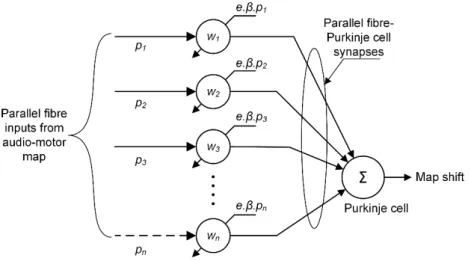
The adaptive filter model of the cerebellum was proposed by Fujita [71] as a variation on the Marr-Albus model [95, 96]. This model emphasises the resemblance of the cerebellar microcircuit to an adaptive filter [8, 72, 97, 98]. The cerebellar microcircuit and the adaptive filter model are shown in Figure 8 A and B respectively. The model is characterised by a very rich set of inputs/basis filters [9] (note, however, that the models in this thesis do not have basis filters). This richness is a result both of the very large number of granule cells (and hence parallel fibres) and of additional processing carried out within the granule cell network itself, which is enhanced by Golgi cells in the granular layer (Section 3.2), and contributes to the power of the adaptive filter function by providing a massive signal analysis capability. The large number of mossy fibres also allows input to the cerebellum from very diverse areas of the brain and sensory systems. Sensory input is to granule cells via the mossy fibres. Granule cell axons form parallel fibre inputs to Purkinje cells. The granule cells (along with their parallel fibre axons) form basis functions/filters that may include, for example, delay functions. In this thesis, and the precursory work that the cerebellar calibrators were based on [4], basis filters were simply unity gains. Hence, the (mossy fibre) input is analysed into multiple filter pathways and synthesized at the Purkinje cell with weights that are affected by the climbing fibre input to the Purkinje cell. Whereas the parallel fibres convey sensory input signals, the climbing fibre conveys a teaching signal. Learning is based on the covariance learning rule [8, 9, 72, 97-101]. This rule serves to de-correlate input signals that contribute to error. As Purkinje cell output is inhibitory, parallel fibres that correlate with Purkinje cell activation will have their synaptic weights reduced by the learning rule. Purkinje cell activation coincides with error (e.g. retinal slip in the vestibulo–ocular reflex) and de-correlation learning drives Purkinje cell activity towards zero. Activation of the Purkinje cell has an inhibitory effect on the appropriate deep cerebellar neurons, counteracting the error. Those parallel fibres that are active in a way that is uncorrelated with Purkinje cell activation will have their weights increased. If a parallel fibre is inactive, the covariance learning rule means that its synaptic weights will be unchanged.
3.5.2 Implementation of the adaptive filter model of the cerebellum
In this thesis Matlab was used to implement an adapted version of the model used in the Bella project (Section 1.1) on a desktop PC/laptop, and this is described in detail in
36
Chapter 4. As mentioned in that chapter, a Zynq System on Chip (SoC) could be a potential candidate for in-the-field implementation. More details are given in Section 4.2. As mentioned in Section 2.2.1, neuromorphic engineering provides a potential low power consumption solution and examples exist of neuromorphic implementations of the cerebellum [102, 103] and specifically the adaptive filter model of the cerebellum [92]. 3.6 The cerebellum in motor control
The motor control role of the cerebellum may not seem relevant to his thesis, however, as the thesis “borrows” a multiple models approach to selecting models for motor control, described in Chapter 5, a brief treatment of this role is undertaken here.
Models of the cerebellum have increasingly been used as adaptive controllers [104]. Internal models contain a paired forward and an inverse model. In the context of motor control, input to the forward model is the motor command but could also include sensory input [74] and the output is a prediction of the consequences of the action given the current state and motor command as input as the forward model learns the dynamics of the controlled plant [6, 105]. In this way, the forward model overcomes the problem of large delays in sensory feedback. On the other hand, an inverse model of the system acts as a controller, providing feedforward control [104] as it produces the required motor command for a given desired state. Another way of viewing this is that the inverse model acting in series with the controlled plant together form an identity such that the output is identical to the input provided the inverse model is accurate.
Forward models can be learned through experience, adjusting for example synaptic weights in response to an error signal obtained from the difference between desired state and actual state ascertained through feedback.
Inverse (controller) models are more problematic to learn, as the teaching signal is not usually directly available. Two key solutions to this have been proposed: distal supervised learning [106] and feedback-error-learning [107, 108]. In the latter, the feedback error signal is provided in motor coordinates (in the cerebellum this is via the climbing fibre inputs). In this scheme, the feedback error signal is in task-oriented coordinates (e.g. desired arm trajectory) or body-oriented coordinates and is transformed into motor coordinates by an approximate inverse model of the plant, which is used to teach a
feed-37
forward adaptive element such as a cerebellar model. Porrill et al. eliminated the need for such an approximate inverse model by applying the teaching signal instead to a recurrent adaptive element [7].
Figure 8. Adaptive filter model of the cerebellum. (a) Cerebellar microcircuit. (b) Adaptive filter equivalent. Adapted with permission by Royal Society from [7].
38
Chapter 4
Cerebellar calibration
4.1 Introduction4.1.1 Adapted model- whisker map calibration
The cerebellar calibration model is an adaptation of that used in a previous study to calibrate whisker input to a robot platform [4, 5], which draws on the adaptive filter model of the cerebellum to calibrate a 2-dimensional topographic map of the whisker sensory space [71]. That study also drew on the concept that animal collicular maps receive information about target locations from multiple modalities [109], and that saccades in particular can be controlled based on sensory input to, for example, bring the target onto the fovea in primates. Accuracy can be relearnt following artificial mis-calibration where the Cerebellum is intact, suggesting a role for the latter in calibration of collicular maps [110]. An array of 20 whisker-like tactile sensors were mounted on the “head” of a robotic manipulator, with a camera mounted centrally to the whisker array (Figure 9). The model was implemented in Matlab and cerebellar connections are shown in Figure 10, with the topographic map representing the superior colliculus. Input to the model were coordinates of the sensed whisker contact location in head-centric space, and represented by a 2-dimensional Guassian on the topographic map. Granular layer processing is limited to coarse coding (with 64 parallel fibres in an 8 x 8 2D array) and normalisation, so that there is no explicit basis filter. The performance of the system using artificial distortion (in software) is shown in Figure 11.
39
40
Figure 10. Architecture of the whisker map calibration system. Unimodal sensory signals, corresponding to target locations (xd, yd), are written into the map, which because of the distortion provides an inaccurate estimate of target location (xg, yg) that is used to generate a correspondingly inaccurate orienting response. The map output is also sent to the cerebellum, where it is converted into a coarse-coded, normalised set of PF signals. These are sent to two cerebellar microzones, each represented in the
diagram by a single Purkinje cell, that receive climbing fibre inputs that initially signal errors (xd-xg, yd-yg) in the orienting response. These errors are used to alter PF-PC synapses, generating cerebellar output that shifts the map so that the orienting response is now made to the new location (xa, ya). This process is repeated until the error
(xd−xa, yd-ya) becomes zero. Figure and caption adapted from [5] under the Creative Commons Attribution License.
![Figure 4. Audio map of sound source location in head-centric space. Reprinted from [54]](https://thumb-us.123doks.com/thumbv2/123dok_us/641634.2577330/25.892.281.734.563.924/figure-audio-sound-source-location-centric-space-reprinted.webp)
![Figure 6. Basic structure of the cerebellar cortex. Reprinted by permission from Springer Nature: Nature, Nature Reviews Neuroscience [73] © 2005](https://thumb-us.123doks.com/thumbv2/123dok_us/641634.2577330/29.892.188.735.649.980/figure-structure-cerebellar-reprinted-permission-springer-reviews-neuroscience.webp)
![Figure 7. Hierarchical layers in subsumption architecture. Reprinted with permission from [77]](https://thumb-us.123doks.com/thumbv2/123dok_us/641634.2577330/32.892.264.715.157.450/figure-hierarchical-layers-subsumption-architecture-reprinted-permission.webp)
![Figure 16. Cerebellar model in learning mode. Adapted by permission from Springer Nature [113] © 2017](https://thumb-us.123doks.com/thumbv2/123dok_us/641634.2577330/48.892.280.710.399.683/figure-cerebellar-model-learning-adapted-permission-springer-nature.webp)