Reference number ISO 11228-3:2007(E) © ISO 2007
STANDARD
11228-3
First edition 2007-04-01Ergonomics — Manual handling —
Part 3:
Handling of low loads at high frequency
Ergonomie — Manutention manuelle —
Partie 3: Manipulation de charges faibles à fréquence de répétition élevée
Licensed to UNIV. OF MILAN/BRUNO PICCOLI ISO Store order #:874300/Downloaded:2008-01-08 Single user licence only, copying and networking prohibited
PDF disclaimer
This PDF file may contain embedded typefaces. In accordance with Adobe's licensing policy, this file may be printed or viewed but shall not be edited unless the typefaces which are embedded are licensed to and installed on the computer performing the editing. In downloading this file, parties accept therein the responsibility of not infringing Adobe's licensing policy. The ISO Central Secretariat accepts no liability in this area.
Adobe is a trademark of Adobe Systems Incorporated.
Details of the software products used to create this PDF file can be found in the General Info relative to the file; the PDF-creation parameters were optimized for printing. Every care has been taken to ensure that the file is suitable for use by ISO member bodies. In the unlikely event that a problem relating to it is found, please inform the Central Secretariat at the address given below.
© ISO 2007
All rights reserved. Unless otherwise specified, no part of this publication may be reproduced or utilized in any form or by any means, electronic or mechanical, including photocopying and microfilm, without permission in writing from either ISO at the address below or ISO's member body in the country of the requester.
ISO copyright office
Case postale 56 • CH-1211 Geneva 20
Tel. + 41 22 749 01 11 Fax + 41 22 749 09 47 E-mail [email protected] Web www.iso.org Published in Switzerland
© ISO 2007 – All rights reserved iii
Contents
Page Foreword... iv Introduction ... v 1 Scope ... 1 2 Normative references ... 13 Terms, definitions, symbols and abbreviated terms... 2
3.1 Terms and definitions... 2
3.2 Symbols and abbreviated terms ... 3
4 Recommendations... 4
4.1 Avoiding repetitive handling tasks ... 4
4.2 Risk assessment... 4
4.2.1 General... 4
4.2.2 Hazard identification... 6
4.2.2.1 General ... 6
4.2.2.2 Repetition... 6
4.2.2.3 Posture and movement ... 6
4.2.2.4 Force... 6
4.2.2.5 Duration and insufficient recovery... 6
4.2.2.6 Object characteristics... 6
4.2.2.7 Vibration and impact forces... 6
4.2.2.8 Environmental conditions (lighting, climate, noise, etc.) ... 7
4.2.2.9 Work organization ... 7
4.2.2.10 Psychosocial factors (e.g. job complexity, job demands, job content) ... 7
4.2.2.11 Individuals... 7
4.2.3 Risk estimation ... 8
4.2.3.1 Method 1 — Simple risk assessment ... 8
4.2.3.2 Method 2 — Detailed risk assessment... 8
4.3 Risk reduction ... 12
Annex A (informative) Risk assessment — General framework and information on available methods ... 13
Annex B (informative) Method 1 — Simple risk assessment checklist ... 16
Annex C (informative) Method 2 — OCRA method for detailed risk assessment ... 25
Annex D (informative) Other methods for detailed risk assessment ... 66
Annex E (informative) Risk reduction ... 70
Bibliography ... 73
Licensed to UNIV. OF MILAN/BRUNO PICCOLI ISO Store order #:874300/Downloaded:2008-01-08 Single user licence only, copying and networking prohibited
Foreword
ISO (the International Organization for Standardization) is a worldwide federation of national standards bodies (ISO member bodies). The work of preparing International Standards is normally carried out through ISO technical committees. Each member body interested in a subject for which a technical committee has been established has the right to be represented on that committee. International organizations, governmental and non-governmental, in liaison with ISO, also take part in the work. ISO collaborates closely with the International Electrotechnical Commission (IEC) on all matters of electrotechnical standardization.
International Standards are drafted in accordance with the rules given in the ISO/IEC Directives, Part 2. The main task of technical committees is to prepare International Standards. Draft International Standards adopted by the technical committees are circulated to the member bodies for voting. Publication as an International Standard requires approval by at least 75 % of the member bodies casting a vote.
Attention is drawn to the possibility that some of the elements of this document may be the subject of patent rights. ISO shall not be held responsible for identifying any or all such patent rights.
ISO 11228-3 was prepared by Technical Committee ISO/TC 159, Ergonomics, Subcommittee SC 3,
Anthropometry and biomechanics.
ISO 11228 consists of the following parts, under the general title Ergonomics — Manual handling: ⎯ Part 1: Lifting and carrying
⎯ Part 2: Pushing and pulling
⎯ Part 3: Handling of low loads at high frequency
© ISO 2007 – All rights reserved v
Introduction
Handling of low loads at high frequency (repetitive work) can cause pain and fatigue, which could lead to musculoskeletal disorders, reduced productivity, and deteriorated posture and movement co-ordination. The latter can increase the risk of errors and may result in reduced quality and hazardous situations. Good ergonomic design and proper organization of work are basic requirements for the avoidance of the adverse effects mentioned.
Risk factors in repetitive work include the frequency of actions, exposure duration, postures and movement of body segments, forces associated with the work, work organization, job control, demands on work output (e.g. quality, task precision) and level of training/skill. Additional factors can include environmental factors, such as climate, noise, vibration and illumination.
The recommendations provided by this part of ISO 11228 are based on available scientific evidence concerning the physiology and epidemiology of manual work. The knowledge is, however, limited, and the suggested guidelines are subject to change according to future research.
Licensed to UNIV. OF MILAN/BRUNO PICCOLI ISO Store order #:874300/Downloaded:2008-01-08 Single user licence only, copying and networking prohibited
© ISO 2007 – All rights reserved
1
Ergonomics — Manual handling —
Part 3:
Handling of low loads at high frequency
1 Scope
This part of ISO 11228 establishes ergonomic recommendations for repetitive work tasks involving the manual handling of low loads at high frequency. It provides guidance on the identification and assessment of risk factors commonly associated with handling low loads at high frequency, thereby allowing evaluation of the related health risks to the working population. The recommendations apply to the adult working population and are intended to give reasonable protection for nearly all healthy adults. Those recommendations concerning health risks and control measures are mainly based on experimental studies regarding musculoskeletal loading, discomfort/pain and endurance/fatigue related to methods of working. For the evaluation of working postures, refer to ISO 11226.
This part of ISO 11228 is intended to provide information for all those involved in the design or redesign of work, jobs and products.
2 Normative
references
The following referenced documents are indispensable for the application of this document. For dated references, only the edition cited applies. For undated references, the latest edition of the referenced document (including any amendments) applies.
ISO 6385, Ergonomic principles in the design of work systems
ISO 11226, Ergonomics — Evaluation of static working postures
ISO 11228-1, Ergonomics — Manual handling — Part 1: Lifting and carrying
ISO 11228-2, Ergonomics — Manual handling — Part 2: Pushing and pulling
ISO 14738, Safety of machinery — Anthropometric requirements for the design of workstations at machinery
ISO 15534 (all parts), Ergonomic design for the safety of machinery
Licensed to UNIV. OF MILAN/BRUNO PICCOLI ISO Store order #:874300/Downloaded:2008-01-08 Single user licence only, copying and networking prohibited
3 Terms, definitions, symbols and abbreviated terms
For the purposes of this document, the terms and definitions given in ISO 6385, ISO 11228-1, ISO 11228-2, ISO 11226 and the following terms, definitions, symbols and abbreviated terms apply.
NOTE In the definitions involving frequency, a unit of time is mentioned because more than one method is involved, each using a different unit, e.g. seconds in HAL (see Annex D), minutes in the OCRA Index (see Annex C) and Strain Index (see Annex D).
3.1 Terms and definitions
3.1.1repetitive task
task characterized by repeated work cycles 3.1.2
work cycle
sequence of (technical) actions that are repeated always the same way 3.1.3
cycle time
tC
time, in seconds, elapsing from the moment when one operator begins a work cycle to the moment that the same work cycle is repeated
3.1.4
technical action
elementary manual actions required to complete the operations within the cycle EXAMPLE Holding, turning, pushing or cutting.
3.1.5
repetitiveness
characteristic of a task when a person is continuously repeating the same work cycle, technical actions and movements
3.1.6
frequency of actions
number of technical actions per unit of time 3.1.7
force F
physical effort of the operator required to execute the task 3.1.8
postures and movements
positions and movements of body segment(s) or joint(s) required to execute the task 3.1.9
recovery time
period of rest following a period of activity which allows restoration of musculoskeletal function (in minutes) 3.1.10
additional risk factor
object and environmental factors for which there is evidence of causal or aggravating relationship with work-related musculoskeletal disorders of the upper limb
EXAMPLE Vibration, local pressure, cold environment or cold surfaces. Licensed to UNIV. OF MILAN/BRUNO PICCOLI
© ISO 2007 – All rights reserved
3
3.1.11move
transport of an object to a given destination using the upper limbs and without walking 3.1.12
reach
shift the hand towards a prefixed destination 3.1.13
carry
transport of an object to a given destination by walking
3.2 Symbols and abbreviated terms
AM additional multiplier
ATA actual technical action
f frequency of actions per minute
F force (N)
FB basic force limit
FL force limit
FM force multiplier
j generic repetitive tasks
kf constant of frequency of technical actions per minute
L actual load
MODA PTS modular analysis predetermined time system
MSD musculoskeletal disorders
MTA motion time analysis
MTM methods/time measurement
MVC maximum voluntary contraction
nATA overall number of actual technical actions within a shift
nep number of exposed individuals
npa number of persons affected by one or more UL-WMSD nRPA partial reference number of technical actions within a shift nrt number of repetitive task(s) performed during a shift nRTA overall number of reference technical actions within a shift
Licensed to UNIV. OF MILAN/BRUNO PICCOLI ISO Store order #:874300/Downloaded:2008-01-08 Single user licence only, copying and networking prohibited
nTC number of technical actions in a cycle
OCRA occupational repetitive action
PA prevalence (%) of persons affected
PM posture multiplier
PTS predetermined time system
RTA reference technical action
ReM repetitiveness multiplier
RcM recovery multiplier
SE standard error
t net duration of each repetitive task, in minutes
tC cycle time, in seconds
TA technical action
tM duration multiplier
UL-WMSD upper limb work-related musculoskeletal disorders
WF work factor
4 Recommendations
4.1 Avoiding repetitive handling tasks
Hazardous manual handling tasks should be avoided wherever possible. This can be achieved through work enlargements, job rotation and/or mechanization/automation within the framework of a participative ergonomics approach. In the case of repetitive handling of low loads at high frequency, many tasks can be modified through the use of robotics or automated production systems.
NOTE A “participative ergonomics approach” signifies the practical involvement of workers, supported by suitable communication, in planning and managing a significant amount of their work activities, with sufficient knowledge and ability to influence both processes and outcomes in order to achieve desirable goals.
4.2 Risk
assessment
4.2.1 GeneralWhen repetitive handling is unavoidable, a four-step approach in accordance with ISO Guide 51 and ISO 14121, and involving both risk assessment and risk reduction, should be adopted. The four steps are hazard identification, risk estimation, risk evaluation and risk reduction.
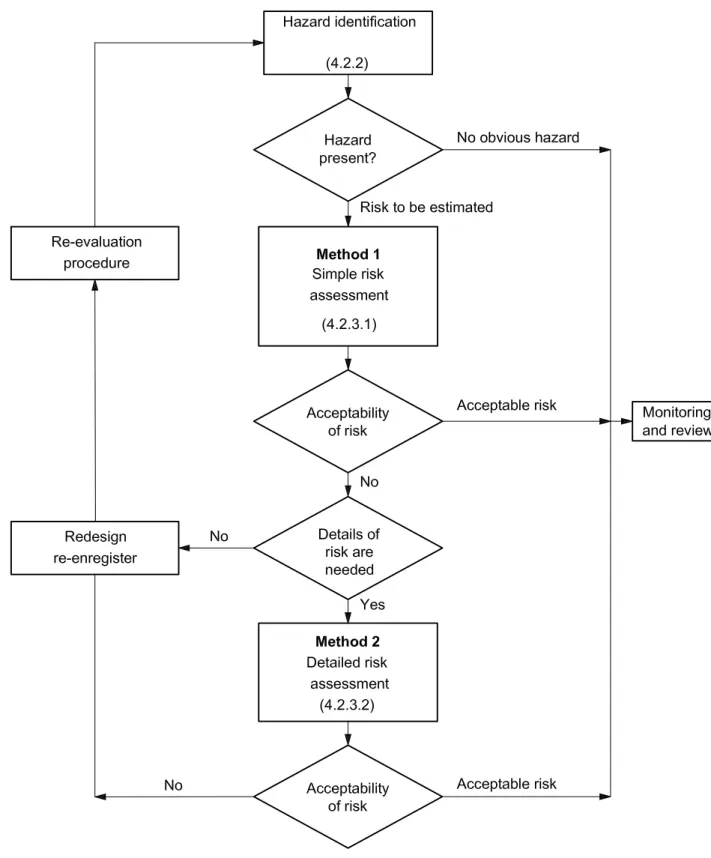
The procedure shown in Figure 1 should be adopted when carrying out a risk assessment of jobs involving the manual handling of low loads at high frequency.
© ISO 2007 – All rights reserved
5
Figure 1 — Risk assessment procedureLicensed to UNIV. OF MILAN/BRUNO PICCOLI ISO Store order #:874300/Downloaded:2008-01-08 Single user licence only, copying and networking prohibited
4.2.2 Hazard identification 4.2.2.1 General
The first step of the risk assessment is to identify whether hazards exist which may expose individuals to a risk of injury. If such hazards are present, then a more detailed risk assessment can be necessary. When determining if one or more of the following hazards is present, consideration should be given to the guidelines for avoiding them.
4.2.2.2 Repetition
Frequent repetitive movements give rise to a risk of injury that can vary depending on the context of the movement pattern and the individual. As the movement cycle increases and/or the cycle time decreases, the risk of injury increases. Repetitive movements should be avoided within a task or job.
4.2.2.3 Posture and movement
Sitting restricts overall movement of the body, particularly those of the lower leg and back. This may lead to increased and complex loading of the back and upper extremities. Standing for prolonged periods of time often results in pain/discomfort in the legs and lower back and can lead to venous pooling in the legs. Complex postures involving combined movements (e.g. flexed and twisted) can present greater risk (see ISO 11226). Whenever possible, workers should be given the option to vary between sitting and standing. Work tasks and operations should provide variations to the working posture: both whole-body postures and movement of specific limbs. In the work tasks, extreme ranges of joint movement should be avoided; there is also need to avoid prolonged static postures.
4.2.2.4 Force
Forceful exertions can be harmful. Tasks should involve smooth force exertions, with the avoidance of sudden or jerky movements. Handling precision (accurate picking and placement), and the type and nature of the grip can introduce additional muscular activation.
4.2.2.5 Duration and insufficient recovery
Insufficient time for the body to recover between repetitive movements (i.e. lack of recovery time) increases the risk of injury. Duration can be broken down into different levels, i.e. work shift duration, job duration, task duration. The opportunity for recovery or rest may fall within each of these work periods.
4.2.2.6 Object characteristics
Inappropriately designed objects could have characteristics that can cause harm (e.g. contact forces, shape, dimensions, coupling, object temperature). Inappropriately placed handholds may lead to awkward hand/arm postures. Non-cushioned handholds and objects constructed of a smooth material increase the difficulty of grasping the object and increase force requirements. The size and shape of the object being handled and the coupling between it and the operator’s hands will determine the grip type and the force that the operator must exert.
4.2.2.7 Vibration and impact forces
Exposure to hand/arm vibration, shocks or impacts can lead to a desensitizing of the hand and increase the force necessary for gripping an object or tool. Prolonged exposure to these types of risk factors has also been linked to vascular and neurological disorders of the upper limbs.
© ISO 2007 – All rights reserved
7
4.2.2.8 Environmental conditions (lighting, climate, noise, etc.)Inappropriate lighting, hot and cold environments and high levels of noise can impose additional hazards. Wet or contaminated surfaces are likely to inhibit the ability to exert forces and increase the risk of injury. The designer of products shall consider environmental conditions only within the limits of the foreseeable use of the product.
4.2.2.9 Work organization
Work organization (e.g. task duration, job duration, recovery time, shift patterns) has an important part to play in the exposure to musculoskeletal risk factors. This should be structured to facilitate rest periods and avoid the use of similar muscle groups over the duration of the work shift. Job rotation, job diversification and job enlargement are all methods of structuring the work to facilitate variation and recovery within the work period. 4.2.2.10 Psychosocial factors (e.g. job complexity, job demands, job content)
Psychological response to work and workplace conditions has an important influence on general health and, in particular, musculoskeletal health. These factors include the design, organization and management of work, the specific impact of workplace risk factors, such as work content, and the overall social environment (i.e. the context of work). Many of the effects of these psychosocial factors occur via stress-related processes, which can have a direct effect on biochemical and physiological responses.
4.2.2.11 Individuals
Individual skills, training, age, gender, health problems and pregnancy are personal characteristics that can influence performance and should be considered in the risk assessment. Skill and experience are likely to benefit the individual when performing the task and reduce the risk of injury. Training can increase the level of skill.
Important aspects of work design include the amount of control an individual has over his/her work, the level of work demands, the variety of tasks he/she is required to perform and the level of support provided by managers, supervisors and/or co-workers. Undesirable psychosocial aspects of a job contributing to a risk of musculoskeletal disorders include the following:
⎯ workers have little or no control over their work and work methods or organization; ⎯ tasks require high levels of attention and concentration;
⎯ workers are unable to make full use of their skills; ⎯ workers have little or no involvement in decision making;
⎯ workers are expected to carry out repetitive, monotonous tasks exclusively; ⎯ work is machine- or system-paced;
⎯ work demands are perceived as excessive;
⎯ payment systems encourage working too quickly or without breaks; ⎯ work systems limit opportunities for social interaction;
⎯ high levels of effort are not balanced by sufficient reward (resources, remuneration, self-esteem, status, etc.).
Licensed to UNIV. OF MILAN/BRUNO PICCOLI ISO Store order #:874300/Downloaded:2008-01-08 Single user licence only, copying and networking prohibited
4.2.3 Risk estimation
4.2.3.1 Method 1 — Simple risk assessment
Risk estimation is performed by a simple risk assessment of jobs composed by a single repetitive task (monotask jobs).
The procedure and checklist model presented in Annex B is preferred for the carrying out of the simple risk assessment. There are four parts to this assessment procedure:
⎯ preliminary information describing the job task;
⎯ hazard identification and risk estimation procedure and checklist; ⎯ overall evaluation of the risk;
⎯ remedial action to be taken.
NOTE As a second choice, other simple methods and checklists given in Annex A can be used, taking into consideration the specific characteristics of the repetitive task under examination.
Risk estimation using Method 1 should allow the classification of the risk by the three-zone approach (green, yellow and red) and determine the consequent action to be taken. The three risk zones are defined as follows. a) Green zone (acceptable risk)
The risk of disease or injury is negligible or is at an acceptably low level for the entire working population. No action is required.
b) Yellow zone (conditionally acceptable risk)
There is a risk of disease or injury that cannot be neglected for the entire working population or part of it. The risk shall be further estimated (using the more detailed assessment of Method 2), analysed together with contributory risk factors and followed as soon as possible by redesign. Where redesign is not possible, other measures to control the risk shall be taken.
c) Red zone (not acceptable)
There is a considerable risk of disease or injury that cannot be neglected for the operator population. Immediate action to reduce the risk (e.g. redesign, work organization, worker instruction and training) is necessary (see 4.3 and Annex E).
4.2.3.2 Method 2 — Detailed risk assessment 4.2.3.2.1 General criteria
If the risk estimated using Method 1 is considered to be YELLOW or RED, or if the job is composed of two or more repetitive tasks (multitask job), the performing of a more detailed risk assessment is recommended. This will also allow a better determination of the remedial measures to be taken.
For detailed risk assessment, OCRA (occupational repetitive action) is the preferred method (see 4.2.3.2.2). It is recommended for the specific purposes of this part of ISO 11228 because, given the knowledge at the time of publication, it considers all the relevant risk factors, is also applicable to “multitask jobs”, and provides criteria — based on extensive epidemiological data — for forecasting the occurrence of UL-WMSD (upper limb work-related musculoskeletal disorders) in exposed working populations.
© ISO 2007 – All rights reserved
9
Other detailed risk assessment methods are available which can be used for a detailed risk assessment, depending on the kind of risk factors identified by Method 1, the nature of the job and the experience of the analyst.Annex D gives basic information about other detailed risk assessment methods useful for the purposes of this part of ISO 11228, together with some remarks about their applicative limits at the time of publication.
Whichever method is used for detailed risk assessment, it should allow the classification of the risk by the three-zone model and determine the consequences to be acted upon in accordance with Table 1.
Table 1 — Method 2 — Final assessment criteria
Zone Risk level Consequences
Green No risk Acceptable: no consequences
Yellow Very low risk Improve structural risk factors (posture, force, technical actions, etc.) or take other organizational measures Red Risk Redesign tasks and workplaces according to priorities
4.2.3.2.2 OCRA method for detailed risk assessment
The OCRA index is the ratio between the number of actual technical actions, ATA, carried out during a work shift and the number of reference technical actions, RTA, for each upper limb, specifically determined in the scenario under examination [11], [38].
The OCRA risk assessment procedure consists of three basic steps: a) Step 1
Calculate the frequency of technical actions/min and the overall number of ATA carried out in the shift (by each upper limb).
b) Step 2
Calculate the overall number of RTA. c) Step 3
Calculate the OCRA index and perform a risk evaluation.
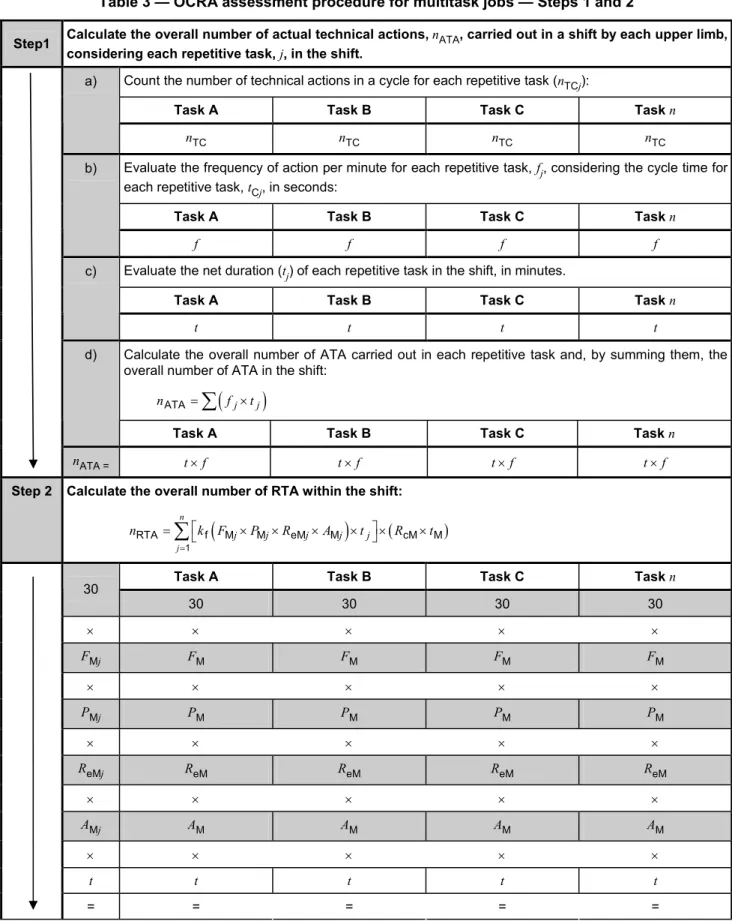
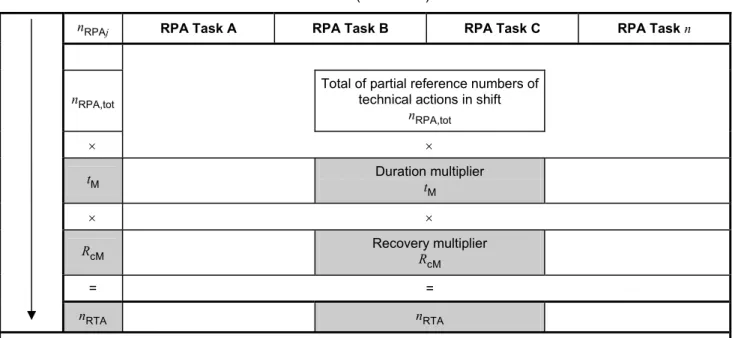
Table 2 (ATA and RTA calculation in monotask jobs), Table 3 (ATA and RTA calculation in multitask jobs) and Table 4 (OCRA index calculation and risk evaluation) give an overview of the procedure detailed in Annex C.
Licensed to UNIV. OF MILAN/BRUNO PICCOLI ISO Store order #:874300/Downloaded:2008-01-08 Single user licence only, copying and networking prohibited
Table 2 — OCRA assessment procedure for monotask jobs — Steps 1 and 2
Step1 Calculate the overall number of actual technical actions, nATA, carried out in a shift by each upper limb.
a) Count the number of technical actions, nTC, in a cycle.
b) Evaluate their frequency, f, per minute, considering the cycle time, tC, in seconds:
C
TC 60 f n
t
= ×
c) Evaluate the net duration, t, of the repetitive task in the shift, in minutes. d) Calculate the overall number of ATA carried out in the shift:
nATA = f×t
Step 2 Calculate the overall number of RTA within the shift:
nRTA = kf×FM×PM×ReM×AM×t×RcM× tM
30 Constant of frequency, kf, of technical actions = 30/min
× FM Force multiplier × PM Posture multiplier × ReM Repetitiveness multiplier × AM Additional multiplier ×
t Duration of the repetitive task, in minutes =
nRPA Partial reference number of technical actions in the shift
×
tM Duration multiplier
×
RcM Recovery multiplier
=
nRTA Overall number of RTA
NOTE See 3.2. for the complete list of symbols and abbreviated terms used in this part of ISO 11228.
© ISO 2007 – All rights reserved
11
Table 3 — OCRA assessment procedure for multitask jobs — Steps 1 and 2Step1 Calculate the overall number of actual technical actions, nATA, carried out in a shift by each upper limb,
considering each repetitive task, j, in the shift.
Count the number of technical actionsin a cycle for each repetitive task (nTCj):
Task A Task B Task C Task n
a)
nTC nTC nTC nTC
Evaluate the frequency of action per minute for each repetitive task, fj, considering the cycle time for each repetitive task, tCj, in seconds:
Task A Task B Task C Task n
b)
f f f f
Evaluate the net duration (tj) of each repetitive task in the shift, in minutes.
Task A Task B Task C Task n
c)
t t t t
Calculate the overall number of ATA carried out in each repetitive task and, by summing them, the overall number of ATA in the shift:
(
)
ATA j j
n =
∑
f ×td)
Task A Task B Task C Task n
nATA = t ×f t ×f t ×f t ×f
Step 2 Calculate the overall number of RTA within the shift:
(
)
(
)
1 RTA f M M eM M cM M n j j j j j j n k F P R A t R t = ⎡ ⎤ =∑
⎣ × × × × ⎦× ×Task A Task B Task C Task n
30 30 30 30 30 × × × × × FMj FM FM FM FM × × × × × PMj PM PM PM PM × × × × × ReMj ReM ReM ReM ReM × × × × × AMj AM AM AM AM × × × × × t t t t t = = = = =
Licensed to UNIV. OF MILAN/BRUNO PICCOLI ISO Store order #:874300/Downloaded:2008-01-08 Single user licence only, copying and networking prohibited
Table 3 (continued)
nRPAj RPA Task A RPA Task B RPA Task C RPA Task n
nRPA,tot
Total of partial reference numbers of technical actions in shift
nRPA,tot × × tM Duration multiplier t M × × RcM Recovery multiplier R cM = = nRTA nRTA
NOTE See 3.2. for the complete list of symbols and abbreviated terms used in this part of ISO 11228.
Table 4 — OCRA index calculation and risk evaluation — Step 3 Step3 Calculate the OCRA index and carry out the risk evaluation:
Number of actual technical actions in the shift OCRA Index = ATA
RTA
n
n Number of reference technical actions in the shift
Risk evaluation Zone OCRA Index value Risk level
Green u 2,2 No risk
Yellow 2,3–3,5 Very low risk
Red > 3,5 Risk
4.3 Risk
reduction
A proper risk assessment is the basis for appropriate choices in risk reduction. Risk reduction can be achieved by combining, in different ways, improvements in different risk factors and should consider, among other things
⎯ the avoidance and limitation of repetitive handling, especially for long daily durations without proper recovery periods or at high frequencies,
⎯ proper design of the task, workplaces and work organization, also using existing International Standards and introducing adequate task variation,
⎯ proper design of the objects, tools and materials handled, ⎯ proper design of the work environment,
⎯ individual workers’ capacities and level of skill for the specific task. See Annex E for more detailed information about risk reduction options.
© ISO 2007 – All rights reserved
13
Annex A
(informative)
Risk assessment — General framework and information on available
methods
A.1 General framework
The Consensus Document listed under Reference [10], which was prepared and published by the IEA1) Technical Committee, Musculoskeletal Disorders, with the endorsement of ICOH, defines in a general model the main risk factors to be considered and presents observational procedures that can be used in their description, classification and evaluation.
In its conclusions, the document underlines the need for an integrated evaluation by means of concise exposure indices.
The general model of description and assessment of tasks, concerning all exposed workers in a given situation, is aimed at analysing four main risk factors: repetitiveness, force, awkward postures and movements, and lack of proper recovery periods. Such factors should be assessed as functions of time (mainly considering their respective durations). In addition to these factors, others, grouped under the term “additional risk factors”, should be considered; these are mechanical factors (e.g. vibrations, localized mechanical compressions), environmental factors (e.g. exposure to cold) and organizational factors (e.g. pace determined by machinery), and for most of them there is evidence of association with UL-WMSD.
Each identified risk factor should be properly described and classified. This allows, on the one hand, identification of possible requirements and preliminary preventive interventions for each factor and, on the other hand, eventually, the consideration of all the factors contributing to the overall “exposure” within a general and mutually integrated framework. From this viewpoint “numerical” or “categorical” classifications of results may be useful to make management of results easier, even if it is important to avoid the feeling of an excessive objectiveness of methods whose classification criteria can still be empirical.
In adopting Reference [10], it should be emphasized that the OCRA method (and the OCRA index) [11], [38] represents an endeavour to organize the data obtained from the descriptive analysis of the various mechanical risk factors, as they are collected following indications contained in the Consensus Document itself.
The main advantages of the OCRA method are the following:
⎯ it provides a detailed analysis of all the main mechanical and organizational risk factors for UL-WMSD; ⎯ it uses a common language with respect to traditional methods of task analysis (predetermined time
systems): this makes company technicians (production engineers, analysts) more familiar with the method and helps them to improve work procedures;
⎯ it considers all the repetitive tasks involved in a complex (or rotating) job and estimates the overall worker’s risk level;
⎯ in many epidemiological surveys it has shown itself to be well related with health effects (such as the occurrence of UL-WMSD); therefore, it is a good predictor (within definite limits) of the risk at a given OCRA level.
1) International ergonomics association
Licensed to UNIV. OF MILAN/BRUNO PICCOLI ISO Store order #:874300/Downloaded:2008-01-08 Single user licence only, copying and networking prohibited
As for the OCRA method’s disadvantages, it should be underlined that it can be time consuming, especially for complex tasks and multitask jobs, and does not consider all psychosocial factors related to the individual sphere.
These considerations were the basis for the choice of the OCRA method in Annex C as the reference method for detailed risk assessment.
However, other methods are proposed in the literature for a detailed risk assessment; in the following paragraphs the main of those methods will be briefly presented, also taking into account their potential limits in respect to the general model here considered.
A.2 Review of other methods of risk assessment
Several other methods/procedures for the risk assessment of repetitive movements and efforts of the upper limbs which also provide synthetic exposure scores are already available in the literature.
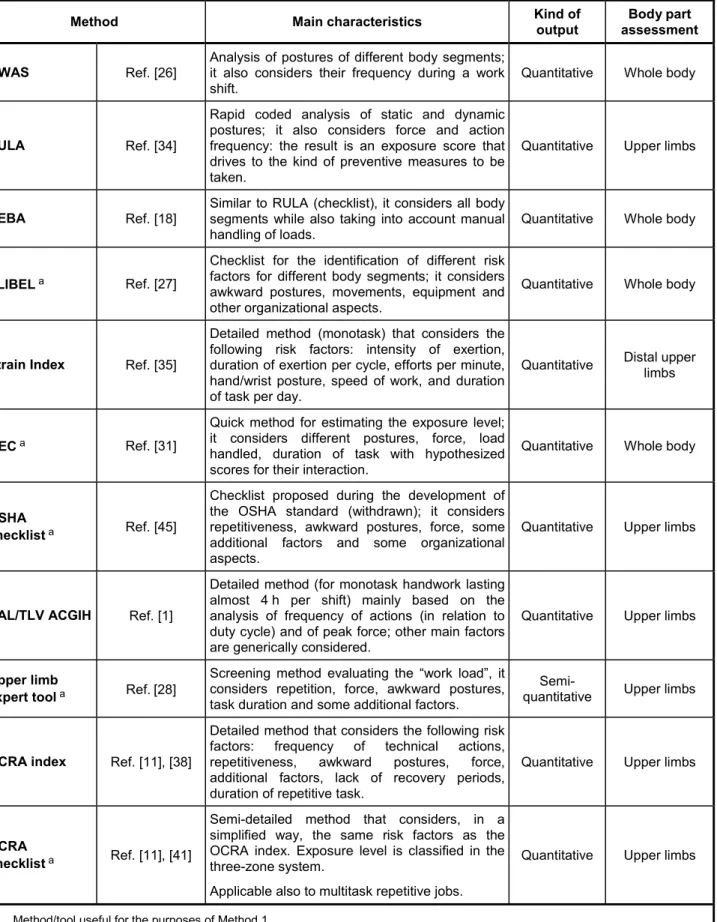
A non-exhaustive list is given in Table A.1 (adapted from Reference [32]).
Most of them are simple (and often empiric) screening tools, not tailored for a detailed risk assessment: they could be used at an entry level (step 1) as an alternative to the recommended Method 1 presented in 4.2.3.1 and Annex B).
Other methods, such as OWAS and, in part, RULA, are primarily devoted to the study of working postures and give less consideration to the other main risk factors involved in repetitive handling at high frequency.
A special mention should be given to the tool OREGE [21], a movement identification and evaluation aid whose purpose is to quantify biomechanical stresses represented by forces, constraining postures and movement repetitiveness. Developed by France’s Institut National de Recherche et de Sécurité (INRS), it has not been included in Table A.1 because, as proposed by INRS, it cannot stand alone and can be used only in the context of a more general and specified approach to UL-WMSD prevention. The application of the tool requires a specific ergonomic ability because it is mainly based on observation of the operator, his/her perception of constraints and on dialogue between the expert and the operator, and final assessment is based largely on expert knowledge and experience. OREGE uses other tools (i.e. visuoanalogic scales for the estimation of frequency and force, RULA for the estimation of postures) in a combined way. Notwithstanding this “mixed” approach, which makes it unsuitable for the specific scope of application of this part of ISO 11228, OREGE represents an interesting and participatory method for the prevention of UL-WMSD at the field level, justifying its mention in this short review.
Of the methods included in Table A.1, only a few allow for a detailed risk assessment in some way corresponding to the general model [10]. In addition to the OCRA index, these are, substantially, the Strain Index and the HAL/ACGIH TLV (for monotask handwork), which methods are also briefly presented in Annex D along with data presented in Reference [9].
© ISO 2007 – All rights reserved
15
Table A.1 — Non-exhaustive list of main methods for risk assessment of repetitivemovements/exertions at high frequency
Method Main characteristics Kind of output assessment Body part
OWAS Ref. [26]
Analysis of postures of different body segments; it also considers their frequency during a work
shift. Quantitative Whole body
RULA Ref. [34]
Rapid coded analysis of static and dynamic postures; it also considers force and action frequency: the result is an exposure score that drives to the kind of preventive measures to be taken.
Quantitative Upper limbs
REBA Ref. [18]
Similar to RULA (checklist), it considers all body segments while also taking into account manual
handling of loads. Quantitative Whole body
PLIBEL a Ref. [27]
Checklist for the identification of different risk factors for different body segments; it considers awkward postures, movements, equipment and other organizational aspects.
Quantitative Whole body
Strain Index Ref. [35]
Detailed method (monotask) that considers the following risk factors: intensity of exertion, duration of exertion per cycle, efforts per minute, hand/wrist posture, speed of work, and duration of task per day.
Quantitative Distal upper limbs
QEC a Ref. [31]
Quick method for estimating the exposure level; it considers different postures, force, load handled, duration of task with hypothesized scores for their interaction.
Quantitative Whole body
OSHA
checklist a Ref. [45]
Checklist proposed during the development of the OSHA standard (withdrawn); it considers repetitiveness, awkward postures, force, some additional factors and some organizational aspects.
Quantitative Upper limbs
HAL/TLV ACGIH Ref. [1]
Detailed method (for monotask handwork lasting almost 4 h per shift) mainly based on the analysis of frequency of actions (in relation to duty cycle) and of peak force; other main factors are generically considered.
Quantitative Upper limbs
Upper limb
expert tool a Ref.[28]
Screening method evaluating the “work load”, it considers repetition, force, awkward postures, task duration and some additional factors.
Semi-
quantitative Upper limbs
OCRA index Ref. [11], [38]
Detailed method that considers the following risk factors: frequency of technical actions, repetitiveness, awkward postures, force, additional factors, lack of recovery periods, duration of repetitive task.
Quantitative Upper limbs
OCRA
checklist a Ref. [11], [41]
Semi-detailed method that considers, in a simplified way, the same risk factors as the OCRA index. Exposure level is classified in the three-zone system.
Applicable also to multitask repetitive jobs.
Quantitative Upper limbs
a Method/tool useful for the purposes of Method 1.
Licensed to UNIV. OF MILAN/BRUNO PICCOLI ISO Store order #:874300/Downloaded:2008-01-08 Single user licence only, copying and networking prohibited
Annex B
(informative)
Method 1 — Simple risk assessment checklist
B.1 General
This annex provides checklists and the evaluation model for the simple risk assessment of Method 1 (see 4.2.3.1). The structure and content of the checklist is as follows.
⎯ Preliminary information describing the job task
B.2.1 consists of general information (job description, tasks to be evaluated, etc.). Initial consideration should also be given to the prevalence of work-related health complaints and/or work changes (planned or improvised) made to the work equipment or tools.
⎯ Hazard identification, risk estimation procedure and checklist
B.2.2 presents a procedure that adopts a five-step approach, taking account of the four primary physical risk factors (repetition, high force, awkward posture and movements, insufficient recovery), as well as any other additional risk factors which may be present. When hazards are identified, steps should be taken to reduce or eliminate these hazards from the task/job (see Annex E).
The characteristics of the work cycle are the primary risk factors for a job. Step 1 of the assessment is therefore the base of the risk estimation. The other risk factors that are relevant for the risk assessment are awkward or uncomfortable postures (step 2), use of force by upper limbs (step 3), lack of recovery periods (step 4) and additional risk factors (step 5).
⎯ Overall evaluation of the risk
B.2.3 describes the method for the overall risk assessment and the actions to be taken in consequence. If one of the risk factors is found to be in the red zone, then the overall risk is RED; if none of the risk levels are RED, but one or more is in the yellow zone then the overall risk is YELLOW; if all risk levels are in the green zone then the overall risk level is GREEN. For additional factors, the level of risk decreases as one moves towards the green zone. In making an overall assessment, additional factors should always be taken into consideration. See 4.2.3.1 for an explanation of the risk zones and consequential action. ⎯ Remedial action to be taken
See B.2.4 for the remedial action that should be formulated and carried out.
B.2 Checklist
B.2.1 Preliminary information
Complete Table B.1.© ISO 2007 – All rights reserved
17
Table B.1Job description: Diagrams (other information):
Operations covered by this assessment (detailed description):
Locations:
Personnel involved:
Date of assessment:
B.2.2 Hazard identification and risk evaluation
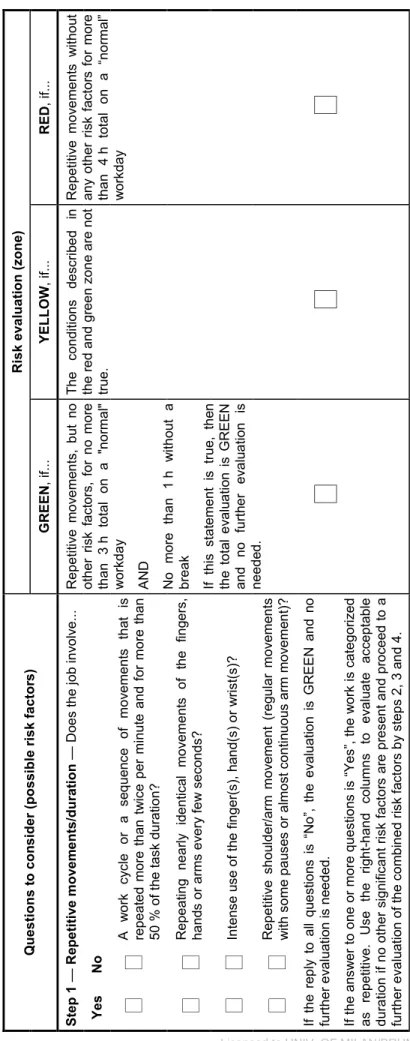
This part of the checklist is used for a specific risk evaluation if the work is repetitive. The risk should always be further analysed if the work involves nearly identical movements that are frequently repeated for a significant period of the normal workday. If the duration of the repetitive work is for less than 1 h/day or 5 h/week, the risk caused by repetition is considered negligible. In that case, no further risk evaluation of the repetitiveness is needed.
Complete Table B.2.
Licensed to UNIV. OF MILAN/BRUNO PICCOLI ISO Store order #:874300/Downloaded:2008-01-08 Single user licence only, copying and networking prohibited
T ab le B.2 Risk ev aluati on (z one) Q uestions t o con s ider (p oss ible r isk factor s) GREEN , if... YELLO W , if... RED , if... Step 1 — Re petitiv e mov e m e nts/durat ion — Do es t he job inv o lv e... Yes N o A w ork cy cle or a se que nc e of mov em ent s tha t is repeat ed m ore tha n tw ice per minut e and for more t han 50 % of th e ta sk durat ion ? R epeat ing near ly id ent ica l m o ve ment s of t he f ing ers, hand s or arm s ev ery few sec onds? Inten se u se of th e fi nger( s), h an d(s) or w rist(s)? R epetit iv e shou lder /arm mov ement (reg ular mov eme nts w ith some pau se s or al most c ontin uou s ar m m o ve me nt)? R epetit iv e m ov eme nts, bu t n o other r is k f act ors, for no mor e than 3 h t otal on a " nor mal " w orkday AND No m o re than 1 h w itho u t a break If this stat em ent i s true , the n the tota l ev alu atio n is G R EE N and no furth e r ev alu a tio n i s neede d. T he cond itio ns d es crib ed i n the r ed and gr een z one are no t true. R epetit iv e mov em ent s w ithou t any other ris k fa ctor s for m o re than 4 h to tal on a “nor ma l” w orkday If the re ply to al l qu est ion s is “N o”, the ev al uati on i s G R EEN and n o further ev alua tio n is ne eded . If the an sw er to one or more quest ion s is “Y es”, t he w ork is c ategor iz ed as r epet itiv e. U se the rig ht-hand co lu mns to ev alu ate acc epta ble durati on if no other s ign ifi cant risk fa ctor s ar e pr ese nt and pr ocee d t o a further ev alua tio n of t he com bi ned ri sk fa ctors by st eps 2, 3 and 4.
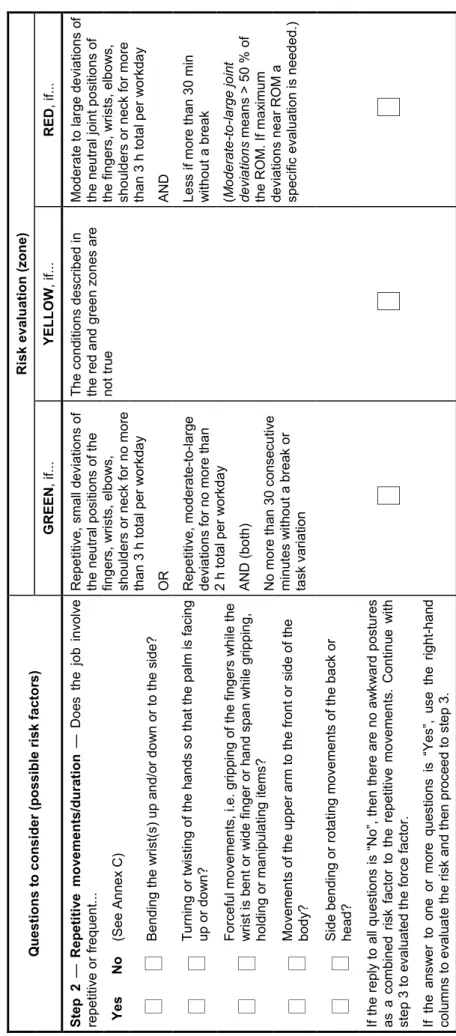
T ab le B.2 ( conti nue d ) Risk ev aluati on (z one) Q uestions t o con s ider (p oss ible r isk factor s) GREEN , if... YELLO W , if... RED , if... Step 2 — Rep e titiv e mov e ments/d u ration — D o es t h e j o b i n vol ve repeti tiv e or f requ ent.. . Yes N o (See Ann e x C ) Bendi ng th e w rist(s) up a nd/o r dow n or to th e s ide ? T urning or tw isting of th e h and s so that the pal m i s f aci ng up or dow n? Forcef ul mov em ent s, i. e. gr ipp ing o f the fin gers w hile th e w rist is b ent or w ide fin ger o r h and span w hile gr ippi ng, hold ing or m ani pul atin g it em s? M o vements of t he u pper arm to the f ront or s ide of t he body ? Side b end ing or rot atin g m ov ement s of the bac k or head? R epetit iv e, s m al l d ev iati ons of the ne utra l po sit ion s of the finger s, w rist s, e lbow s, shou lder s or ne ck f or no mor e than 3 h t otal per w orkd ay OR Repetit iv e, m oder ate-to -larg e dev iati ons for n o m o re t han 2 h tot al per w orkday AN D (both) N o more tha n 30 co nse cut iv e minu tes w ithout a brea k or task v ariat ion T he cond itio ns des cri bed in the re d an d gre en z one s ar e not tru e M oderate to l arge dev iat ion s o f the ne utra l jo int pos iti ons of the fi nger s, w rists , el bow s, shou lder s or ne ck f or m ore than 3 h t o tal per w o rkd ay AND Les s if mor e tha n 30 mi n w ithout a br eak ( M o derate-to-lar ge j o in t devi ati o ns me ans > 50 % o f the RO M . If max imum dev iati ons near R O M a spe cifi c ev al uat ion is nee ded.) If the rep ly to al l que sti on s is “ N o”, then t here ar e no aw kw ar d post ure s as a c omb ine d ri sk fa ctor t o the re peti tiv e mov em ents . C ontinu e w ith step 3 to ev alua ted the forc e factor. If the an sw er to on e or mor e que sti on s i s “Y es”, u se t he right-han d colu mn s to ev alu ate t he ri sk a nd the n pr oce ed t o st ep 3 .
© ISO 2007 – All rights reserved
1
9
Licensed to UNIV. OF MILAN/BRUNO PICCOLI ISO Store order #:874300/Downloaded:2008-01-08 Single user licence only, copying and networking prohibited
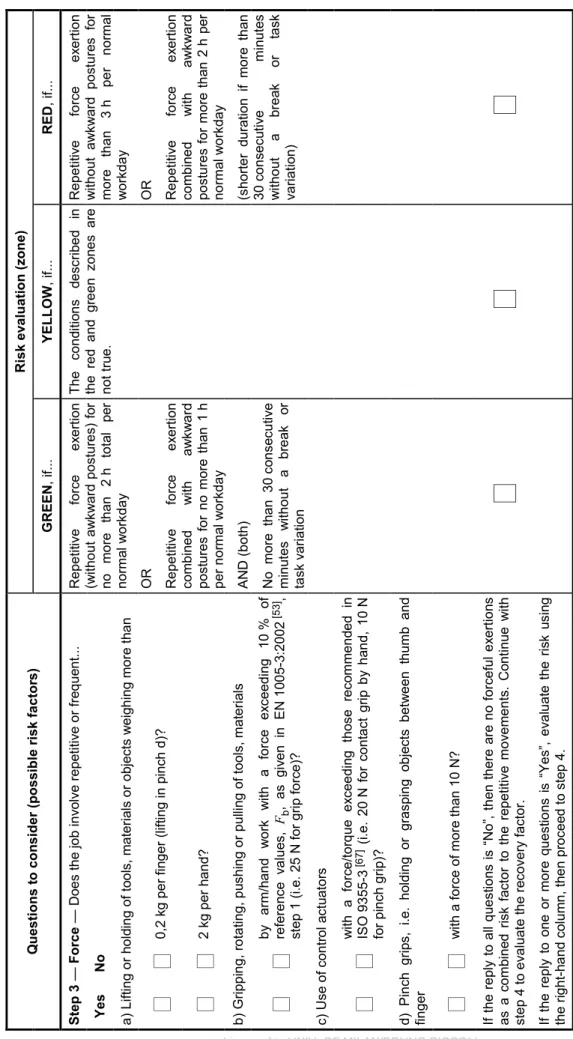
T ab le B.2 ( conti nue d ) Risk ev aluati on (z one) Q uestions t o con s ider (p oss ible r isk factor s) GREEN , if... YELLO W , if... RED , if... Step 3 — Fo rc e — Do es t he job inv olv e repe titiv e or fre que nt... Yes N o a) Lift ing or h old ing of to ol s, m ateria ls or ob je cts w eig hing m ore th an 0,2 k g per fin ger ( lift ing in p in ch d)? 2 kg per h and ? b) G rippi ng, r otat ing, pu shi ng or pul lin g of too ls, mat eria ls by arm/h and w ork w ith a f orce ex ceedin g 10 % of re fe re nc e va lu es , Fb , as giv en i n EN 10 05-3 :200 2 [53] , step 1 (i. e . 2 5 N for grip forc e) ? c) U se of contr ol a ctu ator s w ith a forc e/tor que ex ceedin g tho se r eco mm end ed in ISO 9355-3 [67] (i.e. 20 N f or cont act gr ip by ha nd, 10 N for pi nch grip )? d) Pinc h grip s, i. e. ho ldi ng o r grasp ing o bje cts betw een t humb and finger w ith a forc e of more tha n 10 N ? R epetit iv e forc e ex ertion (w ithout aw kw ard postur es) f or no m ore t han 2 h tota l p er norma l w orkday OR Repetit iv e forc e ex ertion com b in ed w ith aw kw ar d post u res for no more tha n 1 h per nor ma l w orkday AN D (both) N o more th an 30 co nse cut iv e minu tes w ithout a br ea k o r task v ariat ion T he cond itio ns d es crib ed i n the red and gr een z on es ar e not tru e . R epetit iv e forc e ex ertion w ithout aw kw ard pos ture s f or more than 3 h per nor ma l w orkday OR Repetit iv e forc e ex ertion com b in ed w ith aw kw ar d post ures for more tha n 2 h p er norma l w orkday (s hort er d u rat ion if m o re tha n 30 c ons ecu tiv e min ute s w ithout a brea k or t as k va ri a tio n ) If the rep ly to all qu est ion s i s “N o”, the n t here are no forc ef ul ex ertion s as a c omb ine d ri sk fa ctor t o the re peti tiv e mov em ents . C ontinu e w ith step 4 to ev alua te t he re cov er y factor. If the r eply t o on e or more q uest ion s i s “Y es”, ev al uat e th e ris k u sin g the ri ght-h and co lum n, th en pr ocee d to ste p 4.
T ab le B.2 ( conti nue d ) Risk ev aluati on (z one) Q uestions t o con s ider (p oss ible r isk factor s) GREEN , if... YELLO W , if... RED , if... Step 4 — Re cov e ry periods — Does t he j ob inv o lv e... Yes N o Lac k of brea ks ? Poor v ariat ion of ta sk s? Lac k of r ecov ery p eriod s At lea st 30 mi n lun ch br ea k and 10 mi n brea k in th e morni ng and 10 mi n br ea k i n the aft e rno on AND No mo re t han 1 hour' s w ork w ithout brea k or ta sk v ari atio n T he cond itio ns d es crib ed i n the red and gr een z on es ar e not tru e . Les s tha n 3 0 m in l unc h bre ak OR Mo re than 1 ho ur' s w o rk w ithout brea k or ta sk v ari atio n U se the ri ght-h and c olu mn s t o answ er thes e que sti ons a nd ev aluat e the ri sk of l a ck of r e co ve ry peri ods. T hen proc eed to s tep 5 an d ev aluat e ad dit iona l ri sk fac tors .
© ISO 2007 – All rights reserved
21
Licensed to UNIV. OF MILAN/BRUNO PICCOLI ISO Store order #:874300/Downloaded:2008-01-08 Single user licence only, copying and networking prohibited
T ab le B.2 ( conti nue d ) Q uestions t o con s ider (p oss ible r isk factor s) Step 5 — A dditiona l risk f act ors Ph ys ical Ps yc hosocial Yes N o D oes t he re peti tiv e jo b i nv olv e. .. Yes N o D oes t he re peti tiv e jo b i nv olv e. .. U se of v ibrati ng t ool s? H igh w ork pre ssur e/to o muc h w ork to fi ni sh w ithi n t he w orkin g hours ? Loca liz ed co mpre ss ion of anat omi cal stru ctur es due to to ol s? Lac k of con trol of p lan ning an d arrang em ent o f the w ork tas ks ? E xposure t o h ot or col d? Lac k of sup port f rom co lle agu e s or ma nager s? Person al prote ctiv e equ ip men t that res tric ts mov ement s or inh ibit s perfor m an ce? A high me ntal lo ad, h igh co nc entrat ion or att enti on? R isk of su dden , u nex pected/ unco ntro lled m ov eme nt (i .e. slip per y floor, fal lin g ob jec ts, bad gras p) ? An is olat ed t as k in a pr odu ctio n pro ces s? Q uick ac cel erati on/ dec eler atio n of mov eme nts ? Paced w ork, by a m ach ine or perso ns ? Static for ce/l oad ? For ex ample ... Predefi ned w ork r ate s or b onu s sy st em s? R aise d s houl der arm s (ho ldi ng the ar ms /obj ect s a gai nst grav ity )? Re s u lts C ontin uou s grip pin g onto t ool s (su ch as kniv es in s lau ghte rhous e, fish ind u str y) ? Zone Step 1 Step 2 Step 3 Step 4 Step 5 Loc ked or f ix ed pos ture s (b ad de sign of too ls or w orkp la ces , la ck o f spa ce)? G reen H amme ring , s hoc k or forc es w ith ra pid bui ld-u p? Yello w H igh-pre ci sio n w ork co mb ine d w ith force ? Re d
T ab le B.2 ( conti nue d ) T his inf orma tion ca n be gat her ed by ob serv in g the w ork sit ua tion or by us ing v alid ated que st ionn aire s. If add itio nal fa ctors are pre sen t, the se sho uld be con sid ered after t he ri sk fac tors of step s 1 –4 hav e been de alt w ith. Ev aluate stat ic pos ture s/du rati on a ccor din g to ISO 1122 6. Large ran ge o f mov eme nt: if v ery large dev iatio ns (near m ax imu m R O M ) are prev al ent it is im porta nt t o d o a sp ec ifi c ev al uati on of pos sib le ac ute r is k o r sho rt-ter m ri sk . For a fu ll ev al uat ion o f w orkin g pos ture s, u se ot her ev al uat ion me thod s, see ISO 1 122 6. For ev alu atio n of e nv iron m ent al fa ctor s aff ect ing p ost ures , u se ISO 14 738 an d ISO 15534 (pl anni ng of s pac e, preferr ed w o rkin g are a an d h e ight) . T hese Inter nati ona l Sta ndard s c an b e v e ry relev a nt fo r a furt her/ spe cifi c ri sk ev alu a tion of pos ture. H igh for ce: if v ery forcef ul ex ertion s (ne ar M V C ) are prev ale nt, it i s i m por tant t o do a sp ec ific ev alua tion of po ss ibl e a cut e ri sk o r sh o rt -te rm r isk . F o r a f u ll e val u a tio n o f force ex ertion s, it mig h t be rel e vant t o u se ot her ev alua tio n meth ods : f o r l ifti ng, ISO 11 228 -1, a nd for pu sh/p ull , ISO 1 1 22 8-2 . T h ese Int ernat ion a l Stan dards m a y be v er y relev ant for a furth e r/s pec ifi c fo rce ev aluat ion .
© ISO 2007 – All rights reserved
23
Licensed to UNIV. OF MILAN/BRUNO PICCOLI ISO Store order #:874300/Downloaded:2008-01-08 Single user licence only, copying and networking prohibited
B.2.3 Assessment of overall risk level
B.2.3.1 Red evaluationIf one of the risk levels examined in B.2.2 was found to be in the red zone, then the overall risk is RED. If the job falls within this zone, then the work is judged to be harmful. The severity of risk is increased if one or more of the additional risk factors also falls within the red zone. It is recommended that measures be taken to eliminate or reduce the risk factors or that a more detailed risk assessment be performed using Method 2 (see Annex C).
B.2.3.2 Yellow evaluation
If none of the risk levels examined in B.2.2 was found to be RED, but one or more were YELLOW, then the job is judged to be within the yellow zone. If one severe or two additional factors (step 5) are present, the overall risk level shifts from YELLOW to RED. In case of a yellow evaluation, a more detailed risk assessment is needed, using Method 2 (see Annex C), or else remedial action should be taken to reduce the risk to the green level.
B.2.3.3 Green evaluation
If all risks are GREEN then the overall risk level is acceptable. If the job falls within the green zone, the risk of developing work-related musculoskeletal disorders is most likely considered to be acceptable. However, if additional risk factors are present (step 5), it is recommended that an attempt be made to reduce or eliminate these risks.
B.2.4 Remedial action to be taken
Complete Table B.3.Table B.3 Remedial steps that should be taken
(in order of priority)
Person who should take the action
Date by which action should be taken
Date and responsibility for follow-up initiatives 1
2 3 4 5
Date for reassessment: Assessor’s name: Signature:
Take action and check that it has the desired effect by repeating Method 1.
© ISO 2007 – All rights reserved
25
Annex C
(informative)
Method 2 — OCRA method for detailed risk assessment
C.1 General
This annex gives all the relevant information for applying the OCRA (occupational repetitive action) method in accordance with this part of ISO 11228.
C.2 to C.5 describe in detail, step by step, how the OCRA index is determined; C.6 provides the means for
determining technical actions for step 1; C.7, C.8 and C.9 explain, respectively, how to determine force levels,
analyse postures and movements and identify and evaluate the different factors and force multipliers applied in step 2; C.10 gives information about the criteria adopted for OCRA Index classification (step 3) as well as on forecast models of the expected percentage of persons affected (PA) by one or more UL-WMSD; while
C.11 provides applicative examples of the use of the OCRA method for assessing repetitive tasks.
C.2 OCRA Index
The OCRA Index is the ratio between the number of actual technical actions (ATA) carried out during a work shift and the number of reference technical actions (RTA), for each upper limb, specifically determined in the scenario under examination [11], [38]:
ATA RTA OCRA Index n n = (C.1) where
nATA is the overall number of ATA in the shift; nRTA is the number of RTA in the shift.
The three-step procedure for determining the index is detailed in C.3 to C.5 (see also 4.2.3.2.2).
C.3 Step 1
Calculate the frequency of technical actions (TA) per minute and the overall number of ATA carried out in the shift by each upper limb (see also Table 2).
a) Count the number of technical actions (nTC) in a representative cycle of each repetitive task in the job. See C.6 for details on how to determine the technical actions.
b) Evaluate their frequency, f, per minute, considering the cycle time, tC, in seconds:
C
TC 60
f n
t
= × (C.2)
c) Evaluate the net duration, t, of the repetitive task in the shift, in minutes. Licensed to UNIV. OF MILAN/BRUNO PICCOLI
ISO Store order #:874300/Downloaded:2008-01-08 Single user licence only, copying and networking prohibited
d) Calculate the overall number of ATA carried out in the shift:
nATA=f×t (C.3)
For a multitask analysis, follow the procedure shown in Figure C.1 (see also Table 3).
a) Count the number of technical actions in a cycle, nTC, for each repetitive task.
b) Evaluate the frequency of action, f, per minute for each of the repetitive tasks considering the cycle time, tC, in seconds for each of the tasks.
c) Evaluate the net duration, t, of each of the repetitive tasks in the shift, in minutes.
d) Calculate the overall number of ATA carried out in each of the repetitive tasks, then, by summing them, the overall number of ATA in the shift.
(
)
ATA j j
n =
∑
f ×t
(C.4)Figure C.1
© ISO 2007 – All rights reserved
27
C.4 Step 2
C.4.1 General formula
Use the following formula to calculate the overall number of RTA within a shift (the OCRA method considers a number of risk factors and corresponding multipliers):
(
)
(
)
RTA f M M eM M cM M 1 n j j j j j j n k F P R A t R t = =∑
⎡⎣ × × × × ⎤⎦× × (C.5) wheren is the number of repetitive tasks performed during a shift; j is the generic repetitive task;
kf is the constant of frequency of technical actions per minute (= 30); FM frequent or high force exertions (force multiplier) in each repetitive task, j;
PM awkward or uncomfortable postures or movements (posture multiplier) in each repetitive task, j; ReM high repetition of the same movements (repetitiveness multiplier) in each repetitive task, j; AM presence of additional factors (additional multiplier) in each repetitive task, j;
t is the net duration, in minutes, of each repetitive task, j;
RcM is the multiplier for the risk factor lack of recovery period (recovery multiplier);
tM is the multiplier according to the overall duration of all repetitive tasks during a shift (duration multiplier).
The determination of these multipliers is given in C.4.2 to C.4.7.
C.4.2 Determining RTA
In practice, use the following procedure to determine the overall number of reference technical actions, nRTA, within a shift.
a) For each repetitive task, start from kf (30 actions/min).
b) For each task, weight the frequency constant, kf, using the respective multipliers and considering the presence and degree of the risk factors force, FM, posture, PM, repetitiveness, ReM, and additional, AM. c) Multiply the weighted frequency thus obtained, for each task, by the number of minutes of the real
duration, t, of each repetitive task.
d) Sum up the values obtained for the different tasks.
e) Multiply the resulting value by the multiplier factor for recovery periods, RcM.
f) Apply the last multiplier factor that considers the total time spent in repetitive tasks during the whole shift,
tM.
g) The value thus obtained represents the total number of RTA in the shift for the examined job (made up of one or more repetitive tasks), nRTA.
Licensed to UNIV. OF MILAN/BRUNO PICCOLI ISO Store order #:874300/Downloaded:2008-01-08 Single user licence only, copying and networking prohibited
C.4.3 Determining force multiplier,
F
MStep 2 is considered here in more detail.
Determine the force multiplier, FM, which will be equal to 1 if the following “optimal” conditions (see EN 1005-3) are met:
⎯ the isometric force does not exceed 50 % of the values proposed for 15th force percentile for professional use in the healthy adult European population;
⎯ actions do not imply fast movements;
⎯ the frequency of force exertions is no more than 1 in 5 min and the action time is no more than 3 s; ⎯ the duration of the repetitive task is no more than 1 h.
If these conditions are not met, use Table C.1 to determine an FM that applies to the average level of force as a function of time. The force level is given as a percentage of maximum voluntary contraction, MVC, or as a percentage of the basic force limit, FB, as determined in EN 1005-3, Step A. If the percentage of MVC or the FB is difficult to assess, a value derived from the application of the CR-10 Borg scale [6], [7] can be used (second procedure). The corresponding FM can be derived from Table C.1. Use FM = 0,01 when the technical actions require “peaks” above 50 % of MVC or a score of 5 (or more) on the Borg scale for more than 10 % of the cycle time.
Table C.1 — Multiplier relative to different uses of force Force level,
% of MVC, or FB 5 10 20 30 40 W 50
0,5 1 2 3 4 W 5
CR-10 Borg score very, very
weak very weak weak moderate
somewhat strong
strong/very strong
Force multiplier, FM 1 0,85 0,65 0,35 0,2 0,01
These values can be interpolated if intermediate results are obtained.
See C.7 for further explanation on how to determine force levels.
© ISO 2007 – All rights reserved
29
C.4.4 Determining posture (and movements) multiplier,
P
MThe multiplier PM is equal to 1 when one of the postures or movements, given in Table C.2 is present for less than 1/3 of the cycle time; otherwise use Table C.2 to obtain the specific PM. Choose the lowest PM (corresponding to the worst condition) between the posture and movements analysed.
Also consider shoulder postures and movements by checking that the arms are not held or moved:
⎯ at about shoulder level (flexion or abduction at about 80° or more) for more than 10 % of cycle time and/or for more than 2 actions/min [42];
⎯ in mild abduction (between 45° and 80°) for more than 1/3 of cycle time and/or for more than 10 actions/min.
If one of those two conditions occurs, a risk of shoulder disorder exists and should be accurately considered. See C.8 for further explanation on how to analyse postures and movements of the upper limbs.
Table C.2 — Multiplier factor for awkward postures
Portion of cycle time
Awkward posture and/or movement [10] Less than 1/3
from 1 % to 24 % 1/3 from 25 % to 50 % 2/3 from 51 % to 80 % 3/3 more than 80 % Elbow supination (W 60°)
Wrist extension (W 45°) or flexion (W 45°)
Hand hook grip or palmar grip (wide span)
0,7 0,6 0,5
Elbow pronation (W 60°) or flexion/extension (W 60°)
Wrist radio/ulnar deviation (W 20°)
Hand pinch
1
1 0,7 0,6
C.4.5 Determining repetitiveness multiplier,
R
eMWhen the task requires the performance of the same technical actions for at least 50 % of the cycle time, or when the cycle time is shorter than 15 s, ReM = 0,7. Otherwise, ReM = 1.
C.4.6 Determining additional multiplier,
A
MThe main additional factors include the use of vibrating tools, gestures implying countershock (such as hammering), requirement for absolute accuracy, localized compression of anatomical structures, exposure to cold surfaces and environments, the use of gloves interfering with handling ability and high pace completely determined by the machinery.
If additional factors are absent for most of the task duration, AM = 1. Otherwise:
⎯ if one or more additional factors are present at the same time for 1/3 (from 25 % to 50 %) of the cycle time, AM= 0,95;
⎯ if one or more additional factors are present at the same time for 2/3 (from 51 % to 80 %) of the cycle time, AM= 0,90;
⎯ if one or more additional factors are present at the same time for 3/3 (more than 80 %) of the cycle time, AM= 0,80.
C.9 further explains how to identify and evaluate the different additional factors. Licensed to UNIV. OF MILAN/BRUNO PICCOLI
ISO Store order #:874300/Downloaded:2008-01-08 Single user licence only, copying and networking prohibited
C.4.7 Determining partial reference number,
n
RPAC.4.7.1 Monotask analysis
Multiply the adjusted kf, thus obtained for tj, to obtain, for each task, j, a partial reference number of technical actions, nRPA:
(
)
RPAj f Mj Mj eMj Mj j
n =k F ×P ×R ×A ×t (C.6)
Figure C.2 shows the procedure for calculating nRPAj in an monotask analysis.
Figure C.2 C.4.7.2 Multitask analysis
For a multitask analysis, when more than one repetitive task is present, repeat the procedure given in C.4.3 to C.4.7 for each repetitive task, j, in the shift, then sum all nRPAj as shown in Figure C.3.
© ISO 2007 – All rights reserved
31
Figure C.3C.4.8 Determining recovery period multiplier,
R
cMDetermine the recovery multiplier, RcM, and adjust the total of partial numbers of reference technical actions,
nRPA,tot, in relation to the presence and distribution of recovery periods.
A recovery period is a period of rest which allows restoration of the musculoskeletal function in one or more muscle/tendon groups.
The following can be considered as recovery periods:
⎯ breaks (official or non-official), including the lunch break; ⎯ visual control tasks;
⎯ periods within the cycle that leave muscle groups totally at rest consecutively for at least 10 s, almost every few minutes.
Licensed to UNIV. OF MILAN/BRUNO PICCOLI ISO Store order #:874300/Downloaded:2008-01-08 Single user licence only, copying and networking prohibited
For repetitive tasks, the reference condition is represented by the presence, for each hour of repetitive task, of work breaks of at least ten consecutive minutes, or, for working periods lasting less than 1 h, in a ratio of 5:1 between work time and recovery time [1], [8], [48].
In relation to these reference criteria it is possible to consider how many hours of a work shift do not have an adequate recovery period. It requires the observation, one by one, of the single hours that make up a work shift: for each hour, check whether there are repetitive tasks and adequate recovery periods. For the hour preceding the lunch break (if it is present), and for the hour before the end of the shift, the recovery period is represented by these two events.
On the basis of the presence or absence of adequate recovery periods within every hour of repetitive work, count the number of hours with “no recovery”. This done, adjust nRPA,tot and determine RcM in accordance with