Lessons Learned from
Implementation of a
Radiology Clinical Decision
Support System
JAMES BRIAN ALLISON, MD, UNIVERSITY OF VERMONT MEDICAL CENTER
NO DISCLOSURES
KEVIN O’NEAL, BA, I.S. PROJECT MANAGER, UNIVERSITY OF VERMONT MEDICAL CENTER
NO DISCLOSURES
KRISTEN K. DESTIGTER, MD, FACR, UNIVERSITY OF VERMONT MEDICAL CENTER
CONSULTANT, PHILIPS HEALTHTECH
Overview
What is Clinical Decision
Support?
“Clinical decision support (CDS)
provides clinicians, staff, patients or
other individuals with knowledge
and person-specific information,
intelligently filtered or presented at
appropriate times, to enhance
health and health care.”
(1)
CDS systems “aid directly in clinical
decision-making by providing
specific clinical recommendations
through matching patient
characteristics with rules in a
computerized knowledge base.”
(2)
Radiology CDS Systems
should:
“Present the available choice of
imaging procedures or range of
imaging procedures determined
as appropriate based on the
medical evidence, to the extent
possible, supplemented by clinical
expertise.”
(3)
“Provide to the ordering clinician
any procedure determined
appropriate and not restrict
selection to a specific exam
whether defined by CPT® codes,
charge master codes, or other
manner that a facility may use to
code a procedure.”
(3)1. http://www.healthit.gov/policy-researchers-implementers/clinical-decision-support-cds 2. Holstiege J, et al. J Am Med Inform Assoc 2015;22:236–242
Common User Interface Features
Input field for clinical history, symptoms, diagnosis
Input field for desired procedure
CDS provides listing of relevant examinations
Links to published evidence behind recommendations
Displays ACR appropriateness level (1-9, color coded)
Clickable links for alternate exam types
Appropriateness rating and relative radiation doses displayed
Allows clinician to choose more appropriate exam without reentering data
Transfer of appropriateness score, etc. into RIS for review
Selection and Preparation
Product Selection Criteria:
1. Integration of Standard
Guidelines
2. Links to supporting publications
or consensus statements
3. Modifiable guideline database
4. Vendor-provided updates
concurrent with evolving clinical
guidelines and research.
5. Traceable data, such as
appropriateness of orders,
identification of inappropriate
orders for review, and overall
utilization statistics
Committee Members:
Radiology Chairman
Radiology Vice Chairman
Hospital Chief Medical Information
Officer
IT Project Manager
Dedicated IT staff member
Five R4 Radiology Residents
Enterprise Imaging Architect
Our Goals of Implementation
1. Create Hospital CDS rule set
Incorporate established rule sets from the ACR and other sources such as the
Royal Australian and New Zealand College of Radiologists.
2. Evaluate data collected through CDS
Provide feedback regarding ACR recommendations for further improvement
Evaluation ordering practices of individual and groups of clinicians
3. Integrate the Radiology CDS with Hospital EHR
Access CDS via Inpatient, Ambulatory, and Emergency Room EHR modules
4. Minimize claim denials
Reduce Medicare reimbursement denials through use of the radiology CDS
system.
Obviate the need for pre-authorization from private insurers
Initial Decisions - Examples
Concerns
Determinations
User Status - Can we customize CDS
usage requirements?
e.g. Can we make usage
mandatory for all interns
regardless of specialty?
IT department could not
guarantee accurate classification
of users throughout organization
Order Set Conflicts
e.g. Should imaging included in
order sets (admission CXR)
trigger CDS usage?
Avoid conflicts with existing order
sets and use CDS data to address
order set utilization in a broader
context
Would use of the CDS hinder
patient care in certain situations
without significant benefit?
Clinician pop-up/alert fatigue
Include only high cost exams or
those potentially requiring
pre-authorization (CT, MRI, NM)
Integration with Existing Systems
CDS required to integrate with
two major existing Enterprise
systems:
Radiology Information System
(Centricity, GE Healthcare)
Hub through which orders are received
from EHR, scheduled, protocoled, and
charged
Electronic Health Record (EPIC)
Provides clinical interface for ordering
studies
Desire to seamlessly integrate the CDS
into the EHR interface
All agreed a external interface would
deter users and introduce workflow
inefficiencies.
Challenges to integration:
1. EHR and RIS use different designations for
the same studies.
2. One-to-one relationship does not exist
between the two systems
RIS contains many additional study codes
than are av ailable to clinician in EHR.
3. Multiple relationships between orderable
exams and the ACR clinical indications
Relationships had to be mapped through the
CDS.
4. CPT codes provide only universal
terminology
No accounting for exam v ariations (e.g. single
v s. multiphase CT)
Non-specificity for certain exams (e.g. lower
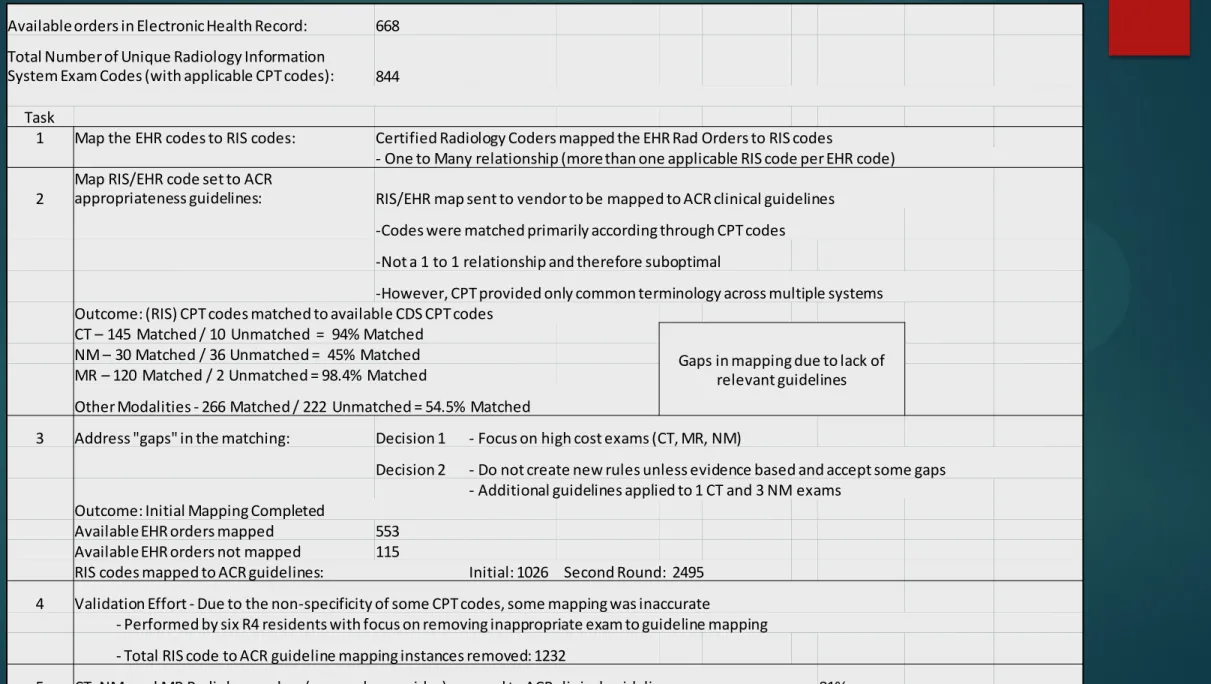
Available orders in Electronic Health Record: 668 Total Number of Unique Radiology Information
System Exam Codes (with applicable CPT codes): 844
Task
1 Map the EHR codes to RIS codes: Certified Radiology Coders mapped the EHR Rad Orders to RIS codes - One to Many relationship (more than one applicable RIS code per EHR code)
2
Map RIS/EHR code set to ACR
appropriateness guidelines: RIS/EHR map sent to vendor to be mapped to ACR clinical guidelines -Codes were matched primarily according through CPT codes -Not a 1 to 1 relationship and therefore suboptimal -However, CPT provided only common terminology across multiple systems Outcome: (RIS) CPT codes matched to available CDS CPT codes CT – 145 Matched / 10 Unmatched = 94% Matched
Gaps in mapping due to lack of relevant guidelines
NM – 30 Matched / 36 Unmatched = 45% Matched MR – 120 Matched / 2 Unmatched = 98.4% Matched Other Modalities - 266 Matched / 222 Unmatched = 54.5% Matched 3 Address "gaps" in the matching: Decision 1 - Focus on high cost exams (CT, MR, NM)
Decision 2 - Do not create new rules unless evidence based and accept some gaps
- Additional guidelines applied to 1 CT and 3 NM exams Outcome: Initial Mapping Completed Available EHR orders mapped 553 Available EHR orders not mapped 115 RIS codes mapped to ACR guidelines: Initial: 1026 Second Round: 2495 4 Validation Effort - Due to the non-specificity of some CPT codes, some mapping was inaccurate - Performed by six R4 residents with focus on removing inappropriate exam to guideline mapping - Total RIS code to ACR guideline mapping instances removed: 1232 5 CT, NM, and MR Radiology orders (as seen by provider) mapped to ACR clinical guidelines: 81%
Validation
CDS Procedure ID CDS Procedure Name CDS Modifiers CDS CPT codes CPT4 EHR Procedure CODE RIS ExamCodes PROCEDURE RECORD NAME
Remove (Y)
Procedure Record ?
ACR114226 Core biopsy breast Adult 19102|76942 76942 IR277 SPUSGUIDE IR U/S DRAINAGE Y US113 USBRBI RAD US BREAST BIOPSY US117 USBRNL RAD US GUIDE NEEDLE LOC, BREAST ONLY US129 USGDBX RAD US GUIDANCE, BX, ASP, INJ, LOC Y
US130 USGDBXFNA RAD US GUIDANCE BIOPSY FNA THYROID Y
US131
USGDCORD
O RAD US GUIDANCE CORDOCENTESIS Y
US134 USGDNLOC RAD US GUIDE NEEDLE LOC, NON-BREAST ONLY Y US135 USGDPARA RAD US GUIDANCE PARACENTESIS Y US137 USGDTHOR RAD US GUIDE THORACENTESIS Y US144 USLPN RAD US ASPIRATION ANY SITE Y
-Aforementioned process was used to automatically identify and assign EHR/RIS
codes to CDS ACR guidelines
-Senior residents manually removed errors in the mapping process
-Due to the non-specificity of CPT codes, clinically irrelevant
studies/procedures erroneously assigned to guidelines.
Hurdles and Limitations
1. Process of mapping the CDS to RIS/EHR examination codes was labor
intensive
Required many hours from clinicians and IT staff, delaying go-live date.
Vendor did not feel responsible for this as their system technically worked as
advertised.
2. Validation of mapping process was achieved fairly rapidly
Senior residents could quickly identify and exclude irrelevant mappings.
Did not address potential mappings which
escaped inclusion
Would require intensive review of all guidelines and identification of relevant exams
which were not mapped to them.
3. Desire to integrate CDS into running instance of EHR required significant
effort from the IT department
Many institutions might not be willing or able to provide this level of tech support.
4. The effort exposed many difficulties related to integrating new technology
with legacy RIS
Mainly due to lack of unified terminology that provides one-to-one relationships
Barriers to Utilization
1. Opted against mandatory
usage
Some institutions have shown success
targeting mandatory usage to
specific modalities or clinical
scenarios
(1,2,3,4)
2. Technical issues with
integration into EPIC inpatient
module
Initial go-live only in EPIC outpatient
module.
No data accumulated in ER or
inpatient setting.
3. Several factors resulted in
limited vendor access to future
ACR guideline updates
Summary: Over three months, 20
unique users engaged the system 22
times, but only submitted 4 orders
through the CDS interface. During
the same period, over 1900
applicable outpatient radiology
orders were submitted without CDS.
Product deemed ineffective and
decommissioned 4 months after
go-live
Month
Unique CDS
Users
CDS Consult
Started
CDS Orders
Submitted
Nov '14
10
10
1
Dec '14
5
7
2
Jan '15
5
5
1
Table 3: Initial Usage Data
1. Raja AS et al. Radiology. 2012 Feb;262(2):468-74 2. Lau BD et al. Med Care. 2015 Jan;53(1):18-24 3. Ip IK et al. Am J Med. 2014 Jun;127(6):512-8
Take Home Points
1. Installing a Radiology CDS is a complex undertaking
Take steps to ensure compatibility with existing systems
Consider engaging third party expert prior to implementation, particularly if organizational
resources are limited
Chose vendor with proven integration to existing EHR/RIS
2. Define objectives and outcomes clearly prior to installation
Set clear clinical and administrative goals
Engage ordering clinicians to establish targets for certain tests or clinical scenarios
3. Despite challenges with our installation, the future potential of Radiology CDS
deemed essential within our organization.
Data mining of EHR with natural language processing algorithms to identify relevant clinical
and safety information (e.g. MRI hazards, contrast allergies)
Potential to negate need for preauthorization if appropriateness criteria met
Automatic documentation of adherence to guidelines
Minimize unnecessary or inappropriate exams
References
http://www.healthit.gov/policy-researchers-implementers/clinical-decision-support-cds
Best Practices Guidelines On Imaging Clinical Decision Support Systems, 2012, American College of
Radiology and Radiology Business Management Association
Holstiege J, Mathes T, Pieper D. Effects of computer-aided clinical decision support systems in improving
antibiotic prescribing by primary care providers: a systematic review. J Am Med Inform Assoc.
2015;22(1):236-42. doi: 10.1136/amiajnl-2014-002886. PubMed PMID: 25125688.
Ip IK, Gershanik EF, Schneider LI, Raja AS, Mar W, Seltzer S, et al. Impact of IT-enabled intervention on MRI
use for back pain. Am J Med. 2014;127(6):512-8.e1. doi: 10.1016/j.amjmed.2014.01.024. PubMed PMID:
24513065; PubMed Central PMCID: PMCPMC4035377.
Lau BD, Haider AH, Streiff MB, Lehmann CU, Kraus PS, Hobson DB, et al. Eliminating Health Care Disparities
With Mandatory Clinical Decision Support: The Venous Thromboembolism (VTE) Example. Med Care.
2015;53(1):18-24. doi: 10.1097/MLR.0000000000000251. PubMed PMID: 25373403; PubMed Central PMCID:
PMCPMC4262632.
Raja AS, Ip IK, Prevedello LM, Sodickson AD, Farkas C, Zane RD, et al. Effect of computerized clinical
decision support on the use and yield of CT pulmonary angiography in the emergency department.
Radiology. 2012;262(2):468-74. doi: 10.1148/radiol.11110951. PubMed PMID: 22187633; PubMed Central
PMCID: PMCPMC3267081.
Sistrom CL, Dang PA, Weilburg JB, Dreyer KJ, Rosenthal DI, Thrall JH. Effect of computerized order entry
with integrated decision support on the growth of outpatient procedure volumes: seven-year time series
analysis. Radiology. 2009;251(1):147-55. doi: 10.1148/radiol.2511081174. PubMed PMID: 19221058.