OFLOPS: An Open Framework for
OpenFlow Switch Evaluation
Charalampos Rotsos1, Nadi Sarrar2, Steve Uhlig2, Rob Sherwood3?, and Andrew W. Moore1
1
University of Cambridge2TU Berlin / T-Labs3Big Switch Networks
Abstract. Recent efforts in software-defined networks, such as OpenFlow, give
unprecedented access into the forwarding plane of networking equipment. When building a network based on OpenFlow however, one must take into account the performance characteristics of particular OpenFlow switch implementations. In this paper, we present OFLOPS, an open and generic software framework that permits the development of tests for OpenFlow-enabled switches, that measure the capabilities and bottlenecks between the forwarding engine of the switch and the remote control application. OFLOPS combines hardware instrumentation with an extensible software framework.
We use OFLOPS to evaluate current OpenFlow switch implementations and make the following observations: (i) The switching performance of flows depends on applied actions and firmware. (ii) Current OpenFlow implementations differ sub-stantially in flow updating rates as well as traffic monitoring capabilities. (iii) Accurate OpenFlow command completion can be observed only through the data plane. These observations are crucial for understanding the applicability of Open-Flow in the context of specific use-cases, which have requirements in terms of forwarding table consistency, flow setup latency, flow space granularity, packet modification types, and/or traffic monitoring abilities.
1
Introduction
OpenFlow1, an instance of software-defined networking (SDN), gives access deep within the network forwarding plane while providing a common, simple, API for network-device control. Implementation details are left to the discretion of each ven-dor. This leads to an expectation of diverse strengths and weaknesses across the existing OpenFlow implementations, which motivates our work.
OpenFlow is increasingly adopted, both by hardware vendors as well as by the research community [12, 22, 19]. Yet, there have been few performance studies: to our knowledge, OFLOPS is the first attempt to develop a platform that is able to provide de-tailed measurements for the OpenFlow implementations. Biancoet al.[7] show the per-formance advantage of the Linux software OpenFlow over the Linux Ethernet switch, while Curtiset al.[9] discuss some design limitations of the protocol when deployed in large network environments. We consider OFLOPS, alongside [10], as one of a new generation of measurement systems that, like the intelligent traffic and router evalua-tors [13, 4], go beyond simple packet-capture.
?
The majority of the work was completed while at Deutsche Telekom Inc. R&D Lab 1http://www.openflow.org/
We present OFLOPS2, a tool that enables the rapid development of use-case tests for both hardware and software OpenFlow implementations. We use OFLOPS to test publicly available OpenFlow software implementations as well as several OpenFlow-enabled commercial hardware platforms, and report our findings about their varying performance characteristics. To better understand the behavior of the tested OpenFlow implementations, OFLOPS combines measurements from the OpenFlow control chan-nel with data-plane measurements. To ensure sub-millisecond-level accuracy of the measurements, we bundle the OFLOPS software with specialized hardware in the form of the NetFPGA platform3. Note that if the tests do not require millisecond-level accu-racy, commodity hardware can be used instead of the NetFPGA [5].
The rest of this paper is structured as follows. We first present the design of the OFLOPS framework in Section 2. We describe the measurement setup in Section 3. We describe our measurements in Section 4. We provide basic experiments that test the flow processing capabilities of the implementations (Section 4.1) as well as the perfor-mance and overhead of the OpenFlow communication channel (Section 4.2). We follow with specific tests, targeting the monitoring capabilities of OpenFlow (Section 4.3) as well as interactions between different types of OpenFlow commands (Section 4.4). We conclude in Section 5.
2
OFLOPS framework
Measuring OpenFlow switch implementations is a challenging task in terms of char-acterization accuracy, noise suppression and precision. Performance charchar-acterization is not trivial as most OpenFlow-enabled devices provide rich functionality but do not dis-close implementation details. In order to understand the performance impact of an ex-periment, multiple input measurements must be monitored concurrently. Furthermore, measurement noise minimization can only be achieved through proper design of the measurement platform. Current controller designs, like [11, 3], target production net-works and thus are optimized for throughput maximization and programmability, but incur high measurement inaccuracy. Finally, high precision measurements after a point are subject to loss due to unobserved parameters of the measurement host, such as OS scheduling and clock drift.
The OFLOPS design philosophy is to enable seamless interaction with an OpenFlow-enabled device over multiple data channels without introducing significant additional processing delays. The platform provides a unified system that allows de-velopers to control and receive information from multiple control sources: data and control channels as well as SNMP to provide specific switch-state information. For the development of measurement experiments over OFLOPS, the platform provides a rich, event-driven, API that allows developers to handle events programatically in order to implement and measure custom controller functionality. The current version is written predominantly in C. Experiments are compiled as shared libraries and loaded at run-time using a simple configuration language, through which experimental parameters
2
OFLOPS is under GPL licence and can be downloaded fromhttp://www.openflow.
org/wk/index.php/Oflops
Fig. 1.OFLOPS design schematic -3e+06 -2.5e+06 -2e+06 -1.5e+06 -1e+06 -500000 0 500000 0 20000 40000 60000 80000 100000 120000
timer drift (nsec)
relative delay since first packet (msec) pcap oflops netfpga oflops netfpga calibrated
Fig. 2.Evaluating timestamping precision using
a DAG card.
can be defined. A schematic of the platform is presented in Figure 1. Details of the OFLOPS programming model can be found in the API manual [1].
The platform is implemented as a multi-threaded application, to take advantage of modern multicore environments. To reduce latency, our design avoids concurrent access controls: we leave any concurrency-control complexity to individual module implemen-tations. OFLOPS consists of the following five threads, each one serving specific type of events:
1. Data Packet Generationcontrols data plane traffic generators.
2. Data Packet Capturecaptures and pushes data plane traffic to modules.
3. Control Channeltranslates OpenFlow packets to control events.
4. SNMP Channelperforms asynchronous SNMP polling.
5. Time Managermanages time events scheduled by measurement modules.
OFLOPS provides the ability to control concurrently multiple data channels to the switch. By embedding the data channel within the platform, it is possible to understand the impact of the measurement scenario on the switching plane. To enable our platform to run on multiple heterogeneous platforms, we have integrated support for multiple packet generation and capturing mechanisms. For the packet generation functionality, OFLOPS supports three mechanisms: user-space, kernel-space through the pktgen mod-ule [16], and hardware-accelerated through an extension of the design of the NetFPGA Stanford Packet Generator [8]. For the packet capturing and timestamping, the plat-form supports both the pcap library and the modified NetFPGA design. Each approach provides different precisions and different impacts upon the measurement platform.
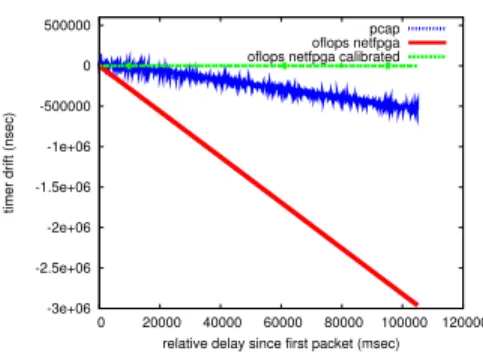
A comparison of the precision of the traffic capturing mechanisms is presented in Figure 2. In this experiment we use a constant rate 100 Mbps probe of small packets for a two minute period. The probe is duplicated, using an optical wiretap with negligible delay, and sent simultaneously to OFLOPS and to a DAG card. In the figure, we plot the differences of the relative timestamp between each OFLOPS timestamping mechanism and the DAG card for each packet. From the figure, we see that the pcap timestamps drift by 6 milliseconds after 2 minutes. On the other hand, the NetFPGA timestamping mechanism has a smaller drift at the level of a few microseconds during the same period.
3
Measurement setup
The number of OpenFlow-enabled devices has slowly increased recently, with switch and router vendors providing experimental OpenFlow support such as prototype and evaluation firmware. At the end of 2009, the OpenFlow protocol specification was re-leased in its first stable version 1.0 [2], the first recommended version implemented by vendors for production systems. Consequently, vendors did proceed on maturing their prototype implementations, offering production-ready OpenFlow-enabled switches to-day. Using OFLOPS, we evaluate OpenFlow-enabled switches from three different switch vendors. Vendor 1 has production-ready OpenFlow support, whereas vendors 2 and 3 at this point only provide experimental OpenFlow support. The set of selected switches provides a representative but not exhaustive sample of available OpenFlow-enabled top-of-rack-style switching hardware. Details regarding the CPU and the size of the flow table of the switches are provided in Table 1.
OpenFlow is not limited to hardware. The OpenFlow protocol reference is the soft-ware switch, OpenVSwitch [17], an important implementation for production environ-ments. Firstly, OpenVSwitch provides a replacement for the poor-performing Linux bridge [7], a crucial functionality for virtualised operating systems. Secondly, several hardware switch vendors use OpenVSwitch as the basis for the development of their own OpenFlow-enabled firmware. Thus, the mature software implementation of the OpenFlow protocol is ported to commercial hardware, making certain implementation bugs less likely to (re)appear. In this paper, we study OpenVSwitch alongside our per-formance and scalability study of hardware switches. Finally, in our comparison we include the OpenFlow switch design for the NetFPGA platform [15]; a full implementa-tion of the protocol, limited though in capabilities due to hardware platform limitaimplementa-tions.
Switch CPU Flow table size
Switch1 PowerPC 500MHz 3072 mixed flows
Switch2 PowerPC 666MHz 1500 mixed flows
Switch3 PowerPC 828MHz 2048 mixed flows
OpenVSwitch Xeon 3.6GHz 1M mixed flows
NetFPGA DualCore 2.4GHz 32K exact & 100 wildcard
Table 1.OpenFlow switch details.
In order to conduct our measurements, we setup OFLOPS on a dual-core 2.4GHz Xeon server equipped with a NetFPGA card. For all the experiments we utilize the NetFPGA-based packet generating and capturing mechanism. 1Gbps control and data channels are connected directly to the tested switches. We measure the processing de-lay incurred by the NetFPGA-based hardware design to be a near-constant 900nsec independent of the probe rate.
4
Evaluation
In this section we present a set of tests performed by OFLOPS to measure the behavior and performance of OpenFlow-enabled devices. These tests target (1) the OpenFlow packet processing actions, (2) the update rate of the OpenFlow flow table along with its
Mod. type Switch1 OpenVSwitch Switch2 Switch3 NetFPGA med sd loss% med sd loss% med sd loss% med sd loss% med sd loss%
Forward 4 0 0 35 13 0 6 0 0 5 0 0 3 0 0 MAC addr. 4 0 0 35 13 0 302 727 88 - - 100 3 0 0 IP addr. 3 0 0 36 13 0 302 615 88 - - 100 3 0 0 IP ToS 3 0 0 36 16 0 6 0 0 - - 100 3 0 0 L4 port 3 0 0 35 15 0 302 611 88 - - 100 3 0 0 VLAN pcp 3 0 0 36 20 0 6 0 0 5 0 0 3 0 0 VLAN id 4 0 0 35 17 0 301 610 88 5 0 0 3 0 0 VLAN rem. 4 0 0 35 15 0 335 626 88 5 0 0 3 0 0
Table 2.Time inµs to perform individual packet modifications and packet loss. Processing delay
indicates whether the operation is implemented in hardware (<10µs) or performed by the CPU
(>10µs).
impact on the data plane, (3) the monitoring capabilities provided by OpenFlow, and (4) the impact of interactions between different OpenFlow operations.
4.1 Packet modifications
The OpenFlow specification [2] defines ten packet modification actions which can be applied on incoming packets. Available actions include modification of MAC, IP, and VLAN values, as well as transport-layer fields and flows can contain any combination of them. The left column of Table 2 lists the packet fields that can be modified by an OpenFlow-enabled switch. These actions are used by network devices such as IP routers (e.g., rewriting of source and destination MAC addresses) and NAT (rewriting of IP ad-dresses and ports). Existing network equipment is tailored to perform a subset of these operations, usually in hardware to sustain line rate. On the other hand, how these oper-ations are to be used is yet to be defined for new network primitives and applicoper-ations, such as network virtualization, mobility support, or flow-based traffic engineering.
To measure the time taken by an OpenFlow implementation to modify a packet field header, we generate from the NetFPGA card UDP packets of 100 bytes at a constant rate of 100Mbps (approx. 125 Kpps). This rate is high enough to give statistically significant results in a short period of time. The flow table is initialized with a flow that applies a specific action on all probe packets and the processing delay is calculated using the transmission and receipt timestamps, provided by the NetFPGA. Evaluating individual packet field modification, Table 2 reports the median difference between the generation and capture timestamp of the measurement probe along with its standard deviation and percent of lost packets.
We observe significant differences in the performance of the hardware switches due in part to the way each handles packet modifications. Switch1, with its production-grade implementation, handles all modifications in hardware; this explains its low packet pro-cessing delay between 3 and 4 microseconds. On the other hand, Switch2 and Switch3 each run experimental firmware providing only partial hardware support for OpenFlow actions. Switch2 uses the switch CPU to perform some of the available field modifica-tions, resulting in two orders of magnitude higher packet processing delay and variance. Switch3 follows a different approach: All packets of flows with actions not supported in hardware are silently discarded. The performance of the OpenVSwitch software
0.01 0.1 1 10 100 1000 1 10 100 1000 delay(msec) number of flows barrier reply transmission delay first packet
(a) OpenVSwitch (log-log scale)
0.01 0.1 1 10 100 1000 1 10 100 1000 delay(msec) number of flows barrier reply transmission delay first packet
(b) Switch1 (log-log scale)
Fig. 3.Flow entry insertion delay: as reported using thebarriernotification and as observed
at the data plane.
plementation lies between Switch1 and the other hardware switches. OpenVSwitch fully implements all OpenFlow actions. However, hardware switches outperform Open-VSwitch when the flow actions are supported in hardware.
We conducted a further series of experiments with variable numbers of packet mod-ifications as flow actions. We observed, that the combined processing time of a set of packet modifications is equal to the highest processing time across all individual actions in the set.
4.2 Flow table update rate
The flow table is a central component of an OpenFlow switch and is the equivalent of a Forwarding Information Base (FIB) on routers. Given the importance of FIB updates on commercial routers, e.g., to reduce the impact of control plane dynamics on the data plane, the FIB update processing time of commercial routers provide useful reference points and lower bounds for the time to update a flow entry on an OpenFlow switch. The time to install a new entry on commercial routers has been reported in the range of a few hundreds of microseconds [18].
OpenFlow provides a mechanism to define barriers between sets of commands: the barriercommand. According to the OpenFlow specification [2], the barrier com-mand is a way to be notified that a set of OpenFlow operations has been completed. Further, the switch has to complete the set of operations issued prior to the barrier be-fore executing any further operation. If the OpenFlow implementations comply with the specification, we expect to receive a barrier notification for a flow modification once the flow table of the switch has been updated, implying that the change can be seen from the data plane.
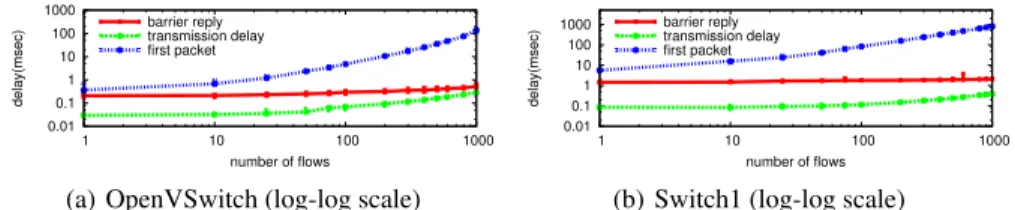
We check the behavior of the tested OpenFlow implementations, finding variation among them. For OpenVSwitch and Switch1, Figure 3 shows the time to install a set of entries in the flow table. The NetFPGA-based switch results (not reported) are similar to those of Switch1, while Switch2 and Switch3 are not reported as this OpenFlow mes-sage is not supported by the firmware. For this experiment, OFLOPS relies on a stream of packets of 100 bytes at a constant rate of 10Mbps that targets the newly installed flows in a round-robin manner. The probe achieves sufficiently low inter-packet periods in order to measure accurately the flow insertion time.
In Figure 3, we show three different times. The first,barrier notification, is de-rived by measuring the time between when thefirst insertion commandis sent by the OFLOPS controller and the time the barrier notification is received by the PC. The sec-ond,transmission delay, is the time between the first and last flow insertion commands
are sent out from the PC running OFLOPS. The third,first packet, is the time between
thefirst insertion commandis issued and a packet has been observed for the last of
the (newly) inserted rules. For each configuration, we run the experiment 100 times and Figure 3 shows the median result as well as the10thand90thpercentiles (variations are small and cannot be easily viewed).
From Figure 3, we observe that even though thetransmission delayfor sending flow insertion commands increases with their number, this time is negligible when compared with data plane measurements (first packet). Notably, thebarrier notification measure-ments are almost constant, increasing only as the transmission delay increases (difficult to discern on the log-log plot) and, critically, this operation returns before any first
packetmeasurement. This implies that the way thebarrier notificationis implemented
does not reflect the time when the hardware flow-table has been updated.
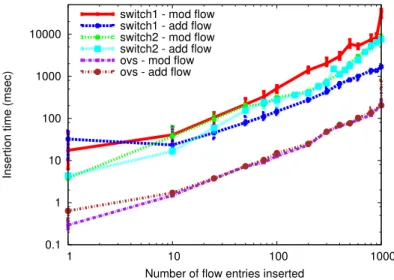
In these results we demonstrate how OFLOPS can compute per-flow overheads. We observe that the flow insertion time for Switch1 starts at1.8ms for a single entry, but converges toward an approximate overhead of1ms per inserted entry as the number of insertions grows. 0.1 1 10 100 1000 10000 1 10 100 1000
Insertion time (msec)
Number of flow entries inserted switch1 - mod flow
switch1 - add flow switch2 - mod flow switch2 - add flow ovs - mod flow ovs - add flow
Fig. 4.Delay of flow insertion and flow modification, as observed from the data plane (log-log
scale).
Flow insertion types We now distinguish between flow insertions and the modification
of existing flows. With OpenFlow, a flow rule may perform exact packet matches or use wild-cards to match a range of values. Figure 4 compares the flow insertion delay as a function of the number of inserted entries. This is done for the insertion of new entries and for the modification of existing entries.
These results show that for software switches that keep all entries in memory, the type of entry or insertion does not make a difference in the flow insertion time. Sur-prisingly, both Switch1 and Switch2 take more time to modify existing flow entries compared to adding new flow entries. For Switch1, this occurs for more than 10 new entries, while for Switch2 this occurs after a few tens of new entries. After discussing
this issue with the vendor of Switch2, we came to the following conclusion: as the number of TCAM entries increases, updates become more complex as they typically requires re-ordering of existing entries.
Clearly, the results depend both on the entry type and implementation. For exam-ple, exact match entries may be handled through a hardware or software hash table. Whereas, wild-carded entries, requiring support for variable length lookup, must be handled by specialized memory modules, such as TCAM. With such possible choices and range of different experiments, the flow insertion times reported in Figure 4 are not generalizable, but rather depend on the type of insertion entry and implementation.
4.3 Flow monitoring
The use of OpenFlow as a monitoring platform has already been suggested for the appli-cations of traffic matrix computation [20, 6] and identifying large traffic aggregates [14]. To obtain direct information about the state of the traffic received by an OpenFlow switch, the OpenFlow protocol provides a mechanism to query traffic statistics, either on a per-flow basis or across aggregates matching multiple flows and supports packet and byte counters.
We now test the performance implications of the traffic statistics reporting mecha-nism of OpenFlow. Using OFLOPS, we install flow entries that match packets sent on the data path. Simultaneously, we start sending flow statistics requests to the switch. Throughout the experiment we record: the delay getting a reply for each query, the amount of packets that the switch sends for each reply and the departure and arrival timestamps of the probe packets.
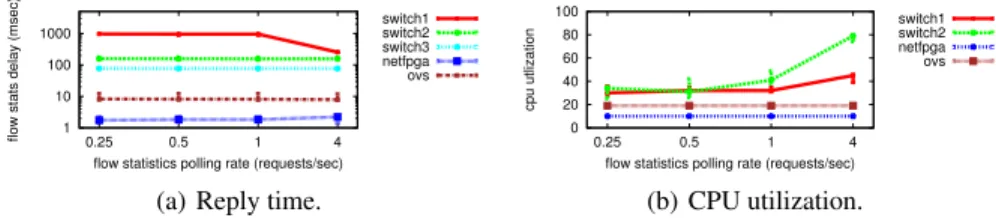
Figure 5 reports the time to receive a flow statistics reply for each switch, as a function of the request rate. Despite the rate of statistics requests being modest, quite high CPU utilization results for even a few queries per second being sent. Figure 5 reports the switch-CPU utilization as a function of the flow statistics inter-request time. Statistics are retrieved using SNMP. Switch3 is excluded for lack of SNMP support.
1 10 100 1000
0.25 0.5 1 4
flow stats delay (msec)
flow statistics polling rate (requests/sec) switch1 switch2 switch3 netfpga ovs
(a) Reply time.
0 20 40 60 80 100 0.25 0.5 1 4 cpu utlization
flow statistics polling rate (requests/sec) switch1 switch2 netfpga ovs
(b) CPU utilization.
Fig. 5.Time to receive a flow statistic (median) and corresponding CPU utilization.
From the flow statistics reply times, we observe that all switches have (near-)constant response delays: the delay itself relates to the type of switch. As expected, software switches have faster response times than hardware switches, reflecting the availability of the information in memory without the need to poll multiple hardware counters. These consistent response times also hide the behavior of the exclusively hard-ware switches whose CPU time increases proportionally with the rate of requests. We observe two types of behavior from the hardware switches: the switch has a high CPU
10 100 1000 10000 2 1 0.33 0.25 0
insertion delay (usec)
flow statistics polling rate (requests/sec) switch1 switch2 switch3 netfpga ovs
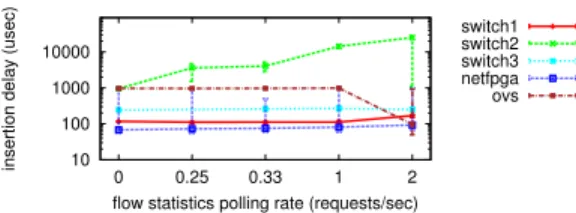
Fig. 6.Delay when updating flow table while the controller polls for statistics.
utilization, answering flow-stats requests as fast as possible (Switch2), or the switch de-lays responses, avoiding over-loading its CPU (Switch1). Furthermore, for Switch1, we notice that the switch is applying a pacing mechanism on its replies. Specifically, at low polling rates the switch splits its answer across multiple TCP segments: each segment containing statistics for a single flow. As the probing rate increases, the switch will ag-gregate multiple flows into a single segment. This suggests that independent queuing mechanisms are used for handling flow statistics requests. Finally, neither software nor NetFPGA switches see an impact of the flow-stats rate on their CPU, thanks to their significantly more powerful PC CPUs (Table 1).
4.4 OpenFlow command interaction
An advanced feature of the OpenFlow protocol is its ability to provide applications with, e.g., flow arrival notifications from the network, while simultaneously providing fine-grain control of the forwarding process. This permits applications to adapt in real time to the requirements and load of the network [12, 21]. Under certain OpenFlow usage scenarios, e.g., the simultaneous querying of traffic statistics and modification of the flow table, understanding the behavior of the data and control plane of OpenFlow switches is difficult without advanced measurement instrumentation such as the one provided by OFLOPS.
Through this scenario, we extend Section 4.2 to show how the mechanisms of traffic statistics extraction and table manipulation may interact. Specifically, we initialize the flow table with 1024 exact match flows and measure the delay to update a subset of 100 flows. Simultaneously, the measurement module polls the switch for full table statistics at a constant rate. The experiment uses a constant rate 10Mbps packet probe to monitor the data path, and polls every 10 seconds for SNMP CPU values.
In this experiment, we control the probing rate for the flow statistics extraction mechanism, and we plot the time necessary for the modified flows to become active in the flow table. For each probing rate, we repeat the experiment 50 times, plotting the median, 10thand90thpercentile. In Figure 6 we can see that, for lower polling rates, implementations have a near-constant insertion delay comparable to the results of Section 4.2. For higher probing rates on the other hand, Switch1 and Switch3 do not differ much in their behavior. In contrast, Switch2 exhibits a noteworthy increase in the insertion delay explained by the CPU utilization increase incurred by the flow statistics polling (Figure 5(b)). Finally, OpenVSwitch exhibits a marginal decrease in the median insertion delay and at the same time an increase in its variance. We believe this behavior is caused by interactions with the OS scheduling mechanism: the constant polling causes frequent interrupts for the user-space daemon of the switch, which leads to a batched handling of requests.
5
Summary and Conclusions
We presented, OFLOPS, a tool that tests the capabilities and performance of OpenFlow-enabled software and hardware switches. OFLOPS combines advanced hardware in-strumentation, for accuracy and performance, and provides an extensible software framework. We use OFLOPS to evaluate five different OpenFlow switch implemen-tations, in terms of OpenFlow protocol support as well as performance.
We identify considerable variation among the tested OpenFlow implementations. We take advantage of the ability of OFLOPS for data plane measurements to quantify accurately how fast switches process and apply OpenFlow commands. For example, we found that the barrier reply message is not correctly implemented, making it difficult to predict when flow operations will be seen by the data plane. Finally, we found that the monitoring capabilities of existing hardware switches have limitations in their ability to sustain high rates of requests. Further, at high rates, monitoring operations impact other OpenFlow commands.
We hope that the use of OFLOPS will trigger improvements in the OpenFlow pro-tocol as well as its implementations by various vendors.
References
1. OFLOPS.http://www.openflow.org/wk/index.php/Oflops.
2. Openflow switch specification (version 1.0.0). www.openflow.org/documents/
openflow-spec-v1.0.0.pdf, December 2009.
3. The snac openflow controller, 2010.http://www.openflow.org/wp/snac/.
4. Agilent. N2X router tester.http://advanced.comms.agilent.com/n2x/.
5. P. Arlos and M. Fiedler. A method to estimate the timestamp accuracy of measurement
hardware and software tools. InPAM, 2007.
6. G. Balestra, S. Luciano, M. Pizzonia, and S. Vissicchio. Leveraging router programmability
for traffic matrix computation. InProc. of PRESTO workshop, 2010.
7. A. Bianco, R. Birke, L. Giraudo, and M. Palacin. Openflow switching: Data plane
perfor-mance. InIEEE ICC, may 2010.
8. G. Covington, G. Gibb, J. Lockwood, and N. Mckeown. A packet generator on the NetFPGA
platform. InFCCM 2009.
9. A. R. Curtis, J. C. Mogul, J. Tourrilhes, P. Yalagandula, P. Sharma, and S. Banerjee.
De-voflow:scaling flow management for high-performance networks. InACM SIGCOMM, 2011.
10. D. A. Freedman, T. Marian, J. H. Lee, K. Birman, H. Weatherspoon, and C. Xu. Exact
temporal characterization of 10 gbps optical wide-area network. InIMC 2010.
11. N. Gude, T. Koponen, J. Pettit, B. Pfaff, M. Casado, N. McKeown, and S. Shenker. Nox:
towards an operating system for networks.SIGCOMM Comput. Commun. Rev., July 2008.
12. N. Handigol, S. Seetharaman, M. Flajslik, N. McKeown, and R. Johari. Plug-n-Serve:
Load-Balancing Web Traffic using OpenFlow. InACM SIGCOMM Demo, August 2009.
13. Ixia. Interfaces.http://www.ixiacom.com/.
14. L. Jose, M. Yu, and J. Rexford. Online measurement of large traffic aggregates on commodity
switches. InProc. of the USENIX HotICE workshop, 2011.
15. J. Naous, D. Erickson, G. A. Covington, G. Appenzeller, and N. McKeown. Implementing
an openflow switch on the netfpga platform. InANCS, 2008.
17. J. Pettit, J. Gross, B. Pfaff, M. Casado, and S. Crosby. Virtualizing the network forwarding
plane. InDC-CAVES, 2010.
18. A. Shaikh and A. Greenberg. Experience in black-box ospf measurement. InACM IMC,
2001.
19. R. Sherwood, G. Gibb, K. Yapa, M. Cassado, G. Appenzeller, N. McKeown, and G. Parulkar.
Can the production network be the test-bed? InOSDI, 2010.
20. A. Tootoonchian, M. Ghobadi, and Y. Ganjali. OpenTM: traffic matrix estimator for
open-flow networks. InPAM, 2010.
21. K.-K. Yap, M. Kobayashi, D. Underhill, S. Seetharaman, P. Kazemian, and N. McKeown.
The stanford openroads deployment. InProceedings of ACM WINTECH, 2009.
22. M. Yu, J. Rexford, M. J. Freedman, and J. Wang. Scalable flow-based networking with