Victorian 'Live Box' Microscope
Capability in 40mm
R. Jordan Kreindler (USA)
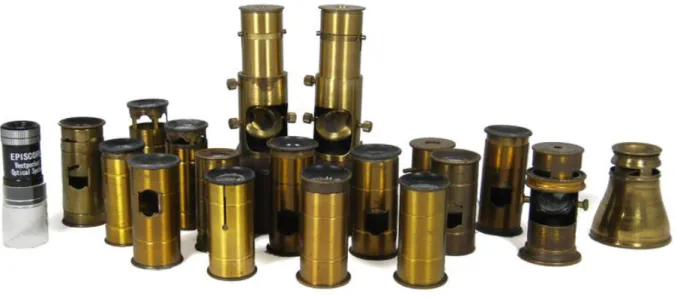
Small cylindrical microscopes were popular at the end of the 19th century and the beginning of the 20th. Fig 1. presents some varieties that are still commonly available at antique malls, flea markets, and through on-line auctions. These are sometimes referred to as "Pocket
Microscopes" or "Pocket Magnifiers". They are descendants of the microscope first invented by Nicolas Hartsocker (Dutch) c. 1689, and popularized by James Wilson (England) c 1702. The cylindrical instruments shown in Fig. 1 come from a variety of makers usually with only minor variations and are generally quite similar in size. Many include a removable magnifying glass (Fig. 2).
The examples in Fig 1. include two somewhat atypical microscopes at the right. The rightmost microscope displays a somewhat more conical than cylindrical shape, although of relatively similar size. See below and Fig. 4 for a brief discussion of the second microscope from the right. At the far left a modern Episcope, mounted on a stand, is included for comparison.
Earlier examples of cylindrical microscopes can be found in the Royal Microscopical Society collection (RMS) i which also has a related example ii. Other related example are in the Science Museum, London iii . The Billings collection provides additional varieties iv.
Some of these microscopes come with a spring-loaded stage which is moved downward by two short lateral metal dowels to allow small slides to be viewed. (See three instruments to the rear of Fig 1.) Like the centuries earlier Wilson screw-barrel
microscope, these instruments' slides are inserted in the sides of the body tube. They were often provided with a Stanhope lens.
Spring-loaded stage pocket microscopes were
frequently sold in cardboard or wood boxes with 3 to 6 small slides, often with one or more plain slides, a well slide, and some prepared slides with slots to store the slides. Some kits included a stand containing an adjustable mirror. The microscope could be mounted in the stand and secured with a built-in knurled screw. These microscopes were sold under a variety of names including
various combinations of the words universal, pocket, and microscope. These included, e.g., "The Microscope", "Universal Pocket Microscope", "Pocket Microscope", "Universal
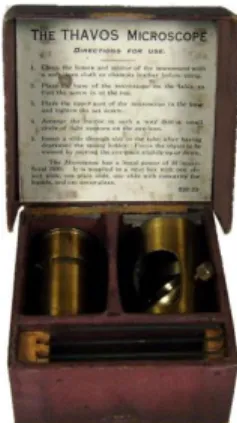
Microscope". They were also sold as, "The Thavos Microscope", "Achromatisches Universal Taschenmikroskop", "The Midgard", etc. Two stands with microscopes mounted are shown at the center rear of Fig. 1, A storage box with microscope, stand, and slides is shown in Fig. 3. Many of these microscopes were made in Europe, particularly in Germany and France. A spring-loaded pocket microscope was discussed in an interesting paper by Martin Mach, in a Micscape articlev some years ago.
While many of the cylindrical microscopes shown in Fig. 1 focus by movement of pressure fitting components, there are cylindrical
microscopes that focus via rotating threads. The microscope shown in Fig 4. has a base similar to that of a typical drum microscope. It has a
threaded cylinder which can be screwed up and down the main body tube
Figure 2. A Basic Cylindrical Microscope Disassembled to Show Removable Magnifying Glass
Figure 3. Storage Box for Thavos Microscope
Figure 4. Stage Focusing Pocket Microscope
to achieve focus by effectively moving the stage. Other examples were also sold with integral mounted mirrors.
It might be easy for professional microscopists to miss the importance of these small and relatively expensive microscopes which at the turn of the century cost about 1svi. However, for many microscope users these were often the first, and perhaps only, microscopes they had. Their low price made these microscopes quite popular as demonstrated by the variety of manufacturers and the number available in the marketplace, even today.
The microscope discussed here in its fully open state is similar in height to the Bertrand "Furnace" pocket microscope, c 1840 vii (Fig. 5), but somewhat wider. Closed it is considerably smaller than the Bertrand "Furnace" or any of the brass microscopes shown in Fig 1. Like those microscopes, it can only accept smaller slides, but unlike those instruments it is unique in having its own convenient built-in live box.
The 'Live Box' microscope can be disassembled into three parts: (1) the lower section is the live box bottom, i.e., a brass cylinder
terminating in a clear glass plate, (2) the middle section is the body tube with lateral openings for
Figure 5. Betrand "Furnace" and Pocket 'Live Box' Microscope Open and Closed
small slides, and also terminating in a glass plate, and (3) the upper section contains the eyepiece with pressure fitting collar. (Fig. 6).
The microscope focuses with a sliding tube inside a friction collar (Fig. 7), allowing it to change focus easily from slide to live box. The eyepiece is composed of a two air separated glass elements. The bottom of the lower element of the eyepiece extends below its housing and is convex. The eyepiece lens is approximately 19 mm in diameter, and the live box about 25.4 mm.
Unlike most similar small microscopes the top lens of the eyepiece is not flush with the top of the instrument, but recessed approximately 7 mm.
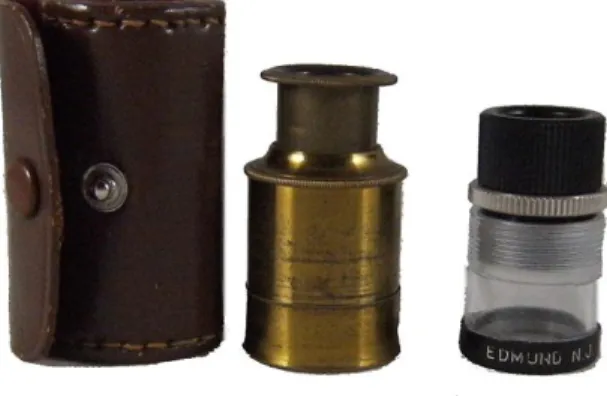
The microscope was sold in a single hinged wood box, with single front latch approximately 38.5 mm high x 50 mm x 67 mm at its longest dimension. Although protective of the instrument when stored, it was not an ideal companion for the pocket. See Fig. 11 for a more convenient carrying case. The microscope's size and design, in particular its integral live box, should make it a nice companion for field trips. So, this raises the question of its optical performance.
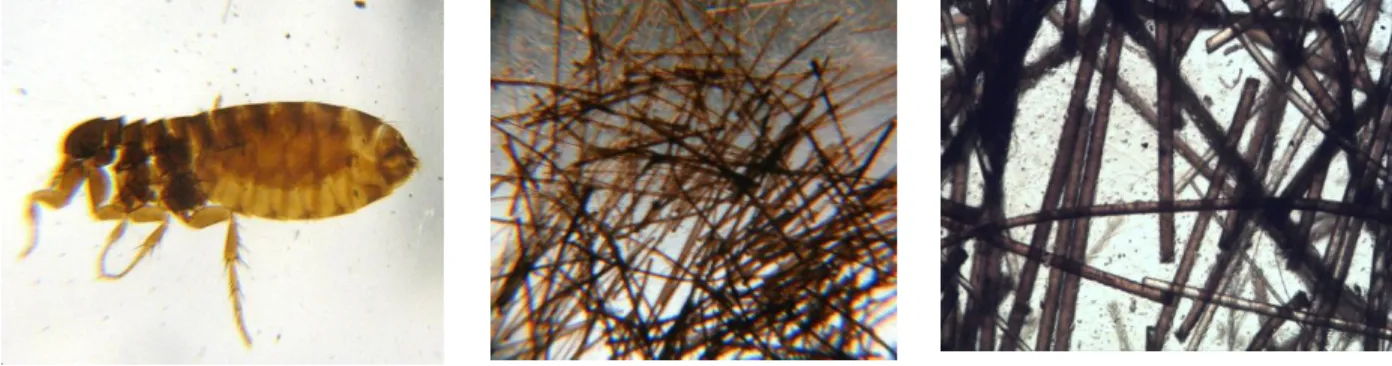
Below are pictures taken though the microscope of two small, approximately 55mm x 17mm, paper covered Victorian slides of a 'flea' and 'Haar'; live box subject resolution is similar. These were adjusted in Photoshop to approach the visual view through the microscope. In use, actual views are somewhat crisper than the photographs suggest. Fig. 8 shows a flea as seen in its entirety through the microscope's eyepiece. Fig. 10 is a photograph through an Olympus microscope of the hair shown in Fig. 9, providing a comparison with a modern benchtop instrument. Performance is surprisingly good for an instrument only 40mm tall when closed.
Figure 8. Flea Through Pocket Microscope
Figure 9. 'Haar' Through Pocket Microscope
Figure 10. 'Haar' Through Olympus Benchtop at 100x For Comparison
The full provenance of the instrument is unknown. Before I obtained the microscope, it was owned by several generations of a Western US family. It had been used extensively as demonstrated by the occasional slippage of the friction focusing tube, which was easily repaired.
Although, perhaps, not quite as optically capable as e.g., a later Seibert Wetzlar Emoscope, its ability to accept both slides and its integral live box, in which specimens can be quickly enclosed, makes it an almost ideal, easy to carry companion for field trips. I now pocket this microscope for excursions stowed in a nicely fitting case, originally made for an Edmund N.J. optical measurement viewer (Fig. 11).
Small cylindrical brass microscopes are still widely available and are usually quite inexpensive, in today's, 2011, market from $10 to $50 depending on condition, completeness, and of course the buyers present at the time of sale. A similar example to the one presented here sold with wood case on eBay in Apr 2011 for $50 viii.
The 'Live Box' style of pocket microscope discussed here occasionally comes to market, and although not up to professional quality, these instruments are still quite capable microscopes that make excellent, comfortable to carry, and convenient companions for casual outings.
___________________________________________
©2011 Text and photographs by the author.
The author welcomes any suggestions for corrections or improvement. He is always pleased to learn about any unique small brass cylindrical microscopes. He can be contacted at,
R. Jordan Kreindler: [email protected]
Figure 11. Carrying Case for 'Live Box' Microscope, Adapted from an Edmund, N.J. Measurement Tool
References.
i Turner, G.L'E. The Great Age of the Microscope. The Collection of the Royal Microscopical
Society through 150 Years. Adam Hilger: Bristol, England and New York, 1989, Figs. 262, 265,
266, 267, and 268 ii
Ibid, Fig. 310. iii
Bracegirdle, Brain. A Catalog of the Microscopy Collection of The Science Museum, London. 2005, Item 1/32 - "Pocket Microscope", 1/33 "Pocket Microscopes", 4/31 "Pocket Microscope", etc.
iv
Purtle, Helen R. (ed.). The Billings Microscope Collection. Second Edition. Armed Forces Institute of Pathology: Washington, D.C., 1974, Figs 294, 296, 314, 393
v
Mach, Martin. 30 g of microscope please! Micscape Magazine, August 2000
vi
Ibid iii, 4/27 "Pocket Microscope" vii
Moe, Harald. The Story of the Microscope. Rhodos: Denmark, 2004, p 189 viii
US eBay, April 14, 2011, Item ID 290553686109, 4 bidders, 9 bids, USD $50.
_______________________
Published in the online magazine Micscape, June 2011, www.microscopy-uk.org.uk.
Please report any Web problems or offer general comments to the Micscape Editor. Micscape is the on-line monthly magazine of the Microscopy UK web