
Taking Account of the Actions of Others in Value-based
Reasoning
Katie Atkinson and Trevor Bench-Capon
Department of Computer Science, University of Liverpool, Liverpool, L69 3BX, UK
Abstract
Practical reasoning, reasoning about what actions should be chosen, is highly
depen-dent both on the individual values of the agent concerned and on what others choose to
do. Hitherto, computational models of value-based argumentation for practical
reason-ing have required assumptions to be made about the beliefs and preferences of other
agents. Here we present a new method for taking the actions of others into account that
does not require these assumptions: the only beliefs and preferences considered are
those of the agent engaged in the reasoning. Our new formalism draws on utility-based
approaches and expresses the reasoning in the form of arguments and objections, to en-able full integration with value-based practical reasoning. We illustrate our approach
by showing how value-based reasoning is modelled in two scenarios used in
experi-mental economics, the Ultimatum Game and the Prisoner’s Dilemma, and we present
an evaluation of our approach in terms of these experiments. The evaluation
demon-strates that our model is able to reproduce computationally the results of ethnographic
experiments, serving as an encouraging validation exercise.1.
Keywords: Value-based Reasoning, Practical Reasoning, Expected Utility,
Argumentation Schemes, Ultimatum Game, Prisoner’s Dilemma
1This article is a revised and extended version of [1], which was adjudged runner up for the best paper
award at the Twenty Second European Conference on Artificial Intelligence (ECAI 2016). This article also incorporates some material based on [2].
1. Introduction
The Ultimatum Game is widely used in experimental economics to explore
interac-tions between people. In the Ultimatum Game, one person is given a sum of money and
told that she can offer as much of it as she wishes to her partner. That partner can accept
the offer, in which case both keep the money offered, or the partner can reject the offer,
in which case neither gets any money at all. Classical game theory suggests that the
offer should be as small as possible: it will be accepted by a rationally self-interested
person, since anything is better than nothing, and this will maximise what can be kept.
But in practice people do not offer the minimum: it seems that they take other factors
into account, perhaps altruism, perhaps a feeling that they are not comfortable with exploitation, or something else. Worse, minimum offers are very often rejected: the
partner cannot be relied on to act out of rational self interest either. Studies have shown
that people rarely act in conformity with the classical model, and have also shown that
they exhibit a wide range of behaviours, with extensive inter-cultural and intra-cultural
variation. Since so many of the decisions we take in practical reasoning rely for their
success on how other people respond and make their own choices, we have to take
account of how other people will behave. Since, however, reliable assumptions about
others’ actions cannot be made, when choosing our actions we need to find a way to
reduce the assumptions we make about how other people will react, or at least be clear
about the extent of our assumptions, and the consequences of them being mistaken. In this paper we will look at how we can take account of not justparticularactions that
other people might do, butthe whole setof actions that they might do. We begin with
a general consideration of practical reasoning.
A key difference between theoretical reasoning (reasoning about what is the case)
and practical reasoning (reasoning about what to do) [3] is thedirection of fit [4].
Whereas in theoretical reasoning an agent is trying to fit its beliefs to the world, in
practical reasoning an agent is choosing an action intended to fit the world to its
de-sires. For theoretical reasoning, there is only one, shared, world, and so if agents differ,
one (or both) of them is wrong. In contrast, desires will legitimately differ from agent
subjec-tive aspirations and desires of theindividualagents. Agents may even be in conflict, so
that they attempt to bring about different worlds. The conclusions are therefore
legit-imately subjective, and disagreement is both rational and to be expected, as discussed
extensively by Searle in [4]. Acceptance of an argument as to what to do depends not
only on the argument itself - for it must, of course, be a sound argument - but also on
the audience to which it is addressed [5]. Capturing such rational disagreement within a computational model of argument is one of the key motivations for our work, as we
will discuss in more detail in the next section. First we set out our main objectives for
this paper, which are:
• to take account of the effects on our actions of what others may do in the frame-work of value-based practical reasoning; and do this without requiring
assump-tions about the beliefs and preferences of any agents other than the agent engaged
in the reasoning;
• to do so in a manner compatible with the results of game theory and multi-criteria utility (e.g., [6], [7]) while explicitly and transparently allowing for subjectivity and altruism;
• to be able to express the reasoning in the form of arguments and objections so as to facilitate integration with value-based practical reasoning, and persuasion [8]
and deliberation [9] dialogues based on this style of reasoning.
The rest of the paper is structured as follows. In section 2 we provide some
back-ground discussion that motivates our computational account of value-based reasoning
and we also summarise prior work on the topic. In section 3 we provide an overview
of the games we use from experimental economics as the settings for exploring our
computational account. Section 4 contains the main details of our account of justifying actions by relating arguments to reasoning about expected utilities. In section 5 we
show how the reasoning can be expressed in terms of argumentation schemes that can
be used as the basis of persuasion and deliberation dialogues within practical
reason-ing. Further, we demonstrate how the schemes can be used in the Prisoner’s Dilemma
the Ultimatum Game. Section 7 offers an evaluation of the approach by relating it back
to our original objectives and also through consideration of how well our approach is
able to reproduce the results of previous real world ethnographic studies. Section 8
closes the paper with some concluding remarks.
2. Background
In this section we provide some background motivation for the work that we present.
We start by discussing Perelman’s notion of an audience [5], then we summarise prior
work that provides a computational realisation of this concept within an
argumentation-based account, and we follow this with a discussion on modelling the values of others.
2.1. Audiences
Perelman’s insight that we draw upon in our work is that for an argument to be
accepted, it has to be accepted bysomeone, an argument is only convincing if it
con-vinces people. There are a number of reasons why the audience should fail to accept an argument that seems entirely convincing to the speaker.
• The audience may be irrational, or use some different kind of logic. In [10], the tortoise accepts bothpandp→q, but refuses to acceptq. No efforts on the part of Achilles can persuade the tortoise: there is insufficient in common between
them to enable any meaningful debate.
• The audience may lack the capacity to follow the argument. While a watertight proof may appear to be a universally acceptable argument, it may be that the
audience cannot follow the proof and so are not convinced by it. If such an
audience accepts the conclusion it is on the basis of a kind of argument from authority, because they recognise that the speaker is in a position to know and
they trust the speaker, not on the basis of the proof they do not understand.
• The audience and the speaker may have different Weltanschauungs. Thus for example, Christians often deploy arguments about green issues based on a
secular ecologists. The groups may be able to debate, but there will be some
arguments that they are not able to share. In the famous words of Karl Barth,
“belief cannot argue with unbelief”.
• Related, but more tractable, is that there may be a difference in conceptualisa-tion. This may well lead to mutual misunderstandings. In Computer Science, this problem is addressed by the use of ontologies [11]. Once the different
con-ceptualisations have been made explicit it may be possible to align them [12],
enabling fruitful debate.
• The audience may differ from the speaker in beliefs. This is perhaps the most corrigible, since both should agree that either the speaker or the audience is right.
They can thus use mutually acceptable methods to resolve the factual dispute, or
appeal to an arbitration process, such as the use of a jury to establish the facts in
legal cases.
• Finally, as suggested above, in practical reasoning the audience may differ in aspirations, interests, values, goals and preferences, so that they evaluate future
states of affairs differently. While it is possible to argue for value preferences
[13], it may well be that the participants will agree to disagree [8]. Unlike the
other disagreements, disagreements about what to do are based on individual
properties of the agents, and so agents should be expected to differ. For practical
reasoning, unlike the other cases, the disagreement is not a sign that something
has gone wrong, and reconciliation is not always achievable, or desirable.
These are all interesting cases, and all need to be considered in argumentation, but it
is only the last that we are concerned with in this paper. Perelman summarises the
situation with respect to practical reasoning in [14]:
If men oppose each other concerning a decision to be taken, it is not
be-cause they commit some error of logic or calculation. They discuss
apro-pos the applicable rule, the ends to be considered, the meaning to be given
to values, the interpretation and characterisation of facts.
Assume universally valid and accepted standards of rationality, assume
perfectly rational agents operating with perfect information, and you will
find that rational disagreement will still occur; because, for example, the
rational agents are likely to have different and inconsistent values and
in-terests, each of which may be rationally acceptable
In what follows, to capture the required type of disagreement, we will consider an
audience to be characterised by a set of values, and a preference ordering on those
values.
This notion of audience was computationally modelled in [15] and made more
for-mal in Value-based Argumentation Frameworks (VAFs) [16]. VAFs are an extension
of the abstract Argumentation Frameworks (AFs) introduced in the seminal paper of
Dung [17]. In a VAF arguments are associated with the social (i.e.notnumeric) values2
their acceptance promotes or demotes. Different audiences can now be characterised
by the ordering they place on these values. Whereas in an AF an argument is defeated
by any attacking argument, in a VAF an argument isdefeated for an audienceby an attacker only if the value associated with the attacking argument is ranked at least as
highly by that audience. In this way different audiences will accept different sets of
arguments (preferred semantics [17] is used to determine acceptance), and, as is shown
in [16], provided the VAF contains no cycles in the same value, there will be a unique
non-empty preferred extension. Thus, use of VAFs provides a way of explaining (and
computing) the different arguments accepted by different audiences. Value-based
Rea-soning has been widely used as the basis of practical reaRea-soning ([18], [19], [20], [21],
[7], [22]) and applied in particular areas such as law ([23], [24], [25]), e-democracy
([26], [27]), policy analysis ([28]), medicine, ([29]), experimental economics ([30]),
rule compliance ([31]), decision support ([32]) and even ontology alignment ([33], [34]). Complexity results for VAFs were established in [35] and [36].
2Valuesare the aspirations or the purposes an agent might pursue, such as liberty, equality, fraternity,
2.2. An Argumentation Scheme for Value-Based Practical Reasoning
The application of the preferences of an audience, expressed as an ordering on
val-ues, to practical reasoning requires the generation of the arguments and identification
of the values associated with them. The proposal made in [37] was to use an
argumen-tation scheme (now included in the compendium of argumenargumen-tation schemes collected
in [38]) justifying an action in terms of the values it promotes. The scheme appears in
[37] as:
In the current circumstancesR, I should perform actionA, to bring about
new circumstancesS, which will achieve goal G and promote valueV.
We will henceforth refer to this scheme as Practical Reasoning Argumentation
Scheme(PRAS). Like all argumentation schemes, PRAS establishes its conclusion only
presumptively [39] and can be challenged using what [39] and [38] callcritical
ques-tions. Thus an argument generated using PRAS can be challenged by claims against its
soundness such as:
• that the current state is different, • that the action is not possible,
• that the action will reach a different state, • that the action will fail to achieve its goal, or • that the action will fail to promote its value.
It can also be challenged on the basis of thedesirabilityof the action:
• that it will also demote values and these values are more important, or • that alternative actions promote values that are more important.
This second group of objections is what gives room for subjectivity arising from
different value orderings so that we can model the differences between audiences
aris-ing from differences in the states they wish to braris-ing about.
In [19] seventeen different critical questions were identified that could give rise to
2.3. Computational Realisation of this Scheme
In order to make this approach computable, it is necessary to provide an underlying
representation of relevant aspects of the world and how they can be affected by the
actions of agents. State Transition Diagrams are a natural choice for this purpose, since
they can represent the world as a set of states, and actions as the transitions between
them. In open agent systems, however, the outcome of an action may well depend
on what the other agents in the situation choose to do. Thus an individual’s choice
does not necessarily determine the state that will be reached. To account for this, open
agent systems should model transitions as thejoint actions3composed of the individual
actions of all the agents relevant to the situation4. A suitable variant of state transition diagrams for use in open agent systems isAction-based Alternating Transition Systems
(AATS), introduced in [41], since they do have joint actions as their transitions. AATSs
are formally based on Alternating-time Temporal Logic [40]. The basic AATS was
augmented in [19] to allow the labelling of the transitions with the values promoted
and demoted by that transition. AATSs labelled in this way were termedAction-based
Alternating Transition Systems with Values(AATS+V) and AATS+Vs were used to
provide the underpinning semantical structure for the approach to practical reasoning
set out in that paper.
AATSs are particularly concerned with the joint actions of the set of agents Ag.
jAgis the joint action of the set ofnagents that make upAg, and is a tuplehα1,...,αni,
where for eachαj(wherej≤n) there is someagi∈Agsuch thatαj∈Aci. Moreover,
there are no two different actionsαjandαj0 injAgthat belong to the sameAci. That is, a joint action contains one, and only one action, for every agent inAg. The set of all
joint actions for the set of agentsAgis denoted byJAg, soJAg=Qi∈Ag Aci. Given a
j∈JAgand an agentagi∈Ag,agi’s action injis denoted byji. Using this, the formal
3Here, as in [40] and [41], byjoint actionno implication of the agents acting together is intended. A joint
action is simply an action composed of actions performed by a set of agents at the same time, without any suggestion of coordination, or common purpose. This contrasts with the notion of joint action in e.g. [42], which concerns acting in teams.
4This is an important difference from classic planning systems such as STRIPS[43], which focus on
definitions of an AATS are as follows:
Definition 1: AATS [41]. AnAction-based Alternating Transition System(AATS)
is an (n+ 7)-tupleS=hQ,q0,Ag,Ac1, ... ,Acn,ρ, τ,Φ, πi, where:
• Qis a finite, non-empty set ofstates; • q0∈Qis theinitial state;
• Ag={ag1,...,agn}is a finite, non-empty set ofagents;
• Aciis a finite, non-empty set of actions, for eachagi∈AgwhereAci∩Acj=∅
for allagi6=agj∈Ag;AcAgis the set of all actions{Ac1∪...∪Acn};
• ρ: AcAg→2Qis anaction pre-condition function, which for each actionα∈
Acagdefines the set of statesρ(α)from whichαmay be executed;
• τ: Q×JAg→Qis a partialsystem transition function, which defines the state
τ(q,j) that would result by the performance ofjin stateq. This function is partial
as not all joint actions are possible in all states;
• Φis a finite, non-empty set ofatomic propositions; and
• π:Q→2Φis an interpretation function, which gives the set of primitive
propo-sitions satisfied in each state: ifp∈π(q), then this means that the propositional variablepis satisfied (equivalently, true) in stateq.
This definition was extended in [19] to allow the transitions to be labelled with the
values they promote.
Definition 2: AATS+V [19]. Given an AATS, an AATS+V is defined by adding
two additional elements as follows:
• Vis a finite, non-empty set of values.
• δ:Q×Q×J×V→ {+, –, =}is avaluation functionwhich defines the status (promoted (+), demoted (–) or neutral (=)) of a value vu ∈ V ascribed to the
vu) labels the transition betweenqxandqyusingji with one of{+, –, =}with
respect to the valuevu∈V.
This definition is an extension of [19] to allow for values to be promoted by the
intrinsic worth of actions. Suppose Tom enjoys fishing while Dick does not. Now both
the joint action where Tom fishes and Dick does nothing and the joint action where
Dick fishes and Tom does nothing will result in the pair having fish. But only the first
will promote pleasure, since only Tom enjoys the activity of fishing in itself. Thus there
will be two different transitions, one for each of the joint actions, and only one of them
should return “+” with respect to the value pleasure.
AnAction-based Alternating Transition System with Values(AATS+V) is thus
de-fined as an (n+ 9) tupleS=hQ,q0,Ag,Ac1, ...,Acn,ρ, τ,Φ, π,V, δi. The values may
be ascribed to transitions on the basis of the source and target states, or in virtue of an
action in the joint action, where that action has intrinsic value.
Given a representation of the problem situation as an AATS+V, the discovery of
arguments, counter arguments and objections can be implemented in several ways,
including that used in [44]. In [44] a database containing tables for the states, joint
actions and transitions of the AATS+V is created to hold the problem information and
then instantiations of PRAS and challenges to those instantiations can be found by
fairly simple queries to that database. For example there will be an instantiation of PRAS if there is a transition from the current state which promotes a value.
Three stages in practical reasoning are identified in [19]:
• Problem formulation: essentially the construction of an AATS+V for the partic-ular problem situation. The AATS+V will reflect the views of the agent engaged in the reasoning, and so can be seen as embodying that agent’s causal model (to
determine the transitions) and its values (to enable the labelling of transitions),
as is demonstrated in [45];
• Epistemic stage: this involves determination of what the agent engaged in the reasoning believes (or chooses to assume) about the current state and the joint
action that will result from the choice of a particular individual action by the
• Option selection: the arguments generated from the AATS+V are formed into a VAF and their acceptability status determined according to the preferences of
the agent engaged in the reasoning.
While problem formulation and the identification of the current state can be
re-solved using normal theoretical reasoning techniques, and the option selection stage can be carried out using value-based reasoning based on VAFs as described in [16],
how the joint action should be determined in the epistemic stage is less obvious and is
the topic of this paper. The essential problem is that in order to know what it is best to
do, it is necessary to anticipate what the other agents that can influence the outcome of
our action will do, since this may drastically affect what results from our own actions.
But since this reasoning will depend on the beliefs, aspirations and preferences of these
other agents, a number of assumptions are required to be made and these are often
dif-ficult to justify. Agents who adopt the naive approach of assuming that others will be
like themselves, tend to perform badly in practice as is shown in work such as [46], but
the agents may have no knowledge at all of some or all the other agents involved, which could provide the basis of a different model. Even if they do have knowledge of these
other agents, predicting their behaviour is a highly uncertain matter. This variety of
possible behaviours should be expected since an important feature underlying practical
reasoning is that agents are different, have different desires and aspirations, and will
rightly make different choices in similar situations.
In [47] the argumentation was articulated into a set of argumentation schemes
de-signed to justify each of the components in PRAS. In that paper the actions of others
were seen to present a problem for the justification of the claim that a particular value
would be promoted, since this required that a specific transition be followed. As noted
in [47], the requirement imposed by PRAS is rather weak: merely that there issome
joint action containing the advocated action which gives rise to a transition labelled
with the value. But if this is challenged we need to show why we believe the other
relevant agents will act so that this is indeed the joint action that will be performed and
that this is the transition that will be followed. To do this in the terms of PRAS requires
the appropriate action using an instantiation of PRAS applicable to them individually.
That is, they use an AATS+V embodyingtheirbeliefs, causal model, and values [45].
This, in turn requires us to consider how each relevant agent will formulate the
prob-lem, the epistemic assumptions that each agent will make, and the value preferences of
each agent. Note that this will include the assumptions that the agents will make about
each other. Given the number of assumptions that need to be made, it is evident that some firmer basis for the choice of joint action is highly desirable.
2.4. Modelling the Values of Others
One approach, common in classical economics, is to see agents as consistently
ra-tional and narrowly self-interested agents who can be expected to pursue their
subjectively-defined ends optimally. John Stuart Mill [48] put it thus when describing “economic
man” (sometimes calledhomo economicus):
[Economics] is concerned with him solely as a being who desires to
pos-sess wealth, and who is capable of judging the comparative efficacy of
means for obtaining that end.
Game Theory [49] also uses a single measure of utility expressed as a payoff matrix,
and has become a very widespread basis for the design of multi-agent agent systems
[50]. This approach has led to some insights, and provided the foundation for much
elegant mathematics, but unfortunately does not provide a satisfactory explanation of
the way in which humans behave in practice. And of course, if we are deciding what
to do, we cannot expect others to behave as theyshould, so even if this were a good
normativetheory, we would still need an adequatedescriptivetheory.
That others cannot be seen in this way is well demonstrated by a number of
exper-iments carried out in behavioural economics. These experexper-iments are carried out, using a variety of public goods games, to test the theory that behaviour can be predicted
us-ing the assumptions of classical economics and game theory. There are valuable meta
studies, in particular for the Dictator Game [51] and the Ultimatum Game [52]. There
is also a study comparing how fifteen small scale societies play the Ultimatum Game
[53]. The findings suggest that the canonical model is followed only very rarely. Thus
in addition to their own material payoffs, many experimental subjects
ap-pear to care about fairness and reciprocity, are willing to change the
dis-tribution of material outcomes at personal cost, and are willing to reward
those who act in a cooperative manner while punishing those who do not
even when these actions are costly to the individual.
Even in the Prisoner’s Dilemma [54], where defection is clearly the dominant
strat-egy, we find a tendency to deviate from it [55]. In [56], the emergence of norms and
conventions is discussed in terms of the Prisoner’s Dilemma, and some of the other
characteristics influencing behaviour, such as empathy, trust andesprit de corpsare
cited as ways in which these norms can be formed. The role of punishment is explored in [57]. What all these comparative studies show is that
• The canonical model used in classical economics, game theory and many multi agent systems is not adequate to explain the behaviour encountered in
experi-mental studies;
• There is a significant amount of inter-cultural variation, suggesting that the es-tablished values of subjects is carried forward into these experiments;
• There is also a significant amount of intra-cultural variation, suggesting that the behaviour of individuals cannot reliably be predicted solely on the basis of their cultural background.
Our view is that by bringing the subjective ordering of values of agents to the fore,
value-based reasoning can provide a fruitful way of exploring these issues. This was
borne out by the examination of the Dictator and Ultimatum Games in [30]. There, however, like all approaches based on [19], the reasoning about what others would do
relied too heavily on unjustifiable assumptions about the values they would use, and
how they would order them, which is an issue that we address in this paper.
3. The Games
In this section we describe two games from experimental economics that we use as
Game here, because although, as shown in [51] and [30], it is amenable to analysis in
terms of value-based reasoning, there is only one decision maker, and so the need to
anticipate the actions of others, which is the aspect in which we are interested here,
does not arise. We will therefore only consider the Ultimatum Game and the Prisoner’s
Dilemma in this paper.
3.1. The Ultimatum Game
In the Ultimatum Game [58] the first player is given a sum of money and told that
he may offer some (or all) of it to the second player. Once the proposer has made
an offer the respondent may choose to accept the offer, or reject it, in which case
both players receive nothing. Whereas traditional game theory would suggest that the proposer would make the smallest offer possible and the respondent would accept it,
experiments do not support this. The meta-analysis of thirty-seven papers reported in
[52] found
that on average the proposer offers 40% of the pie to the responder. ... On
average 16% of the offers is rejected. ... We find differences in behavior
of responders (and not of proposers) across geographical regions.
It may well be that regions (at least at the country or even continent level used in
[52]) do not provide the best explanation for different behaviours, being themselves
large and often culturally heterogeneous. Another study [53], based on small-scale, homogeneous societies, found the different cultures more predictive:
Among the Achuar, Ache and Tsimane, we observe zero rejections [...].
Moreover, while the Ache and Achuar made fairly equitable offers, nearly
50 percent of Tsimane offers were at or below 30 percent, yet all were
accepted. Similarly, Machiguenga responders rejected only one offer,
de-spite the fact that over 75 percent of their offers were below 30 percent.
At the other end of the rejection scale, Hadza responders rejected 24
per-cent of all proposer offers and 43 perper-cent of offers at 20 perper-cent and below.
of Papua New Guinea rejected both unfair and hyper-fair (greater than 50
percent).
Two aspects of the societies concerned, namely the amount of cooperation found in
the general economic activity of the society and the extent to which market exchanges
were a feature of daily life, were found to be explanatory in [53]:
the Machiguenga and Tsimane rank the lowest; they are almost entirely
economically independent at the family level and engage rarely in
pro-ductive activities involving more than members of a family. By
con-trast, the Lamelara whale-hunters go to sea in large canoes manned by
a dozen or more individuals. ... The Machiguenga show the lowest
co-operation rates in public-good games, reflecting ethnographic descriptions
of Machiguenga life, which report little cooperation, exchange, or sharing
beyond the family unit.
In contrast, the Lamelara have the highest mean offer (58%) and a zero rejection rate. As shown in [30], this can can be explained by differing values and preferences
amongst the participants, with the ordering emerging from their everyday activities
being applied in the games. The game was analysed in [30], with the following six
values:
• Proposer’s Money (M1): Promoted by acceptance of an offer to a degree in-versely related to the size of the offer and demoted if the offer is rejected;
• Respondent’s Money (M2): Promoted by acceptance of an offer, to a degree related to the size of the offer;
• Generosity (G): Promoted for the proposer by giving away a reasonable amount of money;
• Equality (E): Promoted by both participants receiving the same amount; • Proposer’s Contentment (C1): Promoted by the acceptance of a low offer (did
Figure 1: AATS+V for Ultimatum Game from [30]. In this paper t (the threshold for fairness) will be taken as 35%.
enough), or by the rejection of a good offer, since the respondent would then be
considered unreasonable;
• Respondent’s Contentment (C2): Promoted by accepting a good offer and de-moted by accepting a low offer.
The transition diagram for the Ultimatum Game used in [30] is given in Figure
1. This considers the actions as happening serially, so that the joint actions have two stages. Whilst this makes the interaction, where values are promoted and demoted,
more explicit, in this paper we prefer to combine the actions, so that our joint actions
will comprise a proposal and a response to it. The proposer may make a very high (vho)
offer (more than 50%), an equal (eo) offer (=50%), a fair (fo) offer (35-50%), or a low
(lo) offer (less than 35%). The respondent may accept or reject, giving 8 joint actions.
j1is{vho, accept},j2is{vho, reject}and so on. The AATS+V state records the money
for each participant, and two flags, indicating whether the participants are content.
Most important are the values promoted and demoted by the transitions determined by
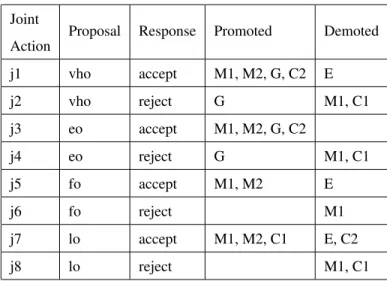
Table 1: Value promotion and demotion in the Ultimatum Game
Joint
Action
Proposal Response Promoted Demoted
j1 vho accept M1, M2, G, C2 E j2 vho reject G M1, C1 j3 eo accept M1, M2, G, C2 j4 eo reject G M1, C1 j5 fo accept M1, M2 E j6 fo reject M1 j7 lo accept M1, M2, C1 E, C2 j8 lo reject M1, C1 3.2. Prisoner’s Dilemma
In this very well known game [54], widely used in discussions of norm emergence
such as [56] and [55], both players may either cooperate or defect. Mutual cooperation
results (for example) in a payoff of 3 to each player, mutual defection a payoff of 1
to each player, and if one cooperates and the other defects the defector receives 5 and
the cooperator receives 0 (though other payoffs are possible provided the order defect-cooperate, both defect-cooperate, both defect and cooperate-defect is maintained, and that
the sum for mutual cooperation exceeds the sum for any other option). The “correct”
strategy is to defect since that gives a better payoff whichever move the other makes
(thus it is thedominant strategy). Note also it is not a zero-sum game: collective
utility is maximised by mutual cooperation. Here too, experiments find that the
game-theoretic choice is not always made in practice. As explained in [56] conventions to
encourage mutual cooperation often emerge or are devised. An example used in [56] is
a military situation where much effort is made to build up trust and loyalty to create an
esprit de corpsin a regiment so that members will cooperate rather than defect, feeling
that they are able to rely on their comrades, and in turn reluctant to let their comrades down. The conventions are often reinforced by the use of sanctions to punish defectors
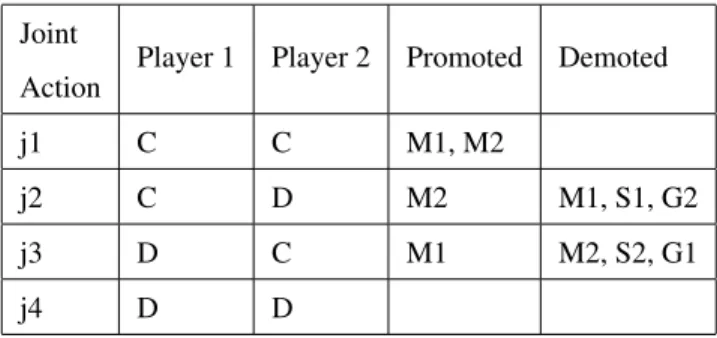
Table 2: Value promotion and demotion in the Prisoner’s Dilemma
Joint
Action
Player 1 Player 2 Promoted Demoted
j1 C C M1, M2
j2 C D M2 M1, S1, G2
j3 D C M1 M2, S2, G1
j4 D D
we use the following values:
• Player Money (M1 and M2): promoted if a player’s payoff is greater than 1 (which can be ensured by defection), and demoted if it is less than 1.
• Player Guilt (G1 and G2): demoted if player defects and the other player coop-erates
• Player Self-Esteem (S1 and S2): demoted if player 1 (or 2) cooperates and player 2 (or 1) defects: since the player may feel that they should have known better.
In this game there are four joint actions which promote and demote values as shown
in Table 2. Note that mutual defection provides a baseline, neither promoting nor
demoting any values, since it can always be achieved or bettered.
4. Justification of Actions
The currently used approach to value-based reasoning about the actions of others
follows that proposed in [19] and applied in [30]. This approach is:
1. Select a desirable transition based on the values it promotes and demotes.
2. Argue for the individual action performed by the agent in the joint action
corre-sponding to that transition.
3. Consider objections based on the other agents choosing different actions and so
causing different joint actions to be performed.
(a) The values promoted and demoted by the alternative transition are
accept-able.
(b) It is considered that the other agents will not act in this way.
Whereas 4a can be resolved on the basis of the preferences of the agent at whom
the argument is directed, 4b, which is very often needed since the alternative choices of the other agents may lead to undesirable situations, requires more assumptions about
the other agents than can be really justified.
In previous treatments based on such transition diagrams and using PRAS (e.g.
[30]) we would get arguments such as we should cooperate to promote M1 which
would be challenged with objections such asbut player 2 might defect which would
demote M1. Now if M1 is the most important value for Player 1, then the objection
will succeed, unless cooperation can be assumed. If M1 is the only value considered,
defection isdominant, giving a better outcome whatever the other player chooses. Only
if other values are considered will Player 1 choose cooperation. For example, M2 might
be rated as highly as M1 (perhaps Player 2 is Player 1’s child, or a close colleague), or a clear conscience is regarded as more important than money, in which case Guilt
must be considered. The arguments as modelled in [30] are, however, really for a
par-ticulartransition (joint action), with the agent’s own action justified in virtue of the
appearance of that action in the desired transition: the objections are available because
other joint actions contain the same individual action for the agent concerned. Better
would be an argument for the individual action itself, not the joint action and its
corre-sponding transition. This will require us to look at thesetof transitions containing the
action. In the Ultimatum Game suppose thatprob(jointaction)is the probability of
jointactionbeing performed when the agent making the argument chooses some
par-ticular individual action. Now the values will be expected to be promoted and demoted according to the probability of the second player’s response, as shown in Table 3, and
so the expected utility can be calculated, taking account of the complete set of joint
ac-tions that include a particular individual action. This obviates the need to assume that
the other will perform a particular action, which would enable a particular joint action
Table 3: Values promoted and demoted in the Ultimatum Game taking account of probabilities of different joint actions Proposer Action Promoted Demoted vho G, prob(j1)M1, prob(j1)M2, prob(j1)C2 prob(j2)C1, prob(j2)M1, prob(j1)E eo G, prob(j3)M2, prob(j3)C2, prob(j3)M1 prob(j4)C1, prob(j4)M1
fo prob(j5)M1, prob(j5)M2 prob(j6)M1, prob(j5)E
lo prob(j7)M1, prob(j7)M2,
prob(j7)C1
prob(j7)C2, prob(j8)M1,
prob(j8)C1, prob(j7)E
0≤prob(jointaction)≤1.
Now we can base arguments on the complete set of transitions containing an
ac-tion, taking into account the likelihoods of all possible responses, rather than having
to assume an action on the part of the other and then consider objections based on the
potential performance of a different action. Several forms of argument are available:
our examples assume the context of a persuasion dialogue [60] between a persuader (who may be an advisor or the proposer engaged in an internal dialogue, but cannot be
the respondent, since the Ultimatum Game, in this form, allows no contact between the
two players) and the proposer:
• Where an action is certain to promote a value. E.g.You should make a very high offer to promote G.
• Where an action cannot promote a value. E.g. You should not make a very high offer as that cannot promote C1.
• Where an action can promote a value. E.g. You should make a fair offer as this can promote M1.
• Where an action can demote a value. E.g. You should not make a low offer as that will risk demoting C1.
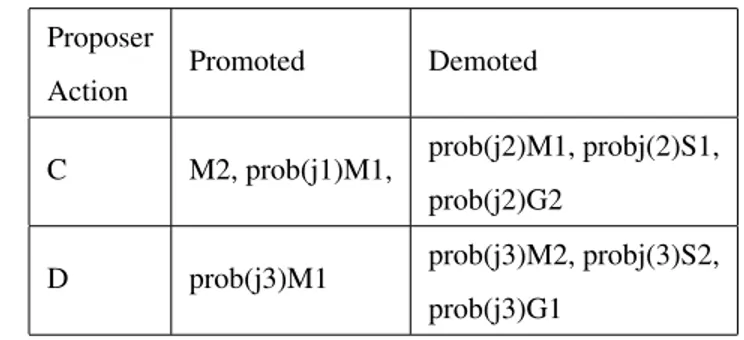
Table 4: Values promoted and demoted in Prisoner’s Dilemma, taking account of the probability of various joint actions
Proposer
Action
Promoted Demoted
C M2, prob(j1)M1, prob(j2)M1, probj(2)S1,
prob(j2)G2
D prob(j3)M1 prob(j3)M2, probj(3)S2,
prob(j3)G1
The third and fourth forms will have variants, if we can say something about the
relative probabilities of acceptance and rejection. These variants will replace “can”
with an indicator of how probable promotion is, such as “very likely”, “more likely
than not”, “may possibly” etc. For example, we know from [52] that a fair offer is
much more likely to be accepted than rejected, and so we can sayyou should make
a fair offer as that is likely to promote M1, or, since low offers are more likely to be
rejected,you should not make a low offer as there is a substantial risk of demoting M1. Similar arguments can be generated for the Prisoner’s Dilemma. Promotions and
demotions of the extended set of values for each action are shown in Table 4. From this
table, arguments can be generated (using techniques from [27], for example), as given
below.
• You should cooperate to promote M2
• You should not cooperate as this risks demoting M1, S1 and G2 • You should defect as this might promote M1
• You should not defect as this risks demoting M2, G1 and S2.
The real advance here over previous work such as [19] is that there is no longer any
need to make assumptions about what the other believes and prefers: the agent can now
come to a decision using itsownrelative preferences between values, its own beliefs
it uses only the AATS+V [19] based on its own beliefs, causal model and values [45].
This fulfils the first of the objectives identified in section 1.
4.1. More than one other agent
The games discussed above have only one other agent. Of course, in practice there
will typically be several, or even very many, agents that can have an influence. For
ex-ample, we might extend the Ultimatum Game so that there are several respondents and
acceptance or rejection is determined by a majority, or acceptance may require
una-nimity. Or we might want to look at a problem such as the free-rider problem, whereby
defection pays, unless some proportion of the population defects. For example, a small
number of tax avoiders will not affect services, but if there are too many, the state in-frastructure will collapse. In other situations there may be a number of agents with a
range of, perhaps different, choices. This might, at first sight, present a problem, since
the number of joint actions rises rapidly:nagents each withmactions give rise tonm
joint actions. But we are not especially interested in details of the joint actions: the
point of our approach here is to consider the set of joint actions in which the agent of
concern performs a particular action, which limits what we have to consider.
In the standard value-based approach, as proposed in [19] the values promoted and
demoted by a transition are determined by the source and target states. Even where the
action performed does affect values, as in [47], so that the intrinsic value of an action
can be taken into account, what matters for the agent concerned is its own individual action, and so all transitions between the same pair of states containing that action
will promote and demote the same values, as far as that agent is concerned. Thus, for
our current purposes, we will consider all joint actions with the same action by the
agent concerned leading to the same state to be equivalent, so that consideration can be
limited to the different outcomes possible for a given action of the agent engaged in the
reasoning, irrespective of how many joint actions reach each outcome. Effectively all
the other agents can be considered together as a single other. If a majority is required,
it does not matter which agents make up that majority; nor does it matter who the other
free loaders are provided that there are not too many of them, and so on. Of course,
agent in six will reject a fair offer, then we can be more confident that the larger the
number of respondents the more likely it is that there will be a majority for acceptance,
but the less likely it is that the offer will be accepted if we require unanimity.
4.2. Preferred Values
If only a single value is recognised as worthy of promotion, the choice is often
un-problematic. In the Prisoner’s Dilemma, M1 may be promoted and cannot be demoted
by defection, M2 is only promoted by cooperation, C1 can only be demoted by
defec-tion and S1 can only be demoted by cooperadefec-tion. In some cases, however, whether a
value is promoted or demoted may depend on what the other agents choose to do (as
is shown through the example presented in Tables 3 and 4). Similarly some combina-tions of values are unproblematic, but hard choices arise when different values pull us
in different directions, because an action may promote one value and demote another,
or because values are promoted and demoted to different extents. In such cases we
will need to express the subjective preferences of the agent engaged in the reasoning to
establish the outcome it prefers5.
4.3. Expected Utilities
We now turn to our second objective. In all value-based reasoning it is assumed that
an agent is capable of expressing a preference in terms of an ordering on values.
How-ever, sometimes quantification of the degree of preference and the extent of promotion
is required (see e.g. [32]). In the Prisoner’s Dilemma the payoff matrix gives the extent
of promotion e.g. j1 promotes M1 and M2 to extent 2 etc: (remember that we only
count gains in excess of the baseline towards promoting M1 and M2), but to quantify
the preference of combinations of values each value can conveniently be expressed in
terms of a single selected value (M1 is the obvious choice). The valuation is subjective to each agent, but requires reference only to its own preferences. Agent Preferences
are defined below.
5A recent exploration of the relationship between quantitative and qualitative aspects of decision making
Definition 3: Agent Preferences.
The preferences of an agentag∈Agis the setOag={hv0, w0i,hv1, w1i, ...,hvn, wni},
wherev0...vnare values andw0...wnare weights associated with these values.
Using these weights we can calculate the expected utility of agentiperformingα.
We will assume that if the desired joint action (j0) does not result from the
perfor-mance ofα, the worst case alternative joint action (jw) will be the one that does result
(providing a lower bound). Informally the expected utility of performingαwill be the
utility ofj0multiplied by the probability ofj0plus the utility ofjw(which will often
be negative) multiplied by (1 minus the probability ofj0).
Now, unlike previous work such as [19], there is no longer any need for the
reason-ing agent to make assumptions about the others’ beliefs, domain conceptualisation and
preferences that this other agent would use to choose a particular action: the reasoning
agent will then be able to decide using itsownrelative preferences between values,
its own beliefs and, where necessary, the particular degree of risk it is subjectively
prepared to accept.
Once the agent preferences have been established, the expected utilities can be
calculated as shown in Definition 4 below:
Definition 4: Expected Utility ofagperformingαin stateqs.
• LetJα = {j0, j1...jn} be the set of joint actions in whichag performsα(i.e.
jag =α) available in the starting state,qs. The action whichagwants to result
from performingαisj0.
• LetEjag
k = he0, e1, ..., emibe the (m+1)-tuple of the extents to which the
val-uesv0..vm are promoted (ei positive) or demoted (ei negative) forag by the
performance ofjk∈Jαinqs.
• The utility foragof the performance ofjk∈Jαinqs,u(ag, jk), isP n
i=0(ei∗wi)
for everyeiinEjagk wherehvi, wii ∈Oag. NowU
ag
α is the set of utilities forag
for allji ∈Jα. Letuwbe theui ∈Uαag, such thatuw ≤ui, for allui ∈Uαag.
Thusjwis the worst case foragof performingα(and so represents the strongest
• Letprob(j0)be the probability ofj0 being the joint action performed whenag
performsαinqs.
• Now the expected utility,euag(α)foragof performingαinqsis(u(ag, j0)∗
prob(j0)) + (u(ag, jw)∗(1−prob(j0))). Note that we are assuming that ifj0
does not result fromagperformingα, thenjwresults, so thateuag(α)is a lower
bound on the expected utility foragof performingα.
If we apply our machinery to the Prisoner’s Dilemma (PD), since there are only two
joint actions containing cooperation by a given agent,prob(j2) = 1−prob(j1). In the traditional PD only the agent’s own payoff is recognised as having utility. The utility is
the actual payoff minus the guaranteed payoff (i.e. the payoff from mutual defection).
For cooperation by an agent the extent to which M1 is promoted for that agent is 2
when the other cooperates. M1 is demoted to extent 1 for that agent when the other
defects. For defection by the agent it is promoted to extent 4 when the other cooperates
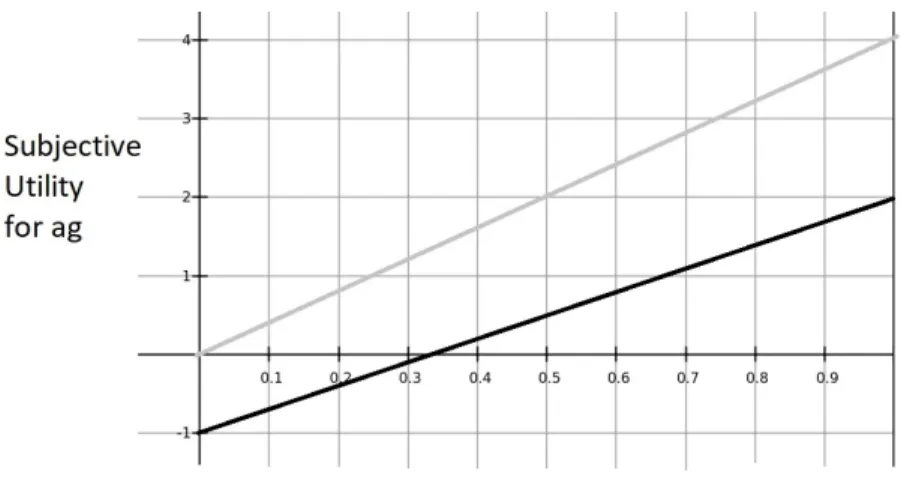
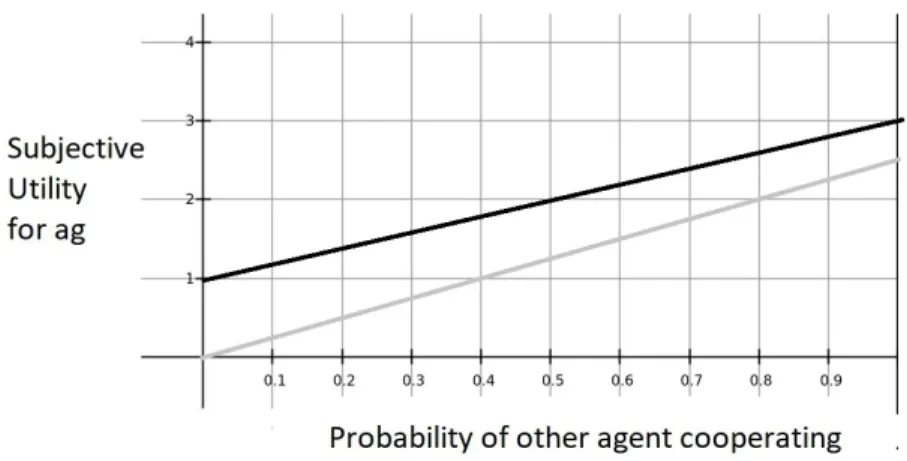
and neither promoted nor demoted when the other defects. The expected utilities for agcooperating (dark grey) and defecting (light grey) for the various probabilities of
the other cooperating are shown in Figure 2.
Suppose, however, that both the values M1 and M2 are recognised in PD, and M2
is weighted by the agent engaged in the reasoning at 0.5M1. Now the utility of
cooper-ating when the other also cooperates will be 3M1, and the utility of coopercooper-ating when
the other defects M1. Similarly we can calculate the expected utility of defecting for
the various probabilities of the other cooperating. Defecting when the other cooperates
yields a utility of 3.5M1, and mutual defection 0 (since this is the baseline case, no
values are considered promoted). Again the desired joint action is performed when the
other agent cooperates. This gives the graph shown as Figure 3. The crossover is at prob(j0) = 0.67.
If we now add in the value of Guilt (with a weight of 1), which gives a negative
utility when an agent defects and the other cooperates, we get the expected utilities
shown in Figure 4.
These three figures represent the three possibilities. In Figure 2, which shows the
Figure 2: Expected utilities foragwhenagvalues M1 only. Dark grey isagcooperates, light grey isag
defects.
Figure 3: Expected utilities foragwith M2 = 0.5M1. Dark grey isagcooperates, light grey isagdefects.
higher however likely it is that other defects or cooperates. Therefore defection is the
re-Figure 4: Expected utilities foragwith M2 =0.5M1 and G = M1. Dark grey isagcooperates, light grey is
agdefects.
verse is true: the inclusion of the additional values means that cooperation dominates
defection. In Figure 3, there is a crossover, atprob(j0) = 0.67, so that for high
proba-bilities of cooperation by the other, defection is preferred, but for low levels, the utility
afforded to the payoff received by the other makes cooperation preferred.
4.4. Arguments in Prisoner’s Dilemma Using Expected Utilities
Our third objective, to be able to express the reasoning in the form of arguments and
objections, is addressed by producing arguments based on the expected utilities. These
different possibilities mean that several types of argument can be based on the expected
utilities. Our examples are expressed in terms suitable for a persuasion dialogue (not
between the PD participants, but between a participant and advisor).
1. With your value preferences, you should C (respectively, D) since the expected
utility is always greater than any alternative.
2. With your value preferences, you should C (respectively, D) since the expected
utility is always positive.
3. With your value preferences, you should C (respectively, D) since the expected utility is greater than the alternative when the probability of cooperation is greater
Of these (1) is appropriate when the action advocated is dominant, and is the
strongest of the three. Argument (2) is rather weak: although the expected utility is
always positive, the proposed action may have a lower expected utility than the
alter-native for some (or even all) values ofprob(j1). It may, however, be useful if we wish
to reach the target state in order to enable some more beneficial action, since it
indi-cates that no harm is done, and so can be used to rebut objections. The argument shows that we suffer no loss, although there may be an opportunity cost. Argument (3) can be
effective provided we can give reasons to suppose that probability of cooperation is in
the desired range.
A natural dialogue arising from using (1) for cooperation might run:
A: Since you value M1 and M2 equally, you should C since the expected return is
always greater than the alternative.
B: This overvalues M2.
A: Even if M2 is only worth 70% of M1, the expected utility is always greater than
the alternative.
A: But even 70% overvalues M2.
B: Even if M2 is only worth half M1, a less than 0.6 probability of cooperation by
the other player will mean cooperation has the higher expected utility. Moreover
the expected utility of cooperation is still always positive.
In the course of the dialogue, the very strong argument of type (1) has become
untenable, but a combination of arguments of types (2) and (3) remain potentially
per-suasive. Here we are producing argumentation dialogues (albeit not yet expressed in a
computational dialogue model) which explore the sensitivity to the assessment of the relative valuations, and the sensitivity to the estimates of cooperation. These dialogues
do not require knowledge about the other, but if such information is available these
dialogues provide a context in which the information can be deployed by constraining
the range for the probability of cooperation by the other player. For an example based
B: Since you value M2 at 50% of M1, you should C since the expected return is
always positive.
A: But with these values, D gives a better return unless the probability of
coopera-tion is worse than 0.6.
This objection could be reinforced with reasons to suppose it likely that the other will
cooperate (family member, team member or similar, or experimental results, if
appro-priate results are available). Note, however, that these may also be reasons to increase
the valuation of M2 relative to M1.
5. Expression as Argumentation Schemes
The above arguments (1)-(3) for PD can be generalised and presented as
argumen-tation schemes in the manner of [39]; here we present one possible set of such schemes.
Note that the users of these schemes are not to be identified with the players in the PD. The dialogues below are supposed to represent one player being given advice (likely
to be a persuasion situation), or two people acting as a team in the PD discussing their
best course of action (likely to be a deliberation situation). The schemes have a
num-ber of premises, and the conclusion in common. These are the premises that set up the
situation and identify the key elements. Then additionally there is one key premise for
each scheme, which will be characteristic of the scheme. All the schemes have
• Conclusion:agshould performα
5.1. Common Premises
Each scheme will have four premises in common6:
• Values Premise: V is the set of values considered to be relevant byag
• Weighting Premise: The relative valuation of the members of V given byagis a set ofhvalue, relativeweightipairs
6The extents to which values are promoted are not given as a premise here because they are part of the
• Joint Action Premise:{j0, j1, ...jn}is the set of joint actions in whichag
per-formsα
• Expected Utility Premise: euag(α, prob(j0))returns the expected utilities of
agentagperformingαfor values ofprob(j0)wherej0is the desired joint action.
The first premise identifies the values that the agent will consider and the second
weights them in terms of the most important value. The joint actions containing the
advocated actionαas the action ofag are then taken from the AATS+V to give the
third premise. The fourth premise then establishes the expected utilities for the various probabilities of the desired joint action,j0, resulting fromagperformingα.
5.2. Characteristic Premises
We have three schemes to express the arguments (1)-(3) of section 4. We will name
these as follows:
1. Argument from Dominance
2. Argument From Positive Expected Utility
3. Argument From Probability of Cooperation7
Each scheme has its own characteristic premises. For Argument from Dominance:
• Dominance Premise: euag(α, j0) ≥ euag(β, j0)for any alternative actionβ
available toag, for all values ofprob(j0); wherej0is the joint action compliant
with the action ofag.
For Argument From Positive Expected Utility:
• Positive Utility Premise:euag(α, j0)≥0for all values ofprob(j0)
Finally, for Argument From Probability of Cooperation:
• Probability Range Premise:euag(α, j0)≥euag(β, j0)for all values ofprob(j0)≥
(respectively,≤)crossover, wherecrossoveris the point at whicheuag(α, j0)
becomes greater (respectively, less) thaneuag(β, j0)
7When other agents act so thatj
Here we are taking the joint action resulting from the agent engaged in the
reason-ing (ag) performingβto be thebestalternative, namely the joint action containingβ
is the one which yieldsagthe highest expected utility. Thusβwill represent a better
choice foragfor some probabilities of cooperation (i.e. there is a cross over point).
When, however, we are considering non-cooperation we use the worst case forag to
provide a lower bound on the expected utility. For instance, suppose we are playing chess and there is a choice of three moves A, B and C. When considering alternatives
to A, we choose the better of B and C. However, when considering the opponent’s
response to each of these moves, we consider the response that will give rise to the
desired transition and the response that will produce the worst outcome for our agent.
This will allow us to compare the joint actions using a lower bound on their expected
utility.
5.3. Critical Questions
These schemes can be associated with critical questions, as in [39]. Some will be
common to all three schemes, while those associated with the characteristic premises
will be applicable only to the particular scheme. We begin with those common to all
schemes.
5.3.1. Critical Questions Applicable to All Schemes
• CQ1Are all the members of V relevant?
• CQ2Are any other Values (i.e values in the AATS+V, but not included in V for this argument) relevant?
• CQ3Are any members of V over weighted? • CQ4Are any members of V under weighted?
CQ1 and CQ2 are directed at the Values Premise and CQ3 and CQ4 at the
Weight-ing premise. We have no CQs directed at the other two premises, which are taken
di-rectly from the AATS+V and so considered beyond challenge at this stage. If there are
by the labelling of transitions in the AATS+V, together with the Values and Weighting
premises. If there are more than two such joint actions, the worst case should be used
as the basis for comparison, as described above.
Once we have established which values we wish to consider, we can only challenge
the characteristic premise of the Argument from Dominance by coming up with an
alternative actionγfor whicheuag(γ, j0)> euag(α, j0)for at least some probabilities
of compliance. But if the dominance premise is correct with respect to the AATS+V it
follows strictly, and so this would challenge the AATS+V, which is considered outside
the scope of this stage of the argumentation. Therefore there are no CQs peculiar to the
Argument from Dominance. Similarly the Argument From Positive Expected Utility
has no individually applicable CQs. The Argument From Probability of Cooperation
does, however, have its own CQ:
• CQ5Canprob(j0)be assumed to be≥(respectively,≤)crossover?
5.3.2. Rebuttals
These critical questions will have their own typical rebuttals, but these may depend
on the context supplied by the original scheme. For example CQ3 could be met by
even if the relative weight of v is reduced to n%,euag(α, j0)remains greater than its alternatives for all values ofprob(j0).
in the context of the Argument from Dominance. In the context of Argument From
Positive Expected Utility, however, we would meet CQ3 with
even if the relative weight of v is reduced to n%,euag(α, j0)remains≥0for all
values ofprob(j0).
These rebuttals can be preempted by posing a more specific challenge: for example,
to the Argument From Positive Expected Utility:
if the relative weight of v is reduced to n%,euag(α, j0)becomes<0for values ofprob(j0)< p.
Perhaps a more natural way of challenging a move in a dialogue is first to pose
the appropriate CQ and then to put forward an argument of ones own. Thus the last
challenge would be made using both CQ3, and an Argument from Probability of
Co-operation for an alternative toα.
5.3.3. Dialogue Based on These Schemes
These schemes, challenges based on the critical questions and rebuttals can be
de-ployed in an adversarial discussion, enabling us to realise dialogues of the sort sketched
in section 4.4. As an example we will consider a dialogue betweenWhiteandBlack,
concerning the action to take in the Prisoner’s Dilemma.
In the dialogue, we will take it that the participants start from a common AATS+V, so that the schemes can be summarised in the form
GivenListOfValueWeightPairs, one shouldαbecauseCharacteristicPremise.
White, arguing for defection, begins the dialogue:
W1 Given hM1,1i, one should defect because the expected value of defection is always greater than the expected value of cooperation.
Black, arguing for cooperation, can now challenge this using CQ2. As M1 is the
only value used in W1, the other CQs cannot be used against W1.Blackneeds to find a
value demoted by defection. As Table 2 shows, there are three possibilities: the payoff of the other player, guilt, or the self-esteem of the other player. Blackcan make the
challenge (hereBlack uses the payoff of the other player) and then counter with an
Argument From Probability of Cooperation:
B1 You must take some account of the payoff to the other player.
B2 Given hM1,1i, hM2,0.5i, one should cooperate since the expected utility is greater for probability of the other cooperating less than 0.67.
At this pointWhitehas several possibilities:
R1, based on CQ1:There is no reason to care about the payoff of the other. This
R2, based on CQ2: Introduce another value, demoted by cooperation. Self
Es-teem is a possibility. A weight of 1 forS1will restore Defection to dominance.
R3, based on CQ3: Argue that M2 is overrated. For example, reducing the
weight to 0.2 will restore defection to dominance. Any greater weight will give
some value ofprob(j0)at which cooperation is better.
R4. Since B2 expresses an Argument From Probability of Cooperation, CQ5 is
also available.
HowBlackresponds will depend on the particular move chosen byWhite. For R1,
much will depend on the context. IfWhiteis trying to persuadeBlack,Blackgets to
choose the weights on values [8]8, and so the move is not available toWhite, since
Blackhas, in B1, already shown that M2 is, in its opinion, something to care about. In
other situations, such as deliberation, they are in a different dialogue type, and a nested
persuasion dialogue must be entered in whichBlackwill attempt to persuadeWhite
that the value should be given a positive weight. UnlessBlackis trying to persuade
White(when Whitehas the last word on what values should be considered), R1 is probably best avoided at this point. R2 similarly depends on context. If it isBlackbeing
persuaded,Blackcan simply reject this challenge, but ifWhiteis being persuaded, or in
a deliberation, R2 may be an effective move, if arguments for why the additional value
merits consideration can be produced.
Probably the best tactic forWhiteis to use R3, since this explores the sensitivity
ofBlack’schallenge to the weight used and so can establish the least weight that may
be accorded to the payoff of the other. Even ifWhiteandBlackagree to compromise
and accept a value for M2 between 0.2 and 0.5, then having made R3 means that R4
becomes more effective because of the reduction in the crossover point. For example, splitting the difference at 0.35 will reduce the crossover to 0.29.
Suppose, however, the dialogue in fact continues as follows (e.g. Blackis the
per-suadee, and so is able, in this context, to have the final say as to weights and values.)
8Note that a weight of 0 indicates that the agent recongises the value (for example, realises that other
W2 You have overrated M2. At 0.5, you would be happy for the other to defect when
you cooperate9. Suppose we weight it at no more than 0.25M1.
W3 GivenhM1,1iandhM2,0.25ione should defect because the expected value of defection is always greater than the expected value of cooperation.
B3 I think that 0.5 is the correct weight for M2.
Blackmay now introduce a third value, say Guilt, which will enable the Argument from Dominance:
B4 GivenhM1,1i,hM2,0.5iandhG1,0.5i, one should cooperate because the ex-pected value of cooperation is always greater than the exex-pected value of
defec-tion.
This will work well ifBlackhas the final say as to the weights on values. But even
if this is not so,Blackmay still defend cooperation with the Argument From Positive
Expected Utility:
B4a GivenhM1,1iandhM2,0.5i, I can cooperate because the expected value of cooperation is always greater than zero.
IfWhitehad responded to B2 using R4, arguing that there is no reason to think
that the probability of cooperation will be below 0.67,Blackcould try to argue that
cooperation is unlikely (e.g. because of the game-theoretic dominance of defection) or,
as in B4a, reply with the Argument From Positive Expected Utility, which licenses the
performance of the action as a non-harmful choice, while acknowledging that it may
not be the best choice.
9This could be so in many concrete situations, depending on the relationship between the two players.
A parent will often give preference to the needs of a child, or a cooperator may expect present (or future) compensation from others who defect. Normally, however, a player would be expected to wish to avoid the situation in which he cooperates and the other defects.
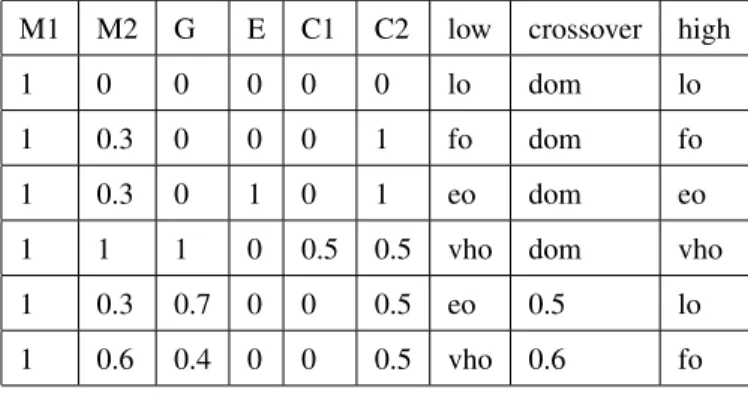
Table 5: Effects of different value weights on choices in the Ultimatum Game
M1 M2 G E C1 C2 low crossover high
1 0 0 0 0 0 lo dom lo
1 0.3 0 0 0 1 fo dom fo
1 0.3 0 1 0 1 eo dom eo
1 1 1 0 0.5 0.5 vho dom vho
1 0.3 0.7 0 0 0.5 eo 0.5 lo
1 0.6 0.4 0 0 0.5 vho 0.6 fo
6. Application to the Ultimatum Game
Similar arguments as used in the Prisoner’s Dilemma scenario can be developed for the Ultimatum Game. Different weights for the different values will lead to
differ-ent argumdiffer-ents being dominant. Also the differdiffer-ent actions will promote M1 and M2 to
varying degrees. M1 will be promoted most (if accepted) bylo, thenfotheneoand
least byvho, whereas for M2 the reverse will be true. Some example value profiles
and recommended actions corresponding to them are given in Table 5. The first six
columns indicate the weights for each value, the seventh the best choice for low
proba-bilities of acceptance of offers made, the eighth whether the choice is dominant, or the
particular crossover point for this profile, and the last column the best choice for high
probabilities of acceptance of offers made. For example, in the penultimate row, at low probabilities of acceptance the best choice is the equal offer: this promotes
generos-ity and avoids angering the other, without sacrificing more money than is necessary to
achieve these goals. When the probability of acceptance reaches 0.5 both the fair offer
and the low offer take over, with the low offer being slightly preferred. In the final
row, the high weight of M2 means that the very high offer is better than the equal offer
for low probabilities of acceptance, but the fair offer becomes best for probabilities of
acceptance greater than 0.6. When the probability exceeds 0.7, the low offer is also
7. Evaluation
We offer two aspects of evaluation. Technically, we can ask whether we achieved
the objectives set out in section 2.4. Practically, we can explore the extent to which our
proposed approach is able to reproduce the results of empirical studies such as [53].
Three technical objectives were given in section 2. Our first objective was to
ac-commodate the need to take account of the possible actions of others, while only
con-sidering the values, and preferences of the agent concerned, since modelling of others
is inevitably unreliable, given the extent of inter- and intra-cultural variation. We have
achieved this, using only the structure of the AATS+V applicable to the agent engaged
in the reasoning, by considering all the joint actions containing a given individual action as a set, for all probabilities of compliance, obviating the need to choose the specific
actions performed by others. The second objective was to capture this reasoning in a
way consistent with existing game and multi-criteria utility theory. We have achieved
this by relating the value-based approach to expected utilities. The key notion of a
dominant action remains, since, if there is a dominant action, the expected utility of the
values promoted by that action will always be greater than any alternative. Moreover
where an action is not dominant for all probabilities of the other behaving as required,
the bounds can be identified, which allows for the sensitivity to the relative weighting
of the relevant values, and to the probability of the other cooperating, to be quantified.
To fulfil the third objective, we have given argumentation schemes grounded on the expected utilities. Objections can be based on adding, removing or re-weighting
val-ues, which can change the dominant action, or restrict its dominance to a certain range
of probabilities of the other agents allowing a particular outcome to be reached. The
required degree of revaluation can be specified, allowing for the degree of risk to be
specified.
The payoffs of game theory are, as is perfectly correct for games which do require
firm rules, fixed and unchanging and the same for all the agents. However, the utilities
of these payoffs are subjective with respect to the individual goals and aspirations of the
agent concerned, and so can be individually set and made subject to change, possibly
![Figure 1: AATS+V for Ultimatum Game from [30]. In this paper t (the threshold for fairness) will be taken as 35%.](https://thumb-us.123doks.com/thumbv2/123dok_us/637950.2576866/16.918.276.652.186.460/figure-aats-ultimatum-game-paper-threshold-fairness-taken.webp)

![Table 6: Actions for values relating to cooperation and exchange activities, and selected other profiles for societies discussed in [53]](https://thumb-us.123doks.com/thumbv2/123dok_us/637950.2576866/38.918.202.752.229.511/actions-relating-cooperation-exchange-activities-selected-societies-discussed.webp)
