A NEW POLICY FOR THE SERVICE REQUEST ASSIGNMENT PROBLEM
WITH MULTIPLE SEVERITY LEVEL, DUE DATE AND SLA PENALTY SERVICE REQUESTS Anshul Sheopuri
Sai Zeng Chitra Dorai
IBM T.J. Watson Research Center 19 Skyline Drive Hawthorne, NY 10532, U.S.A.
ABSTRACT
We study the problem of assigning multiple severity level service requests to agents in an agent pool. Each severity level is associated with a due date and a penalty, which is incurred if the service request is not resolved by the due date. Motivated by Van Meighem (2003), who shows the asymptotic optimality of the Generalized Longest Queue policy for the problem of minimizing the due date depend-ent expected delay costs when there is a single agdepend-ent, we develop a class of Index-based policies that is a generaliza-tion of the Priority First-Come-First-Serve, Weighted Shortest Expected Processing Time and Generalized Long-est Queue policy. In our simulation study of an assignment system of a large technology firm, the Index-based policy shows an improvement of 0-20 % over the Priority First-Come-First-Serve policy depending upon the load condi-tions.
1 INTRODUCTION
Several large companies employ Service Request Assign-ment Systems (SS) to support hardware and software is-sues faced by users. Such services are typically outsourced to IT service providers. The performance of the system is governed by a mutually agreed contract between the buyer and the service provider.
In our setting, the penalties espoused in the contract are as follows: If the request is not resolved by its due date, a (fixed) Service Level Agreement (SLA) penalty cost is incurred. Otherwise, no cost is incurred. The due date and penalty cost for a service request are determined by the se-verity level assigned to the request by a Subject Matter Ex-pert (SME), who reviews it prior to the assignment deci-sion.
We model the problem of service request assignment as a continuous time optimization problem. Since the prob-lem is intractable, we develop near-optimal policies. Spe-cifically, the policy answers the following two questions dynamically.
• If at least one agent is free and there are multiple service requests waiting to be served, which re-quest should be assigned to one of the free agents?
• If all agents are busy and there is a waiting service request, which service request that is being served should be preempted, if at all?
The remainder of the section is organized as follows. Section 1.1 discusses the relevant literature. We then intro-duce the notation and formulate the problem in Section 1.2. In Section 1.3, we summarize our main results.
1.1 Literature Survey
The literature on modeling the performance of (SS) has mainly focused on addressing two questions: (1) staffing, i.e., how many agents should be staffed on a particular shift, and, (2) assignment, i.e., what policy should be fol-lowed to assign service requests to agents? Several re-searchers have addressed the question of staffing and as-signment jointly (for example, (Gurvich et al. 2007), and (Bassamboo et al. 2004)). However, oftentimes, staffing decisions are tactical and cannot be implemented simulta-neously with assignment decisions. Consequently, the bulk of the literature examines the staffing and assignment deci-sions independently. For example, a well-cited rule for staffing is the “Square root safety rule”, which suggests keeping a square root of workload safety stock of agents, analogous to classical inventory models (Tijms 2003). Be-low, we focus on the literature related to assignment only as it is most relevant to our work.
Among the policies suggested for assignment, the First-Come-First-Serve (FCFS) is most common. This in-tuitive policy suggests that requests be assigned in the or-der in which they are received. In systems with service re-quests of multiple severity levels, Priority FCFS is a natural extension to the FCFS policy. In this policy, re-quests are assigned in the order that they are received, but with strict preference given to higher severity requests. In the sequel, we use FCFS and Priority FCFS interchangea-bly to mean severity level preference based assignment.
While the FCFS policy is intuitive, it does not con-sider the penalty costs, due dates, etc. that are seen in prac-tice. Recently, researchers have developed policies with the objective of minimizing the costs stipulated in the con-tract. Van Meighem (1994) shows the asymptotic optimal-ity of the Generalized cμ rule for convex delay costs and a single agent. According to this policy, service requests are assigned dynamically based on the product of the service rate and marginal cost at the age (or time in system) of ser-vice request.
Van Meighem (2003) studies costs which are a func-tion of whether the job has resided in the system longer than its due date. He observes that this cost structure is in-tractable, and thus considers a sequence of continuous cost functions, which is discontinuous in the limit. He uses the Generalized cμ rule analysis to show that the Generalized Longest Queue (GLQ) policy is asymptotically optimal for this cost structure when there is a single agent. We will re-view this policy in more detail in the Section 2.
The literature on scheduling is related to our problem. For a review of the literature on scheduling, we refer the readers to Pinedo (1995). Here, we state one result that we will refer to later in the paper. For the problem of schedul-ing requests to minimize the weighted flow time with a single agent, Smith (1959) shows the optimality of the Weighted Shortest Processing Time (WSPT) policy. Ac-cording to this policy, each service request is assigned a number, given by the product of the weight assigned to the request and the inverse of the processing time. The re-quests are then scheduled for service in descending order of the numbers assigned to them. An extension to this pol-icy which schedules requests in the product of the weights and inverse of mean processing times (Weighted Shortest Expected Processing Times (WSEPT)) is known to be the optimal for the case of stochastic processing times for a single agent (Rothkopf 1966).
1.2 Notation and Problem Definition
Let the service requests comprise n levels of severity, de-noted by 1, 2, …, n. We will use k to denote the severity level of a generic service request. Let μk be the average
service rate, i.e., the inverse of the mean processing time of a severity k request. Let Dk be the due date of severity k
service requests. Let ck be the penalty cost incurred if a
service request is not resolved within its due date Dk, i.e.,
the penalty cost incurred is zero if a severity k request is resolved in time Dk and ck if it takes longer to resolve the
request.
The contract between the buyer and service provider stipulate higher SLA cost penalties for the more important severity levels. Requests with higher penalty costs are also more difficult to solve and their mean service rates are thus lower. Consequently, without loss of generality, we assume that the penalty costs and service rates are ordered in sever-ity levels as follows:
n
c
c
c
1>
2>
...
>
andμ
1<
μ
2<
...
<
μ
n. Before we formulate the problem, we formally define what we mean by a policy. A policy π is a dynamic deci-sion rule to determine which service requests to assign to agents and which service requests to preempt, given the state of the system. In order to write the objective function, we need some additional notation. Let Sk be the set ofse-verity k service requests. Let
τ
ikbe the sojourn time of the ith request in the set Sk. The problem is to find the policy π
that minimizes the penalty cost, i.e.,
{
∑
}∑
∈ ∈>
n k ki Sk k ikD
c
,..., 2 , 1}
{
1
τ
. 1.3 Our Main ResultsWe develop a class of policies, which we call Index-based policies that is a generalization of three well-know poli-cies: First-Come-First-Serve, Weighted Shortest Expected Processing Time and Generalized Longest Queue policy. Each of these polices is either optimal for a special case of our problem or a related problem.
We benchmark the performance of our policies through a simulation study. We simulate the service request as-signment process of a large technology firm to evaluate the performance of our policies. The main insights of our study are:
• The cost of the best Index-based policy, within the class of index-based policies compared to the FCFS policy shows an improvement of 0-20% for the base case of problem instances in the dataset.
• Allowing preemption can add significant value to the business process. However, for certain load re-gimes, preempting service requests without consid-ering elapsed service time can lead to poorer per-formance.
• The best Index-based policy perform better than the FCFS policy on a customer satisfaction metric that we develop.
The remainder of the paper is structured as follows. In Sec-tion 2, we derive our policy class, which we refer to as In-dex-based policies. In Section 3, we perform an extensive numerical investigation. We briefly discuss the implemen-tation in Section 4 and discuss the scope for future research in Section 5.
2 INDEX-BASED POLICIES
Recall that any policy answers the following two questions dynamically.
• If at least one agent is free and there are multiple service requests waiting to be served, which re-quest should be assigned to one of the free agents?
• If all agents are busy and there is a waiting service request, which service request that is being served should be preempted, if at all?
In the sequel, we propose a class of index-based poli-cies to make the assignment decision. We then discuss the various preemption schemes that we consider.
To motivate our class of index-based policies, we first examine Van Meghem (2003) in detail. As stated earlier, he considers a (SS) with requests of multiple severity lev-els, due dates, SLA penalty costs and a single agent. Using results from Van Meighem (1994), he shows that a dy-namic priority rule, which he refers to as the Generalized Longest Queue (GLQ) policy, is asymptotically optimal. The GLQ policy is FCFS within severity level and priori-tizes the severity level with highest index at time t, defined as k k k k
D
t
N
t
I
λ
)
(
)
(
=
,where Nk(t) is the number of severity k requests in the
system at time t.
While the GLQ policy proposed by Van Meighem (2003) is asymptotically optimal for the case of a single agent, our setting is of multiple agents. We propose a new policy class with two parameters, x and y, which we call the index-based class of policies. For a given x and y, the policy is a modification of the GLQ policy with a SLA pe-nalty cost and service rate term considered multiplica-tively: k k k y k x k k
D
t
N
c
t
In
λ
μ
)
(
)
(
)
(
)
(
=
.We use π(x,y) to denote an Index-based policy with parameters x and y. The index based policy is sensitive to SLA penalty costs and service rates, which allows us to
show that this class encompasses the FCFS policy, the WSEPT policy and the GLQ policy. We state this result rigorously next.
Theorem 1 Suppose that the number of arrivals in [0, T] is bounded above by M(T) < ∞. Then, for the class of Index-based policies π(x,y) operated during [0,T], the following statements hold:
1) For a given y, there exists m1(T) < ∞ such that for x > m1(T) , π(x,y) is FCFS.
2) There exists m2(T) < ∞ such that for x = y > m2(T) ,
π(x,y) is WSEPT.
3) For x = y = 0, π(x,y) is GLQ.
Proof: Omitted.
The best policy, within the class of Index-based poli-cies, is computed by means of a search over the parameters x and y. We refer to this as the best Index-based policy. Since the index-based policy class contains the FCFS pol-icy, the cost of the best Index-based policy is guaranteed to be better than the FCFS policy.
We next address the question of when to preempt a service request in case all agents are busy. We consider three preemption rules:
(P1) No preemption: Never preempt requests being ser-viced.
(P2) Partial preemption: Preempt the lowest index service request that is being served that has been served for less than the mean of the service time of its severity level if a higher index service request is waiting.
(P3) Full preemption: Preempt the lowest index service re-quest that is being served if a higher index service rere-quest is waiting.
In case of preemption, we allow for work-saving, i.e., if a service request is preempted, an agent who is assigned this request later learns about the prior resolution attempts. This assumption is not unreasonable as agents document solutions that have been attempted. However, note that the insights of our results carry over to the no work-saving case as well.
3 COMPUTATIONAL RESULTS
To simulate a (SS), we used data from a large service pro-vider. The dataset contains information about arrival times, service times, severity levels and due dates regarding 297 service requests. Since we do not know the optimal policy or the optimal cost, we benchmark the performance of our policy against the FCFS policy.
We first make an interesting observation. A histogram of the empirical distribution of the inter-arrival times of
Severity 1 level tickets clearly shows that the tail is long (histogram excluded for confidentiality reasons). Conse-quently, we tested whether the distribution of the inter-arrival times is sub-exponential Weibull using a chi-squared test. The null hypothesis that the distribution is Weibull with parameters k = 0.74 and λ = 54.61 was not rejected at 95 % statistical significance. The reader may note that this observation is in contrast with the assumption of Poisson arrivals that is common in the queueing litera-ture. This underscores the value of a simulation-based ap-proach to our problem.
In out computational experiments, we compare the best Index-based policy with the FCFS policy. The reader may note that the optimal value of the parameters x and y is computed by means of search. Further, as stated before, since the FCFS policy belongs to the Index-based policy class, the best Index-based policy is guaranteed to perform better than the FCFS policy on an expect cost penalty measure. Of course, evaluating the best Index-based policy through a search on the parameter space of x and y means that the best Index-based policy is computationally more intensive than the FCFS policy. However, it is worth add-ing that the computational effort required to determine the best Index-based policy may be controlled through coarse-ness of the search over the parameter space.
The remainder of the section is structured as follows. We first discuss the performance of the Index-based class of policies for the base-case of parameters in the dataset (The parameters have been normalized due to confidential-ity concerns) in Section 3.1. We then discuss the value of preemption in the business process in Section 3.2. Section 3.3 discusses sensitivity analysis with respect to the service rates and the penalty costs. Finally, in Section 3.4, we dis-cuss the performance of our policies on a Customer Satis-faction score that we develop.
3.1 Performance of Policies
We first test the performance of our policy for the problem instances of SLA penalty costs and mean service times in the data for various load conditions (or number of agents). The values of penalty costs and service rates for the base case are
c
1=
100
,
c
2=
5
,
c
3=
2
,
c
4=
1
(USD) and5
,
1000
,
4000
,
16000
2 3 4 1=
μ
=
μ
=
μ
=
μ
(inser-vice requests / min). We benchmark the performance of our policy by comparing the cost that can be “affected” with that of the FCFS policy. We define this formally next. Define the Sunk cost as the cost of service request vio-lations corresponding to requests whose service time ex-ceeds the due date. Intuitively, this cost corresponds to SLA penalty violations which are unavoidable, i.e., the cost incurred irrespective of the number of the agents that are staffed.
Since any policy that we propose cannot affect the sunk cost associated with SLA penalty violations, we com-pute the difference of the cost of SLA penalty violations and Sunk cost as the metric of performance of a policy. We define this to be the Operating cost of the policy. To benchmark the performance of the index policy, we com-pute the percentage improvement of the Operating cost of the index policy over the Operating cost of the FCFS pol-icy.
We first summarize our results. For each problem in-stance of the number of agents, we compare the cost of the best preemption scheme with the Index-based policy and the best preemption scheme with the FCFS policy. We note that the percentage improvement is 0-20% depending upon the number of agents. The detailed results are provided in Table 1 in the Appendix.
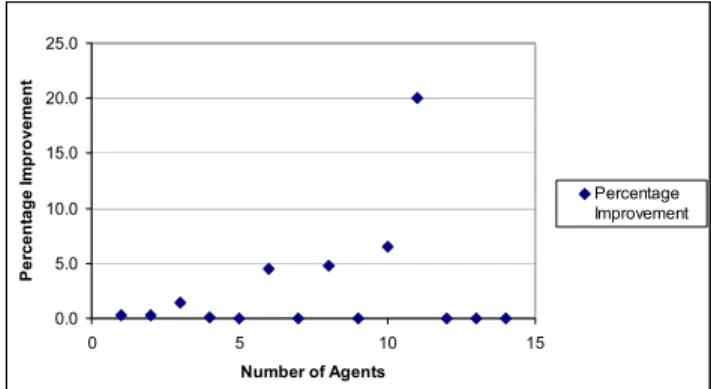
Next, we discuss the performance of our policy com-pared to the FCFS policy as the number of agents is varied. We first note that the performance of both policies is simi-lar when the number of agents is either small or simi-large. The intuition behind this observation is as follows: When the number of agents is small, both policies primarily target reductions in severity 1 service requests. When the number of agents is large, some agents are “always free” and thus the policy need not be intelligent. This can be seen in Fig-ure 1, which shows the percentage improvement in Operat-ing Cost of the Index based policy against the FCFS policy as the number of agents is varied. Thus, we recommend us-ing Index-based policies in medium load conditions.
0.0 5.0 10.0 15.0 20.0 25.0 0 5 10 15 Number of Agents Pe rc e n ta ge Im p rov em e n t Percentage Improvement
Figure 1: Comparison of Index-based policy with the FCFS policy
3.2 Value of Preemption
We now investigate the value of preemption in the busi-ness process. We compare the performance of the three preemption schemes that we consider: (1) No preemption, (2) Partial preemption and (3) Full preemption.
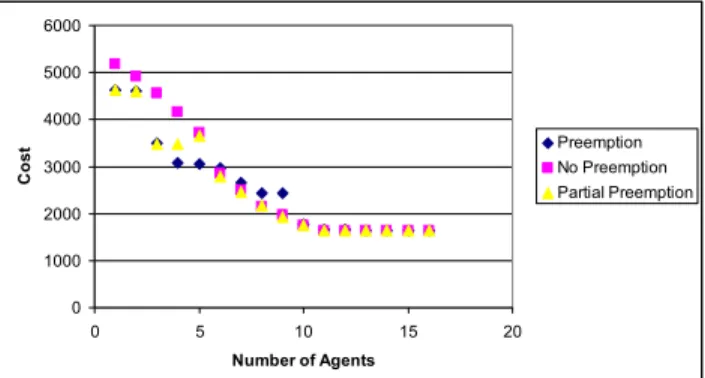
We make the following observations from Figure 2, which shows the performance of the Index-based policies for the three cases of preemption. Our first observation is that none of the policies dominate the other two for all load
conditions. Secondly, when the number of agents is large, the performance under the three preemption schemes is identical. 0 1000 2000 3000 4000 5000 6000 0 5 10 15 20 Number of Agents Co s t Preemption No Preemption Partial Preemption
Figure 2: Value of preemption for Index-based policies We summarize our recommendations of the preemp-tion scheme that performs well for Index-based policies for different number of agents (see Table 2). The entries in the table may be interpreted as follows: A “X” in the ith row
and jth column denotes that the jth preemption scheme
per-forms well for the ith load condition.
Table 2 Recommendation for the different preemption schemes
# Agents No Partial Full
Low X X
Medium X
High X X
Very High X X X
3.3 Sensitivity Analysis
Next, we consider the performance of the best Index-based policy against the FCFS policy when the penalty costs and service rates are varied. We expect that greater benefit can be derived from using the Index-based policy against the FCFS policy if the penalty costs are “similar” or the ser-vice rates are “dissimilar” across different severity levels, because in either case, there is a greater incentive to give assignment preference to a lower severity level. We make this notion rigorous below.
Let xi, i = 1, 2, 3 be n-dimensional vectors and let
xi =
(
,
,...,
)
2 1 i n i ix
x
x
. Definition: Let2
≤
k
≤
n
.
Let
x
1j=
x
2j∀
j
∈
{
1
,
2
,
3
,...,
n
}
\
k
. We say that the com-ponents of x2 are less similar than those of x1 (thecompo-nents of x1 are more similar than those of x2 ) if
|
x
k1−
x
k1+1|
≤
|
x
k2−
x
k2+1|
The similarity of the components of a vector, when on-ly component k is varied, is defined with respect to com-ponent k+1 since the Index-based policy would outperform the FCFS only by reducing the number of lower severity level violations. This intuition that the benefit from Index-based policies is higher when the SLA penalty costs are more similar is confirmed in the figure below (see Figure 3). A similar result may be obtained for less similar service rates (see Figure 4). Both Figures 3 and 4 are for the case of Full preemption, keeping all other parameters of the base case fixed.
0 10 20 30 40 50 60 70 80 90 100 0 5 10 15 20 Number of Agents P e rcent a g e Im p ro vem ent c_1 = 8 c_1 = 100
Figure 3: Sensitivity with Penalty Cost
0 10 20 30 40 50 60 70 80 90 100 0 5 10 15 20 Number of Agents Pe rc e n ta ge Im p rov em e n t mu_2 = 8000 mu_2 = 4000
Figure 4: Sensitivity with Service Rates 3.4 Customer Satisfaction
The reader may note that the structure of the penalty func-tion results in the following intuitive property of an opti-mal policy: “If a service request is not resolved by its due-date, it is optimal to never resolve it”. This is a conse-quence of the fact that the contract does not penalize non-resolution of service requests. However, in several practi-cal scenarios, there is a good-will cost associated with ei-ther not resolving a request or resolving it too late. Conse-quently, our policy does not have this property. Instead, we
measure the impact of the goodwill cost by evaluating a customer-satisfaction metric.
We use the following Customer Satisfaction metric,
{
∑
}∑
∈ ∈>
+
n k i S ik k k kD
c
,..., 2 , 1}
)
1
{(
1
β
τ
,the total cost of SLA violations when the due date of each request is extended by a factor of β > 0. Clearly, one can develop other customer satisfaction metrics as well.
Our results show that the best Index-based policy has a significantly greater customer satisfaction metric that the FCFS policy for any number of agents for the case of β = 0.25 (see Figure 5). Consequently, we conclude that the Index-based policies do not result in a poorer customer sat-isfaction than the FCFS policy.
0.0 5.0 10.0 15.0 20.0 25.0 0 5 10 15 Number of Agents P e rc ent a ge I m pr o vem ent Percentage Improvement
Figure 5: Customer Satisfaction of Index-based policy ver-sus FCFS policy
4 IMPLEMENTATION
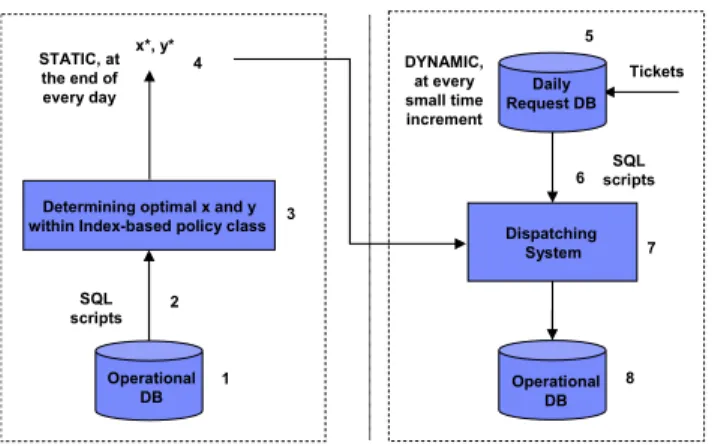
We now discuss an implementation of (SS). The imple-mentation has two modules. The first module performs batch or static analysis to compute the optimal parameters of the Index-based policy at the end of every review pe-riod, say everyday. The second module takes these parame-ters as input from the static module to enable the dynamic real-time assignment decision during the next period, for example, the next day.
We now examine the implementation in detail. The historical service request information is maintained in the Operational Database 1, from where is extracted periodi-cally using SQL scripts 2 (say everyday) to determine the optimal policy, within the class of index-based policies. The optimal values of the parameters x and y are fed into the assignment system 7, which is used to assign requests extracted using SQL scripts 6 extracted from the database 5 which is populated with daily arrivals at every small time increment. The assignment decision is then fed into data-base 8, which is then extracted by the agents (see Figure 6).
Determining optimal x and y within Index-based policy class
x*, y* Dispatching System Tickets DYNAMIC, at every small time increment STATIC, at the end of every day 1 2 3 4 5 6 SQL scripts 7 8 SQL scripts Operational DB Daily Request DB Operational DB
Figure 6: An illustrative implementation. 5 CONCLUSION AND FUTURE RESEARCH In this paper, we propose an algorithm to assign service re-quests to agents. The class of policies that we propose, which we refer to as index-based policies, is motivated by the GLQ policy proposed by Van Meighem (2003). The policy class contains the FCFS, WSEPT and GLQ policy. The average improvement of the Index-based policy over the FCFS policy is 0-20%, depending upon the load condi-tion.
One drawback of our analysis is that we are unable to offer guidance on the optimality gap of our policies. Un-derstanding the optimality gap would enable us to deter-mine the scope for improvement from using more sophisti-cated policies than those proposed in this paper.
Though our model captures several dimensions of (SS), it has certain limitations as well. In particular, it would be interesting to capture the skill level of agents and use this information in the decision of assigning service re-quests to agents. Developing new policies that incorporate this information would definitely enrich the model and be of practical interest.
ACKNOWLEDGEMENTS
The authors would like to thank Vijay Iyengar and Abhijit Bose, IBM T.J. Watson Research Center for several help-ful suggestions relating to benchmarking and process in-sights respectively.
APPENDIX Table 1
REFERENCES
Basamboo J.M. Harrison and A. Zeevi 2004. Design and control of a large call center: Asymptotic analysis of an LP-based method" . Working Paper.
Gurvich I, Armony M., Mandelbaum A. 2008. Service Level Differentiation in Call Centers with Fully Flexi-ble Servers.Management Science, forthcoming. Van Meighem, J 1994. Dynamic scheduling with Convex
delay Costs: The Generalized cm rule. The Annals of Applied Probability. 5(3) 808-833.
Van Meighem, J. 2003. Due date Scheduling: Asymptotic Optimality of Generalized Longest Queue and Gener-alized Largest Delay Rules. Operations Research
51(1) 113-122.
Pinedo, M. 1995. Scheduling Theory, Algorithms and Sys-tems. Prentice Hall.
Rothkopf, M. 1966. Scheduling with random service times.
Management Science 12 703-713.
Smith, W.E. 1956. Various Optimizers for Single Stage Production. Naval Research Logistics Quarterly 3 59-66.
Henk C. Tijms. 2003. A First Course in Stochastic Models.
AUTHOR BIOGRAPHIES
ANSHUL SHEOPURI is a Research Scientist with the Business Insight group at the IBM T.J. Watson Research Center. He is also an Assistant Adjunct Professor at the Leonard N. Stern School of Business, New York Univer-sity. He has authored papers in conferences and journals such as M&SOM, Interfaces, etc. His current research in-terests include process optimization, inventory manage-ment and queueing theory. He received his PhD from the Leonard N. Stern School of Business, New York Univer-sity in Operations Management and a B.Tech. in Mechani-cal and Industrial Engineering from the Indian Institute of Technology, Madras.
SAI ZENG is a Research Scientist at the IBM T.J. Watson Research Center. Her research interest is in Business In-sight Generation, Product Quality Management, Systems Engineering, Product Lifecycle Management, Computer Aided Design and Computer Aided Engineering. More specifically, her expertise is focused on process improve-ment for Supplier Quality manageimprove-ment, Process and Sys-tem Collaboration and Integration Technologies, Predictive Analysis for Finance and Banking industry and associated Business Consulting Services offerings. Her research inter-ests and past experience are also in reliability analysis modeling for product design, and product design-analysis integration. She has 20 journal/conference publications and 8 pending patents. She received the PhD degree in Me-chanical Engineering, MS degree in Electrical and Com-puter Engineering from the Georgia Institute of Technol-Cost of Index-based Policy Cost of FCFS Policy
# Agents No Partial Full No Partial Full Savings Savings %
1 5186 4618 4618 5227 5127 4627 9 0.3 2 4912 4608 4608 4917 5117 4617 9 0.3 3 4561 3478 3503 4562 4464 3504 26 1.4 4 4153 3478 3073 4453 4464 3074 1 0.1 5 3723 3653 3057 3753 3653 3057 0 0.0 6 2851 2799 2967 3351 2851 3059 52 4.5 7 2512 2464 2662 2664 2464 3059 0 0.0 8 2153 2177 2432 2288 2178 3059 25 4.8 9 1974 1917 2432 2027 1917 2468 0 0.0 10 1754 1757 1762 1773 1765 1762 8 6.6 11 1642 1648 1667 1644 1765 1762 2 20.0 12 1632 1646 1667 1632 1646 1668 0 0.0 13 1632 1632 1632 1632 1632 1632 0 0.0 14 1632 1632 1632 1632 1632 1632 0 0.0
ogy, MS and BS degrees in Mechanical Engineering from Huazhong University of Science and Technology, China. CHITRA DORAI is a Senior Research Manager at the IBM T.J. Watson Research Center in New York. Her re-search interests are in the areas of cloud computing, dis-tributed stream processing systems, e-learning media man-agement, mobile imaging, multimedia content analysis, computer vision, pattern recognition, and machine learn-ing. Chitra Dorai has published over 85 technical papers in premier IEEE and ACM conferences and journals, and has been granted multiple patents. She was the Editor of a book on Media Computing: Computational Media Aesthet-ics in 2002 and has contributed chapters to various books and edited collections in multimedia. She also served as the Associate Editor of IEEE Transactions on Multimedia and the Associate Editor of the Pattern Recognition Letters journal. She received the B. Tech. degree in Electrical En-gineering from the Indian Institute of Technology, Madras, M.S. degree in Electrical Engineering from the Indian In-stitute of Science, Bangalore, and her Ph.D. from the De-partment of Computer Science at Michigan State Univer-sity, with the Distinguished Academic Achievement Award. She is a senior member of the IEEE and a member of the ACM.