Basic and Applied Research
(IJSBAR)
ISSN 2307-4531 (Print & Online)
http://gssrr.org/index.php?journal=JournalOfBasicAndApplied
---
Selected Factors Affecting Adoption of Improved Finger
Millet Varieties by Small- Scale Farmers in the Semi-Arid
Mogotio District, Kenya
Grace W. Gitu
a*, Christopher A. Onyango
b, James A. Obara
ca
Department of Agricultural Education and Extension, Egerton University P.O Box 14570, Nakuru 2100 Kenya
b
Department of Agricultural Education and Extension, Egerton University, P.O Box 536 Egerton 20115 Kenya
c
Department of Agricultural Education and Extension, Egerton University P.O Box 536 Egerton 20115 Kenya
a [email protected] b [email protected] c [email protected] Abstract
Finger millet is one of the important traditional, nutritious and drought tolerant food crop grown by small scale farmers in most arid and semi-arid lands (ASALs) of the world. In the ASALs of Kenya, the small scale farmers mainly grow unimproved finger millet varieties of low yields. Despite availability of improved high yielding and recommended varieties, the farmers’ adoption is very low contributing to persistent food insecurity experienced in these areas. The purpose of this study was to establish selected variety technical factors affecting the adoption of improved finger millet varieties by small scale farmers in the ASAL Mogotio District in Baringo County. The factors studied were the finger millet varieties technical attributes of maturity period, yield, grain colour, grain usage; making of `ugali’, porridge, tradition brew and other uses (sale, baking, tradition gifts).
--- * Corresponding author.
E-mail address: [email protected].
The study employed a survey research design and used a sample of 300 small scale farmers randomly selected from Mogotio and Emining Divisions in Mogotio District and interviewed using a questionnaire.
The study established that the adoption of improved finger millet varieties by the small farmers was significantly affected by the varieties technical attributes. The study recommends that farmers be assisted to increase the adoption of improved finger millet varieties through awareness, training campaign and improvement on stakeholders’ linkages. The study findings are significant in that finger millet is a nutritious drought tolerant crop that can be used to reduce food insecurity, malnutrition and poverty dry areas of Kenya.
Keywords: Adoption; Agricultural information, Finger Millet; Household Head; Mogotio; Semi-Arid Areas;
Small-Scale Farmers; Social Cultural, Variety Technical Attributes.
1.Introduction
Crop farming in the Arid and Semi-arid Lands (ASALs) is a big challenge due to factors such as the harsh climatic conditions experienced there, low adoption of improved drought tolerant crop varieties and limited farmer’s knowledge on appropriate agricultural technologies [12,43]. These factors contribute significantly to low food production, which leads to food insecurity persistently experienced in the ASALs, which are home to about a thirdof the world’s population [13]. Food insecurity is a global concern and has been given priority number one under the United Nations (UN) Millennium Development Goals (MDGs) of 1990, whose objective is to bring down by half the world population facing serious poverty and hunger due to food insecurity, by 2015 [41,43]. The semi-arid tropics of Africa (SAT), share of hunger is rising sharply, showing 7% less food per person over the last 40 years, while the developed world indicates 30% more food per person over the last 40 years [31,42]. An estimated 300 million of poor African farmers in the ASALs are at risk of low food production resulting to dependency on food aid from World Food Programs and other well-wishers. Finger millet is an important crop for the semi-arid tropics and it is nutritious, easy to grow, takes a short time to mature and also its grains can store for many years without storage pest damage [19]. Finger millet is especially valuable as it contains methionine amino acid which is important in controlling malnutrition but lacking in other major starchy diets. This amino acid is lacking in other starchy diets from maize, wheat, sorghum, rice and root crops of cassava, yams and sweet potatoes for the poor population in the ASALs [12].
In Kenya, the Adoption of improved finger millet varieties is reported to have reduced poverty and enhanced food security, in Western Kenya, where the crop was considerably popularized. The result was increased production that met farmers’ household requirement and surplus that helped to generate household income (Kenya Agricultural Research Institute [20,34]. The Western Kenya model can also be replicated in the ASALs Mogotio District, but the distribution and adoption of finger millet in this County, is not documented. Further report is that most Kenyan milling companies import finger millet from neighboring countries of Tanzania and Uganda since the local production cannot meet demand [18]. This is an indicating of ready market for any
surplus finger millet produced locally. Despite their high development potential, the ASALs of Kenya have the lowest development indicators and highest poverty incidence although they occupy over 80% of Kenyan land and are home to over 10 million of the country population.
New agricultural technologies such as improved finger millet varieties are continuously made available to the farmers in the ASALs to adopt and increase their food production. Previous studies have examined the particular farm-level factors affecting the adoption of new technologies by smallholders and have shown that a farmer’s choice to adopt a new technology requires several types of information that may increase adoption [2,9,35]. Different behaviors regarding adoption may be as result of different opportunities and constraints as well as of differences in inherent characteristics or perceptions of the technology by farmers [26].The ASAL farmers continue to grow the unimproved varieties contributing to persistent food insecurity in these regions.
2.Statement of the Problem
Finger millet has been grown for many years in the semi-arid Mogotio District for its nutritive and food security values. The main crop producers in the district are small scale farmers who have continuously grown low yielding unimproved finger millet varieties. This has contributed significantly to the low food production and consequently food insecurity persistently experienced in the district. Improved high yielding and recommended finger millet varieties have been popularized by stakeholders in the district, but farmers’ adoption is very low. Information on factors affecting the adoption improved finger millet varieties by the small scale farmers is not readily available, forming the basis for this study.
3.Objectives of the Study
i) To compare the production of improved and unimproved finger millet varieties based on yield in tons/ha and number of small scale farmers growing the varieties in the study area.
ii) To determine the socio cultural factors affecting the adoption of improved finger millet varieties based on household land use control and source of labour in the study area.
iii) To establish the finger millet varieties technical attributes affecting the adoption of improved finger millet varieties based on varieties maturity period, grain color, yield and grain usage (making of ugali, porridge and brewing) by farmers in the study area.
iv) To establish the sources of Agricultural information on finger millet production affecting the adoption of improved finger millet varieties, focusing on extension staff, farmers groups, neighbours/friends, Non- governmental orgainisations (NGOs)/Faith based orgainisations (FBOs) by farmers in the study area.
4.Research Question
Is there a difference in production of improved and unimproved finger millet varieties, based on yields in tons/ha and number of small scale farmers growing the varieties in the study are?
5.Research Hypotheses
The study had 3 hypotheses that were tested at 0.05% significance level:
Ho1: There is no statistically significant relationship between the socio cultural factors of household land use control and labour source, and the adoption of improved finger millet varieties by small scale farmers in the semi-arid Mogotio District.
Ho2: There is no statically significant relationship between the finger millet varieties technical attributes of maturity period, grain color, yield and grain usage (making porridge, ugali and local brew) and the adoption of improved finger millet varieties in the study area.
Ho3: There is no statistically significant relationship between the sources of agricultural
information of extension staffs, farmer groups, friends/neighbours, NGOs/FBOs, and the adoption of improved finger millet varieties by small scale farmers in the study area.
6. Significance of the Study
The findings from this study revealed useful information that may guide finger millet stakeholders to assist the farmers to increase adoption of improved finger millet varieties in Mogotio District. The findings may also enhance collaboration between the District Agriculture Development Planners and the finger millet stakeholders such as the breeders, industrial bakers and brewers, nutritionists, millers, animal feeds producers, agro-inputs suppliers and traders to increase finger millet production in the district.
7. Assumptions of the Study
1. The selected farmers had equal opportunity to interact with all the stakeholders involved in the production of finger millet in Mogotio District.
2. That respondent’s illiteracy did not affect the accuracy of their responses to items in the study instrument as they were correctly translated
8.Limitations of the Study
The study covered small scale finger millet farmers in Mogotio District and therefore any generalizations made from the findings have to be confined to this group of farmers.
9.Literature Review
9.1 Adoption of Agriculture Technologies by Small Scale Farmers
Globally, farmers are faced by many challenges in their agriculture practices and these include unpredictable weather, inaccessibility to quality agro-inputs, appropriate agriculture technologies and suitable market for their produce [9,42].These challenges affects the farmers’ decision to grow crops and consequently food production. Majority of the farmers in the ASALs regions of Africa are small scale involved in production of subsistence crops mainly of cereals like finger millet, legumes like cowpeas and livestock keeping. These small scale farmers are worst hit by unpredictable climatic condition of erratic rainfall, high temperatures, pest and diseases and drought risks as well as the lack of resources and poor information on food production strategies [39,43].
With reference to the developing world, the term small scale farmer is often associated with small-scale and subsistence-level family farming in resource-poor conditions operating with few purchased inputs and limited production technologies [38,42]. Empowering small scale farmers can increase food production tremendously as they form over 75% of all agricultural producers in the developing countries [17,42]. A success story of empowering small scale farmers is demonstrated by Vietnam, where the country could not feed its population by 1970 leading to reliance on food aids but after empowering the small scale holders on rice production, the country is now the second world leading exporter of rice [29]. The Vietnam small holders achieved this production from an average of two acres farm holding. Kenya can learn from Vietnam and empower small scale farmers with production technologies that will lead to increased production and achieve the most desired food security for its population.
The role of agricultural technological change in reducing rural poverty and fostering economic growth has been widely documented in economic literature and although very complex, the relationship between adoption of technologies and poverty reduction has been found positive by [8,24,42]. However, a farmer decision-making is generally more complex and [9] emphasizes that multiple factors are involved and they include among others food security, adequate cash income, available resource base and the farmer’s objective.
An understanding of the processes leading to the adoption of new technologies by smallholders has long been seen as important to the planning and implementation of successful research and extension programs ([7]; [8]). A successful adoption depends on more than careful planning in research and the use of appropriate methodologies in extension but also depends on farm- household factors and critical external factors that are largely unpredictable as arguably noted by [3,4,23]. Most agricultural technologies come in as packages that require a combination of inputs for successful output and it is important that the farmers are able to apply all the packages to attain the intended product. The farmers will require to be given accurate information on production technologies especially on quality inputs [1]. Quality inputs will include seeds, fertilizer and chemicals and each contributes to enhanced production. Seed is one of the most important basic inputs of crop production and its
quality contributes greatly to improved production. The government recognized the importance of seed quality and initiated a regulatory body called Kenya Plant Health Inspectorate Service (KEPHIS) in 1998 [16] under the Ministry of Agriculture (MOA) to regulate the quality of seeds offered to the farmers. Under government standards enforced by KEPHIS, seeds offered to farmers have to meet the minimum standards set by the government and offering seeds to farmers that fall below these standards is a violation of laws and one can face prosecution. Seed sellers are required to register and be licensed by KEPHIS and maintain and renew their license annually to ensure compliance to standards [22,16].
9.2 Socio-Cultural Factors Affecting Adoption of Agricultural Technologies
The causes of food shortage are in no way limited to physical and biological factors affecting production but also on socio-cultural factors. The orgainisation of land and labour use are some of the important socio-cultural factors that can affect food production [4,35]. The socio-cultural factors exert particular power structures between men and women in rural communities that have direct effect on farming activities. Factors like literacy will enhance adoption of agriculture technologies through greater access to information [24]. The age and gender of the farmer are important power factors in a rural community. Landholding is used as a measure of household poverty or wealth and a predictor of household agricultural and economic productivity. Landholdings that cannot provide sufficient food and income may push workers off the farm in search of income and cause labour scarcity at planting and harvest times and hence lower food production [7].
9.3 Source of Agricultural Information
A farmer’s will choose to adopt a new technology when certain type of information is available either from other farmers, extension staffs and media among others. The farmer must know that the technology exists, its benefits and knowledge of how to use it effectively [36]. Information from extension workers may be particularly important for the adoption of new technologies but not all extension workers are motivated to do their job well due to limiting facilities that affect their performance [6,30]. Studies on technology adoption in fields other than agriculture show that individuals learn from others within their social network. The results are however mixed; adoption by one’s peers can make adoption more or less likely to have an effect to a new technology as noted by [9]. In Kenya agriculture extension services play a key role in enhancing the adoption and sustainability of innovations by the farming groups. The extension staff links the community with the relevant stakeholders through participation diagnosis involving community at local level [14,15].
9.4 Finger Millet Varieties Technical Attributes
Although finger millet is vital for the livelihood of millions of resource- poor Africans, research in these crop lags behind that of crops like maize, wheat and rice [10,37]. It became less important due to gradual neglect from research and development, resulting in lack of appropriate and modern production technologies as
reported by [5,40]. Today finger millet ranks as the sixth most important grain in the world produced in over 4 million ha and sustaining over a third of the world’s population [19,41]. Finger millet production in Kenya, has been declining over the 30 years in favour of other cereals such as maize and wheat but production is currently reported to make a comeback with yields rising from between 500-780 tons per ha., to a range of between 3.5-4.2tons per ha from use of improved varieties [27] and this is mainly due to its nutritive and commercial value. There is reported enhanced food production, reduced hunger and malnutrition in the ASALs of Turkana County arising from popularization of growing of drought tolerant crops such finger millet, as reported by[33] and National Television (NTV) [32]. Finger millet breeders have used the genetic understanding to obtain improved varieties offering higher quality in grain yields, maturity period, preferred color usage qualities, tolerance to harsh climatic conditions, faster growth, resistant to pests and diseases and many other superior qualities [35]. These variety technical attributes offer farmers options for replacement with the unimproved varieties [21,22]. However, most small scale farmers in the semi-arid Mogotio District, continue to produce unimproved finger millet varieties which have very low yields at less than 2 bags/ acre [28] contributing to food insecurity in the district.
10.Methodology
The study employed a research survey design and a structured questionnaire to collect required information from a randomly selected sample of 300 respondents from 2 divisions of Mogotio and Emining in Mogotio District. The 2 divisions were selected as popularization of improved finger millet varieties had been considerably done by stakeholders. The accessible population was 8,052 of Mogotio Division 4,777 and Emining Division 3,275 small scale farmers. Proportionate sampling was used to select 178 and 122 respondents from Mogotio and Emining divisions respectively using the formula;
𝒏𝒏=� 𝒕𝒕𝟐𝟐 𝒅𝒅𝟐𝟐 𝟏𝟏+𝑵𝑵𝟏𝟏�𝒕𝒕𝟐𝟐𝒅𝒅𝒑𝒑𝒑𝒑𝟐𝟐 − 𝟏𝟏�� Sample size (n) =267 N= Population size =8052 d2p= Probability (50%) =0.5 q=1-p = 0.5 t= z-statistic =1.96 d= Margin of error (6%) = 0.06 454
11.Results
The study findings are presented as characteristics of the household heads, production of finger millet, social cultural, varieties technical attributes and sources of agricultural information factors affecting production of improved finger millet in Mogotio District.
11.1 Household Heads Characteristics
This was studied to enable generalization of findings. The characters studied were gender, education level and crops grown by households. Table 1 gives the results.
Table 1: Characteristics of Household Heads and crops grown
Variable Item Frequency Percentage
Household head gender Male 283 95.1
Female 14 4.9
Household head education level None 80 27
Primary 87 29
Secondary 95 32
Post-secondary 35 12
Crops grown by household Finger millet 295 99.9
Maize 298 97
Others 76 25
The results were that majority (95.1%) of the household head were men with women household head only at 4.9%. There was a high proportion (56%) of none and primary education level of household heads. All the farmers grew more than one crop in their farmlands with majority (99.9%) growing finger millet.
11.2 Production of Finger Millet Varieties
The production of finger millet was studied based on the number of farmers growing the improved and unimproved varieties and the yield they obtained during a normal season. The findings are presented in table 2.
Table 2: Production of Finger Millet Varieties by Small-scale Farmers in Mogotio District.
Variable Item Frequency Percentage
Number of farmers growing Unimproved varieties 257 86.4 Improved varieties 40 13.6 Yields (tons/ha)
Improved varieties Below 1 31 10.4
Between 1-2 7 2.3 Above 2 3 1.1 None 256 86.2
Unimproved varieties Below 1 247 83.2
Between 1-2 43 14.5 Above 2 7 2.3
None 0 0
Majority (86.4%) of the farmers grew unimproved varieties and only 13.6% grew improved varieties. During a normal season, Most farmers growing either improved or unimproved varieties, obtained yields below 1 ton/ha.
11.3 Social Cultural Factors
The household land use control and sources labour were studied and results are given in table 3.
Table 3: Household Land Use Control and Labour Source for Finger Millet Production
Variable Item Percentage
Household labour source Family members 42 Hired labour 8 Both Family and hired 50
Household land control Men 72.4
Female 5
Both male and female 22.6
The findings were that land use control was mainly (72.4%) by men only with women control only at 5%. There were 3 main sources of labour for finger millet production being sources from family members (42%), hired (8%) and a combination of family and hired (50%).
11.4 Finger Millet Varieties Technical Attributes
The farmers rating of varieties technical attributes of maturity, grain color, yield and grain usage; making of porridge, ugali, local brew and other uses was studied. Table 5 gives the results.
Table 5: Rating of Varieties Technical Attributes by Small Scale Finger Millet Farmers of Mogotio District
Variable Rating Percentage
Maturity period Important 90.1
Not important 9.1
Grain color Important 84.9
Not important 15.1
Yield Important 94
Not important 6
Ugali making Important 97
Not important 3
Porridge making Important 97
Not important 3
Local brew making Important 79.2
Not important 21.8
Other uses Important 27.6
Not important 73.4
11.5 Sources of Agricultural Information
The farmers’ sources of agricultural information studied were Farmers friends/neighbours, farmers groups, extension staffs, NGOs/FBOs and results given in table 6.
Table 6: Sources of Agricultural Information on Production of Finger Millet in Mogotio District
Variable Response Percentage Neighbours and friends yes 86.2
no 13.8
Extension staffs yes 32
no 68
Farmers groups yes 15.5
no 84.5
NGOs/FBOs yes 7.4
no 92.6
12. Research Question
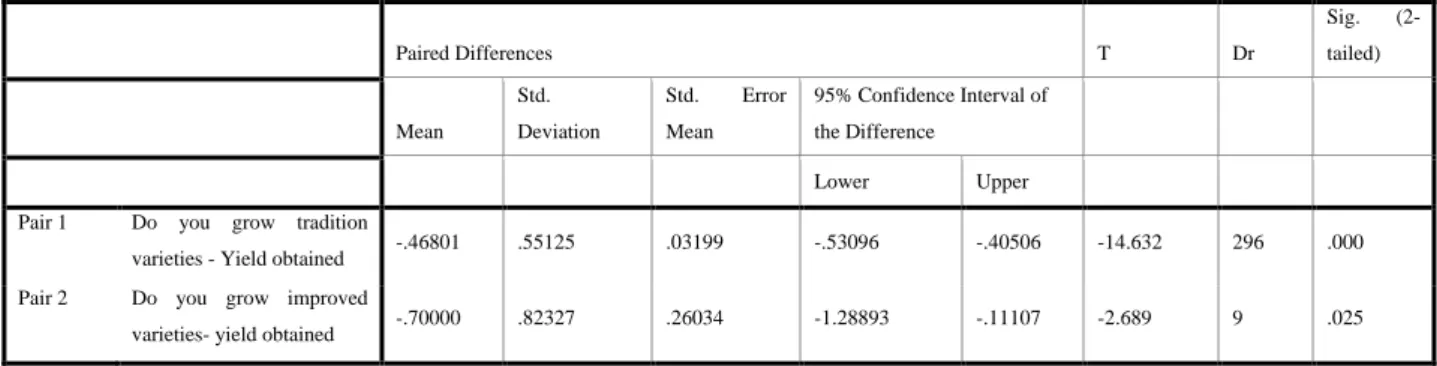
This research question was analysed to establish whether there was a difference between the production of improved and unimproved finger millet varieties based on yield and number of farmers growing the varieties. Paired sample t-test statistic was used to compute the value set at α=0.05 significance level. The results are presented in Table 24.
Table 7: Paired Sample T-Test on Mean Yields of Improved and Unimproved Varieties
Paired Differences T Dr Sig. (2-tailed) Mean Std. Deviation Std. Error Mean 95% Confidence Interval of the Difference Lower Upper
Pair 1 Do you grow tradition
varieties - Yield obtained -.46801 .55125 .03199 -.53096 -.40506 -14.632 296 .000
Pair 2 Do you grow improved
varieties- yield obtained -.70000 .82327 .26034 -1.28893 -.11107 -2.689 9 .025
The values obtained were 0.00 0 and 0.025 respectively which were lower than α=0.05 significance level. Hence there is a statistically significant difference between the yields of the improved and unimproved finger millet varieties
13 Hypotheses Testing
13.1 Hypothesis One
Ho1:Tested to determine if a relationship exists between the socio cultural factors of household labour source and the adoption of improved finger millet varieties
Table 8: Pearson Correlation Matrix between Farmers Adoption of Improved Varieties and the Socio-cultural Factors
Do you grow improved
varieties Control of land Source of labour
Do you grow improved Pearson Correlation 1 .027 .029
Sig. (2-tailed) . .041 .014
N 297 297 297
Control of land Pearson Correlation .027 1 .114
Sig. (2-tailed) .041 . .049
N 297 297 297
Source of labour Pearson Correlation .029 .114 1
Sig. (2-tailed) .014 .049 .
N 297 297 297
Values of 0.014 and 0.041 are lower than α=0.05 significant and hence the null hypothesis is rejected.
13.2Hypothesis Two
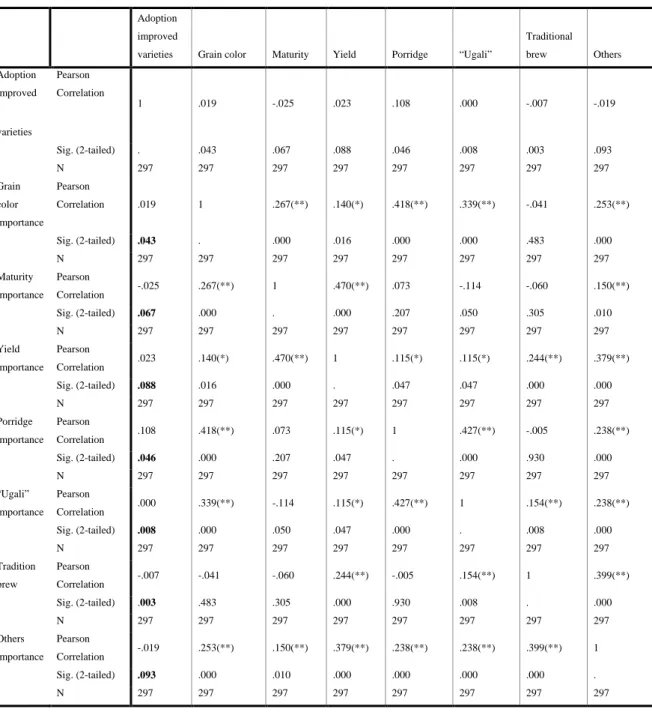
Ho2:Tested to determine if a relationship exists between the varieties technical attributes and the adoption of improved finger millet. Pearson correlation test results are given in table 8
Table 8:Correlation Matrix between Farmers Adoption and Variety Technical Attributes
Adoption improved
varieties Grain color Maturity Yield Porridge “Ugali”
Traditional brew Others Adoption improved varieties Pearson Correlation 1 .019 -.025 .023 .108 .000 -.007 -.019 Sig. (2-tailed) . .043 .067 .088 .046 .008 .003 .093 N 297 297 297 297 297 297 297 297 Grain color importance Pearson Correlation .019 1 .267(**) .140(*) .418(**) .339(**) -.041 .253(**) Sig. (2-tailed) .043 . .000 .016 .000 .000 .483 .000 N 297 297 297 297 297 297 297 297 Maturity importance Pearson Correlation -.025 .267(**) 1 .470(**) .073 -.114 -.060 .150(**) Sig. (2-tailed) .067 .000 . .000 .207 .050 .305 .010 N 297 297 297 297 297 297 297 297 Yield importance Pearson Correlation .023 .140(*) .470(**) 1 .115(*) .115(*) .244(**) .379(**) Sig. (2-tailed) .088 .016 .000 . .047 .047 .000 .000 N 297 297 297 297 297 297 297 297 Porridge importance Pearson Correlation .108 .418(**) .073 .115(*) 1 .427(**) -.005 .238(**) . Sig. (2-tailed) .046 .000 .207 .047 . .000 .930 .000 N 297 297 297 297 297 297 297 297 “Ugali” importance Pearson Correlation .000 .339(**) -.114 .115(*) .427(**) 1 .154(**) .238(**) Sig. (2-tailed) .008 .000 .050 .047 .000 . .008 .000 N 297 297 297 297 297 297 297 297 Tradition brew Pearson Correlation -.007 -.041 -.060 .244(**) -.005 .154(**) 1 .399(**) Sig. (2-tailed) .003 .483 .305 .000 .930 .008 . .000 N 297 297 297 297 297 297 297 297 Others importance Pearson Correlation -.019 .253(**) .150(**) .379(**) .238(**) .238(**) .399(**) 1 Sig. (2-tailed) .093 .000 .010 .000 .000 .000 .000 . N 297 297 297 297 297 297 297 297
**Correlation is significant at the 0.01 level (2-tailed). *Correlation is significant at the 0.05 level (2-tailed).
The results from Table 8 show that the values for finger millet varieties attribute to making of porridge (0.046), ugali (0.008) and local brew (0.003) was below that set at 0.05 significant level. The null hypotheses for these attributes were hence rejected. The obtained values for yield (0.088), maturity (0.067) and other uses(0.093) were higher than that set at 0.05 significance level and hence their null hypotheses were not rejected.
13.3 Hypothesis Three
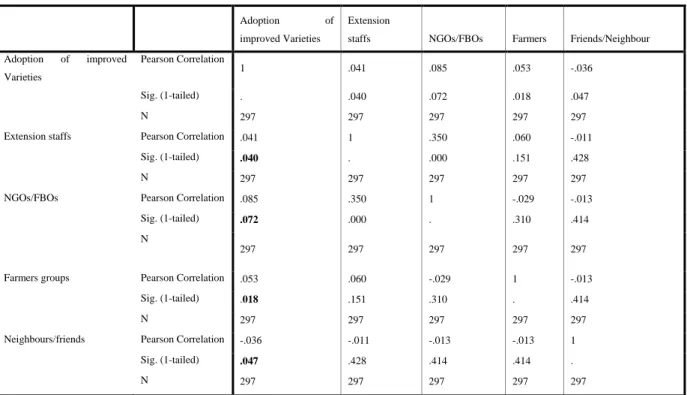
Ho3: There is no statistically significant relationship between the sources of agricultural information based on extension staffs, farmer groups, friends/neighbours, NGOs/FBOs, and the adoption of improved finger millet varieties by small scale farmers. Table 9 gives the Pearson Correlation test results
Table 9: Pearson Correlation between Farmers Adoption and the Sources of Information
Adoption of
improved Varieties
Extension
staffs NGOs/FBOs Farmers Friends/Neighbour
Adoption of improved Varieties Pearson Correlation 1 .041 .085 .053 -.036 Sig. (1-tailed) . .040 .072 .018 .047 N 297 297 297 297 297
Extension staffs Pearson Correlation .041 1 .350 .060 -.011
Sig. (1-tailed) .040 . .000 .151 .428
N 297 297 297 297 297
NGOs/FBOs Pearson Correlation .085 .350 1 -.029 -.013
Sig. (1-tailed) .072 .000 . .310 .414
N
297 297 297 297 297
Farmers groups Pearson Correlation .053 .060 -.029 1 -.013
Sig. (1-tailed) .018 .151 .310 . .414
N 297 297 297 297 297
Neighbours/friends Pearson Correlation -.036 -.011 -.013 -.013 1
Sig. (1-tailed) .047 .428 .414 .414 .
N 297 297 297 297 297
The values obtained for extension staff (0.040), farmers groups (0.018) and Neighbours(0.047) were all below 0.05 significant levels and hence the null hypotheses for these sources were rejected. The NGOs/FBOs sources had a value of 0.072 which is higher than the 0.05 significance level and hence the null hypothesis for NGOs/FBOs was not rejected.
14. Discussions and Conclusion
The study findings were;
• Majority (99.9%) of the small scale farmers in the semi-arid Mogotio District produce finger
millet varieties. This confirms[10] observation that finger millet is an important crop in the ASALs.Majority (%) of the small scale farmers in the semi-arid Mogotio District produces unimproved finger millet varieties and this confirms the findings of [25].
• Most household heads (95.1%) were men who also controlled had the highest (72.4%) control of household land use. The observation on the ground was that finger millet was considered by men as `woman’ crop of less value and when men did not allocate land for this crop, women grew their valuable crop inside the other crops. Crops planted late in the season suffer on late planting, poor plant spacing and poor crop management among others. This may have contributed to the low yields obtained. The study recommends farmers training on good agricultural practices and sensitisation of gender equality on use of household resources.
• The study established that farmers had preferences on the variety technical attributes when choosing the variety to produce. Improved varieties that offer the preferred technical attributes are available [21] for farmer’s adoption but very few (13.6%) of the farmers’ utilized the improved varieties. The study recommends an awareness campaign on the special attributes of the improved varieties by all stakeholders of the finger millet crop.
• The study established that most farmers (86.2%) get their finger millet production information from their neighbours. According to [26], peer farmers can have a positive or negative impact on the adoption of an agricultural technology and it was established that farmers' neighbours and friends were the main (86.5%) source of finger millet production information in the study area. Agricultural extension is an out-of-school education for rural people that give assistance to farmers to help them identify and analyse their production problems and become aware of the opportunities for improvement [13]. It was however established that only 32% of the farmers’ utilized extension staff information. The study recommends a study to establish why the farmers are not utilizing the extension staff information.
Acknowledgement
My special thanks go to my two supervisors Prof. C.A. Onyango and Dr. James Obaraboth of the Department of Agricultural Education, Egerton University, for their valuable insights, suggestions and criticisms to make this thesis what it is. I sincerely appreciate the help l received from the administrators, leaders that made it possible for me to access their areas and collect the data. My appreciation also goes to the surveyed farmers who willingly provided me with their personal data and answers to the questions used in this research.
References
[1] A. E. Adams, N. T Place and M. E Swisher.‘Knowledge levels regarding the concept of community food security among Florida extension agents’. Journal of Extension, 47, 23-32. Available: http://www.joe.org/joe ] June 22, 2009)
[2]A. D. Alene and V. M Manyong,.Farmer-To-Farmer Technology Diffusion and Yield Variation among Adopters.The Case of Improved Cowpea in Northern Nigeria.Agricultural Economics 35]2): 203–211.2006
[3] M. A. Amudavi,.Influence of Social–Economic Factors on Adaption of Maize Related
Technology.The Case of Smallholders Farmers in Hamisi Division, Kakamega District]Unpublished MSc. Dissertation) University of Melbourne. 1993
[4] J. R. Anderson.Agricultural Advisory Services a Background Paper for Innovating through Science and Technology, Chapter 7 of the World Development Report 2008.
[5] C. Bosch, Borus and Brinks M. Cereals and Pulses of Tropical Africa.Prota Foundation, Wagingen, Netherlands.2007
[6]Common Market of East and Southern Africa COMESA/COMPRAP. ]2010, September).Strengthening market for trade and food security.Regional Staple Foods. Workshop, 8th to 11th September, 2010 held in Uganda
[7] R.A. Cramb. Processes affecting the successful adoption of new technologies by smallholders.In: Hacker, B. ]ed). Working with Farmers: The Key to the Adoption of Forage Technologies, pp.11-22. ACIAR Proceedings No. 95. Canberra: Australian Centre for International Agricultural Research. 2003
[8] C. R. Doss. Understanding Farm Level Technology Adoption: Lessons Learned from CIMMYT’s Micro Surveys in Eastern Africa,” CIMMYT Economics Working Paper No. 03-07. Mexico, D.F.:
CIMMYT.2003http://www.agriculturaleconomics.net/downloads/Fertilizer%20use%20in%20Kenya_ Revised).pdf retrieved on 27/6/11.
[9] C. R. Doss. Analyzing Technology Adoption Using Micro studies: Limitations, Challenges and Opportunities for Improvement.Agricultural Economics.2006http://www.agriculturaleconomics.net. Available: ]June 27, 2011).
[10]East and Central Africa Sorghum and Millet Network ]ECASAM). Plant Resources of Tropical Africa.2010http://www.google.co.ke/search?q=ecarsam%2C2010 .viewed on 4/7/11
[11] A. W. Edwards.Non Experimental Quantitative Research. Columbus Ohio USA.2006
[12]Food and Agriculture Orgainisation]FAO). Sub-Saharan Africa Challenge Programme. Research plan and Programme for Impact assessment. Accra, Ghana.2009
[13]Food and Agriculture Orgainisation ]FAO).The State of Food Insecurity in the World, Addressing Food Insecurity in Protracted Crises. Rome, Italy.2010
[14]Government of Kenya]GOK). Strategic Plan Ministry of Agriculture 2005-2009. Nairobi, Kenya
Government printers.2004
[15] Government of Kenya ]GOK). The Draft National Policy for the Sustainable Development of Arid and Semi-Arid Lands of Kenya. Ministry of Planning and National Development. Nairobi, Kenya.2004
[16]Government of Kenya ]GOK). Kenya Vision 2030, Sector Plan for Agriculture 2008-2012. Nairobi, Kenya Government printers.2009
[17] S. F Hosseini, G. H.Nejad and M. Niknami.Policies Affect the Application of Information and Communication Technologies by Agricultural Extension Service.American Journal of Applied Sciences 6, 1478-1483, 2009.
[18]International Crop Research for Semi-Arid Tropics ]ICRISAT). Stakeholders Perspectives on finger Millet Production and Utilization, in ICRISAT workshop 15-18 0ctober, in Nairobi.2008
[19]International Crop Research for Semi-Arid Tropics ]ICRISAT). Producing more and better food from staple cereals ]sorghum and millets) and legumes ]groundnuts, chickpea and pigeonpea) at lower cost in the eastern and southern African through genetic improvement..http://cgmap.cgiar.org. 2010. Viewed on 12/10/11.
[20]Kenya Agricultural Research Institute ]KARI). Agricultural Research Institute Livestock Research Programme, Nairobi Kenya.2004
[21]Kenya Agricultural Research Institute ]KARI). Crop Improvement Program in ICRISAT. Annual Report.2009
[22]Kenya Plant Health Inspectorate Service ]KEPHIS). Quality Agro-inputs Through Seed Certification. Cooperate Business plan 2008-2012. Unpublished.2010
[23]B.Kibaara, J.Ariga,J. Olwande and T. S Jayne.Trends in Kenyan Agricultural Productivity: 1997-2007. Working Paper No.31, Egerton University, Tegemeo Institute, Nairobi. 2008
[24]W. M. Kidane,P.Maetzand Dardel. P. Food Security and Agricultural Development In Sub Saharan Africa. Rome, Food and Agriculture Organization of the United Nations.2006
[25] P.Kimurto.Developing New Crop Technologies. UN locking the Farming Potential in the Arid and Semi-arid in Kenya. Access to Global Online Research in Agriculture ]AGORA).2010. viewed on 26th April, 2011.
[26] A. SLangyintuo and A.Mekuria. Accounting for Neighbourhood Influence in Estimating Factors Determining the Adoption of Improved Agricultural Technologies. Selected Paper Presented at the American Agricultural Economics Association Annual Meeting, Providence, RI, USA, July 24-27.2005
[27] J. M. Lenne. Progress and Plans on Improving Finger Millet Production and Utilization in East Africa.Rockefeller and Kilimo Foundations. 2006
[28]Ministry of Agriculture ] MOA). Koibatek District Annual Report. Unpublished.2010
[29] M.Mutiga, Poverty and hunger in Africa. The Sunday Nation, pp.27.2011
[30] J.G. Mwangi. Policy Milestones in Kenya that have Supported or Constrained Sustainable Agriculture and Poverty Alleviation 1890 – 1999. Research Report prepared for the Director Tegemeo Institute NBI, Kenya. 1999
[31]New Partnership for Africa Development ]NEPAD). African Action plans 2010 – 2015.2010http://www.google.co.ke. reviewed on 3rd June, 2011.
[32]National Television ]NTV) “Farming in Turkana.” Media Group ]2011, 6th august). Nation Media Group. http://www.ntv.co.ke. retrieved on 17/10/11
[33] N.Nyassy. “Kenya Suffer Food Shortage in 50 years”. The Daily Nation, pp. 15. 18th September, 2007. Nation Media Group LTD. Nairobi.200
[34] C. O. A. Oduori. The Importance and Research status of Finger Millet in Africa. A paper presented at McKnight foundation collaborative crop research program workshop on finger Millet, in Nairobi Kenya.2005
[35]E. F. Oster and R. L. Thornton.Determinants of Technology Adoption. Peer Effects in Menstrual Cup Take-Up NBER Working Paper.2008
[36] B. Shiferaw,G. Obare and G. Muricho.Rural Institutions and Producer Organizations in
Imperfect Markets: Experiences from Producer Marketing Groups in Semi-Arid Eastern Kenya. CAPRI
Working Paper 60. Also jointly released as ICRISAT Socio-Economics and Policy Working Paper Series, No.23, Patancheru, Andhra Pradesh.2006
[37] M.Styslinger.Finger Millet: A Once and Future Staple.Nourishing the
Planet.blogs.worldwatch.org/nourishingtheplanet/tag/matt-styslinger.2010.Viewd on 12/6/2011. [38] Syngenta. Syngenta Foundation for Sustainable Agriculture.
2011http://www.syngentafoundation.org/ Retrieved on 23rd April 2011
[39] Z. Tadele. New Approaches to Plant Breeding of Orphan Crops of Africa. Proceedings of an International Conference, 19-21 Sept. 2007, Bern, Switzerland.2009
[40] J. P Takan, Akello B.,Bandyapadhyay, Coll R. and N. J. Talbot, S.Mathumeenakshi, S.Sreenivasaprasad.Characterisation of Finger Millet Blast Populations in East Africa and Strategies for Disease Management. Technical Report DFID Crop Project Program.2002
[41] United Nations. Millennium Development Goals.Millennium Assembly.Reaching Sustainable Food Security for All by 2020: Getting the Priorities and Responsibilities Right. International Food Policy Research Institute: Washington.2000
[42] World Bank. Reaching the Rural Poor: Reward Strategy for Rural Development Washington D.C., U.S.A the World Bank.2003
[43] World Bank. Agriculture for Development.World Development Report. Washington DC.2008