Section 2. Korean Peninsula
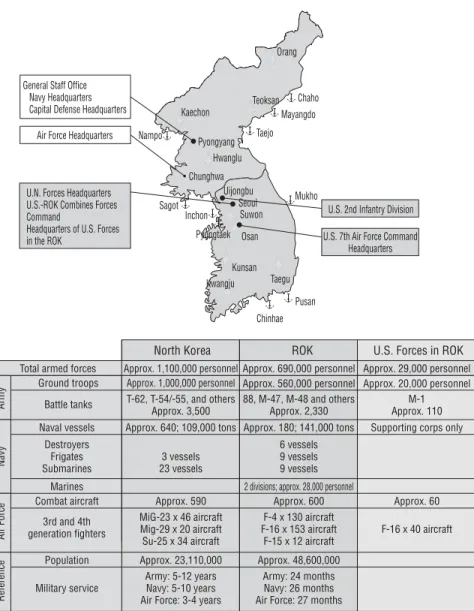
On the Korean Peninsula, which covers an area equivalent to approximately 60% of Japan, people of the same ethnicity have been divided into two—north and south—for more than half a century. Even today, the Republic of Korea (ROK) and North Korea pit their ground forces of about 1.5 million against each other across the demilitarized zone (DMZ). North Korea has only half the population of the ROK, and is economically far outstripped by the ROK. Nevertheless, the size of North Korea’s armed forces far exceeds those of the ROK, as shown in the figure. Such military confrontation has continued since the armistice of the Korean War.
Maintaining peace and stability on the Korean Peninsula is vital for the peace and stability of the entire East Asia, to say nothing of Japan. (See Fig. I-2-2-1)
General Staff Office Navy Headquarters Capital Defense Headquarters
Air Force Headquarters
U.N. Forces Headquarters U.S.-ROK Combines Forces Command
Headquarters of U.S. Forces in the ROK
U.S. 2nd Infantry Division U.S. 7th Air Force Command
Headquarters Nampo Sagot Inchon Pyongtaek Orang Chaho Teoksan Mayangdo Taejo Uijongbu Mukho Kunsan Kwangju Chinhae Pusan Taegu Seoul Suwon Osan Kaechon Pyongyang Hwanglu Chunghwa
North Korea ROK U.S. Forces in ROK
Total armed forces Approx. 1,100,000 personnel Approx. 690,000 personnel Approx. 29,000 personnel
Naval vessels Approx. 640; 109,000 tons Approx. 180; 141,000 tons Supporting corps only
Combat aircraft Approx. 590 Approx. 600
Population Approx. 23,110,000 Approx. 48,600,000 Military service
Army: 5-12 years Navy: 5-10 years Air Force: 3-4 years
Army: 24 months Navy: 26 months Air Force: 27 months
Approx. 60 3rd and 4th generation fighters MiG-23 x 46 aircraft Mig-29 x 20 aircraft Su-25 x 34 aircraft F-4 x 130 aircraft F-16 x 153 aircraft F-15 x 12 aircraft F-16 x 40 aircraft Marines 2 divisions; approx. 28,000 personnel
Destroyers Frigates Submarines 3 vessels 23 vessels 6 vessels 9 vessels 9 vessels T-62, T-54/-55, and others Approx. 3,500 88, M-47, M-48 and others Approx. 2,330 M-1 Approx. 110 Approx. 560,000 personnel Approx. 20,000 personnel
Army Navy Air For ce Reference Ground troops Battle tanks Approx. 1,000,000 personnel
Note: Materials are taken from The Military Balance 2007 and others.
1. North Korea
North Korea has been advocating the construction of a “powerful and prosperous nation” as its basic national policy, aiming to create a strong socialist state in all areas—ideology, politics, military affairs and economy—and it adopts “military-first politics” to realize this goal. The policy has been defined as a form of leadership that advances the great undertaking of socialism by resolving all problems that arise in the revolution and national construction on the principle of military first and stressing the importance of the armed forces as the pillar of the revolution18. Indeed, General Secretary of the Korean Workers’ Party Kim Jong Il is in a position to
completely control North Korea’s military forces as Chairman of the National Defense Commission and regularly visits military forces. It would appear that he intends to continue running the country by attaching importance to and relying on the military forces.
Although North Korea is faced with serious economic difficulties to this day and depends on the international community for food and other resources, the country seems to be maintaining and enhancing its military capabilities and combat readiness by preferentially allocating resources to its military forces. For example, military personnel represent a high proportion of the population, with active-service military personnel estimated to account for nearly 5% of the overall population19. It is noteworthy that North Korea deploys most of its armed forces along the DMZ. According to an official announcement made at the Supreme People’s Assembly in April this year, the proportion of defense budget in this year’s national budget is 15.8%, but it is estimated that the official defense budget represents only a portion of the real defense expenses.
Furthermore, North Korea seems to maintain and reinforce its so-called asymmetric military capabilities by developing weapons of mass destruction (WMD) and ballistic missiles and also by maintaining large-scale special operation forces.
By acting in this way, North Korea increases military tension over the Korean Peninsula, and its behavior constitutes a serious destabilizing factor for the entire East Asian region, including Japan.
1. WMD and Ballistic Missiles
Concerning WMD, issues of North Korea’s nuclear weapons program have been pointed out, as well as its capability of chemical and biological weapons. In particular, North Korea’s nuclear issue has serious influence on Japan’s national security and it is also a critical problem to be solved by the entire international community to ensure non-proliferation of WMD.
As for ballistic missiles, North Korea seems to be conducting R&D to extend the range of its ballistic missiles and to use solid fuel20. Also, it is continually pointed out that North Korea is proliferating ballistic missiles21. Combined with the nuclear issue, North Korea’s missile issue is thus becoming a destabilizing factor not only for the Asia-Pacific region, but also for the entire international community, and there are strong concerns about the movement of the country.
Furthermore, following the launch of seven ballistic missiles on July 5, 2006, North Korea claimed to have conducted a nuclear test on October 9 of the same year22. These series of acts by North Korea pose serious threats not only to Japan but also to the peace and stability of East Asia and the international community, and evoked considerable debate in Japan.
(1) Nuclear Weapons
North Korea had been suspected of developing nuclear weapons. In 1993, North Korea refused to allow the International Atomic Energy Agency (IAEA) to conduct a special inspection and declared its withdrawal from the Treaty on the Non-Proliferation of Nuclear Weapons (NPT). As a result, suspicions of North Korea developing nuclear weapons at a graphite-moderated nuclear reactor (5-MW reactor)23in Yongbyon, to the north of Pyongyang, were aggravated. The Agreed Framework24signed between the United States and North Korea in 1994 once showed a roadmap to settle this issue through dialogue.
Under the Agreed Framework, the United States had been supplying heavy oil as an alternative energy to North Korea since 1995, and the Korean Peninsular Energy Development Organization (KEDO) was established to provide North Korea with light water reactors.
Since then, no violations of the Agreed Framework by North Korea had been detected. However, in October 2002, the United States announced that North Korea admitted the existence of a uranium-enrichment program for nuclear weapons when James A. Kelly, then Assistant Secretary of State visited North Korea that month.
As the international community’s concerns over the nuclear issue of North Korea mounted, North Korea announced in December 2002 that it would resume the operations of the nuclear-related facilities in Yongbyon that had been frozen under the Agreed Framework. In January 2003, North Korea again declared the withdrawal from the NPT. In February of the same year, the IAEA submitted a report on the North Korea nuclear issue, including the violation of the IAEA Safeguard Agreement, to the U.N. Security Council. At the end of the month, it was confirmed that the operation of the graphite-moderated nuclear reactor (5-MW nuclear reactor) in Yongbyon, which had been frozen, was resumed. Subsequently, North Korea claimed that it needed to maintain a “nuclear deterrent” and indicated the reprocessing of spent fuel rods25in April 2003, declared the completion of the reprocessing of spent nuclear fuel rods in October of the same year, released the statement of its Ministry of Foreign Affairs that North Korea had already produced nuclear weapons in February 2005, and announced the completion of the extraction of 8,000 spent fuel rods from the restarted graphite-moderated nuclear reactor in May of the same year. Thus North Korea repeatedly increased international tensions by its words and actions. In the course of these movements, the supply of heavy oil and the construction project of light water reactors by the KEDO had been suspended. Eventually in May 2006, the organization officially decided to abolish the construction project.
On the other hand, in the pursuit of a peaceful solution to this problem and denuclearization of the Korean Peninsular, Six-Party Talks have been held since August 2003. At the fourth round of the Six-Party Talks held in 2005, a joint statement was adopted for the first time, which focused on the verifiable abandonment of “all nuclear weapons and existing nuclear programs” by North Korea. Subsequently, however, North Korea strongly accused the United States of designating a bank in Macao dealing with North Korea as “a financial institution of primary money laundering concern,” claiming that it is a financial sanction by the United States.
North Korea suspended its participation in the Six-Party Talks and in 2006, it launched seven ballistic missiles and claimed that it had conducted a nuclear test despite advance warnings by the nations concerned. Against these actions by North Korea, which further increased international tensions, the U.N. Security Council adopted Resolutions 1695 and
1718 and imposed economic sanctions on North Korea. In December 2006, North Korea finally returned to the fifth round of the Six-Party Talks26and in February 2007, the parties, including North Korea, reached an agreement on “Initial Actions for the Implementation of the Joint Statement” to implement the Joint Statement made at the fourth round of the Six-Party Talks. The agreement, however, was not implemented as planned.
Regarding North Korea’s response to nuclear issues described above, some people argue that it is resorting to brinkmanship by intentionally heightening tension to receive compensation. However, others argue that North Korea’s ultimate objective is to possess nuclear weapons. Because the ultimate goal of North Korea is believed to be the maintenance of its existing regime, it appears that the two foregoing views are not incompatible.
In light of a series of North Korea’s words and actions and the fact that the issue of North Korea’s suspected development of nuclear weapons is not yet elucidated, there is some possibility that North Korea has already made considerable progress in its nuclear weapons program. In addition, it was concluded in 2006 that the probability that North Korea had conducted a nuclear test was extremely high (see Note 5). This implies that there is a high possibility that the country has further advanced its nuclear weapons program, and it is necessary to keep an eye on the country’s future movement, including the downsizing of nuclear weapons and deployment of nuclear warheads.
(2) Biological and Chemical Weapons
Because North Korea is an extremely closed country and most materials, equipment, and technology used in the manufacture of biological and chemical weapons are for dual-use, which makes camouflaging their actual use quite easy, details of biological and chemical weapons developed or held by North Korea are not clear. However, it is believed that North Korea has a certain level of production base for biological weapons, although it ratified the Biological Weapons Convention in 1987. As for chemical weapons, it is also believed that North Korea has several facilities capable of producing chemical agents and has substantial stocks of such agents. It has not acceded to the Chemical Weapons Convention27.
(3) Ballistic Missiles
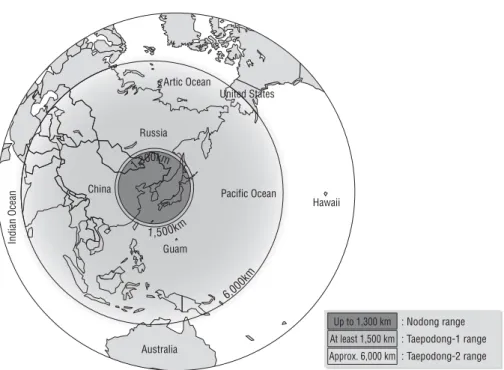
It is believed that since the middle of the 1980s, North Korea has manufactured and deployed Scud B and Scud C28, a variant of Scud B with extended range, and exported these missiles to Middle Eastern countries and others. By the 1990s, North Korea allegedly began developing longer-range ballistic missiles, such as Nodong. There is a strong possibility that the ballistic missile that North Korea test-launched over the Sea of Japan in 1993 was a Nodong. In 1998, North Korea launched a ballistic missile based on Taepondong-1 over Japan. Furthermore on July 5, 2006, completely lifting its freeze on the launch of ballistic missiles since 1999, North Korea fired six ballistic missiles early in the morning and a seventh missile in the evening. The third missile is assessed to have been Taepodong-2 and others Scud and Nodong missiles. Partly because North Korea is an extremely closed country, details of its ballistic missiles are still unclear. It, however, appears that North Korea gives high priority to ballistic missiles not only to enhance its military capabilities but also to earn foreign currency29and for other political and diplomatic purposes. At present, the country is thought to be developing a new intermediate-range ballistic missile and a new solid propellant short-range ballistic missile in addition to the existing inventory of ballistic missiles30. Also, it is necessary to pay attention to the possibility that the country is improving existing Scuds and Nodongs for the extension of their range or other purposes. (See Fig. I-2-2-2)
It seems that Nodong is a single-stage ballistic missile based on a liquid fuel propulsion system and a significant number of Nodong missiles seem to have already been deployed. It is thought to have a range of about 1,300 km, and is able to reach almost all parts of Japan. Although its specifications are not confirmed in
detail, it is thought to be based on the Scud technology, which would indicate that it does not, for example, have the accuracy to carry out pinpoint attacks on specific target installations.
Because North Korea is a closed country, it is extremely difficult to verify the intention of its military activities. It is believed that underground military facilities have been constructed across the country. Nodong, as is the case with Scud, is thought to be loaded on a transporter-erector-launcher (TEL) and operated with mobility. Therefore, it would be difficult to detect the concrete signs of the launch of Nodong in advance, such as its specific launch location and timing.
Also, North Korea has been developing Taepodong-1 with an estimated range of at least 1,500 kilometers. Taepodong-1 missile is assumed to be a two-stage, liquid propellant ballistic missile with a Nodong as its first stage and a Scud as its second stage. The missile launched in 1998 was thought to have been based on Taepodong-1. It is surmised that North Korea was able to verify the performance of the technology concerning the separation of a multistage booster, attitude control, and thrust control through the launch of this missile. North Korea seems to have now shifted its focus to the development of Taepodong-2 with a longer range: Taepodong-1 might have been a transitory product to develop Taepodong-2.
On July 5, 2005, North Korea launched a Taepodong-2 missile from the Taepodong district located in the northeastern coastal area of the country. The missile is thought to be a two-stage missile with a new booster as its first stage and a Nodong as its second stage, and with an estimated range of approximately 6,000 kilometers. It seemed to fail in mid-flight (at a height of several kilometers) several tens of seconds after launch without separating the first stage and fall near the launch site. North Korea, however, would learn lessons from this failure and would continue to extend the range of its ballistic missiles. It might even develop derivative missiles of Taepodong-231.
Also on July 5, 2006, North Korea fired other six ballistic missiles from Kittaeryong (approximately 35 km from Weonsan) located in the southeastern coastal area of the country. All of these missiles seemed to fly a
6,00 0km 1,500km 1,300km Indian Ocean Hawaii Guam Australia China Russia Artic Ocean United States Pacific Ocean Up to 1,300 km At least 1,500 km Approx. 6,000 km : Nodong range : Taepodong-1 range : Taepodong-2 range
Note: Materials are taken from Jane’s and others.
suborbital flight over approximately 400 km and landed in the Sea of Japan. These missile launches have the following characteristics, which seem to have simulated real-world combat situations. This is indicative of the improvement of North Korea’s capability to launch ballistic missiles32.
a. Launch began before dawn
b. Multiple, serial launches of different types of missiles within a short period of time c. Use of multiple TELs
d. Missiles with differing operational ranges successfully landed within a certain, concentrated geographical area.
As the background of North Korea’s rapid strides in the development of its ballistic missiles with only a few test launches, it is assumed that the country imported various materials and technologies from outside. It is pointed out that North Korea transfers and proliferates ballistic missiles or its related technologies including Nodong and its related technologies to Iran and Pakistan and that North Korea promotes the development of missiles using funds procured by such transfer and proliferation33. In light of this, it is necessary to monitor the transfer and proliferation of ballistic missiles by North Korea in addition to the development and deployment of these missiles by the country.
2. Military Posture
North Korea has been building up its military capabilities in accordance with the Four Military Guidelines (extensive additional training for existing soldiers, modernizing of the armed forces, arming the entire population, and converting the entire country into a fortress )34.
North Korea’s military capabilities35are made up mainly of ground forces, with total troop strength of roughly 1.1 million. Although North Korea has been making efforts to maintain and strengthen its military capabilities and readiness, most of its equipment is outdated.
On the other hand, North Korea has large scale special operation forces that can conduct various operations ranging from intelligence gathering and sabotage to guerilla warfare. These forces are thought to be composed of approximately 100,000 personnel36. Moreover, it seems that there are many underground military installations across the country.
(1) Activities in Recent Years
North Korean forces appear to be constantly maintaining and enhancing their capabilities and readiness and continuing their infiltration exercises37.
In June 2002, there was an exchange of fire between North Korea and the ROK’s naval vessels across the Yellow Sea. In February 2003, a North Korean MiG-19 flew over the Northern Limit Line (NLL) across the Yellow Sea. In March 2003, North Korean military planes including MiG-29 approached and pursued a U.S. military plane flying over the Sea of Japan.
These military activities may have been simple incidents, or have been intentionally conducted in order to increase tension as a part of brinkmanship or to raise the morale and support the military structure under the “military-first politics”. (See Section 2, 1)
In December 2001, a suspicious boat was detected to the southwest of Kyushu and the boat eventually sank. After salvaged and inspected, the suspicious boat was identified to be a special operations vessel of North Korea. In 1999 as well, a ship suspected of being a North Korean special operations vessel infiltrated Japanese territorial waters. It was judged that the boat had later arrived at a harbor in the north of North Korea. (See Fig. I-2-2-3)
(2) Military Capabilities
The North Korean Army comprises about one million personnel, and roughly two-thirds of them are believed to be deployed in the forward areas along the DMZ. The main body of the army is infantry, but the army also maintains armored and artillery forces, including at least 3,500 tanks. North Korea is thought to have deployed long-range artillery along the DMZ, such as 240-mm multiple-launch rockets and 170-mm self-propelled guns, which can reach cities including the capital city of Seoul and bases in the northern part of the ROK.
The Navy has about 640 ships with total displacement of approximately 109,000 tons and is chiefly made of small naval vessels such as high-speed missile crafts. Also, it has about 20 Romeo-In July 1997, North Korean
soldiers crossed the DMZ and fired at ROK forces.
In March 2003, four fighter aircraft approached a U.S. military aircraft.
In March 1999, there were incidents involving suspicious boats off the Noto Peninsula. In February 2003, a MiG-19 transgressed the NLL. In June 1999 and June 2002, shooting incidents arose between ROK and North Korean patrol vessels.
In April 1996, North Korean soldiers invaded the Panmunjom Joint Security Area. In September 1996 and June 1998, North Korean submarines violated ROK territorial waters.
In December 2001, a suspicious boat appeared in waters off southwest Kyushu.
In December 1998, ROK forces sank a North Korean semi-submarine that had intruded into the ROK’s southern waters. Sagot Kaechon Nampo Pyongyang Onchon Hwangju Chunghwa Panmujom Kwangju Ujongbu Seoul Inchon Pyongtaek Suwon Osan Kunsan Demilitarized Zone Organ Chaho Mayangdo Teoksan Taejo Chinhae Mukho Taegu Pusan
class submarines and about 60 midget submarines and about 140 air-cushioned landing craft, the former of which are thought to be used for infiltration and transportation of the special operation forces.
The Air Force has about 590 combat aircraft, most of which are out-of-date models made in China or the former Soviet Union, but some fourth-generation aircraft such as MiG-29s and Su-25s are also included. North Korea has a large number of outdated An-2s as well, which are believed to be used for the transportation of special operation forces.
North Korea continues to give various types of training to its forces to maintain and strengthen their state of readiness. On the other hand, given the serious food situation, the military forces seem to be engaged in agricultural assistance work as well.
3. Domestic Affairs
In 1998, the Supreme People’s Assembly38was held for the first time in four and a half years after President Kim Il Sung died in 1994, and Kim Jong Il , General Secretary of the Workers’ Party of Korea was reappointed as Chairman of the National Defense Commission, which was newly defined as “the highest post of the state.” At the Supreme People’s Assembly held subsequently in September 2003, Kim Jong Il was reappointed as Chairman of the National Defense Commission again. Some point out that the North Korean regime is not as stable as it was due to loosening of social control resulting from both an increasing disparity between the rich and the poor and a trend of money-worshipping, and declining military morale. However, in view of the fact that national events39are held and negotiations with other countries are made in an orderly manner, the regime in North Korea based around Kim Jong Il, Chairman of the National Defense Commission, is considered to be still on the right track.
On the economic front, North Korea has been facing chronic economic stagnation and energy-food shortages in recent years due to a number of factors including the fragility of its socialist planned economy and decreased economic cooperation with the former Soviet Union and Eastern European countries following the end of the Cold War. In particular, it seems that North Korea still has to rely on food assistance from foreign countries40. It is,however, pointed out that many North Koreans are starving and their sense of moral has declined.
In response to these various economic difficulties, North Korea is trying some realistic reform measures and changes in its economic management systems, although limited in scale. It is believed that since July 2002, North Korea has been carrying out a new economic policy, in which wages and commodity prices are raised and exchange rates are devaluated41. However, as it is considered that North Korea is not likely to undertake a structural reform that would affect its current regime, the country would face various difficulties in fundamentally improving its current economic situation.
4. External Relations
Although North Korea has improved its relationship with Western European countries and others, its activities related to nuclear and missile issues have raised international concerns.
The United States made it clear that it would make efforts to persuade North Korea to abandon its nuclear program in close cooperation with other countries, aiming to solve the problem through the Six-Party Talks. North Korea said that the denuclearization of the Korean Peninsula was the “dying wish” of Kim Il Sung and promised to abandon “all nuclear weapons and existing nuclear program.” North Korea, however, continued to criticize various policies of the United States, insisting that the United States had yet to abandon its “hostile policy” toward North Korea, and so there exists a significant gap between the two countries’ stances. In addition, the United States has repeatedly expressed concerns over the possible proliferation of nuclear weapons and nuclear-related materials by North Korea and the development, deployment, and proliferation of ballistic missiles by the country.
Furthermore, the United States has designated North Korea as a terrorist-supporting state because the abduction issues involving Japanese nationals has not yet been solved and North Korea continued to provide a haven to the hijackers of Yodo42.
North Korea and the ROK, while international concern is increasing about the nuclear and other issues of North Korea, have been consistently continuing talks and economic and human exchanges. North Korea insists the importance of North-South cooperation and the ROK is willing to continue North-South talks and exchanges. On the military front, no specific results were achieved after defense ministerial talks were held in 2000. In 2004, however, military talks by generals-level were held twice and the two sides agreed on measures to prevent incidental conflicts in the Yellow Sea and on the suspension of propaganda activities and the removal of facilities and equipment for propaganda near the DMZ. Furthermore, by the summer of 2005, a certain progress was made, including the opening of a hotline between the headquarters of the fleets of North Korea and the ROK and the completion of the removal of facilities and equipment for propaganda. Since then, however, no further progress has been made.
Concerning relations between North Korea and China, the China-North Korea Treaty on Friendship, Cooperation and Mutual Assistance, which was concluded in 1961, is still effective. In 1992, China and the ROK established diplomatic relations and after that, North Korea’s relations with China seemed to have changed from the close relationship they enjoyed during the Cold War. Subsequently, however, the leaders of the two countries made mutual visits and the relationship appeared to have been improved again. Regarding North Korea’s nuclear issue, China has repeatedly expressed its support to denuclearization of the Korean Peninsula and has played an active role in resolving this issue by, for example, acting as chairman of the Six-Party Talks and contributing to reaching agreement at the forth and fifth rounds of the Talks. Some, however, point out that relationship between China and North Korea seems to be not as close as they were.
Although relations between North Korea and Russia cooled compared with their relations during the Cold War, the relations improved as the two countries signed the Russia-North Korea Treaty on Neighborly Friendship and Cooperation, which lacked articles on military alliance43unlike the previous treaty, in February 2000. Subsequently, in July of the same year, Russian President Vladimir Putin visited North Korea. In return, Kim Jong Il, Chairman of the National Defense Commission visited Russia both in 2001 and 2002. Relations between North Korea and Russia have thus been strengthened in recent years.
Since 1999, North Korea has made an effort to establish relations with Western European countries and others, including the establishment of diplomatic relations with European countries and participation in ARF ministerial meetings. On the other hand, the EU and ASEAN have traditionally expressed concerns over North Korea’s nuclear and other issues.
In order to solve North Korea’s nuclear issue, it is important for Japan, the United States, and the ROK to keep working closely together. At the same time, other states such as China and Russia, which are also participants of the Six-Party Talks, and international organizations including the United Nations and the IAEA should play important roles in this concern.
It is quite natural to prohibit North Korea from possessing nuclear weapons. There are, however, security concerns other than nuclear issues regarding North Korea, and it is necessary to closely monitor future developments on the Korean Peninsula, such as military antagonism as well as the development, deployment, and proliferation of ballistic missiles by North Korea.
Because North Korea is a closed country, it is difficult to clarify the trends of its policies and activities. It is, however, necessary to continue to pay close attention to such trends to understand the real intentions of North Korea.
2. The ROK
1. General Situation
In the ROK, democracy has taken root through such means as the direct presidential election adopted by the 1987 amendment to the constitution. The Roh Moo-hyun administration, inaugurated in February 2003, upholds “Policy of Peace and Prosperity,” which succeeds to the thinking of “Engagement Policy” promoted by the administration of former President Kim Dae-jung.
U.S. forces, mainly the Army, have been stationed in the ROK since the cease-fire of the Korean War. The ROK has established close security arrangements with the United States primarily based on the United States-Republic of Korea Mutual Defense Treaty. In view of the progress in the North-South relations, improved national strength of the ROK, and changes in the U.S. strategy, the two countries are committed to solving the issues such as the realignment of the U.S. forces stationed in the ROK and the transition of the operational control authority44over ROK forces, which is currently held by the United States, to the ROK in times of war. As for the realignment of U.S. forces in the ROK, relocation of U.S. Forces Camp Yongsan located in the center of Seoul to the Pyongtek area to the south of Seoul and the reposition of U.S. troops stationed in the northern side of Han Gang to the southern side of the river were agreed upon in 2003. It has, however, become difficult to complete the relocation to the Pyongtek area by the targeted deadline of the end of 2008 due to delayed purchase of land required and also for other reasons. As for the transition of the operational control authority, the U.S. Secretary of Defense and the ROK Minister of National Defense agreed at their meeting in February 2007 that the two sides would disestablish the U.S.-ROK Combined Forces Command on April 17, 2012 and complete the transition of the wartime operational control authority to the ROK. In the future, transition to the new “supporting-supported” command relationship between U.S. and ROK forces will be promoted in line with a substantial decrease in the ROK’s forces, and it is necessary to monitor if the transition is conducted while maintaining deterrent on the Korean Peninsula.
To assist U.S.-led military operations in Afghanistan, the ROK forces continue to dispatch engineering and medical units there. Regarding the units dispatched to Iraq in response to the request from the United States, the ROK continues the dispatch although the scale of dispatched forces has been reduced to at least 1,200 or approximately one-thirds of the initial size. The country, however, states that it will establish a plan for the troops dispatched to Iraq to successfully complete their duties there, comprehensively considering the movements of other countries that have dispatched their units to Iraq.
Between the ROK and China, since the first visit by then ROK Minister of National Defense Cho Seong Tae to China in August 1999 and the first visit by then Chinese Minister of Defense Chi Haotian to the ROK in January 2000, efforts have been made to promote military exchanges between the countries, including mutual visits of naval vessels and air-force planes. In March 2005, the ROK Minister of National Defense visited China for the first time since 2001 and in April 2006, the Chinese Minister of National Defense visited the ROK for the first time since 2000. Subsequently in April 2007, the ROK Minister of National Defense Kim Jang Soo visited China and discussed with the Chinese Minister of National Defense Cao Gangchuan on the establishment of hotlines between the navies and air forces of the two countries as well as on other topics. At the ROK-China summit talks held in July 2003, it was agreed for the two countries to develop their cooperative partnership into all-around cooperative partnership. Their relations in the security area, however, remain on an initial level compared with relations in other areas, including the economic area.
Between the ROK and Russia, military exchanges have been made in recent years, including exchanges between senior military officials and mutual visits of naval vessels. When then Russian Minister of Defense Ivanov visited the ROK in April 2003 and then ROK Minister of National Defense Yoon Kwang-ung visited Russia in April 2005, the two countries agreed once again on the cooperation in the areas of military
technology, defense industry, and war materials in addition to the promotion of military exchanges. In February 2004, the navies of the two countries conducted joint search and rescue exercises for the first time45and at the ROK-Russia summit meeting held in September 2004, it was regarded that the bilateral relations were shifted from the “constructive and mutually complementary partnership” to “comprehensive partnership of mutual trust.” In addition, the ROK has been purchasing tanks and armored vehicles from Russia since 1995 as means for the redemption of debt from Russia.
2. Military Affairs
(1) Defense Policies
The ROK has a defensive weakness in that its capital Seoul, where a quarter of the country’s population is concentrated, is situated close to the DMZ.
The ROK has set the defense objectives as follows: “defending the nation from external military threats and invasion, upholding the peaceful unification, and contributing to regional stability and world peace.” As one of “external military threats,” the ROK had been designating North Korea as its “main enemy,” but in its Defense White Paper 2004, North Korea was no longer described as such46.
The ROK currently intends to promote “National Defense Reform 2020” to satisfy its defense needs such as the organization of its military capabilities in line with the development of information and scientific technologies, balanced development of its Army, Navy, and Air Force, elimination of inefficiency, and buildup of barrack culture in accordance with social trends. The reform program is based on the following ideas and the bill on the national defense reform incorporating most of these ideas was passed at the parliament in December 2006.
1) Expansion of civilian base for national defense: Establish the structure in which civilians have the central role in deciding and implementing defense policies and the military forces focus on executing combat missions.
2) Buildup of the military structure and system of the forces in conformity with the characteristics of modern wars: While reducing the size of the standing forces from 680,000 personnel to the level of 500,000 personnel mainly in the Army and that of reserved troops from 3 million personnel to the appropriate level in line with the reduced size of the standing forces, enhance its war potential by such means as modernizing equipment.
3) Reorganization of the national defense management system into a low-cost and highly efficient system: Improve the organization and system to ensure transparency of procurement service and expertise, and in the area of logistic support, strengthen the infrastructure for computerization and promote outsourcing.
4) Improvement of barrack culture in accordance with trends of the time: Take measures to improve the environment of military personnel’s service and establish the system to prevent accidents.
(2) Trends in Defense Buildup
As for the ROK armed forces, the ground forces consist of three ground army commands of 22 divisions and two marine divisions, totaling 590,000 personnel; the naval forces consist of three fleets of about 180 vessels with a total displacement of approximately 141,000 tons; and air forces (Air Force and Navy together) of nine combat air wings with approximately 610 combat aircraft.
In recent years, the ROK has been trying to modernize its Navy and Air Force with the introduction of submarines, multi-role helicopters, and F-15Ks as next fighters (F-X). Also, the ROK plans to procure four Airborne Warning and Control Systems (AWACS) by 2012, and domestically manufactured destroyers (KDX-IIs and KDX-I(KDX-IIs). The KDX-III (an Aegis-equipped destroyer) will be in service in 2008. In addition, the
ROK Navy plans to construct two large transport ships by 2010. In November 2001, the Agency for Defense Development (ADD) test-launched a short-range missile, and the ROK is believed to be promoting the domestic production of missiles47.
The 2007 defense budget amounts to approximately 24,500 billion won, up approximately 8.8% over the previous fiscal year. (See Fig. I-2-2-4)
3. U.S. Forces Stationed in the ROK
Combined with the ROK’s own defense efforts, U.S. forces stationed in the country play a vital role in preserving the military balance on the Korean Peninsula and providing a deterrent against large-scale armed conflicts on the peninsula.
At present, the United States is changing the posture of its forces stationed in the ROK based on the agreement to reposition them to the southern side of Han Gang in two stages (made in June 2003) and the agreement to reduce the number of its stationed military personnel (approximately 41,000) by 12,500 (made in October 2004). In the course of these changes, the United States is making efforts to maintain and strengthen the deterrence capabilities of U.S.-ROK allied forces both by retaining forces of approximately 29,000 personnel (as of the end of September 2006) in the
ROK under the United States-Republic of Korea Mutual Defense Treaty and by investing $11 billion in the modernization of the U.S. forces stationed in the ROK. On the other hand, the ROK, under a maxim of “cooperative independent defense,” is committed to ensuring its own defense capabilities and to firmly developing the ROK-U.S. alliance towards the future. (See Fig. I-2-2-5)
The United States and the ROK have engaged in joint exercises in order to increase their combined
(100 million won) (%)
Note: Based on the Defense White Paper (for FY 2003 to 2006) published in 2006; based on press releases from the Ministry of National Defense for the FY 2007 budget
07 (FY) 06 05 04 03 0 5 10 15 20 0 50,000 100,000 150,000 200,000 250,000 300,000
Defense Budget (100 million won) Year-on-year growth rate (%)
defense capabilities in dealing with contingencies on the Korean Peninsula. Among these is the “Foal Eagle” exercise, a large-scale joint logistics support field exercise, which was staged in March 2007 concurrently with the Reception, Staging, Onward movement and Integration (RSOI) joint exercise48.
DMZ
DMZ
Dotted all over the country 43 bases (241,560,000 m2) Present
Han Gang Han Gang
Seoul Seoul
Pyongtaek
Taegu
Pusan Chinhae
Note: ROK Defense White Paper 2006
After the completion of transfer and relocation
Joint Exercise Center
Central part
Southern part Pohang
Two strategic points 16 bases (82,995,000 m2)