Lending to Commodity Traders
by Bruce W. Frazier and Gino E. Verza
his article presents a framework for bank lending based on the
fundamentals of commodity trading. It highlights central issues
in the credit management process, such as risk underwriting
criteria, credit structuring, and risk control; touches on the essential
impact of technology over the activities of trading firms and banks,
such as information management and transaction processing; and
reviews a broad range of benefits available to commodity traders using
banking services.
© 1998 by RMA. Frazier is senior vice president, Bank of America NT & SA. Verza is vice president, Bank of America NT & SA. Both work in the International Trade Bank and specialize in international trade credit management and supervision.
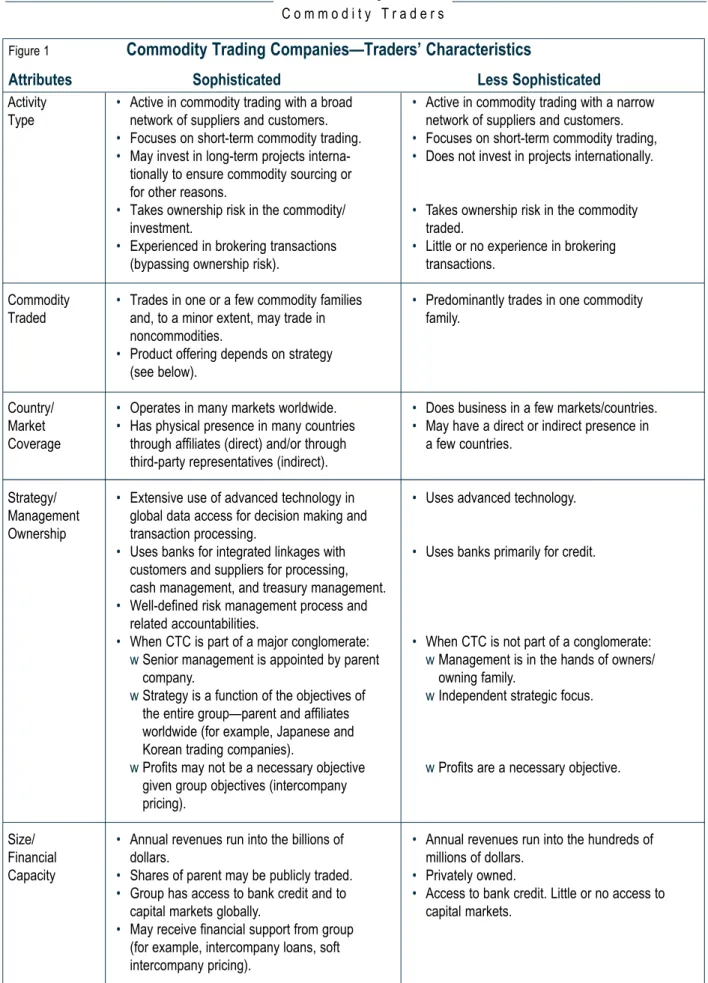
he predominant activity of commodity trading compa-nies (CTCs) is the commerce of commodities, domestically or across borders. Their core business is in buying and selling commodi-ties with little or no value added to the commodity from a manufactur-ing point of view. Inherent in these activities is the risk related to own-ing the commodity and collectown-ing the sale’s proceeds. Characteristics of CTCs are shown in Figure 1.
Typically return on sales (ROS) is low because of competitive com-modity market pricing and the low value added to the commodity by the trading firm. Return on equity
(ROE) is driven by high asset turnover (AT) and high leverage (L). High AT and high L are a func-tion of the short durafunc-tion of the asset conversion cycle and the high quality of the trading assets (high liquidity). Brokering can increase ROE through brokerage fees earned without using the firm’s balance sheet, bypassing ownership risk. The large financing require-ments of commodity traders com-pared with their equity are met by
banks, suppliers, and parent/affili-ates.
• Bank financing is generally transactional in nature because the purpose and the repayment of financing are closely con-nected with the conversion of specific trading assets into cash.
• Suppliers provide short financ-ing terms or require cash upon delivery due to the high liquid-ity of commodities.
• Intercompany financing may be tied to a specific transaction or support the overall capital posi-tion of the firm, for example, ROE = Net Profits/Equity = ROS x AT x L
ROS = Net Profits/Sales AT = Sales/Total Assets L = Total Assets/Equity
Activity • Active in commodity trading with a broad • Active in commodity trading with a narrow Type network of suppliers and customers. network of suppliers and customers.
• Focuses on short-term commodity trading. • Focuses on short-term commodity trading, • May invest in long-term projects interna- • Does not invest in projects internationally.
tionally to ensure commodity sourcing or for other reasons.
• Takes ownership risk in the commodity/ • Takes ownership risk in the commodity
investment. traded.
• Experienced in brokering transactions • Little or no experience in brokering (bypassing ownership risk). transactions.
Commodity • Trades in one or a few commodity families • Predominantly trades in one commodity Traded and, to a minor extent, may trade in family.
noncommodities.
• Product offering depends on strategy (see below).
Country/ • Operates in many markets worldwide. • Does business in a few markets/countries. Market • Has physical presence in many countries • May have a direct or indirect presence in Coverage through affiliates (direct) and/or through a few countries.
third-party representatives (indirect).
Strategy/ • Extensive use of advanced technology in • Uses advanced technology. Management global data access for decision making and
Ownership transaction processing.
• Uses banks for integrated linkages with • Uses banks primarily for credit. customers and suppliers for processing,
cash management, and treasury management. • Well-defined risk management process and
related accountabilities.
• When CTC is part of a major conglomerate: • When CTC is not part of a conglomerate: wSenior management is appointed by parent wManagement is in the hands of owners/
company. owning family.
wStrategy is a function of the objectives of wIndependent strategic focus. the entire group—parent and affiliates
worldwide (for example, Japanese and Korean trading companies).
wProfits may not be a necessary objective wProfits are a necessary objective. given group objectives (intercompany
pricing).
Size/ • Annual revenues run into the billions of • Annual revenues run into the hundreds of
Financial dollars. millions of dollars.
Capacity • Shares of parent may be publicly traded. • Privately owned.
• Group has access to bank credit and to • Access to bank credit. Little or no access to
capital markets globally. capital markets.
• May receive financial support from group (for example, intercompany loans, soft intercompany pricing).
Figure 1
Commodity Trading Companies—Traders’ Characteristics
subordinated debt.
Commodities’ Characteristics Commodities include goods such as:
• Grains and feeds, including corn, wheat, and soybeans. • Livestock and meat, including
cattle, hogs, and pork bellies. • Food and fiber, including
cocoa, coffee, sugar, cotton, and orange juice.
• Metals and petroleum, includ-ing copper, gold, platinum, sil-ver, crude oil, gasoline. • Lumber, including wood and
paper products.
Commodities represent good collateral value for bank financing because they are highly liquid and traded worldwide in large volumes at easily determinable prices. Their attractiveness, however, is dimin-ished by their susceptibility to spoilage and by price volatility. Core Activities and Risks
The asset conversion cycle (order, pay, sell, and collect) of commodity traders entails two major activities:
1. Holding, for which risk is related to owning the commodity prior to sale. Negative outcomes related to this risk include:
•Physical loss (spoilage/obso-lescence).
• Value loss (price decline/volatility). •Market demand loss (il-liquidity).
2. Collecting, for which risk is related to obtaining payment from the customer after the sale
is made. Negative outcomes related to this risk include: • Loss from customer’s inabili-ty to pay when due (commer-cial risk).
•Loss from shortage or unavailability of foreign exchange to the customer (country risk).
•Loss due to currency devalua-tion (foreign currency risk). When compared with shorter holding and collecting periods, longer periods are subject to greater exposure to loss because of spoilage and price decline. Longer periods also produce greater costs, such as interest expense for carrying inven-tory and accounts receivable. There-fore, longer periods require higher profit margins to compensate for greater exposure to loss, higher costs, and lower rate of asset turnover.
Competitive Advantages Commodity traders can add value to their customers’ businesses based on their own competitive advantages. These can include the following:
• Management expertise in spe-cific commodities, particularly concerning trends, ways to mit-igate aggregate portfolio risks, and swift transaction decision-making.
• Enhanced strategic commodity sourcing at negotiated terms, rather than market sourcing at standard terms. This can be achieved by maintaining long-standing relationships with sup-pliers, including joint ventures and other cooperative
arrange-ments.
• A globally diversified base of suppliers and customers. • Effective systems support for
linking the trading company with its network of customers, suppli-ers, counterparties, and lending banks, thus facilitating effective information, risk management, transaction processing, and trea-sury management.
At the center of these competi-tive advantages is the trading com-panies’ strategic focus on their own customers. This strategic focus encompasses: • Market selection—national or regional. • Customer profile—wholesalers, distributors, or retailers. • Services provided—selling on
small amounts, longer terms, or just-in-time inventory delivery. Bank Financing
Commodity trading is a capital-intensive business that requires extensive financing. Banks provide financing based on the quality of the underlying asset and on the firms’ trading capabilities.
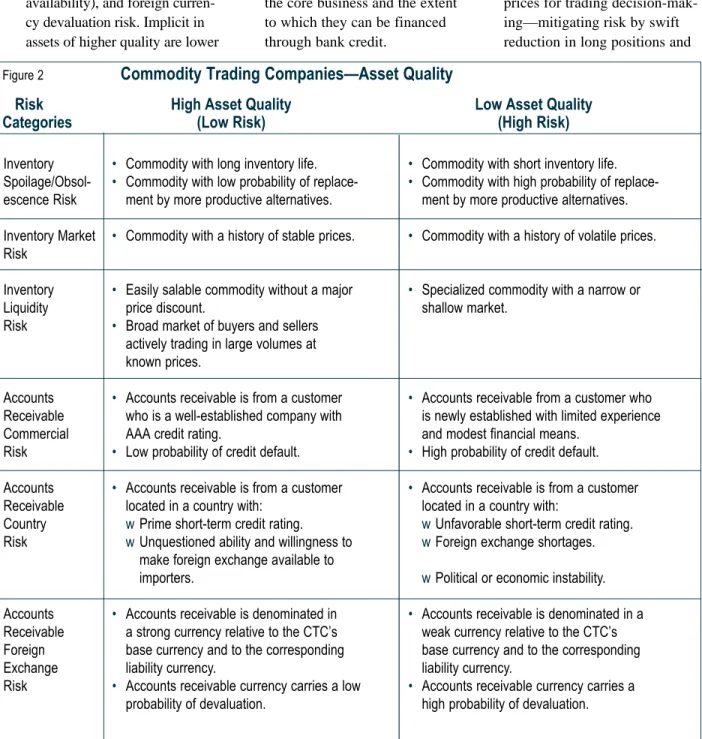
Asset Quality.Asset quality is one of the most important aspects of credit assessment. Asset quality by risk categories are shown in Figure 2. The assets of the trading compa-nies can be divided in three broad categories:
1. Cash and short-term invest-ments, such as near-cash secu-rities, are high-quality assets that provide liquidity for the operating needs of the firm. 2. Commodity trading assets
repre-sent the core business of CTCs. Their quality is determined by the risks inherent in holding and collecting. Inventory risks include spoilage/obsolescence risk, market (price) risk, and liq-uidity risk. Accounts receivable risks include commercial risk (customer creditworthiness), country risk (foreign currency availability), and foreign curren-cy devaluation risk. Implicit in assets of higher quality are lower
risk and capacity to support higher leverage.
3. Long-term assets generally sup-port the trading activities of the CTCs, such as corporate real estate, equipment, equity investments, and loans for sup-plier financing. These assets must be assessed separately to determine their contribution to the core business and the extent to which they can be financed through bank credit.
Trading Capabilities.Trading capabilities represent another im-portant aspect of credit assessment. They comprise the following: • Management expertise as it
embodies experience in the market and knowledge of the factors influencing commodity prices for trading decision-mak-ing—mitigating risk by swift reduction in long positions and
Inventory • Commodity with long inventory life. • Commodity with short inventory life. Spoilage/Obsol- • Commodity with low probability of replace- • Commodity with high probability of replace-escence Risk ment by more productive alternatives. ment by more productive alternatives. Inventory Market • Commodity with a history of stable prices. • Commodity with a history of volatile prices. Risk
Inventory • Easily salable commodity without a major • Specialized commodity with a narrow or
Liquidity price discount. shallow market.
Risk • Broad market of buyers and sellers actively trading in large volumes at known prices.
Accounts • Accounts receivable is from a customer • Accounts receivable from a customer who Receivable who is a well-established company with is newly established with limited experience
Commercial AAA credit rating. and modest financial means.
Risk • Low probability of credit default. • High probability of credit default. Accounts • Accounts receivable is from a customer • Accounts receivable is from a customer Receivable located in a country with: located in a country with:
Country wPrime short-term credit rating. wUnfavorable short-term credit rating. Risk wUnquestioned ability and willingness to wForeign exchange shortages.
make foreign exchange available to
importers. wPolitical or economic instability.
Accounts • Accounts receivable is denominated in • Accounts receivable is denominated in a Receivable a strong currency relative to the CTC’s weak currency relative to the CTC’s Foreign base currency and to the corresponding base currency and to the corresponding
Exchange liability currency. liability currency.
Risk • Accounts receivable currency carries a low • Accounts receivable currency carries a probability of devaluation. high probability of devaluation.
Figure 2
Commodity Trading Companies—Asset Quality
Risk
High Asset Quality
Low Asset Quality
improving sales pricing and terms by redirecting commodi-ty shipments in transit. • Integrity of the firm’s
account-ing systems.
• Adequacy of systems support. • Use of advanced technology for
trading processing and risk con-trol.
Timely access to market data for information management and close tracking of merchandise, doc-uments, and funds are all important in commodity trading.
In assessing trading capabili-ties, banks also consider the CTCs’ strategies and risk management pri-orities in light of market opportuni-ties and available resources, includ-ing capital. Related to this assess-ment is the consistency exhibited by management in keeping day-to-day activities consistent with the execu-tion of strategies.
Trading companies undertaking transactions with greater levels of risk, such as those involving com-modities with high price volatility, implicitly place greater demands on their trading capabilities and on the firm’s equity cushion for absorbing losses. Examples of greater
demands on the firm’s trading capa-bilities include expertise in portfolio risk containment and the ability to close long positions quickly through supplementary commodity or deriv-ative trading.
In those cases in which the CTC belongs to a major conglomer-ate, its strategies are often subordi-nated to the objectives of the overall conglomerate, particularly when the firm functions as a captive entity. Ownership can have a critical effect on the trading capabilities of the
firm.
Bank Audits. Bank-conducted audits, an important due diligence component, are useful in ascertain-ing asset quality and the tradascertain-ing capabilities of the firm. Audits can be conducted periodically based on the specific situation and the need to track progress on issues pending correction.
Credit Structuring
Credit structuring defines the attributes of the credit facility and related lending conditions. It rests on asset quality and on the trading capabilities of the firm.
Bank financing is generally transaction-based because the pur-pose and the repayment of bank financing are closely connected with the conversion of specific assets into cash. Related reasons for transaction-based financing include: • The large size of individual
transactions in absolute dollars or in comparison with the trad-er’s own equity position. • The short asset conversion
cycle, usually fewer than 100 days, and the large loan expo-sure relative to the purchase price of the commodity, usually 80% - 90%.
Credit facilities are generally short term because of the short con-version cycle in commodity trading. They provide for the following: • Import letters of credit to
sup-port purchases.
• Loans and bankers’ acceptances to finance inventory and account receivables.
• Bid bonds for expediting
cus-toms clearance.
In addition to credit facilities, counterparty foreign exchange lines facilitate the conversion of curren-cies, whether spot or forward.
The size of the credit facility depends on the following factors: • Annual purchase volumes ($). • The length of the asset
conver-sion cycle (days).
• The loan advance ratio (loan amount as a % of the commodi-ty cost).
The loan advance ratio repre-sents the extent of credit risk the lending bank is willing to undertake in specific transactions, excluding the trader’s operating costs to carry out the transaction and the transac-tion’s earnings, given the risks incurred in holding and collecting. Conversely, the percentage not financed—100% minus the loan advance ratio—represents the equity cushion implicitly contributed by the CTC for the transaction.
Credit structuring defines the conditions for maintaining the over-all financial position of the firm within the agreed parameters by means of financial covenants, such as those defining minimum equity, maximum leverage, and minimum profits. It also includes conditions for:
• Protecting the value of the commodity financed with insurance coverage and ware-housing safety.
• Maintaining asset control through title documents or warehouse receipts.
with collateral liens over the assets financed.
• Ensuring physical access to cash from sales, that is, cash dominion.
Credit pricing in the form of interest margin and fees compen-sates the bank for the risk incurred in lending to the commodity trader and for the expenses incurred. Pricing also entails compensation to the bank’s shareholders. It is impor-tant that the overall credit facility, pricing included, is competitive in the marketplace in meeting the firm’s asset conversion needs.
The challenge is structuring a credit facility that is responsive to the core activities of the trading firm, is competitive in the market-place, and, at the same time, pro-vides for effective risk control by the lending bank and superior returns to the bank’s shareholders. Risk Control
Risk control entails perfor-mance monitoring by the lending bank of the lending conditions agreed with by the trading company and timely corrective action behind any shortfalls. Monitoring covers overall financial performance track-ing against financial covenants and specific transaction tracking against transactional lending conditions.
Of critical importance in lend-ing to commodity traders is the lending bank’s systems and process for tracking individual transactions regarding the following:
• Transaction eligibility relative to collateral qualification and line availability.
• Collateral maintenance in terms
of market valuation, vis-a-vis loan coverage.
• Warehouse reliance in terms of reputation, control efficacy, and adequacy of contractual under-taking (warehouse agreement). • Documentary control with
respect to the negotiability and possession of title documents underlying collateral. • Cash dominion for accessing
the transaction’s sales proceeds directly from the CTC’s cus-tomers for loan repayment. • Security interest, which
pro-vides creditor protection under Uniform Commercial Code fil-ing.
• Insurance coverage in terms of amount, scope of coverage, insurer credit rating, and bene-ficiary designation.
Risk Underwriting
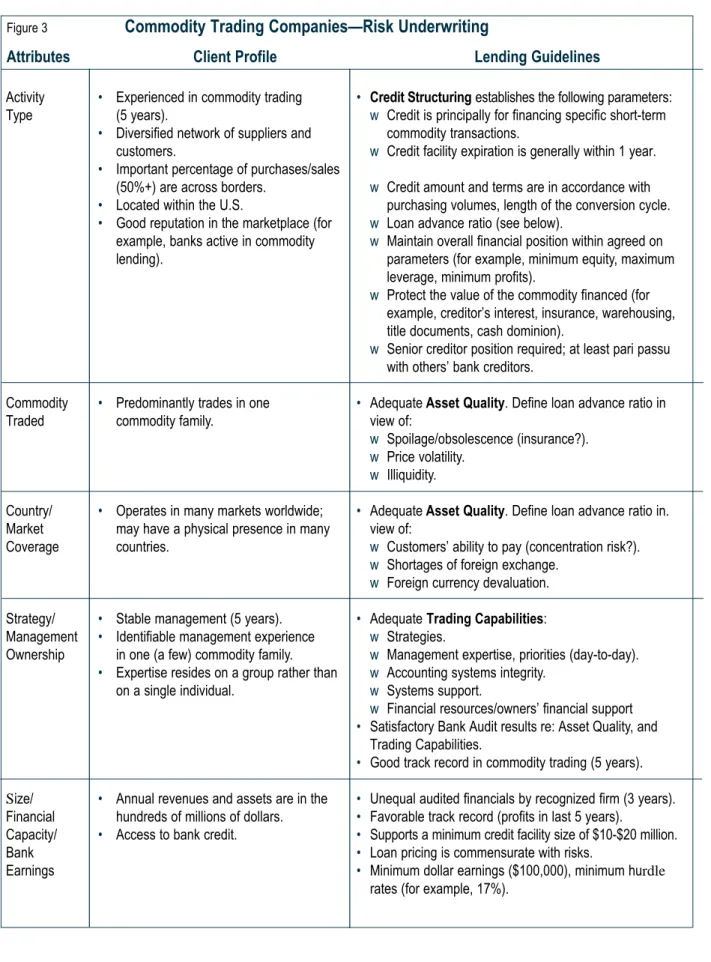
A bank’s marketing plan for pursuing business with commodity traders encompasses various ele-ments, including risk acceptance parameters, market priorities, target segments, client profiles, priority products, minimum account size and profitability standards, resource allocation (including staffing), port-folio fit, and so forth. This section outlines just some of the issues per-taining to risk underwriting under two headings—Client Profile and Lending Guidelines. As shown in Figure 3, these guidelines provide direction for prospecting and prod-uct offering regarding questions such as the following:
• What does my prospect look like?
• What financing can I offer? • What are the lending
condi-tions?
These guidelines do not neces-sarily represent absolute require-ments that must be strictly met but do provide general direction and a contextual reference regarding client selection and recommended credit structures. The guidelines should be flexible in application depending on such factors as the particular needs of the trading firm and its overall credit standing. It is important for the marketing plan to be in harmony within the broader context of the bank’s financial posi-tion, competencies, and credit poli-cy.
Banking Services
Depending on the scope of the relationship between the trading firm and the bank, services provided can expand beyond credit to cover a broader spectrum of needs. Banks can facilitate the firm’s asset con-version cycle and contribute to enhancing their commercial rela-tionships with customers and sup-pliers by linking the firm with its network of suppliers and customers through a broad range of banking services.
Of particular importance in establishing the linkages is the reach of the bank’s international network and the use of advanced technology in communication, automation, and decision-making systems support.
Major categories of banking services supporting the working capital needs of the CTCs include: • Transaction processing—
instructions and documents. • Cash management—money.
Activity • Experienced in commodity trading • Credit Structuring establishes the following parameters: Type (5 years). w Credit is principally for financing specific short-term
• Diversified network of suppliers and commodity transactions.
customers. w Credit facility expiration is generally within 1 year. • Important percentage of purchases/sales
(50%+) are across borders. w Credit amount and terms are in accordance with • Located within the U.S. purchasing volumes, length of the conversion cycle. • Good reputation in the marketplace (for w Loan advance ratio (see below).
example, banks active in commodity w Maintain overall financial position within agreed on
lending). parameters (for example, minimum equity, maximum
leverage, minimum profits).
w Protect the value of the commodity financed (for example, creditor’s interest, insurance, warehousing, title documents, cash dominion).
w Senior creditor position required; at least pari passu with others’ bank creditors.
Commodity • Predominantly trades in one • AdequateAsset Quality. Define loan advance ratio in
Traded commodity family. view of:
w Spoilage/obsolescence (insurance?). w Price volatility.
w Illiquidity.
Country/ • Operates in many markets worldwide; • AdequateAsset Quality. Define loan advance ratio in. Market may have a physical presence in many view of:
Coverage countries. w Customers’ ability to pay (concentration risk?).
w Shortages of foreign exchange. w Foreign currency devaluation. Strategy/ • Stable management (5 years). • Adequate Trading Capabilities: Management • Identifiable management experience w Strategies.
Ownership in one (a few) commodity family. w Management expertise, priorities (day-to-day). • Expertise resides on a group rather than w Accounting systems integrity.
on a single individual. w Systems support.
w Financial resources/owners’ financial support • Satisfactory Bank Audit results re: Asset Quality, and
Trading Capabilities.
• Good track record in commodity trading (5 years). Size/ • Annual revenues and assets are in the • Unequal audited financials by recognized firm (3 years). Financial hundreds of millions of dollars. • Favorable track record (profits in last 5 years).
Capacity/ • Access to bank credit. • Supports a minimum credit facility size of $10-$20 million.
Bank • Loan pricing is commensurate with risks.
Earnings • Minimum dollar earnings ($100,000), minimum hurdle
rates (for example, 17%).
Figure 3
Commodity Trading Companies—Risk Underwriting
• Treasury management—bor-rowing and liquidity manage-ment.
Examples of the benefits most commonly accrued to CTCs using banking services include:
• Reduced holding and collecting times by expediting and track-ing the flow of the merchan-dise, documents, and funds between the CTC and its net-work of key customers and sup-pliers; this can increase asset turnover.
• Increased efficiency by reduc-ing processreduc-ing costs through existing technology in commu-nication, for example, an import letter of credit initiation in the lender’s personal com-puter, and by integrating the bank’s systems into the back-room of the trading firm. This can reduce paperwork, reduce costs, and increase return on sales.
• Enhanced access to credit and capital markets worldwide for a broad range of financing trans-actions. Examples include asset conversion financing and buy-ers’ financing in concert with export credit government agency programs—at competi-tive terms. Competicompeti-tive credit structures can lower costs and enhance transactional process-ing for the CTC, thereby increasing return on sales. • Reduced risk by transferring
certain risks inherent to the firm’s asset conversion cycle to the bank. These risks may include foreign exchange con-tracts, derivative concon-tracts, and nonrecourse financing of export draft/documents.
Conclusion
The protection of the value of the commodity is of primary impor-tance in the performance of the trading company and for loan repayment. Such value is subject to a variety of risks with potentially large negative impact to the trading company. Through sensible credit structuring and constant risk moni-toring, lending banks can effectively and profitably finance commodity trading firms in a fashion that ade-quately addresses lending risk and is consistent with the client’s own parameters of risk and profit. Critically important in commodity lending is the adequacy of the lend-ing bank’s systems and processes for risk control, particularly those directed at protecting the value of the commodity financed.
Commodity trading is a global business. Implicit in its global scope is the growing importance of tech-nology to both trading companies and lending banks in global infor-mation access, timely portfolio risk decision making, and transaction execution. There is ample opportu-nity for banks to add value to the commodity trading firms by provid-ing comprehensive solutions to their working capital needs. This entails
globally linking the trading firms with their respective networks of key suppliers, customers, and stake-holders through the bank’s interna-tional network and a broad range of banking services. These services, encompassing varying degrees of technological sophistication, can benefit commodity traders in such broad areas as transaction process-ing, cash management, and treasury management—including borrowing and liquidity investing. p