1184
ScientistLink PublicationsMobile Application for Medicinal Services
1M.Alice Oshin, 2C.Chandni, 3M.Vinuthaa, 4Dr. B. Shanthini 1,2,3UG Scholar, 4Head,
Department of Information Technology
St. Peter’s College of Engineering & Technology, Chennai, India Email id: [email protected]
ABSTRACT: Common man is always unaware of the consequences of the drugs they consume in their day to day life. They only consume the medicines in prescribed doses as prescribed by the physician without knowing the purpose of the drug. This project helps in overcoming the difficulty mentioned above. This project is a MOBILE APPLICATION that describes a medicine and its specifications including a drug’s purpose, composition and prescribed doses along with an image. It also locates the local pharmacies and hospitals with respect to the user’s location. This application has a special feature of scanning the Quick Response Codes on the strips of medicines which displays the details embedded onto the code. Another feature of Handwriting recognition is added to the application which helps to recognize the handwriting on the prescription of the doctors so that the user himself can surf the details of the medicine from the app.
1. INTRODUCTION
Android software Development is the process by which new applications are created for the Android operating system. Applications are usually developed in Java programming language using the Android Software Development Kit (SDK) but other development environments are also available. The developer of Android SDK is Google. Android Software Development Kit includes a comprehensive set of development tools.
1.1. OFFICIAL DEVELOPMENT TOOLS
The Android SDK includes a debugger, libraries, a handset emulator based on QEMU, documentation, sample code and tutorials. Currently supported development platforms include computers running Linux, Mac OS X 10.5.8 or later, and Windows XP or later also, Android software can be developed on Android itself by using specialized Android applications. The officially supported integrated development environment (IDE) was Eclipse using the Android Development Tools (ADT) plug-in, though IntelliJ IDEA IDE fully supports Android development out of the box, and Net Beans IDE also supports Android Development via plug-in. As of 2015, Android Studio made by Google and powered by IntelliJ is the official IDE. Additionally, developers may use any text editor to edit java and XML files, then use command line tools to create, build and debug Android applications as well as control attached Android devices.
1.2. ENHANCEMENTS TO ANDROID SDK
This goes hand in hand with the overall Android platform development. The SDK also supports older versions of android platform incase developers wish to target their applications at older devices. Development tools are downloadable components, so after one has downloaded the latest version and platform, older platforms and tools can also be downloaded for compatibility testing. Android applications are packaged in .apk format and stored at the /data/app folder on the Android OS. APK package contains dex files, resource file, etc.
1.3. GPS IN ANDROID
The Global Positioning System (GPS) is a space-based satellite navigation system that provides location and time information in all weather conditions, anywhere on or near the earth where there is an unobstructed line of site to four or more GPS satellites. This system provides critical capabilities to military, civil and commercial uses around the world. This is freely accessible to anyone with the GPS receiver. This is enabled in Android phones through Google maps. Google maps is a desktop and mobile web mapping service application and technology provided by Google offering satellite imagery, street maps and street view perspectives as well as functions such as a root planner for travelling by foot, car, bicycle or with public transportation. Also supported are maps embedded on third party websites via Google maps API. Google maps for the mobile is the world’s most popular application for smartphones with over 54% of global smartphone owners using it. Google maps provide high resolution aerial or satellite images for the most urban areas of the world. Like many other Google web applications Google map uses JavaScript extensively.
1.4. SCANNING CODES USING ANDROID
QR Code is the trademark for a type of matrix bar code designed for the automotive industry in Japan. A bar code is a machine readable optical label that contains information about the item to which it is attached. A QR Code uses four standardized encoding modes (numeric, alpha numeric, byte/binary, kanji) to efficiently store data. A QR Code consists of blank modules arranged in a square grid on a white background which can be read by an imaging device such as a camera which is used in mobile apps now. The application Barcode Scanner is an Android application from the open source project ZXing that allows a user to scan 1-D or 2-D graphical barcodes with a camera on their Android devices. The program turns that scans in to the original data that is represented by the barcode or QR Code. This allows the user to get web addresses, geographical coordinates, small pieces of text and much more just by pointing their device’s camera at the bar code or QR Code. In this way the Android based system works on almost like a conventional barcode or QR Code reader.
1.5. ANDROID IN MEDICAL FIELD
The term medical applications and medical software are undefined terms that can designate any software, software item or system used within a medical context, depending on its intended use/indication for use.
The following would be considered to fall under its scope
Software intended to analyze patient data generated by a medical device with a view to diagnosis and monitoring. Application that incorporates dosage algorithms for chronic conditions such as diabetes.
Application intended for use by patients to diagnose or treat a physical or medical ailment.
Dozens of examples now exist were the critical functions performed by medical devices are partly or entirely directed by software, notably by software that is stand alone. The last decade saw a vast new array of software programs entering the medical technologies space. The dramatic increase in smartphone usage over the last five years are so is perhaps most significant factor that has triggered the emergence of 1000’s of pure software programs and applications in this space.
2. LITERATURE REVIEW
2.1. E-MEDICAL APPLICATIONS
E-Health is a relatively recent term for the Health care practice supported by electronic processes and communication. One such application was suggested by Mukesh Joshi and Durgesh Pant [1]. In this they proposed E-HEALTH service model which allows better sharing of health information among multiple government departments. The fact of not meeting the person and diagnosing them in person is overcome by the model proposed by Hafez Fouad [2]. He suggested the transfer of the medical care services to the patient, rather than the transport of the patient to the medical services providers. As the Internet grew, the need for making all services online also grew. Priyanka Patil, Sruthi Kunhirama and Rohini Temkar suggested a means of turning all the services online [3]. This paper describes about an idea of such a web based platform that make many medical/hospital procedures online using Web, networking, cloud and android programming technology that can be very important in implementing the functionality of online medical management. Only the services were made online in the above paper. To improve the efficiency, medicinal tools including software tools relating with medicine also were made online [4]. This system is named iMAT and suggested by P. H. Tsai. iMAT is a system of automatic medication dispensers and software tools. It is for people who take medications on long term basis at home to stay well and independent. The workload of doctors in diagnosing patients can be reduced by an Expert System was suggested by Nana Yaw [5]. This is an advancement where the doctors do not feel pressure in diagnosing the patients when there are a lot of patients visiting the doctor the same day. One of the above papers provides a generic diagnosis of all the physical issues of the patient. Dr. Abdullah Al-Malaise Al-Ghamdi, Majda A.Wazzan, Fatimah M. Mujallid and Najwa K.Bakhsh proposed a paper that specifically deals only with diabetes [6]. They developed a specialized application developed only for diagnosing diabetes.
2.2. HANDWRITING RECOGNITION
A system employing the conventional horizontal and off-line handwritten alphabetical character recognition system using multilayer feed forward neural network is described in the paper [7]. A new method, called, diagonal based feature extraction is introduced for extracting the features of the handwritten alphabets. Fifty data sets, each containing 26 alphabets written by various
people, are used for training the neural network and 570 different handwritten alphabetical characters are used for testing. The proposed recognition system performs quite well yielding higher levels of recognition accuracy compared to the systems vertical methods of feature extraction. This system will be suitable for converting handwritten documents into structural text form and recognizing handwritten names.
2.3. QR SCANNER
Identification of objects and places in the real world is important, and 2-D printing code is useful to store identifiers of them. Any camera mobile device with capture function can read content from a barcode tag directly. When a barcode contains important data or privacy information, the risk of security becomes an important problem. Because QR codes simply feature a square barcode with a unique pattern, people have no idea whether the code will take them to reputable information or a site loaded with malware. In this paper, discusses QR codes different data types, attack via QR codes and security solutions [8]. However, since it is easy to modify the content stored in the 2-D code, we must verify whether the identifier written in the 2-D code is indeed issued by the authorized organization
3. SYSTEM ANALYSIS 3.1. EXISTING SYSTEM
In the existing system the mobile application provides health information to the user. It sends health alerts through SMS. It provides medical consultation and prescribed drugs according to the illness of the user.
3.2. LIMITATIONS OF EXISTING SYSTEM
It doesn’t provide the details of any specified medicine It doesn’t give the banned status of the medicine. It doesn’t locate the pharmacies with respect to the user location.
3.3. PROPOSED SYSTEM
To make the user feel comfortable in knowing the properties (name, proportion, use, image, locality of the nearest pharmacies with respect to user) of a particular medicine on a single tap.To create awareness on the medicine’s dosage and also an idea about the medicines those are banned in Tamil Nadu at present.To locate the local pharmacies with respect to the user’s position.To retrieve the details of the medicine using the QR Code on the medicines and also to perform Handwriting recognition to recognize the handwriting of doctors on prescription.
4. OVERVIEW OF THE PROJECT
1187
ScientistLink PublicationsThe project is a trusted mobile application that helps the user to gain information about the medicines he/she is using. The mobile application provides three other functionalities which are mentioned below.
i. A GPS Locator that locates the user and finds the hospitals and pharmacies nearer to his location.
ii. A QR Code Scanner that scans the QR code on the strips of medicines and provides the details embedded in it. iii. A Handwriting Recognizer that recognizes the handwriting on the prescription of the doctors.
All the above three functionalities are divided into modules to make the development process easier. 4.1. MODULE DESCRIPTION
A modular design reduces complexity, facilitates and allows a program to be intellectually manageable. The five important criteria that enable us to evaluate a design with respect to its ability to define an effective modular design are: Modular Decomposability, Modular Comps ability, Modular Understandability, Modular continuity and Modular Protection. The following are the modules of the project, which are planned in aid to complete the project with respect to the proposed system to overcome the problems in existing system and also providing the support for the future enhancement.
Module 1 : Medicinal Information Retrieval Module 2 : GPS Locator
Module 3 : QR Scanner
Module 4 : Handwriting Recognition 4.1.1. MODULE 1:
MEDICINAL INFORMATION RETRIEVAL
The first step is to create a mobile application which is connected to a database which contains the details of all the medicines in a pharmacy. The database contains the name of the medicine, its proportion, symptoms of usage, its image etc. When the user types the name of any medicine on the search bar, the corresponding medicine relevant to his search is displayed. On clicking on the name of the medicine, all the details of the corresponding medicine, stored in the database is displayed to the user, as shown in fig. 4.2.
4.1.2. MODULE 2: GPS LOCATOR
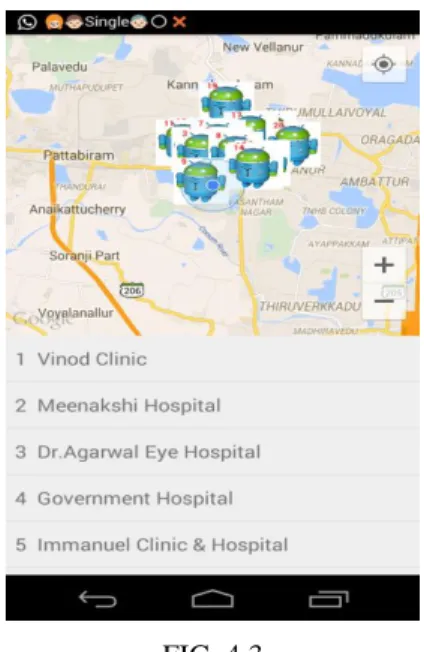
The Global positioning System in this mobile application first locates the user’s position. Once the position of the user is located, the hospitals and pharmacies nearer to his location are shown as in fig. 4.3. If the user selects a particular pharmacy or hospital, the user is asked whether he would need directions to reach the pharmacy/hospital. If the user selects ‘Yes’, then he is shown the directions to the particular pharmacy/hospital in the form of text and Google Maps.
FIG. 4.3 4.1.3. MODULE 3:
QR SCANNER
On the strips of all the medicines, the QR code is present. In the mobile application, there is an option to scan the QR code. When the scanner is opened and placed in front of the QR code, the code is scanned and the details embedded on the code such as price of the medicine, the brand and manufacturer of the medicine are displayed as shown in fig. 4.4.
FIG. 4.4 FIG. 4.5
4.1.4. MODULE 4:
HANDWRITING RECOGNITION
The app recognizes the text on prescription as above shown in fig. 4.5, and stores it on the SD card for later use.
5. CONCLUSION
By using this application we can get the details of the medicines that we use it in our day to day lives .It also enables to locate the nearest pharmacy and hospitals in the surroundings of the user who is in a remote location using GPS .We can also know the complete details of the drugs and the times when it is used. This app also gives the valuable information about the chemical composition of the drugs and whether it is banned or not .It also supports a search bar to type the name of the medicine and also a QR code scanner that takes the name and details of the medicines as input and displays the corresponding details as the output. 6. FUTURE ENHANCEMENTS
In the current scenario we have used only search bar and QR scanner as input to the database. We have tried implementing Handwriting Recognition which reads the handwritten alphabets from a paper or doctor’s prescription .We can improve the Handwriting Recognition module to read all kinds of handwriting and letters spontaneously in the upcoming future.
REFERENCES
[1] P. H. Tsai, “iMAT: Intelligent Medication Administration Tools”, IEEE Published by the IEEE Computer Society, Volume 2 Issue 7, September October 2005.
[2] Hafez Fouad,”Web-Based Database Management To Support Telemedicine System”, International Journal of Advanced Information Technology (IJAIT) Vol. 4, No. 1, February 2014, DOI : 10.5121/ijait.2013.4101.
[3] Dr. Abdullah Al-Malaise Al-Ghamdi, Majda A.Wazzan, Fatimah M. Mujallid and NajwaK.Bakhsh, “An Expert System of Determining Diabetes Treatment Based on Cloud Computing Platforms”, (IJCSIT) International Journal of Computer Science and Information Technologies, Vol. 2 (5), 2011, 1982-1987.
[4] Priyanka Patil, Sruthi Kunhirama and Rohini Temkar, “Functional Description of Online Medical Management System Using Modern Technology”, ISSN: 2319-5967 ISO 9001:2008, Certified International Journal of Engineering Science and Innovative Technology (IJESIT) Volume 2, Issue 6, November 2013
[5] Mukesh Joshi and Durgesh Pant, Ph.D., “Proposed E-Health Service Model by using Smart Phone Apps for Uttarakhand”,International Journal of Computer Applications (0975 – 8887) Volume 97– No.19, July 2014.
[6] Nana Yaw, “mMES: A Mobile Medical Expert System for Health Institutions in Ghana”, Asabere School of Software, DUT International Journal of Science and Technology ©2012 IJST Volume 1 Issue 3, 2012.
[7] J. Pradeep, “Diagonal Based Feature Extraction for Handwritten Alphabets Recognition System Using Neural Network”, International Journal of Computer Science & Information Technology (IJCSIT), Vol. 3, No. 1, Feb,2011.
[8] Sankara Narayana, “QR codes and security solutions”, IEEE Published by the IEEE Computer Society, Volume 3, Issue 5, November 2004.