Abstract- Electric Vehicles, EVs, are expected to contribute definitively to the sustainable mobility. However, in order to allow a faster market penetration, standardization is of extreme importance. Indeed, for comfortable and secure vehicle utilization, there are many aspects of EVs that need to be standardized. The primary objective of this paper is to present, on a compact form, the standardization framework in the field of electric vehicles and hybrid electric vehicles, the most important and urgent standardization activities going on, and the standardization activities in Portugal. A secondary objective is to give the references allowing a non expert on standards to seek for the actualized state of the standardization activities concerning EVs in the future.
I.
I
NTRODUCTIONElectric Vehicles, EVs, are expected to contribute
definitively to the sustainable mobility [1][2]. However, in
order to allow a faster market penetration, standardization is
of extreme importance. Indeed, for comfortable and secure
vehicle utilization, there are many aspects of EVs that need
to be standardized as, for example, the plugs for charging,
the chargers voltages, the communication between the
vehicle and the chargers, fast charging systems and
respective billing, security measures for vehicle safety and
safety of persons against electric shock, on-board electric
energy storage for propulsion and vehicle energy
performance and energy measurements.
In this paper, the standardization framework in the field
of electric vehicles and hybrid electric vehicles (HEVs) is
firstly presented, followed by the most important and urgent
standardization activities going on, and finally the
standardization activities in Portugal are presented.
II.
G
LOBALS
TANDARDIZATION ANDE
LECTRICV
EHICLES
TANDARDIZATIONF
RAMEWORKAt a worldwide level, standardization is mainly under the
competence
of
two
institutions:
the
International
Electrotechnical Commission (IEC) [3], founded on 1906,
and the International Organization for Standardization (ISO)
[4], founded on 1946.
A.
International Electrotechnical Commission, IEC
IEC is the world’s leading organization preparing and
publishing International Standards for all electrical,
electronic and associated technologies. Its structure can be
seen in Fig. 1. In 2010, it had around 174 Technical
Committees (TCs) and Subcommittees (SCs).
TCs report to the Standardization Management Board
and can form SCs to deal with items on the TCs’ work
programme. TC membership is composed of the IEC
National Committees (NCs) that can participate in the work
of any TC either as Participating members (P-Members) or
Observer members (O-Members).
Fig. 1. IEC’s structure [3]
B.
International Organization for Standardization, ISO
Founded in 1946 in London and officially beginning its
activities on 23 February 1947, in Geneva, Switzerland, ISO
is the world's largest developer and publisher of
International Standards, dealing with the non-electrical
technologies. It is constituted by 160 national standards
institutes coordinated by a Central Secretariat in Geneva. In
order to avoid different acronyms in different languages it
was decided to use as short name, "ISO". This was derived
from the Greek
isos
, which means "equal". The ISO
structure is represented in Fig. 2 and in 2011 has nearly 220
technical committees.
Fig. 2. ISO’s structure [4]
Standardization in Electric Vehicles
Paulo G. Pereirinha
1,2,3, João P. Trovão
1,2,
1
IPC-ISEC, Polytechnic Institute of Coimbra, R. Pedro Nunes, P-3030-199 Coimbra, Portugal
2
Institute for Systems and Computers Engineering at Coimbra (INESC-Coimbra), Portugal
3
APVE, Portuguese Electric Vehicle Association. Participate at the Portuguese CTE 69 and CT146
C.
European and National level standardization
organizations
Besides ISO and IEC, in the field of EVs and HEVs
there are also some relevant standardization organizations at
European and National level, namely:
•
CEN, the European Commission for Standardization.
Its TC 301 –
Road Vehicles
, is responsible for
electric road vehicles.
•
CENELEC,
the
European
Committee
for
Electrotechnical Standardization. EVs are dealt with
by the TC 69X –
Electrical systems for electric road
vehicles
.
•
In the U.S., the Society of Automotive Engineers
(SAE).
•
In Japan, the Japanese Electric Vehicle Association
(JEVA).
•
In Portugal, by delegation of the Portuguese Quality
Institute, IPQ, the Portuguese Electric Vehicle
Association, APVE, is the “sector standardization
organism” for electric road vehicles. It has two TCs:
CTE 69 –
Electric Road Vehicles,
and CT146 –
Electric Systems for Electric Road Vehicles
.
D.
Electric Vehicle Standardization Responsibility?
An important issue appears concerning the EVs’
standardization responsibility. As a road vehicle, the EV
(and the HEV) is under the competence of ISO, namely, of
ISO TC22/SC21 –
Electrically propelled road vehicles
,
which has three working groups (WGs):
•
WG 1 -
Vehicle operation conditions, vehicle safety
and energy storage installation
;
•
WG 2 -
Definitions and methods of measurement of
vehicle performance and of energy consumption
;
•
WG 3 -
Lithium Ion traction Batteries.
But, an electric vehicle can also be considered as an
electrical device, which is in the competence of IEC, namely
the IEC TC69 –
Electric road vehicles and electric
industrial trucks
. IEC TC69 has two active WGs:
•
WG 2 -
Motors and motor control systems
;
•
WG 4 -
Power supplies and chargers
.
These two TCs, ISO TC22/SC21 and IEC TC69, have
been collaborating since its foundation. Nevertheless, some
discussions have arisen in the past due to various
intersections on the work division by the two groups. This
was solved by a consensus agreement in 1996 [5], defining
the competences of the respective committees, as can be
seen in Table 1. A recent ISO/IEC Memorandum of
Understanding (MoU) [6][7], valid for all types of road
vehicles
and
respective
equipments,
clarified
the
collaboration rules and modes.
TABLE I
BASIC WORK DIVISION BETWEEN ISO AND IEC COMMITTEES
ISO IEC
Work related to the electric vehicle as a whole
Work related to electric components and electric supply infrastructure
A list of ISO and IEC committees responsible for and
involved in standardization of electrotechnology for road
vehicles as by 2010 is also presented in [7].
III.
M
OSTI
MPORTANTS
TANDARDIZATIONA
CTIVITIESG
OINGO
N IN THEE
LECTRICV
EHICLESF
RAMEWORKFrom the ISO/IEC Memorandum of Understanding,
resulted the standardization activity presented in Table II
(IEC/ISO on-going projects by 2010).
TABLE II
IEC/ISO ON-GOING PROJECTS [7] Electrotechnology/
Project
IEC TC/SC ISO TC/SC
Starter batteries TC 21 TC 22
Secondary lithium cells IEC 62660-1 Ed 1.0 IEC 62660-2 Ed. 1.0
TC 21/SC 21A/TC 69
TC 22/ SC 21
Lithium batteries – battery pack and system level
ISO 12405-1 Ed. 1.0 ISO 12405-2 Ed. 1.0 TC 21/SC 21A/TC 69 TC 22/SC 21 EV Charging System IEC 61851 series TC 69 TC 22/SC 21
Vehicle to grid communication interface (JWG V2G CI)
ISO 15118
TC 69 TC 22/SC 3
Plugs and Socket-outlets IEC 62196 series
SC 23H TC 22/SC 3
Lamps, lamp holders and caps SC 34A/SC 34B TC 22/SC 8 Radio interferences (>= 9 KHz)
caused by road vehicle electrical systems
CISPR D TC 22/SC3
EMC emissions on low frequency (<9 kHz) disturbances and basic EMC immunity standards for the whole frequency range
SC 77A TC 22/SC3
EMC immunity for EV charging systems
TC 69 TC 22/SC3
EMC immunity for vehicle and its equipment
TC 77 TC 22/SC3 Organization in bold has the administrative lead
These projects are leaded by different IEC TC/SC or ISO
TC/SC (Table II) and are at different developments’ level, as
will be shown following.
A.
Standards and projects under the direct responsibility
of ISO TC22/SC21
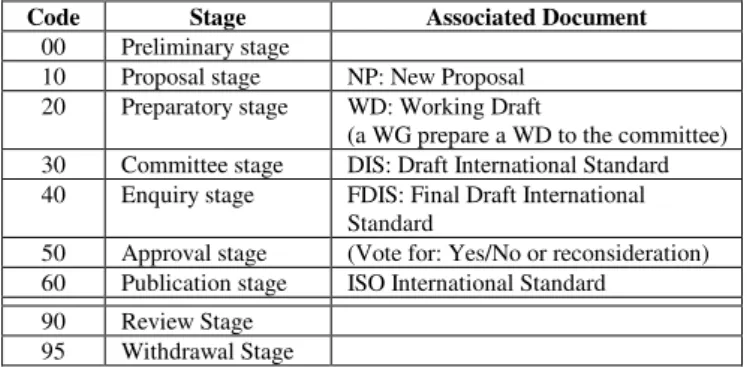
The International Standards developed by ISO TC and
SC pass a multistep-step process, to which correspond the
International harmonized stage codes in Table III.
TABLE III
STAGES AND CODES IN ISO STANDARDS DEVELOPMENT [8][9]
Code Stage Associated Document
00 Preliminary stage
10 Proposal stage NP: New Proposal 20 Preparatory stage WD: Working Draft
(a WG prepare a WD to the committee) 30 Committee stage DIS: Draft International Standard 40 Enquiry stage FDIS: Final Draft International
Standard
50 Approval stage (Vote for: Yes/No or reconsideration) 60 Publication stage ISO International Standard
90 Review Stage 95 Withdrawal Stage
A document in one stage can be at one of the substages
presented in Table IV. For example, a project with the code
60.60 is at “Publication stage+ Completion of main action”,
that is, 60.60 means “International Standard published”. A
full stage codes table with a visual representation of the
development stages can be found at [9].
TABLE IV
SUBSTAGES AND CODES IN ISO STANDARDS DEVELOPMENT
Code Substage
00 Registration 20 Start of main action 60 Completion of main action
90 Decision Substages
92 Repeat an earlier phase 93 Repeat current phase 98 Abandon
99 Proceed
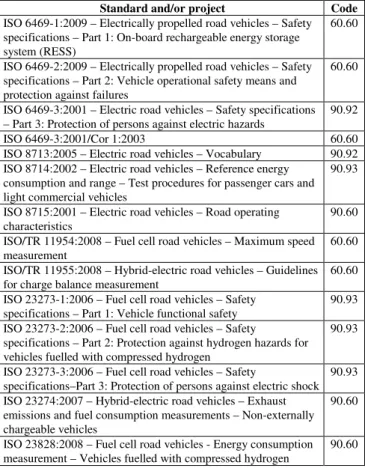
The standard and/or projects in Table V have been
published, while those in Table VI are under development
by May 2011 [10].
TABLE V
STANDARDS/PROJECTS PUBLISHED BY ISO TC22/SC21
Standard and/or project Code
ISO 6469-1:2009 – Electrically propelled road vehicles – Safety specifications – Part 1: On-board rechargeable energy storage system (RESS)
60.60
ISO 6469-2:2009 – Electrically propelled road vehicles – Safety specifications – Part 2: Vehicle operational safety means and protection against failures
60.60
ISO 6469-3:2001 – Electric road vehicles – Safety specifications – Part 3: Protection of persons against electric hazards
90.92
ISO 6469-3:2001/Cor 1:2003 60.60
ISO 8713:2005 – Electric road vehicles – Vocabulary 90.92 ISO 8714:2002 – Electric road vehicles – Reference energy
consumption and range – Test procedures for passenger cars and light commercial vehicles
90.93
ISO 8715:2001 – Electric road vehicles – Road operating characteristics
90.60 ISO/TR 11954:2008 – Fuel cell road vehicles – Maximum speed measurement
60.60 ISO/TR 11955:2008 – Hybrid-electric road vehicles – Guidelines for charge balance measurement
60.60 ISO 23273-1:2006 – Fuel cell road vehicles – Safety
specifications – Part 1: Vehicle functional safety
90.93 ISO 23273-2:2006 – Fuel cell road vehicles – Safety
specifications – Part 2: Protection against hydrogen hazards for vehicles fuelled with compressed hydrogen
90.93
ISO 23273-3:2006 – Fuel cell road vehicles – Safety
specifications–Part 3: Protection of persons against electric shock 90.93 ISO 23274:2007 – Hybrid-electric road vehicles – Exhaust
emissions and fuel consumption measurements – Non-externally chargeable vehicles
90.60
ISO 23828:2008 – Fuel cell road vehicles - Energy consumption measurement – Vehicles fuelled with compressed hydrogen
90.60
TABLE VI
STANDARDS/PROJECTS UNDER DEVELOP. BY ISO TC22/SC21
Standard and/or project Code
ISO/FDIS 6469-3 – Electrically propelled road vehicles – Safety specification – Part 3: Protection of persons against electric shock
50.20 ISO/DTR 8713 – Electric road vehicles – Vocabulary 30.60 ISO/PRF 12405-1 – Electrically propelled road vehicles – Test specification for lithium-ion traction battery packs and systems – Part 1: High-power applications
50.20
ISO/DIS 12405-2 – Electrically propelled road vehicles – Test specification for lithium-ion traction battery packs and systems – Part 2: High energy application
40.60
ISO/NP 12405-3 – Electrically propelled road vehicles - Test specification for Lithium-ion traction battery packs and systems – Part 3: Safety performance requirements
10.99
ISO/NP PAS 16898 – Electrically propelled road vehicles – Battery system design – Requirements on dimensions for lithium-ion cells for vehicle propulslithium-ion
10.99
ISO/CD 23274-1 – Hybrid-electric road vehicles – Exhaust emissions and fuel consumption measurements – Part 1: Non-externally chargeable vehicles
30.20
ISO/DIS 23274-2 – Hybrid-electric road vehicles – Exhaust emissions and fuel consumption measurements – Part 2: Externally chargeable vehicles
40.20
B.
Standards and projects under the direct responsibility
of IEC TC69
TABLE VII
STANDARDS/ PROJECTS PUBLISHED BY IEC TC69 Reference, Edition, Date, Title
IEC/TR 60783 –Edition 1.0 (1984-12-30) –Wiring and connectors for electric road vehicles –Stability Date : 2008
IEC/TR 60784 –Edition 1.0 (1984-12-30) –Instrumentation for electric road vehicles –Stability Date : 2008
IEC/TR 60785 –Edition 1.0 (1984-12-30) –Rotating machines for electric road vehicles –Stability Date : 2008
IEC/TR 60786 –Edition 1.0 (1984-12-30) –Controllers for electric road vehicles –Stability Date : 2008
IEC 61851-1 –Edition 2.0 (2010-11-25) –Electric vehicle conductive charging system - Part 1: General requirements –Stability Date : 2012 IEC 61851-21 –Edition 1.0 (2001-05-04) –Electric vehicle conductive charging system - Part 21: Electric vehicle requirements for conductive connection to an a.c./d.c. supply –Stability Date : 2010
IEC 61851-22 –Edition 1.0 (2001-05-04) –Electric vehicle conductive charging system - Part 22: AC electric vehicle charging station –Stability Date : 2010
IEC 62576 –Edition 1.0 (2009-08-18) –Electric double-layer capacitors for use in hybrid electric vehicles - Test methods for electrical characteristics –Stability Date : 2014
TABLE VIII
STANDARDS/PROJECTS UNDER DEVELOPMENT BY IEC TC69
Project Reference Stage
IEC 21 Ed. 2.0 – Review Report on IEC 61851-21 Ed. 1.0: Electric vehicle conductive charging system - Part 21: Electric vehicle requirements for conductive connection to an a.c./d.c. supply
1CD (1st Committee Draft) IEC 61851-22 Ed. 2.0 – Electric vehicle conductive
charging system - Part 22: a.c. electric vehicle charging station
1CD
IEC 61851-23 Ed. 1.0 – Electric vehicle conductive charging system - Part 2-3: D.C electric vehicle charging station
1CD
IEC 61851-24 Ed. 1.0 – Electric vehicles conductive charging system - Part 24: Control communication protocol between off-board d.c. charger and electric vehicle
ANW (Approved New Work) IEC 61980-1 Ed. 1.0 – Electric equipment for the
supply of energy to electric road vehicles using an inductive coupling - Part 1: General requirements
PNW (Proposed New Work) IEC 61980-2 Ed. 1.0 – Electric equipment for the
supply of energy to electric road vehicles using an inductive coupling - Part 2: Manual connection system using a paddle
PWI (Potential new work item) IEC 61981 Ed. 1.0 – On board electric power
equipment for electric road vehicles
PWI ISO/IEC 15118-1 Ed. 1.0 – Road vehicles - Vehicle to grid communication interface - Part 1: General information and use-case definition
2CD (2nd Committee Draft) PNW 60069-182 Ed. 1.0 – Electric vehicle charging
and discharging metering and billing equipment
PNW PNW 69-176 Ed. 1.0 – Utility grid communication
network in electric vehicle charging infrastructure
PNW PNW 69-177 Ed. 1.0 – IEC 61851-2-x: Electric vehicle conductive charging system - Part 2-x: Control communication protocol between a.c./d.c. supply hybrid charging system and electric vehicle
PNW
PNW 69-181 Ed. 1.0 – Electric charging station - Charging supervisor system
PNW PNW 69-183 Ed. 1.0 – General technical requirements for off-board charging and discharging equipment
PNW PWI 69-1 Ed. 1.0 – Electric vehicle conductive
charging system - Part 24: Communication protocol between off-board charger and electric vehicle
PWI
PWI 69-2 Ed. 1.0 – Battery exchange infrastructure PWI
The standards and projects under the direct responsibility
of IEC TC69 [11] already published are shown in Table VII
and Table VIII, this later with the stage codes. It should be
noticed, that even though the stages and associated
documents have in most cases similar codes and names for
both ISO and IEC (cf. Table III, Table V, Table VI and
Table VIII), they are not always exactly the same. A full list
of IEC stage codes (as those in Table VIII), its meaning and
the equivalent harmonized stage codes can be found in [12].
C.
ISO/IEC Directives, Procedures for the technical work
As said previously, to avoid conflicts and overlaps
between ISO and IEC standards a consensus agreement and
an ISO/IEC Memorandum of Understanding (MoU) were
done. Also, to overcome the issues raised by different
procedures of each organization, ISO/IEC Directives were
established to “standardize” common standardization
activities (cf. Table II):
•
ISO/IEC Directives, Part 1: Procedures for the
technical work [13];
•
ISO/IEC Directives, Part 2: Rules for the structure and
drafting of International Standards [14];
•
ISO Supplement, Procedures specific to ISO [15];
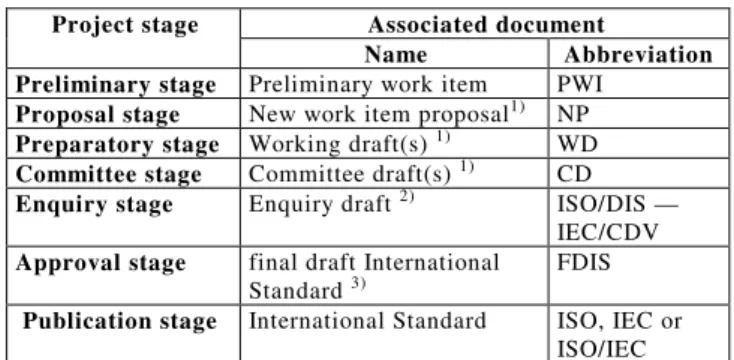
For example, the ISO/IEC Directives, Part 1, shows the
project stages and associated documents as to be used by the
both organizations and joint working groups, as in Table IX.
TABLE IX
PROJECT STAGES AND DOCUMENTS FOR ISO/IEC [13]
Project stage Associated document
Name Abbreviation
Preliminary stage Preliminary work item PWI
Proposal stage New work item proposal1) NP
Preparatory stage Working draft(s) 1) WD
Committee stage Committee draft(s) 1) CD
Enquiry stage Enquiry draft 2) ISO/DIS —
IEC/CDV Approval stage final draft International
Standard 3)
FDIS Publication stage International Standard ISO, IEC or
ISO/IEC
1) These stages may be omitted, as described in Annex F of [13] 2) Draft International Standard in ISO, committee draft for vote
in IEC.
3) May be omitted (see 2.6.4 of [13]).
As all these stages and process can seen a little bit fuzzy,
a flowchart showing the
process for the development of new
standards and the maintenance of existing standards
and
another with the
overview of the processes for the
withdrawal and the systematic review of existing standards
can be found in the ISO Supplement [15].
D.
Standardisation Mandate to CEN, CENELEC and ETSI
Concerning the Charging of Electric Vehicles
IEC and ISO have published or started to develop the
previously mentioned standards. However, there are some
difficulties on ensuring interoperability between chargers of
EVs, as, for example, at IEC level there are at least three
different types of plugs under consideration (IEC 62196-2,
Table II), and different power levels (charge modes)
previewed (IEC 61851-1, Table VII) [16]. A freely available
short explanation on this subject can be found in [17]. This
lack of interoperability would fragment the market, creating
difficulties to the EVs mobility between regions and states.
Being aware of this, in June 2010 the European
Commission, EC, by the Mandate M/468, has requested the
CEN, the CENELEC and the ETSI (European
Telecommu-nications Standards Institute) “
to develop European
standards or to review existing standards in order to:
a) Ensure interoperability and connectivity between the
electricity supply point and the charger of electric
vehicles, including the charger of their removable
batteries, so that this charger can be connected and be
interoperable in all EU States.
b) Ensure interoperability and connectivity between the
charger of electric vehicle- if the charger is not on
board- and the electric vehicle and its removable
battery, so that a charger can be connected, can be
interoperable and re-charge all types of electric
vehicles and their batteries.
c) Appropriately consider any smart-charging issue with
respect to the charging of electric vehicles.
d) Appropriately
consider
safety
risks
and
electromagnetic compatibility of the charger of electric
vehicles in the field of Directive 2006/95/EC (LVD)
and Directive 2004/108/EC (EMC).
” [18]
As a consequence of this mandate, the
Focus Group on
European Electro-Mobility
has been created and a
Final
Report to CEN and CENELEC Technical Boards in
response to Commission Mandate M/468 concerning the
charging of electric vehicles
is expected by the end of June
2011.
IV.
EV
S’
S
TANDARDIZATIONA
CTIVITIES INP
ORTUGALDue to the intense standards development activities
presented before for EVs, also APVE and its two TCs [19],
CTE 69 –
Electric Road Vehicles,
and CT146 –
Electric
Systems for Electric Road Vehicles
, have been very active,
especially during the last two years, as these TCs participate
on that do IEC/ISO and CEN/CENELEC standards
development process, having at least to review and comment
the standards on its different stages, and to give advice to the
IPQ vote for the Portuguese position. Furthermore, in order
to help the Portuguese entities concerned with the EVs,
APVE with CTE69 and CT146 is preparing the translation
to Portuguese of the standards presented in Table X.
TABLE X
STANDARDS TO BE TRANSLATED TO PORTUGUESE Standards
EN 1986-2:2001: Electrically propelled road vehicles - Measurement of energy performances - Part 2: Thermal electric hybrid vehicles EN 61851-21:2002 : Electric vehicle conductive charging system – Part 21: Electric vehicle requirements for conductive connection to an a.c/d.c. supply
EN 61851-22:2002: Electric vehicle conductive charging system - Part 22: AC electric vehicle charging station
ISO 6469-1:2009: Electric road vehicles –Safety specifications -Part 1: On-board electrical energy storage
ISO 6469-2:2009: Electric road vehicles – Safety specifications - Part 2: Functional safety means and protection against failures
ISO 6469-3:2009: Electric road vehicles – Safety specifications - Part 3: Protection of persons against electric hazards
ISO 8713:2005: Electric road vehicles – Vocabulary
ISO 8714:2002: Reference energy consumption and range - Test procedures for passenger cars and light commercial vehicles ISO 8715:2001: Road operating characteristics
ISO 23273-1:2006: Fuel cell road vehicles - Safety specifications – Part 1: Vehicle functional safety
ISO 23273-2:2006: Fuel cell road vehicles - safety specifications – Part 2: Protection against hydrogen hazards for vehicles fuelled with compressed hydrogen
ISO 23273-3:2006: Fuel cell road vehicles - Safety specifications – Part 3: Protection of persons against electric shock
ISO 23274:2007: Exhaust emissions and fuel consumption measurements –Non-externally chargeable vehicles
ISO 23828:2008: Energy consumption measurement - Vehicles fuelled with compressed hydrogen
V.
C
ONCLUSIONSBefore concluding, it is important to clarify the
differences between Standards and Regulations. Standards
are voluntary documents produced by technical committees
and approved by the representatives of the concerned and
interested entities in the countries (namely the IEC National
Committees or ISO national standards institutes). On the
other hand, regulations are legally binding documents, which
are issued by government. Nevertheless, our modern way of
life would not be possible without standards (and many
standards finally are adopted has regulation by the
countries). From an electrical point of view, it suffices to
think what would happen if we had several different plugs in
each country, with different voltage levels and frequencies!
The same happens with the EVs, and at this stage of the first
wave of modern EVs reaching the market, there are many
aspects of EVs that still can and need to be standardized as,
for example, the plugs for charging, the chargers voltages,
the communication between the vehicle and the chargers,
fast charging systems and respective billing, security
measures for vehicle safety and safety of persons against
electric shock, electromagnetic compatibility and health
effects issues [20], on-board electric energy storage for
propulsion and vehicle energy performance and energy
measurements.
The evolution of electric vehicle standardization, from
the very beginning, was the subject of an important doctoral
thesis on this subject,
The Electric Vehicle: Raising the
Standards
, from the actual IEC TC69 Secretary, Prof. Peter
Van den Bossche [21]. Nowadays there is still an intense
effort on this subject endured by different standardization
organizations and also by European Commission. In this
paper, the EV standardization framework was presented on a
compact form as well as the most important standardization
activities going on at world, Europe and Portugal levels.
References were given allowing the non standards expert, to
easily and quickly access the state of the standardization
activities in the EVs frameworks also in the future.
The Standardization in Electric Vehicles is not an easy
task. But a serious amount of effort is being put on this in
order to ensure that there are no obstacles from this point of
view to the EVs massive spread as a sustainable mobility
solution.
VI.
R
EFERENCES[1] P.G. Pereirinha, J.C. Quadrado, J. Esteves, “Sustainable Mobility: Part I – Main Problems”, Proceedings of the CEE'05 - International Conference on Electrical Engineering - 10-12 October 2005, Coimbra – Portugal, in CD-ROM.
[2] P.G. Pereirinha, J.C. Quadrado, J. Esteves, “Sustainable Mobility: Part II – Some Possible Solutions Using Electric and Hybrid Vehicles”, Proceedings of the CEE'05 - International Conference on Electrical Engineering - 10-12 October 2005, Coimbra – Portugal, in CD-ROM.
[3] International Electrotechnical Commission (IEC) web-site, www.iec.ch
[4] International Organization for Standardization (ISO), www.iso.org [5] Peter Van den Bossche, Joeri Van Mierlo, Yonghua Cheng, Jean
Timmermans, “Evolution of international standardization of electrically propelled vehicles”, Proc. of the European Ele-Drive Transportation Conference 2007, EET-2007, 30th May - 1st June 2007, Brussels, Belgium, in CD-ROM.
[6] “ISO shapes future of electric vehicles”, Press Release, 2011-02-17, www.iso.org/iso/pressrelease.htm?refid=Ref1402
[7] ISO/IEC Agreement Concerning Standardization of Electro-technology for Road Vehicles and the Cooperation Between ISO/TC 22 “Road Vehicles” and IEC Technical Committees, 2010.
[8] “Stages of the development of International Standards”, ISO, www.iso.org/iso/standards_development/processes_and_procedures/ stages_description.htm
[9] “International harmonized stage codes”, ISO, www.iso.org/iso/standards_development/processes_and_procedures/ stages_description/stages_table.htm
[10] ISO, “Standards and projects under the direct responsibility of the Secretariat of TC 22/SC 21 - Electrically propelled road vehicles”, www.iso.org/iso/iso_catalogue/catalogue_tc/catalogue_tc_browse. htm?commid=46946
[11] IEC - TC 69, Electric road vehicles and electric industrial trucks, Projects / Publications, www.iec.ch/dyn/www/f?p=103:23:0::::FSP_ ORG_ID,FSP_LANG_ID:1255,25
[12] “Stage Codes”, IEC, www.iec.ch/standardsdev/how/processes/stage_ codes.htm
[13] ISO/IEC Directives, Part 1: Procedures for the technical work (8th edition, 2011).
[14] ISO/IEC Directives, Part 2: Rules for the structure and drafting of International Standards (6th edition, 2011).
[15] ISO Supplement, Procedures specific to ISO (2nd edition, 2011); [16] “Plug them in and move them on!”, IEC e-tech, April 2011,
www.iec.ch/etech/2011/etech_0411/tc-1.htm [17] “IEC 62196”, http://en.wikipedia.org/wiki/IEC_62196
[18] “M/468 EN, Standardisation Mandate to CEN, CENELEC and ETSI Concerning the Charging of Electric Vehicles”, European Commission, Brussels, 4th June 2010, http://ec.europa.eu/energy/ gas_electricity/smartgrids/doc/2010_06_04_mandate_m468_en.pdf [19] Normalização, Associação Portuguesa do Veículo Eléctrico,
www.apve.pt/content01.asp?treeID=06
[20] International Commission on Non-Ionizing Radiation Protection, Guidelines for Limiting Exposure to Time-Varying Electric and Magnetic Fields (1 Hz to 100 kHz), ICNIRP Guidelines, Health Physics, December 2010 – Vol. 99 - Issue 6 - pp 818-836.
[21] P. Van den Bossche, The electric vehicle: raising the standards, PhD thesis, Vrije Universiteit Brussel, 2003.
![Fig. 1. IEC’s structure [3]](https://thumb-us.123doks.com/thumbv2/123dok_us/9466942.2427998/1.892.467.812.244.550/fig-iec-structure.webp)