Technical Dossier
Business Continuity Plan
---
I.S. Strategy and recovery solutions
(Disaster Recovery Plan)English version: November 2004
TECHNICAL COMMISSION FOR LOGIC SECURITY
CLUB DE LA SECURITE DES SYSTEMES D’INFORMATION FRANÇAIS 30, rue Pierre Semard, 75009 PARIS
Tel. : +33 153 25 08 80 – Fax : +33 1 53 25 08 88 e-mail : [email protected] - Web : http://www.clusif.asso.fr
C
ONTENTS
Contents...I Acknowledgements ... III 1 Introduction... 1 2 Recovery strategy... 3 2.1 Definitions ... 3 2.2 Method ... 32.2.1 The different phases of the methodology ... 3
2.2.2 Launch phase... 4
2.2.3 The operational research phase... 5
2.2.4 Vulnerability study phase ... 5
2.2.5 Risk analysis phase... 6
2.2.6 Orientation phase: operational targets and the choice of technical recovery solutions: ... 7
3 The Disaster Recovery Plan ... 9
3.1 Introduction... 9
3.2 Organization ... 9
3.2.1 The crisis management committee ... 9
3.2.2 The Coordinating Committee ... 10
3.2.3 The operational response teams... 10
3.2.4 The user services ... 10
3.3 Activation... 11
3.4 Recovery measures... 11
3.5 Documentation ... 13
3.5.1 Documents used to communicate the recovery plan ... 13
3.5.2 Documents used to implement the recovery plan ... 13
3.5.3 Documents used to manage the recovery plan... 14
3.5.4 Documents used to audit the recovery plan ... 14
3.6 Maintaining the plan... 14
3.6.1 Organization ... 14
3.6.2 Tools... 15
3.7 The test plan ... 15
4 Recovery solutions ... 17
4.1 Disaster recovery solutions... 17
4.1.1 Types of recovery solutions and the methods used to manage them ... 19
4.1.2 Type of resources brought into play ... 22
4.1.3 Level of preparation and availability of resources... 25
4.2 Telephone systems backup ... 27
4.2.1 Network connections ... 27
4.2.2 Telephone backup resources... 28
4.2.3 The routing of telephone links (on a single number)... 28
4.3 Salvaging the premises and the equipment in it ... 28
4.4 Backup / recovery... 29
4.4.1 Types of backup ... 29
4.4.1.2 Logic backup ... 30
4.4.1.2.1 Complete logic backup ... 30
4.4.1.2.2 Incremental backup ... 30
4.4.1.2.3 Application backup ... 30
4.4.1.2.4 Logging... 30
4.4.2 Duplication, backup and recovery techniques ... 31
4.4.2.1 Replication; ... 31
4.4.2.1.1 Case 1: Immediate replication... 31
4.4.2.1.2 Case 2: Updates are passed on at regular intervals ... 31
4.4.2.2 Traditional backup... 31
4.4.3 Data synchronization ... 32
4.4.4 Backup / recovery solutions. ... 32
4.4.4.1 So-called centralized architecture... 33
4.4.4.2 Distributed or client / server architecture ... 33
4.4.5 Procedures, tests, and follow-up... 33
4.5 The recovery of printing and mailing resources... 34
4.6 Backup Internet access ... 34
4.6.1 The Internet connection ... 34
4.6.2 Rerouting Internet flow ... 34
4.7 The contract for the backup resources... 35
4.7.1 Object of the contract ... 36
4.7.2 Detailed description of the “services” ... 36
4.7.3 Activation procedures... 36
4.7.4 Conditions of use... 36
4.7.5 Logistics ... 37
4.7.6 Tests and dry runs... 37
4.7.7 Managing priorities ... 37
4.7.8 Commitments and responsibilities... 38
4.7.9 Financial aspects... 39
4.7.10 Evolving configurations ... 39
4.7.11 Confidentiality... 39
4.7.12 A few recommendations... 40
5 Appendix: Risk analysis guides ... 41
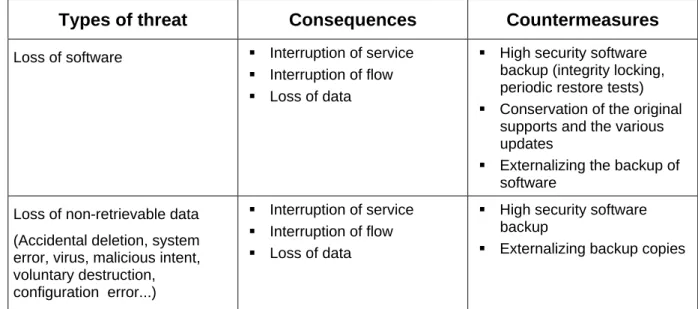
5.1 Premises and infrastructure... 41
5.2 Computer and telecommunications equipment ... 45
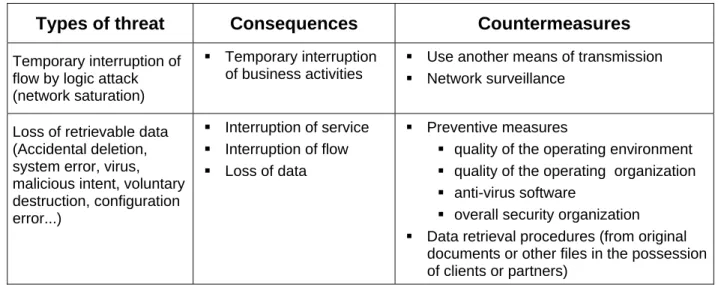
5.3 Operating systems, applications, data and flow ... 47
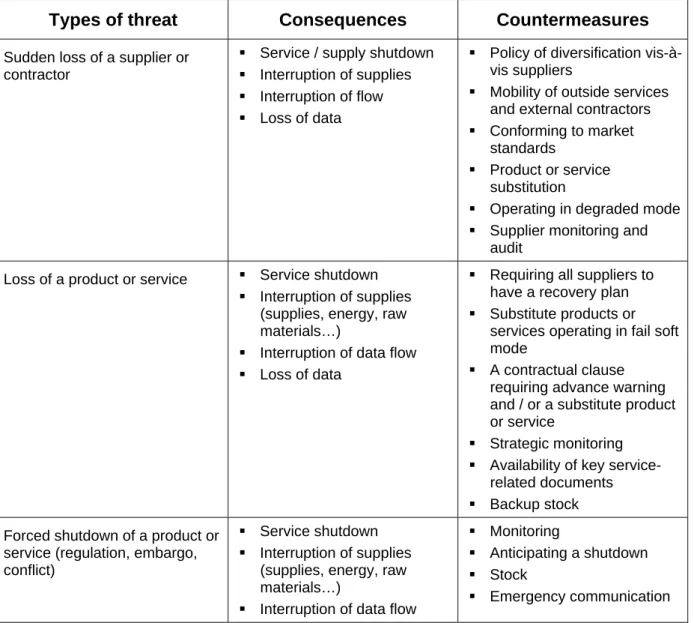
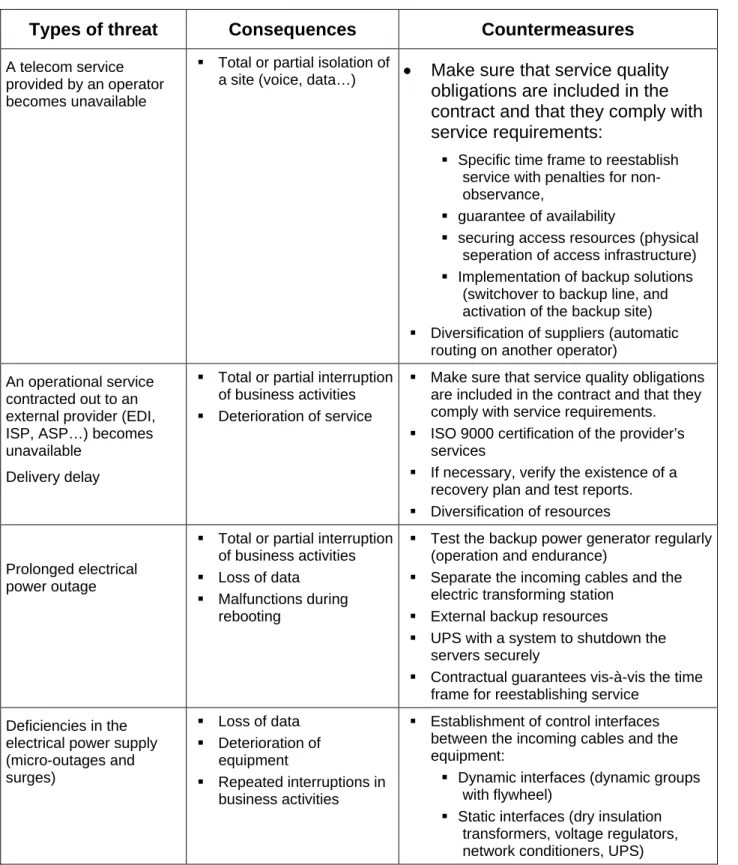
5.4 Services, supplies and outside contractors ... 49
5.5 Human resources... 51
6 diagrams and tables ... 53
A
CKNOWLEDGEMENTS
CLUSIF would like to thank those people who helped to make this document possible, particularly:
Robert BERGERON CAP GEMINI
Annie BUTEL PRICEWATERHOUSECOOPERS
Jean-Claude GANDOIS LEGRAND
Guy JOVER CNAMTS
Guy KHOUBERMAN ACOSS CNIR SUD
Siegfried NOEL TELINDUS
We would also like to express our gratitude to the « Espace RSSI » and its leader, Pierre SINOQUET, for the fruitful exchanges that were had over the issue of ensuring the continuity of business activities.
1 I
NTRODUCTION
This document is primarily intended for security directors, IT departments, risk managers and those involved in internal audits. It also concerns the various players (senior management, the legal department, the human resources department, the administrative and financial departments...) who may play a role in defining, implementing, maintaining or guaranteeing security. It is intended to help in the selection and establishment of the procedures that are necessary to ensure the continuous availability of the company’s information systems.
The question of ensuring the continuity of the information systems (IS) may be tackled:
in the framework of a Business Contingency Plan (BCP). A company’s strategic projects are realized at the request of senior management. These plans are meant to ensure the company’s survival. The recovery of IT resources is just one of the aspects of a BCP;
during the development of a Disaster Recovery Plan (DRP). The DRP concerns the recovery of IT resources. However, it has to include the full involvement of senior management. The IT. Recovery Plan aims to guarantee the minimum service required for the information systems;
during the setup of a new application, during important changes on the technical architecture or during the negotiation of service contracts. It is about responding to a specific need within the framework of the overall strategy (BCP, DRP) – if such a strategy has already been defined.
This document is divided into three main sections:
Taking needs into account and definite a recovery strategy (chapter 2). This chapter provides elements that help:
in the preliminary analysis of the risks;
in the selection of the measures to be implemented (permanent measures pertaining to quality or recovery plans that are only set in motion in the event of an incident / disaster).
The development of a Disaster Recovery Plan (chapter 3). This chapter describes the organization and key components of a DRP and how it fits into a more comprehensive business contingency plan.
A presentation of the principal measures that need to be set in place to ensure the continued availability of the information systems (chapter 4).
2 R
ECOVERY STRATEGY
The development of a Disaster Recovery Plan is an operation made complex by the number of scenarios that need to be considered (damage to the premises, equipment breakdown, errors, malevolence, etc) and by the volume and difficulty of the tasks that need to be conducted in order to restore a normal activity. It is a process that inevitably takes a considerable amount of time to set in place. It also requires a great deal of work from the teams involved. The need for service continuity is becoming increasingly important and this leads to ever more costly solutions. In addition, it is essential that the recovery strategy reflects the specificities and requirements of the company.
This chapter presents the traditional stages that ultimately help to define a recovery strategy. In addition, CLUSIF has several documents on hand that explore the various methods – particularly the MEHARI method – which defines outlines and the various stages of a vulnerability study and the essentials of risk analysis.
2.1 Definitions
In this document, we will also refer to certain notions of risk analysis as set out in the MARION and MEHARI methods:
Impact: the impact level measures the consequences on the company of a disaster (a risk becoming a reality). By defining an impact level, we can specify those situations that will be critical or fatal for the company (financial losses, damage to the company’s image, disruption...). It also provides us with a common reference to assess risks.
Potentiality: the potentiality level gives us an understanding of the probability of a risk occurring. Generally, there are 4 or 5 levels, which is enough to differentiate between a slim theoretical possibility and a risk that will probably occur in the near future.
Seriousness: A combination of impact and potentiality. The level defining the seriousness of a risk measures its degree of acceptability as defined by senior management.
2.2 Method
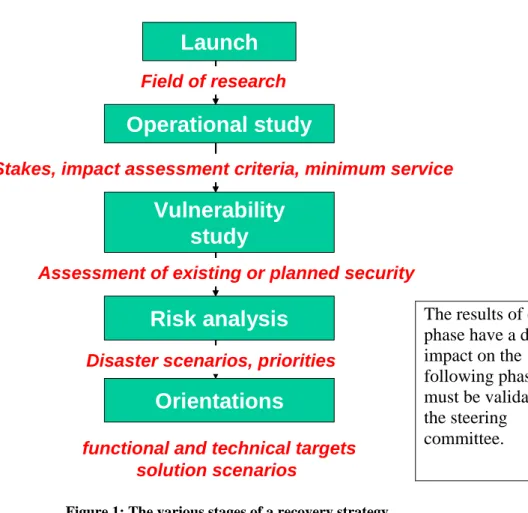
2.2.1 The different phases of the methodology
Launch
Operational study
Vulnerability
study
Risk analysis
Orientations
Field of researchStakes, impact assessment criteria, minimum service
Assessment of existing or planned security
Disaster scenarios, priorities
functional and technical targets solution scenarios
The results of each phase have a direct impact on the following phase and must be validated by the steering
committee.
Figure 1: The various stages of a recovery strategy 2.2.2 Launch phase
Before undertaking a Disaster Recovery Plan study, it is essential to specify the field. In particular, it is advisable to have the business activities concerned and the types of risks to be considered validated by the company’s management via a steering committee. Such a plan could cover all of a company’s business activities or, conversely, it could be limited to a strategic sector. For each business activity concerned, we assign a corresponding DRP for the project team.
The primary difficulty with this type of study is establishing a DRP adapted to its environment. The adoption of a customized methodology can help the plan’s appropriation among the managers concerned.
Management needs to define the risks to be covered. Depending on the choices made, the “elements” at risk (computer hardware, telecommunications equipment, external supplies, personnel, premises, ...) as well as the nature of the risks need to be specified (for example, should industrial unrest be taken into account?).
Depending on the specified risks and the area of coverage desired, the recovery plan will either be a Disaster Recovery Plan or it will be similar to a Business Contingency Plan.
The risk analysis guides at the end of this document list the main groups of elements at risk that can be covered in a DRP as well as the principal risks associated with them.
2.2.3 The operational research phase
The operational research phase aims to define the requirements to ensure the continuity of each business activity. In order to do this, we need to examine the stakes, identify the essential business activities and assess the consequences of an interruption or disruption of these activities (temporary or definitive shutdown, loss of data, disruption of service ...). A comparison of the different situations should help to adjust the impact levels (defining the “unbearable” nature of a situation) which will be used later in the risk analysis phase.
The operational research phase also needs to specify the minimum conditions necessary to ensure an acceptable level of business activity in any circumstances. To do this, one needs to:
identify the elements of the information system which are essential for the continuation of business activity (applications, means of communication, information) specify the minimum level of service acceptable for each business activity, namely:
the vital applications; the human resources; the premises;
the equipment (work stations, telephones, printers, networks...); the return time objective for the resumption of business activity the duration of the period of minimum service;
the degree of service disruption that is acceptable (response time, activities that may be carried out manually...);
the conditions for a return to normal;
the external supplies which are indispensable.
Such an assessment will be more effective if it includes operational groups that are able to represent each of the company’s business activities. In that case, it will be necessary to make consolidations and to verify the general consistency of the needs as expressed by the various groups (it is only natural for user managers to consider their own business activities to be strategic). If necessary, senior management should act as arbitrators. Once the requisite solutions have been quantified, the notion of an “acceptable minimum service” may then be revised (iterative process).
From this phase, a list of applications that comprise the strategic core of the DRP should be deduced.
2.2.4 Vulnerability study phase
As in any security study, it is necessary to evaluate the current security measures as well as those that are planned in the future. If such an assessment has not already been carried out in the framework of an overall study, it will, at the very least, be necessary to conduct a review of the following themes:
Security organization;
Insurance coverage of IT-based risks;
Physical & Environmental security (environment, physical access, fire prevention/safety measures and water damage, security guidelines);
The security measures that are in place or planned for (servers, network, terminals, electrical feeds, air conditioning, supplies, personnel... depending on the field of study). At this stage, it is important to estimate the degree of confidence one can have in the recovery measures (can the deadlines to implement the measures be guaranteed? Are the measures documented and tested?);
The means to protect stored information:
IT backup measures: backup copies of saved data, archives (accompanied by reliable retrieval procedures);
Paper backup (dossiers, archives, documentation, ...);
The measures established to ensure the security of external exchanges (protection of the network...);
The maintenance contracts for equipment and software (verifying the obligations of service providers);
The supplier contracts for sensitive equipment (guarantees to reestablish service in the event of disruption/failure);
The means for administering and operating the systems (system audit and application vulnerabilities, alert follow-up ...).
An examination of these themes can result in preventive measures aimed at reducing the potentiality of risks.
We can also use the audit questionnaires of the MARION or MEHARI methods to help us conduct the study.
2.2.5 Risk analysis phase
The risk analysis phase is intended to quantify the risks of a total or partial lack of availability of the information systems and to highlight the priorities in terms of processing the risks. The realization of a recovery plan or a Business Contingency Plan is a major operation. If priorities are defined, the plan may be conducted in stages.
The risk analysis phase can be broken down into two parts: a technical phase to study incident / disaster scenarios; an operational phase to study the potential impact.
By building on the assessment made in the previous phase, the technical study consists of listing one or several significant risks for each asset at risk, then, for each of the risks, to study and describe the direct consequences that such a risk would have on the information system. At this step, we still don’t explore the consequences of the impact of the incident / disaster. The objective is to make an assessment of the direct consequences in terms of:
length of time the resources are available (applications, services...); amount of information lost (last updates, flow, archives...);
potentiality of the risk. Depending on the method used in the previous phase, the potentiality will either be directly attributed or calculated.
The operational phase consists in measuring the impact of the potential risks with the aid of criteria that were predetermined during the launch phase. This evaluation needs to be conducted with the support of the operational managers to take account of any bypass resources that may currently exist.
A scale of seriousness is thus determined by combining impact and potentiality (cf. MARION and MEHARI methods – risk avoidance table). A hierarchical list of the risks is made in descending order of gravity. This helps to determine the risks that need to be taken into account in the recovery plan as well as their priority in that list.
Note: The risk analysis guides at the end of this document list the risk type for each group of elements at risk, and for each, examples of the consequences to analyze and the potential antidotes to them (at this stage of the study, we use these guides to verify the potential existence of an antidote).
2.2.6 Orientation phase: operational targets and the choice of technical recovery solutions:
The operational target is determined by an analysis of the operational organization chart of the information system and a classification of the functions and sub-functions according to the needs in availability as assessed by the operational managers. This classification helps to determine the strategic operational core that represents the minimum required to ensure the company’s survival.
Based on the incident / disaster scenarios, it is necessary to estimate the length of time that service is interrupted for each vital function, by attempting to regroup them according to previously determined levels of seriousness (4 to 5 maximum) ranging from a mere service shutdown to a “disaster” situation.
All the “elements” of the information system (applications, hardware, network equipment, supplies…) that are crucial to the operation of the core will be identified and regrouped into indivisible sub-groups.
In regard to these elements, it will henceforth be possible to consider and evaluate return time scenarios and the appropriate means of recovery to bring the estimated impact down to an acceptable level. One also must be sure to retain the coherence of all the constituent elements needed to recover the strategic core. The development of specific interfaces or the definition of manual procedures are often necessary to obtain the desired level of service or the reduced level of service depending on the constraints and the means that have been chosen.
It will also be necessary to establish a plan to circulate information and assess the needs in terms of office space and work stations to enable “strategic” users to ensure the minimum level of service in a crisis situation.
Finally, in order to reboot after an incident / disaster, we will need to study the means to restore and synchronize the data associated with the operational core.
3 T
HE
D
ISASTER
R
ECOVERY
P
LAN
3.1 Introduction
After working out the specifications of the recovery plan, a phase of research needs to be conducted to determine the various technical and organizational solutions. Once this research has been completed, a compendium of solution options will be submitted to the decision-making committee. Then, it will have the task of defining the definitive content of the Disaster Recovery Plan (the different types of solutions that can be envisaged will be presented in chapter 4). At this stage of the study, an assessment of the solutions may lead to adjustments in the type of resources that are requested.
A preparatory plan will be launched to specify the chosen solutions. The plan will include a phase of detailed research and implementation as well as a test phase to formalize the operational procedures. The whole solutions and procedures will make up the implementation plan that will ultimately be activated in the event of an incident.
The preparatory plan may be strengthened by the addition of performance indicators. They will point out and evaluate the progression of those who are responsible for the actions to be taken.
The objective of this chapter is to set out the principal themes that will need to be dealt with during the preparatory plan. The documentation produced during this phase will compose the Disaster Recovery Plan.
3.2 Organization
The different tasks associated with steering and implementing the recovery plan must be assigned to the various “protagonists”. These protagonists are predefined operational entities comprised of enough people to ensure that the completion of the task can be guaranteed in event of an incident.
The first people to intervene are those charged with sounding the alarm and issuing the instructions according to pre-determined response procedures.
In the event of an incident, the following will be brought into play: The crisis management committee;
The coordinating committee; The operational response teams ; The user services.
Through a system of “crisis organization” one also designates a joint crisis management/coordinating committee.
3.2.1 The crisis management committee
At the very least, the crisis management committee needs to include representatives from the following areas: senior management, the principal user departments, the general services department, the human resources department, the IT department, the communications department and of course, the recovery plan director. The crisis management committee will take the principal decisions concerning the recovery procedures. In particular, it will be responsible for deciding when to implement any given aspect of the Disaster Recovery Plan. The crisis management committee may also call upon specific, internal or external expertise, especially in terms of communications and legal guidance.
The means of communication with the crisis management committee need to be predetermined and guaranteed in the event of an incident (the designated meeting place, telephone numbers, fax numbers...).
3.2.2 The Coordinating Committee
The actual task of steering the recovery operations may be delegated to a coordinating committee. This will relieve the crisis management committee of the task of coordinating the various actions.
Ideally, the coordinating committee will be made up of a small number of people: the director of the Disaster Recovery Plan (the person who is familiar with and who has control over the entire plan) and the people in charge of coordinating the computer-based and logistical operations.
Some decision making powers may be delegated to the coordinating committee by the crisis management committee, particularly those pertaining to the implementation of certain advance measures (example: reserving a backup site with a service provider).
3.2.3 The operational response teams
The operational response teams are given the various task of the recovery according to the skills required, availability and the place were the teams are intervening. One needs to make sure that existing work contracts allow for these teams to be sent to a different location. Examples:
Logistical team charged with transporting equipment;
IT response team, composed of a network specialist and a maintenance agent in charge of operations on the backup site;
A team in charge of emergency communication;
A network response team in charge of configuring the network at the user backup site; etc.
Finally, certain protagonists outside the company also need to be identified: emergency contractors, energy suppliers, telephone service providers, Internet access provider…
All internal and external responders must be listed with the relevant contact information in a regularly updated “recovery plan directory”.
3.2.4 The user services
The user services are in charge of their own business contingency plan depending on the resources that are made available to them. Among the tasks which are the responsibility of the managers of these services, we can include:
the tasks needing to be achieved while recovery is pending;
the organization associated with reinitiating (normal or reduced) startup; the establishment of possible bypass procedures;
the organization of special tasks (example: adjustments).
It is important to ensure that the necessary human expertise is fully available in all circumstances and that those involved are aware of the technical procedures to follow in the framework of the backup systems. If needed, it is possible to lean on the expertise of those external responders who have already participated in previous continuity tests.
3.3 Activation
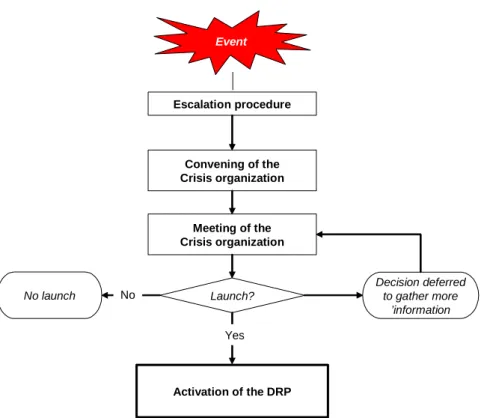
Event Escalation procedure Convening of the Crisis organization Meeting of the Crisis organization Activation of the DRP Launch? Decision deferred to gather more ’information No launch No YesFigure 2: Activation procedures
The crisis organization includes the crisis management committee and the coordinating committee.
The escalation procedures are essential. When an incident occurs, the person informed –often someone in a company security post– needs to know who to contact and how to contact them (particularly if the usual means of communication are not available). In turn, depending on the seriousness of the incident, that person must know which people to contact to get further details or if necessary to set the crisis organization in motion. It is crucial to set out in advance exactly who is authorized to activate the crisis response effort and to call only the people who have been specifically designated to prevent unnecessary congestion on the lines.
3.4 Recovery
measures
A recovery plan is comprised of elementary measures (technical or organizational procedures). Their activation will depend on the type of event and the general context in which that event occurs. The activation of certain measures or the way they are activated may depend on multiple factors (example: emergency communication).
The various measures of a recovery plan may be classified by business type: Mobilizing the necessary resources:
Human resources: mobilizing the operational response teams;
reserving additional means as a backup (requisitioning, alerting an external service contractor...) ;
recovery of saved data; recuperation of documents; Computer equipment backup:
restoring the system environments;
technical adaptations (often, the backup material is not the same as the original equipment);
restoring the applications;
validating the restored processes and systems; Backup networks:
setting up of backup equipment; switching over to backup links; configuring the different equipment; Telephone system backup:
rerouting of calls;
setting up of backup equipment; configuration;
Resumption of processes: software adaptations;
adaptation of operational procedures;
restoring the flow and synchronization of data; special processes;
operational validations; Logistics:
transportation; supplies;
crisis management of the personnel (choice of staff to mobilize, team rotation, taking account of individual situations...);
Relocation:
organizing the emergency relocation; preparing reception sites;
Resumption of user service business:
user tasks prior to the implementation of backup measures; organizing a minimum level of service;
special tasks (bypass procedures, recovery procedures...); Emergency communication:
internal (personnel, other entities...); external (clients, partners, the public...); Post-recovery measures:
preliminary measures and support (insurance, returning the premises to normal, salvaging equipment...);
To be operational, these emergency measures need to be accompanied by permanent measures aimed at keeping the former up to standard (examples: the backup plan, the updating procedures and the training of key players involved in the DRP...).
3.5 Documentation
Documentation is a key element in any recovery plan. Generally, such documentation is voluminous and it is constantly being updated (new personnel postings, changing configurations, new applications...). For all these reasons, it is highly recommended to oversee such documentation with the support of a specialized tool used in the administration of recovery plans or business contingency plans. It is also important to ensure the confidentiality of these documents, since they may very well contain personal and strategic information held by the company.
Depending on the stated objective, the documentation for a recovery plan may be structured into 4 levels: communication, implementation, management, and audit.
3.5.1 Documents used to communicate the recovery plan
Internal communication about the recovery plan must not be neglected. It needs to provide the different managers with a clear understanding of all the anticipated solutions and the general conditions governing their implementation. More particularly, this documentation should include:
A summary of the objectives of service continuity;
A general description of the different measures of the recovery plan (recovery of computer equipment, backup telecommunications, relocation solutions, emergency communications...);
A general description of the crisis organization;
The principles of alerting the crisis organization and the steering of operations; A reminder of the residual risks.
3.5.2 Documents used to implement the recovery plan
These documents effectively make up the core of the recovery plan. They are intended for the people who are responsible for the various measures of the plan. They describe all the elements which are essential to their implementation: procedures, technical documentation, elements of synchronization, contracts etc… The technical documentation should, by its level of detail, help to minimize stress-related human error.
More specifically, the documentation should include:
A recovery plan directory that lists all the potential responders and contributors inside the company and out, together with the relevant information to contact them;
A description of the recovery strategy for each of the risks identified. This document is intended to help the crisis organization make the right decisions. The recovery strategy defines all the recovery measures that need to be activated depending on the context of the incident (type of event, extent of the damage...);
The schedule for the various resumption phases;
A list of tasks to be completed, structured by player and / or recovery measure; An “intervention order” for each of the plan’s actors, for each case indexed;
All useful appendices (procedure documents, technical files, copies of contracts, diagrams, etc...).
When associated with a control tool, the documentation also enables the crisis organization to follow the various operations as they unfurl.
A copy of the documentation (paper and / or the management tools of the plan) should be kept at a secure location outside the company’s premises. This location should nonetheless be accessible to be consistent with the objectives of the planned start up.
3.5.3 Documents used to manage the recovery plan
In order to manage the recovery plan, it will be necessary to provide additional documentation for the plan managers and the various teams associated with them. The aim of this documentation is to ease subsequent developments. It may include resource analysis tables as well as a list of where the documents were circulated. It should also include a history of previous test results and an outline of the consequent adjustments.
3.5.4 Documents used to audit the recovery plan
Performance indicators: Test schedules; Detailed test reports;
Quality indicators of the plan’s measures; An assessment of the residual risks.
3.6 Maintaining the plan
3.6.1 Organization
A director of the recovery plan will need to be appointed. His/her primary duties will be: to carry out, follow and manage the tests and the resulting modifications
to commit to and follow up the process of updating the recovery plan according to the ever-changing landscape of risks (new threats, new projects, new technologies…); to maintain, secure and distribute the documentation for the recovery plan.
Systems of information gathering should be established to improve awareness of: new risks;
new technical and structural developments; new projects.
A recovery plan committee made up of the directors of the various teams as well as the technical managers (IT, general services) should meet regularly (at least twice a year). The committee, chaired by the plan director, will be responsible for assessing new risks and for setting up a plan of action which will focus on:
the implementation of security measures; the updating of all documentation;
the possible changes in the contract with the service contractor; the testing of new recovery measures.
3.6.2 Tools
Recovery is not only complex (it is made up of numerous measures intended to respond to all kinds of situations), it is forever in a state of flux (changes in organization, business practices, priorities, personnel, architecture techniques, and applications...). Believing that one can manage such a plan with just a word processing tool is simply illusory.
The task of maintaining a recovery plan is greatly facilitated by the use of a specialized tool. Such a tool should be able to:
handle all the documentation needed to implement each measure in the plan; manage the resources needed to implement all the measures;
produce the schedules for the re-launch operation, according to the situation at hand; manage all tests (planning, results follow-up, gauging the plan’s performance…); manage the recovery strategy, according to incident types and degree of seriousness; provide performance indicators for the individual measures and the overall plan; offer ways of distributing the documents (automatic distribution lists, intranet...); audit and verify the regular documentary updates.
It is preferable to have a tool that draws on a database and which can facilitate research into the impact of new developments (identifying the tasks that were the responsibility of a person who has been transferred, identifying the measures which are affected by a change in applications, identifying the incident scenarios that need to be reviewed following the transfer or relocation of a department etc ...).
3.7 The test plan
The Disaster Recovery Plan needs to be validated by a test plan that can help to check off each of the recovery measures and their synchronization, then, audit the operational character of the recovery plan through regular tests that closely reproduce real-life situations.
Basically, there are three categories of tests:
Unitary technical tests: these technical tests are intended to validate a single backup element (for example a backup server): validating the backup configuration, validating the procedures and the return time, validating the choice of responders, validating the relevant documentation;
Integration tests: the integration tests help to validate the compatibility of the different backup elements, the synchronization of technical operations and the workload on the different teams;
Full-scale real-life tests: real-life tests have similar characteristics to the integration tests yet they have an additional objective: to test the reactivity of the teams and to verify that the palliative measures run smoothly by monitoring a group of users in conditions similar to a crisis situation (restricted resources, unavailable or limited documentation...). Full-scale real life tests can only be run if all the other tests outlined above have been successful. As they can pose a risk for business it would be wise to evaluate beforehand. The tests can be conducted in isolation (users working in parallel on expendable copies of the production applications), or they can be real, in which case they will be scheduled at the end of the integration tests on work carried out in the production sites. The full-scale tests also help to test the steering of operations (crisis organization and steering tools). Full-scale, real-life tests can also be conducted without advance notice (at least for the operational response teams).
In the framework of the test plan, it is advisable to ensure that the most critical elements of the Disaster Recovery Plan are tested several times a year. As for the number of integration tests or full-scale tests, we recommend 1 to 2 per year. The unitary technical tests should be performed periodically (once every quarter) though they should be carried out systematically after any changes in backup or recovery-related equipment or after any modification that may have an impact on the existing recovery measures.
For each test, the following operations are to be conducted: The intended objectives are formalized;
The test scenario is analyzed and mapped out: preparation, simulation, tested cases, user test methods, tests conducted in isolation or in a real-life situation, validation methods…
The preparations for the test are finalized: earmarking of the technical and human resources, presentation and validation of the tasks and the scheduling (except if the test is meant to be impromptu), finalization of the relevant documentation…
One or several observers are designated to follow operations and to note any problems that may be encountered;
A test review is drawn up and a report is drafted that can validate all or part of the recovery plan and suggest the necessary corrective actions.
4 R
ECOVERY SOLUTIONS
4.1 Disaster recovery solutions
The overall solution is the result of several solutions that have been adapted according to the specified requirements governing the resumption of activities and the loss of data accepted by the users. All share a certain number of attributes and those attributes can generally be classified into 3 main groups:
a. The way backup resources are managed contractually (How are the conditions governing activation and availability formalized? How are priorities managed in the event that resources are shared?);
b. The type of resources used (fixed or mobile resources, local or distant…);
c. The level of preparation and availability of the resources (are the resources “ready to use” or do they require additional preparation?) as well as the length of time the backup resources can be used (can the resources only be used for a set period in time due to contractual, technical, performance-related or cost-related reasons?…).
A large number of solutions may result from the association of different possible values for these attributes. For example, in a given situation, the optimal solution could be:
Management = contractual agreement with an external supplier for shared resources Resources = mobile container
Degree of availability = equipment operational without data In another situation, the following solution may be more suitable:
Administration = internal, with specific resources
Resources = fixed installation on a internal though distant site Degree of availability = “mirror” configuration
Even so, it is important to note that all solutions worthy of any confidence will need (material and intangible) investment as well as permanent expenditure in normal times. It is dangerous to believe that one can wait until the day of the incident to define the specifics of a backup solution and implement it. In the same way that you cannot and never will be able to obtain retroactive insurance, it is wholly illusory to think that at the last minute we will always be able to use a business relationship or find a supplier who for a price will be able to “fix things” for a while.
The scenarios for the solutions developed during the “Orientation” phase of a Disaster Recovery Plan (cf. §2.2.6.) are comprised of all the measures intended to ensure the continuity of the information systems necessary for the company’s strategic business activities, in the face of all the pre-defined risks.
In a distributed IS context, the chosen scenario will generally be comprised of a collection of technical and/or organizational solutions which will be combined according to the situation. These elementary solutions will offer recovery solutions for specific areas, namely:
the local network;
the external access points to the network; the specifics of the Internet access;
the backup servers able to withstand a loss of availability for 24 hours; the backup measures for the telephone systems ;
the backup measures for a call-center ; the backup measures for a user platform; etc.
Numerous backup solutions are possible, ranging from the establishment and permanent operation of entire duplicate installations, to the formalized mutual assistance agreements between companies.
The overall coherence of the choices made for each of these sub-systems needs to be assured. Before the chosen solution for the scenario is validated, it is particularly necessary to run an analysis of the residual risks in order to verify that the risks that need to be dealt with are done so effectively and that the envisaged solutions do not create new unacceptable risks.
The criteria used to assess a backup/recovery solution can be classified into two groups. A - Those criteria that help to verify that the solution for a scenario responds to the needs as stated in the specifications of the recovery plan or contingency plan:
The return time objective: the total return time objective is the sum of the time needed to activate the plan, the time needed to implement the measures (supplying, restoration, tests...), and the time needed to resynchronize the data. These parameters, together with the maximum length of time that the backup installations are available, are crucial in calculating the potential residual operational losses and, by extension, the solution’s effectiveness. Particular attention should be given to the length of time needed to detect an event and the amount of time spent in decision-making in order to minimize them both;
The acceptable amount of data that may be lost between the shutdown and the resumption of activities;
The level of coverage: does the planned solution cover the risks that have been selected? Which residual risks have not been dealt with? Can the solution be used outside the context of an incident (relocation, conversion...)?
B - Those criteria that help to assess the pros and cons of the planned scenarios:
The solution’s plausibility: a solution may seem viable and reliable at a particular moment, but its guaranteed availability and its ability to evolve over time like the needs of the company are not assured. Furthermore, certain solutions need to take account of the possibility that risks will accumulate – geographical or sector-based… - and finally, the act of conducting realistic tests on a regular basis is a determining factor and proof of plausibility (or implausibility!);
The flexibility in establishing the Disaster Recovery Plan: it is often difficult to imagine dealing with all unacceptable risks quickly. A flexible solution will work to build an adjustable recovery plan in stages, and in turn enable it to adapt to different constraints (budget, availability of internal resources, synchronization with other company projects, acquisition of know-how, the degree of maturity in the market...); The solution’s potential to adapt: evaluating its capacity to take account of developments inside the company (technical architecture, organization, the stakes, new risks...);
The cost: each type of solution comes with a series of fixed, variable, and recurrent costs:
Subscriptions and various contracts;
The subsequent costs of maintaining and updating the solution (tests, changes in configuration, additional operational costs, consumption...);
The cost of using the solution (some of these may be covered by insurance). The summary below reviews the different types of recovery solutions for each of the attributes mentioned at the outset together with their compatibility with the newly-defined criteria.
4.1.1 Types of recovery solutions and the methods used to manage them
A – Types of recovery solutions
Generally, three main types of solutions can be identified and each makes use of resources from inside or outside the company:
Mutual assistance agreements (between different sites of the same company or between different companies):
If this particular type of solution is highly attractive financially (often it involves agreements that cost nothing), it tends to be illusory in terms of plausibility and effectiveness, in particular since the establishment of interactive processes has become widespread: difficulties following up the synchronization and development of “partner” data processing parks, unlikelihood of maintaining over-capacity permanently in each of the sites, underestimating conflicts of priorities and interests that run the risk of surfacing at the time of the incident, the potential for serious legal problems over the validity of the signatories’ powers and the transfer and limits of their responsibility in the event that commitments are not respected, the near impossibility to conduct a test, the underestimation or oversight of logistical problems in both time and space (user helpdesk, connectivity...).
For the same reasons and given the lack of professionalism, the notions of the length of availability and the time needed for implementation are immaterial because under pressure from reality, these can tend towards zero and infinity respectively.
The capacity to cover situations other than incidents is generally nil given the potential for cascading impacts.
Given the complexity and evolving nature of information system architecture, this type of solution can only be considered in specific situations and even then only partially.
The use of shared (potentially specialized) backup resources:
In this case, several entities make provisions to use the same backup resources. The different methods of managing these resources will be examined in the following paragraph. In normal times, these resources can be assigned to other low priority tasks to increase their return value (non-repetitive office services, the development and fine-tuning of applications, trials or simulations, demonstrations…).
The solution will likely be acceptable if one is careful to control the number of entities sharing the structures, the homogeneity of the levels of prevention in place among the partners, the non-accumulation of sectoral risks and the quality of the tests.
The cost of this type of solution varies depending on the extent to which the installations are shared, and their potential to be profitable: since the latter may be unpredictable (as
the installations can only host non-priority business activities) the cost may already be significant (several percent of the cost of acquiring the chosen resources).
Protection from damage resulting from error or malicious intent may be planned for if the backup structure has anti-virus reference or if it is fed with data that has been saved according to stringent security procedures.
Still, this kind of solution is not acceptable when, in the event of an incident, it is imperative that the backup resources are not shared (since by definition, in the case of shared resources, the danger of conflicting needs is never zero). As such, it should not be chosen if the entities are subject to service constraints or when the residual risks cannot be passed on to insurers.
Contractual limitations: in the case of shared resources, the contractor (especially if it is an outside contractor) may set time limits on availability in order to reduce the risk that the same resources will be called upon simultaneously.
The use of dedicated (potentially specialized) resources:
Generally, in this category, each entity has an environment at its disposal which it alone has the power to requisition in the event of an incident. This does not exclude the possibility that these installations may be allocated to other low-priority tasks outside crisis situations.
This solution represents the most plausible of all, since we can predetermine with certainty the availability of the resources, the time needed to implement them and the extent of any functional damage. Furthermore, it is easier to conduct frequent tests, and the infrastructure can be used to resolve loss of availability situations when such a loss is not the result of material damage.
The only drawback with this type solution is the cost of creating and maintaining such infrastructures. Generally, such a solution is reserved for situations where availability is essential, or made necessary by the specificity of the equipment.
Logistical limitations: concerning the backup infrastructure, the resources used need to be acceptable, even in the event of prolonged usage of the backup site.
B – Methods of managing backup resources
Generally, we can identify four different ways of managing recovery solutions, according to the level of formalization and externalization:
Formalized external management:
In this case, the backup resources are obtained from an entity outside the company, either from a specialized firm or from another company guaranteeing to free up and/or make the necessary processing capacity available at the time when an incident occurs. The relationship between requester(s) and provider(s) is controlled by specific contractual agreements (in terms of the services required and any contractual violations) and tested regularly (see the “Contract” sheet).
In this case, it is possible to reasonably guarantee a high degree of plausibility and establish the parameters pertaining to time and duration.
Plausibility can be greatly enhanced by conducting contractual tests regularly. It should be noted that pitfalls may be found in:
the clauses specifying the limits of the supplier’s responsibility, should the latter be unable to fulfill the mission due to conflicts in priorities or technical problems;
the guarantee of I.S. security, notably in the case of shared resources.
In addition, for most of the solutions in this category, it is possible to cover the risks linked to strikes and industrial unrest.
Formalized internal management:
Here, the backup solutions are found within the company (vs. from an outside contractor), and they are controlled, as above, by specific and regularly tested service contracts.
The advantages of this type of solution are to be found in its flexibility and compatibility in terms of needs, usage and development.
In terms of costs, it is difficult to prejudge the appeal of this solution in relation to the preceding one, in so far that it includes some cost-reducing elements (investments stay in-house, effects of scale on existing infrastructure), however these may be offset by other expenses (the cost of the training phase, difficulty in maintaining the solution’s level of operability, the need to split investment in the event of diverging material developments at different sites…).
The coverage of risks related to industrial unrest is generally more difficult with this type of solution and one has to be aware of the fact that such problems can easily spread.
Formalized mixed management:
Here, the backup solutions are split between several entities sharing a common interest. The conditions determining how the costs and resources are divided are subject to legal and contractual obligations .
The functional advantages of this type of solution are numerous (overall cost, suitability of the solution, usage for low-priority tasks…), however, working out the contractual fine print is generally a delicate process (attitudes in the event of a conflict of priorities, managing specific needs, managing the situation when member entities follow different development paths, the dangers of accumulating sectoral risks, the admission and withdrawal of members, the attribution and ownership of investments, managing the transitional phase of the creative process, dividing up the various responsibilities of group organization and the administrating resources…).
To maintain the plausibility of the situation (notably in terms of conducting tests, administrating resources, and managing obsolescence), these structures generally entrust the management of backup resources to companies which specialize in that particular area.
Informal management (internal or external):
In this case, the recovery solutions (be they home-grown within the company or outsourced to a third party) are meant to be available outside the framework of a contract: the hypotheses relative to the time needed to implement the solution, to the length of time it is available, to the accounting of equipment and software, to the limits of responsibility... are not documented and/or countersigned by the different parties concerned.
This type of management style can open the door to significant legal risks and major disruptions at the site where it is being applied. It can also provoke major difficulties in the setup and test phases.
In the age of shared computer networks and the increasingly strategic character of IT communication resources, informal management should be prohibited.
4.1.2 Type of resources brought into play
A Disaster Recovery Plan must enable the processing of both a technical incident and a major disaster. The following table offers a series of solutions for consideration. These may be local or external depending on the company’s requirements for the availability of its information systems.
High Availability Medium Availability Low Availability
Sub-systems Immediate or quasi-immediate resumption (a few minutes).
Minimal loss of data.
Recovery in a few hours (less than 12 hours). Limited loss of data (a few minutes to a few hours).
Recovery in 48 hours or more.
Loss of data generally less than 24 hours.
Strategic servers Dedicated backup servers, geographically distant, internal or external, in operation (applications and data).
High availability architecture: load balancing, server cluster, mirroring solutions (applications and data).
Internal or external geographically remote dedicated backup servers, interconnected with the principal servers.
Ready-to-operate systems: remote mirroring or remote copying of updates and periodical updating of the backup databases.
Internal or external geographically remote backup resources that may be shared.
Local network Redundancy.
Backup hardware and emergency bypassing with automatic switchover.
Backup hardware and emergency bypassing. Flying cable kit
Existence of external pre-cabled backup user sites that can be equipped rapidly (work station, equipment ...).
External network access (voice, images and data)
At least two separate external inlets, if possible on two distinct sites and via different operators. Switching over of communications to the backup site in the event of an incident, with a maximum of automatic functions.
Creation of redundant links in the company network.
External backup node with automatic or manual switchover (parameterization) . Contract obligating the operator to intervene and get the connections operational again in a set timeframe.
Spare equipment.
Commitment from the supplier to intervene with an obligation to guarantee results.
Calls forwarded to a backup site by the provider.
Telephony (equipment) Backup PAX, preferably at a different site to the main premises with automatic switchover of communications.
Contract obliging the provider to forward calls to a backup site that is equipped to accept those calls (the necessary telephone equipment and human resources in place).
Backup PAX.
Calls forwarded to a backup site by the provider.
Creation of a pre-recorded message.
Internet access (web site) Double connection to the Internet at each site (main site and backup site) with different access providers.
The switchover can be automatic due to a DNS update and/or a policy of “peering” between access providers.
Internet connection at the backup site with the manual switchover of connections from the main site to the backup site by DNS update.
Internet connection at the backup site with the manual switchover of connections from the main site to the backup site by DNS update.
Before deciding on the IT resources to set in place, it is necessary to examine the type of infrastructure in or from which they will have to operate. In effect, there are four principal types of infrastructure:
Fixed installations:
Two types of usage can be considered:
either one (or several) remote IS sites integrated with production and capable of providing the immediate backup of I.S. resources;
or one (or several) remote site(s) that can be used in the event of an incident.
Remote I.S. Site integrated with production and capable of providing the immediate backup of I.S. resources:
This solution corresponds to the requirements of high availability and to the constraints of real time without loss of data. It leads to a doubling of computer equipment, but in the event of an incident, it lightens the business return time procedures considerably. The cost of the solution needs to be assessed in its entirety.
The choice of architecture depends on what is required in terms of the RPO and the return time objectives.
Whatever the architecture, these solutions assume that a backup copy of data is available on the backup equipment and the up-and-running ready-to-use servers.
What differentiates the various possible architectures is:
how often the remote backup copy of data is updated (cf. replication, § 4.4.2). This may be instantaneous or deferred for several minutes or several hours;
whether or not the equipment at the second site is involved in the production process. Such involvement could be achieved by spreading the load of the same application between both sites. This would assume the complete mirroring of data between the two sites, or by spreading the production applications over the two sites with each application having a backup copy at the other site. The latter case is technically less complex than the former and it can support deferred replication.
The completeness of the solution is closely linked to the capacity of the operating systems, and the systems managing the databases and the applications.
Remote site that can be used in the event of an incident:
This solution is the more traditional; in the event of activation, a team of employees from the entity affected (IT technicians and probably users) travel to the backup site to continue carrying out transactions and running processes. Generally, this type of solution has limited telecommunications resources and above all excludes the remote connection of the regular terminals (the solutions based on sophisticated telecommunications are examined in the following paragraph).
These solutions have significant negative consequences in terms of organizing the work of the operational teams (traveling, possible breakup of the teams, changes in inflow / outflow, remoteness of archives and documentation), and can only function effectively if the backup centre is not too far from the site needing to be protected (which leads to vulnerability vis-à-vis sectoral risks).
Backup user sites:
Recovery Plan (DRP). Nevertheless, when choosing a backup site for the company information systems, it would be wise to take account of the possibilities of access to those sites that are liable to host users.
In the case where the Disaster Recovery Plan study is part of a wider project, the choices made to host the users can have an impact on the sharing of certain backup material between the site providing the backup for the information systems and the site set aside for the users (notably for performance-based reasons).
Mobile resources:
With this type of organization, after an incident has been declared, one needs to transport and install the infrastructure for the information systems, either near the affected site, or near another backup site (whether the latter has been planned for or not).
Generally these solutions are made up of either modular container-type structures or inflatable tent-like units. In both cases, they come equipped (as standard or as an option) with air conditioning equipment, generators, security systems, and pre-wired material... They may or may not be delivered with the necessary human and processing resources. The advantages of this type of solution reside in their flexibility and their ability to adapt to the real life conditions of the incident and to limit the disruptive effects for the users, the teams of computer technicians (who remain close to their regular environment as well as the users), and the information input/output circuits. In addition, reconnecting the network is relatively easy, if precautionary care has been taken to separate the head-ends. Clearly, these solutions are only viable when the geographical and topological situations are suitable (which generally rules out densely populated urban areas).
Evidently, the initial return time is hampered by the time needed to transport and assemble the installations –and an awareness of the imponderables linked to that transportation.
Service integration:
All of the solutions outlined above might – or might not be – added to the provision of services (provided by teams inside the company, or by outside contractors).
It includes among other things, help in fine-tuning the Return Time Plan for the site being protected, help setting up and laying out the infrastructure (hardware or software), help with tests, help at the re-launch phase, help storing duplicate equipment or supplies specific to the protected site, help storing saved data, help providing operating staff, managing constraints, providing additional insurance, supplementary expenses and recreating media...
4.1.3 Level of preparation and availability of resources
For reasons related to the cost / performance of backup resources, a situation may well arise in which solutions are defined requiring varying degrees of operational preparation. As such, different levels can be envisaged:
Hard ware environment for back up
With these solutions (also called “hot sites” even when it involves mobile resources), all the backup computer equipment is present in the backup infrastructure. Naturally, this equipment is maintained in constant working order, but the programs and data of the entity that will potentially be using it are not loaded (this may extend to the operating system).
The level of plausibility is high, on condition, of course, that exhaustive tests are conducted regularly.
Evidently the costs are significant, and they often will account for a percentage of the IT budget, even for shared installations with reasonable conditions of probability for the simultaneous use of the resources.
The return time may be measured in dozens of hours, since it will be necessary to reload all or part of the operating system by adapting the parameters, reloading the user applications and data, rebuilding lost information due to the backup cycle, and re-synchronizing the applications...
Partial or total “mirror” environments:
Here, not only is all the equipment operational around the clock, but all or part of the operating system, programs, and data of the user entity are permanently on site.
Given the architecture of the systems and the technology used, this type of environment is not compatible with shared solutions.
Even when one manages to share the resources, these solutions are expensive, because they require significant alterations to the infrastructure to enable the permanent feeding of fresh data and to ensure the duplication of local networks and remote networks. However, doing so can help to reduce (though certainly not eliminate!) backup procedures, in so far that the same information is available simultaneously at two different sites (naturally, this assumes that the mirror configuration is at a reasonable distance geographically from the site being protected!).
Naturally, the level of plausibility that can be expected is the maximum, because the logistical constraints and the switchover time are practically zero. The risk that the installations will become desynchronized is high, and the constant maintenance of logical consistency is a major problem.
It should be noted that this type of solution has a peculiarity that makes it more sensitive to intangible incidents (errors, sabotage, virus): any operation carried out on the main installation will be immediately activated on the mirror installation, unless complex filters are installed.
A certain gradation can be considered in these solutions :
So-called “first response backup” or “stand-by backup”;
It refers to those limited yet highly specific backup resources that allow for the quasi-instantaneous resumption of the most strategic applications, enabling a type of system “afterglow” that lasts for a few hours during which the main backup solution (or so-called “heavy backup”) is reloaded.
Typically, they are dedicated to highly transactional rapid cycle systems (Computer Aided Management and Manufacturing with tight flow, running cash registers or ATMs, EDI with timed mailbox pickup, Web servers…).
Generally, they are built on a specialized branch of the network. As such, they are constantly “listening” to the transactions to keep their files up to date. In addition, some are able to start up automatically when no signals are received from the installation they are protecting. Clearly, due to their limited size, their performance value and the relevance of the data they contain deteriorate very quickly once they go into stand-alone mode, but this should be enough to guarantee a relay.
Given the limited architecture of this solution, the operational costs can be reined in, especially if the resources can be shared. Conversely, the research and setup costs may be high because the characteristics of the minimal functional core need to be analyzed.
So-called “split production” resources;
In this case, the two centers (the one being protected and the one acting as backup) are both constantly sharing the workload; all the files and access to the strategic network are duplicated, and updates are made as they arrive. Ideally, the processes are carried out equally (and alternatively) on each of the sites from either one of them.
Naturally, in the event of an incident, with these solutions it is necessary to accept a high degree of deterioration though starting up again can be fast and reliable. However, intangible damage (such as a strike) remains a difficult factor to tackle.
The costs are significant though not nearly as expensive as the solution below. “Complete mirror” environments.
In the most extreme case, all the strategic activities of the production environment are constantly replicated in the backup environment thus, it is the only task. Unlike the preceding solution, the backup environment does not participate in day-to-day production.
Clearly, it takes less time to start up again and there is less functional deterioration.
The costs of possession are very high and can effectively lead to a doubling of the operating budget.
4.2 Telephone systems backup
4.2.1 Network connections
The first area of vulnerability concerns the physical access to the public network. Generally, there is one access point or it is backed up by a second cable passing through the same duct. Different levels of backup can be considered for the secondary connection:
A dual connection to the local loop. The two connections are physically distinct and separated. This type of solution can be envisaged when the site allows for it (a campus, a building having access on several streets...);
A dual connection to the locale loop with access to two different exchanges. This solution helps to protect against a variety of risks, including breaks in the connection, failure of the local loop and unavailability of the telephone exchange;
A physically distinct backup connection to a second operator;