SAN
“The Storage Utility”
! Make scalable computing possible
! Make systems more usable, manageable ! Effective, inherent security
Object Based Storage: A Vision
OBSD: Technology Foundation
OBSD: Technology Foundation
! Resources for OBSD appear to be possible, but cost pressure severe
1997
1997 20012001
Processor
Processor 25 Mips25 Mips 100 Mips100 Mips
Memory
Memory 1-4MB1-4MB 8-64MB8-64MB
1-2 parts
! IP Agreement signed 2/97
! Goal: pre-competitive research collaboration ! Focus: Server Class Storage Management
! Participants
! HP - John Wilkes, Richard Golding, Lou Schreier ! IBM - Paul Hodges, Jack Gelb, Greg Van Hise
! Quantum - Satish Rege, Paul Massiglia, Steve Byan, Geoff Peck ! STK - Chuck Milligan, Scott Robb, Jim Hughes
! Seagate - Dave Anderson, Chris Malakapalli
! CMU - Garth Gibson, Bill Courtright, David Nagle, ...
! Work Product
! Proposal for an Object Based Storage Device protocol standard ! Concepts for attribute-based storage management, security model
NSIC Network Attached Storage Devices
! Activities
! Private quarterly meetings - discuss research, direction
! First - March 1995
! Public meetings - education for NASD group, public
! March 98 - general
! June 98 - Intelligence in drives, Active Discs ! September 98 - Networking for Storage ! May 1999 - File Systems
! August 1999 - Data Bases
! Protocol Proposal
! Requirements document posted to NSIC web site June 1998 ! Continuously revised
! Will be presented to T10 on November 9th
! Long CDB approved by SCSI
NSIC Network Attached Storage Devices
Scalable Computing
Need to share access to data Heterogeneous computing
Dynamic scaling without interruption Scalable resiliency & security
Storage Management
Today more expensive that storage itself Manual management proven impossible Need more automated management
Goal is self managed storage
Scalable Computing Scalable Computing
! Shared access to data
! Heterogeneous computing
! Dynamic scaling without interruption
Storage Management Storage Management
! Today, more expensive than storage itself
! Platform independent capability
! Goal is self managed storage Scales with storage
Managed by policies and attributes
Research Objectives: Find Solutions
!Proposed on 11/2
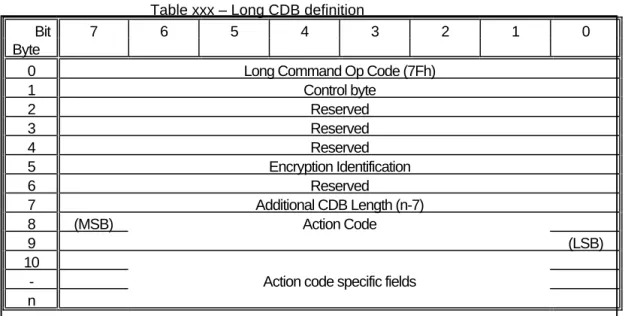
>80 bytes realistically used 256 total CDB byte limit Bytes 0-9 never encrypted
!Encryption ID: Covers bytes 8 - n
(Encrypted or not)
!Action code: NAS command
Determines values for Bytes 11 - n
Now part of SCSI Standard!
OBSD: Long CDB
OBSD: Long CDB
Table xxx – Long CDB definition
Bit 7 6 5 4 3 2 1 0 Byte
0 Long Command Op Code (7Fh) 1 Control byte 2 Reserved 3 Reserved 4 Reserved 5 Encryption Identification 6 Reserved 7 Additional CDB Length (n-7) 8 (MSB) Action Code 9 (LSB) 10
- Action code specific fields n
! Command Set:
! Object specific Group Other
! Create Object Create Object Group Set Attribute ! Open Object Remove Object Group Get Attribute
! Read Object Flush
! Write Object Format OBSD
! Append Object ! Close Object ! Remove Object ! Import Object ! Flush Object
NSIC/NASD Command Set
! Byte addressing only
! Partitions = Object Groups Partitions
! None - majority position Not divisions of capacity ! Needed for legacy support Sets of Objects
! Needed, and lots = 4 byte address Can have capacity quota
! Open & Close - polar division Open/Close
! Needed for QoS specification Frame sessions ! Needed for management support Sets QoS parms
! Waste of time Not equated to file system Open ...
! Object ID
! Set by OBSD or Requester ! Length - 32, 64, 128 ??
OBSD Some Key Issues/Features
! What is an OBSD: A New Boundary
! Not just a disc drive
! Tape drive, Tape library, Disc Array, Jukebox, etc
! Aggregation - objects across OBSD’s
! Three kinds
! For redundancy: RAID, mirroring ! For Performance: Striping
! For Capacity: Spanning
! Two solutions
! Disc Arrays
! Do on an Object basis
! Possible also with the Object abstraction
! Mapping function required ! RAID 5 harder, but doable
OBSD: What About Aggregation
OBSD: What About Aggregation
Object x Object y Object x Object p
Data stored as objects (files), not sectors
Data stored as objects (files), not sectors
! Still supports OS’s file structures ! Disc does space management
! Disc knows when a file is open, in use, ...
OBSD Advantages
OBSD Advantages
! OS workload greatly reduced
! Space management scales with # of drives ! Storage can be self-managed
! Storage can do off-line work ! Copy, Mirror, Backup, etc.
Sectors Sectors Application Application OS OS Driver Driver File File System System Object Object Based Based Storage Storage Application Application OS OS Driver Driver File File System System Red line
Red line = sector request Blue line
Blue line = file/object request
Storage Device
OBSD TODAY
OBSD: Object Based Storage Devices (nee OOD, OBD)
OBSD: Object Based Storage Devices (nee OOD, OBD)
! Key to storage participating in management
! Enables storage supported Quality-of-Service agreements ! Heterogeneous computing made easier(?)
! Performance opportunities
! Metadata never leaves device
! More effective cache with Open/Close visibility ! More knowledgeable prefetching
! Object level LOCKS + VIA => direct application (DBMS) access
Why Objects
! VIA: Defined by Microsoft, Intel, Compaq ! Provides shortcut to wire
! Very low latency communications
! OBSD + VIA
! Open Objects through OS
! Then application goes right to disc ! “Saves 25% of CPU” Object Object File File System System Application Application OS OS Driver Driver File File System System OBSD
OBSD + VIA = Fast Path to Data
Physical Sector Logical Block File Bytes
Data Sector ECC, Space
Separator Buffer Mapping Mgmt.
(geometry, flaws)
!Each level was in the host at some point!
!Each advancement was met with resistance
!Eventually advantages of new interface became compelling
OBSD and Interface Progression
!
Object Based Storage affects more than devices
! Need participation, input from broader industry
! File system
! Middle ware suppliers ! Data based developers ! Hardware vendors
!
Need collaboration with ANSI SCSI committee
! SNIA not a standards body
! ANSI lacks broad representation
OBSD and SNIA and ANSI
!
NSIC members committed to SNIA activity
!