Edition 1 - 2010 © CCNR/OCIMF 2010 Page 227
Chapter 13
HUMAN ELEMENT
CONSIDERATIONS
This Chapter describes, in general terms, some basic human element considerations for providing and maintaining a safe working environment on tankers and within terminals.
Guidance on manning levels, training, the management of fatigue and the control of drugs and alcohol is contained in this Chapter.
13.1 Manning Levels
It is the Company’s responsibility to ensure that the minimum safe manning level of each tanker and terminal is maintained at all times, in accordance with any (inter)national legislative requirements. At all times during the tanker’s stay at a terminal, a sufficient number of personnel should be present on board and on the terminal to deal with any emergency.
13.2 Training and Experience
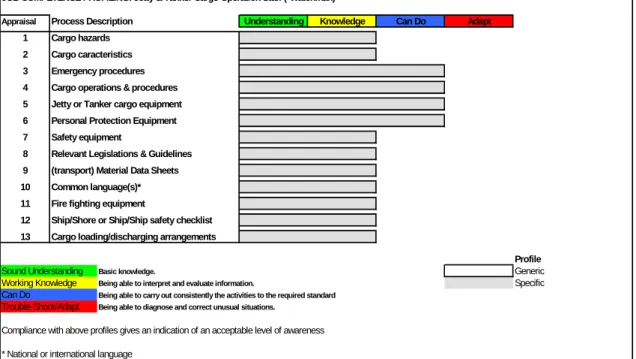
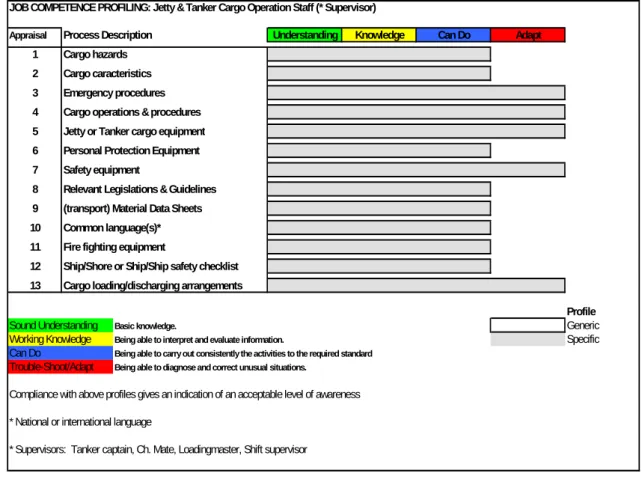
The competence of personnel involved in cargo transfer operations should be defined and assessed. Figures 13.1 and 13.2 provide recommendations for minimum competence requirements for a watchman and a supervisor.
Figure 13.1 – Example: Minimum Job Competence Profile for Watchman
JOB COMPETENCE PROFILING: Jetty & Tanker Cargo Operation Staff (*Watchman)
Appraisal Process Description Understanding Knowledge Can Do Adapt 1 Cargo hazards
2 Cargo caracteristics 3 Emergency procedures 4 Cargo operations & procedures 5 Jetty or Tanker cargo equipment 6 Personal Protection Equipment 7 Safety equipment
8 Relevant Legislations & Guidelines 9 (transport) Material Data Sheets 10 Common language(s)* 11 Fire fighting equipment
12 Ship/Shore or Ship/Ship safety checklist 13 Cargo loading/discharging arrangements
Profile
Sound Understanding Basic knowledge. Generic
Working Knowledge Being able to interpret and evaluate information. Specific
Can Do Being able to carry out consistently the activities to the required standard
Trouble-Shoot/Adapt Being able to diagnose and correct unusual situations.
Compliance with above profiles gives an indication of an acceptable level of awareness * National or international language
Edition 1 - 2010 © CCNR/OCIMF 2010 Page 229 Figure 13.2 – Example: Minimum Job Competence Profile for Supervisor
13.3 Hours of Rest
13.3.1 Statutory Requirements
Personnel are to have sufficient hours of rest to ensure that they are ‘fit for duty’ and are able to carry out their duties safely, in accordance with (inter)national labour regulations. National regulations might require tankers to maintain individual records of the hours of work and rest of everyone on board.
The senior staff on tankers and within terminals are responsible for managing the rest periods of staff in the most efficient manner. However, when complex or protracted operations are undertaken, it may be necessary to suspend operations to provide an adequate rest period for those personnel most heavily engaged in the operation.
Where intense or prolonged operations are expected, the Company should consider the provision of additional personnel if this is necessary to avoid the suspension of operations. Any additional personnel involved with the operations must be competent and familiar with the risks associated with handling liquid cargo/products on tankers and terminals.
JOB COMPETENCE PROFILING: Jetty & Tanker Cargo Operation Staff (* Supervisor)
Appraisal Process Description Understanding Knowledge Can Do Adapt
1 Cargo hazards 2 Cargo caracteristics 3 Emergency procedures 4 Cargo operations & procedures 5 Jetty or Tanker cargo equipment 6 Personal Protection Equipment 7 Safety equipment
8 Relevant Legislations & Guidelines 9 (transport) Material Data Sheets 10 Common language(s)* 11 Fire fighting equipment
12 Ship/Shore or Ship/Ship safety checklist 13 Cargo loading/discharging arrangements
Profile
Sound Understanding Basic knowledge. Generic
Working Knowledge Being able to interpret and evaluate information. Specific Can Do Being able to carry out consistently the activities to the required standard
Trouble-Shoot/Adapt Being able to diagnose and correct unusual situations.
Compliance with above profiles gives an indication of an acceptable level of awareness
* National or international language
13.3.2 Fatigue
All parties involved with tanker operations should be aware of the factors that can contribute to fatigue and take appropriate measures to reduce the potential for fatigue when planning and managing the activities and working times of personnel.
Guidance on fatigue mitigation and management is contained in the IMO publication ‘Guidelines on Fatigue’. However, the most effective means of preventing fatigue is to ensure compliance with existing hours of rest regulations.
13.4 Drug and Alcohol Policy
13.4.1 Industry Guidelines
The international oil tanker industry has operated a voluntary drug and alcohol policy for a number of years and guidance for operators is provided in publications such as:
• Guidelines for the Control of Drugs and Alcohol Onboard Ship (OCIMF).
• Drug Trafficking and Drug Abuse: Guidelines for Owners and Masters on Prevention, Detection and Recognition (ICS).
The implementation of policies and operating procedures aimed at providing a work place with personnel unaffected by drugs and alcohol will greatly improve operational safety and employees’ health.
Drug and alcohol policies should be established and be clearly communicated to all personnel.
13.4.2 Control of Alcohol
The consumption of alcohol should be controlled to ensure no person is intoxicated while on board.
The standards that are used to define intoxication are laid down in published industry guidelines, which define alcohol limits and the method of determining them.
Controls on consumption should ensure that personnel are able to carry out scheduled duties free from the effects of alcohol.
Scheduled duties include, but are not limited to, standing of a deck or engine watch, the commencement of day work for day workers, arrival at a pilot station, going to mooring stations, or any other duty (including overtime work) scheduled at a specific time.
On tankers operating with an Unmanned Machinery Space (UMS), the officer on standby duty, on call to answer UMS alarms, is considered to be on duty for the purposes of alcohol control.
No person should be allowed to consume alcohol while on watch or during the performance of any shipboard duties.
Edition 1 - 2010 © CCNR/OCIMF 2010 Page 231
13.4.3 Drug and Alcohol Testing Programmes
To ensure that the drug and alcohol policy is effective, operators should have a programme in place to prevent the use of illegal drugs and the misuse of alcohol.
Tests may be performed for the following reasons:
• Reasonable suspicion.
• After an accident.
• Pre-employment.
• Random testing programme.
A policy for random tests should be developed by the Company in conformity with the requirements/limitations of the country of jurisdiction.
13.5 Drug Trafficking
Companies should have procedures in place to prevent their tankers being used for drug trafficking. For guidance, reference should be made to the ICS publication ‘Drug Trafficking and Drug Abuse: Guidance for Owners and Masters on Prevention, Detection and Recognition’.
Procedures should require the tanker’s Master to notify the tanker’s owner/operator immediately, and the authorities at the next port of call:
• Of any suspicious circumstances during the voyage that can be related to the trafficking of drugs or other contraband.
• If any unauthorised persons have been found in areas on board that may be used to conceal drugs or other contraband.
• If any drugs or other contraband are found aboard. When drugs are discovered, the contraband and the area where it is found should be secured to ensure minimal handling and disturbance prior to appropriate action by the authorities when the tanker arrives in port.
13.6 Employment Practices
The health and welfare of tanker crew, which includes the provision of decent working conditions on board tankers, has direct relevance to safe operations.