Volume 32 Number 3 Article 7
October 2019
Work Experience of People Who are Deaf or Hard of Hearing in
Work Experience of People Who are Deaf or Hard of Hearing in
Hong Kong
Hong Kong
Petrus Ng noneFollow this and additional works at: https://repository.wcsu.edu/jadara Recommended Citation
Recommended Citation
Ng, P. (2019). Work Experience of People Who are Deaf or Hard of Hearing in Hong Kong. JADARA, 32(3). Retrieved from https://repository.wcsu.edu/jadara/vol32/iss3/7
Work Experience of People Who are Deaf or Hard of Hearing in Hong Kong
Petrus Ng & Angela Tsun
Abstract
Helping members of the deaf culture to engage in gainful work is an important means of their integration into the community. However, members of the deaf culture are often received simply as those with impaired hearing, and they experience difficulties in obtaining and keeping work. Cross-cultural and communication conflict is a major factor affecting their employment opportunities. Audism, the social prejudgement of the capacities of members of the deaf culture, is part of this conflict. These factors restrict their social and vocational opportunities. The aim of this study is to assess the employment situation of members of the deaf community in Hong Kong. Analyses of the responses of 111 individuals indicate that people with hearing impairment are dissatisfied with their work situation, the opportunities
offered them, and the limited facilities to help them cope with difficulties at work. A more
comprehensive study to explore the needs of people with hearing impairment and ways to
improve their employability is warranted.
The 48th session of the Economic and Social Commission for Asia and Pacific (ESCAP) held in Beijing in April, 1992 adopted the Proclamation on the Full Participation and Equality of People with Disabilities in the Asian and Pacific Region. The Hong Kong Government
subsequently produced a White Paper on Rehabilitation, which outlines the policy objectives for full participation and equalization of opportunities for people with a disability (Hong Kong Government, 1995). The Deaf Cultural perspective holds that there is a deaf community, with its own language and culture (Lane, Hoffmeister & Bahan, 1996). The deaf community is a shared experience of common interests, shared norms of behavior, and shared survival techniques. Therefore, within this cultural frame, to be deaf is not to be disabled (Padden & Padden, 1988). Though not all members of the deaf community share the same values as those persons who support Deaf culture, they do find the term "hearing-impaired" to be negative and stigmatizing. The terms preferred by the deaf community are "deaf' and "hard of hearing" (Alcom & Humphrey, 1996). Whether deafness is inteipreted culturally or as a vocational disability, helping deaf people and those who are hard of hearing obtain and maintain gainful employment is regarded as an important way to meet the policy objectives of the Hong Kong Government (Hong Kong Government, 1995). Central to these policy objectives is the concept of "work" and its relevance to the human condition.
There is a paucity of research previously conducted that seeks to understand the working situation of Hong Kong's people who are deaf or hard of hearing. There were an estimated 39,856 persons deaf and hard of
hearing in 1997. Ranked by degree of hearing impairment, there were 6,507 people with profound deafness: 5,173 people with severely impaired hearing; and 28,177 people with mild and moderate impairment (Hong Kong Government, 1996). Of the total number of deaf and hard of hearing people, 44.0% are in the most productive age range, between 20 and 59 years of age. The interpretation of the work setting and the degree of hearing impairment seem to affect the employability of these people, as many of them are not able to obtain paid work in the labor market. The deaf culture's right to work has generally been neglected.
Adjustment is regarded as a phenomenon of social conformity. Social adjustment stresses the compatibility of people's individual and social goals (Roessler & Bolton, 1978). Work of some kind could play a large part in facilitating the social adjustment of people and in wiping out their social dependence. When deafness is viewed as a disability, some studies show that individual acceptance and adjustment to their disability is significantly related to their perception of the severity of the disability as well as to the attitudes of other people (Belgrave, 1991). Deaf and hard of hearing people usually encounter problems in emotional and social adjustment, often becoming upset by the reactions of others in society. The disability is constructed more by how others treat them, than by "disability" (Tackett, Kerr & Helmstodter., 1990). Social support from others is of vital importance for people's well-being, including those who are deaf or hard of
hearing (Kampfe, 1990; Tackett et al., 1990).
The bilingual-bicultural perspective of the deaf culture views individuals who are deaf or hard of hearing as an institutionally oppressed language-cultural group who need to maintain dynamic equivalence in the communication event and linguistic mediation (Lucas, 1989). Bicultural individuals have knowledge of two cultures and develop socially appropriate behaviors necessary to fit into each of these two cultures. They have the ability to adjust from culture to culture. Bilingual-bicultural education approaches classroom instruction through sign language, with the aural- and written-language as the second language of instruction. Despite significant educational, cultural, and technological advances in devices to translate the aural world, deaf people are perceived as disabled and impaired.
In Hong Kong, as in countries such as the US and Britain, there is a trend to help people with a disability to live in the community and to earn their own living. However, there is no doubt that many are still unemployed because of changing pattems of employment and an increase in the 'social restriction' on them in the labor market (Oliver, 1991). The former refers to
the withering away of the manufacturing industry in Hong Kong in recent years whereas the latter refers to the exclusion of people with a disability
Vol. 32, No. 3,1999 36 JADARA
2 https://repository.wcsu.edu/jadara/vol32/iss3/7
from work activity owing to contemporary social facilities and work organizations that take little or no account of their disability. As a result, people with a disability, such as people deaf or hard of hearing, are often the
first to be excluded from the work force because of their disability and the discrimination they face. They are in an inferior and disadvantaged work position as society usually has prejudiced views of their capacities (Bowman, 1987). The majority work in semi-skilled and unskilled occupations. Some experience discrimination from employers in terms of pay and selection (Hodson & Sullivan, 1990). Additionally, there is little evidence of vertical mobility (Mowry, 1987). They constitute part of the "underclass" in the society, and are "marginalized within the labour market, as well as in society as a whole" (Oliver, 1991,p. 133). Most of the deaf and hard of hearing people work in semi-skilled and unskilled occupations, with little evidence of upward mobility (Mowry, 1987). Some experience pay and hiring discrimination from their employers (Hodson & Sullivan, 1990).
Attitudes to people with a disability, are deeply rooted in the social and cultural values of a society, and are closely related to feelings, beliefs and meanings attached to disability. Negative attitudes towards people who are deaf or hard of hearing have certainly affected the prospects for community living and most importantly the opportunity to find a job in the labor market. The institutionalized belief that disability is a form of individual inadequacy has already been reflected in the classification of impairment, disability and handicap by the World Health Organization. The classification has been questioned by people with a disability as well as by professionals as "victim blaming" (Oliver, 1991, p. 134) and fails to reflect the extent to which their lives are disadvantaged by the social structure of the society (United Nations, 1994). As a consequence. Disabled People's International has suggested another definition of disability as "the loss or limitation of opportunities to take part in the normal life of the community on an equal level with others due to physical and social barriers" (United Nations, 1994, p.3). This new definition sees disability as a social restriction rather than an individual limitation, and places more emphasis on the importance of society removing barriers and offering equal opportunities to people with a disability to enable them to enjoy full participation in society
and to determine their own needs and priorities.
The conditions of the deaf and hard of hearing people in Hong Kong
are not very different from those in many places elsewhere. Experience shows that employment opportunities and the related supportive services for people with a disability are neither favorable nor adequate. There are very few related studies done to find the employment problems faced by people with a disability. The only comprehensive study on the employment situation
of people with a disability in Hong Kong was conducted in 1987
(Hong
Kong Council of Social Service, 1987). A total of 3,415 interviews were
conducted with participants from a stratified sampling of people who are
deaf or hard of hearing, people who are blind, people with physical
disabilities, people with mental limitations, and people with mental illness. As part of the study, the findings showed that 7.2% of the 483 people in the study who are deaf or hard of hearing were unemployed. This was much higher than the unemployment rate of the general population, which was less than 1.6% in 1988 (Hong Kong Government, 1989). The results also suggested that the deaf people and blind people felt that they were more
often discriminated against by employers. This differed from the experience
of people with other disabilities, who viewed their health problems as more serious in hindering their job seeking (Hong Kong Council of Social Service, 1987, p.52). Among the 1,221 respondents who were employed during the
study, deaf persons and those with mental limitations were found to earn
lower mean incomes of US$ 298 and US$ 168 respectively than people with physical disabilities (US$ 355) and blind people (US$ 342). Moreover, it was found that deaf people and people with mental illness had relatively higher percentages than others of experiencing difficulties in their jobs (21.5% and 20.2% respectively).
The 1987 study provided information about the employment situation of people with a disability in Hong Kong. However, the data are now outdated. Moreover, the study had limitations, as it was not designed to investigate the employment problems faced by a specific disability group, and it did not take into consideration the heterogeneity of the population. Because there were five disability groups included in the scope of disabled persons, the natures and degrees of their disabilities were quite different. Their effects on employability might also be quite varied. Most of the analyses in the 1987 study were conducted with reference to the disabled population as a whole. As a result, the kinds of difficulties experienced by people of different disability groups were not included or identified. There is no study under way dealing specifically with the employment difficulties of the deaf and hard of hearing populations in Hong Kong. The present study aims to obtain information that reflects the present employment situation of these people, in order to contribute to the knowledge about developing vocational training programs that promote employment opportunities for people who are deaf or hard of hearing.
Vol. 32, No. 3,1999 38 JADARA
4 https://repository.wcsu.edu/jadara/vol32/iss3/7
Method
Participants and Procedures
The aim of this study was to explore the employment difficulties of
people who are deaf or hard of hearing in Hong Kong. The study was
conducted using a structured questionnaire method,
administered by
face-to-face interviews and self-administered questionnaires through the mail. For the face-to-face interviews, the two social service centers for deaf and the
hard of hearing people were approached. Members who visited the centers
during the study week were all invited to participate. With the help of
voice-to-sign interpreters, 85 face-to-face interviews were conducted. To obtain
responses from members who did not visit the centers during the week,
the
same questionnaires were mailed to them. One hundred and seventy
self-administered questionnaires with postage free return envelopes were sent. Twenty-six of these were successfully completed and returned within the
period of the study. A
total of 111 completed questionnaires were used for
the final analysis.
Measures
A structured questionnaire was developed and used in face-to-face interviews, and also sent to members of the selected social service centers for
people who are deaf or hard of hearing. The questionnaire was on the basis
of face validity. An initial draft of the questionnaire was constructed based on a review of the literature on studies relating to the employment situation
of people with a disability (Hong Kong Council of Social Service, 1987),
direct contacts with staff workers, volunteers and members of social clubs
for people who
are deaf
or hard of hearing, suggestions from the principal of
a special school for deaf and hard of hearing people, and personal work
experience with the people themselves. The draft questionnaire was then
sent to staff workers and 12 members for a pilot test. Based on comments
and suggestions from staff workers and members and with a view toward reducing the difficulty of sign interpretation, a major change was made to
replace the 7-point Likert scale with a 5-point scale on items that required
answers along an agreement continuum. In order to make the questions easier to understand, some of the more abstract phrases were re-written in more concrete terms. As most of the questions in the questionnaire of the 1987 study did not accommodate the specific needs of people who are deaf or hard of hearing, only two questions, namely those on the reasons for job changes and on ways to deal with problems in job seeking, were adapted for
this study. The
final version of
the questionnaire was divided into four major
General information about the respondents: including demographic characteristics, such as sex, age, educational attainment, occupation type and position, income level, and the causes and severity of hearing impairment;
Perception of work: including views on the types of work that are most suitable for deaf and hard of hearing people, and factors that facilitate these people to work;
Problems with current jobs: including the difficulties experienced in their current jobs, social relations at work, income level and financial situation; and
Reasons for unemployment: including their employment status, reasons for unemployment, length of unemployment, and the reasons for job changes.
Results
Demographic Background. The demographic background of the respondents showed that the percentage of male respondents in the study was slightly higher than that of female respondents (54.1 % male compared with 45.9% female). Slightly more than half of the respondents (51.4%) were within the range of productive age (21 to 44 years of age). Fifty-one percent were single, which is higher than the figure for the general population (31.5%) in Hong Kong (Census Department, 1996). The figures are not surprising, as people with a perceived disability may experience greater difficulty in marrying. The degree of hearing impairment of respondents was ranked as; 22.5% with partial hearing who needed hearing aids; 56.8% with severe hearing impairment, who were eligible for a disability allowance; and, 11.7% with profound impairment. The causes of the hearing impairment were: 35.1% congenital deafness and 61.3% post-natal disease and illness. The educational levels of the respondents were: 41.4% with 6 years of formal education, 24.3% with 11 years of formal education, and none reaching post-secondary education or above. Obviously, they received less education than the general population (Census Department, 1996). Census data indicate that only 32.1% of the population aged 15 and over have received less than 6 years of formal education, 46.6% have obtained 11 years of formal education and 15.7% have received tertiary (postsecondary) education.
Perception of Work. Seventy respondents were employed during the study period; however, the majority of these were employed as unskilled laborers or service workers. Slightly less than a quarter of these respondents (24.3%)
Vol. 32, No. 3,1999 40 JADARA
6 https://repository.wcsu.edu/jadara/vol32/iss3/7
were employed in the manufacturing sector and 21.4% in the restaurant and hotel business, whereas 14.3% were working in the fields of transportation and commercial as unskilled or semi-skilled workers, and 14.3% as clerks and sales people in the service industry, such as financing, insurance and real estate. In examining factors that affected their work, over 60% of the respondents stated that auxiliary services and facilities such as sign boards, fax machines, amplifier equipment and sign interpreter services in the
working setting were the most important.
Concerning the meaning of work, more than 70% of the employed respondents identified tangible rewards, such as earning money to support independent living, as important for them to keep their jobs. Intangible employment benefits, such as social status against discrimination and filling time to prevent boredom were not major reasons for engaging in work. In fact, many have to tolerate relatively poor working environments and sacrifice personal needs for their meager incomes. These findings are consistent with England and Rear's (1975) study of general worker attitudes in Hong Kong during the late 1960s. The two authors proposed three main elements in Hong Kong workers' orientation to work, which may explain the work incentive of most employed respondents in this study. These elements were: (1) an instrumental orientation to work, characterized by an exceptionally high degree of importance attached to pay over other substantive (or procedural) conditions of employment; (2) the tendency to avoid social involvement with others in the workplace; and (3) the willingness to tolerate authoritarian behavior by management (Levin, 1990). In general, culturally marginalized or disabled, including those with hearing impairment, are deprived of the opportunity to shop around for jobs offering relatively higher pay. They are compelled to tolerate all sorts of employment deprivation in return for pecuniary gain.
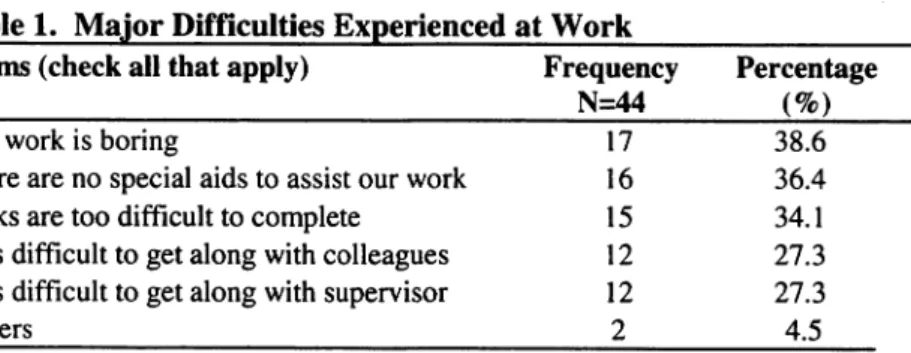
Problems with Current Job. Limited educational background may be one of the causes of their limited career choice. Unskilled employment then often becomes associated with dissatisfaction and difficulties. More than half of the employed respondents (44 out of 70) reported experiencing difficulties at work. Approximately one-quarter to one-third of participants reported that the major difficulties were: boring or difficult work, problems with supervisors and/or colleagues, and the lack of accommodations (see Table 1).
Table 1. Major Difficulties Experienced at Work
Items (check all that apply) Frequency Percentage
N=44 (%)
the work is boring 17 38.6
there are no special aids to assist our work 16 36.4
tasks are too difficult to complete 15 34.1
it is difficult to get along with colleagues 12 27.3
it is difficult to get along with supervisor 12 27.3
others 2 4.5
The inability to communicate with others may result in feelings of boredom at work. Moreover, these communication problems may create misunderstandings with colleagues and supervisors, resulting in difficult social relationships. Many respondents felt that their colleagues exhibited negative attitudes toward them (31.8%). Among these respondents, 43.1% reported that colleagues always scolded them or expressed dissatisfaction with their work. Relations with the supervisor were also strained, with 40.9% reporting negative comments in supervision. Some 54.5% of the respondents felt that their supervisors were always ordering them to do things, whereas 40.9% felt that their supervisors always scolded them or expressed dissatisfaction with their work (see Table 2).
Table 2. Social Relations at Work
Items (check all that apply) Frequency Percentage
N=44 (%)
feel colleagues exhibited negative attitudes 14 31.8 towards you
feel colleagues scold you or are dissatisfied with 19 43.1 you
have negative comments from supervisor 18 40.9 feel supervisor ordering you to do things 24 54.5 feel supervisor always scolds you or is 18 40.9
dissatisfied with you
The majority of the employed respondents were paid relatively low wages for their work, as compared with the overall average monthly wage of the general population. In 1995, the average income of manual workers in Hong Kong in the manufacturing sector was US$ 871 per month (Hong Kong Government, 1996). The dominant income group (31.8% of employed respondents) in this study earned US$ 514 to US$ 771 per month at their most recent job. The second largest income group (29.5% of employed respondents) ranged from US$ 256 to US$ 514 per month. As a result of
Vol. 32, No. 3,1999 42 JADARA
8 https://repository.wcsu.edu/jadara/vol32/iss3/7
these relatively low incomes, more than half of the employed respondents did not have sufficient funds to cover the daily living expenses of their families. Nearly 10% of employed respondents had to seek financial assistance from relatives. Many said that they did not have money for other purposes, such as recreational activities with their family members.
Unemployment and job seeking. Thirty-three respondents in this
study were unemployed and eight had become homemakers. This is much
higher than the unemployment rate of a study conducted by the Hong Kong Council of Social Service in 1987. The findings of this study show that the
perceived causes of the unemployment are many. The impairment, which
refers to employers' discrimination against them,
accounts for 43.9% of
the
unemployment among the respondents. Other reasons include unsatisfactory
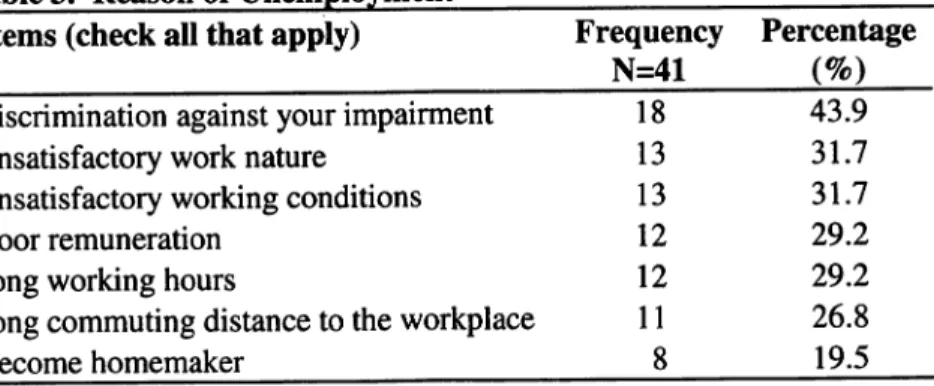
work nature (31.7%), unsatisfactory working conditions (31.7%), poor remuneration (29.2%), long working hours (29.2%), and long commuting distance to the workplace (26.8%) as the common causes (see Table 3). A substantial number of unemployed respondents (26.8%) reported their duration of unemployment as more than one year.
Table 3. Reason of Unemployment
Items (check all that apply) Frequency Percentage
N=41 (%)
discrimination against your impairment 18 43.9
unsatisfactory work nature 13 31.7
unsatisfactory working conditions 13 31.7
poor remuneration 12 29.2
long working hours 12 29.2
long commuting distance to the workplace 11 26.8
become homemaker 8 19.5
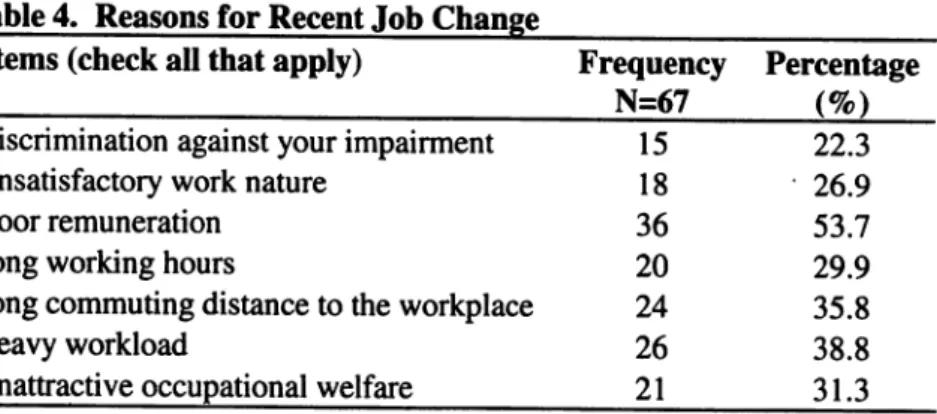
Sixty-seven respondents have changed jobs recently. Poor remuneration (53.7%) is the major cause of job change, followed by heavy workload (38.8%), long commuting distance to the workplace (35.8%), unattractive welfare (31.3%), long working hours (29.9%), and
unsatisfactory work nature (26.9%)
(see Table 4). With the exception of
heavy workload, the reasons for job changes are similar to those for their
unemployment.
Though the hearing impairment per se is not the main reason
(22.3%)
for job changes, it is perceived as a major cause (43.9%)
of their
Table 4. Reasons for Recent Job Change
Items (cbeck all that apply) Frequency
N=67
Percentage (%) discrimination against your impairment 15 22.3
unsatisfactory work nature 18 26.9
poor remuneration 36 53.7
long working hours 20 29.9
long commuting distance to the workplace 24 35.8
heavy workload 26 38.8
unattractive occupational welfare 21 31.3
In this study, 75
of
the 111 respondents of
the study had previously
experienced difficulties in job seeking. Half of them reported experiencing
prejudice from prospective employers. Disability in communication affected
the application process for 42.7% of the respondents, particularly their
performance during the job interview. Inadequate knowledge and skills for
the job
(42.7%)
accounted for other kinds of difficulties in job seeking (see
Table 5). To
overcome these difficulties, 68%
of
the respondents sought help
from relatives and fiiends, whereas 44% saw a career counselor, social worker or approached the Labour Department for job assistance (see Table 6). To resolve the communication problem, more than 34.7% of these
respondents enlisted the aid of a sign-to-voice interpreter during job
interviews.
Items (check all that apply) Frequency Percentage
N=75 (%)
prejudice from prospective employers 37 49.3
disability in communication 32 42.7
inadequate knowledge and skills for the 32 42.7 job
Table 6. Assistance Sought in Job Seeking
Items (cbeck all that apply) Frequency Percentage
N=75 (%)
sought help from relatives & friends 51 68.0
sought help from career counselor & social 33 44.0 worker
Vol. 32, No. 3,1999 44 JADARA
10 https://repository.wcsu.edu/jadara/vol32/iss3/7
Discussion
The results of this study show that the relatively low educational attainment level of the respondents may have impacted their employability. In normal situations, education is completed before occupation begins, and is modeled as affecting a person's occupational status and income. Similarly,
Scott (1996)
speculated that in post-industrialized societies, occupational
hierarchy is organized around education and expertise rather than manual skills. In fact, both educational levels and income have consistently been found to be predictors for occupational status in Hong Kong in the last two decades (Tsang, 1992). An early end to education has therefore restricted the
respondents' occupational horizons. Understandably, many respondents
must remain in a dreadful employment situation by keeping, a boring job, or facing lengthy unemployment.
More than half the respondents have demanded higher remuneration and better working conditions. Very few employed respondents were satisfied with their employment. For those who had experienced difficulties,
36.4% reported having no special aids to assist their work,
and 34.1
%
said
they had encountered difficulties performing job tasks. This qualitative
illustration of the work situation for deaf and hard of hearing people in Hong
Kong voices their subjective reality —
a negative voice affecting their
self-respect and personal identity.
Respondents who were deaf or hard of hearing reported an
occupation status of significant under-representation in professional,
managerial and technical occupations. The majority of the employed
respondents worked at unskilled jobs in the manufacturing (24.3%) and
service sectors (21.6%), with relatively low pay and long working hours.
They were dissatisfied with their existing jobs, especially with the extrinsic
work incentives. Their relatively low occupational status and long working hours may further exclude them from social and cultural participation. Poor remuneration from unsatisfactory work reinforces feelings of impairment and disability for respondents who are deaf or hard of hearing. They cannot afford any "extra spending" to foster a quality of life for the flourishing of
seif-pride and personal satisfaction. They may hold the firm belief that they
are "discouraged" workers (Prause & Dooley, 1997), who (1) could not find work, (2) lacked necessary skills, and/or (3) suffered a handicap in finding a
job once they were unemployed. This silences the deaf and hard of hearing
population into a limited world of social acquaintances. Further study to
explore the social life of
those who
are deaf
or hard of hearing in Hong Kong
The migration of Hong Kong's labor-intensive manufacturing industry to Mainland China continues to erode unskilled employment possibilities. Because people who are deaf or hard of hearing tend to work at unskilled jobs, they are more vulnerable to long-term unemployment. The transformation of Hong Kong's means of production together with negative social attitudes has resulted in further exclusion for persons who are deaf or hard of hearing from employment. The employment prospects of this group will erode with the manufacturing sector, unless social and employer
misunderstandings and prejudgements of their abilities can be transformed (Colorez & Geist, 1987; Combs & Omvig, 1986; Greenwood & Johnson, 1987). This study has voiced the opinions of deaf and hard of hearing people on their employment situation. Hearing employers may have different views on the working abilities and contributions of those who are deaf or hard of hearing. There should be a more comprehensive study to elicit the voice of the employers. A study on the employers' views may provide positive suggestions to reduce work discrimination against people with
hearing impairment and to help them obtain and maintain their work. There is no study to identify the types of work that are suitable for people with hearing impairment in Hong Kong. The results of this study show that people with hearing impairment are dissatisfied with their work
and feel they are being discriminated against. Ways
to improve the existing
working situation of deaf and hard of hearing people should be explored. Most of the employed respondents in this study are working in the manufacturing and service sectors. As the manufacturing industry is diminishing, more people will have to look for work in the service and information sectors. Is this type of work suitable for people who are deaf and hard of hearing? Can the Deaf Cultural Community find solidarity to build a place of their own (Van Cleve & Crouch, 1989) within Hong Kong's
emerging information society?
References
Alcom, B. & Humphrey, J. (1996). So you want to be an interpreter: An introduction to sign language interpreting (2nd ed.). Amarillo, TX: H & H Publishers.
Belgrave, F. Z. (1991). Psychosocial predictors of adjustment to disability in African Americans. Journal of Rehabilitation, 57(1), 37-40.
Bowman, J. T. (1987). Attitudes toward disabled persons: Social distance and work competence. Journal of Rehabilitation, 53(1), 41-44.
Buckle, J. R. (1971). Work and housing of impaired persons in Great Britain. Office of Population Censuses and Surveys. London: HMSO.
Vol. 32, No. 3,1999 46 JADARA
12 https://repository.wcsu.edu/jadara/vol32/iss3/7
Census and Statistics Department (1991). 1991 Population census. Hong Kong: Census and Statistics Department.
Census and Statistics Department (1996). 1996 Population by-census: Main report. Hong Kong: Census and Statistics Department.
Colorez, A. & Geist, G. O. (1987). Rehabilitation vs. general employer attitudes toward hiring disabled persons. Journal of Rehabilitation, 53(2), 44-47.
Combs, I. H. & Omvig, C. P. (1986). Accommodation of disabled people into employment: Perceptions of employers. Journal ofRehabilitation, 52(2), 42-45.
England, J. and Rear, J. (1975). Chinese labour under British rule. Hong Kong: Oxford University Press.
Greenwood, R. & Johnson, V. A. (1987). Employer perspectives on workers with disabilities. Journal of Rehabilitation, 53(3), 37- 45.
Hodson, R. & Sullivan, T. A. (1990). The social organisation ofwork. Belmont, Calif: Wadsworth Publishing Company.
Hong Kong Council of Social Service and Rehabilitation Development Co-ordinating Committee, (1987). Survey on employment situation of the disabled. Hong Kong: Hong Kong Council of Social Service.
Hong Kong Economic Journal (1998, June 16). Unemployment rate rose to 4.2% - the highest in the past fifteen years. Hong Kong: Hong Kong Economic Journal.
Hong Kong Government (1994). Hong Kong 1994. Hong Kong: Hong Kong Government.
Hong Kong Government (1989). Hong Kong 1989. Hong Kong: Hong Kong Government.
Hong Kong Government (1995). Equal opportunities and full partici pation: A better tomorrow for all. White Paper by the Working Party on Rehabilitation Policies and Services, Hong Kong: Hong Kong Government.
Hong Kong Government. (1996). Review of rehabilitation programme plan. Rehabilitation Division, Hong Kong: Health and Welfare Branch of Government Secretariat.
Jones, L., Kyle, J., & Wood, P. (1987). Words apart: Losing your hearing as an adult. New York: Tavistock Publications.
Kampfe, C. M. (1990). Communicating with persons who are deaf: Some practical suggestions for rehabilitation specialists. Journal of Rehabilitation, 56(4), 41-45.
Lane, H., Hoffmeister, R. & Bahan, B. (1996). A Journey into the Deaf world. San Diego, CA: Dawn Sign Press.
Levin, D. A. (1990). Work and its deprivations. In B. K. P. Leung,Ed.D., Social issues in Hong Kong (pp. 85-113). Hong Kong: Oxford University Press.
Lucas, C. (Ed.) (1989). The sociolinguistics of the deaf community. Washington, DC: Gallaudet University.
Luckner, J. L. (1989). Altering locus of control of individuals with hearing impairments by outdoor-adventure courses. Journal of Rehabilitation, 55(2), 62-67.
Lunt, N. & Thornton, P. (1994). Disability and employment: Towards an understanding of discourse and policy. Disability and Society, 9(2), 223-238. Mindel, E. & Vemon, M. (undated). They grow in silence. Boston, MA: College Hill Press.
Mingpao (1998, June 16). One hundred and forty thousand people were unemployed - the highest in the past fifteen years. Hong Kong: Hong Kong Mingpao Newspaper.
Moores, D. F. (1987). Educating the deaf: Psychology, principles, and practices. Boston, MA: Houghton Mifflin Company.
Mowry, R. L. (1987). Vocational and socioeconomic characteristics of
hearing-impaired former clients of a state VR agency. Journal of
Rehabilitation, 55(3), 58-62.
Myklebust, H. R. (1964). The psychology of deafness: Sensory deprivation, learning, and adjustment. New York: Grune and Stratton.
Nolan, M., & Tucker, I. (1981). The hearing impaired child and the
family. London: Souvenir Press.
Oliver, M. (1991). Disability and participation in the labour market. In Philip Brown and Richard Scase (Eds.) Poor work: disadvantage and the division of labour (pp. 133-146). Milton Keynes: Open University Press.
Padden, C. & Padden, H. T. (1988). Deaf in America: Voices from a culture. Cambridge, MA.: Harvard University.
Prause J. & Dooley, D. (1997). Effect of underemployment on school-leavers' self-esteem. Journal of Adolescence, 20, 243-260.
Roessler, R., & Bolton, B. (1978). Psychosocial adjustment to disability. Baltimore: University Park Press.
Scott, J. (1996). Stratification and power: Structure ofclass, status and command. Cambridge, UK: Polity Press.
Sidransky, R. (1990). In silence: Growing up hearing in a deaf world. New York: St. Martin's Press.
Tackett, P., Kerr, N., and Helmstadter, G. (1990). Stresses as
perceived by children with physical disabilities and their mothers. Journal of Rehabilitation, 56(3), 30-34.
Topliss, E. (1982). Social responses to handicap. London: Longman. Tsang, W. K. (1992). The class structure in Hong Kong. Hong Kong: Hong Kong Institute of Asia-Pacific Studies, Chinese University of Hong Kong. United Nations (1994) Families and disabilities. Occasional Papers Series, No. 10, Vienna: United Nations.
Vol. 32, No. 3,1999 48 JADARA
14 https://repository.wcsu.edu/jadara/vol32/iss3/7
Van Cleve, J. V. and Crouch, B. A. (1989). A place of their own: Creating the Deaf community in America, Washington, DC: Gallaudet University Press.
Petrus Ng, Ph,D„ RSW Angela Tsun, MSW, RSW Department of Social Work Hong Kong Baptist University RMRLl-105. Block 1
Baptist University Road Kowloon Tong
Hong Kong
The authors are grateful to Richard Bums for his editorial assistance in preparation of this paper.