Composite Performance and Availability Analysis
of Wireless Communication Networks
Yue Ma, Member, IEEE, James J. Han, Senior Member, IEEE, and Kishor S. Trivedi, Fellow, IEEE
Abstract—With the increasing popularity of wireless
communi-cation systems, customers are expecting the same level of service, availability, and performance from the wireless communication networks as the traditional wire-line networks. Traditional pure performance model that ignores failure and recovery but considers resource contention generally overestimates the system’s ability to perform a certain job. On the other hand, pure availability analysis tends to be too conservative since performance consid-erations are not taken into account. To obtain realistic composite performance and availability measures, one should consider performance changes that are associated with failure recovery be-havior. In this paper, a brief review is first given over the advances in composite performance and availability analysis. Thereafter, three techniques for composite performance and availability analysis are discussed in detail through a queueing system in a wireless communication network. Numerical results show that an approximate model based on a framework originally proposed by Bobbio and Trivedi (BT approach) provides remarkably accurate predictions on system performance.
Index Terms—Availability, channel allocation, failure recovery,
performability, stochastic reward net (SRN), wireless communica-tion systems.
I. INTRODUCTION
W
ITH the increasing popularity of wireless communica-tion systems, customers are expecting the same level of service, availability and performance from the wireless com-munication networks as the traditional wire-line networks. Due to the dynamic environment, such as the roaming of the mo-bile subscribers, maintaining a high radio frequency (RF) avail-ability is one of the most challenging aspects in wireless net-works. When a wireless network encounters failures, either due to software, hardware, environment, human error, or a combi-nation of these factors, the network can generally provide its service continuously without interruption. However, the system capacity, that is, the number of active subscribers that the system can support, may decrease. The system performance such as throughput and response time may degrade. Traditional pure performance model that ignores failure and recovery but con-siders resource contention generally overestimates the system’s ability to perform a certain job. On the other hand, pure avail-ability analysis tends to be too conservative since performanceManuscript received September 6, 2000.
Y. Ma and J. J. Han are with Global Software Group, Motorola, Inc., Elk Grove Village, IL 60007 USA (e-mail: [email protected]; [email protected]).
K. S. Trivedi is with Center for Advanced Computing and Communication (CACC), Department of Electrical and Computer Engineering, Duke University, Durham, NC 27708-0291 USA (e-mail: [email protected]).
Publisher Item Identifier S 0018-9545(01)08524-3.
considerations are not taken into account. To obtain realistic composite performance and availability measures, one should consider performance changes that are associated with failure recovery behavior.
Over the last two decades, significant advances have been made in the development of techniques for evaluating the per-formance, availability, and reliability of computer and commu-nication systems in an integrated way. In the late 1970s, Beaudry [2] developed measures which provide quantitative informa-tion about the tradeoffs between reliability and performance of degradable computing systems. Meyer [20] defined the concept of performability, where performance and reliability are con-sidered in a unified manner. He also proposed a general frame-work for model-based performability evaluation. Since then, extensive research activities in performability modeling have been carried out ranging from model construction and solution through tool development and applications.
There are several approaches [23] that have been shown to be useful for composite performance and availability analysis. One approach is to combine the performance and availability models into a single monolithic model. The advantage of this approach is that it yields accurate results. However, this direct approach generally faces two problems, namely, largeness and stiffness. The largeness problem can be alleviated by using automated generation methods for Markov chains. These automated eration methods address only the model specification and gen-eration issues. To tackle the largeness problem, two basic tech-niques can be applied: largeness tolerance and largeness avoid-ance [10]. Stiffness arises when the transition probabilities/rates of the Markov models are of widely varying orders of magni-tude. This is clearly true in the performability models where the performance related rates are large and the failure related rates are small. Aggregation techniques [3] and stiffness-toler-ance [18] can be applied in dealing with the stiffness problems. Another widely applied approach in combined performance and availability analysis is the hierarchical modeling technique [19]. There are several advantages in using this approach. First, the largeness problem can be avoided through the “divide and conquer” strategy, where a large system is decomposed into sev-eral submodels [8]. Second, the stiffness problem can be re-solved by separating the fast and slow rates from each other [4]. In this paper, we will illustrate three techniques for com-posite performance and availability analysis through evaluating
an queueing system in a wireless communication
network. These techniques include: exact composite perfor-mance and availability approach [23], pure performability approach [21] and the BT approach (proposed by Bobbio and Trivedi [4]).
In Section II, we give a brief description of a simplified channel allocation scheme in a wireless network. In Section III, three techniques for composite performance and availability analysis are discussed in detail. Numerical results are presented in Section IV. We make our conclusions in Section V. In the Appendix, a brief introduction of stochastic reward net (SRN) is given.
II. A SIMPLEPUREPERFORMANCEMODEL FORCHANNEL ALLOCATION
To illustrate different techniques for composite performance and availability analysis, we use a channel allocation scheme adapted from [15]. When a new call (NC) is attempted in a cell covered by a base station (BS), the NC is connected if an idle channel is available in the cell. Otherwise, the call is blocked. When a mobile station (MS) with an ongoing call travels across the cell boundaries, the channel in the old serving cell is re-leased, and an idle channel is required in the target cell, which would be the new serving cell. This process is called handoff. If an idle channel exists in the target cell, the handoff call (HC) continues nearly transparently to the user. Otherwise, the HC is dropped.
The dropping of a handoff call (HC) is considered more se-vere than the blocking of a new call (NC). One method [22] to reduce the dropping probability of HCs is to reserve a fixed or an adaptive (natural or fractional) number of channels exclusively for HCs. These exclusively reserved channels are referred to as guard channels. For example, if the total number of RF channels is and the number of guard channels is , then the number of RF channels available for both NCs and HCs is . It should be noted that no specific channels are reserved as guard chan-nels but only a specific number of chanchan-nels are reserved.
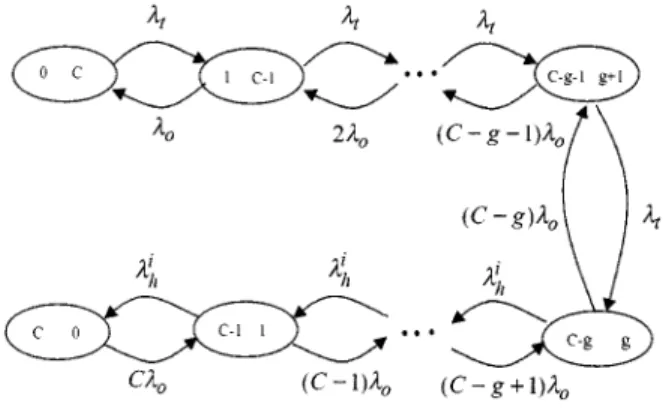
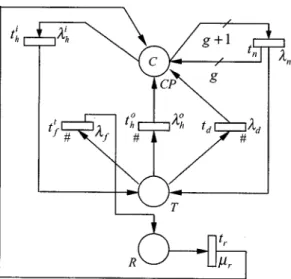
For comparison purposes, we first present a pure performance model under the assumption that the channels in a wireless net-work never fail. To make the model easier to understand, we first present the model in form of an SRN (Fig. 1). Its corresponding continuous time Markov chain (CTMC) is shown in Fig. 2. Compared with the traditional CTMC, which is generally quite abstract from the system being modeled, a high-level descrip-tion language such as SRN can specify a real-world system in a compact and intuitive way. Since the early 1990s, SRN has been used as a powerful modeling tool for performance, availability, and reliability analysis in communication networks [11]–[15], [24]. An introduction of SRN is given in the Appendix.
In Fig. 1, place CP is the channel pool for the cell. Initially, there are idle channels which are accessible for both the NCs and the HCs. Transitions and represent the arrivals of NCs and HCs, respectively. Transition is enabled with at least one idle channel in place CP. Otherwise, it is blocked. Transition is disabled if there are less than channels in place CP. This is represented by the multiple input arc from place CP to tran-sition and the multiple output arc from transition to place CP. The resulting effect is that when transition fires, only one token is moved from place CP to place . The number of tokens in place is the number of channels currently being utilized in the cell. Transitions and respectively represent the depar-ture of a call, either due to the termination of the call or due to
Fig. 1. SRN of a performance model for channel allocation.
Fig. 2. CTMC for the SRN model in Fig. 1.
the MS leaving the cell. The clearing rate for a single call is . The handoff departure rate is . Notice that transitions and have marking dependent firing rates. The actual firing rates for transitions and are and , respectively, where is the number of tokens in place . The marking dependency is indicated by the # signs next to the transitions in Fig. 1.
Let denote the number of tokens in place and,
conse-quently, let CP denote the marking of the SRN
in Fig. 1. The CTMC for the SRN of the performance model is
shown in Fig. 2, where and . With
the underlying infinitesimal generator for the CTMC, numer-ical solution methods can be applied to get the desired different performance measures.
III. COMPOSITEPERFORMANCE ANDAVAILABILITYANALYSIS: EXACT ANDAPPROXIMATEAPPROACHES
In this section, we will illustrate three techniques for com-bined performance and availability analysis through evaluating an queueing system with failure, repair, but no recovery of the channels. These techniques include: exact composite performance and availability approach [23], pure performability approach [21] and BT approach (proposed by Bobbio and Trivedi [4]). For the queueing system, we assume the call arrival rates for the new and handoff calls are and , respectively. The channel can fail with rate and is repaired with rate . A single repair facility is assumed. We also assume that the channel can be found in failure status only while it is being utilized. In other words, a channel is assumed
Fig. 3. Exact SRN model of theM=M=C=C queueing system with channel failure and repair.
not to fail while it is idle. The failure and recovery of idle channels are discussed in [15], [16].
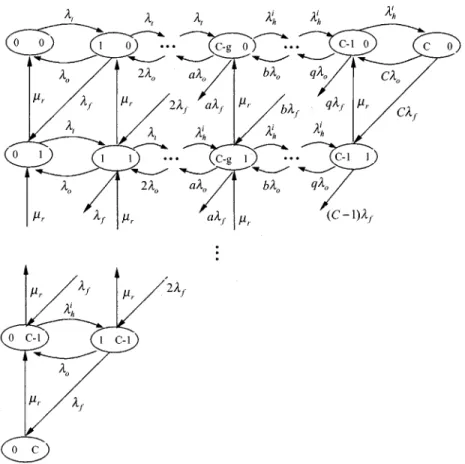
A. Exact Composite Performance and Availability Model First, we consider the exact composite model. The monolithic SRN model is shown in Fig. 3. Compared with Fig. 1, Fig. 3 has one more place (place ) and two more transitions (transitions and ). Place represents the place where the channels are being repaired or waiting to be repaired. Transition repre-sents the failure of a channel while transition represents the repair of a channel. The corresponding CTMC model of Fig. 3 is shown in Fig. 4, where state represents that there are talking channels and channels are in failure status. In Fig. 4,
and .
We denote the dropping and the blocking probabilities for the composite approach as and , respectively. To calculate
, the reward rate assignment is if # CP otherwise
The reward rate for state in the CTMC of SRN is denoted by , and # CP represents the number of channels in place CP in marking (state) . Thus, a reward rate of one is assigned to the states where the channel pool is empty, and a reward rate of zero is assigned to the other states. Then is calculated by (1)
where
set of all tangible markings;
steady-state probability of marking ;
sum of weighted state occupancy probabilities when the number of channels in place is nonzero. The reward rate assignment for is
# if #
otherwise
In summary, the first term of (1) represents the dropping prob-ability for incoming handoff calls when the channel pool is empty; the second term of (1) represents the dropping proba-bility for ongoing calls when the channels they use are down.
The blocking probability is calculated through
where
if # CP otherwise
That is, a reward rate of one should be assigned to the states where the channel pool has less than channels.
In a realistic environment, an exact approach generally en-counters the largeness and the stiffness problems. A hierarchical approach is generally an ideal methodology for avoiding the above problems. In the next two sections, we will model the same channel allocation scheme through two hierarchical ap-proaches.
B. Pure Performability Model
Now, we compute the dropping and blocking probabilities using the pure performability approach [21], which is a two-level Markov reward model. Such a two-two-level model is an ap-proximation since we assume that in each state of the upper level model, the lower level model reaches steady state. The upper level model, as shown in Fig. 5, describes the failure and repair behavior of the system. Each state in Fig. 5 repre-sents the number of nonfailed (either talking or idle) channels. The upper level model is a pure availability model. Notice that
the transition rate from state to state is .
The index includes both idle and talking channels. Therefore, in this example, the pure performability model incorporates an approximation of the exact composite model. The lower level model, as shown in Fig. 6, captures the pure performance as-pect of the system. Each state represents the number of talking channels in the system. In Fig. 6, . In other words, for the upper level model in Fig. 5, there are corresponding lower level pure performance models as depicted in Fig. 6. To get the numerical measures of the whole system, the lower level performance model is solved and its results are passed as reward rates to the upper level availability model.
We denote, respectively, and as the dropping and blocking probability in the pure performability model. The approximate dropping probability is obtained through
(2)
where is the steady-state probability of the
system being in state of the upper level model and is the dropping probability in the lower level model when .
The approximate blocking probability is obtained through
Fig. 4. The exact CTMC model of theM=M=C=C queueing system with channel failure and repair.
Fig. 5. Upper level availability model for theM=M=C=C system.
Fig. 6. Lower level performance model for theM=M=C=C system.
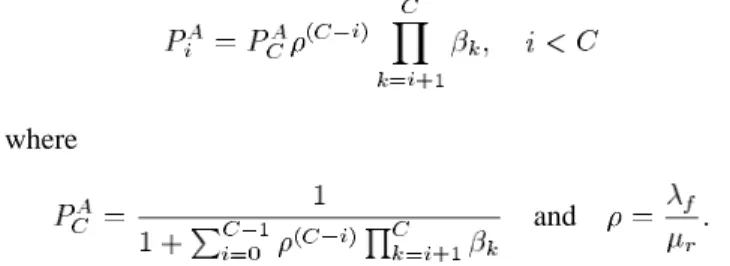
where is the blocking probability in the lower level model when . The steady-state probability in (2) and (3) is calculated from
where
and
The steady-state probability for the lower
level model is obtained from
(4) where you have the equation shown at the bottom of the page. Consequently, the dropping probability in the lower level model is derived as
Fig. 7. CTMC for a generic fast recurrent subset of Fig. 4.
The expression for the blocking probability of each lower level model is
(6)
C. BT Method
Finally, we calculate the probabilities for the dropped and blocked calls using the one-step aggregation technique origi-nally proposed by the BT method [4]. This approximate algo-rithm first proceeds by separating the state transition rates into fast rates and slow rates. The fast rates are generally of several orders of magnitude larger than the slow rates. The state–space of CTMC is consequently divided into fast and slow states. Fast states are the ones with at least one fast outgoing transition. Slow states do not have any fast outgoing transition. The fast states can be further divided into several recurrent subsets and at most one transient subset. States in the fast recurrent subset are con-nected with each other via fast transitions, but are concon-nected to any outside state only by slow transitions. The fast transient subset is connected to an outside state by means of at least one fast transition.
The key idea of the BT method is to separate the state space of a CTMC into fast recurrent subsets and/or a fast transient subset. Each recurrent subset is analyzed independently and is replaced by a slow state. The transient subset is analyzed to obtain conditional branching probabilities and is replaced with these probabilities. The resulting Markov chain is small and nonstiff. Conventional numerical techniques can be used to an-alyze this Markov chain.
Now consider the queueing system as shown in
Fig. 4. We assume that the rates and are fast, and and are slow. From the classification presented earlier in this section, state is the only slow state. The first rows of states in Fig. 4 form, respectively, fast recurrent subsets. Each subset can be modeled by a CTMC as shown in Fig. 7. The CTMCs in Figs. 6 and 7 are actually the same. Only the notations for the states are different. An approximate Markov chain (Fig. 8) is obtained by aggregating the recurrent subsets into slow states. In Fig. 8, the transition parameters
represent the expected number of talking channels in the fast recurrent subset and is given by
Fig. 8. Aggregated Markov chain for the exact model of Fig. 4.
where is the steady-state probability for the CTMC in Fig. 7 and is obtained through (4).
We denote and as the dropping and the blocking probability for the BT method, respectively. The dropping prob-ability is given through
(7)
where is the steady-state probability of the
system being in state of the aggregated Markov chain and is the dropping probability in the fast recurrent subset when
.
The blocking probability is given by
(8)
where is the blocking probability in the fast recurrent subset when . The steady-state probability in (7) and (8) is given by
where
and
The dropping probability and the blocking probability are obtained from (5) and (6), respectively.
The main difference between the pure performability approach and the BT method is the transition rates among the states in Figs. 5 and 8. Our original assumption is that a channel can fail only when it is being used. Through , the BT method can reflect this assumption in a realistic way. For the performability approach, the upper level model (Fig. 5) is a pure availability model. It does not have the flexibility of separating the busy channels from the idle channels. As
TABLE I
DROPPINGPROBABILITIES FOR THETHREEAPPROACHES
TABLE II
BLOCKINGPROBABILITIES FOR THETHREEAPPROACHES
a result, it can only model the situation where both idle and working channels can fail.
IV. NUMERICALRESULTS
For the purpose of discussion, we assume that a set of channels are assigned to each cell. The average travel time to cross from one cell to another is 6 min. The expected call holding time is 1.2 min. The average failure rate for each channel is once every 80 000 h. The expected repair time is 30 min. The handoff arrival rate is obtained through fixed-point iteration [9], [15], [17].
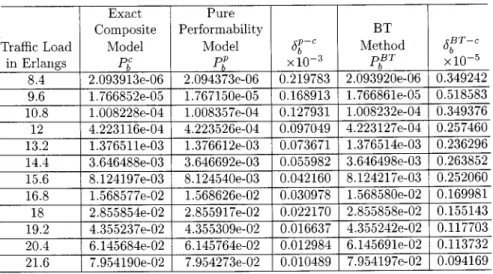
The corresponding dropping and blocking probabilities are shown in Tables I and II. The relative errors of the pure performability approach and the BT approach are de-fined as follows:
and .
As the traffic load increases, the dropping and blocking proba-bilities obtained from the pure performability model get closer to the exact values. This is as expected since when the traffic in-creases, the number of talking channels increases and the error
caused by assuming the idle channel failures decreases. From the numerical results, it is shown that the BT method gives a better approximation over the pure performability approach. Because in the aggregated Markov chain, the channel failure rate depends on the expected number of talking channels. This reflects the original assumption (only the talking channels can fail) in a realistic way.
V. CONCLUSION
During the last decade we have witnessed a tremendous growth within the wireless communication industry. Customers want speed and improved cost effective performance, but only if it comes with reliable services. This requires fundamental rethinking of the traditional pure performance model that ig-nores failure and recovery but mainly concentrates on resource contention. To reflect a real-world system in a realistic way, availability, capacity, and performance issues of a network should be considered in an integrated way.
In this paper, we illustrate three modeling approaches for composite performance and availability analysis. The three
modeling techniques include an exact composite model and two approximate models, pure performability model, and the BT model. For comparison purposes, a pure performance model is also presented. A high-level description language, stochastic reward net, as well as the continuous time Markov chain, are used to construct models for evaluating the performability measures of a channel allocation scheme in a wireless network. Numerical results show that an approximate model based on BT approach yields very accurate predictions on system performance.
APPENDIX INTRODUCTION TOSRN
SRN[6] is an extension of Petri net (PN) [1], [5], which is a high-level description language for formally specifying com-plex systems. A PN is a bipartite directed graph with two types of nodes: places and transitions. Each place may contain an ar-bitrary (natural) number of tokens. For a graphical presentation, places are depicted as circles, transitions are represented by bars and tokens are represented by dots or integers in the places. Each transition may have zero or more input arcs, coming from its input places; and zero or more output arcs, going to its output places. A transition is enabled if all of its input places have at least as many tokens as required by the multiplicities of the cor-responding input arcs. When enabled, a transition can fire and will remove from each input place and add to each output place the number of tokens corresponding to the multiplicities of the input/output arcs. A marking depicts the state of a PN which is characterized by the assignment of tokens in all the places.
Generalized stochastic Petri nets (GSPNs) [1] extend the PNs by assigning a firing time to each transition. Transitions with ex-ponentially distributed firing times are called timed transitions while the transitions with zero firing times are called immediate transitions. A marking in a GSPN is called vanishing if at least one immediate transition is enabled; otherwise it is called a tan-gible marking. Under the condition that only a finite number of transitions can fire in finite time with nonzero probability, it can be shown that a given GSPN can be reduced to a homogeneous continuous time Markov chain (CTMC) [1].
In order to make more compact models of complex systems, several extensions are made to GSPN, leading to the SRN. One of the most important features of SRN is its ability to allow ex-tensive marking dependency. In an SRN, each tangible marking can be assigned one or more reward rate(s). Parameters such as the firing rate of the timed transitions, the multiplicities of input–output arcs and the reward rate in a marking can be spec-ified as functions of the number of tokens in any place in the SRN. For an SRN, all the output measures are expressed in terms of the expected values of the reward rate functions. To get the performance and reliability/availability measures of a system, appropriate reward rates are assigned to its SRN. In this paper, we use the tool stochastic Petri net package (SPNP) [7] to specify and solve the SRN models.
REFERENCES
[1] M. Ajmone-Marsan, D. Kartson, G. Conte, and S. Donatelli, Modeling
with Generalized Stochastic Petri Nets. New York: Wiley, 1995. [2] M. D. Beaudry, “Performance-related reliability for computer systems,”
IEEE Trans. Comput., vol. C-27, pp. 540–547, June 1978.
[3] A. Bobbio and K. S. Trivedi, “Computing cumulative measures of stiff Markov chains using aggregation,” IEEE Trans. Comput., vol. 39, pp. 1291–1298, Oct. 1990.
[4] , “An aggregation technique for the transient analysis of stiff Markov chains,” IEEE Trans. Comput., vol. C-35, pp. 803–814, Sept. 1986.
[5] G. Bolch, S. Greiner, H. de Meer, and K. S. Trivedi, Queueing Networks
and Markov Chains, Modeling and Performance Evaluation with Com-puter Science Application. New York: Wiley, 1998.
[6] G. Ciardo, A. Blakemore, P. F. Chimento Jr., J. K. Muppala, and K. S. Trivedi, “Automated generation and analysis of Markov reward models using stochastic reward nets,” in Linear Algebra, Markov Chains
and Queuing Models, C. Meyer and R. Plemmons, Eds. New York: Springer-Verlag, 1993, vol. 48, pp. 145–191.
[7] G. Ciardo, J. K. Muppala, and K. S. Trivedi, “SPNP Users Manual, Ver. 5.01,” Duke Univ., Durham, NC, Tech. Rep., 1998.
[8] G. Ciardo and K. S. Trivedi, “A decomposition approach for stochastic reward net models,” Performance Evaluation, vol. 18, no. 1, pp. 37–59, July 1993.
[9] G. Haring, R. Marie, R. Puigjaner, and K. S. Trivedi, “Loss formulae and their optimization for cellular networks,” IEEE Trans. Veh. Technol., vol. 50, pp. 664–673, May 2001.
[10] B. R. Haverkort, “Approximate performability and dependability mod-eling using generalized stochastic Petri nets,” Performance Evaluation, vol. 18, pp. 61–78, 1993.
[11] S. Hunter, T. Phillip, and K. S. Trivedi, “Combined performance and availability analysis of a switched network application,” in Proc. Int.
Conf. Communications (ICC’97), Montréal, Québec, Canada, June
1997.
[12] O. C. Ibe, H. Choi, and K. S. Trivedi, “Performance evaluation of client-server systems,” IEEE Trans. Parallel Distributed Syst., vol. 4, pp. 1217–1229, Nov. 1993.
[13] F. J. Jaimes-Romero, D. Muñoz-Rodríguez, C. Molina, and H. Tawfik, “Modeling resource management in cellular systems using Petri nets,”
IEEE Trans. Veh. Technol., vol. 46, pp. 298–312, May 1997.
[14] Y. Ma, J. J. Han, and K. S. Trivedi, “Call admission control for reducing dropped calls in code division multiple access (CDMA) cellular sys-tems,” in Proc. IEEE INFOCOM 2000, Tel-Aviv, Israel, Mar. 2000, pp. 1481–1490.
[15] , “Channel allocation with recovery strategy in wireless networks,”
Eur. Trans. Telecommun. (ETT), vol. 11, no. 4, pp. 395–406, July–Aug.
2000.
[16] , “A method for multiple channel recovery in TDMA wireless communications systems,” Comput. Commun., vol. 24, no. 12, pp. 1147–1157, July 2001.
[17] V. Mainkar and K. S. Trivedi, “Sufficient conditions for existence of a fixed point stochastic reward net-based iterative models,” IEEE Trans.
Software Eng., vol. 22, pp. 640–653, Sept. 1996.
[18] M. Malhotra, J. K. Muppala, and K. S. Trivedi, “Stiffness-tolerant methods for transient analysis of stiff Markov chains,” Microelectron.
Reliability, vol. 34, no. 11, pp. 1825–1841, 1994.
[19] M. Malhotra and K. S. Trivedi, “A methodology for formal specification of hierarchy in model solution,” in Proc. 5th Int. Workshop Petri Nets
and Performance Models (PNPM93), Toulouse, France, Oct. 1993.
[20] J. F. Meyer, “On evaluating the performability of degradable computing systems,” IEEE Trans. Comput., vol. C-29, pp. 720–731, Aug. 1980. [21] , “Performability: A retrospective and some pointers to the future,”
Performance Evaluation, vol. 14, no. 3–4, pp. 157–196, Feb. 1992.
[22] N. D. Tripathi, J. H. Reed, and H. F. Vanlandingham, “Handoff in cellular systems,” IEEE Personal Commun., vol. 5, pp. 26–37, Dec. 1998. [23] K. S. Trivedi, J. K. Muppala, S. P. Woolet, and B. R. Haverkort,
“Com-posite performance and dependability analysis,” Performance
Evalua-tion, vol. 14, no. 3–4, pp. 197–215, Feb. 1992.
[24] C.-Y. Wang, D. Logothetis, and K. S. Trivedi, “Transient behavior of atm networks under overloads,” Proc. IEEE INFOCOM 96, pp. 978–985, Mar. 1996.
Yue Ma (S’97–M’99) received the Cand.Mag. and Cand.Scient. degrees, both
in informatics, from University of Oslo, Norway, in 1993 and 1995, respec-tively, and the M.S. and Ph.D. degrees in computer science from Duke Univer-sity, Durham, NC, in 1998 and 1999, respectively.
He is currently a Lead Software Engineer at Motorola. His research interests are in architecture, availability, performance, quality of service, and reliability analysis of wireless and broad-band access networks.
James J. Han (S’83–M’86–SM’91) received the undergraduate degree in
elec-trical engineering from Chiaotung University, China, the graduate degree in electrical engineering from the Graduate School of Academia Scinica, China, and the M.S. (applied mathematics) and Ph.D. (electrical engineering) degrees from The Ohio State University, Columbus, OH, in 1985, respectively.
He is a Project Manager of the Global Software Group, Motorola, Elk Grove Village, IL. After teaching electrical and computer engineering in Southern Illi-nois University, Edwardsville, and the IlliIlli-nois Institute of Technology, Chicago, as a Professor for six years, he joined AT&T Bell Laboratories, Columbus, OH, and worked on communication system architectures, system performance, and software development. He has worked on research and development projects in wireless communication systems since he joined Motorola. He now manages projects on high availability wireless communication systems, including GSM, iDEN, CDMA, GPRS, and Internet and IP-based wireless communication sys-tems. He also manages high-availability projects in broad-band and wide-band wireless and wire-line communication systems such as wireless G3 and G4 sys-tems and cable communication syssys-tems. His research interests are in the next generation wireless communication systems and high availability communica-tion systems, including hardware, software, and the overall systems.
Kishor S. Trivedi (M’86–SM’87–F’92) received the B.Tech. degree from the
Indian Institute of Technology, Bombay, and the M.S. and Ph.D. degrees in com-puter science from the University of Illinois, Urbana-Champaign, in 1968, 1972, and 1974, respectively.
He holds the Hudson Chair in the Department of Electrical and Computer En-gineering, Duke University, Durham, NC. He also holds a joint appointment in the Department of Computer Science at the same university. He is the Duke-Site Director of an NSF Industry-University Cooperative Research Center between North Carolina State University, Raleigh, and Duke University for carrying out applied research in computing and communications. He has been on the Duke faculty since 1975. He has served as a Principal Investigator on various AFOSR, ARO, Burroughs, DARPA, Draper Laboratory, IBM, DEC, Alcatel, Telcordia, Motorola, NASA, NIH, ONR, NSWC, Boeing, Union Switch and Signals, NSF, and SPC funded projects and as a consultant to industry and research labo-ratories. He is a codesigner of HARP, SAVE, SHARPE, SPNP, and SREPT modeling packages, which have been widely circulated. He has supervised 33 Ph.D. dissertations. He is the author of Probability and Statistics with
Reli-ability, Queuing and Computer Science Applications, (Englewood Cliffs, NJ:
Prentice-Hall, 1982) and has recently published Performance and Reliability
Analysis of Computer Systems (Norwell, MA: Kluwer, 1995) and Queueing Net-works and Markov Chains (New York: Wiley, 1998). His research interests are
in reliability and performance assessment of computer and communication sys-tems, topics of which he has published over 300 articles and lectured extensively. Dr. Trivedi is a Golden Core Member of IEEE Computer Society. He was an editor of the IEEE TRANSACTIONS ONCOMPUTERSfrom 1983 to 1987.