econ
stor
www.econstor.eu
Der Open-Access-Publikationsserver der ZBW – Leibniz-Informationszentrum Wirtschaft The Open Access Publication Server of the ZBW – Leibniz Information Centre for EconomicsNutzungsbedingungen:
Die ZBW räumt Ihnen als Nutzerin/Nutzer das unentgeltliche, räumlich unbeschränkte und zeitlich auf die Dauer des Schutzrechts beschränkte einfache Recht ein, das ausgewählte Werk im Rahmen der unter
→ http://www.econstor.eu/dspace/Nutzungsbedingungen nachzulesenden vollständigen Nutzungsbedingungen zu vervielfältigen, mit denen die Nutzerin/der Nutzer sich durch die erste Nutzung einverstanden erklärt.
Terms of use:
The ZBW grants you, the user, the non-exclusive right to use the selected work free of charge, territorially unrestricted and within the time limit of the term of the property rights according to the terms specified at
→ http://www.econstor.eu/dspace/Nutzungsbedingungen By the first use of the selected work the user agrees and declares to comply with these terms of use.
zbw
Leibniz-Informationszentrum Wirtschaft Czaika, Mathias; Mayer, AmyConference Paper
Burden-sharing or migration
management?
Proceedings of the German Development Economics Conference, Göttingen 2007 / Verein für Socialpolitik, Research Committee Development Economics, No. 3
Provided in cooperation with:
Verein für Socialpolitik
Suggested citation: Czaika, Mathias; Mayer, Amy (2007) : Burden-sharing or migration management?, Proceedings of the German Development Economics Conference, Göttingen 2007 / Verein für Socialpolitik, Research Committee Development Economics, No. 3, http:// hdl.handle.net/10419/19859
Burden-sharing or migration management?
The political economy of aid and forced migration
Mathias Czaika
∗University of Freiburg
Amy Mayer
University of Freiburg
June 13, 2007
AbstractThis paper analyses the impact of refugee movements on emergency and development aid allocation decisions of bilateral donors in a political economic framework. We investigate two alternative hypotheses about donor motiva-tions: first, an altruistic burden-sharing policy towards recipient countries that serve as hosts for a significant refugee population, and second, a more self-interested migration prevention policy focusing on recipient countries that actually cause refugee movements. We find some evidence that short-term humanitarian aid is predominantly used for burden-sharing purposes towards major refugee havens, while long-term development assistance is rather allo-cated to the source countries either to prevent further refugee outflows or to facilitate voluntary repatriation. Furthermore, it is evident that the inflow of asylum seekers into donor countries leads to a reallocation of aid funds to the respective countries of origin.
JEL Classification: F22, H77, J61
Keywords: Refugee burden-sharing, migration prevention, aid allocation
∗Corresponding author: Department of International Economic Policy, University of Freiburg,
[email protected]
Introduction
During the past decades, contributions of humanitarian and development aid have multiplied. For instance, official development assistance (ODA) to developing coun-tries increased from USD 26.1 billion in 1960 to USD 106.8 billion in 2005 (OECD 2006). In the same period, refugee flows have risen to a similar extent. The United Nations High Commissioner for Refugees (UNHCR) reported 2.5 million refugees in 1970, by the end of 2004 this number had increased to 9.2 million (UNHCR 2005). With rising numbers of forced migrants, the economic, social and political burdens on first asylum countries in the region or third asylum countries in the Western world have grown tremendously. The objective of this paper is to link these two developments and to investigate whether refugee movements have had any impact on the allocation of both humanitarian and development aid.
Particularly since the European asylum crisis of the 1990s, policymakers search for ways to relieve economic and social burdens borne by the neighboring regions of conflict-ridden countries and to tackle the root causes of large refugee outflows. An often discussed instrument to reach these objectives is inter alia the use of foreign aid. However, the decision whether aid should be targeted towards countries of origin or rather to first asylum countries has been more subject to the policymakers ideologies than to aid efficacy considerations. The question whether aid works in respect to migration management policies is still subject to a lively discussion. Our objective is to focus on the aid allocation ideology of bilateral donors, that is to reveal empirically two alternative aid policy approaches: burden-sharing towards refugee host countries versus migration prevention strategies towards the source countries. For investigating this, firstly, we examine whether developing countries with a high economic or social burden are compensated through a heightened allo-cation of humanitarian or development aid, and secondly, we test whether refugee source countries receive increased aid volumes to tackle the root causes of refugee flights. Thirdly, we discuss whether aid allocation decisions of donor countries are influenced by lobbying activities of asylum seekers in favor of their countries they originate from.
an extended review of both the aid allocation and forced migration literature. In section 3, we derive our main hypotheses in a political economic framework. Sec-tion 4 provides the respective empirical investigaSec-tion for testing the hypotheses, we derived theoretically in the previous section. Section 5 concludes the paper.
2
Literature review
2.1
Aid allocation and effectiveness
Over the last three decades, a broad discussion about foreign aid allocation has taken place. McKinlay and Little (1977, 1978) were among the first to analyze bi-lateral aid allocation with the distinction of donor self-interest and recipient need variables. Since these early studies in the late 1970s, it has become common to distinguish between these two sets. While the former primarily reflect donors’ self-interests such as foreign affairs objectives, the latter are more oriented towards the economic or human needs of the recipient country. The most common variables to control for donor self-interest are well-established trade relations, UN voting be-havior (reflecting political similarity), geographical distance, military expenditures or colonial ties. There is no consensus on the variables to be used and most stud-ies control for a different set of political, economic, military-strategic, and cultural variables (Neumayer 2003d).
On the other hand, income per capita is the classical proxy for testing recipient needs motivations. However, since this variable captures only individual monetary aspects, other humanitarian (e.g. infant mortality, drinking water access, or literacy) or economic determinants (e.g. external debt or inflation rate) are taken as well. As the third major category of determinants, good governance variables control for the political and institutional setting of the recipient country. The range of good governance variables is rather broad, reaching from measures for democratic or au-tocratic tendencies to the degree of freedom on civil, political and personal integrity rights as well as corruption indices. Initially, models for donor self-interest and re-cipient need were estimated separately to compare their influence on bilateral aid allocation decisions (McKinlay and Little (1977, 1978), Maizels and Nissanke (1984),
Tsoutsoplides (1991)). While in the early studies the donor self-interest model mostly excels with more explanatory power, more recent analyses indicate a shift towards the recipient need model (Grilli and Riess 1992). Later, it became common to estimate hybrid models, which estimate both sets of the determinants simultane-ously. Nevertheless, the main objective of all analyses is to reveal the underlying aid giving motivation and to compare the magnitude of the different categories (Dudley and Montmarquette (1976), Maizels and Nissanke (1984), McGillivray (1989), Trum-bull and Wall (1994), Alesina and Dollar (2000), Neumayer (2003d), Berth´elemy and Tichit (2004)).
Throughout the empirical literature, there exists fundamental evidence that donor self-interest variables are the most important ones for determining bilateral aid allo-cations. McKinlay and Little’s (1977, 1978) studies on the bilateral aid decisions of major donors identify economic, political and security interests, as well as colonial ties as the most influential factors. Developmental needs and political instability have less or no priority in the aid decision making process. In Maizels and Nis-sanke (1984), the importance of donors’ interests in terms of political and security objectives, measured by the amount of arms transfers and a regional dummy, stand out as significant, whereas bilateral trade as an economic interest variable is found to be insignificant. Tsoutsoplides (1991) estimates bilateral aid from the European Community (EC) to 62 of the least developed countries. While he supports the importance of the donor self-interests, that is trade relations and colonial links, security interest variables deliver no significant results. In most bilateral aid alloca-tion analyses, colonial links are found to be of importance so that former colonies receive a higher share of allocated aid(Dudley and Montmarquette (1976),Alesina and Dollar (2000), Alesina and Weder (2002), Neumayer (2003d)). Colonial ties and trade relations as two of the most common donor self-interest variables that are controlled for, predominantly indicate a significant influence on the allocation of bilateral aid (Trumbull and Wall (1994), Neumayer (2003a, 2003b), Berth´elemy and Tichit (2004)). Together with political similarity measured e.g. by UN vot-ing behavior, these political factors explain most of the cross country differences in bilateral aid allocations (Alesina and Dollar 2000).
On the other hand, the influence of recipient needs aspects on bilateral aid allocations reveal a rather different perspective. Although most donors give higher shares of aid to poorer countries (Wall (1995), Alesina and Dollar (2000), Neumayer (2003d)), the significance of other need variables is less distinctive. For instance, it was not until the late 1980s that development indicators and external debt began to show relevance to aid allocation decisions (Grilli and Riess 1992). Berth´elemy and Tichit (2004) include primary school enrollment and infant mortality in their estimations and show that its significance is very volatile with respect to time and donor. Other human needs variables show less or no impact on bilateral aid allocations, e.g. in the work of Maizels and Nissanke (1984) and Neumayer (2003d).
Considering good governance rewarding, Alesina and Weder (2002) do not find any evidence that corrupt regimes receive less aid on an aggregated level. However, disaggregation shows that Nordic countries tend to allocate more aid to less cor-rupt countries whereas the opposite seems true for the US. Furthermore, Svensson (2000) finds no evidence that donors systematically disfavor more corrupt recipi-ent countries. With respect to the quality and security of political and civil rights in the aid receiving countries, Neumayer (2003b, 2003c) proves that most donors take these individual rights into account when deciding upon aid giving.1 Alesina
and Dollar (2000) as well as Neumayer (2003d) provide evidence of good governance (democracy) rewarding effects, even though Berth´elemy and Tichit (2004) state that political attitudes are less important since the end of the Cold War than during it. Generally, donor preferences for poverty alleviation, or the promotion of democracy and human rights, differ largely between the donor states. For instance, the more like-minded Nordic countries claim to give self-interest less significance than others when allocating aid. Gates and Hoeffler (2004) underline this by providing evidence that Nordic donor states favor recipient countries that are more democratic, poorer and exhibit more respect for human rights.
While studies on development aid allocations are quite numerous, research on emer-gency aid allocations is rather poor. Since it is distributed in urgent situations like
1Neumayer’s results are generally in line with other analyses on this issue, like e.g. the study
violent conflicts, draughts or earthquakes, where basic requirements of the popula-tion need to be satisfied very rapidly and often only for a short-term, the allocapopula-tion of emergency aid is (or, should be) particularly based on the basic needs of the recipient’s population instead of alternative donor interests.
With regard to our later analysis on migration prevention policies, we will now discuss the effectiveness of aid in reducing poverty, promoting democracy, and ac-celerating economic growth (Boone (1996), Burnside and Dollar (2000), McGillivray (2003)). Burnside and Dollar (2000) argue that good policies is a necessary condi-tion for aid to be effective in promoting growth and reducing poverty. Examining the effect of aid flows with respect to policy conditions, they claim that aid does not systematically influence recipient policies. Therefore, they conclude that aid is most effective when systematically conditioned on sound economic policies. In their study, Collier and Dollar (2002) show that, for a given level of poverty and in a fragile to moderate policy environment, aid allocation is positively correlated to policy. How-ever, this impact decreases in a moderate to good policy climate. Thus, although the effectiveness of aid would increase, the amount of aid allocated declines.2 Other
studies also have emphasized that aid spurs growth (Hansen and Tarp (2001), Collier and Hoeffler (2002)), but that it is not necessarily conditional on good policies. The presumption that aid is only effective in a good policy environment has been widely disputed (Easterly (2003), Ovaska (2003)). Quibria (2005) reveals a discrimination against poorer countries with the least capacity for good governance structures, that is those countries where aid is needed most. Obviously, such selectivity strategies are constraint by diminishing returns to scale, and respectively, the absorption capaci-ties of the recipient country (McGillivray 2003). However, Collier and Dollar (2002) indicate that the absorptive capacity is positively correlated with the institutional level of the recipient country.
Evidence for the impact of foreign aid on human development indicators is rather inconsistent. Generally, most studies on aid effectiveness ponder rather on economic
2Collier and Dollar (2001) suggest a poverty-efficient allocation rule, that is a higher share of aid
should be allocated to poorer and larger countries with a better policy environment, which could pull about twenty million people out of poverty annually by reallocating the disposable amount of aid, in contrast to ten million raised out of poverty with the current allocation.
development indicators such as growth or income per capita than on human devel-opment variables. McGillivray (2003) surveys recent literature with a focus on aid allocation that maximizes poverty reduction. He identifies a range of poverty reduc-ing criteria on which aid selectivity should be based upon in addition to income per capita and the quality of policy, as for example, political stability (Chauvet 2003), economic vulnerability (Casella and Eichengreen 1996) or post-conflict situations (Collier and Hoeffler (2004), Kang and Meernik (2004)).
The basic insight of reviewing the aid effectiveness literature is that aid generally works, but that the degree of effectiveness depends strongly on country-specific con-ditions (McGillivray 2003). Based on this, we now introduce a new issue -migration policy- into the context of bilateral aid allocation decisions. We subsequently provide a brief review of the literature on refugee burden-sharing and migration manage-ment policies. This outlines the need for an analysis of aid allocation motivations of bilateral donors investigating altruism and self-interest with respect to refugee movements.
2.2
Refugee Burden-Sharing and Migration Management
The 1951 Geneva Convention defines a refugee as an individual, who owing to a ”[. . . ] well-founded fear of being persecuted for reasons of race, religion, nationality, membership of a particular social group or political opinion, is outside the country of his nationality and is unable or, owing to such fear, [. . . ] and is unwilling to return to it.”
The interpretation and implementation of this convention is contingent on the country where an asylum application is placed. However, the principle of ’non-refoulement’ denies the signing countries the right to refuse protection to asylum seekers, even when refugee status is not granted.3 Though the general classification
3Many individuals who are not granted refugee status according to Article 1, may still not
be deterred as Article 33 declares that ”no contracting state shall expel or return (’refouler’) a refugee in any manner whatsoever to the frontiers of territories where his life or freedom would be threatened on account of his race, religion, nationality, membership of a particular social group or
of refugee status has not changed in the past decades, the number of persons seek-ing protection has multiplied until recently (Widgren (1989), Schuck (1997), Hatton (2004)). Since the end of the Cold War, refugees have originated predominantly from the Southern hemisphere. Although refugee movements have become increas-ingly intercontinental, the majority of these displaced people remains in the region of origin (Hatton and Williamson (2005)). However, as the distinction between le-gitimate and illele-gitimate refugees becomes more and more delicate, the reasons for emigration became increasingly blurred. Rotte, Vogler, and Zimmermann (1997) differentiate between the two interwoven strands of economic and political determi-nants. They find some evidence that decreasing per-capita income gaps between the country of origin and the intended country of asylum, and an increasing absolute level of per-capita income, reduce both emigration pressures. Furthermore, dimin-ishing political oppression in the country of origin and increasing restrictiveness of immigration law in the host country lessens migration propensities.4 In contrast, Gosh (1992) delivers evidence that improving economic conditions along with po-litical reforms may initially lead to a rise in emigration, while on a higher level the desire to leave the home country decreases. However, neither Hatton (2004) nor Neumayer (2005) or Rotte, Vogler, and Zimmermann (1997) find any evidence of such a ‘migration hump’. Generally interested in the prevention of asylum immi-gration, and simultaneously, to uphold the solidarity with those most vulnerable people, Western asylum countries are confronted with a balancing act between hu-man aspects and self-interests. By distinguishing different determinants for refugee flows, there are three potential dimensions of migration management policies West-ern countries could adopt: first, emigration pressures could be lessened through generous development assistance for reducing economic hardships, second, immigra-tion laws could be designed, implemented and enforced more restrictive, and third, the political conditions in the source countries could be ameliorated by improving human rights observance or the implementation of democratic and good governance structures (Widgren (1989), Neumayer (2005)).
4Hatton (2004) and Neumayer (2005) emphasize the importance of economic hardship as well
Since the largest part of the global refugee population is hosted in other neigh-boring developing countries and only a small share finds refuge in Western asylum countries, many (mostly African) countries perceive that they shoulder a dispro-portionate burden of hosting refugees in relation to the international community (UNHCR (2004), Betts (2004)). As this inequality in the distribution of displaced persons is eminent and not deniable, an alternative and more altruistic aid policy approach focuses on a burden-sharing between Western donor (and potential third asylum) countries and Southern first asylum countries. However, measuring and sharing the net costs for refugees financially are rather difficult, since the ’refugee burden’ includes economic, political, social and even cultural costs and benefits (Vink and Meijerink 2003). Generally, two policy approaches are discussed to ad-dress an unequal distribution of refugees: first, resource-sharing in terms of sharing the financial costs of hosting refugees, which could mean money transfers as well as provision of technical or logistic assistance, and second, responsibility-sharing in terms a reallocation of refugees between countries based on the principle of double voluntarism: the third country of asylum and the asylum seeker himself should both agree on the resettlement (Noll 2003).
Obviously, burden-sharing and migration management strategies are interwoven to some extent. Schuck (1997) identifies the root cause strategy, the repatriation strat-egy, the temporary protection stratstrat-egy, and permanent resettlement as the main options to cope with refugee flows. Hereby, the root cause strategy is the most proactive, but also intricate, approach for managing refugee flows, since it is aimed at preventing or resolving a specific crisis. The complexity arises from relieving the political, economic, environmental or cultural conditions that prompt refugees to flee their homes and countries. As complicated as it may seem to identify the causes of migration, even more complex is the task to tackling them. Due to national sovereignty of the affected countries and an often observed reluctance to cooper-ate, the options for intervention are constrained to economic instruments such as development aid, investment, or trade. Although the influence of intervention on the root causes of emigration and the success of altering deeply rooted political and economic grievances in the country of origin are rather limited (Byrne 2003),
the previous section showed that development assistance is under certain conditions effective in promoting economic progress, and short-term emergency aid eases the consequences of the different forms of humanitarian disasters. It is shown by Collier and Hoeffler (2002) that even if aid does not alter the level of policy, aid enhances economic growth, which indirectly reduces conflict risk and consequently lowers the propensity to emigrate.
The remaining three strategies are rather reactive measures for tackling refugee flows, in that they deal with the situation after the refugees have left their home countries in order to seek protection in a country granting them either refugee sta-tus, temporary protection status or a permission to stay permanently. Hereby, the repatriation strategy is generally the preferred option by the host country, since the refugees return to their home countries as soon as possible. However, repatriation is often not possible for years due to the aftermaths of civil conflicts. Most internal conflicts arise and are enlivened by ethnic, religious or economic disputes that de-generate into violent conflicts between and among different societal groups. These consequences of such clashes do often not cease completely, even if the direct men-ace of persecution disappears. Therefore, refugees often await repatriation for a long period until the conditions responsible for the flight from the home country have been remedied.5 For many asylum countries, providing temporary protection status
is more attractive than granting full refugee status according to the UN Refugee Convention. This is because the duration and the standards of treatment are not regulated and therefore present a possibility of diminished obligations (Fitzpatrick 2000). Resettlement is the least used option for managing migration flows, as many countries fear receiving disproportionate numbers of refugees.6 The decrease in
re-settled refugees is mainly caused by an increased domestic pressure to lower the
5UNHCR (2005) reports that in 2004 about 1.5 million refugees repatriated, which is a relatively
small share as the people of concern to the UNHCR reached a total number of 20 million people at the beginning of 2004. Despite being the preferred solution to refugee flows, the approach is accompanied by some severe challenges in reintegrating returnees (Harrell-Bond (1989), Rogge and Akol (1989), Rogers (1992).
6The total number of resettlements is extremely small (around 30.000 people in 2004) compared
admission rates, compassion fatigue with the ever growing numbers of refugees, and rising social costs of integrating persons with completely different cultural heritages in third asylum countries (Stein (1986), Boswell (2003)). However, Western coun-tries are rather heterogenous in their refugee and asylum policies, and the total number of refugees resettled varies widely across countries (Schuck 1997).
Based upon the implications of these two policy fields, we subsequently analyze the influence of refugee movements on bilateral aid allocations more thoroughly. In the next section, we derive the main hypotheses to be tested later on in a political economic framework.
3
Model analysis
For modeling aid allocation with respect to burden-sharing or migration prevention motives we assume three countries: an aid-donating countryd, a conflict-torn coun-try of origino, and a (neighboring) refugee-hosting first asylum country a. Initially, we assume the population in the donor country d to be homogeneous. However, there are two groups of individuals in each recipient country, which are labeled 1 and 2, respectively. In the refugee-hosting first asylum country a, group a1 reflects
the refugee population coming from countryo, and groupa2 contains the native
pop-ulation. In the conflict-torn country o, group o1 contains the persecuted (by ethnic,
religious, political, or other reasons) sub-population, and group o2 reflects the
re-maining, non-persecuted sub-population. The sizes of the respective sub-populations of each country are given byLd, Lo1, Lo2, La1, La2. For reasons of simplicity, we shall
assume Ld=1.
3.1
Burden-Sharing Motives
We assume that people in the donor country are altruistic only towards the refugee sub-population a1 in the first asylum country a.7 Before tax-financed lump-sum
aid transfers are made, per-capita (factor) incomes are exogenously given by ¯Yi for
i = d, o1, o2, a1, a2.8 The per-capita utility level, ud, of the donor is then given by
the following functional form:
ud=Vd+λa(La1ua1), (1)
whereVd is the indirect utility derived from net income, ua1 is the per-capita utility
of the hosted refugees in recipient countrya, andλais the altruism parameter. The
total amount of aid directed towards this recipient country is given by Ta.
How-ever, the native population in country a lobby their national government to obtain a proportion of the received aid transfers. Aid allocation between the two respective sub-populations is endogenously determined with µa as the share allocated to the
refugee sub-population a1. Thus, the recipient government decides upon the aid
share directed towards the donors’ intended purpose. When deciding upon alloca-tion, the recipient government needs to take into consideration possible sanctions by the donor, which may lower the total amount of aid.
We assume that aid is distributed as a lump-sum transfer among the hosted refugees, and it is financed in the donor country by lump-sum taxation. Then, the per-capita utility of the individuals in the donor country and those of the targeted refugee population in the recipient country are given by
ud = Vd[ ¯Yd−Ta] +λa(La1ua1), (2)
ua1 = Va1[ ¯Ya1 +
µa1Ta1
La1
]. (3)
For all subsequent model variations we assume positive and diminishing marginal utilities of net income. The above equations imply that the net income in the donor country is equal to its factor income minus the given aid amount. In the recipient country, the net income of the refugees is equal to their factor income plus the pro-portion of the aid they receive.
The aid allocation parameter µa is the policy instrument of the government in the
first asylum country and it is determined endogenously in the political equilibrium.
8Factor prices do not vary in this analysis, because all countries are assumed to be small in
the international goods market, commodity prices are determined exogenously, factors are inter-nationally immobile and inelastically supplied, and refugees are considered as not integrated into domestic labor markets.
The following specification of the political equilibrium is based upon Dixit, Gross-man, and Helpman (1997) and Lahiri and Raimondos-Møller (2004). Refugees in the first asylum country are not able to lobby, however, native residents make con-tributions to the government to partake the aid funds. The contribution schedule is then denoted by
Ga =ρaca+ (La1ua1 +La2ua2), (4)
with ρa as a ’corruption’ parameter expressing the weight the government gives to
lobbying funds compared to maximizing social welfare. The political equilibrium is an outcome of a two-stage game. The natives choose their contribution sched-ule before the government sets its policy parameter µa. A political equilibrium is
then determined by the optimal contribution schedule c∗(µa). This maximizes the
welfare of the natives given the anticipated optimization by the government, and the policy parameter µ∗ that maximizes the government’s objective function given the contribution schedule.9 Thus, when the natives lobby, the recipient government
maximizes (4) and allocates the received aid amount according to the condition
ρa =Va01, (5)
which equalizes the benefit of allocating a marginal unit of aid to the refugee sub-population with the marginal loss in lobbying contributions. From differentiating (5), it follows that an increase inTaor a decrease inLa1, would reduce the equilibrium
value ofµ∗, and thus, leaves the utility of the refugees unchanged, that is dµ∗ dTa <0, dµ ∗ dLa1 >0, and du ∗ a1 dLa1 = du ∗ a1 dTa = 0.
We assume that the donor and the recipient country act simultaneously. This implies that both governments choose their policy instrument optimally by taking the other’s policy choice as given. While the choice of the recipient government is given by (5), the choice of the donor is derived from (2) by
Vd0 =λaµ∗aV
0
a1, (6)
where µ∗ has been taken as given. This equation states that the amount of aid is determined by equalizing the marginal costs and benefits of aid giving, the latter
being the marginal utility of a refugee, discounted by the degree of altruism and the proportion of aid targeted to the refugee sub-population. Equations (5) and (6) determine simultaneously the optimal values for the policy instruments Ta and µa.
By differentiating (5) and (6) with respect to these two parameters, we obtain the following comparative static result:
dTa dLa1 = λaµaV 0 a1 La1 · Ta (λaµaVa01 −V 00 dTa) >0. (7)
This implies that a refugee inflow, i.e. dLa1 >0, would increase both the proportion
of aid going to the refugee sub-population and the total amount of bilateral aid transfers.
Proposition 1 Burden-sharing motive
If both, the first asylum and recipient country as well as the donor country, act simultaneously in their choice of the respective aid allocation parameter, an inflow of refugees to the first asylum country increases both the total amount of aid received from the donor country and the proportion channeled to the refugee sub-population.
3.2
Migration Prevention Interests
In an alternative migration policy approach, the donor government is interested in a reduction of the emigration pressure in the conflict-torn country of origin and the promotion of repatriation incentives for refugees in neighboring asylum countries. This policy is rooted in the fear that refugees will make a secondary movement towards the donor country. For modeling this, we adjust the previous model speci-fication in some points. We assume that a donor country with migration prevention interests focus on the well-being of the total stock of potential refugees in the coun-try of origin ¯Lo1, and not only on the remaining non-persecuted population Lo1 as
the government of country o. Then, equations (2) and (4) adjust according to: ud =Vd[ ¯Yd−To] +λoL¯o1Vo1[ ¯Yo1 + µo1To1 ¯ Lo1 ], and (8) Go =ρoco+Lo1Vo1[ ¯Yo1+ µo1To1 Lo1 ] +Lo2uo2. (9)
Consequently, the respective optimization conditions (5) and (6) change accordingly:
ρo = Vo01, and (10)
Vd0 = λoµ◦oV
0
o1. (11)
The following comparative static result is derived by differentiating both equations (10) and (11) and solving simultaneously:
(λoµoV 0 o1 To −Vd00)dTo = λoµoVo01 dLo1 [1 + V 00 o1 V0 o1 ·µ¯oTo Lo1 ]dLo1. (12)
From equation (12), we can see that the total amount of bilateral aid transferred to the refugee-sending countryo increases due to migration prevention interests of the donor country if and only if the following condition is true:
dTo dLo1 <0 if and only if −V 00 o1 V0 o1 ·µ¯oTo Lo1 >1. (13)
This condition states that if the initial amount of aid channeled to a potential refugee (µoTo
¯
Lo1 ) is relatively large, or alternatively, the relative risk aversion of the potential
refugee is relatively large, the donor country will increase its total bilateral aid transfers toward the refugee-sending country when refugees flee.
Proposition 2 Migration prevention interests
If both, the refugee-sending and recipient country as well as the donor country, act simultaneously in their choice of the respective aid allocation parameter, an outflow of refugees from the conflict-torn recipient country increases the total amount of bilateral aid received from the donor country if and only if −V
00 o1 V0 o1 · µoTo ¯ Lo1 >1.
3.3
Lobbying by Asylum Seekers
Finally, we analyze, and also test in section 4, whether refugees and asylum seekers who entered the donor country act as lobbyists in the aid allocation process for the benefit of their conflict-torn home country o. For this, we assume that some of the refugees from country o do not only move to the first asylum country a, but move on and apply for asylum in the donor country d. There, they engage in lobbying
implies that refugees and asylum seekers play the role of information and urgency transmitters, which might enhance the ’willingness’ of the donor country to increase bilateral aid transfers towards the country of origin (Czaika 2005).
If we assume that the shareτod of the refugees, who originate from the conflict-torn
country o, live as asylum seekers in the donor country d, the objective function of the donor government is given by
max To W = ud+τod( ¯Lo1−Lo1)uod1 (14) with uod1 = Vod1[ ¯Yod1] +λod1Lo1uo1[ ¯Yo1 + µo1To1 Lo1 ].
The welfare maximizing condition for the donor government is derived from (14): τod( ¯Lod−Lod)λodVo01µo1 =V
0
d (15)
Taking the total differential of both conditions (10) and (15) and solving simulta-neously, the following comparative static expression results:
dTo dLo1 =τod( ¯Lo1 −Lo1) µodλodVo01 Lo1V 00 d <0 (16)
Proposition 3 Lobbying activities of asylum seekers
If both, the refugee-sending and recipient country as well as the donor country, act simultaneously in their choice of the respective aid allocation parameter, an inflow of asylum seekers into the donor country increases the total amount of bilateral aid transferred to the refugee-sending country.
4
Empirical analysis
In this section, we empirically test the previously derived propositions. We ana-lyze whether bilateral aid allocation decisions are characterized by implicit burden-sharing agreements -aid for refugee burden compensation- between refugee-hosting developing countries and Western donor countries, or alternatively, whether bilat-eral aid is rather used by donor countries as an instrument to manage migration flows with respect to the country of origin. The estimation equation can be formally described as follows:
Bilateral aid transfer y is estimated as a dependent variable by the constant α, the independent variable set X, β as the corresponding vector of coefficients and the error termu. The expected value of the latter is assumed to be zero and uncorrelated with the independent variables. The index i specifies the affiliation of the variable with a country, t indicates the observed time period. One problem in estimating foreign aid allocation is the nature of the dependent variable, i.e. the amount of aid allocated. Aid selectivity produces a bias in the dependent variable, since the data are non-linear and a proportionally large share of observation points is clustered at the value zero. The literature provides different estimation techniques to account for non-linearity and the existence of a positive probability mass at the value zero for the dependent variable (Apodaca and Stohl (1999), Neumayer (2003d), Berth´elemy and Tichit (2004)).10
For instance, the Tobit model estimates the allocation of aid in one step and includes only the positive values. This property is restrictive, since it assumes that the vari-ables, which determine aid eligibility, also influence the amount of aid allocated and the coefficient is of the same sign for both stages. Therefore, the Tobit model is not used and we differentiate between the eligibility stage and the level stage regarding the respective influence of the explanatory variables. The Heckman model estimates the two stages simultaneously with differing variable specifications. However, to re-ceive unbiased estimation results, an exclusion variable is needed which affects on the one hand aid eligibility, but has on the other hand no influence on aid levels. Since an appropriate variable with this characteristic is not at hand, the Heckman model is not applied. Therefore, in the present study we employ the two-part model, which estimates the two stages separately. This can be formally described as follows: yi|zi∗ >0 = β+β1X1i+u1i i= 1, ..., N (18)
zi∗ = β+β2X2i+u2i i= 1, ..., N (19)
with yi = yi∗ and zi = 1 if z∗i >0,
yi = 0 and zi = 0 otherwise,
and 0 = Cov(u1i, u2i).
The two equations are treated as independent, assuming that the correlation of the error terms is zero. Even though both equations are estimated independently, the level stage regression (18) is estimated with the subsample deemed eligible for receiving aid. The eligibility stage (19) is estimated with a logistic regression with zi∗ as the binary choice variable.
Our sample contains 18 donor countries and 148 recipient countries covering the years from 1992 to 2003. We run a fixed effects model to control for country-specific heterogeneity effects, which might not be captured by the model specification. As donor decisions on aid allocations and the actual aid transfers are predominantly not settled in the same year, the variables enter with a one-year time lag. This shall also reduces potential simultaneity problems. Furthermore, we use logarithms for the dependent as well as for some of the independent variables for capturing non-linearity effects. Estimation results are reported with standard errors which are robust towards arbitrary heteroscedasticity and serial correlation.
4.1
Data
Data on official development assistance (ODA) are provided by the Development As-sistance Committee of the OECD. ODA is characterized by its composition of grants and highly concessional loans, the objective of promoting economic development and welfare, and its distribution by the official sector.11 We use gross disbursements
in-stead of commitments, since they reflect the aid volume actually transferred to the recipient country.12 Furthermore, we use shares of total ODA, instead of aid per
11Chang, Fernandez-Arias, and Serven (1999) discuss the many shortcomings of the official
development aid data from the OECD which include the underestimation of the aid content, the over-representation of loans with high concessionality, as well as the constant interest rate of 10 % to calculate the grant element of the highly concessional loans. Thus, they develop the aid measure EDA (effective development assistance) to eliminate most of the failures of ODA. However, as Ovaska (2003) shows that both ODA and EDA yield essentially the same results, we use standard ODA measures.
12Neumayer (2003d) states that gross data are non-negative and conceptually closer to
commit-ments than net ODA disbursecommit-ments, but the problem with gross data is that parts of the amounts disbursed are not at the country’s unrestricted disposal, as they are used to repay current loans.
capita, to reflect the aid allocation decision making process of the donor government more realistically (Neumayer 2003d).
Data on emergency aid disbursements are provided by the Creditor Reporting Sys-tem (CRS) of the OECD. Since emergency aid features some different characteristics compared to official development assistance, the dependent variable is defined by emergency aid per capita and not by cross-country shares.
The core explanatory variables used for measuring the effect of refugee migration on humanitarian and development aid allocations are provided by UNHCR. We use data on refugee stocks, which capture the number of persons recognized as refugees according to the 1951/67 Geneva Convention. We define two alternative variables to test for refugee burden-sharing: first, the refugee burden (gdp) variable, as the number of refugees divided by the host country’s GDP, shall reflect the economic burden placed on the refugee-hosting country, and second, therefugee burden (p.c.) variable, as the number of hosted refugees relative to the population of the recipient country, shall rather proxy the social and political costs for the host country. For testing migration management interests of donor countries, we userefugee stock (per capita)variable, which indicates the stock of fled refugees in proportion to the source country’s total population. We assume that this variable proxies both political as well as economic grievances in the country of origin. We argue that the higher the share of sent refugees, the higher the allocation of aid to this country in order to stabilize the conditions there, so that emigration abates and repatriation becomes a real option for refugees. To investigate the lobbying approach, we create two alternative variables. First, the asylum applications (donor) variable captures the number of asylum applications submitted to a donor country by persons of a specific sending country as a ratio of the donor country’s population. This variable shall serve as a proxy for a bilateral migration pressure exerted by the source on the donor country. We presume that the more asylum seekers enter the donor country, the higher the lobbying efforts to allocate more aid to the source country. We apply the asylum applications (recipient) variable as an alternative measure for the donor’s bilateral asylum burden. Here, asylum applications are set relative to the source country’s population, which reflects the special need for bilateral responsibility and
interest of the donor to tackle the root causes in the refugee-sending and aid-receiving country.
Concerning other control variables, they are roughly divided into donor self-interest, recipient need and good governance variables.13 The bilateraltrade variable proxies
major commercial interests of the donor. It is defined by goods and services ex-ported to the recipient country as share of total exports. Hereby, we assume that larger trade volumes result in larger aid amounts. Although there may exist an en-dogeneity bias due to aid-tying, Lloyd, Morrissey, and Osei (2001) find no evidence that tied aid increases trade.14 Furthermore, as a proxy for economic openness, we
include the recipient country’s total imports and exports as a share of its GDP into our regression.15 We assume that the more a recipient economy is integrated into international trade, the more aid it will received from donors. For taking into ac-count the economic potential, total population of the recipient country is included, assuming that larger countries receive more aid. Thedistance variable shall capture the economic, political and cultural proximity measured as geographical distance between the donor and recipient country. The further away the recipient country is, the lower are the economic and political spill-overs into the donors’ interest spheres. An often used variable is the colonial background of the recipient country. Since colo-nial ties create closeness between former colonies and the donor country in terms of country-specific political, economic and cultural linkages, it is reasonable that donors allocate more aid to their former colonies. In order to control for cultural and religious similarity and dissimilarity, respectively, the share of Christian and Muslim population, respectively, living in the recipient country are used as prox-ies. Since almost all donor countries in the sample are predominantly Christian, we presume that the former enters with a positive sign, contrary to the latter variable, which is assumed to have a negative influence on the transferred amount of aid. the
13All variables and the information on their composition and sources are provided in the
Ap-pendix B.
14Since the correlation between the two variables (0.13) is relatively small, potential aid and
trade simultaneity should not exert too much influence on the estimation results.
15The correlation between the trade and the openness variables is relatively small (0.15), hence,
years of ODAvariable emphasizes the partnership between the aid-receiving and the aid-allocating country.16 We assume that long-lasting development assistance rela-tionships result, ceteris paribus, in higher amounts of aid due to the well-established knowledge of the recipient’s policy and institutions, current projects, established contacts and personnel already present in the country. The external debt variable measures the total debt of the recipient country as a percentage of GDP.17Basically,
the external debt can be categorized both as a donor interest and a recipient need variable.
The most common recipient need variable isincome (per capita), which approximates the economic needs of the recipient country’s population. For lowering economic hardships, more aid is transferred. However, as income per capita is evident to be deficient to measure basic human needs, the Physical Quality of Life Index (PQLI) is additionally included as a proxy for human well-being in a recipient country (Morris (1979), Moon (1991)).18 The determinant natural disasters deaths is only included in the estimation of emergency aid. We use it as a proxy for the immediate basic needs after a natural catastrophe. It measures deaths by natural disasters as a share of the total population, such as droughts, famines or earthquakes. Obviously, the allocation of emergency aid is expected to correspond positively to the extent of a calamity.
Good governance is controlled for by the democracy variable, which reflects the
16We simply counted the number of years a country has received ODA from 1960 until 1991. As
there are a number of countries which achieved independence later than 1960, these were added from the date of their independence.
17An often emerging problem of including external debt in a regression is the poor data
availabil-ity. However, the availability of good data has improved significantly, as the Bank for International Settlements (BIS), the International Monetary Fund (IMF), the Organization for Economic Co-operation and Development (OECD) and the World Bank (WB) operate a new joint database on external debt.
18Morris (1979) develops the PQLI as an aggregate measure of infant mortality, literacy and
life expectancy. All three variables are transformed to a scale from 0 (worst) to 100 (best), after which the average is taken. The PQLI is preferred the Human Development Index (HDI), since the latter is available for fewer countries, and additionally, income per capita is not a component of the PQLI.
quality of the recipient country’s democratic structures (e.g. competitiveness in elections, regulation of participation, or openness of executive recruitment). As most donors are committed to the promotion of better democratic institutions, the size of aid transfers is assumed to be larger for higher levels of democracy. A proxy for political fragility and instability of the recipient country is taken into account by the number of battle deaths resulting directly from violence inflicted through the use of armed forces. Armed conflicts destabilize the political and economic environ-ment, which results in major failures of governments to insure the basic needs of the population. Although interpretable as a recipient needs variable, we presume that the share of allocated aid will decline with higher numbers of battle deaths. The argument states that donors are generally not eager to support politically fragile states, and moreover, development assistance becomes more delicate in conflicting countries. Since this variable indicates immediate instability, we use it solely for the emergency aid regression. As an alternative good governance variable capturing hu-man rightsaspects, we use the personal integrity rights data recorded in the political terror scales (PTS).19 The PTS measures basic human rights, such as occurrences
of torture, political imprisonment and murder.20
4.2
Results
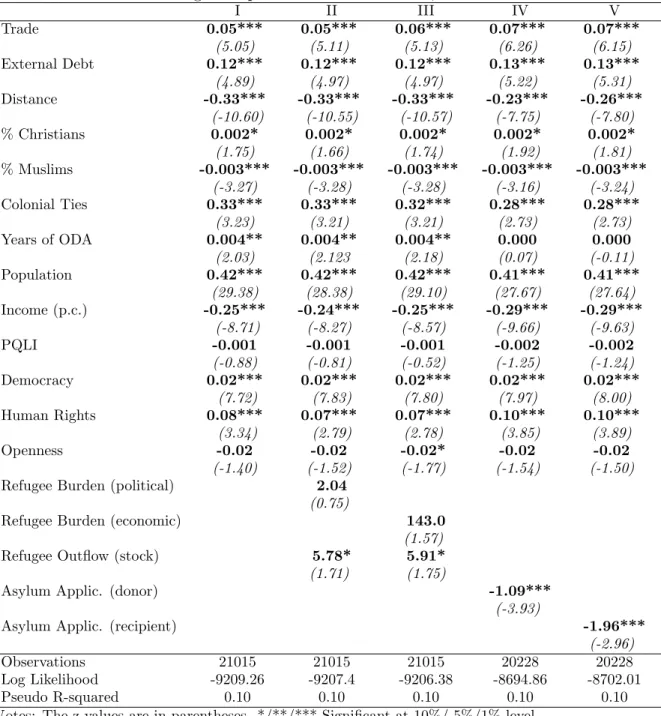
Tables 1 and 2 provide the results for the eligibility and the level stage estimation on ODA, respectively. For the eligibility stage, bilateral trade displays a positive and significant coefficient supporting the hypothesis that trade relations between the
19The PTS is ranked on a scale of one to five, where one is the category with the least frequency
of torture and political imprisonment and five describes the worst conditions for the population under the predominating regime including regularly torture and murder.
20The other commonly used variable is the civil and political rights indices from Freedom House,
which indicate e.g. the freedom to form political parties and to compete for leading positions in government, as well as liberty with respect to religious, ethnic and personal freedoms. However, we use the PTS variable, instead of the political and civil rights indices, for statistical reasons. The joint variable on civil and political rights is highly correlated with both the democracy variable and the PTS, whereas the correlation between the PTS and the democracy determinant is negligible, therefore the latter two variables are included. Nevertheless, we use the civil and political rights measure for a robustness check.
Table 1: Logit: Dependent Variable: ODA, 1992-2003 I II III IV V Trade 0.05*** 0.05*** 0.06*** 0.07*** 0.07*** (5.05) (5.11) (5.13) (6.26) (6.15) External Debt 0.12*** 0.12*** 0.12*** 0.13*** 0.13*** (4.89) (4.97) (4.97) (5.22) (5.31) Distance -0.33*** -0.33*** -0.33*** -0.23*** -0.26*** (-10.60) (-10.55) (-10.57) (-7.75) (-7.80) % Christians 0.002* 0.002* 0.002* 0.002* 0.002* (1.75) (1.66) (1.74) (1.92) (1.81) % Muslims -0.003*** -0.003*** -0.003*** -0.003*** -0.003*** (-3.27) (-3.28) (-3.28) (-3.16) (-3.24) Colonial Ties 0.33*** 0.33*** 0.32*** 0.28*** 0.28*** (3.23) (3.21) (3.21) (2.73) (2.73) Years of ODA 0.004** 0.004** 0.004** 0.000 0.000 (2.03) (2.123 (2.18) (0.07) (-0.11) Population 0.42*** 0.42*** 0.42*** 0.41*** 0.41*** (29.38) (28.38) (29.10) (27.67) (27.64) Income (p.c.) -0.25*** -0.24*** -0.25*** -0.29*** -0.29*** (-8.71) (-8.27) (-8.57) (-9.66) (-9.63) PQLI -0.001 -0.001 -0.001 -0.002 -0.002 (-0.88) (-0.81) (-0.52) (-1.25) (-1.24) Democracy 0.02*** 0.02*** 0.02*** 0.02*** 0.02*** (7.72) (7.83) (7.80) (7.97) (8.00) Human Rights 0.08*** 0.07*** 0.07*** 0.10*** 0.10*** (3.34) (2.79) (2.78) (3.85) (3.89) Openness -0.02 -0.02 -0.02* -0.02 -0.02 (-1.40) (-1.52) (-1.77) (-1.54) (-1.50)
Refugee Burden (political) 2.04
(0.75)
Refugee Burden (economic) 143.0
(1.57)
Refugee Outflow (stock) 5.78* 5.91*
(1.71) (1.75)
Asylum Applic. (donor) -1.09***
(-3.93)
Asylum Applic. (recipient) -1.96***
(-2.96)
Observations 21015 21015 21015 20228 20228
Log Likelihood -9209.26 -9207.4 -9206.38 -8694.86 -8702.01
Pseudo R-squared 0.10 0.10 0.10 0.10 0.10
Notes: The z-values are in parentheses. */**/*** Significant at 10%/ 5%/1% level.
donor and the recipient country affect aid eligibility. A similar positive influence is reported for the degree of external debt. Geographical distance influences the donors’ aid eligibility decision negatively. Contrarily, bilateral relationships, expressed by colonial ties and the number of years of bilateral development cooperation, have a positive impact on the aid allocation decision. Cultural similarities show the
whereas countries with a high share of Muslims are less probable to receive aid. Throughout the different regressions, poorer and larger countries are more likely to receive aid. The PQLI coefficients show the expected negative sign, but exert no significant influence on the donor’s decision to allocate aid at all. Countries with a higher level of democratic structures are more likely to receive aid than those with autocratic tendencies. Securing human rights is not rewarded, quite the contrary, the coefficients consistently exhibit positive signs. On the eligibility stage, economic as well as social burdens resulting from refugee hosting in recipient countries do not have a significant impact on the binary aid allocation decision of donors. Both variables controlling for burden-sharing motivations do not have any significant effect, even though they display the expected sign. On the other hand, migration preventive interests, controlled for by the stock of refugee outflow, displays some weak significance. Asylum applications are reported with a negative impact on the aid eligibility choice of the donor. The more asylum applications that have been submitted to the donor country, the less eligible the source country is to receive aid. That is, the higher the migration pressure on the donor country, the less likely the source country is to receive aid at all.
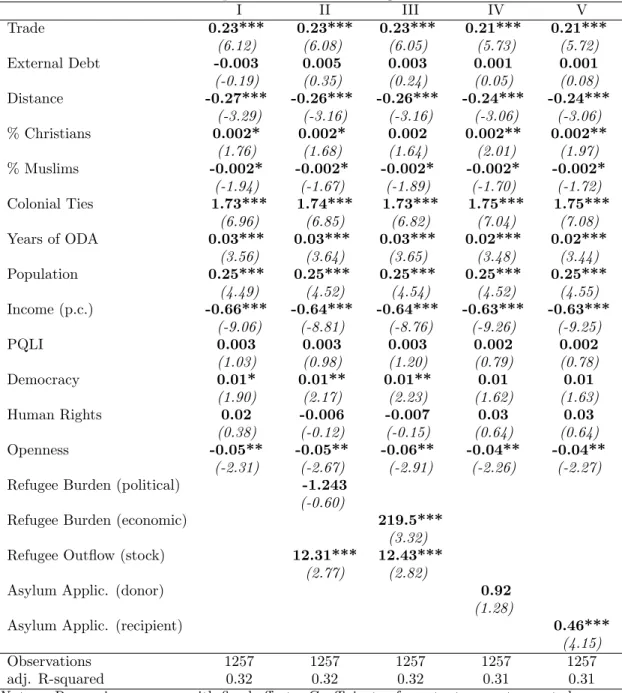
For the level stage of ODA allocation, donor self-interest variables, in line with the eligibility stage, do predominantly have a significant influence on the allocation of aid. Aid is positively correlated with the amount of exports to the recipient coun-try, however, external debt, which played a role in determining whether a country is eligible to receive aid, displays no significance at the level stage. Geographical dis-tance influences the amount of aid allocated negatively, whereas, colonial ties as well as the number of years of development cooperation raise the share of bilateral aid transfers. Cultural and religious (dis-)similarity, measured by the share of the recip-ient country’s population that is Christian or Muslim, have the expected signs, that is positive for similarity and negative for dissimilarity. By controlling for recipient need variables, more aid is allocated to poorer and more populated countries, even though evidence exists that there is a large-country bias. Countries which are one percent larger than others receive only 0.25 percent more aid. Human development (PQLI) does not significantly influence the amount of aid allocated, just as it did
Table 2: OLS: Dependent Variable: Log of ODA, 1992-2003 I II III IV V Trade 0.23*** 0.23*** 0.23*** 0.21*** 0.21*** (6.12) (6.08) (6.05) (5.73) (5.72) External Debt -0.003 0.005 0.003 0.001 0.001 (-0.19) (0.35) (0.24) (0.05) (0.08) Distance -0.27*** -0.26*** -0.26*** -0.24*** -0.24*** (-3.29) (-3.16) (-3.16) (-3.06) (-3.06) % Christians 0.002* 0.002* 0.002 0.002** 0.002** (1.76) (1.68) (1.64) (2.01) (1.97) % Muslims -0.002* -0.002* -0.002* -0.002* -0.002* (-1.94) (-1.67) (-1.89) (-1.70) (-1.72) Colonial Ties 1.73*** 1.74*** 1.73*** 1.75*** 1.75*** (6.96) (6.85) (6.82) (7.04) (7.08) Years of ODA 0.03*** 0.03*** 0.03*** 0.02*** 0.02*** (3.56) (3.64) (3.65) (3.48) (3.44) Population 0.25*** 0.25*** 0.25*** 0.25*** 0.25*** (4.49) (4.52) (4.54) (4.52) (4.55) Income (p.c.) -0.66*** -0.64*** -0.64*** -0.63*** -0.63*** (-9.06) (-8.81) (-8.76) (-9.26) (-9.25) PQLI 0.003 0.003 0.003 0.002 0.002 (1.03) (0.98) (1.20) (0.79) (0.78) Democracy 0.01* 0.01** 0.01** 0.01 0.01 (1.90) (2.17) (2.23) (1.62) (1.63) Human Rights 0.02 -0.006 -0.007 0.03 0.03 (0.38) (-0.12) (-0.15) (0.64) (0.64) Openness -0.05** -0.05** -0.06** -0.04** -0.04** (-2.31) (-2.67) (-2.91) (-2.26) (-2.27)
Refugee Burden (political) -1.243
(-0.60)
Refugee Burden (economic) 219.5***
(3.32)
Refugee Outflow (stock) 12.31*** 12.43***
(2.77) (2.82)
Asylum Applic. (donor) 0.92
(1.28)
Asylum Applic. (recipient) 0.46***
(4.15)
Observations 1257 1257 1257 1257 1257
adj. R-squared 0.32 0.32 0.32 0.31 0.31
Notes: Regressions are run with fixed effects. Coefficients of constant are not reported. The t-values are in parentheses. */**/*** Significant at 10%/ 5%/1% level.
not influence the eligibility of a country to receive aid. Considering good governance rewarding effects, the results of the eligibility stage are weakly supported. The more progressed in establishing democratic structures the recipient country is, the higher the share of aid it receives from bilateral donors. On the other hand, respect for human rights is insignificant throughout.
We find strong evidence for our hypothesis that donors use development aid for migration management purposes. The refugee stock variable is strongly significant, indicating that a refugee outflow is of considerable concern for donor countries. Thus, aid is significantly deployed for migration prevention purposes. Furthermore, the number of asylum applications, indicating the direct bilateral migration pres-sure towards the donor country, is positive but only significant with respect to the recipient country’s total population. Donor countries tend to transfer more aid to-wards refugee-sending countries if they are directly affected. The coefficients of the burden-sharing variables indicate that social or political aspects do not influence aid allocation decisions significantly, while economic burdens are positively correlated to the share of aid allocated to the recipient country. This constitutes rather weak evidence for underlying burden-sharing motivations of ODA allocation decisions of bilateral donors.
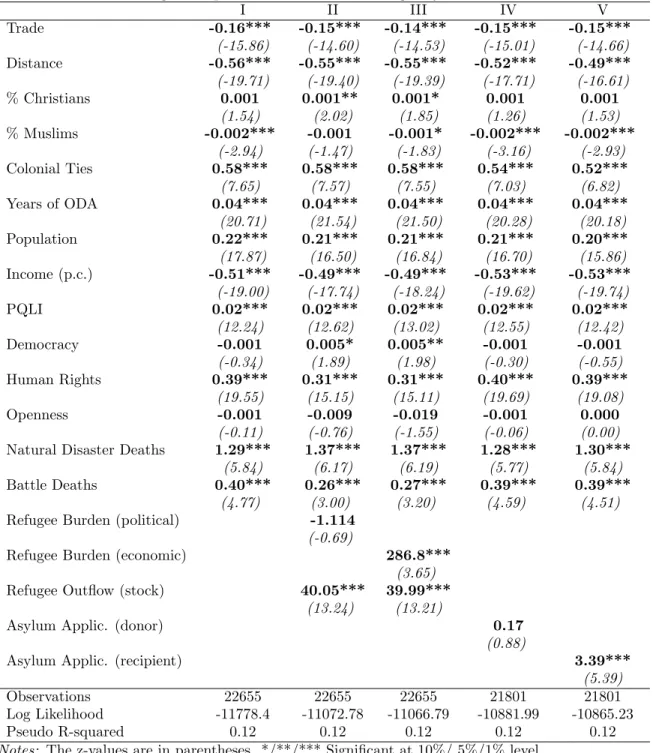
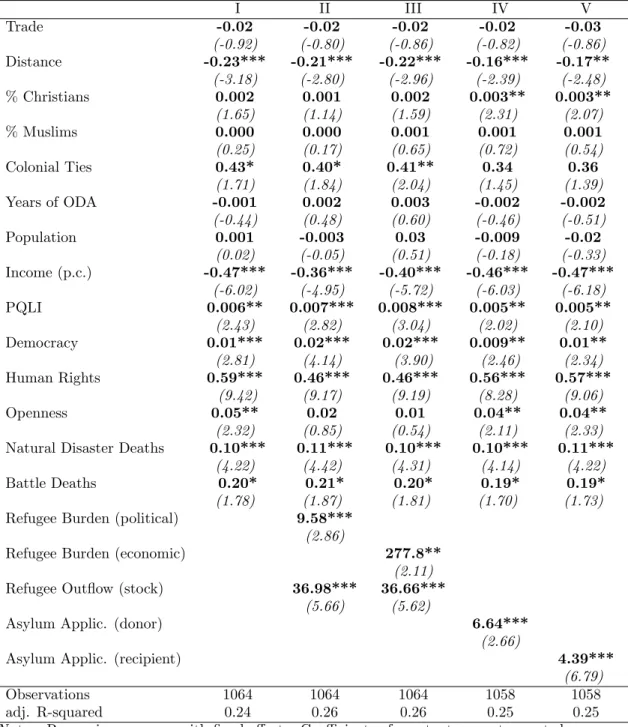
Tables 3 and 4 provide the results for the eligibility and the level stage estimation of emergency aid. At the level stage the influence of donor interest variables is less distinct than at the eligibility stage. We find that the bilateral trade volume is in-significant for all level regressions. However, it is in-significant throughout the binary choice regressions, however, with an unexpected negative sign which contradicts our assumption that better trade relations influence the decision on aid allocation posi-tively. Geographical distance affects both the eligibility and the amounts of received emergency aid negatively, which reveals bilateral donors pay less attention to more distant recipient countries in times of humanitarian crises. Cultural similarity shows ambiguous significance, indicating that countries with a high share of Muslim popu-lation are less eligible to receive emergency aid. However, at the level stage, Muslim countries are not discriminated against. Former colonial ties seem to be an asset for receiving emergency aid in times of urgent need. Furthermore, besides the colonial background, long-lasting bilateral development cooperation between donor and re-cipient countries is significant only for the eligibility stage, not for the scale of aid transfers. This means that the longer there has been a donor-recipient development cooperation partnership, the higher the probability also to receive aid for humani-tarian purposes. Moreover, poorer and larger countries appear to be more eligible
Table 3: Logit: Dependent Variable: Emergency Aid, 1992-2003 I II III IV V Trade -0.16*** -0.15*** -0.14*** -0.15*** -0.15*** (-15.86) (-14.60) (-14.53) (-15.01) (-14.66) Distance -0.56*** -0.55*** -0.55*** -0.52*** -0.49*** (-19.71) (-19.40) (-19.39) (-17.71) (-16.61) % Christians 0.001 0.001** 0.001* 0.001 0.001 (1.54) (2.02) (1.85) (1.26) (1.53) % Muslims -0.002*** -0.001 -0.001* -0.002*** -0.002*** (-2.94) (-1.47) (-1.83) (-3.16) (-2.93) Colonial Ties 0.58*** 0.58*** 0.58*** 0.54*** 0.52*** (7.65) (7.57) (7.55) (7.03) (6.82) Years of ODA 0.04*** 0.04*** 0.04*** 0.04*** 0.04*** (20.71) (21.54) (21.50) (20.28) (20.18) Population 0.22*** 0.21*** 0.21*** 0.21*** 0.20*** (17.87) (16.50) (16.84) (16.70) (15.86) Income (p.c.) -0.51*** -0.49*** -0.49*** -0.53*** -0.53*** (-19.00) (-17.74) (-18.24) (-19.62) (-19.74) PQLI 0.02*** 0.02*** 0.02*** 0.02*** 0.02*** (12.24) (12.62) (13.02) (12.55) (12.42) Democracy -0.001 0.005* 0.005** -0.001 -0.001 (-0.34) (1.89) (1.98) (-0.30) (-0.55) Human Rights 0.39*** 0.31*** 0.31*** 0.40*** 0.39*** (19.55) (15.15) (15.11) (19.69) (19.08) Openness -0.001 -0.009 -0.019 -0.001 0.000 (-0.11) (-0.76) (-1.55) (-0.06) (0.00)
Natural Disaster Deaths 1.29*** 1.37*** 1.37*** 1.28*** 1.30***
(5.84) (6.17) (6.19) (5.77) (5.84)
Battle Deaths 0.40*** 0.26*** 0.27*** 0.39*** 0.39***
(4.77) (3.00) (3.20) (4.59) (4.51)
Refugee Burden (political) -1.114
(-0.69)
Refugee Burden (economic) 286.8***
(3.65)
Refugee Outflow (stock) 40.05*** 39.99***
(13.24) (13.21)
Asylum Applic. (donor) 0.17
(0.88)
Asylum Applic. (recipient) 3.39***
(5.39)
Observations 22655 22655 22655 21801 21801
Log Likelihood -11778.4 -11072.78 -11066.79 -10881.99 -10865.23
Pseudo R-squared 0.12 0.12 0.12 0.12 0.12
Notes: The z-values are in parentheses. */**/*** Significant at 10%/ 5%/1% level.
to receive emergency aid. However, we find no evidence to support the assumption that with increasing human development, the probability for receiving aid decreases. Quite the contrary, the positive signs indicate that emergency aid is positively cor-related to higher scores on the PQLI. Democratic structures do not strictly make a
country more likely to be eligible for receiving emergency assistance, however if eli-gible, more democratic countries receive more emergency assistance. Humanitarian catastrophes, either caused by natural disasters or violent conflicts, generally initi-ate solidarity with the affected country. However, donors seem to evaluiniti-ate victims of natural disasters differently from those of violent clashes. Donors are more likely to assist in natural catastrophes than in violent conflicts. However, if donors are willing to support at all, casualties of violent conflicts attract double the attention of those of natural disasters. Thus, countries with high numbers of battle fatalities and a low respect for human rights are more eligible for receiving emergency aid. Thus, human rights violations and violent conflicts are not disciplined by reduced amounts of emergency aid, i.e. compassion seems to dominate reprehension.
At the eligibility stage, we find no evidence for a social burden-sharing policy (con-trolled for by refugees per capita), while the sharing of an economic refugee burden (controlled for by refugees per GDP) seems to be in the interest of donors. Countries with a high proportion of refugee emigration are more likely to receive emergency aid. At least one measure for controlling lobbying activities is significant and con-firms the respective hypothesis. The more asylum applications that are submitted bilaterally to the donor country, the more eligible the recipient country becomes for emergency aid. At the level stage, we find strong evidence for both an economic as well as social and political burden-sharing policy. This indicates that countries with a high number of refugees either with respect to the size of their own population or to their own GDP, obtain more aid. Countries of origin tend to receive more aid when people leave the country. As Czaika (2005) already noted, this might induce counterproductive incentives, since source countries could be tempted to enhance refugee flights to attract more emergency aid. Finally, asylum applications display a positive and significant sign. Two explanations for this result are interrelated: first, ’information’ about the urgency is transmitted by the numbers of asylum seekers to the donor country, and that seeks to stabilize the conditions in the source country, so that voluntary repatriation might become an option. The second explanation states that asylum seekers proactively lobby the (emergency) aid allocation decision mak-ing process of the donor (and their host) country for the sake of their compatriots
Table 4: OLS: Dependent Variable: Log of Emergency Aid, 1992-2003 I II III IV V Trade -0.02 -0.02 -0.02 -0.02 -0.03 (-0.92) (-0.80) (-0.86) (-0.82) (-0.86) Distance -0.23*** -0.21*** -0.22*** -0.16*** -0.17** (-3.18) (-2.80) (-2.96) (-2.39) (-2.48) % Christians 0.002 0.001 0.002 0.003** 0.003** (1.65) (1.14) (1.59) (2.31) (2.07) % Muslims 0.000 0.000 0.001 0.001 0.001 (0.25) (0.17) (0.65) (0.72) (0.54) Colonial Ties 0.43* 0.40* 0.41** 0.34 0.36 (1.71) (1.84) (2.04) (1.45) (1.39) Years of ODA -0.001 0.002 0.003 -0.002 -0.002 (-0.44) (0.48) (0.60) (-0.46) (-0.51) Population 0.001 -0.003 0.03 -0.009 -0.02 (0.02) (-0.05) (0.51) (-0.18) (-0.33) Income (p.c.) -0.47*** -0.36*** -0.40*** -0.46*** -0.47*** (-6.02) (-4.95) (-5.72) (-6.03) (-6.18) PQLI 0.006** 0.007*** 0.008*** 0.005** 0.005** (2.43) (2.82) (3.04) (2.02) (2.10) Democracy 0.01*** 0.02*** 0.02*** 0.009** 0.01** (2.81) (4.14) (3.90) (2.46) (2.34) Human Rights 0.59*** 0.46*** 0.46*** 0.56*** 0.57*** (9.42) (9.17) (9.19) (8.28) (9.06) Openness 0.05** 0.02 0.01 0.04** 0.04** (2.32) (0.85) (0.54) (2.11) (2.33)
Natural Disaster Deaths 0.10*** 0.11*** 0.10*** 0.10*** 0.11***
(4.22) (4.42) (4.31) (4.14) (4.22)
Battle Deaths 0.20* 0.21* 0.20* 0.19* 0.19*
(1.78) (1.87) (1.81) (1.70) (1.73)
Refugee Burden (political) 9.58***
(2.86)
Refugee Burden (economic) 277.8**
(2.11)
Refugee Outflow (stock) 36.98*** 36.66***
(5.66) (5.62)
Asylum Applic. (donor) 6.64***
(2.66)
Asylum Applic. (recipient) 4.39***
(6.79)
Observations 1064 1064 1064 1058 1058
adj. R-squared 0.24 0.26 0.26 0.25 0.25
Notes: Regressions are run with fixed effects. Coefficients of constant are not reported. The t-values are in parentheses. */**/*** Significant at 10%/ 5%/1% level.
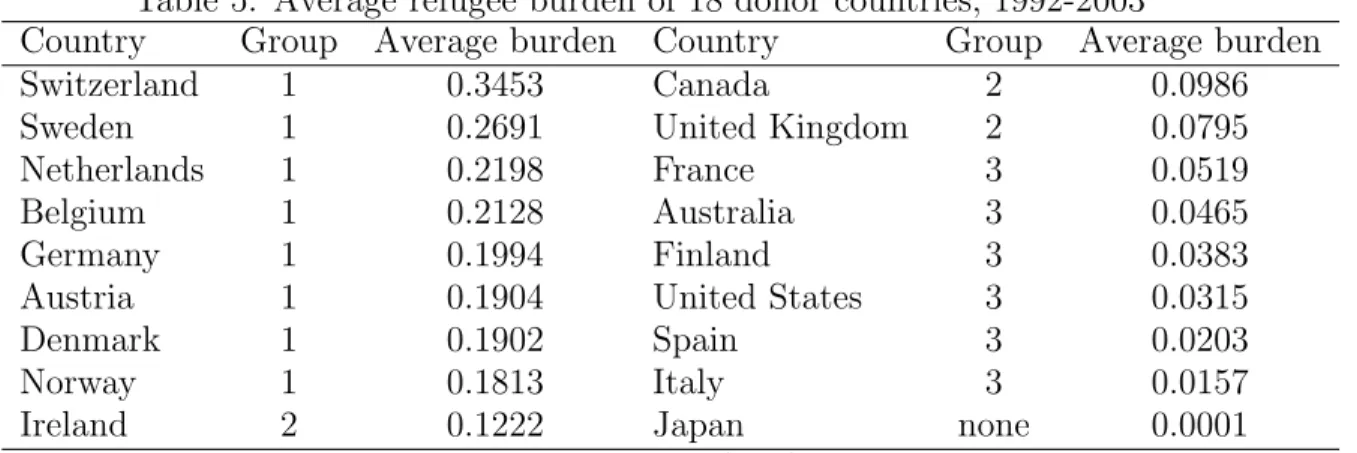
Table 5: Average refugee burden of 18 donor countries, 1992-2003
Country Group Average burden Country Group Average burden
Switzerland 1 0.3453 Canada 2 0.0986
Sweden 1 0.2691 United Kingdom 2 0.0795
Netherlands 1 0.2198 France 3 0.0519
Belgium 1 0.2128 Australia 3 0.0465
Germany 1 0.1994 Finland 3 0.0383
Austria 1 0.1904 United States 3 0.0315
Denmark 1 0.1902 Spain 3 0.0203
Norway 1 0.1813 Italy 3 0.0157
Ireland 2 0.1222 Japan none 0.0001
Notes: Own calculations, refugee data from UNHCR (2005).
4.3
Robustness
The sensitivity of the preceding results is analyzed by changing some model speci-fications.21 Firstly, the good governance variables democracy and human rights are
replaced by the Freedom House variable on civil and political rights, which is highly correlated to both variables.22 However, this alters only slightly the previous
find-ings, and the evidence for altruistic burden-sharing policies by allocating emergency aid primarily to refugee-hosting countries does not change. For the allocation of ODA, the estimation results do not vary by exchanging the variables. Secondly, we group the donors into three classes according to their average refugee burden. This is measured by the number of asylum applications claimed to a donor country di-vided by its population, and taking the average of the period 1992 to 2003. Average burdens and group classifications of the countries are depicted in Table 5.
Japan was not included, since its average burden covers less than one percent of Italy’s, the country with the second lowest average burden. The emergency aid estimation results for the first group of donors, that is those with a relatively high average refugee burden, shows that, except for the variable on social and political burdens, all other refugee-related variables stay significant. The second group of countries with medium refugee burdens, display insignificance for economic burdens, while social and political burdens are alleviated through higher amounts of aid.
21Throughout this analysis, emphasis is put on the level stage rather than on the eligibility stage. 22The results of these regressions are available on request.
Additionally, the asylum applications variable (donor) becomes insignificant. The third group, with a relatively small refugee burden in terms of submitted asylum applications, also exhibits insignificance towards social and political burdens. At the same time, the asylum application variable (recipient), which reflects a bilateral migration pressure on the donor country, also becomes insignificant. This robustness check suggests that the refugee stock variable is the only determinant for emergency aid allocations independent of differing model specifications, whereas significance levels of the other variables differ between the donor groups. For the grouped ODA allocation estimations, two major differences in the results emerge. In the first two groups, social and political burdens of refugee-hosting recipient countries are taken into account, whereas the results for donors with lower refugee burdens stay in line with the previous outcome. The variable testing for the economic burden remains unchanged. The second major difference is the significance of the asylum application (donor) variable, which is now positively correlated with the amount of allocated aid.
5
Conclusion
This paper focuses on the effects of refugee movements on the allocation of hu-manitarian and development aid of bilateral donors. Until now, the aid allocation literature does not treat this question. Increasing refugee inflows and outflows, par-ticularly within the most fragile regions of the developing world, highlight the need of both sending and hosting countries for international support. Generally, two ap-proaches for international support of first asylum countries are discussed: financial and physical burden-sharing. While the latter is not part of the present analysis, financial (humanitarian and development) aid is of great importance to alleviate the burdens of refugee-hosting developing countries. By linking the two subjects, we investigate if and how refugee movements influence the aid allocation decisions of bilateral donors and test possible underlying motivations. Our results indicate that refugee movements generally influence the allocation of bilateral aid, though the mo-tives of aid allocation vary. The outcomes suggest that the allocation of emergency