Editorial Office: 410 22nd St. E., Suite 820, Saskatoon, SK, Canada, S7K 5T6. _____ Phone (306) 244-4800; Fax (306) 244-7839; email: [email protected] 14
The Complexities of the Interface
between Agricultural Policy and Trade
The world is full of complexities, making empirical welfare economics difficult.
A n d r e w S c h m i t z
Troy G. Schmitz
Associate Professor, Agribusiness and Resource Management, Arizona State University
Andrew Schmitz
Professor and Eminent Scholar, Food and Resource Economics, University of Florida This paper is based in part on a presentation at the July 2010 Agricultural and Applied Economics Association meetings, Denver, Colorado. We thank Carole Schmitz for her comments on earlier drafts.
Tariff and non-tariff barriers are widespread as applied to agricultural trade. The theory of gains from trade considers the impacts of free trade relative to no trade and to non-tariff barriers, while the theory of agricultural policy generally places little weight on the international trading sector. However, it is necessary to combine agricultural policy with the international trading sector so that agricultural policy instruments such as price supports are considered together with barriers to trade such as tariffs. This is possible within the context of welfare economics when considering the costs and benefits of alternative agricultural and trade policies.
Keywords: agricultural policy, biofuels, export taxes, gains from trade, tariffs
T h e E s t e y C e n t r e J o u r n a l o f
International Law
and Trade Policy
Estey Centre Journal of International Law and Trade Policy ____________ 15
Introduction
he discussion of gains from trade goes back at least to Adam Smith (Letiche, Chambers, and Schmitz, 1979). A significant body of literature now exists on the impact of removing tariff and non-tariff barriers. This literature falls under the heading gains from trade. This topic is also taken up in welfare economics, in part because gains-from-trade proofs often make use of the concept of economic surplus, that forms the basis of modern welfare economics (Just, Hueth, and Schmitz, 2004).
Paralleling the discussion on gains from trade is the literature on the welfare economics of agricultural policy and its impact on trade. It is possible for policy to impact trade even in the absence of tariffs and quotas.
With the above discussion in mind, there appears to be a great deal of confusion over what is meant, at least in empirical modeling, about the economic gains from moving to freer trade. For example, does moving to freer trade mean eliminating farm programs, or eliminating tariff and non-tariff barriers, or does it mean something different? The welfare economics of farm policy contains trade, but trade is only one aspect of policy models.
What is even more confusing is the discussion of the net gains from trade for countries in aggregate versus the net gain from trade for a single country. It turns out that the welfare impact for an individual country imposing tariffs or price supports can be large, but the impact when exporters and importers are considered together is relatively small. In welfare models of policy and trade, distributional impacts can be significant even though the inefficiency impacts can be small.
The purpose of this paper is to help clarify the meaning of such terms as gains from trade,the welfare impact of agricultural policy, and the interface between trade and policy. In the discussion, several models are brought forward that include two distortions, such as price supports and import controls coupled with policies that affect inputs used to produce outputs. In these cases, the results require a cautious interpretation.
Gains from Trade, Tariffs, and Export Taxes
The concept of gains from trade is usually discussed in the frame of a comparison between free trade and no trade. From a technical standpoint, the gains from free trade are measured as areas above excess supply curves and below excess demand curves (see the technical annex). In a general equilibrium context, there are losers and gainers from trade, but on net, all countries gain from free trade. This general statement pervades the economic literature and is the basis for much of the empirical work on the impact of freer trade in agriculture.
Estey Centre Journal of International Law and Trade Policy ____________ 16 The common trade-distorting instruments, such as tariffs, export taxes, and
production quotas, can also be discussed within the context of welfare economics. Individual countries can gain from such trade instruments, but the gains are less than what the trading partners lose. In other words, there are net losses from the use of trade instruments. Thus the outcome of trade barriers does not satisfy either the Pareto nor the Compensation principle (see the technical annex).
From a technical standpoint, the optimal welfare tariff is one where the importer acts as a monopsonist against an exporter, while in the optimal export tax case the exporter acts as a monopolist against an importer. In the case of the optimal revenue tariff, the government in the importing country behaves as both a monopsonist and monopolist. Also the net welfare costs of these trade instruments are given by deadweight loss (DWL) triangles. Of the instruments, the optimal revenue tariff leads to the greatest net welfare cost.
Optimal Byrd Tariff
In many models of international trade, little emphasis is given to processors and other sectors beyond the farm gate. However, under the optimal Byrd tariff, where the tariff revenues go to the petitioners for trade litigation, processors play a key role as they are often the sector that brings legal action against another country for unfair trade practices (Schmitz, Seale, and Schmitz, 2006). Under the Byrd tariff, processors, for example, can gain relative to free trade as they have the potential of gaining through lower import prices and higher internal prices than would otherwise be the case. Under the Byrd Amendment processors can theoretically extract large hidden rents by receiving monopolistic and monopsonistic rents.
There can be large distributional effects from the Byrd tariff, as in the classic tariff models, but the net welfare effect for both countries taken together can be small. (The welfare effect of price distortions can be significant for an individual country, but the net gains from trade, taking into account trading partners, can be relatively small.) Like classic tariff models, the Byrd tariff generates net welfare costs that can be summarized as a DWL triangle.
Trade Elimination and Policy Sw itching
One can derive models where, if one takes into account retaliatory action by an importer in response to a tariff policy by an exporter, a situation can arise where trade ceases. In addition, under retaliatory action, tariffs can give way to production subsidies (see the technical annex). As a result, even if one correctly measures the
Estey Centre Journal of International Law and Trade Policy ____________ 17 impact of production subsidies in a trade context, the policy instrument that gives rise
to the subsidies can be a tariff. Note that production subsidies are common worldwide, including those in China. We hypothesize that many of these subsidies can be a result of early tariff protection.
In a two country model, the gain in absolute size to Country A from retaliation is far greater than either the gain or loss to Country B. (The loss may be positive or negative depending on price elasticities and the size of the tariff.) There is policy switching, and the net improvement from this subsidy is positive. Country A gains while Country B loses, but on net (i.e., both countries taken together), there is a net welfare gain by Country A from retaliating to Country B’s use of the tariff.
Production Quotas
Production quotas have long been used for traded commodities. Two examples include the early U.S. production quota programs for peanuts and tobacco. In a seminal paper, Paul Johnson (1965) argued that there could be net benefits from the U.S. tobacco program because production quotas gave rise to monopolistic prices being charged to tobacco importers. In essence, this argument runs counter to results for a closed, no-trade model where production quotas result in net welfare costs.
Voluntary export restraints are common in international trade (Bredahl, Schmitz, and Hillman, 1987). This type of restraint essentially involves a production quota for exporters. In this case, the producers in both the importing and exporting countries gain. At the extreme, the voluntary export restraint is equivalent to the optimal export tax discussed earlier, but the tax revenue resides with export producers.
Price Supports and Exports
When modeling the impact of price supports, one clearly has to incorporate both the domestic and trade sectors. It is difficult for one to speak about trade in the absence of agricultural policy. Also, it is necessary to include price supports and their impact on trade along with input subsidies. These two distortions can lead to both large trade and welfare effects. The case of U.S. cotton policy clearly highlights that the impact on trade can be significant along with the welfare cost. Furthermore, there can be negative gains from trade, a concept often ignored in trade discussions.
Consider the case where trade takes place in the presence of domestic agricultural policy but in the absence of any tariff or non-tariff barriers. The interesting result is that, from the exporter’s perspective, the cost of price supports is far greater than the net cost for both the exporter and importer taken together. Also, the net effect is a
Estey Centre Journal of International Law and Trade Policy ____________ 18 DWL triangle, as was the case for trade in the presence of tariffs and export taxes
discussed earlier. Key points:
• Price supports result in increased exports.
• There are net welfare gains to the exporter from removing the price support, but the importer loses.
• There are “negative gains” from trade in the sense that the exporter can be better off with no trade than with trade under price supports (Schmitz, Schmitz, and Dumas, 1997).
• Trade can be impacted by domestic farm policy in the absence of tariff or non-tariff barriers.
• The net welfare cost of exporter price supports for the aggregate of both exporters and importers can be far less than the net cost for the exporter from the use of price supports.
Input Subsidies and Price Supports
The motivation for the theory that combines price supports and water subsidies was the Brazilian lawsuit against the United States’ cotton policy. The Brazilians contended that the U.S. cotton policy significantly depressed world cotton prices. In the technical annex, we show a theoretical model that contains both cotton price supports and water subsidies. On the basis of the analysis, we found that the U.S. cotton policy depressed world cotton prices by about $0.18 to $0.22 per pound (Schmitz et al., 2010). The welfare costs of the U.S. cotton program were empirically estimated to be large. The history of the Brazilian lawsuit and the outcome are contained in Powell and Schmitz (2005). In the court ruling in favour of Brazil, the argument made was that the U.S. cotton policy resulted (according to lawyers) in a significant price suppression of world cotton prices (although from an economic perspective, it is unclear what percentage drop in price is needed for there to be a significant price suppression effect).
The model in the technical annex focuses on the interaction of input subsidies and price supports, which for our purpose include countercyclical payments (CCPs) and loan rate payments (LRPs). We analyze these instruments taken together and individually, and demonstrate that they operate in a multiplicative rather than an additive manner. In this model, the relative magnitude and distribution of the rents depend largely on the size of demand and supply elasticities, the amount of exports, and the per unit cost of the water subsidy. For example, the more elastic the supply, the greater the DWL triangle; also, the higher the proportion of domestic production
Estey Centre Journal of International Law and Trade Policy ____________ 19 that is exported, the greater the net cost of the combined subsidies. Using this model
framework, Schmitz, Schmitz, and Dumas (1997) show theoretically and empirically the existence of negative gains from trade for U.S. cotton.
A combination of the two subsidies distorts output more than when each one acts alone, causing the multiplicative effects of the two instruments to be greater than a mere summation of the individual effects. Both of these effects increase the size of the price support payments made by the government, and in conjunction with price supports, the aggregate size of the input subsidy is greater than in the absence of price supports.
Key points:
• The combination of price supports and input subsidies can lead to negative gains from trade.
• There are gainers and losers from domestic policy distortions (e.g., importers and domestic producers gain at the expense of domestic taxpayers).
Supply Management and Border Controls
Two distortions often exist together, such as import quotas along with production controls — the case of Canadian supply management. Here the welfare costs can be large or small even though trade may not be restricted as a result of supply management. In addition, this type of modeling highlights an element often ignored in trade analysis — the impact of trade on sectors beyond the farm gate, such as processors.
The model by Vercammen and Schmitz (1992) considers together import quotas and domestic production controls. The impact of supply management depends in part on the level of the constraint placed on imports. The tighter the import control, the greater will be the welfare cost of supply management. Regardless of the constraint placed on imports, the net effect of supply management is given by a DWL triangle.
An interesting aspect in supply management models is the value attached to production quotas. Quota values play a major role in determining compensation to producers and landowners if the policy containing production controls as a key ingredient is terminated. For example, in the buyout of the U.S. peanut program, government compensation to producers and landowners was based largely on peanut quota values (Schmitz and Schmitz, 2010a). Quota values would also play a role if, for example, supply management–type programs in Canada were eliminated.
Key point:
• Supply management can result in large welfare costs, but it need not cause trade distortions.
Estey Centre Journal of International Law and Trade Policy ____________ 20
Biofuels
One of the most difficult exercises in empirical welfare economics is conducting a benefit-cost analysis of the U.S. corn ethanol program (Schmitz, Moss, and Schmitz, 2007). This is because energy is used to produce corn which, in turn, through subsidies, is used to produce energy. Direct production subsidies are not the only policy instruments that affect trade. For example, with ethanol production, even in the absence of price supports, trade is affected by indirect subsidies to corn producers via tax credits to ethanol processors and tariffs on ethanol imports. In this case, corn producers win while other groups lose, including livestock producers.
The study by Schmitz, Moss, and Schmitz (2007) of the impact of ethanol tax credits clearly highlights the need to identify the gain to processors and other sectors beyond the farm gate. Also, government policy plays a key role in the analysis. For example, net welfare gains increase when one takes into account the impact of ethanol production on the lowering of farm subsidies.
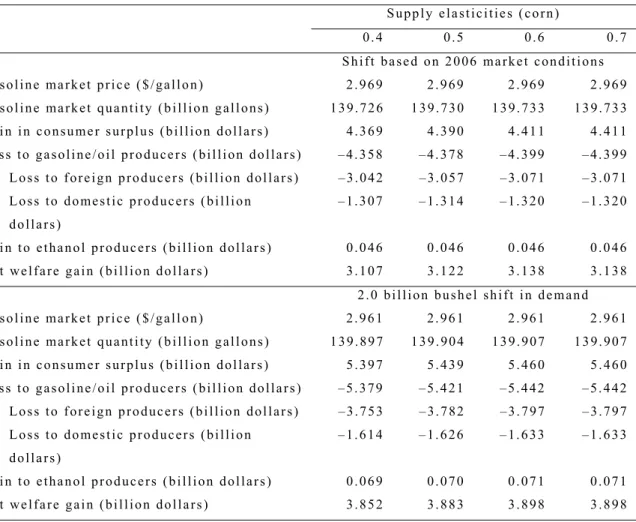
The analysis of production subsidies can be complex and difficult. In the ethanol case, one has to consider additional elements that are not easily captured in the corn market. One has to account for environmental impacts, the value of distillers grain, and the impact on the government payment of a corn farm subsidy. Also, perhaps more importantly, general equilibrium effects have to be considered. For example, how does ethanol consumption affect the overall fuels market? As we show in Table 1, the net welfare gains from providing ethanol tax credits can be positive if ethanol has a positive price-depressing effect in the overall fuels market. Du and Hayes (2008) argue, for example, that the impact of ethanol on the fuels market can be quite large (between $0.29 and $0.40 per gallon). Along the same lines, Zilberman et al. (2011) contend that fuel prices are impacted partly because the OPEC strategy of production controls is related to the U.S. ethanol policy. The debate over ethanol subsidies continues. Many of the components of an ethanol corn model, such as whether or not the price impact on the overall fuels market is significant, are open to debate.
Trade becomes an integral part of biofuels policy. First, there are exports and imports of ethanol. Second, trade is created from one of the ethanol byproducts, namely distillers grain (DG). Since 2002, U.S. ethanol production has increased by an average of 26 percent per year, reaching nine billion gallons in 2008. As a byproduct of dry-mill ethanol production, distillers grain production also increased rapidly, reaching approximately 20 million metric tons (million tonnes) in 2008 (Fox, 2009).
From 1995 to 2004, U.S. exports of DG averaged about 740,000 tonnes, ranging from 526,000 tonnes in 1996 to 842,000 tonnes in 2002 (Figure 1). Mexico and Canada accounted for approximately 43 percent of DG exports by the United States in
Estey Centre Journal of International Law and Trade Policy ____________ 21 2007 and 2008. Canadian imports peaked in 2008 at roughly 800,000 tonnes, but fell
to 600,000 in 2009 (Figure 2).
Table 1 U.S. Ethanol and the Broader Fuels Market
Supply ela st ic itie s (corn)
0 . 4 0 . 5 0 . 6 0 . 7
S h i ft ba se d on 2 0 06 ma rke t c on di t i on s
G a s ol i n e ma rk e t p ri c e ( $/ ga l l o n ) 2 . 9 6 9 2 . 9 6 9 2 . 9 6 9 2 . 9 6 9
G a s ol i n e ma rk e t q ua nt i ty ( b i l l i o n gal l on s ) 1 3 9. 72 6 1 3 9. 73 0 1 3 9. 73 3 1 3 9. 73 3 G a i n i n c o n su m e r s ur pl u s (b i l l i o n d ol l a r s ) 4 . 3 6 9 4 . 3 9 0 4 . 4 1 1 4 . 4 1 1 L o ss to ga soli ne /o il pr o duce r s ( bil li on d o lla r s ) – 4. 3 58 – 4. 3 78 – 4. 3 99 – 4. 3 99 L o s s t o f ore i g n p ro d uc e r s (b i l l i o n d ol l a r s ) – 3. 0 42 – 3. 0 57 – 3. 0 71 – 3. 0 71 L o ss to domest ic producers (bill i on
dolla rs)
– 1. 3 07 – 1. 3 14 – 1. 3 20 – 1. 3 20
G a i n t o e t han o l p r od uc e rs (b i l l i on d ol l a r s ) 0 . 0 4 6 0 . 0 4 6 0 . 0 4 6 0 . 0 4 6
N e t wel fa re g a i n (b i l l i o n d o l l a r s ) 3 . 1 0 7 3 . 1 2 2 3 . 1 3 8 3 . 1 3 8
2.0 bill ion bushel shi ft in de mand
G a s ol i n e ma rk e t p ri c e ( $/ ga l l o n ) 2 . 9 6 1 2 . 9 6 1 2 . 9 6 1 2 . 9 6 1
G a s ol i n e ma rk e t q ua nt i ty ( b i l l i o n gal l on s ) 1 3 9. 89 7 1 3 9. 90 4 1 3 9. 90 7 1 3 9. 90 7 G a i n i n c o n su m e r s ur pl u s (b i l l i o n d ol l a r s ) 5 . 3 9 7 5 . 4 3 9 5 . 4 6 0 5 . 4 6 0 L o ss to ga soli ne /o il pr o duce r s ( bil li on d o lla r s ) – 5. 3 79 – 5. 4 21 – 5. 4 42 – 5. 4 42 L o s s t o f ore i g n p ro d uc e r s (b i l l i o n d ol l a r s ) – 3. 7 53 – 3. 7 82 – 3. 7 97 – 3. 7 97 L o ss to domest ic producers (bill i on
dolla rs)
– 1. 6 14 – 1. 6 26 – 1. 6 33 – 1. 6 33
G a i n t o e t han o l p r od uc e rs (b i l l i on d ol l a r s ) 0 . 0 6 9 0 . 0 7 0 0 . 0 7 1 0 . 0 7 1
N e t wel fa re g a i n (b i l l i o n d o l l a r s ) 3 . 8 5 2 3 . 8 8 3 3 . 8 9 8 3 . 8 9 8
Estey Centre Journal of International Law and Trade Policy ____________ 22
Figure 1 U.S. exports of DG, 1998–2009.
Figure 2 U.S. exports of DG to Canada and Mexico.
*Projected based on Jan-May
Source:USDA-FAS http://www.fas.usda.gov/ustrade/USTExHS10.aso?0/=
*Projected based on Jan-May
Estey Centre Journal of International Law and Trade Policy ____________ 23
Conclusions
This paper demonstrates the interconnection between trade policy and agricultural policy. Because of the significant role played by agricultural policy, its impact cannot be discussed without being placed in a trade context. Agricultural policy can impact agricultural trade in the absence of tariff and non-tariff barriers. Likewise, trade policy can impact agriculture even if agricultural policy instruments are absent. However, both are important and have to be modeled together, and the results should be discussed in the context of welfare economics, where gainers and losers and welfare net impacts are identified.
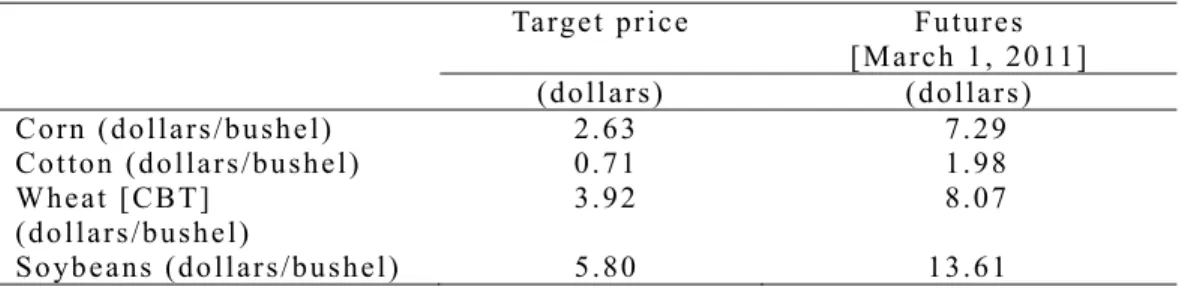
Empirically, the importance of combined trade and policy instruments depends in part on the time period covered by the analysis. For example, throughout much of the history of U.S. policy, the impact was significant, because U.S. farm policy established target prices for major commodities that were well above market prices. However, as of early 2011, market prices were significantly above target prices (Table 2). For example, cotton and corn prices were more than double the target prices set in the 2008 U.S. Farm Bill. Also, higher commodity prices give rise to importers lowering tariff and non-tariff barriers (Schmitz and Schmitz, 2010b). As a result, the impacts of farm policy (in conjunction with tariff and non-tariff barriers) are highly dependent on the extent to which time periods are included where target prices are binding.
Table 2 U.S. Target Prices and Futures for Selected U.S. Commodities
Target price Futures [March 1, 2011] (dollars) (dollars) Corn (dollars/bushel) 2.63 7.29 Cotton (dollars/bushel) 0.71 1.98 Wheat [CBT] (dollars/bushel) 3.92 8.07 Soybeans (dollars/bushel) 5.80 13.61
Estey Centre Journal of International Law and Trade Policy ____________ 24
References
Bredahl, M., A. Schmitz, and J. Hillman. 1987. Rent seeking in international trade: The great tomato war. American Journal of Agricultural Economics 69(1): 1-10. Du, X., and D. J. Hayes. 2008. The Impact of Ethanol Production on U.S. and
Regional Gasoline Prices and Regional Gasoline Prices and on the Profitability
of the U.S. Oil Refinery Industry. Working Paper 08-WP 467. Ames, IA: CARD.
Fox, J. A. 2009. Export Markets for Distillers Grains. North American Institute for Beef Economic Research (NAIBER), Kansas State University Agricultural Experiment Station and Cooperative Extension Service, Manhattan, KS.
Johnson, P. 1965. The social cost of the tobacco program. Journal of Farm Economics 47(2): 242-255.
Just, R., D. Hueth, and A. Schmitz. 2004. The Welfare Economics of Public Policy: A
Practical Approach to Project and Policy Evaluation. Northampton, MA: Edward
Elgar Publishing.
Letiche, J. M., R. G. Chambers, and A. Schmitz. 1979. The development of gains from trade theory: Classical to modern literature. In Economic Perspectives: An
Annual Survey of Economics, edited by M. Ballabon. NY: Gordon and Bresch
Publishing.
Powell, S. J., and A. Schmitz. 2005. The cotton and sugar subsidies decisions: WTO’s dispute settlement system rebalances the agreement on agriculture. Drake Journal of Agricultural Law 10(2): 287-330.
Schmitz, A., C. Moss, and T. G. Schmitz. 2007. Ethanol: No free lunch. Journal of Agricultural and Food Industrial Organization 5(2): Article 3.
http://www.bepress.com/jafio/vol5/iss2/art3.
Schmitz, A., C. B. Moss, T. G. Schmitz, H. W. Furtan, and H. C. Schmitz. 2010. Agricultural Policy, Agribusiness, and Rent-Seeking Behaviour. Second Edition. Toronto: University of Toronto Press.
Schmitz, A., J. Seale, and T. Schmitz. 2006. The optimal processor tariff under the Byrd Amendment. International Journal of Applied Economics 3(2): 9-20. Schmitz, A., and T. G. Schmitz. 2010a. Benefit-cost analysis: Distributional
considerations under producer quota buyouts. Journal of Benefit-Cost Analysis 1(1): Article 2. http://www.bepress.com/jbca/vol1/iss1/2.
Schmitz, A., and T. G. Schmitz. 2010b. US and EU agricultural policy: Divergence or convergence? In The Economic Impact of Public Support to Agriculture: An International Perspective, edited by V. E. Ball, R. Fanfani, and L. Gutierrez, 41-66. NY: Springer Publishing.
Schmitz, T., A. Schmitz, and C. Dumas. 1997. Gains from trade inefficiency of government payments and the net economic effects of trading. Journal of Political Economy 105(3): 637-647.
Vercammen, J., and A. Schmitz. 1992. Supply management and import concessions.
Estey Centre Journal of International Law and Trade Policy ____________ 25 Zilberman, D., D. Rajagopal, S. Sexton, G. Hochman, and T. Serra. 2011. The
economics of biofuels, food, and the environment. In The Economics of
Alternative Energy Sources and Globalization, edited by A. Schmitz, N. Wilson, C. Moss, and D. Zilberman, chapter 3. UAE: Bentham Science Publishers.