Research Institute of Industrial Economics P.O. Box 55665 SE-102 15 Stockholm, Sweden
IFN Working Paper No. 1057, 2015
Cross-Border Acquisitions and Restructuring:
Multinational Enterprises versus Private
Equity-Firms
Selva Baziki, Pehr-Johan Norbäck, Lars Persson
and Joacim Tåg
Cross-border Acquisitions and Restructuring:
Multinational Enterprises versus Private Equity-firms
∗
Selva B. Baziki Uppsala University Pehr-Johan Norbäck
Research Institute of Industrial Economics (IFN) Lars Persson
Research Institute of Industrial Economics (IFN) and CEPR Joacim Tåg
Research Institute of Industrial Economics (IFN)
January 2015
ABSTRACT
An increasingly large share of cross-border acquisitions are undertaken by private equity-firms (PE-firms) and not by traditional multinational enterprises (MNEs). We propose a model of cross-border acquisitions in which MNEs and PE-firms compete over domestic assets. MNEs’ advantage lies in firm-specific synergies and retained earnings, whereas PE-firms are good at reorganizing target firms. Prevailing interest rates do not work in favor of PE-firms, but a lower risk premium and a better financial market development does. Stronger firm-specific synergies, however, favors MNEs. Performing a welfare analysis, we show that a policy of restricting PE-firms from buying domestic assets can be counterproductive.
Keywords: Cross-border, International Restructuring, Ownership Efficiency, Private Equity, M&As. JEL Codes: F23, F65, L13.
∗
Financial support from the Marianne and Marcus Wallenberg Foundation and Tom Hedelius’ and Jan Wallander’s Research Foundation is gratefully acknowledged. We thank seminar participants at various institutions for excellent comments and suggestions. E-mail: [email protected]
1
Introduction
It is well established that cross-border acquisitions by multinational firms (MNEs) play a key role in the global industrial development and restructuring process. It is less known, however, that more than 8 percent of all cross-border acquisitions that took place during 1998-2010 were cross-border acquisitions undertaken by private equity firms (PE-firms). PE-firms are financial buyers of assets that acquire firms with the goal of restructuring and then reselling them. Data from the Capital IQ database displayed in Figure 1 shows that there is substantial variation over time, across countries, and across sectors in the share of cross-border acquisitions that are acquisitions by PE-firms as opposed to by MNEs.
Despite a burgeoning literature on cross-border acquisitions by MNEs, there is, to our knowl-edge, no work on the determinants and effects of cross-border acquisitions undertaken by PE-firms and their interaction with cross-border acquisitions undertaken by MNEs. What are potential determinants behind the variation we observe in Figure 1? And what are the welfare effects of acquisitions by PE-firms as opposed to MNEs?
To answer these questions, we develop a theory of cross-border acquisitions by MNEs and PE-firms. The starting point is that MNEs and PE-firms differ along three important dimensions. First, MNEs are "insiders" in an industry in the sense that they already have industry-specific knowledge and firm-specific assets in the global marketplace. These assets take the form of production facilities, intellectual property and retained earnings. Second, PE-firms are on the other hand "outsiders" that excel at reorganizing target firms to improve their productivity and profitability. As such, they do not have to rely on firm-specific assets to profit from acquisitions of target firms and they do not have to account for how their actions affect other potential asset holdings in the market. They are, however, required to rely to a greater extent on external investors to finance the acquisitions they undertake. Third, PE-firms are temporary owners of assets while MNEs are more permanent owners of assets. This implies that PE-firms are in need of clear exit strategies and face additional costs associated with reselling the target firms they acquire.
Using this distinction between MNEs and PE-firms, we propose the following model: initially there is a domestic product-market served by several foreign MNEs. There is also a domestic firm which is put up for sale. The domestic firm could be acquired either by one of the foreign MNEs or,
Figure 1: Percent of cross-border acquisitions that are undertaken by PE-firms 4 6 8 10 12 Pe rce n t b y PE-firms 1998 1999 2000 2001 2002 2003 2004 2005 2006 2007 2008 2009 2010 0 2 4 6 8 10 12 14 16 Percent by PE-firms China RussiaBrazil Mexico Hong Kong United StatesCanada India Ukraine Australia South AfricaIreland Poland Singapore New ZealandNorway United KingdomCzech Republic Austria BelgiumFinland Denmark NetherlandsSweden SwitzerlandSpain GermanyItaly France 0 2 4 6 8 10 12 14 Percent by PE-firms Information Technology Energy Materials Telecommunication Services Financials Healthcare Utilities Industrials Consumer Staples Consumer Discretionary
Notes. These figures display the percent of all cross-border acquisitions between 1998 and 2010 in the Capital IQ database that undertaken by PE-firms across time (top), country (bottom left), and sector (bottom right). We selected all "Mergers/Acquisitions" that had the feature "Cross-border" and "Acquisition of Majority Stake" and with transaction status "Closed" or "Effective". We then characterized the transaction as a transaction by a PE-firm if the transaction had the secondary feature of "LBO (Leveraged Buyout)". The figures display the percent of all cross-border transactions across time, country and industry for countries with more than 500 transactions in total.
alternatively, by one of several competing foreign PE-firms. Prior to bidding for the domestic firm, MNEs and PE-firms may seek financing from outside investors to finance the acquisition. Post-acquisition, product market competition takes place between the firms with assets in the market, repayments to outside investors are made, and finally—if a firm acquired the target—the PE-firm resells the target PE-firm.
We first establish that firm-specific synergies between MNE assets and the target firm assets are an important determinant of whether an MNA or a PE-firm ends up acquiring the target. Stronger synergies work in favor of the MNEs, that are then able to bid higher for the target firm than the PE-firms can. This suggests that variation across industries in how complementary assets are or how strong economies of scale are could be one important determinant of the the share of all cross-border transactions across industries that are acquisitions by PE-firms as opposed to acquisitions by MNEs.
We then show that acquisitions by PE-firms are more likely when financial market development in the target firm’s country is higher. The reason is that this makes exits by PE-firms less costly. For example, in countries with developed financial markets there are more exit opportunities, and it is common that PE-firms exit their investments by listing the target firm on a stock exchange. Financial market development may thus be one important factor determining the share of all cross-border acquisitions across countries that are made by PE-firms.
In addition to synergies and financial market development, we also examine how general financial market conditions affect whether an MNE or a PE-firm acquires the target. We show that the overall interest rate in the economy does not affect who ends up as the owner in equilibrium. At first glance, this result is surprising since PE-firms lack retained earnings and must to a greater extent rely on financing from banks and investors. However, with well functioning capital markets, the cost of access to capital from outside investors to finance the acquisition also determines the opportunity cost of retained earnings for MNEs. When the interest rate goes down, making access to external financing more costly, the opportunity cost of using retained earnings for the acquisition also increases, implying that the foreign MNE firms remain indifferent to using retained earnings or external financing to finance the acquisition. Acquisition prices, though, do respond to changes in the interest rate as higher interest rates reduce the amounts that both MNEs and PE-firms are willing to pay to make the acquisition.
However, in contrast to the general interest rate, the risk premium associated with lending does affect the equilibrium ownership of the target. In effect, since MNEs can finance part of an acquisition with retained earnings instead of going to outside investors, MNEs have an advantage over PE-firms when the risk premium is high. This financial advantage decreases when the risk pre-mium decreases. This suggests that we should observe fewer cross-border acquisitions by PE-firms relative to cross-border acquisitions by MNEs when economic conditions are worse and external financing for acquisitions is more costly.
Our model also allows us to explore the policy dimension. In the policy debate, there has been a concern that acquisitions by PE-firms—in particular byforeign PE-firms—are driven by short-run tax gains and asset stripping, resulting in job losses and long-run inefficiencies. For example, in 2005 Franz Muntefering of the ruling Social Democratic Party in Germany attacked foreign PE-firms making acquisitions in Germany by stating to the newspaper Bild that “They stay anonymous, have no face, fall upon companies like swarms of locusts, strip them bare and move on.”1
Performing a welfare analysis on the effects of restricting foreign PE-firms from buying domestic target firms, we underscore that restricting PE-firms can be counterproductive since PE-firms may prevent a concentration of the market and may also—in instances when synergies between the MNEs’ assets and the target’s assets are low—increase productivity of the target’s assets more than MNEs do.
Our paper is a contribution to the theoretical literature on cross-border mergers and acquisitions in oligopolistic markets. This literature has, in contrast to the traditional foreign direct investment literature, emphasized that greenfield investments and cross-border acquisitions are not perfect substitutes.2 There is also a small theoretical literature addressing welfare aspects of cross-border mergers in international oligopoly markets.3 Our contribution to these literatures is to build on Norbäck and Persson (2007, 2008) to incorporate foreign financial bidders in the form of PE-firms along the lines of Norbäck, Persson, and Tåg (2013). We are thus the first to propose an oligopoly
1
See also, for instance, “Testing the Model: Private Equity Faces a More Hostile World” (Jul 9 2009, The Economist), “Editorial, New Rules for Private Equity” (August 30 2009,New York Times) or “Private Equity Fights Tax Plan” (February 27 2009,Financial Times).
2See, for instance, Blonigen (1997), Bjorvatn (2004), Bertrand and Zitouna (2006), Fumagalli and Vasconcelos (2006) Head and Ries (2008), Mattoo, Olarreaga and Saggi (2004), Raff, Ryan and Stähler (2009) and Norbäck and Persson (2008)
3
This literature includes papers by, for example, Falvey (1998), Head and Ries (1997), Horn and Persson (2001), Lommerud, Straume and Sorgard (2006), Neary (2007) and Norbäck and Persson (2007).
model of cross-border acquisitions where MNEs compete for domestic target firms with foreign PE-firms. We then use this model to derive predictions on when acquisitions by PE-firms as opposed to by MNEs are more likely and to study the welfare effects of restricting acquisitions by PE-firms. The paper is also related to the literature on industrial reorganization in the finance literature which shows that M&A activity can be triggered by changes in owner productivity and the cost of new capital, where more productive owners buy assets from less productive ones.4 We add by showing that financial conditions may affect the types of mergers and how the efficiencies in these acquisitions are affected. There is also an emerging finance literature on the differences between strategic and financial buyers of assets in takeover auctions.5 This literature has not, however, focused on cross-border takeover auctions, oligopolistic product markets or welfare analyses.
The rest of the paper is organized as follows. The next section briefly discusses the differences between MNEs and PE-firms. In Section 3 we then set up a formal model of bidding competition between MNEs and PE-firms over domestic targets. In Section 4, we perform comparative statics to derive our main propositions regarding the effect of synergies, financial market development, and financial market conditions on whether an MNE or a PE-firm ends up buying the target. Section 5 discusses the welfare effects of banning cross-border acquisitions by PE-firms, Section 6 discusses extensions to the model, and we offer some concluding remarks in Section 7.
2
The Difference Between MNEs and PE-Firms
To better highlight the difference between MNEs and PE-firms, we start out with a brief primer of the business model of MNEs and PE-firms. MNEs are typically firms with firm-specific assets such as patents, know-how, and brand image that they exploit internationally. They are often large in size, organized as limited liability companies, and listed on a stock market. An MNE can expand internationally, either through greenfield investments (setting up a new plant) or by acquiring firms in host countries. The MNE model works as follows:
1. A group of entrepreneurs or managers with a business idea sets up a limited liability firm.
4See, for instance, Maksimovic and Phillips (2002) 5
See, for example, Gorbenko and Malenko (2014), Martos-Vila, Rhodes-Kropf, and Harford (2013) and Hege, Lovo, Slovin, and Sushka (2012).
2. Due to proficient management and the creation of high-quality firm-specific assets such as patents and know-how, they grow and expand internationally.
3. The firm then exploits its firm and industry-specific assets and retained earnings interna-tionally by exporting and/or undertaking foreign direct investment. It can also engage in greenfield investments or cross-border acquisitions at this stage.
4. This process then continues and shareholders benefit from increased stock market value and dividends.
In contrast, PE-firms are partnerships set up to acquire, restructure and resell firms with the help of money from institutional investors and from banks. This business model emerged in the 1980s in the United States but has since spread out worldwide.6 The private equity business model works as follows:
1. A group of entrepreneurs or managers with restructuring skills and an idea on how to improve the profitability of existing businesses set up a PE-firm and an associated PE-fund with a predetermined life span (usually around 10 years).
2. The partners in the PE-firm go out and raise capital from institutional investors such as pension funds and wealthy individuals.
3. After the target amount of capital for the PE-fund has been raised, the fund is closed and the PE-firm starts looking for firms to acquire, restructure, and then resell.
4. Once a firm has been identified, debt is raised to finance the acquisition. PE-firms usually acquire multiple firms in each fund, and each acquisition is financed with 60%-90% debt. 5. The target firm is acquired and restructured. Cash flows from the firm are used to pay off
part of the debt.
6. After the firm has been restructured, the PE-firm resells the firm. The most common exit routes are listing the company on a stock exchange or selling it to another firm.
7. The returns from cash flows during the restructuring period and from the sale of the firms in the fund are split on a 80/20 basis with 80% going back to the investors in the PE-fund and 20% going to the PE-firm. The PE-firm also charges a management fee of 1%-2% of the capital committed to the fund.
This business model gives PE-firms several advantages over publicly listed MNEs in the re-structuring process. First, concentrated ownership implies that agency costs are lower than in publicly listed firms and that the high leverage that PE-firms put on target firms puts pressure on managers to generate cash flow and not waste money on unprofitable investments (Jensen 1986; 1989). Second, PE-firms are temporary owners of the target firms and therefore have stronger incentives to both restructure target firms and take on debt to give management incentives to undertake restructuring activities (Norbäck, Persson and Tåg, 2013). Finally, PE-backed firms are not listed on a stock exchange and can therefore have an advantage over publicly traded firms due to less stringent reporting requirements. Publicly traded firms are subject to tighter bookkeeping, accounting and reporting standards which impose restrictions on the time and effort management spends on productivity enhancing exercises.
3
The Model
Throughout the paper, we will focus on three differences between MNEs and PE-firms that derive from the above two descriptions of how PE-firms and MNEs operate. First, MNEs are "insiders" in an industry in the sense that they already have industry-specific knowledge and firm-specific assets in the global marketplace. These assets take the form of production facilities, intellectual property and retained earnings. PE-firms lack such retained earnings, assets and industry-specific knowledge.
Second, PE-firms are on the other hand "outsiders" that excel at reorganizing target firms to improve their productivity and profitability.7 As such, they do not have to rely on firm-specific assets to profit from acquisitions of target firms and they do not have to account for how their actions affect other potential asset holdings in the market.
7See Davis, Haltiwanger, Handley, Lerner and Jarmin, Miranda (2014) for recent evidence on productivity im-provements and Kaplan and Strömberg 2009 or Tåg(2010) for surveys of the literature.
Third, PE-firms are temporary owners of assets while MNEs are more permanent owners of assets. This implies that PE-firms are in need of a clear exit strategy and face additional costs associated with reselling the target firms they acquire.
In the remainder of this section, we build a model that incorporates these three differences between MNEs and PE-firms.
3.1 Setup
Consider an economy consisting of a domestic target firm, several foreign MNEs also operating in the domestic market and several foreign PE-firms. MNEs and PE-firms compete with each other to acquire the target firm, and they both need to obtain financing from external investors. The timing of the model is as follows:
1. Financial contracting. MNEs and PE-firms write contracts with external investors to ob-tain promises of financing in stage 2 in the case of winning the auction for the target firm. Repayments are made at the end of stage 3.
2. The acquisition auction. A domestic target firm is up for sale through a first price perfect information auction with externalities.8 Externalities mean that the value of winning for a bidder is determinedrelative to what happens if the bidder loses the auction. The bidders in this auction are the MNEs and the PE-firms. Depending on the valuations for winning the auction, either an MNE or a PE-firm obtains the target.
3. Product market competition. Firms that have assets for producing compete in the product market. If the target was acquired by a PE-firm, there are n+ 1 firms on the market. Alternatively, if an MNE acquired the target, there are onlynfirms competing on the market. If the PE-firm acquired the target in stage 2, it will need to resell the target firm (to, say, an independent outside investor). After product market actions have been set and profits have been realized, repayments to outside investors are made, eventual costs of reselling the assets are incurred and the game ends.
We solve the game by backward induction starting with the product market competition stage.
8
3.2 Stage 3: Product Market Competition
The set of potentially producing firms in the industry isJ ={i1, i2, .., in, p1, p2, .., pm}, wherej∈ J
is an element. The first n entries refer to the n number of MNEs (i) and the final m entries to them number of PE-firms (p). The set of (potential) owners of the target firm’s assets is L=J, where l∈ L is an element. Letπj(x, l) denote the product market profit of firm j. The vector of
actions taken by firms in product market interaction isx. Only firms that have assets for producing compete in the product market. Hence, if the target was acquired by a PE-firm then there aren+ 1 firms on the market, whereas if an MNE acquired the target, there are nfirms on the market.
Given l, firm j chooses an action xj to maximize its product market profits anticipating the repayments to outside investors:
πj(xj, x−j :l)−Rl−El−Fl. (1)
In this expression, x−j is the set of actions taken by j’s rivals, Rl refers to payments made to
outside investors and El are exit costs incurred by PE-firms such that Ei = 0 and Ep =E if firm j=l is the acquirer. Fixed restructuring costs areFl and are only relevant if the target is acquired
(Fl>0 if l=j and Fl= 0 for l6=j).
Assume that a unique Nash-Equilibriumx∗(l) = (x∗j(l), x∗−j(l)) exists, and is defined as
πj(x∗j, x∗−j :l)−Rl−El−Fl ≥πj(xj, x
∗
−j :l)−Rl−El−Fl, ∀xj ∈R+. (2)
Since product market actions do not affect repayments of what was previously borrowed and fixed restructuring costs do not affect product market actions, we can define a reduced-form product market profit for a firm j, taking as given the ownership l of the target firm’s assets, as πj(l) ≡
πj(x∗j(l), x∗−j(l), l). Thus, we have that πA(i) is the profit for an MNE (l=i) and πP(p) is the
profit for a PE-firm (l = p) in the case when an acquisition takes place. Non-acquiring MNEs’ profits are πN A(l),wherel={p, i}is the type of owner of the target firm. Non-acquiring PE-firms
do not have assets in the market and thus have zero profits.
The potential owners of the target firm differ in terms of how efficient they are at utilizing its assets; this is denoted by an ownership efficiency parameter γ ∈ [0, γmax] forγmax > 1. This
parameter captures synergies between the assets of the MNE and the target and it captures the extent to which PE-firms are able to restructure the target firm to improve profitability. We allow the ownership efficiency parameter to vary between MNEs and PE-firms, but normalize it to unity for PE-firms. Hence,γ >1 says that a MNE firm would be able to make better use of the target’s assets than a PE-firm, whereas if γ < 1 then an MNE is less efficient than a PE-firm at running the target.
The ownership efficiency parameter will affect the profits of MNEs and rival MNEs in the following way:
Assumption 1 dπA(i)
dγ >0 and
dπN A(i) dγ <0.
Assumption 1 is compatible with oligopoly models of competition (see for example Farrell and Shapiro, 1990) including the Cournot model where γ reduces the marginal costs for the acquirer.9
3.3 Stage 2: Acquisition Auction
In this stage, we determine the ownership and the acquisition price of the target’s assets. The acquisition process is depicted as an auction where all MNEs and PE-firms simultaneously post bids. Everyone announces a bid, bi, which is either accepted or rejected by the target’s owner.
Following the announcement of bids, the target’s assets are sold at the highest bid price. The acquisition is solved for Nash equilibria in undominated pure strategies. We allow MNEs with retained earnings A to access financial markets to earn interest rate r between stages 2 and 3, if they do not use the retained earnings to (partly) pay for the target’s assets. In stage 1, each MNE and PE-firm is offered a borrowing contract specifying a repayment R∗l(Il) in period 3 when
borrowing an amount Il.
To solve the acquisition auction and determine bids, we need to determine the valuations of the bidders for obtaining the assets. To aid in this, we introduce the net gain function Nl(S) which
defines the net gain for a bidder of type l if the acquisition price is S and that the acquirer only borrows the minimum amount needed to be able to pay the acquisition price defined asIlmin(S, A).
9
Take the Linear Quadratic Cournot Model as an example. Let demand be linear,P =a−Q
s, whereaindicates consumer willingness to pay andsdenotes market size. Direct product market profits are Πh= (P−ch)qh, where qhis output for a firm of typeh={A, N A}. The marginal cost of an acquirer iscA=c−γkand the non-acquirer has the marginal costcN A=c. kcaptures the quality of the initial assets. Reduced-form profits then take the form πh(l) =1s(q∗h) 2 , whereqA∗(i) = a−c+nγk n+1 andq ∗ N A(i) = a−c−γk n+1 . Hence, dπA(i) dγ >0 and dπN A(i) dγ <0.
As noted above, the MNE will face a fixed restructuring cost of Fi when restructuring the target
firm.
An MNE will have two net gain functions defined as
Nil(S) = [πA(i)−S] + [Iimin(S, A)−Ri∗(Iimin(S, A))] +A−Fi | {z } Acquire −[πN A(l) + (1 +r)A] | {z } Do not acquire , (3)
forl∈ {i, p}. The first term consists of product market profits net of the acquisition price (πA(i)− S). The second term consists of the interest payments on borrowed funds, i.e. the amount borrowed net the amount repaid (Iimin(S, A)−Ri∗(Iimin(S, A)). The third term is the retained earnings (A) and the fourth term is the fixed restructuring costs (−Fi). The fifth term is the product market profits in the case where the MNE does not acquire the target and is forced to compete either with an MNE that acquires the assets (−πN A(i)) or a target acquired by a PE-firm (−πN A(p)). Note that an MNE’s maximum willingness to pay for the target depends on what happens if another MNE obtains the target (l=i) or if a PE-firm obtains the target (l =p) in a different way since the two types differ in synergiesγ. The final term,−(1 +r)A, is the value of the retained earnings in the case where the MNE does not acquire the target.
The maximum willingness to pay,vil, can be determined asvil = minS,s.t Nil(S)≥0. Solving
forNil(S) = 0, we get the maximum willingness to pay for each of the two net gain functions as
vil=πA(i)−Fi−[R∗i(Iimin(vil, A))−Iimin(vil, A)]
| {z }
Cost of borrowing
−πN A(l)− rA
|{z}
Opportunity cost of retained earnings
(4)
Using the same argument, we see that the net gain for a PE-firm of acquiring the assets equals
Np(S) = [πp(p)−E]−S−[Rp∗(Ipmin(S))−Ipmin(S)]−Fp | {z } Acquire − 0 |{z} Do not acquire , (5)
which gives a maximum willingness to pay equal to
vp =πP(p)−Fp−E−[Rp∗(Ipmin(vp))−Ipmin(vp)]
| {z }
Cost of borrowing
. (6)
the target’s assets and determine equilibrium ownership and the acquisition price. These valuations can be ranked in six ways and the auction solved by considering each ranking in turn.
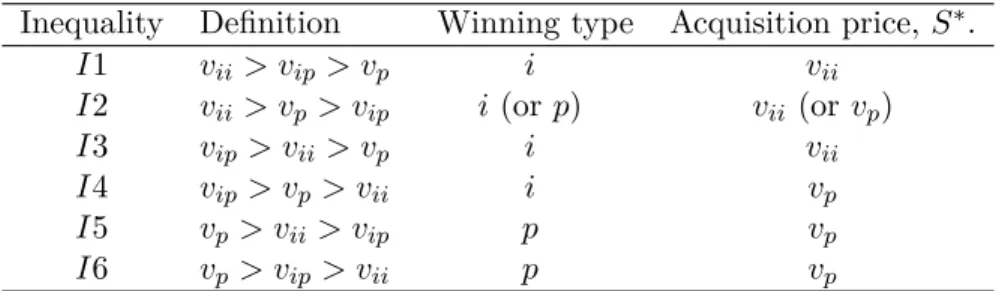
Lemma 1 The equilibrium ownership of the target and the acquisition priceS∗ in stage 1 are given in Table 1.
Table 1: Equilibrium Ownership
Inequality Definition Winning type Acquisition price,S∗.
I1 vii> vip> vp i vii
I2 vii> vp > vip i(orp) vii (orvp)
I3 vip> vii> vp i vii
I4 vip> vp > vii i vp
I5 vp> vii> vip p vp
I6 vp> vip> vii p vp
Proof. See the Appendix.
ForI1−I3, apreemptiveMNE acquisition takes place. MNEs bid against each other in the fear of being forced to compete with an MNE that acquired the target and obtained efficiency gains from synergies, γ. The acquisition price is bid all the way up toS∗ =vii. For I2, there can potentially
be two equilibria. In the first, MNEs do not expect other MNEs to outbid the PE-firms so that a PE-firm wins the auction. In the second, MNEs expect other MNEs to bid for the target and that a preemptive acquisition takes place. For simplicity, we will focus on the second equilibrium (a preemptive acquisition occurs). For I4, a concentrating MNE acquisition takes place at price
S∗ = vp. One MNE finds it profitable to bid slightly above the PE-firms in order to reduce the number of firms on the market from n+ 1 to n. For I5−I6, a PE-firm acquires the assets since a PE-firm’s valuation exceeds an MNEs’ valuations. Finally, note that the equilibrium borrowing
Il∗(S∗, A) and repaymentR∗l(Il∗(S∗, A)) are determined by S∗.
3.4 Stage 1: Financial Contracting
In this stage, each MNE and PE-firm is offered a borrowing contract specifying a repayment
Rl(Il) in stage 3 when borrowing an amount Il in stage 2 if acquiring the target firm, up to
the maximum amountRmax
we assume perfect information and bidding competitions among symmetric investors, implying that all investors break even. Consequently, each MNE and PE-firm is promised a borrowing contract in equilibrium.
Since acquiring firms are typically associated with an idiosyncratic risk, the investor will require a risk premium, labeled ρ, to lend money to the acquirer. This risk will, however, not be present in the deposit (lending) rate r, which is not subject to this kind of risk.10
Given perfect financial markets, it follows that investors will require an interest rate of r+ρto lend in equilibrium. At a lower interest rate, the investor will prefer putting its money in the risk free investment to getr. And perfect financial markets mean that there are always investors willing to lend to the MNEs and the PE-firms at r+ρ. This implies that the equilibrium repayment will beR∗l = (1 +r+ρ)Il.
We can now state the following lemma.
Lemma 2 In the borrowing equilibrium, we have that:
(i) A PE-firm will get a loan guarantee ofIp∗max= (1 +r+ρ)−1(πP(p)−Fp−E) with an associated repayment of R∗max
p =πP(p)−Fp−E.
(ii) An MNE will get a loan guarantee of Ii∗max = (1 +r+ρ)−1(πA(i)−Fi) with an associated
repayment of Rp∗max=πA(i)−Fi.
This lemma pins down the maximum amount that MNEs and PE-firms can borrow to finance the acquisition in stage 2. The proof goes a follows. For PE-firms, we know that the maximum payoff in stage three is πP(p)−Fp−E. Thus, R∗pmax = πP(p)−Fp −E and Ip∗max = (1 +r+
ρ)−1(πP(p)−Fp −E). For an MNE, we know that its maximum repayment in stage three is
πA(i)−Fi. Thus,Ri∗max=πA(i)−Fi and Ii∗max = (1 +r+ρ)−1(πA(i)−Fi).
10The risk premium will account for a comprehensive credit risk that includes but is not limited to the risk of loan restructuring, moratorium, and other changes in the payment plan which are more common among PE-firms than the MNE. Additionally,ρcould reflect additional expectations of returns investors in PE-funds would require to compensate for liquidity risks. Thus, it would make sense to introduce differences in the credit risk of both types of borrowers. However, to simplify this, we here assume it to be the same for MNEs and PE-firms. We relax this assumption in Section 6.
4
Equilibrium Ownership: MNEs versus PE-Firms
Having set up a model of bidding competitions between MNE firms and PE-firms, let us now turn to comparative statics on the determinants of when an MNE will acquire the target and when the target will be bought by a PE-firm. We focus on three aspects: firm-specific synergies (γ), financial market conditions (interest rates, r and ρ) and financial market development (exit costs,E).
4.1 Firm-Specific Synergies
We start with how equilibrium ownership depends on firm-specific synergies, γ. To this end, we need to derive the maximum willingness to pay,vil and vp, given optimal behavior in the financial
market. We can use that R∗i = (1 +r+ρ)Ii and Imin =S−A in equation (3) to obtain
Nil(S) = [πA(i)−Fi−S] + [(S−A)−(1 +r+ρ)(S−A)] +A | {z } Acquire −[πN A(l) + (1 +r)A] | {z } = 0 Do not acquire , (7)
forl ∈ {i, p}. Solving forNil(S) = 0, we get the maximum willingness to pay for each of the two
net gain functions:
vil= [1 +r+ρ]−1[πA(i)−Fi−πN A(l) +ρA]. (8)
Then, we use thatR∗l = (1 +r+ρ)Il and Imin =S in equation (5) to obtain
Np(S) = [πp(p)−E]−S−[(1 +r+ρ)S−S]−Fp | {z } Acquire − 0 |{z} Do not acquire . (9)
Solving for Np(S) = 0, we get:
vp = [1 +r+ρ]−1[πp(p)−Fp−E]. (10)
Having obtained the valuations vii, vip and vp, we can now turn to examining how synergies γ
affect who will acquire the target firm.
The valuations of MNEs,vipandvii,increase monotonically inγ, whereas the PE-firm valuation vp is independent ofγ. Thus, we can state the following Lemma.
Lemma 3 There exists a unique γP E defined from vip(γP E,·) = vp and a unique γP RE defined
from vii(γP RE,·) =vp.
To explain and illustrate our results, we will make use of the following assumption which, for instance, holds in the LQC model.
Assumption 2 γP RE > γP E >0.
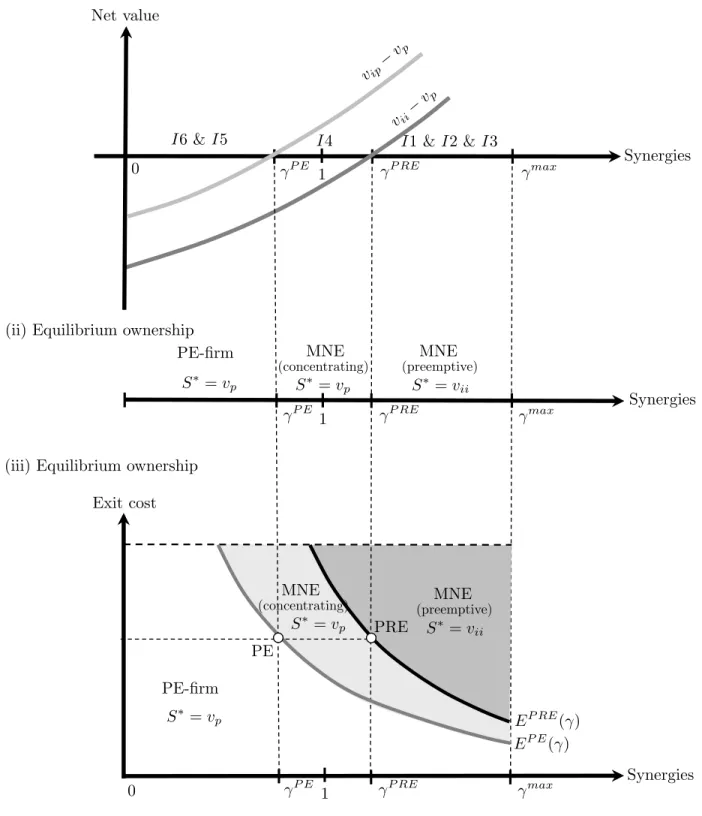
This assumption allows us to derive a simple graphical solution where all types of relevant equilibria are present. In Figures 2(i) and 2(ii), we derive equilibrium ownership for which the size of synergiesγ varies. We can state the following proposition.
Proposition 1 Equilibrium ownership depends on firm-specific synergies, γ, as follows: (i) A PE-firm will acquire the target at price S∗ =vp if γ ∈(0, γP E).
(ii) An MNE concentrating acquisition will take place at price S∗ =vp if γ ∈[γP E, γP RE). (iii) An MNE preemptive acquisition will take place at price S∗ =vii if γ ≥γP RE.
To see the intuition behind this proposition, start with considering Figure 2. The top part of the figure illustrates the net value for an MNE of deterring a PE-firm from acquiring the target (vip −vp) and the net value for an MNE of deterring another MNE from acquiring the target
(vii−vp). These functions are given by
vip−vp= [1 +r+ρ]−1[πA(i)−Fi−πN A(p) +ρA−πp(p) +Fp+E], and (11) vii−vp= [1 +r+ρ]−1[πA(i)−Fi−πN A(i) +ρA−πp(p) +Fp+E]. (12)
When the synergies are low γ ∈ (0, γP E), an MNE’s valuation is lower than a PE-firm’s. This is illustrated in Figure 2(i) where both thevip−vp and thevii−vpcurve is below zero. Thus, without
sufficient firm-specific synergies, an MNE acquisition is not profitable and instead a PE-firm will acquire the target firm (Figure 2(ii))
From Assumption 1, the valuationvipincreases in synergies,γ. Indeed, the profit as an acquirer,
πA(i), increases inγ:
d(vip−vp)
dγ = (1 +r+ρ)
−1dπA(i)
vip
vp
vii
vp
(i) The acquisition game Net value
Exit cost (ii) Equilibrium ownership
(iii) Equilibrium ownership 0 0 Synergies Synergies Synergies P E P RE max P E P RE max P E P RE max
I6 & I5 I4 I1 & I2 & I3
PE-firm MNE MNE
(concentrating) (preemptive) S⇤=vp S⇤=vp S⇤=vii EP E( ) EP RE( ) PE PRE PE-firm S⇤=vp MNE (concentrating) S⇤=vp MNE (preemptive) S⇤=vii 1 1 1
A further increase in synergiesγwill thus make an MNE concentrating acquisition strictly profitable as vip−vp > 0. The equilibrium sales price is then S∗ = vp. This is illustrated in Figure 2(ii), where MNE concentrating acquisitions occur in the region γ ∈[γP E, γP RE).
Finally, we turn to the case of high levels of firm-specific synergies γ ∈ (γP RE, γmax). Using Assumption 1, we can note that the preemptive valuation of MNEs vii will increase more than the concentrating valuationvipsince increasing synergies do not only increase the product market profit as an acquirer but also decrease the product market profit as a non-acquirer. Thus, the preemptive valuationviiis not only driven by the benefits of obtaining a strong position in the product market
as an acquirer, but also by the preemptive motive for avoiding a weak position as a non-acquirer:
d(vii−vp) dγ = (1 +r+ρ) −1dπA(i) dγ − dπN A(i) dγ >0. (14)
It then follows that a further increase in firm-specific synergies into the region γ ∈ (γP RE, γmax) will make a preemptive acquisition strictly profitable asvii−vp >0 (Figure 2(i)). A fierce bidding
competition among MNEs then drives the equilibrium sales price to S∗=vii (Figure 2(ii)).
4.2 Financial Market Development
Financial market development (as captured by E) is likely to favor PE-firms over MNEs in the competition for the target firm. PE-firms which own the target and its assets temporarily incur exit costsE when reselling the target firm. Financial market development in a country is important when reselling assets as PE-firms often list the target on a stock exchange or resell it to other incumbent firms. These resales are easier to undertake if financial markets are better developed. In contrast, this cost is not present for MNEs which are permanent owners of the target and its assets. We have the following proposition.
Proposition 2 More developed financial markets (lower E) favor PE-firms over MNEs.
To see how exit costs E affect equilibrium ownership, consider Figure 2(iii). This figure shows how equilibrium ownership is jointly determined by the synergies γ and the exit cost, E, faced by PE-firms. Let EP E(γ) be the PE-condition defined from vip = vp, and let EP RE(γ) be the
preemption condition defined fromvii=vp. Solving for E in each equation we have:
EP E(γ) =−πA(i) +πN A(p) +πP(p)−ρA−Fp+Fi, and (15)
EP RE(γ) =−πA(i) +πN A(i) +πP(p)−ρA−Fp+Fi. (16)
The loci associated with both the PE-condition EP E(γ) and the preemption condition EP RE(γ)
are downward-sloping in theγ−E space. Since the profit of the acquirer increases inγ, the profits of a non-acquirer πN A(l) are decreasing in γ, and a lower exit cost for the PE-firm is needed to
balance the incumbent’s higher value of obtaining the target.
Preemptive acquisitions occur to the right of the preemption locus EP RE(γ). Here, the exit costs and synergies for the MNEs are too high for PE-firms to compete. The high levels of synergies for the MNEs make the acquisition very attractive to them, which is why they compete with each other for the ownership of the target firm. Below this point for lower values of both E and γ, PE-firms can compete with MNEs for ownership of the target firm. Until we hit the EP E(γ) border,
MNEs are winning the auction and performing entry deterring acquisitions between the PE-locus
EP E(γ) and the preemption locus EP RE(γ). This is since for any given E, the synergies γ are still high enough (and likewise, for any given γ,E are still too high). Below the lineEP E(γ), the combinations of the costs and synergies make it more profitable for the PE-firms to own the target firm, so we have PE-firm acquisitions to the left of the locus EP E(γ). Thus, it follows that for higher exit costs E, MNEs are more likely to end up acquiring the target firm.
4.3 Financial Market Conditions
Financial market conditions (randρ) vary over the business cycle and refer to firms’ cost of acquir-ing outside fundacquir-ing for their projects and acquisitions. PE-firms are dependent on the availability of cash from outside investors to be able to make acquisitions. MNEs on the other hand, have retained earnings, A, which they can use to finance acquisitions. Thereby, financial market conditions will affect the two types of buyers differently. Our model provides the following predictions.
Proposition 3 Financial market conditions affect equilibrium ownership as follows:
equilibrium acquisition price S∗.
(ii) A lower risk premium,ρ, makes an acquisition by a PE-firm more likely.
To see how r affects equilibrium ownership, note that both EP E(γ) and EP RE(γ) are inde-pendent of the interest rate r so r does not affect equilibrium ownership of the target firm. The acquisition price, however, is affected by r. To see this, note that
dS∗(i) dr = dvii dr =−(1 +r+ρ) −2[π A(i)−Fi−πN A(i)]<0, and (17) dS∗(p) dr = dvp dr =−(1 +r+ρ) −2[πP(p)−Fp−E]<0. (18)
The higher r is, the lower are the equilibrium acquisition prices. Intuitively, while MNEs have retained earningsAto use as payment in acquisitions, these retained earnings have an opportunity cost dictated by the same interest rate r that determines the cost of borrowing. Hence, having retained earnings does not lower the cost for an MNE to make the acquisition because the MNE accounts for the opportunity cost of using these funds. Perfect financial markets make an MNE indifferent between using retained earnings and financing the acquisition using outside financing. The equilibrium acquisition prices, however, do respond to financial market conditions since the more costly it is to obtain financing for an acquisition, the lower is the profitability of making the acquisition and, hence, the lower the valuations that MNEs and PE-firms put on the target.
Let us now turn to how the risk premium ρ affects equilibrium ownership. InspectingEP E(γ) and EP RE(γ), it follows that both EP E(γ) and EP RE(γ) shift downwards as the relative value of the MNE’s retained earnings used as payment in the acquisition increases (whenρincreases). With a higher risk premium ρ, MNEs gain an advantage over PE-firms that lack retained earnings that can be used to partly finance the acquisition. In effect, an MNE "saves" ρAby being able to use retained earnings instead of going to outside investors. This implies that MNEs are able to pay more for the target firm in a given acquisition making it more likely that an acquisition by an MNE takes place.
5
Welfare Effects of Restricting PE-Firms
To assess the welfare effects of restricting PE-firms for the domestic country, we will compare welfare for domestic consumers and the target firm in different market structures. These are (i) a non-discriminatory (N D) policy where both PE-firms and MNEs are allowed as owners, and (ii) a discriminatory (D) policy which prohibits PE-firms from buying domestic assets.
To this end, we let P S(l) and CS(l) denote the producer and consumer surpluses when the owner of the target firm is either the MNE (l=i) or the PE-firm (l=p). Welfare under ownership
l will then be the sum of the producer (target) and consumer surpluses, that is
W(l) =P S(l) +CS(l) =S∗(l) +CS(l). (19)
In each of the six potential equilibrium ownership outcomes in Table (1), we can investigate the difference betweenN D and Dpolicies (denoted by subscripts).
I1(vii> vip> vp): MNEs compete against each other for ownership of the target. Restricting
PE-firms from participating in the auction for the target neither affects equilibrium ownership nor the acquisition price. We haveWN D =WD =vii+CS(i).
I2(vii> vp > vip): There are two equilibria under the N D policy. There is one where MNEs
compete with each other, and here PE-firms do not affect the outcome. There is also another equilibria where no bidding competition between MNEs occur since all MNEs coordinate on bidding belowvp. For this equilibrium a PE-firm may end up owning the target. Then, under theD policy, PE-firms would be restricted from taking over the target. As before, we focus on the equilibrium with an MNE as the acquirer. We haveWN D=WD =vii+CS(i).
I3(vip> vii> vp): Here vp is too low for the MNEs to respond by bidding up the price to vip.
Competition is again between MNEs. The absence of PE-firms in the auction under a D
policy has no effect on the outcome. We have WN D =WD =vii+CS(i).
I4(vip> vp > vii): The PE-firm acts as an active threat in the auction as its valuation has an
edge over vii. This is since the MNE’s valuation of the firm when the alternative buyer is a PE-firm, vip, is the highest valuation and the sales price S∗ under MNE ownership goes
up from vii to a strictly higher vp under the N D policy. Under the D policy, the threat of
a PE-firm taking over the target is missing, and so the sales price remains at vii. We have
WN D =vp+CS(i) and WD =vii+CS(i).
I5(vp> vii> vip): Under theN D policy, the target is acquired by a PE-firm at price S∗ =vp as
opposed to by an MNE at price S∗ =vii under the D policy. We have WN D =vp+CS(p) and WD =vii+CS(i).
I6(vp> vip> vii): Once more, theN D policy allows for a PE-firm to acquire the target instead of
an MNE at a price ofvp rather thanvii. We haveWN D =vp+CS(p) andWD =vii+CS(i).
Thus, depending on the rankings of the valuations, the Dpolicy will have different effects. The domestic target firm gets the same sales priceS∗=vii for InequalitiesI1−I3 under both policies,
but under I4−I6 the target firm gets a lower sales price of vii instead of vp. Consumer surplus
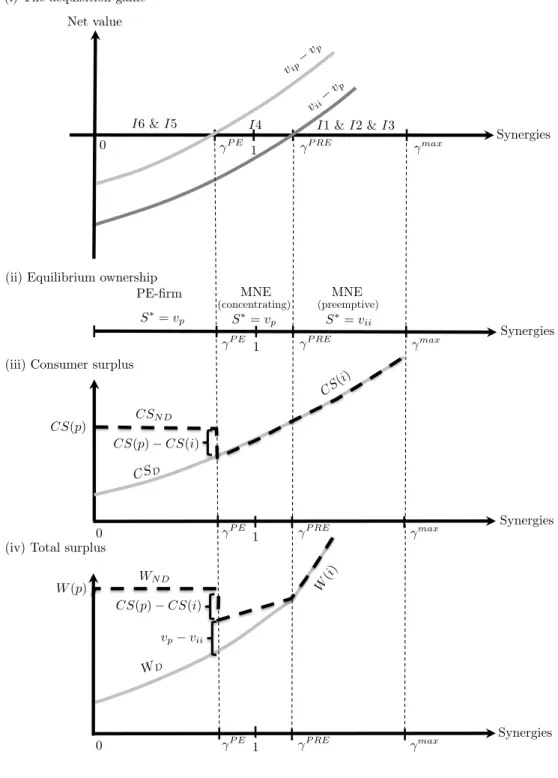
depends on two components: the number of firms that service the market (n or n+ 1) and the synergies between the owners and the target firm (γ). Both of these will affect product market prices on the domestic market. Under I1-I4 with an MNE acquisition, there are fewer firms serving the market since the target is acquired by the MNE (we go from n+ 1 ton firms in the market). This reduces consumer surplus. However, the owner will operate the target with synergies equal toγ which, for high values, can overturn the negative effect on consumer surplus from fewer firms operating in the market. Note, however, that the D policy does not affect the outcome, so in the comparison between theN D and theDpolicies, consumer surplus remains unchanged forI1−I4. In sum, we have: WN D−WD = CS(p)−CS(i) +vp−vii forI5−I6. vp−vii forI4. 0 forI1−I3. (20)
Figure 3 illustrates this outcome graphically. Note first that Figure 3(i) shows that concen-trating MNE acquisitions can occur for synergies below unity, i.e. whereγ is above the threshold
γP E but below one. Welfare inefficient MNE acquisitions, compared to acquisitions by PE-firms, can therefore lead to decreased consumer prices for two reasons. First, productivity in the MNE
(iv) Total surplus (i) The acquisition game
Net value
(ii) Equilibrium ownership 0 0 Synergies Synergies Synergies P E P RE max P E P RE max P E P RE max
I6 &I5 I4 I1 &I2 &I3
PE-firm MNE MNE
(concentrating) (preemptive)
S⇤=vp S⇤=vp S⇤=vii
0 P E P RE max Synergies
(iii) Consumer surplus
vip vp vii vp 1 1 1 1 vp vii CS(p) CS(i) CS(p) CS(i) WD WN D CSN D CS(p) W(p) CSD CS( i) W( i)
acquired firm is lower than after an acquisition by a PE-firm which will lead to an increase in equi-librium consumer prices. Second, an MNE acquisition leads to a market concentration compared to an acquisition by a PE-firm (nfirms instead of n+ 1 firms). This induces an additional decrease in the consumer surplus. The aggregate effect is illustrated in Figure 3(iii) as a discrete change downwards by CS(p)−CS(i) in the consumer surplus at γP E. Figure 3(iv) illustrates the effect on total surplus by accounting for the change in producer surplus as well. For regions I4−I6, producer surplus is reduced by vp−vii. This leads to an additional discrete drop in total surplus
equal tovp−vii atγP E. Note that for I1−I3 the WD and WN D curves run in parallel. We thus
have the following proposition:
Proposition 4 Restricting PE-firms from bidding for domestic targets can decrease consumer and total surplus when synergies between the MNEs and the target’s assets (γ) are sufficiently low.
Thus, acquisitions by PE-firms can be welfare improving both because PE-firms could be more efficient than foreign MNEs at running the target firm, and because an acquisition by a PE-firm prevents a concentration of the market. Hence, a policy of restricting foreign PE-PE-firms from acquiring domestic targets could be counterproductive.
6
Extensions
6.1 Different Risk Premia
As stated above, the risk premia account for the credit risks that could be different for the two types of borrowers (MNEs and PE-firms). Thus, we could formulate the difference in rates between PEs and MNEs as banks charge the same underlying rates to both types of borrowers, but denote the risk premia associated with MNEs as ρM N E and the risk premia associated with PE as ρP E. We then get Nil(S) = [πA(i)−Fi−S] + [(S−A)−(1 +r+ρM N E)(S−A)] +A | {z } Acquire −[πN A(l) + (1 +r)A] | {z } = 0 Do not acquire (21)
for l∈ {i, p}. To see how equations EP E(γ) and EP RE(γ) would then be updated to reflect the differences we first calculate the different valuations in this setting to evaluateEP E(γ):
vip= [1 +r+ρM N E]−1[πA(i)−Fi−πN A(p) +ρM N EA]. (22)
The valuation for the PE-firm then takes the value:
vp = [1 +r+ρP E]−1[πp(p)−Fp−E]. (23)
The expression for EP E(γ) would then become:
EP E(γ) =−E = [πA(i)−Fi−πN A(p) +ρM N EA][1 +r+ρP E]
[1 +r+ρM N E] −[πp(p)−Fp]. (24)
Let us consider the situation where we move from a setting where the premia are equal to the case of ρP E > ρM N E. We have ∂EP E(γ) ∂ρP E = [πA(i)−Fi−πN A(p) +ρM N EA] [1 +r+ρM N E] >0. (25)
Thus, if we allow for different risk premia for different types of buyers in a setting where
ρP E > ρM N E, we will have the EP E(γ) curve shift down, thus, decreasing the combinations of
γ and E that correspond to an acquisition made by a PE-firm. This implies that MNEs gain an advantage over PE-firms compared to in the setting where risk premia are equal.
7
Concluding Remarks
The globalization process implies that new business models spread wider and faster over the world than ever before. More than 8 percent of all cross-border acquisitions that took place during 1998-2010 were cross-border acquisitions undertaken by PE-firms. And there was substantial variation over time, across countries and across sectors in the share of cross-border acquisitions that were acquisitions by PE-firms as opposed to those by MNEs.
In this paper we have developed a formal model of competition for domestic assets between MNEs and PE-firms to better understand possible causes for this variation. In our model, MNE
advantage lies in firm-specific synergies and retained earnings, whereas PE-firms are good at reor-ganizing target firms. We showed that prevailing interest rates do not work in favor of PE-firms, but that lower risk premia and better financial market developments do. Stronger firm-specific synergies, however, favor MNEs. Performing a welfare analysis, we show that a policy of restricting PE-firms from buying domestic assets can be counterproductive.
While it is well established that cross-border mergers and acquisitions play a key role in the global industrial development and restructuring process, our model is, to the best of our knowledge, the first to incorporate PE-firms that compete with MNEs for domestic firms that are up for sale. As such, we identify an important role of the PE-firms as challengers of existing international oligopolies. These results suggest that policies improving the international market for corporate control would be preferred to policies restricting cross-border acquisitions by PE-firms.
In the analysis, we have assumed that the PE-firm exits its investment by means of listing the firm on a stock exchange or through a sale to an outside investor. However, a substantial share of all exits by PE-firms are exits through trade sales to incumbents. In that setting, while the main results of the paper will still be valid, an acquisition by a PE-firm will from a welfare point of view not restore the intensity of competition in the product market in the long run. However, as shown by Norbäck, Persson and Tåg (2013), exits by trade sales to incumbents lead to incentives to invest more in restructuring to enhance bidding competitions for target firms in the exit stages. This tends to benefit consumers but can hurt producers.
References
Bertrand, Olivier and Habib Zitouna, "Trade Liberalization and Industrial Restructuring: The Role of Cross-Border Mergers and Acquisitions," Journal of Economics and Management Strategy, 15 (2006):479–515.
Bjorvatn, Kjetil, "Economic integration and the profitability of cross-border mergers and acquisi-tions," European Economic Review, 48 (2004):1211–1226.
Blonigen, Bruce A., "Firm-Specific Assets and the Link between Exchange Rates and Foreign Direct Investment," American Economic Review, 87(1997): 447–465.
Davis, Steven J., John Haltiwanger, Kyle Handley, Ron Jarmin, Josh Lerner and Javier Miranda, "Private Equity, Jobs and Productivity," American Economic Review, American Economic As-sociation, 104 (2014):3956–3990.
Falvey, Rod, "Mergers in Open Economies," The World Economy, 21 (1998):1061–1076.
Farrell, Joseph and Carl Shapiro, "Asset Ownership and Market Structure in Oligopoly," RAND Journal of Economics, 21 (1990):275–292.
Fumagalli, Eileen and Helder Vasconcelos, "Sequential Cross-Border Mergers," International Journal of Industrial Organization, 27 (2006):175–187.
Gorbenko, Alexander S. and Andrey Malenko, "Strategic and Financial Bidders in Takeover Auc-tions," The Journal of Finance, 69 (2014):2513–2555.
Head, Keith and John Ries, "FDI as an Outcome of the Market for Corporate Control: Theory and Evidence," Journal of International Economics, 74 (2008):2–20.
Head, Keith and John Reis, "International mergers and welfare under decentralized competition policy," Canadian Journal of Economics, 30 (1997):1104–1123.
Hege, Ulrich, Stefano Lovo, Myron B. Slovin and Marie E. Sushka, "Asset sales and the role of buyers: strategic buyers versus private equity," MPRA Paper 39549, University Library of Munich, Germany (2012).
Horn, Henrik and Lars Persson, "The Equilibrium Ownership of an International Oligopoly," Journal of International Economics, 53 (2001):307–333.
Jehiel, Philippe and Benny Moldovanu, "Resale Markets and the Assignment of Property Rights" Review of Economic Studies, 66 (1999):971–991.
Jensen, Michael C., "Eclipse of Public Corporation," Harvard Business Review, 67 (1989):61–74. Jensen, Michael C., "Agency Costs of Free Cash Flow, Corporate Finance, and Takeovers,"
Ameri-can Economic Review, 76 (1986):323–329.
Kaplan Steven and Per Strömberg, "Leveraged Buyouts and Private Equity, " Journal of Economic Perspectives 23 (2009):121–146.
Lommerud, Kjell E., Odd R. Straume and Lars Sorgard, "National versus International Mergers in Unionized Oligopoly," The RAND Journal of Economics, 37 (2006):212–233
Maksimovic, Vojislav and Gordon Philips, "Do Conglomerate Firms Allocate Resources Inefficiently Across Industries? Theory and Evidence," Journal of Finance, 57 (2002):721–767.
Martos-Vila, Marc, Matthew Rhodes-Kropf and Jarrad Harford, "Financial vs. Strategic Buyers," NBER Working Papers 19378, National Bureau of Economic Research (2013).
Mattoo, Aaditya, Marcelo Olarreaga and Kamal Saggi, "Mode of Foreign entry, Technology Trans-fers, and FDI Policy," Journal of Development Economics, 75 (2004):95–111.
Neary, J. Peter, "Cross-Border Mergers as Instruments of Comparative Advantage," The Review of Economic Studies, 74 (2007):1229–1257.
Norbäck, Pehr- Johan and Lars Persson, "Investment Liberalization - Why a Restrictive Cross-Border Merger Policy can be Counterproductive," Journal of International Economics, 72 (2007):366– 380.
Norbäck, Pehr-Johan and Lars Persson, "Globalization and Profitability of Cross-Border Mergers and Acquisitions," Economic Theory, 35 (2008):241–266.
Norbäck, Pehr-Johan, Lars Persson and Joacim Tåg, "Buying to Sell: Private Equity Buyouts and Industrial Restructuring," CESifo Working Paper Series No. 4338 (2013)
Raff, Horst, Michael Ryan and Frank Stähler, " The Choice of Market Entry mode: Greenfield Investment: M&A and Joint Venture," International Review of Economics and Finance, 18 (2009):3–10.
Tåg, Joacim, "The Real Effects of Private Equity Buyouts." In The Oxford Handbook of Private Equity (2012), edited by Douglas Cumming. Oxford: Oxford University Press.
A
Appendix
A.1 Proof of Lemma 1
First, bi ≥max{vp, vii, vip} is a weakly dominated strategy. No owner wants to post a bid above its valuation of obtaining the assets, and the assets will always be sold.
Inequality I1 (vii> vip> vp): Since vip> vp,an MNE will always have an incentive to outbid
PE-firms. The MNEs will then bid up the price tovii to prevent a rival from obtaining the assets.
An MNE will obtain the assets.
Inequality I2 (vii > vp > vip): Since vp > vip, the outcome depends on what an MNE believes
will happen if it does not win. If it believes that another MNE will win, MNEs will then bid up the price to vii and an MNE will obtain the assets. If it believes that a PE-firm will win, then since
vp > vip, the PE-firms will bid up the price to vp and an MNE will obtain the assets.
Inequality I3 (vip> vii> vp): Since vip> vp,an MNE will always have an incentive to outbid PE-firms. The MNEs will then bid up the price tovii to prevent a rival from obtaining the assets.
An MNE will obtain the assets. Since MNEs realize that a PE-firm will never obtain the assets (vip> vp), the price will not be bid up tovip.
Inequality I4 (vip> vp > vii): Since vip> vp,an MNE will always have an incentive to outbid
PE-firms and bid up the price to slightly above vp. However, only one MNE has this incentive, since no other MNE wants to outbid him or her (vp > vii). An MNE will then obtain the assets at pricevp.
Inequality I5 (vp > vii> vip): Sincevp > vip, no MNEs will want to outbid the PE-firms. The PE-firms will then bid up the price tovp and a PE-firm will obtain the assets.
Inequality I6 (vp > vip> vii): Sincevp > vip, no MNEs will want to outbid the PE-firms. The