Abstract— The purpose of this study was to identify the content structure and learning experience for integrating cloud computing into high-school learning offered by the High-Scope Project. For coping with new contents brought by fast advancing technology, education system should provide ways to integrating that new information of emerging technology into our curriculum for preparing students with up-to-date knowledge. There is a need to identify learning goals, the scope and structure of integrating cloud computing into formal learning. The selected learning experience of cloud computing were identified by following the theory of technology education. By applying the investigation method, the content was verified by invited professionals. Their evaluation resulted significant agreement between selected contents and technology principles. The reliability between evaluators was 0.87
Keywords—High Scope Project, Senior High Education, Emerging Technology, Cloud Computing
I. INTRODUCTION
ECHnology education is a subject area of common education and provides learner the opportunity of accepting technology. Innovative technology grows everyday and the information and knowledge of technology expands, too. Systems of technology in some areas are even exploded, such as energy & power technology and information & communication technology. In science education, how to integrating emerging technology into formal education becomes a concern. Education reform acts in Taiwan pointed out this trend and raised a “High Scope Curriculum Development” project to foster teachers to design teaching material and learning activities of emerging technology.
Cloud computing leads a new tide of information technology toward a whole new world of living style. Technology education is a subject area of common education and provides learner the opportunity of accepting technology. Innovative
Manuscript received April 1, 2012: Revised version received May 5, 2012. This work was supported in part by the Taiwan National Science Council under High Scope Project Grant 100-2514-S-017-001-.
L.H. Kuo is with the National Kaohsiung Normal University, 80201 Taiwan, R.O.C. (e-mail:[email protected])
J.C. Yu was with National Science and Technology Museum, Kaohsiung, 807 Taiwan, R.O.C. (e-mail: [email protected]).
H.H.Yang is with the Oriental Institute of Technology, 220 Taiwan, R.O.C. (e-mail:[email protected])
W.C. Hu is with the University of North Dakota, ND 58202-9015, USA. (e-mail:[email protected])
H.J. Yang is with the National Kaohsiung Normal University, 80201 Taiwan, R.O.C. (e-mail: [email protected], phone: 886-7-7172930 ext. 7603,; fax: 886-7-6051206).
technology grows everyday and the information and knowledge of technology expands, too. Systems of technology in some areas are even exploded, such as energy & power technology and information & communication technology. In science education, how to integrating emerging technology into formal education becomes a concern. Education reform acts in Taiwan pointed out this trend and raised a “High Scope Curriculum Development” project to foster teachers to design teaching material and learning activities of emerging technology.
Cloud computing is a service for enabling ubiquitous, convenient, on-demand network access to a shared pool of configurable computing resources. It is the delivery of computing as a service rather than a product, whereby shared resources, software, and information are provided to computers and other devices as a metered service over a network. Cloud computing provide computation, software, data access, and storage resources without requiring cloud users to know the location and other details of the computing infrastructure[1-2]. As a result, cloud computing is a popular topic for blogging and white papers and has been featured in the title of workshops, conferences, and even magazines. Nevertheless, confusion remains about exactly what it is and when it's useful.[3]
There is a need to identify the learning goals, the content structure and the learning experience of cloud computing in terms of senior high technology education, so can help high school learners coping with this emerging technology. At the same time, the research result could be effectively applied on integrating emerging technology into formal technology education.
II.PROBLEM FORMULATION
Technology education in Taiwan set out a cloud strategy that had the potential for substantial savings in cost while also providing for greater control of IT infrastructure, newer technology, improved stability, and a more agile learning environment. Technology educators understood that the roles of IT professionals change as a result of adopting a different concept for managing the cloud, and that cloud has an impact on the people who live in the society.
In order to prepare high-school students for the future and to manage this transition successfully, educators realized that it is essential to take the people along and prepare them for the journey. High-scope project was established along this line.
A Study of Creating Technology Education
Course for Cloud Computing
Lung-Hsing Kuo, Jui-Chen Yu, Hsieh-Hua Yang, Wen-Chen Hu, Hung-Jen Yang
A.Technology Education
Technology education is a subject of studying technology in which learners could learn about the context, process, and knowledge related to technology[1]. Technology education is all about learning technology literacy.
Technological literacy is much more than just knowledge about computers and their application. It involves a vision where each citizen has a degree of knowledge about the nature, behavior, power, and consequences of technology from a broad perspective. Inherently, it involves educational programs where learners become engaged in critical thinking as they design and develop products, systems, and environments to solve practical problems. Through technology, people have changed the world. In the drive to satisfy needs and wants, people have developed and improved ways to communicate, travel, build structures, make products, cure disease, and provide food. This has created a world of technological products and machines, roadways and buildings, and data and global communications. It has created a complex world of constant change.
Each technological advance builds on prior developments. Each advance leads to additional potentials, problems, and more advances in an accelerating spiral of development and complexity. The acceleration of technological change, and the greater potential and power that it brings, inspires and thrills
some people, but confuses—even alienates—others. Many people embrace technological change, believing that through technology their lives will be made easier. They see the growing ability to solve age-old problems ranging from food supply to education and pollution.
A rationale and structure for the study of technology has been presented here that should assure that everyone can gain the foundation they need to participate in and adapt to today’s ever-changing technological world. These materials should be compatible with the emerging standards for technology education. It is hoped that this will encourage technology education leaders to develop new curriculum materials at the state and local levels.
Technology education, as presented here, must become a valued subject at every level.
People make decisions about technological activities every day. However, the growing complexity of technological systems means that all technological decision-making should include an assessment of the impacts and consequences of an implemented or proposed technological system.
Fig. 1 Technology Universal Model, editing from ITEA[1].
PROCESSES KNOWLEDGE
All technological activity impacts humans, society, and the environment. Moreover, technological activity involves tradeoffs and risks. Decision makers should understand real vs. implied risks associated with technological developments.
Erich Bloch, past Director of the National Science Foundation, said that, “Technologically literate people should be able to read a newspaper or magazine article and react to those articles related to technology on a basis of some understanding, not on a basis of emotion.” [16]
B.Basic of Cloud Computing
What is cloud computing and how can an organization decide whether to adopt it?
Cloud computing is a distributed computing paradigm that focuses on providing a wide range of users with distributed access to scalable, virtualized hardware and/or software infrastructure over the internet. Cloud computing is in essence an economic model for a different way to acquire and manage IT resources.
An organization needs to weigh the cost, benefits, and risks of cloud computing in determining whether to adopt it as an IT strategy. This session seeks to help organizations understand cloud computing essentials, including drivers for and barriers to adoption, in support of making decisions about adopting the approach.
Cloud computing is a paradigm for large-scale distributed computing that makes use of existing technologies such as virtualization, service-orientation, and grid computing. It offers a different way to acquire and manage IT resources on a large scale.
A simple example of cloud computing is webmail. The webmail provider maintains the server space and provides access; the webmail user just plugs a web address into a browser and submits user information to access an account.
There is growing interest in cloud computing from consumers and providers. For example, "Previous year, Intel, Yahoo and HP announced a joint test centre for cloud computing education and research. Last August IBM announced a $360m data center in North Carolina to provide Cloud Computing facility to their clients."[4]
One reason for this trend is the move toward cloud computing as a means to reduce IT hardware costs.[5] More adopters will result in more people seeing savings and thus working to reduce barriers to adoption. The growth in cloud computing consumers will also drive a continuing increase in the number of providers.
C.Core Concepts of Cloud Computing
In the cloud computing model, computing power, software, storage services, and platforms are delivered on demand to external customers over the internet.[7] The access that this technology provides to resources and services can be scaled up or down to meet demand.
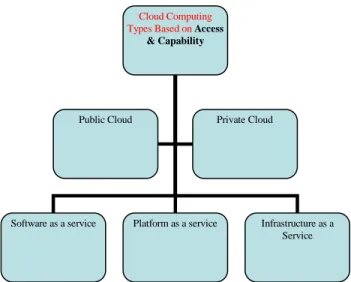
The types of cloud computing technology can be viewed
from two perspectives: capability and access. In this section, we look at three types based on capabilities provided and two based on who can access resources. In Fig. 1, the concept are shown.
One type of cloud computing capability is called Software-as-a-Service (SaaS). SaaS focuses on providing users with business-specific capabilities, such as e-mail or customer management. In SaaS, organizations and developers can use the business-specific capabilities developed by third parties in the “cloud.” Some examples of SaaS providers are
Google Apps: provides web-based office tools such as e-mail, calendar, and document management
salesforce.com: provides a full customer relationship management (CRM)[8] application
zoho.com: provides a large suite of web-based applications, mostly for enterprise use[9]
A second type of cloud computing capability is known as Infrastructure-as-a-Service (IaaS). This capability type provides chiefly computational infrastructure available over the internet (e.g., compute cycles or storage). IaaS allows organizations and developers to extend their IT infrastructure on an on-demand basis. Some examples of IaaS providers are
Amazon Elastic Compute Cloud (EC2): provides users with a special virtual machine (AMI) that can be deployed and run on the EC2 infra-structure[10]
Amazon Simple Storage Solution (S3): provides users with access to dynamically scalable storage resources [11]
GoGrid: provides users with access to dynamically scalable computing and storage resources, as well as dedicated servers[12]
Microsoft Live Mesh: provides users with access to a Cloud Computing
Types Based on Access & Capability
Software as a service Platform as a service Infrastructure as a Service Public Cloud Private Cloud
distributed file system; targeted at individual use[13]
Rackspace Cloud: provides users with access to dynamically scalable computing and storage resources, as well as third-party cloud applications and tools[14]
The third and final type of cloud computing capability is Platform-as-a-Service (PaaS). In this type, application development platforms allow users to leverage the resources of established organizations to create and host applications of a larger scale than an individual or small business would be able to handle.
Some PaaS examples include
Akamai EdgePlatform: provides a large distributed computing platform on which organizations can deploy their web applications; has a large focus on analysis and monitoring [15]
Force.com: from salesforce.com (an SaaS provider), provides users with a platform to build and run applications and components [16]
Google App Engine: provides users with a complete development stack and allows them to run their applications on Google’s infrastructure[17]
Microsoft Azure Services Platform: provides users with on-demand compute and storage services as well as a development platform based on Windows Azure[18]
Yahoo! Open Strategy (Y!OS): provides users with a means of develop-ing web applications on top of the existing Yahoo! platform and in doing so leveraging a significant portion of the Yahoo! Resources [19]
The two perspectives of cloud computing based on who can access resources can be characterized as public and private.
In public clouds, resources are offered as a service, usually over an internet connection, for a pay-per-usage fee. Users can scale their use on demand and do not need to purchase hardware to use the service. Public cloud providers manage the infrastructure and pool resources into the capacity required by its users.
In private clouds, resources are deployed inside a firewall and managed by the user organization. It is the user organization that owns the software and hardware infrastructure and that manages the cloud and controls access to its resources. Typically, those resources and services are not shared outside the organization.
The National Institute of Standards and Technology (NIST) defines two additional types of cloud deployment models: (1) community clouds that are shared by multiple organizations and support specific needs and concerns of a community and (2) hybrid clouds that are the combination of two or more public, private, and community clouds. However, both community and hybrid cloud are specialties of public and private clouds.
Table 1 Cloud Computing Driving Forces
Attribute Driving toward Cloud Computing Availability
Users have the ability to access their resources at any time through a standard internet connection.
Collaboration
Users begin to see the cloud as a way to work simultaneously on common data and information.
Elasticity
The provider transparently manages a user’s resource utilization based on dynamically changing needs.
Lower Infrastructure Costs
The pay-per-usage model allows an organization to only pay for the resources they need with basically no investment in the physical resources available in the cloud. There are no infra- structure maintenance or upgrade costs.
Mobility Users have the ability to access data and applications from around the globe. Risk
Reduction
Organizations can use the cloud to test ideas and concepts before making major investments in technology.
Scalability
Users have access to a large amount of resources that scale based on their demand.
Virtualization
Each user has a single view of the available resources, independently of how they are arranged in terms of physical devices. Therefore, there is potential from a provider perspective to serve a greater number of users with fewer physical resources.
III. PROBLEM SOLUTION
Based upon the characteristics of integrating emerging technology into formal curriculum, cloud computing literature was reviewed for establishing the learning goals, scope, and content structure. The learning experience of cloud computing was identified according to these selecting criteria.
A content analysis procedure was applied to verify the consistency of selected materials. Content professionals were invited to do the content analysis. The levels of selected content fitting into criteria were evaluated. The reliability among professionals were also evaluated.
A.Learning Goals of Cloud Computing
Education adopted an approach whereby they skilled their students to gain an understanding of the key principles of virtualization and cloud computing, ensuring that the workforce has the right skill set and competencies to enable the society to support the following transformational objectives
with respect to the cloud:
Transform the competencies of the IT experience from working in a “traditional” IT environment to working in a next generation service provider.
Fit into services of cloud computing as a technology user.
Reduce the risk and complexity inherent in a fragmented data strategy.
Virtualizes to modern, future-proof platforms.
Build a operating model of could computing.
B.Topics of Integrating Cloud Computing
The high school technology education curriculum were checked for the potential of integrating cloud computing. The best fitted topics are identified in table 2 and 3.
Communication technology domain would be the best area for integrating cloud computing for high school students to recognize this emerging technology. There are core course and advanced course. In table 2, topics of the core course were listed with major content and class hours. The total class hours are 36.
Table 2 Topics of Core Course Topics Major Content Class in
hours Technology Development 1.Innovation of Technology 2.Impact of Technology 4 Technology
World 1.Scope of Technology 8
Creative Design & Production Principle of Creative Design Practice of Creative Design
Project of Design & Production
24
For the advanced course, the topic is communication technology. The class hours are 36. The major content are also listed in the table 3.
Table 3 Content of Advanced Course in the topic of communication technology
Topics Major Content Class in
hours Communication Technology 1.Electronic Communication 2.Information Communication 3.Communication Ethics 4.Communication Industry
5.Project of Design & Production
36(12+2 4 project)
C.Structure
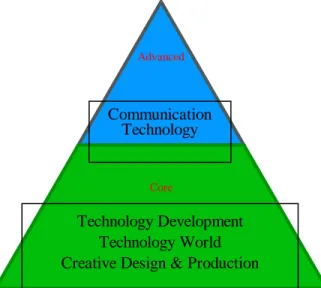
The following is the proposed structure with both core and advanced course. The core course serves as a foundation for the advanced course. In Fig. 2, the structure was illustrated. In following sections, the proposed content of each course would be described. Advanced Core Communication Technology Technology Development Technology World Creative Design & Production
Fig. 3 Curriculum Structure for Emerging Technology of Cloud Computing
D. Innovation of Cloud Computing
The learning experience of this topic would focus on the followings:
The definition, essence, and meanings of cloud computing.
Contemporary development of cloud computing
Cloud computing in Taiwan
E.Impact of Cloud Computing
The learning experience of this topic would focus on the followings:
Relations among Cloud Computing, Living, Society, Culture
Relations among Cloud Computing, Industry, economy development and National Competition Ability
Cloud Computing and Environment Issues
Cloud Computing, Ethics, and Law
F.Scope of Cloud Computing
The learning experience of this topic would focus on the followings:
Principles of Cloud Computing
Application of Cloud Computing
G. Creative Design Principles
The learning experience of this topic would focus on the followings:
Creative Design of Cloud Computing Methods
Creative Design of Cloud computing Procedures
H. Creative Design Practice
The learning experience of this topic would focus on the followings:
Needs investigation of Cloud Computing
Concept and design in Cloud Computing
Operating Cloud Computing
I. Project of Cloud Computing Practice
The learning experience of this topic would focus on the following:
Project based learning on Cloud Computing in real world problem.
J.Electronic Communication
This is a part of advanced course. The learning experience on electronic communication would focus on the following items:
Communication Technology on Cloud Computing
The electronic foundations and application of Cloud Computing
The wired, wireless, and communication principles and
application of cloud computing
K.Information Communication
This is also a part of advanced course. The learning experience on information communication would focus on the following items:
Cloud computing computer system and application
Cloud computing for the print media system and application
Cloud computing for the multi-media system and application
L.Communication Ethics
This is also a part of advanced course. The learning experience on communication ethics would focus on the following items:
Law and ethics of Cloud Computing
Security issue of Cloud Computing
M. Communication Industry
This is also a part of advanced course. The learning experience on communication industry would focus on the following items:
Contemporary Industry of Cloud Computing
Impacts of society and life by the Cloud Computing
Development and trend of Cloud Computing
N.Definitions and Taxonomy
For a emerging technology, it is important to establish concrete foundation for people to identify, discuss, and recognize. Following characters should meet:
A practical customer-experience-based context for discussions on interoperability and standards
Where existing standards should be related
The following definitions and taxonomy would provide an overview of cloud computing concepts. Based upon use case scenarios, it intends to show overview of cloud computing.
1)Definitions of Cloud Computing Concepts
Cloud Computing: Cloud computing is a model for enabling ubiquitous, convenient, on-demand network access to a shared pool of configurable computing resources (e.g., networks, servers, storage, applications, and services) that can be rapidly provisioned and released with minimal management effort or service provider interaction[1].
2)Delivery Models
The NIST definition of cloud computing defines three delivery models:
application, but does not control the operating system, hardware or network infrastructure on which it's running.
Platform as a Service (PaaS): The consumer uses a hosting environment for their applications. The consumer controls the applications that run in the environment (and possibly has some control over the hosting environment), but does not control the operating system, hardware or network infrastructure on which they are running. The platform is typically an application framework.
Infrastructure as a Service (IaaS): The consumer uses "fundamental computing resources" such as processing power, storage, networking components or middleware. The consumer can control the operating system, storage, deployed applications and possibly networking components such as firewalls and load balancers, but not the cloud infrastructure beneath them.
3)Deployment Models
The NIST definition defines four deployment models:
Public Cloud: In simple terms, public cloud services are characterized as being available to clients from a third party service provider via the Internet. The term “public” does not always mean free, even though it can be free or fairly inexpensive to use. A public cloud does not mean that a user’s data is publically visible; public cloud vendors typically provide an access control mechanism for their users. Public clouds provide an elastic, cost effective means to deploy solutions.
Private Cloud: A private cloud offers many of the benefits of a public cloud computing environment, such as being elastic and service based. The difference between a private cloud and a public cloud is that in a private cloud-based service, data and processes are managed within the organization without the restrictions of network bandwidth, security exposures and legal requirements that using public cloud services might entail. In addition, private cloud services offer the provider and the user greater control of the cloud infrastructure, improving security and resiliency because user access and the networks used are restricted and designated.
Community Cloud: A community cloud is controlled and used by a group of organizations that have shared interests, such as specific security requirements or a common mission. The members of the community share access to the data and applications in the cloud.
Hybrid Cloud: A hybrid cloud is a combination of a public and private cloud that interoperates. In this model users typically outsource non-business critical information and processing to the public cloud, while keeping business-critical services and data in their
control.
4)Essential Characteristics
The NIST definition describes five essential characteristics of cloud computing.
Rapid Elasticity: Elasticity is defined as the ability to scale resources both up and down as needed. To the consumer, the cloud appears to be infinite, and the consumer can purchase as much or as little computing power as they need. This is one of the essential characteristics of cloud computing in the NIST definition.
Measured Service: In a measured service, aspects of the cloud service are controlled and monitored by the cloud provider. This is crucial for billing, access control, resource optimization, capacity planning and other tasks.
On-Demand Self-Service: The on-demand and self-service aspects of cloud computing mean that a consumer can use cloud services as needed without any human interaction with the cloud provider.
Ubiquitous Network Access: Ubiquitous network access means that the cloud provider’s capabilities are available over the network and can be accessed through standard mechanisms by both thick and thin clients.
Resource Pooling: Resource pooling allows a cloud provider to serve its consumers via a multi-tenant model. Physical and virtual resources are assigned and reassigned according to consumer demand. There is a sense of location independence in that the customer generally has no control or knowledge over the exact location of the provided resources but may be able to specify location at a higher level of abstraction (e.g., country, state, or datacenter).
5)Related Terms
For recognizing purpose, related terms were also critical, defined, and selected as follows.
Interoperability: Interoperability is concerned with the ability of systems to communicate. It requires that the communicated information is understood by the receiving system. In the world of cloud computing, this means the ability to write code that works with more than one cloud provider simultaneously, regardless of the differences between the providers.
Portability: Portability is the ability to run components or systems written for one environment in another environment. In the world of cloud computing, this includes software and hardware environments (both physical and virtual).
Integration: Integration is the process of combining components or systems into an overall system. Integration among cloud-based components and
systems can be complicated by issues such as multi-tenancy, federation and government regulations.
Service Level Agreement (SLA): An SLA is contract between a provider and a consumer that specifies consumer requirements and the provider’s commitment to them. Typically an SLA includes items such as uptime, privacy, security and backup procedures.
Federation: Federation is the act of combining data or identities across multiple systems. Federation can be done by a cloud provider or by a cloud broker.
Broker: A broker has no cloud resources of its own, but matches consumers and providers based on the SLA required by the consumer. The consumer has no knowledge that the broker does not control the resources.
Multi-Tenancy: Multi-tenancy is the property of multiple systems, applications or data from different enterprises hosted on the same physical hardware. Multi-tenancy is common to most cloud-based systems.
Cloud bursting: Cloud bursting is a technique used by hybrid clouds to provide additional resources to private clouds on an as-needed basis. If the private cloud has the processing power to handle its workloads, the hybrid cloud is not used. When workloads exceed the private cloud’s capacity, the hybrid cloud automatically allocates additional resources to the private cloud.
Policy: A policy is a general term for an operating procedure. For example, a security policy might specify that all requests to a particular cloud service must be encrypted.
Governance: Governance refers to the controls and processes that make sure policies are enforced.
Virtual Machine (VM): A file (typically called an image) that, when executed, looks to the user like an actual machine. Infrastructure as a Service is often provided as a VM image that can be started or stopped as needed. Changes made to the VM while it is running can be stored to disk to make them persistent.
Application Programming Interface (API): An application programming interface is a contract that tells a developer how to write code to interact with some kind of system. The API describes the syntax of the operations supported by the system. For each operation, the API specifies the information that should be sent to the system, the information that the system will send back, and any error conditions that might occur.
APIs can be defined in specific programming languages or in more neutral formats such as WSDL or IDL. REST specifications typically don't have a machine-readable language, but
they define an API nonetheless.
An API can also include the details of protocols (such as HTTP) and data formats (such as JSON or an XML Schema).
An API requires human intelligence to understand the semantics of the data and operations. A machine can discover that method x requires two integers as its parameters, but a developer, a human being, has to figure out which of infinity's two integers should be used.
6)Taxonomy
The taxonomy of cloud computing was defined by NIST and shown in Fig.3. Service consumers use the services provided through the cloud. Service Manage the cloud infrastructure and service developers create the services themselves.
Fig. 4 Taxonomy of Cloud Computing
There are four different levels of APIs. Each level requires the developer to focus on different tasks and data structures.
Level 1 – The Wire: At this level, the developer writes directly to the wire format of the request. If the service is REST-based, the developer creates the appropriate HTTP headers, creates the payload for the request, and opens an HTTP connection to the service. The REST service returns data with an accompanying HTTP response code. Because of the straightforward nature of many REST services, it is possible to be relatively efficient while writing code at this level. If the service is SOAP-based, the developer creates the SOAP envelope, adds the appropriate SOAP headers, and fills the body of the SOAP envelope with the data payload. The SOAP service responds with a SOAP envelope that contains the results of the request. Working with SOAP services requires parsing the XML content of the envelopes; for that reason, most SOAP services are invoked with a higher-level API.
Level 2 - Language-Specific Toolkits: Developers at this level use a language specific toolkit to work with SOAP or REST requests. Although developers are still focused on the format and structure of the data going across the wire, many of the details (handling response Consu mer Open Standards Service Provider Open Standards Developer
codes and calculating signatures, for example) are handled by the toolkit.
Level 3 - Service-Specific Toolkits: The developer uses a higher-level toolkit to work with a particular service. Working at this level, the developer is able to focus on business objects and business processes. A developer can be far more productive when focusing on the data and processes that matter to the organization instead of focusing on the wire protocol.
Level 4 - Service-Neutral Toolkits: This is the highest level of API. A developer working at this level uses a common interface to multiple cloud computing providers. As with Level 3, the developer focuses on business objects and business processes. Unlike Level 3, a developer working at Level 4 does not have to worry about which cloud service they are working with. An application written with a service-neutral toolkit should be able to use a different cloud vendor with minimal changes to the code, if any.
Programming interfaces can be divided into five categories:
Category 1 – Ordinary Programming: The usual application programming interfaces in C#, PHP, Java, etc. There is nothing cloud-specific in this category.
Category 2 – Deployment: Programming interfaces to deploy applications to the cloud. In addition to any cloud-specific packaging technologies, this includes traditional packaging mechanisms such as .Net assemblies and EAR/WAR files.
Category 3 – Cloud Services: Programming interfaces that work with cloud services. As discussed in the previous section, cloud service APIs can be either service-specific or service-neutral. These APIs are divided into subcategories for cloud storage services, cloud databases, cloud message queues, and other cloud services. A developer writing code using cloud services APIs is aware that they are using the cloud.
Category 4 – Image and Infrastructure Management: Programming interfaces to manage virtual machine images and infrastructure details. APIs for images support uploading, deploying starting, stopping, restarting, and deleting images. Infrastructure management APIs control details such as firewalls, node management, network management and load balancing.
Category 5 – Internal Interfaces: Programming interfaces for the internal interfaces between the different parts of a cloud infrastructure. These are the APIs you would use if you wanted to change vendors for the storage layer in your cloud architecture. The Enterprise Cloud Usage scenarios are intended to illustrate the most typical cloud use cases and are not meant to
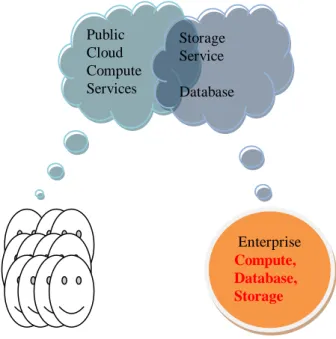
be an exhaustive list of realizations within a cloud environment. In end user to cloud scenario, an end user is accessing data or applications in the cloud.
Common applications of this type include email hosting and social networking sites. A user of Gmail, Facebook or LinkedIn accesses the application and their data through any browser on any device. The user doesn’t want to keep up with anything more than a password; their data is stored and managed in the cloud. Most importantly, the user has no idea how the underlying architecture works. If they can get to the Internet, they can get to their data.
Fig. 5 End User to Cloud Scenarios
IV. CONCLUSION
The results of this study provide an concrete evidence for the feasibility of integrating cloud computing into senior high-school learning. Following the strict learning goal and principles of technology education, the content selecting and learning experience could be ideally organized for fitting into original curriculum.
As the finding shown, there are four level knowledge of cloud computing technology provided for learning. Those four levels of knowledge are fact, concept, procedure, and meta-analysis. In this study, the fact knowledge mostly comes from definition.
Based upon definitions of cloud computing technology, this emerging technology become reality and could be further discussed and explained. The learning goals, knowledge structure, learning experience then could be identified to
Public Cloud Compute Services Storage Service Database Enterprise Compute, Database, Storage
organize the subject matter. The content of cloud computing were identified and verified with the curriculum standard by this study.
The purpose of this study was to identify the content structure and learning experience for integrating cloud computing into high-school learning offered by the High-Scope Project. This study provided a response of coping emerging technology by integrating cloud computing into formal education.
By introducing learns with following topics, a core technology education course of integrating cloud computing are designed. Those topic are:
Technology Development
Technology World
Creative Design Production
An advanced communication technology course is also designed. The major contents are:
Electronic Communication
Information Communication
Communication Ethics
Communication Industry
Project of Design & Production
It is concluded that cloud computing could be integrated into high-school technology education as an emerging technology. The in-service teacher education might be used for promoting this new course.[20-22]
REFERENCES
[1] P. Mell and T. Grance, "The NIST Definition of Cloud Computing," Computer Security Division, Information Technology Laboratory, National Institute of Standards and Technology, Gaithersburg2011.
[2] D. Zissis and D. Lekkas, "Addressing cloud computing security issues," Future Generation Computer Systems, vol. 28, pp. 583-592, March 2012 2010.
[3] M. Armbrust, et al., "A view of cloud computing," Communications of the ACM, vol. 53, pp. 50-58, April 2010 2010.
[4] nanospeck. (2012, Febrary 11). Top Cloud Computing Companies List To Watch and Invest in 2012. Available: http://nanospeck.hubpages.com/hub/Best-Cloud-Service-Providers
[5] I. Guseva. (2010, Febrary 11). Gartner: Top Technology Predictions for
2010 and Beyond. Available: http://www.cmswire.com/cms/enterprise-20/gartner-top-technology-predict
ions-for-2010-and-beyond-006390.php
[6] ITEA, Standards for technological literacy, Content for the study of technology. Executive Summary. Va: Reston, 2000.
[7] I. Foster, et al. (2008, Cloud Computing and Grid Computing 360-Degree Compared. Available: http://ieeexplore.ieee.org/xpls/abs_all.jsp?arnumber=4738445
[8] Salesforce.com. (2012, February 11). CRM, the cloud, and the Social Enterprise. Available: http://www.salesforce.com/
[9] zoho.com. (2012, February 11). More Than 5 Million Users Work Online With Zoho. Available: http://www.zoho.com/
[10] Amazon.com. (2012, February11). Amazon Elastic Compute Cloud (Amazon EC2). Available: http://aws.amazon.com/ec2/
[11] Amazon.com. (2012, February 11). Amazon Simple Storage Service (Amazon S3). Available: http://aws.amazon.com/s3/
[12] GoGrid. (2012, February 11). How GoGrid Works. Available: http://www.gogrid.com/cloud-hosting/
[13] J. Duffy. (2012, February 11). Microsoft Windows Live Mesh. Available: http://www.pcmag.com/article2/0,2817,2399932,00.asp
[14] Rackspace. (2012, February 11). Cloud Computing, Cloud Hosting, & On-line Storage by Rackspace. Available: http://www.rackspace.com/cloud/
[15] Akamai. (2011, February 11). EdgePlatform. Available: http://www.akamai.com/html/technology/edgeplatform.html
[16] Force.com. (2011, February 11). Force.com. Available: http://en.wikipedia.org/wiki/Force.com
[17] Google. (2012, February). Google App Engine - Developer's Guide - Google Code. Available: http://code.google.com/appengine/docs/
[18] Microsoft. (2011, February 11). Tourv - Overview - Window Azure. Available: http://www.windowsazure.com/en-us/home/tour/overview/ [19] Yahoo. (2012, February). Introducing the the Yahoo! Open Strategy (YOS).
Available: http://developer.yahoo.com/yos/intro/
[20] Kuo, L.H., Yang, H.H., Yu, J.C., Yang, H.J, Lin,L.. (2010). Identifying the Course Role of In-service Learning via the Social, Network Structure. WSEAS Transactions on Communications,9(9),583-594.
[21] Kuo, L.H., Yang, H.H., Yu, J.C., Yang, H.J, Lin,L.. (2010). Identifying the Course Network Structures Based upon Records of In-service Learning Database. WSEAS Transactions on Communications,10(9),1224-1234 [22] Kuo, L.H., Yang, H.H, Yang, H.J., and Chen, C.H., Identifying a General
Structure of Teachers’ In-service Learning, International Journal of Education and Information Technologies, 6(1), 105-113.
Lung-Hsing Kuo received his Master (M.E.) in Education (1990~1993) and Ph.D. in Education from (1993~1997) National Kaohsiung Normal University. He is the director of the center for teacher career and professional development in National Kaohsiung Normal University. His research interests include social Science Research Methodology, Continuing Education, Human and social, Youth Study, Emotion development and management, Counseling and Education Issues. Jui-Chen Yu obtained a Master (M.S.) in Technology Education from University of North Dakota and a Ph.D. in Industrial Technology Education from Iowa State University. She is currently conducting research on Museum Technology Education, and Science Museum Learning. Her research has appeared in a variety of journals including those published by the NAUN and WSEAS.
Hsieh-Hua Yang received her Master (M.S.) in Health Promotion and Health Education from National Taiwan Normal University and Ph.D. in Health Policy and Management from National Taiwan University. She is a professor in Health Care Administration at Oriental Institute of Technology. Her research focuses are health behavior, social network and organizational behavior.
Wen-Chen Hu received a BE, an ME, an MS, and a PhD, all in Computer Science, from Tamkang University, Taiwan, the National Central University, Taiwan, the University of Iowa, Iowa City, and the University of Florida, Gainesville, in 1984, 1986, 1993, and 1998, respectively. He is currently an associate professor in the Department of Computer Science of the University of North Dakota, Grand Forks. He was an assistant professor in the Department of Computer Science and Software Engineering at the Auburn University, Alabama, for years. He is the Editor-in-Chief of the International Journal of Handheld Computing Research (IJHCR) and an associate editor of the Journal of Information Technology Research (JITR), and has acted as editors and editorial advisory/review board members for over 30 international journals/books and served more than 30 tracks/sessions and program committees for international conferences. He has also won a couple of awards of best papers, best reviewers, and community services. Dr. Hu has been teaching more than 10 years at the US universities and over 10 different computer/IT-related courses, and advising more than 50 graduate students. He has published over 100 articles in refereed journals, conference proceedings, books, and encyclopedias, edited five books and proceedings, and solely authored a book entitled “Internet-enabled handheld devices, computing,
and programming: mobile commerce and personal data applications.” His
current research interests include handheld/mobile/Smartphone/tablet computing, location-based services, Web-enabled information system such as search engines and Web mining, electronic and mobile commerce systems, and Web technologies. He is a member of the IEEE Computer Society and ACM (Association for Computing Machinery).
Hung-Jen Yang obtained a Master (M.S.) in Technology Education from University of North Dakota and a Ph.D. in Industrial Technology Education from
Iowa State University. He is currently conducting research on knowledge transfer, and knowledge reuse via information technology. His research has appeared in a
![Fig. 1 Technology Universal Model, editing from ITEA[1].](https://thumb-us.123doks.com/thumbv2/123dok_us/947654.2623383/2.918.207.723.635.1068/fig-technology-universal-model-editing-itea.webp)