Lv
Fs
A7qJ
POLICY RESEARCH WORKING PAPER
2793
Agricultural Markets
Policymakers haveabandoned efforts to rnanage
and Risks
agricultural markets and haveturned instead to policies that
Management of the Latter,
emphasize risk management.Formal markets for risk are
Not the Former
growing. But canpolicy-makers take steps that extend
Panos Varangis the reach of markets to help
Donald Larson households and srnall firms at
Jock R. Anderson risk?
The World Bank
Development Research Group
H
Public Disclosure Authorized
Public Disclosure Authorized
Public Disclosure Authorized
POLICY RESEARCH WORKING PAPER 2793
Summary findings
Varangis, Larson, and Anderson review the historical problems remain important development issues, but that relationship between the work of applied economists and appropriate policy instruments are largely separate. policymakers and the institutions that came to Nonetheless because governments, households, and firms characterize the commodity and risk markets of the must all respond to a wide range of sources of risk, they 1980s. These institutions were a response to the harmful emphasize the role for an integrated policy by
consequences of commodity market volatility and government.
declining terms of trade. But the chosen policies and Increasingly, alternative approaches have come to rely instruments relied on market interventions to directly on market-based instruments. Such approaches accept affect prices or the distribution of prices in domestic and the market view of relative prices as immutable, but international markets. For practical and more address directly the negative consequences of volatility. fundamental reasons, this approach failed. As traditional risk markets (such as futures and insurance
The authors next discuss how a growing body of work markets) expand and new parametric markets emerge, contributed to a change in thinking that moved policy the practicality of applying market-based instruments to away from stabilization goals toward policies that traditional risk and development problems increases. The emphasized the management of risks. They distinguish authors show the change in approaches to risk, and the between the macroeconomic effects of volatile reliance on old and new market instruments with new commodity markets and the consequences for businesses and sometimes experimental programs, with special and households. The authors argue that both sets of emphasis on programs at the World Bank.
This paper-a product of Rural Development, Development Research Group-is part of a larger effort in the group to analyze new approaches in managing agricultural risks. Copies of the paper are available free from the World Bank, 1818 H Street NW, Washington, DC 20433. Please contact Pauline Kokila, room MC3-604, telephone 473-3716, fax 202-522-1151, email address [email protected]. Policy Research Working Papers are also posted on the Web at http:/ /econ.worldbank.org. The authors may be contacted at [email protected], [email protected], or
[email protected]. February 2002. (25 pages)
The Policy Research Working Paper Series disseminates the findings of work in progress to encourage the exchange of ideas about development issues. An objective of the series is to get the finzdings out quickly, even if the presentations are less than fully polished. The papers carry the names of the authors and should be cited accordingly. The findings, interpretations, and conclusions expressed in this paper are entirely those of the authors. They do not necessarily represent the view of the World Bank, its Executive Directors, or the
AGRICULTURAL MARKETS AND RISKS: MANAGEMENT
OF THE LATTER, NOT THE FORMER
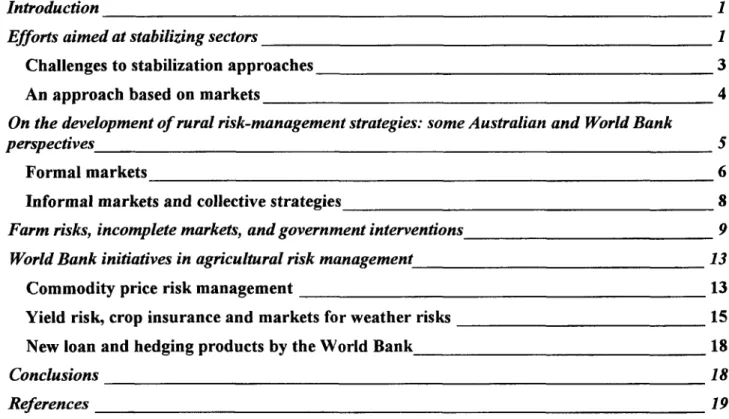
TABLE OF CONTENTS
Introduction I
Efforts aimed at stabilizing sectors I
Challenges to stabilization approaches 3
An approach based on markets 4
On the development of rural risk-management strategies: some Australian and World Bank
perspectives 5
Formal markets 6
Informal markets and collective strategies 8
Farm risks, incomplete markets, and government interventions 9 World Bank initiatives in agricultural risk management 13
Commodity price risk management 13
Yield risk, crop insurance and markets for weather risks 15
New loan and hedging products by the World Bank_ 18
Conclusions 18
AGRICULTURAL MARKETS AND RISKS: MANAGEMENT OF THE LATTER, NOT THE FORMER
Panos Varangis, Donald Larson and Jock R. Anderson'
INTRODUCTION
During the past dozen years, the political institutions that characterize the markets of internationally traded commodities have changed in dramatic ways. During that time, approaches based on certain types of government interventions that were common for decades were reevaluated and generally found to be ineffective and unsustainable. Related policies and supporting institutions that were originally put in place to foster development came to be viewed as impediments to growth. Although past approaches have been largely abandoned, how best to manage the negative
consequences of volatile commodity markets remains a key issue for governments and policy makers because traded commodities remain an important source of export earnings for many developing countries and an important component of income and expense for the poor.
The purpose in this paper is to review the historical relationship between the work of applied economists and policy makers and the institutions that came to characterize the commodity and risk markets of the 1980s. We discuss how a growing body of work contributed to a change in thinking that moved policy away from stabilization goals toward policies that emphasized the management of risks. We illustrate this change in approach with new and sometimes experimental programs, with special emphasis on programs at the World Bank.2
EFFORTS AIMED AT STABILIZING SECTORS
By the 1 980s unilateral and multilateral interventions in commodity markets were
commonplace. Broadly, the goal was macroeconomic and commodity sector stabilization and price stabilization was the objective. International commodity organizations employed buffer stocks or managed trade with the intention of bringing order to unstable commodity markets. The United States used support prices and inventories to manage domestic prices. The EU had a similar scheme but also operated a special set of commodity-specific exchange rates-"green rates"-for trade among EU members. Marketing boards and stabilization funds were common in both developed and developing countries, for example, wool in Australia and coffee in Uganda. For developing countries, lines of credit were available at the IMF and elsewhere to support the operations. How did this come about?
The reasons for past interventions are many and include historical and practical
considerations. Akiyama, Baffes, Larson and Varangis (2001) discuss these in the context of coffee, cocoa, cotton, sugar and grains. However, many of the interventions-especially the multilateral interventions-are partly explained by prevailing economic thought.
1 Authors are reverse-listed alphabetically; all are with the World Bank, Washington, DC.
2 This paper was prepared as a background piece for a presentation in a seminar held to honor Ronald C. Duncan on the
occasion of his retirement as Executive Director of the National Centre for Development Studies and Director, Asia Pacific School of Economics and Management, Australian National University, Canberra, in July 2001. Several of the themes taken up in this paper relate to work that Ron Duncan initiated when he served in the Bank as Chief of the then Commodities Division, and in his previous time in the then Industries Assistance Commission, Australia..
To a significant degree, many of the interventions can be traced to events at the close of World War II. At the time, policy makers focused on ways to prevent short-term trade shocks from turning into the wide-spread economic decline that characterized the Great Depression years. In an age of gold-standard fixed currencies, central banks were often challenged to manage shocks in export earnings. At Bretton Woods, Keynes (1943) proposed a world currency based on a price index of the thirty most-traded commodities. By linking currencies to the index, commodity prices and price-related swings in trade earnings would be largely stabilized in an automatic fashion. While Keynes' ideas were not incorporated into the charters of the Bretton Woods institutions founded at that time, an alternative approach to link lending with commodity volatility emerged. A succession of proposed internationally-backed compensatory financing schemes followed the Bretton Woods conference, including the 1953 Olano Proposal for a Mutual Insurance Scheme; the 1961
Development Insurance Fund; the 1962 Organization of American States Proposal; the Swedish and Brazilian Proposals at the Committee for International Commodity Trade meetings and the French Proposal for Market Organizations, all in 1963.
Also in 1963, the IMF began to offer compensatory financing to countries experiencing an unexpected temporary decline in export earnings. The on-going program is based on net export earnings, rather than a single set of commodities, thus taking advantage of any natural portfolio effect that might arise from diversified exports and imports. With modifications, this program remains the primary instrument among the Bretton Woods institutions for handling the effects of volatile
commodity trade. Later, as part of the first Lome Agreement in 1975, the EU offered its own
compensatory financing schemes, STABEX and SYSMIN, to ACP countries, but these have recently been terminated.
In 1950 Prebisch (1950) and Singer (1950) independently offered the hypothesis that, because of differing elasticities of income and demand, prices for primary commodity exports would fall relative to manufactured imports. Consequently, the net barter terms of trade for commodity producing developing countries would decline. This contradicted the long-standing notion of
increasing scarcity put forward by Malthus and Ricardo and Hotelling. Soon thereafter, the two ideas were combined so that the "commodity dependency" problem was characterized by declining terms of trade and volatile export earnings. Generally economists argued that instability of export earnings limited development through adverse effects on income, inflation, savings and investment. As a consequence international efforts were extended to key commodity markets as well. Later, Massell (1969, 1970) would integrate these ideas into a model he used to estimate the benefits of stabilizing commodity markets. More than a decade later, Newbery and Stiglitz (1981, p. 18) would comment: "The predictions of the (Massell 1969) model are readily derived ... and are quite precise: (i) producers gain and consumers lose from price stabilization if the source of instability lies on the supply side; (ii) consumers gain and producers lose from price stabilization if the source of instability lies on the demand side; (iii) in both cases, gainers could afford to over-compensate the losers, so there are net benefits from price stabilization."
Although the economic arguments were challenged, policies based on these arguments moved forward. Beginning in the 1950s, many governments of commodity-producing and consuming
countries took on the task of managing commodity markets through international agreements. Proponents of the agreements argued that commodity-producing countries suffered not only because
of market volatility, but also because of declining terms of trade. Under United Nations auspices, five international commodity agreements were signed by producing and consuming countries: the
Cocoa Agreement (1972); and the Natural Rubber Agreement (1980). In 1968, UNCTAD put forward a proposal that ultimately resulted in a 1975 resolution calling for an Integrated Program for Commodities, covering ten core commodities. The Common Fund for Commodities was established to provide liquidity for the integrated program. Moving more rapidly, the IMF established its Buffer Stock Financing Facility on June 25, 1969.
Governments began to run domestic stabilization programs. In 1990, Knudsen and Nash categorized prevailing approaches. These included: buffer stock schemes (examples at that time included Bangladesh, India, Indonesia, Mexico, the Philippines and South Korea); buffer funds (examples included Papua New Guinea, C6te d'Ivoire and South Korea); marketing boards with monopolies on trade (examples included most of Africa, India, Ecuador and Malaysia); and variable tariff schemes (examples included Malaysia, Chile and Venezuela).
CHALLENGES TO STABILIZATION APPROACHES
While the argument that volatility reduced investment and subsequently led to lower rates of growth in commodity-dependent countries was appealing, economists found only weak empirical evidence of a direct link. Using data from Malaysian rubber plantations, Caine (1954) challenged the negative link between revenue instability and investment. Later, MacBean (1966) also challenged the findings using cross-country data, as did Knudsen and Parnes (1975). Deaton (1992) found that that, for Africa overall, expansion periods for investment and ultimately GDP were greater during periods of increasing export prices than were the contractions during periods of falling prices. Conversely, Dawe (1996) calculated instability indices for a cross-section of countries by taking account of the share of exports in any given economy and found that export instability was negatively associated with growth and investment.
Increasingly, economists began to wonder if the link between low growth and volatile commodity markets had more to do with government mismanagement than private investment. Gelb
and Bourguignon (1988) provided evidence from Venezuela as did Bevan, Collier and Gunning (1990) for Nigeria and Indonesia. Moreover, Hausmann and Gavin (1996) argued that uncertainty over commodity-dependent government revenues (and fiscal management) had a cascading negative
effect on the economies of Latin America. Rodrik (1998) argued that the link between short-term economic shocks and growth was determined by the capacity of governments to manage the political conflict over resources that such shocks initiate.
Some economists also argued that the benefits of stabilization were over-stated. In 1954, Friedman stressed the importance of private savings rather than public stabilization schemes in
solving the "producer income problem". Newbery and Stiglitz (1981) argued that the Massell model was flawed in ways that exaggerated the benefits of stabilization. An important and frequent finding is that the welfare gains that are possible from price stabilization are relatively small (e.g., Anderson et al. 1981, Myers and Oehmke 1988, Wright 1988, Kannapiran 2000). Moreover, the practical implementation of stabilization schemes raises many thorny problems to be overcome by program administrators (Anderson, Hazell and Scandizzo 1977). These include the difficult-to-assess supply responsiveness to induced stability (e.g., Just 1975, Griffiths and Anderson 1978).
Early on, Bauer and Parish (1952) noted that the stabilization objectives of most marketing boards were ill defined and potentially more of a guise for taxation. Quiggin and Anderson (1979,
1981) discussed the limits of price bands and buffer funds. Wright and Williams (1990) noted the wide-spread failure of domestic stabilization schemes of all sorts and linked the failure to the nature
of commodity prices and underlying models of storage. Examining the time-series properties of commodity prices, Deaton (1992) argued that the series tended to be mean-reverting-a condition for a successful stabilization fund-but that the reversion took place over years; consequently, successful stabilization funds needed impractically large lines of credit. Later, in a book edited by Claessens and Duncan (1994), Larson and Coleman showed that, even with hedging, commodity price movements would eventually bankrupt stabilization schemes.
But the most telling criticism was the growing evidence that the interventions failed to accomplish their intended effect, most often because they could not be sustained. The international commodity agreements were unable to adapt to changes in the market, and by 1996 the economic clauses in them had all lapsed or failed (Gilbert 1987, 1996), victims of politics and economics (Table 1).3 Funds dedicated to buffer-stock management at the Common Fund have never been used for that purpose.
Table 1. Historically, International Commodity Agreements Have Proven Unsustainable
Sugar Tin Coffee Cocoa Rubber
... ... ... ...
Initial agreement 1954 1954 1962 1972 1980
date
Status of lapsed in 1963 collapsed in 1985 suspended in suspended in Suspended in
economic clauses and 1983 1989 1988 1996; revived
1997; suspended in 1999.
Number of 4 6 4 4 4
agreements
Source: Gilbert (1995), and World Bank, files.
AN APPROACH BASED ON MARKETS
As the poor performance of stabilization schemes became more evident, writers began to emphasize the distinction between policies that attempted to change the distribution of prices internationally or domestically with policies of managing uncertainty using markets for price risk.4 They also began to distinguish between macroeconomic problems rooted in the ability of government treasuries to manage assets and liabilities, and issues related to household vulnerability.
McKinnon (1967) explored the use of futures markets as an alternative to buffer stocks. Later, Gilbert (1985) demonstrated that hedging on forward markets could substitute for some of the
welfare gains normally associated with buffer stocks. Gemmill (1985) argued that futures markets for cocoa, coffee and sugar would provide an attractive mechanism for hedging export-earnings risks and that forward contracts could be substantially cheaper than buffer-stock operations. O'Hara (1984) looked at the use of commodity bonds to stabilize consumption. Rolfo (1980) investigated the use of futures for cocoa producer prices and calculated the optimal hedge ratio in the presence of both production (output) and price volatility. Overdahl (1987) demonstrated the benefits of oil futures 3 Gilbert's (1996) obituary for the commodity agreements proved either premature or precognitive, since the rubber
agreement was briefly revived in 1997 only to be suspended in 1999.
4In the early 1980s, Ron Duncan took several initiatives concerning uncertainty in commodity prices, including reporting
information on uncertainty in World Bank commodity price forecasts, and analysis of how uncertainty should be
markets for oil-producing states. The volume edited by Priovolos and Duncan (1991) brought
together thinking on the use of market instruments to manage government debt. In that volume Myers and Thompson provided a model of external debt management that included commodity-linked bonds. Claessens pointed out that commodity bonds can be used to hedge debt-management problems associated with volatile export earnings. Wright and Newbery proposed commodity-linked financial instruments to smooth commodity export revenue and Anderson, Gilbert and Powell looked at the role of partial guarantees and commodity contingency.
In 1994, Claessens and Duncan edited their second volume, this time showing how markets could be used to achieve many of the sectoral stabilization objectives of many existing programs in a sustainable way. In that volume, market-based methods were offered as an alternative to unsound programs in Costa Rica, Papua New Guinea and Venezuela.
About the same time, evidence mounted that many of the interventions, put in place in part to facilitate growth, had instead become an impediment to growth. This was due in part to the
stabilization policies that limited competition and misdirected resources; however, it was also due to the inconsistent policy objectives of many developing countries. In many instances, the same
governments that sought to protect producers from the negative consequences of volatile commodity markets also taxed their producers directly or indirectly to spur industrialization and favor urban interests. Influential studies by Kruger, Schiff and Valdes (1991) and Mundlak, Cavallo and Domenech (1993) documented the negative consequences of these policies and recommended
sweeping reforms.
As the end of the century approached, a series of events and crises launched a pervasive series of reforms, undertaken in part at the urging of multilateral lenders such as the World Bank. Akiyama, Baffes, Larson and Varangis (2001) illustrate the rapid pace of these reforms for Africa, for instance.
While the reforms swept away many of the ineffective institutions that were mandated to stabilize domestic markets-for example the IMF eliminated its Buffer Stock Financing Facility in February 2000-they did not, nor were they designed to, address two key remaining problems related to commodity risks: (i) the inability of some governments to prudently manage revenue and
expenditures that are volatile; (ii) the high cost paid by vulnerable rural households-in terms of forgone productivity-to limit the consequences of risks. We will return to some promising approaches after considering some more general aspects of rural risk.
ON THE DEVELOPMENT OF RURAL RISK-MANAGEMENT STRATEGIES: SOME AUSTRALIAN AND WORLD BANK PERSPECTIVES
Often, early writers failed to distinguish between the sector and economy-wide effects of stabilization and the consequences of stabilization for farmers. An exception was a 1978 Industries Assistance Commission (IAC) Report, "Rural Income Fluctuations", prepared under the Presiding Commissionership of Sir John Crawford.5 Lloyd and Mauldon (1986), for one set of highly involved contributors to this debate, have put this work in a worthy wider policy context. Many observers today recognize that an adequate risk-management framework must involve multiple strategies
(prevention, mitigation, coping, management) and arrangements (informal, market-based, public) for dealing with risk, and instruments that take account of the sources and characteristics of rural risk. 5 "Industry-wide stabilisation measures, such as various methods of price stabilisation, are unlikely to contribute greatly
The theme is clearly an important one for contemporary development and is so recognized in the 2001 updating of the World Bank rural development strategy (e.g., Anderson 2001). Moreover, since strategies for managing risks can fail, understanding the limited capacity of governments, firms and households to manage risks is an important component of a social protection strategy (World Bank, 2001.)
Agriculture itself, a key sector operating largely in rural areas, is an intrinsically risky
industry (e.g., Robison and Barry 1987, Anderson and Dillon 1992). Australia, for one non-randomly selected illustration, is quite a risky space, especially in rural areas (e.g., Anderson 1979). There is no shortage of unpredictable uncertainties that impinge on farmers and other business operators who work in rural areas, not to mention those who supposedly serve them in the various legislative, administrative, judicial, and other domains of influence. Since the type and severity of the risks confronting farmers and others everywhere vary greatly with the farming system and local
characteristics, and with the changing climatological, infrastructural, policy, and institutional settings, there is a certain boundlessness to the issues. This has naturally made the attention of governments, NGOs and international agencies to such matters not only challenging but also highly varied. Few really general (and worthy) prescriptions about strategies to manage risk are possible. The strategic options considered here have, of course, been worked on extensively by agricultural economists in recent decades, and have been synthetically examined by Robison and Barry (1987), Huime, Hardaker and Anderson (1997) and, especially for developing countries, McConnell and Dillon (1997).
FORMAL MARKETS
Profit is the reward for risk-taking, therefore any profit seekers in the business of farming, or in any other business, must be prepared to bear some risk. Ways of establishing which risks are bearable and which are not for a particular farmer are the heartland of agricultural decision analysis/risk analysis/policy analysis (e.g., Anderson, Dillon and Hardaker 1977). While virtually every decision will have risky consequences, it is clear that not every decision exposes a business or dependent household to "unbearable" risk. Many decisions can be made by basing choice on some notion of expected return.
The fact that returns from different activities are typically strongly positively correlated limits the gains from diversification on farm. Better opportunities to spread risks may lie in spatial
diversification, although this type of diversification in its most extreme form is open only to the largest businesses. Investments in off-farm activities may provide an effective risk-spreading avenue that should not be overlooked by strategists, even for relatively poor farmers. There is strong
evidence that farmers in poor rural communities are risk-averse and take actions that result in lower, but more stable incomes. (See, for example, Moscardi and de Janvry, 1977; Dillon and Scandizzo,
1978; Just and Pope, 1978;Binswanger, 1980; Antle, 1987; Rosenzweig and Binswanger, 1993; Gautam, Hazell and Alderman, 1994; Ellis 1998, Reardon 1997, 2000). For example, farm families often diversify income sources, engaging in such non-farm activities as agricultural processing, providing services such as construction and repair, and small-scale manufacturing. These various imperfect mechanisms for risk management mean that there may be a case for assisting stressed rural households directly. As the IAC (1978) investigation revealed, such intervention should be
approached carefully and rather cautiously, beyond broad social-protection economy-wide measures. However, before turning to a discussion of interventions to supplement the capacity of households to
manage risk, we review briefly the ways in which rural households can and do manage pervasive risks.
Debt and savings. The way a farm business uses debt (and savings) can have major
implications for risk exposure (Barry and Baker 1984). This was brought out strongly in the IAC RIF reference, and extensive use was made of the then-recent piece by Baker (1974) on variable
amortization schemes. A key concept in regard to financial risk exposure is financial leverage, defined as the use of credit and other fixed-obligation financing relative to the use of equity capital (Robison and Barry 1987, chapter 16). Increases in financial leverage magnify the impact of variability of firm returns from the point of view of the owner. If the return on total assets is above the borrowing rate, the rate of return on the owner's equity will be increased, and conversely, if the overall rate of return is less than the borrowing rate, the owner will suffer, in the extreme case receiving a negative rate of return on equity. Given a run of bad years, the farmer may reach the limit on borrowing set by the bank, or may run up more debt than can be serviced, especially if there is a persistent downturn in farm profitability. Such situations can obviously lead to bankruptcy. It is recognized as unwise to borrow to the limit of available credit set by lending institutions since holding a credit reserve can be a way to provide liquidity to get a business through troubled times. However, while the direct costs of holding a credit reserve are usually low, the opportunity costs, in terms of the return on the forgone investment, may be considerable.
Price-pooling. In many countries, farmers have the opportunity, if not an obligation in some
cases, to reduce price risks through various marketing arrangements. The most important alternatives, from a risk-management perspective, include cooperative marketing with price pooling, forward contracts for commodity sales or for input delivery, and hedging on futures markets (Varangis and Larson 1996, and other sections of this chapter). Of these, price-pooling arrangements are usually the least effective for risk management. They operate by a group of farmers collectively buying their inputs or selling their outputs through a cooperative or marketing board. Membership of the selling group may be voluntary or compulsory. The price-pooling arrangements may be operated in various ways but are generally designed to protect the individual from short-term fluctuations in prices by some form of averaging. There may also be claimed advantages from increased market power and economies of size, leading to lower input prices or higher product prices than could be obtained by the individual, but these benefits, if they do indeed exist, will be at least partially offset by the administrative costs of the scheme.
Forward contracting of sales or purchases is a much more effective and relatively widely
used form of risk management for farmers, the most common being a contract for the sale of a crop. The contract is written, perhaps at planting time, or maybe later in the season, between the farmer and the purchaser of the product, agreeing on a price (or a basis for determining a price, such as a price scale according to grade). The contract may stipulate the quantity of produce to be delivered by the farmer, or may relate to the whole production, which will obviously depend on the yield. Of course, the price offered is likely to be discounted below the generally expected price for the future delivery date, since the merchant is taking a risk of loss should the market drop between the contract date and the delivery date. However, elevator operators in the USA, for instance, routinely hedge their own risks and this is passed on to farmers at quite low cost (Harwood et al. 1999, p. 75). A risk-averse farmer alone may, however, also be willing to accept a discounted price for the security of an assured price for the product. Personal assessment will be needed to determine whether or not a contract offer should be accepted. Depending on the details of the contract and the size of the harvest realized, it
may be necessary for the farmer to purchase on the market to meet the contracted delivery requirements.
Hedging on afutures market is rather similar to forward selling on contract but with a number
of differences. One important difference is that the futures contracts are standardized contracts that are widely traded, so prices are more competitively determined than for a specific contract between a single farmer and a single merchant. That might mean that the farmer could get a better deal by hedging on the futures market than by selling forward on contract. Not that risk can be totally dodged in such trading. The basis will vary over time, and is a source of uncertainty that cannot be eliminated by the farmer. For developing countries trading on foreign markets, there is the additional
disadvantage of large variations in basis, consisting of ocean freight, currency rates and possibly also export subsidies.
Agricultural economists have devoted much effort to attempts to analyze futures markets systematically and to show how risk-averse farmers 'should' use such markets. Yet the reality is that rather few farmers actually use futures hedging, probably mainly because of lack of knowledge of how the market works. Use by farmers even in the USA is low (Harwood et al. 1999), and Gardner (2000) thinks that this is because of the relative unimportance of the agricultural share of the incomes
of the majority of relatively small-scale farmers who gain most of their livelihood in non-farm activities. Moreover, there are in general some limitations to hedging on futures as a means of risk management, beyond the mentioned basis risk that cannot be eliminated. Prices for the grade of product sold by the farmer may move somewhat differently from prices for the grade specified in the futures contract, creating a further source of uncertainty. In many settings it is necessary also to
examine simultaneous use of insurance contracts. Finally, farmers must be able to finance their futures trading operations. They will be required to place a deposit with their brokers when selling the contract, and will also face the possibility of additional (margin) calls for funds to cover potential losses should the futures price move against them.
The decision on whether to hedge hinges principally on the farmer's expectations about the cash price at the date in the future when the commodity is to be sold, relative to the futures contract price for that period. Harwood et al. (1999, p. 76) note that the extent of risk reduction achieved can be quite small where variability of yield is high or yield and price are negatively correlated. For a risk
averter, hedging will be attractive only if the more or less certain futures contract price is above the expected value of the subjective distribution of future cash price by an amount more than sufficient to cover the costs of the transactions. If a decision is taken to hedge, usually it will pay to hedge an amount approximately equal to projected actual sales, although, as with forward contract selling, it is possible to hedge only a portion of expected sales.
INFORMAL MARKETS AND COLLECTIVE STRATEGIES
These remarks about futures contracts largely apply to farming in a country where the farmers and others readily have the option to trade in futures if they wish, a situation that has not always prevailed in the rural areas of many developing countries. Access to futures markets is, however, increasing around the world (e.g., Priovolos and Duncan 1991, Claessens and Duncan 1993), but even so, it will be moot as to how useful futures markets are to resource poor farmers who lack the information and financial acumen to take direct advantage of them. It is likely that their access will be indirect, such as through their marketing cooperative hedging future sales on their behalf (e.g., Claessens and Coleman 1993). Indeed, this has long been the practice in some countries specializing
in production of commodities for which there is an active futures market, such as West African cotton relative to the New York cotton futures market (Satyanarayan, Thigpen and Varangis 1993). Analysis has suggested useful possibilities for futures trading to assist in risk management in diverse
circumstances, such as wheat in Pakistan (Faruqee and Coleman 1996) and coffee in Costa Rica (Claessens and Varangis 1993). There is, as discussed below, still a need to undertake further policy and institutional work before seeking to introduce such marketing innovations.
Credit and risk-sharing institutions are, of course, widely available in industrial countries to help farmers overcome such risk problems. Farmers can usually borrow for production or
consumption purposes to ease the transition from good years to bad. In many cases, they have access to a variety of privately provided insurance against specific types of risks, and they can trade in commodity futures and options markets. In developing countries these kinds of institutions are usually much more rudimentary, and are seldom available at all for small-scale farmers or other impoverished residents of rural areas. Developing-country household studies confirm that farmers in developing countries self-insure through a variety of formal and informal mechanisms including diversification of crops and labor, gift-giving, and income-and-responsibility sharing Morduch 1998 and Fafchamps 1999). Using household data, Paxson (1992) confirmed earlier observations by Cain and Friedman and showed that Thai rice farmers save most, if not all transitory income. However, self-insurance can prove expensive (Robertson 1987) and unreliable (Alderman and Paxson 1992). For example, returns to liquid savings can be negative (Deaton 1991) or heavily taxed by inflation (Fafchamps 1999). Moreover, self-insurance schemes can fail when they are needed most,
particularly in time of drought (Reardon, Matlon and Delgado 1988). In the extreme case, households are unable to command adequate food supplies. Famines are characterized by such failures on a large scale (Sen, 1981.)
FARM RISKS, INCOMPLETE MARKETS, AND GOVERNMENT INTERVENTIONS
The incidence of risk and risk-averse behaviour in farming has been widely perceived to be important for policy makers. Fluctuations in farm incomes, particularly the risk of catastrophic loss, may present difficult welfare problems for farmers. There are also important spillover effects on other rural households and businesses. Destroyed crops and livestock reduce employment opportunities, with serious implications for the landless rural poor in developing countries, and add to
unemployment problems in other countries. Destroyed crops and stock also lower farm output and so reduce turnover for agricultural merchants and agro-processors. Moreover, reduced farm incomes have negative multiplier effects on income and employment for many rural non-farm businesses and towns (Powell and Mandeville 1978, Haggeblade and Hazell 1989).
Market failures seem to be most evident when catastrophic events, such as droughts or widespread floods, occur, largely because of the "co-variation problem" or the problem of "covariate
risk". In turn, event-related failures in markets for food and for storage can exacerbate shocks to incomes and to food supplies (Ravallion 1997). Catastrophic risks are often blamed for failures in credit markets including widespread defaults on bank loans (e.g., Yaron, Benjamin and Piprek 1997), even in some industrial countries such as the USA. However, it is often difficult to determine whether loan defaults are really driven more by an inability to pay, or by the expectation that
governments, under political pressure, will provide debt relief in bad years (e.g., Anderson and Dillon 1988). In the past, governments have too often responded to farmers' difficulties by forgiving their loans, which undermines the operation of the credit system and sends the wrong signal to farmers about the need for them to take responsibility for managing their own risks.
Despite the lack of adequate quantitative assessments of the costs of market failures in risk management, and hence of the potential benefits from public interventions, governments around the world have implemented various forms of risk-management policies. An assessment of experience with these interventions is now attempted. Given the diversity of their nature, and their proliferation over time and geopolitical boundaries, the experience of risk-intervention policies is, not surprisingly, diverse and varied. Much of the focus of the profession of agricultural economics has been on dealing with instability inherent in the sector, especially following the USA-oriented writings of Schultz (1945), Johnson (1950) and Heady (1952). Fortunately, it is not necessary here to undertake a comprehensive examination of this experience as it has been well reviewed by authors such as Fackler (1988), Rausser (1988), Anderson and Hazell (1997), Harwood et al. (1999), Coble and Barnett (1999), Gardner (2000), OECD (2000) and Tomek and Peterson (2000), not to mention the IAC (1978), so the generalizations below represent a synthesis of seemingly cogent studies in the field.
As already discussed, for the fifty years following World War II, price stabilization was the preferred approach of most policy makers and the programs were expected to confer benefits to rural households as well as the economy generally. But there were other changes over this period that surely had many significant influences on the risk encountered by commercial producers, especially those producing for an export market. If the risk experience of such producers is assessed by the variability in real domestic currency prices, the effect of the general shift to flexible exchange rates depends on several factors: the exchange rate variation, the good's own foreign currency price variation, domestic price level variation, and the covariation between these three variables (Smith
1999). In the case of Australian wool, for example, it seems likely that producers suffered less price volatility following the floating of the exchange in 1974 (O'Mara et al. 1999), quite apart from the later debacle of the Reserve Price Scheme for wool (Phillips and Bewley 1991, Bardsley 1994, Bardsley and Olekalns 1996). But to return to the post-stabilization era, alternative choice-based approaches have been suggested and examined, and these are briefly reviewed.
Crop insurance is provided or supported by the public sector in both industrial countries and
developing countries. The driving force for such programs often originates in governmental concern about catastrophic risks such as drought, or the desire to reduce the incidence of loan defaults to banks. The topic was raised as an important issue in the RIF investigation (IAC 1978), which in turn led to a deeper subsequent analysis (IAC 1986).
An overwhelming factor is the incentive problem that arises once the government establishes a pattern of guaranteeing the financial viability of an insurance provider. If the insurance staff know that any losses will automatically be covered by government, they have little incentive to pursue sound insurance practices when setting premiums and assessing losses (Wright and Hewitt 1994). In fact, they will find it profitable to collude with farmers in filing exaggerated or falsified claims.
Yet another common reason for failure has been that governments undermine public insurers for political reasons. In the USA, the government has repeatedly undermined the national crop insurer (FCIC) by providing direct assistance to producers in disaster areas. Why should farmers purchase crop insurance against major calamities (including drought) if they know that farm lobbies can usually apply the necessary political pressure to obtain direct assistance for them in times of need at no financial cost?
Price and revenue insurance. Various ideas have been floated for dealing with the downside
test by the International Task Force on Commodity Risk Management in Developing Countries (1999), an initiative discussed later in this paper, are not intended to stabilize prices in real markets, but rather focus on placing a floor under the prices of traded commodities received by producers in developing countries, which have been selected for testing novel arrangements. Indeed, a research component of the effort is designed to inform debate on emerging policy in this area.6
Disaster reliefpolicy, or sometimes the lack of it, represents a significant opportunity for
public intervention, long the subject of policy analysis. There has been a tendency for emotion and public outcry to drive a process that leads governments to intervene in ways that, with the wisdom of hindsight, are demonstrably ineffective and distorting of individual incentives to plan more carefully for what in many situations are inevitable occasional bad outcomes. Such planning would naturally include selective purchase of insurance contracts, as discussed above, with the predictable negative consequences for broad participation in formal insurance markets. It is worth recalling, from time to time, that the world is indeed a risky place, and the extent of resultant costs can be considerable. If governments rush to bail people out of the effects of otherwise-insurable natural disaster risks whenever there is political clamor to do so, development of commercial insurance markets will be fatally compromised. Just where governments should seek to position themselves relative to the insurance market in sharing responsibilities has long been on the research agenda of public policy (e.g., Kunreuther with others 1978) and continues to be today.
A distinguishing mark of a potentially good policy is one that swings into action as needed, without requiring (or even allowing) political largesse, and yet provides no disincentives for affected producers to do the best that individually they can to plan for and manage their own natural-disaster (e.g., drought) experiences as they unfold (e.g., Anderson and Dillon 1988). Australia, for instance, now has such a system in place for droughts (DPRTF 1990), after a long history of at best
questionable interventions (Butler and Doessel 1979), such as in fodder and livestock markets under the rubric of assisting producers in their drought management.
There is clearly an important job to be done in providing assistance to prepare for and recover from natural or man-made disasters that can result in great human and economic losses7. Indeed, developing countries suffer the greatest costs when disaster hits: more than 95 percent of all deaths caused by disasters occur in developing countries; and losses due to natural disasters are 20 times greater (as a percent of GDP) in developing countries than in industrial countries. Poorly planned
development can turn a recurring natural phenomenon into a human and economic disaster. For agricultural markets, catastrophes result in multiple crop failure. Such events have a rippling effect throughout the local economies as agricultural workers and those employed in
supporting services suffer income losses. However, farm income losses associated with the failed crops can, in some instances, be privately insured. When parametric insurance is considered - for 6 There are diverse views about the value of any such subsidized interventions, e.g., "The management of commodity
risks has entered a new era with the global liberalisation of agricultural markets. This liberalisation has strong support within economic research, which judges international and domestic efforts to stabilise prime commodity prices to be difficult, if not impossible, to implement without subsidies, highly likely to be captured by special interests, and of unproven social benefit. Research is needed on the question of the social value of reducing price uncertainty and/or price variability and under what circumstances or for which commodities it is likely to be of benefit". (Duncan 1997, p. 442).
7 See Ravallion (1997) for a review of public action failures related to famine. Examples include governments that
inadequately respond to food shortages - sometimes deliberately so - as well as government market interventions that enhanced the vulnerability of households to famine.
example, temperature or area-yield policies -the distinction between disaster relief and insurance - as compensating mechanisms diminishes; however publicly financed disaster relief will create a
different set of incentives than privately priced insurance that can induce risk-taking and other problems related to moral hazard. This has prompted Skees, Varangis and Larson (2001) to suggest that triggers for disaster relief only pay out for rare events - with the corollary result that relevant definitions of disaster will due to climatic and other differences.
The case of Mexico can illustrate these points. In Mexico, the government in 1996 established a Fund for Natural Disasters (FONDEN) for post-disaster financing for reconstruction of public infrastructure, and compensation to low-income producers for crop and livestock losses arising from natural disasters. FONDEN targets the beneficiaries and has limits to amounts it disburses per beneficiary. The intention is not to compete with private insurance. In addition, more recently, FONDEN has started to adopt objective rules for declaring catastrophic events. This removes an ad hoc dimension in the declaration of catastrophes and reduces the political interference in FONDEN's operations. Operating in parallel to FONDEN are a group of mutual insurance funds amongst farmer
organization. These farmer organizations are calledfondos de aseguramiento (fondos for short), formed to provide mutual crop insurance to their members. The fondos collect premiums creating reserves to pay indemnities and cover operational costs. The fondos purchase traditional reinsurance for times when claims deplete held reserves. However analysis of historic reinsurance payouts reveals that weather events, similar to those covered under FONDEN, are the primary source of systemic payouts by the fondos
Other mechanisms are available to governments intent on easing the pain of dealing with risk
in various parts of the economic system, or at least sharing in the enterprise risk. In an economy where the income-tax system functions well, schemes may be put in place that enable taxpayers,
including farmers, to manage their post-tax income streams in a manner that causes them less financial suffering and presumably boosts enterprise efficiency in the face of variable fortunes in productivity and markets (e.g., Buffier and Metternick-Jones 1995). Where some groups contribute little to taxation revenues, as may be the case with many farming communities, there are obvious limitations to such instruments as risk-management mechanisms. The idea of having mechanisms that
are neutral across sectors of the economy is, however, virtuous.
One potential such mechanism is the credit system. In principle, having a financial system serving rural areas in a flexible manner that recognizes the riskiness of life in such space is the best single approach to helping all concerned to manage their risks. Credit, as noted above, serves as a useful, largely self-managed instrument in industrial countries, but is not so straightforward in
developing countries, where much agricultural lending is tied to farm inputs and must be repaid at the end of the season, even if it is a bad one. Credit to smooth consumption across years is rarely
available from the formal sector in developing countries. This is part of the rationale for the proposals noted above as being under examination by the International Task Force on Commodity Risk
Management in Developing Countries (1999), and variously discussed by others in recent years (e.g., Varangis, Akiyama and Mitchell 1995, Duncan 1997, Sarris 1997).
Commercial banking institutions, particularly those in developing countries lending to agriculture, face considerable risk in identifying "problem borrowers" who have little intention of repayment. In managing their resources, banks typically diversify across sectors and regions, maintain financial reserves, establish contingent loan arrangements with other banks, and build up personal relationships with their clients. In times of stress they will work with a borrower to develop a rescue plan of roll-overs, interest rate adjustments, and so on around the agreed collateral. But such
flexibility was seldom encountered in the traditional agricultural banks, which were thus
correspondingly vulnerable (Hazell 1995b). One hope for progress was agricultural credit insurance, but this too has met the fate of most crop insurance programs (Pomarada 1984, Hazell 1995b), and attention has now shifted to the possibly of loan-guarantee schemes. There is yet little evidence to suggest that credit insurance helps banks much, or that they increase the volume of lending to agriculture in general and to small-scale farms in particular, but they may still prove to be effective, and more research seems warranted.
WORLD BANK INITIATIVES IN AGRICULTURAL RISK MANAGEMENT
Two key conclusions of the debate over how best to manage risks is partly reflected in World Bank lending. The notion that many of the stabilization programs, of the type common in the 1980s, were ineffective and at times and obstacle to growth, is well reflected in the Bank's research and also in the Bank's structural lending. The conclusion that some households are, at times, especially vulnerable to certain types of risks is also reflected in research and in Bank lending for safety nets and social protection. However, in recent years, activities at the World Bank have also been directed at an unresolved question to the effect that, if households and small firms in developing countries are
especially vulnerable to certain types of risk, in part, because they have poor access to market-based instruments for managing risk, can the problem be mitigated, if not solved, by extending the reach of markets?
COMMODITY PRICE RISK MANAGEMENT
The World Bank has long recognized price volatility as an important problem for farmers and rural households in general. In the mid- 1 980s, the Commodities Division of the International
Economics Department started a serious investigation on the use of commodity price-risk management instruments, such as futures, options and swaps, by developing countries.
This early work culminated in 1991, with the publication of the book by Priovolos and Duncan. As discussed earlier, the book argued that commodity price-hedging instruments have been used in financial markets of industrial countries and offer considerable potential for managing
commodity price risks in developing counties. These instruments have been little used in these latter countries, not because they are new, but also because of the lack of understanding and awareness, and countries not understanding their risk exposure. The book focused on commodity-linked financing instruments, such as commodity bonds and commodity-linked securities. The focus was more on the macro, country-wide level, rather than sectoral level and more on the theoretical/conceptual side rather than on practical applications.
Following this early work, several case studies were undertaken to demonstrate the
applicability of the approach. This work was as much one of research into the problems of price risk management to be resolved and issues to be discussed, as it was one of actual technical assistance (mainly awareness raising) to particular countries. Most of this early case-study work focused on Colombia, Costa Rica, Papua New Guinea and Venezuela. The book edited by Claessens and Duncan presenting these case studies and lessons learned was published in 1993. The early test cases
demonstrated that developing countries can benefit significantly from using financial instruments to manage commodity price risks. The work undertaken argues that the fact that very few developing
countries or entities in these countries have used these instruments "... is attributed to a lack of awareness of the risks that are faced; to a lack of knowledge of the potential use of market
instruments; to domestic regulatory, institutional, and legal constraints; and to considerations in the marketplace regarding the countries' creditworthiness. The obvious conclusions are that technical assistance, training and education, and credit enhancement by third parties are necessary to allow developing countries to benefit fully from the use of these instruments."
The early work by the World Bank both on the theoretical/conceptual front (Priovolos and Duncan 1991) and applications (Claessens and Duncan 1993) contributed to increasing the visibility of commodity price-risk management not only within the World Bank group but also among the development community (e.g., CFC, FAO, UNCTAD, donor governments). In 1999, the World Bank became the catalyst for the establishment of the International Task Force (ITF) on Commodity Risk Management that was convened to evaluate the feasibility of providing small producers access to risk-management instruments and services in developed countries. The ITF is a partnership which brings together a broad representation of international institutions, producer and consumer
organizations, and private sector entities. ITF focused on the actual delivery of
price-risk-management instruments to small farmers. The major challenge of the ITF work is to find a local institution that can capably aggregate enough volume from many small farmers to access the international market for risk management instruments.
To demonstrate how this will actually work, in 2000 the ITF initiated feasibility studies to evaluate, in some depth, the feasibility of making price risk management instruments available to producers in developing countries. These test cases look at the existence of producer organizations that could purchase price insurance for their members. The risk-management instrument proposed in the ITF work is the purchase of put options by producers, because of the limited exposure to counter party (credit) risk; that is, as long as the producer purchases the option, there is no risk. And if the producer defers the payment of the option at the time of the sale of the commodity, the risk is limited to the amount of the deferred option premium. Price insurance in these test cases is linked to
financing. Producers who receive credit, through their organization, are required to have price insurance to cover the repayment of the loan. The financial institution providing credit through the producer organization then will be willing to provide financing for the purchase of the price insurance (the put option premium).
It is still too early to evaluate the experience from these test cases as most of them are still under way. A challenge in the ITF approach has been to identify viable producer organizations to provide risk-management instruments to their members. Such organizations often require significant technical assistance and training to understand the instruments offered and manage their obligations. Furthermore, the risk-management instruments offered need to be simple and transparent for farmers to understand . This has led to the choice, at least initially, of put options as the practical price insurance mechanism for a minimal fee (the option premium).
Originally, credit risk was considered a major obstacle. That is, producer organizations needed some credit enhancement in order to obtain credit or defer the payment for the put option premium. The test cases so far have indicated that deferred payment for the options or obtaining credit for the premium is not an issue. Banks that finance these producer organizations are often willing to extend credit if this is used to purchase price insurance. Thus, the key element of success in the early cases is linking price insurance with credit.
Another issue is the willingness to pay. Put option premiums can be expensive exactly at the times when price insurance is most needed, that is, for longer dated periods and when price volatility is high. It remains to be seen how much producers will be willing to pay for price insurance. Of
course, if insurance is linked to credit, the demand for insurance is a derived demand for credit. This has less elastic demand and farmers may be willing to pay more in order to access credit that
otherwise would be either more expensive or rationed.
It may also be observed from these cases, that price risk management is not really for the poorest of the poor. The main clients for such insurance are commercially-oriented farmers. They may have small land plots but they are producing a surplus that they market. They obtain credit and spend money on inputs. These are not subsistence farmers and not the poorest amongst rural people. This does not mean that price risk management will not contribute to adopting new production technologies, and to making new investments that could ultimately lead to higher household incomes. But the main beneficiaries will be commercially-oriented farmers, including small ones, while for the poorest in rural areas, social programs may be rather more appropriate. This should not diminish the value of price-risk management per se, but expectations should be set realistically.
The replicability and long-term financial viability of the ITF price-risk-management approach is very important. So far the ITF has tried to identify one or more cooperatives (or producer
associations) within each country that would retail price insurance to members. This is fine for the pilot test phase. However, to continuously try to identify, educate and train producer associations and cooperatives requires start-up costs and human resources that can quickly add up to significant amounts if the exercise moves beyond the test-case phase. There needs to be a local institution that could aggregate the function of several cooperatives and producer organization within a given country. A bank or an insurance company could perhaps play such a role. Such an organization should be able to also provide technical assistance to producer organizations along with the risk-management products. The ITF would then have to deal with the "local aggregator" and not with each individual cooperative or producer association. The bank, the insurance company, or some other
such aggregator would replicate the ITF approach locally, perhaps with technical assistance from the ITF.
YIELD RISK, CROP INSURANCE AND MARKETS FOR WEATHER RISKS
In addition to price risks, farmers face yield risks, due to mainly adverse weather but also to other factors such as pests and diseases. The World Bank has long recognized the need for yield insurance but experience so far with traditional crop insurance has been discouraging. Traditional crop insurance has proven to be expensive and riddled with moral-hazard and adverse-selection problems. New developments in weather risk management markets have provided new opportunities to re-think yield insurance in emerging markets, and in 2000 the Bank and its International Finance Corporation (IFC) launched a project to investigate this.
Government-supported crop insurance has been touted for years as being an important innovation for helping rural households manage risk. A market-based, risk-sharing insurance
alternative for agriculture has many potential advantages. If society can reduce the risk from growing agricultural commodities, then the market failure in supplying credit can be addressed. These
arguments are very seductive since credit plays a major role in development, as producers generally must borrow to invest in new technologies.
Still, there are yet no examples of successful crop insurance programs without heavy reliance on government subsidies (Skees, Hazell and Miranda 1999). Providing individual crop insurance requires significant monitoring and some form of farm-level inspection to verify crop losses. Farm-level inspection of small plots of land is cost-prohibitive for a private insurance firm. Further, such
investments by the public sector are also questionable, since these funds likely have a higher return when used for other purposes. Even if crop insurance could be provided with low government costs (subsidies), crop insurance could be of limited value to small farmers since income from growing crops is generally a small proportion of the household portfolio. For example, in Mexico only around 20% of the household incomes of small-scale farmers (under 2 ha) comes from own-farm activities (crops and livestock).
There are, however, alternatives for managing and coping with yield risks. These have to do with making use of recent capital-market innovations. In recent years, much has been written about the convergence of traditional insurance markets and capital markets (Doherty 1997, Lamm 1997, Skees 1999). There are several innovations in packaging natural-disaster/weather risk into various forms of tradable financial assets. Some of these instruments are packaged as catastrophe bonds; insurance contracts; weather derivative contracts; exotic options; or some other derivative financial instrument. In any case, they all provide the holder with large amounts of capital contingent upon the occurrence of some risky event. By purchasing these instruments, those holding the risk share some of their risk exposure with market investors. Those selling the instruments earn favorable returns and are willing to accept the risk as part of a broad-based diversified portfolio. These emerging risk-sharing markets should open many more doors for innovative, risk-risk-sharing solutions for weather-related and natural-disaster risks.
Although the application of weather-based index insurance and cat bonds is quite advanced in the energy sector and for earthquake insurance, respectively, applications in the agricultural sector are still limited. For one, this type of insurance is new. Second, it has to compete with highly subsidized agricultural insurance schemes in developed countries. In other words, high subsidies for traditional crop insurance crowd out the development of weather-based index products. And third, farmers in several developed countries, such as the USA, Canada, and Australia, are usually large-scale commercial farmers demanding individual loss assessment.
Weather-based index insurance is a relatively new insurance (or risk-management) instrument whose payouts are based on the occurrence of a weather event, rather than on actual crop losses (Skees 1999, Skees, Hazell and Miranda 1999). Thus, for instance, in the case of drought, insurance contracts would be written against severe rainfall shortfalls (say 30 percent or more below a defined norm) measured at agreed regional weather stations. The insurance would be sold in standard units (for example, US$10 or $100), and all buyers would pay the same premium and would receive the same indemnity payment per unit of insurance if the pre-defined rain shortfall happens.
The key advantage to this kind of insurance is that the weather or "trigger" event (e.g., a rainfall shortage) can be independently verified, and therefore not subject to the possibilities of manipulation that are present when insurance payments are linked to actual farm losses. And since the contracts and indemnity payments are the same for all buyers per unit of insurance, the usual problems of moral hazard and adverse selection associated with public crop insurance are lessened. Besides, the insurance would be easy to administer, since there are no individual contracts to write no on-farm inspections and no individual loss assessments. This can help make the insurance affordable to a broad range of people, including agricultural traders, shopkeepers and landless workers, whose incomes are also affected by the insured events.
Weather index insurance would be also easy to market. For example, it could be sold through banks, farm cooperatives, input suppliers and micro-finance organizations, as well as being sold directly to farmers, perhaps in the same way that lottery tickets are sold in village stores. Weather