Simulation-based training in
anesthesia crisis resource management
(ACRM): A decade of experience
David M. Gaba Steven K. Howard Kevin J. Fish Brian E. Smith Yasser A. Sowb Stanford University
Several gaps exist in the training of clinicians in health care domains, such as anesthesiology, that have the cognitive profile of complexity and dynamism. These features are shared with other industries such as com-mercial aviation. Training for cockpit crews on Crew Resource Management (CRM) emphasizes deci-sion-making and teamwork principles. The authors created a simulation-based curriculum (ACRM) for anesthesiology based on principles of CRM in aviation. The training philosophy adapted to health care is one of training single-discipline crews to work in teams. The ACRM curriculum involves highly realistic simulation scenarios requiring complex decision making and interaction with multiple personnel. Sce-narios are each followed by a detailed debriefing using videotapes of the simulation session. ACRM has been adopted at major health care institutions around the world. Special training for instructors is provided, especially concerning debriefing. The ACRM approach has been extended to a wide variety of other health care domains that involve complexity and dynamism, such as emergency and trauma medicine, intensive care, and cardiac arrest response teams. Simulation-based training based on CRM principles is expected to become routine in many health care settings in the coming decade.
KEYWORDS: anesthesiology; crew resource management; crises; debriefing; health care; patient simulation.
The mannequin-based fully interactive patient simulator was first developed in the late 1960s and reinvented in the late 1980s. The characteristics and evolution of patient simulators are beyond the scope of this article, and they have been described fully in various publications (Gaba, 1996, 1999; Gaba & DeAnda, 1988; Good & Gravenstein, 1989; Smith & Gaba, 2001). Suffice it to say that these devices can replicate a large set of features of the human body and its physiology and pharmacology. They provide sig-nals to actual medical monitoring equipment and can be used with real life-support
AUTHORS’ NOTE: This work was funded in part by the Patient Safety Center of Inquiry program of the United States Department of Veterans Affairs. The authors wish to thank the VA Palo Alto Health Care Sys-tem for providing support for the Simulation Center.
SIMULATION & GAMING, Vol. 32 No. 2, June 2001 175-193 © 2001 Sage Publications, Inc.
devices. They are thus analogous to full-motion flight simulators used in commercial and military aviation.
Anesthesiology has the most extensive experience in health care with the use of mannequin-based simulation for training and research (Gaba, 1999; Smith & Gaba, 2001). Initially, the profession viewed the utility of patient simulators with great skep-ticism. Many viewed them as “video games” with nothing significant to offer for medi-cal training. Over the last decade, this view has changed and simulation is becoming more widespread in anesthesiology. We believe that this change occurred in part because of the development of advanced curricula with specific teaching goals that are difficult or impossible to achieve without using simulation.
Closing Gaps in the Training of Anesthesiologists
In 1987, our laboratory (VA/Stanford Simulation Center) began a set of studies of decision making by anesthesiologists, using a patient simulator (CASE 1.3) that we invented (Gaba et al., 1998). In these experiments, anesthesiologists of different levels of experience managed a simulated patient during a surgical procedure in which multi-ple medical and equipment faults were triggered. Although the full operating room (OR) team was not re-created for these simulations, an investigator did play the roles of surgeon and circulating nurse where necessary (DeAnda & Gaba, 1990, 1991; Gaba & DeAnda, 1989).
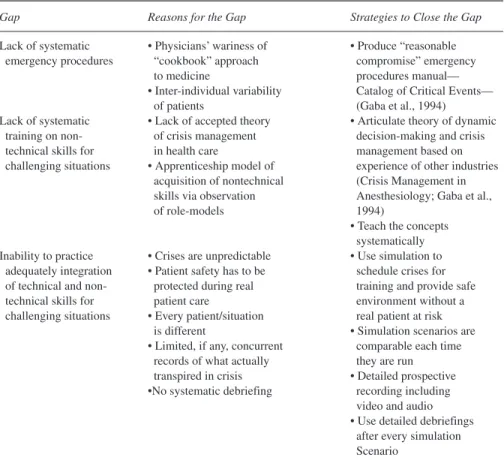
Analysis of videotapes from these early experiments, along with the practical expe-rience of providing anesthesia suggested that the training of anesthesiologists con-tained gaps concerning several critical aspects of decision making and crisis manage-ment that were not systematically taught during standard residency or postgraduate education. These gaps are shown in Table 1
“Naturalistic Decision Making” Applies to Anesthesiologists’ Cognition
When we evaluated the existing literature on decision making in medicine we found that it revolved around relatively static decisions such as diagnosis (Groen & Patel, 1985; V. L. Patel, Evans, & Kaufman, 1990; V. L. Patel, Groen, & Arocha, 1990) or pattern recognition (e.g. radiology) (Lesgold et al., 1981). These studies did not match up well to the kinds of highly dynamic decisions we saw being made in the operating room. A better match was found in the work on naturalistic decision making (Klein, Orasanu, & Calderwood, 1993). Clearly, anesthesiology fits the criteria outlined by Orasanu and Connolly (1993) for a “complex dynamic world” in which naturalistic decision making should apply:
• Problems are ill-structured.
• The environment is dynamic.
• The environment is full of uncertainty.
• There is intense time pressure.
• Action/feedback loops are tightly coupled.
• The stakes are high.
• There are multiple “players.”
• Personnel operate under strong organizational and cultural norms.
Aviation Crew Resource Management Was a Useful Model for Anesthesiology
Commercial aviation is one of the many complex dynamic worlds, to which anes-thesiology has been compared frequently. For many years, airline pilots have been undergoing simulation training and practice in flying skills and the technical manage-ment of specific emergencies such as engine fires. In the 1980s however, research in aviation had already demonstrated that a large proportion of aircraft accidents was linked to failures on the part of crews with appropriate technical skills to manage their resources effectively (Billings & Reynard, 1984). In an effort to address these short-comings airlines in the United States joined with NASA and the U.S. military to pio-neer a new type of training termed Crew (originally ““cockpit’’) Resource
TABLE 1: Gaps in the Training of Anesthesiologists
Gap Reasons for the Gap Strategies to Close the Gap
Lack of systematic • Physicians’ wariness of • Produce “reasonable emergency procedures “cookbook” approach compromise” emergency
to medicine procedures manual—
• Inter-individual variability Catalog of Critical Events— of patients (Gaba et al., 1994) Lack of systematic • Lack of accepted theory • Articulate theory of dynamic
training on non- of crisis management decision-making and crisis technical skills for in health care management based on challenging situations • Apprenticeship model of experience of other industries
acquisition of nontechnical (Crisis Management in skills via observation Anesthesiology; Gaba et al.,
of role-models 1994)
• Teach the concepts systematically Inability to practice • Crises are unpredictable • Use simulation to
adequately integration • Patient safety has to be schedule crises for of technical and non- protected during real training and provide safe technical skills for patient care environment without a challenging situations • Every patient/situation real patient at risk
is different • Simulation scenarios are • Limited, if any, concurrent comparable each time
records of what actually they are run transpired in crisis • Detailed prospective •No systematic debriefing recording including
video and audio • Use detailed debriefings
after every simulation Scenario
Management (CRM) (Jensen & Biegelski, 1989; Lauber, 1986; Wiener, Kanki, & Helmreich, 1993). This type of training is now required for U.S. aircrews and is also common in airlines throughout the industrialized world. The training typically con-sists of didactic components, group exercises and discussions, and full-mission simu-lations followed by debriefings.
The Anesthesia Crisis Resource Management (ACRM) Curriculum
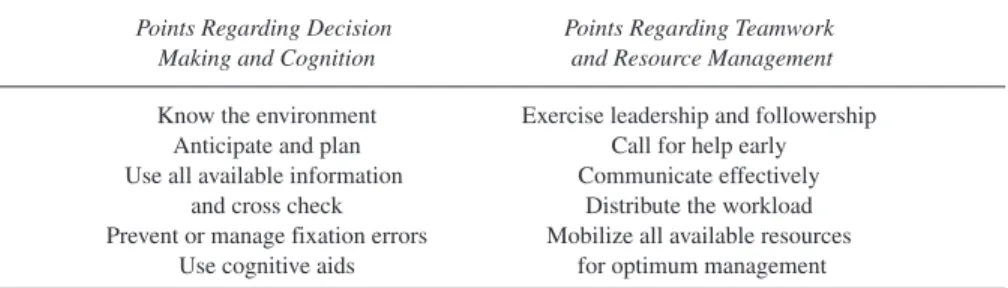
In 1989, we (Howard, Gaba, Fish, Yang, & Sarnquist, 1992) began to develop a simulation-based curriculum based in part on CRM in aviation and its key principles. The first course using the new curriculum was held in September 1990. We called the curriculum Anesthesia Crisis Resource Management (ACRM) because anesthesiolo-gists would be more familiar with the term “crisis” rather than “crew.” The distillation of CRM principles for health care is shown in Table 2.
ACRM Involves Training Crews to Work in Teams
Crews versus teams. Each discipline in health care can be considered a “crew” con-taining one or more individuals. Several crews may work together closely as a “team.” For example, the operating room team consists of an anesthesia crew, a surgery crew, and a nursing crew (as well as crews of technicians and support personnel).
Crew training. In ACRM we have opted for a strategy of “training crews to work in teams” (also referred to here as crew training). We conduct training for single-discipline crews (e.g., anesthesiologists) for whom teamwork is an important component of the curriculum. ACRM uses crew training to provide comprehensive teaching and prac-tice in the integrated use of technical, cognitive, and behavioral skills in managing cri-ses relevant to their domain. This integration requires that they become familiar with
• specific technical skills applicable to specific situations relevant to their domain, in the context of a wide variety of types of clinical situations (e.g., cardiac, orthopedic, or gen-eral surgery, labor and delivery, intensive care);
• generic skills of dynamic decision making, resource management, leadership, and team-work applicable to any challenging clinical situation;
• working effectively with a spectrum of personalities and behaviors by other crew or team members; and
• organizational learning after adverse clinical occurrences through individual and group debriefing and by analyzing reports of adverse events.
Advantages of training crews to work in teams. Training crews to work in teams also provides a degree of cross-discipline understanding by allowing participants to discuss other team members’views of the same situation. In crew training, participants in some cases play the role of a different discipline than their own. Crew training has other advantages in that it allows
• concentration on specific skills and knowledge for each specific crew, including material that may be of little relevance to other crews;
• the simulator to be used specifically for those disciplines whose work can be simulated with high fidelity (e.g., as of now the technical aspects of surgery itself cannot be simu-lated adequately);
• simplified logistical and political considerations of training only one discipline at a time; and
• training on teamwork to be provided to health care personnel who do not work in fixed crews or teams.
Combined Team Training
A different approach is to conduct “combined team training” where all participants of the team, from several different crews (e.g., surgeons, nurses, anesthesiologists), undergo training together (Helmreich & Merritt, 1998; Helmreich & Schaefer, 1994; Kurrek, Devitt, Ichinose, et al., 1998; Marsch, 1998; Sexton et al., 1998). Combined team training allows for more natural team interactions and reinforces understanding across disciplines. It can be most effective when a specific group of individuals will work together as a dedicated team. However, combined team training cannot as readily achieve some of the goals listed above for training crews to work in teams. Therefore, these two approaches are complementary methods to improve decision-making and teamwork skills. Ideally, personnel should participate in both types of sessions.
ACRM Three Stage Curriculum
From its beginning as a single course (Howard et al., 1992), the ACRM curriculum has now expanded to encompass three simulation-based full-day courses (ACRM1, ACRM2, ACRM3). As participants gain more experience with ACRM, the courses have more ambitious goals. ACRM1 is the primary introduction to ACRM principles and skills. ACRM2 provides a refresher on these skills and begins to explore analyzing clinical events not only from the perspective of the clinicians’ technical and behavioral performance, but also from the standpoint of the functioning of the organization as a system. ACRM3 emphasizes leadership and debriefing skills and the follow-up to
TABLE 2: Key Points of ACRM
Points Regarding Decision Points Regarding Teamwork Making and Cognition and Resource Management
Know the environment Exercise leadership and followership Anticipate and plan Call for help early Use all available information Communicate effectively
and cross check Distribute the workload Prevent or manage fixation errors Mobilize all available resources
adverse clinical events. When the sequence is taught to residents in training, they take one stage of the course during each of their three years of residency
Each course has a similar basic structure:
• preassigned readings to present new concepts;
• a course introduction and review of conceptual material;
• a familiarization with the simulator and the “local” clinical environment;
• a “group-work” teaching module in which the participants must work collectively to dis-cuss and analyze cases presented on videotape or paper, using the concepts and vocabu-lary being taught;
• simulation scenarios each followed immediately by a debriefing session (total approxi-mately 6 hours); and
• summary session and completion of postcourse evaluations.
Simulation Scenarios
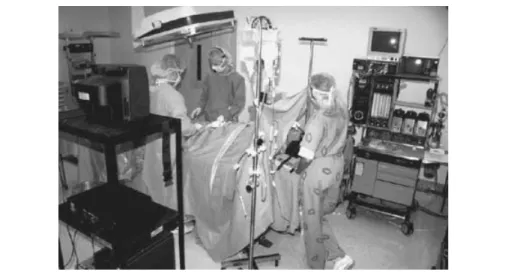
The heart of the ACRM course revolves around peri-operative hands-on simulation scenarios using a high fidelity patient simulator system in a full replica of an operating room. This contains complete and functional surgical and anesthesia equipment (including drapes, surgical instruments, anesthesia machine, monitoring equipment, drug cart). The scenarios are between 25 and 45 minutes in duration. Simulation sce-narios become more complex in the different stages of ACRM, involving progres-sively more challenging sets of underlying diseases and more challenging problems to solve. The scenarios are designed so that simple solutions to problems will not always be applicable or successful. In the more advanced courses, scenarios can involve
FIGURE 1: ACRM Simulation Scenario in Action
NOTE: The medical equipment is all real. Simulated arthroscopic knee surgery is underway. The anesthesi-ologist is at the head of the table.
subspecialties such as cardiac anesthesia, neuroanesthesia, and intensive care. To reduce the likelihood of hypervigilance during simulations, participants are told that they may encounter a “null scenario” in which nothing of significance will occur.
Operating Room Personnel
A retired OR nurse acts as the circulating nurse, and an anesthesiologist instructor acts as the operating surgeon. From their own experience as clinicians, the instructors have a broad knowledge of the work of surgeons and of the spectrum of their skills and personalities. To train the crew to work in teams, we script loosely the behaviors of the nurse and surgeon. The simulation director can talk with them privately in real time (using two-way radio headsets) and can modulate their behavior. This allows us to cre-ate a variety of plausible and challenging interpersonal situations. When necessary, participants can request help from an anesthesia technician or other assistants, and they can request whatever drugs or equipment they need for clinical care.
Participants Rotate Through Different Roles
Participants take turns working in different roles during the simulation sessions. Each spends one scenario as the primary anesthesiologist (we call this “being in the hot seat “). Another participant, in a role called the “first responder,” is sequestered in another room. If called in to help by the primary anesthesiologist the first responder arrives with no prior knowledge of the unfolding scenario. This is a common situation in clinical care. It requires rapid transfer of information, establishment of leadership, and distribution of workload. Participants also rotate through the role of the “scrub technician” (who passes instruments to the surgeon). This role allows anesthesiolo-gists to experience an untoward event evolving “on the other side of the drapes” but not to be involved in managing it. The last role is an “observer”who views the scenario from the debriefing room on a multiview audio-video link.
Debriefing
Debriefing is an integral part of the process of any experiential-learning technique. During debriefing participants are led through a detailed discussion of their experi-ences (Lederman, 1992; Steinwachs, 1992). In many settings of experiential learning, participants report deriving substantial further benefit from the debriefing in addition to the benefit of having worked through the problem-solving scenario. Our own ques-tionnaire data from participants support the contention that the debriefing sessions are the most important component of the ACRM course.
In ACRM, all participants take part in the debriefing session regardless of the role they played in the simulation scenario. The debriefings last approximately 40 minutes. We have worked with experts from NASA Ames Research Center to ensure that our debriefings follow state-of-the-art guidelines for debriefing in CRM for aviation (McDonnell, Jobe, & Dismukes, 1997). The goal during debriefing is to explore
alternatives, and to recognize and discuss principles of ACRM as they were either exe-cuted or were foregone in the scenario. Participants are asked to process their experi-ences and share their individual viewpoints. With guidance from the instructor, they link their observations to behaviors and events from the real world. Instructors strive for an atmosphere of constructive critique and feedback provided in a supportive, nonjudgmental manner. They aim for maximum participant involvement, open-ended questioning, and active learning. Ideally, the instructor should merely facilitate the process of the group debriefing itself.
The “Death Scenario”
In basic and intermediate ACRM courses we go to great lengths to prevent the patient from “dying.” We can disable the simulator’s “cardiac arrest pathway.” When this is disabled, the simulated patient’s condition will worsen if the correct actions are not taken, but the situation will not evolve into a cardiac arrest. The instructors can then prevent the patient’s demise, even if this means sending in experienced staff to assist the participants. We do this so that the emotional overlay of a patient’s death does not interfere with the main focus of ACRM teaching. However, in the advanced ACRM curriculum we do present a scenario in which an otherwise healthy patient dies from a serious allergic reaction to a drug he had never received before.
The Death Scenario Is Used to Challenge Specific Skills and Behaviors
We purposefully expose participants to the experience of a patient’s death to force them to exercise the follow-up to such an event. This includes delivering the bad news
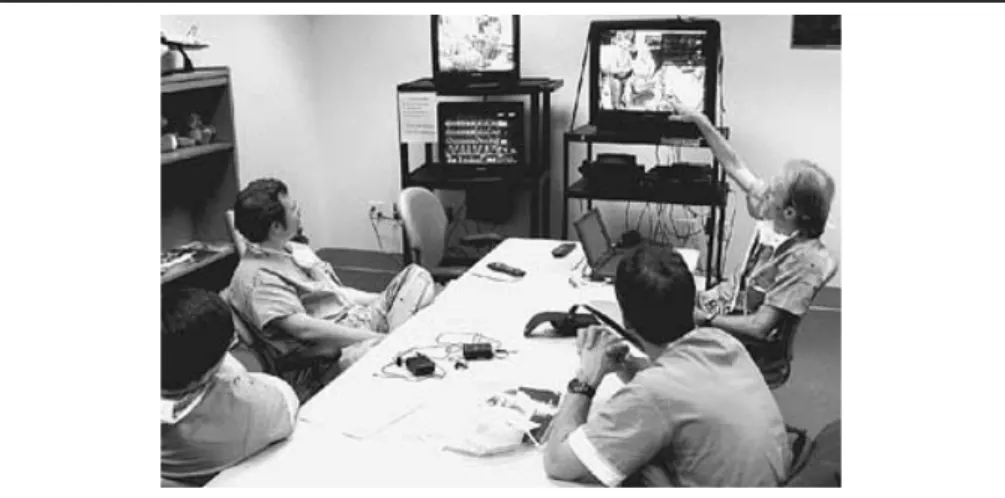
FIGURE 2: Debriefing Session in ACRM Curriculum for Pediatricians.
NOTE: The debriefing instructor is pointing to the television monitor. He can control the videotape playback of the simulation scenario using a laptop computer. Course participants are gathered around the table and debrief as a group.
to the patient’s family, and carrying out appropriate quality management activities, such as impounding the equipment and supplies in the operating room pending an investigation. Participants do not know in advance that the patient will die despite their best efforts, nor do they know that the scenario will continue after the patient is pro-nounced dead. Despite the fact that they realize that the relative of the simulated patient is just an actor (a quality management nurse), the requirement to explain to the “family” what has just transpired is a major challenge. These sessions are often highly emotional and are moving to observe.
Simulation facilitates learning these skills. The death scenario exemplifies the abil-ity of realistic simulation to teach material that cannot be taught adequately in other ways. The unexpected death of a patient is an event that most anesthesia trainees (and many experienced personnel) will never have faced, but which they might confront at any time. Furthermore, the follow-up principles that we teach in the context of the ulti-mate adverse event (death) are also applicable to the follow-up after less severe adverse events. Compared to simple role-playing about delivering bad news, the ACRM death scenario is unique. As in the real life situation, participants have just undergone a harrowing clinical simulation requiring very intense clinical decision making and action on their part. Not only is this more realistic than role-playing alone, we believe it intensifies the participants’ interest in the follow-up principles.
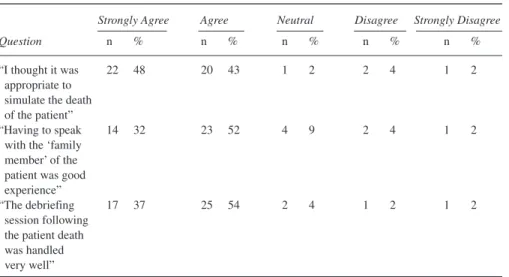
Experience with the death scenario. To date the death scenario has been run 15 times. Questionnaire data evaluating this component of the ACRM curriculum have been extremely positive (see Table 3). We are also collaborating with psychologists to analyze the verbal and nonverbal communication in these sessions and how well the participants use best-practice techniques for delivering bad news to family members. Preliminary analysis suggests that participants have difficulty “getting to the point”—disclosing the bad news without ambiguity or inappropriate delay. They also have a tendency to fall back on technical descriptions even when they understand that they are speaking to a lay person.
Proliferation and Formalization of ACRM Training Programs
Since the inception of the ACRM1 course in 1990 the response has been quite posi-tive (Blum, Holzman, Cooper, & Raemer, 1997; Gaba, 1995; Holzman et al., 1995; Howard et al., 1992; Kurrek et al., 1996; O’Donnell, Fletcher, Dixon, & Palmer, 1998; Small, 1998). The ACRM curriculum has been formally adopted as a focus of training at a number of major teaching institutions. ACRM is mandatory on a yearly basis for anesthesia trainees at several of these sites. At many centers, it is offered not only for trainees but also as continuing medical education for experienced practitioners. The Harvard Risk Management Foundation (the insurer of the Harvard-affiliated hospi-tals) has announced recently a new rate structure for malpractice insurance for simulation-trained versus non-simulation-trained anesthesiologists. Thus, the Boston
Center for Medical Simulation plans to conduct ACRM training on a recurring basis for all staff anesthesiologists in the Harvard system (Jeff Cooper, PhD, personal communication)
CRM-Oriented Curricula in Addition to ACRM
Several variant curricula similar to ACRM were developed based on the textbook Crisis Management in Anesthesiology and based on firsthand observation of early ACRM training courses at VA/Stanford. One variant is the Rational Anesthesia curric-ulum in Denmark. This has now been given to the majority of Danish anesthesiologists and anaesthetic nurses, and it is now required for certification. Other variants are con-ducted in Brussels, Belgium, and Bristol, United Kingdom. An independent formula-tion of CRM for operating room teams has been developed at the University of Basel (Marsch, 1998; Sexton et al., 1998). This course, which uses the combined team train-ing approach, is called Team-oriented Medical Simulation (TOMS) (http://www.medana.unibas.ch/eng/team/hufa132.htm). A unique feature of this cur-riculum is that actual animal organs are provided behind a screen to allow endoscopic surgery (using cameras and instruments through small incisions). The TOMS group conducts these simulations for complete OR teams of nurses, orderlies, surgeons, and anesthesiologists. The team performs routine peri-operative care of the simulated patient. During surgery, one or more adverse events may be triggered by the instruc-tors. As in ACRM, a debriefing session using videotapes of the simulation follows. Unfortunately, recent word from Basel indicates that the surgery department has ceased to participate in TOMS.
TABLE 3: Response of Participants to the “Death Scenario”
Strongly Agree Agree Neutral Disagree Strongly Disagree
Question n % n % n % n % n %
“I thought it was 22 48 20 43 1 2 2 4 1 2
appropriate to simulate the death of the patient”
“Having to speak 14 32 23 52 4 9 2 4 1 2
with the ‘family member’ of the patient was good experience”
“The debriefing 17 37 25 54 2 4 1 2 1 2
session following the patient death was handled very well”
ACRM Instructor Training
Special training is needed for new ACRM sites and instructors. The three pioneer-ing centers in the development of ACRM (VA/Stanford Simulation Center, the Boston Center for Medical Simulation, and the Canadian Simulation Centre) formed The Working Group on Crisis Management Training in Health Care. It has produced, and provides site licenses for, a 150-page training manual for ACRM instructor candidates. The Working Group has developed, tested, and conducts three-day ACRM Instructor Training Courses (Kurrek et al., 1996). At least 15 new instructor groups have been trained since 1995. Experience with the instructor course suggests that the most diffi-cult aspect of ACRM instructing is debriefing. New instructors require a significant period of experience, preferably in consultation with more senior instructors, before being ready to be fully independent.
Criteria for Genuine ACRM Curricula
As described above, interest in ACRM is growing. There are a number of different curricula in use purporting to be the same as or equivalent to ACRM. The Working Group has promulgated a set of criteria to be met by a curriculum in order to be called “ACRM” or “ACRM-like.” The full set of criteria are available at: http://pkpd. icon.palo-alto.med.va.gov/simulator/ACRM_Criteria.htm. Briefly the criteria are
• A majority of the emphasis is on crisis resource management behaviors rather than on medical/technical knowledge and skill;
• The bulk of training consists of realistic simulations and debriefings. These can be com-plemented, but not replaced by, didactic, discussion, or role-playing sessions;
• Simulations are highly realistic and require participants to interact with relevant person-nel. The primary clinician can request and receive help from colleagues in some scenarios;
• Debriefing by specially trained instructors is required;
• Training is intense with a high ratio of faculty to participants; and
• Participating by observation only cannot be considered equivalent to taking the ACRM course by participating in scenarios and debriefings.
Evaluation of ACRM Training
Questionnaires and AnecdotesThousands of participants, including anesthesia residents, faculty, private practitio-ners, and certified nurse anesthetists have undergone ACRM training at various cen-ters. Several articles have been published detailing the response of participants to this curriculum. These include data from questionnaires (Holzman et al., 1995; Howard et al., 1992; Kurrek et al., 1996) as well as from blinded structured interviews of anes-thesiologists with or without previous ACRM training (Small, 1998). Participants have been extremely positive about their experiences in ACRM courses and most
believe that it contributes to their safe practice of anesthesia. These perceptions are maintained at least six months after completion of the training (Blum et al., 1997). Centers teaching ACRM have received a number of anecdotes from participants con-cerning real-world situations that they believe they handled better, both technically and behaviorally, because of their ACRM training (e.g., Leith, 1997).
Does ACRM Training Improve Patient Outcome?
The evaluations conducted so far suggest that simulator-based ACRM training is a powerful technique that both novice and experienced anesthesiologists believe to be highly beneficial and may improve clinical performance. Simulation provides an opportunity to teach material that cannot be taught any other way. The gold standard for proving the benefit of ACRM training would be assessing whether its use improves the actual outcome of patients. To make such an assessment would be extremely diffi-cult because of the large number of confounding variables (e.g., coexistent medical disease, surgical complications) and the relative infrequency of serious crisis events. Those investigating simulator-based training do not believe that such a study of patient outcome is feasible logistically.
Does ACRM Training Improve Clinician Performance?
On the other hand, determining the impact of ACRM training on the intermediate variables of “performance’’and “ability’’is feasible in principle, although it will not be easy. Before we can determine whether ACRM training improves decision making, resource management, or teamwork, we need to determine how to measure these aspects of performance. To this end, we conducted an experiment to measure anesthe-siologists’ behavioral and technical management of simulated crisis situations (Gaba et al., 1998). Some of the details of this experiment are discussed below.
Medical/technical performance. Measuring the “technical” performance of anesthesiologists—the appropriateness of the medical decisions and actions taken—can be difficult. First, agreement is lacking within the domain on a standard scoring system for different actions or omissions in particular case scenarios (Chopra et al., 1994; DeAnda & Gaba, 1991; Devitt, Kurrek, & Cohen, 1998; Devitt et al., 1997; Devitt, Kurrek, Cohen, Fish, et al., 1998; Gaba et al., 1998; Jacobsen et al., 1998; Kurrek, Devitt, & Cohen, 1998; Kurrek, Devitt, Cohen, & Szalai, 1999). Second, regardless of the scoring system used, some element of subjectivity will probably remain.
In our experiment, the technical performance rating was based on a predefined checklist of reasonable medical and technical actions for each scenario. Point values for successful implementation of each action were assigned prospectively by the investigators. Raters recorded the presence or absence of each action during a scenario and each rater summed the point values for all actions recorded as present. Some actions were considered critical “essential items,” for example, defibrillating a patient
whose heart rhythm is ventricular fibrillation. The absence of an essential item is so catastrophic that it cancels any other points accrued, resulting in a net score of zero. Behavioral performance. Adding the measurement of crisis management behav-iors adds a significant level of complexity and subjectivity. For behavioral assessment in our experiment, twelve “markers” of crew resource management were adapted from marker sets originally developed for use in commercial aviation (Helmreich, Wilhelm, Kello, Taggart, & Butler, 1991). Markers included behaviors such as “communica-tion,” “leadership and followership,” “distribution of workload,” and “Overall CRM performance.” Each marker was rated on a 5 point anchored scale.
Results of the experiment. Raters scored 14 videotapes of each of two scenarios (cardiac arrest and malignant hyperthermia) taken from ACRM courses. We examined two separate issues: (a) the variability of performance across the different individuals and teams, (b) the variability between raters scoring identical performances (interrater variability). The results of this study (Gaba et al., 1998) can be summarized as follows:
• Individuals and teams varied widely in performance on the scenarios. Variability was greater for behavioral performance than for technical performance;
• Some primary anesthesiologists (21%-35%, depending on the scenario) and anesthesia crews (14%-28%) were scored as having behavioral performance at or below the level of “substandard, minimally acceptable”;
• All teams managed the scenarios with acceptable levels of technical performance (70%-90% of maximum score), in part because each anesthesiologist should have had sufficient training to recognize and treat the events. They were also allowed to call for help from colleagues so that working collectively as a crew they raised the probability of success;
• Interrater variability was less for technical ratings than for behavioral ratings. For behav-ioral ratings variability was sufficiently great to suggest that a minimum of two raters is needed to provide a fair performance assessment. However, the level of interrater vari-ability seen was as good as or better than that reported for peer review of real case man-agement (Levine et al., 1998). It was better than that reported in some (Klock, Jacobsohn, & Group, 1998), but not all (Schubert, Tetzlaff, Tan, Ryckman, & Mascha, 1999), studies of mock oral board certification examinations; and
• The largest difficulty in behavioral rating was aggregating a single score for behaviors that fluctuated greatly over time.
Challenges for Comprehensive Performance Assessment
The results from this study suggest that the measurement of ACRM performance is feasible but challenging. Any experiments involving such measurements will be com-plex and expensive. Many factors complicate the assessment of the effectiveness of simulator-based training.
High variability. Due to the high interindividual and intercrew variability, experi-ments will require a large number of subjects. Due to the high interrater variability, they will require a minimum of two expert raters. Several research groups continue to
work on improved techniques for assessing both technical and behavioral performance.
Biases of simulation testing of simulation-based learning. Paradoxically, simula-tion provides one of the only tools for measuring clinician performance. Substantial bias can exist when attempting to measure the impact of the simulator training by using performance in the simulator as a test. This bias can be controlled in part by experi-mental design but it cannot be eliminated.
Learning complex behaviors is a life-long effort. Studying the impact of a single session of a curriculum that attempts to alter complex behaviors and skills may under-estimate the course’s impact were it to be used on a regular and repetitive basis. In com-mercial aviation, CRM training begins with initial flight instruction and is continued yearly throughout an airline pilot’s career, regardless of seniority. Proper assessment of the impact of ACRM training may require assessing participants longitudinally over a long period of time.
The workplace must reinforce the simulator. A final caveat about the impact of ACRM is that simulation-based safety training can be totally negated if the organiza-tional culture of the actual workplace does not support and reinforce key principles of resource management. A commitment of the organization to high reliability (Roberts, 1989) and a culture of safety (La Porte, Perrow, Rochlin, & Sagan, 1994) will be needed to promote the behaviors practiced during simulation training.
Extension of the ACRM Approach to Other Health Care Domains
Anesthesiology Was Particularly Well Suited for Training Inspired by CRMFor several reasons, simulation-based training inspired by CRM has had its biggest impact to date in the field of anesthesiology. The fully interactive patient simulation devices were developed by anesthesiologists (Gaba, 1999) who then applied them to their own domain. The physiology of patients during anesthesia changes dynamically, so that a rapidly varying and fully interactive simulation is needed to capture fully the challenging aspects of care. Anesthetized patients are monitored intensively by physi-cal examination and electronic devices; data for both of these methods can be gener-ated readily by a simulator. Anesthesiologists recognized early the need to manage unusual but lethal events. Anesthesiology took a special interest in human perfor-mance and human factors issues. Finally, anesthesiology is inherently a team activity in concert with surgeons, nurses, technicians, and other staff. Crew and team manage-ment issues arise naturally in this setting, providing a close match to considerations also found in aviation.
Other Domains of Health Care Should Benefit From Simulation-Based Training
Some other medical fields share with anesthesiology the cognitive profile of a com-plex dynamic world. These fields are also likely to benefit from the same kinds of sim-ulation-based training based on CRM principles. Different simulation centers have been extending ACRM-like training methodologies to these arenas especially where they have been able to forge alliances with experts in these arenas. These include
• the intensive care unit,
• the emergency department or trauma center (Ellis & Hughes, 1999; Small et al., 1999),
• the delivery room (Halamek, Howard, Smith, Smith, & Gaba, 1997; R. M. Patel & Crombleholme, 1998),
• cardiac arrest response teams (Christensen, Heffernan, Andersen, & Jensen, 1998; Kurrek, Devitt, Ichinose, et al., 1998; Palmisano et al., 1994; Raemer, Barron, Blum, Frenna, & Sica, 1998), and
• radiology (Raemer, Barron, Blum, Frenna, & Sica, 1998).
Other domains currently using simulation training that might find ACRM-like training appropriate include field response by ambulance staff and combat casualty care in the military.
Teamwork training was praised in the IOM Report. It is highly likely that process of extending ACRM-like curricula will accelerate in the coming years. On December 1, 1999 the Institute of Medicine1
released a landmark report on medical error and patient safety, To Err is Human: Building a Safer Health System (Kohn, Corrigan, & Donaldson, 1999). The report lays out the magnitude of the problem of medical error and describes it as a “systems problem.” The report discusses the impact of human fac-tors and organizational issues on errors and safety. Simulation training, and in particu-lar crew resource management and teamwork training, are mentioned prominently in this report. For example, “The Committee believes that health care organizations should establish team training programs for personnel in critical care areas (e.g., the emergency department, ICU, and OR) using proven methods such as crew resource management techniques employed in aviation, including simulation” (p. 149).
Aviation requires CRM training, so should health care. The use of simulation and CRM training are required by law for airline pilots in the United States and in many other countries. Airlines must therefore provide funds for this training even when they face many other financial demands. Health care, as yet, lacks such a requirement. The reality in health care is that clinical institutions put funding for education and training of personnel near the bottom of their priorities. Nonetheless, because of the growing awareness of the need for comprehensive strategies to improve patient safety (Kohn et al., 1999), it is our expectation that simulation training based on CRM principles—
like ACRM and its derivatives—will become routine for health care personnel work-ing in all applicable settwork-ings. As with other industries in which human lives depend on the skilled performance of responsible operators, we believe that health care will come to embrace these modalities fully and will not wait idly for unequivocal proof of its benefits.
Note
1. The IOM is one of the United States “National Academies,” which are congressionally chartered, pri-vate, nongovernmental agencies providing independent research and advice on scientific and technological matters.
References
Abrahamson, S., Denson, J., & Wolf, R. (1969). Effectiveness of a simulator in training anesthesiology resi-dents. Journal of Medical Education, 44(6), 515-519. PLEASE PROVIDE IN-TEXT CITATION OR
DELETE
Billings, C. E., & Reynard, W. D. (1984). Human factors in aircraft incidents: Results of a 7-year study.
Avia-tion Space and Environmental Med Medicine, 55(10), 960-965.
Blum, R., Holzman, R., Cooper, J., & Raemer, D. (1997, December). ACRM improves OR crisis skills at 6
months. Paper presented at the New York Postgraduate Assembly, New York.
Carter, D. (1969). Man-made man: Anesthesiological medical human simulator. Journal of the Association
for the Advancement of Medical Instrumentation, 3(2), 80-86. NOT CITED; DELETE?
Chopra, V., Gesink, B., De Jong, J., Bovill, J., Spierdijk, J., & Brand, R. (1994). Does training on an anaes-thesia simulator lead to improvement in performance? British Journal of Anaesanaes-thesia, 73(3), 293-297. Christensen, U. J., Heffernan, D., Andersen, S. F., & Jensen, P. F. (1998). ResusSim 98—A PC advanced life
support trainer. Resuscitation, 39(1/2), 81-84.
DeAnda, A., & Gaba, D. (1990). Unplanned incidents during comprehensive anesthesia simulation.
Anes-thesia & Analgesia, 71(1), 77-82.
DeAnda, A., & Gaba, D. (1991). The role of experience in the response to simulated critical incidents.
Anes-thesia & Analgesia, 72(3), 308-315.
Denson, J., & Abrahamson, S. (1969). A computer-controlled patient simulator. Journal of the American
Medical Association, 208(3), 504-508. NOT CITED; DELETE?
Devitt, J., Kurrek, M., & Cohen, M. (1998). Can a Simulator Based Evaluation Be Used to Assess Anesthe-siologists (abstract)? Anesthesiology, 89(3), A1172.
Devitt, J., Kurrek, M., Cohen, M., Fish, K., Fish, P., Murphy, P., & Szalai, J. (1997). Testing the raters: Interrater reliability of standardized anaesthesia simulator performance. Canadian Journal of
Anaesthe-sia, 44(9), 924-928.
Devitt, J., Kurrek, M., Cohen, M., Fish, K., Fish, P., Noel, A., & Szalai, J. (1998). Testing internal consis-tency and construct validity during evaluation of performance in a patient simulator. Anesthesia &
Anal-gesia, 86(6), 1160-1164.
Ellis, C., & Hughes, G. (1999). Use of human patient simulation to teach emergency medicine trainees advanced airway skills. Journal of Accident and Emergency Medicine, 16(6), 395-9.
Gaba, D. (1995). Simulator training in anesthesia growing rapidly. Anesthesia Patient Safety Foundation
Newsletter, 10(2), 34-36.
Gaba, D. (1996). Simulators in anesthesia. In C. Lake (Ed.), Advances in Anesthesia (pp. 55-94). St. Louis, MO: C. V. Mosby.
Gaba, D. (1999). The human work environment and anesthesia simulators. In R. Miller (Ed.), Anesthesia (5th ed., pp. 2613-2668). New York: Churchill Livingstone.
Gaba, D., & DeAnda, A. (1988). A comprehensive anesthesia simulation environment: Re-creating the operating room for research and training. Anesthesiology, 69(3), 387-394.
Gaba, D. M., & DeAnda, A. (1989). The response of anesthesia trainees to simulated critical incidents.
Anesthesia & Analgesia, 68(4), 444-451.
Gaba, D. M., Fish, K. J., & Howard, S. K. (1994). Crisis Management in Anesthesiology. New York: Chur-chill Livingstone. NOT CITED; DELETE?
Gaba, D., Howard, S., Flanagan, B., Smith, B., Fish, K., & Botney, R. (1998). Assessment of clinical perfor-mance during simulated crises using both technical and behavioral ratings. Anesthesiology, 89(3), 8-18. Good, M. L., & Gravenstein, J. S. (1989). Anesthesia simulators and training devices. International
Anes-thesiology Clinics, 27(3), 161-168.
Groen, G. J., & Patel, V. L. (1985). Medical problem-solving: Some questionable assumptions. Medical
Education, 19(2), 95-100.
Halamek, L., Howard, S., Smith, B., Smith, B., & Gaba, D. (1997). Development of a simulated delivery room for the study of human performance during neonatal resuscitation. Pediatrics, 100(Suppl. 3), 513-524.
Helmreich, R., & Merritt, A. (1998). Culture at work in aviation and medicine. Aldershot, UK: Ashgate. Helmreich, R., & Schaefer, H. (1994). Team performance in the operating room. In M. Bogner (Ed.), Human
error in medicine (pp. 225-253). Hillsdale, NJ: Lawrence Erlbaum.
Helmreich, R., Wilhelm, J., Kello, J., Taggart, W., & Butler, R. (1991). Reinforcing and evaluating crew
resource management: Evaluator/LOS instructor reference manual (NASA/UT Technical Manual 90-2, Revision 1) . Austin: NASA/University of Texas Aerospace Crew Performance Project.
Holzman, R. S., Cooper, J. B., Gaba, D. M., Philip, J. H., Small, S. D., & Feinstein, D. (1995). Anesthesia crisis resource management: Real-life simulation training in operating room crises. Journal of Clinical
Anesthesia, 7(8), 675-687.
Howard, S., Gaba, D., Fish, K., Yang, G., & Sarnquist, F. (1992). Anesthesia crisis resource management training: Teaching anesthesiologists to handle critical incidents. Aviation Space and Environmental Med
Medicine, 63(9), 763-770.
Jacobsen, J., Jensen, P. F., Osterfaard, D., Lindekaer, A., Lippert, A., & Schultz, P. (1998). Performance enhancement in anesthesia using the training simulator Sophus (PEANUTS). In L. Henson & A. Lee (Eds.), Simulators in anesthesiology education (pp. 103-106). New York: Plenum.
Jensen, R., & Biegelski, C. (1989). Cockpit resource management. In R. Jensen (Ed.), Aviation psychology (pp. 176-209). Aldershot, England: Gower Technical.
Klein, G., Orasanu, J., & Calderwood, R. (1993). Decision making in action: Models and methods. Norwood, NJ: Ablex.
Klock, P., Jacobsohn, E., & Group, O. B. E. (1998). Inter-rater reliability of oral board examinations with American and Canadian examiners (abstract). Anesthesiology, 89(3A), A66.
Kohn, L., Corrigan, J., & Donaldson, M. (1999). To err is human: Building a safer health system. Washing-ton, DC: National Academy Press.
Kurrek, M., Devitt, J., & Cohen, M. (1998). Relationship Between Response time and Performance Score During Clinical Competence Evaluation in the Simulator (abstract). Anesthesiology, 89(3A), A1179. Kurrek, M., Devitt, J., Cohen, M., & Szalai, J. (1999, January). Inter-rater reliability between live-scenarios
and video recordings in a realistic scenario (p. 31). Paper presented at the Society for Technology in
Anesthesia Annual Meeting, San Diego, CA.
Kurrek, M., Devitt, J., Ichinose, F., & Bhatnagar, G. (1998). Simulator team training: A concept beyond
anesthesia (p. 14). Paper presented at the Society for Technology in Anesthesia Annual Meeting,
Tuc-son, AZ.
Kurrek, M., Small, S., Feinstein, D., Russell, R., Fish, K., & Gaba, D. (1996). Anaesthesia crisis resource management (ACRM) instructor course—Teaching the teachers (abstract). Anesthesia & Analgesia,
82(3), S256.
La Porte, T., Perrow, C., Rochlin, G., & Sagan, S. (1994). Systems, organizations, and the limits of safety: A symposium. Journal of Contingencies and Crisis Management, 2(4), 205-240.
Lauber, J. (1986). Cockpit Resource Management: Background and Overview. In H. Orlady & H. Foushee (Eds.), Cockpit resource management training (NASA Conference Publication 2455) (pp. 5-14). Wash-ington, DC: National Aeronautics and Space Administration.
Lederman, L. (1992). Debriefing: Toward a systematic assessment of theory and practice. Simulation &
Gaming: An International Journal, 23(2), 145-160.
Leith, P. (1997). Crisis management training helps young anesthesiologist successfully manage mid-air pas-senger cardiac arrest (letter). Journal of Clinical Monitoring, 13(1), 69.
Lesgold, A., Feltovich, P., Glaser, R., & Wang, Y. (1981). The acquisition of perceptual diagnostic skill in
radiology (Technical Report Number PDS-1). Pittsburgh, PA: University of Pittsburgh Learning
Research and Development Center.
Levine, R., Sugarman, M., Schiller, W., Weinshel, S., Lehning, E., & Lagasse, R. (1998). The effect of group discussion on interrater reliability of structured peer review. Anesthesiology, 89(3A), 507-515. Marsch, S. (1998). Team oriented medical simulation. In L. Henson & A. Lee (Eds.), Simulators in
anesthe-siology education (pp. 51-55). New York: Plenum.
McDonnell, L., Jobe, K., & Dismukes, R. (1997). Facilitating LOS debriefings: A training manual (NASA
Technical Memorandum 112192). Moffett Field, CA: National Aeronautics and Space Administration.
O’Donnell, J., Fletcher, J., Dixon, B., & Palmer, L. (1998). Planning and implementing an anesthesia crisis resource management course for student nurse anesthetists. CRNA, 9(2), 50-8.
Orasanu, J., & Connolly, T. (1993). The reinvention of decision making. In Klein, G., Orasanu, J., & Calderwood, R. (Eds.), Decision making in action: Models and methods (pp. 3-20). Norwood, NJ: Ablex.
Palmisano, J. M., Akingbola, O. A., Moler, F. W., & Custer, J. R. (1994). Simulated pediatric cardiopulmonary resuscitation: Initial events and response times of a hospital arrest team. Respiratory
Care, 39(7), 725-729.
Patel, R. M., & Crombleholme, W. R. (1998). Using simulation to train residents in managing critical events.
Academic Medicine, 73(5), 593.
Patel, V. L., Evans, D. A., & Kaufman, D. R. (1990). Reasoning strategies and the use of biomedical knowl-edge by medical students. Medical Education, 24(2), 129-36.
Patel, V. L., Groen, G. J., & Arocha, J. F. (1990). Medical expertise as a function of task difficulty. Memory
and Cognition, 18(4), 394-406.
Raemer, D., Barron, D., Blum, R., Frenna, T., & Sica, G. (1998). Teaching crisis management in radiology
using realistic simulation (p. 28). Paper presented at the Society for Technology in Anesthesia Annual
Meeting, San Diego, CA, and Tucson, AZ.
Raemer, D., Maviglia, S., Van Horne, C., & Stone, P. (1998). Mock codes: Using realistic simulation to teach
team resuscitation management (p. 29). Paper presented at the Society for Technology in Anesthesia
Annual Meeting, San Diego, CA, and Tucson, AZ.
Roberts, K. (1989). New challenges in organizational research: High reliability organizations. Industrial
Crisis Quarterly, 3(3), 111-125.
Schubert, A., Tetzlaff, J. E., Tan, M., Ryckman, J. V., & Mascha, E. (1999). Consistency, inter-rater reliabil-ity, and validity of 441 consecutive mock oral examinations in anesthesiology: Implications for use as a tool for assessment of residents. Anesthesiology, 91(1), 288-298.
Sexton, B., Marsch, S., Helmreich, R., Betzendoerfer, D., Kocher, T., Scheidegger, D., & TOMS TEAM. (1998). Participant evaluation of team oriented medical simulation. In L. Henson & A. Lee (Eds.),
Simu-lators in anesthesiology education (pp. 109-110). New York: Plenum.
Small, S. (1998). What participants learn from Anesthesia crisis resource management training.
Anesthesi-ology, 89(3A), A71.
Small, S. D., Wuerz, R. C., Simon, R., Shapiro, N., Conn, A., & Setnik, G. (1999). Demonstration of high-fidelity simulation team training for emergency medicine. Academic Emergency Medicine, 6(4), 312-323.
Smith, B., & Gaba, D. (2001). Simulators. In C. Lake (Ed.), Clinical monitoring: Practical application for
anesthesia and critical care (pp. 26-44) Philadelphia: W. B. Saunders.
Steinwachs, B. (1992). How to facilitate a debriefing. Simulation & Gaming: An International Journal,
Wiener, E., Kanki, B., & Helmreich, R. (1993). Cockpit Resource Management (p. 5). San Diego: Academic Press.
David M. Gaba, MD, is director of the Patient Safety Center of Inquiry (PSCI) at VA Palo Alto Health Care System and Professor of anesthesia at Stanford University. His university degree (Northwestern University) is in biomedical engineering. His laboratory has been working on patient safety and medical simulation for 15 years. The PSCI has seven tracks of activity, including theory of organizational safety in health care and safety cultures of health care institutions. He is also the Secretary of the Anesthesia Patient Safety Founda-tion and a member of the Research Committee of the NaFounda-tional Patient Safety FoundaFounda-tion (US). He is a (for-mer) general aviation pilot. His hobbies include skiing, scuba diving, and juggling.
Steven K. Howard, MD, is the associate director of the PSCI and an associate professor of Anesthesia at Stanford University. He received his bachelor’s degree in pharmacology from the University of California, Santa Barbara, in 1983 and his MD degree from Chicago Medical School in 1987. He received his training in anesthesiology at Stanford, after which he took his current academic position in 1991. His main research interests are the study of performance shaping factors such as fatigue and production pressures incurred by health care personnel. He also enjoys his family, running, and fishing as time permits.
Kevin J. Fish, MD, is the anesthesiology service chief at the VA Palo Alto Health Care System and is a profes-sor of anesthesia at Stanford University. His MD and his MSc (clinical pharmacology) is from Manchester University, England. He came to the United States in 1978 from Toronto, Canada. His research interests include anesthetic metabolism and patient safety. His interests include MG sports cars and coaching soccer to his daughters, and he is a converted fan to American football (favoring, of course, the San Francisco 49ers).
Brian E. Smith, MD, is an anesthesiologist in private practice at El Camino Hospital in Mountain View, Cal-ifornia. A former fellow and full-time investigator in Gaba’s laboratory, Smith now has a voluntary appoint-ment as clinical assistant professor at Stanford University and teaches anesthesia crisis resource manage-ment at the VA Palo Alto Health Care System.
Yasser A Sowb, PhD, is a biomedical engineer and research associate at the PSCI of the VA Palo Alto Health Care System. His education includes a BS in electrical and electronic engineering and an MS and a PhD in biomedical engineering with emphasis in biomedical instrumentation design and cognitive engineering. Currently, he is manager of the Simulation Center at PSCI, and he directs one of its research tracks on human factors and user-interface design of medical equipment. His hobbies include African dance and downhill skiing.
ADDRESS: DMG, SKH, KJF, BES, and YAS: Patient Safety Center of Inquiry 112A/PSCI, VA Palo Alto HCS, 3801 Miranda Avenue, Palo Alto, CA 94304, USA; telephone +1 650 858 3938; fax +1 650 852 3423; e-mail [email protected].