XMark: A Benchmark for XML Data Management
Albrecht Schmidt
1Florian Waas
2Martin Kersten
1Michael J. Carey
3Ioana Manolescu
4Ralph Busse
51 CWI, Kruislaan 413, 1090 GB Amsterdam, The Netherlands, firstname.lastname
@cwi.nl
2 Microsoft Corporation, Redmond (WA), USA,[email protected] 3 BEA Systems, Inc., USA,[email protected]
4 INRIA-Rocquencourt, 78153 Le Chesnay Cedex, France,[email protected] 5 FHG-IPSI, Dolivostr. 15, 64293 Darmstadt, Germany,
Abstract
While standardization efforts for XML query languages have been progressing, researchers and users increasingly focus on the database technology that has to deliver on the new challenges that the abundance of XML doc-uments poses to data management: valida-tion, performance evaluation and optimiza-tion of XML query processors are the up-coming issues. Following a long tradition in database research, we provide a framework to assess the abilities of an XML database to cope with a broad range of different query types typically encountered in real-world sce-narios. The benchmark can help both imple-mentors and users to compare XML databases in a standardized application scenario. To this end, we offer a set of queries where each query is intended to challenge a particular as-pect of the query processor. The overall work-load we propose consists of a scalable doc-ument database and a concise, yet compre-hensive set of queries which covers the ma-jor aspects of XML query processing ranging from textual features to data analysis queries and ad hoc queries. We complement our re-search with results we obtained from running the benchmark on several XML database plat-forms. These results are intended to give a first baseline and illustrate the state of the art. Permission to copy without fee all or part of this material is granted provided that the copies are not made or distributed for direct com-mercial advantage, the VLDB copyright notice and the title of the publication and its date appear, and notice is given that copying is by permission of the Very Large Data Base Endowment. To copy oth-erwise, or to republish, requires a fee and/or special permission from the Endowment.
Proceedings of the 28th VLDB Conference, Hong Kong, China, 2002
1
Introduction
The data exchange format XML has been penetrating virtually all areas of Internet application programming. Thus, electronic commerce sites and content providers who rely heavily on the new technology are increas-ingly interested in deploying advanced data manage-ment systems for sites whose data volume exceeds toy sizes. The complexity of the challenge has also at-tracted the attention of the database research commu-nity. Early efforts mainly concentrated on schema is-sues and the theory of organizing data without a fixed schema, which first seemed incompatible with exist-ing technology. However, as XML gained more and more momentum and numerous commercial products have been appearing on the market – many more being under development – the focus of research shifted; spe-cific technical issues like physical data breakdown and query performance have started to determine the suc-cess or failure of implemented XML-based solutions.
Increasingly, major and minor database vendors (see [4] for a seemingly ever-growing list) are scram-bling to leverage their existing products – well be-yond the rudimentary XML support like conversion of purely relational data to XML documents which most products already provide – with whatever one may need to meet the new requirements. However, these new requirements are still somewhat sketchy and, though the differences between XML and relational or object-relational data are easy to grasp, the implica-tions on the underlying data store are not fully under-stood yet.
XML, by definition, is a textual markup language which means that unlike relations in (O)RDBMS, data elements are ordered by nature; string is the core data type, from which richer data types, e.g., integers, floats and even user-defined abstract data types are derived. Externally provided schema information, which may or may not be present, can help to avoid excessive and expensive coercions between data types.
Addition-ally, to cope with the tree structure of XML documents and the resulting intricate hierarchical relationships be-tween data, regular path expressions are an essential ingredient of query languages and hence call for effi-cient evaluation strategies. References are a powerful language feature to model relationships that exceed the limitations of tree structures and require further map-ping logics like logical OIDs or join indexes for effi-cient management.
Earlier work on how to extend existing data mod-els to cope with the new XML requirements provided helpful guidance; but since almost all of these proto-types were implemented on top of data or object stores,
i.e., using standard APIs but without direct access to
the internal workings of a product, the conclusions drawn are only valid to a certain extent and the effec-tiveness of a particular mapping remains unclear. Of-ten, simple extensions to the product could have caused significant performance improvements [17]. Due to their complexity and interdependencies with various system components, most of the designs are hard to as-sess without putting them to the only conclusive test: a comprehensive quantitative assessment, or in short the right benchmark.
The need for new benchmarks has been a recur-ring momentum in database research, and so, over the past years the database community developed a rich tradition in performance assessment of systems ranging from research developments like the Hyper-model [1], OO1-Benchmark [10], OO7-Benchmark [8] or the BUCKY benchmark [9] to industrial standards like the family of TPC benchmarks [15] just to men-tion a few examples. However, none of the available benchmarks offers the coverage needed for XML pro-cessing: all of them are geared towards a certain data model but the flexibility and expressiveness of semi-structured query languages exceed existing systems’ limitations by far.
The XMark Benchmark described in this paper takes on the challenge and features a tool kit for eval-uating the retrieval performance of XML stores and query processors: a workload specification, a scal-able benchmark document and a comprehensive set of queries, which were designed to feature natural and intuitive semantics. To facilitate analysis and inter-pretation, each of the queries is intended to challenge the query processor with an important primitive of the query language. This is useful in a number of ways. In the first place, a systematic examination of the query processors proves beneficial as a such a pro-cessor can operate on a variety of architectures, each of which tends to be suited for different application work-loads and exhibits special characteristics. For instance, XML stores have been derived from relational, object-relational, main-memory and object-oriented database technology as well as from textual information retrieval data structures and persistent object stores. Therefore,
different products can be expected to display diverging behavior in performance and stress tests according to their system architecture and physical data breakdown. Second, the benchmark document and the queries can aid in the verification of query processors, which has been a challenging problem since high level query lan-guages were introduced [24]. In the world of XML, the problem of equivalence of query processor output goes from bad to worse: the degrees of freedom that the different possible physical representations of the docu-ment (see [5] for an attempt to tackle it) introduce, are combined with the degrees of freedom in query execu-tion with regards to the order of set-valued attributes, different character encodings, namespaces etc. Our ex-perience suggests that the problem of deciding when to regard the output of XML query processors as equiva-lent still requires research. Third, executing the bench-mark query set exhibits details of the work required to incorporate the query processor into an application scenario. Consequently, the benchmark can also help users to estimate the costs of actually deploying such a system in their application scenario and to answer the question what systems fits best their needs.
XML processing systems usually consist of various logical layers and can be physically distributed over a network. To make the benchmark results interpretable we abstract from the systems engineering issues and concentrate only on the core ingredients: the query pro-cessor and its interaction with the data store. We do not consider network overhead, communication costs (e.g., RMI, HTTP, CORBA, Sockets, RPC, Java Beans, or others) or transformations (e.g., XSLT) of the output. As for the choice of language, we use XQuery [11], an amalgamation of many research languages for semi-structured data or XML (see [3] for an overview) and a proposed standard. It is in the process of standard-ization as the language of choice of the major competi-tors in the field. We do not consider updates other than bulkload as there is little agreement on semantics and a standard is yet to be defined.
The target audience of this paper can be divided into three groups. First, the framework presented here can help database vendors to verify and refine their query processors by comparing them to other implementa-tions. Second, customers can be assisted in choosing between products by using our setting as a simple case study or pilot project that yet provides essential ingre-dients of the targeted system. For researchers, lastly, we provide example data and a framework for helping to tailor existing technology for use in XML settings and for refinement or design of algorithms.
The rest of the paper is structured as follows: First, we motivate the necessity of a benchmark for XML query processors, then we introduce the structure of the document database. After presenting the queries we give some results and interpretations obtained by running the queries in our test environments.
2
XML Query Processing
Existing database benchmarks cover a plethora of as-pects of traditional data management ranging from query optimization to transaction processing. But even if we make use of established techniques to store and process XML, it is not clear if and in what way the semi-structured nature of the data impacts on perfor-mance and engineering issues; it might impede on the effectiveness that these techniques have in their origi-nal area. In the sequel, we motivate the need for a new benchmark specifically for XML query processors.
The evolution of XML differs significantly from the evolution of relational databases in that for XML there was an agreed-upon standard at an early stage which was accepted and supported by a large community. This imposes a top-down perspective for the mark designer resulting in a kind of thematic bench-mark, in the sense that it should provide challenges for typical query primitives. Thus, the combination of tra-ditional and new features present in XML processing systems results in the need for a new quality of systems engineering and, hence, a new benchmark.
While it has been shown that many ‘data-centric’ documents, i.e., documents which logically repre-sent data structures [4], map very nicely to relational databases (e.g., see [14, 20, 23]) or object-relational databases [16], it is less clear how the same systems can handle efficiently documents that are ‘document-centric’, i.e., natural language with mark-up inter-spersed. Therefore we want to hint at how different DBMS architectures respond to the XML challenge, which can be summarized as follows: (1) The textual
order of XML structures as in the original document
can be incorporated into queries: a feature that can make simple look-up queries expensive in systems that are not prepared for this challenge (see Queries 2 and 3 in Section 6). (2) Strings are the basic data type; they can vary greatly in length posing additional stor-age problems. Type problems can also arise as the typ-ing rules of query languages tend to clash the generic string tokens of XML. (3) Queries involving
hierar-chical structures in the form of complicated path
ex-pressions, especially 1 : n relationships in connec-tion with order being queried tend to require expensive join and aggregation operations when executed on re-lational systems. (4) What compounds matters is the
loose schema of many XML documents which tends to
make query formulation tedious from a user’s point of view. Technically, NULL values can blow up the size of the database. Also, specifying long and complicated path expressions is error-prone.
Activities in the context of XML Schema [25] try to allay some of these challenges by making data-centric documents more accessible for (O)RDBMS by refor-mulating concepts integrity constraints in an XML con-text. This can indeed solve many problems but requires additional engineering efforts and thus sacrifices some
buyer, seller author watch sellerbidder, interest itemref person from,to category annotation item closed auction open auction itemref categoryref Figure 2: References
of the quick-and-easy-to-use appeal that helped XML gain popularity so quickly. The benchmark queries have been designed to address these matters specifi-cally.
3
Related Work
By now there are other benchmarks available that can be used to evaluate certain aspects of XML reposito-ries or database systems. XMach-1 [2] is a benchmark developed at the University of Leipzig. It consists of eight queries and three update operations. The goal of the benchmark is to test how many queries per second a database can process at what cost. Additional measures include response times, bulk load times and database or index sizes. The main objective of the benchmark is to stress-test XML systems under a multi-user work-load. XOO7 [7] is the XML counterpart of the OO7 benchmark [8], which is geared towards object repos-itories; it comprises an XML version of the origi-nal OO7 database against which reformulations of the original queries are run; accordingly, the challenges are traversal-oriented. The benchmark also features exten-sions which are tailored towards testing XML-specific features. Our work differs from them in that it aims at large-scale analytical XML processing (unlike [7]) and at the same time offers query challenges that are designed along the lines of XML query algebras (like [2]) thus helping to analyze and improve the un-derlying query processor rather than merely measuring systems performance.
4
Database Description
The design of an XML Benchmark requires a cau-tiously modeled example database to make the behav-ior of queries predictable and to allow for the formula-tion of queries that both feel natural and present con-cise challenges. Let us first outline the characteristics of the document and then have a closer look at the tech-nical issues of generating such documents.
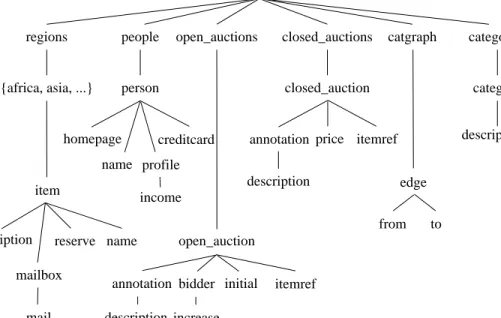
item regions site {africa, asia, ...} closed_auctions open_auctions people person description category categories catgraph reserve
description name open_auction
closed_auction edge to from mailbox mail annotation bidder increase description itemref initial annotation description itemref price homepage creditcard name profile income
Figure 1: Element relationships between most of the queried elements
4.1 Hierarchical Element Structure
The nesting of elements renders the overall tree struc-ture of XML documents. In this subsection we de-scribe the structure of the benchmark document, which is modeled after a database as deployed by an Internet auction site. The main entities come in two groups:
person, open auction, closed auction, item, and cate-gory on the one side and annotation and description
on the other side. The relationships between the enti-ties in the first group are expressed through references while those of the second group, which take after nat-ural language text and are document-centric element structures, are embedded into the sub-trees to which they semantically belong. The hierarchical schema is depicted in Figure 1; an ER diagram can be found in [7]. The semantics of the entities just mentioned is as follows: (1) Items are the objects that are on for sale or that already have been sold. Each item carries a unique identifier and bears properties like payment (credit card, money order, . . . ), a reference to the seller, a description etc., all encoded as elements. Each item is assigned a world region represented by the item’s par-ent. (2) Open auctions are auctions in progress. Their properties are the privacy status, the bid history (i.e., in-creases or dein-creases over time) along with references to the bidders and the seller, the current bid, the time interval within which bids are accepted, the status of the transaction and a reference to the item being sold, among others. (3) Closed auctions are auctions that are finished. Their properties are the seller (a reference to a person), the buyer (a reference to a person), a reference to the respective item, the price, the number of items
sold, the date when the transaction was closed, the type of transaction, and the annotations that were made be-fore, during and after the bidding process. (4) Persons are characterized by name, email address, phone num-ber, mail address, homepage URL, credit card numnum-ber, profile of their interests, and the (possibly empty) set of open auctions they are interested in and get notifi-cations about. (5) Categories feature a name and a de-scription; they are used to implement a classification scheme of items. A category graph links categories into a network.
These entities constitute the relatively structured and data-oriented part of the document: the schema is regular on a per entity basis and exceptions, such as that not every person has a homepage, are predictable. Apart from occasional list types such as bidding histo-ries, the order of the input is not particularly relevant. On the other hand, the offspring of annotation and
de-scription elements makes up the document-centric side
of the document. Here the length of strings and the internal structure of sub-elements varies greatly. The markup now comprises itemized lists, keywords, and even formatting instructions and character data, imitat-ing the characteristics of natural language texts. This ensures that the database covers the full range of XML instance incarnations, from marked-up data structures to traditional prose. At [19] we have made available some snippets of the benchmark document.
4.2 References
An overview of the references that connect sub-trees is given in Figure 2. Care has been taken that the
references feature diverse distributions, derived from uniformly, normally and exponentially distributed ran-dom variables. Also note that all references are typed,
i.e., all instances of an XML element point to the same
type of XML element; for example, references that model interests always refer to categories.
4.3 Generated Text
To generate text that bears similarities with natural language, we analyzed Shakespeare’s plays and de-termined statistic characteristics like word frequency, stopwords etc. The generator mimics these characteris-tics by using the 17000 most frequent words excluding stop words. We did not incorporate additional charac-teristics like punctuation as they are only of little rel-evance for the performance assessment. We believe that tokenization and other text compression methods commonly used can be sufficiently well assessed with the text we provide. For entities like names, email ad-dresses etc. we used various Internet sources like elec-tronically available phone directories and scrambled them. We refer to [22] for more details.
4.4 XML Constructs
The XML Standard [6] defines constructs that are use-ful for producing flexible markup but do not justify the definition of queries to challenge them directly. There-fore, we only made use of a restricted set of XML features in the data generator which we consider per-formance critical in the context of XML processing in databases. We do not generate documents with Enti-ties or Notations. Neither do we distinguish between Parsed Character Data and Character Data assuming that both are string types from the viewpoint of the stor-age engine. Furthermore, we don’t include namespaces into the queries. We also restrict ourselves to the seven bit ASCII character set. A DTD and schema informa-tion are provided to allow for more efficient mappings. However, we stress that this is additional information that may be exploited.
4.5 xmlgen– Or How to Generate a Document We designed and implemented a document generator, calledxmlgen, to provide for a scalable XML doc-ument database. Besides the obvious requirement to be capable of producing the XML document speci-fied above we were eager to meet the following addi-tional demands. The generation of the XML document should be: (1) platform independent so that any user in-terested in running the benchmark is able to download the binary and generate the same document no matter what hardware or operating system is used; to achieve this plain ANSI C was used to implement xmlgen; (2) accurately scalable ranging from a minimal docu-ment to any arbitrary size limited only by the capac-ity of the system; (3) both time and resource efficient,
Name Scaling Factor Document Size
tiny 0.1 10 MB
standard 1 100 MB
large 10 1 GB
huge 100 10 GB
Figure 3: Scaling the benchmark document
i.e., elapsed time ideally scales linearly whereas the
re-source allocation is constant – independent of the size of the generated document; (4) deterministic, that is, the output should only depend on the input parameters. First, in order to be able to reproduce the document independently of the platform, we incorporated a ran-dom number generator rather then relying on the op-erating system’s built-in random number generators. Together with basic algorithms which can be found in statistics textbooks this xmlgenimplements uni-form, exponential, and normal distributions of fairly high quality. We assigned to each of the elements in the DTD a plausible distribution of its children and its references, observing consistency among referenc-ing elements, that is, the number of items organized by continents equals the sum of open and closed auc-tions, etc. Second, to provide for accurate scaling we scale selected sets like the number of items and per-sons with the user defined factor. Moreover, we cal-ibrated the numbers to match a total document size of slightly more than 100 MB for scaling factor 1.0 (cf. Fig. 3). Finally, it is a challenge to implement the data generator efficiently because references are cre-ated at various places throughout the document; since we have to abide by the integrity constraint that every reference points to a valid identifier we could go for the straight-forward solution of keeping some sort of log and record which identifier has already been ref-erenced; unfortunately this seems infeasible for large documents. We solved this problem by modifying the random number generation to produce several identical streams of random numbers. That way, we are able to implement a partitioning of sets like the item IDs that are referenced from both open and closed auctions. In its current version,xmlgenrequires less than 2 MB of main-memory, and produces documents of sizes of 100 MB and 1 GB in 33.4 and 335.5 seconds, respectively (450MHz Pentium III). A more detailed description of the tool and downloads can be found at the project Web page [18].
5
Bulkloading the Document
In the context of XML, the role of bulkloading stands apart from its importance in other benchmarks. As (prospective) standards like XQuery [11] are not ex-clusively designed as database but data integration lan-guages, we can, strictly speaking, neither assume the need to bulkload documents nor the presence of a
database. However, there should be little doubt that databases can help with managing large amounts of XML data. We therefore resort to the following inter-pretation: We take the XQuery syntax for
FOR $a in document(”auction.xml”)/...
literally and formulate all queries with respect to a sin-gle large document without committing ourselves to a specific database scenario.
Although the authors themselves did not experience problems when bulkloading the document in our test environments, they are aware that the size of the doc-ument may be too large for some systems. Hence, the data generatorxmlgenadditionally offers a mode that outputsnentities (as defined in Section 4) per file wherencan be chosen by the user.
Note that in this case, modifications to the one-document version of the benchmark may become nec-essary. For example, if the user chooses to make use of the DTD we supply, parser-controlled references,
i.e., ID and IDREF declared attributes, should be
con-verted to REQUIRED attributes. Otherwise a validat-ing parser tries to check for uniqueness and existence of IDs and IDREFs, respectively. With respect to queries, changes to the path expressions, which as presented as-sume a single document, are necessary. Nevertheless, all changes remain local. However, we stress that this solution should be regarded as a work-around and that the semantics of the queries as defined in the following section should not differ no matter whether they are executed against a single document or a collection of documents. The query semantics of the one document version are normative.
6
Benchmark Queries
This section lists the queries of the benchmark. We chose to express the queries in XQuery [11], the suc-cessor to Quilt [12], which is about the be standardized. Due to lack of space, this is the only query we present in source code. The remaining queries can be down-loaded from the project Web site at [19]. The Queries are grouped under subsection headings which indicate the concept to be tested.
6.1 Exact Match
This simple query is mainly used to establish a perfor-mance baseline, which should help to interpret subse-quent queries. It tests the database ability to handle simple string lookups with a fully specified path. Q 1. Return the name of the person with ID ‘person0’. FOR $b IN /site/people/person/[@id=”person0”]
RETURN $b/name/text()
Now we are ready for more challenging queries:
6.2 Ordered Access
These queries should help users to gain insight how the DBMS copes with the intrinsic order of XML docu-ments and how efficiently they can expect the DBMS to handle queries with order constraints.
Q 2. Return the initial increases of all open auctions. This query evaluates the cost of array lookups. Note that it may actually be harder to evaluate than it looks; especially relational back-ends may have to struggle with rather complex aggregations to select the bidder element with index 1.
Q 3. Return the first and current increases of all open
auctions whose current increase is at least twice as high as the initial increase.
This is a more complex application of array lookups. In the case of a relational DBMS, the query can take ad-vantage of set-valued aggregates on the index attribute to accelerate the execution. Queries Q2 and Q3 are akin to aggregations in the TPCD [15] benchmark. Q 4. List the reserves of those open auctions where a
certain person issued a bid before another person.
This time, we stress the textual nature of XML doc-uments by querying the tag order in the source docu-ment.
6.3 Casting
Strings are the generic data type in XML documents. Queries that interpret strings will often need to cast strings to another data type that carries more seman-tics. This query challenges the DBMS in terms of the casting primitives it provides. Especially, if there is no additional schema information or just a DTD at hand, casts are likely to occur frequently. Although other queries include casts, too, this query is meant to chal-lenge casting in isolation.
Q 5. How many sold items cost more than 40? 6.4 Regular Path Expressions
Regular path expressions are a fundamental building block of virtually every query language for XML or semi-structured data. These queries investigate how well the query processor can optimize path expressions and prune traversals of irrelevant parts of the tree. Q 6. How many items are listed on all continents?
A good evaluation engine or path encoding scheme should help realize that there is no need to traverse the complete document tree to evaluate such expressions. Q 7. How many pieces of prose are in our database? Also note thatCOUNTaggregations do not require a complete traversal of the document tree. Just the cardi-nality of the respective parts is queried.
6.5 Chasing References
References are an integral part of XML as they al-low richer relationships than just hierarchical element structures. These queries define horizontal traver-sals with increasing complexity. A good query opti-mizer should take advantage of the cardinalities of the operands to be joined.
Q 8. List the names of persons and the number of items
they bought. (joins person, closed auction)
Q 9. List the names of persons and the names of
the items they bought in Europe. (joins person, closed auction, item)
6.6 Construction of Complex Results
Constructing new elements may put the storage engine under stress especially when the newly constructed ele-ments are to be queried again. The following query re-verses the structure of person records by grouping them according to the interest profile of a person. Large parts of the person records are repeatedly reconstructed. To avoid simple copying of the original database we trans-late the mark-up into French.
Q 10. List all persons according to their interest; use
French markup in the result.
6.7 Joins on Values
This query tests the database’s ability to handle large (intermediate) results. This time, joins are on the basis of values. The difference between these queries and the reference chasing queries Q8 and Q9 is that references are specified in the DTD and may be optimized with logical OIDs for example. The two queries Q11 and Q12 differ mainly in the size of the result set and hence provide various optimization opportunities.
Q 11. For each person, list the number of items
cur-rently on sale whose price does not exceed 0.02% of the person’s income.
Q 12. For each person with an income of more than
50000, list the number of items currently on sale whose price does not exceed 0.02% of the person’s income.
6.8 Reconstruction
A key design for XML-to-DBMS mappings is to deter-mine the fragmentation criteria. The complementary action is to reconstruct the original document from its broken-down representation. Query 13 tests for the ability of the database to reconstruct portions of the original XML document.
Q 13. List the names of items registered in Australia
along with their descriptions.
6.9 Full Text
We continue to challenge the textual nature of XML documents; this time, we conduct a full-text search in the form of keyword search. Although full-text scanning could be studied in isolation we think that the interaction with structural mark-up is essential as the concepts are considered orthogonal; so Q14 is re-stricted to a subset of the document by combining con-tent and structure.
Q 14. Return the names of all items whose description
contains the word ‘gold’.
6.10 Path Traversals
In contrast to Section 6.4 we now try to quantify the costs of long path traversals that don’t include wild-cards. We first descend deep into the document tree (Query 15); in Query 16 we additionally ascend the tree with a selection. Note that both queries only check for the existence of paths.
Q 15. Print the keywords in emphasis in annotations
of closed auctions.
Q 16. (Confer Q 15.) Return the IDs of the sellers
of those auctions that have one or more keywords in emphasis.
6.11 Missing Elements
This is to test how well the query processors know to deal with the semi-structured aspect of XML data, especially elements that are declared optional in the DTD.
Q 17. Which persons don’t have a homepage? The fraction of people without a homepage is rather high so that this query also presents a challenging path traversal to non-clustering systems.
6.12 Function Application
This query puts the application of user defined func-tions (UDF) to the proof. In the XML world, UDFs are of particular importance because they allow the user to assign semantics to generic strings that go beyond type coercion.
Q 18. Convert the currency of the reserves of all open
auctions to another currency.
6.13 Sorting
Due to the lack of a schema, SORTBY clauses often play the role of the SQL-ish ORDER BY and GROUP BY. This query requires a sort on generic strings. Q 19. Give an alphabetically ordered list of all items
6.14 Aggregation
The following query computes a simple aggregation by assigning each person to a category. Note that the aggregation is truly semi-structured as it also includes those persons for whom the relevant data is not avail-able.
Q 20. Group customers by their income and output the
cardinality of each group.
These twenty queries constitute the challenges posed in XMark. While deploying them in various en-vironments we felt that the number and type of queries exhibit a good balance between conciseness and detail, making it possible to run the benchmark in acceptable time while still acquiring interesting characteristics of the system(s) tested.
7
Experiments and Experiences
The benchmark has been a group-design activity of academic and industry researchers and is known to be used with success to evaluate progress in both commer-cial and research settings. The evaluation in this sec-tion here is meant to present the highlights we encoun-tered when running the benchmark on a broad range of the systems; an in-depth analysis of the behavior of all individual systems would be beyond the scope of this paper. We anonymized the systems due to well-known license restrictions; instead, we simply speak of systems A through G. Our test platforms fall into two categories: (1) Systems that are designed as large
scale repositories and therefore can be expected
per-form well at handling large amounts of data. We call them System A through System F; in the sequel, we will also refer to these systems as mass storage
sys-tems. Some of the systems, namely A to C, are based
on relational technology, come with a cost-based query optimizer and allow the kind of hand-optimization and hints as the relational product. While A and B do not require the user to provide a mapping for physical data breakdown, System C reads in a DTD and lets the user generate an optimized database schema. Systems D to F are main-memory based and only come with heuris-tic optimizers; however, they also allow rewriting the queries by hand if necessary. (2) Query processors that are intended to serve as embedded query processors in programming languages and aim at small to medium sized documents. We call the software system that falls into this category System G.
A note on the analysis. Some systems provided us with the opportunity to look at query execution in de-tail, i.e., find out how much time is spent for query op-timization, metadata access or during I/O wait; others only allowed a black-box analysis augmented with the usual monitoring tools that operating systems provide. The tools to run the benchmark document have been
made available on the project Web site [18]. They in-clude the data generator and the query set along with a mapping tool to convert the benchmark document into a flat file that may be bulk-loaded into a (relational) DBMS; a variety of formats are available.
The experiments we conducted are based on a va-riety of set-ups: some systems required us to prepare the data and translate the queries into a proprietary lan-guage that was then executed, other systems processed the queries as they are presented in [19, 22] possibly with minor syntactic changes. All queries were run on machines equipped with 550 MHz Pentium III proces-sors, SCSI Ultra2 harddisks and 1 GB of main mem-ory; operating systems were Windows 2000 Advanced Server and Linux 2.4 respectively depending on what the packages required. Although the systems were all equipped with at least two processors, only one proces-sor was used during bulk load and query execution.
System Size Bulkload time
A 241 MB 414 s B 280 MB 781 s C 238 MB 548 s D 142 MB 50 s E 302 MB 96 s F 345 MB 215 s
Table 1: Database sizes
Concerning the scaling factor, we were not able to run all queries on all systems at scaling factor 1.0 as we had intended to do. The mass storage Systems A-F were able to process the queries, but the embedded System G failed to do so. So for the Systems A-F, which with we commence our evaluation, the bench-mark document was generated at scaling factor 1.0. Note that it took the XML parserexpat[13] 4.9 sec-onds (user time on the above Linux machine includ-ing system time and disk I/O) to scan the benchmark document (this time only includes the tokenization of the input stream and normalizations and substitutions as required by the XML standard and no user-specified semantic actions). The bulkload times are summarized in Table 1: they range from 49 seconds to 781 seconds. They constitute completed transactions and include the conversion effort needed to map the XML document to a database instance. Note that System C requires a DTD to derive a database schema; the time for this derivation is not included in the figure, but is negligi-ble anyway. The resulting database sizes are also listed in Table 1; we remark that some systems which are not included in this comparison require far larger database sizes.
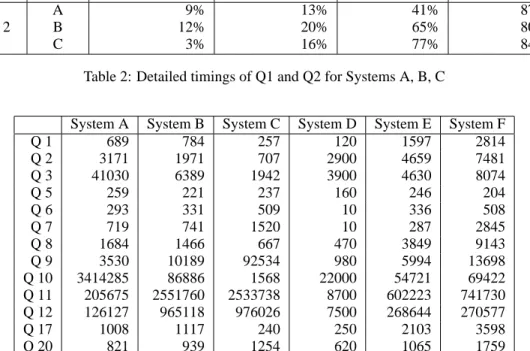
We now turn our attention to the running times and statistics as displayed in Table 3 and present some ba-sic insights. Since we do not have the space to discuss all timings and experiments in detail, we only present
Query System Compilation CPU Compilation total Execution CPU Execution total A 16% 25% 31% 75% Q 1 B 13% 51% 30% 49% C 0% 29% 20% 71% A 9% 13% 41% 87% Q 2 B 12% 20% 65% 80% C 3% 16% 77% 84%
Table 2: Detailed timings of Q1 and Q2 for Systems A, B, C
System A System B System C System D System E System F
Q 1 689 784 257 120 1597 2814 Q 2 3171 1971 707 2900 4659 7481 Q 3 41030 6389 1942 3900 4630 8074 Q 5 259 221 237 160 246 204 Q 6 293 331 509 10 336 508 Q 7 719 741 1520 10 287 2845 Q 8 1684 1466 667 470 3849 9143 Q 9 3530 10189 92534 980 5994 13698 Q 10 3414285 86886 1568 22000 54721 69422 Q 11 205675 2551760 2533738 8700 602223 741730 Q 12 126127 965118 976026 7500 268644 270577 Q 17 1008 1117 240 250 2103 3598 Q 20 821 939 1254 620 1065 1759
Table 3: Performance in ms of queries discussed in Section 7
a selection. In most physical XML mappings found in the literature, Query Q1 consists of a table scan or index lookup and a small number of additional table look-ups. It is mainly supposed to establish a perfor-mance baseline: At scaling factor 1.0, the scan goes over 10000 tuples and is followed by two table look-ups if a mapping like [20] is used.
Queries Q2 and Q3 are the first ones to provide sur-prises. It turns out that the parts of the query plans that compute the indices are quite complex TPC/H-like ag-gregations: they require the computation of set-valued attributes to determine the bidder element with the least index with respect to the open auction ancestor. There-fore the complexity of the query plan is higher than the rather innocent looking XQuery representations of the queries might suggest. Consequently, running times are quite high. Although System A was able to find an execution plan which was as good as that of the other systems, it spent too much of its time on optimization. Table 2 displays some interesting characteristics of Q1 and Q2 that can be traced back to the physical map-pings the systems use. System A basically stores all XML data on one big heap, i.e., only a single relation. System B on the other hand uses a highly fragment-ing mappfragment-ing. Consequently, System A has to access fewer metadata to compile a query than System B, thus spending only half as much time on query compilation (i.e., optimization) as System B. However, this comes at a cost. Because the data mapping deployed in
Sys-tem A has less explicit semantics, the actual cost of ac-cessing the real data is higher than in System B (75%
vs 49%). System C as mentioned needs a DTD to
de-rive a storage schema; this additional information helps to get favorable performance. Still in Table 2, we also find the detailed execution times for Q2. They show that mappings that structure the data according to their semantics can achieve significantly higher CPU usage (compare 77% of System C and 65% of System B vs System A’s 41%). We remark that System C also uses a data mapping in the spirit of [23] that results in com-paratively simple and efficient execution plans and thus outperforms all other systems for Q2 and Q3.
Q4 (no results presented due to lack of space) fea-tures the ‘BEFORE’ predicate which may be expensive to evaluate. Some mappings like [26] which store the
extent of tags, i.e., not only the position of the start tag
but also that of the corresponding end tag, may be able to exploit this additional information and achieve good running times.
We now come to Query Q5 which tries to quantify the cost of casting or type-coercion operations such as those necessary for the comparisons in Q3. For all mass-storage systems, the cost of this coercion is rather low with respect to the relative complexity of Q3’s query execution plan and given the execution times of Q5. In any case, Q5 does not exhibit great differences in execution times. We note that all character data in the original document, including references, were
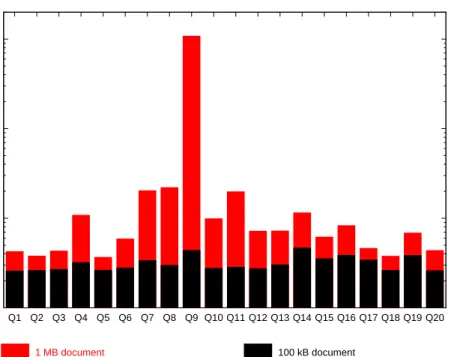
1 10 100 1000 Q1 Q2 Q3 Q4 Q5 Q6 Q7 Q8 Q9 Q10 Q11 Q12 Q13 Q14 Q15 Q16 Q17 Q18 Q19 Q20 time in seconds 1 MB document 100 kB document
Figure 4: Performance figures for the embedded query processor System G stored as strings and cast at runtime to richer data types
whenever necessary as in Queries 3, 5, 11, 12, 18, 20. We did not apply any domain-specific knowledge; nei-ther did the systems use schema information nor pre-calculation or caching of casting results.
Regular path expressions are the challenge pre-sented by queries Q6 and Q7. System D keeps a de-tailed structural summary of the database and can ex-ploit it to optimize traversal-intensive queries; this ac-tually makes Q6 and Q7 surprisingly fast. However, on systems without access to structural summaries, which effectively play the role of an index or schema, these queries often are significantly more expensive to ex-ecute. The problem that Q7 actually looks for non-existing paths is efficiently solved by exploiting the structural summary in the case of System D. For some systems, the cost of accessing schema information was very high and dominated query performance.
Queries Q8 and Q9 are usually implemented as joins. In the systems that we could analyze in detail, chasing the references basically amounted to executing equi-joins on strings. We were surprised that Q8 and Q9 were relatively cheap in comparison to Q2 and Q3 as we would have deemed the individual elements sim-ilarly expensive. For Q9, System C was not able to find a good execution plan in acceptable time. Apart from that anomaly, the implementation of the executed join algorithms seemed to determine the performance.
The construction of complex query results is ad-dressed in Q10. The path expressions and join expres-sion used in the query are kept simple so that the bulk of the work lies in the construction of the answer set which amount to more than 10 MB of (unindented)
XML text.
Whereas Q10 produced massive amounts of output data, Q11 and Q12 test the ability to cope with large in-termediate results by theta-joining potential buyers and items that might be of interest to them. The theta-join produces more than 12 million tuples. Q12 especially is also a challenge to the query optimizer to pick a good execution plan and allows insights into how the data volume influences query and output performance. For Systems B and C, the optimizer chose a sub-optimal execution plan. For Systems D through F we had to ex-periment with several hand-optimized execution plans. The queries so far have not attempted to estimate the cost of long path expressions with respect to short ones. This is exactly where Q15 and Q16 can help. For the sake of space, we do not present figures here but report that Systems A, B and C needed about 8 times longer to execute Q16 than they needed for Q15. This is due to the many joins that the more complicated path expres-sion in Q16 brings about – both in execution and op-timization. Also, the SQL output of System E needed some massaging to keep intermediate results small.
Q17 again stresses the loose schema of many XML documents by querying for non-existing data. The query execution plan computes the intersection of two sets. The timings in Table 3 show a typical situation: although all systems are able to process the query in less than four seconds, there is still an order magni-tude of difference in the performance. Queries Q18 and Q19 (no performance figures are presented due to lack of space) are primarily of interest to establish the relative costs of function application and sorting oper-ations when comparing two system architectures. The
aggregations of Q20 conclude the query set with a com-bination of three table scans and a set difference. All systems show similar performance.
A general note on the queries: we often had to refor-mulate the queries into SQL or proprietary XML query languages to satisfy a query processor; frequently it was also necessary to hand-optimize multi-pass SQL,
i.e., sequences of SQL statements that reuse
interme-diate results, that were generated by the ‘native’ XML engines E and F. Systems A to C on the other hand did not need manual intervention. As a separate obser-vation, we would like to mention that the installation effort for the tested systems differed greatly and that in a production setting this effort may be very impor-tant [21].
In some of the performance figures certain systems (particularly Systems A to C) show pathological run-ning times. This does not necessarily mean that the relevant systems are inferior to the others; we rather relied on the built-in query optimizers and did not at all change or reformulate queries by hand. This was to show that the benchmark queries indeed present rea-sonable challenges that can be solved even if not mally. The analysis of the query translation and opti-mization process showed that search spaces for XML queries are often larger than necessary since, during the translation from XQuery to a lower-level algebra, information especially about path expression is often lost. To improve on this, experimenting with new prun-ing strategies and extended low-level algebras to bet-ter capture query semantics, might be a good starting point.
For comparison, Figure 4 presents the performance behavior of an embedded query processor on document sizes 100 kB (scaling factor 0.001) and 1MB (scaling factor 0.01), which were the largest sizes we could sensibly execute on the System G without running out of resources. On the smaller document, no query took longer than 5 seconds but none was faster than 2.5 seconds; this means that the implementation tech-niques used for the embedded processor incur a signifi-cant performance overhead compared to the mass stor-age systems, which were overall competitive in many cases. With respect to join queries one should note that the result sizes were very small in comparison to those of the mass storages systems, on which we used a much larger scaling factor (1.0) for our experiments. An ad-vantage of the embedded systems is that they usually allow more control over query execution by providing hooks into their execution engine or by letting users implement certain operators themselves.
We also would like to mention one point that would facilitate query formulation enormously. If a query processor was able to validate path expressions online,
i.e., tell the user whether a given sequence of tags
ac-tually exists in the database instance, it would often be of great help to users as quite regularly, simple typos
in path names often evaluate to empty results. While the DBMS of course can’t decide whether a given path expression contains a typo or not, it could well issue a warning if a path expression contains non-existing tags. An approach like Query By Example could pos-sibly lead to very helpful results.
8
Conclusion
In this paper, we presented the benchmark specifi-cations developed for XMark, a set of queries and lessons learned while executing the workload speci-fication on a number of platforms. The benchmark was designed top-down taking the standardization is-sues around XML as a starting point. The queries try to capture the essential primitives of XML processing in Data Management Systems such as path expressions, querying for NULL values, full-text search, hierarchi-cal data with varying fan-outs, ordered data and coer-cions between data types and complex results.
Our experiences during the experiments can be sum-marized as follows: (1) The physical XML mapping has a far-reaching influence on the complexity of query plans. Each mapping favors certain types of queries by enabling efficient execution plans for them. How-ever, no mapping was able to outperform the others across the board. (2) The complexity of query plans is often aggravated by information-loss during transla-tion from the declarative high-level query language to the low-level execution algebra. There often appears to be a semantic gap between the two. Thus, cost-based query optimizers have to deal with larger search spaces than necessary. (3) Meta-data access can be a dominant factor in query execution especially in simple lookup queries with small result sizes (see Table 2 and expla-nations in Section 7). (4) Schema information often en-ables better database schema design and is also useful in query optimization; see the running times of System C versus the comparable Systems A and B in Table 3.
Important parts of a complete application scenario are still missing: update specifications, for which a W3C standard has yet to be defined, are the most prominent one. Therefore, we expect our work to con-tinue and evolve in the future along with the standard-ization efforts.
References
[1] T. Anderson, A. Berre, M. Mallison, H. Porter, and B. Schneider. The HyperModel Bench-mark. In International Conference on
Extend-ing Database Technology, volume 416 of Lec-ture Notes in Computer Science, pages 317–331,
1990.
[2] T. B¨ohme and E. Rahm. XMach-1: A Benchmark for XML Data Management. In Proceedings of
[3] A. Bonifati and S. Ceri. Comparative Analysis of Five XML Query Languages. ACM SIGMOD
Record, 29(1):68–79, 2000.
[4] R. Bourett. XML Database Products. available at http://www.rpbourret.com/xml/ XMLDatabaseProds.htm, 2000.
[5] J. Boyer. Canonical XML Version 1.0, 1
2001. available at http://www.w3.org/
TR/xml-c14n.
[6] T. Bray, J. Paoli, C. M. Sperberg-McQueen, and E. Maler. Extensible Markup Language (XML) 1.0 (Second Edition). available at http:// www.w3.org/TR/REC-xml, 2000.
[7] S. Bressan, G. Dobbie, Z. Lacroix, M. Lee, Y. Li, and U. Nambiar. X007: Applying 007 Bench-mark to XML Query Processing Tools. In
Inter-national Conference on Information and Knowl-edge Management, pages 167–174, 2001.
[8] M. Carey, D. DeWitt, and J. Naughton. The OO7 Benchmark. In Proceedings of the ACM
SIG-MOD International Conference on Management of Data, pages 12–21, 1993.
[9] M. Carey, D. DeWitt, J. Naughton, M. Asgarian, P. Brown, J. Gehrke, and D. Shah. The BUCKY Object-Relational Benchmark. In Proceedings of
the ACM SIGMOD International Conference on Management of Data, pages 135–146, 1997.
[10] R. Cattell and J. Skeen. Object Operations Bench-mark. TODS, 17(1):1–31, 1992.
[11] D. Chamberlin, D. Florescu, J. Robie, J. Sim´eon, and M. Stefanescu. XQuery: A Query Language for XML, February 2001. available athttp:// www.w3.org/TR/xquery.
[12] D. Chamberlin, J. Robie, and D. Florescu. Quilt: An XML Query Language for Heterogeneous Data Sources. In International Workshop on
the Web and Databases (WebDB), pages 53–62,
2000.
[13] James Clark et al. Expat XML Parser.
available at http://sourceforge.net/
projects/expat/, 2001.
[14] D. Florescu and D. Kossmann. Storing and Querying XML Data using an RDMBS. IEEE
Data Engineering Bulletin, 22(3):27–34, 1999.
[15] J. Gray. Database and Transaction
Process-ing Performance Handbook. available at
http://www.benchmarkresources. com/handbook/contents.asp, 1993.
[16] M. Klettke and H. Meyer. XML and Object-Relational Database Systems - Enhancing Struc-tural Mappings Based on Statistics. In
Inter-national Workshop on the Web and Databases (WebDB), pages 63–68, 2000.
[17] K. Ramasamy, J. Patel, J. Naughton, and R. Kaushik. Set Containment Joins: The Good, The Bad and The Ugly. In Proceedings of the
International Conference on Very Large Data Bases, pages 351–362, 2000.
[18] A. Schmidt, M. Kersten, D. Florescu, M. Carey, I. Manolescu, and F. Waas. The XML Store
Benchmark Project, 2000. http://www.
xml-benchmark.org.
[19] A. Schmidt, M. Kersten, D. Florescu, M. Carey, I. Manolescu, and F. Waas. Example Snip-pet and Queries, 2002. available at http: //monetdb.cwi.nl/xml/snippet.txt
and http://monetdb.cwi.nl/xml/
queries.txt.
[20] A. Schmidt, M. Kersten, M. Windhouwer, and F. Waas. Efficient Relational Storage and Re-trieval of XML Documents. In International
Workshop on the Web and Databases (WebDB),
pages 47–52, Dallas, TX, USA, 2000.
[21] A. Schmidt, F. Waas, M. Kersten, D. Florescu, M. Carey, I. Manolescu, and R. Busse. Why And How To Benchmark XML Databases. ACM
SIG-MOD Record, 30(3):27–32, 2001.
[22] A. Schmidt, F. Waas, M. Kersten, D. Florescu, I. Manolescu, M. Carey, and R. Busse. The XML Benchmark Project. Technical Report INS-R0103, April 2001.
[23] J. Shanmugasundaram, K. Tufte, C. Zhang, G. He, D. J. DeWitt, and J. F. Naughton. Rela-tional Databases for Querying XML Documents: Limitations and Opportunities. In Proceedings of
the International Conference on Very Large Data Bases, pages 302–314, 1999.
[24] D. R. Slutz. Massive Stochastic Testing of SQL. In Proceedings of the International Conference
on Very Large Data Bases, pages 618–622, 1998.
[25] W3C. W3C XML Schema.http://www.w3.
org/XML/Schema, 2001.
[26] C. Zhang, J. Naughton, D. DeWitt, Q. Luo, and G. Lohman. On Supporting Containment Queries in Relational Database Management Systems. In
Proceedings of the ACM SIGMOD International Conference on Management of Data, 2001.