Probabilistic Approach
Mohamad MehdiA Thesis in
The Computer Science Department
Presented in Partial Fulfillment of the Requirements for the Degree of Doctor of Philosophy (Computer Science) at
Concordia University Montr´eal, Qu´ebec, Canada
May 2015
c
School of Graduate Studies
This is to certify that the thesis prepared
By: Mohamad Mehdi
Entitled: Trust and Reputation Management: a Probabilistic Approach and submitted in partial fulfillment of the requirements for the degree of
DOCTOR OF PHILOSOPHY (Computer Science)
complies with the regulations of this University and meets the accepted standards with respect to originality and quality.
Signed by the final examining commitee:
Dr. S. Mudur Chair
Dr. Noura Faci External Examiner
Dr. Olga Ormandjieva Examiner
Dr. Abdulwahab Hamou-Lhadj Examiner
Dr. Peter Grogono Examiner
Dr. Nizar Bouguila Supervisor
Dr. Jamal Bentahar Co-supervisor
Approved
Chair of Department or Graduate Program Director 20
Dr. Amir Asif, Ph.D., Dean
Trust and Reputation Management in Web Services: A Probabilistic
Approach
Mohamad Mehdi, Ph.D. Concordia University, 2015
Software architectures of large-scale systems are perceptibly shifting towards employing open and distributed computing. Web services emerged as autonomous and self-contained business applications that are published, found, and used over the web. These web services thus exist in an environment in which they interact among each other to achieve their goals. Two challenging tasks that govern the agents interactions have gained the attention of a large research community; web service selection and composition. The explosion of the number of published web services contributed to the growth of large pools of similarly functional services. While this is vital for a competitive and healthy marketplace, it complicates the aforementioned tasks. Service consumers resort to non-functional characteristics of available service providers to decide which service to interact with. Therefore, to optimize both tasks and maximize the gain of all involved agents, it is essential to build the capability of modeling and predicting the quality of these agents.
In this thesis, we propose various trust and reputation models based on probabilistic approaches to address the web service selection and composition problems. These approaches consider the trustworthiness of a web service to be strongly tied to the outcomes of various quality of ser-vice metrics such as response time, throughput, and reliability. We represent these outcomes by a multinomial distribution whose parameters are learned using Bayesian inference which, given a likelihood function and a prior probability, derives the posterior probability. Since the likelihood, in this case, is a multinomial, a commonly used prior is the Dirichlet distribution. We propose, to overcome several limitations of the Dirichlet, by applying two alternative priors such as the gen-eralized Dirichlet, and Beta-Liouville. Using these distributions, the learned parameters represent the probabilities of a web service to belong to each of the considered quality classes. These prob-abilities are consequently used to compute the trustworthiness of the evaluated web services and
lations among various quality metrics using real data sets, we introduce a hybrid trust model that captures these correlations using both Dirichlet and generalized Dirichlet distributions. Given their covariance structures, the former performs better when modeling negative correlations while the latter yields better modeling of positive correlations. To handle composite services, we propose various trust approaches using Bayesian networks and mixture models of three different distri-butions; the multinomial Dirichlet, the multinomial generalized Dirichlet, and the multinomial Beta-Liouville. Specifically, we employ a Bayesian network classifier with a Beta- Liouville prior to enable the classification of the QoS of composite services given the QoS of its constituents. In addition, we extend the previous models to function in online settings. Therefore, we present a generalized-Dirichlet power steady model that predicts compositional time series. We similarly extend the Bayesian networks model by using the Voting EM algorithm. This extension enables the estimation of the networks parameters after each interaction with a composite web service. Furthermore, we propose an algorithm to estimate the reputation of web services. We extend this algorithm by leveraging the capabilities of various clustering and outlier detection techniques to deal with malicious feedback and various strategic behavior commonly performed by web services. Alternatively, we suggest two data fusion methods for reputation feedback aggregation, namely, the covariance intersection and ellipsoidal intersection. These methods handle the dependency be-tween the information that propagates through networks of interacting agents. They also avoid over confident estimates caused by redundant information. Finally, we present a reputation model for agent-based web services grouped into communities of homogeneous functionalities. We exploit various clustering and anomaly detection techniques to analyze and identify the quality trends pro-vided by each service. This model enables the master of each community to allocate the requests it receives to the web service that best fulfill the quality requirements of the service consumers. We evaluate the effectiveness of the proposed approaches using both simulated and real data.
Acknowledgements
First and foremost, all praises to Allah for guiding and blessing me throughout this long journey. I would like to express my sincere gratitude to my supervisors Prof. Nizar Bouguila and Prof. Jamal Bentahar for their continuous support and guidance that were vital to the completion of this thesis. Their insightful feedback taught me valuable lessons for life-long career in research. I extend my gratitude to all the members of the examining committee including Prof. Olga Ormand-jieva, Prof. Peter Grogono, and Prof. AbdelWahab Hamou-Lhadj for their valuable feedback and suggestions that definitely ameliorated my thesis.
Special thanks to all my colleagues and friends, in particular, Elise Epaillard, Claude Fachkha, Elias Bou-Harb, and Ali S. Bakhtiari for the fruitful discussions and their encouragements espe-cially during tough times.
I also would like to take this opportunity to extend my heartfelt gratitude to my parents who crafted my education path with their sweat and lots of sacrifice. Without their constant support and endless prayers I wouldnt have reached thus far. My brothers and sister, thank you for your incessant encouragements and love. Your faith in me was a never-ending source of energy and determination.
Finally, last but not the least, I express my profound and sincere gratitude to my wife for her patience and unwavering support and love. I am specially grateful for her tolerance towards my endless working hours and over-occupied mind. She was definitely the bedrock upon which the last five years of my life have been built.
Table of Contents
List of Figures ix
List of Tables xi
1 Introduction 1
1.1 Background and Motivation . . . 1
1.2 Methodology . . . 5
1.3 Thesis Contributions . . . 7
1.4 Thesis Organization . . . 9
2 Trust and Reputation: a Literature Review 12 2.1 Existing Surveys . . . 12
2.2 Probability-Based Trust And Reputation Systems . . . 14
2.3 Other Trust and Reputation Systems . . . 16
2.4 Trust and reputation systems categorization . . . 17
2.4.1 Reputation propagation and storage . . . 18
2.4.2 Reputation target . . . 18 2.4.3 Conceptual modeling . . . 19 2.4.4 Information sources . . . 19 2.4.5 Computation techniques . . . 20 2.4.6 Cheating filtration . . . 21 2.5 Discussion . . . 22
3 QoS-Based Probabilistic Trust Models 24 3.1 QoS Modeling Via Composite Distributions . . . 25
3.1.1 QoS Metrics Overview . . . 26
3.2.2 QoS-Aware Trust Model . . . 35
3.2.3 Trust with multi-dimensional QoS . . . 37
3.2.4 Practical Example . . . 40
3.3 Online Trust: Generalized Dirichlet Power Steady Model . . . 43
3.3.1 Compositional Time Series . . . 43
3.3.2 Generalized Dirichlet Formulation . . . 47
3.4 State Space Models . . . 50
3.5 Generalized Dirichlet Power Steady Model(GDPSM) . . . 50
3.5.1 Transformations . . . 51
3.5.2 Time Series Model . . . 52
3.5.3 Model Evaluation . . . 53
3.6 Experiments . . . 54
3.6.1 Correlation Estimation . . . 54
3.6.2 GDPSM Experiments . . . 55
4 Trustworthy Composite Web Services Using Probablistic Approaches 64 4.1 Trustworthiness of Composite Services . . . 65
4.1.1 Bayesian Network Model . . . 65
4.1.2 Online Bayesian Network . . . 72
4.1.3 Generative Mixture Models . . . 77
4.2 Experimental Results . . . 77
4.2.1 Bayesian Network Experiments . . . 78
4.2.2 Mixture Models Experiments . . . 95
5 Reputation Aggregation and Filtering Approaches 100 5.1 Reputation Background . . . 100
5.2 Reputation Aggregation: Model 1 . . . 103
5.2.1 QoS-Based Reputation . . . 103
5.2.2 Kalman Filter for Service Reputation . . . 105
5.2.3 Proposed Aggregation Methods . . . 106
5.3 Reputation Aggregation: Model 2 . . . 109
5.3.1 Unfair referrals . . . 109
5.3.2 Dynamic Behavior . . . 111
5.4 Reputation Aggregation: Model 3 . . . 112
5.4.1 Gaussian Reputation . . . 114
5.4.2 Web Service QoS profile . . . 116
5.5 Experimental Evaluation . . . 121
6 Conclusions 134
List of Figures
1.1 Web service selection . . . 3
1.2 Thesis Organization . . . 10
2.1 Trust and Reputation Systems Taxonomy . . . 17
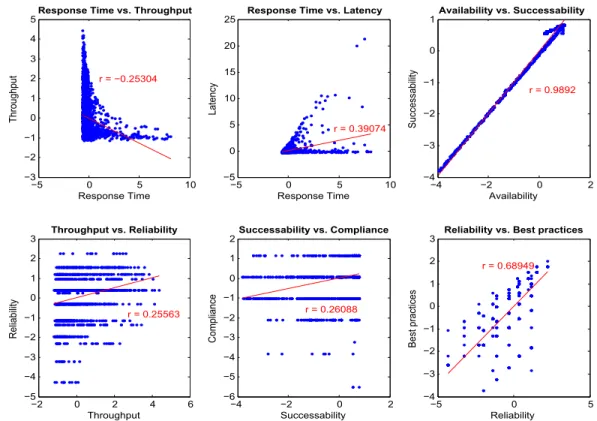
3.1 Correlation between six pairs of QoS metrics from the QWS data set . . . 35
3.2 MSE of estimating positive correlations . . . 54
3.3 MSE of estimating negative correlations . . . 56
3.4 Sample data (top) with zoom (bottom) . . . 59
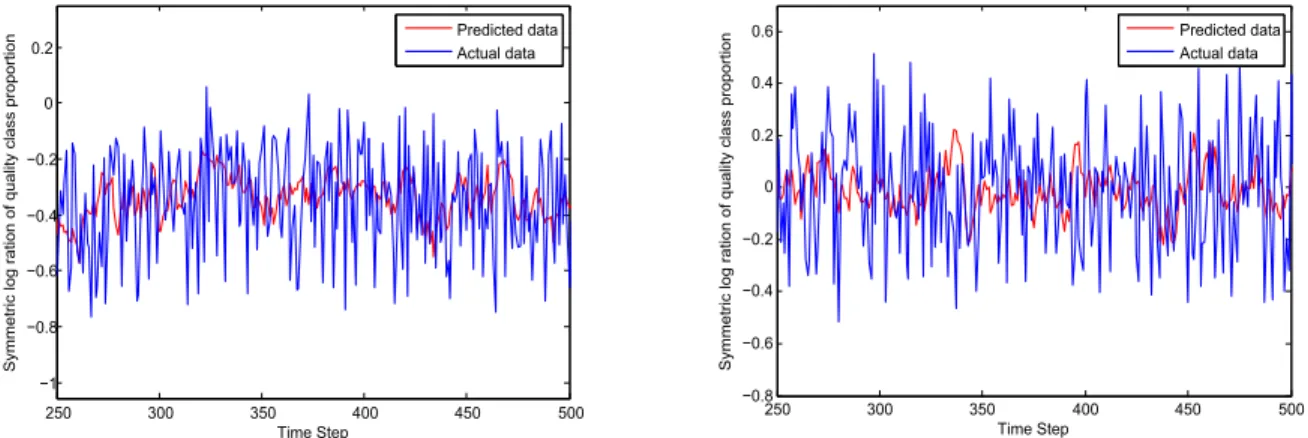
3.5 Actual versus predicted data for the first (top) and second (bottom) dimensions . . 60
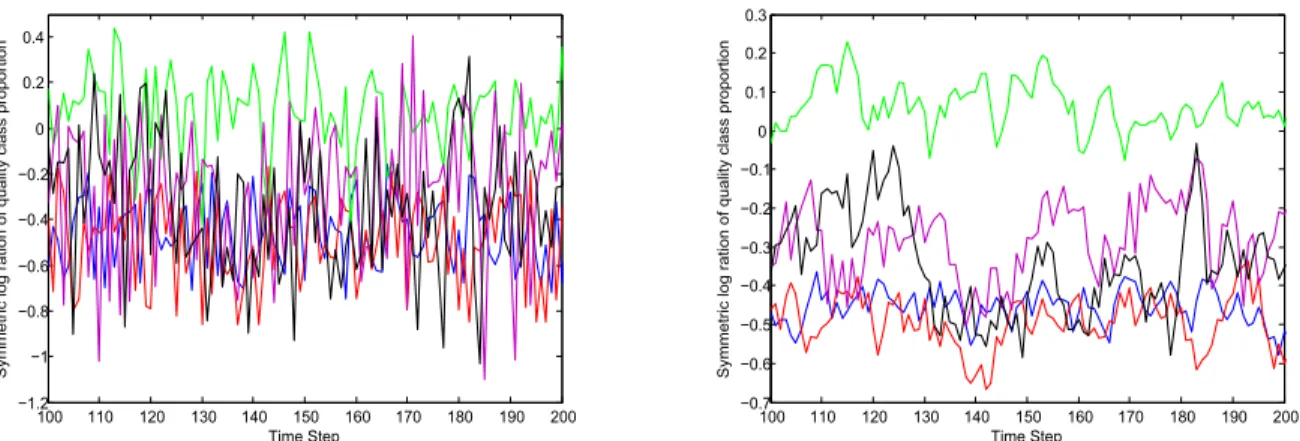
3.6 Actual (left) versus predicted (right)6-dimensional function-based data . . . 61
3.7 Actual (left) versus Predicted (right)3-dimensional Random data . . . 62
3.8 Actual (left) versus Predicted (right)6-dimensional random data . . . 63
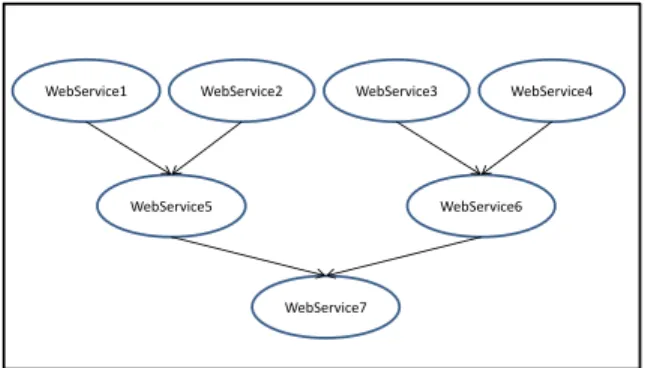
4.1 Bayesian network representation of an example of a composite web service. . . 66
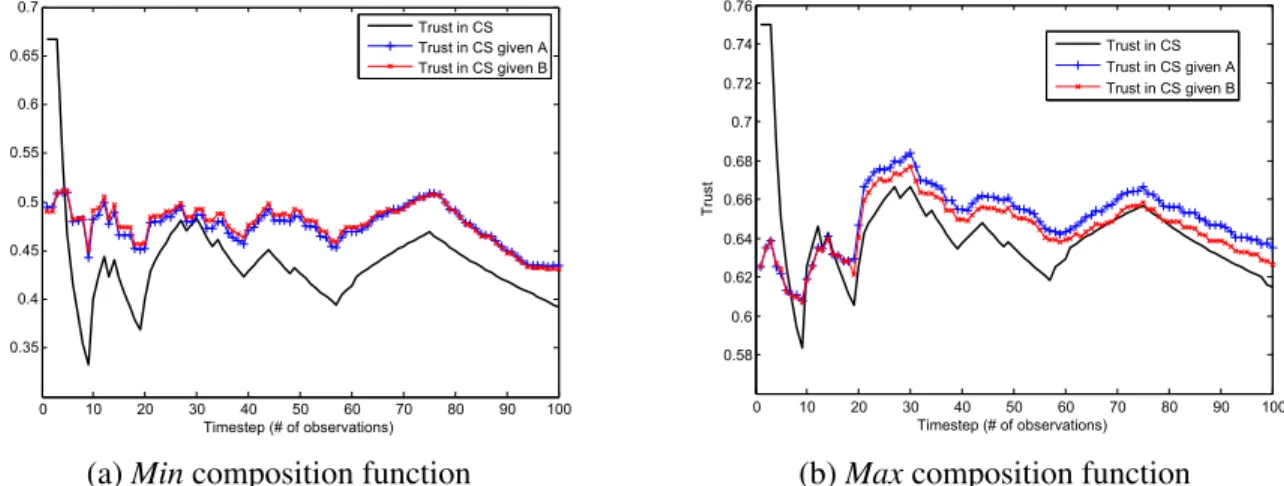
4.2 Bayesian (Dirichlet prior) vs. Naive Bayes trust estimation forSwitchcomposition function . . . 81
4.3 Bayesian (Dirichlet prior) vs. Naive Bayes trust estimation . . . 82
4.4 Conditional trust estimation based on constituent servicesAandB . . . 83
4.5 Bayesian (Beta Liouville prior) vs. Naive Bayes trust estimation for SWITCH composition function . . . 83
4.6 Bayesian (BL prior) vs. Naive Bayes trust estimation . . . 84
4.7 Mean Error of parameters estimation. . . 92
4.8 Bayesian network representation of a more complex composite web service. . . 93
4.9 Error bars of the estimated parameter CPT(1,4,3) using Voting EM (8 services). . . 93
4.10 Error bars of the estimated parameter CPT(1,4,3) and CPT(2,1,1) using Voting EM (15 services). . . 94
4.13 Actual vs. learned trust using the mixture of MDD with Sum (left) andProduct
(right) composition functions . . . 98
4.14 Actual vs. learned trust using the mixture of MGDD with various Switch (left), Min(center), andMax(right) composition functions . . . 98
4.15 Actual vs. learned trust using the mixture ofMGDDwithSum(left) andProduct (right) composition functions . . . 99
4.16 Actual vs. learned trust using the mixture of MGDD with various Switch (left), Min(center), andMax(right) composition functions . . . 99
4.17 Actual vs. learned trust using the mixture ofMBLDwithSum (left) andProduct (right) composition functions . . . 99
5.1 UML Use Case diagram of the proposed Reputation system . . . 117
5.2 QoS1 (left) andQoS2(right) Reputation scores (4 agents). . . 122
5.3 QoS1 (left) andQoS2(right) Reputation scores (100 agents). . . 123
5.4 Reputation aggregation with varied ratio of malicious web services and reputation feedback . . . 124
5.5 Reputation with dynamic behaviors . . . 125
5.6 Reputation with dynamic behaviors . . . 126
5.7 Reputation with dynamic behaviors . . . 127
5.8 Data based on stable QoS behavior and fair feedback reports . . . 130
5.9 Data based on stable QoS behavior and both fair and unfair feedback reports . . . . 131
5.10 Data based on unstable QoS and both fair and unfair feedback reports . . . 132
List of Tables
3.1 Attributes extracted from the ProgrammableWeb API . . . 32
3.2 Sample ofSSLandFeesraw values . . . 33
3.3 A sample from the QWS dataset . . . 34
3.4 Correlation of QWS dataset QoS metrics . . . 34
3.5 10outcomes of three QoS metrics . . . 41
3.6 Counts of pair-wise outcomes combinations . . . 41
3.7 Mean of pair-wise outcomes combinations . . . 41
3.8 Correlation matrix of100000outcomes . . . 55
3.9 Standardized residuals (left) and MSE (right) ofGDPSMandDPSM(3-dimensional data) . . . 59
3.10 Standardized residuals forGDPSMandDPSMwith 6-dimensional data . . . 60
3.11 Residuals correlations at lag 0 . . . 60
3.12 MSE forGDPSMandDPSMwith 6-dimensional data . . . 61
3.13 Standardized residuals (left) and MSE (right) for GDPSM and DPSM with 3-dimensional random data . . . 62
3.14 Standardized residuals forGDPSMandDPSMwith 6-dimensional random data . . 62
3.15 Residuals correlations at lag 0 . . . 63
3.16 MSE forGDPSMandDPSMwith 6-dimensional random data . . . 63
4.1 CPT of constituent serviceA. . . 79
4.2 CPT of constituent serviceB. . . 79
4.3 CPT of composite serviceCS . . . 80
4.4 Multinomials used to generate the classes of the four single web services. . . 84
4.5 CPT of WS1, WS2, WS3 and WS4. . . 85
4.6 CPT of composite service WS5. . . 86
4.7 CPT of composite service WS6. . . 87
4.11 CPT of composite service WS6. . . 90
4.12 CPT of composite service WS7. . . 91
4.13 Confusion Matrices: classifier1 (left) 82%, classifier2 (middle) 84%, classifier3 (right)77% . . . 91
4.14 Confusion Matrices: classifier1 (left) 82%, classifier2 (middle) 84%, classifier3 (right)77% . . . 92
4.15 Estimated parameters by multinomial mixture andMDDmixture withSwitch com-position operator. . . 96
4.16 Estimated parameters by multinomial mixture and MDD mixture with Min and Maxcomposition operators. . . 96
4.17 Estimated parameters using multinomial mixture andMDDmixture withProduct andSumcomposition operators. . . 97
5.1 MSE of the three estimators with 4 and 100 agents . . . 122
5.2 Means of the mixture components - scenario 1 . . . 130
5.3 Means of the mixture components - Scenario 2a . . . 131
5.4 Means of the mixture components - scenario 2b . . . 133
Chapter
1
Introduction
1.1
Background and Motivation
The emergence of service oriented architecture (SOA), the competitiveness of nowadays global markets, and the agility of business processes have contributed to the increase in the number of published web services. SOA provided the necessay infrastructure for distributed computing in which web services are built as Internet-based applications. Web services are business applica-tions deployed as autonomous and interoperable agents that are published, found, and used on the web. As presented in [1–3], and as defined by W3C, each web service is associated with an agent that acts on its behalf and oversees its performance, commitments, and availability details. In this setting, an agent-based web service is a service entity that exists in a computational envi-ronment and acts both individually and cooperatively with other peers in order to accomplish its goals. Being loosely coupled and platform and language independent, web services ensure a flex-ible integration of diverse systems especially for business-to-business and business-to-consumer applications. Examples of such applications exist in various domains including e-commerce ac-tivities [4], semantic web, and peer-to-peer networks [5]. Key players in the high-tech space that participated in the existence and development of web services include IBM, Microsoft, Amazon, and Google.
• WSDL:is an XML-based standard language used for describing web services. The main elements of a wsdl document as described by W3C are:
• types:This element defines the data types used by the web services.
• message:This element defines the data being handled by the corresponding
web service.
• portType: This is the core element of wsdl documents. It describes the
operations and input and output messages of a web service.
• binding: This element defines the protocol and data format of each port
type defines in the previous element.
• SOAP: is an XML-based simple object access protocol used for accessing web ser-vices.
• UDDI: stands for Universal Description, Discovery and integration. It is employed as a web service directory that is described in WSDL and communicates via SOAP. UDDI is is the medium between service consumers and service providers.
Web services have been argued to have many advantages of which we select the following noteworthy benefits:
• Ease of information sharing and processing: as companies grow in size, various busi-ness processes become more cumbersome including data entry and lookup, and ap-plications integration. Different apap-plications may be written in different languages, run on different platforms, and store data in different formats. Web services are de-signed to overcome this challenge through a set of standardized protocols that govern the communcation and data sharing between different applications.
• Cutting costs: Customized tools and patches to optimize business processes can get very expensive. Web service are relatively cheaper to design and maintain.
Two major problems that are prominent in the web service research community motivate the works developed in this thesis, namely, the web service selection and composition problems.
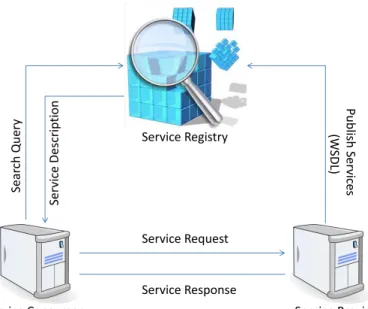
Web Service Selection: Web services are deluging the web with similar functionalities, ren-dering the service selection a challenging task. We use the terms agent-based services, agents, and web services interchangeably throughout this thesis. Figure 1.1 illustrates the web service
Service Consumer Service Provider Service Registry Service Response Service Request P ub lish Se rvic es (W SDL) Sea rc h Qu er y Ser vic e De scr ip ti on
Figure 1.1: Web service selection
selection scenario that involves three main actors; the service consumer, service provider, and the registry in which a web service can be found (UDDI).
Given a search query, the UDDI returns the relevant web services. However, querying the UDDI is based on the functional requirements of the target web service only. The non-functional or quality characteristics required by the service consumer are utterly ignored. This increases the difficulty of choosing among of functionally similar web services the one that best meets all other requirements of a specific consumer.
Web Service Composition
The main motive behind the web services effort is to enable the interoperability between busi-ness applications by exploiting the Web standards, As such, the success of SOA was mainly in-fluenced by the standardization of composition languages such as the Business Process Execution Language (BPEL). BPEL is based on the WSDL specifications and enables the definition of busi-ness processes as sets of integrated web services interactions. For a comprehensive description of BPEL and its characteristics, the reader can refer to [6]. Many business process management sys-tems have been developed to enhance the automation the discovery, management and composition of business processes, including “SAPs NetWeaver, and IBMs WebSphere and BPM Suite” [7].
However, with the emergence of service oriented computing, the need for composing and integrat-ing services from different providers becomes compellintegrat-ing. Indeed this emanates the same web service selection problem described above and the need to consider the quality characteristics of the constituent services. The difference between evaluating the quality of single and composite web services arises as a result of the dependencies between the composed services. Therefore, new composition systems or add-ons are needed to consider these dependencies when evaluating the quality of web services before selecting the ones to be included in compositions. Whether BPEL is used to describe the control logic that coordinates the web services in a process flow, or WSCI is employed to describe the exchanged messages between web services, the quality of service (QoS) characteristics are important to complement and optimize the composition process.
Trust and Reputation Based Solutions
Trust is a fundamental concern in our social life which is governed by the quality of our inter-actions. Due to the contingent nature of human behavior, this confidence is not stable, but rather a dynamic belief. A person you trust today might loose your trust tomorrow if s/he lets you down, has been caught lying, or betraying. The notion of human trust can be projected on the compu-tational trust in the open world available on the web. This projection is rationalized due to the increase of various activities available on the web involving the interactions between various par-ties. Therefore, trust becomes a critical concern in this kind of loosely-controlled environment [8]. Trust has been defined in various ways in different contexts. In this thesis, we consider the defini-tion given by the authors in [9]; a confidence one party has that the other party will act truthfully and reliably according to his/her claims.
Thus, in loosely-controlled open agent-based web service environment, trust becomes vital especially for selecting and composing services. Many applications require agents to coordinate with each other including e-commerce, supply chain management, semantic web and peer-to-peer networks [10]. Resources involved in the interactions among agents include time, money, and hardware usage. To make efficient use of these resources, it becomes extremely essential for an agent to be able to predict as accurately as possible the future behavior of its peers. These valuable resources play major roles in increasing productivity, enhancing the economic cycle, and saving the resources of individuals, businesses, and governments.
The majority of trust and reputation mechanisms has been employed in opens systems such as e-commerce, peer-to-peer-systems, and multi-agent systems. However, trust and reputation sys-tems in web services has lately been an active research area with the continuous need for further investigations and studies. Therefore, our research questions are concerned with trust and rep-utation approaches related to web services even though we argue they can scale to other open systems.To compute the trustworthiness of web services, considering the web services QoS per-formance has become the norm. The trust and reputation models proposed in this thesis are also based on the QoS of the direct and indirect interactions among agents. The agent with the highest trust score will be then selected to provide the required functionalities.
1.2
Methodology
The trust and reputation models presented in this thesis are based on representing the quality of web services by various probabilistic distributions. The intuition behind this representation is that the outcome of an interaction with a web service is governed by the uncertainty concept. In other words, a service consumer is always skeptical about the quality a web service might provide. Modeling the quality as a statistical distribution is aligned with this fact and helps evaluating the uncertainties about the quality of web services.
Therefore, the basis of our models is to map the web services QoS outcomes into multinomial distributions. This is an intuitive mapping that appreciates the consumers need to have a simplistic way to view and assess the quality of one service and easily compare it to other web services. Estimating the parameters of the multinomial results in the probabilities of a web service to deliver a quality that belongs to one of the predefined quality classes. The probabilities provide a simple mechanism by which a service consumer would select, from a pool of functionally similar web services, the one that has the highest probability assigned to the highest quality class. To estimate these probabilities we apply, in Chapter 3, the Bayesian inference method which solves the poor estimates of the popular maximum likelihood estimation method in cases of low frequencies by adding a prior to the estimate the posterior. In our models, we present and compare three conju-gate priors, Dirichlet, generalized Dirichlet, and Beta-Liouville. We argue for selecting the last
two priors as they have more general covariance structures that overcome the limitation embedded in the strictly negative covariance of the Dirichlet distribution. In Chapter 3, we analyze the corre-lations among various QoS attributes and found that both positive and negative correcorre-lations exist. We leverage the correlation information to propose a trust model that provides a trust score based on the outcomes of multiple QoS attributes. It also computes the correlations among each pair of attributes using a hybrid model that takes advantage of both Dirichlet and generalized Dirichlet. These correlations are subsequently employed to enhance the estimation of the uncertainties in the delivered trust scores.
The previous models consider web services that function independently of others to provide a simple business function. However, larger business processes require the collaboration among multiple services which enter what is referred to as a service composition. Therefore, there is a need to devise a model that is capable of evaluating the trustworthiness of composite services and the influence of each of the constituent services in their overall quality. Chapter 4 is dedicated to trust models that are developed for these purposes. These models consist of representing the quality of composite services by Bayesian networks or mixtures of the probability distributions discussed in Chapter 3.
The previous learning approach belongs to the batch learning family. In other words, it requires a historical data on which the model is trained. However, such data is not always possible and the learning has to occur in near real-time. For single web services, we proposed a generalized power steady model that takes as input a time series of the quality classes proportions (Chapter 3). As for composite web services, we extended the Bayesian networks approach to function in online settings using two methods. The first applies the Voting-EM algorithm to learn the parameters of the networks when the underlying data is complete. The second method deals with missing data by employing the expectation maximization algorithm and a moving window that incorporates larger weights for newer data and smaller ones for older data within the same window (Chapter 4).
The aforementioned trust models are based on direct interactions among web services. The computed trust scores can be then viewed as the personalized opinion of each web service in the peers it interacts with. Nevertheless, the personal opinion is not always satisfactory to solve the web service selection problem especially when service consumers have no direct experience with
certain services. This raises the need for reputation models that compute the global opinion about the web services quality based on the trust scores of multiple consumers. The three models pro-posed in Chapter 5 are developed to serve this purpose. The first model is based on two data fusion algorithms, namely covariance intersection and ellipsoidal intersection. Both methods are motivated by the need to combine two estimates while handling correlated errors (the former) and mutual information (the latter). The second model extends the correlation-based trust approach from Chapter 3 by combining trust scores that are perceived credible by the service consumer who requested these scores. The credibility of the trust scores is computed using a combination of a heuristic method and a cluster-based outlier detection algorithm. This reputation model deals with unfair referrals sent to badmouth or unreasonably praise a service. It also identifies various dy-namic behaviors a web service may encounter; milking, building, and oscillating behaviors. The first occurs when a service performs well over a long period of time then suddenly drops its quality. The second behavior, building, is the opposite phenomenon. A web service’s quality is boosted after a long period of low performance. The oscillating behavior is an alternation between both milking and building behaviors. The third model aims to demonstrate the potential of applying data mining techniques to evaluate the trustworthiness of communities of web services. These commu-nities group web services that provide similar functionalities in order to better serve consumers by handling simultaneous requests and implementing a fault-tolerant architecture.
1.3
Thesis Contributions
This thesis aims to present various probabilistic approaches to solve the web service selection and composition tasks via QoS-aware trust and reputation. These approaches are built upon the modeling of the web services QoS metrics as various composite multi-simensional distributions, namely, multinomial Dirichlet, multinomial generalized Dirichlet, and multinomial-Beta Liouville. The main contributions of this thesis can be summarized as follows:
PQoS Modeling Using Multi-Dimensional Composite Distributions:
We propose to compute the QoS ratings based on the outcomes of multiple quality metrics. Subse-quently, we model the counts of the QoS ratings, after a number of interactions, by various multi-dimensional statistical distributions including the multinomial-Dirichlet, multinomial-genralized Dirichlet and multinomial-Beta Liouville. These distributions offer, in comparison to the Beta-binomial used in current models, a more comprehensive QoS representation of evaluated web services. We also leverage the correlations among QoS metrics to devise a hybrid trust approach based on Dirichlet and generalized Dirichlet distributions. This approach aims to improve the accuracy of trust estimates and their corresponding uncertainties.
POnline Trust Estimation Via Time-Series Forecasting Model:
To assist service consumers in real-time, we introduce a time-series forecasting approach, based on a generalized-Dirichlet state space model. This approach follows the popular divide-and-conquer method by transforming a generalized-Dirichlet distribution into multiple Dirichlet distributions in a lower dimensional space.
PBayesian Networks and Mixture Models for Trustworthy Composite Services:
Business processes, in the majority of cases, provide more than a single functionality, which ne-cessitate the collaboration among various web services to form a composite service. To evaluate the performance of composite services and assist the composition of new web services, we pro-pose multiple Bayesian networks classifiers and mixture models. These are capable of learning the dependencies between the composed web services and the responsibilities (contributions) of each web service in the overall quality of the composite service. We also extend the Bayesian networks model to estimate the future quality of composite web services in an online setting using the Voting EM algorithm. In other words, the estimated conditional probabilities of the QoS of composite web services are updated after every interaction. This addresses the dynamic behavior of web services that might offer a low quality interaction at timetand a better one at timet+ 1.
PData Fusion Methods for Reputation Feedback Aggregation:
One of the main issues in considering the indirect interactions among web services in the trust computation is the aggregation of the reputation feedback. Kalman filter is an attractive method to combine multiple measurements (in this case, reputation feedback) and predict the state of a
dynamic system. However, Kalman filter is limited by the independence assumption between the estimation and measurement errors at time t and t+ 1, respectively. This assumption leads
to under/over-estimated covariance matrices of the predictions. To overcome this limitation, we employ two data fusion methods that avoid this assumption and lead to more consistent estimates; covariance intersection and ellipsoidal intersection.
PReputation Management Using Clustering and Outlier Detection Techniques:
It has been recorded that the quality of web services fluctuate both intentionally and unintention-ally. In this thesis, the interest is in the intentional fluctuations due to different malicious behavior. We propose a reputation management framework that captures different types of web service ma-licious behaviors including milking and building reputation. It also penalize web services that exhibit such behaviors by diminishing their reputation scores. This framework is based on cluster-ing and outlier detection techniques.
1.4
Thesis Organization
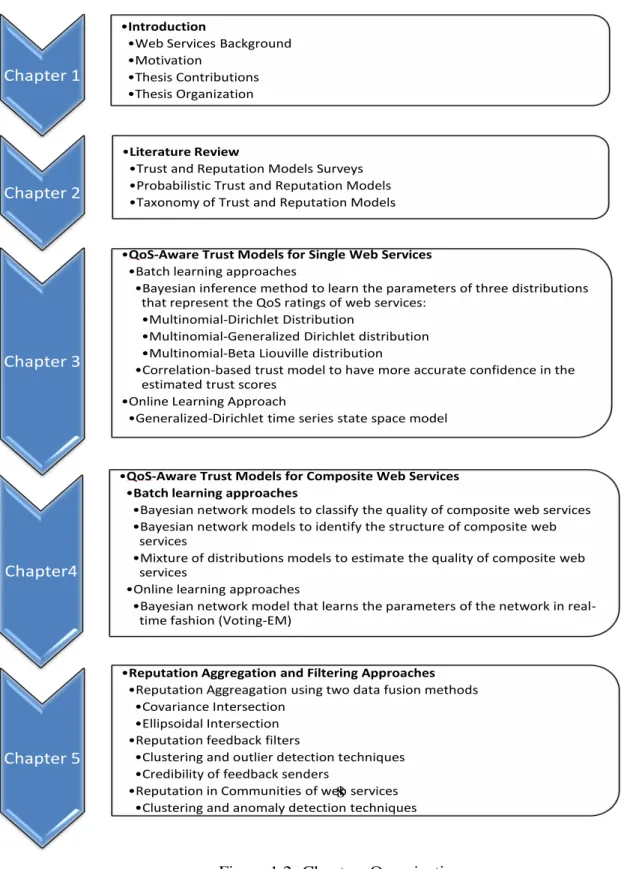
This thesis is organized into an introductory chapter, four chapters that describe the proposed models, and a closing chapter that summarizes the contributions and sets the stage for potential future works. This organization is illustrated in Figure 1.2.
oChapter 1: overviews the web service selection and composition problems highlighting the notion of trust to solve these problems. The motivation of the proposed approaches is also clearly defined. Afterwards, the existing literature of trust and reputation systems is reviewed and the main contributions of the thesis are described.
o Chapter 2: presents a trust approach that is based on modeling the outcomes of various QoS metrics using three composite distributions; multinomial-Dirichlet, multinomial-generalized Dirichlet, and multinomial-Beta Liouville. This approach is further extended by considering the correlations among the considered QoS metrics. This extension aims to improve the estimated trust scores and provide an accurate uncertainty measure in these scores.
Chapter 1
•Introduction
•Web Services Background
•Motivation
•Thesis Contributions
•Thesis Organization
Chapter 2
•Literature Review
•Trust and Reputation Models Surveys
•Probabilistic Trust and Reputation Models
•Taxonomy of Trust and Reputation Models
Chapter 3
•QoS-Aware Trust Models for Single Web Services •Batch learning approaches
•Bayesian inference method to learn the parameters of three distributions that represent the QoS ratings of web services:
•Multinomial-Dirichlet Distribution
•Multinomial-Generalized Dirichlet distribution
•Multinomial-Beta Liouville distribution
•Correlation-based trust model to have more accurate confidence in the estimated trust scores
•Online Learning Approach
•Generalized-Dirichlet time series state space model
Chapter4
•QoS-Aware Trust Models for Composite Web Services •Batch learning approaches
•Bayesian network models to classify the quality of composite web services
•Bayesian network models to identify the structure of composite web services
•Mixture of distributions models to estimate the quality of composite web services
•Online learning approaches
•Bayesian network model that learns the parameters of the network in real-time fashion (Voting-EM)
Chapter 5
•Reputation Aggregation and Filtering Approaches •Reputation Aggreagation using two data fusion methods
•Covariance Intersection
•Ellipsoidal Intersection
•Reputation feedback filters
•Clustering and outlier detection techniques
•Credibility of feedback senders
•Reputation in Communities of web services
•Clustering and anomaly detection techniques
Figure 1.2: Chapters Organization 8
o Chapter 3: proposes various Bayesian network models to estimate the trustworthiness of composite web services. Each of these models employs one of the QoS models described in Chap-ter 1. An alChap-ternative approach, based on generative mixture of multinomial Dirichlet distributions is also introduced to learn the distributions of the quality outcomes of the constituents web services given the quality outcomes of the composite web service.
oChapter 4: extends the proposed trust models to function in online settings. Specifically, a generalized Dirichlet power steady model is proposed to model the time series that consist of the proportions of the quality classes of the evaluated web service over a period of time. Moreover, the Bayesian network models from Chapter 3 are extended to learn the networks parameters after each data point.
oChapter 5: describes three models for reputation aggregation taking into account the exis-tence of dishonest feedback and malicious behaviors. These models are based on different outlier detection algorithms, data fusion methods, and data mining techniques.
oChapter 6: summarizes the thesis by highlighting its main contributions. It also discusses some concluding remarks and the limitations of the proposed models. Directions for future works are also outlined.
Chapter
2
Trust and Reputation: a Literature Review
2.1
Existing Surveys
Computational trust has gained the attention of a wide range of research in the area of reputation and rating systems [11]. The notion of trust has been defined differently by researchers influenced by their diverse background areas and applications. On one hand, the most common definition of trust can be stated as being an entity’s opinion regarding another entity’s behavior. The importance of this opinion appears in governing decision making processes such as deciding on which entity (agent/service provider) to be selected. Reputation, on the other hand, is the community’s opinion about the standing of an entity [12]. This section far from being systematic, aims to discuss the current literature’s most representative models. It also intends to fit our research within the exist-ing academic studies. The next few paragraphs are dedicated to examinexist-ing the existexist-ing literature reviews of trust and reputation systems [13], [14], [12], [5], [15], [16].
Jøsang et al. presented an in-depth literature review of trust and reputation systems in various web communities rather than in specific ones [13]. After disambiguating the notion of trust, this survey identified various reasons that motivate research in this area. The authors also discussed and provided multiple dimensions to differentiate between trust and reputation system. For instance, they used Grandison and Sloman’s classification (2000) to divide trust into five classes; provision,
access, delegation, identity, and context. The reputation systems were classified as either central-ized or decentralcentral-ized. This classification depicts how ratings and reputation scores are distributed among agents in reputation systems. The reputation computation adds another dimension that fur-ther divides reputation systems into simple summation, Bayesian, discrete trust, belief, fuzzy and flow systems. [13] also lists a number of problems that current trust and reputation systems face along with solutions to each of these problems. The prominent problem is uncovering and dealing with biased positive and negative ratings that unfairly affect the trust and reputation values of an entity.
Artz et al. reviewed scholarly work related to trust in computer science and semantic web [14]. The authors of this survey classified trust into four main areas including policy-based trust, reputation-based trust, general models of trust, and trust in information resources. In our research, we treat the reputation-based trust to evaluate the future behavior of an agent-based web service based on the quality of its past performance. They further divided the reputation-based trust into four subcategories. Namely, decentralization and referral trust, trust metrics in a web of trust, trust in P2P networks and grids, application specific reputation.
Wang and Vassileva investigated trust and reputation systems for the purpose of drawing poten-tial research directions for similar systems in web services [12]. The main contribution of this work is a three-dimensional classification of existing trust and reputation systems. The first dimension captures the reputation management aspect of such systems and distinguish between “centralized” and “decentralized” systems. The second dimension depicts the reputation modeling target. On one hand, trust and reputation systems such as eBay can be viewed as “person/agent” if the target is a person or an agent. On the other hand, they can be viewed as “resource” systems such as Epinions if the reputation is associated with products or services. The third and last dimension encapsulates the basis or source of the reputation of a person or service. For instance, if this source is the opinions of specific group of people, the system is referred to as “personalized”. However, if the reputation is the result of the opinions of all entities, then the system is classified as “global”. According to the authors in [12], the majority of trust and reputation systems for web services are centralized, resources-based and personalized. Indeed, these systems make use of a central registry that is responsible for collecting and storing the QoS data. This opens new research directions for
investigating decentralized, agent-based and global trust and reputation systems for web services. In [5], the authors classified the different approaches to trust in multi-agent systems as individual-level trust and system-individual-level trust. The individual-individual-level trust enables agents to reason about their level of trust in other agents using different models including socio-cognitive, reputation, and evolutionary and learning models. The system-level trust mechanisms such as trustworthy interac-tion, reputainterac-tion, and distributed security mechanisms, ensure that an agent can trust other agents’ actions. Our study builds upon and extends the trust learning models using machine learning tech-niques.
Sabater and Sierra classified trust and reputation models with special attention on computa-tional models. This classification’s highest level consider the following dimensions [15]. The con-ceptual model, information sources, visibility types, model’s granularity, agent behavior assump-tions, type of exchanged information, and trust/reputation reliability measure. We will elaborate on these dimensions in the trust and reputation systems categorization section.
Pinyol and Sabater-Mir reviewed in [16] the classification schemes of trust and reputation sys-tems in three previous works; [15], [17] and the European project eRep *(2006)*. The authors also contributed with an additional four-dimensional classification: trust, cognitive, procedural and generality dimensions.
2.2
Probability-Based Trust And Reputation Systems
This section overviews studies in which trust is computed using statistical models. Hang and Singh modeled the quality of a service using a Binomial distribution [18]. The authors of this study proposed two service selection approaches based on Bayesian networks and Beta-mixture model. These approaches capture the responsibilities of the constituent services in the overall quality of a composite service. They used various composition functions including switch, sum, product, min, and max. The proposed approaches can only handle one quality metric at a time. It is rare that agents would be interested in only one quality metric when willing to interact with other agents. Although it is possible to treat each quality metric separately, this would be time consuming. Also, the Binomial distribution represents the quality of a service as good or bad which fails to depict its
degree of goodness or badness.
Wang and Vassileva proposed a Bayesian network approach representing and combining dif-ferent faces of trust In [19]. The focus of this work is peer-to-peer networks. for instance, the Bayesian network root represent the overall quality of a file provider. The root’s children and net-work’s leaves represent the trust in various capabilities of the file provider. These may include the download speed, the file quality and the file type. It would be interesting to scale this to handle other types of large scale distributed systems.
Rettinger et al. aimed for learning context-specific trust using statistical relational learning [20]. The authors used the collaborative filtering to improve the performance of trust learning. The proposed model in this work does not consider composite services. According to [20], a large number of the current models of trust are based on a holistic view of the behavior of the trustee. The contextual information of the subject entities and their environment is not deeply addressed yet. Trust is based on various quality metrics which constitute quantifiable measures of web services reliability, throughput, availability, latency, and response time. Most of existing trust models either deal with each quality metric separately or fail to capture the responsibility of each metric in the overall performance of an agent. An agent, for example, might be reliable, but disappoints its truster because of its low availability.
Teacy et al. used probability theory to compute trust based on past interactions between agents [21]. Using such approach, each agent stores the outcomes of its interactions with other agents. These outcomes have the values 1 in case of a successful interaction (contract fulfilled) and 0
otherwise. A beta distribution is then used to represent the probability of having a good outcome based on previous ones. Two main measures are then computed; the level of trust in an agent and a confidence value associated with it. Moreover, this system considers the reputation of an agent in cases where the confidence values are low. It also employs an exogenous solution to filter inaccurate reputation.
In [22], Li and Wang proposed a subjective probability based deductive approach to compute trust for composite web services. The composition of services is modeled according to six types
of invocations between them; sequential, parallel, probabilistic, circular, synchronous, and asyn-chronous. A direct invocation from one service to another causes trust dependency which is mod-eled by a conditional probability. An algorithm, SELECTIVE, has also been proposed to compute the subjective trustworthiness of a composite service. The travel example was used to represent a composite service for which the ratings were taken from Epinions. Neither the reputation of service providers nor the inaccurate ratings were considered in this work.
2.3
Other Trust and Reputation Systems
Zacharia et al. proposed in [23] two collaborative filtering methods to compute users’ reputation ratings; SPORAS and HISTOS for loosely and highly connected online communities, respectively. SPORAS combined direct and witness ratings to compute the reputation of an entity. It dealt with new entities by assigning them low reputations which are then built up after interactions with other entities. To update the reputation of an entity, SPORAS considered the last rating only. When SPORAS is considered as a global reputation system, HISTOS is a personalized system that accounts for pairwise ratings. These ratings are propagated through the edges of a directed graph connecting entities that had interacted with each others. A breadth first search and a recursive step are used to to compute a personalized reputation score of an entity. Both systems were tested using four simulations presenting different scenarios including a new entity joining the system and a collusion by two entities.
A QoS-based service selection with trust and reputation reinforcement was proposed in [24]. The prediction of a web service future quality is accomplished using a real-valued time series forecasting technique. The basis of the approach developed in this study is the quality conformance values of a service dispensed for various quality attributes. This is computed as the ratio of the difference between the observed quality and the one claimed by the service provider to the latter. The conformance valued are also broadcasted among users as reputation reports about each web service. The dishonest values were filtered out ”by combining a trust-distrust propagation approach with a data-mining method”.
Trust & Reputation Systems
Reputation Propagation and Storage Centralized/global Decentralized/distributed Reputation Target Person/Agent Resource Conceptual Cognitive Game-theoretical Trust-based Procedural General Information sources Direct/Past Interactions Indirect/witness Information Sociological Signs Computation techniques Average of ratings Bayesian methods Discrete models Belief models Fuzzy models Flow models Cheating filtration techniques Exogenous Endogenous
Figure 2.1: Trust and Reputation Systems Taxonomy
2.4
Trust and reputation systems categorization
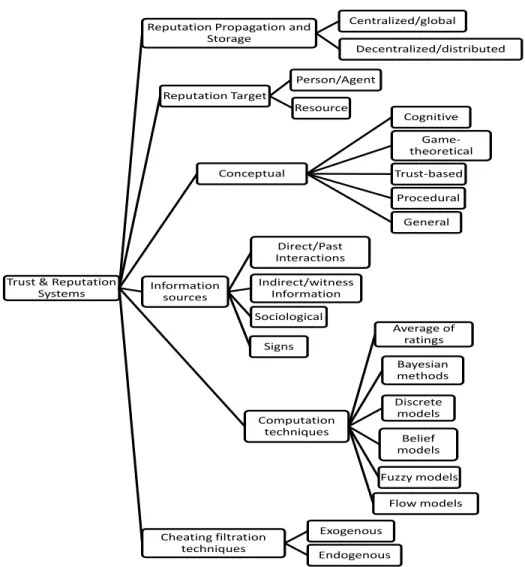
This section amalgamates the trust and reputation systems dimensions extracted from the various studies reviewed in the literature review section. Figure 2.1 summarizes these dimensions in a hierarchical taxonomy. The following sections provide descriptions for each of the categories illustrated in this taxonomy.
2.4.1
Reputation propagation and storage
The current trust and reputation systems can be divided by the means the reputations of the sys-tem’s entities are propagated and stored. For instance, we differentiate between Centralized and
Decentralizedsystems [12], [13]. These two groups match the two visibility types reported in [15],
namelyGlobalandPersonal, respectively. They also overlap with theCentralizedandDistributed
reputation network architectures reported in [13].
Centralized Centralized systems follow the repository architectural style. In other words, these systems employ a central repository that is responsible for computing and storing the ratings of their entities. The ratings are then globally visible and accessible by all the entities presently in the system.
Decentralized Decentralized systems are designed according to the distributed architecture. In other words, there is no central repositories for all entities ratings. Instead, each entity stores a model of the ratings of each other entities it interacts with. Afterwards, an entity can request the ratings of other entities with which it had no direct interaction.
2.4.2
Reputation target
This dimension focuses on describing the reputation target that can be classified into two main classes [12];Person/AgentandResource.
Person/Agent The most common reputation system that reports the ratings associated to a person is Ebay. When the reputation target is a person or an agent acting on behalf of a person, the system is referred to as Person/Agent.
Resource Systems in which the reputation target a product or a service are considered Resource systems. A popular example of a Resource system is Epinions.
2.4.3
Conceptual modeling
Various studies have considered the conceptual dimension to classify trust and reputation systems. Sabater and Sierra divided the conceptual modeling category into two classesCognitiveand
Game-theoretical[15].
Cognitive Cognitive approaches are based on the entities’ mental states that drive to trust other entities or assign them reputation scores. The mental state of an entity depend on the degree of beliefs related to other entities.
Game-theoretical Game-theoretical approaches apply a more practical method to compute trust and reputation scores when compared to cognitive ones. This method relies on the probability an entity X has assigned to entity Y that the latter successfully fulfills certain functions that the former’s goal depends on. Indeed this probability is based on past interactions between the two entities X and Y.
2.4.4
Information sources
This is the dimension that can capture any trust and reputation system under at least one of its classes. The majority of these systems compute their entities’ trust values based on Direct past
interactionsbetween them. However, consideringIndirect/Witness informationabout an entity has
lately gained the attention of many researchers [21], [25], [26], [27], etc... [15] appended two new classes to the existing information sources: SociologicalandSigns.
Direct past interactions In almost all trust and reputation systems, entities keep a model of other entities they interact with. This model consists of the status or quality of the direct past interactions between the two entities. This is a natural mapping of the foundation of human trust to the concept of computational trust.
Indirect/Witness information A common real life scenario might be the following: an entity is willing to interact with another entity with which it had no previous experience. In this case it is
hard for the former entity to decide if the latter is trustworthy or not. Therefore, the indirect or witness information would be vital to assist the truster entity in such scenarios. This information consist of the reputation of the trustee entity computed by other entities who had direct interactions with it.
Sociological This is a fairly new information source for trust and reputation systems. This can be described as a projection of human social relations that have great impact on reputation values. For instance, a group of people who have collaborative relationships might report biased reputations about each others. This can also be the case in case of collaborative agents or web services. Another example can be about two web services providing similar functions. These might then report unfair low reputations one about the other. A social analysis of agents and web services is a new challenge that assists the computation of trust and reputation.
Signs This class is called prejudicein [15]. We substituted prejudice by signs to amputate the
negativity of the former term. Signs can be attributed as identifiers of a group of people. For instance, signs of harmless drugs and biological products can be the approval of the Food and Drug Administration (FDA).
2.4.5
Computation techniques
In addition to the different information sources, trust and reputation can be computed using various methods. These include the summation or Average of ratings, Bayesian, Discrete, Belief, Fuzzy
andFlowmethods [13].
Summation/Average of ratings The authors in [13] accounted for three forms of computing reputation values. The first and simplest way is by calculating the difference between the sum of positive and negative ratings. This model is implemented in the eBay reputation system. The second form would be by computing the average of all ratings given to an entity. Epinions is an example of a reputation system that uses this form of reputation computing. The third and last form add weights to the ratings before computing the average.
Bayesian methods Bayesian systems are based on the statistical updating method that combine the a priori and new values to compute the updated a posteriori score. Most of the Bayesian-based reputation systems represent the reputation score by a Beta distribution parameters(α, β)[18]. α
andβrepresent the amounts of positive and negative ratings respectively. Other models also
con-sidered multi-valued scores which then can be represented by a Dirichlet distribution parameters
α1, . . . , αN. N is the number of categories a score can belong to. For instance, a system with the
three categories score modelHigh, Medium, Lowwill introduce a Dirichlet distribution with the
parametersα1, α2, α3. α1, α2, and α3 represent the amounts of High, Medium, and Low ratings respectively. Then, the trust values can be computed as the expected values of the Beta or Dirichlet distributions given respectively by α
α+β and α
PN
i=1αi.
Discrete models Discrete trust models such as in [25] are those that “rate performance in the form of discrete verbal statements, than continuous measure” [13].
Belief models Belief models refer to the system that apply belief theory to compute trust or reputation scores. This theory is based on the belief measures of the behavior of an entity in past interactions.
Fuzzy models The intuition behind fuzzy models is the approximate reasoning rather than the exact or fixed. Following this intuition, a reputation or trust score is represented by an approximate value that depicts the degree to which a system is trustworthy or not.
Flow models [13] defined flowed models by the systems that “compute trust or reputation by transitive iteration through looped or arbitrarily long chains”.
2.4.6
Cheating filtration
Most of trust and reputations systems are based on ratings of entities provided by other entities. These ratings might be influenced by social relations or rivalries among these entities. Therefore, one can surely assume that a number of the provided ratings are not just. Many cheating filtration
mechanisms have been proposed by the community. Jøsang et al. classified these mechanisms as
EndogenousandExogenous[13]:
Endogenous Endogenous methods use the ratings statistical properties to analyze the ratings values and discount unfair ones. The authors in [28], [29], and [30] proposed statistical filtering techniques that fit under this category.
Exogenous Exogenous methods cope with unfair ratings by using the rater’s global reputation. This technique is applicable under the assumption that raters with low reputations tend to provide unfair ratings. Examples of exogenous methods are available in [31] and [27].
2.5
Discussion
The trust and reputation systems literature seems to be facing the following research gaps: 1. Indirect/Witness information:
In addition to past direct interactions among web services, witness information is of compa-rable importance especially in two main scenarios:
(a) A service consumer needs to evaluate the trustworthiness of a new web service (no past interactions are available). This is a common scenario in open and distributed systems. (b) A service consumer needs to evaluate the trustworthiness of a web service with which only few interactions exist. In other words, the former’s model trust model of the latter is based on the outcomes of few past interactions.
2. Confidence in trust scores:
A trust score that dates a year back is not as reliable as another score that was recently up-dated. Moreover, a reputation score that has been assigned by an entity with high reputation is more accurate than a score assigned by another one with low reputation. This raises the need to assign a confidence value to each trust and reputation score. For instance, a web
service with a trust score 0.5 and confidence value 0.8 is better than another web service
with trust score0.8and confidence value0.3.
3. Unfair ratings:
Rivalries and alliances are homely to open systems whose entities might provide similar goods or services. Therefore, the propagated ratings between the systems’ entities include inequitable ones. Possible scenarios that might incur unfair ratings include:
(a) A web service WS1 requests a referral from WS2 about its biggest competitior WS3. (b) Two web services WS1 and WS2 have formed and alliance to provide a group of
com-plementary functions. WS2 global reputation is not high due to certain flaws in its behavior. When WS3 requests a referral from WS1 about WS2, the former sends a high but unjust reputation score.
4. Service providers trustworthiness:
An additional information resource that helps directing any based decision is the trust-worthiness of service providers. For instance, a web service WS1 is willing to interact with a new web service WS2. WS1 has never interacted with WS2 and neither did other web services currently available in the system. Suppose WS1 has already interacted with WS3, a web service supplied by the same service provider of WS2. Then, the trustworthiness of the service provider of both WS2 and WS3 can be considered an initial indicator of the trustworthiness of WS2.
Chapter
3
QoS-Based Probabilistic Trust Models
The service selection problem has gained the attention of researchers from the computational trust community, especially with abundance of functionally similar services. Following our definition of trust, designing a model that evaluates the trustworthiness of web services presents a challenging yet motivating problem. Accoriding to [32], this is a defying task given the lack of intelligence in the communication protocol among web services.
This chapter is devoted to the description of a QoS-based trust model that is based on the statis-tical modeling of the QoS ratings of web services interactions. We propose to classify the quality of web services into multiple classes (more than 2) based on different sets of QoS metrics according to the consumers’ preferences. This approach allows consumers to maintain a trust model for each service provider they interact with. As such, the trust model assists consumers in selecting, among a plethora of similar services, the most trustworthy one. We thus associate the trust in a service to its performance denoted by QoS ratings instigated by the amalgamation of various QoS metrics. Since the quality of a service is contingent, which renders its trustworthiness uncertain, we adopt a probabilistic approach for the prediction of the quality of a service based on the evaluation of past experiences (ratings) of each of its consumers. We represent the QoS ratings of services using different statistical distributions, namely, multinomial-Dirichlet (MDD) , multinomial-generalized
Dirichlet (MGDD), and multinomial-Beta-Liouville (MBLD). These representations enable the
purpose, we use the Bayesian inference method to estimate the parameters of the aforementioned distributions, which presents a multidimensional probabilistic embodiment of the quality of the corresponding web services.
In [14], the authors classified trust into four main areas including policy-based trust, reputation-based trust, general models of trust, and trust in information resources. Following their definitions of each type of trust, our approach fits the reputation-based trust definition which consists of eval-uating the future behavior of web services based on the quality of its past performance. The reputation-based trust may also include referrals from peers which is discussed in chapter 5.
The main contributions presented in this chapter can be summarized as follows:
1. We propose to compute QoS ratings based on multiple quality metrics such as the follow-ing performance and dependability quality metrics: response time, throughput, availabil-ity and reliabilavailabil-ity. Subsequently, we model the QoS ratings of web services by various multi-dimensional statistical distributions which offer more descriptive representation than the Beta Binomial.
2. We estimate the future quality of web services by learning the parameters of their QoS dis-tributions using the Bayesian inference method based on their past behavior. Using this method, the ratings of a service and the prior knowledge about its behavior are combined to compute the posterior probabilities.
3. In addition to the multidimensional representation of the QoS of a web service, we propose a QoS-based trust function to compute one-dimensional trust scores. These scores can be used to compare between web services from various systems with disparate number of QoS ratings.
3.1
QoS Modeling Via Composite Distributions
The following sections overview a subset of the QoS metrics that may be considered in the pro-posed trust model. They also discuss the details and advatanges of modeling the QoS ratings using
the different distributions;MDD,MGDB, andMBLD.
3.1.1
QoS Metrics Overview
The QoS of agent-based web services has gained the attention of wide spectrum of research es-pecially in the contexts of service discovery, selection and composition. The computational trust notion in agents was particularly treated in the pursuit of solving the preceding tasks. Given a pool of agents that fulfill the functional requirements of a consumer, the latter chooses the one that is estimated to provide the best quality. As such, the trustworthiness of a service is positively corre-lated to the aggregation of the outcomes of its QoS metrics. However, aggregating the measures obtained from monitoring the different QoS metrics is not trivial. This is due to (1) not all con-sumers are interested in monitoring and evaluating the same metrics. (2) given the values of a set of QoS metrics, there is no standardized approach to aggregate them.The list below defines some examples of QoS metrics [33]:
• Response time (RT): This is a measure of the time spent between sending a request
and receiving the last byte of the response. RT is inversely proportional to the quality of a service. In other words, a lower RT value implies a better service.
• Throughput (T): The throughput of a service is the number of requests it can handle
per time unit. This measure is directly proportional to the QoS.
• Availability (A): The availability measure denotes the probability of the service to be
up and ready to answer its users requests. Availability is directly proportional to the overall quality of a service.
• Reliability (R): Reliability may refer to the ratio of the number of valid responses to
the total number of responses an agent-based service provides.
• Latency (LA): This refers to the time a server needs to process a request.
• Cost (C): The cost of a service measures the usage of resources during its execution
time and might refer to the service fees. This metric is inversely proportional to the general quality of a service. A higher cost will compromise the quality of the corre-sponding service.
After each interaction with a service provider, the above metrics are measured and the service provider is then assigned a QoS score given by:
QoS Score= RT WRT
M ax(RT) +
T WT
M ax(T) +AWA+RWR+CWC
,
where WM is the weight of the quality metric M and
P
M∈{RT ,T,A,R}WM = 1. M ax(RT)and M ax(T)are used to normalize the values of RT andT, respectively. Afterwards, a QoS rating
(class) is attributed to the current interaction with the service provider. The following is one of many possible ways to partition the QoS ratings:
QoS Rating= 1 if0.7< QoS Score <1 2 if0.5< QoS Score <0.7 3 if0.3< QoS Score <0.5 4 otherwise
3.1.2
MDD, MGDD and MBLD for QoS Modeling
To compute the trustworthiness of a web service, we propose to model its quality over a period of time using a MDD. This distribution helps positioning the quality of a service on a spectrum
that captures its level of goodness or badness. Given this distribution, we learn the probabilities of the QoS to belong to various quality classes (note that we use the terms quality class and quality rating interchangeably). To assist the service selection task, we will compute the trustworthiness of a web service based on its past direct interactions with other web services. We will defer the use of indirect observations based on peers recommendations to Chapter 4. The qualities of these past interactions are represented as vectors of quality rankings counts. Each of these vectors has a size equal to the number of quality classes. More formally, letX = [X~1, ~X2, ..., ~XN]represents
a set ofN K-dimensional vectors of counts where X~i = [Xi1, Xi2, ..., XiK]represents theith set
of quality rankings and K is the number of classes the quality of a service can belong to. Xik is
from a multinomial distribution with parameters~θ = (θ 1, . . . , θK+1)given by: p(X~i|~θ) = |X~i|! QK k=1Xik! K Y k=1 θXik k (3.1) where|X~i| = PK
k=1Xik. A common method to estimate the parameters of the multinomial is the
Maximum Likelihood Estimation (MLE) which gives the following estimates:
ˆ θk =
Xik
|X~i|
(3.2) For example, suppose that an agent A (truster) wants to estimate the trustworthiness of another agent B (trustee) and we have four quality classes. Therefore, the past experiences of agent A with agent B will be represented by 4-dimensional vectors such as the following: X~ = [8,6,3,1].
Then, the MLE estimates of the trustworthiness of agent B will be according to equation (3.2) the probabilities vector~θ = [8
18, 6 18, 3 18, 1
18]. Each element of this vector represents the probability of agent B providing one of the four qualities. Although the MLE method tends to give more or less natural estimates, it gives poor estimates in the case of low or rare frequencies. For instance, suppose agent A had eight interactions with agent B all of which were classified as first-class quality. That is, the quality vector is X~ = [8,0,0,0]. Then, the parameters vector ~θ will be [1,0,0,0]which gives a poor estimate by setting the distribution to zero.
To deal with the above problem, we can apply a Bayesian inference-based method to improve these estimates. This approach consists of selecting a prior distribution for the vecθ parameters.
It is a common practice to assign a Dirichlet prior to the parameter vector of a multinomial dis-tribution since it is a conjugate prior [34]. In other words, both the prior and the posterior are Dirichlet. The Dirichlet distribution is the multivariate extension of the Beta distribution. There-fore, this model states that the quality of an agent is drawn from a multinomial that represents the counts of the quality being in each of the classes. The prior is a Dirichlet which parameters work as pseudo-counts. The resulting distribution is known asMDD[35] given by:
p(X~i|θ) = Γ(PK+1 k=1 αk)Γ( PK+1 k=1 Xik+ 1) Γ(PK+1 k=1 Xik+ PK+1 k=1 αk) K+1 Y k=1 Γ(Xik+αk) Γ(αk)Γ(Xik+ 1) (3.3)
The posterior is given by: p(~θ|X~i, α1, ..., αK+1) = p(X~i, ~θ|α1, ..., αK+1) p(X~i|α1, ..., αK+1) = Γ( PK+1 k=1 Xik+ PK+1 k=1 αk) QK+1 k=1 αk+Xik K+1 Y k=1 θαk+Xik−1 k
which is a Dirichlet with parameters(α1 +Xik, ..., αK+1 +XiK+1), where(α1, ..., αK+1)are the parameters of a Dirichlet. Using this prior information,θˆ
kbecomes: ˆ θk= Xik+αk PK+1 k=1 αk+ PK+1 k=1 Xik (3.4)
MDDis the multidimensional case of the Beta binomial distribution widely used in many
ap-plications including trust estimation [18]. Moreover,MDDhas one extra degree of freedom when
compared to the multinomial distribution, since its parameters are not constrained to sum up to one, which makes it more practical [36]. Further details about theMDDproperties and the development
of its moments can be found in [37].
Suppose we have the same vector,X~ = [8,0,0,0], which we have previously handled poorly
using MLE. By introducing a Dirichlet prior with the parameters α~ = [1,1,1,1], the smoothed
estimates evaluated using equation (3.4) are:
~ θ = [8 + 1 4 + 8, 0 + 1 4 + 8, 0 + 1 4 + 8, 0 + 1 4 + 8] = [ 9 12 = 0.75, 1 12 ≈0.083, 1 12 ≈0.083, 1 12 ≈0.083]
The hyperparametersα~ can be thought of as being hidden quantities added in order to
repre-sent our confidence about the estimates. They are also beneficial to moderate the extreme estimates given by the MLE of the multinomial distribution. In spite of the flexibility of the Dirichlet distri-bution and the fact that it is conjugate to the multinomial, it still suffers from various restrictions. For instance, the Dirichlet has a very restrictive negative covariance matrix defined by: