Impulse feature extraction method for machinery
fault detection using fusion sparse coding and online
dictionary learning
Deng Sen
a,b,*, Jing Bo
a, Sheng Sheng
a, Huang Yifeng
a, Zhou Hongliang
a aAeronautics and Astronautics Engineering College, Air Force Engineering University, Xi’an 710038, China b
Unit 94371 of People’s Liberation Army, Zhengzhou 450045, China
Received 19 May 2014; revised 7 August 2014; accepted 31 October 2014 Available online 21 February 2015
KEYWORDS Dictionary learning; Fault detection;
Impulse feature extraction; Information fusion; Sparse coding
Abstract Impulse components in vibration signals are important fault features of complex
machines. Sparse coding (SC) algorithm has been introduced as an impulse feature extraction method, but it could not guarantee a satisfactory performance in processing vibration signals with heavy background noises. In this paper, a method based on fusion sparse coding (FSC) and online dictionary learning is proposed to extract impulses efficiently. Firstly, fusion scheme of different sparse coding algorithms is presented to ensure higher reconstruction accuracy. Then, an improved online dictionary learning method using FSC scheme is established to obtain redundant dictionary and it can capture specific features of training samples and reconstruct the sparse approximation of vibration signals. Simulation shows that this method has a good performance in solving sparse coefficients and training redundant dictionary compared with other methods. Lastly, the proposed method is further applied to processing aircraft engine rotor vibration signals. Compared with other feature extraction approaches, our method can extract impulse features accurately and efficiently from heavy noisy vibration signal, which has significant supports for machinery fault detection and diagnosis.
ª2015 The Authors. Production and hosting by Elsevier Ltd. on behalf of CSAA & BUAA. This is an open access article under the CC BY-NC-ND license (http://creativecommons.org/licenses/by-nc-nd/4.0/).
1. Introduction
Fault feature extraction plays a key role in detecting failures of machinery engineering systems such as aircraft engine, space shuttle and rotating machinery. In recent decades, signal pro-cessing theory has been widely used in feature extraction for fault diagnosis. Periodical impulse components in vibration signals are important indicators of system health status. Therefore, many advanced signal processing methods have been studied to extract the impulse components from vibration * Corresponding author at: Aeronautics and Astronautics
Engineer-ing College, Air Force EngineerEngineer-ing University, Xi’an 710038, China. Tel.: +86 29 84787628.
E-mail address:[email protected](S. Deng).
Peer review under responsibility of Editorial Committee of CJA.
Production and hosting by Elsevier
Chinese Society of Aeronautics and Astronautics
& Beihang University
Chinese Journal of Aeronautics
[email protected]www.sciencedirect.com
http://dx.doi.org/10.1016/j.cja.2015.01.002
1000-9361ª2015 The Authors. Production and hosting by Elsevier Ltd. on behalf of CSAA & BUAA. This is an open access article under the CC BY-NC-ND license (http://creativecommons.org/licenses/by-nc-nd/4.0/).
signals.1 However, due to the factors of sensor inaccuracy, operator error and electromagnetic interference, the measured vibration signals may contain different kinds of noises. How to extract impulse components effectively from noisy vibration signals can be more attractive.2,3
Wavelet analysis is considered to be effective for fault fea-tures extraction from vibration signals. The wavelet shrinkage method proposed by Donoho achieved huge success in removing noises and extracting features.4Qiu et al. presented
wavelet filtering to detect periodical impulse components from vibration signals.5 He et al. proposed a hybrid method
comprised of wavelet filter and morphological processing to get weak mechanical impulse.6 However, when the noise strength is too high, wavelet analysis methods may reduce signal energy and discard important impulse features during the process of removing noises. Moreover, without the prior information of noises in vibration signal, it is difficult to select wavelet filters’ parameters which have great influence on the performance of feature extraction.
Sparse coding (SC) is a new signal processing method which has found many applications in the solution of image process-ing,7 signal de-noising,8 compressed sensing,9 etc. The noisy vibration signal can be most sparsely represented in sparse domain by redundant dictionary, which provides an efficient way to reconstruct input signal and extract impulse compo-nents. The sparse coefficients of noises are zero or nearly zero, but impulse components have large sparse coefficients. Thus, the noises in vibration signal are not reconstructed in the process of sparse reconstruction and the sparse signal obtained by using SC method is the estimation of noiseless impulse components. The key issues of extracting features based on SC method include sparse reconstruction and redundant dic-tionary selection. Many researchers have focused on this field, and recent contributions for extracting impulse features using sparse model are proposed.10–12Liu et al. proposed a shift-in-variant sparse coding (SISC) algorithm to get basis functions of redundant dictionary separately and extract sparse features for fault diagnosis.10Tang et al. also used SISC algorithm to learn redundant dictionary and an optimal latent components’ filtering algorithm was designed to extract features based on this redundant dictionary.11 Chen et al. presented a new
scheme called sparse extraction of impulse by adaptive dic-tionary (SpaEIAD) to represent vibration signal and extract impulse components.12The problem of dictionary selection is to choose a fixed dictionary such as the wavelet basis and Fourier basis, or learn a redundant dictionary adapted to the input signal. Dictionary learning method achieves sparse signal representation by learning redundant dictionary from training samples, which can match the structure of input signal. Typical learning algorithms include the K-SVD,13the sparse K-SVD,14
the method of direction (MOD),15 etc. In practice, vibration signal often contains mass data samples. The above dictionary learning methods cannot handle large training sets effectively because the whole training sets are used to solve a constrained optimization problem at each iteration. Moreover, classical sparse reconstruction algorithms include basis pursuit (BP), orthogonal matching pursuit (OMP), subspace pursuit (SP), etc, and it is difficult to select an appropriate sparse reconstruction algorithm which has great effect on the performance of extracting features and recovering signals.
Generally, it is essential to design appropriate sparse coding and dictionary learning methods for extracting impulse
features. In data fusion theory, information collected from dif-ferent sensors can be fused to get higher reliable information. Fusion scheme of several estimators has been studied to form a better estimator.16,17 Ambat et al. presented a fusion com-pressed sensing algorithm to improve the signal reconstruction performance.18 If the estimated results of various SC algorithms are collected and fused effectively, the accuracy of recovering signals will be improved remarkably. So a fusion scheme of SC algorithms is designed in this paper. To deal with large training samples rapidly, Mairal et al. proposed a new online dictionary learning method based on stochastic approximation algorithm.19 The online approach processed one element of the training set at a time, which is suitable to learning large vibration data samples with low computational time. But this online method in Ref.19only used singular SC algorithm (Lasso) and it would affect the accuracy of solving sparse coefficients and learning redundant dictionary. If fusion scheme of SC algorithm is used to solve the sparse coefficients in online dictionary learning method, the redundant dictionary will be learned accurately to adapt to the input signals. The advantages of fusion spares coding (FSC) algorithm and improved online dictionary learning method are beneficial to extracting impulse features from vibration signals accurately and effectively, especially for the vibration signal with heavy background noises. Commonly, the noise power of heavy noisy vibration signal is large and the sparse coefficients of noises solved by some singular SC algorithms may be far greater than zero. The inaccuracy of solving sparse coefficients causes the learned redundant dictionary not adapt to the structure of input signal. FSC and improved online learning method can solve the sparse coefficients and update the redundant dictionary more accurately and effectively, which can significantly improve the performance of sparse reconstruction and dictionary learning for extracting impulse features from heavy noisy vibration signal.
This paper is organized as follows: In Section 2, the fundamentals about sparse coding and dictionary learning are introduced. Section 3 presents FSC algorithm and improved online dictionary learning method in detail. In Section 4, the scheme of extracting impulse features using the proposed method is presented, and the performance of this method is validated through simulations and comparisons. In Section5, the proposed method is applied to processing air-craft engine rotor vibration signals with heavy background noises, which can illustrate the capability of this method to identify the impulse features for machinery fault diagnosis. Finally, conclusions and summaries are presented in Section6. 2. Sparse coding and redundant dictionary design
Sparse coding is described as a generative model that an input signal can be represented as a linear combination of basis functions with additive noise. Denote a measured noisy signal
x2Rpand noiseless signalz2Rp, the model can be represented as
x¼zþw¼Dsþw ð1Þ
where D2Rpn is called redundant dictionary, and the dic-tionary consists of n basis functions dj2Rpðj¼1;2;. . .;nÞ.
s2Rn called sparse coefficients of the input signal x, and
r2. In this model, the number of basis functions should be greater than the dimension of input signal withn>p.
Sparse coding is the process of determining sparse coefficients s using the redundant dictionary D which is specified manually or learned from input signal x. Eq. (1) has infinite solutions because the redundant dictionaryDhas greater columns than its rows. However, most of the elements insare zero or nearly zero, which mean input signalxcan be recovered using small number of basis functions in dictionary
D. The sparest solution in Eq.(1)can be solved by the follow-ing optimization problem
min
s ksk0 s:t: kxDsk2
6c ð2Þ
where k k0 and k k2 denote l0- and l2- norm, respectively. Parametercis the approximation error tolerance. The redun-dant dictionary D can be assigned as specified transform matrix or learned from training data adapted to the structure of signals. The sparse coefficients s can be estimated using Eq.(2)withDandxfixed:
^s¼argmin
s kxDsk 2
2þlksk1 ð3Þ
Solving the sparse coefficientssin Eq.(2)proves to be a NP-hard problem because thel0- norm sparest solution is a non-convex optimization problem. Some algorithms based on greedy strategy have been used to solve the problem such as matching pursuit (MP), OMP, etc, which can compute coeffi-cientsssequentially. Other algorithms solve sparse coefficients based on maximum a posterior (MAP) estimation theory and more details can be found in Refs.20–22. The MAP method esti-mates coefficients s as random variables by maximizing the posterior likelihood function, which means the problem can be solved through convex optimization because thel0- norm in Eq.(2)is replaced of thel1- norm in Eq.(3). These methods include BP,23Lasso,24coordinate descent (CD),25etc. Similar algorithm is focal underdetermined system solver (FOCUSS) that uses lp- norm as a replacement of l0- norm.26 Some advanced sparse reconstruction algorithms have also been pro-posed in order to seek the sparse coefficientss.27,28
Designing redundant dictionary D is another important issue for sparse signal reconstruction. For certain special sig-nal, it is difficult to select an appropriate redundant dictionary to match the structure of input signal. Dictionary learning method can obtain a proper dictionaryDadapted to the input signal, and the method learns redundant dictionary based on maximum likelihood (ML) estimation theory.13,14,20 Given the training setX¼ fxigNi¼1, the dictionaryD can be learned by the following joint optimization problem:
^ D¼argmin D XN i¼1 min si fkDsixik22þlksik1g ð4Þ wheresidenotes sparse coefficients corresponding to the train-ing samples xi. l a regularization parameter. Approach to solve the joint optimization problem in Eq.(4) involves two sub-problems: solving sparse coefficients s and computing redundant dictionary D, whereas the optimization problem in Eq.(4)is not jointly convex. So it is commonly solved by computing the coefficients s with fixed D, and computing dictionaryDwith the coefficientssfixed.
It can be found that none of the SC algorithms has the best sparse reconstruction performance without knowing the prior
information about signal sparsity level, noise strength, etc. Moreover, most recent dictionary learning methods such as K-SVD algorithm learn redundant dictionaries with long computation time, because the whole training dataset should be processed to minimize a constrained objective cost function at a time.19,29Due to the large data samples in vibration signal, it is essential to develop advanced sparse coding and dictionary learning schemes to extract impulse features for machinery fault detection.
3. FSC algorithm and online dictionary learning 3.1. FSC scheme
For sparse coding problem, the performance of solving sparse coefficients depends on appropriate sparse coding algorithm for input signals. In Eq.(3), sparse coding problem with fixed redundant dictionaryDis transformed into anl1- norm regu-larized linear least-squares problem, which can be solved using different algorithms such as BP, CD, Lasso, etc. However, it is difficult to determine which SC algorithm can achieve a better sparse reconstruction performance.
Fusion of different sensors data will provide a more robust and accurate estimation.16FSC scheme is proposed to fuse dif-ferent SC algorithms to improve the performance of solving sparse coefficients and it has two main steps. Firstly, several SC algorithms are executed in parallel to estimate sparse coeffi-cients independently. Then, the estimated results are collected and fused to get a new estimate of the sparse coefficients. Any SC algorithm can be used as a participating algorithm in FSC. FSC method has no limit on the number of participating algorithms. In this paper, we assume thatmP2 denotes the number of different participating SC algorithms, and K is the sparse level which keeps only the most K-dominated sparse coefficients. For the jth participating SC algorithm ðj¼1;2;. . .;mÞ, ^sj denotes the estimated sparse coefficients by current SC algorithm, andK^jis defined as a support set that indicates the positions ofK-dominate elements in^sj. The union of support sets estimated by different SC algorithms is defined as joint support set C¼Smj¼1K^j, and Cc denotes the complement set ofC.jCjdenotes the size of joint support set Cand we assume thatjCj ¼q6p. So the problem in Eq.(1) is converted into a low dimensional problem as follows:
x¼DCsCþw ð5Þ
whereDC2RpqandsC2Rq1. The pseudo-inverse matrixDþC
can be computed based on the assumption ofq6p. Therefore,
we can use least-square approach to solve Eq.(5)to estimate sparse coefficients. The procedure of FSC is shown inTable 1. In Table 1, K^denotes the support set estimated by FSC algorithm and K^C. K^c denotes the complement set of K^ which indicates the position of non-dominated elements in
VK. FSC algorithm solves sparse coefficients using a simple least-squares approach, and the participating algorithm can be any SC algorithm without any modification. In view of the difficulty in selecting appropriate SC algorithm, the union of support set C in FSC always contains at least as many dominated coefficients as the support sets estimated from singular best performing SC algorithm. The fusion scheme of SC algorithm can provide improvement on solving sparse
coefficients and reconstructing sparse signal. However, FSC method has higher computational complexity because different participating algorithms are executed in parallel.
3.2. Improved online dictionary learning method
Vibration signals provide useful information to extract impulse features for machinery fault detection. However, the measured signals usually contain large number of data samples. Classical dictionary learning methods update each column of the current redundant dictionary by using the whole training set and the dictionary obtained in previous iteration, which cause low computational efficiency of training dictionary.
Assuming that the vectorxi2Rpis one sample in training setX¼ fxigNi¼1 andMdenotes the number of iterations. The problem of training redundant dictionaryDin Eq.(4)can be solved by using different dictionary learning methods. In clas-sical learning methods, each column of dictionaryDtat current iteration is updated by using the whole training setXand the dictionaryDt1 obtained at the previous iteration. For exam-ple, the iterative procedure of updating dictionary using typical steepest descent learning algorithm can be described as follows:30
Dt¼Dt1gX N
i¼1
ðDt1sixiÞxTi ð6Þ
wheregdenotes the parameter of learning rate. To avoid the values ofDto be awfully large, it is common to constrain its columnsfdjgnj¼1 to have al2- norm less than or equal to one. The convex set of matricesXis subject to the constraint: X¼ fD2Rpn s:t:8j¼1;2;. . .;n; dTjdj61g ð7Þ Based on stochastic approximations theory, online dictionary learning method is presented to train redundant dictionary with low computational cost and consumption.29 In online
method, the samples of training setX¼ fxigNi¼1 are assumed as independently and identically distributed (i.i.d) samples with a probability distribution P(x).19 Based on stochastic
approximation algorithm, the new redundant dictionary Dt
attth iteration can be computed by minimizing the expected cost functionf^tðDÞin Eq.(8)
Dt¼arg min D2X ^ ftðDÞ ¼arg min D2X 1 t Xt k¼1 1 2 x kDsk 2 2þl s k 1 ð8Þ
where xk is the sample drawn from probability distribution function P(x) at kth iteration. In practice, the i.i.d samples can be commonly obtained by choosing data sequentially in training set29 or using a Markovian process method.31skthe sparse coefficients computed atkth iteration. Instead of using the whole training setX, online dictionary learning method only uses small training samples drawn from probability dis-tribution function, which can improve the efficiency of training redundant dictionary. However, singular SC algorithm (LARS-Lasso) was used to solve the sparse coefficients in the online learning method,19,29which may not compute the sparse coefficients accurately.
Based on FSC method in Section3.1, an improved online dictionary learning method is presented to obtain the redun-dant dictionary with high accuracy. The procedure of the improved online dictionary learning method can be seen in Table 2. The improved method includes sparse coefficients’ solving and redundant dictionary updating.
(1) Sparse coefficients’ solving. The sparse coefficientskis used to update the redundant dictionary at each itera-tion, and it is important to ensure the accuracy of solving sparse coefficients. Thus, FSC scheme is used to solve the sparse coefficients in Step 3 accurately. And the participating SC algorithms can be any SC algorithm such as BP, Lasso, CD, etc.
(2) Redundant dictionary updating. The redundant dic-tionaryDcan be updated with high training speed based on stochastic approximation algorithm. The key point of Algorithm 2 is that dictionaryDkcan be updated each time by using stochastic approximation algorithm in Step 6. This step only needs small training samples to learn dictionary at each iteration. Basis functions fdjg
n
j¼1 in redundant dictionary are obtained by using online learning techniques. It has been proved that djk
in Step 6 gives the solution of learning dictionary Dk
in Eq. (8) with updating columns of dictionary sequentially.19
Generally, our improved online dictionary learning method handles small training samples drawn from distribution function P(x) at each iteration, which can solve the constrained optimization problem effectively. Additionally, the online learning method can be executed without learning rate parameter, which has great effect on the performance of training redundant dictionary. Although the complexity of algorithm increases due to the usage of FSC scheme, the method can still compute the redundant dictionary D with
Table 1 Procedure of FSC.
Algorithm 1: FSC
Require:D2Rpn,x2Rp;K, andjCj6p Initialization:V¼02Rp
Fusion:
Step 1.Different participating SC algorithms are executed independently, and the support setsfK^jgj¼1:mare computed Step 2.Compute joint support setC¼Sm
j¼1K^j; Step 3.VC¼DþCx,VCc¼0;
Step 4.LetVKdenote the bestK-sparse approximation ofV, andK^is the position ofK-dominated elements inVK
Output:^sK^¼D
þ
^
high accuracy and low consuming time because of processing small training samples. It has superiority to dealing with large dataset of training samples compared with other dictionary learning methods.
4. Impulse feature extraction method using FSC and online dictionary learning
4.1. Impulse components’ extracting scheme
Vibration signals often contain different kinds of noises in mea-surement process, and impulse features are difficult to extract from noisy signals for machinery fault detection. Sparse coding and dictionary learning algorithm can find concise and high-level sparse representations of input signal, which is the key procedure of extracting impulse features.32 Large data samples in measured noisy vibration signal may lead to slow dictionary learning process and low sparse reconstruction accu-racy. FSC and online dictionary learning method can overcome the disadvantages of classical methods, which are very suitable to extract impulse features from noisy input signals.
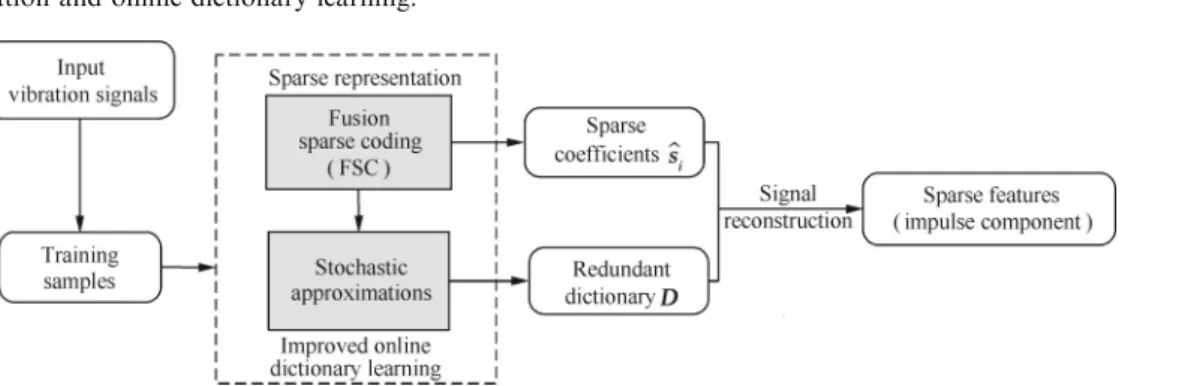
An impulse feature extraction scheme is proposed using FSC and improved online dictionary learning methods (see Fig. 1). The scheme includes two critical procedures: sparse representation and online dictionary learning.
As many dictionary learning problems in processing image or speech signals, the input signals are divided into multi-segments to train dictionary effectively.33 To reduce the dictionary learning time, vibration signal should also be decomposed into overlapping segments to construct training samples. Assume thatX02RL is a one-dimensional vibration signal with large data samples, andZ2RL denotes noiseless signal. The matrixRi2RpLðL>>pÞis defined as an opera-tor that converts the original signalX0into overlapping seg-ments. Samples in training setX¼ fxigNi¼1can be described as
xi¼RiX0 ði¼1;2;. . .;NÞ ð9Þ
In the step of sparse representation, sparse coefficient ^si corresponding to the samplexiis solved using FSC algorithm. Improved online dictionary learning method can obtain the redundant dictionary adapted to statistical structures of vibration signal. In the step of improved online method, redundant dictionary D is trained using Algorithm 2 with low computation time, and the dictionaryDis used to repre-sent vibration signal sparsely. With fixedDand^si, the noiseless signal Z^ can be estimated through solving the optimization problem in Eq.(10). b Z¼arg min Z kkX0Zk 2 2þ XN i¼1 D^siRiZ k k22 ð10Þ
Table 2 Procedure of Improved online dictionary learning.
Algorithm 2: Improved online dictionary learning Require:D02Rpn(initial dictionary),X¼ fx
igNi¼1(training set),xk2RpPðxÞ(i.i.d sample drawn from distributionP),l(regularization parameter),M(number of iterations)
Initialization:A0¼0;B0¼0(intermediate variables) Repeat:
Step 1. fork= 1 toMdo
Step 2.Draw one samplexkfrom probability distributionP(x) using method in Ref.29 Step 3.Sparse coefficients solved using FSC method in Section3.1
sk¼arg s2Rnmin1 2kxkD k1sk2 2þlksk1 Step 4.Ak¼Ak1þskðskÞ T ,Bk¼Bk1þxkðskÞ T ;Dk1¼ ½dk1 1;d2k1;. . .;dkn 1 2Rpn
Step 5.UpdateDkin Eq.(8)based on stochastic approximation algorithm withDk1as warm restart SetA¼Pkl¼1slðslÞ
T
;A¼ ½a1;a2;. . .;an 2Rnn;B¼Pkl¼1xlðslÞ T
;B¼ ½b1;b2;. . .;bn 2Rpn Step 6.The columns ofDkat current iteration are updated sequentially
Repeat: forj=1tondo
Update thejth column ofDkby the following equations
dkj ¼maxðk1ujk2;1Þuj,uj¼ 1 Ajj bjD k1a j þdj End for
Step 7. Return:update dictionaryDkatkth iteration Step 8. End for
Step 9. Output:Redundant dictionaryD
The optimization problem in Eq.(11)is a quadratic term that has a closed-form solution.34
b Z¼ kIþX N i¼1 RTiRi !1 kX0þ XN i¼1 RTiD^si ! ð11Þ whereZb denotes the estimated noiseless signal which is recov-ered usingDand^si, and the original signal can be represented sparsely using FSC and improved online dictionary leaning method. The parameter kis dependent on the noise level of input signal and small values of kcan achieve better results when the noise level increases.34 Noise standard deviationr is the indicator of noise level, which is used to compute parameterk. Based on FSC and improved online dictionary leaning method, it is easy to extract impulse features by means of reconstructing sparse signal and eliminating noises from original signal.
4.2. Simulations and comparisons
The impulse components in vibration signals are the most important features of machinery defects, but impulse features are usually contaminated by heavy background noises in mea-sured signals. In order to verify the performance of the proposed method, the simulated vibration signal of rolling element bear-ing is chosen as the analysis signal. A mathematical simulation model was presented to describe the defects of bearings,11and the vibration signalX0can be simulated as follows:
X0¼ XM0 i¼1 AiSðtiTsiÞ þwðtÞ Ai¼A0cosð2pfmtþuAÞ SðtÞ ¼eBtsinð2pf ntþuwÞ 8 > > > > < > > > > : ð12Þ
where Aiand Tare amplitude and period of impulse signal respectively,sithe phase of the impulse, andw(t) is the additive zeros-mean white noise with noise levelr.fmthe frequency of amplitude modulator,uAthe phase of amplitude modulator,fn the natural frequency related to bearing,uwthe phase related to bearing, andBthe coefficient of resonance damping.
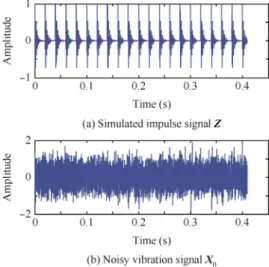
The sample rate is 20 kHz and the length of vibration signal L is 8192. We choose the parameters of impulse amplitude A0= 1, frequency fm= 0.5 kHz, phase si=uA=uw= 0, period T= 0.02 s and natural frequency fn= 1 kHz. The coefficient of resonance damping B is set as 100 p. Signal-to-noise ratio (SNR) is used to evaluate the standard deviation of noiseless impulse components compared to that of the additive noise. We simulate various vibration signals with different SNRs to further test the performance of the proposed method.Fig. 2(a) is the time-domain waveform of simulated noiseless impulse signal, and Fig. 2(b) shows the time-domain waveform of impulse signal under 10 dB zeros-mean Gaussian white noise.
The scheme of the proposed method inFig. 1 is used to extract impulse features from simulated noisy vibration signal
X0 in Fig. 2(b). Due to the large data samples, raw signal
X0 is locally processed to learn dictionary efficiently. Input signal X0 should be firstly divided into segments with data pointsp= 64 to construct the training setXusing operators
Riði¼1;2;. . .;NÞ. Overlapping rate is an important parame-ter which deparame-termines the size of training set.12It is commonly
used to balance between computational efficiency and training
accuracy. In this example the parameter is set as overlap ratio of 50%. The redundant dictionary is trained using improved online learning method in Algorithm 2, and the dimension of the initial dictionary D0 is set as 64·128. Classical regularization parameterlis 1=pffiffiffip,35but the parameter lis experimentally set as 1:2=pffiffiffip¼0:15 in this simulation example which ensures a reasonable sparsity level of data samples (not more than 10 K-dominate coefficients). Different levels of noises are added to original impulse signal, and we find empirically that the parameterk¼3=r can achieve the best accuracy of sparse signal reconstruction with various SNRs. The number of iterations for online dictionary learning algorithmMis 30.
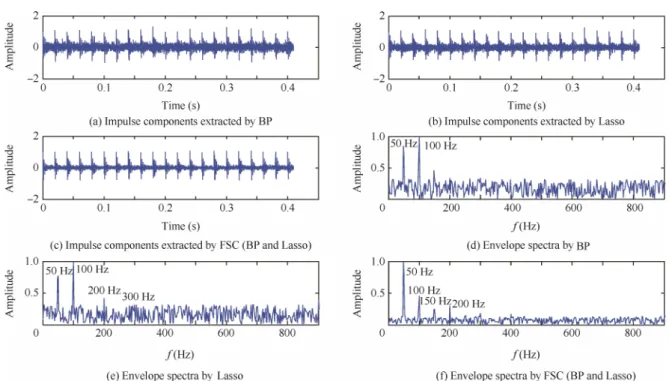
FSC scheme is used to solve sparse coefficients and the participating SC algorithms include BP, Lasso and CD. We also use the same participating SC algorithms in FSC scheme to solve sparse coefficients for improved online dictionary learning in Algorithm 2. To compare the performance of different methods, the impulse components are extracted from raw signal X0 using FSC method with the improved online dictionary learning and singular SC method with traditional online method (seeFig. 3). Results of reconstructed impulse components using different methods are assessed by average root mean squared errors (RMSE) as follows:
RMSE¼ 1 Q XQ i¼1 ffiffiffiffiffiffiffiffiffiffiffiffiffiffiffiffiffiffiffiffiffiffiffiffiffiffiffiffiffiffiffiffiffiffiffiffiffiffiffiffi 1 L XL j¼1 ðZðjÞ ZbðjÞÞ2 v u u t ð13Þ
where L is the length of simulated noisy signal, and Zb the impulse components reconstructed by different SC methods. To each level of SNR, ten noisy signals are simulated and the parameterQ= 10. The average RMSE between original signalZand reconstruction signalZb are listed inTable 3.
It can be seen fromFig. 3(a)–(c) that the additive noise in simulated vibration signal has been reduced greatly. With the values of SNR increasing, FSC scheme has better performances in extracting impulse components than other singular SC methods. The corresponding envelope spectra based on Hilbert transform are shown in Fig. 3(d)–(f). For the simulation model of defective bearing in simulated vibra-tion signal X0, the impulse characteristic frequency f= 1/
T= 50 Hz and its harmonics (100, 150, 200) Hz can be mark-edly identified using FSC method inFig. 3(f). However, due to the heavy background noises, it is difficult to distinguish whether the impulse characteristic frequency is 50 or 100 Hz using BP or Lasso algorithm in Fig. 3(d)–(e). Especially in Fig. 3(e), with the large amplitude of the frequency in 100 and 200 Hz, the impulse characteristic frequency will be wrongly regarded as 100 Hz with its harmonic components (200, 300) Hz. In Fig. 3(f), FSC method can identify 50 Hz impulse characteristic frequency accurately compared with other singular SC methods. From Table 3, FSC(BP, CD, Lasso) method has the least RMSE and it can significantly improve the sparse reconstruction performances. As the addi-tive noise level decreases, impulse components are extracted correctly and RMSE also decreases using different methods. Grey part inTable 3 indicates that FSC method may not be the optimal solutions, because the jointly support sets esti-mated by FSC(BP, Lasso) are not superior to that of CD algo-rithm. However, without prior information of original input signal, FSC method still has better performance in extracting impulse features correctly than other singular SC methods.
The training set X consists of 64·255 samples. We use different dictionary learning methods to train redundant dictionaryD and compute the time consumed. These redun-dant dictionaries are produced using K-SVD and the improved online dictionary learning method (executed 10–100 iterations with 10 interval, using BP and FSC(BP, Lasso) for sparse coding). All the simulations in this paper are running on a dual-core 2.93 GHz CPU machine with 2 GB RAM using MATALB2009A implementation. In Fig. 4, we compare the consumed time of K-SVD and the improved online dictionary learning methods using FSC(BP, Lasso) algorithm.
The simulation shows that the improved online method executes significantly faster than K-SVD in training redundant dictionary D. K-SVD method is essentially a second-order iterative batch procedure, which uses the whole training set to minimize the objective cost function at each iteration; whereas online method only processes one i.i.d sample drawn from the training set Xwith distributionP(x) at a time and it can solve the dictionary learning problem more efficiently.
To further evaluate the performance of the proposed method in impulse components extraction, the wavelet
Fig. 3 Time-domain waveforms of impulse components extracted by different SC algorithms.
Table 3 Comparison of average RMSE with various SNRs using different sparse coding methods.
Method SNR 10 dB (r0.47) 6 dB (r0.29) 2 dB (r0.19) 0 dB (r0.15) 2 dB (r0.12) 4 dB (r0.09) BP 0.122 0.104 0.097 0.080 0.068 0.047 Lasso 0.107 0.093 0.086 0.069 0.055 0.036 CD 0.101 0.091 0.072 0.063 0.050 0.033 FSC(BP, Lasso) 0.089 0.078 0.067 0.059 0.057 0.044 FSC(BP, CD) 0.084 0.071 0.062 0.052 0.045 0.028 FSC(Lasso, CD) 0.079 0.068 0.057 0.042 0.037 0.025 FSC(BP, CD, Lasso) 0.072 0.066 0.057 0.039 0.036 0.022
shrinkage method4 and basic pursuit de-noising (BPDN) method36are used to process the simulated heavy noisy
vibra-tion signal with SNR =10 dB for comparison. The noise levelris important for signal analysis and processing, which can be estimated as ^r¼medianðjw1medianðw1ÞjÞ=0:6745 based on the wavelet coefficients of input signal at the finest scale resolution level,37 where w1 denotes the orthogonal wavelet coefficients at the finest scale and in this example noise levelr0:065. The threshold of wavelet shrinkage method is set asrpffiffiffiffiffiffiffiffiffiffiffiffiffiffiffiffiffiffiffiffi2 lnðLÞ=L,4whereLis the length of vibration data.
We use wavelet shrinkage method to extract impulse compo-nents with the above chosen threshold. BPDN is also used to process the simulated signal for comparison and the redundant dictionary is trained based on K-SVD method. Ten noisy signals are simulated independently to evaluate the performances of different methods and the parameters Q= 10. The average RMSE between the extracted impulse components and simulated noiseless signal are computed and the average running time with different methods is also compared inTable 4.
Table 4 shows that FSC and improved online dictionary learning method has the least RMSE and the average running time is reasonable. Compared with other impulse feature extraction methods, the proposed method can reconstruct sparse signal and extract impulse components embedded in heavy noisy vibration signal accurately and effectively. 5. Experimental example
In order to validate the effectiveness and performance of the proposed method, a practical example of extracting fault fea-tures from aircraft engine rotor vibration signal with heavy background noises is presented. The proposed method is used to process the vibration signal and extract impulse features com-pared with wavelet shrinkage method and the BPDN method.
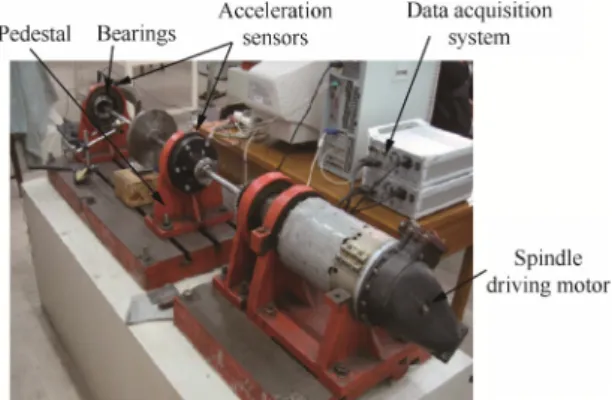
The vibration data is acquired from the aircraft engine rotor experimental platform provided by Nanjing University of Aeronautics and Astronautics. The platform consists of the rotor, a spindle driving motor, rolling bearings, pedestal mount and couplings. The vibration data acquisition system and platform installation sketch can be seen in Fig. 5. Both vertical and horizontal vibration signals are collected using acceleration sensors at 20 kHz sample frequency. The rotational speed of the spindle driving motor is 1500 r/min.
Bearings are the critical parts of the aircraft engine rotor system and it is important to extract the fault features from vibration data for classifying the fault types of bearings. Thus, the bearing run-to-failure test is carried out to obtain the fault data in this experimental platform. The vibration data is acquired from sensors attached to the test bearing in both vertical and horizontal directions. In order to acquire the fault data rapidly, we use the bearing with outer race fault at the beginning of the run-to-failure test. The test bearing used in this experiment is deep groove ball bearing 6309E and the
Fig. 5 Experimental platform of aircraft engine rotor.
Fig. 4 Comparisons of consumed time by using different dictionary learning methods.
Table 4 Comparison of average RMSE and computation time by different methods.
Method Average RMSE Running time(s)
Wavelet shrinkage 0.1497 2.141
BP and K-SVD (30 iterations) 0.1214 13.673
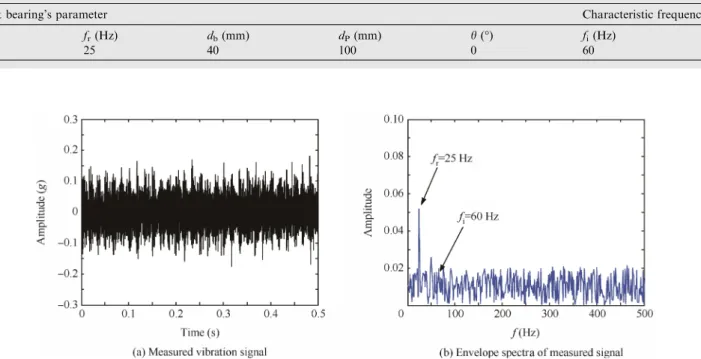
outer race fault characteristic frequencyfican be computed as follows:1 fi¼ Nbfr 2 1 dbcosðhÞ dp ð14Þ where Nbdenotes the number of balls, fr the rotational fre-quency of the rotor, db the ball diameter, dp the ball pitch diameter and h the ball contact angle. The test bearing’s parameters and the outer race fault characteristic frequency fiare shown inTable 5.
A group of measured vibration data collected from one verti-cal acceleration sensor is shown inFig. 6(a). The measured raw signal has 10,000 data points, and impulse features are mainly buried with heavy background noises. As can be seen from the envelope spectrum in Fig. 6(b), the rotational frequency fr= 25 Hz is presented. But the fault characteristic frequency fi= 60 Hz cannot be identified clearly due to the heavy noises. Therefore, the proposed method is used to extract impulse fea-tures from original vibration signal for weak fault detection.
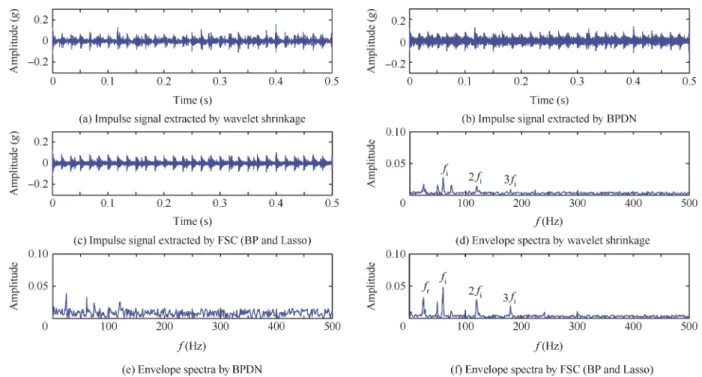
For the purpose of evaluating the performances of impulse features extraction, we use the proposed method to process the measured vibration signal compared with wavelet shrinkage and BPDN methods. The noise levelr can be estimated by using the method in Section4.2, and in this example noise level r0:05. The threshold of wavelet shrinkage method is set as rpffiffiffiffiffiffiffiffiffiffiffiffiffiffiffiffiffiffiffiffi2 lnðLÞ=L. The above chosen threshold is used in wavelet shrinkage method to extract impulse components. BPDN is also used to process the vibration signal for comparison and the redundant dictionary is trained based on K-SVD method. The impulse features extracted by using wavelet shrinkage and BPDN method can be seen inFig. 7(a) and (b).Fig. 7(d)–(e) are the corresponding envelope spectra of signal waveforms.
In our method, the raw vibration signal is divided into small segments to construct training samples. To obtain the redundant dictionary which can represent the original
vibration signal sparsely with low computational time, the seg-ment size and overlap size are set as 50 and 25 respectively. For improved online dictionary learning method, the dimension of the initial dictionaryD0is 50·100, regularization parameteru is experimentally set as 0.14 (not more than 8 K-dominated coefficients) with a reasonable sparsity level. We test several values for parameter k and the best result is obtained with k¼0:1=r¼2. The number of iterationsMis 30 in this algo-rithm. BP and Lasso algorithm are the participating sparse coding algorithms in FSC method. The reconstructed impulse signal and its corresponding envelope spectrum using the pro-posed method are shown inFig. 7(c) and (f) respectively.
Fig. 7 displays the waveforms of reconstructed impulse components and the corresponding envelope spectra using dif-ferent de-noising methods. Wavelet shrinkage method removes much energy in the process of reducing noise. As can be seen from the envelop spectrum inFig. 7(d), the amplitude of each characteristic frequency is small due to the large energy loss of raw signal, and the triple harmonics (3fi) cannot be distin-guished because of the low amplitude. In some cases, wavelet shrinkage method may discard some important features from the measured vibration signal. BPDN method uses BP algo-rithm as SC algoalgo-rithm with K-SVD dictionary learning. BP algorithm does not have a good sparse reconstruction perfor-mance because of the heavy background noises, and the impulse characteristic frequency is not identified correctly in Fig. 7(e). However, the noises in measured vibration signal have been removed evidently inFig. 7(c). Due to the influence of bearing outer race fault, the impulse characteristic frequency fi= 60 Hz and its harmonics (2fi, 3fi) are remarkable features in envelop spectrum, which can be detected correctly in Fig. 7(e). The impulse features can be extracted from heavy noisy vibration signal using FSC and online dictionary learning method.Table 6compares the computation time for training redundant dictionary with
Table 5 Test bearing’s parameters and fault characteristic frequency.
Test bearing’s parameter Characteristic frequency
Nb fr(Hz) db(mm) dP(mm) h() fi(Hz)
8 25 40 100 0 60
various training set sizes using different methods. All the experi-ments are carried out on a dual-core 2.93 GHz CPU machine with 2 GB RAM using Matlab2009A implementation.
It can be seen from Table 6that the running time of the proposed method is reasonable, especially in dealing with large training datasets. Although several participating sparse coding algorithms in FSC method are executed in parallel, the computation time of our method is still lower than K-SVD method because the improved online learning method trains redundant dictionary rapidly using small training samples.
The experiment demonstrates that our method can keep most of energy in raw signal and identify impulse feature fre-quency correctly. Compared with other de-noising algorithms, the proposed method has good performances on extracting impulse features from heavy noisy signal with reasonable computation time, which can be used for machinery fault fea-ture extraction and incipient fault detection.
6. Conclusions
(1) In this paper, we propose an impulse feature extraction method based on fusion sparse coding and improved online dictionary learning. Fusion sparse coding
algorithm achieves better sparse reconstruction accuracy than any singular sparse coding algorithm, which is also used to improve the performance of traditional online dictionary learning method. The improved online dic-tionary learning method can obtain redundant dicdic-tionary by using small training samples with high accuracy and reasonable computation time.
(2) The vibration signal can be reconstructed in sparse domain using FSC and the improved online dictionary learning method, which is the key issue of extracting impulse features for fault detection. The simulation validates that the proposed method can achieve good performance in reducing noises and extracting impulse components from raw signal, especially for the vibration signal with heavy background noises.
(3) The application to processing aircraft engine rotor vibration signal indicates that this method can be generalized into impulse features extraction and weak fault detection. Compared with other de-noising meth-ods, this method can extract impulse features and detect the fault feature frequency correctly and efficiently. (4) Deeper research about selecting the parameters of
seg-ment size, overlapping rate and training samples length needs to be further studied.
Fig. 7 Time-domain waveforms of impulse features extracted using different de-noising algorithms.
Table 6 Comparison of computation time with various training set sizes using different de-noised methods.
Method Training set size (30 iterations)
50·100 80·100 100·100
BP and K-SVD(s) 3.122 8.451 11.231
FSC(BP, Lasso) and improved online learning(s) 3.874 6.966 10.525 FSC(Lasso, CD) and improved online learning(s) 4.245 8.172 11.651
Acknowledgements
This work was supported by the National Natural Science Foundation of China (No. 51201182). We would like to thank the authors of Refs.18,19for sharing the codes and Mr. Qiang of Nanjing University of Aeronautics and Astronautics for providing experimental vibration data of aircraft engine rotor. References
1. Li RY, Sopon P, He D. Fault features extraction for bearing prognostics.J Intell Manuf2012;23(2):313–21.
2. Yan RQ, Gao RX. Energy-based feature extraction for defect diagnosis in rotary machines. IEEE Trans Instrum Meas2009; 58(9):3130–9.
3. Gary YG, Lin KC. Wavelet packet feature extraction for vibration monitoring.IEEE Trans Industr Electron2000;47(3):650–67. 4. Donoho DL. De-noising by soft-thresholding. IEEE Trans Inf
Theory1995;41(3):613–27.
5. Qiu H, Lee J, Lin J, Yu G. Wavelet filter-based weak signature detection method and its application on rolling element bearing prognostics.J Sound Vib2006;289(4):1066–90.
6. He W, Jiang ZN, Qin Q. A joint adaptive wavelet filter and morphological signal processing method for weak mechanical impulse extraction.J Mech Sci Technol2010;24(8):1709–16. 7. Yu NN, Qiu TS, Bi F, Wang AQ. Image features extraction and
fusion based on joint sparse representation.IEEE J Sel Top Signal
Process2011;5(5):1074–82.
8. Jafari MG, Plumbley MD. Fast dictionary learning for sparse representations of speech signal.IEEE J Sel Top Signal Process 2011;5(5):1025–31.
9. Donoho DL. Compressed sensing. IEEE Trans Inf Theory 2006;52(4):1289–306.
10. Liu HN, Liu CL, Huang YX. Adaptive feature extraction using sparse coding form machinery fault diagnosis.Mech Syst Signal
Process2011;25(2):558–74.
11. Tang HF, Chen J, Dong GM. Sparse representation based on latent components analysis for machinery weak fault detection.
Mech Syst Signal Process2014;28(1):158–74.
12. Chen XF, Du ZH, Li JM, Li X, Zhang H. Compressed sensing based on dictionary learning for extracting impulse components.
Signal Process2014;96(1):94–109.
13. Aharon M, Elad M, Bruckstein A. K-SVD: an algorithm for designing overcomplete dictionaries for sparse representation.
IEEE Trans Signal Process2006;54(11):4311–22.
14. Rubinstein R, Zibulevsky M, Elad M. Double sparsity: learning sparse dictionaries for sparse signal approximation.IEEE Trans
Signal Process2010;58(3):1553–64.
15. Engan K, Aase SO, Husoy JH. Method of optimal directions for frame design.IEEE international conference on acoustics, speech, and signal processing, 1999 Mar 15–19 Phoenix, AZ, UK. 1999. p. 2443–6.
16. Xu LJ, Zhang JQ, Yan Y. A Wavelet-based multi-sensor data fusion algorithm.IEEE Trans Instrum Meas2004;53(6):1539–45. 17. Elad M, Yavneh I. A plurality of sparse representations is better than
the sparsest one alone.IEEE Trans Inf Theory2009;55(10):4701–14. 18. Ambat SK, Chatterjee S, Hari KV. Fusion of algorithms for compressed sensing. IEEE Trans Signal Process 2013;61(14): 3699–704.
19. Mairal J, Ponce J, Sapiro G. Online learning for matrix factor-ization and sparse coding.J Mach Learn Res2010;11(2):19–60.
20. Lewicki MS, Sejnowski TJ. Learning overcomplete representa-tions.Neural Comput2000;12(2):337–65.
21. Liu JY, Zhu JB. High range resolution profile automatic target recognition using sparse representation. Chin J Aeronaut 2010;23(5):556–62.
22. Olshausen BA, Field DJ. Natural image statistics and efficient coding.Netw Comput Neural Syst1996;7(2):333–9.
23. Chen SB, Donoho DL, Saunders MA. Atomic decomposition by basis pursuit.SIAM J Sci Comput1998;20(1):33–61.
24. Tibshirani R. Regression shrinkage and selection via the Lasso.J
Roy Stat Soc B1996;67(1):267–88.
25. Friedman J, Hastie T, Hoefiling H, Tibshirani R. Pathwise coordinate optimization.Ann Appl Stat2007;11(9):302–32. 26. Gorodnitsky IF, Rao BD. Sparse signal reconstruction from
limited data using FOCUSS: a re-weighted norm minimization algorithm.IEEE Trans Signal Process1997;45(3):600–16. 27. Cai T, Wang L, Xu GW. Shifting inequality and recovery of sparse
signals.IEEE Trans Inf Theory2010;56(9):4388–94.
28. Varadarajan B, Khudanpur S, Tran TD. Stepwise optimal subspace pursuit for improving sparse recovery. IEEE Signal
Process Lett2011;18(1):27–30.
29. Bottou L, Bousquet O. The trade-offs of large scale learning.Adv
Neural Inf Process Syst2008;20(2):161–8.
30. Olshausen BA, Field BJ. Sparse coding with an overcomplete basis set: a strategy employed by v1? Vision Res 1997;37(12): 3311–25.
31. Benveniste A, Metivier M, Priouret P.Adaptive algorithms and
stochastic approximations. Berlin: Springer Publishing Company,
Incorporated; 1990. p. 141–3.
32. Donoho DL, Elad M, Temlyakov VN. Stable recovery of sparse overcomplete representations in the presence of noise.IEEE Trans
Inf Theory2006;52(2):6–18.
33. Protter M, Elad M. Image sequence denoising via sparse and redundant representations.IEEE Trans Image Process2009;18(1): 27–35.
34. Elad M, Aharon M. Image denoising via sparse and redundant representations over learned dictionary. IEEE Trans Image
Process2006;15(12):3736–45.
35. Bickel PJ, Ritov Y, Tsybakov AB. Simultaneous analysis of Lasso and Dantzig selector.Ann Stat2009;37(4):1705–32.
36. Yang H, Mathew J, Ma L. Fault diagnosis of rolling element bearings using basis pursuit.Mech Syst Signal Process2005;19(2): 341–56.
37. Donoho DL, Johnstone IM. Ideal spatial adaptation by wavelet shrinkage.Biometrika1994;81(3):425–55.
Deng Senreceived B.S. and M.S. degrees from Air Force Engineering University in 2008 and 2011, respectively, and then became a Ph.D. candidate in the same university. His main research interests are signal processing and fault diagnosis.
Jing Boreceived M.S. degree from Air Force Engineering University in 1996, Ph.D. from Northwestern Polytechnical University in 2002, and she is now a professor in Air Force Engineering University. Her cur-rent research focuses on prognostics and health management, design for testability, sensor network and information fusion.
Sheng Sheng received B.S. and M.S. degrees from Air Force Engineering University in 2008 and 2011, respectively, and then became a Ph.D. candidate in the same university. His main research interests are prognostics and health management (PHM) and fault diagnosis.