Carlos Arg´aez
1, Peter Giesl
2and Sigurdur Hafstein
11Faculty of Physical Sciences, University of Iceland, 107 Reykjav´ık, Iceland 2Department of Mathematics, University of Sussex, Falmer BN1 9QH, U.K.
Keywords: Dynamical System, Complete Lyapunov Function, Meshless Collocation, Radial Basis Functions.
Abstract: Ordinary differential equations arise in a variety of applications, including e.g. climate systems, and can ex-hibit complicated dynamical behaviour. Complete Lyapunov functions can capture this behaviour by dividing the phase space into the chain-recurrent set, determining the long-time behaviour, and the transient part, where solutions pass through. In this paper, we present an algorithm to construct complete Lyapunov functions. It is based on mesh-free numerical approximation and uses the failure of convergence in certain areas to determine the chain-recurrent set. The algorithm is applied to three examples and is able to determine attractors and repellers, including periodic orbits and homoclinic orbits.
1 INTRODUCTION
In this paper, we describe a new algorithm to analyse the behaviour of a dynamical system. Let us consider a general autonomous ordinary differential equation (ODE) ˙x=f(x), wherex∈Rn.
A classical (strict) Lyapunov function (Lyapunov, 1992) is a scalar-valued function that can be used to analyse the basin of attraction of one attractor such as an equilibrium or a periodic orbit. It attains its mini-mum at the attractor, and is otherwise strictly decreas-ing along solutions of the ODE.
A generalization of this idea is the notion of a complete Lyapunov function (Conley, 1978a; Con-ley, 1988; HurCon-ley, 1995; HurCon-ley, 1998), which charac-terizes the complete behaviour of the dynamical sys-tem. It is a scalar-valued functionV :Rn→R,
de-fined on the whole phase space, not just in a neighbor-hood of one particular attractor. It is non-increasing along solutions of the ODE. The phase space can be divided into the area where the complete Lyapunov function strictly decreases along solution trajectories and the one where it is constant along solution trajec-tories. The area where the complete Lyapunov func-tion is strictly decreasing along solufunc-tion trajectories characterizes the gradient-like flow. There solutions pass through and the larger this area is, the more in-formation is obtained from the complete Lyapunov function. Note that, by definition, the complete Lya-punov function needs to be constant along solution
trajectories on each transitive component of the chain-recurrent set.
Note that there are other methods to analyse the general behaviour of dynamical systems: The di-rect simulation of solutions with many different ini-tial conditions, however, is costly and can only give limited information about the general behaviour of the system, unless estimates are available, e.g. when shadowing solutions. More sophisticated methods in-clude the computation of invariant manifolds, form-ing the boundaries of basins of attraction of attractors (Krauskopf et al., 2005); here, additional analysis of the parts with gradient-like flow is necessary. The cell mapping approach (Hsu, 1987) or set oriented meth-ods (Dellnitz and Junge, 2002) divide the phase space into cells and compute the dynamics between these cells, see also for example (Osipenko, 2007); these ideas have also been used to compute complete Lya-punov functions, see Section 2.1.
In this paper we focus on a new algorithm of tack-ling a mathematical problem numerically. Inspired by a method to compute classical Lyapunov functions for an equilibrium, we approximate the solution of V0(x) =−1, whereV0(x) =∇V(x)·f(x)denotes the
orbital derivative, the derivative along solutions of the ODE. We use mesh-free collocation with Radial Basis Function to approximately solve this partial differen-tial equation (PDE): we choose a finite set of collo-cation pointsXand compute an approximationvtoV which solves the PDE in all collocation points. 134
Argáez, C., Hafstein, S. and Giesl, P.
Analysing Dynamical Systems - Towards Computing Complete Lyapunov Functions. DOI: 10.5220/0006440601340144
Note, however, that the PDE cannot be fulfilled at all points of the chain-recurrent set, such as an equilibrium or periodic orbit. We use the failure of the method to approximate in certain areas to identify these areas. We split the collocation pointsX into a setX0, where the approximation fails, andX−, where
it works well. A complete Lyapunov function should be constant inX0, so in the next step we solve the
PDEV0(x) =0 for allx∈X0 andV0(x) =−1 for
allx∈X−, which is an approximation of a complete
Lyapunov function.
The computed function v gives us the follow-ing information about the ODE under consideration: the setX0, wherev0(x)≈0 approximates the
chain-recurrent set, including equilibria, periodic orbits and homoclinic orbits, while the setX−, wherev0(x)≈ −1
approximates the area with gradient-like flow, where solutions pass through. The function v, through its level sets, gives information about the stability and attraction properties: minima ofvcorrespond to at-tractors, while maxima represent repellers.
Let us give an overview over the paper: in Section 2 we discuss complete Lyapunov functions as well as mesh-free collocation to approximate solutions of a general linear PDE. In Section 3 we present our algo-rithm to compute a complete Lyapunov function. In Sections 4 and 5 we apply the method to three exam-ples and discuss the results in detail.
2 PRELIMINARIES
2.1 Complete Lyapunov Functions
We will consider a general autonomous ODE˙
x=f(x), wherex∈Rn. (1) A complete Lyapunov function (Conley, 1978b; Con-ley, 1978a) is a continuous function V: Rn → R
which is constant on the chain-recurrent set, includ-ing local attractors and repellers, and decreasinclud-ing else-where. In contrast to classical Lyapunov functions (Lyapunov, 1992), which are defined on the basin of attraction of just one attractor, a complete Lyapunov function characterizes the flow on the whole phase space and distinguishes between the chain-recurrent set and the gradient-like flow. Thus, it captures the long-term behaviour of the system.
Conley (Conley, 1978b; Conley, 1978a) proved the existence of complete Lyapunov functions for dy-namical systems on a compact metric space. The idea is to consider corresponding attractor-repeller pairs and to construct a function which is 1 on the repeller, 0 on the attractor and decreasing in between. Then
these functions are summed up over all attractor-repeller pairs. This was generalized to more general spaces by Hurley (Hurley, 1992; Hurley, 1995; Hur-ley, 1998).
The smaller the part of the phase space where the complete Lyapunov function is constant, the more in-formation is provided by a complete Lyapunov func-tion. There exists a complete Lyapunov function which is only constant on the generalized chain-recurrent set (Auslander, 1964), thus providing fur-ther information about the system as the generalized chain-recurrent set is a subset of the chain-recurrent set.
In (Kalies et al., 2005; Ban and Kalies, 2006; Goullet et al., 2015) a computational approach to construct complete Lyapunov functions was consid-ered. A discrete-time system was given by the time-T map and the phase space was subdivided into cells and the dynamics between them computed through an induced multivalued map using the computer pack-age GAIO (Dellnitz et al., 2001). An approximate complete Lyapunov function is then computed using graph algorithms (Ban and Kalies, 2006). This ap-proach requires a high number of cells even for low dimensions. We will use a different methodology, in-spired by the construction of classical Lyapunov func-tions, which is faster and works well in higher di-mensions. In (Bj¨ornsson et al., 2014a), the approach of (Ban and Kalies, 2006) is compared to the RBF method for equilibria (see below) for one particular example; here, the method of (Ban and Kalies, 2006) works well only on the chain-recurrent set, while the RBF method is very efficient on the gradient-like part. In (Bj¨ornsson et al., 2015), a complete Lyapunov is constructed as a continuous piecewise affine (CPA) function, affine on a fixed simplicial complex. How-ever, it is assumed that information about local attrac-tors is a available, while the proposed method in this paper does not require any information about the sys-tem under consideration.
2.2 Mesh-free Collocation
For classical Lyapunov functions, several numerical construction methods have recently been proposed, e.g. (Johansson, 1999; Johansen, 2000; Marin´osson, 2002; Giesl, 2007; Hafstein, 2007; Bj¨ornsson et al., 2014b; Kamyar and Peet, 2015; Anderson and Pa-pachristodoulou, 2015; Doban, 2016; Doban and Lazar, 2016) see also the recent review (Giesl and Hafstein, 2015). Our algorithm will be based on the RBF (Radial Basis Function) method, a special case of mesh-free collocation, which approximates the so-lution of a linear PDE, specifying the orbital
deriva-tive.
Mesh-free methods, particularly based upon Ra-dial Basis Functions, provide a powerful tool for solv-ing generalized interpolation problems efficiently. We assume that the target function belongs to a Hilbert space H of continuous functions (often a Sobolev space) with reproducing kernel ϕ :Rn×Rn →R,
given by a suitable Radial Basis FunctionΦthrough ϕ(x,y):=Φ(x−y), where Φ(x) =ψ(kxk) is a ra-dial function. Examples for Rara-dial Basis Functions include the Gaussians, multiquadrics and inverse mul-tiquadrics; we, however, will use the compactly sup-ported Wendland functions in this paper, which will be defined below.
We assume that the informationr1, . . . ,rN∈Rof
a target functionV∈Hgenerated byNlinearly inde-pendent functionalsλj∈H∗is known. The optimal
reconstruction of the functionV is the solution of the minimization problem min{kvkH:λj(v) =rj,1≤j≤
N}.It is well-known (Wendland, 2005) that the solu-tion can be written asv(x) =∑N
j=1βjλyjϕ(x,y),where
the coefficientsβjare determined by the interpolation
conditionsλj(v) =rj, 1≤j≤N.
In our case, we consider the PDEV0(x) =g(x),
whereg(x)is a given function. We chooseN points x1, . . . ,xN ∈Rnof the phase space and define
func-tionalsλj(v):= (δxj◦L)xv=v0(xj) =∇v(xj)·f(xj),
where L denotes the linear operator of the orbital derivativeLV(x) =V0(x) andδ is Dirac’s delta
dis-tribution. The right-hand sides areV0
j =g(xj)for all
1≤j≤N. The approximation is then v(x) =
∑
Nj=1
βj(δxj◦L)yΦ(x−y),
whereΦis a positive definite Radial Basis Function, and the coefficientsβj∈Rcan be calculated by
solv-ing a system ofN linear equations. A crucial ingre-dient is the knowledge on the behaviour of the er-ror function|V0(x)−v0(x)|in terms of the so-called
fill distance which measures how dense the points
{x1, . . . ,xN}are, since it gives information when the
approximate solution indeed becomes a Lyapunov function, i.e. has a negative orbital derivative. Such error estimates were derived, for example in (Giesl, 2007; Giesl and Wendland, 2007), see also (Nar-cowich et al., 2005; Wendland, 2005).
The advantage of mesh-free collocation over other methods for solving PDEs is that scattered points can be added to improve the approximation, no triangula-tion of the phase space is necessary, the approximat-ing function is smooth and the method works in any dimension.
In this paper, we use Wendland functions (Wend-land, 1998) as Radial Basis Functions through
ψ(x):=ψl,k(ckxk), wherec>0,k∈Nis a
smooth-ness parameter and l =bn2c+k+1. Wendland functions are positive definite functions with com-pact support, which are polynomials on their sup-port; the corresponding Reproducing Kernel Hilbert Space is norm-equivalent to the Sobolev space Wk+(n+1)/2
2 (Rn). They are defined by recursion: for
l∈N,k∈N0we define
ψl,0(r) = (1−r)l+
ψl,k+1(r) =Rr1tψl,k(t)dt
(2) for r∈R+
0, wherex+=xforx≥0 andx+=0 for
x<0.
As collocation pointsX⊂Rnwe use a hexagonal
grid withα∈R+constructed according to
( α
∑
n k=1 ikwk:ik∈Z ) , where w1 = (2e1,0,0, . . . ,0) w2 = (e1,3e2,0, . . . ,0) ... ... wn = (e1,e2,e3, . . . ,(n+1)en)and ek = s 1 2k(k+1), k∈N.We setψ0(r):=ψl,k(cr)with positive constantc
and define recursivelyψi(r) = 1rdψdri−1(r)fori=1,2
andr>0. The explicit formulas forvand its orbital derivative are v(x) =
∑
N j=1 βjhxj−x,f(xj)iψ1(kx−xjk), v0(x) =∑
N j=1 βj h −ψ1(kx−xjk)hf(x),f(xj)i +ψ2(kx−xjk)hx−xj,f(x)i · hxj−x,f(xj)i iwhereβis the solution ofA·β=r,rj=V0(xj)andA
is theN×Nmatrix with entries
ai j=ψ2(kxi−xjk)hxi−xj,f(xi)ihxj−xi,f(xj)i
−ψ1(kxi−xjk)hf(xi),f(xj)i
fori6=jand
aii=−ψ1(0)kf(xi)k2.
More detailed explanations on this construction are given in (Giesl, 2007, Chapter 3).
If no collocation pointxjis an equilibrium for the
positive definite and the system of equationsAβ=r has a unique solution. Note that this holds true inde-pendent of whether the underlying discretized PDE has a solution or not, while the error estimates are only available if the PDE has a solution.
3 ALGORITHM
Starting with scattered collocation pointsX, we solve the equationV0(x) =−1, whereV0(x):=∇V(x)·f(x)
denotes the orbital derivative, the derivative along so-lutions of (1). Note that the equationV0(x) =−1 does
not have a solution on chain-recurrent sets in general; e.g. along a periodic orbit, the orbital derivative must integrate to 0. However, as mentioned above, we can still compute a (unique) approximation by the method described in Section 2.2.
In the next step we check for each collocation pointxj inX whether the approximation was poor
(thenxj∈X0) or good (thenxj∈X−). Then we
ap-proximate the solution of the new problemV0(x) =
−1 forx∈X−andV0(x) =0 forx∈X0; the setX0
indicates the (generalized) chain-recurrent set. To determine whether the approximation was poor or good, we evaluatev0(x)for test points x around
each collocation pointxj – for a good approximation
we expectv0(x)≈ −1. In view of our goal to compute
a complete Lyapunov function, we classify colloca-tion points as poor if the orbital derivative near them is larger than 0 or a chosen critical value, i.e.v0(x)>γ,
for certain pointsxnear the collocation pointxj. As
points to check near a collocation pointxjwe choose
points on two circumferences around each collocation pointxj. They are distributed around each collocation
point and we place 64 checking points per each col-location point. In particular, inR2, for a collocation
pointxj∈R2, we use the following checking points
Yxj: xj±rα(cos(θ),−sin(θ)) xj±rα(sin(θ),cos(θ)) xj±r2α∗(cos(θ),sin(θ)) xj±r2α∗(cos(θ),−sin(θ)) (3) where r is a scaling parameter and θ = 0.0,11.25,22.5,45,56.25,67.5,75 and 105 degrees; this is shown in Figure 1.
The algorithm can be summarized as follows. 1. Create the collocation pointsX and compute the
approximate solutionvofV0(x) =−1
2. For each collocation pointxj, computev0(x): if
v0(x)>γ for a pointx∈Yx
j, thenxj∈X0,
oth-erwisexj∈X−, whereγ≤0 is a chosen critical
value
Figure 1: The figure shows the collocation points (blue) and the checking points (red) around each collocation point. The collocations points are used to construct the Lyapunov function and the checking points are used to evaluate the orbital derivative of the complete Lyapunov function.
3. Compute the approximate solution vofV0(x) =
−1 forx∈X−andV0(x) =0 forx∈X0
4. Repeat steps 2. and 3. until no more points are added toX0
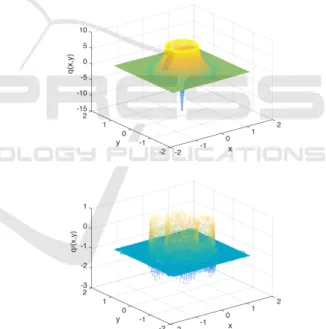
Figure 2: Lyapunov function for (4). The upper figure shows the approximated complete Lyapunov function. The lower figure shows its orbital derivative. The minima in the upper figure correspond to the asymptotically stable equi-librium and periodic orbit with radius 1, while the maxi-mum is attained at the repelling periodic orbit of radius 1/2. The orbital derivative fails to be negative on the periodic or-bits and the equilibrium.
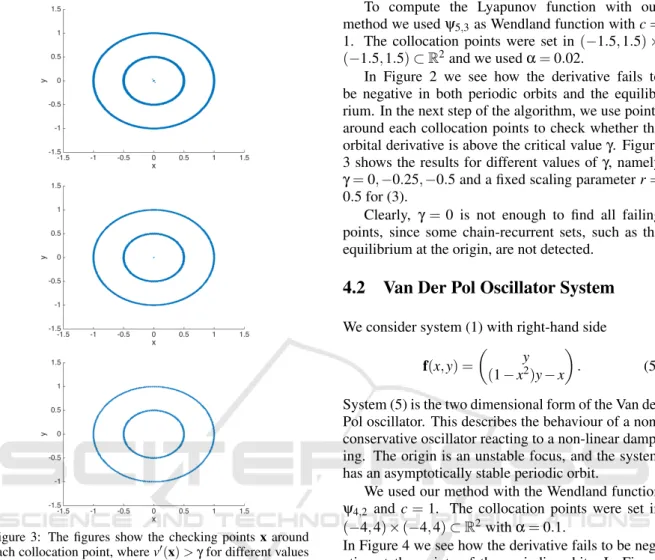
Figure 3: The figures show the checking pointsxaround each collocation point, wherev0(x)>γfor different values ofγ. Upper:γ=−0.5. Middle:γ=−0.25. Lower:γ=0. In all cases,α=0.02,r=0.5.
4 EXAMPLES
In the following we apply the method to three exam-ples and then analyse the behaviour of the method with respect to certain parameters. In this section we only consider the first step of the method, and we will discuss the iterations in Section 5. Note that in all examples we use the notationx= (x,y).
4.1 Two Circular Periodic Orbits
We consider system (1) with right-hand sidef(x,y) = −x(x2+y2−1/4)(x2+y2−1)−y −y(x2+y2−1/4)(x2+y2−1) +x , (4) which has an asymptotically stable equilibrium at the origin, an asymptotically stable periodic orbit with ra-dius 1, and a repelling periodic orbit with rara-dius 1/2.
To compute the Lyapunov function with our method we usedψ5,3as Wendland function withc=
1. The collocation points were set in (−1.5,1.5)× (−1.5,1.5)⊂R2and we usedα=0.02.
In Figure 2 we see how the derivative fails to be negative in both periodic orbits and the equilib-rium. In the next step of the algorithm, we use points around each collocation points to check whether the orbital derivative is above the critical valueγ. Figure 3 shows the results for different values ofγ, namely γ=0,−0.25,−0.5 and a fixed scaling parameterr= 0.5 for (3).
Clearly, γ=0 is not enough to find all failing points, since some chain-recurrent sets, such as the equilibrium at the origin, are not detected.
4.2 Van Der Pol Oscillator System
We consider system (1) with right-hand sidef(x,y) = y (1−x2)y−x . (5)
System (5) is the two dimensional form of the Van der Pol oscillator. This describes the behaviour of a non-conservative oscillator reacting to a non-linear damp-ing. The origin is an unstable focus, and the system has an asymptotically stable periodic orbit.
We used our method with the Wendland function ψ4,2 and c=1. The collocation points were set in
(−4,4)×(−4,4)⊂R2withα=0.1.
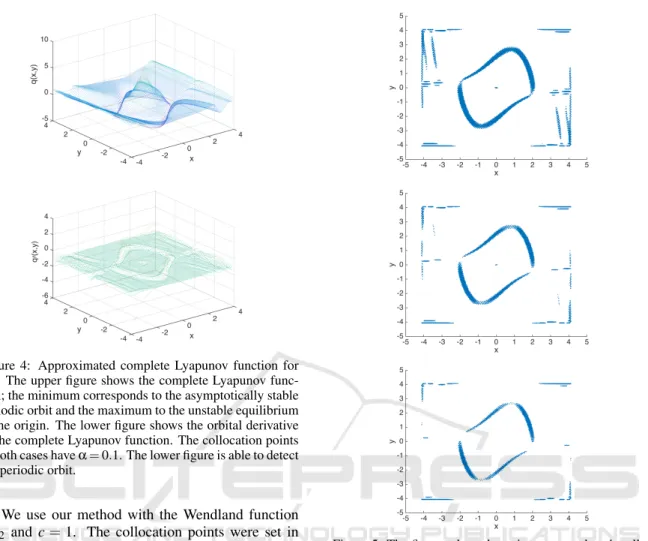
In Figure 4 we see how the derivative fails to be neg-ative at the points of the periodic orbit. In Figure 5 we show the points in X0 for three critical
val-uesγ=0,−0.25,−0.5 and a fixed scaling parameter r=0.5.
Forγ=0 andγ=−0.25 we do not detect all points of the periodic orbit, but we can already see its shape (see Figure 5), while forγ=−0.5 the whole periodic orbit is covered. However, we obtain points in the gradient-like flow where the orbital derivative fails to be negative, and thus overestimate the chain-recurrent set.
4.3 Homoclinic Orbit
We consider system (1) with right-hand sidef(x,y) =
x(1−x2−y2)−y((x−1)2+ (x2+y2−1)2) y(1−x2−y2) +x((x−1)2+ (x2+y2−1)2) . (6) This system has an unstable focus at the origin and an asymptotically stable homoclinic orbit at a circle centered at the origin and with radius 1.
Figure 4: Approximated complete Lyapunov function for (5). The upper figure shows the complete Lyapunov func-tion; the minimum corresponds to the asymptotically stable periodic orbit and the maximum to the unstable equilibrium at the origin. The lower figure shows the orbital derivative of the complete Lyapunov function. The collocation points in both cases haveα=0.1. The lower figure is able to detect
the periodic orbit.
We use our method with the Wendland function ψ4,2 and c=1. The collocation points were set in
(−1.5,1.5)×(−1.5,1.5)⊂R2withα=0.02.
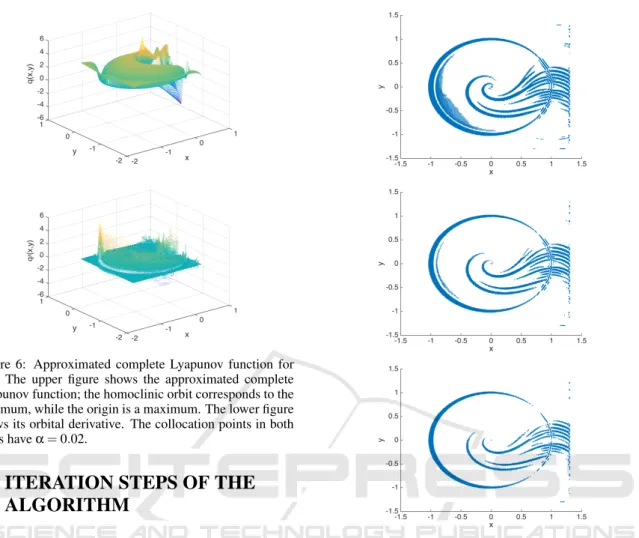
The method detects the points of the homoclinic orbit well, but has problems at the unstable equilibrium at (1,0), corresponding to the homoclinic orbit. Here, the approximation also fails at points which belong to the gradient-like flow.
In Figure 7 we see how the derivative fails to be negative at the points of the homoclinic orbit, and also beyond. We show the points inX0 for three critical
valuesγ=0,−0.25,−0.5 and a fixed scaling radio r=0.5.
4.4 Dependence on the Collocation Grid
and the Verification Points
A very interesting behaviour is observed by varying the density of the collocation grid. A natural way to vary it is by changing the value of the parameterαin (3): the larger theαthe fewer collocation points we have for a defined area.
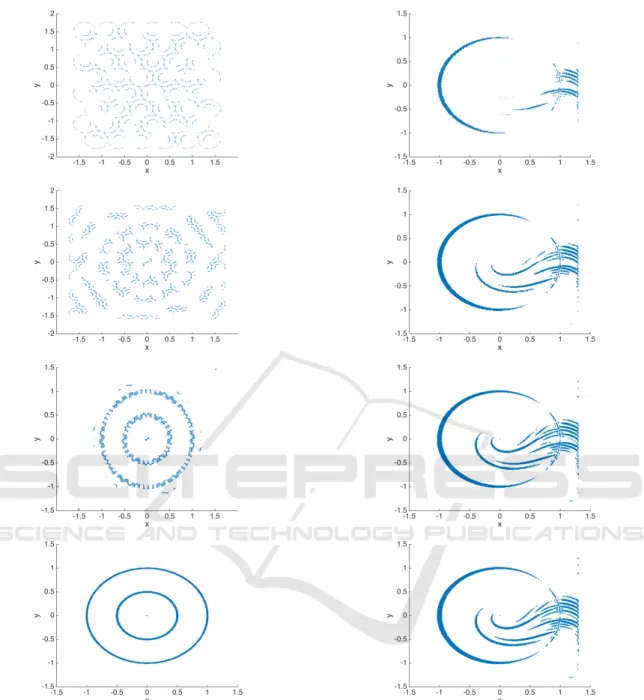
In Figure 8 we can observe how our algorithm converges to the chain-recurrent set for example (4). We observe that in order to be able to detect the
dy-Figure 5: The figures show the pointsxaround each collo-cation point, wherev0(x)>γfor different values ofγ. Up-per: γ=−0.5. Middle: γ=−0.25. Lower: γ=0. In all cases,α=0.1,r=0.5.
namical behaviour, the collocation grid needs to be sufficiently dense. This corresponds to error estimates between the solution of a PDE and its approximation using mesh-free collocation which proves that the er-ror is bounded by a constant times the fill distance, measuring the density of the collocation points. In our case, however, the PDE does not have a solution and thus these error estimates do not apply.
In Figure 9 we consider example (6) and vary the radius r for the checking points, used to determine poor and good collocation points. We are only able to detect the whole homoclinic orbit with a sufficiently large radius. This is to be expected, since at the col-location points we have v0(x) =−1 and sincev0 is
continuous it will be negative close enough to the col-location points.
Figure 6: Approximated complete Lyapunov function for (6). The upper figure shows the approximated complete Lyapunov function; the homoclinic orbit corresponds to the minimum, while the origin is a maximum. The lower figure shows its orbital derivative. The collocation points in both cases haveα=0.02.
5 ITERATION STEPS OF THE
ALGORITHM
After splitting the set of collocation pointsX into the setX0, where the approximation is poor, and the
re-maining pointsX−, in the next step, our method will
solve the problemV0(x) =0 forx∈X0andV0(x) =
−1 forx∈X−. This is done by solvingAβ=rwith
an updated right-hand-siderand we look again for collocation points where the approximation is poor. This procedure should then be iterated until no more collocation points are added toX0.
For the Van der Pol system (5) the results of this procedure withγ=−0.25 andα=0.1 can be seen in Figures 10 to 12. Figure 10 shows the complete Lyapunovvfor each step, which does not change sig-nificantly after the first step; observe, that the range ofvis slightly reduced. Figure 11 shows its orbital derivative; again, there is no significant change after the first step, only the range ofv0is slightly reduced
and the values near the chain-recurrent set are now 0 rather than different values above the critical value.
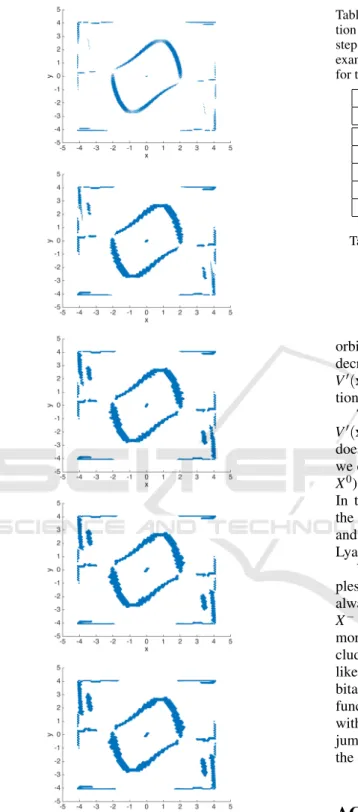
Figure 12, finally, displays the set of checking points where the orbital derivative is larger than the critical valueγ=−0.25; these points should approx-imate the chain-recurrent set, in this case the unstable equilibrium at the origin and the asymptotically
sta-Figure 7: The figures show the pointsxaround each collo-cation point, wherev0(x)>γfor different values ofγ. Up-per: γ=−0.5. Middle: γ=−0.25. Lower: γ=0. In all cases,α=0.02,r=0.5.
ble periodic orbit. We observe that the set of points increases and nearly covers the whole periodic or-bit. However, collocation points away from the chain-recurrent set also are included, mainly at the bound-ary of the domain under consideration as the values of v0(x)become more extreme.
After the first step there is no significant change in the figures, although a close study reveals that the algorithm still adds points, see Table 1. There are boundary effects, such that points near the boundary of the considered domain do not behave as expected. We are currently studying these phenomena and ex-pect that a more elaborate way of fixing the values of v0 at the collocation points will improve the
perfor-mance of the method.
For all examples (4) to (6) we show a table of how many points we find by iterating this procedure. The corresponding parameters are given in Table 2. In Table 1 the number of total collocation points and
Figure 8: Example (4) with collocation grids of varying density. Upperα=0.5. Middle upα=0.3. Middle down
α=0.1. Lowerα=0.02. The radii for the test circles for
all of them were set tor=0.5 and the critical value was γ=−0.25.
the total number of points inX0 with poor
approxi-mation in each step iteration are shown. For system (4) we see that after the fourth step no more points are added toX0, while for the other two examples the
method keeps adding points.
Figure 9: We consider example (6) with fixedα=0.02, fixed critical valueγ=0.0 and varyingr. Upperr=0.2. Middle upr=0.3. Middle downr=0.4. Lowerr=0.5.
6 CONCLUSIONS AND
OUTLOOK
We have presented a method to compute a complete Lyapunov function and thus to determine the quali-tative behaviour of a given ODE, using both the val-ues of the complete Lyapunov function and its orbital derivative. A complete Lyapunov functionV is con-stant along solutions in the chain-recurrent set, i.e. the
Figure 10: Evolution of the complete Lyapunov function approximationv(x)for the Van der Pol problem with critical
valueγ=−0.25,α=0.1,r=0.5. The top figure shows the
first iteration of the method, the second, third and fourth show the corresponding iterations. The figures only change very slightly after the first step; one can observe that the range of values is reduced.
Figure 11: Evolution of the complete Lyapunov function approximation v0(x) for the Van der Pol problem for the steps of the method. After the first step, where points with poor approximation have orbital derivatives with positive values, they are close to zero in subsequent steps. There are no significant changes in the later steps.
Figure 12: Evolution of the checking points with orbital derivative larger than the critical valueγ=−0.25 for the Van der Pol problem over several steps. It can be seen that after the first step visibly more points are added, which nearly cover the whole periodic orbit, while in later steps there are no significant changes. Apart from the chain-recurrent sets, also points at the boundary of the domain are marked as poor approximations.
Table 1: In this table we list the overall number of colloca-tion points as well as the collocacolloca-tion points inX0 in each step of the algorithm for each of the examples (4) to (6). In example (4), no further points are added after step 4, while for the other two examples we keep adding points toX0.
system (4) (5) (6) collocation points 29440 7708 19500 step 1 1358 762 2517 step 2 1362 956 2751 step 3 1368 1034 2802 step 4 1370 1072 2820 step 5 1370 1092 2829 Table 2: Parameters to obtain results shown in table 1.
system (4) (5) (6) α 0.02 0.1 0.02 γ -0.25 -0.25 0 r 0.5 0.5 0.5
orbital derivative is zero (V0(x) =0), and it is strictly
decreasing along solutions in the gradient-like set, i.e. V0(x)<0. Minima of the complete Lyapunov
func-tion correspond to attractors and maxima to repellers. The method approximately solves the PDE V0(x) =−1 with mesh-free collocation. As this PDE
does not have a solution in the chain-recurrent set, we examine where the approximation is poor (the set X0) and thus can determine the chain-recurrent set.
In the subsequent steps of the algorithm we adjust the PDE problem by solving V0(x) =0 for x∈X0
andV0(x) =−1 elsewhere to approximate a complete
Lyapunov function.
While the method works well in several exam-ples to detect the dynamical behaviour, it does not always converge to a fixed set of points in X0 and
X−=X\X0, but keeps on adding points.
Further-more, points at the boundary of the domain are in-cluded in X0, although they belong to the
gradient-like part. The reason could be that we set the or-bital derivative to 0 and−1, rather than a continuous function. Further research will consider replacing this with a more elaborate method, e.g. by replacing the jump function by a smooth function of the distance to the detected chain-recurrent set.
ACKNOWLEDGEMENTS
First author in this paper is supported by the Ice-landic Research Fund (Rann´ıs) grant number 163074-052, Complete Lyapunov functions: Efficient numer-ical computation. Special thanks to Dr. Jean-Claude Berthet for all his good comments and advices on C++.
REFERENCES
Anderson, J. and Papachristodoulou, A. (2015). Advances in computational Lyapunov analysis using sum-of-squares programming.Discrete Contin. Dyn. Syst. Ser. B, 20(8):2361–2381.
Auslander, J. (1964). Generalized recurrence in dynamical systems.Contr. to Diff. Equ., 3:65–74.
Ban, H. and Kalies, W. (2006). A computational approach to Conley’s decomposition theorem. J. Comput. Non-linear Dynam, 1(4):312–319.
Bj¨ornsson, J., Giesl, P., and Hafstein, S. (2014a). Al-gorithmic verification of approximations to complete Lyapunov functions. InProceedings of the 21st In-ternational Symposium on Mathematical Theory of Networks and Systems, pages 1181–1188 (no. 0180), Groningen, The Netherlands.
Bj¨ornsson, J., Giesl, P., Hafstein, S., Kellett, C., and Li, H. (2014b). Computation of continuous and piece-wise affine Lyapunov functions by numerical approx-imations of the Massera construction. InProceedings of the CDC, 53rd IEEE Conference on Decision and Control, Los Angeles (CA), USA.
Bj¨ornsson, J., Giesl, P., Hafstein, S., Kellett, C., and Li, H. (2015). Computation of Lyapunov functions for sys-tems with multiple attractors. Discrete Contin. Dyn. Syst. Ser. A, 35(9):4019–4039.
Conley, C. (1978a). Isolated Invariant Sets and the Morse
Index. CBMS Regional Conference Series no. 38.
American Mathematical Society.
Conley, C. (1978b). Isolated Invariant Sets and the Morse
Index. CBMS Regional Conference Series no. 38.
American Mathematical Society.
Conley, C. (1988). The gradient structure of a flow i. Er-godic Theory Dynam. Systems, 8:11–26.
Dellnitz, M., Froyland, G., and Junge, O. (2001). The algo-rithms behind GAIO – set oriented numerical methods for dynamical systems. InErgodic theory, analysis, and efficient simulation of dynamical systems, pages 145–174, 805–807. Springer, Berlin.
Dellnitz, M. and Junge, O. (2002). Set oriented numer-ical methods for dynamnumer-ical systems. InHandbook of dynamical systems, Vol. 2, pages 221–264. North-Holland, Amsterdam.
Doban, A. (2016). Stability domains computation and sta-bilization of nonlinear systems: implications for bio-logical systems. PhD thesis: Eindhoven University of Technology.
Doban, A. and Lazar, M. (2016). Computation of Lyapunov functions for nonlinear differential equations via a Yoshizawa-type construction. IFAC-PapersOnLine, 49(18):29 – 34. 10th IFAC Symposium on Nonlinear Control Systems NOLCOS 2016, Monterey, Califor-nia, USA, 23-25 August 2016.
Giesl, P. (2007). Construction of Global Lyapunov Func-tions Using Radial Basis FuncFunc-tions. Lecture Notes in Math. 1904, Springer.
Giesl, P. and Hafstein, S. (2015). Review of computational methods for Lyapunov functions. Discrete Contin. Dyn. Syst. Ser. B, 20(8):2291–2331.
Giesl, P. and Wendland, H. (2007). Meshless collocation: error estimates with application to Dynamical Sys-tems.SIAM J. Numer. Anal., 45(4):1723–1741. Goullet, A., Harker, S., Mischaikow, K., Kalies, W., and
Kasti, D. (2015). Efficient computation of Lyapunov functions for Morse decompositions.Discrete Contin. Dyn. Syst. Ser. B, 20(8):2419–2451.
Hafstein, S. (2007). An algorithm for constructing Lya-punov functions. Monograph. Electron. J. Diff. Eqns. Hsu, C. S. (1987). Cell-to-cell mapping, volume 64 of Ap-plied Mathematical Sciences. Springer-Verlag, New York.
Hurley, M. (1992). Noncompact chain recurrence and at-traction. Proc. Amer. Math. Soc., 115:1139–1148. Hurley, M. (1995). Chain recurrence, semiflows, and
gradi-ents.J Dyn Diff Equat, 7(3):437–456.
Hurley, M. (1998). Lyapunov functions and attractors in arbitrary metric spaces. Proc. Amer. Math. Soc., 126:245–256.
Johansen, T. (2000). Computation of Lyapunov functions for smooth, nonlinear systems using convex optimiza-tion. Automatica, 36:1617–1626.
Johansson, M. (1999). Piecewise Linear Control Systems. PhD thesis: Lund University, Sweden.
Kalies, W., Mischaikow, K., and VanderVorst, R. (2005). An algorithmic approach to chain recurrence. Found. Comput. Math, 5(4):409–449.
Kamyar, R. and Peet, M. (2015). Polynomial optimization with applications to stability analysis and control – an alternative to sum of squares. Discrete Contin. Dyn. Syst. Ser. B, 20(8):2383–2417.
Krauskopf, B., Osinga, H., Doedel, E. J., Henderson, M., Guckenheimer, J., Vladimirsky, A., Dellnitz, M., and Junge, O. (2005). A survey of methods for computing (un)stable manifolds of vector fields.Internat. J. Bifur. Chaos Appl. Sci. Engrg., 15(3):763–791.
Lyapunov, A. M. (1992). The general problem of the sta-bility of motion. Internat. J. Control, 55(3):521–790. Translated by A. T. Fuller from ´Edouard Davaux’s French translation (1907) of the 1892 Russian orig-inal, With an editorial (historical introduction) by Fuller, a biography of Lyapunov by V. I. Smirnov, and the bibliography of Lyapunov’s works collected by J. F. Barrett, Lyapunov centenary issue.
Marin´osson, S. (2002). Lyapunov function construction for ordinary differential equations with linear program-ming. Dynamical Systems: An International Journal, 17:137–150.
Narcowich, F. J., Ward, J. D., and Wendland, H. (2005). Sobolev bounds on functions with scattered zeros, with applications to radial basis function surface fit-ting. Mathematics of Computation, 74:743–763. Osipenko, G. (2007). Dynamical systems, graphs, and
al-gorithms. Springer, Berlin. Lecture Notes in Mathe-matics 1889.
Wendland, H. (1998). Error estimates for interpolation by compactly supported Radial Basis Functions of mini-mal degree.J. Approx. Theory, 93:258–272.
Wendland, H. (2005). Scattered data approximation, vol-ume 17 of Cambridge Monographs on Applied and
Computational Mathematics. Cambridge University