The University of San Francisco The University of San Francisco
USF Scholarship: a digital repository @ Gleeson Library | Geschke
USF Scholarship: a digital repository @ Gleeson Library | Geschke
Center
Center
Master's Projects and Capstones Theses, Dissertations, Capstones and Projects
Summer 8-7-2020
Community Foundation Donor-Advised Funds: Analyzing
Community Foundation Donor-Advised Funds: Analyzing
Efficiency and Effectiveness
Efficiency and Effectiveness
Megan BartellFollow this and additional works at: https://repository.usfca.edu/capstone Part of the Nonprofit Administration and Management Commons Recommended Citation
Recommended Citation
Bartell, Megan, "Community Foundation Donor-Advised Funds: Analyzing Efficiency and Effectiveness" (2020). Master's Projects and Capstones. 1093.
https://repository.usfca.edu/capstone/1093
This Project/Capstone is brought to you for free and open access by the Theses, Dissertations, Capstones and Projects at USF Scholarship: a digital repository @ Gleeson Library | Geschke Center. It has been accepted for inclusion in Master's Projects and Capstones by an authorized administrator of USF Scholarship: a digital repository @ Gleeson Library | Geschke Center. For more information, please contact [email protected].
Community Foundation Donor-Advised Funds:
Analyzing Efficiency and Effectiveness
by
Megan Clare Bartell [email protected]
Capstone Research Report Submitted in Partial Fulfillment of the Requirements for the
Master of Nonprofit Administration Degree in the School of Management
directed by Dr. Marco Tavanti
San Francisco, California Summer 2020
Abstract
Philanthropy is constantly evolving, and some traditional philanthropic institutions may need to rethink their strategies to attract the next generation of donors. The younger generation of donors tends to value the broader concept of social impact through many aspects of their lives, rather than traditional philanthropy alone. One trendy giving vehicle, with extensive growth in the last few years, is donor-advised funds (DAFs). This research is an analysis of California-based community foundations and their approaches to working with DAF donors. DAFs are a popular subject today in the nonprofit world, but in fact, they were originally established in the 1930s by community foundations. The DAF landscape has changed, particularly in the last thirty years, with new competition and evolving technology, which has changed the nature of donor
engagement and stewardship. While the majority of growth has been seen in the commercial sector, it is important to understand how this changing landscape impacts community
foundations. Every community foundation has different strategies and goals and emphasizing DAFs may or may not be a priority. By analyzing the websites of different community
foundations and scoring them on efficiency and effectiveness indicators, the different
approaches become clear. This research may indicate which type of community foundation is best prepared for the future of philanthropy, and show those falling short how they might pivot to stay relevant.
Acknowledgments
Thank you to the University of San Francisco MNA program for an incredible year of learning and growth. This program has inspired me in so many ways, and I am excited to continue my career journey by “doing good and doing it well.” Special thanks to Dr. Marco Tavanti and Dr. Richard Waters for your guidance during this capstone project. Additionally, thank you to the community foundation and donor-advised fund professionals who participated in interviews for this research. Lastly, I would like to thank my parents and my husband for your encouragement and support throughout this past year.
Table of Contents
List of Tables and Figures ii
Section 1. Introduction 1
Section 2: Literature Review 3
Defining Community Foundations and Donor-Advised Funds 3
Changing DAF Landscape 6
Differing Community Foundation Strategies and Goals 11
Engagement Strategy: Efficiency and Effectiveness 14
Research Questions 16
Section 3: Methods and Approaches 17
Section 4. Data Analysis 18
Content Analysis 19
Statistical Results 20
Expert Interviews 22
Section 5: Implications and Recommendations 32
Matchmaking: Path Towards Efficiency and Effectiveness 33
Attracting the Next Generation of Donors 34
Return to Community Roots 35
Section 6: Conclusions 35
List of References 37
Appendices 40
Appendix A: Content Analysis Indicators 40
Appendix B: Interview Questions 41
Appendix C: List of Community Foundations Analyzed 42
Appendix D: List of Experts Interviewed 43
Author’s Bio 44
List of Tables and Figures
Table 1. Community Foundation Total Reported Assets, Gifts, and Grants 2009-2018 5 Table 2. 2018 Total Donor-Advised Fund Assets by Sponsor Type 5 Table 3. Promising Practices Aligned with Strategic Intents 14 Table 4. Efficiency and Effectiveness Scores by Community Foundation Classification 19 Table 5. Statistically Significant Efficiency and Effectiveness Scores 21 Figure 1. Total Donor-Advised Fund Assets by Sponsor Type Pie Chart 2 Figure 2. Total Donor-Advised Fund Assets, Gifts, and Grants in Community Foundations 2 Figure 3. Four Quadrants of Efficiency and Effectiveness 18 Figure 4. Plot Chart of Community Foundation Efficiency and Effectiveness Scores 20 Figure 5: Model for Successful Community Foundation Strategy 34
Section 1. Introduction
Philanthropy has always evolved and will continue to evolve. The next generation of philanthropists has far different motivations from John D. Rockefeller and Andrew Carnegie, who accumulated massive wealth and gave it away to establish institutions in their names. Philanthropy as a concept is no longer just about donating to charities but instead encompasses the broader concept of social impact. Many traditional
philanthropic institutions will need to rethink strategies to stay financially secure and impactful, given the changing technology and new competition attracting donors. This project seeks to better understand one trendy giving vehicle, donor-advised funds (DAFs), in relation to community foundations within California. While DAFs are
frequently discussed today in philanthropy and nonprofit news, they have actually been around for nearly 90 years. This philanthropic tool may not be new, but it has become increasingly popular, and people in the nonprofit sector have taken notice. Like the changing mindset of donors, the nonprofit sector has evolved to be more strategic and results-oriented, seeking a collective impact. As DAFs continue to develop, it will be important to reconcile with these dynamics in philanthropy.
Increasing numbers of wealthy people are trying to figure out how to make the biggest impact through philanthropy. They are not experts in community issues, so they often need advice from professionals who can guide them towards effective nonprofits. The role of community foundations in providing this type of guidance has continued to evolve for over 100 years. With the initial surging growth of DAFs in the early and mid-2000s, many community foundations wanted to harness the power of
donor-choice, making donor services a priority (Graves et al., 2014). Now the shift has started to center around impact, with many community foundations striving to take on more of a community leadership role.
Despite these general landscape shifts, community foundations still have different strategies and goals, and emphasizing DAFs may or may not be a priority. Each
community foundation is unique because of its history, population, regional issues, and numerous other factors. This research looks at the external approaches that community foundations take to engage donors. By analyzing the websites of different community foundations and mapping out their scores related to efficiency and effectiveness indicators, the results of different approaches become clear. This research seeks to indicate which type of community foundation is best prepared for the future of philanthropy, while showing those falling short how they might pivot to stay relevant.
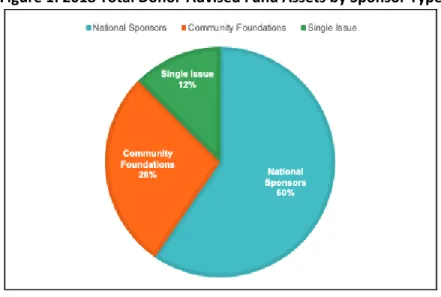
By focusing on community foundations, this research is only looking at a small segment of DAFs. Community foundations only hold 28% of the total DAF assets in the United States (see figure 1).
Figure 1: 2018 Total Donor-Advised Fund Assets by Sponsor Type
Source: Author’s creation with data from the
National Philanthropic Trust’s2019 Donor-Advised Fund Report
Despite holding a relatively small proportion of DAFs overall, looking at community foundations is important because they were the pioneers of DAFs. All DAF sponsors will likely face the repercussions of the changing landscape and sentiment around DAFs. Community foundations have over $30 billion in assets (see figure 2), and over the past couple of years, their payout rates have been between 16-20% of total assets (National Philanthropic Trust’s2019 Donor-Advised Fund Report).
Figure 2: Total Donor-Advised Fund Assets, Gifts, and Grants in Community Foundations
The literature around community foundations and DAFs led to the research questions of this paper. The methodology is explained before looking at the results of the
quantitative content analysis and the qualitative expert interviews. The implications of these results lead to some recommendations for community foundations to consider in their next evolutionary phase.
Section 2: Literature Review
Defining Community Foundations and Donor-Advised FundsCommunity foundations have been around for 106 years in the United States, and DAFs have existed within community foundations for nearly 90 of those years. Looking at the history of community foundations is useful in understanding their purpose within their communities, showing how DAFs work in conjunction with community foundations and their overarching missions.
The Council on Foundations defined community foundations as “grantmaking public charities that are dedicated to improving the lives of people in a defined local geographic area” (2020). Community foundations pool together funds from
corporations and individuals to support nonprofit organizations in their communities. As of 2014, there were approximately 795 community foundations in the U.S., and they range in size from less than $1 million to over $8 billion in assets (Foundation Center, 2014). In 2018, the largest 50 community foundations nationwide held over $86 billion in assets, of which around 17% lies in 50 California-based community foundations (Columbus Survey Results, 2018).
The first community foundation was established in 1914 in Cleveland, Ohio. Before the existence of community foundations, when donors established charitable trusts, it had been difficult to change the charitable purpose of these trusts once the donor was deceased, even if the original purpose was no longer feasible to fund (Colinvaux, 2017a). To get around this issue, a committee of “prominent local public officials and
community leaders” would be formed, which would then “change the purpose of the trust and make distributions if the donor’s intent became obsolete or conditions changed” (Colinvaux, 2017a, p. 8). This was the original iteration of a community
foundation, which essentially enabled the redistribution of charitable funds to the most pressing community needs. While community foundations were focused on long term philanthropy, usually through bequests, other organizations, like the United Way, focused on immediate community needs (Colinvaux, 2017a).
“A philanthropic giving vehicle administered by a charitable sponsor. A
donor-advised fund allows donors to establish and fund the account by making irrevocable, tax-deductible contributions to the charitable sponsor. Donors then recommend grants from those funds to other charitable organizations” (National Philanthropic Trust’s2019 Donor-Advised Fund Report).
The story of DAFs began in the 1930s at community foundations, where donated funds were managed by the foundation, and the original donor could remain involved with dispersing those funds (Colinvaux, 2017b). However, “DAFs remained relatively obscure until the rise of the national sponsoring organization (NSO) in the 1990s. NSOs are public charities with a national focus that administer DAFs as their main activity” (Colinvaux 2017b, p. 45).
There are three different kinds of DAF sponsors: national sponsors, community foundations, and single-issue charities. Fawcett and Jacobs (2019) broke down the different characteristics of each. In their discussion about the NSOs, they described the approach this type of DAF sponsor, “Generally, commercial gift funds may offer
personalized grantmaking services to higher-dollar donors; however, most do not offer local or funding issue expertise and support, nor do they offer networking opportunities with other donors” (Fawcett and Jacobs, 2019, par. 20). Community foundations, on the other hand, “have deep knowledge of community needs and organizations successfully addressing those needs. They have the ability to vet local nonprofit organizations, and they freely share their local knowledge, expertise, and connections with donors” (Fawcett and Jacobs, 2019, par. 6).
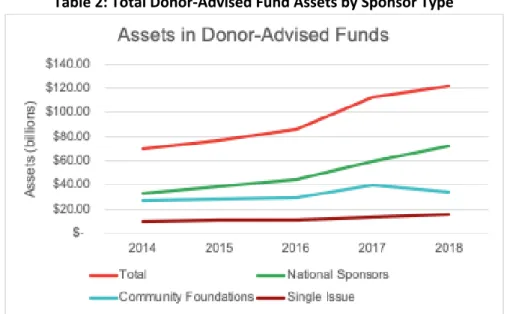
As of 2018, community foundations had over 77,000 DAF accounts, with assets totaling $33.87 billion (National Philanthropic Trust’s2019 Donor-Advised Fund Report). The number of DAF accounts at community foundations continues to grow steadily (see table 1), but not nearly as rapidly as at the national sponsoring organizations (see table 2). “The number of individual donor-advised fund accounts at National Charities grew to 593,356 in 2018 from 339,008 in 2017, an increase of 75 percent” (National
Philanthropic Trust’s2019 Donor-Advised Fund Report). Cantor (2018) reflected that: “most of the growth in donor-advised funds has been occurring not at
community foundations, but at commercial DAF sponsors such as Fidelity Charitable and its dozens of financial services siblings. Community foundations find themselves uncomfortable partners and competitors with a set of
Table 1: Community Foundation Total Reported Assets, Gifts, and Grants 2009-2018
Source: Columbus Survey Results, 2018
Table 2: Total Donor-Advised Fund Assets by Sponsor Type
Source: Author’s creation with data from the
National Philanthropic Trust’s2019 Donor-Advised Fund Report
During a 2018 webinar discussing Giving USA’s Special Report on Donor-Advised Funds, Pam Norley, president of Fidelity Charitable, noted that 50% of accounts are less than $25,000. She also mentioned that Fidelity Charitable’s mission is to broker philanthropy, taking a high tech, app-based approach that makes it easy to give, “similar to shopping on Amazon.” From a higher-level perspective, the average size of donor-advised funds at national charities is $121,937 as of 2018 (National Philanthropic Trust’s2019
Donor-Advised Fund Report). In comparison, the average size of donor-advised funds at community foundations was $438,561 in 2018 (National Philanthropic Trust’s2019 Donor-Advised Fund Report).
Depending on the sponsoring organization, DAFs look quite different. However, the incredible growth of DAFs at the national sponsoring organizations impacts all other sponsoring organizations, including community foundations.
Changing DAF Landscape
The largest change in the DAF landscape occurred when private financial institutions started creating public charities with the sole purpose of administering DAFs. Fidelity Charitable opened in 1991, and other financial institutions followed in creating public foundations and began heavily marketing DAFs to their existing client base. This brought about scrutiny related to the actual public benefit these charities were providing. As Colinvaux (2017b) described: “Because funds raised by the NSO typically are managed by the commercial entity that shares the NSO’s name, there is a question whether the public purpose of raising funds for charity or the private benefit that flows to the commercial firm is dominant” (p. 47).
The first DAF legislation was enacted by Congress in 2006 as part of the Pension Protection Act, requiring grant distributions to go to other public charities (Colinvaux, 2017b). These regulations apply to all DAFs, regardless of sponsoring organization type. However, the regulations for DAFs are still quite minimal, and “Critics of DAFs contend that DAFs face an inherent conflict of interest, hoard money, and should be subject to greater regulation” (Colinvaux, 2017b, p. 50). Criticism surrounding the transparency and accountability of DAFs continues to provoke controversy.
However, it is important to recognize that the growing popularity of DAFs makes it likely that they are here to stay. In the National Philanthropic Trust’s 2019 DAF Report,
“Grants from donor-advised fund accounts at community foundations totaled $6.59 billion in 2018, up from $5.98 billion granted in 2017—a 10.2 percent increase. The compound annual growth rate from 2014 to 2018 was 13.3 percent” (NPT 2019 DAF Report).
Madoff (2018) provided an explanation for the recent growth of DAFs:
“DAF sponsors earn fees for the management of DAF funds. Ever since financial services companies have begun creating DAF sponsors, they have used their considerable marketing skills to fuel their growth. In addition, because individual financial advisors are also able to profit from managing DAF funds, their
influence has assisted the growth of DAFs, as well. This increased public
awareness of DAFs has fueled the growth of all DAF contributions, not just those associated with the financial services industry” (par. 7).
Clearly, it was the proliferation of national sponsoring organizations that brought increased attention to DAFs. Although much of this attention has been negative, the DAF landscape has changed in positive ways as well.
Positive Impacts. Rooney (2017) provided an analysis of DAFs to determine how they are changing the philanthropic landscape. He outlines the primary reason for the growing popularity of DAFs, namely their flexibility, which allows donors to earmark funds for charity without timing pressure, their ability to offset high earning years, and their anonymity allowing donors to bypass traditional philanthropic stewardship if they want. One reason for their growing popularity is that “Commercial charitable gift funds are providing DAFs at extremely low price points” (Kasper, Marcoux, and Ausinheiler, 2014, p. 4). This may be attracting donors who otherwise would not have considered opening this kind of charitable vehicle.
One publication with a positive outlook on DAFs is from the National Philanthropic Trust, which is a non-commercial national DAF sponsor. This organization produces a DAF report annually, with quantitative research related to trends in the field. When discussing the future of DAFs, some key trends are explained, outlining some of the reasons why DAFs have become so popular:
“Donors find donor-advised funds convenient. Sponsors are introducing new models for donor-advised fund giving, including employer-sponsored
donor-advised fund accounts that allow employees to make payroll deductions for charitable giving and/or for employers to match employee giving. Online tools like mobile apps, online transactions and credit card processing have facilitated donor-advised fund giving in unprecedented ways. These changes have led to increased accessibility for donors and charities. Lower dollar minimums to set up a donor-advised fund account have helped drive adoption for younger donors. Mobile applications that easily allow donors either to add to or grant from their donor-advised fund account and tools to help verify
charitable registration for eligible grantees mean donors can respond to charitable impulses quickly using their donor-advised fund” (National Philanthropic Trust’s2019 Donor-Advised Fund Report).
Another positive aspect of DAFs is that they enable donors to be advised by experts on impactful nonprofits. Zerbe (2018) noted that:
“Many charities that manage DAFs provide important and valuable
support—especially those located at a number of community foundations. These charities that embrace managing DAFs and providing value to donors will
highlight specific charities doing important work, foster donations, and
encourage donors to move dollars into the hands of working charities—and also send out warnings of possible bad charities.” (par. 26).
Colinvaux (2017a) also analyzed the changing nature of community foundations as large national sponsoring organizations (NSOs) have gained popularity. Community
foundations are losing donors and are less able to accomplish their mission of
supporting local communities with the competition now felt from DAFs through NSOs. He further explains:
“When the DAF is part of a charity that has other goals, as with a community foundation or single-issue charity, the DAF is not an end in itself but an activity used in furtherance of those goals. As a general matter, donors to these DAF sponsors are attracted to the underlying mission of the sponsor, contributions are earmarked for a particular cause or charity, and the advice offered by donors should fit within the mission of the underlying charity. This was the historic model for the DAF” (Colinvaux, 2017b, p. 61).
Colinvaux (2017b) described three different purposes of DAFs: 1.) they serve as equivalents to private foundations; 2.) they substitute gifts that would otherwise be made individually, and; 3.) they serve as a means of encouraging new donors to contribute more philanthropically. These different perspectives make it difficult to define DAFs broadly. Colinvaux (2017b) argued that community foundations serve a need that NSOs do not, and in order to help community foundations succeed, they must be treated differently from NSOs. Colinvaux (2017a) concluded that due to the different intentions, capacities, and procedures, community foundations should have their own definition, distinguishing them from commercial donor-advised funds. This would enable these community foundations to continue supporting the local community, rather than the broader national interests of their competitors.
DAF Criticism. Much of the criticism about DAFs centers around their lack of transparency and accountability. This negative reaction towards DAFs can be highlighted by this sentiment from Andreoni (2015), who wrote that “Giving is rarely done for purely altruistic reasons” (p. 47).
One primary criticism of DAFs is that the donors get tax benefits for their outright gift to a public charity (i.e. DAF sponsor), and those funds will not necessarily be distributed to an active nonprofit organization right away. Andreoni (2018) looked at whether U.S. tax policies subsidizing DAFs results in a net positive benefit for public charities. He
giving more to charities, but instead, DAFs are used largely to avoid capital gains taxation (Andreoni, 2018). Ultimately, this argument is that the tax benefits are the primary reason behind contributing to a DAF, and these donations would be more valuable to nonprofit organizations if they were given immediately.
Rooney (2017) described more concerns about DAFs, including slow payout rates to charities and the misleading nature of payout rates with double-counting of grants made from one sponsoring organization to another. Since private foundations have a minimum annual distribution requirement of 5% of total foundation assets, some argue that DAFs should have a similar requirement to ensure the funds ultimately go towards a public charity rather than sitting in the account for many years.
Madoff (2018) argued that several steps need to be taken in order to protect taxpayers and nonprofits from the growing popularity of DAFs. These include delaying charitable deductions until grants are made, requiring grants to be paid within a specified time period, preventing private foundations from making annual distributions to DAFs, and making sure that the tax deductions donors receive are equivalent to the amount of public good being provided (Madoff, 2018). Others have echoed many of these ideas as possible legislation that could make DAFs more beneficial to the public.
These potential regulations for DAFs have the community foundations worried. Kridler et al. (2018), a group of community foundation leaders, stated that:
“While we know the recent growth brings scrutiny, we are concerned that some of the most vocal critics of DAFs have not worked directly with donors to
understand their motivations and behaviors. We fear that the most common, broad-brush proposals for reform would have the opposite effect these critics intend: less money going to charity, not more” (par. 6).
On top of this, the potential administrative burden has also been cited as a reason for community foundation reluctance to support new DAF regulations.
Other Considerations. DAFs are not black and white. The arguments criticizing DAFs are valid, but there is also no denying the increasing amount of charitable dollars being contributed to DAFs, even if they may be earmarked for some future date. Given the current financial crisis that has arisen due to COVID-19, it is worth remembering the benefit that DAFs provide during recessions. Heist and
Vance-McMullen (2019) recognized that DAFs are increasingly popular and wanted to determine how grantmaking changes during periods of economic downturns. Their
article concluded that grants continue to flow during economic recessions, and have on average higher payout rates than private foundations. It makes sense that DAFs
continue giving during recessions since the funds are already earmarked for charitable giving. During times of financial stress, the ability for donors to disperse funds that were already donated provides a much-needed flow of charitable dollars when many other donors will need to tighten their belts.
There are certainly administrative issues with DAFs. For example, Rooney (2017) noted that there is a lack of data on measuring DAFs, with concerns of double counting and differing methodologies for calculating payout rates. However, there is evidence that DAF advisors are making more charitable gifts than they would have without this tool. Even though there are accountability issues with DAFs, it is compelling to remember that some charitable giving would be less likely to happen without them. The anonymity of giving through DAFs may be a complication for traditional fundraisers, but if the end result is more donations to charity, perhaps this new approach from DAF advisors can be accepted and appreciated in a different way.
One main part of the discussion of DAF legislation is the distinction between the different kinds of DAF sponsors.
“NSOs with commercial affiliations are poised to succeed. The for-profit firm provides a pre-established donor base in the form of its existing customers and also contributes a powerful brand that both reassures existing customers and attracts new ones. The commercial firm also has an incentive to assist the related NSO because the affiliated commercial enterprise typically manages the charitable gift funds (for a fee), and often bases the compensation of employees of the commercial firm on total funds under management, including funds owned by the NSO” (Colinvaux, 2017b, p. 45-46).
Specifically looking at community foundations, Graddy and Morgan (2006) did not find that community foundations had changed their strategies because of the changing DAF landscape with commercial funds:
“The impact of this changing competitive environment on organizational strategy is not obvious. One might expect that the increased competition would
encourage community foundations to focus more attention on donor services. However, this is not what we observe” (Graddy and Morgan, 2006, p. 617). The analysis of the changing DAF landscape provides a foundation for looking at overarching strategies used by community foundations.
Differing Community Foundation Strategies and Goals
Community foundation strategies are extremely varied, and as Ostrower (2006) stated, “once you’ve seen one foundation — you’ve seen one foundation” (p. 510). Depending on endowment size, staff size and bandwidth, and organizational mission, each
community foundation will take a different approach to donor-advised funds. In the community foundation literature, two articles discuss categorizing the different community foundation strategies. First, there is Graddy and Morgan (2006), which determined three categories of foundations. Second, there is Graves et al. (2014), which identified four different categories of foundations.
Graddy and Morgan (2006) focused their research on community foundations within California and their ability to make strategic plans to better impact their communities. They established a model of three different types of strategies: community leadership, matchmaking, and donor services, which broadly align with each of the different community foundations. Donor services foundations are “primarily positioned to build gift funds by serving financial planners and donors” (Graddy and Morgan, 2006, p. 607). In terms of marketing, “collateral material and Web page content [are] dominated by information about giving, and a majority of staff time [is] spent on donor relations” (p. 608). The matchmaking foundations are primarily intermediaries between donors and nonprofits. The community leadership foundations are seen as the highest level of community foundation status, as they seek “to be a catalyst for change in the
community by participating and leading broader conversations about new policies” (p. 609). Graddy and Morgan concluded that older, more established foundations are more easily able to take on a community leadership role, which is the most effective model for making a larger community impact. However, they found that endowment size was not “found to be important drivers of strategic choice” (p. 624).
Graves et al. (2014) outline four different strategies that community foundations tend to follow. First are the ones labeled “For Good Forever,” which do not see their
relationships with donors as transactional at all. Instead, they want to be effective partners with donors to enhance grantmaking, with more of a focus on growing their endowments and encouraging donors to think about their long-term legacy.
The second type of strategy is called “Fuel For Change,” and these foundations “promote DAFs as a flexible vehicle to meet the needs of local philanthropic leaders with significant resources” (Graves et al., 2014, p. 40). This type of foundation is both positioned as a community leader while focusing on helping donors meet their own priorities. This strategy does not encourage donors to give “to leadership funds, or other
opportunities to partner and get engaged philanthropically” (Graves et al., 2014, p. 40). Instead, it is more about supporting the donor’s desires.
Third, there is the “Leader to Leader” strategy, which seeks to “engage donors who share our values, have aspirations to have impact in our community, are interested in partnering with us, and are able to contribute significant dollars and their own
leadership to achieve shared goals” (Graves et al., 2014, p. 41). This strategy focuses on local impact and will turn away donors that are simply looking for the cheapest
philanthropic giving vehicle. This kind of foundation will have high fees, with the donors understanding that this allows the foundation to support and advise them.
The final community foundation approach described by Graves et al. (2014) is “Diverse, Global and Comprehensive.” These foundations target many types of donors by
approaching them broadly, yet being intentional about how to communicate with the different segments of donors. These foundations position themselves as a
“comprehensive resource for philanthropy and feel good about promoting [their] DAFs as a strong but distinct choice when compared with the flexibility and capabilities of other DAF providers” (Graves et al., 2014, p. 42).
Between the three-category strategic framework from Graddy and Morgan (2006), and the four-category framework from Graves et al. (2014), it is clear that categorizing community foundations can be nuanced. Since the framework from Graves et al. (2014) was based on financial and organizational data that was not easily accessible, this research used the Graddy and Morgan (2006) framework of classifying community foundations as either focused on donor services, matchmaking, or community leadership.
Classifying community foundations is sometimes obvious. Some community foundations make their strategies known in their messaging:
“instead of offering a ‘generic’ DAF, some community foundations send clear messages to donors through the policies and practices they pursue. They are clear about the types of funds they want and don’t want and the type of engagement that represents success” (Graves et al., 2014, p. 31).
Some community foundations may not have such a narrow focus on who would be the best kind of DAF donor. Nico et al. (2007) argued that:
“Many community foundations welcome any and all donors and any and all funds. While this is consistent with a mission to advance philanthropy and serve
donors, an open door policy can pose challenges. If the policy reflects a lack of understanding of the economic implications of all funds, it may ultimately undermine the community foundation’s long-term ability to serve its community” (p. 22).
Part of the reason why community foundations might be more open to accepting a broad range of donors is that they may be trying to build up their assets as a new foundation. Nico et al. (2007) noted that:
“Emerging community foundations often accept small funds for two reasons: so donors of any financial ability can participate in community philanthropy, and so targeted donors can “try out” the organization. Foundations frequently cultivate small funds with such donors in the hopes of receiving a larger gift or bequest in the future. In the present, however, they must be aware of the investment required to administer a large number of small funds” (p. 25).
Sometimes, however, targeting smaller individual donors to open DAFs might be a good way to begin building a relationship with donors that can lead to more fruitful
engagement in the future. In some cases, “donors will gain confidence in the community foundation, grow their funds and leave bequests that yield significant grants for the community” (Nico et al., 2007, p. 25). However, it is also true that there are ways to engage donors that “may not carry the administrative burden of many individual funds” (p. 25).
While studying community foundations and their approaches to DAFs, it is key to recognize that each one can have differing goals, which leads them to different strategies of donor engagement. Graves et al. (2014) outline six aspirations that most community foundations have related to DAFs:
● serve as an entry point to grow flexible assets that benefit the community,
● promote grantmaking to local organizations, ● grow grantmaking dollars,
● align grantmaking in support of community priorities and actively partner to address needs,
● increase future grantmaking by building endowment while also supporting grantmaking today, and
● contribute to sustainability, generating a surplus to support other areas, or at least covering costs (Graves et al., 2014, p. 5).
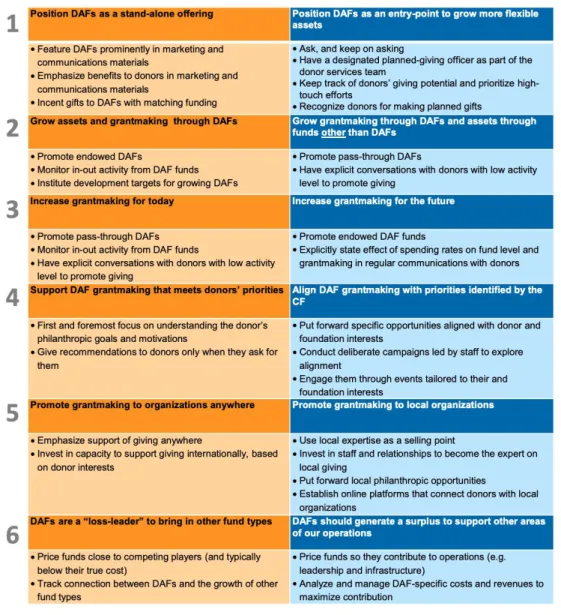
Graves et al. (2014) outline some promising practices related to their DAF strategies (see table 3), but all of the foundations surveyed thought that more could be done. This table shows the different approaches that community foundations take regarding DAFs.
Table 3: Promising Practices Aligned with Strategic Intents
Source: Graves et al. (2014). Do More Than Grow Engagement Strategy: Efficiency and Effectiveness
Looking at the DAF landscape, and understanding the positive and negative aspects of DAFs has laid the groundwork for exploring engagement strategies used by community foundations, specifically addressing the relationship between efficiency and
engagement, the Urban Institute Center on Nonprofits and Philanthropy conducted a survey in 2014 about DAFs at community foundations with the following results:
● 88% of foundations report donors participate in special events sponsored by the community foundation
● 81% of foundations report donors serve on the foundation’s board, or in another leadership role
● 81% of foundations report donors contribute to general or other funds of the community foundation
The survey results indicate that community foundations are largely finding ways to engage DAF donors in a meaningful way, showing that the relationship goes beyond the transactional level. During a 2018 webinar discussing Giving USA’s Special Report on Donor-Advised Funds, Dave Scullin, CEO of Communities Foundation of Texas, noted that DAF donors have a higher likelihood of giving a planned gift. There is clearly a spectrum of donor engagement, and not all community foundations follow the same strategy of working and connecting with their donors.
Defining success among community foundations is difficult since each foundation has differing goals. Generally, the Oxford English Dictionary defines effectiveness as “the degree to which something is successful in producing a desired result.” The key part to consider is the “desired result,” which varies significantly on an individual and
organizational level. Graddy and Morgan (2006) discussed how the donor-centric community foundations are “rooted in a model that measures effectiveness in terms of the grants made to communities” (p. 608). The matchmaking community foundations might look at effectiveness in terms of the ability to connect donors to local nonprofits that are successful in their mission to solve a community need (Graddy and Morgan, 2006).
Ostrower (2006) looked at effectiveness frameworks to understand the heterogeneity of the foundation space. Her “typology of frameworks does not categorize foundations according to any single characteristic, attitude, or practice but according to their overall approaches to effectiveness as reflected across a range of attitudes and behaviors” (p. 511). Ostrower’s research looks at four different measurements of effectiveness, including proactive orientation, technical assistance/capacity building, social policy/advocacy, and internal staff development. All of these categories can be prioritized by foundations in their own definitions of success. This analysis further emphasizes the lack of an easy definition of effectiveness for community foundations.
This research is not only focused on effectiveness, but also efficiency since the changing DAF landscape with commercial funds has led to a more simple way to do philanthropy. Dictionary.com defines efficiency as the “ability to accomplish something with the least
waste of time and effort.
”
This definition in relation to donor-advised funds translates toa cheap, fast, and easy product. From the community foundation perspective on DAFs,
“Little by little, a host of different organizations have been chipping away at what was once primarily the domain of community foundations. Every service can now be
provided by some other player in the marketplace, often better, cheaper, or faster than community foundations” (Kasper, Marcoux, and Ausinheiler, 2014, p. 4).
Guo and Brown (2006) look at effectiveness on two levels: bringing donors in and dispersing grants to nonprofit organizations. The first level of effectiveness in attracting donors is also linked to efficiency since that is how commercial funds have been able to open so many DAF accounts. The second measurement of effectiveness through
allocating funds is more similar to the commonly held view of what defines a foundation’s impact.
While commercial funds have dominated the efficiency scale, effectiveness is more subjective since it depends on the organization’s goals. The efficient model of
donor-advised funds at commercial DAF sponsors would be considered highly effective according to their internal parameters. However, in the nonprofit sector, effectiveness is often seen as equivalent to “impact.” For the scope of this research, the following definitions for efficiency and effectiveness were used in this project.
Efficiency means attracting more charitable dollars, having a lower minimum fee to open a DAF, communicating clearly about DAFs, and providing a user-friendly experience for DAF holders.
Effectiveness means granting more charitable dollars to nonprofits, educating donors about nonprofits, local issues, and philanthropy, and serving as a leader by bringing together community stakeholders.
Research Questions
The findings within the literature have led to the following research questions:
1. What are the strategic approaches of California community foundations?
1a. How do these strategies influence their work with donor-advised funds?
2. What is the relationship between efficiency and effectiveness in community foundation donor-advised funds?
2a. Do community foundation websites reflect the effectiveness and efficiency dynamics in DAFs?
Section 3: Methods and Approaches
To better understand the landscape of community foundation DAF strategies, a content analysis was conducted to review practices. Websites of 30 California-based community foundations were analyzed. These community foundations were chosen because of their affiliation as members of the League of California Community Foundations. This affiliation means that they have a mutual understanding of the role of community foundations, even if they have varying strategic approaches. This group comes together to learn from each other and collaborate on relevant issues that they all face.
The next step of the content analysis process was determining the classification of each of these community foundations by dividing them into three categories of focus areas: donor services, matchmaking, and community leadership. As previously noted in the literature review, these categories were established by Graddy and Morgan (2006), and are widely accepted by community foundations as an accurate delineation in strategy. While it is clear that many of these community foundations strive to address all three focus areas, several measures were used to categorize them. These community
foundations were categorized by looking at mission statements, values statements, and website orientation.
Classifying community foundations by these metrics is difficult. The lines between these three types of community foundations are blurry. Certain foundations might prioritize two out of three, or try to address all three. However, based on the orientation of the website, there are some nuanced ways to determine the strongest priority. Some community foundation professionals might characterize these categories as insufficient. One of the interviewees mentioned that the polar ends of the spectrum across
community foundations go from donor-focused to community-focused (Anonymous Interviewee, personal communication, July 31, 2020).
For the content analysis, the indicators being measured fall under the larger umbrellas of efficiency and effectiveness. As previously defined within the literature review, for the purpose of this research, efficiency relates to the ability to attract charitable dollars, communicating clearly about DAFs, and providing a user-friendly online experience for donors. This research looks at effectiveness as it relates to granting more charitable dollars from DAFs, educating donors about philanthropy and local nonprofits, and serving as a leader by bringing together community stakeholders.
Additionally, nine interviews were conducted in order to provide context to the data found in the content analysis. The individuals approached for this interview either currently work or previously worked directly with DAF clients. Their job titles ranged from CEO to Director of Donor Relations to Director of Philanthropic Services, and
others in between. The terminology for professionals working with DAFs at community foundations is not standardized. The interviewees all work, either currently or formerly, for foundations with a wide range of assets, from $36 million to $8.8 billion. One
interviewee wished to remain anonymous, and the others are listed in Appendix D. These interviews served as a means of further exploring the findings from the content analysis, to better understand why community foundations presented DAFs in the manner in which they were displayed on their websites.
Section 4. Data Analysis
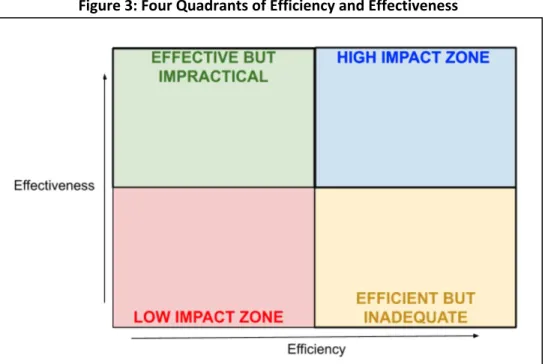
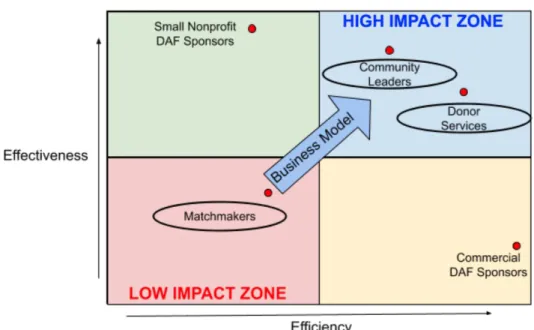
This research was based on the notion that the ways that community foundations can achieve high impact are dependent on a foundation’s ability to be both efficient and effective. There are four quadrants on the efficiency and effectiveness scale where community foundations could be situated (see figure 3). The high impact zone is the ideal place to land, and the low impact zone should be avoided. This zone that is neither efficient nor effective is where community foundations will struggle to remain relevant since they are neither reaching donors in an efficient way nor fully educating and engaging donors about key local issues. The content analysis plots where each community foundation falls on the scale.
Figure 3: Four Quadrants of Efficiency and Effectiveness
Content Analysis
The content analysis was conducted by reviewing the websites of 30 California-based community foundations. A set of indicators was established (see Appendix A), and each foundation was given a score for each indicator. There were seven indicators related to efficiency and seven related to effectiveness. Each indicator was valued at one point, so possible scores ranged from zero to seven.
The final scores were then analyzed by the community foundation classification types. The three classifications were: Donor Services, Matchmaking, and Community
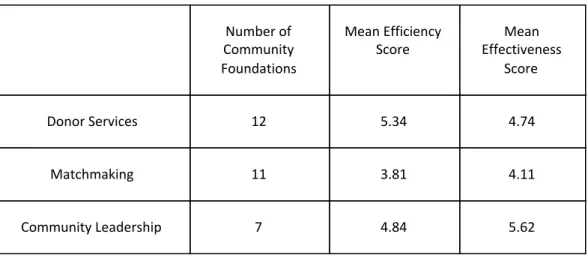
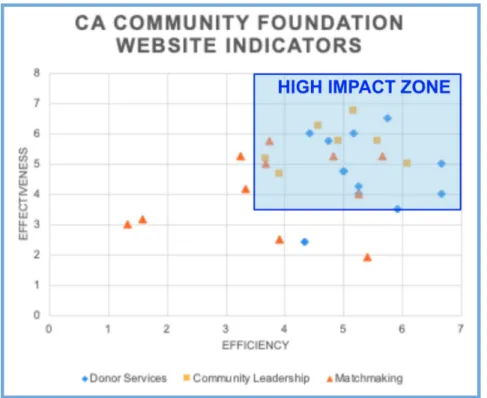
Leadership. The minimum score found for efficiency was 1.33, and for effectiveness was 1.91. The maximum score found for efficiency was 6.66, and for effectiveness was 6.75. The mean scores for each classification are shown below in Table 4, and these results are also mapped out on a scatter plot in Figure 4.
Table 4: Efficiency and Effectiveness Scores by Community Foundation Classification
Number of Community Foundations Mean Efficiency Score Mean Effectiveness Score Donor Services 12 5.34 4.74 Matchmaking 11 3.81 4.11 Community Leadership 7 4.84 5.62
Figure 4: Plot Chart of Community Foundation Efficiency and Effectiveness Scores
Source: Author’s creation
One notable observation is that six out of the seven community foundations that fall outside of the “high impact zone” are matchmaking community foundations. This analysis indicates that some matchmaking organizations are falling short of their potential.
Statistical Results
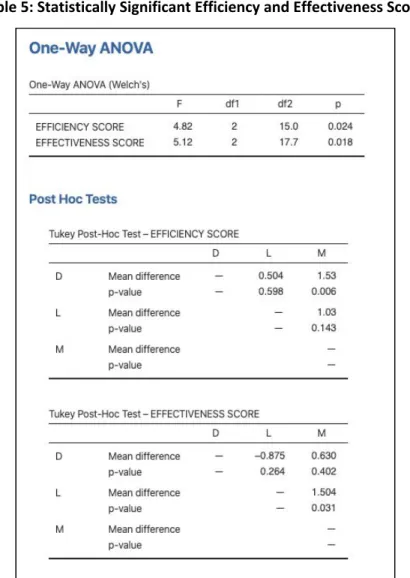
A one-way ANOVA determined that donor services foundations were more efficient, by a significant margin, than matchmaking foundations, and community leader foundations were significantly more effective than matchmaking foundations (see table 5).
Table 5: Statistically Significant Efficiency and Effectiveness Scores
Source: Author’s creation using Jamovi software
Some limitations of this study are worth noting. First, the indicators measured from each community foundation were scored only on what information was found on their website. This external assessment does not always show the full picture of the
foundation’s engagement efforts. Some foundations may have received lower scores than they should have for certain indicators because they do not publish the
information on their websites. For example, foundations with a lower minimum fund amount resulted in a higher efficiency score than foundations with a high minimum fund
amount. Foundations that did not publish minimum amounts received a score of zero for this indicator, since there was no way of knowing this number.
For many of these community foundations, most engagement occurs through individual communication with current donors. Also, if a potential donor calls or emails the
foundation, they would be able to ask clarifying questions and learn more. However, this content analysis reflects what is seen by any potential donor on the website. While this might seem like a superficial level of assessment, it is still important. Especially for young donors, the website of an organization is a critical means of assessment.
Expert Interviews
The interviews conducted captured the perspectives of a variety of relevant actors in the community foundation and donor-advised fund space. Nine experts were
interviewed with a goal of discussing DAFs and community foundations to understand how practices aligned with the results of the content analysis.
The following themes were addressed during these interviews: 1. Community Foundation Strategies
2. Donor Engagement
3. Defining Success as DAF Sponsors
4. Commercial DAF Providers Changing the Landscape 5. Marketing and Website
6. Efficiency and Effectiveness
Community Foundation Strategies. The first question asked in each interview was related to the overall strategy that each community foundation followed, since the literature review revealed just how varied community foundations are when it comes to priorities and goals.
Two of the experts interviewed suggested that there are two kinds of community foundations: those that are more donor-focused and those that are more
community-focused. The donor-centric foundations tend to view themselves purely as intermediaries with the intention of elevating philanthropy in their region. The
community-based approach is on the other end of the spectrum, where foundations always begin thinking about the local region first. Another distinction lies between community foundations that have big endowments and those that do not. Some interviewees believed that many community foundations want to shift into more of a leadership role in their communities, and having a larger endowment makes that possible. This shift is due to the changing DAF landscape, where commercial funds are able to dominate the donor-services end of the spectrum.
One executive from a large community foundation, who asked to remain anonymous, described their organization as much more community-focused. Regarding their work with donors, the interviewee stated, “We view donors as a terrific opportunity to leverage grantmaking dollars to the region and to the issues we find most critical” (personal communication, July 31, 2020). Not only does this foundation focus on the region, but equally important, they have an opinion about the region. The interviewee explained that “post COVID and George Floyd, that role has become increasingly important for us. Nonprofits want us to take the lead.”
Community leadership is one of the categories of community foundations identified in the content analysis. This type of foundation was identified by the orientation of its website as well as its mission and values statements. One hypothesis related to endowments was that community foundations with a larger amount of assets in their endowment than in their DAFs would be more community-focused. A series of one-way ANOVAs showed that endowment size being bigger than DAF size did not automatically make a foundation community-focused. For example, the Marin Community Foundation has a large endowment through the Buck Family Fund, devoted to serving the
community. Despite this, the foundation is considered donor-focused. Linda Sweeney, Senior Director of Philanthropic Planning at Marin Community Foundation, mentioned that their “entire focus over the last five years has been donor engagement and advising” (personal communication, July 27, 2020).
Community foundations that emphasize donor services were a second category identified for the content analysis. One interviewee believed that the younger
foundations with smaller endowment funds had to focus on donor services in order to survive and grow. While this may be one strategy, it became evident that even
donor-focused community foundations can find ways to work with DAF donors in order to support local causes. Jessica Sanchez, Director of Donor Relations at the Santa Barbara Foundation, indicated that their overall strategy stems from strong donor services offerings. Beyond this, she said, “As part of our services, we encourage donors to keep the dollars in Santa Barbara County because that’s where our constituency is” (personal communication, July 28, 2020).
The third category of community foundations identified for the content analysis is matchmaking. The focus here is on connecting donors to effective local nonprofits and serving as an intermediary to help make a positive difference in the local community. Matchmaking foundations want charitable dollars to stay in the region, and they worry that emphasizing DAFs will inevitably lead to donors making grants across the country, and not necessarily focusing on the community needs.
Many interviewees expressed that ideally, community foundations would both be donor-oriented and play a community leadership role. Jackie Downing, former Director of Donor Relations at the San Francisco Foundation, noted that during the Great Recession of 2008, “many endowments lost an enormous amount of money, just when the community’s needs went way up” (personal communication, July 23, 2020). This led to the realization that by providing staff to work with DAF donors and encouraging them to work in partnership with the foundation’s goals, more funds could be directed
towards the most pressing community needs.
Meanwhile, donor services foundations like the Santa Barbara Foundation only started appealing to DAF donors for unrestricted funding more recently. Sanchez and her team “realized that DAF holders are important constituents, and they have the capacity to support the community foundation’s work” (personal communication, July 28, 2020). Another donor services foundation, the Marin Community Foundation, has a different perspective on working with donors on regional issues. Sweeney noted:
“We’re in a really really lucky position because a big chunk of our assets are endowed, and they have that Marin restriction on it. When we’re working with our clients, they can give locally, they can give nationally, or internationally. And for us, it’s all about doing a deep dive and understanding where they’re coming from and what’s important for them” (personal communication, July 27, 2020). There is no one-size-fits-all approach for community foundations. Megan Barber Allende, CEO of the Community Foundation of Mendocino County, expressed that rural community foundations have a different approach from many of their urban or
suburban counterparts. Allende acknowledged that “over half of our county is food and housing insecure. Our endowment is extraordinarily large, considering the economics that we have” (personal communication, July 29, 2020). Because of this, the focus of the foundation is really on connecting donors to local nonprofits that need support. In fact, during her 14 years at the community foundation, Allende says that DAFs were
de-emphasized in order to remain focused on building up the endowment, which supports the most pressing community issues.
Diane Lai, who has been a philanthropic advisor for 9 years, summarized the primary challenge of this research well, “the biggest issue in your research is generalizing a bespoke approach” (personal communication, August 4, 2020). Throughout these interviews, it became clear that there are no easy ways to define community foundation strategies. While the donor services, matchmaking, and community leadership are the three categories of foundations used in the content analysis, there some additional
nuances that must also be understood. These will be described within the thematic discussion of the expert interviews.
Donor Engagement. Many of the interviewees shared similar approaches to engaging DAF donors, whether through email communication, events, or individual philanthropic advising. Donor engagement goes well beyond the website indicators analyzed in the content analysis, like blog posts and annual reports. Multiple experts who were interviewed emphasized how personal DAFs are to the individuals who open them. P. Vien Walker, Director of Donor Engagement at the Rancho Santa Fe
Foundation, explained: “philanthropy decisions are very personal, and they’re different from one person to another” (personal communication, July 24, 2020). Sweeney from the Marin Community Foundation echoes this sentiment, “We really focus on what the client is interested in, and every DAF donor has a philanthropic advisor. Every advisor reaches out to the client depending on their interests. Communication is tailored to the client” (personal communication, July 27, 2020).
Other types of engagement efforts include educational forums to inform DAF holders about community issues and needs. After receiving feedback expressing interest in these kinds of educational events, the Santa Barbara Foundation “began offering nonprofit tours, allowing donors to engage with the organizations they’re supporting” (Sanchez, personal communication, July 28, 2020).
Many community foundations expressed the importance for donors to know that they are a resource and a partner on the donor’s philanthropic journey. The anonymous executive at a large community foundation emphasized, “We don’t want to just open more DAFs. It’s not just about that” (personal communication, July 31, 2020). It is more important to align DAF grants with their own grantmaking priorities. There is
tremendous potential to influence donors to prioritize equity organizations in the local region. At the Rancho Santa Fe Foundation, Walker stated that “We can handle
philanthropic advice, but we can also bring resources together to help causes that can help vulnerable people and make a bigger impact” (personal communication, July 24, 2020).
Engaging donors in a meaningful way is part of the mission of many community
foundations. While this can be accomplished in different ways, the end result is always positive: more support being given to public charities.
Defining Success as DAF Sponsors. With differing strategies around
donor-advised funds, it makes sense that the definition of success is different for each foundation. For community-focused foundations, the anonymous interviewee explained
that “a successful philanthropic advisor will not only make the donor feel like a partner but also influence their grantmaking in the way that makes the most impact in the region” (personal communication, July 31, 2020). For some donor-focused community foundations, like the Santa Barbara Foundation, the definition of success is not so different. Sanchez stated that “success is looking at the dollar amount that is distributed both to the foundation and within the community. If we can get 100% of DAF holders to participate in supporting community needs in our county, that is a big success”
(personal communication, July 28, 2020).
At the Community Foundation of Mendocino County, Allende explained that there are two different perspectives to address when defining success. From the foundation’s perspective, “success is that they’re investing in the community, projects, and
organizations that are making a difference.” From the donor standpoint, “I want them to feel like they got good service from our organization, they felt good about projects they invested in, and I want them to feel like they’re making a difference” (personal communication, July 29, 2020). However, the ultimate success would be if the donor becomes a planned giver, per the foundation’s overarching strategy.
While some criticism of DAFs revolves around the lack of distribution requirements, all of the interviewees expressed that the vast majority of DAF holders are actively making grant distributions, and this is a key value of the foundation. When discussing the legislative efforts for regulating DAFs, Lisa Barr, a DAF professional of six years at
multiple foundations, noted, “nobody has to give money away, and many people don’t” (personal communication, July 31, 2020). Her personal mantra is “to make philanthropy fun and easy, so people do more of it.” Many community foundation professionals seem to agree with this sentiment and tend to worry about the burden that new
requirements might place on the community foundation. From the Santa Barbara Foundation, Sanchez expressed:
“It’s very important that we keep our DAF holders active in terms of distributing and also engagement. We see our relationship with donors more as an
investment with the foundation and partnering with the nonprofit sector, so we are able to meet those needs in the community” (personal communication, July 28, 2020).
At the Marin Community Foundation, Sweeney said that “the biggest definition of our success is the money going out to support nonprofits. Our focus is not stockpiling the assets, but getting them out the door” (personal communication, July 27, 2020).
One of the interviewees, Nicholas Almeida, USF adjunct professor who formerly worked with DAF donors at the Tides Foundation, expressed a unique perspective. He said:
“the textbook answer for success is that your donor’s charitable intent has been satisfied. For me personally, I think donor-advised funds are a unique mechanism that should be used to push the envelope. They should be about investing in things to test new concepts, to test new approaches, and to find solutions that create a more positive impact in the world. The lack of regulations on
donor-advised funds should enable more high-risk, high-reward types of grantmaking, and investments in the world. I think it should be a tool for innovation” (personal communication, July 28, 2020).
Commercial DAF Competition & Landscape. One key purpose of the interviews was to understand how community foundations have shifted their approaches to DAFs since the commercial funds, like Fidelity and Schwab, started dominating the landscape. The overall sentiment among the experts interviewed is that commercial funds have changed the DAF landscape, and community foundations have had to differentiate themselves in order to compete.
From Lai’s perspective, having worked at multiple community foundations, “There is a clear distinction between commercial donor-advised fund offerings and community foundation donor-advised fund offerings. At one point, they were in competition with one another” (personal communication, August 4, 2020). She also explained the changing view about this competition in the last few years and, “instead of competing, they’re trying to own and embrace the unique role a community foundation plays in society in the charitable community.”
One important thing to understand about the commercial funds is that “they have taken over the transactional part of the DAF business. They have so much money to spend on data and systems to where they have lowered the cost of DAFs significantly where we just can’t compete on a price level” (Anonymous interviewee, personal communication, July 31, 2020). Despite the inability to compete on transactions, the commercial funds have inspired changes within community foundations. Originally, when commercial funds were seen as a new competitor that would take the DAF clients away, “many of us invested in technology and worked on efficiency to try to compete on that. On some level, it was a good thing for the field. There’s nothing like competition to up your game” (Anonymous interviewee, personal communication, July 31, 2020).
Community foundations also have to work much harder to open new DAFs because they often do not have a pre-existing relationship with the donors. Commercial funds already
serve as fund managers to their clients, so they have this wide audience to market to, and they have been able to grow much faster than community foundations. Downing explained that the commercial funds and community foundations are serving two different kinds of DAF donors, and “if your giving isn't that big of a focus in your life and you just need a vehicle for it, you're more likely to end up at a commercial fund since they're more visible and cheaper” (personal communication, July 23, 2020).
Downing also described why it is impossible to compare commercial DAF sponsors to community foundations. “The community foundations are the boutique option, so you get a much richer experience. You can't really compare them to the commercial funds — they're so different. One is a McDonald’s, and the other is Chez Panisse”(personal
communication, July 23, 2020). After realizing that they cannot fairly compete with each other, many community foundations are shifting towards that community leadership strategy. The anonymous interviewee noted, “Many are realizing that to distinguish themselves from the commercial funds, they need to move into a leadership role to make the donor feel that they are partnering with someone that is making their region a better place for everyone” (personal communication, July 31, 2020).
The Marin Community Foundation still sees commercial funds as competitors but acknowledges that its offerings are very different. Sweeney even said that “after speaking to certain prospective clients, I might refer them to Fidelity or Schwab if they don’t need any advice or research help and want the cheapest option. We’re not trying to be all things to all people.” (personal communication, July 27, 2020).
Walker, at the Rancho Santa Fe Foundation, had a similar sentiment:
“There’s no way we can compete with the fees of Fidelity, but the distinction is that they aren’t in our community. We keep donor dollars in the community, and we know the nonprofits that are here. Our purpose is to connect our donors with the local issues here. We are not trying to be the cheapest thing — it’s a
boutique-style service where we know the clients individually, and we know the nonprofit fundraisers and leadership” (personal communication, July 24, 2020). Almeida explained another reason why commercial funds might be popular in the Bay Area in comparison with community foundations as DAF sponsors. “Many individuals in the Bay Area that are opening up DAFs are probably younger people going through a tech IPO” (personal communication, July 28, 2020). Many of them lack the experience to know what issues and organizations they are passionate about. Commercial funds offer them “a product of convenience” that allows them to make smaller grants and postpone designating funds to charities.
One additional perspective addressed in the interview with Lai was that DAF sponsors view “engagement with donor-advised funds as a spectrum from transactional to relational” (personal communication, August 4, 2020). This spectrum means that more transactional DAFs allow for lower fees, while more relational DAFs require higher fees to compensate for the added costs of professional philanthropic advising. Lai notes that “there hasn’t really been an overall trend, but community foundations have really worked toward being more thoughtful in their approach based on their donor
population and who they’re serving and why they’re serving” (personal communication, August 4, 2020).
Community foundations, even those focused on donor services, no longer seem persuaded to compete directly with commercial funds. Sanchez intentionally markets them by saying, “Yes, fees are higher, but these fees are ultimately going to be distributed to your community. They’re making a difference in your community” (personal communication, July 28, 2020).
It is also important to understand how rural community foundations feel about the DAF competition with commercial funds. According to Allende of the Community Foundation of Mendocino County, the commercial funds probably have contributed to their smaller number of DAFs. However, this “hasn’t been too much of a negative” for them since they are explicitly de-emphasizing DAFs (personal communication, July 29, 2020). Allende does not want smaller DAFs opening up at the foundation because they do not make sense for the foundation or the donor.
Marketing and Website. Barr stated that “websites are very important, and community foundations are getting savvier. There’s an expectation that when you’re looking for information, it should be findable” (personal communication, July 31, 2020). This was the underlying assumption in the content analysis, that website
communication should be clear and informative.
Downing noted that “You can tell a lot about the orientation of a community foundation by their website” (personal communication, July 23, 2020). If the majority of a
foundation’s resources are oriented towards its community leadership work, then the website will be less obviously geared towards donors.
The donor services community foundations often designed their websites to be
engaging to donors. At the Santa Barbara Foundation, Sanchez said that a lot of thought went into their website rebranding a couple of years ago, and they “wanted to make sure that the content was clear and could be understood by anybody who approached