RESEARCH
perspective
NCT’s journal on preparing parents for birth and early parenthoodIssue 31 June 2016
Peer support: how do we know
what works?
Heather Trickey, NCT Senior Researcher and Research
Associate at DECIPHer, Cardiff University, considers
challenges to interpreting the evidence base
What is the idea behind peer support?
Peer support interventions engage people who have had personal experience of an emotional, social or health issue to provide non-professional help to others who are facing a similar issue (see box). Peer support interventions recognise that some forms of help are more acceptable and/or more
effective when the relationship is not a professional one. They also recognise that not everyone can find the informal help they need from within their existing networks and that sometimes there is a need to bridge the gap between support from family and friends and the health service.
The idea of enabling ordinary people to feel confident to help one another, drawing on their own experience, has been applied across health care
settings and underlies the core work of many voluntary organisations, including NCT. Dennis1 talks about a spectrum of peer support from
para-professionals (lay workers with extensive training) to natural peers (existing friends and family). This breadth is reflected in the work of NCT.1 Antenatal
teachers, breastfeeding counsellors, and postnatal leaders are selected for extensive training partly on the basis of their own experience. NCT also provides shorter peer support training courses to enable a greater number
of parents to help others with respect to specific issues. At the other end of the ‘training’ spectrum, NCT promotes the creation of informal parent-to-parent networks via classes, volunteer groups, shared-experience registers, a national volunteer network and via social media.
Commissioners responsible for perinatal and public health increasingly
recognise the potential of peer support to improve health outcomes. Currently, NCT is commissioned (i) to provide peer support interventions to help parents from more vulnerable backgrounds (for example refugees and asylum seekers, younger parents, and those who have experienced abuse) along the transition to parenthood, (ii) to provide help focused on feeding a baby and (iii) to improve women’s mental health around the time of pregnancy.
Bringing the evidence together
Anyone involved in receiving, delivering, designing or commissioning peer support will have an interest in the evidence base, in understanding ‘what
works’. A range of approaches to evidence synthesis have been applied to
studies of peer support interventions.
Syntheses of experimental evidence compare outcomes across studies of
people who have been randomly allocated to intervention or to study control groups. The aim is to determine an independent intervention ‘effect’ on pre-specified outcomes. Syntheses can be narrative, or can include statistical combination methods. A finding across several studies that intervention X is (or is not) associated with outcome Y will help to build a picture of intervention strength and generalisability. Researchers will look across
studies to explore whether an intervention tends to be more successful when it has particular components (e.g. frequent contacts) or when delivered in particular contexts (e.g. within UK populations), though it is difficult to break down statistical analysis beyond a few categories without losing power. Broadly, experimental studies ask ‘did it work?’ and, on the face of it, this is the question we most want answered.
Syntheses of qualitative and process studies draw on interview, focus
group, or observational data, perhaps combined with survey data or monitoring information to tell us about the experience of those effected by peer support and to identify factors that help or hinder delivery. They can help to build theory about how peer support is actually working.
Qualitative studies may not be linked to a specific peer support intervention. Alternatively, they may be used as the main method of evaluating an
intervention, or carried out alongside an experimental study as part of a process evaluation to help researchers interpret experimental findings. Findings from qualitative studies can be systematically combined
through review. Qualitative studies and process studies often ask ‘how
was the intervention experienced?’ and look at implementation, take-up,
idiosyncrasies and unintended effects, to ask ‘what happened in practice?’
What is peer support?
‘The provision of emotional, appraisal, and informational assistance by a created social network member who possesses experiential knowledge of a specific characteristic or stressor and similar characteristics as the target population’.1
Realist synthesis is based on the belief that it is nonsense to try to separate
out complex interventions, such as peer support, from their delivery context. Realists do not combine studies to look at overall strength of effect, but seek to understand what the underlying processes of change actually are in any given context and why they are triggered in some circumstances and not in others. Realists look to identify changes in the thinking of the people touched by an intervention – the ‘generative mechanisms’ – that cause them to act in ways that they would not otherwise have done, thereby changing the context and so leading to different outcomes. Evidence synthesis occurs through realist review, which incorporates studies of all methodological types in order to develop and test theories about the mechanisms that tend to be triggered in certain contexts. Rather than questioning ‘what works?’ realists ask: ‘how did the intervention work in this context, with this population and in relation to these observed outcomes?’ and ‘what are the transferrable lessons?’
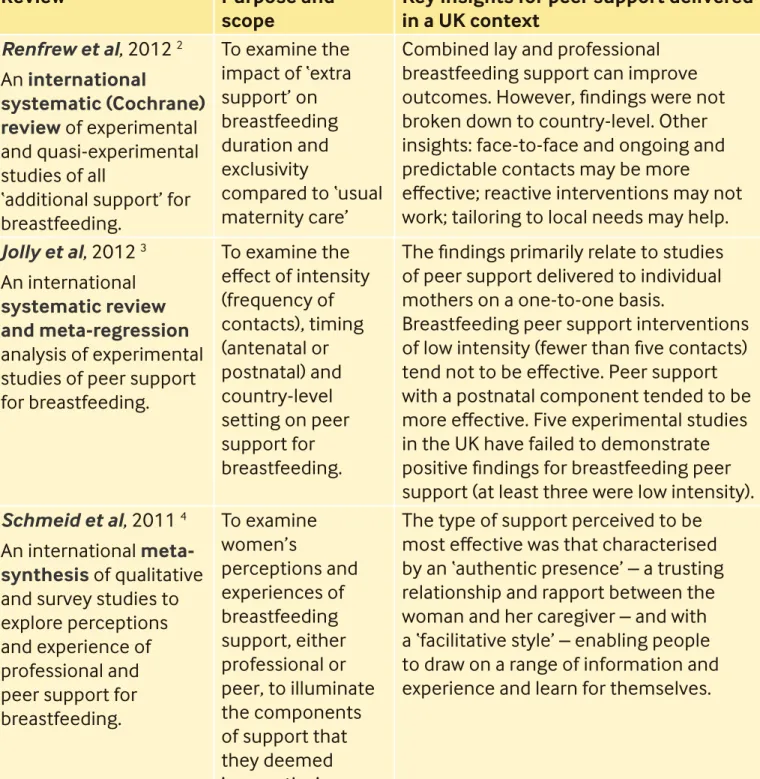
Different approaches to evidence synthesis have their own quality standards and can contribute to our understanding in many ways. An illustration of the various insights that can be drawn from applying different lenses to the peer support evidence base is given in Table 1.
Table 1. The varied sorts of insights arising from different forms
of evidence synthesis around peer support and infant feeding
Review Purpose and scope
Key insights for peer support delivered in a UK context Renfrew et al, 2012 2 An international systematic (Cochrane) review of experimental and quasi-experimental studies of all
‘additional support’ for breastfeeding. To examine the impact of ‘extra support’ on breastfeeding duration and exclusivity compared to ‘usual maternity care’
Combined lay and professional breastfeeding support can improve outcomes. However, findings were not broken down to country-level. Other insights: face-to-face and ongoing and predictable contacts may be more
effective; reactive interventions may not work; tailoring to local needs may help.
Jolly et al, 2012 3
An international
systematic review and meta-regression
analysis of experimental studies of peer support for breastfeeding. To examine the effect of intensity (frequency of contacts), timing (antenatal or postnatal) and country-level setting on peer support for breastfeeding.
The findings primarily relate to studies of peer support delivered to individual mothers on a one-to-one basis.
Breastfeeding peer support interventions of low intensity (fewer than five contacts) tend not to be effective. Peer support with a postnatal component tended to be more effective. Five experimental studies in the UK have failed to demonstrate positive findings for breastfeeding peer support (at least three were low intensity).
Schmeid et al, 2011 4
An international meta-synthesis of qualitative and survey studies to explore perceptions and experience of professional and peer support for breastfeeding. To examine women’s perceptions and experiences of breastfeeding support, either professional or peer, to illuminate the components of support that they deemed ‘supportive’.
The type of support perceived to be most effective was that characterised by an ‘authentic presence’ – a trusting relationship and rapport between the woman and her caregiver – and with a ‘facilitative style’ – enabling people to draw on a range of information and experience and learn for themselves.
Review Purpose and scope
Key insights for peer support delivered in a UK context Dykes, 2005 5 A UK-based review of process evaluations of community-based peer support interventions in low-income settings. To synthesise common themes across peer support projects, highlight innovative ways of delivering services, develop best practice, and illustrate issues related to sustainability.
Primarily relating to group-based peer support, the results indicate that projects will be more successful if they are:
aligned to local culture and facilitate local networking; address the needs of health professionals and make time for co-ordination; have clear guidelines for selection, training and supervision of peers and provide training on a rolling basis; market the peer support well and have multiple access points for mothers; embed evaluation; work towards a
sustainable funding basis.
Harris et al, 2015 6
A primarily
UK-based realist review
of community
engagement models of peer support to improve health literacy across a range of
health topics (including breastfeeding). To understand the potential of community-based peer support in order to help people understand and act on health information.
Peer support is more effective when local people are involved in design and peers use their autonomy to deliver culturally-tailored support. Peers should have ongoing supervision. Peer support works better to promote health literacy when peers have something in common with participants, get participants involved in social networks to discuss problems, and allow participants to discuss a range of topics, not just health.
Challenges to interpretation of
evidence syntheses
Interpretation challenges arise because peer support is (i) loosely defined; (ii) complicated, because it involves myriad design decisions; and (iii) complex, because by touching so many people the peer support intervention itself can change the wider context in which it is embedded. The latter may
occur, for example, through the incidental up-skilling of relatives and health professionals, or a change in the facilities or focus of an existing organisation due to increased funding. The failure to take these changes into account, and an over-reliance on ‘headline’ findings from reviews, can lead to premature conclusions as to whether peer support can be expected to ‘work’.7
Who is a peer? The commonly used definition provided by Dennis1
leaves plenty of room for interpretation. The use of peer support implies that similarities between supporter and supportee matter, as these will help a trusting relationship to form. But what exactly is meant by ‘similar characteristics’? Do we mean social group, local area, age, education, or sense of humour? What sort of length or extent of ‘experiential knowledge’ is necessary? Does a mother supporting another with a perinatal mental health issue need to have experienced the same mental health problem? And does it matter how long ago? How much and what type of training will be necessary to integrate and augment experience? Interventions vary in the emphasis they place on ‘matching’ peers and the extent to which ‘peerness’ is considered an active ingredient in the intervention.
One-to-one or group-based? Most experimental studies of peer support are
of support delivered by peer supporters to individual mothers on a one-to-one basis. In contrast, much of the perinatal peer support currently delivered
across the UK (some of which has been subject to qualitative and process evaluation) is group-based. At least some element of mutual support is
intended to take place between participants who have had no special training but who have been deliberately brought together on the basis of their
common and ongoing experiences. These different forms of peer support are likely to work in very different ways and to be subject to different challenges. They will probably require different approaches to evaluation and be
associated with different sorts of outcomes. Therefore, we should be cautious in transferring findings from one form of support to another.
A thousand design differences. Design decisions are based on many
factors: the requirements of commissioners, the literature on effectiveness, hunches and experience of stakeholders about what is valued, and practical and financial constraints. Who should the intervention reach - all the parents living in an area, those experiencing severe problems, mothers in poverty, young mothers? When should the peer make contact with the mother, and how - face-to-face, over the telephone, by text? Should she be proactive or wait for the mother to call, or to turn up at a group? How frequently should the contacts be? And when? Should the peer support training have an
explicit underlying philosophy (e.g. person-centred counselling)? Or is there an underpinning conversational approach (e.g. motivational interviewing)? All this variation complicates attempts to bring together findings from experimental studies. Crude stratification according to a small number of design criteria fails to incorporate the full complexity.8
Context matters. A peer support intervention will only ever be part of a
package of influences that work in favour or against a desired health goal. If we imagine a community-level change in a health behaviour as being like depending on a number of cogs all working together, it will be important to know what other parts of the machine need to be in place before the peer support cog can be turned to produce a change in outcomes. For example, existing high background rates of breastfeeding may be a pre-condition allowing ‘additional support’ to achieve improved rates in the short term.2
It may be that in areas with lower background rates the primary function of peer support is to contribute to a change in the context (such as beliefs, attitudes or resources) that will eventually allow another part of the system to make a sustained difference. Or, it may be that without the right context a peer support intervention will fail to gain traction. Non-experimental
studies can help identify the components of context that matter (e.g. existing services, organisational buy-in, local leadership, a legislative framework).
The ways in which these components interact that will allow peer support to make a difference.
Unsuccessful implementation. Well-conducted experimental studies
of peer support are evaluated on the basis of ‘intention-to-treat’, in other words they test whether there was a difference between the intervention study population and the control population, regardless of whether the intervention population actually received peer support as intended. This analytical approach is important because (i) it allows evaluators to
understand effectiveness in the real world where implementation challenges have to be overcome; and (ii) it retains randomness of allocation in the
studies of breastfeeding peer support have demonstrated problems with implementation (poor take-up, or insufficient peer-mother contacts) and some have raised questions of ‘contamination’ (the control group
receiving some of the intervention) or ‘displacement’ (existing services over-compensating with more support for the control group). When interpreting the evidence from experimental studies it is important to be aware of these problems because they suggest that this intervention may have been difficult to deliver (at least under study conditions) and also that a ‘fair trial’ of the underlying theory of the intended intervention may not have taken place. We can’t know what might have happened if participants had received the intervention as intended.
Lack of theory of change. Often reports of peer support interventions
do not set out an explicit theory about how the intervention is supposed to work, but will have various hunches, ideas and beliefs. Perhaps the key ingredient is expected to arise directly from the relationship between parent and peer, causing a mother to feel better able to cope with her individual circumstances. If so, how? And why? Alternatively (or additionally), peer support is perhaps expected to lead to better inter-disciplinary working, mutual-problem solving across groups of mothers, raised awareness of an issue within a social network, and wider cultural change. How will we know if the processes we expect are happening in practice? How do we expect different sorts of intermediate outcomes to contribute to end goals? What timescales are appropriate for measuring different outcomes? Absence of a clear intervention theory and poor inclusion of expected intermediate outcomes can lead to a lack of congruence between peer support design, implementation and evaluation in individual studies. It may also lead to very different interventions being inappropriately grouped together for the purposes of review. This can be deeply frustrating for stakeholders who may be left feeling that an evaluation, or review of evidence, has failed to consider all the relevant outcomes, or has drawn an inappropriate conclusion.
Towards better interpretation
Evidence to inform the design and delivery of peer support interventions can be garnered from a range of methodological approaches, which can be combined through different forms of evidence synthesis. Findings from experimental studies alone cannot tell us what we need to know about whether peer support will ‘work’. Indeed, given the variety of peer support approaches, trying to answer the simple question ‘does it work?’ may be unhelpful without further specifying what ‘it’ is. Although experimental studies can help us to know whether a certain form of peer support was effective in a given context, difficulties in transferring lessons learned arise from the heterogeneity in intervention design, the complex relationship between peer support and context, common problems with implementation, and lack of theory underpinning the intervention design.
There is a need to break the cycle of under-specification. Commissioners should ensure that descriptions of peer support indicate how the
intervention is intended to work and the range of intermediate and longer-term changes that are expected to result in the given context. Interpretation of individual studies will be improved by inclusion of a detailed description of the components of a given intervention and of the usual care context in
which it is embedded, as well as the theories of change that underpin the intervention. The latter should be shared by all stakeholders involved in the giving and receiving of peer support. Ideally local stakeholders should participate in the intervention design, and theories of change reviewed as the intervention becomes embedded. Evaluation should seek to capture intended and unintended processes and outcomes.
References
1. Dennis CL. Peer support within a health care context: a concept analysis. Int J Nurs Stud 2003;40(3):321-2.
2. Renfrew MJ, McCormick FM, Wade A, et al. Support for healthy breastfeeding mothers with healthy term babies. Cochrane Database Syst Rev 2012;Issue 5. Available from: DOI: 10.1002/14651858.CD001141.pub4.
3. Jolly K, Ingram L, Khan KS, et al. Systematic review of peer support for breastfeeding continuation: metaregression analysis of the effect of setting, intensity, and timing. BMJ 2012;344. Available from: http://www.bmj.com/content/344/bmj.d8287.long Accessed on 3 May 2016
4. Schmied V, Beake S, Sheehan A, et al. Women’s perceptions and experiences of breastfeeding support: a metasynthesis. Birth 2011;38(1):49-60.
5. Dykes F. Government funded breastfeeding peer support projects: implications for practice. Matern Child Nutr 2005;1(1):21-31.
6. Harris J, Springett J, Croot L, et al. Can community-based peer support promote health literacy and reduce inequalities? A realist review. Public Health Research 2015;3(3).
7. Thomson, G and Trickey, H. What works for breastfeeding peer support - time to get real. Eur Med J. Gynaecol Obstet 2013;(1):15-22.
8. Trickey, H. Peer support for breastfeeding continuation: an overview of research. Perspective 2013;(21):15-20. Available from http://bit.ly/1sF5C5I Accessed on 20/5/16
Heather Trickey is a PhD student and Research Associate at DECIPHer, University of Cardiff, and a research manager for NCT. Her research interests relate to the effectiveness, experience and ethics of
interventions to improve public health outcomes in pregnancy, birth and early parenthood. Her PhD research explores the theory underpinning community-based interventions which aim to support breastfeeding and other forms of infant feeding.