Montreal
February 2006
© 2006 Pierre-Paul Lemyre, Richard Willemant. Tous droits réservés. All rights reserved. Reproduction partielle permise avec citation du document source, incluant la notice ©.
Short sections may be quoted without explicit permission, if full credit, including © notice, is given to the source
Rapport de projet
Project report
2006RP-04
The Legal Issues Surrounding Free
and Open Source Software:
Challenges and Solutions for the
Government of Québec
Pierre-Paul Lemyre, Richard Willemant
Part of a RESOLL study conducted and translated for the
Treasury Board of Canada Secretariat
CIRANO
Le CIRANO est un organisme sans but lucratif constitué en vertu de la Loi des compagnies du Québec. Le financement de son infrastructure et de ses activités de recherche provient des cotisations de ses organisations-membres, d’une subvention d’infrastructure du Ministère du Développement économique et régional et de la Recherche, de même que des subventions et mandats obtenus par ses équipes de recherche. CIRANO is a private non-profit organization incorporated under the Québec Companies Act. Its infrastructure and research activities are funded through fees paid by member organizations, an infrastructure grant from the Ministère du Développement économique et régional et de la Recherche, and grants and research mandates obtained by its research teams.
Les organisations-partenaires / The Partner Organizations PARTENAIRES
. Alcan inc. . Banque du Canada
. Banque Laurentienne du Canada . Banque Nationale du Canada . Banque Royale du Canada . Bell Canada
. BMO Groupe financier . Bombardier
. Bourse de Montréal
. Caisse de dépôt et placement du Québec . Fédération des caisses Desjardins du Québec . Gaz Métro
. Hydro-Québec . Industrie Canada
. Ministère des Finances du Québec . Pratt & Whitney Canada
. Raymond Chabot Grant Thornton . Ville de Montréal
. École Polytechnique de Montréal . HEC Montréal
. Université Concordia . Université de Montréal . Université du Québec
. Université du Québec à Montréal . Université Laval
. Université McGill . Université de Sherbrooke ASSOCIÉ À :
. Institut de Finance Mathématique de Montréal (IFM2) . Laboratoires universitaires Bell Canada
. Réseau de calcul et de modélisation mathématique [RCM2]
. Réseau de centres d’excellence MITACS (Les mathématiques des technologies de l’information et des systèmes complexes))
The Legal Issues Surrounding Free
and Open Source Software:
Challenges and Solutions
for the Government of Québec
Pierre-Paul Lemyre, Richard Willemant
Abstract
The Government of Québec is slowly but surely turning its attention to the issue of free
and open source software in response to the interest shown by Québec’s software industry
and the attention paid to the phenomenon by governments around the world. This
openness is easy to understand given an environment in which online service provision to
citizens must be enhanced while minimizing expenditures on technology, curtailing
service providers’ control over the administration, and promoting the development of the
information society in Québec. Nonetheless, as we see in the news, adoption of this new
attitude toward to software development is not always immune to legal challenges.
Consequently, the manner in which Québec law interacts with free and open source
software, as well as the associated risks, assume a particular significance.
The analysis we present here reveals that the law, as it currently stands in Québec,
appears adequate to effectively address the various legal issues inherent in the use of free
and open source software. First of all, no legal rule seems to be incompatible with the
validity of free and open source licences, despite that fact that few of them were designed
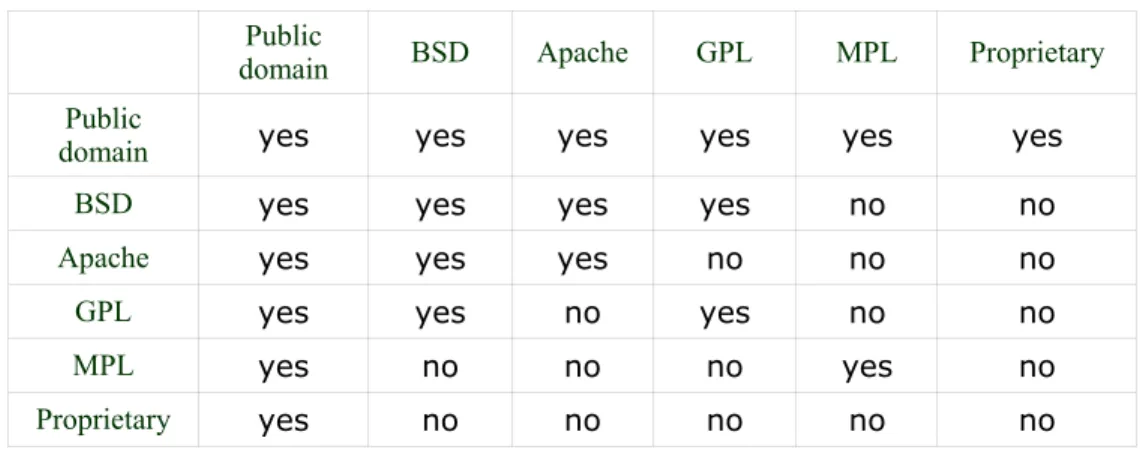
with the Québec legal system in mind. Moreover, both federal copyright rules and
Québec regulations affecting contractual liability allow the authors and users of free and
open source software to effectively preserve the freedom of computer code, which is
typically the purpose of free and open source licences.
Nonetheless, it remains the case that some legal risks are associated with free and open
source software. These risks may arise from the formalism requirements included in the
Copyright Act, prior violations of intellectual property rights by third parties, or simply
from the broader contractual protection afforded to licensors. Consequently, integrating
free and open source software into the technology strategy of the Government of Québec
requires setting up some initiatives to allow these risks to be mitigated as much as
possible and to enable the management of those risks that cannot be completely
eliminated.
1.
Executive summary
[1] The Government of Québec is slowly but surely turning its attention to the issue of free and open source software in response to the interest shown by Québec’s software industry and the attention paid to the phenomenon by governments around the world. This openness is easy to understand given an environment in which online service provision to citizens must be enhanced while minimizing expenditures on technology, curtailing service providers’ control over the administration, and promoting the development of the information society in Québec. Nonetheless, as we see in the news, adoption of this new attitude toward to software development is not always immune to legal challenges. Consequently, the manner in which Québec law interacts with free and open source software, as well as the associated risks, assume a particular significance.
[2] The analysis we present here reveals that the law, as it currently stands in Québec, appears adequate to effectively address the various legal issues inherent in the use of free and open source software. First of all, no legal rule seems to be incompatible with the validity of free and open source licences, despite that fact that few of them were designed with the Québec legal system in mind. Moreover, both federal copyright rules and Québec regulations affecting contractual liability allow the authors and users of free and open source software to effectively preserve the freedom of computer code, which is typically the purpose of free and open source licences.
[3] Nonetheless, it remains the case that some legal risks are associated with free and open source software. These risks may arise from the formalism requirements included in the Copyright Act, prior violations of intellectual property rights by third parties, or simply from the broader contractual protection afforded to licensors. Consequently, integrating free and open source software into the technology strategy of the Government of Québec requires setting up some initiatives to allow these risks to be mitigated as much as possible and to enable the management of those risks that cannot be completely eliminated.
2.
About the authors
[4] Pierre-Paul Lemyre is International Projects Manager at LexUM,1 the legal
software team of the Centre de recherche en droit public (the public law research centre) at the Université de Montréal. In this position he has developed and overseen many projects about the dissemination and management of legal information. His recent accomplishments include Droit francophone, the legal portal of the Agence intergouvernementale de la francophonie, JuriBurkina, the Legal information Center of Burkina Faso, and the report Feasibility Study for a Telecommunication Decision Database, completed for the World Bank and the International Telecommunication Union.
[5] A lawyer by training, he has been interested in free and open source software and its impact on the legal world for many years. His Master’s thesis in information technology law was titled Les logiciels libres sous l'angle de la responsabilité civile
(Free software from the perspective of public liability). He also had the opportunity, in 2000 and 2002, to be invited as a speaker at the conference Rencontres mondiales du libre, in Bordeaux.
[6] Richard Willemant is a member of the Paris bar association. A lawyer by training, he is currently working on an LL.M. (Master’s of Law) degree at Montréal’s McGill University in the Institute of Comparative Law.2 In France, he holds a Master’s
(DESS) in Multimedia and Computer Law (Université Paris II Panthéon-Assas) and a Master’s (DEA) in contract and property law (Université Paris I Panthéon-Sorbonne). [7] His interest in free and open source software dates from a collaboration with Maître Christiane Féral-Schuhl, an associate in the Salans law firm (Paris), for whom he conducted an analysis of the validity and impacts of free and open source licences under French law. He also contributes to the l'ADIJ (Association pour le Développement de l'Informatique Juridique), which, among other things, deals with e-administration.
1LEXUM, source : <http://www.lexum.umontreal.ca>.
3.
Table of Contents
1. Executive summary ... i
2. About the authors ... ii
3. Table of Contents ... iii
4. Introduction ... 1
5. Free and open source software and the law ... 6
5.1. The legal protection of software...6
5.2. The different types of software licences ...9
5.3. Free licences vs. open source licences ... 12
5.4. Non-copylefted free and open source licences... 14
5.5. Copylefted free and open source licences ... 16
6. The legal validity of free and open source licences... 19
6.1. The discussion on the international level ... 19
6.2. Québec law ... 25
7. Intellectual property ... 33
7.1. The protection of the copyright owner ... 33
7.2. Establishment of the chain of title ... 38
7.3. Conflicts between licences ... 43
7.4. Software patents... 47
8. Contract ... 51
8.1. The legal designation of the licence contract... 51
8.2. The obligations of the parties ... 54
8.3. Exemption clauses... 61
8.4. Consumer Protection... 64
9. Recommendations... 67
9.1. Accounting for pre-existing contractual agreements during the elaboration of migration plans ... 67
9.2. Elaborating a procedure for accepting free and open source licences... 67
9.3. Elaborating a procedure for granting free and open source licences ... 69
9.4. Adopting a consistent policy regarding software patents... 70
9.5. Adopting mechanisms for the management of legal risk ... 71
9.6. Renouncing to the adoption of a free and open source software promotion law 72 10. Conclusion ... 75
12. Caveats... 77
4.
Introduction
[1] Like all societies, Québec depends to a large extent on the pooling of free and open resources. The most important of these resources is undoubtedly the French language. No one has an exclusive claim on the words, no one controls their use, and yet our language continues to evolve and develop to the benefit of many enterprises. The same can be said of scientific research and, more broadly, of public goods such as highways and municipal parks.3
[2] However, when confronted with the prospect that this same principle could apply to software, the vast majority of people are initially mystified, even stunned. It is easy for us to accept that language can be used freely and that the results of scientific research are made available to all, but many feel that software must necessarily be proprietary.
[3] However, this vision is not shared universally. The extent of the free and open source software movement in recent years illustrates that fact very well. In fifteen years, this new approach to software development has gradually transformed the software industry by making available reliable and robust applications, such as the GNU/Linux operating system, while simultaneously attracting billions of dollars in investment.
[4] Far from remaining on the margins, Quebeckers have contributed actively to the development of free and open source software. In all likelihood, this is one of the elements underlying the interest shown in the domain by the Government of Québec in the framework of its online government program. This openness to the free is easy to understand, given a context in which online service provision to citizens must be enhanced while minimizing expenditures on technology, curtailing service providers’ control over the administration, and promoting the development of the information society in Québec.
[5] The Government of Québec is not the first to show an interest in, and to examine, the role it should play with respect to free and open source software. Thus, certain governments, such as those of Venezuela4 and Canberra Territory in
3Lawrence LESSIG, Free Culture, Penguin Press, New York, 2004; Lawrence LESSIG, The Future of Ideas:
The Fate of the Commons in a Connected World, Vintage, New York, 2002.
4Gregory WILPERT, “Venezuela’s Public Administration to Use Open Source Software”, (2004)
Australia,5 have already adopted statutes requiring the public administration to use
free and open source software whenever feasible. A bill with similar provisions has also been proposed in Peru.6 Other countries, such as France, have created agencies
with the specific purpose of integrating free and open source software into their administrations. Elsewhere, official policies recommending the use of free and open source software have been elaborated (European Union, Israel).
[6] However, these various governmental experimentations from around the world have demonstrated that this new attitude vis-à-vis software development can create difficulties. This is particularly true in the legal domain, for which recent events have provided numerous examples.
[7] Without question, the most celebrated of these examples is the legal dispute between SCO and IBM, which gradually spread its tentacles until it engulfed the entire free and open source software community. SCO, owner of the operating system UNIX, alleged that IBM committed several offences, including the divulgation of trade secrets and breach of contract, by integrating its proprietary code into the free and open source operating system GNU/Linux. Going even further, SCO took steps to collect royalties from 1500 companies using GNU/Linux, invoking a violation of its intellectual property rights. The most recent turn of events in this legal imbroglio has raised questions regarding the constitutionality of the General Public License7 (GPL) in the United States—a licence under which SCO itself distributed its
own operating system for several years.
[8] Questions about the validity of the GPL have also arisen in France, especially in academic circles. It has been deemed incompatible with French law owing to the fact that it is unilingually English, that it contains certain clauses providing for blanket release from liability, and the totally unrestricted scope of the rights granted. These observations have spurred three government agencies to announce the elaboration and dissemination of the CeCILL licence,8 a free and open source licence adapted to
5Government Procurement (Principles) Guideline Amendment Act 2003, A.C.T. (2003), 63, s. 6A, source:
<http://www.austlii.edu.au/au/legis/act/num_act/gpgaa200363o2003595/index.html#s1>.
6Bill 3030, tabled on May 29, 2002, by senator Luis Gonzales Reinos, source:
<http://www2.congreso.gob.pe/Sicr/TraDocEstProc/CLProLey2001.nsf>.
7FREE SOFTWARE FOUNDATION, “GNU General Public License”, 2005 FSF, source:
<http://www.fsf.org/licensing/licenses/gpl.html>.
8CEA (Commissariat de l'Energie Atomique, the French atomic energy commission), CNRS (Centre National
de la Recherche Scientifique, the French national centre for scientific research), and INRIA (Institut National de Recherche en Informatique et en Automatique, the National institute for research in computer science and control), “French Free Software licenses,” 2004 CeCILL, source:
the French legal context. Though contested by the Free Software Foundation’s (FSF) French branch, the odds are that CeCILL will soon play an important role in France, especially in the public administration.
[9] Furthermore, free and open source software is also attracting attention in the context of the elaboration of regulations governing software patents—an issue on which seas of ink have been spilled in Europe over the past three years. This is understandable, since the patentability of software is potentially very detrimental to free and open source projects, which do not always have access to the financial means required to fully benefit from patent protection, and the philosophy of which is fundamentally at odds with the appropriation of ideas. The efforts of free and open source software defenders have been fruitful to date, thanks to the support of Poland, since the most recently proposed directive9 does not appear likely to be
adopted by the Ministerial Council of the European Union.
[10] These various issues all lead to the affirmation that the definition of a government policy in support of the use of free and open source software must include a legal component. Consequently, the challenges and solutions described in this study are primarily designed to shed light on the legal context underlying the use of free and open source software by Québec’s public administration. This analysis is all the more important since the law is intimately linked to cultural and social values, and thus how the law deals with free and open source software is likely to vary from one country to the next. In Québec, bijuralism adds a further specificity that must be taken into account.
[11] Being first and foremost software, free and open source software primarily benefits from the protection afforded by copyright, like proprietary software. Not being bound by any formality, copyright automatically exists following the creation of software. Furthermore, it is subject to uncountable divisions, a feature that is extensively used by the authors of software in light of the diversity of existing software licence models. The primary purpose of these licences is to cede to a third party some portion of the rights belonging to the owner under copyright law. Thus, the main distinction that can be observed between free and open source licences and other software licence types is in the scope of the rights granted to the users. While proprietary software licences restrict the use, modification, and redistribution of
9Proposal for a Directive of the European Parliament and of the Council on the patentability of
computer-implemented inventions, COD 2002/0047, source:
software as much as possible, and it is distributed in a binary form, users of free and open source software receive all of these rights along with the source code.
[12] Clearly, this innovative fashion of granting rights could not spread without being challenged. As a consequence, several authors have advanced arguments against the validity of free and open source licences in recent years. In general, these arguments revolve around: a contention that the objective of these licences is undermining the principles of copyright, the viral character of free “copylefted” licences, and the technique used to obtain consent from the licensees. Given these circumstances, it is vital to assess their validity under Québec law. Since copyright is a matter of federal jurisdiction in Canada, it is first and foremost the Copyright Act10
with which free and open source licences must comply. However, software licences also possess the characteristics of a contract, so the relationships established between licensor and licensee are also governed by the general law of obligations under Québec civil law.
[13] Aside from the issue of their validity, free and open source licences raise some questions regarding the enforcement of the legal rules governing intellectual property. Consequently, it proves essential to establish the potential impact of non-compliance by the licensee with the terms of the licence if we are to understand its enforceability within Québec. Conversely, the SCO litigation motivates us to ask questions regarding the way in which rights are transferred between developers and the consequences for the licensee of a prior violation of the licence, or simply of its invalidity. Finally, the particularities of free and open source software give rise to two further legal difficulties, one pertaining to issues of compatibility between the various types of licence, and the other to their interaction with the software patent regime.
[14] The contractual liability of the parties raises further concerns in the matter of free and open source software. In Québec, assessing the obligations of the parties first implies associating the licence contract with one of the contract regimes specified in the Québec Civil Code (QCC).11 Imputing liability to the licensee should
generally be a simple matter, since free and open source licences are abrogated as soon as one of their clauses is violated. Under those circumstances, the licensee is automatically subject to copyright law penalties. Conversely, anyone wishing to
10Copyright Act, R.S. (1985) c. C-42, source: <http://www.canlii.org/ca/sta/c-42/>. 11Québec Civil Code, L.Q. 1991, c. 64, s. 1708 and f., source:
impute liability to the licensor will need to take into account the implicit guarantees specified by the law, the clauses in the licence that limit liability, and the consumer law in effect.
[15] Given the state of the law in Québec, it appears possible for the Government of Québec to orient its technological strategy around free and open source software. Nonetheless, establishing a strategy allowing the optimal use of free and open source software, while reducing exposure to legal risks to a strict minimum, implies that certain initiatives must be taken. Among other things, these initiatives will allow the government to honour its contractual commitments to current service providers, to manage the legal context of the use, and redistribution of, free and open source software by the administration, to ensure consistency in the position of the government of Québec toward intellectual property, to share the inherent legal risks with other stakeholders and, finally, to comply with Canada’s international commitments in the area of trade.
5.
Free and open source software and the law
[16] In the past fifty years, the law has had to accommodate a new discipline, computer data processing, as well as the new types of works that characterize it. Furthermore, far from being a curiosity for legal scholars, software is governed by a set of relatively well-defined regulations today. It is primarily intellectual property rights law, and more specifically the Copyright Act, that determines the scope and terms of application of the rights of software authors. Since they have the authority to establish conventions involving these rights, as in the case of licences, contract law also plays an important role in this area. However, the nature of software licences varies enormously: Proprietary licences tend to limit the rights granted, while free and open source licences seek to expand them. Moreover, not all free and open source licences are created equal.
5.1.
The legal protection of software
[17] Throughout the Western World, certain products of the human intellect are considered eligible for appropriation. The property right covering intangibles developed over the course of centuries to promote artistic creativity and the advancement of knowledge by guaranteeing a monopoly to inventors over the disposition of their work. From these rules follow the assumption that the author of software is the first owner of its intellectual property rights. Since software, once it has been captured on a medium, assumes a predominantly literary form, copyright rules apply to it.
[18] Internationally, copyright protection is governed by the Berne Convention for the Protection of Literary and Artistic Works12 (the Berne Convention). This
document establishes a minimal framework of protection for literary and artistic works to safeguard the interests of the author. This protection extends to the creative expression of the work, but not to its underlying concept. Thus, for example, the author of a program that performs a mathematical calculation possesses some rights to the chosen computational technique, but not to the algorithm on which it is based. In particular, he obtains the right of control over reproduction, transformation, and distribution of his work. While enforcement of copyright law remains a national matter, the Berne Convention extends copyright protection to the territory of its 139 member countries.
12Berne Convention for the Protection of Literary and Artistic Works, (2005) Juris International, source:
[19] Canada is one of the countries having ratified the Berne Convention. Since copyright is a matter of federal jurisdiction,13 implementation of this treaty in
Québec law falls under the Copyright Act of Canada. This Act leaves no doubt as to its applicability to computer software, since its Section 2 specifies that software is assimilated to literary works. Furthermore, the broad definition of software in the Act should ensure that no computer program falls outside of its purview:
“a set of instructions or statements, expressed, fixed, embodied or stored in any manner, that is to be used directly or indirectly in a computer in order to bring about a specific result.”14
[20] However, for the author of software to be able to benefit from the protection afforded by the Copyright Act, it is essential that it constitutes an original work. With respect to this, the Supreme Court recently formulated new criteria regarding the exercise of a skill or judgement in a productive process in its ruling in the case of CCH Canadian Ltd. v. Law Society of Upper Canada.15 Usually, in fact, it suffices that
the software was created independently. Consequently, two programs that perform the same mathematical calculation may be eligible for this protection, provided that neither was copied from the other. The purpose, the source of inspiration, and even the computer code may be identical, the originality of each program depends primarily on the independent effort that went into creating it.
[21] Furthermore, to be eligible for protection, software must necessarily be captured on some type of medium, whether a computer file, magnetic tape, or the corner of a napkin. In this regard, it is irrelevant whether the capture takes the form of source16 code (legible to humans) or a binary form17 (an executable program);
both forms benefit from the protection. Conversely, as long as it remains in the mind of its inventor, the software falls outside of the purview of the Copyright Act owing to the lack of a record of the idea on a tangible medium.18 Furthermore, ownership
of this (tangible) medium should not be confused with ownership of the (intangible) work. While the purchaser of a CD-ROM obtains ownership of the disk, by default
13The Constitution Act, 1867, section 91(23), source:
<http://www.canlii.org/ca/const_en/const1867.html>.
14Copyright Act, op. cit., footnote 10, sect. 2.
15CCH Canadian Ltd. v. Law Society of Upper Canada, 2004, SCC 13, Section 24, source:
http://www.canlii.org/ca/cas/scc/2004/2004scc13.html.
16IBM Corp. vs. Ordinateurs Spirales, [1985] 1 C.F. 190.
17Apple Computer vs. Mackintosh Computers Ltd., [1987] 1 C.F. 173.
18Laurent CARRIÈRE, "Protection du logiciel et autres oeuvres originales en vertu de la Loi sur le droit
d'auteur et conventions usuelles en ce domaine” (1996) Léger Robic Richard, source : <http://www.robic.ca/PublicationsFr.shtml>.
this does not confer any claim of copyright on the material contained on that disk on him.
[22] To the extent that software meets the conditions described above, the copyright regime automatically applies, without further formalities. Absolutely no registration or disclaimer is required: copyright exists as of the creation of the work. That does not, however, imply that these operations are valueless. They both serve to facilitate proving the existence of a copyright and establishing its ownership.19
Consequently, addition of a header containing the author’s name and a copyright disclaimer to the source code of the software prevents third parties having downloaded it from pleading ignorance.
[23] A final characteristic of copyright is that it is infinitely divisible. Thus, it is incumbent on the copyright owner to determine who can use it, how, for how long, where, etc. The law makes provision for two types of transactions involving the protection afforded by copyright: assignment and grant.
[24] Assignment involves transferring ownership of the rights over the software. Once this has occurred, the initial owner has forfeited all claims, which are now vested in the assignee. Thus, for example, assignment allows the owner of the copyright to shift responsibility for the exploitation of the software to a third party. However, in this situation, the grant proves a more appropriate approach. The grant, expressed as a licence, makes it possible for the third party to perform certain acts which would otherwise violate the copyright, without any transfer of ownership. In brief, assignment is to sale as grant is to lease. Owing to these particularities, software is nearly always supplied to end users under a licence.
[25] Furthermore, this type of licence has the effect of creating a contractual relationship between the copyright owner and the end user. On one side, the licensor expresses his intention to grant some part of his exclusive rights over the software, while on the other side the licensee expresses his consent to use the software in compliance with the terms specified in the licence. This consent may be given in a variety of forms: by breaking the packaging of a box, by clicking an on-screen button, or simply by using the software. The primary consequence following from this convention is that the licence is covered by contract law.20
19Copyright Act, op.cit., footnote 7, sec. 34(4) and 53(2).
[26] Since the legal rules governing contracts fall under private law, Québec civil law should be applied to software licences in Québec. Thus, provisions of the CCQ governing obligations supplement the Copyright Act in all matters related to contractual liability of the licensor and the licensee. Similarly, every Québec law containing provisions affecting contractual relationships is applicable. This proves particularly useful in light of the lack of precision of the Copyright Act in this matter. [27] Since freedom of the parties is the guiding principle in contractual matters, it is not surprising that software licences are characterized by a wide diversity.
5.2.
The different types of software licences
[28] Since copyright law vests all the rights over software in its author and allows him to divide these rights as he sees fit, there is considerable flexibility in how software licences can be drawn up. Consequently, the number of licences in existence is virtually unlimited—some are extremely restrictive, while others are just as liberal. It is, nonetheless, possible to group them into a few categories that quite accurately reflect the context in which software is usually made available to users. [29] Most of the software available today is proprietary, i.e. a firm or individual reserves exclusive rights over its exploitation. Proprietary licences confer only a usage right on the licensee, and graft a number of restrictions onto it.21 These
restrictions forbid modifying, copying, and redistributing the received copy of the software. Other limitations may affect the warranty provided, issues of liability, or the choice of jurisdiction, for example. To ensure the effectiveness of these restrictions, proprietary software is distributed in the form of binary executables that are illegible to human beings.
[30] Proprietary software may use various distribution models over the Internet. For example, the distribution of freeware is usually allowed because, it is freely distributed from the beginning. However, its use is circumscribed and its modification is forbidden. Similarly, shareware can be redistributed and used for free during a limited period. However, at the end of that period the licensee must pay a fee to the licensor to get the right to continue using the software.
[31] At the other end of the spectrum, some licences have the effect of putting the software into the public domain. This means that the authors relinquish all
21William H. NEUKOM and Robert W. GOMULKIEWICZ, “Licensing Rights to Computer Software˝, (1993)
protections afforded them by copyright law.22 Under this type of licence, the owner
of the rights does not retain any particular claim on the software, which can subsequently be used, modified, and redistributed without restriction.
[32] Free and open source licences are at the midpoint between these two extremes. Under the criteria established by the FSF, software is considered free if its licence allows users the following four fundamental freedoms:
• The freedom to run the program, for any purpose.
• The freedom to study how the program works, and adapt it to their own needs.
• The freedom to redistribute copies of the program.
• The freedom to improve the program, and release their improvements to the public.23
[33] The effectiveness of these freedoms first requires that neither permission nor payment may be required before they can be exercised. Parenthetically, the cost of the software must not include any compensation for copyright, in contrast to firmly established practice in the case of proprietary software. Only the reproduction and distribution cost should be included in the price charged for the software.
[34] Second, the source code must be made available for the licensee to be able to study and modify it. It must be attached to the software or available on demand. Access to the source code is, indeed, the determinant characteristic of free and open source software.
[35] Third, for these freedoms to be meaningful, they must be irrevocable. Thus, if the licensor reserves the right to unilaterally withdraw the rights granted, the software cannot be considered free and open source.
[36] Under these terms, free and open source licences authorize the users of the software to perform most of the actions that are normally precluded by copyright law, while ensuring that ownership of the copyright remains in the hands of the licensor. Among other things, this allows the latter to impose various types of conditions on the use of the software. The most well-known of these conditions is
22Jean-Paul SMETS-SOLANES and Benoît FAUCON, Logiciels Libres: Liberté, Egalite, Business, Freepatents,
Edispher, 1999.
23FREE SOFTWARE FOUNDATION, “The Free Software Definition”, (2005) GNU, source:
undoubtedly the one included in the GPL that obliges licensees who wish to distribute a modified version of the software to do so under the same licence.
[37] Finally, some licensors, while attracted to the principles underlying free and open source software, are not prepared to bear all the consequences that result from the usage of a licence of this type. This reluctance has given rise to a variety of licences called “new” or “semi” free. These licences are much more permissive than proprietary licences, and they all provide for making the source code available, but they restrict the fundamental freedoms associated with free and open source software in some fashion.
[38] In certain cases, the software licence may grant the right to use, redistribute, and modify the software, but stipulate that this is limited to non-profit users or require the payment of a fee for commercial applications. Under these public source licences, third parties are prevented from realizing a profit from the use or distribution of free and open source software, while the copyright owner is not. An example of this is the Aladdin Free Public License.24 This type of licence violates the
first of the freedoms associated with free and open source software, which is the condition of non-discrimination as to the use of the software.
[39] Sometimes the licence will allow the source code to be modified, but under the condition that any implementation of this modified code adheres to certain standards established by the licensor. This is essentially equivalent to subjecting the modification and its distribution to his approval. This approach has been taken by, among others, Sun Microsystems with its Sun Community Source License.25
[40] To satisfy demands from its customers, even Microsoft has developed a semi-free licence, called a Shared Source License.26 Its main feature is to allow licensees
to study a part of the code developed by Microsoft. However, modification and redistribution of this code is severely limited.
[41] Since these various solutions derive from free and open source software, it is likely that the legal framework applicable to the latter will extrapolate to the
24ALADDIN ENTERPRISES, “Aladdin Free Public License˝, (2000) University of Wisconsin, source:
<http://www.cs.wisc.edu/~ghost/doc/cvs/Public.htm>.
25SUN MICROSYSTEMS, “Sun Community Source Licensing (SCSL) - Principles˝, (2005) Sun, source:
<http://www.sun.com/software/communitysource/principles.xml>.
26MICROSOFT CORPORATION, “Microsoft Shared Source License˝, (2005) Microsoft, source:
former…at least partially. However, this statement will need to be validated for the specific terms of each licence.
[42] Moreover, the flexibility available to software copyright owners does not end there. In fact, since each licence constitutes an individual grant, nothing stops the licensor from granting different rights to various licensees.27 Thus, it is possible for
the same software to be subject to different licences, which sometimes allows users to choose the one that best suits their needs. This is the case, for example, with the MySQL database, which is distributed under both the GPL and a proprietary licence.28
This allows MySQL AB to distribute its software for free on the Web while selling it to clients who are interested in incorporating it into their own, proprietary software. [43] Similarly, the way in which software is licensed can potentially change over time. This can occur either by providing for an evolution in the rights granted within a single licence, or by distributing software on different terms at various points in time. Ghostscript is an example of software that has been marketed in such a way. One year following its release, the Ghostscript code becomes available under the GPL, but users seeking to develop commercial applications on the basis of more recent versions must accept the terms of a proprietary licence.29
[44] In a word, the distribution of software is characterized by the wide diversity of contractual arrangements governing it. Furthermore, simply making the source code available to the users does not suffice to impart the fundamental freedoms advocated by the defenders of free and open source software. In fact, even these latter do not always agree on the exact nature of the software they promote.
5.3.
Free licences vs. open source licences
[45] In 1998, a split occurred in the free software community.30 Some
programmers, primarily under the influence of Éric Raymond and Bruce Perens, began to distance themselves from the ideology of the FSF, deeming it poorly adapted to today’s business climate. According to them, the term “free software” was unlikely to motivate the software industry to adopt their development model,
27Andrew M. ST. LAURENT, Understanding Open Source & Free Software Licensing, O'Reilly, Sebastopol,
2004, p. 162.
28MYSQL AB, “MySQL Commercial License˝, (2005) MySQL, source:
<http://www.mysql.com/company/legal/licensing/commercial-license.html>.
29ARTIFEX SOFTWARE, “Licensing info...˝, (2005) Artifex, source: <http://www.artifex.com/licensing/>. 30OPEN SOURCE INITIATIVE, “History of the OSI˝, (1999) Opensource, source:
since it implied a predominance of ethical and moral ideals.31 Consequently, they
adopted a new strategy based on the notion of open source software.
[46] Like the FSF definition, that of the Open Source Initiative (OSI) protects the right to use, redistribute, access the source code of, and modify software.32 Indeed,
on a theoretical level, free software and open source software are identical. Only the terminology was changed to switch the emphasis from the freedom of the user to the availability of the source code. Ultimately, the distinction is essentially philosophical: The open source model emphasizes pragmatism, while the free software model is based on ethics.33
[47] However, on a practical level, some differences between the two camps eventually appeared. These mostly involved firms that provide software and give access to the code while denying some of the other essential freedoms to the user. These actions were sometimes accepted by the advocates of open source, but are categorically rejected by free software supporters. This was the case, for example, with the initial version of the Apple Public Source License34 (APSL) used by Apple for
its Mac OS X operating system. This licence, in addition to compelling the licensees to publish any version of the computer program that they had deployed, and to notify Apple thereof, also included a provision under which Apple could revoke the licence in the event of copyright or patent litigation. These restrictions on the licensees’ freedoms were compatible with the terms of the OSI, but not with those of the FSF. This debate was put to an end with the changes made to the APSL in version 2.0.35
[48] There is no legal distinction between free software and open source software. To understand this, it is sufficient to observe that the two movements are based on the same ideology and the same legal documents. Therefore, we use the term “free and open source” throughout this study to describe the software under examination.
31Sam WILLIAMS, Free as in Freedom: Richard Stallman's Crusade for Free Software, O'Reilly, Sebastopol,
2002, p. 166.
32OPEN SOURCE INITIATIVE, “The Open Source Definition˝, (2005) Opensource, source:
<http://www.opensource.org/docs/definition.html>.
33Brett WATSON, “Philosophies of Free Software and Intellectual Property”, (1999) RAM, source:
<http://www.ram.org/ramblings/philosophy/fmp/free-software-philosophy.html>.
34APPLE COMPUTER, “Apple Public Source License (Version 1.2)˝, (2001) Apple, source:
<http://www.opensource.apple.com/apsl/1.2.txt>.
35APPLE COMPUTER, “Apple Public Source License (Version 2.0)˝, (2001) Apple, source:
[49] Despite this uniformity in terms of the applicable legal framework, free and open source licences are not all fully equivalent. While some simply consist of a few paragraphs, others are very elaborate. It is, however, possible to classify them all into two main groups, depending on whether or not they make use of the copyleft mechanism.
5.4.
Non-copylefted free and open source licences
[50] Non-copylefted licences include most of the free and open source licences that were designed within educational institutions. The majority of these were written by academics seeking to make software developed by their schools available to the public while imposing the smallest possible number of obligations on the licensees. These licences, for all their simplicity, cover a broad array of software that makes up the infrastructure of the Internet.
[51] The legal status of non-copyleft free and open source licences is similar to that of public domain software. As a result, some authors refer to them as “public-domain type” licences,36 because of the breadth of rights they grant. In fact, they
generally authorize the use, modification, and redistribution of the source code with no additional restrictions. However, software that is distributed under these licences is not in the public domain, since they specify that the owner of the copyright does not surrender it. Moreover, they often contain an obligation to reveal the existence of this copyright within the modified versions of the software.
[52] Unlike copylefted software, non-copylefted software allows source code subject to it to be incorporated into software governed by another licence. Any licensee may thus modify the software and redistribute it under the licence of his choice, including a proprietary one.
[53] Among all free non-copylefted licences, the Berkeley Software Distribution (BSD) licence is unquestionably the best known.37 Among other software, this
licence covers the various implementations of the BSD Unix operating system. This licence is non-restrictive, allowing more or less anybody to do just about anything with the code covered, provided that the licensee agrees to:
• Mention the existence of a copyright on the source code;
36J.-P. SMETS-SOLANES and B. FAUCON, op. cit., footnote Erreur ! Signet non défini..
37OPEN SOURCE INITIATIVE, “The BSD License˝, (2005) Opensource, source:
• Mention the existence of a copyright on the binary code and the documentation;
• Refrain from using the licensor’s name to endorse or promote modified versions of the software without permission;
• Recognize that the software is provided without warranty.
[54] Until 1999, the BSD licence also included an advertising clause, requiring the licensee to mention the developers’ names in any promotional material linked to the software. After many years of development, this clause engendered a perverse result: The mandatory credits in some software contained dozens, if not hundreds, of names.38 Consequently, management of these lists of names eventually became a
barrier to the freedom to modify the software, which is in contradiction with the spirit of free and open source software. For this reason, the licence was modified to suppress the advertising clause.
[55] The Massachusetts Institute of Technology (MIT) also created its own free and open source licence.39 It applies, among others, to the X windowing software. Since
the MIT licence was based on the BSD licence, the two became practically identical after the advertising clause was suppressed in the latter. However, the MIT licence is slightly more permissive, as it does not contain a non-endorsement clause for modified versions of the software.
[56] The Apache40 licence is certainly the most elaborate of all the non-copylefted
licences. This is even more true since the publication of version 2.0, early in 2004. This licence, developed by the Apache Software Foundation (ASF) for its celebrated Web server, is increasingly prevalent in academic institutions.
[57] In addition to the terms imposed by the BSD licence, the Apache licence specifies that modifying or distributing the product requires:
• An indication in each modified file that it was modified by the licensee;
• Inclusion of the disclaimer in the licence whenever a modified version of the software is redistributed.
38FREE SOFTWARE FOUNDATION, “The BSD License Problem”, (2004) GNU, source:
<http://www.gnu.org/philosophy/bsd.html>.
39OPEN SOURCE INITIATIVE, “The MIT License˝, (2005) Opensource, source:
<http://www.opensource.org/licenses/mit-license.php>.
40OPEN SOURCE INITIATIVE, “Apache License”, (2004) Opensource, source:
[58] Furthermore, this licence contains a few other provisions that are absent from other non-copylefted free and open source licences. In particular, it takes into account the other regimes of intellectual property, providing for the grant of any patent necessary for the exercise of the other rights ceded, and specifically denying any right to use the licensor’s trademarks. It also explicitly authorizes the licensee to release modified versions of the software under another licence, provided that the terms of the Apache 2.0 licence are not violated. However, the most important of these additional clauses is the one specifying the regime applicable to the contributions made by licensees for purposes of having them integrated into the official software. If no other licence is designated, the provision states that these contributions are automatically subject to the Apache 2.0 licence. The advantage of this stipulation is that it guarantees the project promoter’s ownership of all the rights required to re-license the official software, including the various contributions.
[59] The Academic Free License41 and Artistic License42 are other common
non-copylefted free and open source licences. These two, like several dozen others, are derivatives of the BSD or Apache licences. The main purpose of all of these licences is to promote the dissemination of knowledge by imposing the fewest possible conditions on the use, modification, and redistribution of software. Other licences, using the technique of the copyleft, seek to pursue a similar objective by imposing additional conditions on licensees.
5.5.
Copylefted free and open source licences
[60] The term copyleft was proposed by the FSF as an alternative to copyright. The purpose of the copyleft is to use the protections provided by copyright to guarantee freedom of use and modification for software.
[61] First and foremost, copylefted licences provide a heightened level of freedom to the licensee by allowing him to use, modify, and redistribute the software. Their unique feature, however, is that they extend the same freedoms to the licensees of all software based on any modification to the code of the original software.43 This is
accomplished by the inclusion of a clause that stops the licensee from distributing a
41OPEN SOURCE INITIATIVE, “Academic Free License, v. 2.1˝, (2005) Opensource, source:
<http://www.opensource.org/licenses/afl-2.1.php>.
42OPEN SOURCE INITIATIVE, “Artistic License˝, (2005) Opensource, source:
<http://www.opensource.org/licenses/artistic-license.php>.
43FREE SOFTWARE FOUNDATION, “What is Copyleft?”, (2005) GNU, source:
modified version of the software under more restrictive terms. Consequently, incorporating copylefted computer code into proprietary software is not allowed. [62] The first software licence to integrate the copyleft mechanism was the GPL. To this day, it is still the most widely known and commonly used free and open source licence. It continues to govern the majority of free and open source software, including the operating system GNU/Linux. It confers upon licensees the various rights promoted by the FSF, on condition that they agree to:
• Refrain from asserting copyright over the software;
• Supply the source code to all those who obtain the binary code;
• Insert a notice into the software specifying that the GPL applies to it;
• Recognize that the software is provided without warranty;
• Distribute all modified versions under the same terms.
[63] It is the commitments expected from the licensee that have led certain authors to speak of the “reciprocity” of the GPL.44 The principal impact of this reciprocity is a
constant expansion in the amount of code subject to the GPL. Indeed, each time external code is integrated into code protected by the GPL, or vice versa, the result must be distributed under the GPL. Detractors of this licence criticize this regimentation, which makes it impossible for individuals or firms unable to accept the other conditions of the GPL to benefit from all this freely available code. Conversely, those who do use the GPL respond by observing that it is precisely that mechanism that safeguards the fundamental freedoms they advocate.
[64] At the very least, the case of libraries presents real difficulties when they are subject to the GPL. The role of libraries is to be linked to other programs so as to create executable software. Unfortunately, it is possible to interpret the GPL to mean that any software relying on the use of a library that is governed by this licence must also be distributed under the same licence. However, in this event, very few developers of proprietary software would be inclined to use copylefted libraries.45 To
address this issue, the FSF released a more flexible licence, the GNU Lesser General
44Lawrence ROSEN, Open Source Licensing: Software Freedom and Intellectual Property Law, Prentice Hall
PTR, Upper Saddle River, 2004, p. 103.
45Dennis M. KENNEDY, “A Primer on Open Source Licensing Legal Issues: Copyright, Copyleft and
Public License46 (LGPL). The primary purpose of the LGPL is to provide that, under
some circumstances, software resulting from the use of an LGPL library is not considered a modified version of that library.
[65] The Mozilla Public License47 (MPL) is another copylefted free and open source
licence. Designed as a less restrictive implementation of the copyleft mechanism, it is essentially a compromise between the BSD and GPL licences. While it includes most of the provisions of the GPL governing modified versions and redistribution, it does allow code subject to it to be integrated into a larger project that is under a different licence, such as the BSD. In this case, only the portion that is a modified version of code initially covered must be released under the terms of the MPL, while the rest of the project could be under a proprietary licence. In any event, litigation involving interpretation of the official version of the MPL is not liable to fall under Québec law, since it contains a clause specifying that California law applies.
[66] Once again, this handful of licences has given rise to a plethora of derived licences. Thus, any difficulty arising from their application requires scrutiny of the specific terms of the licence in question. Nonetheless, it is possible to identify a certain set of legal issues that are common to all free and open source licences, the solution to which may vary depending on whether or not they are copylefted.
46FREE SOFTWARE FOUNDATION, “GNU Lesser General Public License˝, (2005) FSF, source:
<http://www.fsf.org/licensing/licenses/lgpl.html>.
47Mozilla Organization, “Mozilla Public License Version 1.1˝, (2005) Mozilla, source:
6.
The legal validity of free and open source licences
[67] The nature and content of free and open source software licences are unique. Some authors even assimilate copyleft licences into viral contracts, since these automatically accompany the digital code. On account of these particularities, detractors of free and open source software contest the validity of the licences, claiming that they cannot be considered legally binding. This question is fundamental, since their validity ensures the legal security required to envisage their use. While the law continues to lag in directly addressing free and open source licences, a certain international jurisprudence has begun to emerge having pronounced in favour of the validity of these licences (though it remains embryonic). Holding them up to Québec law suggests a similar outcome. Nonetheless, no legal proceeding, whether in Québec or elsewhere, has definitively ruled on this issue.
6.1.
The discussion on the international level
[68] In the United States, some authors question the viability of the FSF philosophy, claiming it violates the principles promulgated by copyright. According to this conception, the validity of a licence that uses the copyright regime to eliminate intellectual property rights over derived works is open to challenge.48 This argument
is usually based on Section 8, Clause 8, of the U.S. constitution, which identifies the purpose of intellectual property, namely to “promote the Progress of Science and useful Arts.” However, this argument is flawed, is as much as free and open source software has, in fact, been at the root of many technological innovations having seen the light of day in recent years.
[69] Taking the argument a little further, some claim that copyleft licences are simply informal restrictions encumbering the information, and that they are not executable as long as the licensee has not directly contracted with each of the many preceding licensors.49 Eben Moglen, legal counsel to the FSF, responds to this:
“There's no absence of privity [which isn't required anyway]. […] In the case of the GPL, no one is bound to anything in particular unless she redistributes the software, modified or unmodified. Because copying and redistribution, or the making of derivatives, are never authorized in the
48Mark LEMLEY, Peter MENELL, Robert MERGE and Pamela SAMUELSON, Software and Internet Law, New
York, Aspen Publisher, 2001, p. 532ff.
49Robert P. MERGE, “The End of Friction? Property Rights and Contract in the ‘Newtonian’ World of On-Line
absence of a license, undertaking to redistribute is clear acceptance of our terms for redistribution”50.
[70] Indeed, free and open source licences generally appear to comply with legal requirements, at least to the extent that the licensee’s consent can be ascertained.51
It is, in fact, the assumption that the terms of the licence have been accepted at such a time as when the software is redistributed that raises concerns regarding the opposability of the contract. Indeed, if the user is unaware of the implications of this action, it is not clear that privity exists between the parties. Consequently, each situation represents a particular case subject to the discretion of the courts. As a general rule, for the terms of the licence to be enforceable against the licensee, this latter must have paid sufficient heed to the clauses.
[71] Most commonly, free and open source licences are attached to the software they encumber. This is how they can be associated with the regime of shrinkwrap, clickwrap, and browse-wrap licences, all of which provide similar methods for obtaining the consent of the licensee. There is no doubt today that U.S. law accepts the legitimacy of shrinkwrap and clickwrap licences—the ProCD, Inc v. Zeidenberg52
decision provides the reference. However, U.S. courts generally refuse to recognize application of browse-wrap type licences, i.e. those posted on a Web site, especially when the user has not accepted or viewed the document before downloading the software.53
[72] The issue of consent, taken a little further, also raises questions regarding the capacity of the free and open source software licensee to sub-license the software in turn. In fact, it is not clear that he owns the rights and can consequently grant a license himself. It is the absence of proximity between the developers that creates uncertainty regarding ownership of the rights governing the modified software, to which several individuals will have contributed without, necessarily, forfeiting their own rights. This absence of “privity,” as the term is used in U.S. law, i.e. the contractual relationship between all parties, can raise doubts regarding the capacity of any one of them to sub-license software over which he does not own all
50Eben MOGLEN, quoted in Denis E. POWELL, “ Judgment Day for the GPL? ˝, (2000) LinuxPlanet, source :
<http://www.linuxplanet.com/linuxplanet/reports/2000/1>.
51Mélanie CLÉMENT-FONTAINE, “La licence publique générale GNU”, (1999) Juriscom, par. 32. Source:
<http://www.juriscom.net/uni/mem/08/presentation.htm>.
52ProCD, Inc v. Zeidenberg, 86 F.3d 1447 (7e Cir. 1996).
intellectual property rights. In this scenario, the licence may be void or, at least, non-binding, precisely because of this lack of proximity.
[73] There is another characteristic of free and open source licences that raises doubts in the minds of some authors regarding the validity of these contracts under U.S. law. These are the “grantback” clauses present in copyleft licences. These licences extend the right to use, modify, and redistribute to the licensee, provided that he transfers his copyright over the derived work based on the licensed software in advance. In U.S. law, these provisions could constitute a case of “copyright misuse,” which would strip the contract of its binding effect.54
[74] Despite these many challenges raised by the U.S. literature, it remains the case that, for the most part, free and open source licences are drawn up in consideration of the law applicable in the United States. With respect to foreign laws, some of their clauses may be inapplicable or void if they conflict with a local public policy rule. This may have the effect of invalidating either the clause in question or the entire licence. [75] Thus, several clauses found in most free and open source licences are deemed inapplicable in France. The principal difficulty arises because of their incompatibility with the provisions of French law governing intellectual property rights. This is particularly the case with respect to the formalism requirements for assigning and granting rights. French intellectual property rights law requires that “the domain of the rights granted be limited in terms of their scope, destination, location, and duration.”55 (authors’ translation) Since free and open source licences almost never
contain such limitations on the scope of the exploitation of the rights, they are inevitably void. As a consequence, a licensee redistributing the software is committing an unauthorized act. Moreover, the clause under which the licensee renounces his proprietary rights over the derived software in advance also creates a problem under French law. In this matter, the law prohibits any renunciation of future rights56 and any global assignment of future creations.57 In any event,
non-compliance with the aforementioned formalism implies that assignment in advance is invalid, and consequently all subsequent licences are invalid.
54Christian H. NADAN, “Open Source Licensing Virus or Virtue” (2002) 10 Tex. Intell. Prop. L.J. 349. 55Code de la propriété intellectuelle, section L. 131-3.
56J. Carbonnier, Droit civil, Introduction, PUF, 25th edition, 1997, No. 185. 57Code de la propriété intellectuelle, section L. 131-1.
[76] Aside from these key incompatibilities between free and open source licences and French intellectual property rights law,58 many other problems arise. There is,
for example, violation of French consumer law, especially in matters of abusive clauses59 and the regulation of contracts concluded remotely.60 Nonetheless, this law
applies inasmuch as the licensee assumes the guise of a consumer. These licences are also vulnerable to criticism for failing to comply with the Toubon Act regarding the use of the French language,61 rules relative to the formation of electronic
contracts,62 and, in particular, regulations governing the use of limitation and
disclaimer clauses. In fact, these clauses are prohibited by French law except under certain restrictive conditions. Notably, they must be consistent with the essential commitments of the licensor.63
[77] It was this proliferation of obstacles that motivated CEA, CNRS, and INRIA to launch a project to draw up a French free and open source licence, so as to ensure greater legal protection while preserving the spirit of these licences as much as possible.64 This project gave rise to the CeCILL licence in July of 2004. While French
authorities welcomed this initiative,65 the practical impact of the introduction of such
a licence with a national flavour remains to be established. In any event, there is some reason for concern in that, by trying too hard to comply with domestic laws, this type of licence fails to account for the international character of the free and open source software development model. The geographical distribution of developers will result in a large proportion of the free and open source software used in France being subject to the GPL. Moreover, it will not be possible to integrate the source code of those that are governed by CeCILL into many existing free and open source projects, owing to incompatibilities between CeCILL and the GPL.
58Christophe CARON, “Les licences de logiciel dits 'libres' à l'épreuve du droit d'auteur français”, (2003) 23
Dalloz 1556.
59Code de la consommation, section L. 132-1 and following. 60Code de la consommation, section L. 121-16 and following.
61V. M-L. DE CORDOVEZ, S. LIPOVETSKY, “La loi Toubon confrontée aux nouvelles technologies de
l’information”, (2002) June CCE 16; A. LEPAGE, “Libertés et droits fondamentaux à l’épreuve de l’internet”, Litec, 2002, No. 196 s.
62Code de la consommation, sect. L. 121-16 and following; Act 2004-575 of June, 21, 2004 “pour la
confiance dans l'économie numérique”, J.O. No. 143 of June 22, 2004, p. 11168.
63C. Cass. Com., October 22, 1996, Bull No. 261 (Arrêt Chronopost). 64CEA, CNRS, INRIA, loc. cit., footnote 8.
65Press release: “Renaud DUTREIL soutient CeCILL, la première licence française de logiciel libre élaborée
par le CEA, le CNRS et l'INRIA”, July 5, 2004. Source: <http://www.fonction-publique.gouv.fr/leministre/lescommuniques/communique-200407061150.htm>.
[78] Internationally, the conflict between SCO and several software publishers, including Novell, Red Hat and, especially, IBM, has been a particular focus in terms of the validity of free and open source licences. This major court case, currently before the United States District Court for the District of Utah, has dragged on since March of 2003. SCO accuses IBM, under colour of breach of contract and revealing trade secrets, of having introduced parts of the Unix code over which SCO possessed intellectual property rights into the Linux kernel66. This matter could cause the
judges in Salt Lake City to examine the validity of the GPL and LGPL licenses, partly because of IBM’s counterclaims, but mostly because of SCO’s claims that they are unconstitutional. SCO maintains that the GPL, under which Linux is licensed, violates the constitution of the United States as well as U.S. copyright and patent laws.67
According to SCO, the copyleft system is equivalent to a total negation of the relevant law and is contrary to the objectives and the spirit of the texts referred to, which forcefully protect products of the intellect. However, the judges have not yet examined SCO’s claims and no core decision is expected before the autumn of 2005. [79] In fact, there are few legal decisions, globally, that either countenance or repudiate the validity of free and open source software licences. Very often conflicts in this matter are settled by means of negotiation and out-of-court settlements between the parties.68 Indeed, software developers generally prefer to withdraw the
offending code or submit the software in its entirety to the licence, rather than be liable for damages plus interest or fines for copyright infringement, or to incur the opprobrium of a large segment of their community.69 An additional reason that can
be invoked in this context concerns the self-executing character of free and open source licences. In fact, the burden of the obligations placed on licensees is so light that they cannot generally benefit from challenging the validity of the contractual agreement binding them to the copyright owner.70 When they do so, they place
themselves under generic intellectual property rights rules, which are much more stringent.
66Kerry D GOETTSCH, “Sco Group v. IBM: the future of open-source software” (2003) U. Ill. J. L. Tech. &
Pol'y 581.
67Darl MCBRIDE, “Open Letter on Copyrights”, (2003) SCO. Source: <http://www.sco.com/copyright/>. 68These bilateral transactions are, by their very nature, confidential. See, for example, settlements
between Netfilter and Fujitsu-Siemens, Asus, and Securepoint. Source: <http://www.netfilter.org/news>.
69Mark H WEBBINK, “Open Source Software – Bridging the Chasm”, (2002) 691 PLI/Pat 663, 683. 70A. ST. LAURENT, op. cit., footnote Erreur ! Signet non défini., p. 151.
[80] Two legal decisions relative to the validity of the GPL licence can nonetheless be identified.
[81] The first is a decision, in the form of a preliminary injunction rendered by the Federal Court in the U.S. state of Massachusetts in the case of MySQL v. Progress Software.71 This lawsuit deals with Progress Software’s proprietary Gemini product,
which dynamically links to the free and open source database software MySQL. Since the source code of Gemini was not freely available, MySQL demanded that its distribution be suspended. While the judge did not find for this demand, in the absence of proof of harm, she implicitly considered the GPL to be a binding licence. However, as an out-of-court settlement was ultimately reached in this case, no core decision was every rendered to confirm this preliminary ruling.72
[82] A secon