Improved Irregular Augmented Shuffle Multistage
Interconnection Network
Sandeep Sharma
[email protected]
Department of Computer Science & EngineeringGuru Nanak Dev University, Amritsar, 143001, India
Dr. K.S.Kahlon
[email protected]
Department of Computer Science & Engineering Guru Nanak Dev University, Amritsar, 143001, India
Dr. P.K.Bansal
[email protected]
MIMIT College of Engineering and Technology, Malout , India
Dr. Kawaljeet Singh
[email protected]
Computer Centre
Punjabi University, Patiala, 143001, India
Abstract
Parallel processing is the information processing that emphasized the concurrent
manipulation of data elements belonging to one or more processors to solve a
single problem. The major problem to achieve high-level parallelism is the
construction
of
an
interconnection
network
to
provide
interprocess
communication. One of the biggest issues in the development of such a system
is to developed fault tolerant architecture and effective algorithms to analyze its
characteristics. An irregular class of Fault Tolerant Multistage Interconnection
Network (MIN) called Improved Irregular Augmented Shuffle Network (IIASN) is
proposed. The characteristics of some popular irregular class of Multistage
Interconnection Networks along with proposed IIASN network which is based on
IASN[11] Network are also analyzed in this paper.
Keywords: Augmented Shuffle Network (IASN); Fault Tolerant MIN; Four Tree Network; Multistage Interconnection Network; Routing; Permutation.
1. INTRODUCTION
In the era of parallel processing the multistage interconnection networks are frequently projected as connections in multiprocessor systems to interconnect several processors with several memory modules or processors. A multistage network is capable of connecting an arbitrary input terminal to an arbitrary output terminal [8]. In general a typical MIN consists of more than one stage of small interconnection networks called switching elements (SEs)[10][2]. The stage and number of switching elements may vary from network to network. There are many parameters like path length, cost, and permutation passable that are deciding factor for the whole system
IIASN is designed and analyzed. This paper organized as follows: Section 2 describes the construction procedure of proposed network. Section 3 provides a brief introduction to cost effectiveness and its analysis. Section 4 discuses the path length analysis of various networks along with proposed network. Section 5 describes the permutation passable analysis of some popular MINs. Finally conclusions are given in Section 6.
2. CONSTRUCION PROCEDURE OF IIASN NETWORK
A typical IIASN is an Irregular Multistage Interconnection Network of size 2n x 2n is constructed with the help of two similar groups; lower and upper, each group consisting of a sub network of 2n-1 x 2n-1 size and has 2n-2–1 stages, both stages at log 2 N –3 and log 2 N –1 have 2
n-1
switches (where N=2n of N x N network). The centre stage has exactly 2n-3 switches. The switches in the first stage form a loop to provide multiple paths if a fault occur in the next stage. Each source is connected to two different switches in each group with the help of multiplexer and each destination is connected with demultiplexer. In case the main route is busy or faulty, requests will be routed through alternate path in the same sub-network. The advantage of this network is that if both switches in a loop are simultaneously faulty in any stage even then some sources are connected to the destinations. IIASN network of size 16x16 is illustrated in Figure 1.
3. COST-EFFECTIVENESS ANALYSIS
A common method is used to estimate the cost of a network that is to calculate the switch complexity with the assumption that the cost of a switch is proportional to the number of gates involved, which is roughly proportional to the number of ‘cross points ’ within a switch [1][10]. So in this way the cost of n x n switch comes out to n2. For an interconnection network that contains
FIGURE 1: IIASN MIN of size N=16
Destination
Stages 1 2
0 1 2 3 0 1 2 3 4 5 6 7 8 9 10 11 12 13 14 15 0 0 0 1 0 1 1 2 2 2 3 3 3 0 1 2 3 4 5 6 7 8 9 10 11 12 13 14 15 1Source
multiplexers and demultiplexers, it is roughly assumed that each Mx1 multiplexers or 1xM demultiplexers has M units.[3] . Hence the cost of IIASN network is
Total number of 3x3 switches = 2n-1 Total number of 2x2 switches = 2n-1+2 Total number of multiplexer =2n Total number of demultiplexer =2n Overall cost of network is = 208
Network Cost IIASN 208 IASN 236 FT 258 MFT 276
TABLE 1: Cost comparison of various networks
4. PATH LENGTH ANALYSIS
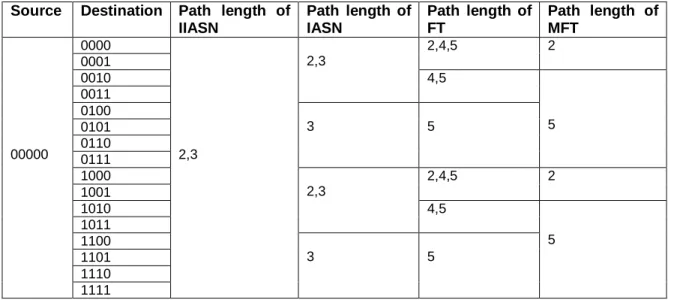
Path length refers to the length of the communications path between the source to destination. Multiple paths of different path lengths are possible in a network .It can be measured in distance or by the number of intermediate switches. The possible path lengths [4] between a particular pair of source to destination may vary from 2 to maximum number of stages. The various path lengths of some popular networks along with proposed network is calculated to route a data from given source (let S=0 i.e 0000) to all destination is shown in table 2.
Source Destination Path length of IIASN Path length of IASN Path length of FT Path length of MFT 0000 0001 2,4,5 2 0010 0011 2,3 4,5 0100 0101 0110 0111 3 5 5 1000 1001 2,4,5 2 1010 1011 2,3 4,5 1100 1101 1110 00000 1111 2,3 3 5 5
Permutation [6] is the one to one association between source to destination pair [7][5]. Path length and the routing tags parameters are the major backbone to evaluate the permutation. There are two ways to evaluate the permutation:
Identity Permutations
A one-to-one correspondence between same source and destination number is called Identity Permutation. For example correspondence between 0..0 , 1..1 and so on .In terms of source and destination this can be expressed by:
Where i = 0,1…….N-1
For example: connectivity between source to destination for identity is represented by: S0 - D0 , S1 – D1 ,--- S15 - D15
Incremental Permutations
A source is connected in a circular chain to the destination in incremental permutation as shown below:
S0 – D4 , S1 – D5 ,--- S15 – D3
We are considering the best possible cases to find out the permutations Non-Critical Case : If a single switch is faulty in any stage
Critical case : If the switches are faulty in a loop in any stage (if it exists)
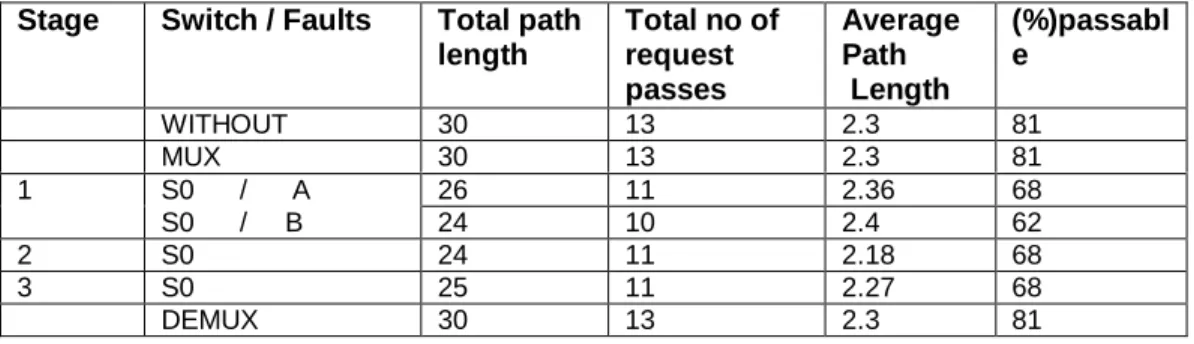
Permutation evaluation requires the path length of given source to destination (path length can be more than one, from a given source to destination if multiple paths exists) and the routing tags. The analysis of some popular network from given source to destination to evaluate incremental (S0 to D4, S1-D5...) permutations along with proposed network is as follows.
A – Non critical B – Critical Case
TABLE 3: Incremental permutation measures of IIASN
Stage Switch / Faults Total path length Total no of request passes Average Path Length (%)passabl e WITHOUT 30 13 2.3 81 MUX 30 13 2.3 81 1 S0 / A 26 11 2.36 68 S0 / B 24 10 2.4 62 2 S0 24 11 2.18 68 3 S0 25 11 2.27 68 DEMUX 30 13 2.3 81 Si = Di
TABLE 4: Incremental permutation measures of IASN
TABLE 5: Incremental permutation measures of FT
TABLE 6: Incremental permutation measures of MFT
Stage Switch / Faults Total path length Total no of request passes Average Path Length (%) passable WITHOUT 28 11 2.5 68 MUX 28 11 2.5 68 1 S0 / A 26 10 2.6 62 S0 / B 21 8 2.6 50 25 10 2.5 62 2 SA /A SA/B 19 8 2.3 50 3 S0 26 10 2.6 62 DEMUX 28 11 2.5 68
Stage Switch / Faults Total path length Total no of request passes Average Path Length (%) passable WITHOUT 20 4 5 25 MUX 20 4 5 25 1 S1 / A 20 4 5 25 S1 / B 20 4 5 25 15 3 5 18 2 S2 / A S2 / B 10 2 5 12 10 2 5 12 3 S3 / A S3 / B 0 0 0 0 15 3 5 18 4 S4 / A S4 / B 10 2 5 12 5 S5 20 4 5 25 DEMUX 20 4 5 25
Stage Switch/Faults Total path length Total no of passes Average path length (%) passable WITHOUT 40 8 5 50 MUX 40 8 5 50 1 S1 / A 35 7 5 43 S1 / B 30 6 5 37 30 6 5 37 2 S2 / A S2 / B 20 4 5 25 30 6 5 37 3 S3 / A S3 / B 20 4 5 25 30 6 5 37 4 S4 / A S4 / B 20 4 5 25 5 S5 35 7 5 43 DMUX 40 8 5 50
6. CONCLUSION
An irregular class of Fault Tolerant Multistage Interconnection Network called Improved Irregular Augmented Shuffle Exchange Network has been proposed and analyzed. It has been observed from table 1 that IIASN has lesser cost in comparison to existing irregular fault tolerant networks. It has been also analyzed from table 2 that IIASN has unique and better path length in comparison to IASN and other popular irregular networks. . It has been also observed from the analysis that the permutation passable of IIASN is much better that existing IASN, FT and MFT networks.
7. REFERENCES
[1] Algirdas Avizenis, “Towards Systematic Design of Fault-Tolerant Systems”, IEEE Computer, Vol. 30, No. 4, , pp. 51-58 , April 1997
[2] Patel,J.H., “Performance of processor-memory interconnection for multiprocessors.” IEEE Transaction on computers , 30,pp. 771-780,1981.
[3] P.K.Bansal, K. Singh, R.C. Joshi, and G.P. Siroha, “Fault tolerant Augmented Base Line Multistage Interconnection Networks” , IEEE TENCON pp. 205-208,1991.
[4] P.K.Bansal, K. Singh, and R.C. Joshi, “Routing and path length algorithm for a cost-effective four-tree multistage interconnection network”, International Journal of Electronics, Vol. 73, pp. 107-115,1992.
[5] Sandeep Sharma, P.K.Bansal, “A new fault tolerant Multistage Interconnection Network ”, IEEE TENCON’02 , vol 1 , pp 347-350,2002.
[6] Shirakawa Isao, “Some comments on Permutation Layout”, IEEE on Networks, Vol. 10, pp. 179-182,1980.
[7] Y.Yang,J.Wang , Y.Pan , “ Permutation capability of optical multistage interconnection network ”, Journal of parallel and Distributed computing ” , pp.60,2000.
[8] George, B.A., P.A. Dharma and H.J. Seigel, 1987. A survey and comparison of fault-tolerant multistage interconnection networks ,Computer, vol. 20, no. 6, pp. 14-27, Jun., 1987. [9] Park, J.H., 2006. Two-dimensional ring-Banyan network: A high-performance fault-tolerant
switching network. Elect. Lett., IEEE , vol. 42,249-251,2006.
[10] Bataineh, S.M. and B.Y. Allosl,. Fault-tolerant multistage interconnection network. J. Telecomm. Syst., 17, pp. 455-472,2001.
[11] Harsh Sadawatri , P.K Bansal Fault Tolerant Irregular augmented Shuffle Network, Proceedings of WSEAS International conference on Computer Engg. And Application, January 17-19, pp. 7-12, 2007