KHAZAR UNIVERSITY
Faculty:Engineering and Applied Sciences Department:Computer Science
Specialty:Informatics
MA THESIS
Theme: Implementation of Search Engine Optimization Techniques for Dynamic Website
Master Student: Sattar Amrahov
Supervisor: Ph.D. Mahammad Sharifov
KHAZAR UNIVERSITY
ENGINEERING AND APPLIED SCIENCES COMPUTER SCIENCE DEPARTMENT
ABSTRACT
OF DISSERTATION FOR MASTER’S DEGREE
THEME
Implementation of Search Engine Optimization Techniques for Dynamic Website
Master student: Sattar Amrahov
II
Abstract
Because of the exponential improvement of the Internet recently, search engines have the compound mission of ranking through so many websites and showing only the most appropriate pages for the presented search query or keywords. Search Engine Optimization (SEO) is optimizing process of a website. This
optimization affect ranking the website properly on SERPs (Search Engine Result Pages). Dynamic websites or Database driven websites recently are used for
universities because the content of website is easily can be modified. Nevertheless this type of websites exposed to indexing related difficulties. This thesis intends to analyze and overcome dynamic websites SEO related troubles. I aim to detect dynamic websites SEO factors, research and experiment SEO tools and techniques, and detect to what size dynamic websites can be made proper for search engine ranking for reaching goals and destinations of this thesis. In this thesis I implement some techniques and use method that helps to increase the ranking of Khazar
University website (www.khazar.org). This thesis gives broad theoretical elucidation about how to implement SEO methods for dynamic websites.
III
Executive Summary
Implementation of Search Engines Optimization Techniques for Dynamic Website
Subject matter: This thesis provides wide information about search engine optimization procedure of dynamic websites, implementation of linking static pages to dynamic website method for optimizing Khazar University website and give theoretical data that how to increase the ranking of websites with the help of SEO techniques.
Introduction: Search engine optimization (SEO) is the process of modifying content and source code of a website for developing ranking within primarily search engines. Creation a website simple for the users realize is a significant viewpoint of SEO. SEO assists the search engines define theme of each page, and how it can be beneficial for users. Effective SEO demands most substantial of time. The SEO technique is used to improve the visibility of site to take the most of visitor probation.
Methodology: In this thesis, comprehensive literature inspection is accomplished to estimate modern knowledge for SEO for dynamic websites. Additionally experimental tests are executed to address indexing and crawling issue of dynamic websites, and to appraise SEO techniques used in implementation part of thesis. Findings: It is detected that all primary search engines cannot exactly index dynamic sites. I implement some SEO techniques that I detected throughout this dissertation to assist dynamic web pages get indexed in famous search engines. The results of experiment reflect the of SEO techniques’ productiveness including URL encoding and using linked static web pages for increasing ranking of website on primary search engines.
IV
Conclusion: Dynamic websites are exposed to indexing related troubles and need extra SEO endeavor for appearing in SERPs. Whole SEO techniques are not evenly efficient on search engines for improving ranking of dynamic webpage. Each applied SEO technique has dissimilar effect on primary search engines. Changing or modifying the URLs technique and implementing linked static pages to dynamic website technique is impressive on the most search engines.
V
Contents
Abstract ... II Executive Summary ...III
Acknowledgement ... 1
1. Introduction ... 2
2. Definition ... 4
2.1 Internet ... 4
2.2 Search Engine ... 6
2.2.1 Goal of Search Engines ... 6
2.2.2 Crawling and Indexing ... 8
2.3 Search Engine Optimization (SEO) ...10
2.3.1 What is SEO ...10
2.3.2 SEO Techniques ...12
2.3.3 White Hat / Black Hat SEO ...13
2.3.4 Keywords ...14 2.3.5 Metadata ...15 2.3.6 PageRank (PR) ...16 2.3.7 Ranking ...17 2.3.8 ON-Page SEO ...18 2.3.9 OFF-Page SEO ...20
2.3.10 Search Engine Marketing (SEM) ...22
2.3.10.1 Paid SEM / Organic SEO ...22
2.3.10.2 Click Popularity ...24
2.3.11 Robots.txt ...24
2.3.12 Eye tracking. How users scan Result Pages ...25
2.4 Google SEO ...27
VI
2.4.2 Google algorithms: Google panda, Google Penguin, Google
Hummingbird ...27
2.4.3 SEO Tools for Google, Bing, Yahoo! ...28
2.5 Web 2.0 ...30
2.5.1 Typology of Web 2.0, Learning Technologies ...30
2.5.2 Blogs, Wikis, RSS ...31
2.6 Websites, SEO site of Websites ...33
2.6.1 Dynamic / Static Websites ...33
2.6.2 Site Design ...35
2.6.3 CMS ...36
2.6.4 Building Content ...37
2.6.5 Link Building Technique ...38
2.6.6 XML Sitemap ...39 2.6.7 XML Syndications ...41 2.6.8 Website Domain ...41 2.6.9 Redirects ...42 3. Related Works ...43 4. Implementation ...46 Conclusion ...66 Future work ...68 Bibliography ...69
VII
Figure 1: Internet Users in the World ... 5
Figure 2: Architecture of Web Crawler ... 7
Figure 3: SEO Process ...11
Figure 4: On-Page SEO categories ...19
Figure 5: Off-Page SEO categories...21
Figure 6: Static and Dynamic Websites ...33
Figure 7: Dynamic Website scheme ...34
1
Acknowledgement It is a pleasure to thank many people.
- My Supervisor – For always being positive, supporting the ideas, giving right direction and guidance and supporting.
- My Family – For always being in my side, supporting and believing me in every difficult days.
- Zahra Khudaverdiyeva whose persistent work ethic pushes me to be motivated. Our skills are very complementary, and I‘ve always felt that it made both of us better at what we do. Thank you for all your support.
2
1.
Introduction
Search engine is search process’s backside running software. Search engines crawl and index websites and gather essential data i.e. keywords from the web pages with indexing and crawling it. These keywords and phrases give information about entire website content. After that, this combined information is kept in the search engines’ databases. The results of search for any keyword to find information could be so many webpages. But, usually users do not look or use the pages after second or third in SERP [1].
Search engines use Crawlers or Bots for crawling websites. The Crawlers repeatedly inspect the internet and add new websites in databases of search engine, indexes or re-index websites as required. Statistics show that, search engines can index approximately half of the entire sites. Search engines cannot view residuary websites. The majority of these invisible websites are dynamic websites too. Make dynamic websites visible to search engines, commonly Search Engine Optimization (SEO) techniques are used.
Search engine optimization (SEO) concerns to the efficiency of optimizing separate web pages or the overall site for making them helpful for gaining high ranking in SERPs. All famous search engines rank web pages on the basis of
established factors that influence its ranking. As a result, SEO goals at establishing the correct signals’ type on the webpages. It increase the webpage visibility
naturally. The SEO techniques that comply search engine instructions are mostly called white hat techniques. This techniques obtain higher ranking in the SERPs. There are also unethical way of SEO techniques, that called black hat SEO or spamming.
SEO is one of the most essential and main Search Engine Marketing (SEM) activities. SEO techniques are purposes for carrying a website between upper
3
search results for some especial keywords. The primary stimulation behind my thesis is to increase knowledge of web developers about search engine optimization. This comprehension allow websites are developed with SEO point of view. This will finally miniaturize overhead of website optimization for search engines. With the help of SEO techniques, visibility of dynamic website could be healed in search engines. Additionally, I will research and perform implementations that are mostly used for optimizing dynamic sites. SEO is essential for developing visibility of the website to increase the traffic density by inserting essential code in the source code of the website.
The dissertation consists of 4 parts. First part is an introduction about the search engines optimization (SEO). It is about the need of search engine and what made SEO actual for today. Second part is about the definitions and briefly explanation of SEO techniques. Third part is about related works which various researchers write and explore different aspects of SEO, optimization techniques, main factors, implementation different methods and etc. Fourth part is about the implementation side, how we can implement the considered SEO methods for optimizing our university website and what issues we should pay attention during the implementation. At the end of thesis give conclusion about all experiments that I do, obtained results, and recent state of the website.
4
2.
Definition
In this chapter, I mention significant aspects, information, and valuable definitions that are related to my thesis.
2.1
Internet
The Internet is the huge computer networks which with the help of the Internet Protocol suite (TCP/IP) for linking all computers or devices around the world. Internet consist of a lot of networks, for example private, public, academic, commerce, and government networks of local to global view. Internet is connected by a wide array of wireless, electronic, and optical network technologies. The Internet transports a broad diapason of information resources and services, like inter-linked hypertext documents and applications of the WWW (World Wide Web). The terms of Internet and World Wide Web (simplicity Web) are not synonymous. The Web is the main application which a lot of people use on the Internet. Despite of it, the Internet provides many various services. The Web is a global network of documents, some different resources, logically connected by hyperlinks and referenced with Uniform Resource Identifiers (URIs). The Web’s main or basic access protocol is the Hypertext Transfer Protocol (HTTP). Users of the World Wide Web can navigate web pages with the help of browsers, like
Opera, Google Chrome, Mozilla Firefox or Safari, and can reach another pages via hyperlinks which embedded in the documents.
5 Figure 1: Internet Users in the World
6
2.2
Search Engine
2.2.1 Goal of Search Engines
Web users search what they want from the web with the help of search engines. Search engine is a system that can find many information on the World Wide Web. Search engine result pages (SERPs) is the list of or the page of the results of
search. The searched information may consist web pages, images, videos, and other types of files. A search engine serves the below processes:
Searching
Crawling
Indexing
Search engines find the needed information with the help of web crawling. Robots.txt which is the standard filename is checked by the “spider”, appealed to it, before sending definite information back to be indexed. This process depending on various factors. Indexing is the linking words and other appointed tokens on web pages to their domain names. Search engine working memory store the page’s cached version during the visits by the spider. If a visit is late, the search engine act like a web proxy. In this situation the web page can distinguish from the indexed search terms. When the real page has been lost, a cached version of a page can be helpful to the web site.
7 Figure 2: Architecture of Web Crawler
Usually user of Web enters a few keywords which are the search query into a search engine. The index any more has the names of keywords holding websites, and these are immediately attained from the index. Besides the Web search engines, there are some other types of search engines. This types include the followings:
Meta search engine: This type of search engine search the query in other search engines and collects the all recieved results.
Local Search Engines: This search engines is used for offline PC, or LAN search using.
8
2.2.2 Crawling and Indexing
Crawling means in search engine optimization is with the help of your links paths to pursue and crawling your web site. Crawl’s main function is to categorize analogous webpages for indexing and estimate if they have changed or
not.Crawling is fulfilled by bots (robots). Another name of bots is search engine spiders. Bots visit the web site and pursue other connected or linked web page and crawl your website. Because of that websites should contain site map, bots use this sitemap and crawl deeply the pages. Robots.txt file prohibit the crawling of a definite part of website.
Indexing process means that web pages are indexed and added to Google search. Google crawl and index the webpages by using the Meta tag which is used for webpage. This Meta tag can be Index or No-Index. If using NO-index, page will not be added in www searching. By default, more pages and posts are indexable [3].
Search engine crawlers and bots access the webpages and return a reference URL of the page for next analysis and indexing purposes. (Dave, 2009) The data
collected by bots and crawler is used to show search results and search engine ranking by search engines. Search engines crawl the websites on systematic basis depends on the website progress, quality and ranking. Websites that updatedpages often with new content on daily basis are crawled and indexed more than acommon postdate content. Web crawler used to store a duplicate of those webpages which are crawled.
Indexer is especially designed and optimized to index files. With the help of indexer building index, some informative or important parts of database can be
9
accessible by search engines. Search engine ranking depends ona website indexing. [4]
10
2.3
Search Engine Optimization (SEO)
2.3.1 What is SEO
The process of influencing the visibility of a website or a web page in a web search engine's natural or unpaid results is search engine optimization (SEO). Generally, the higher places and more often a site emerges in SERP, the more users visit the website from search engine. This users maybe will be customers [5].
Optimizing a website may be editing content of pages, HTML and other languages coding to both increase its appropriation to specific keywords and to eliminate impediments to the indexing pursuits of search engines.
Sitemap is a Google’s program that assist webmasters know when Google has any problem with to index the web site. Sitemap also ensure data on Google traffic to the web site. Bing Webmaster Tools insures a solution for webmasters to submit a sitemap and web feeds, permits users to define the crawl rate, and pursue the web pages index status.
Off-page factors were realized as well as on-page factors to allow Google to keep aloof the kind of manipulation seen in search engines that only realized on-page factors to rank them. The famous search engines, like Google, Bing, and Yahoo, use crawlers for finding pages for their algorithmic search results. Webmasters can learn bots not to crawl definite files or directories with the standard robots.txt file for deviating useless content in the search indexes [6].
A routine search engine optimization process that can be performed to rise a web site ranking, is shown in Figure 3.
11 Figure 3: SEO Process
Search engine optimization (SEO) relates to the optimizing webpages activity or the complete website activity to make them friendlier to get higher ranking in the SERPs. All the main search engines like Google, Yahoo, Ask, Bing etc. rank web pages rest upon certain factors which effect its ranking, from this point of view search engine optimization purposes at creating the correct type of signals on the web pages. This help to increase the visibility of a web page naturally, i.e. unpaid search results. The SEO techniques basically consist of two parts. They are On-page optimization and Off-On-page optimization techniques [7].
12
The aim of SEO is to help websites or web pages attain first places in the unpaid search results by means of increasing the relevancy of a website or web page to the search query that userstry to find. Demonstrating the most relevant pages for the entered keywords has many profits to either the user or the search engine ensuring the results: the user finds the most relevant results, and the search engine is known as reliable and believable because its algorithm shows the most appropriate pages. The SEO process needs time and tactics’ knowledge for implementing and it make better the rankings of websites on natural or unpaid search results. Time is a great primary investment to make the website or page being optimized [8].
2.3.2 SEO Techniques
SEO techniques are divided into 2main categories:
White Hat SEO - Search engines suggest this technique as part of a good design.
Black Hat SEO - Search engines do not recommend and try to minimize the effect of this technique.
Some black hat SEO techniques are: keyword stuffing, link spam, cloaking, hidden links and hidden text [9].
White Hat SEO techniques observe some rules, regulations and guidelines which recommended by the search engines. Some famous White Hat SEO techniques include quality content, use structural markup and divide content from
presentation, titles and meta tags, quality internal links, effective keyword use and keyword research. Black Hat SEO [5] techniques, as against to White Hat SEO technique are unethical way of using the algorithm of search engine. Black Hat
13
SEO techniques includes hidden content, Meta keyword stuffing, Doorway or gateway pages or link framing [10].
2.3.3 White Hat / Black Hat SEO
White hat SEO techniques are ethical optimization of websites that pursues search engine’s policies and rules. If White hat SEO applied for optimizing search engine results, search engines do not block or restrict the website from the SERP. With the using of white hat SEO techniques search engine gives back quality and relevant content. Black hat SEO is try to develop a website which is more effective and low costly to gain many users.
Sometimes SEO techniques for getting higher ranking in SERPs are used in an unethical way which is called spamming. This black hat SEO techniques pull off from the rules and statues of search engine and place the irrelevant site on the top places in list. So this technique besides misleads the search engine algorithms, also decrease the quality of search results and increase traffic. Also these techniques will not have any profit for users [11].
White Hat SEO techniques pursue some rules and policies recommended by the search engines. Some most famous white Hat SEO techniques include Quality Content, Quality inbound links, certain tags, effective keyword use [12]. Black Hat SEO techniques on the other hand are unethical way of manipulation of algorithm of search engine. These techniques are not suggested as there is a risk of website can be blocked or can be removed from the search database index. Some most popular Black Hat SEO techniques include hidden text or links that are same color with the page’s background color, keyword stuffing, Doorway Pages which takes the visitor to the page where products or services are promoted, cloaking
14
[13]purpose is to present a various pages to the user and the search engine, link the spammed sites [14].
2.3.4 Keywords
SEO keywords are the key words and phrases in content of the website which make it possible for users to reach the site with the help of search engines. Keyword is one of the major SEO basics’ element. [15]
A keyword is a term that is used to match with the query a user enters into a search engine to find proper information. Many user of search engines insert search
phrases that consist of 2 to 5 words. This phrases can be called keyword phrases, query phrases, or just keywords. Optimal keyword phrases are especial and representational.
The following concepts bound up to keywords, help to optimize the keywords on a website.
Keyword Frequency: This is determined as how frequently does a keyword seem in a website title or description.
Keyword Weight: It refers to the number of keywords become visible on the web page compared to the sum of words seen on that same webpage. Some search engines consider this during the ranking process of the website for a special keyword search.
Keyword Proximity: It refers to the keywords’ placement on a web page in connection to each other. In other words, we can say that keyword proximity is connection to other words with a analogous meaning as the searched keyword.
15
Keyword Prominence: It is a calculation of how the keywords are detected early or high up on a page. The best situation is the including on a page keywords in the first heading and in the first twenty words or more.
Keyword Placement: Placement of the keywords on a website is one of the most significant factor.
Google uses word stemming which permit word’s all forms - singular, plural, and verb form besides the similar words to be returned for a entered search query. [16] Keywords additionally known as search terms or query terms. Keywords are the word or phrase a user searches during the internet using: these words make a point that you may be found. Keywords are the queries that visitor or user uses when entered in a search box. Search Engine Results Page (SERP) ranks indexed sites towards the appropriate terms.
Keyword Density is a measure of foremost keywords that seem in the content of a page. Keyword Stuffing effects your SEO unfavorable [17].
2.3.5 Metadata
Metadata is data which defines other data. Metadata give brief and major
information about data that can make finding and working with special examples of data easier. Web page’s Metadata keep characteristics of the content of the page, besides the keywords connected to the content. These are generally indicated in the form of Meta tags. Metadata can be generated by manual, or by automated
information processing [18].
Meta tags are fragments of text that define a content of page; the Meta tags invisible on the page itself, but only be inside the code of page. Meta tags only
16
wrote in HTML, usually at the page’s “head” and are only visible to search engines. Meta tags have 4 main types:
Meta Keywords Attribute - A series of keywords you assume suitable to the page in question.
Meta Description Attribute - A short description of the web page.
Title Tag - At the top of browsers this tag’s text is seem. Search engines look title tag as the "title" of web page.
Meta Robots Attribute - search engine crawlers (robots or "bots") know what they should do with the help of this attribute [19].
2.3.6 PageRank (PR)
Google Search use PageRank algorithm for ranking web sites in their SERP. PageRank was named after one of the founders of Google, Larry Page. Under the Google, PageRank count the link’s number and quality to a page to establish an approximate estimate of how significant the website is. The underlying supposition is that the more necessary websites recieve more links from various websites. PageRank is based on unambiguously democratic structure of the web by using its wide link structure as a pointer of a special page’s rate. Actually, Google renders a link from page A to page B as a vote, by page A, for page B. However, Google looks at substantially more than the mere capacity of votes, or links a page receive from others. For instance, it also resolves the page that assigns vote. Votes assign by pages that are themselves necessary scale more severely and help to make other pages necessary. Google provides its perspectives on pages’ relative significance by using these and some other factors. [20]
17
Larry Page and Sergey Brin defined the original PageRank algorithm in different publications. This algorithm is like below:
PR(A) = (1-d) + d (PR(T1)/C(T1) + ... + PR(Tn)/C(Tn))
PR(A) is the PageRank of page A, PR(Ti) is the PageRank of pages Ti that link to page A, C(Ti) is the number of outward links on page Ti and
d is a damping factor that is between 0 and 1. [21]
2.3.7 Ranking
Google define which websites are the most helpful and relevant. For this calculation Google use a complicated algorithm (mathematical process). This algorithm consider more than 200 various factors.
There are three main processes in delivering search results:
Crawling
Indexing
Serving
Crawling is the Google bot process that it explorers new and updated pages to be added to the Google index. Crawl process of Google starts with a list of web page URLs, created from past crawl processes, and improved with Sitemap data ensured by webmasters. When bots visit the web site it identify links on every page and add them to it page list which will be crawled. New sites, modifications to existing websites, and defunct links are noticed and used for updating the Google index. Bot processes for every pages it crawls for the purpose of compile a big index of all the words it sees and their places on each page. Besides that, developers operate
18
or process information contained in key content tag and attributes, like the Title tags and Alt attributes. Bots can process so many information, but not every, content types.
PageRank calculate significance of a page according to the inbound links from the other pages. In other words, every link to a page on website from another website adds to PageRank of website. [22]
2.3.8 ON-Page SEO
On-page SEO is the unification of SEO factors that web designers have firsthand impact over. These are SEO features that reachable “on the web page.” On-page SEO factors cover created content, HTML structure, and architecture of website. Keyword research and quality material may optimize content. We can optimize HTML with the help of HTML titles and Meta tags. One of the well way of optimizing web site is make it crawable for search engines. [23]
SEO divide into two different categories that affect websites’ ranking: off-page SEO that which mostly boils down to the links receiving from other sources to website, and the type of using anchor text. On-page SEO that consider the content of website or page, how it belongs to content on main website in total, generally how relevant are they, type of text in the links and the sites they connect to, and keyword density on the website.
19
Figure 4: On-Page SEO categories
On-page SEO is necessary for search engines to define what to rank our website for. We should have obviously described header tags, Meta keywords, and a
website that is simply for crawling for search engine spiders. Off-page SEO mainly focalizes more on the external sites that are linking back to ours, and an algorithm of search engine looks more at how appropriate the content on them is to our website, the place of our link, and the anchor text used in the link to detect how much the link is value to them. [24]
20
2.3.9 OFF-Page SEO
The two major categories of SEO are On-page SEO and Off-page SEO. Shortly, the distinction between the two is almost like day and night; on-page SEO engaged in with the pages of our website, like internal links, content, and keywords. Off-page SEO engaged in with others that is not related to the present Off-pages of our website.
One of the more significant sub-categories within Off-page SEO is link building - more especially back linking. What many SEO experts pay attention on with Off-page SEO is the other sites that link backwards to our site. The general idea is to get partners or other websites for linking back to us. Furthermore to accomplices, we can also take efforts on our own to get links that guide to our site, such as paper submissions with our URL of website in the Resource or Signature box. It is a nice idea to choose websites and accomplices that have high page rankings in order to this, in turn, affects quality of link of website.
21
Figure 5: Off-Page SEO categories
SEO, generally, is like an infinite circle. Everything that we do to has an impact on indexing and page ranks. With Off-page SEO, you are trying to increase our page ranks from the outside. It is necessary to control our efforts so that we can change something if we see that they are not working or have caused a regress in our present ranking. [25]
22
2.3.10
Search Engine Marketing (SEM)
Search engine marketing (SEM) is a form of Internet marketing that includes the publicity of websites by increasing their visibility in search engine results
pages (SERPs) originally with the help of paid advertising. [26] [27]
SEM is the process of earning traffic from or appearance on search engines. It is significant to know that SEM is at times a general term that deal with two common areas:
Take traffic through free, organic or natural SEO efforts
Take traffic through paid search promotion, also mention to as PPC (pay-per-click).
SEO will only refer to natural search whereas SEM will refer to Paid Search [28]. The purpose of SEM is to rise visibility of websites to targeted users because upgrade qualified traffic and required behavioral responses. SEM includes the mutual constructs of web-metrics, search engine optimization (SEO) and pay-for-performance (PFP) where search engines are paid by firms on the basis of unique and targeted actions of online users. These constructs are nonlinear as they can exploit concurrently or separately, and report on each other [29].
2.3.10.1
Paid SEM / Organic SEO
SEO surrounds all the link building and on-page optimization techniques the purpose of which is to gain good rankings in natural search, while SEM is everything else you pay for, like PPC traffic.
23
Maybe SEO is not include spending money but it is not the cheapest option. When you think about how much time you spend for on-page optimization and for link building, you don't consider it as free. Time is money and these free SEO features have wasted you so much time that you by then know 'free' can be more expensive in some situations. However, there are states when you just want SEO. These cases are below:
- Less competitive keywords, specifically long-tail keywords. - When you do not have enough budget.
Finally we see that free SEO alone doesn't give the results we need. This feeling is particularly powerful after another update to the search algorithm, like the Panda update, when our websites that used to rank well for our keywords get run over down the search results. At these times, the most people will turn to PPC and paid search. But, even when the times aren't decisive, SEM is a nice option. For
example, it give the best results in the following cases: - For competitive keywords.
- In a short period of time we want heaps of traffic. - For better impact.
- To find keywords that transform satisfactory.
Free SEO and paid SEM suit each other perfectly. Each of them has its positives and negatives and for best results, the attractive approach is to use both. You just want to test a little till you find the appropriate combination for you and do
24
2.3.10.2
Click Popularity
Click popularity is estimated by counting the number of clicks each website get from a search engine’s results page. The supposition is that the more frequently the search result is clicked, the website must be more famous. The problem is that a website operator can generate a deceptive representation which induces click through to inappropriate websites.
Your website’s home page is precisely significant. It’s the essential first impression of website. Navigation is important to our complete website and particularly to our home page. If someone is trying to find an established product or article on our page, try to make this process as smooth as possible [31].
The click popularity system is indisputably undefended to falsification. Paid clicks through click farms or rapidly generated small trick programs that perform clicks continuously at particular intervals, can easily warp the results [32].
2.3.11
Robots.txt
Search engines widely rely on Web robots to combine data from the Web. Because of irregular open-access nature of the Web, robot actions are quite various. Such crawling actions can be organized from the server side by distributing the Robots Exclusion Protocol in a file called robots.txt. But it is not a strain standard, ethical robots (and lots of commercial) will follow the rules defined in robots.txt. We focus crawler, and we investigate 7,593 websites from education, government, news, and business domains. Five crawls have been directed in succession to study the casual changes. Through statistical analysis of the information, we represent a
25
review of the usage of Web robots rules at the Web scale. The results also show that the usage of robots.txt has raised during time passed [33].
2.3.12
Eye tracking. How users scan Result Pages
We represent an eye-tracking study that examine the browsing attitude of Web users in the search engines’ result page concerning the fundamental aim of the query (informational, navigational and transactional). We have studied a various set of factors that affect the inspection of users: type of search result (organic and paid), areas of interest (AOIs) (title, snippet, URL and image) and search result’s ranking position. We look that natural results are the major focus of concern for all the purposes; except transactional queries, the users do not waste long time
controlling sponsored results, and when users do that, just top-listed
advertisements are examined. Other factors that affect the browsing behavior of users are the search results’ ranking position and the specific areas of interest. Search engines can take benefit of these determinations and follow the way they introduce the information on result pages in order to offer a better search
knowledge to the users [34]. We explore how users behavior with the results page of a WWW search engine with the help of eye-tracking. The aim is to take
26
for additional searches. Such understanding is necessary for advanced interface design, also for more proper exposition of certain feedback for machine learning. The following introduces primary results, focusing on the total spent time for looking the presented abstracts, the sum of abstract viewed, also measures of how completely searchers estimate their results set [35].
27
2.4
Google SEO
2.4.1 Google SEO Overview
Google is take notice throughout the optimization. The most significant factors of Google SEO are the followings:
Create special, proper page titles. Using the "description" Meta tag. Improving Structure of Site. Improve URLs structure of website. Make website more comfortable for navigation. Optimizing Content. Propose quality content and quality services. Write more advantageous anchor text. Optimize images using on website. Use heading tags properly. Dealing with Crawlers. Make efficient
robots.txt use. Realize the rel="nofollow" for links. SEO for Mobile devices or phones. Show a way to mobile users precisely. Analysis and Promotions. Advance websites in the correct ways. Using the free webmaster tools [36]
2.4.2 Google algorithms: Google panda, Google Penguin,
Google Hummingbird
Google’s algorithms receive our request or query as input and create results in the webpages’ forms that may be so many results, like thousands or even millions. Every year, Google apply nearly 600-700 modifications to its algorithms. When the change is said to be extraordinary, Google notify a new name for the change made. There are three great changes that happened in the last few years. These changes names the Panda Algorithm, the Penguin algorithm and the Humming Bird Algorithm.
28
Panda algorithm's basic function was to focus on demonstrate higher quality sites at the top of the search results compared to low quality websites. During the Panda algorithm on running, many websites that showed enormous number of ads on their webpages were influenced extremely. All this type of websites were noted as low quality websites and the results rejected to include links of these low quality websites.
Google Penguin primarily concentrates on websites that already tricked Google by employing copy backlinks and come in the best of results. Google Penguin takes calculations and marks all those websites that own backlinks and just marks them as low quality ones.
Google Humming Bird work process in a completely different from to the past Google Panda or Google Penguin. It does not confirm the priority status of a webpage but in place of it, it dives into the query searched by the web user. It bursts for keywords in the search and uses them to supply preferable search
experience to the visitor. For instance, when somebody input a query like the 'List of Universities in Azerbaijan, Google Humming Bird detect keywords like
Universities, Azerbaijan and works in producing various webpages that contain lists of universities available in Azerbaijan. Although Google Humming Bird and other algorithms work collectively, it is said to be more user-related as it handles queries that user enters themselves [37].
2.4.3 SEO Tools for Google, Bing, Yahoo!
Google Webmaster Tools is a free web service. The tools permit or let webmasters to control indexing status and optimize website visibility, cover the ability to:
29
Offer and control a sitemap. Control and put the crawl rate, and examine statistics about how Googlebot or crawler accesses a specific site. Create and monitor a robots.txt file. List internal and external linked pages that link to the website. Identify what keyword searches on Google led to the site being listed in the SERP. Put a chosen domain, which defines how the site URL is seem in search engine results pages.
Bing Webmaster Center permits webmasters to add their websites to the Bing Index Crawler. The service also suggests tools for webmasters to solve the
crawling and indexing problems of their website, sitemap generation, presentation and ping tools, and website statistics, reinforcement of content submission, and new content and association resources. Their tools cover:
Crawl subjects let webmasters to explorer potential issues with their websites such as 404 - File Not Found errors, blocked by REP, long dynamic URLs, and
unsupported types content. Backlink data lets webmasters to connect data about their mentioned links. Advanced filtering. Information download lets webmasters to reach the first thousand results in a CSV file to investigate the results. Keyword search tool. Robots.txt verifier. HTTP validator. Outbound links.
Yahoo Site Explorer service allows displaying of information on websites in Yahoo!’s search index. Webmasters who add a private verification code to their websites are also permitted to:
Present Sitemaps. Present till 20 URL elimination requests for their domains to Yahoo!. Write again new dynamic URLs from their website by either displacing a dynamic parameter or by using a default significance for a parameter. Present feeds for Yahoo Search Monkey. Display Errors Yahoo faced while crawling their web site.
30
2.5
Web 2.0
“Web 2.0” is the term used to define a new trend of Internet technologies that lets users to do more than just reach information online – they can add, modify or affect Web content. Web 2.0 also known as social computing. In this type of computing, user can generate content or we can say that is the participative Web. “Web 2.0” was at first invented by O’Reilly Media Chief Executive Officer, Tim O’Reilly, in 2004. Examples of considerations of Web 2.0 applications and tools are surround us: blogs, wikis, photo and video sharing, social networking websites, mashups and virtual worlds. RSS (Really Simple Syndication), podcasts and Web services may also be supposed part of the Web 2.0, but as one-way tools, because of that consumers can use it again but cannot modify their content. As Web 2.0 applications be famous in among people, the demand to market and communicate through these platforms is being accepted by business and Governments
worldwide. [38]
2.5.1 Typology of Web 2.0, Learning Technologies
Web 2.0 technologies propose significant opportunities for educators to improve communication, productivity, and sharing within classes. We can categorize the Web 2.0 learning technologies briefly as follows:
Text based tools: Synchronous text discussion, Discussion forums, Note-taking and document creation.
Image based tools: Image sharing, Image creation and editing, Drawing, Online white boarding, Diagramming, Mind mapping, Mapping, Word clouds.
31
Video tools: Video sharing, Video creation and editing, Video streaming.
Multimodal production tools: Digital pinboards, Presentations, Lesson authoring. Digital storytelling tools: Online book creation, Comic strip creation, Animated videos.
Website creation tools: Individual website creation, Wikis, Blogs.
Knowledge organization and sharing tools: File sharing, Social bookmarking, Aggregators, Republishing.
Data analysis tools: Conducting surveys, Online spreadsheets, Infographics. Timeline tools.
3D modeling tools. Assessment tools.
Social networking systems. Synchronous collaboration tools. Concluding comments. [39]
2.5.2 Blogs, Wikis, RSS
Blogs: Statistically Speaking is a “blog for librarians and other like-minded information professionals remarking the recent information, news, tips and stories relating to the Australian Bureau of Statistics” (ABS)
(http://abs4libraries.blogspot.com). Since May 2007, this blog is online and supply instructional updates on the availability and use of statistical products released by ABS.
32
Blogstats (http://blogstats.wordpress.com/about/) is an informal blog created in 2006 by Armin Grossenbacher (Swiss Federal Statistical Office (FSO)) as an online data sharing platform for statistical spreading and communication
professionals. Designed as a multi-author blog, Blog stats provides the recent news and information about improvings in communicating statistics on the Web.
Wikis: Most statistical offices using wikis restrict their use to those in the
organization or indoor expert groups. Spread within a trusted environment appears to be the power of wiki systems, as public wikis need careful follow to ensure changes to content are admissible to publish. The UNECE Statistical Division has been experiment the usage of wikis to associate groups of specialists for work-related efforts.
Really Simple Syndication: Many, not all, statistical offices are using RSS feeds to ensure notices of their recent information. Proposal range from a single feed of news headlines to supplying upgrades by subject or by region.
33
2.6
Websites, SEO site of Websites
2.6.1 Dynamic / Static Websites
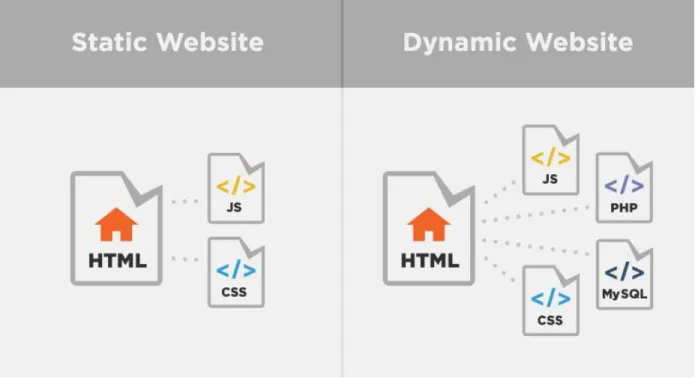
There are primarily two main types of website – static websites and dynamic websites.
Figure 6: Static and Dynamic Websites
A static website is one that is generally written in simple HTML and user look only the code generated page. A dynamic site is developed by using a server-side
scripting language like PHP, ASP, and JSP. In dynamic website the content is called in by the scripting language from another files or from a database. It depending user actions. Elasticity is the primary advantage of a static site - if desired, every page can be various, to match the layout to several content, and it is
34
easy to put in any specific effects for designer that a client or customer may ask for in an individual way on altered pages. The basic problem with static web sites reveals when client want to upgrade or change the content. Unless we are well-informed with HTML and the design methods used in the website then we should go back to the designer to ask make any content modification.
The main advantages of dynamic websites are that by linking them to databases you can simply pull in information in an arranged and structured way for creating product pages or related products’ categories sorted in a different ways depending on the user’s desire to look them. If we can connect to a database then we can also create a content management system - an interface which lets the user to enter and manage data with the help of a web-based series of administration pages. There are few or no continuing costs unless there is a modification in the basic design or an extra skill added. Dynamic website’s design is more stable than a static one
because many of the pages are actually a template into that information and content is poured to generate multiple pages of a same type. Dynamic websites’
disadvantage is that dynamic content is less crawable for search engines. [40]
Figure 7: Dynamic Website scheme
Dynamic functions of a website are only limited by fantasy. Some of the features of dynamic website: content management system, e-commerce system, bulletin / discussion boards, opportunity for clients or users to upload files, opportunity for
35
administrators or users to generate content or add information to a website (dynamic publishing). [41]
2.6.2 Site Design
The main barrier in building great looking websites that also have important performing SEO attributes is combine these two disciplines. Designers or developers concentrate on sites that look abundant and create a useful user experience while being deal with, although an SEO generally needs a website which is very crawlable and one that well ranked.
Look at the example below: these panels are for a fashion retailer, the left panel was visualized by the web designer, and incondition of UX this panel is good looking. The problem is, from an SEO point of view, this panel does not cut it.
SEO require something more than the right side panel. It has an understandable, determined header, possibly an <h1>, followed by some text. One of the possibility to solve this problem is a mouse-over. At first when viewed, the panel will seem as
36
exactly as the designer wish it, yet when a user rolls over the image the panel alters into the right hand side panel (exactly what the SEO wants).
The advantage of this solution is the user experience and click thru are provided and as all of this text is active text, it can be crawled and very reachable to bots, giving the search engines everything they want for indexing the site.
Website design and architecture plays a significant role in determination a first impression of a company and sustaining Internet marketing aims. [42]
2.6.3 CMS
A content management system (CMS) is a computer software that promotes the generation and alteration of digital content using a mutual user interface and thus generally sustaining multiple users working in a collaborative environment. CMSs have been existing since the late 1990s.
37
A content management application (CMA) is the front-end user interface that permits a user, even with less practice, to add, alter and clear content from a website without the intervention of a webmaster.
A content delivery application (CDA) collects that data and updates the website. [43] [44] [45]
2.6.4 Building Content
SEO content is the content that composed to withdraw search engine traffic. Followings are that developer or user need to do for applying SEO your web content:
Keyword Research: If you want to compose traffic through search, it is the most important thing is to do keyword research in advance you start typing. By this way, you can concentrate on keywords for which a specific number of search volume already have – in other words, type toward topics that users are already searching for information about.
Keyword Optimization: Identify the place and how to use the keywords in website’s content for maximum appearing on SERPs.
Content Organization: The content of website should be regulated in a logically. This organization also helps visitors of website to find other related content with ease.
Content Promotion: Rise visibility to new created content by sharing it on social networks and building links to website’s content. [46]
38
2.6.5 Link Building Technique
Link building process is that obtaining hyperlinks from various websites to your own. A hyperlink (generally just called a link) is a path for users to navigate
between one pages to another on the internet. Search engines use links for crawling the web; they will crawl the links between the particular pages on website, and the links will be crawled by them between whole websites. If you can learn the art of building links with high quality, it can really put you ahead of both other SEOs and your opposition.
For understanding the significance of link building, it’s necessary to understand the foundations of how a link is created firstly, how the search engines view links, and what they can evaluate from this links.
There are two basic ways that the search engines use links: 1) To explorer new webpages
2) To help define how well a page should rank in search engine results There is an attribute which can occasionally be applied to links called the “nofollow” attribute.
<a href=”http://www.example.com” rel=”nofollow”>Example</a>
This attribute means that Google not progress any PageRank across this link to the destination URL. [47]
39
2.6.6 XML Sitemap
You can list the pages of website for telling Search engines about the structure of website content by using a sitemap. Bots or crawlers read this file for more
cleverly crawling websites. Developers can use a sitemap for ensuring Google with metadata about certain types of content on webpages, including video, image, and mobile content. If pages of website are appropriately linked, web crawlers can mostly explorer most of website. Nevertheless, a sitemap can advance the crawling of website, especially if the website satisfies one of the following criteria:
Your website is indeed huge.
Your website has a big archive of content pages that are divided or not very perfectly linked to each other.
Your website is new and has few exterior links to it.
Your website uses rich media content, is shown in Google News, or uses other sitemaps-suitable postscripts. [48]
Sitemaps are a simple way for webmasters to notify search engines about web pages on their websites that are valid to crawl. Existing of the
Sitemap protocol does not warranty that web pages are allow for in search engines, however it still the best insurance to get a search engine to know about your whole website. [49]
40
Figure 8:Sitemap.xml Tree of Google
Google presented Google Sitemaps so web developers can issue links’ list from through their websites. The main antecedent is that some websites have a lot of dynamic pages that are only valid through the forms use and user inputs. [50] [51].
41
2.6.7 XML Syndications
Content be valid between websites with the help of web syndication. [52]
The beneficial way to get your excellent content out to the others is to propose it up for XML syndication that means anybody can take content and do as they enjoy with it.
The two main ways users can use your content are with the help of desktop
syndication and mashups. If your content is for the rest in a news format, it can be converted into XML so that users can read it in their RSS readers. This may only include the using your content’s some parts on their website, however if your content is original, and plenty with Meta information, you can be the part of mashups. [53]
2.6.8 Website Domain
On the public Internet every computer has a special numeric address—analogous to the singularity of a phone number—which is a string of numbers that is hard for many people to keep in mind. This string is called the “IP (Internet Protocol) address”. To make it simple to find a dedicated location on the Internet, the
Domain Name System, or DNS, was originated. The DNS translates IP addresses into individual alphanumeric addresses. This addresses called domain names that are simple to store up. If, for instance, you would like to undergo the Khazar University website, would you preferred call the IP address 116.251.204.135, or write www.khazar.orgto your browser? In the example above, the “khazar.org” part of the address is the domain name of website. The “www.” part defines to your browser that you search the World Wide Web interface for that domain name. [54]
42
2.6.9 Redirects
If a webpage is transferred to a new location, developers or users should report this to Search Engines. By using a 301 redirect, the ranking of old or previous page will be transported to the new webpage. Receiving links will also be sent to the new website and search engines will preferable index the website content.
A 302 redirect may effect on SEO. There are numerous examples of websites and pages that couldn’t be found by Google due to the using of 302s. The search engine gets the message that the webpage is transferred but that it cannot be removed yet. Consequently search engines release the old page in place and don’t index the new webpage. For SEO point of view a 301 redirect is a beneficial option. In case of a 301 command the search engine is reported to clear the old version of page and to index the new webpage instead of old one.
43
3.
Related Works
In these days, dynamic websites are generally used in e-commerce; but, dynamic websites are exposed to indexing and ranking concerned problems. Google argued in 2008 that it has produced some development for indexing and crawling dynamic websites and can handle dynamic website as well as static but prevailing research shows that Google still have trouble for indexing dynamic websites [55] [56]. There are many researches about this subject. Regrettably, any of past researches cannot entirely address the problem. Most of researches done by now cover only development of ranking problems on Google. However, Yahoo and Bing are also significant search engines but they are still unable to crawl and index dynamic websites [1]. Yahoo and Bing search engines are expanding day after day and they are substantially competitor of Google.
E. Enge et al. [1] and J. L. Ledford et al. [56] declared in their research works that dynamic websites’ URLs are unfriendly for search engines; since, many search engines are not programed to operate dynamic URLs. For this reason, dynamic webpages and dynamic URLs are not well-considered as search engine friendly. J. L. Ledford et al. [56]says that use of SEO techniques can develop and increase visibility of dynamic website; also SEO techniques could support to troubleshoot indexing problems in search engines to a well rank.
C. Duda and G. Frey [57] demonstrated a model of AJAX search to express indexing of AJAX application. The offered demo introduces the probable phases for AJAX search engine i.e. crawler and indexer. The research directed to reflect the troubles and challenges besides that answers for indexing/ranking of AJAX based application.
N. Nazar [58] has searched for discovering SEO techniques for the sake of Web2.0 websites. The major focus of research was to develop ranking of Web2.0 websites.
44
Though, his work is numbered to investigate questions related to CMS system which generate AJAX based dynamic website. In addition, his research was primarily concentrated to increase the capabilities of current CMS. His research was limited for upgrading ranking on Google.
A. Pirkola [59]also tried to investigate efficiency of various search engines to index domain names from many other countries. Her research was directed to investigate efficiency of indexing search engines based on US, for instance Google, Live search, Virgilo, Voila and www.fi.
G. Rogan [60] also researched for defining the impressions of SEO methods for perfection of the websites’ ranking. He defined some SEO methods by executing case studies on various websites for investigating the influence of designated methods for more preferable ranking on search engines. His research study was purposed to advance websites’ ranking on Google search engine.
J. Köhne [61]improved a model for solving crawling and indexing subjects of a particular CMS generated dynamic website. His research work determined some troubles like parameters in URLs, keywords and site structures. He improved a model to solve these problems to boost crawling and indexing of dynamic websites in Google.
Finally, Dr. K. Baskaran and R. Vadivel [62]worked for performing SEO
techniques on static as good as dynamic web sites. Their main research issue was to create friendly/understandable URLs for Model View Controller (MVC) web applications. Their concentrated of research was to investigate the outcome of some SEO techniques for making friendly dynamic URLs for making them keyword oriented. In addition, they worked to investigate fulfillment of URL rewriting and redirecting by the help of ASP.Net.
The above listed related works mostly concentrated to develop websites ranking or by storing some type of dynamic contents of website up. But, I purpose to research
45
the indexing concerned trouble of dynamic websites and implementing SEO techniques and linked static page method for advancing dynamic websites’ indexing.
46
4.
Implementation
The followings are the first version of web pages’ source code of Khazar University website before my changes:
49
I applied changings to most of major web pages. For optimizing web pages I generate keywords with the help of Google AdWords keyword Planner. Followings are some examples of generated keywords:
50
Beside the keyword generator, I analyzed other well-known universities websites and check the search volume of the using keywords. After all researches I write the keywords in Khazar University website source codes. After applying changes home page source code is the following:
51
I applied keywords and description to all major pages of website, each page of menu.
52
53
54
55
Besides generating keywords and description, I create static webpages for Khazar University website. When I create pages, I also consider the keywords, metatags and some other primary code structures. Then static pages are linked to main website. It help optimize crawling and indexing of Khazar University website because of static web pages.
In static pages there are not any JavaScript file, and I did not use some elements which help to give attractive interface for users, like “Carousel” part. I have use just pure HTML and CSS for creating static pages. It helps to make pages more fast, crawable and indexable.
We can transform a static page into a dynamic variant in a seamless way, i.e. without notice by the browser/user.
I rewrite the URL to the CGI-script and force the handler to be cgi-script so that it is executed as a CGI program. This way a request to /~
menus/32/graduate_admission.html internally leads to the invocation of /~ menus/32/graduate_admission.cgi.
RewriteEngine on
RewriteBase "/~menus/"
RewriteRule "^ graduate_admission\.html$" "graduate_admission.cgi" [H=cgi-script]
56
Followings are the screenshots of static pages source codes and the previews: Khazar home page:
58
60
61
After all implementations I create an account in google analytics, then apply tracking code script to the khazar.org website.
62
Then monitor the changes in SEO dashboard to see development of Khazar University website optimization in search engine.
65
All the implementations I apply will optimize the www.khazar.org website. We can see the development few months later.
66
Conclusion
SEO is necessary for all websites to develop site’s visibility during searching
procedure in search engines. Frequently used SEO techniques for sites are On-page SEO techniques and Off-page SEO techniques. On-page SEO techniques optimize websites content of web page and make it crawable for search engines. Although, Off-page SEO technique does not applied to website contents but it affects
websites to gain higher ranking and develop visit ratio of crawlers to the web pages. There are different helpful SEO tools accessible for webmasters such as for Google: Google Analytics, Google Webmaster tools, and Google AdWords. Since every search engines work with separate algorithms for indexing dynamic sites, results of searching are various in search engines. Main part of this dissertation was the theory of optimizing techniques of web pages in order to increase the ranking in search engines. Leading search engines pretend that there is no any problem for indexing and ranking of static websites. But, there are some
contrasting points about indexing of dynamic websites. Search engines are still try to improve the ability of dynamic URLs index problem. I proposed to investigate Google’s indexing behavior. It is not a secret that none of search engines are capable to completely index dynamic websites. I implemented some SEO
techniques to support indexing of dynamic web pages and tried to define to what range dynamic websites can be optimizes. URL changing or URL modifying technique can keep a dynamic website URLs permanent. By this technique changing of news ID or uploaded files’ location does not change URLs. In addition, dynamic webpage with understandable URLs are more permissible for indexing on search engines. Another effective method for indexing dynamic web pages is the linked static pages method. For ranking better dynamic websites I create and optimize relevant static pages, then linked these pages to the dynamic
67
web pages of our site. It helps dynamic pages to behave like a static pages and indexing more effective. On the basis of experiment results and analysis, I
concluded that SEO techniques and methods are necessary for indexing dynamic web pages.
Since a decently indexed websites are a primary step towards preferable ranking to increase websites visibility in search engines, it is substantial to optimize a web pages decently to increase reliability of a websites. It is feasible to index dynamic websites on whole search engines with suitable SEO methods and techniques.
68
Future work
In future, the site of Khazar University can be more indexable with the help of some other SEO techniques. Because of the limit time, I cannot apply all methods and techniques to the www.khazar.org. After the effect of my works, site will be more crawable. Although, it is not enough for to be the best.
In my opinion, some SEO techniques will be effective besides I applied. For instance, “NEWS” links are not very clear for search engines. Because links
consist of the number of article. Numbers do not very useful when we want to take our website top in ranking.
Second implementation will be the changing of “News” URL’s. If the URL
address of each “news” consists of its article title, it will be very strongly affect the search engine crawling procedure. Search engines craw the page, first take the address of page and use it for ranking. Title of news help users to find the searched keyword, if this keyword also used in the URL of page.
All SEO techniques can be applied periodically to the www.khazar.org website. With the correct techniques and patient, website of the Khazar University will be top ranking one. It also true for all other websites.
69
Bibliography
[1] S. S. R. F. &. J. C. S. E. Enge, The Art of SEO: Mastering Search Engine Optimization, O'Reilly Media Inc, 2009.
[2] V. Beal, "Webopedia," [Online]. Available:
http://www.webopedia.com/TERM/S/search_engine.html. [Accessed 30 March 2016]. [3] Ashusukhija231, "Shout Me Loud," 27 November 2014. [Online]. Available:
http://www.shoutmeloud.com/google-crawling-and-indexing.html. [Accessed 15 March 2016]. [4] A. Sohail, "Search Engine Optimization Methods & Search Engine Indexing for CMS Applications,"
2012.
[5] A. Ortiz-Cordova and B. J. Jansen, " Classifying Web Search Queries in Order to Identify High Revenue Generating Customers," American Society for Information Sciences and Technology, vol. vol.63, no. no.7, p. pp.1426 – 1441, 2012.
[6] J. Beel, B. Gipp and E. Wilde, " Academic Search Engine Optimization (ASEO): Optimizing Scholarly Literature for Google Scholar and Co," Scholarly Publishing, pp. pp.176-190, 2010.
[7] N. Kaur and J. Kaur, "Development of A Ranking Algorithm for Search Engine Optimization," vol. vol.1, no. no.2, pp. pp.1694-2345, May 2014.
[8] E. D. Ochoa, "An Analysis of the Application of Selected Search Engine Optimization (SEO) Techniques and Their Effectiveness on Google's Search Ranking Algorithm," May 2012. [9] Saputratommy, "SEO Form," 20 November 2011. [Online]. Available:
http://www.seomastering.com/seo-forum/on_site_optimization/3_types_of_seo_technique/. [Accessed April 2016].
[10] A. Dixit and M. Agarwal, "Hybrid Approach to Search Engine Optimization (SEO) Techniques," Suresh Gyan Vihar University Journal of Engineering & Technology, vol. vol.1, no. no.2, pp. pp.1-5, 2015. [11] P. S. P., P. B.V. and P. A. S., "Search Engine Optimization: A Study," Research Journal of Computer
and Information Technology Sciences, vol. vol.1, no. no.1, pp. pp.10-13, February 2013.
[12] F. Wang, Y. Li and Y. Zhang, "An empirical study on the search engine optimization technique and its outcomes," in Artificial Intelligence, Management Science and Electronic Commerce (AIMSEC), 2011 2nd International Conference on, Deng Leng, August 2011.
[13] A. Soni and U. Suman, "Counter measures against evolving search engine spamming techniques," in Electronics Computer Technology (ICECT), 2011 3rd International Conference on, Kanyakumari, April 2011.
70 International Journal of Advanced Research in Computer Science and Software Engineering, vol. vol.4, no. no.3, pp. pp.563-566, March 2014 .
[15] "Word Stream," [Online]. Available: http://www.wordstream.com/seo-keyword. [Accessed 5 April 2016].
[16] "SEO Tutorial by Tutorials Point," 2015. [Online]. Available:
http://www.tutorialspoint.com/seo/seo-optimized-keywords.htm. [Accessed 10 April 2016]. [17] CreatorSEO, SEO Keywords Process Steps, 2010.
[18] M. Rouse, "Whatis.com," July 2014. [Online]. Available:
http://whatis.techtarget.com/definition/metadata. [Accessed 8 April 2016].
[19] "Word Stream," [Online]. Available: http://www.wordstream.com/meta-tags. [Accessed 10 April 2016].
[20] D. Sullivan, "What Is Google PageRank? A Guide For Searchers & Webmasters," 26 April 2007 . [Online]. Available: http://searchengineland.com/what-is-google-pagerank-a-guide-for-searchers-webmasters-11068. [Accessed 15 april 2016].
[21] A. Altman and M. Tennenholtz, "Ranking Systems: The PageRank Axioms," in EC '05 Proceedings of the 6th ACM conference on Electronic commerce, New York, NY, USA, 2005.
[22] "Google Search Console Help," [Online]. Available:
https:/