THE ROLE OF KNOWLEDGE MANAGEMENT IN THE HUMAN
RESOURCES MANAGEMENT
GABRIELA ELEXOVÁ Abstract
Under the conditions of the knowledge economy knowledge management has become an integral part of human resources management. People, human resources of the company as the possessors of the majority of company’s knowledge are the most valuable asset and one of the crucial determinants of its success and market position. Therefore it is necessary for a company to change the way of personnel functions performing in order to attract, develop and stabilize the most talented employees. Information and communication technologies play an important role in this process.
Key words: knowledge management, human resources management, knowledge, employees, learning, information technologies.
Classification JEL: M 12 Personnel Management
1. Introduction
Industrial society of the past century gets into totally different shape in new millennium. Information, respectively knowledge society becomes brand new reality. The importance of knowledge within new environment is rising, mainly in the creation of value for customers and its consecutive conversion into profit. Market globalization, increasing intensity of competition and rapid technical development are forces that make companies to be ready for production cycle shortening and increasing quality of innovations. In such conditions it is necessary to be equally informed, in the right time, about actual trends in a branch, about intentions of competitors and about the customers´ needs and expectations. Actually, even the sufficiency of available information is not automatically a warranty of quality. Information becomes a significant source of competitive advantage just in the moment of their acquisition and effective and targeted application in favor of company’s success. Thus used information is forming into knowledge which is the basis of today’s frequently used knowledge economy. Most valuable is just this one, which is carried by people able to convert it into innovations. The objective of this article is to clarify the task of knowledge management in the system of corporate activities, mainly in the management of corporate human resources.
2. Knowledge and its task in a company
Dramatic changes of economic life, in the form and behavior of markets, necessarily lead towards change in organization structure and its partial processes. The basic impulse for these changes was given by the approval of knowledge as a production factor, more important than the others. The term knowledge we understand as the sum of human wisdom, skills and abilities, which are gradually enriched by experience during practicing and which define man’s assumptions for performing certain job. As the opposite to learning, which is just a simple complex of memorable facts and clearly defined relations between them, knowledge is created through extraordinary and complicated system of individually acquired facts, experience, relations, values, mental procedures and meanings [10, p. 46]. It is coming into existence like derivation from information, through comparison, classification, evaluation, verification and its allocation within context of other information, knowledge and experience [11, p. 208]. We can mark them as information with a manual for usage = for action [7, p. 60]. We can’t forget to mention the fact that knowledge not meaningfully used remains in the form of information. Now
it is clear that knowledge within company represents significant source of „energy“, potentially used for ensuring competitive advantage. According to J. Jirásek [6, p. 19] intangible knowledge in the heads of people or embodied in objects (spaces, machines, organization, qualification, interactivity etc.) has much greater value than monumental construction or mechanistic structures. Therefore it is necessary to manage it like any other asset, keep in mind its news, protect it from competitors, repair it and modernize, remove in case of ageing and moreover and basically constantly verify existing resources.
Among relatively new but extremely important activities of every company during 90´s we can rank knowledge management. It represents “the complex of strategies and attitudes proposed for creation, acquiring and using of the knowledge assets in order these can get to the right people in the right time for the purpose of their processing and creation of value for the customers and the company” [4, p. 13]. Effective management of available knowledge is very important because of the fact that it represents a specific kind of corporate resources. We are dealing mainly with its resistance against depreciation (except of moral) and its ability to increase value through the using and interaction with other forms of information. Functioning knowledge management in such form can contribute towards increase of intangible assets value and towards strengthening of the company’s position at the market. It depends only on the company’s ability to ensure acquisition, holding, broadening but most of all usage of needed knowledge for the purpose of fulfilling stated objectives.
Knowledge is supposed to be offered in two basic forms – explicit (knowledge located in different types of material mediums) and tacit (knowledge carried by people). Just the second group of knowledge is considered to be worth and valuable asset for each company. According to the results of several researches employees are disposing of 42 % of knowledge existing within company [3]. J. Vymětal [11, p. 207, 220, 223] noticed that just 10 % of knowledge in company is being documented. Spare 90 % is represented by the intellectual property of employees. Because of this fact the meaning of the knowledge management is going to be mainly in optimization of management of human resources owning such knowledge. Because the main objective of the knowledge management is to maximize the utilization of intellectual capital in organization, the utilization of the employees´ knowledge in order to increase the company´ s performance, profit and fulfill the corporate strategy. At the same time the knowledge management interconnects strategic corporate mission with its human potential. The leaders´ ability to motivate employees towards sharing their intellectual property with other people in the company and towards its effective utilization for the benefit of the company is becoming an important determinant of its competitiveness and effectiveness. Because of this reason we consider the knowledge management activities, including their implementation in human resources management, to be necessary. Because, in spite of increasing strategic importance of personnel work, underestimation of “soft management factors” still persists in many companies. As the main criteria are constantly considered just “hard factors”, i.e. countable and measurable, but much simple in words of interpretation as well. For all that we often forget about the necessity of complex view on system of corporate activities, which has to consist of both quantitative and qualitative aspects.
It is indisputable that despite rapid technological progress and the penetration of information communication technologies there still remain many activities able to be performed only by people. Although informatization and automation have contributed towards the elimination of many routine but time consuming activities, they are not able to replace human intuition, opinion, creativity and either emotions by now. Just people are able to enrich own understanding by new experience, convert them into knowledge and consequently into innovations which represent the motive power of further progress. Knowledge-oriented society needs well-educated people who are disposing of appropriate skills necessarily demanded by new, highly sophisticated technologies and workplaces with higher added value. According to Z.
Pitra [8, p. 6] only those companies can be successfully developing, which are able to appraise the knowledge of their employees in creative way in global world. Also J. Barták [1, p. 8] mentions that prevailing group of success (or failure) in each company depends on the competencies of its employees. Because it doesn’t make any difference what a man knows or understands, but what he or she wants and is able to utilize. It means that success can be reached only by those companies which are able to recruit and retain competent workforces, create appropriate conditions for their development, motivate them towards constant education and development of both abilities and skills, motivate them towards willingness to share own knowledge and experience with other colleagues and utilize them in order to reach output above standard. As Alexander Cimbaľák, in Slovakia awarded Starting entrepreneur 2006, told, a company is not able to be successful. Just people creating company are able to be successful
(lecture named My way towards success at the Faculty of Economics, Matej Bel University, November 12, 2007). Common figure within activities of human resources and knowledge management is permanent effort to concentrate necessary knowledge in the company, to increase its standard according to quality and to prevent them from breakaway towards competitors. From this point of view we can identify several potential areas of knowledge management and personnel work integration.
3. The integration of knowledge management and human resources
management
The approval of human resources as one of the most crucial production factors and significant determinant of competitiveness caused massive increase of endeavor to gain and upkeep quality workforces. In the hypercompetitive environment of the knowledge economy we are dealing with challenging tasks strongly connected with increasing requirements laid down on employees in HR department. They are often forced to use services of professional personnel agencies attempting to gain quality workforces, to cooperate with educational institutions and systematically build image of employer during exhibitions or fairs. Except from this, the outsourcing of personnel activities is considered to be relatively new instrument within the personnel work, which means that they are purchased through external supplies. Apart from advantages in the form of savings in time and costs it brings other benefits like competent solutions of corporate problems or acquisition of valuable know-how.
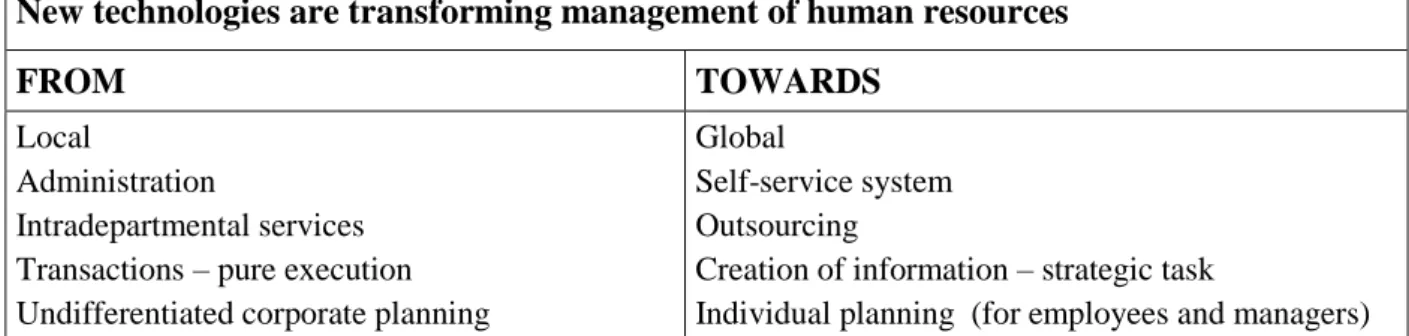
Also an intensive effort to recruit talents from competitors is considered to be a new trend at the labor market. Increased claims on knowledge and abilities of workforces necessarily call for the change of applied methods of recruitment and selection. H. Baxter [2, p. 1] moves the accent from functional technicality to harmony between knowledge of potential applicant and central corporate strategy and culture. Therefore the private interview or assessment centers together with traditional tests are going to be used in order to make a complex review of expertise as well as personal characteristics. Also in this personnel function different instruments of the knowledge management are making a sense and are significantly decreasing its time and administrative consumption. We bear in mind mainly information technologies and systems enabling the automation of routine activities, e.g. electronic communication with applicants, classification of documents and first choice according to selected criteria. Information technologies are in most cases associated with the term knowledge management. But we can’t forget to mention the fact that technologies are not an objective, but just a tool of the knowledge management and an important instrument of effective human resources management. As A.J. Walker [12, p. 17] says the new technologies are changing the orientation of personnel service in several ways (Table No. 1).
Table 1: New form of human resources department
New technologies are transforming management of human resources
FROM TOWARDS
Local
Administration
Intradepartmental services Transactions – pure execution Undifferentiated corporate planning
Global
Self-service system Outsourcing
Creation of information – strategic task
Individual planning (for employees and managers)
Source: WALKER , A. J. a kol., 2003
According to the fact that human resources management is in charge of all people within an organization, i.e. employees on all managerial levels, it is comprehensible, that one of its tasks is to process enormous data volume. Just instruments of the knowledge management offer remedy of elimination of informational overload of employees at the department of personnel work. We bear in mind mainly the managerial and occupational self-service system enabling to delegate a lost of personnel activities. Employees are empowered to change their personal data in information system autonomously, choose from offered benefits, apply for offered job vacancies or educational activities. In such case the employees of the HR department can concentrate on the core activities of strategic importance. The increase of work satisfaction and efficiency as a result of strengthened competencies and responsibility is considered to be a secondary effect. Of course there exist some disadvantages as increased risk of false or incomplete information in personnel evidence as well.
It is said that the gaining of a new customer is much easier than his consequent up keeping. This proclamation is also true in case of employees. Labor market in the knowledge economy is first and foremost the market of purchasers. Talented workforces are not forced to accept whatever job offer, they have a great possibility to select according to their own preferences, interests and ambitions, not only at the local or national market, but because of the globalization at global labor market as well. Global war for talents has started. Intensive effort for stabilization of key employees and effective talent management is required. The crucial role in this process is played by the motivating system of remuneration including benefits, fairly reflecting reached performance and evaluating employees for sharing their knowledge with other people in the organization. H. Bexter [2, p. 1] mentions that one of the most important changes in measuring efficiency is the fact that individuals are awarded more for their skills, abilities and performance, than for their loyalty. And it is not the seniority, but just these factors, which are used as a basis for the remuneration and benefits. Moreover, organizations tend to emphasize rather the importance of education and acquisition of new skills, and this fact is also being taken into consideration when evaluating and rewarding employees.
The knowledge management basically expresses the way of the knowledge economy implementation on a corporate level. According to Minerva – the official government program of the knowledge economy development in Slovakia, as the main pillars of the competitiveness uplift we can consider the information society building, innovations, science and research development, investments into people and education and the support of business environment [5]. The contribution of the HR management and the knowledge management towards fulfilling these objectives can be identified in the development of creativity and innovation activity of employees and their further continuous development. The emphasis is laid on the production of new knowledge, its common sharing, but above all on the conversion of tacit knowledge into explicit. Bypassing of knowledge codification legitimately causes the damage of knowledge in
case that its owner decides to change his or her employer. New trend is based on the effort to build the learning organization, i.e. “organization trying to make its employees constantly broadening their ability to reach desired results, organization supporting new and creative ways of thinking and organization creating adequate field for collective inspiration and for the continuous learning how to learn together “ (Senge, 2007). Or, as J. Vymětal [11, p. 11] mentioned, old slogan „learn, learn and learn” is being changed into new postulate „learn to learn“.
With the implementation of knowledge management into the process of human resources management there is closely connected the creation of suitable organization structure. It constitutes one of the most crucial factors determining the willingness of employees to share their knowledge with others and use them in order to reach corporate goals. The culture of a knowledge oriented company should support the development of creativity and generation of ideas universally, as well as right competitiveness, but hereby to emphasize the feeling of common belief between employees. At the same time it should tolerate bad luck because the fear from failure or irony of fellow workers or superiors can create a significant barrier of the employees´ inventiveness.
As last but not least we can mention the new forms of work organization, which create an integral part of the knowledge management and HR management integration. Its main objective is to reach the functional and numerical flexibility of workforces and the effective flow of knowledge within the company. Knowledge management initiatives are oriented towards the creation of lean organization which means the decrease of levels in the organizational hierarchy and the change of orientation from vertical towards horizontal structure. As a result of such changes the traditional structures are supposed to be retreated because of on-coming cooperation based on project or virtual teams enabling to share the knowledge of professionals of different specialization, no matter of time or spatial barriers. The process of new knowledge creation is in great size supported by on-coming globalization, more frequent appearance of mergers and acquisitions or strategic alliances, together with penetration of miscellaneous cultures and asserted procedures, processes and policies. All these new phenomenon are strongly connected also with increased variety of workforces available to a company.
It is apparent that the knowledge management plays an extremely significant role in effective management of human resources of a modern company. But it is still relatively new and not prevalent term in the business area or study field at universities. Because of this reason we have decided to realize a research focused on the diagnostics of the current state of the knowledge management implementation into the HR management, to identify the way and size of its basic instruments´ application and to analyze the changes in particular personnel activities because of such implementation.
4. Research methodology
In order to fulfill stated objectives we have chosen interrogative method based on the usage of questionnaire and standardized interview as the main techniques. As an object of the research we have considered the personnel work in most significant companies in Czech Republic according to the reached turnover. The extent of the implementation of knowledge management was the main subject of the research. During the first phase of the research (September 2007) we distributed the questionnaires in electronic form to HR managers in the enterprises ranked as the Czech TOP 100 in 2006. Because reached return was only at the level of 4 % in spite of repeated demand, we have decided to visit selected companies personally. The support for such interview was given by particular questions coming from the questionnaire. This stage was realized during the October 2007. Finally, according to questionnaires and interviews we obtained 35 successful
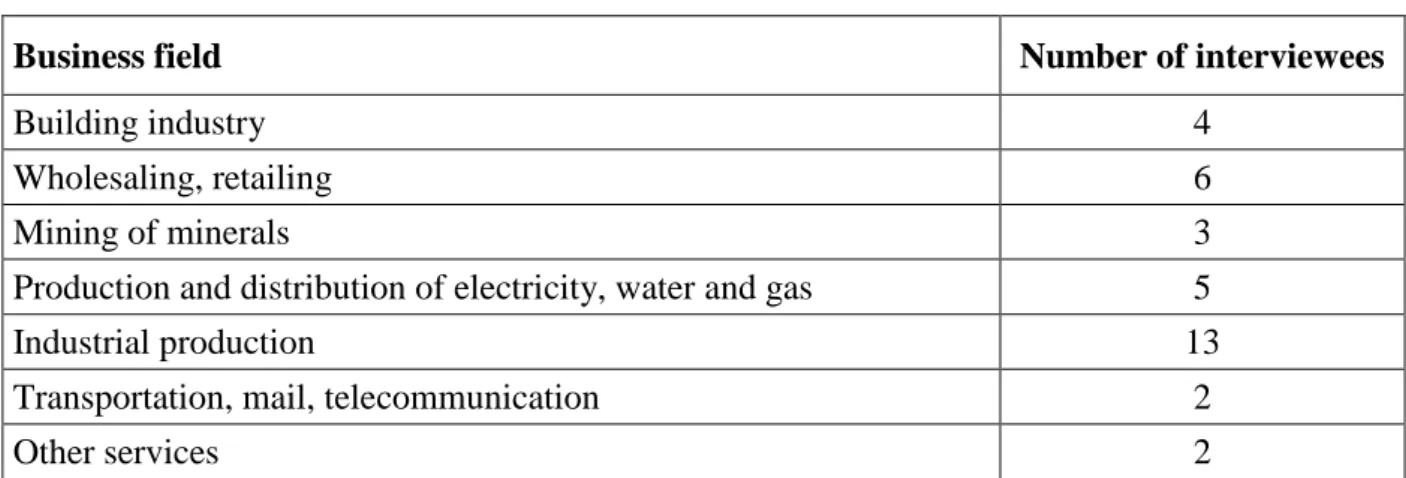
reactions, which means return at the level of 35 %. The composition of research sample is depicted in following table (Table No. 2).
Table 2: Research sample
Business field Number of interviewees
Building industry 4
Wholesaling, retailing 6
Mining of minerals 3
Production and distribution of electricity, water and gas 5
Industrial production 13
Transportation, mail, telecommunication 2
Other services 2
Source: own research
Among the interviewees there were two companies financed by foreign capital, 8 companies financed only by domestic capital resources and remaining 25 companies by combined capital funds (both foreign and domestic). Most interviewees came from two regions with the biggest share on total GDP of the Czech Republic, it means from Prague (20 companies) and from Moravian-Silesian region (8 companies). Additional two companies resided in the North Bohemian, two in the Central Bohemian, and one company in the South Bohemian, Karlovy Vary and Ústí nad Labem.
5. Results of the research
Research realized on the sample of the Czech TOP 100 companies resulted into several interesting findings. The proof of the proclamation that information technologies and systems create an integral part of working performance was given by fact that the employees of all interested companies are still using them when working. The share of the employees using computer in their everyday work is ranging from 10 to 100 %, with 65 % as the median. The median of internet users is 60 %. It appears that 17 out of 35 companies is using internet, or corporate intranet for the knowledge management, from acquiring the knowledge, their processing, preserving to their common sharing by the employees. 83 % of the companies from TOP 100 in Czech Republic use net interface for the publishing of information about job vacancies, 94 % apply electronic communication with applicant for a job, 66 % use internet for the purposes of personnel marketing, i.e. for building of positive employer’s reputation, 54 % enable to their employees to apply for further internal education activities through the corporate intranet, 37 % enable to employees to perform work through teleworking in a distanced form, 14 % offer different benefits electronically, 29 % use internet for benchmarking (systematic comparison with crucial competitors) and 11 % of the interviewees derive profit from individual changes made in personnel information system by the employees. No one company from TOP 100 considers the usage of information technologies as negative. Just the opposite, 11 out of 35 asked evaluated the influence of IT as absolutely positive, 23 companies rather positive and just one had neutral opinion. Above all the TOP companies appreciate better availability of information, mainly in order to manage and make decisions, the speed of the circulation of information, easier performing of particular personnel functions (recruiting, selection, appraisal or different surveys), but also the possibility to share the information among employees and immediate feedback, better quality, accuracy and labor productivity, routine activities
automation and the decrease of costs. Just one company considered as a main positive the opportunity to utilize electronic education.
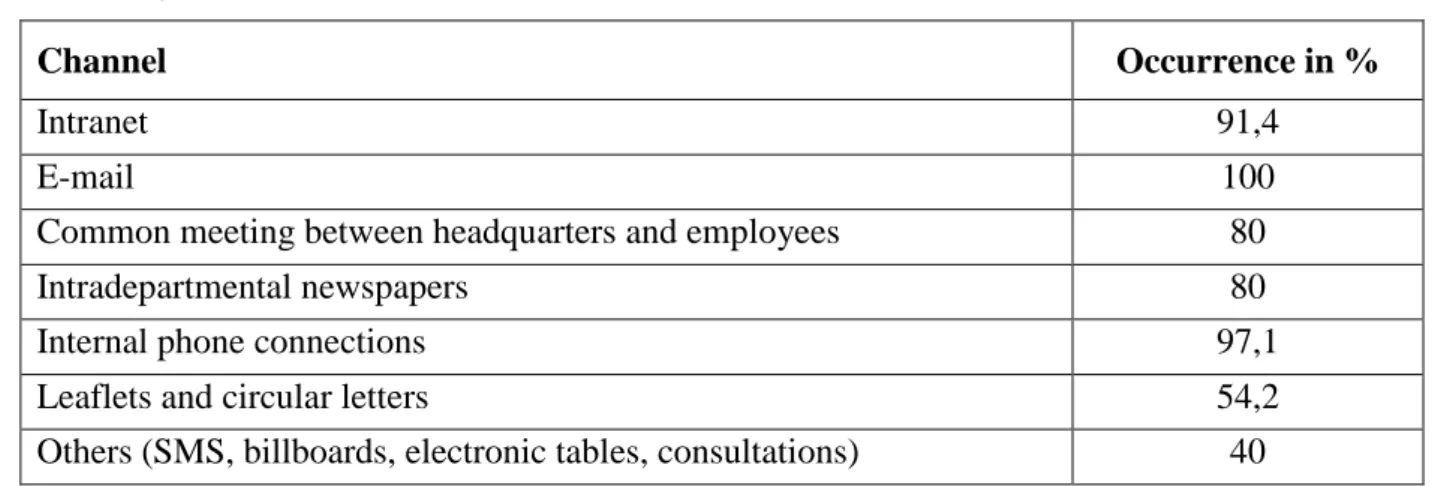
The Table No. 3 indicates how effective the flow of information within company is ensured through different communication channels.
Table 3: Communication channels
Channel Occurrence in %
Intranet 91,4
E-mail 100
Common meeting between headquarters and employees 80
Intradepartmental newspapers 80
Internal phone connections 97,1
Leaflets and circular letters 54,2
Others (SMS, billboards, electronic tables, consultations) 40 Source: own research
From these results it is visible that modern communication and information technologies create an integral part of intradepartmental communication and they are gradually displacing traditional forms, although commonly used in the past. Information- and automation-based processes are not the only one with intensive influence on the way in which personnel function is performed. Among relatively new trends in this function we can rank the usage of personnel consultant companies and the outsourcing of personnel activities. The research indicates that 26 out of 35 most significant Czech companies are utilizing services of special agencies. The other 9 companies are not utilizing this opportunity currently, but they plan to do so in the near future. So the interest in such services is apparent and also the satisfaction is evident, because 55 % of the interviewees consider such cooperation as positive. Mainly advisory services are supposed to be the best, because they bear benefits of new intensions for further company’s development and expert solutions of intradepartmental problems. Just three companies (8 %) quoted bad experience with personnel consultant companies. Their clauses were aimed on general approach, insufficient individualization, preferring of profit instead of professionalism and incapability to meet the demand of customers. The rest of the interviewees initiated neutral standpoint with the reason that the quality depends on choice of appropriate supplier. It is paradoxical that while the cooperation with miscellaneous agencies is going to be more popular, the usage of outsourcing is still at the beginning. The following chart is proving this proclamation (Chart No. 1).
Chart 1: The utilization of outsourcing in the personnel activities
Source: own research
The results shown us that Czech TOP 100 companies are using external services in personnel work much often, mainly in the area of education and training of managers (74 %), counseling and consultations (49 %), in headhunting and executive search – searching for potential applicants for positions of a manager or a specialist (46 %), working motivation or satisfaction surveys (43 %) and assurance of assessment centers (40 %). Because of the character of such activities we suppose that reasons for their external deliveries instead of internal administration are just their specific feature and complexity. The companies are ordering services from professional suppliers, skilled and experienced in required area, having necessary know-how, and therefore proposed solutions are quick and qualitative. Similar reasons are also given by outsourcing, mainly in the area of personnel audits or searching for potential employees. Wage accountancy performed externally is also used rather frequently. Because of the routine character its exclusion enables to the employees to concentrate on more sophisticated problems. Chart No. 1 also depicts first selection, selection procedures, appraisal or care as the activities with lower importance in outsourcing. An argument can be given by the fact, that these functions are ranked as strategic for company’s future and have direct impact on forming and keeping of the workforces. Therefore the companies prefer their internal assurance. Moreover, effective realization of these activities requires detailed information about the company and its culture, which are not available to external partners because of time limitation, but most of all because of the protection of intellectual property.
As the production and sharing of new knowledge is one of the most important tasks of the knowledge management, we have been interested in the extent to which these objectives are achieved in TOP 100 companies in Czech Republic. Results showed us that there exist significant reserves in this field. We found out that in 89 % of companies the employees participate on the innovation activity, e.g. by submitting of their own improvement proposals. Moreover, in 84 % of the companies the employees are awarded for successful proposals. Only 6 % of the companies don’t apply team work. For 46 % of the interviewees the team work is considered to be automatic and applied always, in additional 48 % it is applied when necessary by tricky problems or extraordinary situations with unknown solution. From such numbers it is clear that the TOP companies realize the importance of the employees in the creation of new ideas and innovation activities and therefore they are aimed at favorable corporate culture supporting creativity and willingness to share their knowledge with each other. The only
0 5 10 15 20 25 30 Wage accounting Education Exploring Headhunting First selection Selection Care Evaluation Counselling AC Personnel audit Surveys Service Number of com- panies
negative trend is the fact that only 37 % of the companies are elaborating so-called knowledge maps, depicting all knowledge within the company, including those which are not used in current position. Because of this it is probable that many companies even don’t know what their employees really know, and consequently the knowledge of their employees is not used in an effective way.
As very positive can be identified the fact that the TOP companies emphasize the importance of education and further development of their employees. 80 % of them have established special department or working position, oriented on coordination of educational activities within the company. Just one company considers such personnel function as worthless and expensive and above all as individual investment of employees towards higher wage and carrier improvement. In 8 companies the education represents basic function of the personnel work. It means that these companies enable further education to their employees not only for their individual improvement, but mainly because its broader utilization on behalf of the company itself. Almost 75 % of companies (26) consider education to be lucrative investment and significant determinant of company’s success at the market. Because of this reason they not only enable the employees to participate in education, but also support it. Just one company is strictly oriented on common courses ordered by law. 74,3 % of companies realize trainings aimed at the renewal of certificates obtained in the past, 85,7 % organize trainings oriented towards gaining of new skills and competences and nearly 92 % consider education to be so important that they even support higher education of their employees (e.g. language courses, apprentice programs, university education etc.)
6. Conclusion
The implementation of knowledge management under the conditions of the knowledge economy has become an integral part of the management of human resources. The reason is that people are considered to be the proprietors of essential part of corporate knowledge. Their
eventual outgoing without the codification of their knowledge can cause a great loss for a company, because of the necessity to repeat the whole process of necessary knowledge
acquisition. Therefore it is important to know the advantages connected with particular initiatives in the area of knowledge management. The management should be responsible for all such activities and should know how to utilize the knowledge for defined objectives achievement.
The research mentioned above was realized among the companies ranked as TOP 100 in Czech Republic in 2006 according to the volume of sales. It indicates that the instruments of knowledge management represent relevant component of the human resources management. Results definitely confirmed that the most successful companies are conscious of the wealth embodied in their human resources. These companies understand the fact that continual education and development of the knowledge, skills and abilities of their employees and suitable organizational culture represent a motive power of innovation activities inevitable for the maintaining and strengthening of competitiveness. At the same time these companies remember almost all advantages connected with the usage of information and communication technologies in the human resources management and performing of particular personnel activities. We can suppose that effective implementation of listed instruments of the knowledge management belong to significant determinants of their success.
References:
[1] BARTÁK, J.: Znalostmi k úspěšnosti. In: Personál, časopis pro rozvoj lidských zdrojů, roč. XIII, 2006, č. 3, s. 7 – 8. ISSN 1213-8878
[2] BAXTER, H.: KM and Human resources management. [24. 9. 2006] Dostupné na internete: http://www.knowledgeboard.com zo dňa 12. 4. 2002
[3] Bohatstvo v šedej kôre mozgovej. [31. 10. 2006] Dostupné na internete: http://efocus.sk/index.jsp?1=1&cl_id=418
[4] ENGLISH, M. J. – BAKER, W. H. Jr.: Rychlý transfer znalostí – nový klíč k úspěchu. In: Moderní řízení, roč. XLI, 2006, č. 11, s. 13-15. ISSN 0026-8720
[5] http:\\www.iminerva.sk
[6] JIRÁSEK, J.: Znalost a ignorance v řízení. In: Moderní řízení, roč. XLI, 2006, č. 4, s. 18. ISSN 0026-8720
[7] PETŘÍKOVÁ, R. a kol.: Lidé v procesech řízení (multikulturní dimenze podnikání). Ostrava. Dům techniky Ostrava, spol. s r.o. 2007. ISBN 978-80-86946-28-3
[8] PITRA, Z.: Společnost znalostí vyžaduje změnu systému vzdělávání. In: Moderní řízení, roč. XLI, 2006, č. 9, s. 6 – 10. ISSN 0026-8720
[9] SENGE, P.: Pátá disciplina. Praha. Management Press. 2007. ISBN 978-80-7261-1
[10] VODÁČEK, L.: Informační management: pojetí, poslání a aplikace. Praha. Management Press. 1997. ISBN 80-8594-335-2
[11] VYMĚTAL, J. – DIAČIKOVÁ, A. – VÁCHOVÁ, M.: Informační a znalostní management v praxi. Praha. LexisNexis CZ, s.r.o. 2006. ISBN 80-86920-01-14
[12] WALKER , A. J. a kol.: Moderní personální management. Praha. GRADA. 2003. ISBN 80-247-0449-8.
Ackowledgement
The research was realized with the financial support of Nadácia SPP within the scholarship program Hlavička 2007.
Address of author: Mgr. Gabriela ELEXOVÁ
Katedra ekonomiky a manažmentu podniku Univerzita Mateja Bela
Tajovského 10
974 11 Banská Bystrica