Procedia Technology 17 ( 2014 ) 742 – 748
ScienceDirect
2212-0173 © 2014 The Authors. Published by Elsevier Ltd. This is an open access article under the CC BY-NC-ND license (http://creativecommons.org/licenses/by-nc-nd/3.0/).
Peer-review under responsibility of ISEL – Instituto Superior de Engenharia de Lisboa, Lisbon, PORTUGAL. doi: 10.1016/j.protcy.2014.10.193
Conference on Electronics, Telecommunications and Computers – CETC 2013
A NOVEL DISTRIBUTED CLUSTERING PROTOCOL USING
FUZZY LOGIC
Maryam Mirsadeghi, Ali Mahani∗, Maryam Shojaee
Department of Electrical Engineering, Shahid Bahonar University of Kerman, Kerman, Iran, 76169133 [email protected], [email protected], [email protected]
Abstract
Energy resource constraint is an important issue in wireless sensor networks. An efficient solution to this issue is clustering approach; which markes the network nodes as cluster heads (CHs) and cluster members (CMs). In the clustering method cluster members send packets to the cluster head and CHs forward the received packets to the sink. CH selection mechanism has direct effect on the energy efficiency and network coverage of WSN. In this paper a new distributed clustering approach using fuzzy logic is proposed. Our proposed method uses Fuzzy logic to assign CH selection chance to network nodes in order to choose tentative and final CHs. simulation results demonstrate that our approach reachs to better network lifetime, energy efficiency and network coverage in comparison with UCFIA, GCA, and SCP.
c
2014 The Authors. Published by Elsevier Ltd.
Selection and peer-review under responsibility of ISEL – Instituto Superior de Engenharia de Lisboa.
Keywords: Wireless sensor networks; Clustering; Fuzzy Logic; Network Lifetime.
1. INTRODUCTION
Wireless sensor networks are composed of thousands inexpensive and intelligent sensor nodes which are deployed randomly over a region. In these networks, main constraints of sensor nodes are energy resource, processing power, communication bandwidth and etc. [1]. The power supply of sensor nodes in WSNs is small batteries, that usually could not be recharged or replaced. So the most important issue in WSN is network lifetime, and the best solution is energy efficient protocols. Recently, the clustering is introduced as an energy-saving method, and the good perfor-mance of WSN is strongly dependent on the energy-efficient clustering mechanism [2]. Using the clustering method in the sensor networks leads to the following advantage:
• Low energy consumption
• long lifetime
• Facilitate collaborative signal processing
∗Corresponding Author. Tel.:+98-341-3202534 ; fax:+98-341-3235900.
E-mail address:[email protected]
© 2014 The Authors. Published by Elsevier Ltd. This is an open access article under the CC BY-NC-ND license (http://creativecommons.org/licenses/by-nc-nd/3.0/).
• Facilitate data aggregation
• Reduce communication bandwidth
• Increase scalability and robustness of network
In order to have more efficient clustering mechanism three main issues should be considered: 1) low energy con-sumption during clustering, 2) good distribution of cluster heads to reach high coverage and 3) low number of orphan nodes. LEACH [3] (Low Energy Adaptive Clustering Hierarchy) is one of the classic clustering protocols which only consider the probability for each node to become cluster head. But the location and the residual energy of nodes, does not take into account and leads to the early death of some nodes and the overall invalidity of the network. In GCA [4], a gradual cluster head election algorithm is proposed that gradually elects cluster heads according to the proximity to neighbour nodes and the residual energy level at each clustering step. This method guarantees the net-works connectivity and coverage by increasing the number of CHs. But the critical issue which must be considered is increasing collision probability by increasing the number of CHs. In the DAC [5], a new duplication avoidance method is proposed. Each node has a random number generator based on the logistic map function and with random updating in each round, it can decide to be either a cluster head or not without any control overheads. This method has lower coverage than GCA. In TCAC [6], the authors present a new topology control mechanism in which the nodes can control their transmission power level. This technique ensures that any elected cluster head is connected under an optimal degree which is determined by the number of neighbours for uniform distribution of nodes throughout the time. In SCP [7], a staggered clustering protocol is proposed which selects the high energy node with low commu-nication cost as a cluster-head, and also considers the load balancing. Authors in [8] introduced the fuzzy logic on demand clustering, in which node’s remaining energy is considered for non-probabilistic CH election. In [8], commu-nication between CHs and BS is done in a multi-hop fashion. In [9], a new unequal clustering scheme based on fuzzy logic (UCFIA) is proposed where local information of tentative cluster heads including residual energy, distance to base station and local density are considered. Then the tentative cluster heads’ chance and their competence radius are found. Also adaptive max-min ant colony optimization is used to construct the energy-aware inter-cluster routing between cluster heads and base station (BS). Fuzzy Logic [10,11] is used in clustering for Merging different clustering parameters according to predefined rules and then electing CHs based on the result. Besides, as mentioned in [8] the overhead of cluster head election may be highly reduced by using fuzzy logic.
This paper proposes a new distributed clustering approach using fuzzy logic to address all the goals mentioned above. First, the fuzzy logic is employed to assess the chance of a node to become a CH. Node density, node energy and node’s centrality are taken into account to calculate the cluster head’s chance. We suppose that CHs send their information to the BS in single-hop fashion. The proposed method is compared with UCFIA, GCA and SCP protocols. As mentioned before, GCA has a high coverage but large number of CHs increases collision probability. In SCP nodes with high residual energy are selected as CHs, but lower coverage in comparison with UCFIA is considered as negative point of this method. The obtained results show that the proposed method has better coverage and provides superior network lifetime and energy savings. Also by using fuzzy logic, nodes with the best situation are selected as cluster head. The rest of the paper is organized as follows: In section 2, our new clustering method is presented. Simulation results are discussed in section 3, and finally, the paper is concluded in section 4.
2. PROPOSED METHOD
Three following assumptions are used in proposed clustering mechanism:
• All nodes have the same initial energy and the BS knows this value.
• The BS knows the size of considered environment.
• The BS has information about the initial number of nodes in the network
At the beginning of the proposed network deployment, the BS broadcasts a beacon signal to all sensor nodes which contains some necessary information such as the initial energy of the sensor nodes in the network, number of nodes in the network and network dimension. The same process is used by the sensor nodes, to determine the number of their
neighbor nodes. Our proposed clustering scheme is implemented during several rounds and in the beginning of each round, the neighbor information is updated and each node calculates its chance of becoming CH by using fuzzy logic. 2.1. FUZZY LOGIC
Fuzzy logic (FL) is used to model human experience and human decision making behavior. In the FL the input-output relationship is expressed by using a set of linguistic rules or relational expressions. FL basically consists of four important parts including Fuzzification, Defuzzification, inference engine, and a rule base. Here we have employed the most commonly used fuzzy inference technique, called the Mamdani and Assilian [12] method. for all of the sensor nodes in the network, the following three parameters are collected as fuzzy sets of input variables.
• Remaining energy (represented byenergy), which is the remaining battery power of the sensor node.
• Local Density (represented bydensity), which is the normalized number of neighbor nodes in a sensor nodes neighborhood:
node−desityi=|
node−neighbers|
|node−numbers| (1)
Herenode−neighbersis the number of node’s neighbers andnode−numbersis the number of all nodes in the environment which is constant.
• Node centrality (represented bycentrality):
node−centralityi=
(j∈node−neighbers(i)dist2(i,j))/|node−neighbers(i)|
Network−Dimension (2)
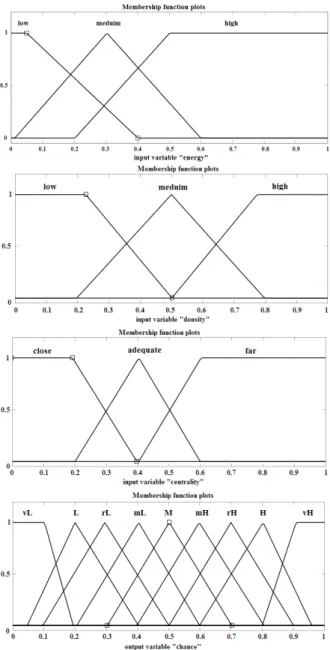
Where for anN×N region of space, the Network−Dimension is defined asN. Anddist(i,j) is the distance between nodesiandj. The fuzzy sets of input variables and output variable (chance) are depicted in figure 2.1. The proposed clustering method calculates a probability which shows the chance of a node to be selected as a CH, using fuzzy if-then rules. Based on the three fuzzy variables, fuzzy if-then rules can be defined which are similar to those presented in table 1. A greater chance means that the node has a higher priority to be elected as CH.
Table 1. Fuzzy rules.
energy density centrality chance
high high close vH (very High)
high high far H (High)
..
. ... ... ...
low low close L (Low)
low low adequate vL (very Low)
2.2. CLUSTERING PROCESS
After computing the chance, each sensor node sets its own delay-time as follows: Delay−T imei=
1 node−chancei
(3) Each node must wait up to its delay time expiration. If a node does not hear theCH−msgmessage from any other sensor node during the delay time, it declare itself as a tentative CH after its delay-time expiration. So it broadcasts aCH−msgmessage to all the nodes within the cluster range to announce its status. for a node with greater chance, its delay time is lower. So, its delay time would be expired sooner and it has a higher priority of being selected as a
Fig. 1. Fuzzy sets: (a) energy, (b) density, (c) centrality and (d) chance
tentative CH. If this particular node has the greatest chance among the tentative CHs in its proximity, it will become a final CH and should inform nodes within its cluster range by sending a f inal−msgmessage within its cluster range. if a node receives a f inal−msgmessage, it can no longer be elected as a CH. Therefore, it must choose to connect to one of the final CHs in its cluster radius based on its distance to selected CHs. On the other hand if a node completes the clustering process and has not yet received any f inal−msgmessage, it will find itself uncovered and so becomes an orphan node. The main problem of this method is convergence in the cluster head election when two nodes have the same chance and so the same delay time. In this situation, the node with lower ID is selected as CH.
3. SIMULATION RESULTS
In this section we compare our proposed clustering method with GCA [4], SCP [7] and UCFIA [9] protocols via MATLAB software and show that it has better performance than other methods in terms of energy consumption, network coverage, number of orphan nodes and network lifetime. simulations for following scenario are conducted: A network with 200 nodes deployed randomly over an area of size 200 * 200 . Each sensing node initially had 0.5 J of energy. The BS is located at the coordinate (100, 250) and the cluster range is chosen such that approximately five percent of nodes be selected as CHs. The results are extracted after 100 rounds of simulation. We suppose that in each round all sensor nodes are active, sense the environment and send their information to their cluster heads. Then all the cluster heads send the aggregated data to the sink in the single-hop manner. The energy consumption model for communication is discussed in [3], in which the consumed energy of transmitter node is:
i f d>d0 Et=lEelec+lempd4+lEDA
i f d≤d0 Et=lEelec+lf sd2+lEDA
(4) WhereEDAis the energy for data aggregation in header nodes,Eelecis the dissipated per bit to run the transmitter
or receiver circuit,f sandempdepend on the transmitter amplifier model, d is distance,d0is threshold distance andl is the packet length. The consumed energy for receiver nodesEris as follows:
Er=lEelec (5)
Some necessary simulation parameters are listed in table 2. Table 2. parameters for energy consumption model
parameter value Eelec 50nJ/bit EDA 5nJ/bit/signal emp 0.0013pJ/bit/m4 f s 10pJ/bit/m2 do 87m l 2000bits Rsense 15m
The first simulation is performed to show the network coverage and the orphan nodes ratio and their effect on energy consumption of WSN. The network coverage and number of orphan nodes can influence on the energy consumption of network because orphan nodes are not covered by any cluster head and send directly to the sink. So when clustering method has high coverage, its numbers of orphan nodes can be reduced and so reduces the energy consumption of network. To satisfy this issue, the number of created CH in each round should be reasonable. figure 2 shows all energy consumed during clustering and sending information to the sink in each method. In table 3, average coverage of network and orphan nodes ratio are demonstrated and table 4 shows the total average number of CHs is shown.
According to the figure 2 and tables 3 and 4, our proposed clustering method has more coverage ratio, lower number of orphan nodes and lower energy consumption in comparison with the other mentioned methods. In fact there is a trade-offbetween these parameters and the average number of CHs in each round.
SCP has the worst coverage and high energy consumption since it has low number of CHs which cannot cover the area well and increases the number of orphan nodes. On the other hand, GCA has the most numbers of cluster heads which increases the network coverage. But as this high coverage is achived by more number of CHs, the collision probability will increase. This means an increase in the number of unnecessary transmission to the sink and more energy consumption.
UCFIA performs better than the SCP and GCA in terms of energy consumption, since there is the lowest number of CHs in each round which increases the orphan nodes ratio. In this method, there are variable sensing ranges for each selected CH which makes its ratio of coverage better than SCP.
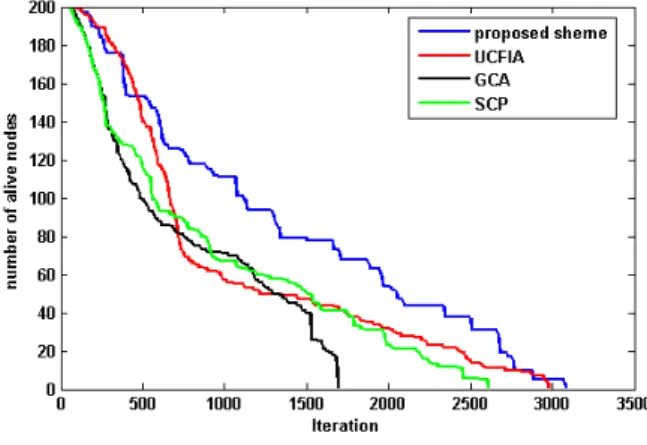
Figure 3 shows the first node, the half node and the last node die in such methods. According to figure 3, our proposed scheme has larger FND, HNA and LND and figure 4 shows that its lifetime is more than mentioned methods.
Table 3. Comparison of network coverage and orphan nodes ratio in mentioned methods
Method Coverage ratio % Orphan nodes ratio
Proposed method 64 0.00038
UCFIA 48 9.1
SCP 28 8
GCA 82 1.5
Table 4. Energy consumption and average number of CHs Comparison in mentioned methods
Method Average number of CHs Energy consumptionJ
Proposed method 37 13.9
UCFIA 8 21
SCP 15 23
GCA 83 31
In all previous methods more number of orphan nodes, not only decrease the network coverage but also makes the network lifetime shorter.
Fig. 2. All energy consumption in each method
Fig. 4. Plot of network lifetime
4. CONCLUSION
In this paper we propose a novel distributed clustering protocol using fuzzy logic. Proposed protocol uses fuzzy logic to merge the local information of nodes including residual energy, local density and node centrality to calculate the node cluster head’s chance and select tentative and final cluster heads. Node with greater chance has lower delay time and higher priority of being selected as a CH. Simulation results show that the proposed method has high coverage ratio, low number of orphan nodes and low energy consumption that prolong the network lifetime.
References
[1] V. Kumar, S. Jain, S. Tiwari, “Energy Efficient Clustering Algorithms in Wireless Sensor Networks: A Survey”, IJCSI International Journal of Computer Science Issues, Vol. 8, Issue 5, No 2, 2011, pp. 1694-0814
[2] Z.Yong, Q.Pei, “A Energy-Efficient Clustering Routing Algorithm Based on Distance and Residual Energy for Wireless Sensor Networks ”, International Workshop on Information and Electronics Engineering (IWIEE), 2012, pp. 1882-1888.
[3] W.R. Heinzelman and A. Chandrakasan, Energy-efficient communication protocol for wireless microsensor networks, Proceedings of Interna-tional Conference on System Sciences, 2000, pp. 1-10.
[4] S.H. Lee, S. Lee, H. Song and H.S. Lee, Gradual Cluster Head Election for High Network Connectivity in Large-Scale Sensor Networks, ICACT, 2011.
[5] A. Mahani, M.H. Askari-Hemmat and Y.S. Kavian, Duplication Avoidance for Energy Efficient Wireless Sensor Networks, 8th IEEE, IET International Symposium on Communication Systems, Networks and Digital Signal Processing, 2012.
[6] D.P. Dahnil, Y.P. Singh and C.K. Ho, Topology-controlled adaptive clustering for uniformity and increased lifetime in wireless sensor networks, The Institution of Engineering and Technology, Vol. 2, Iss. 4, pp. 318327, 2012.
[7] A.K. Tripathy and S. Chinara, Staggered Clustering Protocol: SCP an Efcient Clustering Approach for Wireless Sensor Network, World Congress on Information and Communication Technologies, IEEE, 2012.
[8] H. Taheri, P. Neamatollahi, O.M. Younis, S. Naghibzadeh and M.H. Yaghmaee, An energy-aware distributed clustering protocol in wireless sensor networks using fuzzy logic, Elsevier B.V. 2012.
[9] M. Song and Z. Cheng-lin, “Unequal clustering algorithm for WSN based on fuzzy logic and improved ACO”, The Journal of China Univer-sities of Posts and Telecommunications, 2011, pp. 89-97.
[10] L.A. Zadeh, “Fuzzy Sets, Information and Control” 8 (3), 1965, pp. 338-353.
[11] L.A. Zadeh, “Outline of a new approach to the analysis of complex systems and decision processes”, IEEE Transactions on Systems, Man and Cybernetics, SMC-3 1,1973, pp. 28-44.
[12] E.H. Mamdani and S. Assilian, “An experiment in linguistic synthesis with a fuzzy logic controller”, International Journal of Man-Machine Studies 7 (1), 1975, pp. 1-13.