City, University of London Institutional Repository
Citation
: Keswani, A. ORCID: 0000-0001-9096-7677, Tran, A. ORCID:
0000-0001-7090-8063 and Volpin, P. ORCID: 0000-0002-9287-0972 (2020). Institutional Debt Holdings and Governance. Journal of Financial and Quantitative Analysis,This is the accepted version of the paper.
This version of the publication may differ from the final published
version.
Permanent repository link:
https://openaccess.city.ac.uk/id/eprint/24090/Link to published version
:
Copyright and reuse:
City Research Online aims to make research
outputs of City, University of London available to a wider audience.
Copyright and Moral Rights remain with the author(s) and/or copyright
holders. URLs from City Research Online may be freely distributed and
linked to.
City Research Online: http://openaccess.city.ac.uk/ [email protected]
Institutional Debt Holder Governance
Aneel Keswani, Anh Tran and Paolo Volpin
(Cass Business School, City, University of London)
April 2020
Abstract
Using data on the universe of US-based mutual funds, we find that two out of five fund families hold corporate bonds of firms in which they also own an equity stake. We show that the greater the fraction of debt a fund family holds in a given firm, the greater its propensity to vote in line with the interests of firm debt holders at shareholder meetings. Voting has direct policy consequences as firms that receive more votes in favor of creditors make corporate decisions more in line with the interests of debt holders.
JEL classification: G23, G34
Keywords: corporate governance, institutional investors, agency costs of debt
E-mail:[email protected], [email protected] and [email protected].
Acknowledgments: We thank Pat Akey, Seth Armitage, Lucian Bebchuk, Bo Becker, Maria Boutchkova, Max Bruche, Walid Busaba, Kevin Crotty, Craig Doidge, Craig Dunbar, David Goldreich, Andrey Golubov Amit Goyal, Nandini Gupta, Bing Han, Neltje van Horen, Wei Jiang, Tim Jenkinson, Dirk Jenter, Raymond Kan, Leora Klapper, Nam Le, Ulf von Lilienfeld-Toal, Lucy Liu, Ernst Maug, Joel Peress, Christopher Polk, Zacharias Sautner, Henri Servaes, Clemens Sialm, David Stolin, Javier Suarez, Josef Zechner, seminar participants at Cardiff University, Ivey Business School, Rotman School of Management, University of Edinburgh, University of Liverpool, University of Strathclyde and conference participants at the Seventh Luxembourg Asset Management Summit and the Vietnam International Conference in Finance for comments and suggestions.
Institutional Debt Holder Governance
Abstract
Using data on the universe of US-based mutual funds, we find that two out of five fund families hold corporate bonds of firms in which they also own an equity stake. We show that the greater the fraction of debt a fund family holds in a given firm, the greater its propensity to vote in line with the interests of firm debt holders at shareholder meetings. Voting has direct policy consequences as firms that receive more votes in favor of creditors make corporate decisions more in line with the interests of debt holders.
JEL classification: G23, G34
1
1. Introduction
Institutional investors own more than two thirds of equity traded on the US stock market (Pensions and Investments, 2017) and play an important role in the governance of public corporations. Besides trading their stakes, shareholders can influence firms via a combination of public and private engagement, often labeled as shareholder activism. Public engagement involves submitting a shareholder proposal, initiating a proxy fight, starting a "just say no" campaign and it critically centers on the power to vote at shareholder meetings. Private engagement instead relies on private meetings with directors and executives to persuade the management to act in shareholders' interests, often using public engagement or share divestment as a threat.
Institutional investors also own a large fraction of US corporate bonds. Although there is extensive evidence on the role of institutional investors as shareholders, we know very little about the impact of their debt holdings on their behavior. In this paper, we fill this knowledge gap and look at the effect of holding bonds as well as equity on institutional investors' engagement with a corporation. To identify the potential conflict of interest between debt and equity, we look at companies that are close to financial distress and thus face a wedge between the interests of shareholders and debt holders. In doing so, we follow the approach adopted by Becker and Strömberg (2012), who find that debt-equity conflicts can be affected by changes in managerial fiduciary duties and that the resulting changes in corporate behavior should only be visible for firms in financial distress. Focusing on the voting behavior of mutual fund families, if a fund family holds none of the corporate debt of a firm, we would expect its funds to vote so as to maximize the value of their equity stake. When the family debt fractionis positive, we would expect its funds to pay some consideration to the value of their debt stake, and therefore to vote considering the consequences for the value of both their equity and debt stakes in the firm. So, our first hypothesis is that a fund management company will be more likely to vote in the interests of debt holders in firms in which they own relatively more debt.
To test whether debt holding by fund families affects the way they vote on shareholder proposals we focus on five corporate decisions where debt and equity have conflicted interests: dividend policy; equity issues and share repurchases; anti-takeover provisions; executive compensation; and restructuring activities such as assets sales, asset acquisitions or spinoffs. For each
2
of these corporate decisions, there is evidence in the literature that the interests of shareholders and debt holders may be in conflict with each other, particularly when firms are close to financial distress. To examine whether voting affects firm policy, we relate the extent to which institutional investors vote in favor of creditors to five corporate decisions namely capital expenditures; research and development; seasoned equity offerings; diversifying acquisitions; cash dividends and share repurchases. Our second hypothesis is that firms observing more pro-creditor votes will attach greater importance to creditors’ interests, leading them to act more in the interests of debt holders than shareholders.
Our dataset covers the universe of US fund families investing in US listed firms over the 2009-2013 period and has 12,327 firm-year observations containing 571 fund families. It is obtained by combining three datasets: the Morningstar Direct database, which contains data on the holdings of both debt and equity of all funds sold in the US; the data on fund voting from Institutional Shareholder Services (ISS); and the balance sheet information on all publicly traded firms with a positive level of debt from Compustat.
In the analysis of the voting behavior of mutual funds, the dependent variable is an indicator whether the mutual fund votes in alignment with creditors on a specific proposal. The key independent variable is the fraction of debt held by the fund's family. As traditionally done, we include a number of control variables: a dummy variable that is set to one if ISS supports creditors for the proposal concerned; a set of firm characteristics (log size, leverage, market-to-book ratio and return on assets); the equity stake owned by the fund family; and the log of the number of funds in the fund family. We also include proposal type times year fixed effects.
The basic result shows a positive correlation between family debt fraction and the propensity to vote with creditors. However, the economic effect is small. Intuitively, there is limited conflict between debt and equity when a firm is far from financial distress: what is in the interests of creditors is likely also to be in the interests of shareholders and changes in firm policy have a very small effect on the value of debt holders’ stakes. However, we would expect this conflict to be magnified close to financial distress, when corporate policies are likely to have a larger effect on the market value of debt. Therefore, we augment the analysis by including an indicator of financial distress. Our definition
3
of distress is based on the Bharath and Shumway (2008) distance to default measure. We define distress (0,1) in this case to be one if the firm’s default probability is at least 75% in the year concerned. We interact the family debt fraction with the financial distress indicator and find that the interaction term is statistically significant, positive and large in magnitude.
The correlation is stronger when the vote is in alignment with management and/or the ISS recommendation but is still statistically significant even when creditors' interests are in conflict with these recommendations. As a placebo test, we also look at proposals for which we do not expect much conflict between debt and equity, such as director elections. In those instances we would not expect to find any effect of family debt fraction on voting policy. Our results confirm this prediction. Therefore, overall, the analysis of voting suggests that fund family debt holdings affect how fund families vote on these conflict proposals.
What is the relevance of the voting channel for firm policy? To understand this we follow a two-step procedure. We first determine the total effect of joint debt-equity holdings on firm policy by relating the average debt equity fraction of institutional investors in a given firm to its policy. In the second stage, we measure the importance of the voting channel by relating the votes cast in favor of creditors on a given firm to its policy. We find that there is a significant effect of the voting channel on both firm investment and payout policy and that in terms of economic significance, the voting channel is responsible for about 20% of the link between the debt equity holdings of institutional investors in a firm and its investment policy and about 10% for payout policy.
As a note of caution, the results described so far should be interpreted as simple correlations: mutual fund families with a long position in both corporate debt and equity tend to vote more in line with the interests of debt holders rather than shareholders, compared with families with only equity positions. In an attempt to move closer to the identification of a causality link between institutional debt holdings and corporate governance, we use an instrumental variable approach and a quasi-natural experiment.
For our instrumental variable approach, we use the introduction of a new debt fund by a fund family as an instrument in our first stage models. Opening a new debt fund is likely to be driven by the desire to satisfy market demand rather than because a fund family wants to hold more debt in a
4
particular firm. The creation of a new debt fund mechanically increases the fraction of debt that the fund family holds. Furthermore, we show that the choice of debt securities by fund families when they introduce a new debt fund is virtually “passive” as on average of 86% of the time fund families invest in firms in which they already hold either debt or equity. When we instrument the family debt fraction and its interaction with distress using the new debt fund indicator, we confirm our basic findings: family debt fraction has a significant effect on the propensity to vote with creditors on proposals when firms are in financial distress.
We also use mergers between fund families for a difference-in-differences test. For identification purposes, we use cases either in which the acquirer fund family holds no debt in the firm concerned but the target fund family does (acquirer has no debt and target has only debt) or vice versa (acquirer has only debt and target has no debt) but we exclude cases where both acquirer and target hold debt and equity in the same firm pre-merger. This allows us to identify more clearly the debt-equity position of the merged entity relative to the two initial firms resulting in a cleaner test. As these mergers are likely to be the result of strategic considerations at the fund family level, these serve as quasi-exogenous shocks to the debt equity ratio of fund families. When we take this approach, our basic results remain unchanged. While these results cannot alleviate all concerns of endogeneity, they offer some reassurance about the robustness of our findings.
We conduct several further robustness checks. First, we consider alternative measures of financial distress. Our main measure of financial distress is the distance to default. We show that the results extend to the case in which we measure financial distress using the debt rating and also to the case where we measure financial distress at the industry level, based on the Opler and Titman (1994) definition.
Second, in our main analysis we compute the fraction of corporate debt held by mutual fund families as the total value of debt held by a fund family over the total value of debt and equity held by the family. We obtain similar results if we use the number of debt funds over the total number of funds held by a mutual fund family. Third, we demonstrate that when we exclude funds that use credit default swap (CDS) contracts to hedge the credit risk of the debt securities they hold, that our results are unaffected.
5
Our contribution is to highlight that voting may be affected by joint debt-equity holdings and it is a channel through which these holdings affect policy. This is particularly important as institutional investors commonly hold both debt and equity in the same firm. Our findings suggest that debt holdings change the way institutional investors vote and generally engage with portfolio firms and thus should not be ignored when examining the governance role of institutional investors.
There is a growing literature on the joint holdings of debt and equity of institutional investors.1 Most papers in this area focus on the impact of these joint holdings on target firm conduct. Chu (2018) shows that joint debt equity holdings influence payout policy while Chu, Nguyen, Wang, Wang, Wang (2019) suggest that these joint holdings allow easier resolution of financial distress. As regards investment policy, Yang (2019) and Chava, Wang and Zhou (2019) both show that joint holdings may have an effect on innovation and capital expenditure, respectively. Jiang, Li, and Shao (2010) examine the effect on loan interest rates when banks also hold equity in a given firm. What differentiates our paper is that we focus on the impact of these joint debt and equity holdings on voting behavior and the consequences of these votes.
The most closely related paper to ours is Bodnaruk and Rossi (2016), who look at the effect of institutional investors holding both debt and equity in M&A targets. They examine the implications for the takeover premium, the returns that bondholders receive and the propensity of dual holders to vote in favor of the takeover bid. The scope of our paper is broader as it looks at the effects of institutional investors holding both debt and equity on voting on all types of firm policies not just M&A decisions. Furthermore, we show that the voting channel has implications for subsequent firm conduct while Bodnaruk and Rossi (2016) do not. Therefore, it extends and complements their work.
Our paper has the following structure. Section 2 develops our hypotheses and reviews the related literature. In Section 3 we introduce our data and discuss our sample’s descriptive statistics. In Section 4 we present our empirical results on the effects of debt holdings on voting. Section 5
1 There are also papers that have looked at the impact of other types of institutional investor joint holdings
(rather than debt and equity). For example, Matvos and Ostrovsky (2008) study institutional investors that own equity in both the acquirer and the target and Azar, Schmalz and Tecu (2018) joint ownership of equity by institutional investors in competing firms affects how these firms compete in the product market.
6
examines the consequences of voting for firm policy. Section 6 presents our robustness tests. Section 7 concludes.
2. Hypotheses
Institutional investors that hold equity in a firm can influence its corporate policy in two ways. They can publicly engage with the target firm, initiating a proxy fight and voting for their proposals at the shareholder meetings. Alternatively, they can privately persuade the management to act in their interests, using the possibility of public engagement or sale of their shares as a threat.
The literature on institutional investor activism seems to indicate a large heterogeneity in activity and effectiveness across investors and over time. Wahal (1996) studies 356 public engagements by 9 pension funds between 1987 and 1993 and shows that pension funds are successful in changing the governance structure of targeted firms but their activity is not associated with a significant short-term or long-term improvement in either stock price or accounting measures of performance. Smith (1996) studies a comprehensive set of 51 public activism targets of CalPERS from 1987 to 1993 and finds more promising results: CalPERS seems to target underperforming companies and it has a high success rate (72%) of adopting governance structure changes. The paper shows that shareholder wealth increases for firms that adopt/settle and decreases for firms that resist.
Carleton, Nelson, and Weisbach (1998) examine the private correspondence between TIAA-CREF and 45 firms it contacted between 1992 and 1996. The results indicate that TIAA-TIAA-CREF reaches agreement with target companies more than 95% of the time; in more than 70% of the cases, the agreement reached without shareholders voting on the proposal (and even without shareholders knowing about TIAA-CREF involvement); 87% of the targets subsequently took actions to comply with these agreements. A similar study for the UK by Becht, Franks, Mayer, and Rossi (2010) examines the activity of the activist fund Hermes UK Focus Fund, which was part of the British Telecom pension fund, over the period 1998-2004. The engagement of this fund tends to take a private rather than public form and seeks to restructure firms, focusing their activities, limiting acquisitions and capital expenditure, changing boards and altering financial policy. While there is no
7
positive market reaction to public notification of HUKFF's stake, there is a substantial share price reaction to engagement outcomes of between 3 and 4%.2
The papers mentioned so far focus on the performance of very special funds. More recently, attention has shifted towards the general category of institutional investors. Aggarwal, Erel, Ferreira, and Matos (2011) show that international institutional investors are positively associated with firm-level corporate governance in a large sample of firms from 23 countries during the 2003–2008 period. They find that firms with higher institutional ownership are more likely to terminate poorly performing CEOs and exhibit improvements in valuation over time. Iliev and Lowry (2015) emphasize that there is a large heterogeneity across mutual funds and find that over a quarter of the funds rely almost entirely on Institutional Shareholder Services recommendations, while other funds place little weight on them.
We extend this literature by focusing not only on the equity holdings of institutional investors but also on their debt holdings. As a matter of fact, mutual fund companies often also hold debt in the same firms in which they hold equity. This may be through their debt only funds or their mixed funds that hold both debt and equity. What is the governance role (if any) of these debt holdings?
First consider the public channel, the voting decisions. To measure the extent to which fund families hold debt as a share of the total holdings we define the variable family debt fraction as:
𝐹𝑎𝑚𝑖𝑙𝑦𝑑𝑒𝑏𝑡𝑓𝑟𝑎𝑐𝑡𝑖𝑜𝑛, ,
(1)
If mutual fund companies have no debt in a firm, and their family debt fraction is zero we would expect them to vote so as to maximize the value of their equity share. However, when the family debt fractionis positive we would expect the mutual fund family to take into consideration the interests of their debt stake in the same firm and therefore to vote, thus evaluating not only the consequences for
2 These strategies are also adopted by hedge funds. For instance, Brav, Jiang, Partnoy, and Thomas (2008) use
hand-collected data on 888 events launched by 131 activist hedge funds in 2001-2005 period to find that the announcement of hedge fund activism results in 5-7% abnormal return during the announcement window with no apparent reversal in the subsequent year. Klein and Zur (2009) compare the investment strategies of hedge and non-hedge funds. Brav, Jiang, and Kim (2015) look at the effects of hedge fund activism on productivity, investment and labor policies.
8
the value of their equity stake in the firm but also the consequences for their debt stake. From this we get our first hypothesis:
Hypothesis 1 (Debt-holder governance): The greater the family debt fraction held by a given fund management company in a given firm, the greater the tendency of that fund management company to vote according to the interests of debt holders.
Consider next the private engagement channel. If institutional investors hold only equity, we would expect them to not only vote in the interests of equity but to also push firm policy in the interests of equity through the direct communication channel. However, if institutional investors hold both a mix of debt and equity, then we would expect them to take the interests of debt into account to a greater extent when voting on firm policy and also directly communicating with firms.
Therefore we would expect there to be two channels through which joint debt equity holdings affect firm policy. The first is through the voting channel and the second is through the private engagement channel. While we cannot observe the private communication channel, we can observe the voting channel, and therefore it is possible to test for its relative importance.
If firms observe that institutional investors vote to a greater extent in the interests of creditors then we would expect firms to respond to this by acting more in the interests of creditors as well. Therefore our second hypothesis is:
Hypothesis 2 (Impact of debt-holder governance): The greater the propensity of institutional investors to vote in favor of creditors on the proposals of a given firm, the more the firm will be managed in the interests of debt holders.
We expect to detect the debt governance role of institutional investors in firms close to financial distress. This is because, when a firm is in financial distress, its decisions are likely to have large effects on the value of its bonds as well as the value of its shares. So, when holding a long position in a firm in financial distress, it is worthwhile for a fund family to coordinate the voting of its equity and debt funds, and invest resources to develop their own view on the firm’s strategy. Conversely, away from financial distress, bond prices are hardly affected by firms’ decisions. Therefore, there is no need to coordinate the voting decisions on debt and equity funds.
9
3. Data
To conduct our analysis we merge together datasets from various sources. The first dataset consists of the holdings of U.S. fund families in U.S. listed firms, which allow us to calculate fund family debt fractions by all families in each firm. We gather data on the holdings of both debt and equity of all funds sold in the U.S. between 2009 and 2013 from the Morningstar Direct database, which includes not only funds that hold domestic securities but also global funds that hold a mixture of domestic and international assets.
As we wish to relate fund family debt fractions to how fund families vote, the second set of data describes how mutual funds vote. U.S. mutual fund companies have been required by law to make public how they vote on proposals at the annual meetings of U.S. companies since 2003. We obtain data on fund voting from 2009 to 2013 from Institutional Shareholder Services (ISS). As we wish to relate votes cast in favor of creditors on firms to firm investment and payout policy, we require investment and payout data at the firm level. We gather this data on all publicly traded firms alive with any outstanding debt between 2009 and 2013 from Compustat. We only include firms with a positive amount of debt as these are the only firms that can possibly have a positive debt fraction and therefore allow us to test our hypotheses. We also require data available from CRSP and Compustat to be able to calculate the firm’s key financial characteristics such as market cap, Tobin’s q, leverage, return on assets (ROA), and default probability using the Bharat and Shumway (2008) distance to default model.
We then match these three datasets together for the period 2009 to 2013 to give us a sample of 12,327 firm-year observations containing 571 fund families.3 Table 1 contains data on the fund family debt-equity holdings mix. Of the 571 fund families in our dataset, 8 families hold only debt, 315 families hold only equity, and 248 families hold both debt and equity. Conditional on fund
3 Fund families have to hold equity to be able to vote on firm proposals at the annual meetings. We exclude 18
firm-year observations in which fund families do not own equity but only hold debt in the firm. Including these observations does not qualitatively change our results.
10
families holding both debt and equity in a given firm, the average value of (debt and equity) holdings in each firm are $43 million and the average family debt fraction is 35%.
To test whether the family debt fraction held by fund families affects the way they vote on corporate proposals we need to examine proposals where creditors and equity holders have conflicted interests. Otherwise there would be no relation between the family debt fraction and how fund families vote. We therefore use this criterion to select proposals that we examine. We read each proposal’s description to determine if the proposal is for or against the interests of creditors and categorize the proposals into five groups.
The first group consists of proposals linked with dividend and share repurchases. We would expect that any proposal to increase special dividends or share repurchases is in the interests of shareholders but is against the interests of debt holders as there is now less cash in the firm which reduces the likelihood that debt holders will be paid. Likewise any proposal to decrease dividends or share purchases is classified as being in the interests of debt holders but against the interests of equity holders. Dhillon and Johnson (1994) confirm our priors by showing that bond prices fall significantly in response to large dividend increases and rise significantly in response to large dividend decreases while equity prices change significantly in the opposite direction.
The second group of proposals concerns equity issuance. Equity issues bring more cash into the firm, which is good for debt holders as there is more money to pay them while at the same time it dilutes the holdings of equity holders and therefore may be contrary to the interests of equity holders. Eberhart and Siddique (2002), confirming this view, find that long-term equity returns are significantly negative and long-term bond returns are significantly positive following seasoned equity offerings.
The third group of proposals concerns anti-takeover provisions. Takeovers are generally good for target shareholders. Takeovers however often involve the acquirer borrowing heavily to buy the target particularly in the case that the acquirer is a private equity company. Therefore, takeovers may be bad for debt holders. Seen from this perspective, any proposal that seeks to introduce anti-takeover provisions will reduce the likelihood of takeovers and therefore be bad for shareholders and good for creditors. In contrast, any proposal that seeks to remove anti-takeover provisions will increase the
11
likelihood of takeovers and therefore will be in the interests of shareholders and against the interests of debt holders.
The fourth category of proposals concerns executive compensation. If a given proposal increases the sensitivity of management pay to firm performance then this is in the interests of equity holders as it aligns executive interests with shareholder interests. For this same reason, greater pay to firm performance sensitivity may be against the interests of creditors: for instance, management with an executive compensation that is fully aligned with equity may engage in risk shifting when close to financial distress. DeFusco, Johnson, and Zorn (1990) show that approval of an executive stock option plan which increases the sensitivity of management pay to performance is accompanied by a significant positive stock reaction and a significant negative bond reaction which is consistent with a wealth transfer from bondholders to stockholders.
The fifth category of proposals concerns restructuring activities. Whether a particular restructuring activity is in the interests of debt holders or equity holders depends on the type of restructuring activity concerned and can be gauged by the stock market reaction to their announcement. The positive equity market reaction to asset sales in Clayton and Reisel (2013) and to spin-offs shown by Maxwell and Rao (2003) tell us that these are typically good for shareholders and bad for creditors. The negative market reaction to acquisitions of assets, indicates that the market interprets these as being bad for shareholders if there is overpayment or equity issuance. Lastly, in the case of liquidations of assets, these are generally good for creditors and bad for shareholders as they get little or nothing.
Table 2 Panel A presents statistics on the set of proposals that we analyze grouped into the five categories discussed above. Our conflict proposal sample consists of 2,081 proposals. The average number of families voting within each of these categories of proposals is between 15 and 35 families. Table 2 Panel B presents the statistics on our voting sample. Our voting sample consists of 52,745 for or against decisions by fund families on 2,081 conflict proposals, and as a result is at the fund family-proposal level. For each of the proposals subject to a vote, we calculate a dummy variable
vote with creditors, which is set equal to one if a given fund family casts more than 50% of the votes
12
families vote with creditors about 30% of the time. If we average fraction of votes cast in the interests of creditors across all fund families this is 25%. ISS support for creditors may affect how fund families vote on a given policy and the proportion of proposals for which ISS supports creditors is on average 30.1%. Panel B also presents the firm characteristics that serve as control variables when we analyze the relation between a fund family’s debt fraction and its voting policy.
4. Empirical results
In this section, we present our main findings on the governance role of debt holdings by institutional investors. First, we examine whether the family debt fraction held by a given fund management company in a given firm is correlated with the tendency of that fund management company to vote according to the interests of debt holders. Second, we consider how active and passive investors differ and whether the maturity of the debt holdings matters. Third, we adopt both instrumental variable and difference in differences tests as part of an identification strategy to proceed beyond simple correlations.
4.1. Main findings
We use the sample of 52,745 votes by fund families in support or against creditors’ interests on 2,081 conflict proposals described above to analyze whether the fraction of debt held by fund families affects their propensity to vote with creditors. We regress our vote with creditors dummy on the fraction of debt held by fund families. In our regressions we include a number of control variables. First, we include a dummy variable that is set to one if ISS supports creditors for the proposal concerned. Second, we control for the characteristics of the firm being voted on. In particular, we control for the logarithm of its total assets, its leverage ratio, its market-to-book ratio, and its return on assets.4 Third, motivated by Fich, Harford, and Tran (2015), we control for whether the fund family has a large stake in the company concerned. We would expect that if the fund family has a trivial stake in the firm concerned it might not be worthwhile for the fund family to think much on the
4 In unreported regressions, we also control for the firm’s cash holding (cash/assets) and the results are
13
direction it wishes to vote; whereas, if its stake is large, it might be more compelled to reflect further on these issues. We therefore include a dummy variable, which we label big holding (0,1) that is one if the investment of the fund family in the firm concerned is above the size of its 75th percentile investment in the year concerned and zero otherwise. Fourth, we also include the log of the number of funds in the fund family as a control, as the size of the fund family may have a bearing on the propensity to vote with creditors.
Table 3 Panel A models 1 and 2 show the results of regressing vote with creditors (0,1) on
family debt fraction plus the controls defined above. Due to a large number of fixed effects, we use
OLS regressions. We include fund family fixed effects, proposal type x year fixed effects and our standard errors are clustered at the family level. Consistent with our expectations, Model 1 shows that as the family debt fraction goes up the propensity to vote with creditors goes up as well. A one standard deviation increase (0.15) in the family debt fraction is associated with an increase of 0.3% in the probability of voting in the interests of creditors. This economic effect is small given that the unconditional probability of voting with creditors is 30%.
If firms are in financial distress then small changes in firm policy may have serious consequences for the value of debt holders’ stakes in the firm. However, if firms are away from the bankruptcy threshold, changes in firm policy should have a much more muted effect on the value of debt holders’ stakes. As a result if fund families are voting on a firm in which they hold both debt and equity we would expect that the closer the firm is to financial distress the more the fund family would care about the value of their debt holdings in that firm. This discussion suggests that whether or not the firm being voted on is in financial distress may be material in determining the extent to which fund families vote with the interests of debt holders. We therefore augment the analysis of model 1 by including the influence of financial distress.
To see whether financial distress affects the impact of debt fraction on voting, we interact
family debt fraction with a dummy variable that equals one if the target firm is in financial distress in
that year and zero otherwise. Our definition of distress is based on the Bharath and Shumway (2008) distance to default measure and we define a firm to be in distress if its default probability is at least 75% in the year concerned. The results of our analysis are presented in Model 2. The interaction
14
between financial distress and family debt fraction has a statistically significant and positive effect on the propensity to vote with creditors. A one standard deviation increase in the family debt fraction is associated with an increase of 2.5% in the probability of voting in the interests of creditors when the firm is in financial distress (which represents an increase of 8.3 percentage points from the unconditional probability of voting with creditors). If we compare Model 2 with Model 1, it is clear that the impact of family debt fraction is greater when a given firm is in financial distress. This is consistent with the idea that, the closer fund families are to financial distress, the more they care about the interests of their debt holdings in firms.
In Table 3 Panel A models 3 and 4, we replace the vote with creditors (0,1) variable with a continuous measure of the fraction of votes cast by funds within the family in support of creditors. The results are consistent with those in models 1 and 2. In model 4, the total value of family debt fraction (0.099) + family debt fraction × financial distress (0.1898) is 0.1997, which is significant at the 1% level. For distressed firms, we estimate that a one standard deviation increase in the family debt fraction is associated with an increase of 3% in the fraction of votes in the interest of creditors. This effect represents an increase of 12 percentage points in the fraction of votes in the interest of creditors for the average distressed firm in our sample. For non-distressed firms, a one standard deviation in the family debt fraction is associated with an increase of 0.15% in the fraction of votes in the interests of creditors. This effect represents an increase of 1 percentage point in the fraction of votes in the interest of creditors for the average non-distressed firm in our sample. Therefore, a one standard deviation increase in the family debt fraction is associated with an increase of 3%-0.15%=2.85% in the fraction of votes in the interest of creditors when the firm is in financial distress compared to non-financial distress.
It might be argued that fund families would find it easier to vote with creditors on proposals where creditor interests align with management interests or ISS interests but find it harder to vote with creditors on proposals where voting with creditors involves voting against management or ISS. To test this idea we separate out proposals where creditors interests are either (a) aligned with the management interests or (b) opposite to the interests of management. Panel B presents the analysis of Panel A Model 2 except that we now separately analyze in Panel B Model 1 only proposals where
15
management interests are aligned with creditors interests and in Panel B Model 2 we separately analyze proposals where management interests are contrary to creditor interests.
In Panel B Model 1, a one standard deviation increase in the family debt fraction is associated with an increase of 6.9% in the probability of voting in the interests of creditors when the firm is in distress (which represents an increase of 9.8 percentage points from the unconditional probability of voting with creditors). In Panel B Model 2, the same increase is associated with an increase of 2.6% in the probability of voting in the interests of creditors when the firm is in distress (which represents an increase of 29.2 percentage points from the unconditional probability of voting with creditors).
Likewise, we then separate out proposals depending on whether creditors interests line up with ISS or not and these are presented in Panel C. In Model 1, a one standard deviation increase in the family debt fraction is associated with an increase of 1.9% in the probability of voting in the interests of creditors when the firm is in financial distress (which represents an increase of 2.1 percentage points from the unconditional probability of voting with creditors/ISS). In Model 2, the same increase is associated with an increase of 0.8% in the probability of voting in the interests of creditors when the firm is in financial distress (which represents an increase of 26.5 percentage points from the unconditional probability of voting with creditors).
Overall, the results in Panels B and C show that fund families find it easier to vote with creditors on proposals where creditors interests align with management interests or ISS interests but find it harder to vote with creditors on proposals where voting with creditors involves voting against management or ISS in which the economic effects are much larger. What is noteworthy when we look at our results is that there is still a statistically significant effect of the interaction of debt fraction with financial distress on the propensity to vote with creditors – even if voting with creditors requires fund families to vote against management or ISS. Therefore, overall, when firms are in financial distress, family debt fraction affects how fund families vote on these firms.
Table 3 Panel D performs a placebo test. If our intuition concerning the impact of family debt fraction on voting policy is correct then we would expect that for proposals where debt and equity holders have no conflict that there will be no effect of family debt fraction on voting policy. To test this we take all proposals and remove all “conflict” proposals that have been used to perform the tests
16
in Table 3 Panels A, B, and C. Panel D shows that for all non-conflict proposals there is no link between voting propensities and family debt fraction, as one would expect. It might be argued that director elections are the non-conflict proposals where there is most clearly no conflict of interest between debt and equity holders. We therefore conduct further test using director election proposals alone (and for completeness we also run our analysis for the remaining non-conflict but non-director election proposals). Our results confirm that however we split our sample of non-conflict proposals that family debt fraction interacted with financial distress remains insignificant.
Our tests in Table 3 assume that fund families make their voting decisions at the family level as most fund families have centralized governance offices that handle the voting and engagement functions for all of their funds.5 To examine the validity of this assumption we examine the average fraction of votes within a fund family that are different for the same proposal. Panel E of the same table shows that the percentage of funds that vote differently within a given fund family across all proposals is on average very small and typically under 2% which justifies our assumption. This is consistent with Keswani, Stolin, and Tran (2017), who find that funds within a family vote in the same direction almost 99% of the time. The same panel also shows that when we focus on less clear-cut proposals where ISS recommends voting against management, we find that the level of disagreement within fund families increases. This evidence is consistent with Illiev and Lowry (2015) who find that disagreement within fund families goes up for more contentious proposals. Table 3 Panel E also breaks down the percentage of funds that vote differently within a family according to whether families hold only equity or both debt and equity. As fund families that hold both debt and equity are likely to have funds with a greater number of viewpoints, we might expect these fund families to vote more differently across their funds than pure equity fund families and it confirms that this is indeed the case.
5 See for example BlackRock Investment Stewardship (July 2017). Alternatively Vanguard, Statement of
Additional Information, (April 27, 2017), http://www.vanguard.com/pub/Pdf/sai040.pdf (describing Vanguard’s Proxy Oversight Committee).
17
4.2. Additional analyses
In this section, we present additional analyses to help understand the governance role of debt holdings by institutional investors. First we distinguish between active and passive investors to find out which type of investor is more engaged in debt-holder governance. Second, we consider whether the maturity of the debt holdings matters.
4.2.1. Active vs. passive funds
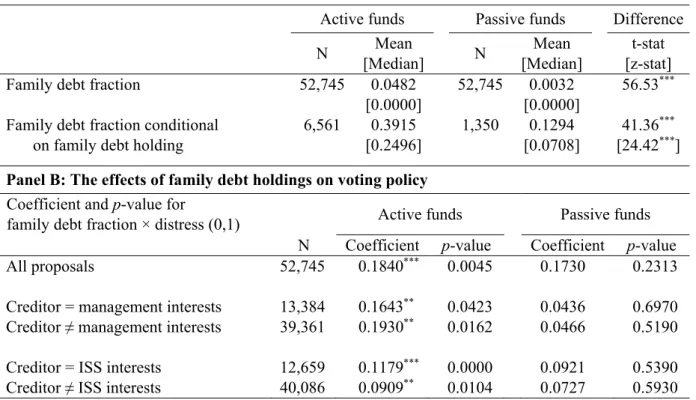
It might be argued that the fraction of stock owned by passive rather than active funds may significantly affect the governance of the firms concerned. To test whether this is the case in our dataset, we first use the names of each of the 6,874 funds in our database to manually classify them into passive versus active funds.6 We find that in our sample 6,096 (88.68%) of the funds are active while 778 (11.32%) are passive. For each family we calculate the debt fraction separately for the active funds and for the passive funds alone. Table 4 Panel A shows that the mean fraction of debt held by active funds in fund families that hold any debt is 39% while the mean debt fraction of passive funds (for fund families that hold some debt) is 13%. Panel B shows that while the debt fraction held by active funds plays a significant role on voting policy, in contrast the debt fraction of passive funds plays no significant role at all. These results suggest that the channel through which the debt holdings of institutional investors affect voting operates via active rather than passive funds.
4.2.2. Debt maturity
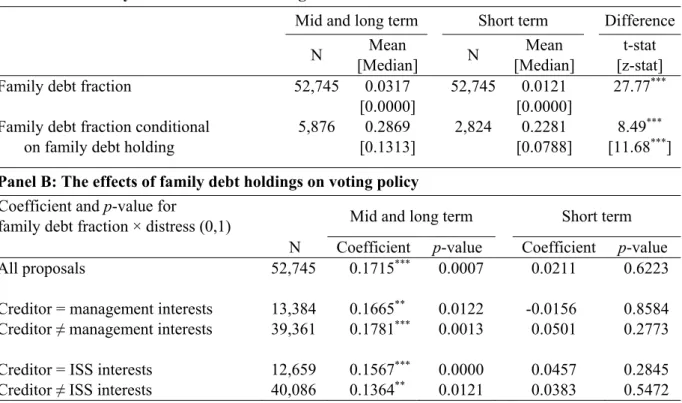
Funds may hold debt of a range of maturities. If funds hold more short-term debt in a given firm, then they may feel less compelled to influence that firm’s policy (particularly if the effects of changes in firm policy are only likely to be manifest in the longer term). We define bonds of less than five years to maturity as being short-term bonds and the remainder as medium and long-term debt. This allows us to calculate a family debt fraction using either just short-term debt or just the combined total of
6 To identify funds as passive we check for the presence of the following strings within the full fund title from
Morningstar: Index, Idx, Indx, Ind, ETF, Russell, Passive, S&P, SandP, DOW, Dow, MSCI, Bloomberg, KBW, NASD, NASDAQ, NYSE, RUSS, STOXX, FTSE, Wilshire, Morningstar, Trkr, ProShares, DJUSHealthCare100, MidCap400, SmallCap600, QQQ, RydexMidCap, MarketTrack. We then run a manual check after this to check whether the observations classified as passive are valid.
18
medium and long-term debt. Table 5 Panel A shows that fund families hold significantly more mid and long-term debt rather than short-term debt with the mid and long-term debt fraction among families being 29% while the short-term debt fraction is only 23%. In Panel B when we examine the effect of the short-term debt fraction on voting policy and we find that it is insignificant while the effect of the fraction of mid and long-term debt does play a significant role. Therefore, our prior beliefs that holdings of short-term debt are less likely to be associated to debt-holder governance are confirmed in the data.
4.3. Identification
The results so far should be interpreted as simple correlations: mutual fund families with a long position in both corporate debt and equity tend to vote according to the interests of debt holders rather than shareholders. This correlation cannot be interpreted as causality because it could well be driven by omitted factors: for instance, higher degree of risk aversion by the fund management may lead to both joint investment in debt and equity, and a conservative choice of voting. In this section we adopt both instrumental variable and difference in differences tests to alleviate endogeneity problems.
4.3.1. Instrumental variable analysis
To move closer to the identification of a causal link between institutional debt holdings and corporate governance, we adopt an instrumental variable approach. If a fund family decides to launch a new debt fund, this may affect the debt-to-equity fraction that this family holds in its portfolio firms.7 Opening a new debt fund is likely to be driven by the desire to satisfy market demand rather than because a fund family wants to hold more debt in a particular firm. Therefore, it might be argued that the opening of a debt fund is a valid instrument to estimate the effect of changes in the family debt fraction on voting. We check our database each year to see when a fund family creates a new debt fund under its management. We are able to find 197 incidents when this happens. We then create our instrument, new debt fund (0,1), which equals one if a given fund family with an ownership stake
7 When a fund family opens a new debt fund, typically (in 58% of the cases) they do not close any other funds at
19
in the firm opens a new debt fund in the year concerned for the family level test, and zero otherwise. We then use this instrument in our first stage models.
As a further cross check using these gathered incidents, we investigate whether fund families use these new fund openings to “actively” re-orientate their portfolios across securities. We find that this is not the case as on average 86% of the time investments that fund families make when they launch new funds in our sample are in the same firms in which they already own debt or equity securities, which suggests that the choice of the firms in which new funds invest is virtually “passive”.
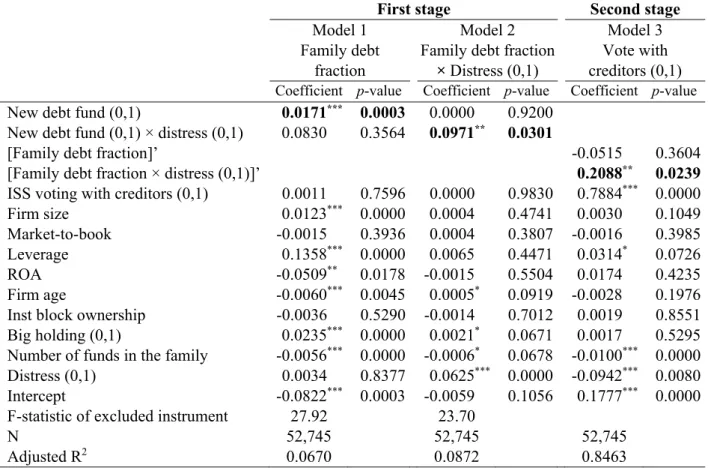
To test whether the introduction of new debt funds significantly affects the family debt fraction, we regress the family debt fraction on a set of control variables and a new debt fund dummy and its interaction with distress. As suggested by Wooldridge (2002, p.236), we instrument for both debt fraction and its interaction with distress (0,1) in two separate first stage models.8 The results of doing so are presented in Table 6 Models 1 and 2. Our first stage results show that new debt fund (0,1)
interacted with distress has a statistically significant positive effect on both the interaction of the family debt fraction with distress. To gauge the strength of our new debt fund instrument and its interaction with the distress variable, the Cragg-Donald statistics of the excluded instrument (against the null that the excluded instrument is irrelevant in the first-stage regression) are clearly above the critical value for the Stock-Yogo weak identification test. We employ the methods outlined by Stock and Watson (2010) to test the validity of our instrument and ensure that the relevance condition is satisfied.
We then use the family debt fraction and its interaction with distress instrumented as in models 1 and 2 to determine whether there is a significant effect of family debt fraction on voting policy, especially when firms are in distress. Model 3 shows that family debt fraction has a significant effect on the propensity to vote with creditors. A one standard deviation increase in the family debt fraction is associated with an increase of 3.1% in the probability of voting in the interests of creditors when the firm is in financial distress, which is similar in magnitude to that from the baseline model of 2.5% reported in Table 3 Panel A Model 2.
8 Gopalan and Xie (2011) study conglomerates and industry distress and they instrument for conglomerate and
20
4.3.2. Using fund family mergers as a quasi-natural experiment
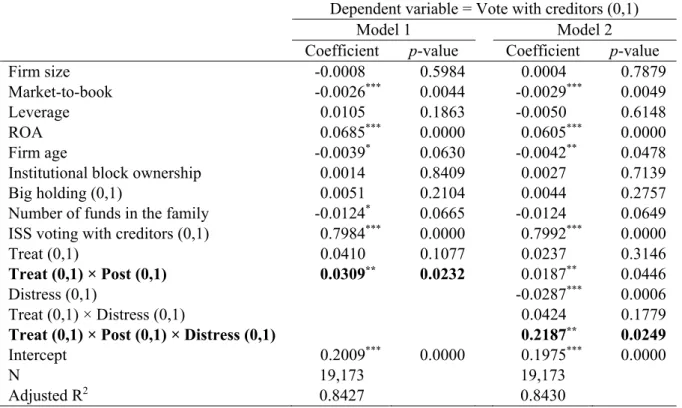
In this section we discuss a further identification test based on He and Huang (2017), which involves conducting a quasi-natural experiment using fund family mergers. As these mergers are unlikely to be motivated by fund family voting considerations or by the desire of a fund family to alter the debt fraction of a given firm, it might be argued that these mergers provide a quasi-exogenous change in the debt fraction of fund companies. We therefore conduct a difference-in-differences (DiD) regression analysis on how changes in debt fraction as a result of exogenous shocks from fund family mergers affect voting policies. We identify fund family mergers completed during 2009-2012 from SDC’s M&A database in which the merging parties own debt or equity stakes in our sample firms before the merger and can be matched to fund families in Morningstar. We are able to find four fund family mergers: Invesco acquiring Van Kampen in 2009 (completed in 2010), Affiliated Managers acquiring Highbury Financial in 2010, PNC Funds acquiring Allegiant in 2010, and Wells Fargo Funds acquiring Evergreen Funds in 2010. We keep only firms in which the merging parties own debt or equity stakes before the merger. We also exclude firms in which fund families hold both debt and equity before the mergers, which allows us to more clearly identify the debt equity position of the merged entity relative to the two initial firms resulting in a cleaner test. To identify treated firms as a result of the merger, we require that (1) the acquirer holds only equity while the target holds only debt in the firm concerned in the year before merger completion or (2) the target holds only equity while the acquirer holds only debt in the firm concerned in the year before merger completion. We note that Chu (2018) excludes firms that are already treated by a merger between financial institutions but are later treated again by another merger between different financial institutions within three years. This does not apply in our sample because all of our mergers between fund families complete in 2010 and our debt and equity holdings are measured at the end of the calendar year. This procedure results in a sample of 27 treated firms involved in these four fund family mergers. Our voting sample has 19,173 observations meeting these criteria. We construct Treat (0,1) to be one for voting observations involving the treated firms and Post (0,1) to be one if the firm-year of the observation is after the merger. All regressions control for fund family fixed effects and (proposal type × year) fixed effects. Post (0,1) is subsumed by the year fixed effects.
21
We present our DiD results in Table 7. Model 1 shows that Treat (0,1) × Post (0,1) is statistically significant and model 2 shows that this effect is magnified under financial distress. Overall, the results indicate that changes in fund family debt holdings as a result of a merger with another family has a significant effect on voting policy. Although we cannot completely rule out endogeneity concerns, our estimates being consistent across different methodologies offer some reassurance about the robustness of our findings.
5. The consequences of voting for firm policy
Our results suggest that joint debt-equity holdings by institutional investors increase the likelihood that they will vote with creditors. In this section we turn to the economic implications of this result. Institutional investors can communicate with firms either directly or by voting. While we cannot generally observe the direct communication, we can see the voting behavior of mutual fund companies and therefore we can examine if these votes have consequences for firm policy. To shed light on the economic importance of voting as the channel through which debt equity holdings affect firm policy we follow a two-step approach. We first calculate the total impact of joint debt-equity holdings on policy, by directly relating the average joint debt-equity holdings across investors in a given firm to its policy. Then we calculate how much of this effect is due to the voting channel by relating votes cast in favor of creditors on that firm to its policy. This allows us to measure what fraction of the total impact of joint debt equity holdings on policy is attributable to voting. The evidence in the literature tells us that joint debt equity holdings affect firm investment and payout policy and therefore we focus below on policy choices in these two areas.
5.1. Measures of firm policy
We measure firm investment policy using four measures. We consider first capital expenditure (CAPEX) policy. The corporate finance literature argues that firms that are close to financial distress may experience debt overhang, which may dissuade them from taking positive NPV investments. We would expect firms receiving more creditor votes to act more in the interests of debt
22
holders and to therefore invest more in financial distress.9 The second policy we examine is seasoned equity offerings (SEO). If firms are close to financial distress, we would expect them to not want to issue equity because of the debt overhang problem. However, if firms recognize that their shareholders care about creditor interests as well, they will be compelled to act more in the interests of debt holders and be more prepared to issue equity in financial distress. As a result we expect to see more equity issuance in financial distress for firms that receive a higher fraction of votes in favor of creditors. To measure the two investment policies above, we scale the value of capital expenditure and SEO proceeds by book value of assets and set to zero missing values. The third policy we examine is non-core acquisitions. Non-core acquisitions in financial distress can be understood as a hedging policy. Shareholders in financial distress do not want hedging rather they want risk shifting. Therefore, non-core acquisitions are not in the interests of equity holders. Conversely, hedging is in the interests of debt holders in financial distress and therefore non-core acquisitions are in the interests of debt holders. The non-core M&A variable is set to one if the firm makes an acquisition in which
the target and the acquirer are not in the same two-digit SIC code during the year, and zero
otherwise.
We model payout policy using two measures namely dividends and repurchases. If more pro-creditor votes signal to the firm the preferences of shareholders, we would expect these votes to lead to payout policy that is more aligned with creditors interests and therefore to lead to less dividends and less share repurchases. We follow a similar approach to our analysis of investment policy in that we include the same control variables and scale our payout variables by book value of assets.
Table 8 Panel A presents the summary statistics of our sample firm characteristics. Our sample used for testing the impact of debt holdings on firm policy includes 12,327 firm-year observations. Overall the key statistics are comparable with other samples used in the literature. For example, our mean dividends scaled by assets is 1.02% which is close to 0.90% reported in Chu
9 Alternatively, we could focus only on large capital investment outlays where there are major investment
injections as opposed to small investments that are likely to occur on a daily basis. We measure large capital expenditure, SEOs, dividends, and repurchases using a dummy variable approach in which the policy variable is set to one if the continuous variable is above the median across all firms in the year concerned. Although our results are qualitatively similar when we use the dummy dependent variables in either OLS or binary models, the dummy variable approach makes the interpretation of the economic effects difficult.
23
(2018). The mean institutional block ownership in our sample is 20%, which is comparable to the statistics in Chen, Harford, and Li (2007) that use the Thomson 13F database instead of Morningstar Direct.
5.2. The direct effect of joint debt equity holdings on policy
We need a firm-level variable that captures the extent to which the equity of a firm is jointly held with debt by institutional investors. We define the value weighted debt fraction of firm (j) in year (t) as the following:
𝑉𝑎𝑙𝑢𝑒𝑤𝑒𝑖𝑔ℎ𝑡𝑒𝑑𝑑𝑒𝑏𝑡𝑓𝑟𝑎𝑐𝑡𝑖𝑜𝑛 ,
∑
𝐹𝑎𝑚𝑖𝑙𝑦𝑑𝑒𝑏𝑡𝑓𝑟𝑎𝑐𝑡𝑖𝑜𝑛, , (2) When we relate the value-weighted debt fraction of a firm to its policies we use a number of control variables. These include the firm’s characteristics such as the log of the market value of equity, market-to-book ratio, return on assets, and leverage ratio. If the holdings of fund families in a firm are more concentrated, then we might expect those families to be able to exert more pressure on the firm than if the holdings of fund families in the firm concerned are more thinly spread. To control for this we include a control variable in our tests known as institutional block ownership, which is defined as the fraction of the firm that is held by block holders that hold more than 5% of the firm each. We also control for fund family characteristic such as the family’s big holding dummy and the number of funds in the family similar to those in the voting regressions but we value weight these measures across all families holding stakes in the firm during a year in the same manner as equation (2). In our firm policy regressions we include industry times year fixed effects and we cluster our standard errors by firm.
The results of doing so are presented in Table 8 Panel B. Higher debt equity holdings lead to firms acting more in the interests of creditors and as a result investing more and raising more finance in financial distress and also paying out less. A one standard deviation increase in the family debt fraction (which is then value-weighted across families holding debt and/or equity in the firm) is associated with a 0.55% increase in capital expenditure, a 0.25% increase in SEO, a 0.49% decrease in the probability of making a non-core acquisition, a 0.11% decrease in dividends and a 0.15%
24
decrease in share repurchases. This is equivalent to a 13.8 percentage point increase in capital expenditure, a 14.1 percentage point increase in SEO, a 23.9 percentage point decrease in the probability of making a non-core acquisition, an 11.1 percentage point decrease in dividends and a 10.5 percentage point decrease in share repurchases, respectively, from their corresponding sample mean.
5.3. The importance of the voting channel on firm policy as a result of debt holdings
Having established the total effect of joint debt equity holdings on policy, we are now in a position to examine how much of this total effect is attributable to voting policy. Table 8 Panel C relates the overall voting policy by fund families to firm investment and payout policy. To measure the fraction of votes in the interest of creditors on all conflict proposals, we calculate first the fraction of votes in the interest of creditors for each fund family across each conflict proposal category. We then average the fraction of votes in the interest of creditors for each fund family across all conflict proposal categories. After calculating the fraction voted in the interest of creditors for a given fund family in a firm in a given year, we calculate an equity-value weighted average fraction of votes in the interest of creditors across fund families in a firm in a given year. We use the same controls as in Table 8 Panel B and also interact the fraction of votes in support of creditors with the distress dummy. Overall the results show that the greater the fraction of votes in the interests of creditors in a given firm, the greater the extent to which the firm acts in the interests of debt holders in both its investment and payout policies. This clearly highlights that the voting channel plays an economically important role in the governance of firms.
Comparing these findings in Panel C with the results in Panel B offers a rough estimate of the relative importance of public versus private engagement in the governance of firms. As previously estimated from Table 3 Panel A Model 4, a one standard deviation increase in the family debt fraction is associated with an increase of 2.8% in the fraction of votes in the interest of creditors. Using the coefficient estimates in Table 8 Panel C, such 2.8% increase in the fraction of votes in the interest of creditors is then associated with a 0.11% increase in capital expenditure, a 0.05% increase in SEO, a 0.08% decrease in the probability of making a non-core acquisition, a 0.01% decrease in dividends
25
and a 0.01% decrease in share repurchases. Compared to the economic effects from Table 8 Panel B, those from Table 8 Panel C represent 21% for capital expenditure, 19% for SEOs, 17% for M&As, 12% for dividends, and 8% for share repurchases, respectively. Overall, the economic significance of voting on corporate investment is about one fifth of the total effect of debt holdings on investment while the economic significance of voting on payout policy is one tenth of the total effect of debt holdings on payout. This suggests that corporate investment is more affected by voting, i.e. public engagement, while payout policy is mostly the result of institutional investors' private rather than public engagement.
5.4. Additional analyses
In section 4.2, we show that the channel through which the debt holdings of institutional investors affect voting is through active rather than passive funds and through funds holding long-term debt rather than short long-term. In this section, we examine if firm policy is associated with debt holdings by active funds rather than passive and long-term debt holdings rather than short term. We find that firm policy is only affected by debt holdings by active funds and long-term debt holdings, not by passive funds’ debt holdings or short-term debt holdings.
We follow the same method in section 5.3 to examine the importance of the voting channel on firm policy as a result of debt holdings by active funds and of long-term debt holdings. We find that the economic significance of voting on corporate investment is about one fourth of the total effect of debt holdings by active funds on investment while the economic significance of voting on payout policy is one fifth of the total effect of debt holdings by active funds on payout. Similarly, the economic significance of voting on corporate investment is about one third of the total effect of long-term debt holdings on investment while the economic significance of voting on payout policy is one fourth of the total effect of long-term debt holdings by active funds on payout. Overall these results suggest that the voting channel plays a more important role on firm policy as a result of debt holdings by active funds or with long maturity.
26
6. Robustness tests
In this section, we provide a number of robustness checks and present their results in Table 9. First, we adopt alternative measures of financial distress. Then, we try different measures of debt holdings at the fund family level. Next, we exclude funds that only hold debt or only hold equity, as may be different from the others. Finally, we consider the effects of non-financial firms and those funds without credit default swap contracts.
6.1. Alternative measures of financial distress
Our results show that the debt fraction of institutional investors influences voting and firm policy to a greater extent when the firm is in financial distress. For this purpose, the definition of financial distress is important. So far, we have classified firms as being in financial distress according to the Bharath and Shumway (2008) distance to default measure and we define distress (0,1) in this case to be one if the firm’s default probability is at least 75% in the year concerned. However, it is interesting to examine whether our results are robust to the use of alternative measures of financial distress.
Our first alternative measure of financial distress follows Opler and Titman (1994) definition. Specifically, for each year, a three digit SIC code industry is in financial distress if the median sales growth is negative and the median stock return is below -30%. We define a firm as being in financial distress if the three digit SIC industry, to which it belongs, is experiencing financial distress in that year. As argued by Gopalan and Xie (2011), an advantage of using this distress measure is that these distress episodes are unexpected. Using this definition, 4.74% of the observations in our voting sample are in distress. As our second alternative measure of financial distress, we classify a firm in financial distress if its debt rating is CCC and below in the year concerned. For the 40,443 voting observations for which we can obtain ratings data, financial distress is restricted to 0.79% of the observations. Panel A of Table 9 presents the effect of our alternative definitions of financial distress on our results. It shows that when we interact debt fraction with our alternative definitions of financial distress, we still get a significant effect of this interaction on voting policy, which suggests that our findings are robust to variations in our definitions of financial distress.
27
6.2. Alternative measures of family debt fraction
We currently calculate the family debt fraction as the total value of debt held by a fund family divided by the total value of debt and equity that it holds. An alternative way to measure the importance of the interests of debt for the fund family concerned is to calculate the fraction of funds that are not pure equity funds in a fund family but are either pure debt funds or are mixed equity and debt funds: both these types of funds should care about the interests of debt relative to pure equity funds. We calculate the value of equity and debt owned by each fund in each year across all firms to categorize each fund into debt, equity or mixed. We classify a pure equity (debt) fund as having at least 95% of its holdings in equity (debt); while we consider all other funds as mixed. In the database of 21,630 fund year observations, we have 4,413 pure debt funds (20.54%), 15,164 pure equity funds (70.11%) and 2,023 (9.35%) mixed funds. Panel B of Table 9 presents our results where we use the proportion of debt funds in the family as the debt fraction, with this proportion being either the proportion of debt and mixed funds or the proportion of pure debt funds. We find that voting policy is still significantly affected by the debt fraction interacted with financial distress as was the case in our main voting results. These findings indicate that our results are robust to the way we measure the family debt fraction.
6.3. Families holding both debt and equity
It might be argued that our results are driven by fund families with no debt. For example, if these fund families exhibit voting behavior that is strongly in the interests of equity, this may help to validate our findings. To test this we exclude these fund families from our sample. The results are reported in Table 9 Panel C. We find that the value weighted debt fraction interacted with distress still has a significant effect on voting policy even when we focus only on fund families that hold both debt and equity.
6.4. Excluding financial companies
As financial companies operate in different ways to non-financial companies, we examine the effect of excluding financial companies from our analysis. The results of doing so are presented in Table 9 Panel D. We find that there is no material effect of excluding financial companies on the link between
28
the debt fraction of fund families and voting policy. This indicates that our voting analysis is unaffected by excluding financial companies.
6.5. Excluding funds that hold credit default swap (CDS) contracts
If fund families hold CDS contracts that hedge the credit risk in their debt positions, they may be less likely to vote in the interests of debt and to push firms to act in a manner that favors creditors. The fact that our main results are robust to the inclusion of holdings of CDS contracts suggests that we may be underestimating the role of debt holdings in influencing voting and firm behavior. As a further check to explore if removing these CDS holdings has any influence on our results, in Table 9 Panel E we exclude fund-years in which funds hold CDS contracts and find barely noticeable changes.10
7. Conclusion
Focusing on the effect of debt holding of mutual funds on voting and showing that this voting affects firm policy are the key contributions of this paper. This is an important extension to the existing literature, which has focused so far on the equity holdings of these investors.
Using data on the universe of US-based mutual funds, we find that it is common for mutual fund families to hold also the corporate debt of firms in which they have equity stakes. In these cases the fund family is more likely to vote in the interests of debt holders when considering a proposal in which there is a conflict between debt and equity, such as dividend policy, equity issues and share repurchases, anti-takeover provisions, executive compensation, and restructuring activities, when close to financial distress. Interestingly, we find no significant difference in voting patterns across mutual fund families when examining proposals that are associated to no conflict of interest, like director elections.
Institutional investors can influence firms via voting or through direct engagement. We test the relative importance of the voting channel as the channel through which debt equity holdings affect firm policy. While the literature has shown that there is a link between the debt equity holdings of
10 We have 285 funds holding CDS positions in our database. It should be recognized that despite excluding
fund-years where funds hold CDS contracts that we still have the same number of fund family-firm-year observations without this exclusion, because this does not cause any fund families to drop out.