Early Childhood Professional Development Report
Orelena Hawks Puckett Institute June 2015 • Volume 1 • Number 2Introduction
This report includes the results from a survey of fac-ulty teaching courses as part of the Early Childhood Ed-ucation Associates Degree Program at the North Caroli-na Community Colleges to determine how much course
Survey of North Carolina Community College Early Childhood
Faculty on Nutrition, Health, and Physical Activity Coursework
Carl J. Dunst Melinda Raab Deborah W. Hamby Orelena Hawks Puckett Institute
Asheville and Morganton, North Carolina Anna Lauren Long
University of North Carolina–Asheville Asheville, North Carolina
North Carolina community college faculty teaching courses in early childhood education at 54 of 58 community colleges were surveyed to determine the extent to which they included content knowledge on child health, nutrition, physical activity, and obesity, and adult wellness, in the courses they taught, and to identify faculty member characteristics that were related to how much content knowledge was included on child and adult health and wellness. Nine of 17 courses previously identified as including or likely including content knowledge and experience on health and wellness were taught by one-third to two-thirds of the survey respondents. One-third to two-One-thirds of the faculty indicated that they included content knowledge or experiences on 11 of 14 health and wellness indicators either quite a bit or a great deal in their courses. The best predictors of including health, nutrition, physical activity, obesity, and wellness content knowledge and experiences in coursework were the number of courses taught, faculty expertise in health and wellness, instructor demonstrations of health and wellness practices, and authentic and self-directed student learning opportunities. Twenty-one of the survey respondents were identified as highly experienced faculty based on a combination of faculty-related variables. Comparisons between those faculty and all other faculty found that the highly experienced faculty included more content knowledge and experiences on infant and child health and nutrition, child physical activity, infant and child obesity, and adult wellness in their coursework compared to other faculty. Results indicated that community college faculty incorporated health and wellness content knowledge and practice into a number of different courses in a number of different ways.
Report prepared for the North Carolina Center for Health and Wellness, Asheville, and the North Caroli-na Institute of Medicine, Morrisville. The opinions ex-pressed, however, are those of the authors and do not necessarily reflect the views or policies of either organi-zation.
content covered topics on child health, nutrition, physical activity, and obesity, and adult wellness. The survey was conducted to identify which coursework faculty taught to upcoming child care and early education profession-als about early childhood health and obesity prevention strategies (North Carolina Institute of Medicine, 2013, p. 137), and to determine whether coursework identified as required and/or having course descriptions including in-formation on health and wellness (Dunst, Raab, Hamby, & Long, 2015) and taught by faculty included content knowledge and experience on:
• Obesity trends among infants and young children, • Impact of obesity on health,
• Healthy food and beverage procurement and prepa-ration and best nutrition practices,
• Strategies to promote healthy and appropriate sleep duration,
• The importance of reducing screen time,
• Age-appropriate movement and physical activity, • Outdoor learning environments and edible
land-scapes,
• Breastfeeding support,
• Staff wellness to support role modeling, and
• Strategies to educate parents and other caregivers about best practices to implement at home in order to promote healthy weight (North Carolina Institute of Medicine, 2013, p. 138).
The results were expected to (1) provide information with regard to the scope of content knowledge acquisi-tion and experiences community college students are af-forded as part of early childhood education professional preparation on topics related to health, nutrition, obesity, physical activity, and wellness and (2) identify which fac-ulty background, knowledge, and expertise factors were related to how much coursework content knowledge and experiences are included on health and nutrition topics in courses that faculty teach.
North Carolina Community Colleges
Fifty-eight community colleges serve all 100 North Carolina counties. All 58 colleges offer an Associate in Applied Sciences Degree in early childhood education. Fifty-five community colleges offer certificates in early childhood education, and 41 offer certificates in infant and toddler education. The early childhood education degree program is offered as either an on campus or on-line program or both.
The Associate Degree program is designed to prepare students to work with children from infancy through early childhood in different types of learning settings and environments (North Carolina Community Col-leges, 2015b). Requirements for the degree range from 64 to 76 semester credit hours in the 58 institutions in the State.
The required credit hours are usually acquired over a four-to-five semester period of time by completing a combination of general education and early childhood courses included in the Combined Course Library (North Carolina Community Colleges, 2015a) approved by the State Board of Community Colleges. Courses in the early childhood major cover theory, content knowledge, methods, and practices on a wide range of early child-hood topics including, but not limited to, child guidance strategies; child physical, cognitive, and
social-emotion-al growth and development; preparation and imple-mentation of developmentally appropriate child learn-ing activities; adult-child interactions; and the physical and nutritional needs of children. Each early childhood program must include a number of State Board of Com-munity College required courses, whereas other courses required or offered vary from college to college.
Early Childhood Coursework Analysis
The extent to which early childhood coursework in-cluded or had a likelihood of including course content on child health, nutrition, physical activity, or obesity, or adult wellness was identified in the Analysis of North Carolina College Early Childhood Education Coursework on Nutrition, Health, and Physical Activity (Dunst et al., 2015) to identify which courses would be included in the survey described in this report. The education course de-scriptions in the Combined Course Library (North Caro-lina Community Colleges, 2015a) were first examined to identify those courses that did or could include content knowledge or experiences on infant and child health, nutrition, physical activity, or obesity; or adult wellness. Seventy-two courses were categorized as early childhood education in the course library.
The 72 course descriptions were each rated in terms of including or likely including content knowledge or practice on the 14 indicators shown in Table 1. The in-dicators were developed from information in Promot-ing Healthy Weight for Young Children (North Carolina Institute of Medicine, 2013), the list of topics for Com-munity/Environment Strategy 2 in that document, and other evidence-based information (e.g., Hinkley et al., 2014; Jennings, McEvoy, & Corish, 2011; Kreichauf et al., 2012; Larson, Ward, Neelon, & Story, 2011; Summer-bell et al., 2009). The ratings were probably not covered, maybe could be covered (low probability), or quite likely could be covered (higher probability).
Table 2 lists the 17 courses that were included on the survey of community college faculty as either required or having a higher likelihood of including content knowl-edge or experiences on the health and wellness indica-tors listed above (Dunst et al., 2015). Courses that had a high likelihood of including health and wellness content but which were not required at any of the community colleges were not included on the faculty survey (EDU 244: Human Growth and Development, EDU 152A: Music, Movement, and Language Lab). Appendix A in-cludes the descriptions of the courses on the faculty sur-vey. Inspection of the course descriptions finds that any number of the 14 health and wellness indicators in Table 1 are or could be included in the coursework which are
Table 1
Health, Nutrition, Physical Activity, Obesity, and Well-ness Items
required or are electives as part of the Associates Degree Program in Early Childhood Education (Dunst et al., 2015).
Survey Methods Participants
The survey respondents were either early childhood education instructors or coordinators at 54 of the 58 com-munity colleges (93%) in North Carolina. There were 67 respondents who completed the survey. There was one respondent each at 47 community colleges (87%), two respondents each at five community colleges (9%), three Infant Health and Nutrition
1. Providing new parents support to encourage breastfeeding
2. Effects of breastfeeding on healthy child development
3. Promoting appropriate child sleep patterns (sleep routines and duration)
Child Health and Nutrition
1. Obtaining and preparing healthy food and beverages for child consumption
2. Encouraging children to eathealthy foods (nutrition practices)
3. Providing children opportunities to grow and sample vegetables and other foods
Exercise and Movement
1. Encouraging healthy age appropriate child movement and physical activity
2. Designing outdoor environments to encourage child physical activity
3. Limiting child TV watching and other screen time (e.g., computers, iPads)
Infant and Child Obesity
1. Understanding the effects of obesity on healthy child development
2. Identifying current trends in obesity among infants and young children
3. Using appropriate infant feeding practices and recognizing signs that a child is full
Adult Wellness
1. Adopting personal wellness practices and providing children and parents role models 2. Educating parents and other caregivers about
healthy development and weight
respondents at one community college (2%), and seven respondents at another community college (2%).
Table 3 shows the highest degree attained by the 67 respondents and the professional discipline for which they received their degree. Nearly all the participants had a masters or doctorate degree (88%). Half of the respon-dents’ degrees were in early childhood education (52%), six participants had birth to kindergarten degrees (9%), and three respondents had degrees in child development and early childhood (4%). The other respondents had degrees in elementary education (17%), child develop-ment and family relations (11%), and humanities, spe-cial education, educational leadership, or administration (7%).
Faculty Survey
The survey completed by participants is included in Appendix B. In addition to the background information described in the Participants section above, the survey asked respondents to indicate which of 17 courses listed in Table 2 they taught in the past two years; the extent to which they included content knowledge or experiences on the 14 nutrition, health, physical activity, obesity, and wellness indicators listed in Table 1; the teaching methods used to promote student understanding and mastery of content knowledge on child health, nutri-tion, physical activity, and obesity, and adult wellness; and any health and wellness specific educational back-ground, special knowledge or skills, or personal exper-tise and interests on the health and wellness indicators rated on the survey. The survey was completed online using Survey Monkey.
Data Preparation
Nutrition, health, physical activity, and obesity rat-ings. The ratings for individual indicators were first ex-amined to determine how much content knowledge was incorporated into coursework by the participants. The 14 health and wellness survey items were each rated on a 5-point scale in terms of “how much content knowledge do you include in any of the courses you teach?” for each of 14 indicators (Table 1). The 5-point scale was not at all, just a little, some, quite a bit, or a great deal. Inspec-tion of the patterns of results was used to collapse the 5-point scale ratings into three categories for displaying the survey results: (1) not at all, (2) just a little or some, or (3) quite a bit or a great deal.
The ratings for the survey items in each category were factor analyzed to determine whether the separate ratings could be summed to compute total “subscale scores” (Spector, 1992). The results are shown in Table 4. Each analysis produced a one-factor solution accounting for a large percentage of variance (covariation) among
a Percent of community colleges.
Course Number Course Title Requireda
EDU 119 Introduction to Early Childhood Education 100
EDU 144 Child Development I 98
EDU 145 Child Development II 98
EDU 151 Creative Activities 100
EDU 151A Creative Activities Lab 17
EDU 152 Music, Movement, and Language 9
EDU 153 Health, Safety, and Nutrition 100
EDU 153A Health, Safety, and Nutrition Lab 7
EDU 157 Active Play 22
EDU 188 Issues in Early Childhood Education 10
EDU 234 Infants, Toddlers, and Twos 100
EDU 234A Infants, Toddlers, and Twos Lab 12
EDU 251 Exploration Activities 62
EDU 251A Exploration Activities Lab 14
EDU 254 Music and Movement for Children 10
EDU 259 Curriculum Planning 86
EDU 284 Early Childhood Capstone Practicum
100
Table 2
Early Childhood Courses Included in the Survey of Community College Faculty
Table 3
Backgrounds of the Faculty Completing the Course-work Survey
Background Variables Number Percent Highest Degree Attained
Associates Degree 6 9
Bachelors Degree 2 3
Masters Degree 54 81
Doctorate Degree 5 7
Professional Degree
Early Childhood Education 34 52
Elementary Education 11 17
Child Development/ Family
Relations 7 11
Birth to Kindergarten 6 9
Child Development/Early
Childhood 3 4
Other (e.g., Educational
Leadership) 6 7
the ratings on the individual items (DeVellis, 1991). The items also had a high degree of internal reliability (Car-mines & Zeller, 1979) as evidenced by coefficient alphas of substantial magnitude for a small number of items per category (Nunnally & Bernstein, 1994). The results from the psychometric analyses of the items in each health and wellness category indicate that it is justifiable to sum the individual ratings to obtain subscale scores. The summated scores were used as dependent measures as part of analyses identifying factors associated with varia-tions in faculty ratings of the health and wellness content knowledge indicators.
Factors associated with variations in participants’ rat-ings of the nutrition, health, and obesity survey items. The extent to which different instructor, course, and teach-ing method measures were associated with differences in survey participants’ ratings of the health and wellness indicators was ascertained through correlation analyses. The instructor measures included highest degree at-tained, degree major, and instructor-reported expertise in child health, nutrition, obesity, or physical activity, or adult wellness. The course measures included total number of courses taught, number of methods courses taught, and number of student field placement courses
taught. The teaching methods measures included a num-ber of different instructor-led and student self-directed methods.
Instructor degree was coded on a 4-point scale rang-ing from an associate degree (1) to a doctorate degree (4). Professional degree was coded as early childhood education, birth to kindergarten, or child development/ early childhood (1) vs. elementary education, child de-velopment/family relations or other (0). Instructor ex-pertise was coded in terms of formal education; special knowledge, skills, or interests; or specialized training in child or adult health or wellness (1) vs. no reported special knowledge, training, or skills (0). Twenty-eight participants (42%) reported having expertise in some aspect of child or adult health or wellness. Formal edu-cation included degrees in Home Economics or Nurs-ing, and specialized training included knowledge and skills on some type of health, nutrition, or physical ac-tivity program or curriculum (Color Me Healthy, Be Ac-tive Kids, Grow North Carolina, Eat Smart – Move More, Healthy Weight – Healthy Child). Instruction experience included employment in the Child and Adult Care Food Program; Head Start Health Services; Women, Infant, and Children Nutrition Program; Community Garden Program; or Green Teacher Network Member. Special knowledge, skills, or interests included personal healthy lifestyle practices (certified aerobics instructor, regular exercise routine, modeling a healthy lifestyle), conduct-ing workshops on child health and nutrition, and devel-oping methods for planning healthy eating patterns in child care programs.
The instructor course measures included how many of 17 courses listed in Table 2 were taught in the past two years, the number of methods courses taught in the past two years (EDU 151, EDU 152, EDU 153, EDU 157, EDU 234, EDU 254, EDU 259), and the number of student field placement courses supervised in the past two years (EDU 151A, EDU 153A, EDU 234A, EDU 251A, EDU Table 4
Psychometric Characteristics of the Five Sets of Health and Wellness Indicators
Health and Wellness Categories
Factor Analysis Results Number of
Items Number of Factors Percent of Variance Explained Coefficient Alpha
Infant Health and Nutrition 3 1 83 .90
Child Health and Nutrition 3 1 79 .87
Child Physical Activity and Movement 3 1 64 .71
Infant and Child Obesity 3 1 78 .86
Adult Wellness 2 1 83 .80
284). Survey respondents were asked to indicate whether they used any of 12 teaching methods to promote stu-dent understanding and mastery of content knowledge on child health, nutrition, obesity, and physical activities, and adult wellness. The teaching methods included au-thentic student learning opportunities (field placements, course labs, service learning), student-directed learn-ing (student projects, online assignments, extra read-ings), instructor-student reflective practices (discussion groups, case-method instruction), instructor-led meth-ods (demonstrations, simulations, role playing), and in-structor lectures.
Data Analysis
Both descriptive and statistical procedures were used to analyze the survey results. The percent of respondents who taught the 17 courses included on the survey were first examined to determine which courses were the basis for faculty ratings of the health and wellness indicators. The patterns of faculty ratings of the 14 health and well-ness indicators were examined to determine how much content knowledge and experience was incorporated into the courses taught by the faculty.
The correlations among the faculty background measures, courses taught, teaching methods, and the five summated health, physical activity, obesity, and wellness measures (Table 4) were computed to determine which variables were the best predictors of variations in faculty ratings of the health and wellness indicators. Post hoc correlation analyses were conducted to identify which particular predictor variables accounted for the cova-riation in the relationships with the health and wellness measures.
K-means cluster analysis (Alsabti, Ranka, & Singh, 1997; Khan & Ahmad, 2004) was used to group the fac-ulty into subgroups based on their backgrounds, educa-tion levels, coursework loads, and specialized expertise. Between-group comparisons were used to determine if
group membership was associated with differences in the summated subscale health and wellness scores. The between group comparisons were made with one-way ANOVAs (SPSS Inc., 2005), and Cohen’s d effect sizes for the differences in the subgroup mean scores on the dependent measures were used to ascertain the magni-tude of the between-group differences (Dunst & Hamby, 2012).
All of the statistical analyses are best understood in terms of the sizes of effects between different predictor variables and the health and wellness subscale scores (Cohen, 1988). Correlation effect sizes between .10 and .29 are considered small, those between .30 and .49 are considered medium, and those equal to or greater than .50 are considered large. Cohen’s d effect sizes between .20 and .49 are considered small, those between .50 and .79 are considered medium, and those equal to or greater than .80 are considered large. Computationally, correla-tion coefficients less than .50, if doubled, equal Cohen’s d Table 5
Number and Percent of Survey Respondents Teaching Foundations, Methods, and Field Placement Courses
Coursework Number Percent
Foundation Courses
EDU 119 Introduction to Early Childhood Education 44 66
EDU 144 Child Development I 37 55
EDU 145 Child Development II 35 52
EDU 188 Issues in Early Childhood Education 2 3
Methods Courses
EDU 151 Creative Activities 28 42
EDU 152 Music, Movement, and Language 1 2
EDU 153 Health, Safety, and Nutrition 40 60
EDU 157 Active Play 10 15
EDU 234 Infants, Toddlers, and Twos 25 37
EDU 251 Exploration Activities 20 30
EDU 254 Music and Movement for Children 3 5
EDU 259 Curriculum Planning 27 40
Field Placements
EDU 151A Creative Activities Lab 6 9
EDU 153A Health, Safety, and Nutrition Lab 5 8
EDU 234A Infants, Toddlers, and Twos Lab 4 6
EDU 251A Exploration Activities Lab 4 6
EDU 284 Early Childhood Capstone Practicum 37 55
effect sizes (e.g., r = .25 is equal to d = .50). Results
Faculty Courses
Table 5 shows the number and percent of faculty who taught the 17 courses included on the survey. Five of the courses (EDU 119, EDU 144, EDU 145, EDU 153, EDU 284) were taught by half to two-thirds of the facul-ty. An additional four courses (EDU 151, EDU 234, EDU 251, EDU 259) were taught by 30% to 42% of the faculty. Nearly all of these courses are required at all or a majority of community colleges (see Table 2). The courses taught by less than 10% of the faculty are all ones not required as part of obtaining an Associate’s Degree in Early Child-hood Education (see Table 2).
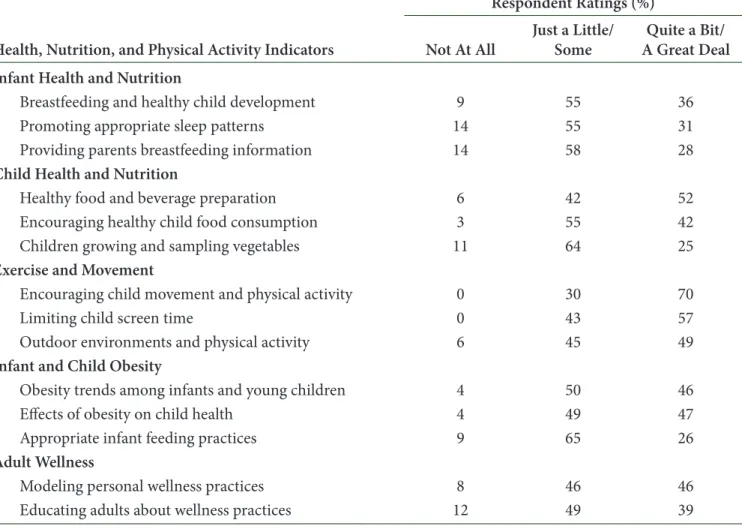
Health, Nutrition, and Physical Activity Indicators The percent of faculty indicating that they included information on the 14 health, nutrition, physical activity,
obesity, and wellness indicators into courses they teach is shown in Table 6. A small percentage of the faculty indicated that they did not at all include information on the indicators in their coursework. Either quite a bit or a great deal of information on encouraging child move-ment and physical activity was incorporated into course-work by 70% of the respondents followed by information on limiting child screen time (57%), healthy food and beverage preparation (52%), information on outdoor environments (49%), effects of obesity on child health (47%), obesity trends among infants and young children (46%), and modeling personal wellness practices (46%). About one-third of the faculty indicated they incorpo-rated either quite a bit or a great deal of information on the other indicators into the courses they taught.
Predictors of Health, Nutrition, and Physical Activity Summated Faculty Scores
Table 7 shows the correlations between the three sets of faculty-related predictor variables and the five summated health and wellness subscale scores. The par-Table 6
Percent of Faculty Indicating Different Degrees of Health and Wellness Content Knowledge in Courses They
Teach
Health, Nutrition, and Physical Activity Indicators
Respondent Ratings (%)
Not At All Just a Little/Some A Great DealQuite a Bit/ Infant Health and Nutrition
Breastfeeding and healthy child development 9 55 36
Promoting appropriate sleep patterns 14 55 31
Providing parents breastfeeding information 14 58 28
Child Health and Nutrition
Healthy food and beverage preparation 6 42 52
Encouraging healthy child food consumption 3 55 42
Children growing and sampling vegetables 11 64 25
Exercise and Movement
Encouraging child movement and physical activity 0 30 70
Limiting child screen time 0 43 57
Outdoor environments and physical activity 6 45 49
Infant and Child Obesity
Obesity trends among infants and young children 4 50 46
Effects of obesity on child health 4 49 47
Appropriate infant feeding practices 9 65 26
Adult Wellness
Modeling personal wellness practices 8 46 46
Educating adults about wellness practices 12 49 39
ticular measures that proved to be the best predictors of variations in the subscale scores are highlighted in italics to show overall patterns of results. Seven of the 11 pre-dictors were significantly related to the child physical ac-tivity, infant and child obesity, and adult wellness scores; five predictors were related to the child health and nutri-tion scores; and four predictors were related to the infant health and nutrition scores. The particular variables that were associated with variations in the health and well-ness summated subscale scores were total number of courses taught, number of methods courses taught, spe-cial faculty expertise in health and wellness, instructor demonstrations of health and wellness practices, authen-tic student learning opportunities, and student-directed learning. In all cases, higher scores on the predictor vari-ables were associated with higher scores on the health and wellness subscale scores.
The particular coursework taught by faculty and correlated with the health and wellness subscale scores is shown in Table 8. Three courses (EDU 153, EDU 234,
Table 7
Correlations Between the Predictor Measures and Health and Wellness Summated Scores
Predictor Variables
Health and Physical Activity Subscale Scores Infant Health/ Nutrition Child Health/ Nutrition Child Physical Activity Infant/ Child
Obesity WellnessAdult r p-value r p-value r p-value r p-value r p-value Faculty Backgrounds
Highest Degree .00 .994 -.02 .851 .06 .655 -.01 .911 .03 .835
Discipline (Early Childhood) .13 .295 -.05 .682 .03 .823 .11 .383 .02 .908 Faculty Special Expertise .35 .004 .20 .116 .38 .001 .41 .001 .27 .032 Coursework
Number of Courses Taught .49 .000 .44 .000 .38 .002 .50 .000 .35 .004 Methods Courses Taught .55 .000 .44 .000 .34 .005 .46 .000 .36 .003 Field Placement Courses .21 .090 .26 .039 .26 .032 .25 .045 .18 .159 Faculty Teaching Methods
Authentic Student Learning .19 .132 .28 .028 .42 .000 .36 .003 .28 .022 Student Reflective Practice .18 .150 .21 .093 .17 .179 .23 .063 .30 .015 Student-Directed Learning .23 .062 .19 .128 .27 .026 .34 .005 .29 .019 Instructor Demonstrations .32 .008 .38 .002 .38 .001 .40 .001 .30 .016
Instructor Lectures .16 .207 .16 .222 .19 .124 .22 .072 .23 .068
Table 8
Coursework Associated with Faculty-Reported Health and Wellness Content Knowledge and Experiences
Faculty Coursework
Health and Physical Activity Subscale Scores Infant Health/ Nutrition Child Health/ Nutrition Child Physical Activity Infant/ Child
Obesity WellnessAdult r p-value r p-value r p-value r p-value r p-value EDU 153 (Health, Safety, and
Nutrition)a .47 .000 .45 .000 .24 .050 .41 .001
.34
.006
EDU 234 (Infants, Toddlers, and
Twos)a .51
.000
.20 .111
.25
.045
.31
.011
.26
.039
EDU 251 (Exploration Activities)b .30
.013
.31
.014
.17 .179
.37
.002
.21 .093
EDU 144 (Child Development I)a .28
.021
.09 .490
.09 .495
.30
.016
.17 .188
EDU 145 (Child Development II)a .13 .286 .20 .116 .15 .223 .30 .013 .19 .138
EDU 151 (Creative Activities)a .29
.017
.20 .112
.15 .235
.20 .111
.18 .150
EDU 157 (Active Play)c .05
.671
.11 .383
.24
.050
.14 .279
.06 .638
EDU 259 (Curriculum Planning)a .24
.047
.19 .135
.11 .396
.12 .338
.17 .171
aRequired at all or most community colleges. bRequired at two-thirds of the community colleges. cRequired at one-fifth of the community colleges..
EDU 251) stand out as most likely to include content knowledge and experiences on infant and child health and nutrition, physical activity, and obesity, and adult wellness. EDU 153 (Health, Safety, and Nutrition) by far was the one class associated with the largest amount of health and wellness content knowledge and experiences as evidenced by significant relationships with all five sub-scale scores. Each of the other courses (EDU 144, EDU 145, EDU 151, EDU 157) was correlated with either one or two subscale scores. Particularly encouraging is the fact that five courses were required at all or most com-munity colleges and one course is required at two-thirds of the community colleges. This is an indication that stu-dents are likely to experience a wide range of learning opportunities on health and wellness.
Cluster Analysis Results
Whether some combination of faculty-related pre-dictor variables accounted for differences in faculty ratings of the health and wellness indicators was ascer-tained by K-means cluster analysis (Alsabti et al., 1997). This type of analysis assigns participants to two or more
groups where between-group differences are maximized by the distances between the partitioned groups on pre-dictor variables. Two, three, and four group clustering analyses were computed. The best solution was a two-group partitioning involving seven of the predictor vari-ables.
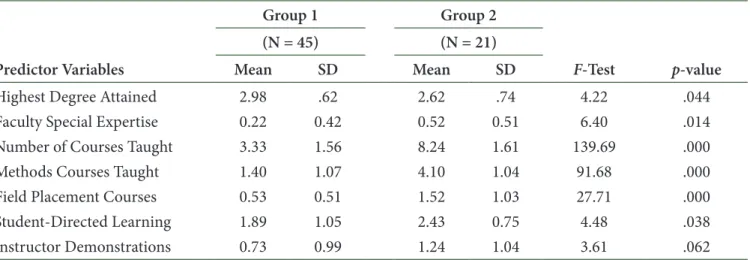
Table 9 shows the between-group differences that best explained group membership. Whereas Group 1 had significantly more years of formal education, Group 2 had significantly higher mean scores on all the other pre-dictor measures. The Group 2 faculty, on average, taught more classes, used more active student and instructor teaching methods, and had more expertise in health and wellness. For purposes of categorizing the two groups, Group 1 can be considered experienced faculty whereas Group 2 can be considered highly experienced faculty.
The means and standard deviations, between-group F-tests, and Cohen’s d effect sizes for the between-group differences on the five health and wellness subscale scores are shown in Table 10. In all five analyses, the highly ex-perienced faculty had larger subscale scores compared to
Predictor Variables
Group 1 Group 2
F-Test p-value
(N = 45) (N = 21)
Mean SD Mean SD
Highest Degree Attained 2.98 .62 2.62 .74 4.22 .044
Faculty Special Expertise 0.22 0.42 0.52 0.51 6.40 .014
Number of Courses Taught 3.33 1.56 8.24 1.61 139.69 .000
Methods Courses Taught 1.40 1.07 4.10 1.04 91.68 .000
Field Placement Courses 0.53 0.51 1.52 1.03 27.71 .000
Student-Directed Learning 1.89 1.05 2.43 0.75 4.48 .038
Instructor Demonstrations 0.73 0.99 1.24 1.04 3.61 .062
Table 9
K-Means Cluster Analysis Results Partitioning the Faculty into Two Subgroups
Table 10
Between Group Differences on the Health, Nutrition, Physical Activity, and Wellness Summated Scores
Predictor VariablesHighly Experienced
Faculty Experienced Faculty
F-Test p-value Effect SizesCohen’s d
Mean SD Mean SD
Infant Health and Nutrition 10.76 2.72 8.16 2.94 11.80 .001 .92
Child Health and Nutrition 10.39 2.00 8.96 2.97 3.53 .065 .57
Child Physical Activity 11.90 1.95 10.51 2.23 6.03 .017 .66
Infant and Child Obesity 11.00 1.79 8.98 2.56 10.62 .002 .92
the experienced faculty. The between-group differences were all statistically significant and had medium to large Cohen’s d effect sizes for all five subscale scores (Cohen, 1988). The results indicate that faculty who teach more courses, employ active teaching methods, and have per-sonal expertise and special interests in health and well-ness were more likely to indicate that they incorporated more content knowledge and experiences on the infant and child health, nutrition, physical activity, and obesity, and adult wellness indicators constituting the focus of investigation in their coursework compared to less expe-rienced faculty (see Table 1).
Conclusions
Results from the survey of North Carolina Com-munity College Faculty in Early Childhood Education reported in this paper found that one-fourth to one-half of the respondents reported that they included content knowledge and experiences on infant and child health, nutrition, physical activity, and obesity, and adult well-ness in the courses they taught either quite a bit or a great deal (see table 6). Faculty teaching EDU 144 (Child De-velopment I), EDU 153 (Health, Safety, and Nutrition), EDU 234 (Infants, Toddlers, and Twos), and EDU 254 (Music and Movement for Children) indicated that they included more health and wellness content knowledge and experiences in their courses compared to faculty not teaching these classes. Three of these courses (EDU 144, EDU 153, and EDU 234) were previously identified as having a high probability of including health and well-ness content (Dunst et al., 2015), and all three courses are required at all or all but one community college (see Table 2).
Analysis of the faculty-related factors associated with “how much” health and wellness content knowledge and experiences were afforded community college students found that a combination of the number of courses taught, faculty expertise in health and wellness, authen-tic student learning opportunities, and faculty illustra-tion or demonstraillustra-tion of health and wellness knowledge and practices were associated with greater degrees of health and wellness content knowledge and experience (see Tables 7, 8, and 10). What was perhaps most surpris-ing was the fact that faculty with advanced degrees and those with early childhood degrees did not include more health and wellness content knowledge or experiences compared to faculty with an AA or BA degree or degrees in fields other than early childhood.
The survey results, together with the findings in a previous report (Dunst et al., 2015), directly address the “call for” information about the existing coursework used
to teach community college early childhood education students content knowledge and provide them experi-ences on infant and child health, nutrition, physical ac-tivity, and obesity, and adult wellness. Both reports pre-pared for the North Carolina Institute of Medicine Task Force on Early Childhood Obesity Prevention based on recommendations in Promoting Healthy Weight for Young Children (North Carolina Institute of Medicine, 2013) indicate that:
• Coursework identified as having a high likelihood of including health and wellness content knowledge (Dunst et al., 2015) tended to be the same courses that were associated with faculty reporting the great-est amount of health, nutrition, physical activity, obesity, and wellness coursework content.
• Faculty reported greater amounts of health and well-ness content in the courses they taught compared to what was identified in an analysis of coursework descriptions (Dunst et al., 2015). This indicates that faculty, and especially more experienced and knowl-edgeable faculty (see Table 10), provide students a broader range of opportunities to learn about infant, child, and adult health and wellness than what was surmised from coursework analyses.
• A small number of courses required at all or most community colleges were found to be related to the largest amounts of health and wellness content knowledge and experiences (Table 8). Faculty teach-ing these courses provide students a wide range of learning opportunities to learn about infant and child health, nutrition, physical activity, and obesity, and adult wellness.
• Although the particular types of health, nutrition, physical activity, obesity, and wellness content (Ta-ble 1) that faculty reported including in courses they taught differed somewhat, students were neverthe-less afforded considerable opportunities to acquire knowledge and skills on health and wellness.
• Despite the fact that very few field placement cours-es are required at most community collegcours-es, faculty provided their students experiences to apply content knowledge through student-directed and authentic student learning opportunities.
• Results from the survey indicate that content knowl-edge and experiences on health and wellness are in-terspersed throughout a number of different courses, and that students are afforded a range of opportuni-ties to learn about, acquire knowledge, and have stu-dent specific experiences, on infant and child health, nutrition, physical activity, and obesity, and adult wellness.
related to the influence of faculty expertise (educa-tional backgrounds, work experiences, personal in-terests, specialized training) on the scope of content knowledge and experience included in courses that particular faculty taught (see Tables 7 and 8). Faculty who had any number of different types of special-ized expertise or interests were the same faculty who placed more emphasis on health and wellness con-tent knowledge.
The findings from the survey described in this re-port, together with the results in the coursework analysis report (Dunst et al., 2015), indicate that certain faculty with certain backgrounds and interests in health and wellness regardless of type of professional degree or discipline find ways of incorporating health, nutrition, physical activity, obesity, and wellness content in the coursework in a number of different ways. The scope of inclusion of health and wellness content knowledge and experience is particularly noteworthy and suggests that about one-third of the survey respondents are very at-tentive to how students are educated about the impor-tance of health and wellness practices.
References
Alsabti, K., Ranka, S., & Singh, V. (1997). An efficient k-means clustering algorithm. Santa Clara, CA: Hitachi America, LTD.
Carmines, E. G., & Zeller, R. A. (1979). Reliability and validity assessment (Quantitative Applications in the Social Sciences No. 17). Newbury Park, CA: Sage. Cohen, J. (1988). Statistical power analysis for the
behav-ioral sciences (2nd ed.). Hillsdale, NJ: Erlbaum. DeVellis, R. F. (1991). Scale development: Theory and
ap-plications. Newbury Park, CA: Sage.
Dunst, C. J., & Hamby, D. W. (2012). Guide for cal-culating and interpreting effect sizes and con-fidence intervals in intellectual and develop-mental disabilities research studies. Journal of Intellectual and Developmental Disability, 37, 89-99. doi: 10.3109/13668250.2012.673575
Dunst, C. J., Raab, M., Hamby, D. W., & Long, A. L. (2015). Analysis of North Carolina community college early childhood education coursework on nutrition, health, and physical activity. Early Child-hood Professional Development Report, Vol. 1, No. 1. Available at www.puckett.org.
Hinkley, T., Teychenne, M., Downing, K. L., Ball, K.,
Salmon, J., & Hesketh, K. D. (2014). Early childhood physical activity, sedentary behaviors and psychoso-cial well-being: A systematic review. Preventive Medi-cine, 62, 182-192. doi: 10.1016/j.ypmed.2014.02.007 Jennings, A., McEvoy, S., & Corish, C. (2011).
Nutri-tional practices in full-day-care pre-schools. Journal of Human Nutrition and Dietetics, 24, 245-259. doi: 10.1111/j.1365-277X.2011.01153.x
Khan, S. S., & Ahmad, A. (2004). Cluster center initial-ization algorithm for K-means clustering. Pattern Recognition Letters, 25, 1293-1302. doi: 10.1016/j. patrec.2004.04.007
Kreichauf, S., Wildgruber, A., Krombholz, H., Gib-son, E. L., Vögele, C., Nixon, C. A. (2012). Critical narrative review to identify educational strategies promoting physical activity in preschool. Obesity Reviews, 13(s1), 96-105. doi: 10.1111/j.1467-789-X.2011.00973.x
Larson, N., Ward, D., Neelon, S., & Story, M. (2011). Pre-venting obesity among preschool children: How can child-care settings promote healthy eating and physi-cal activity? Princeton, NJ: Robert Wood Johnson Foundation.
North Carolina Community Colleges. (2015a). Com-bined course library: Education course information. Retrieved from https://webadvisor.nccommunity-colleges.edu/WebAdvisor/WebAdvisor?TOKENID X=2415201781&SS=2&APP=ST&CONSTITUENC Y=WB.
North Carolina Community Colleges. (2015b). Educa-tion catalog: Early childhood educaEduca-tion. Retrieved from http://www.nccommunitycolleges.edu/sites/ default/files/basic-pages/academic-programs/at-tachments/education_catalog_16jan2015.pdf. North Carolina Institute of Medicine. (2013).
Promot-ing healthy weight for young children: A blueprint for preventing early childhood obesity in North Carolina. Morrisville, NC: Author.
Nunnally, J. C., & Bernstein, I. H. (1994). Psychometric theory (3rd ed.). New York: McGraw-Hill.
Spector, P. E. (1992). Summated rating scale construction: An introduction. Newbury Park, CA: Sage.
SPSS Inc. (2005). SPSS 14.0. Statistical package for the so-cial sciences. Chicago: Author.
Summerbell, C. D., Waters, E., Edmunds, L., Kelly, S. A. M., Brown, T., & Campbell, K. J. (2009). Interven-tions for preventing obesity in children. Cochrane Database of Systematic Reviews, 1.
Appendix A
Coursework Descriptions for Courses Included on the Community College Faculty Survey
EDU 119 Introduction to Early Childhood EducationThis course covers the foundations of the education profession, the diverse educational settings for young children, professionalism and planning developmentally appropriate programs for all children. Topics include historical foundations, program types, career options, professionalism and creating in-clusive environments and curriculum responsive to the needs of all children and families. Upon comple-tion, students should be able to design career plans and develop schedules, environments and activity plans appropriate for all children.
EDU 144 Child Development I
This course includes the theories of child development, needs, milestones, and factors that influence development, from conception through approximately 36 months. Emphasis is placed on developmen-tal sequences in physical/motor, emotional/social, cognitive, and language domains and the impact of multiple influences on development and learning. Upon completion, students should be able to com-pare/contrast typical/atypical developmental characteristics, explain environmental factors that impact development, and identify strategies for enhancing development.
EDU 145 Child Development II
This course includes the theories of child development, needs, milestones, and factors that influence de-velopment, from preschool through middle childhood. Emphasis is placed on developmental sequences in physical/motor, emotional/social, cognitive, and language domains and the impact of multiple influ-ences on development and learning. Upon completion, students should be able to compare/contrast typical/atypical developmental characteristics, explain environmental factors that impact development, and identify strategies for enhancing development.
EDU 151 Creative Activities
This course covers planning, creation and adaptation of developmentally supportive learning environ-ments with attention to curriculum, interactions, teaching practices and learning materials. Emphasis is placed on creating and adapting integrated, meaningful, challenging and engaging developmentally supportive learning experiences in art, music, movement and dramatics for all children. Upon com-pletion, students should be able to create, adapt, implement and evaluate developmentally supportive learning materials, experiences and environments.
EDU 151A Creative Activities Lab
This course provides a laboratory component to complement EDU 151. Emphasis is placed on practical experiences that enhance concepts introduced in the classroom. Upon completion, students should be able to demonstrate a practical understanding of the development and implementation of appropriate creative activities.
EDU 152 Music, Movement, and Language
This course introduces a historical perspective of music and movement and integrates the whole lan-guage concept with emphasis on diversity. Emphasis is placed on designing an environment that empha-sizes language development through developmentally and culturally appropriate music and movement. Upon completion, students should be able to design an environment that develops language through a music and movement curriculum that emphasizes diversity.
EDU 153 Health, Safety, and Nutrition
This course covers promoting and maintaining the health and well-being of all children. Topics include health and nutritional guidelines, common childhood illnesses, maintaining safe and healthy learning environments, recognition and reporting of abuse and neglect and state regulations. Upon completion,
students should be able to demonstrate knowledge of health, safety, and nutritional needs, safe learning environments, and adhere to state regulations.
EDU 153A Health, Safety, and Nutrition Lab
This course provides a laboratory component to complement EDU 153. Emphasis is placed on practical experiences that enhance concepts introduced in the classroom. Upon completion, students should be able to demonstrate a practical understanding of the development and implementation of safe indoor/ outdoor environments and nutrition education programs.
EDU 157 Active Play
This course introduces the use of indoor and outdoor physical activities to promote the physical, cogni-tive, and social/emotional development of children. Topics include the role of active play, development of play skills, playground design, selection of safe equipment, and materials and surfacing for active play. Upon completion, students should be able to discuss the stages of play, the role of teachers in play, and the design of appropriate active play areas and activities.
EDU 188 Issues in Early Childhood Education
This course covers topics and issues in early childhood education. Emphasis is placed on current ad-vocacy issues, emerging technology, professional growth experiences, and other related topics. Upon completion, students should be able to list, discuss, and explain current topics and issues in early child-hood education.
EDU 234 Infants, Toddlers, and Twos
This course covers the unique needs and rapid changes that occur in the first three years of life and the inter-related factors that influence development. Emphasis is placed on recognizing and supporting developmental milestones through purposeful strategies, responsive care routines and identifying ele-ments of quality, inclusive early care and education. Upon completion, students should be able to dem-onstrate respectful relationships that provide a foundation for healthy infant/toddler/twos development, plan/select activities/materials, and partner with diverse families.
EDU 234A Infants, Toddlers, and Twos Lab
This course focuses on practical applications that support the healthy development of very young chil-dren by applying principles of quality inclusive early care and education. Emphasis is placed on recog-nizing the interrelated factors that impact children's development through planning, evaluating and adapting quality environments, including activities and adult/child interactions. Upon completion, stu-dents should be able to demonstrate the ability to engage in respectful, responsive care that meets the unique needs of individual children/families
EDU 251 Exploration Activities
This course covers discovery experiences in science, math, and social studies. Emphasis is placed on developing concepts for each area and encouraging young children to explore, discover, and construct concepts. Upon completion, students should be able to discuss the discovery approach to teaching, ex-plain major concepts in each area, and plan appropriate experiences for children.
EDU 251A Exploration Activities Lab
This course provides a laboratory component to complement EDU 251. Emphasis is placed on practical experiences that enhance concepts introduced in the classroom. Upon completion, students should be able to demonstrate a practical understanding of the development and implementation of appropriate science, math, and social studies activities for children.
EDU 254 Music and Movement for Children
This course covers the use of music and creative movement for children. Topics include a general survey of the basic elements of music and planning, designing, and implementing music and movement experi-ences for creative learning. Upon completion, students should be able to use voice and various musical instruments to provide musical and movement activities for children.
EDU 259 Curriculum Planning
This course is designed to focus on curriculum planning for three- to five-year-olds. Topics include philosophy, curriculum models, indoor and outdoor environments, scheduling, authentic assessment, and planning developmentally appropriate experiences. Upon completion, students should be able to evaluate children’s development, critique curriculum, plan for individual and group needs, and assess and create quality environments.
EDU 284 Early Child Capstone Practicum
This course is designed to allow students to apply skills in a three stars (minimum) or NAEYC accred-ited or equivalent, quality early childhood environment. Emphasis is placed on designing, implement-ing and evaluatimplement-ing developmentally appropriate activities and environments for all children; support-ing/involving families; and modeling reflective and professional practices. Upon completion, students should be able to demonstrate developmentally appropriate plans/assessments, appropriate guidance techniques and ethical/professional behaviors as indicated by assignments and onsite faculty visits. Appendix A, continued
Appendix B
Community College Faculty Survey
Survey of North Carolina Community College Faculty In Early Childhood Education
Introduction
Thank you for taking the time to complete our survey on coursework for the Associate in Applied Sciences Degree in Early Childhood Education. The survey should take no longer than 15 to 20 minutes to complete. The survey includes questions to determine the degree to which early childhood coursework in the early childhood degree program includes content knowledge and experiences on child health, nutrition, obesity, and physical activity and adult wellness. The survey is being conducted in response to a recommendation in
Promoting Healthy Weight for Young Children by the North Carolina Institute of Medicine for “information on curricula used to teach upcoming child care and early education professionals about early childhood health.” Your participation is voluntary and only aggregate information for all faculty combined will be used in a report on the survey results.
At which community college(s) do you teach?
1. ______________________________________________________ 2. ______________________________________________________ 3. ______________________________________________________
Please indicate which of the following is the highest degree you have attained.
AA BS/BA MA/MS Ph.D./Ed.D.
Other (Please describe) ______________________________________________________________________
What is your professional degree/discipline? ______________________________________________________
Please tell us about your professional background
Courses
Please indicate which of the following courses you currently teach or have taught in the last two years.
EDU 119 EDU 144 EDU 145 EDU 151
EDU 151A EDU 152 EDU 153 EDU 153A
EDU 157 EDU 188 EDU 234 EDU 234A
EDU 251 EDU 251A EDU 254 EDU 259
Please list any other courses you teach that include content knowledge on child health, nutrition, obesity, or physical activity or adult wellness
Course 1 ____________________________________________________________________________________ Course 2 ____________________________________________________________________________________ Course 3 ____________________________________________________________________________________
Appendix A, continued
The following questions ask you to indicate how much content knowledge you include in the courses you teach in five health, physical activity, and wellness areas. Please keep in mind the courses you teach when responding to the survey items. Also keep in mind that no course or even a combination of courses would be expected to include content knowledge on all or even most of the survey items.
Child Physical Activity and Movement
Encouraging age-appropriate child movement and exercise to promote healthy development
None at All Just a Little Some Quite a Bit A Great Deal
Information on how to design outdoor environments (e.g., playgrounds) to encourage child physical activity
None at All Just a Little Some Quite a Bit A Great Deal
Importance of limiting child TV watching and other screen time (e.g., computers, iPads)
None at All Just a Little Some Quite a Bit A Great Deal
Child Health and Nutrition
Information on preparing and serving healthy foods and beverages for child consumption
None at All Just a Little Some Quite a Bit A Great Deal
Information on different methods and strategies for encouraging children to eat healthy foods
None at All Just a Little Some Quite a Bit A Great Deal
Information on the value of providing children opportunities to grow vegetables and other food for consumption
None at All Just a Little Some Quite a Bit A Great Deal
How much content knowledge do you include in any of the courses you teach in each of the following exercise and movement topic areas?
How much content knowledge do you include in any of the courses you teach in each of the following child health and nutrition topic areas?
Infant Health and Nutrition
Information on providing first-time parents information and support to encourage breast feeding
None at All Just a Little Some Quite a Bit A Great Deal
Information on the importance of breastfeeding for promoting healthy child development
None at All Just a Little Some Quite a Bit A Great Deal
Information on the importance of encouraging appropriate infant sleep patterns (e.g., sleep routines and duration of sleep)
None at All Just a Little Some Quite a Bit A Great Deal
How much content knowledge do you include in any of the courses you teach in each of the following infant health and nutrition topic areas?
Appendix A, continued
Infant and Child Obesity
Information for understanding the effects obesity has on hindering healthy child development
None at All Just a Little Some Quite a Bit A Great Deal
Information on current trends in obesity among infants, toddlers, and preschool aged children
None at All Just a Little Some Quite a Bit A Great Deal
Information on the importance of recognizing signs that an infant has eaten enough food and encouraging appropriate feeding practices
None at All Just a Little Some Quite a Bit A Great Deal
How much content knowledge do you include in any of the courses you teach in each of the following infant and child obesity topic areas?
Adult Wellness
Importance of adopting personal wellness practices to provide children and their parents role
models for healthy development
None at All Just a Little Some Quite a Bit A Great Deal
Information for educating parents and other caregivers about weight gain and healthy development
None at All Just a Little Some Quite a Bit A Great Deal
How much content knowledge do you include in any of the courses you teach in each of the following adult wellness topic areas?
Teaching Methods
Appendix A, continued
Which of the following teaching methods do you use to promote student understanding and mastery of
content knowledge on child health, nutrition, obesity, and physical activity?
Classroom lectures Role playing Instructor simulations
Student projects Discussion groups Extra readings
Field placements Coursework labs Instructor demonstrations
Case-method Online assignments Service learning
Others (please specify) ______________________________________________________________________
Faculty Expertise
Please describe any educational background, special knowledge or skills, or expertise you have on child health, nutrition, obesity, or physical activity, or adult wellness.
1. __________________________________________________________________________________________ 2. __________________________________________________________________________________________ 3. __________________________________________________________________________________________ 4. __________________________________________________________________________________________ 5. __________________________________________________________________________________________
Thank you for taking the time to complete our survey.
A copy of the final report will be provided to the head of the Early Childhood Education Department at each community college for distribution to faculty.