The Development of Quality Management
toward Customer Value Creation
Acta Wexionensia
Nr 135/2008
Wood Design and Technology
The Development of Quality Management
toward Customer Value Creation
Djoko Setijono
The Development of Quality Management toward Customer Value Crea-tion. Thesis for the degree of Doctor of Philosophy, Växjö University, Sweden 2008.
Series editor: Kerstin Brodén ISSN: 1404-4307
ISBN: 978-91-7636-592-2
Abstract
The evolving roadmaps of TQM (i.e. Six Sigma and Lean Production) have reached a consensus that creating value to customers is the aim of quality management. However, it is not uncommon that suppliers do not have a thorough understanding of customer value, do not know the methods and tools to enable value creation, or not knowing how to demonstrate suppliers’ competence in creating customer value. Although quality management has provided the fundamentals for creating value, further development is required in order to reduce or close the gap between the strategic and the tactical implications of customer value. This dissertation describes the development of quality management toward customer value creation in order to reduce the “gap” between value creation as the aim of quality management and the value as perceived by customers. The development of quality management requires a Profound Knowledge of Customer Value (PKCV), guiding principles that enable organisations to gain customer-related knowledge and to take necessary actions in order to create, deliver, and optimise customer value through
quality management. The principles of PKCV are: appreciation for a
value-creating system, knowledge about customer value modes, theory of improvements, and perceptions.
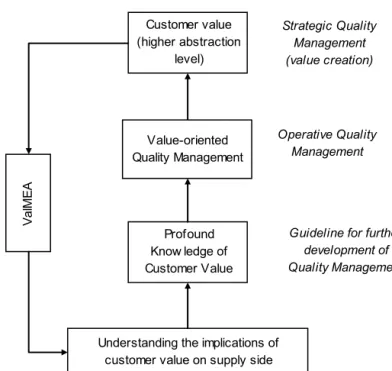
A central point in the PKCV is Value Modes Effect & Analysis (ValMEA), a concept which connects the higher and the lower level of customer value abstraction by describing that customer value appears in different “modes” in different contexts. This interconnection indicates that customer value is not just a concept that is goals/needs-related (fulfilment of goals or needs) or product-related (linked with a product), but also is competence-related
(implying suppliers’ value creation potential). Hence, customer value is both the input and the output of a value-creating system, which “reveals” the bi-directional relationship between quality improvements and customer value. This means that customer value measurements may lead to the identification of improvement opportunities, and suppliers’ efforts in improving quality may influence customers’ perceptions regarding the value of the product.
Through a re-interpretation of the principles of Six Sigma and Lean Production and the adaption of tools to capture customer value, quality management can be further developed toward customer value creation.
List of appended papers
I Setijono, D., Dahlgaard, J.J. (2007), Customer Value as a Key Performance Indicator (KPI) and a Key Improvement
Indicator (KII),Measuring Business Excellence, Vol. 11, No. 2, pp. 44-61.
II Setijono, D., Dahlgaard, J.J. (200x), The Value of Quality Improvements, International Journal of Quality & Reliability Management, to appear in the forthcoming issue.
III Setijono, D., Dahlgaard, J.J. (2007), The Added Value Metric – a complementary performance measure for Six Sigma and Lean Production, The Asian Journal on Quality, Vol. 8, No. 1, pp. 1-14.
IV Setijono, D., Dahlgaard, J.J. (2007), Selecting Improvement Projects that Add Value to Customers, The Asian Journal on Quality, Vol. 8, No. 1, pp. 15-26.
V Setijono, D. (2007), Operationalising Customer Value
Concept and Monitoring Customer Value Performance. Submitted paper.
Co-author statement
Djoko Setijono is the main creator of paper I, II, III, and IV, who introduced the basic ideas (concepts), conducted* data collection and analysis, also wrote and edited those papers.
Professor Jens J. Dahlgaard, who is the co-author of the above mentioned papers, contributed by continuously challenging Djoko’s ideas and giving constructive feedbacks during the writing and editing processes.
Preface
I personally believe that doctoral study is not just about spending four or five years to achieve a PhD degree, but it is a part of a research vision that requires commitment and often long office hours. After several years of hard work in my office at the university and in the factory, I finally reached the first milestone of a long journey as a researcher.
I realised that this dissertation perhaps would never have been written without the encouragements, advices (even constructive criticisms), and assistance of the following people that I am very much in debt to. It was a privilege to know and to learn from all of you.
I would like to thank my supervisor and the co-author of several papers in this dissertation, Professor Jens Jörn Dahlgaard (Linköping University) for his support and willingness to supervise my doctoral research, as well as for his trust on my capability, a student that gave him “headache” sometimes with deadlines and debates about concepts. My next acknowledgement goes to Dr. Dick Sandberg, my supervisor at Växjö University, for his willingness to be my supervisor, his supports, and for his trust on my capability; his goal-orientation and time-awareness did have influence on me. I also would like to thank Professor Thomas Thörnqvist (Växjö University), my examiner, for his support and guidance.
I would like to acknowledge the CEO, managers, staffs, and workers of the case company (their names are not mentioned here due to confidentiality reason) for giving me opportunities and for their contributions when I conducted my case studies. It has been valuable experiences for me and it is my hope that my research gave significant contributions to the company on the continuous improvement journey. I also would like to express my gratitude to Dr. Lars Witell (Linköping & Karlstad University) for his valuable comments during the pre thesis-defence seminar; to the anonymous reviewers of my published papers, and to the editors of scientific journals who have given me the opportunities to publish my works.
The following people also deserved my gratitude because they contributed to the success of my doctoral study in many different ways: Professor
Johan Sterte (Växjö University), Professor Anders Baudin (Växjö University), Professor Kaj Rosling (Växjö University), Dr. Lars-Olof Rask (Växjö University), and Dr. Su Mi Dahlgaard-Park (Lund University). Last but not least, I acknowledge my parents and siblings for their psychological supports during these study periods.
Växjö, Spring 2008
Djoko Setijono
Table of contents
ABSTRACT ... I LIST OF APPENDED PAPERS ... III CO-AUTHOR STATEMENT ...V PREFACE ...VII TABLE OF CONTENTS ... IX 1. INTRODUCTION ...1 1.1 BACKGROUND...1 1.2 RESEARCH PROBLEM...3 1.3 RESEARCH QUESTIONS...4
1.4 PURPOSE AND AIM...5
1.5 LIMITATION...5
1.6 DEMARCATION...5
1.7 GUIDELINES OF THE DISSERTATION...6
2. THEORETICAL REVIEW ...9
2.1 THE CATEGORIES OF VALUE IN MANAGEMENT LITERATURE...9
2.2 CUSTOMER VALUE...9
2.2.1 The nature ...10
2.2.2 The dimensions and types...10
2.2.3 The level of abstraction ...11
2.2.4 The forms...12
2.2.5 The contents ...12
2.2.6 The definitions...13
2.2.7 Reorganising the definitions...14
2.2.8 Towards coherent customer value...17
2.3 QUALITY MANAGEMENT...19
2.3.1 Total Quality Management...19
2.3.2 Six Sigma...22
2.3.3. Lean Production...25
3. RESEARCH METHODOLOGY ...27
3.1 THE SYSTEM METHODOLOGICAL APPROACH...27
3.2 QUANTITATIVE AND QUALITATIVE RESEARCH...30
3.2.1 Quantitative research...30
3.2.2 Qualitative research...30
3.3 CASE STUDY...31
3.4.1 Structure and framework...32
3.4.2 Some reflections on the research process ...37
3.5 DESIGN OF EMPIRICAL STUDIES...38
3.5.1 Study 1...39
3.5.2 Study 2...39
3.5.3 The quality of the research...47
3.6 THE CASE COMPANY...50
3.6.1 General facts ...50
3.6.2 Wood-flooring products ...50
3.6.3 Production process of wood-flooring...51
4. THE FOUNDATION FOR THE DEVELOPMENT OF QUALITY MANAGEMENT TOWARD CUSTOMER VALUE CREATION...55
4.1 THE PATHWAY TO VALUE CREATION...55
4.2 THEPROFOUND KNOWLEDGE OF CUSTOMER VALUE...56
4.2.1 Principle 1: Appreciation for a value creating system...57
4.2.2 Principle 2: Knowledge about customer value “modes” ...59
4.2.3 Principle 3: Theory of Improvements...60
4.2.4 Principle 4: Perception ...60
4.3 COMPARISON WITH THE SYSTEM OF PROFOUND KNOWLEDGE...62
5. THE DEVELOPMENT OF FORWARD-LOOKING QUALITY MANAGEMENT TOWARD CUSTOMER VALUE CREATION...65
5.1 DEFINE...66
5.2 MEASURE...66
5.2.1 Measuring perceived customer value...66
5.2.2 Measuring received customer value...67
5.3 ANALYSE...70
5.3.1 Analysing perceived customer value ...70
5.3.2 Analysing received customer value ...71
5.4 IMPROVE...73
5.4.1 Project nomination...73
5.4.2 Project selection...74
5.5 CONTROL...80
6. THE DEVELOPMENT OF BACKWARD-LOOKING QUALITY MANAGEMENT TOWARD CUSTOMER VALUE CREATION...83
6.1 DEFINE...83 6.2 IDENTIFY...84 6.3 FLOW...86 6.4 PULL...87 6.5 PERFECTION...91 6.5.1 Project nomination...91 6.5.2 Project selection...96
7.1 CONCLUSIONS...99
7.2 THE CONTRIBUTIONS OF THE DISSERTATION...103
7.3 MANAGERIAL IMPLICATIONS...104
7.4 FUTURE RESEARCH AREAS...105
7.4.1 Customer value in purchase and use contexts...105
7.4.2 Customer value and quality improvements ...105
7.4.3 Value-adding (-creating) processes/organisations ...106
7.4.4 Interrelationship between customer (stakeholder) value and shareholder value...107
7.4.5 Value-creating chain & network ...107
1. Introduction
1.1 Background
The definition and discussion regarding the concept of quality in e.g. Zeithaml (1988); Nicholls (1990, 1993); Dahlgaard et al (1998); Hansen (2001); Ulaga and Chacour (2001) embrace the relation between quality and value by, for example, discussing the concept of quality in terms of “value for money”, suggesting that customer value is the fourth phase of quality evolution, and describing the interconnection between perceived quality and perceived value. Although the aim of quality management is to create [customer] value and that TQM studies focus on customer value, “in TQM literature, we note a lack of studies analysing the contribution of quality management to value creation and diffusion in the perspective of stakeholders” (Mele and Colurcio, 2006; p. 467).
According to Khalifa (2004), people have tendencies to define value as one of the following: shareholder value, stakeholder value, or customer value; and customer value is the source of all other values. Hence, the aim of quality management should be first focused on creating value to customers (Nicholls, 1990).
The thoughts by Khalifa (2004) and Mele & Colurcio (2006) can be used to build a reasoning that there is a theoretical “gap” between quality management at a strategic and an operative level, in the sense that although TQM studies focus on customer value, those studies have not yet been directed to the development of quality management in order to enable customer value creation.
Another phenomenon that indicates the “gap” between the aim of quality management (value creation) and customer value is that the operational
aspect of Six Sigma and Lean Production in terms of performance measures do not well reflect customer value as their strategic goals (see paper III). This phenomenon may be caused by the fact that value is a very complex concept (Khalifa, 2004; Mele and Colurcio, 2006).
The "gap" between the “means” of customer value (quality management through TQM, Six Sigma, and Lean Production) and the “end” of
customer value (see figure 1) makes customer value creation a complex task, because customer value as an “end” is customers’ perception or state of mind (Khalifa, 2004), which may not be easily understood by the producers, or because producer and customers may have different views regarding customer value (Womack and Jones, 2003; Möller, 2006). This “gap” may explain the scepticisms regarding [total] quality management that it is: too internally oriented (Woodruff and Gardial, 1996) or originated in a systems analysis and not from a profound understanding of customer's purchase motivation and competitor strategies (Maklan and Knox, 1997). However, these scepticisms ought to be carefully examined because TQM is a management philosophy that consists of principles (core values) such as focus on [external] customers and managerial commitment to achieve quality goals in which benchmarking is a part of the commitment (see e.g. Oakland, 1989; Dahlgaard et al, 1998). Zairi (1994, p. 7) formulates that “TQM as a philosophy is fine, provided that we understand its workings and its benefits (which are long term) .... The problem is not really TQM as a philosophy but rather one of attitudes and behaviour [i.e. focus on the “wrong” things and works in a “wrong” way during TQM implementation]”.
Customer value (state of mind)
Quality management (value creation)
Figure 1. Gap between quality management and customer value The inconsistency between the producer's and customers' views of value seems to be more apparent by comparing a general situation in North American wood flooring industries which compete based on price but end up on disappointments (in Setijono and Sandberg, 2005) and a study by Erntsson (2002) which suggested that wood-flooring customers would likely be less sensitive on price if they perceived higher benefits. Moreover, based on Jonsson’s (2005) customer survey on different flooring materials, the result (for wood type of flooring material) suggested that good price and durability are product characteristics with the highest importance weight/score. Hence, the study indicated that the customers consider the benefit (in terms of quality) and the sacrifice (or
cost) of wood flooring products when they decide to buy and to install wood flooring, which implies the concept of customer value and the “value for money” concept of quality is real. Hence, we may argue that customer value creation seems to be the most appropriate strategy for wood-flooring producers.
1.2 Research problem
An emerging research stream suggests that customer value is related to suppliers’ competencies (Golfetto and Gibbert, 2006). However, there are not many suppliers know the tools and the processes to develop, improve, promote, and to market their value creation competencies.
Suppliers may find the tools and processes for value creation in quality management, considering that quality is an important component of value (Dumond, 2000) and the aim of quality management is to create value. However, quality reflects customer’s cognitive structure from a lower level of abstraction than value does (Zeithaml, 1988), which supports the reasoning that there is a “gap” between quality management and customer value. Besides, the term customer focus (as a prerequisite of customer value creation) is not easily implemented operationally as well as translated into an effective active throughout the organisation and into the market place (Bathie and Sarkar, 2002) – this difficulty is “shared” by both TQM and marketing. The main concern here is that quality should also reflect customer’s cognitive structure at a higher level of abstraction (by accommodating customer’s perception of value) in order to enable quality management for creating value to customers. As a matter of fact, quality will get positive or negative implications when associated with value (Conti, 2005).
Hence, the following research problem is defined:
How does the further development of quality management lead to customer value creation?
The research problem has both theoretical and practical implications. From a research perspective, it is about the further development of quality management toward a new quality management paradigm; while empirically, it is about understanding customer’s perception of value and
then use the knowledge to manage quality in a way that it creates value for customers. Further, developing quality management to create customer value needs to take into account the “bipolar” definitions of quality, i.e.
backward-looking quality (quality in relation to defects, flaws, or deficiencies) and forward-looking quality (quality in terms of positive features or superior characteristics) (Ishikawa, 1985; Kondo, 1993).
1.3 Research questions
TQM’s focus on facts indicates that measurement is fundamental in
managing the creation and delivery of customer value (Mele, 2007) where the measurements should, of course, be based on a correct understanding and interpretation of customer value itself. This statement is in line with the term customer value audit (see e.g. Ulaga and Chacour, 2001; Mele, 2007), which is described as a managerial tool to measure or evaluate customer’s perception of value based on customer’s expectation and perceptions of performance, where the evaluations or measurements may indicate a company’s competitiveness and provide input to improve the implementation of TQM (Mele, 2007). Furthermore, the company’s ability to create and deliver customer value cannot exclude the contribution of synergic relationship between TQM and marketing, in which TQM pillars, especially customer orientation, focus on processes, and continuous improvements, are important to “revitalise” marketing theory and practice (Mele, 2007). Thus, this reasoning implies that further development of quality management for customer value creation may comprise the adaption of customer value audit and marketing methods/tools, featured by TQM pillars, in order to manage (measure and improve) supplier’s performance when creating value.
Hence, the above research problem is divided into the following research questions:
1. What is customer value?
2. How does customer value become a basis (foundation) for further
developing quality management?
3. How does the further development of forward-looking quality
management lead to customer value creation?
4. How does the further development of backward-looking quality
1.4 Purpose and aim
The purpose of this dissertation is to contribute to the development of quality management toward customer value creation, where customer value is not merely about perceptions of customers in the market but it is also related with the way suppliers absorb and utilise the knowledge about customers and their value in order to manage quality. Managing quality with orientation on customer value will enable suppliers to develop and to market their competencies to create value to customers. Hence, the relationship between quality and customer value is bi-directional, meaning that the way an organisation manages its quality will influence customers’ perceptions of its products, and the information (knowledge) about customers’ perceptions regarding the value of products can be used as input to manage quality in an organisation. To view customer value as customers’ judgments on suppliers’ value creation potential “moves” the notion of value one “step” upward, from product-related to competence-related. It is important for the suppliers that the customers “see” supplier’s value-creation potential because it may influence customers’ appreciations regarding the value of the products.
The dissertation aims to reduce the “gap” between value creation (as the aim of quality management) and customer value (as perceptions or states of mind) by providing guidelines for suppliers to manage quality in a way so it enables customer value creation.
1.5 Limitation
The dissertation mainly discusses customer value in relation with products (referred to as manufactured goods) and manufacturing processes. The term “suppliers” refers to “producers” (“manufacturers”), which are then recognised as customer value-creating systems or organisations. The dissertation further narrows the scope of the discussion by describing the creation of value by a single producer, thus not value creation by a constellation of multiple producers and their suppliers.
1.6 Demarcation
This dissertation describes the development of quality management, in which the term “management” is specified as performance measurements, identification of improvement opportunities (project nomination), and
project selection, thus it does not include the implementation of selected improvement projects.
1.7 Guidelines of the dissertation
This dissertation consists of seven chapters and five appended papers. Chapter 2 contains a critical theoretical review and chapter 3 is a methodology chapter.
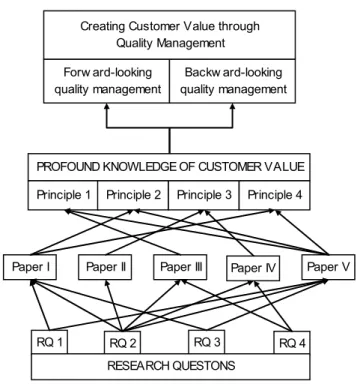
The readers can find the answers of the four research questions in the respective chapters as shown in table 1. Each chapter is connected to several papers, which have been written by the author during his doctoral study.
Table 1. Link between research questions and dissertation’s chapters
Research question Chapter Paper
RQ 1 2 Paper I, V
RQ 2 4 Paper I, II, III, IV, V
RQ 3 5 Paper I, V
RQ 4 6 Paper III, IV
Figure 2 visualises the main content of the dissertation (chapters 4, 5, and 6). The “heart” of the dissertation is the Profound Knowledge of Customer Value (PKCV) in chapter 4, where the main messages of PKCV are that producers should have a correct interpretation about customer value and should have active roles in customer value creation. Similar to the System of Profound Knowledge (Deming, 1994), PKCV consists of four principles, where each principle is “tied up” to particular papers. Chapter 4 also suggests the pathway for value creation, where PKCV is the important foundation of the pathway. The process of transforming quality management toward customer value creation is described in chapters 5 and 6. Finally, the last chapter in this dissertation is chapter 7, which contains the conclusions, managerial implications, and suggestions for future research.
Forw ard-looking quality management
Backw ard-looking quality management Creating Customer Value through
Quality Management
Principle 1 Principle 2 Principle 3 Principle 4 PROFOUND KNOWLEDGE OF CUSTOMER VALUE
Paper I Paper II Paper III Paper IV Paper V
RQ 1 RQ 2 RQ 3 RQ 4
RESEARCH QUESTONS
2. Theoretical review
2.1 The categories of value in management literature
Prior to describing the concept of value, it may be necessary to briefly explain different categories of value. This explanation might be useful to clarify which value that will be referred to in this dissertation and the connection between the different categories of value.
According to Khalifa (2004), management literature on value is usually clustered around three categories: stakeholder value, shareholder value, and customer value.
Stakeholder value
Within the concept of stakeholder value, a company is socially responsible to create value not only for its shareholders, but also for its customers, employees, and society at large (Barsky et al, 1999). The orientation towards creating value to stakeholders has been believed as the meaningful purpose of a business in which all stakeholders are given opportunities to determine the future direction of a company (in Khalifa, 2004).
Shareholder value
Shareholder value in its essence is cash returns on investments, which is determined by comparing the cash flow return on capital with the cost of capital (Sinha, 2006). In its early development, the concept of shareholder value emphasised more on gaining returns from capital or financial investments. Recently, the emphasis has been shifted towards the view that customers are the driver of those returns (see e.g. Gummesson, 2004; Bauer and Hammerschmidt, 2005; van Raiij, 2005). Thus, shareholder
value focuses on the value of customers in generating profit for a
company.
2.2 Customer value
Researchers such as Khalifa (2004) and Mele and Colurcio (2006) have “reminded” that customer value is a complex and difficult-to-define concept. Based on the review on customer value literature, it has been reflected that the difficulty and the complexity of the customer value
concept may be caused by the following aspects: the nature
(characteristics), the dimensions and types, the level of abstraction, the
forms, and the content. These influencing aspects “shape” the definitions, models, and the research direction of customer value. Therefore, it would be useful to first describe these aspects before describing the definition of customer value.
2.2.1 The nature
The complexity and the difficulty of customer value may stem from the characteristics or the nature of customer value, which have been discussed by, e.g. Nicholls (1993), Bounds et al (1994), and Holbrook (1999).
Customer value is described as: idiosyncratic (subjective, personal
preference), dynamic (changes over time), interactive (between subject and object), situational, and the experience of using or consuming a product. It is not unusual that customer value literature mentions both customer value and consumer value, because customers (e.g. buyers) are not always the consumers (end-users) and what the customers value before buying the product may be different compared to when the customers are using the product. This makes the concept of customer value context-dependent.
2.2.2 The dimensions and types
According to Holbrook (1999), there are three dimensions (broken down into six aspects) of customer value which describe the properties of customer value: 1) extrinsic versus intrinsic, 2) self-oriented versus other-oriented, 3) and active versus reactive. Table 2 briefly explains these three dimensions.
Based on these dimensions, Holbrook (1999) describes eight types of customer value: efficiency, excellence, status, esteem, play, aesthetics,
ethics, and spirituality. However, these types of value focus mainly on the consumer and do not capture value in terms of benefits/sacrifices, not applicable in business-to-business context, nor distinguish between “expected” and “actual” value.
Expressing value in terms of benefits/sacrifices can be found in e.g. Zeithaml (1988) and Gale (1994). Woodruff and Flint (2006) distinguish
the desired value from the received value in order to separate between expected and actual value.
Recent development of customer value by Smith and Colgate (2007)
suggests that there are four types of customer value: functional
(instrumental) value, experiential (hedonic) value, symbolic (expressive) value, and cost (sacrifice) value.
Table 2. The dimensions of customer value
Dimension Explanation of value
Extrinsic Accomplishment of goals or purposes. Example: wearing sweater to be warm. Intrinsic Enjoyment of an experience itself.
Example: attending a music concert. Self-oriented Effect of consumption on oneself.
Example: when wearing a sweater, then one-self is being warm, not other.
Other-oriented Effect of consumption on others.
Example: when attending a music concert, one may be perceived as an artistic person.
Active Entails a physical or mental manipulation of some tangible or intangible objects.
Example: one should wear the sweater to be warm. Reactive Results of appreciation or admiration of some objects.
Example: when attending a music concert, one basically does "nothing" but watching and listening.
2.2.3 The level of abstraction
Based on e.g. Zeithaml (1988), Flint et al (1997), Woodruff (1997; in Flint and Woodruff, 2001), and Khalifa (2004), customer value involves both
higher and lower level of abstraction. At a higher level of abstraction, customer value is all about customer perception, experience, or even customer personal values. At a lower level of abstraction, customer value is about the attributes or characteristics of products, services, or even suppliers. According to means-end theory (see e.g. Bounds et al, 1993; Edvardsson and Gustafsson, 1999; Hermann and Huber, 2000; Reynolds and Olson, 2001), these two levels of abstraction are not disconnected, but
they are linked to each other through the consequences of the product’s use. This implies that there are value components (i.e. product attributes or characteristics) that are (explicitly) expected,dissatisfy (value destroyers), ordelight (value magnifiers) the customers (Kano, 2001; Khalifa, 2004). 2.2.4 The forms
In general, customer value involves two basic forms: trade-off and non trade-off. Customer value can be described as a trade-off between benefits
andsacrifices (e.g. Zeithaml, 1988; Gale, 1994). Both the benefits and the sacrifices are stated in plural form because customer value might be best described as a multidimensional construct even though it is not an absolute condition (Lin et al, 2005). At a lower level of abstraction, there are tendencies to “narrow” the benefit as quality and the sacrifice as price or
cost, which explains different interpretations about customer value. The trade-off form of customer value dominates the discussion of customer value in e.g. industrial marketing, procurement, quality management, and service literature.
Customer value can also be described in a non trade-off form, where
customer value is the fulfilment of goals, needs, or wants through the consequences of using or consuming products or services. This type of customer value dominates the discussion of customer value in e.g. consumer marketing, psychology, and other social sciences.
Hence, the basic difference between those two forms is that the trade-off form involves sacrifice element (monetary or non-monetary), while non trade-off doesn’t.
2.2.5 The contents
According to Treacy and Wiersema (1993) and Anderson and Narus (2004), customer value consists of product leadership,customer intimacy, and process excellence, where these elements are likely to be fulfilled through product, service, and customer relationship (in e.g. Lapierre, 2000; Lin et al, 2005). Smith and Colgate (2007) describes that customer value is generated from information, product, interaction, purchase/ consumption environment, and ownership/possession transfer, which are created by different processes and activities within and between organisations.
Fulfilling the elements of customer value requires the producers to produce the goods or deliver the service as well as to interact with customers (before the customers are able to consume the products or services), which should be characterised by speedy response,competitive (low) price, and high quality or premium service (Treacy and Wiersema, 1993) as well as complemented by “soft” aspects such as image,trust, etc. It might be apparent that when describing customer value in terms of speedy response, low price, and high quality, the context has been “switched” into and focused on production, where customer value basically contains quality, time, and cost elements (Womack and Jones, 1996, 2005; Harry and Crawford, 2005). However, this does not imply that quality, time, and cost are what customer value is all about. Instead, those are what usually (should be) focused on when discussing customer value in the context of production (see paper III for further description, especially figure 1 and 2).
Although time is a component of customer value, the customers may
include it as either benefit or sacrifice. On the other hand, suppliers may consider time as an independent variable in the value “equation” since there is transfer of ownership from the supplier to external customers or from internal suppliers to internal customers.
Further descriptions about the contents of customer value can be found in paper I and paper III.
2.2.6 The definitions
The following definitions may provide several clues of what customer value is all about. Zeithaml (1988, p. 14) defines [perceived] value as “consumer’s overall assessment of the utility of a product based on what is received and what is given”. According to Woodruff (1997), customer value is a customer’s perceived preference for and evaluation of those product attributes, attribute performances, and consequences arising from use that facilitate (or block) achieving the customer’s goals and purposes in use situations. Holbrook (1999) defines customer value as an interactive relativistic preference experience. Interactive means that value involves a relationship between the subject (the customer) and the object (the
product). Relativistic indicates a customer’s personal comparison of an object to another in different situations. Preference refers to the judgement a customer made. Experience implies that value resides in consumption (use) rather than in an object or a possession of an object.
Mele and Colurcio (2006) offer a quite representative explanation of customer value, where customer value is defined as the customer’s achievement of satisfactory experiences of buying and consuming goods and services (p. 484); a customer receives “superior” value if the object (obtained from a firm) fulfils his/her needs and wishes in a more satisfactorily way compared to another object (from another firm) (p. 483). 2.2.7 Reorganising the definitions
“Customers’ achievement of satisfactory experience” indicates that customer value is a state of mind or experience, where satisfaction is an important part of value. “Fulfilment of needs and wishes” indicates that the customers cognitively judge the object (a good or a service), where the judgment can also be made in comparison with another object (thus the cognitive judgment occurs in the context of competition and non-competition). An object is created (produced) by a firm and then delivered to the customers by the same or a different firm. In order to create and deliver goods and/or services that fulfil what customers want, when, and where they want, a firm needs to posses competencies to be effective,
efficient, and to establish and maintain cooperation with other firms in a
network. Thus, customer value involves a cognitive judgment on the firm’s competencies in creating and/or delivering the object. This seminal research has been published as a special issue in the Journal of Industrial Marketing Management (vol. 35, issue 8), which thus indicates that customer value is related to the roles of suppliers on creating value to customers.
In order to simplify our view about different concepts of customer value, the different definitions of customer value are reorganised into the following categories:
1. A state of mind (sense of achievement/fulfilment) or an experience 2. A cognitive judgment on product or service
The above way of categorising offers a more up-to-date view of customer value, in the sense that it embraces the customer value notion from both higher (on the market side) and lower levels of abstraction (on the supply side). Customer value at the lower level of abstraction (on the supply side) is important because:
It involves producers (suppliers)
It establishes connection to quality
It eventually leads to purchase transaction and customer value at a higher level of abstraction (because customers, in most situations, couldn’t use the product without first buying it).
Customer value is a state of mind or experience
Customer value as an experience or a state of mind occurs when the customers use or own the product. Thus, this way of defining customer value is common in post-purchase context. At this stage, customer value is the fulfilment of goals, needs, or wants. It is the value that customers “receive” (see Flint and Woodruff, 2001). Customer value may also explain the customer as a person (what he/she values in life). The experience and/or the fulfilment of goals/needs eventually makes the customers feel content or satisfied, which thus implies that a state of emotion also provides a useful explanation of the value concept. This category of customer value definition is usually found in art, psychology, consumer behaviour, etc.
Customer value is a cognitive judgment on product or service
This concept of customer value is the most common reference of customer value in the context of purchasing or service, where customer value is usually defined as a trade-off between perceived benefits and perceived sacrifices (e.g. Zeithaml, 1988; Gale, 1994, Simpson et al, 2001; Lin et al, 2005). Thus, it is usually known as perceived customer value. Although it is generally defined as a trade-off between benefits and sacrifices, there are many different versions of what the benefits and the sacrifices may contain, which depend on e.g. the frame of discussion: business-to-business (B2B) or business-to-business-to-customers (B2C).
Purchase transactions between supplier and buyer usually involve money in exchange to the object of transaction. This is the reason that customer value can also be expressed in monetary terms as exchange value, which is
often simply defined as price. In this sense, customer value is the benefits for customers by paying less. However, the concept of price is multidimensional (Padula and Busacca, 2005), which involves a
comparison between selling price and willingness to pay. This
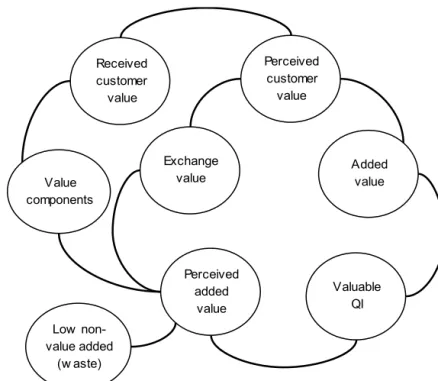
multidimensionality of price becomes the motivation to redefine exchange value as a ratio between utility and price (see paper I), where exchange value is equal to perceived customer value (paper I and II). The equality between exchange value and customer perceived value thus indicates that the economic value of a product reflects customer’s perception about the value of the product. Therefore, producers may predict and monitor customers’ perceptions about the value of products through exchange value. The fact that exchange value is a ratio between two financial measures (i.e. willingness to pay and price) makes exchange value relatively easier to capture than perceived customer value (see paper II). However, exchange value can not be used to replace customer cognitive judgement.
Grönroos (1997) suggests that perceived customer value is equal to core value plus minus added value. This model is “attractive”, not only in the sense that it provides a different concept compared to other models but also because it develops connection to the producers or suppliers.
Customer value is a cognitive judgment on suppliers’ (producers’) competencies
The third concept of customer value describes that customer value is customers’ judgment or evaluation on suppliers’ or producers’ competencies. From the customers’ perspective, competencies are seen as input to customers’ organisational processes that directly create value (Golfetto and Gibbert, 2006). This way of defining customer value is recently “introduced” in the field of, e.g. industrial marketing, where customers use suppliers’ competence profile as the basis for supplier selection (ibid).
Möeller and Törrönen (2003) suggest that these competencies include
efficiency-related competencies (i.e. cost reduction), effectiveness-related competencies (i.e. solution), and networking competencies (i.e. access). Möller and Törrönen (2003) further describe that suppliers create the following types of value: core value,added value, and future value.Core
value is created in a transactional supplier-customer relationship or at the early stages of business relationship where the emphasis is on efficiency; while creating added value focuses on effectiveness. On the other hand,
future value relies on a network that requires partnership between suppliers and customers. The ability to create value spectrum (that consists of core value, added value, and future value) is dependent on: 1) supplier operational performance (efficiency, flexibility, excellence), and 2)
supplier ability to incrementally or radically innovate (Möller and
Törrönen, 2003). The concept of future value seems well described by Gummesson’s (2004) theory that customer value creation occurs in network constellations.
The efficiency, effectiveness, and network as the required competencies to create value to customers are very similar to the components of added value(Harry and Crawford, 2005) and the discussion of customer value in Womack and Jones (1996). Thus, it can be argued that added value is a manifestation of customer value in production, which can be linked to perceived customer value (paper III).
From the suppliers’ perspective, suppliers should promote (demonstrate), transfer, and sell their competencies (Gibbert et al, 2006) as well as continuously develop their competencies (Berghman et al, 2006). However, the implication of customer value on suppliers is less understood, such as what are the tools and processes used by suppliers to develop, market, and deliver competencies [to create value]? (Golfetto and Gibbert, 2006; p. 906). The required tools and processes may be found in quality management methodologies considering that quality is an important component of customer value (Dumond, 2000) and the aim of quality management is to create customer value (Mele and Colurcio, 2006). However, the existing tools and methods in quality management need to be further developed to better reflect customer value.
2.2.8 Towards coherent customer value
It has been noticed that prior to a purchase transaction customer value is discussed primarily in the trade-off form. On the contrary, post-purchase customer value is rarely discussed in utilitarian (trade-off) form.
This, to some extent, is correct because customer value is a state of mind, which is independent of monetary or non-monetary sacrifices. However, customers also make judgement on the benefits gained from the product in comparison to the efforts (or money) they have spent to acquire and own the product.
Thus, in this sense, the overall concept of customer value is not yet coherent, meaning that during the use of the product, the benefits are not compared against the [monetary] sacrifices during the period of ownership, i.e. life cycle costs (LCC). To a certain degree, customers take into account the LCC prior to buying transaction. When LCC is perceived as high, customers may not wish to buy the product, and when customers are negatively “surprised” by high LCC, they may be dissatisfied although the product was previously perceived as valuable (having the desired characteristics). In the case of wood-flooring products, the fact that wood flooring has a higher LCC compared to other flooring materials (see Mousatche and Languell, 2001), leads to a prejudice that installing wood floor is costly, which in turns affect the customer’s desire and decision to buy and install wood floors. Therefore, in paper I and V, the LCC is taken into consideration in the customer value concept.
In brief, the hierarchical value map (means-end model, non trade-off form) often only exposes the benefits for customers and not the sacrifices; it does not “reach” the process where the attributes were created. When the means-end model is extended and the sacrifices are defined in terms of
costs, it is found (as shown in table 3) that the concept of customer value shows coherence, in the sense that we can find consistencies between different ways of defining customer value (i.e. off versus non trade-off, marketing versus operations management).
Viewing customer value as presented in table 3 influences the way customer value is defined and built in the rest of this dissertation. Table 3 suggests that: 1) the way “benefit” and the “sacrifice” is defined will determine the type of value, 2) although there are different types of value, they are related and they explain how customer value is conceptualised at different stages of product’s life cycle, and 3) the link between quality management and customer value is stronger and more apparent. The
coherence of customer value definitions thus validates the argument that “the aim of quality management is customer value creation”.
Table 3. Coherence in value concepts Value as a non trade-off (Extended means-end theory) Sacrifices (Costs as the denominator) Value as a trade-off (Utilitarian model) Values
Consequences Life Cycle Costs Received Customer Value*) Attributes
Attributes
Life Cycle Costs Price
Perceived Customer Value Perceived Customer
Value**)
Quality (product) Costs Value Analysis/Engineering
Quality (process) Non Value-Added Costs
Added Value***)
2.3 Quality management
2.3.1 Total Quality Management Origin and definitions
The term “TQM” was first introduced by John S. Oakland (Oakland, 1989), where he defines TQM as an approach to improving the effectiveness and flexibility of business as a whole – quality in all functional areas. TQM is an “extension” of Total Quality Control (TQC) by Feigenbaum (1956, 1961). The “TQM movement” began to take root from UK, USA, and Canada (Macdonald, 1998; Martinez-Lorente et al, 1998; Page and Curry, 2000) although the origin of TQM can be traced back from the initiatives of Union of Japanese Scientists and Engineers
(JUSE) in order to improve the productivity of industries in Japan (by inviting Deming and Juran) after World War II. The efforts and the initiatives to improve quality manifested through Company Wide Quality
*) In the context of non-competition **) As defined by Gale (1994) ***) See paper III
Control (CWQC) to indicate the Japanese approach of TQC (Ishikawa, 1985; Kondo, 1993).
Researchers in the field of quality management may agree with, e.g. Martinez-Lorente et al (1998), Dahlgaard-Park (1999), that it is not easy to explain what TQM is about due to many different definitions and misconceptions of TQM. However, the following definitions may provide insights of what TQM is:
TQM is a corporate culture [and/or management philosophy] characterised by increased customer satisfaction through continuous improvements with active participation of all employees (Dahlgaard et al, 1998).
It is a management system containing interdependent components (i.e. core values, techniques, and tools) in order to increase internal and external customers’ satisfaction with a reduced amount of resources (Hellsten and Klefsjö, 2000).
Total Quality [Management] is a people-focused management system, which includes systems, methods, and tools, that aims at continual increase in customer satisfaction at continually lower real cost (Evans and Dean Jr, 2003).
Shortly, TQM is an approach to improving the effectiveness and flexibility of business as a whole (Oakland, 1989).
Concepts and contents
Despite the vagueness regarding the definition, there are principles and concepts that can be identified as TQM’s core values. There are many “versions” regarding the description of TQM core values, e.g. Bergman and Klefsjö (1994) and Dahlgaard et al (1998) presented five (5) main
principles of TQM (management commitment/leadership, customer and
employee focus,focus on facts,continuous improvements, and everybody’s participation/involvement), which are included in Dahlgaard-Park’s (1999) finding that TQM consists of twelve (12) principles. An extensive literature review by Mehra et al (2001) suggests that there are forty five (45) critical elements of TQM’s practice, which can be grouped into five (5) main factors: human resources focus, management structure, quality tools, supplier support, and customer orientation. Mehra et al (2001)
further suggest that the future of TQM will emphasise the following areas:
customer focus,process focus,innovation focus, and environmental focus. Hellsten and Klefsjö (2000) explain that the techniques in TQM are ways of working to reach the values, for example: process management, self assessment, and design of experiment. Meanwhile, the tools are useful to analyse data or to support decision making, such as: control chart, process mapping, and Ishikawa diagram.
Future development
Based on the finding of Mehra et al (2001), it is clear that focus on customers (market) is an essential aspect of TQM’s present and future practice, which makes TQM an appropriate methodology for organisational change towards market orientation (Yam et al, 2005). Market orientation is defined as a “culture” of customer focus that is systematically and entirely committed to the creation of superior customer value (Slater and Narver, 1994) yet considering the interests of other key stakeholders (Simpson et al 2001). Market orientation is valuable because it focuses the organisation to continuously collecting information about target-customers’ needs and competitors’ capabilities, and using this information to continuously create superior customer value (Slater and Narver, 1995). Thus, marketing orientation may be a precursor to value creation (Simpson et al, 2001). However, TQM (as well as marketing) experience difficulties in implementing focus on customers operationally, i.e. operate the concept internally and translate it into effective action throughout the organisation and into the marketplace (Bathie and Sarkar, 2002).
Considering the above definitions of TQM, customer focus has been interpreted as satisfying the needs of customers through quality. However, what might be less understood is that [after comparing between Oliver, 1999 and Eggert and Ulaga, 2004] there are two types of customer satisfaction: satisfaction that is related with purchase and satisfaction that is derived from use. These two types of satisfaction are similar to the classification by Johnson et al (1995): transaction-specific satisfaction (short-run evaluation of a product or service experience) and cumulative
satisfaction (overall experience with a product or service to date). This explains why various researchers (e.g. Oh, 1999; van der Haar, 2001; Eggert and Ulaga, 2002; Spitteri and Dion, 2004; Liu et al, 2005) regard
customer value as the predecessor of customer satisfaction, and other researchers (e.g. Edvardsson and Gustafsson, 1999; Dumond, 2004; Khalifa, 2004) consider that customer value is the successor of customer satisfaction. Therefore, customer value and customer satisfaction are complementary yet distinct constructs (Woodruff and Gardial, 1996), where customer value is a cognitive construct while customer satisfaction is an affective construct (Eggert and Ulaga, 2002). We may then interpret that customer satisfaction is the effect of value on customers’ emotions. Hence, it may be argued that TQM’s difficulties in operationalising customer focus may be caused by an inadequate understanding of what customers do value when determining quality.
A successful implementation of TQM to improve the company’s quality can not neglect the contribution of performance measurements (Juran, 1993; McAdam and Bannister, 2001; Dahlgaard and Dahlgaard-Park, 2002). In this case, performance measurements should be customer-centred (i.e. reflect TQM as a customer-oriented methodology) and not manager-centred (McAdam and Bannister, 2001). The importance of performance measurement is more obvious because a performance measurement system is a part of the value management framework (Dumond, 2000).
Mehra et al (2001) describe that TQM is a continuous, dynamic, life-long journey. Hence, as a dynamic management philosophy, there are (would be) new, alternative quality roadmaps originated from TQM, such as Six Sigma and Lean Production methodologies (Dahlgaard and Dahlgaard-Park, 2006).
2.3.2 Six Sigma
Concepts and definitions
Linderman et al (2003, p. 195) define Six Sigma as an organised and
systematic method for strategic process improvement and new product and service development that relies on statistical methods and the scientific method to make dramatic reductions in customer defined defect rates. The method to improve the process is described as define,measure,
analyse, improve, and control (DMAIC); for new product and service
measure, analyse, design, and verify (DMADV) (see Brady and Allen, 2006).
Six Sigma can be seen both from business and statistical perspectives (e.g. Antony and Banuelas, 2002; Antony, 2004; Kwak and Anbari, 2006). From the business perspective, Six Sigma is a strategy to improve the effectiveness and efficiency of all operations to meet or even exceed customers’ needs and expectations (Antony and Banuelas, 2002) by focusing on those that are critical to customers (Antony, 2002). Statistically, Six Sigma is a measure of quality that strives for defect reduction/elimination based on the application of statistical methods to improve process and reduce variation (Antony, 2002). Hence, Six Sigma is ... an intelligent blending of the wisdom of the organization with proven statistical tools to improve both the efficiency and effectiveness of the organization in meeting customer needs …(Breyfogle et al, 2001; p. 5) …
that can lead to breakthrough profitability and quantum gains in quality... (p. 25).
Critical aspects/factors
As a project-driven management approach (Kwak and Anbari, 2006), Six Sigma contains aspects such as: financial returns (bottom-line), leadership, human and process, infrastructure (“belt” system), data and facts, statistics (thinking, techniques, and tools) (Antony, 2002). Successful implementation of Six Sigma depends on several key factors (see e.g. Antony and Banuelas, 2002; Banuelas Coronado and Antony, 2002; Kwak and Anbari, 2006). Those factors may include: management involvement and organisational commitment; project selection, management, and control skills; encouraging and accepting cultural change; continuous education and training.
Weaknesses and challenges
Banuelas et al (2005, p. 554) describe that although there is a wider acceptance of Six Sigma in many organisations, Six Sigma literature can be generally categorised as introductory (instead of in-depth case study), aimed at educating people about the elementary principles of Six Sigma and selling it as valuable management philosophy.
In their attempt to answer the question whether Six Sigma contains something new or not, Klefsjö et al (2001) describe that Six Sigma does not particularly contain anything new because Six Sigma’s focus on process and eliminating variation can be found in the works of Edward Deming and Walter Shewhart, or can be traced back from TQM, namely Japan’s quality evolution (Dahlgaard and Dahlgaard, 2006). Klefsjö et al (2001) further argue that the novelty of Six Sigma seems to be on the link between the use of statistical techniques and market-orientation in order to deliver bottom-line financial results or performance. Thus, Six Sigma has been expanding from a statistical-oriented method to a strategy to improve business performance. Its rapid expansion and wide acceptance in industries makes Six Sigma a new phenomenon compared to its original theoretical concept, that well-grounded theories may be needed in order to understand the “new” Six Sigma phenomenon (Schroeder et al, 2007). This may be the reason behind Antony’s (2002, p. 305) statement that [the new] Six Sigma lacks a theoretical underpinning, which thus causes the gap between theory and practice.
Antony (2002) described that the limitations of Six Sigma is related to: data availability, investment requirements (for start up and solutions), subjective project selection, assumption of normal distribution, “static” and mostly single critical-to-quality (CTQ), limited application in service, organisational culture and learning. However, these limitations provide challenges for future research.
According to Kwak and Anbari (2006), the obstacles and challenges of Six Sigma are as follows: 1) Six Sigma is not a universal answer to all business issues, thus adopting Six Sigma requires analysis and acceptance on its strengths and weaknesses, 2) Six Sigma is not just about problem solving in manufacturing, but also about quality planning and change management, and 3) Six Sigma training should be tailored according to organisational needs and balance between qualitative and quantitative aspects.
The weaknesses of Six Sigma is even more obvious if we compare between the performance measure (i.e. number of defects per million
opportunities or dpmo) and the goal of Six Sigma, i.e. creating and
is not always applicable at a corporate level or in service-oriented companies because it is not always easy to define and count defects (George, 2002). Therefore, in paper III, an attempt has been given to improve the consistency between the performance measure and the goal of
Six Sigma by suggesting added value as a complementary performance
measure for Six Sigma, which is demonstrated through a case study in a Swedish wood-flooring manufacturer.
2.3.3. Lean Production Definitions and principles
Lean production is a methodology that focuses on making the product (goods) flow through a value-adding process without interruption; a "pull" system that cascades back from customer demand by replenishing only what the next operation takes away at short intervals, and a culture in which everyone is striving continuously to improve (Liker, 2004). Lean production methodology consists of the following five steps: defining customer value, defining the value stream, making it flow, pulling from the customer back, and striving for perfection (Womack and Jones, 1996). Goal and approach
Transforming materials into products creates value (Gummesson, 2004), However, during the transformation process, there are activities that do not contribute to value creation but trigger costs. Therefore, Lean Production methodology defines that added value is the actual transformation process or the core process that the customer is paying for, and everything that is not a part of the core process actually does not add value to the customers and will therefore be regarded as "waste" (Liker, 2004). The waste or
non-value added could further be classified into necessary waste (e.g.
inspections, control systems to check that procedures are being followed, documentation) and pure waste (e.g. failures, reworks). Hence, the main goal of Lean Production is to provide customer value (Womack and Jones, 1996, 2005; Hines et al, 2004) by continuously driving out those activities that do not add value to customers (waste).
Weakness
Although the “strategy” of Lean Production methodology is to create value, its application at the operational level does not apply the principle (Hines et al, 2004), in the sense that to what extent the value provided is
unknown. Instead, the “success” in providing customer value is measured through cycle time, under the assumption that the reduction or elimination of waste will create a smoother flow and thus a shorter cycle time. This is
an example of weak linkages between lean production constructs (the
philosophical orientation) and measurement variables (the tools/
measurements) (in Shah and Ward, 2007). To fill in this theoretical gap, a metric to measure added value in a process is suggested in paper III, and then applied in a Swedish wood-flooring manufacturer.
Future development
Although the reduction or the elimination of “waste” plays a significant role in customer value creation, defining customer value as merely elimination of waste may distort the concept of customer value itself. Therefore, Womack and Jones (2003, 2005) further recommend challenging the "traditional" definition of value in Lean Production and fundamentally rethink value from the perspective of customers. Value can only be specified by the ultimate customers, but the producers need to define and express customer value in terms of a specific product with specific capabilities (that customers need or want, not the producer want to make), offered at a specific time and price (Womack and Jones, 1996; 2003).
3. Research methodology
A methodology is a model, which entails theoretical principles as well as a framework that provides guidelines about how research is done in the context of a particular paradigm …it translates the principles of a paradigm in a research language and shows how the world can be explained (Sarantakos, 1993; p. 30). Methodology is related to the development of personal insight and understanding in the creator of knowledge, it is the understanding of how methods are constructed and howoperating paradigm is developed (Arbnor and Bjerke, 1997).
Operating paradigm, which consists of methodical procedure and
methodics, provides “connection” between methodological approach and
area of study. Methodical procedure is about adapting technique to a methodological approach, whereas applying this adaption in a plan and/or an implementation is called methodics.
3.1 The system methodological approach
Definition and logic
A system is a set (an assembly) of related components (elements). System reality is assumed to consist of components that are mutually dependent on each other, which means that they cannot be “summed up”, i.e. the whole is more (or less) than its parts.
The constitution of these components brings about synergistic effect, meaning that information is provided not only by the content of individual components but also through the way those components are put together (Arbnor and Bjerke, 1997). In order to explain or understand an individual component, it must be put in context, not just studying the component itself in isolation.
The system approach is a way of thinking (Checkland, 1981), a practical philosophy, and a methodology of change in which the pieces of our fragmented world can be reassembled and coherence can be created out of chaos (van Gigch, 1978). System approach is an attempt to combine theory, empiricism, and pragmatics and looks at a system from the top down rather than from the bottom up (Skyttner, 2001). System approach denies the usefulness of looking for causal relations. Instead, the
researcher looks at the interaction among the components and the forces that influence the system as a whole, where the “cause” is subsequent in time to the “effect”, like the consequence of a certain action or behaviour. System approach argues that the structure and behaviour of a system are determined by its purposes (teleology).
System approach operates in an integrated framework of modern organisational knowledge and management science, where terms such as interrelationship & interdependence, holism, input & output may describe what system approach is all about (Skyttner, 2001).
According to van Gigch (1978), the system approach can be regarded as: 1) a methodology of design, 2) a common conceptual framework, 3) a new kind of scientific method, 4) a theory of organisation, 5) systems management, 6) a method related to systems engineering, operation research, cost effectiveness, etc, and 7) applied general system theory. System approach and general system theory, from which it derives, encouraging the development of new kind scientific method embodied in the system paradigm that can deal with processes such as life, birth, death, evolution, adaptation, learning, motivation, and interaction (van Gigch, 1978). General system theory investigates the concepts, methods, and knowledge pertaining to the fields of systems and system thinking.
Analogy, language, and interpretation
System researchers use the experience and the result from earlier studies only as a mental inspiration for analogies when they conduct studies of systems with similar orientation and content (Arbnor and Bjerke, 1997) or in order to gain some point of leverage on the complexity (Weinberg, 2001). Systems approach does not lead to the creation of a general, absolute theory or knowledge for the components of a model nor for the way such components must be structured or behave, but theoretical knowledge becomes related to one or several types of system or to specific systems phenomena (system-dependent knowledge).
System approach has, to a large extent, a language of its own that consists of a number of concepts that are specific to the approach, where the creators of knowledge occasionally renew the system language by
inventing new concepts that in their opinion provide a better (or more comprehensive) picture of what is going on in the framework of the object under study, perhaps because system creators of knowledge make no clear distinction between their interpretations and those held by the subject in questions.
Data, reliability, validity, and generality
The system approach uses secondary material and primary material from direct observations and interviews as well as experiments in a trial-and-error sense (Arbnor and Bjerke, 1997).
Theory building, models, and measurements are common aspects to be found in system approach. However, measurements in system approach are not precise and also not considered worth aiming for. The emphasis is on what a measure can be used for, which may be the reason why the concept of reliability is rarely used.
Because of the lower degree of generality and absoluteness of system theory, the connections among theory, definitions, and reality are not very strong. The requirement is not so much that definitions must correspond with existing theory or to be operational. A common system approach procedure to address validity issues is to reflect the real system from as many angles as possible by being in the real system as long and as often as possible, talking to as many people as possible, and studying as much secondary material as possible.
A system-based person trying to create knowledge perceives his/her reality as consisting of systems, which by definition means dependent relations on one hand and partly unique cases on the other hand. Thus, it is common to work with historical studies and case studies.
Before explaining case study, it may be worth describing quantitative and qualitative research.
3.2 Quantitative and qualitative research
3.2.1 Quantitative research
Quantitative research is social research methods that rely upon numerical and statistical methods, thus associated with the terms “positivism” and “empiricism” (Yates, 2004). Quantitative research is characterised by surveys and experiments, where the goal is to produce general statements or “laws” (nomothetic).
The validity of quantitative research depends on internal validity (ability to draw correct conclusion from the data), external validity (ability to draw accurate inferences from the sample data to other persons, other settings, and past or future situations), statistical validity (ability to draw accurate inferences from the data because of adequate statistical power or fulfilment of statistical assumptions), and construct validity (ability to draw accurate inferences due to the use of adequate definitions and measures of variables) (Creswell, 2003). In quantitative research,
cronbach alpha statistic can be used as a reliability check for the internal consistency.
3.2.2 Qualitative research
Qualitative research is research that uses any methods that rely upon primary source information, where very often the “data” is not numerical (Yates, 2004). In many cases, qualitative research crosses these
boundaries: phenomenological (emphasises on inter-subjective human
interaction), hermeneutic (focuses on the meanings of objects and actions), andrelativist positions (existence of a single “reality” or “truth”). Overall these positions can be described as “idealist”, i.e. prioritise or focus upon the ways in which “ideas” are made and used, contra to the positivists who focus upon the observation of “empirical” events and in turn describe most of types of other activity as metaphysical. Most qualitative works fall into
idiographic (detail description of particular circumstances), where the data can be collected in using interviews (in-depth, focus group) or ethnographic fieldworks (collection of qualitative data from a range of contexts). The themes, patterns, understandings, and insights that emerge from fieldwork and subsequent analysis are the fruit of qualitative inquiry (Patton, 2002).