Importance of speech production for phonological
awareness and word decoding: The case of children
with cerebral palsy
Marieke Peeters
a,*
, Ludo Verhoeven
a, Jan de Moor
a, Hans van Balkom
b,c aDepartment of Special Education, Behavioural Science Institute, Radboud University Nijmegen, Nijmegen, The Netherlands bRadboud University Nijmegen, Nijmegen, The Netherlands
cPonTeM-R&D, Nijmegen, The Netherlands
A R T I C L E I N F O Article history: Received 25 September 2008 Accepted 1 October 2008 Keywords: Cerebral palsy Speech impairments Intelligence Phonological awareness Word decoding A B S T R A C T
The goal of this longitudinal study was to investigate the precursors of early reading development in 52 children with cerebral palsy at kindergarten level in comparison to 65 children without disabil-ities. Word Decoding was measured to investigate early reading skills, while Phonological Awareness, Phonological Short-term Memory (STM), Speech Perception, Speech Production and Non-verbal Reasoning were considered reading precursors. Children with cerebral palsy lag behind on all reading precursors at the beginning of the second year of kindergarten. For the children without disabilities, early reading skills in Grade 1 were best predicted by Phonological Awareness and Phonological STM while Speech Production was the most important predictor of early reading success for the children with cerebral palsy, followed by Phonological Awareness and Speech Perception. Furthermore, for children with cerebral palsy, Speech Production appears to dominate reading development, as Speech Production measured at the beginning of the second year of kindergarten was strongly predictive of all other reading precursors measured at the end of the second year of kindergarten. The results of this study reveal that children with cerebral palsy with additional speech impairments are at risk for limited literacy development. Clinical implications are discussed.
ß2008 Elsevier Ltd. All rights reserved.
* Corresponding author at: Behavioural Science Institute, Radboud University Nijmegen, P.O. Box 9104, 6500 HE Nijmegen, The Netherlands. Tel.: +31 243612753; fax: +31 243616211.
E-mail address:[email protected](M. Peeters).
Contents lists available atScienceDirect
Research in Developmental
Disabilities
0891-4222/$ – see front matterß2008 Elsevier Ltd. All rights reserved. doi:10.1016/j.ridd.2008.10.002
1. Introduction
The aim of the present study was to investigate the precursors of word decoding and the structural relationships of these precursors for children with cerebral palsy (CP) in comparison to children without disabilities. Special attention is paid to the role of speech production skills in the development of phonological awareness and word decoding. There is now widespread consensus that phonological awareness is one of the most important precursors of future reading success (Wagner et al., 1997). Phonological awareness refers to ‘‘one’s awareness of and access to the sound structure of oral language’’ (Wagner et al., 1997, p. 469). Phonological awareness can be arranged according to a hierarchy of phonological complexity (Adams, 1990; Stanovich, 1992); children first become aware of onset-rime and syllables before they become gradually aware of the individual phonemes of the words, also called phonemic awareness. Other skills that have shown strong direct relationships with future reading development and indirectly through the development of phonological awareness include: phonological short-term memory (STM) (Wagner & Torgesen, 1987), speech perception
(Elbro & Pallesen, 2002; McBride-Chang, 1995a, 1995b), articulation accuracy or speech ability
(Carroll, Snowling, Hulme, & Stevenson, 2003; Foy & Mann, 2001; Webster & Plante, 1995), and
intelligence (McBride-Chang, 1995b; Stanovich, 1992).
Given the role that reading precursors play in the development of early reading skills of children without disabilities, the question arises as to what role these precursors play in the reading
development of children with disabilities, such as children with CP. According toBax et al. (2005, p.
572), CP can be described as ‘‘a group of disorders of the development of movement and posture, causing activity limitation that are attributed to non-progressive disturbances that occurred in the developing fetal or infant brain’’. Children with cerebral palsy often have disturbed neuromuscular control of the speech mechanisms, resulting in speech production problems, such as dysarthria (Pirila et al., 2007). In addition, the neurological damage that causes speech impairments often results in
some degree of lower intellectual abilities (cf. Bishop, 1988; Dormans & Pellegrino, 1998;
Koppenhaver & Yoder, 1992;Mirenda & Mathy-Laikko, 1989). The speech production and intellectual impairments that often accompany cerebral palsy may have far-reaching consequences for the literacy development of these children. Although previous studies of children with CP with additional speech impairments revealed a low incidence of literacy in this population (Berninger & Gans, 1986; Koppenhaver, Evans, & Yoder, 1991;Smith, 1989), it remains unclear if and how speech production skill are related to these low literacy scores.
Studies investigating the influence of speech production on the development of phonological awareness in children with CP are conflicting. Some studies found no differences in phonological awareness between non-speaking and speaking children with CP (Card & Dodd, 2006) or control groups matched for age and intellectual level (Dahlgren Sandberg & Hjelmquist, 1996a, 1996b). Other studies have shown that children with speech impairments scored below their reading-level matched
control group on phonological awareness tasks (Vandervelden & Siegel, 1999). In addition,Peeters,
Verhoeven, van Balkom, and de Moor (2008)investigated the rhyme perception abilities of a group of children with CP with varying speech production abilities and concluded that articulation ability was strongly related to the rhyme perception scores, even after controlling for intelligence.
With regard to reading development, the role of phonological awareness as the strongest reading precursor for children with CP with speech impairments is debated. Despite equal performance on phonological awareness tests, non-speaking children with CP scored lower on reading and writing skills than speaking children with CP (Dahlgren Sandberg & Hjelmquist, 1996a, 1996b, 1997). In a
longitudinal study of non-speaking children with CP,Dahlgren Sandberg (2001, 2006)further showed
that these children had difficulties acquiring literacy skills, although intellectual level and phonological abilities predicted otherwise. These results question the predictive value of phonological awareness for the early reading development of non-speaking children with CP. An explanation for
these unexpected low reading scores,Dahlgren Sandberg (2002)suggested that the non-speaking
children could have had problems with subvocal or covert rehearsal of phonological information, which is necessary for the more complex phonological tasks, such as reading and writing tasks.
In conclusion, the role of speech production in the early stages of the reading development of children with CP is not clear. Although some studies indicated a major role of speech production for
the emergence of phonological awareness as well as early reading skills, these studies are not conclusive. At the moment, it is still unclear whether phonological awareness is the most important predictor of reading skills of children with CP or if speech production plays a dominant role in reading development. One limitation of previous studies is that they mainly compared groups of children and adults based on their speech ability (e.g., no speech impairment, dysarthria, anarthria) without measuring the participant’s actual degree of speech intelligibility on a continuous scale. Given that the
level of speech intelligibility within a dysarthric group can be very heterogeneous (cf.Mecham, 2002),
such between-group comparisons are likely hampered by a high level of within-group variation. In addition, it is important to bear in mind that previous studies used different matching procedures and different tasks with different levels of phonological complexity, making comparisons between studies difficult. Moreover, longitudinal studies investigating reading development while taking into account the relative importance of different reading precursors in a single design are lacking.
The present nation-wide study attempts to overcome previous limitations by investigating the longitudinal development of early reading skills and its precursors in a group of 52 children with CP and a comparison group of 65 peers, all living in the Netherlands. By measuring all variables on a continuous scale, this study makes it possible to investigate structural relationships between all variables by means of linear structural equation modeling (SEM). First, the groups will be compared on reading skills, i.e., word decoding, and its precursors. Then, separate SEM analyses will be conducted for each group to investigate which reading precursors predict early reading skills and to investigate the structural relationships between reading precursors. Early reading skills were measured by a Word Decoding task, while Phonological Awareness, Phonological STM, Speech Perception, Speech Production and Nonverbal Reasoning were considered reading precursors. The main research questions that will be addressed in the present study are:
1. What precursors are predictive of Word Decoding in children with CP and their nondisabled peers?
2. To what extent do the structural relationships between the precursors of word decoding differ between children with CP and their nondisabled peers?
With regard to the first question, the expectation is that there will be group differences in the set of precursors that are predictive of Word Decoding. Based on previous studies, Word Decoding skills of children without disabilities are expected to be predicted by Phonological awareness and
Phonological memory (Wagner & Torgesen, 1987;Wagner et al., 1997), whereas Speech Production
is expected to be the major predictor for Word Decoding for the group of children with CP. Although Phonological Awareness is expected to also be important for reading development in children with CP, the prediction is that these skills will be overshadowed by the major role that Speech Production plays. With regard to the second question, the prediction is that the groups will differ in the structural
relationship between the precursors. Based on previous research (e.g.,Wagner et al., 1997), the
expectation is that Speech Perception is strongly related to the emergence of Phonological Awareness of the comparison group (McBride-Chang, 1995a), whereas Speech Production will influences the emergence of Phonological Awareness (Peeters et al., 2008) in children with CP.
2. Method
2.1. Participants
For this longitudinal study, all 32 schools for children with physical and multiple disabilities in the Netherlands were asked to participate and obtain written consent from the parents of children with CP who fit the following inclusion criteria: Dutch must be their native language, the intellectual level must range from a mild intellectual disability to average intelligence or above, hearing and vision must be within the normal range, with the ability to respond intentionally, either through speaking or by means of alternative communication (e.g., looking, pointing or gesturing) and they must be five years old at the beginning of the longitudinal study. Fifty-two children with CP participated in the present study; 33 boys (63.5%) and 19 (36.5%) girls. Fifty children (96.1%) had spastic CP and two children had ataxia (3.8%). Of
the children with spastic CP, 13 children (26.0%) had quadriplegia, 22 children (44%) had diplegia, 8 children (16%) had hemiplegia, 5 children (10%) had a combination of spastic-ataxic CP, 1 child (2%) had spastic-hypotonia CP and 1 child (2%) had spastic-dyskinetic CP. Nine of the 52 children (17.3%) had seizures. The speech-language therapists of the children reported that 24 children (46.2%) had no speech difficulties, 10 children (19.2%) had mild dysarthria, six children (11.5%) had moderate dysarthria, nine children (17.3%) had severe dysarthria and were unable to speak, one child (1.9%) had moderate dyspraxia, and two children (3.8%) had a combination of severe dysarthria and dyspraxia. The average age of the children was 67 months (S.D. = 5.8) at Time 1, 72 months at Time 2 (S.D. = 5.7), and 84 months at Time 3 (S.D. = 6.1). Twelve children (23.1%) use some sort of Augmentative and Alternative Communication (AAC) to communicate. All children with CP attended special schools for children with physical and multiple disabilities across the Netherlands. The average score of the fine motor function as measured by the Dutch version of the Manual Ability Classification System (Eliasson et al., 2006), which ranges from one (low impairment) to five (high impairment), was 2.52 (S.D. = .94). The average gross motor skills as measured by the Dutch version of the Gross Motor Function Classification System (Palisano et al., 2000), which also ranges from one to five, was 2.71 (S.D. = 1.26).
The comparison group consisted of 65 children who originated from five regular schools; 34 (52.3%) boys and 31 (47.7%) girls. The children had no known impairments and all spoke Dutch as their native language. The average age of the children was 67 months at Time 1 (S.D. = 3.6), 72 months at
Time 2 (S.D. = 3.6), and 84 months at Time 3 (S.D. = 3.7). The groups did not differ in average age,t
(115) = .31,p>.05, or gender,
x
2(1,N= 117) = 1.47,p>.05. All parents of the children in the presentstudy had given written consent for their children to participate. At Time 1 and 2, all children were second-year kindergartners, while at Time 3 they were following education in the first-grade.
2.2. Materials
2.2.1. Nonverbal Reasoning
Nonverbal reasoning was measured with the Raven Coloured Progressive Matrices (Raven, 1956). This task was used as it correlated highly with general intelligence (Duncan et al., 2000). The task measures nonverbal reasoning with a minimal interference of language and is a commonly used instrument to assess intelligence, or general reasoning ability, in the non-speaking population (Pueyo, Junque´, Vendrell, Narberhaus, & Segarra, 2008). Children were asked to point, aided or unaided, to one of the six pictures that completed the presented figure. The task consisted of 36 items. Raw score were converted to standard scores ranging from .5 to 9.5 using Dutch norms (van Bon, 1986).
2.2.2. Speech Production
In order to assess children’s speech production ability, the standardized Word Articulation task of the SLI Screening test was administrated (Verhoeven, 2006). In the Word Articulation task the child was asked to repeat real words. Words were presented one-by-one by a computer with recorded voice, whereby the task started with words containing only one syllable and increased to words containing up to five syllables. When a child made five successive errors, the task was ended. Eighty-four percent of the children with CP were able to do this task since they had some level of understandable speech; the other children who were given a score of zero. The maximum score was 40. The test manual reported a good internal consistency with Cronbach’s alpha’s of .94 for the Word Articulation task.
2.2.3. Phonological Short-term Memory (STM)
The task was based on a serial-recognition experiment ofGathercole, Pickering, Hall, and Peaker (2001) and did not require physical or speech production abilities. In the newly constructed task, the child heard a string of words and after two seconds the child heard another string of words (e.g., [boat], [knife], [cap], versus [boat], [window], [cap]). The child had to decide whether the two successive strings of words were identical or not. The task consisted of strings of words that increased in length, starting with a length of one word and increasing to a length of eight words. For this task, a set of 10 highly frequent monosyllabic consonant–vowel–consonant (CVC) words were used which occurred in a list of words used in the context of kindergarten education (Schaerlaekens et al., 1999) and differed phonologically and semantically as much as possible from each other. There were a total 48 items; 6 items of each string length. If the child had
only three or less items of a string length correct, the task was ended. The internal consistency of this task in this study was very high with a Cronbach’s alpha of .97 for Time 1 and .95 for Time 2.
2.2.4. Speech Perception
To assess auditory perception abilities, the Auditory Discrimination Task of the standardized Dutch Language Proficiency Test was administrated (Verhoeven & Vermeer, 2001). In this task, the child was presented with minimally differing word pairs and had to indicate whether the words in a pair sounded alike. Response adaptations for children with speech difficulties consisted of nodding or pointing to left or right to indicate if the words sounded the same or different. All items were tested and the maximum score was 50. The task was highly reliable with a Cronbach’s alpha of .97 (Verhoeven & Vermeer, 1999).
2.2.5. Rhyme Perception
The Rhyme Perception (Irausquin, 2001) task was used to measure emergent phonological awareness. The task consists of 10 highly frequent Dutch CVC word pairs. The child had to decide, aided or unaided, whether the auditorily presented word pairs rhymed or not. After four successive failures the task was ended. The internal consistency in this study was sufficient with a Cronbach’s alpha of .72 for Time 1 and .73 for Time 2.
2.2.6. Phonemic Awareness
To test phonemic awareness skills, the First-phoneme Recognition Task was used (de Jong, van Otterloo, & Regtvoort, 2006). This task consists of 10 items with CVC words. Each item consists of five pictures, one stimulus picture and four response pictures. During the exercise items, the test assistant pointed at the stimulus picture and named that picture (e.g., roof). Subsequently, the test assistant explained that the stimulus word could be split up in two parts, the first-phoneme of that word versus the rest of the word (e.g., rrrrr-oof). The test assistant subsequently named all four response pictures with explicitly emphasis on the first-phoneme of the words. The child had to point at one of the four response pictures that started with the same first-phoneme as the stimulus word (i.e., r). During the test items, the test assistant named the stimulus picture and the response pictures without explicitly emphasizing the first-phoneme of the word. The internal consistency of this task in this study was good with a Cronbach’s alpha of .83.
2.2.7. Word Decoding
Word decoding ability was assessed using a shortened version of the Reading Technology Test (Krom, 2001). Twenty items were selected that covered all Dutch sound categories. In this task, each item consisted of one picture presented by five written words, one of which corresponded to the picture. The task of the child was to point at the written word that matches the picture. Three exercise items preceded the task. All words differed minimally from each other and increased in complexity from CVC words at the beginning of the task to CVCVC words as the last items. The test manual reported a good reliability with a Cronbach’s alpha of .89 (Krom & Kamphuis, 2001).
2.3. Statistical method
To answer the research questions, data were analyzed in several steps. First, descriptive statistics (means and standard deviations) were computed for Nonverbal Reasoning at Time 1, Rhyme Perception, Phonological STM, Speech Perception, and Speech Production at Time 1 and Time 2, Phonemic Awareness at Time 2, and Word Decoding at Time 3. Secondly, a Multivariate analysis of variance (MANOVA) was performed to investigate group differences on all measured tasks.
Furthermore, in order to investigate the longitudinal development of all precursors of Word Decoding and the structural relationships between the precursors, two series of SEM analyses were conducted by using AMOS 5 for Structural Equation Modeling (Raykov & Marcoulides, 2006) for each group separately. SEM affords not only to account for measurement errors while examining the
influence of reading precursors on early Word Decoding (Baron & Kenny, 1986;Wagner, Torgesen, &
Rashotte, 1994) but also to look at the independent contribution made by each reading precursor, and the interrelationships among the reading precursors (Arbuckle & Wothke, 1999). The corresponding
correlation matrices are presented inAppendices A and B. The first series of SEM analyses for the comparison group concerned the longitudinal influence of alternatively Phonological Awareness, Phonological STM, Speech Perception, and Speech Production at Time 1 and Time 2 on Word Decoding at Time 3. In the second series of SEM analyses, the longitudinal influences of Phonological Awareness, Phonological STM, and Speech Perception were combined (model 5), along with Speech Production (model 6), and finally with Nonverbal Reasoning (model 7). For this second series of SEM analyses, the error terms of tasks measured at the same time point were allowed to correlate. Both series of SEM analyses were repeated for the group of children with CP.
The goodness of fit of all estimated models was assessed by seven fit indices:
x
2, with degrees offreedom andp-value, goodness of fit index (GFI), adjusted goodness of fit index (AGFI), normed fit
index (NFI), comparative fit index (CFI), root mean square error of approximation (RMSEA), and standardized root mean square residual (SRMR). A model fits well if the ratio of the Chi-square value to the degrees of freedom is smaller than two (Ullman, 2001), GFI, NFI and CFI are between .90 and 1.00,
and close to 1.00 (Bentler, 1990;Hu & Bentler, 1999;Jaccard & Wan, 1996), and AGFI is greater than .85
(Kline, 1998). In addition,Hu and Bentler (1999)advised a cutoff value of .06 for RMSEA and .08 for
SRMR. Based on the relatively small sample size, not only significant standardized Beta (b) values are
presented, but all
bs with values
<.10 are shown.3. Results
3.1. Descriptive statistics
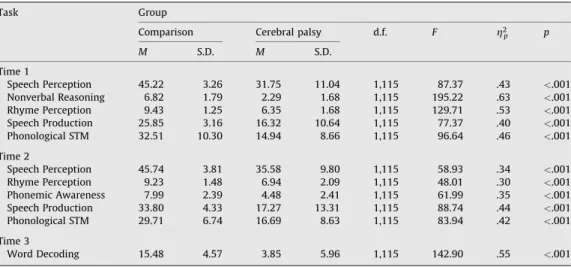
Table 1shows descriptive statistics for all tasks for both groups, along with the results of the MANOVA. The results of the MANOVA indicate that there is a multivariate effect for group, Wilks’
lambda = .276,F(11, 105) = 24.98,p<.001, and
h
2p¼:72. Descriptive statistics show that the group of
children with CP scored below the comparison group of children without disabilities on all tasks and
univariate tests revealed that all these differences were significant, seeTable 1.
3.2. Structural equation modeling for the children without disabilities
To answer the second research question, two series of SEM analyses were conducted in a stepwise manner. In model 1, the predictive value of Phonological Awareness at Time 1 and Time 2 for Word Decoding at Time 3 is tested. In this model, Phonological Awareness at Time 1 was
Table 1
Results of the MANOVA for all precursors at Time 1 and Time 2 and Word Decoding at Time 3 for the group of children with CP (n= 52) and the comparison group (n= 65).
Task Group
Comparison Cerebral palsy d.f. F h2
p p M S.D. M S.D. Time 1 Speech Perception 45.22 3.26 31.75 11.04 1,115 87.37 .43 <.001 Nonverbal Reasoning 6.82 1.79 2.29 1.68 1,115 195.22 .63 <.001 Rhyme Perception 9.43 1.25 6.35 1.68 1,115 129.71 .53 <.001 Speech Production 25.85 3.16 16.32 10.64 1,115 77.37 .40 <.001 Phonological STM 32.51 10.30 14.94 8.66 1,115 96.64 .46 <.001 Time 2 Speech Perception 45.74 3.81 35.58 9.80 1,115 58.93 .34 <.001 Rhyme Perception 9.23 1.48 6.94 2.09 1,115 48.01 .30 <.001 Phonemic Awareness 7.99 2.39 4.48 2.41 1,115 61.99 .35 <.001 Speech Production 33.80 4.33 17.27 13.31 1,115 88.74 .44 <.001 Phonological STM 29.71 6.74 16.69 8.63 1,115 83.94 .42 <.001 Time 3 Word Decoding 15.48 4.57 3.85 5.96 1,115 142.90 .55 <.001
measured by Rhyme Perception. A confirmatory factor analysis revealed that, together, Rhyme Perception and Phonemic Awareness at Time 2 represent the latent variable Phonological
Awareness at Time 2, seeFig. 1.Table 2shows that model 1 has a reasonably good fit. In this model
22.0% of the variance in Word Decoding at Time 3 is explained by the latent variable Phonological Awareness at Time 2.
Model 2 tested the development of Phonological STM as a predictor for Word Decoding. This model
showed a moderate to good fit; see Table 2 for the fit indices. In this model, the
b
betweenPhonological STM Time 1 to Time 2 was .28, and the
b
for Phonological STM Time 2 for Word Decodingat Time 3 was .29. This model explained 8% of the variance in Word Decoding.
Model 3 tested the development of Speech Perception as a predictor for Word Decoding. As can be
seen inTable 2, the fit of the model is not satisfactory. Speech Perception at Time 2 is not a strong
predictor of Word Decoding at Time 3 (b= .17). Model 4 tested the development of Speech Production
in kindergarten for the prediction of Word Decoding in Grade 1. The fit indices indicated a close fit.
Speech Production at Time 1 and Time 2 shows a strong relationship (b= .51), and therefore Speech
Production at Time 1 is a good autoregressor of Speech Production at Time 2. The standardized Beta coefficient between Speech Production at Time 2 and Word Decoding at Time 3 is .28. In this model 25.5% of the variance in Speech Production at Time 2 is explained by Speech Production at Time 1, while only 7.9% of the variance in Word Decoding is explained by Speech Production at Time 2.
In the second series of SEM analyses the models were combined in a stepwise manner. First, model 5 was tested, wherein the development of the three most important predictors of early reading skills were combined, i.e., Phonological Awareness, Phonological STM, and Speech Perception. The fit indices indicated a good fit for the model. In this model the most important predictor for Word Decoding was
Phonological Awareness at Time 2 (b= .43), followed by Phonological STM (b= .17). In model 6, the
Fig. 1.SEM model 1 for the children without disabilities with Rhyme Perception at Time 1, the latent variable Phonological Awareness at Time 2, i.e., Rhyme and Phonemic Awareness, and Word Decoding at Time 3. Rectangles represent observed variables and the oval represents the latent variable.
Table 2
Summary of SEM analyses for the children without disabilities.
Model x2
d.f. p GFI AGFI NFI CFI RMSEA SRMR 1 Phonological Awareness T1, T2> Word Decoding (WD) T3 5.66 2 .059 .96 .80 .91 .93 .17 .07 2 Phonological STM T1, T2>WD T3 1.70 1 .192 .98 .90 .86 .93 .11 .06 3 Speech Perception T1, T2>WD T3 3.49 1 .062 .97 .80 .51 .39 .20 .09 4 Speech Production T1, T2>WD T3 .62 1 .432 .99 .96 .98 1.00 .00 .03 5 Phonological Awareness, Phonological STM,
Speech Perception T1, T2>WD T3
10.68 8 .221 .96 .84 .91 .97 .07 .04 6 Phonological Awareness, Phonological STM,
Speech Perception, Speech Production T1, T2>WD T3
12.01 11 .363 .97 .84 .94 .99 .04 .04
7 Final Model T1, T2, and T3. 14.02 13 .373 .97 .83 .94 .99 .04 .04 Phonological Awareness, Phonological STM,
Speech Perception, Speech Production T1, T2 and IQ T1>WD T3
Note—GFI: goodness of fit index; AGFI: adjusted goodness of fit index; NFI: normed fit index; CFI: comparative fit index; RMSEA: root mean square error of approximation; SRMR: standardized root mean square residual.
development of Speech Production was added to the previous model. Again, Phonological Awareness
(b= .42) and Phonological STM (b= .17) turned out to be the best predictors of Word Decoding. This
model explained 25.1% of the variance in Word Decoding. Furthermore, Speech Production at Time 1 is
a good predictor of Phonological Awareness at Time 2 (b= .27).
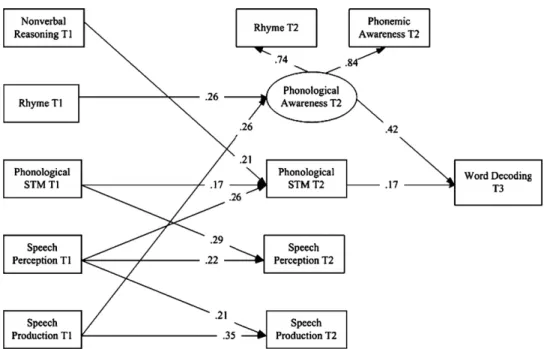
In the final model, i.e., model 7, the variable Nonverbal Reasoning at Time 1 was added to the previous model. Adding Nonverbal Reasoning to this model did not change important structural relations between the variables. However, the addition of Nonverbal Reasoning resulted in a small decrease of the standardized Beta weight of Speech Perception at Time 1 for Phonological STM at Time 2 from .32 to .26. Nonverbal Reasoning turned out to only be predictive for Phonological STM at Time 2
(b= .21).Fig. 2shows that Phonological Awareness, followed by Phonological STM turned out to be the
two most important predictors of Word Decoding one-year later. With regard to the development of Phonological Awareness at Time 2, apart from its autoregressor Rhyme Perception at Time 1, these
skills were best predicted by Speech Production at Time 1 (b= .26). Model 7 explained 25.4% of the
variance in Word Decoding.
3.3. Structural equation modeling for the children with CP
The same series of SEM analyses were repeated for the group of children with CP. The first model tested the development of Phonological Awareness at Time 1 and Time 2 to predict Word Decoding at Time 3. A confirmatory factor analysis was performed to test if Rhyme Perception and Phonemic Awareness at Time 2 constitute the latent factor Phonological Awareness at Time 2. This turned out to
be the case, as can be seen at the standardized Beta coefficients inFig. 3. The model shows a good fit
(Table 3). The high standardized Beta coefficient of the latent variable Phonological Awareness for
Word Decoding showed its high predictive value (b= .69). In addition, Rhyme perception at Time 1
turned out to be a good autoregressor of Phonological Awareness at Time 2. This model explained 48.2% of the variance in Word Decoding at Time 3.
Table 3 shows that the development of Phonological STM and its predictive value for Word Decoding resulted in a model with a close fit. Phonological STM is a good predictor of Word Decoding
(b= .58), and Phonological STM at Time 1 turned out to be a good autoregressor of Phonological STM at
Fig. 2.Final SEM model 7 for the group of children without disabilities, with Nonverbal Reasoning at Time 1, Phonological Awareness, Speech Perception, Auditory STM, and Speech Production at Time 1 and Time 2, and Word Decoding at Time 3.
Time 2 (b= .59). This model explained 33.1% of the variance in Word Decoding. Model 3 investigated
the development of Speech Perception and its predictive value for Word Decoding.Table 3indicates
that this model has a close fit. Speech Perception at Time 2 was a good predictor of Word decoding at
Time 3 (b= .58). In addition, Speech Perception at Time 1 was a good autoregressor of Speech
Perception at Time 2 (b= .77). This model explained 33.5% of the variance in Word Decoding. Model 4
tested the development of Speech Production for the Word Decoding at Time 3.Table 3shows that the
fit of the model was good again. Speech Production at Time 2 was predicted by its autoregressor at
Time 1 (b= .91). Furthermore, Speech Production was revealed as a good predictor for Word Decoding
(b= .61). This model explained 36.5% of the variance in Word Decoding.
In the second series of SEM analyses the models were combined. In Model 5, the development of Phonological Awareness, Phonological STM, and Speech Perception were used to predict Word Decoding. This model showed a good fit. The best predictor of Word Decoding in this model was Phonological
Awareness (b= .42), followed by Speech Perception (b= .18), and Phonological STM (b= .17). This
model explained 47.5% of the variance in Word Decoding. Phonological Awareness is the most important precursor of Word Decoding, in correspondence with the results of the SEM analyses for the group of children without disabilities. This model explained 26.2% of the variance in Word Decoding.
In model 6 Speech Production at Time 1 and Time 2 was added to the previous model. The fit indices indicated a good fit. Whereas in model 5 Phonological Awareness was the main predictor of Word Decoding, as was also found in the final model of the children without disabilities, when Speech Production was added to the model this variable became the main predictor of Word Decoding
(b= .34), followed by Phonological Awareness (b= .24), and Speech Perception (b= .24). These results
showed that when taking Speech Production into account, the importance of Phonological STM and Phonological Awareness decreased. The role of Speech Production is not limited to the prediction of
Fig. 3.SEM model 1 for the group of children with cerebral palsy with Rhyme Perception at Time 1, Phonological Awareness at Time 2, i.e., Rhyme and Phonemic Awareness, and Word Decoding at Time 3. Rectangles represent observed variables and the oval represents a latent variable.
Table 3
Summary of SEM analyses for the group of children with CP.
Model x2
d.f. p GFI AGFI NFI CFI RMSEA SRMR 1 Phonological Awareness T1, T2> Word Decoding (WD) T3 1.84 2 .399 .98 .92 .97 1.00 .00 .03 2 Phonological STM T1, T2>WD T3 .00 1 .955 1.00 1.00 1.00 1.00 .00 .00 3 Speech Perception T1, T2>WD T3 .48 1 .487 .99 .96 .99 1.00 .00 .02 4 Speech Production T1, T2>WD T3 .40 1 .528 1.00 .97 1.00 1.00 .00 .01 5 Phonological Awareness, Phonological STM,
Speech Perception T1, T2>WD T3
5.04 8 .753 .98 .90 .98 1.00 .00 .02 6 Phonological Awareness, Phonological STM,
Speech Perception, Speech Production T1, T2>WD T3
3.41 11 .984 .99 .94 .99 1.00 .00 .01
7 Final Model T1, T2, and T3. 5.88 13 .950 .98 .90 .99 1.00 .00 .02 Phonological Awareness, Phonological STM,
Speech Perception, Speech Production T1, T2 and Nonverbal Reasoning T1>WD T3
Note—GFI: goodness of fit index; AGFI: adjusted goodness of fit index; NFI: normed fit index; CFI: comparative fit index; RMSEA: root mean square error of approximation; SRMR: standardized root mean square residual.
Word Decoding, as Speech Production at Time 1 was also good a predictor of Phonological Awareness
(b= .34), Phonological STM (b= .29), and Speech Perception (b= .14) at Time 2. This model explained
55.2% of the variance in Word Decoding.
In the final model, Nonverbal Reasoning at Time 1 was added to the previous model, and this model showed a very good fit. Adding Nonverbal Reasoning to the model did not change many of the structural relationships between the variables, except that Nonverbal Reasoning proved to have predictive value
for Phonological Awareness and Phonological STM at Time 2.Fig. 4shows the final SEM model for the
children with CP. This final model explained 55.4% of the variance in Word Decoding. Furthermore, the model indices did not indicate any potential for improving the fit of the model.
4. Conclusions and discussion
Several conclusions can be drawn from the present study. First of all, children with CP lag behind their peers in the development of precursor skills for reading as early as the second year of kindergarten. These results are in line with previous studies indicating that children with CP show a delay in emergent literacy skills, even before the start of formal reading and writing education (Peeters et al., 2008;Peeters, Verhoeven, de Moor, van Balkom, & van Leeuwe, 2009).
The SEM model for children without disabilities reveals that, in accordance with previous studies, phonological Awareness and phonological STM are the most important precursors for word decoding
(Wagner & Torgesen, 1987; Wagner et al., 1997). These results show that when controlling for
Phonological Awareness at Time 2, Phonological STM at Time 2 plays an independent role in the prediction of Word Decoding. This implies that in order to decide which written word matches a presented picture (i.e., the task of the Word Decoding test) children must be aware of the word’s individual phonemes and remember the phonemes when recoding the graphemes into phonemes in order to blend them together to form a word. Then, the child is able to decide whether the recoded word matches the presented picture or if he or she should consider the next word as a possible match. As expected, the set of precursors that are predictive of Word Decoding differ for the group of children with CP and the comparison group. The SEM model for children with CP reveals that Speech Production is the most important precursor of Word Decoding for these children. A potential
Fig. 4.Final SEM model 7 for the group of children with CP, with Nonverbal Reasoning at Time 1, Phonological Awareness, Speech Perception, Phonological STM, and Speech Production at Time 1 and Time 2, and Word Decoding at Time 3.
explanation for the importance of Speech Production for the development of Word Decoding in children with CP may lie in the problems children with speech impairments experience with the retrieval of whole-word phonology, or the access and retrieval of phonological lexical representations. Vandervelden and Siegel (1999)investigated the effect of speech impairments on retrieval of whole-word phonology by looking at the difference between the scores of two conditions in a whole-word-to-print matching task. Following the presentation of a picture (condition one) or a spoken word (condition two), the task of the student was to select the written word that matches one of three pictures/spoken words. The results pointed out that the picture-presentation was more difficult than the spoken word condition. This design was also used in a rhyme judgement task and a word spelling task. The group of AAC-users with no intelligible speech scored lower than the reading-level matched control group on all tasks. Furthermore, the AAC-user group scored significantly lower on almost all tasks compared to the speech-impaired group with impaired but intelligible speech. These results suggest that non-speaking students who use AAC may have problems in retrieving the phonological form of words, which may interfere with their phonological recoding skills. As in the present study, Word Decoding was assessed by presenting a picture, rather than a spoken word, that needed to be matched to a written word. The fact that the test assistant did not name the picture, requiring the child to cognitively access the phonology of the word, may have complicated the task for children with low speech production skills.
Some conclusions can be drawn with regard to the structural relationships between reading precursors for the group of children without disabilities. First of all, Speech Production at Time 1 is important for the development of Phonological Awareness at Time 2. These results are in line with previous studies indicating that the quality of articulation, or articulation accuracy, is an important determinant of growth in phonological awareness (Webster & Plante, 1995).
The structural relationships between reading precursors in the group of children with CP showed a strong effect of Speech Production at Time 1 on the other reading precursors at Time 2. First of all, Speech Production did play a major role in the development of Phonological Awareness. Children with CP who had better word articulation skills were more aware of the sound structure of the language. These results are in line with previous studies (Peeters et al., 2008). Though we know from previous research that the ability to articulate is not necessary for phonological awareness to emerge (Card & Dodd, 2006;Foley & Pollatsek, 1999), the results of this study show that the extent to which a child is able to articulate influences his or her phonological awareness development. These results highlight the facilitating role of overt or covert speech; the more children can use overt or covert speech in order to determine which picture starts with the same first-phoneme, or to find out whether two words rhyme, the better their phonological awareness skills are. Therefore, children with low levels of articulation and non-speaking children are disadvantaged in their development of phonological awareness. Furthermore, the present study points out that the facilitating role of speech production is not limited to the development of phonological awareness. Also, the better the articulation skills of the child, the longer the string of words the child can remember and thus the better the phonological STM spans of the child. These results show a linear relationship between the quality of the articulation and the memory spans of the children with CP.
Although the present study reveals an important role for speech production in the development of word decoding and its precursors, the study has some limitations.
To begin with, the present study showed that the speech production etc. of children with CP is related to the development of their Phonological STM. However, although Speech Production, i.e., articulation accuracy, was included in the present design, speech rate was not. Previous studies have shown that speech rate is closely related to performance of short-term memory tasks (Hulme, Thomson, Muir, & Lawrence, 1984;Raine, Hulme, Chadderton, & Bailey, 1991). Future research should include speech rate in order to uncover whether this variable plays an additional role in explaining phonological STM skills of children with CP. Moreover, future research should investigate what role speech production skill plays in the later stages of reading development, when basic levels of decoding skills are achieved. Do reading skills then depend more on phonological STM for the automaticity of word identification or on understanding complex syntactic and text comprehension skills instead of speech production skills? Longitudinal studies including word decoding and text comprehension skills could answer these questions.
Furthermore, in the present study the group of children with CP was considered as one group. The reason was that subdividing the group of children into subgroups would result in very small groups. In addition, studies investigating the reliability of the classification of type of CP report at best a reasonable reliability and reliability regarding further subdivisions has hardly been studied (Blair & Stanley, 1985;Krageloh-Mann et al., 1993).
The results of the present study have a number of implications for clinical practice. First of all, the role that speech production plays in the development of reading precursors and word decoding stresses the need for early intervention for children with speech impairments. One way to improve the speech production skills or speech intelligibility skills in general of children with CP is by providing
them with AAC devices with a speech output component. In a research reviewMillar, Light, and
Schlosser (2006)stated that, in general, AAC intervention lead to at least modest gains in speech production skills of participants, although they stated that more research is needed to better understand the relationship between AAC intervention and speech production across a wider range of participants and AAC interventions.
The role of speech generating devices is not limited to improving natural speech production. Researchers have hypothesized that speech generating devices, also known as voice output communication aids, can be effective in developing subvocal articulatory rehearsal and phonological
awareness (e.g.,Blischak, 1994; Schlosser, 2003; Schlosser, Blischak, Belfiore, Bartley, & Barnett,
1998). For example,Blischak, Lombardino, and Dyson (2003)hypothesized that speech generating devices can play a role in the development of an internal phonology. Experiences with sound patterns provided by speech generating devices can help children to become more aware of the individual phonemes of the language and can support the internal phonological information needed for reading
and writing development. Furthermore,Steelman, Pierce, and Koppenhaver (1993)stated that speech
feedback in computer-aided instruction can improve the literacy skills of children with speech impairments, because it gives them the opportunity to map oral language onto written language. Up to now, the role of speech output for promoting literacy skills has only been systematically studied in
children without disabilities (cf.Olofsson, 1992;Wise & Olson, 1992). Studies investigating the use of
speech feedback for improving phonological awareness and literacy skills of children with CP are
scarce.Dahlgren Sandberg and Hjelmquist (1997)indicated a positive effect of synthetic speech for
reading skills in a group of children with CP. She concluded that a subgroup of non-vocal readers who used speech synthesis in spelling and reading training at school scored higher on tasks of phonological awareness and vocabulary than a subgroup of non-vocal non-readers who did not use synthetic
speech. In addition,Schlosser et al. (1998)showed that the spelling skills of a non-speaking child with
autism improved when computer-based speech output feedback was given.
As children with CP lag behind in phonological awareness and the fact that these are also important precursors of literacy in this population, early intervention for phonological awareness is needed in order to prevent these children from developing limited word decoding skill. One method of intervention could consist of playing language games with educational software. Earlier research (Segers & Verhoeven, 2004) has indicated that children with specific language impairments can benefit from computer training for phonological awareness. However, considering the physical and speaking barriers children with CP often encounter, it is important that any intervention be adapted by means of AAC devices. One potential multimedia tool that has been adapted to these physical and speech limitations is LinguaBytes; an interactive, tangible play and learning system to stimulate the language development of toddlers with multiple disabilities (Hengeveld et al., 2008; Voort et al., 2008). The system uses a variety of input- and display modules for play- and learning activities. The content is based on interactive storytelling and anchored instruction (Stoep & van Elsa¨cker, 2005). Eight themes were selected, such as animals, in and around the house, people, toys and traffic. Each theme starts with a story which consists of several scenes. In each scene a part of the story is told using audio, pictures and animations. Following the story, each theme offers a set of playful exercises, primarily to train language skills, speech perception and phonological awareness. For each theme, phonological exercises with incremental levels of complexity are presented. For example, in the theme ‘animals’ the easiest phonological awareness exercises consist of playing songs and rhymes. The toddler can place an animal on the module and the system reacts by playing a well-known song about that animal and by showing the animal with meaningful animations on the screen. Because LinguaBytes combines phonological awareness
intervention by using a multimedia tool that can be adapted to the physical needs of the child, this is a valuable tool that speech and language therapists can use when training phonological awareness and other language in children with CP and other disabilities.
Acknowledgements
This study is funded by the European Union, Interreg 4-BMG-V-1=31 and Viataal (St. Michielsgestel, the Netherlands). Special appreciation is expressed to the children and parents who participated, and the clinical experts of the participating schools. We would also thank Prof. Dr. Juul Becher, who made it possible to collect medical information of the children with cerebral palsy. Appendix A. Input correlation matrix for structural equation modeling analyses for the children without disabilities 1 2 3 4 5 6 7 8 9 10 11 12 1 Speech Per T1 1 2 STM T1 .38 1 3 Rhyme T1 .45 .26 1 4 Speech Pro T1 .58 .35 .41 1 5 NR T1 .46 .38 .29 .40 1 6 Speech Per T2 .17 .22 .13 .10 .11 1 7 STM T2 .37 .28 .23 .21 .36 .01 1 8 Rhyme T2 .30 .23 .33 .35 .23 .21 .21 1 9 Phon T2 .33 .26 .37 .39 .26 .24 .24 .62 1 10 Phon factor T2 .40 .32 .44 .47 .32 .28 .29 .74 .84 1 11 Speech Pro T2 .43 .35 .24 .51 .27 .23 .31 .41 .46 .55 1 12 Word T3 .23 .19 .23 .23 .18 .17 .29 .35 .40 .48 .28 1
Note—Speech Per: Speech Perception; STM: Phonological STM; Speech Pro: Speech Production; NR: Nonverbal Reasoning; Phon: Phonemic Awareness; Phon factor: factor Phonological Awareness; Word: Word Decoding.
Appendix B. Input correlation matrix for structural equation modeling analyses for the children with CP 1 2 3 4 5 6 7 8 9 10 11 12 1 Speech Per T1 1 2 STM T1 .64 1 3 Rhyme T1 .60 .52 1 4 Speech Pro T1 .35 .20 .49 1 5 NR T1 .39 .39 .65 .28 1 6 Speech Per T2 .77 .51 .62 .44 .43 1 7 STM T2 .70 .59 .52 .48 .44 .74 1 8 Rhyme T2 .56 .52 .48 .45 .39 .55 .55 1 9 Phon T2 .50 .46 .42 .40 .35 .49 .49 .64 1 10 Phon factor T2 .65 .61 .56 .53 .46 .65 .65 .85 .76 1 11 Speech Pro T2 .31 .20 .42 .91 .26 .34 .45 .49 .44 .58 1 12 Word T3 .51 .39 .48 .59 .34 .58 .58 .56 .50 .65 .60 1
Note—Speech per: Speech Perception; STM: Phonological STM; Speech Pro: Speech Production; NR: Nonverbal Reasoning; Phon: Phonemic Awareness; Phon factor: factor Phonological Awareness; Word: Word Decoding.
References
Adams, M. J. (1990).Beginning to read: Thinking and learning about print. Cambridge, MA: MIT Press. Arbuckle, J. L., & Wothke, W. (1999).Amos 4.0 user’s guide. Chicago: SPSS/SmallWaters.
Baron, R. M., & Kenny, D. A. (1986). The moderator-mediator variable distinction in social psychological research: Conceptual, strategic, and statistical considerations.Journal of Personality and Social Psychology, 51(6), 1173–1182.
Bax, M., Goldstein, M., Rosenbaum, P., Leviton, A., Paneth, N., Dan, B., et al. (2005). Proposed definition and classification of cerebral palsy.Developmental Medicine and Child Neurology, 47, 571–576.
Berninger, V. W., & Gans, B. M. (1986). Language profiles in nonspeaking individuals of normal intelligence with severe cerebral palsy.
Augmentative and Alternative Communication, 2, 45–50.
Bishop, D. V. (1988). Language development in children with abnormal structure or function of the speech apparatus. In D. V. Bishop & K. Mogford (Eds.),Language development in exceptional circumstances. New York: Churchill Livingstone.
Blair, E., & Stanley, F. (1985). Interobserver agreement in the classification of cerebral palsy.Developmental Medicine and Child Neurology, 27, 615–622.
Blischak, D. M. (1994). Phonological awareness: Implications for individuals with little or no functional speech.Augmentative and Alternative Communication, 10, 245–254.
Blischak, D. M., Lombardino, L. J., & Dyson, A. T. (2003). Use of speech-generating devices in support of natural speech.Augmentative and Alternative Communication, 19(1), 29–35.
Bon, W.H.J. van. (1986).Raven’s coloured progressive matrices: Manual of Dutch norms. Lisse: Swets & Zeitlinger.
Card, R., & Dodd, B. (2006). The phonological awareness abilities of children with cerebral palsy who do not speak.Augmentative and Alternative Communication, 22(3), 149–159.
Carroll, J. M., Snowling, M. J., Hulme, C., & Stevenson, J. (2003). The development of phonological awareness in preschool children.
Developmental Psychology, 39(5), 913–923.
Dahlgren Sandberg, A. (2001). Reading and spelling, phonological awareness, and working memory in children with severe speech impairments: A longitudinal study.Augmentative and Alternative Communication, 17, 11–26.
Dahlgren Sandberg, A. (2002). Phonological recoding problems in children with severe congenital speech impairments: The importance of productive speech. In E. Witruk, A. D. Friederici, & T. Lachmann (Eds.),Basic functions of language, reading and reading disability(pp. 315–327). Dordrecht, the Netherlands: Kluwer Academic Publishers.
Dahlgren Sandberg, A. (2006). Reading and spelling abilities in children with severe speech impairments and cerebral palsy at 6, 9, and 12 years of age in relationship to cognitive development: A longitudinal study.Developmental Medicine and Child Neurology, 48, 629–634.
Dahlgren Sandberg, A., & Hjelmquist, E. (1996a). A comparative, descriptive study of reading and writing skills among non-speaking children: A preliminary study.European Journal of Disorders of Communication, 31, 289–308.
Dahlgren Sandberg, A., & Hjelmquist, E. (1996b). Phonological awareness and literacy abilities in nonspeaking preschool children with cerebral palsy.Augmentative and Alternative Communication, 12, 138–154.
Dahlgren Sandberg, A., & Hjelmquist, E. (1997). Language and literacy in nonvocal children with cerebral palsy.Reading and Writing, 9, 107–133.
Dormans, J. P., & Pellegrino, L. (1998).Caring for children with cerebral palsy: A team approach(1st). Baltimore: Paul H Brookes. Duncan, J., Seitz, R. J., Kolodny, J., Bor, D., Herzog, H., Ahmed, A., et al. (2000). A neural basis for general intelligence.Science, 289, 457–
460.
Elbro, C., & Pallesen, B. R. (2002). The quality of phonological representations and phonological awareness: A causal link? In L. Verhoeven, C. Elbro, & P. Reitsma (Eds.),Precursors of functional literacy. Amsterdam/Philadelphia: John Benjamins Publishing Company.
Eliasson, A. C., Krumlinde-Sundholm, L., Rosblad, B., Beckung, E., Arner, M., Ohrvall, A. M., et al. (2006). The Manual Ability Classification System (MACS) for children with cerebral palsy: Scale development and evidence of validity and reliability.
Developmental medicine and child neurology, 48(7), 549–554.
Foley, B. E., & Pollatsek, A. (1999). Phonological processing and reading abilities in adolescents and adults with severe congenital speech impairments.AAC: Augmentative and Alternative Communication, 15(3), 156–173.
Foy, J. G., & Mann, V. (2001). Does strength of phonological representations predict phonological awareness in preschool children?
Applied Psycholinguistics, 22, 301–325.
Gathercole, S. E., Pickering, S. J., Hall, M., & Peaker, S. M. (2001). Dissociable lexical and phonological influences on serial decoding and serial recall.Quarterly Journal of Experimental Psychology: Human Experimental Psychology, 54A, 1–30.
Hengeveld, B. J., Hummels, C. C. M., Overbeeke, C. J., Voort, R., Balkom, H. v an, & de Moor, J. (2008). Let me actuate you.Second International Conference on Tangible and Embedded Interaction(pp. 159–166)New York, NY, USA: ACM.
Hu, L. T., & Bentler, P. M. (1999). Cut-off criteria for fit indexes in covariance structure analysis: Conventional criteria versus new alternatives.Structural Equation Modeling, 6, 1–55.
Hulme, C., Thomson, N., Muir, C., & Lawrence, A. (1984). Speech rate and the development of short-term memory.Journal of Experimental Child Psychology, 38, 241–253.
Irausquin, R. (2001). Rijmperceptie, Rijmproductie en Beginrijm [Rhyme perception, rhyme production and alliteration]. Unpublished Manuscript, University of Nijmegen, The Netherlands.
Jaccard, J., & Wan, C. K. (1996).Lisrel approaches to interaction effects in multiple regression. Thousand Oaks: Sage Publications Inc. de Jong, P. F., van Otterloo, S. G., & Regtvoort, A. G. F. M. (2006).Fonologische bewustzijn taken voor kleuters: Rijm en beginfoneem
[Phonological awareness tasks for kindergarten children: Rhyme and first-phoneme]. Unpublished Manuscript, University of Amsterdam, The Netherlands
Kline, R. B. (1998).Principles and practice of structural equation modeling. New York: Guilford Press.
Koppenhaver, D. A., Evans, D. A., & Yoder, D. E. (1991). Childhood reading and writing experiences of literate adults with severe speech and motor impairments.AAC: Augmentative and Alternative Communication, 7(1), 20–33.
Koppenhaver, D. A., & Yoder, D. E. (1992). Literacy learning of children with severe speech and physical impairments in school setting.
Seminars in Speech and Language, 13(2), 143–153.
Krageloh-Mann, I., Hagberg, G., Meisner, C., Schelp, B., Haas, G., Eeg-Olofsson, K. E., et al. (1993). Bilateral spastic cerebral palsy-a comparative study between south-west Germany and western Sweden. I: Clinical patterns and disabilities.Developmental Medicine and Child Neurology, 35, 1037–1047.
Krom, R. S. H. (2001).Leestechniek [Reading technology]. Arnhem, The Netherlands: Cito.
Krom, R. S. H., & Kamphuis, F. H. (2001).Wetenschappelijke verantwoording van de toetsserie Leestechniek en Leestempo [Scientific justification of the test series reading]. Arnhem, The Netherlands: Cito.
McBride-Chang, C. (1995a). Phonological processing, speech perception, and reading disability: An integrative review.Educational Psychologist, 30(3), 109–121.
Mecham, J. M. (2002).Cerebral palsy. Austin: PRO-ED.
Millar, D., Light, J., & Schlosser, R. (2006). The impact of augmentative and alternative communication intervention on the speech production of individuals with developmental disabilities: A research review.Journal of Speech Language Hearing Research, 49, 248–264.
Mirenda, P., & Mathy-Laikko, P. (1989). Augmentative and alternative communication applications for persons with severe congenital communication disorders: An introduction.Augmentative and Alternative Communication, 5(1), 3–13.
Olofsson, A˚. (1992). Synthetic speech and computer aided reading for reading disabled children.Reading and Writing, 4, 165–178. Palisano, R. J., Hanna, S. E., Rosenbaum, P. L., Russel, D. J., Walter, S. D., Wood, E. P., et al. (2000). Validation of a model of gross motor
function for children with cerebral palsy.Physical Therapy, 80(10), 974–985.
Peeters, M., Verhoeven, L., de Moor, J., van Balkom, H., & van Leeuwe, J. (2009). Home literacy predictors of early reading development in children with cerebral palsy.Research in Developmental Disabilities, 33, 445–461.
Peeters, M., Verhoeven, L., van Balkom, H., & de Moor, J. (2008). Foundations of phonological awareness in preschool children with cerebral palsy: The impact of intellectual disability.Journal of Intellectual Disability Research, 52(1), 68–78.
Pirila, S., Meere, van der, J., Pentikainen, T., Ruusu-Niemi, P., Korpela, R., Kilpinen, J., et al. (2007). Language and motor speech skills in children with cerebral palsy.Journal of Communication Disorders, 40, 116–128.
Pueyo, R., Junque´, C., Vendrell, P., Narberhaus, A., & Segarra, D. (2008). Raven’s coloured progressive matrices as a measure of cognitive functioning in cerebral palsy.Journal of Intellectual Disability Research, 52(5), 437–445.
Raine, A., Hulme, C., Chadderton, H., & Bailey, P. (1991). Verbal short-term memory span in speech-disordered children: Implications for articulatory coding in short-term memory.Child Development, 62, 415–423.
Raven, J. C. (1956).Guide to using the coloured progressive matrices. London: HK Lewis.
Raykov, T., & Marcoulides, G. A. (2006).A first course in structural equation modeling(2nd ed.). Mahwah, NJ: Psychology Press. Schaerlaekens, A., Kohnstamm, D., Lejaegere, M., de Vries, A., Peeters, L., & Zink, I. (1999).Streefwoordenslijst voor 6-jarigen(3rd ed.).
Lisse: Swets & Zeitlinger.
Schlosser, R. W. (2003). Roles of speech output in augmentative and alternative communication: Narrative review.Augmentative and Alternative Communication, 19(1), 5–27.
Schlosser, R. W., Blischak, D. M., Belfiore, P. J., Bartley, C., & Barnett, N. (1998). Effects of synthetic speech output and orhographic feedback on spelling in a student with autism: A preliminary study.Journal of Autism and Developmental Disorders, 28(4), 309– 319.
Segers, E., & Verhoeven, L. (2004). Computer-supported phonological awareness intervention for kindergarten children with specific language impairments.Language, Speech, and Hearing Services in Schools, 35, 229–239.
Smith, M. M. (1989). Reading without speech: A study of children with cerebral palsy.The Irish Journal of Psychology, 10(4), 601–614. Stanovich, K. E. (1992). Speculations on the causes and consequences of individual differences in early reading acquisition. In P. B.
Gough, L. C. Ehri, & R. Treiman (Eds.),Reading acquisition. Hillsdale, N.J. L. Erlbaum Associated.
Steelman, J. D., Pierce, P. L., & Koppenhaver, D. A. (1993). The role of computers in promoting literacy in children with severe speech and physical impairments (SSPI).Topics of Language Disorders, 13(2), 76–88.
Stoep, J., & van Elsa¨cker, W. (2005).Peuters interactief met taal [Toddles in interaction with language]. Nijmegen: EN: Expertisecentrum Nederlands.
Ullman, J. B. (2001). Structural equation modeling. In B. G. Tabachnick & L. S. Fidell (Eds.),Using multivariate statistics(4th ed., pp. 653–771). New York: Allyn & Bacon.
Vandervelden, M. C., & Siegel, L. (1999). Phonological processing and literacy in AAC users and students with motor speech impairments.AAC: Augmentative and Alternative Communication, 15(3), 191–211.
Verhoeven, L. (2006).ESM-screeningsinstrument [SLI Screening test]. Arnhem, the Netherlands: Cito.
Verhoeven, L., & Vermeer, A. (1999) Cognitive factors in early First and second language proficiency. In: C. Perdue & R. Rast (Eds.),
Actes du 8e colloque EUROSLA-conference Paris(Vol. 1: La personne bilingue, pp. 97–110). Paris: Universite Paris. Verhoeven, L., & Vermeer, A. (2001).Taaltoets Alle Kinderen (TAK) [Language Proficiency Test for all Children]. Arnhem: Cito. Voort, R., van Balkom, H., Hengeveld, B., Hummels, C., de Moor, J., & Overbeeke, K. (2008, August).LinguaBytes: an interactive, tangible
play and learning system to enhance early literacy and language development of toddlers with multiple disabilities. Paper presented at the International Society of Augmentative and Alternative Communication (ISAAC) Conference, Montreal, Canada. Wagner, R. K., & Torgesen, J. K. (1987). The nature of phonological processing and its causal role in the acquisition of reading skills.
Psychological Bulletin, 101(2), 192–212.
Wagner, R. K., Torgesen, J. K., & Rashotte, C. A. (1994). Development of reading-related phonological processing abilities: New evidence of bidirectional causality from a latent variable longitudinal study.Developmental Psychology, 30(1), 73–87. Wagner, R. K., Torgesen, J. K., Rashotte, C. A., Hecht, S. A., Barker, T. A., Burgess, S. R., et al. (1997). Changing relationships between
phonological processing abilities and word-level reading as children develop from beginning to skilled readers: A 5-year longitudinal study.Developmental Psychology, 33(3), 468–479.
Webster, P. E., & Plante, A. S. (1995). Productive phonology and phonological awareness in preschool children.Applied Psycho-linguistics, 16, 43–57.
Wise, B. W., & Olson, R. K. (1992). How poor readers and spellers use interactive speech in a computerized spelling program.Reading and Writing, 4, 145–163.