ISSN 1990-9233
© IDOSI Publications, 2012
Comparative Study of Direct Bisulfite Sequencing PCR and
Methylation Specific PCR to Detect Methylation Pattern of DNA
Oranous Bashti Shiraz, Hamid Galehdari, Majid Yavarian,
1 2 3
Bita Geramizadeh, Farshid Kafilzadeh and Sahar Janfeshan
4 5 1
Department of Biology, Arsenjan Branch, Islamic Azad University, Arsenjan, Iran 1
Department of Genetics, Shahid Chamran University of Ahvaz, Ahvaz, Iran 2
Homeostasis and Thrombosis Unit, Hematology Research Center, 3
Shiraz University of Medical Science, Shiraz, Iran
Department of Pathology, Shiraz University of Medical Science, Shiraz, Iran 4
Department of Biology, Jahrom Branch, Islamic Azad University, Jahrom, Iran 5
Abstract: Alterations in the patterns of DNA methylation are among the most common events in tumorigenesis and several techniques have been developed to distinguish the changes. To compare two methods, the methylation specific PCR (MSP) and the bisulfite direct sequencing, we analyzed methylation pattern of the P16 promoter in patient’s samples with hepatocellular carcinoma. Forty three paraffin embedded formalin fixed tissues was tested with the two above mentioned methods. In addition, 10 samples from normal liver tissues were used as control group. The Bisulfite direct sequencing method showed heterozygous hypermethylation in 13.9% of samples and methylation of GC box IV in 58.1% of samples. In contrast, the MSP method revealed heterozygous hypermethylation in 25.5% of patients and unmethylated band were detected in all of the HCC and normal samples. Finally, It is proposed that bisulfite sequencing PCR is more reliable because of frequent false positive results assessing with the MSP method.
Key words: Bisulfite Direct Sequencing Hepatocellular Carcinoma Hypermethylation Methylation
Specific PCR P16
INTRODUCTION promoter regions of genes, especially the tumor
DNA methylation is a type of epigenetic changes DNA methylation pattern is the bisulfite treatment of that refers to covalent addition of methyl groups to the DNA, which converts the unmethylated cytosine residues cytosine ring within CpG islands [1]. This reaction is to the uracil, but leaves methylated cytosine residues catalyzed by a group of enzymes called DNA unaffected. Thus, the bisulfite treatment introduces methyltransferases [2], which is developed to imprint specific changes, depending on the methylation pattern genes for regulation purposes [3]. Interest in the field of in the DNA sequences. Different methods such as the the DNA methylation has been significantly increased methylation specific PCR (MSP) and the bisulfite direct in the recent years, because of its major role in the sequencing have been developed to determining these development of cancer [4, 5, 6]. Aberrant methylation kind of changes in the DNA template. To distinguish the pattern in tumors consists of a global hypomethylation differences between the direct bisulfite sequencing and and local hypermethylation within the CpG islands. These the MSP methods, we examine the mentioned methods in two types of epigenetic abnormalities usually seem to order to analyze the P16 gene promoter in the patients affect different DNA sequences. In most cancer cases and with hepatocellular carcinoma (HCC). The HCC is the main types, the genomic hypomethylation is usually seen in the type of the primary liver cancer with frequent promoter repeated sequences and the hypermethylation has been hypermethylation of the P16 gene [10, 11, 12]. The p16 observed most often in the CpG islands within the gene is a tumor suppressor gene that acts as a negative suppressor gene [7, 8, 9]. The first step in determining
regulator of the cell cycle by binding to and inhibiting p16U forward: 5-TTATTAGAGGGTGGGGTGGATTGT-3 cyclin-dependent kinase 4 [13]. The p16 gene promoter p16U reverse: 5-CAACCCCAAACCACAACCATAA-3 contains five GC boxes, which are termed to GC- I to GC-V, p16M forward: 5-TTATTAGAGGGTGGGGCGGATCGC-3 respectively. The boxes cover a region from the p16M reverse: 5-GACCCCGAACCGCGACCGTAA-3 nucleotide -474 to -1 locating upstream of the translational
start site [14]. Here we analyzed the methylation pattern of PCR conditions were 94°C for 1 min, 35-cycles at 94°C the GC box-IV, the GC box-V and a partial region of exon for 45s, 63°C for 45s, 72°C for 30s for nested-unmethylated 1 in the p16 gene by two specific methods to compare PCR and 94°C for 1 min, 35-cycles at 94°C for 45s, 66°C for them regarding their reliability and reproducibility. 45s and 72°C for 30s for nested methylated amplification.
MATERIALS AND METHODS and visualized by ethidium bromide staining. We also
DNAExtraction: Paraffin embedded formalinfixed (PEFF) methylated in direct bisulfite sequencing method, as a
tissues of 43 patients with HCC were collected from positive control for in this assay. Nemazee hospital (Shiraz, Iran) between September 2005
and December 2009. Ten samples from normal liver tissue Bisulfite Direct Sequencing: A 191basepair sequence were also obtained from volunteers for liver graft. Ten µm including 19 CpG dinucleotide of the P16 gene promoter sections were cut from PEFF tissue blocks and was amplified by nested PCR. The first round of deparaffinization was performed by xylene. The genomic amplification was performed with 100ng of the bisulfite-DNA was extracted by DNasy blood and tissue kit treated DNA. The primers for the first PCR were used 5-according to the manufacturer’s instruction (Qiagene TTTTTAGAGGATTTGAGGGATAGG-3 as forward and
5-Company). CTACCTAATTCCAATTCCCCTACAAACTTC-3 as
Bisulfite Modification: Bisulfite modification was cycles at 94°C for 45 s, 65°C for 45 s, 72°C for 30 s; 5
performed based on the principle that bisulfite converts cycles at 94°C for 45 s, 64°C for 45 s, 72°C for 30 s; 25 unmethylated cytosine residues into uracil, whereas cycles at 94°C for 45 s, 63°C for 45 s, 72°C for 30 s; methylated cytosine residues remain unaffected. Thus followed by 4 min at 72°C. The reaction was then cooled after bisulfite conversion, methylated and unmethylated down to 4°C. Following the first amplification, an aliquot cytosines can be determined by different methods such as of the PCR products was used as a template DNA for the methylation specific PCR (MSP) and direct sequencing. nested PCR. The primers for the nested PCR were 5-Bisulfite treatment of DNA was performed according to AGAAAGAGGAGGGGTTGGTTGG-3 as forward and 5-the manual instructions of Epitect Bisulfite kit (Qiagene ACRCCCRCACCTCCTCTACC-3 as reverse. The nested
company). PCR conditions were as follows: 94°C for 1 min, 35 cycles
Methylation Specific PCR: The MSP was assessed as maintained at 72°C for 4 min. The PCR products were run
nested PCR with 100 ng of bisulfite-treated DNA in the on an agarose gel and purified for subsequent sequencing first round of the PCR. The primers in the first round were reactions. Cycle sequencing was done on an automatic specific for bisulfite-converted DNA but with no sequencer (ABI Company).
discrimination between methylated or unmethylated
sequences. The primers (0.5 µM of each) were 5- RESULTS
AGAAAGAGGAGGGGTTGGTTGG-3 as forward and
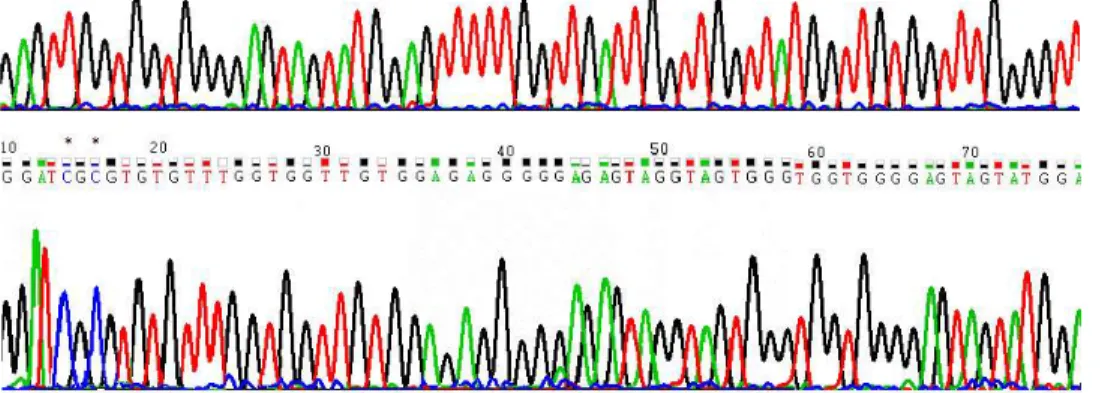
5-ACRCCCRCACCTCCTCTACC-3, as reverse. Initial PCR A fragment with the length of 191bp from the P16 conditions were as follows: 94°C for 1 min, 35 cycles at gene promoter region was used for the bisulfite direct 94°C for 45 s, 61°C for 45 s, 72°C for 30 s and a last sequencing method. For this purpose, 43 PEFF cases of incubation step for 5 min at 72°C. The PCR products the HCC tissues and 10 samples from normal liver tissue were diluted 10-fold and 1 µl were used for two separate was tested. We found in 13.9% (n=6) of HCC cases nested PCR with 0.5 µM of each primer specific for hypermethylation (Figure 1A), but no methylation in methylated (p16M) and unmethylated (p16U) sequences normal samples (Figure 1B). Methylation ratio in these
as follow: patients was 90%-100%, which indicate frequent cytosine
The PCR products were then loaded onto 2% agarose gels used a sample, which was determined to be hetrozygously
reverse. Initial PCR conditions were 94°C for 1 min, 5
Fig. 1: (A) part of the promoter of p16 gene, which is methylated hetrozygously in HCC samples; (B) the same region of unmethylated promoter in the normal tissues; (C) a part of the promoter, which is methylated in GC box IV of the promoter. Methylated nucleotides are indicated with asterisk
Fig. 2: Methylation specific PCR of the promoter region of P16 gene. Sample 7 is hetrozygously methylated and the others are unmethylated. U: unmethylated; M: methylated
methylation in the amplified region. Methylation in the GC DISCUSSION
box IV within the promoter region was observed in 58.1%
(n=25) (Figure 1C). In contrast, MSP analysis of the 150 Epigenetics is the study of DNA modifications bp amplicon from the P16 promoter region represented altering gene expression that is caused by environmental heterozygous hypermethylation in 25.5% (n=11) of HCC factors and not genomic changes [15]. Alterations in the cases. All of the HCC and normal samples showed patterns of DNA methylation are among the earliest and unmethylated bands, in electrophoresis (Fig. 2). most common events in tumorigenesis [16].
To trace these modifications, several techniques have that MSP tends to be a qualitative, rather than a been developed for evaluation of cytosine methylation quantitative method and it was accompanied with some including bisulfite sequencing, MSP, combined bisulfite wrong interpretation. On the other hand, bisulfite direct restriction analysis (COBRA) and etc. sequencing is a more confident method mainly known as Bisulfite direct sequencing is the most a quantitative method representing precise numbers of straightforward way to detect and locate cytosine methylated cytosines that also shows exact ratios of methylation in which bisulfite treated DNA is used as methylated to unmethylated modification and the template for PCR and subsequent direct sequencing [17]. distribution of methylation in the amplified region, too. In order to amplify both methylated and unmethylated The main disadvantage of the direct sequencing sequences, the required primers should be designed to technique is its cost, which makes it unsuitable for the make no distinction between methylated and screening of large number of samples.
unmethylated DNA [18]. On the other hand, it is beneficial
to design primers as having several non CpG cytosines, ACKNOWLEDGEMENTS
which avoid amplifying of incompletely treated templates.
Finally, after direct sequencing all sites of unmethylated We would like to thank all of those who supported us cytosines are displayed as thymine in amplified in any respect during the completion of the project, sequence of the sense strand and as adenine in the especially all staff of the Hematology Research Center, amplified antisense strand. The other technique that have Nemazee Hospital, Shiraz.
been used in numerous assays, is the methylation specific
PCR (MSP). Besides, the MSP can rapidly assess REFERENCES
methylation state of a given DNA without necessity to
use sequencing or methylation-sensitive restriction 1. Singal, R. and G.D. Ginder, 1999. DNA methylation. enzymes. The method consists of initial modification of Blood, 93: 4059-4070.
DNA by sodium bisulfite in order to converting all 2. Reik, W. and W. Dean, 2001. DNA methylation unmethylated, but not methylated cytosines to uracil. and mammalian epigenetics. Electrophoresis, Thus, changes are distinguished by DNA amplification 22(14): 2838-43.
with primers specific for methylated versus unmethylated 3. Herman, J.G., J.R. Graff, S. Myöhänen, B.D. Nelkin DNA. In MSP, the primers are designed to contain several and S.B. Baylin, 1996. Methylation-specific PCR: a cytosines within CpG islands, which are not changed in novel PCR assay for methylation status of CpG methylated primers, but will be changed to ‘TG’ in the islands. Proc. Natl. Acad. Sci. USA, 93(18): 9821-9826. case of unmethylated primers. Generally, the MSP is 4. Strathdee, G., A. Sim and R. Brown, 2004. Control of known as not prone to false positive results [3]. gene expression by CpG island methylation in normal Controversy, some reports indicate disadvantages of cells. Biochem. Soc. Trans, 32(6): 913-915.
MSP, because of its susceptibility to false positives [19]. 5. Jones, P.A., 2002. DNA methylation and cancer. However, we analyzed methylation state of the P16 gene Oncogene, 21(35): 5358-5360.
promoter by MSP method showing positive methylation 6. Gao,Y., M. Guan, B. Su, W. Liu, M. Xu and Y. Lu, in 11.6% of cases, which could not be confirmed by 2004. Hypermethylation of the RASSF1A gene in bisulfite direct sequencing method. Some factors might gliomas. Clin Chim. Acta, 349(1-2): 173-179. lead to false positive results in MSP such as incomplete 7. Ehrlich, M., 2002. DNA methylation in cancer: conversion of the template, false priming or a sensitivity too much, but also too little. Oncogene, issue due to the capacity of MSP to amplify very low-level 21(35): 5400-5413.
methylation [20]. Furthermore, it might be possible that 8. Ksiaa, F., S. Ziadi, K. Amara, S. Korbi and some samples would be methylated in this region, what M. Trimeche, 2009. Biological significance of we really observed it afterward by bisulfite sequencing. promoter hypermethylation of tumor-related genes This would be mistakenly concluded as hypermethylated. in patients with gastric carcinoma. Clin Chim Acta, Conversely, all of HCC samples represented unmethylated 404(2): 128-133.
bands while 58.1% of patients were homozygously 9. Tangkijvanich, P., N. Hourpai, P. Rattanatanyong, methylated in 2-3 cytosines that we determined by N. Wisedopas, V. Mahachai and A. Mutirangura, sequencing. In fact, unmethylated band in MSP alone 2007. Serum LINE-1 hypomethylation as a potential cannot be guarantee for unmethylated sites of all prognostic marker for hepatocellular carcinoma. Clin cytosines in the interested region. Finally, we can deduce Chim Acta, 404(2): 128-33.
10. Csepregi, A., M.P. Ebert, C. Röcken, 16. Liu, Z.J. and M. Maekawa, 2003. Polymerase chain R. Schneider-Stock, J. Hoffmann, H.U. Schulz, reaction-based methods of DNA methylation A. Roessner and P. Malfertheiner, 2010. Promoter analysis. Anal Biochem., 317: 259-265.
methylation of CDKN2A and lack of p16 expression 17. Frommer, M., L.E. McDonald, D.S. Millar, C.M. Collis, characterize patients with hepatocellular carcinoma. F. Watt, G.W. Grigg, P.L. Molloy and C.L. Paul, 1992.
BMC Cancer, 10: 317. A genomic sequencing protocol that yields a
11. Jin, M., Z. Piao, N.G. Kim, C. Park, E.C. Shin, J.H. Park, positive display of 5-methylcytosine residues in H.J. Jung, C.G. Kim and H. Kim, 2000. p16 is a major individual DNA strands. Proc. Natl Acad Sci. USA, inactivation target in hepatocellular carcinoma. 89(5): 1827-31.
Cancer, 89(1): 60-68. 18. Paul, C.L. and S.J. Clark, 1996. Cytosine methylation: 12. Narimatsu, T., A. Tamori, N. Koh, S. Kubo, quantitation by automated genomic sequencing and K. Hirohashi, Y. Yano, T. Arakawa, S. Otani and GENESCAN analysis. Biotechniques, 21: 126-133. S. Nishiguchi, 2004. P16 promoter hypermethylation 19. Rand, K., W. Qu, T. Ho, S.J. Clark and P. Molloy, in human hepatocellular carcinoma with or without 2002. Conversion-specific detection of DNA hepatitis virus infection. Intervirol., 47(1): 26-31. methylation using real-time polymerase chain 13. Serrano, M., G.J. Hannon and D. Beach, 1993. A new reaction (ConLight-MSP) to avoid false positives.
regulatory motif in cell cycle control causing specific Methods, 27: 114-120.
inhibition of cyclin D/cdk4. Nature, 366: 704-707. 20. Aggerholm, A. and P. Hokland, 2000. DAP-kinase 14. Wu, J., L. Xue, M. Weng, Y. Sun, Z. Zhang, CpG island methylation in acute myeloid leukemia: W. Wang and T. Tong, 2007. Sp1 Is Essential for methodology versus biology? Blood, 95: 2997-2999. p16INK4a Expression in Human Diploid Fibroblasts
during Senescence. PLoS ONE, 2(1): 164.
15. Galm, O., J.G. Herman and S.B. Baylin, 2006. The fundamental role of epigenetics in hematopoietic malignancies. Blood Rev., 20: 1-13.