We are committed to providing Industry with sector specific insights that will help them to better their working practice, execute more effective marketing campaigns and increase ROI. To that end, the autumn 2011 Consumer Trend Report on Direct Marketing from the Retail Sector pinpoints consumer attitudes to Retail Marketing that could help providers working in the sector to increase the efficiency of their marketing resources during a time of great change and economic flux.
Consumer Trend Report 2011
Direct Marketing from the Retail Sector
Background
At REaD Group we believe that effective direct marketing is built
upon strong data management principles. The fact of the matter
is that good data management encompasses data security; it
is mindful of ID Fraud, it adheres to best practice guidelines and
above all else, it is responsible. Furthermore, for consumers to
have confidence in the organisations using their personal data, it
needs to be treated with the respect it deserves.
The Sample
The sample were randomly selected from Consumer Research Specialist fast. MAP’s Consumer Voice panel to be representative of the UK population.
The panel was closed i.e. members of the public cannot voluntarily join and are recruited via a number of sources to demographically represent the markets based on age and gender.
Results are re-weighted by age and gender. Sample Size = 1,524.
This gives a statistical confidence level of +/- 1.91%.
Introduction
The last 3 years have seen UK businesses and consumers thrown about in soup of uncertainty. We’ve reeled from pillar to post in a whirl of hyperbole, understatement, panic, economic decline, brief recovery and now we’re almost certainly heading for a ‘double dip’ with no clue as to what lies at the end of the rainbow. The only thing we can be sure of is that it’s unlikely to be a pot of gold. Economists, politicians, statisticians and the media struggled to forecast the impossible combination of events that left many businesses in tatters and high streets across the country forever changed. The hoik in VAT, stiff competition from online only retail brands, budget cuts, a decline in consumer spending, not to mention the recent riots in retail hotspots like Manchester, Birmingham and London, which have cost retailers over £140 million in repairs, loss of business and looted stock, has all taken its toll.
Vacant lots, once home to retail bastions like Woolies, now house sprawling budget shops and small independent
retailers have been replaced by a plethora of charity shops that are capitalising on favourable rates and exemption from VAT. To make matter worse financial meltdown in the Eurozone and the US debt crisis, all tenuously underpinned by the Chinese RMB, will undoubtedly slow the growth of international and domestic spending. However, even though consumers are scrutinising every penny they spend there’s still money to be made, but retailers will have to market their products even harder in order to grab consumer’s attention. Ultimately, the companies who invest in honing their customer communications will bolster brand perceptions and boost sales against the odds.
Our 2011 Consumer Trend Report on Direct Marketing from the Retail Sector aims to help marketers in the sector understand where to invest their precious marketing budgets and highlights the best way to work across a variety of marketing channels to greatest effect.
Multi Tasking!
Back in 1999 multichannel retailing was a thing of the future, a great, glossy, seamless series of transactions, tailored around the needs of the consumer. Bricks, mortar and mail order were the staple routes to market and internet only brands like Amazon and Ebay were inventing the wheel.
Realising the infinite possibilities online and mobile phones had opened up, it wasn’t difficult to picture retail utopia: No more jostling with a million other frantic Christmas Eve shoppers on Oxford St at 3.45pm or fighting over the last festive gift set in Boots. It wasn’t clear exactly how we’d get to retail heaven, when we’d get there or the new technologies it might involve, but we could dream, right? Fast-forward 12 years and multichannel retailing is here to stay. With the exception of but a few retailers such as Primark, who have made a conscious decision to stick with bricks, the vast majority of retailers have a multichannel strategy in place. Recent figures from the British Retail Consortium shows that retail search terms using smartphones has increased by 181% in one year, which indicates that consumers are increasingly technology savvy and that armchair shopping is here to stay.
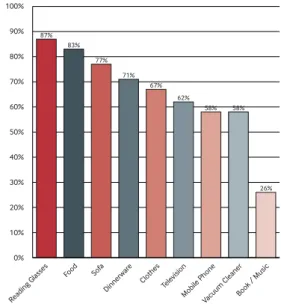
To see if there were any notable changes in buying behaviours, we asked consumers what products they were most likely to buy in stores. As one would expect, reading glasses came top of the list with 87% of consumers preferring to buy specs in store. At the opposite end of the scale, consumers were least likely to buy books and music in store, which isn’t that surprising considering the steady growth of music, book and gaming retailers in the online space (Fig. 1). Clothes, technology and white goods all achieved figures of under 70%, which points to the gradual shift in buying behaviour away from the high street.
Fig. 1 How likely are you to purchase the following goods in store?
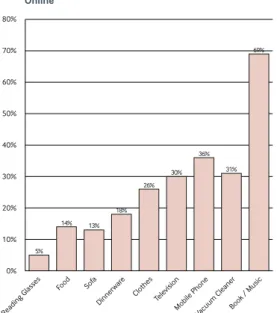
To get a more rounded picture, we also asked consumers what products they would be most likely to purchase online (Fig. 2). By comparing the results in Fig. 1 and Fig 2. it’s clear that products that require a degree of sensory qualification on the part of the consumer did better in store than online. It seems that we still want to ‘try out’ high value products like sofas or distinctly personal purchases like dinnerware or reading glasses that could be complicated or costly to return. And, in spite of significant investment on the part of supermarkets only 14% of consumers are most likely to buy food online. While this indicates that consumers still want to touch, smell and see the food products that they buy it also suggests that retailers need to continue to improve and personalise the online food buying process. Reading Glasses Food Clothes Sofa Television Mobile Phone
Vacuum CleanerBook / Music Dinner ware 100% 90% 80% 70% 60% 50% 40% 30% 20% 10% 0% In Store 87% 83% 77% 71% 67% 62% 58% 58% 26%
Fig. 2 How likely are you to buy the following goods online?
Finally, we asked consumers what products they were most likely to buy using catalogues. Overall, mail order was unpopular with consumers when used as a stand-alone channel. Retailers that use mail order successfully generally target niche markets and demographics (for example 65+ market) or use it in conjunction with other channels (Fig. 3).
Fig. 3 How likely are you to purchase the following goods using mail order?
Topline Stats
Reading Glasses Food Clothes Sofa Television Mobile PhoneVacuum CleanerBook / Music Dinner ware 80% 70% 60% 50% 40% 30% 20% 10% 0% Online 5% 14% 13% 18% 26% 30% 36% 31% 69% Reading Glasses Food Clothes Sofa Television Mobile Phone
Vacuum CleanerBook / Music Dinner ware 50% 40% 30% 20% 10% 0% Catalogue 38% 46% 33% 46% 34% 40% 33% 37% 46%
41% of 35-44 year olds would not consider purchasing clothes using catalogues preferring to buy online and in store. 18-24 year olds and consumers over 65 prefer to purchase food in store.
Women are far more likely to shop online for food than men are, however both sexes show an equal preference for buying food in store (94%).
Channel Surfing
Multichannel retailing should be underpinned by a multichannel marketing strategy that promotes and drives ecommerce across the channels. This will enable retailers to understand their customers, build a dynamic database and target their communications to greatest effect. Despite anaemic spending across the sector, which has seen profits plummet, John Lewis Partnership and sister company Waitrose smashed sales targets across their retail channels by employing a savvy marketing strategy. In addition, Waitrose has recently relaunched their internet grocery service to waitrose.com to help them gather intelligence from their marketing database, which can be used to target the services they offer and tailor communications around their customers.
Similarly, Marks & Spencer has announced that it plans to invest in building a bespoke multichannel platform that will enable it to collect and use customer data more effectively and fulfil its aim to grow 40% the business internationally. Previously hosted by Amazon, M&S will take full ownership of the platform and all its customer data so that services can be tailored around the needs of the customer.
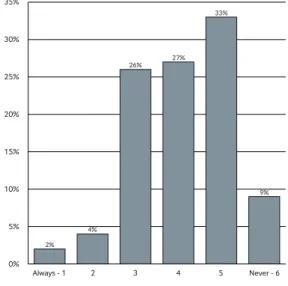
While other retailers are struggling to stay afloat, the secret to the continued success of retail brands like M&S and the John Lewis Partnership lies in their willingness to adapt their behaviour to make it easier to listen to and communicate with their customers. Given that customer choice and service are at the heart of good multichannel retailing, we were keen to discover if consumers found the information they currently receive from retailers to be relevant 10% and appropriate. Staggeringly, only 6% of consumers found that the information they receive from retailers to be relevant, which means retailers are missing the mark with over 40 million adults in the United Kingdom (Fig. 4).
Fig. 4 How often is the information you receive from retailers appropriate and relevant to you?
Always - 1 2 3 4 5 Never - 6 35% 30% 25% 20% 15% 10% 5% 0% ALL 2% 4% 26% 27% 33% 9%
To help retailers address the issue of relevance and build an accurate picture of the communication channels consumers like best, we asked consumers how they wanted their favourite retailers to tell them about their products, offers and promotions. Email and retailer website were the most popular, which was followed by TV advertising, postal DM and magazines/print advertising. SMS and social media were bottom of the list however, with an unprecedented rise in retail specific searches using smartphones it would be unwise to ignore these channels (Fig. 5) particularly as these less established channels strike a chord with the younger demographic.
Fig. 5 How would you prefer your favourite retailers to tell you about their new products, offers and promotions?
For retailers wishing to target prospects, we asked the consumers how they preferred to hear from retailers with whom they do not currently have a relationship. TV advertising came out on top, which was closely followed by website, magazine articles, email and postal DM. Although a third of the consumers surveyed said they didn’t want to hear from retailers from whom they haven’t previously purchased from (Fig. 6), 73% of 35-44 year olds would welcome communications from retailers they don’t have a relationship with (Fig. 7).
Fig. 6 How would you prefer retailers you don’t currently buy from to tell you about their new products, offers and promotions?
SMS te
xt messageOn Facebook By post Magazine ar
ticles / adv erts
Television adv ert
On their w ebsite
By email
I don’t want them to tell me 50% 40% 30% 20% 10% 0% ALL 3% 5% 17% 20% 27% 28% 31% 47% SMS te xt messageOn Facebook Magazine ar ticles / adv erts By post On their w ebsite
Television adv ert
I don’t want them to tell me By email 40% 35% 30% 25% 20% 15% 10% 5% 0% ALL 5% 6% 16% 17% 21% 22% 30% 36%
Fig. 7 How would you prefer retailers you don’t currently buy from to tell you about their new products, offers and promotions? (According to age)
SMS te
xt message On Facebook By post By email
On their w ebsite
Tele vision adv
ert
I don’t want them to tell me Magazine ar ticles / adver ts 60% 50% 40% 30% 20% 10% 0% 65+ 1%2% 2% 1%2% 5% 5%4% 6% 11% 14% 17% 17% 15%15% 15% 15% 27% 32% 35% 38% 35% 49% 39% 33% 27% 30% 41% 17% 13% 19% 19% 22% 20% 20%20% 20% 24% 23% 26%27% 32% 16% 19% 13% 18% 6% 18% 55-64 45-54 35-44 25-34 18-24
Retailers need to improve the way they communicate across channels.
SMS and social media came out on top with 18-34 year olds. TV advertising is still very popular with all consumers and is a powerful medium for retailers with bigger budgets.
Email is the preferred digital channel.
Topline Stats
Promotions
Worth an estimated £30bn a year in the UK alone, there are thousands of retail voucher code and promotion websites across the world. Recent estimates by JP Morgan suggest that there are somewhere in the region of 200 in the UK, 500 in the United States and over 2,000 in China. With approximately 90 million subscribers between them, the biggest players in the market are Groupon and Living Social and it won’t be long before other heavy hitters in the online space vie for a share of the market.
For brands, online promotions can be a crucial component in driving new consumers through their carefully constructed retail channels. Using online promotions successfully hinges upon having a good offer, employing a multichannel communication strategy that reinforces the brand messages and uses permissioned data to encourage direct conversations with consumers and most importantly, working with the right partners (including specialist lead marketing agencies, publishers and voucher sites etc.).
To identify the key factors involved in getting consumers to make purchases, we asked which forms of marketing were most and least likely to motivate them. Word of mouth and incentives were far more likely to motivate consumers to buy than an isolated piece of marketing. 51% of consumers said a friend’s recommendation was the strongest motivating factor and for 50% of consumers an attractive promotion held the greatest sway, while 26% of consumers said they were influenced by magazine reviews and mentions (Fig. 8). Moreover, it seems that everyone loves a bargain. 63% of consumers earning between £40k and £50k were most susceptible to promotions, while those earning less than £20,000 were least likely to be swayed by an incentive (Fig. 9).
Fig. 8 Of the following what are most and least likely to motivate you to buy? (1 & 2 Combined Score)
60% 50% 40% 30% 20% 10% 0% SMS te xt letting y ou kno w
about the latest off er
Celebrity endor semet or
seen using the pr oduct
A tele vision adv
ert
Personally addr essed direct mark
eting
Comments on a w eb forum
A review or mention in a magazine An attr activ e promotion or incentiv e Friends r ecommendation An email dir ect f orm the r etailer ALL 7% 7% 9% 13% 19% 22% 22% 50% 51%
Fig. 9 Of the following what are most and least likely to motivate you to buy? (According to income)
SMS te xt letting y
ou
know about the latest off er
Celebrity endor sement or
seen using the pr oduct
Personally addr essed
direct mark eting An email dir ect from the r etailer Comments on a web f orum Friends recommendation A review or mention in a magazine
An attr activ e promotion or incentiv e A tele vision adv ert 70% 60% 50% 40% 30% 20% 10% 0% Under £10K £10-£19.9K £20-£29.9K £30-£39.9K £40-£49.9K £50K+ 16% 6% 4% 4% 5% 8% 7% 7% 7% 8% 4% 5% 5% 2% 14% 12% 12% 12% 12% 11% 14% 18% 18% 41% 57% 18% 14% 11% 19% 25% 24% 63% 61% 51% 46% 42% 45% 48% 53% 52%53% 20% 24%24% 23% 37%38% 30% 16% 19% 13% 20% 21% 15%
5-34 year olds are most receptive to promotions, while consumers over 55 are more interested in their friend’s recommendations.
In general, men are more motivated by comments on a web forum, TV ads and reviews.
Promotions were most successful when used in conjunction with food and clothes products, which was followed by books and music and technology.
Topline Stats
Data Minefield
With so many brands feeling the pinch, it’s essential that retailers don’t charge headlong into multichannel retailing without ensuring that their all singing ecommerce solutions encrypt valuable customer data and payment information securely. In April 2011, Sony’s PlayStation Network, which has about three million British online users, had their customer data stolen and the company is now facing legal and legislative action for failing to do enough to protect their customer data.
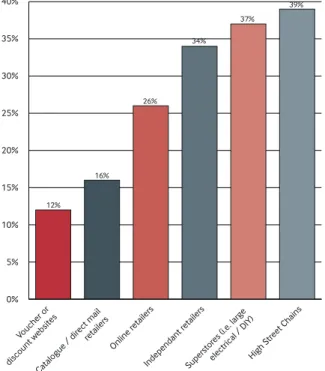
With the exponential growth of online only retailers and multi channel retailing in recent years, Sony’s ability to compete with their nearest competitors including Apple, Microsoft and Amazon could be seriously 40% jeopardised by a lack of consumer confidence in the brand. With trust playing such a huge role in the popularity and success of retail brands, we asked the sample to rank types of retailers according to how much 35% they trust them with their personal data (Fig. 10).
At a glance high street chain stores, superstores and independent retailers were most trusted by consumers, while voucher sites, mail order companies and online retailers were least trusted, which indicates that consumers are increasingly aware of data security but lack confidence in the way their data is managed. Although high street chains fared best 20% overall with 39% of consumers placing high levels of trust in their ability to manage their personal data, 61% of consumers don’t trust them! The most interesting trust results came from the 18-24 demographic. 61% of young adults placed high levels of trust in superstores, high street chains & online retailers, nearly all of which fluently conduct their business across multiple channels (Fig. 11).
Fig. 10 Which type of retailer do you most and least trust with your personal customer details?
Voucher or discount w ebsites Catalogue / dir ect mail retailer s Super stor es (i.e. lar ge electric al / DIY) Online r etailer s High Str eet Chains Independant r etailer s 40% 35% 30% 25% 20% 15% 10% 5% 0% ALL 12% 16% 26% 34% 37% 39%
Fig. 11 Which type of retailer do you most and least trust with your personal customer details? (According to age) Voucher or discount websites Catalogue / dir ect mail r etailer s Online r etailer s Independent retailer s High Str eet Chains Super
stores (i.e. lar ge electric al / DIY) 70% 60% 50% 40% 30% 20% 10% 0% 65+ 55-64 45-54 35-44 25-34 18-24 38% 39% 49% 61% 33% 37% 37% 35% 29% 34% 37% 30% 33% 37% 23% 20% 24% 24%26% 42% 14% 6% 17% 18% 11% 11% 5% 16% 17% 17% 16% 16% 32% 39% 34% 38%
While these figures indicate that younger consumers are more at home in a multichannel retail environment, this savvy demographic knows the true value of their personal data, placing exceptionally low levels of trust in the voucher and discount sites that make a profit from the consumer data exchange.
While improving and investing in database security is essential for retailers, the consequences of rolling out a poorly targeted campaign using flawed data could also have serious financial implications, as well as causing brand damage. Therefore, retailers need to ensure that they keep their customer data in tip-top condition, cleaning it regularly, de duping records and drilling down into the data to draw meaningful conclusions from it that will
Topline Stats
Overall men trust retailers more than women.
Bricks and mortar retailers enjoy biggest trust scores with high street chains and supermarkets leading the way.
18-24 year olds are most trusting of big retailers when it comes to protecting their personal customer details and least trusting of independent retailers.
Service Please
With customer service playing a large part in how consumers perceive retail brands, we were keen to identify the brands that offer the best customer experience and establish the most popular retailers in terms of market penetration. With 40 brands to choose from, the most popular retail brand was Tesco with 75% of adult consumers (over 32 million) making purchases with the supermarket during a 12-month period (Fig. 12). Because food and grocery
shopping is a necessity occurring at a higher frequency than clothes shopping perse, it’s not surprising that seven supermarkets were included in the top 15 most popular retailers with consumers. A more striking detail however is that the second most popular retailer with consumers was Amazon, with a staggering 74% of consumers making purchases with the online retailer in a12-month period, which was closely followed by high street chain Boots with 65%.
Tesco
Amazon Boots Asda Sainsbur
y’s Marks & Spencer
Morrison’s
B&Q Co-op
Homebase Debenhams
Next Ikea Play.com John Lewis / Waitr
ose 80% 70% 60% 50% 40% 30% 20% 10% 0% 75% 74% 65% 58% 56% 53% 47% 43% 42% 33% 28% 26% 25% 21% 20%
When it came to the brands that stood out for giving customers the best overall buying experience the John Lewis Partnership/Waitrose ranked highest with consumers, while Amazon came a close second making it the most popular retailer with consumers for frequency of purchases and giving their customers the best buying
experience overall (Fig. 13). Interestingly, it wasn’t just big brands that scored highly with consumers for offering exceptional buying experience. Laura Ashley, Hotel Chocolat, Richer Sounds and Bose were the next most successful retailers, followed by Tesco and then Firebox.
Fig. 13 Which retailer stands-out as giving its customer the best buying experience?
Tesco Firebo x Amazon
Laur a Ashley
Hotel ChocolatRicher Sounds
Bose Asda
Lakeland
Sainsbur y’s Gap
Marks & Spencer
Morrison’s Co-op Debenhams iTunes Ne xt Ikea Phones4U Play .com Specsav ers John Lewis / Waitr
ose 40% 35% 30% 25% 20% 15% 10% 5% 0% 37% 27% 21% 20% 16% 16% 13% 12% 12% 11% 10% 9% 8% 7% 7% 7% 7% 7% 7% 7% 7% 7%
Tesco has the same penetration as Amazon in UK. Women shop more frequently and widely than men! John Lewis & Amazon offer the best buying experience.
Topline Stats
To conclude the research we asked consumers how retailers could improve their marketing further (Fig. 14).
Fig. 14
For case studies and bright
ideas on how to manage
your data please visit
www.readgroup.co.uk
Advertise on TV, on the web and in magazines.
Don’t send post addressed to `the
occupier`. I find it hugely annoying.
Offer more discounts.
Personal vouchers through door, I never get any.
Keep information relevant and
don’t send it too often