TAX
TRANSPARENCY
BENCHMARK 2015
3
Tax Transparency Benchmark 2015
A comparative study of 64 Dutch listed companies
Disclaimer
The contents, conclusions and recommendations of the report are the sole responsibility of the VBDO.
Authors:
Imre Vellenga and Annemieke Reijngoud (VBDO)
Input and support:
Eric van der Stroom, Dave Reubzaet, Manon van Aalst and Eelco van der Enden (PwC)
For information:
Please contact Sigi Simons, PR and Communications VBDO ([email protected]) Dutch Association of Investors for Sustainable Development (VBDO)
Utrecht, the Netherlands
July 2015
This report has been made possible with the contributions of: Dutch Ministry of Foreign Affairs.
The first copy of this publication was presented at the International Tax Conference ‘Pay your taxes where you add the value’ on July 2nd2015 in The Hague.
5
Contents
Foreword by Minister Ploumen
6Executive Summary
101)
Introduction
132)
Methodology
193)
Results
224)
Paying Taxes in Developing Countries
375)
Recommendations
44Appendix A: Jury Report
45Foreword
Multinationals are the engines of globalisation, binding countries and people together. This dynamic brings about great progress, but also creates new global challenges. One of these concerns the correct payment of tax by multinationals in the countries where they operate. This issue stems from the collective failure of governments to keep pace with the rapid global developments. A lack of international tax governance has given multinationals plenty of leeway to determine their total tax burden themselves. As a result, many do not pay their taxes where they actually add value to economies. It is therefore good news that 62 countries are working, via the OECD/G20 Base Erosion and Profit Shifting project, on additional commitments designed to bring about a fairer distribution of tax revenue. In so doing, governments are fulfilling their responsibility to make better tax rules for a global economy.
But the role of government is just one side of the coin. The other is the role that businesses can play in ensuring they pay their fair share of tax. Companies looking for a business location benefit from an open and friendly investment climate. They can contribute to this themselves by operating as responsible economic agents. Where tax is concerned, this requires compliance with both the letter and the spirit of the tax laws of the countries in which they operate. Developing countries are particularly reliant on this, as they often lack the capacity to see through tax avoidance structures. At the same time a substantial portion of their total tax base is made up of profits generated by multinationals. Companies can dispel any mistrust about their tax payments by including their tax behaviour in their corporate social responsibility strategies and being transparent about their profits and tax remittances.
Lilianne Ploumen
Minister for Foreign Trade and Development Cooperation
The Tax Transparency Benchmark presents a clear picture of where we stand as regards corporate social responsibility in tax matters. I would therefore like to express my appreciation for the work of the Dutch Association of Investors for Sustainable Development (VBDO) in conducting this survey. Its results, however, provide a less than favourable picture. Of the 64 Dutch multinationals examined, only a minority performed satisfactorily on the company assessment criteria. So I am pleased to see that the VBDO intends to repeat this benchmark survey every year. Hopefully this will encourage companies to adopt transparent tax policies and demonstrate good tax compliance in every host country, and hence contribute according to their means to the available funds for public investment. That in turn will boost economic growth and the business climate.
Rank Company Listing Ops* Score (max 36 points)
1 Unilever AEX 22
1 KPN AEX 22
3 DSM AEX G 21
4 Shell AEX G 20
5 ING Group AEX G 19
6 Heineken AEX G 18
6 Kendrion Other G 18
6 Philips AEX G 18
6 Rabobank ** G 18
10 Randstad AEX G 17
11 Van Lanschot Other 16
11 Wessanen Other 16
13 AkzoNobel AEX G 15
14 Aegon AEX G 14
14 Arcadis AMX G 14
14 BAM Group AMX G 14
14 Grontmij Other 14
18 Nutreco ** G 13
19 Brunel AMX 12
20 Ahold AEX 11
20 Reed Elsevier AEX G 11
22 ASML AEX G 10
22 Delta Lloyd Group AEX 10
22 Fugro AMX G 10
22 Gemalto AEX G 10
22 Wereldhave AMX 10
22 Wolters Kluwer AEX G 10
28 Beter Bed Other 9
28 NSI AMX 9
28 USG People AMX 9
31 Boskalis Westminster AEX 8 32 Airbus Group ** G 7 32 BE Semiconductor Industries AMX G 7
32 KAS Bank Other 7
Tax Transparency Benchmark 2015
9
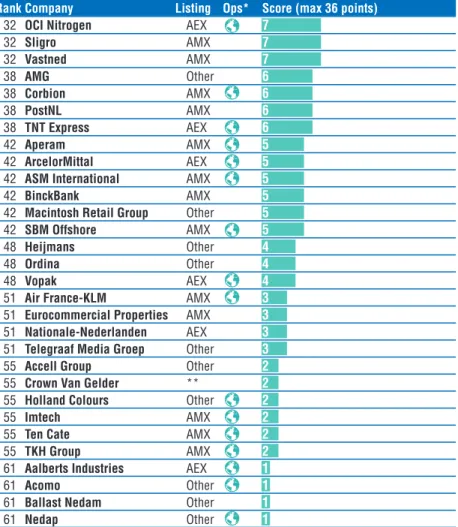
Rank Company Listing Ops* Score (max 36 points) 32 OCI Nitrogen AEX G 7
32 Sligro AMX 7 32 Vastned AMX 7 38 AMG Other 6 38 Corbion AMX G 6 38 PostNL AMX 6 38 TNT Express AEX G 6 42 Aperam AMX G 5 42 ArcelorMittal AEX G 5 42 ASM International AMX G 5
42 BinckBank AMX 5
42 Macintosh Retail Group Other 5 42 SBM Offshore AMX G 5
48 Heijmans Other 4
48 Ordina Other 4
48 Vopak AEX G 4
51 Air France-KLM AMX G 3 51 Eurocommercial Properties AMX 3 51 Nationale-Nederlanden AEX 3 51 Telegraaf Media Groep Other 3 55 Accell Group Other 2 55 Crown Van Gelder ** 2 55 Holland Colours Other G 2
55 Imtech AMX G 2
55 Ten Cate AMX G 2
55 TKH Group AMX G 2 61 Aalberts Industries AEX G 1
61 Acomo Other G 1
61 Ballast Nedam Other 1
61 Nedap Other G 1
Figure 1:Overall ranking of the Tax Transparency Benchmark 2015.
.
* A ‘global company’ is defined as a company that is active in more than 10 countries of which at least 3 non-OECD. ** Not listed in Amsterdam.
Executive Summary
The ‘good tax governance’ and ‘paying your fair share in taxes’ debate is here to stay. Society, media, governments, the European Union and the OECD are keeping the debate alive. Even though at first, many people thought this wind of change would blow over.
In this report we share the results of the first Tax Transparency Benchmark. This study ranks 64 Dutch listed multinational companies on the transparency that they provide into their res-ponsible tax policy and its implementation. On average, the companies in scope score only 9 out of 36 points (25%). The benchmark identifies a group of 9 frontrunners that score 50% or above, see Figure 1.
Key findings include:
• 58% of all companies investigated sees tax as part of its corporate social responsibility; • 45% has published its tax strategy (compared to 16% last year);
• 23% discusses its tax strategy with its stakeholders;
• 36% reports its corporate income taxes on a more granular level than consolidated, but only 3% publishes a full country-by-country report;
• 16% provides information on taxes other than corporate income tax; • 58% includes tax related risks in its annual report;
• 45% mentions that the audit committee reviews the tax strategy;
• 5% of the companies in scope refers to tax in its In Control Statement, none of the companies provides third party tax assurance. We do see a trend towards these forms of additional assurance in other countries.
An independent jury has appointed UNILEVER as the winner of the Tax Transparency Award 2015. In addition to above analysis of publicly available information, we conducted 8 interviews with tax directors of Dutch multinational companies to get their perspective on taxation in developing countries and other non-OECD countries. When asked about fair tax, all interviewees replied that this is a complex debate and no single answer exists. A few indicated that fair tax is a subject of internal discussions, and some stated that paying a fair share should result in an effective tax rate between 20-30% in all countries. For most interviewees, however, fair taxation is still an unexplored topic and no internal working definition is developed yet.
Obstacles that companies faced with respect to taxation in developing countries included: • Opportunistic to aggressive attitude of local tax authorities towards multinational
companies;
• Overly hierarchical and bureaucratic organisation of tax authorities, and difficult to get a single point of contact;
• Time-consuming and costly appeal procedures; • Multi-interpretable, complex and fast-changing tax laws; • Corruption within government bodies;
• Lack of capacity and skills of local tax authorities in least developed countries, especially regarding transfer pricing and tax treaties.
Many companies found it difficult to establish an open and transparent relationship with local tax authorities in developing countries. Those who succeeded experienced less discrepancy between developing countries and developed countries.
In regards to the societal call of more transparency on tax, many companies supported the latest developments in the OECD and UN. However, some feared that this would result in more disputes with local tax authorities in developing countries based on simplistic ratio calculations (e.g., corporate income tax per employee or per revenue). Additionally, companies feared that different countries would implement the new regulations differently, leading to an increased administrative burden on companies. On the question why they were not yet fully transparent, most companies answered that this would result in disclosing sensitive competitive information. Based on this research, we provide the following main recommendations to multinational companies. See Chapter 5 for more recommendations for governments, NGOs, tax advisory firms, and investors.
• Discuss your tax strategy and behaviour with your stakeholders, including governments, tax authorities, civil society organisations, and investors;
• Report your corporate income taxes on a geographic basis, preferably country by country;
• Invest more time in your relationship with local tax authorities in developing countries, e.g., to explain the working of your industry and value chain, and to manage expectations.
1 Introduction
The ‘good tax governance’ and ‘paying your fair share in taxes’ debate is here to stay. Society, media, governments, the European Union and the OECD are keeping the debate alive. Even though at first, many people thought this wind of change would blow over. The changing attitude of organisations can, for example, be found in the increasing number of sustainable company visions - a novelty in itself. To name a few: making sustainable living commonplace; making the world healthier and more sustainable through innovation; empowering people; helping the world thrive.1With these statements, companies are recognising
the responsibility they have to contribute to the societies in which they operate, and to create value for other stakeholders than shareholders alone, including employees, consumers and local communities.
Corporate social responsibility (CSR) goes beyond mere adherence to international and national laws and regulations. This also applies to paying taxes. Therefore, even though tax planning and certain tax rulings may technically fall within the limits of the law, companies should acknowledge that tax is not a profit centre and take their responsibility by paying taxes in the spirit of the law. By paying their fair share of taxes, companies contribute to the societies of which they benefit. Think for instance of children’s education to eventually become valuable employees, infrastructure in the country to improve the commute for workers and transport of goods to and from factories, and local law enforcement to ensure a safe and secure business environment. Taxation is an important way to contribute to a sustainable society in many ways. Multinational companies are crucial for the financial climate of developing countries with an estimated annual contribution of 750 billion dollars to local economies.2However, UNCTAD
also estimates that developing countries lose around 100 to 300 billion dollars per year due to tax avoidance and profit shifting.3Therefore we should enter into a dialogue on how to
achieve the mutual objectives and establish a transparent sustainable tax infrastructure for developing countries in their relationship with global operating companies.
Latest developments
In the last few years, the good tax governance debate has evolved from a debate by NGOs to a debate by society at large, and more specifically by politicians. The European Commission
13 1 Quotes found on the website of respectively: Unilever, Philips, ING and Cargill. 2 UNCTAD, “World Investment Report”, 2015.
for example is investigating whether or not certain tax rulings concluded by member states with large corporations can be seen as illegal state aid. Examples of rulings that the Committee is investigating are: Apple in Ireland, Starbucks in the Netherlands and Fiat in Luxembourg.4
In addition, the European Parliament has taken its own responsibility by instating the TAXE Committee to investigate whether some member states use special tax regimes that benefits large corporations.5
We also see that the OECD is taking a stance in the debate, for example, through their base erosion and profit shifting action plan (BEPS), which is supported by the G20. One action is of specific interest for good tax governance purposes. Within action thirteen (transfer pricing documentation) country-by-country reporting is proposed as a means to increase transparency. If multinational companies are required to report their turnover, profit, number of employees and taxes paid on a per country basis, tax avoidance scheme’s would become immediately apparent, thus encouraging tax ethical behaviour by these companies. Other organisations also play their part. The Dow Jones Sustainability Index, one of the leading global sustainability indices covering all large multinational companies, has included questions on responsible taxation. According to their 2014 report “aggressive and non-transparent tax optimisation strategies can pose financial, operational and reputational risks for multinational companies”.6Such risks are thus considered no longer sustainable.
In addition, various sector-based initiatives are under construction or have already been implemented. For example, the Extractive Industries Transparency Initiative (EITI). EITI promotes revenue transparency and accountability in the extractive sector. It aims to strengthen governance in resource-rich countries by improving transparency and accountability as to how natural resource wealth is generated and used. The application of EITI is voluntary, and supported by governments, companies, investors, NGOs and partner organisations. Under the European Capital Requirements Directive (CRD IV) the financial sector is required to perform country-by-country reporting. It is proposed that the reporting requirements as agreed upon in the CRD IV Directive will also apply to other large companies and groups.
4 European Commission, “State aid: Commission investigates transfer pricing arrangements on corporate taxation of Apple
(Ireland) Starbucks (Netherlands) and Fiat Finance and Trade (Luxembourg)”, press release, 11 June 2014.
5 European Parliament News, “Special committee on tax rulings: Do some get preferential tax treatment?”, 2 June 2015. 6 Dow Jones Sustainability Index, DJSI 2014 Review: Results, 2014.
Multinational companies
It is hard to explain that a company that states to minimise its environmental footprint or to fight child labour, is at the same time avoiding taxes. As mentioned earlier, we see many companies embracing their corporate social responsibility. However, tax is often not integrated into the CSR strategy, and most companies do not discuss their tax policy with their stakeholders. They maintain to substantiate their tax policy from a tax technical and legal perspective.
Governments
Governmental entities sometimes seem to play a double role. The increased attention for tax avoidance (EU state aid investigations, OECD BEPS discussion, adjusting legislation, etc.) is a contrary force to countries’ strive to be as attractive for multinationals as they can. More resident corporations means more economic activities, employment and tax income.
Civil society organisations
Civil society organisations increasingly focus on tax evasion by multinational companies. Their main argument is that it is unfair that large and powerful organisations use their position to avoid paying taxes for self-enrichment whilst this money is much needed to solve social and environmental problems. The nuance that some companies do make an effort to pay their fair share of taxes is sometimes lost.
Tax advisory firms
For many years advice on tax structuring and profit shifting in order to minimise tax costs have been among the core activities of most tax advisory firms. As the debate on fair taxation is progressing, tax advisory firms will also have to adapt their advice practices.
Investors
Investors still seem to be slightly indistinctive on what they think of the matter. Reducing tax payments enhances profits and thus their return on investment. However, investors such as pension funds are under increased pressure to invest in a responsible way. For example, we see more and more investors that require adherence to the OECD Guidelines for Multi-national Enterprises of their investees. These guidelines include a chapter on taxation, in which it is (among other) stated that organisations should comply with both the letter and the spirit of the law.7In practice, however, (institutional) investors seem unwary to include
responsible tax in their investment policy. This is not necessarily due to unwillingness, but can also be (partly) due to lack of relevant information.
15
Role and stance of stakeholders
Within the good tax governance debate, numerous stakeholders have a distinct role.
Guiding principles for good tax governance
To provide guidance in the discussion on good tax governance, VBDO and Oikos introduced six Good Tax Governance Principles in 2014.8 The first copy of the report was presented to
Jonathan Leigh Pemberton, Deputy Head of International Cooperation and Tax Administration at OECD on 22 April 2014.
The Good Tax Governance Principles are:
1. Define and communicate a clear tax strategy;
2. Tax must be aligned with the business and is not a profit centre by itself; 3. Respect the spirit of the law. Tax compliant behaviour is the norm; 4. Know and manage tax risks;
5. Monitor and test tax controls; 6. Provide tax assurance.
Every year, the VBDO attends the Annual General Meeting of all Dutch listed companies. At these meetings, the VBDO asks companies whether they are willing to adopt the Good Tax Governance Principles.
We have received various reactions and feedback on the report and the principles. To name just a few:
“VBDO makes a significant contribution to the debate about the role of tax in CSR. We support VBDO’s view that a responsible tax strategy is part of CSR. The taxes that Heineken pays are a significant part of our economic contribution to the 70+ countries in which we operate.”
- Mark Melzer, Director Global Tax at Heineken
“The report stimulates the much-needed discussion on corporate tax responsibility by combining different perspectives. It also highlights dilemmas of special importance for multinationals operating in developing countries, such as benefitting from tax incentives versus paying a fair share.”
- Francis Weyzig, Policy Advisor at Oxfam Novib
“VBDO’s Good Tax Governance report is a relevant contribution to change the perspective of companies on taxation. Companies strongly rely on infrastructure and other public services. Shareholders and society at large should be able to verify that companies make a significant contribution to these public goods. This is more than merely a matter of corporate social responsibility: it is their duty, like it is for every citizen of a country."
- Bas Eickhout, Member of the European Parliament for GroenLinks (the Netherlands)
Tax Transparency Benchmark 2015
Following the introduction of the Good Tax Governance Principles in 2014, this report examines to what extent Dutch listed companies are transparent about their responsible tax strategy and tax payments.
Transparency is the first requirement for an informed and constructive dialogue on fair taxation by multinational companies. With this benchmark we would like to contribute to this discussion. The report is structured as follows. Chapter 2 outlines the methodology of the Tax Transparency Benchmark, and Chapter 3 provides the results. Chapter 4 contains a deep dive into taxation in developing countries. For this chapter, we interviewed several tax directors of multinational companies. Finally, in Chapter 5 we present our recommendations for the next steps that need to be taken by companies, governments, NGOs, tax advisory firms, and investors.
2. Methodology
The methodology of the Tax Transparency Benchmark is based on the Good Tax Governance Principles.9From these principles, we derived measurable criteria that have
been tested against publicly available information on Dutch listed companies. The methodology of the benchmark is explained in further detail below.
Testing criteria
The guiding principles listed speak for themselves and in a way state the obvious. To deter-mine whether companies act on these principles, a list of criteria has been designed which has objectified and quantified the principles. Each principle has been dissected into various elements. The elements have then been converted into measurable criteria. For example, the first principle – Define and communicate a clear strategy – consists of the elements communication and strategy. The communication element relates to the question whether the tax strategy can be retrieved from public sources such as the annual report, the CSR report or the company website.
We refer to Appendix B for a comprehensive list of the criteria used, listed per principle of good tax governance.
The criteria have been developed by VBDO and have been reviewed by experts in the field of taxation from various backgrounds. The review panel includes representation from NGOs, scholars, multinational companies and tax advisory firms.
Subjects
In the 2015 Tax Transparency Benchmark, 64 companies were included. The full list can be found in Figure 1. These companies were selected based on their listing in the Netherlands (AEX, AMX, AScX and locally), and/or their sustainability performance in the 2014 AGM season of the VBDO.10All are sizeable multinational companies, operating in various industries such
as finance, oil and gas, industrials and chemicals, and building and construction.
19
9 See: VBDO and Oikos, “Good Tax Governance in Transition: Transcending the tax debate to CSR”, 2014. 10 VBDO, “Sustainability Performance of Dutch Stock Listed Companies: AGM Report 2014”, 2014.
Approach
For all criteria of the Tax Transparency Benchmark, we have reviewed the company’s annual report and other publicly available documents (e.g., transparency reports, governance documents, strategy documents). We have checked whether or not the criteria of Appendix B are addressed in any of these documents. On each criterion, a score of 1 point could be obtained. In addition, for topics like country-by-country reporting, a total score of 6 points could be obtained. For each company in the benchmark, the scores were totalled and subsequently returned to the company for feedback. Where applicable, we have incorporated the feedback of the companies in the results. In order to make the results as measurable and comparable as possible, a very strict interpretation of the criteria was used. In case there was room for interpretation of the texts in the available documents, i.e. it was not clear whether a certain criterion was met, we did not allocate a point to the respective criterion.
Based on the results of our research, a top 10 of best performing companies surfaced. In order to reach an independent verdict on the winner of the Tax Transparency Benchmark, an independent expert jury was appointed by the VBDO. The jury further examined the top 10 companies, weighed the results and selected the winner of the 2015 Tax Transparency Benchmark.
Jury
The jury consists of four members acting in personal capacity who are appointed by the VBDO. The jury of the 2015 Tax Transparency Benchmark consists of experts in the field of good tax governance from various backgrounds:
• Hans Gribnau, Professor Tax Law at Tilburg University and Leiden University; • Victor van Kommer, Director Tax Services at the International Bureau
of Fiscal Documentation (IBFD) and Professor Tax Policy at Utrecht University; • Carola van Lamoen, Head Governance and Active Ownership at Robeco; • Francis Weyzig, Policy advisor at Oxfam Novib.
Quick facts
64 companies in scope
32 criteria worth 36 points in total
56% response rate
3. Results
On average, the 64 companies in scope score only 9 out of 36 points (25%). The benchmark identifies a group of 9 frontrunners that score 50% or higher, see Figure 2, but also a large group of 37 companies that are lagging behind and score 25% or below. Key findings include:
• 58% of all companies investigated sees tax as part of its corporate social responsibility; • 45% has published its tax strategy;
• 23% discusses its tax strategy with its stakeholders;
• 36% reports its corporate income taxes on a more granular level than consolidated, but only two companies publish a full country-by-country report; • 16% provides information on taxes other than corporate income tax;
• 58% includes tax related risks in its annual report;
• 45% mentions that the audit committee reviews the tax strategy; • 5% of the companies in scope refers to tax in its In Control Statement,
none of the companies provides third party tax assurance.
Figure 2:Top 10 companies in the benchmark.
Since the publication of our report on good tax governance11, transparency on companies’
tax strategies has taken a steep rise. Since last year the number of companies that have published their tax strategy has almost tripled, see Figure 3.
Rank Company Score
1 Unilever 22 61% 1 KPN 22 61% 3 DSM 21 58% 4 Shell 20 56% 5 ING Group 19 53% 6 Heineken 18 50% 6 Kendrion 18 50% 6 Philips 18 50% 6 Rabobank 18 50% 10 Randstad 17 47%
Figure 3:Percentage of Dutch listed companies that communicates its tax strategy in 2013 to 2015.11,12
In 2013 only 6% of Dutch listed companies specified tax as a CSR issue. Compare that to the 58% now and we see that much has changed in the past two years. This also gradually translates into an increased transparency on companies’ tax payments. Over the previous financial year, 36% of companies investigated reports its corporate income taxes on a more granular level than consolidated versus only 8% two years ago.
However much room for improvement remains. Especially with regard to transparency on stakeholder engagement, country-by-country reporting, total tax rate, and tax assurance.
Recommendations for companies:
• Discuss your tax strategy with your stakeholders, including governments, tax authorities, civil society organisations, and investors;
• Report your corporate income taxes, revenues, profits, assets, and employees on a country by country basis (or as granular as possible without disclosing competitive information); • Publish your total tax contribution, including VAT, withholding taxes, wage taxes, and
other taxes;
• Describe your tax risks and mitigating actions in detail;
• Provide better tax assurance, e.g., by a Tax In Control Statement or third party tax assurance.
23
11 VBDO and Oikos, “Good Tax Governance in Transition: Transcending the tax debate to CSR”, 2014. 12 VBDO, “Sustainability Performance of Dutch Stock Listed Companies: AGM Report 2014”, 2014.
Transparency on company's tax strategy
16%
201316%
201445%
2015Average tax transparency score of selected groups
34%
AEX19%
AMX18%
AScX27%
Global22%
Non-GlobalOn average, we see that AEX listed companies provide more tax transparency than smaller sized AMX and AScX listed companies, see Figure 4. A notable exception is Kendrion, an AScX listed producer of electromagnetic and mechatronic systems, that ranks #6 in the benchmark. Other smaller sized companies that rank high are: Van Lanschot (#11), Wessanen (#11), Arcadis (#14), BAM Group (#14), Grontmij (#14), and Brunel (#19).
Figure 4:Average score in the Tax Transparency Benchmark of AEX, AMX and AScX listed companies, and global and non-global companies.13
Winner
An independent jury has appointed UNILEVER as the winner of the Tax Transparency Award 2015. Please refer to Appendix A for the jury report.
Results per principle
A. Define and communicate a clear strategy
Top scorer Rabobank
A proper tax strategy is transparent and clearly contains a company’s vision and objectives with respect to taxation. It takes stakeholders’ interests into consideration, and it describes the company’s policy towards tax administrations. Finally, it explains roles and responsibilities. None of the companies investigated meet all indicators under this principle. Rabobank is top scorer with 7 out of 8 points. We are pleased to see that almost half of the companies in scope communicate their tax strategy, and that several companies describe their attitude towards tax authorities and demonstrate an ethical view of tax, see Figure 5. However, few companies discuss their tax strategy with stakeholders, of which even fewer report on the actions taken as a result of this dialogue. Moreover, very few companies clearly communi-cate the performance indicators of the tax department, or the status and progress of the implementation of the tax strategy, see Figure 5.
25
Figure 5:Percentage of companies in scope that communicates a clear tax strategy.
Good practice
Heinekenclearly describes its response to the demand of stakeholders for more transparency
Source: Heineken Sustainability Report 2014. Company communicates tax strategy Tax strategy has been part of dialogue with stakeholders
Company explains how stakeholder dialogue has influenced tax strategy Vision on relationship with tax authorities is included
Company specifies tax as CSR issue Company communicates KPIs of tax department
Audit committee reviews tax strategy Company communicates progress of implementation of tax strategy
45%
23%
6%
42%
58%
8%
45%
2%
B. Tax must be aligned with the business and is not a profit centre by itself
Top scorer Rabobank
In principle, a company should declare profits and pay taxes there where it employs business activities, and it should demonstrate how it does so.
Only 4 companies score more than half of the points under this principle. Rabobank scores most points (9 out of 15 points). Approximately one-third of the companies investigated state that tax follows the business and that they do not use ‘tax havens’ for tax avoidance, see Figure 6. All companies provide a clear effective tax rate (ETR) to statutory tax rate reconciliation, as is required by accounting regulations. However, few companies explain the origin of the difference in detail, and almost no company explains the difference between cash tax paid and ETR.14
Several companies report their corporate income taxes on a more granular level than con-solidated, but only two companies publish a full country-by-country report, linking corporate income tax per country to revenues, profits, assets and FTE per country.
Finally, some companies also provide information on taxes other than corporate income tax,although most of them do this on a company-wide basis, see Figure 6.
14 Please refer to “Tax Transparency Building Public Trust: Responding to the Tax Transparency debate” by PwC UK (2014) for
good practices from UK companies on how to explain the difference between cash tax paid and ETR.
Company states that tax follows business Company states that it does not use 'tax havens' for tax avoidance
Clear ETR to statutory tax rate reconciliation Origin of difference is explained
Explanation for difference between cash tax paid and ETR
Impact of tax on earnings per share is discussed
Company reports on impact of possible CbCR regulations
34%
28%
100%
23%
2%
0%
9%
27
Figure 6: Percentage of companies in scope that is transparent about its tax payments
Good practice
Randstadprovides a detailed ETR to statutory tax rate reconciliation, both quantitative and qualitative.
Source: Randstad Holding Annual Report 2014. Basis of reporting on corporate income taxes
Company explains why it has chosen for this basis
Company provides information on taxes other than corporate income tax Basis of reporting on total tax rate
The change in the weighted average applicable tax rate in 2014 compared to 2013 is due to a changed relative mix in the results of subsidiaries in countries with different tax rates.
The tax-exempt income related to French CICE tax credits has an impact of 7.4%-points on the effective tax rate in both years, whereas the effect of the non-tax deductible French business tax (CVAE) was only 4.9%-points in 2014 (2013: 6.7%-points), which is due to the increase in profit before taxes. The other tax-exempt income and non-tax deductible expenses had a positive impact of 4.2%-points (2013: 2.1%- points). 'Changes in statutory applicable tax rates and effects of prior years' in 2014, is mainly influenced by negative effects of tax rate changes and tax audits in certain countries, whereas in 2013 positive effects from tax rate changes were recorded. 'Change in valuation of deferred tax assets and other' is impacted by the non-recoverability of the French deferred tax assets as a result of the negative impact of CICE on taxable results (2014: 2.9%-points; 2013: 5.4%-points). The lower effect is mainly due to the increase in profit before taxes. Other effects on this line originate from assessment of the deferred tax asset valuation in various countries.
11%17% 8% 64%
20%
16%
4 11%
Country Region Segment Company-wideGood practice
Grontmijgives a full country-by-country report, including corporate income taxes, reve-nues, profits, assets and FTE per country. Note that the category ‘Other markets’ is less than 5% of total revenue.
Good practice
Shellprovides insight into its total payments to governments.
Source: Shell, Payments to Governments 2014.
Good practice
This infographic by Air France-KLMprovides a picture of the company’s contribution to its hubs and destinations.
Source: Air France-KLM Corporate Social Responsibility Report 2014.
C. Respect the spirit of the law. Tax compliant behaviour is the norm
Top scorers
Randstad | Shell | Unilever
A company should aim to comply with the letter as well as the spirit of the law. By definition, the spirit of the law cannot be described unambiguously. It requires discussions with internal stakeholders, among which tax, legal, compliance and CSR officers, and external stakeholders, including governments, tax authorities, civil society organisations and investors.
Randstad, Shell and Unilever meet all indicators under this principle. In total, only one-fifth of the companies in scope explicitly mention that their tax strategy is based on the spirit of the law. Even fewer companies are transparent about whether they have a program in place to train their employees on how to deal with tax related dilemmas or possible breaches of the tax strategy, see Figure 7. We believe that such a training program is essential to ensure effective embedding of the company’s tax strategy into the organisation.
Figure 7:Percentage of companies in scope that is transparent about respecting the spirit of the law.
Good practice
Unileverclearly describes how it is embedding its tax principles into the organisation. “In 2013, we published our Global Tax Principles. We believe these Principles illustrate good corporate practice in the area of tax management and tax transparency, balancing the interests of our various stakeholders. These include consumers, investors, and the governments and communities in the countries in which we operate. In 2014 we further embedded these Principles into our organisation by rolling out an online training course for all of our employees who make decisions concerning tax, and instituting new procedures for assessing whether material transactions or changes in the way we do business comply with the Principles.”
Source: www.unilever.com/sustainable-living/what-matters-to-you/tax.html.
31
Company communicates that tax strategy is based on spirit of law
Company communicates that it has program on ethical tax dilemmas
20%
8%
D. Know and manage tax risks
Top scorers
Ahold | Brunel | Corbion | DSM | Fugro | Heineken | Kendrion | Nutreco | Randstad | Unilever | Vastned | Wereldhave | Wessanen |
Tax risk management should be demonstrably embedded within the risk management and internal control function of the company.
None of the companies investigated satisfy all indicators under this principle, but there is a large group of 13 companies that score 4 out of 5 points. Approximately three-fifth of the companies report on financial or regulatory tax risks. Few of those also include reputational tax risks, see Figure 8. Not all companies that mention tax risks describe these risks in detail or their mitigating actions. We encourage companies to do so, because it provides stake-holders with a better understanding of the actual risks involved.
Moreover, few companies explicitly describe their tax risk appetite. Sometimes companies claim that it can be deduced from their tax principles, but this we did not count. Also a clear description of the company’s tax risk appetite helps stakeholders to better understand potential tax risks.
Figure 8: Percentage of companies in scope that is transparent about its tax risks.
Company describes tax risk appetite Company reports financial or regulatory tax risks
Company reports reputational tax risks Tax risks described in detail
Description of company's response to tax risks
23%
58%
8%
41%
42%
Good practice
Gemaltoclearly describes its tax risks and main mitigating actions
Source: Gemalto Annual Report 2014.
E. Monitor and test tax controls
Top scorers
AkzoNobel | Fugro | Grontmij | Heineken | Philips | Shell | Unilever
It is important that a company has a standardised approach for monitoring and testing the execution of its tax strategy and controls, and that it does so on a regular basis.
Less than half of the companies in scope are transparent about their tax control framework, see Figure 9. AkzoNobel, Fugro, Grontmij, Heineken, Philips, Shell and Unilever are the positive exceptions in this respect. Stakeholders are increasingly looking for confirmation whether companies have appropriate governance systems and controls in place. It is there-fore important to publicly disclose information around this.15
33 15 PwC UK, “Tax Transparency: Trends in voluntary tax disclosures”, 2015.
Figure 9: Percentage of companies in scope that is transparent about its tax controls.
Good practice
Philips gives a reasonable amount of information about roles and responsibilities with regard to taxation.
“The responsibility for tax management ultimately rests at the Executive Committee with the Group Chief Financial Officer. A globally organized tax function (Group Tax) is established to ensure compliance with local and international laws and regulations. Group Tax is charged to draft local and internationally compliant tax policies across all businesses and is tasked to create awareness of and adherence to these policies in the businesses.
Philips has procedures and controls in place to ensure policies are adhered to and are kept up to date with the ever changing tax regulations. These procedures and controls also help to support submission of accurate tax returns and fiscal positions.”
Source: Philips Tax Principles June 2014 Company mentions tax control framework Internal audit department is involved in monitoring tax control
Tax risk management is included in reporting to audit committee
28%
42%
41%
Figure 10:Percentage of companies in scope that is transparent about its tax assurance.
F. Provide tax assurance
Top scorers
Beter Bed | KPN | Wessanen
A company should be prepared to provide additional tax assurance should regulators, tax authorities or other stakeholders require a certain level of comfort.
Beter Bed, KPN and Wessanen score most points under this principle; 2 out of 3 points. Of the companies investigated, approximately one-third communicates that it participates in a cooperative compliance program with the Dutch tax authorities. Very few companies refer to tax see Figure 10. In other countries we do see a trend towards these forms of additional assurance.16
Company refers to tax in In Control Statement Company provides third party tax assurance
Company participates in co-operative compliance program
35
16 For example, in the United Kingdom the Senior Accounting Officer (SAO) of large companies is required to report to HMRC on the
adequacy of the company’s tax accounting systems for the production of an accurate tax return (in: Enden van der, E., J. de Groot and E. van der Stroom, “Tax Risk Management, from risk to opportunity”, Chapter 12 “The Netherlands”, IBFD, edited by A. Bakker and S. Kloosterhof, 2010). In Australia a form of regulated self-assessment is implemented, requiring auditors to sign-off on the Corporate Income Tax return of large companies (Towell, N., “Business tax free-for-all”, The Sidney Morning Herald, 16 January 2014).
5%
0%
31%
4. Paying Taxes in
Developing Countries
On the one hand society is critical on tax behaviour of multinational companies in general and in developing countries in particular, on the other hand multinationals are crucial for the financial climate of developing countries with an estimated annual contribution of 750 billion dollars to local economies.17Therefore we should enter into a dialogue on how to
achieve the mutual objectives and establish a transparent sustainable tax infrastructure for developing countries in their relationship with global operating companies.
It is estimated by UNCTAD that developing countries lose around 100 to 300 billion dollars per year in revenues due to tax avoidance and profit shifting. If this figure is correct it would imply that almost three times more than the total budget spent on development aid is withheld from developing countries.18This is unacceptable and therefore merits further
research on this topic. The effect of reduced tax income is further strengthened by governments participating in an international ‘race to the bottom’ in offering tax incentives to large companies. Corporate tax rates have been declining worldwide. That combined with companies avoiding taxes through offshore financial centres or tax havens leads to an eroding domestic revenue basis. Even though these structures are legal, they are hardly morally acceptable.19The
international community has put tax avoidance and domestic resource mobilisation on the agenda.
In this chapter we give a company perspective on taxation in developing countries and other non-OECD countries. Do they consider the amount of taxes paid in those countries to be a fair reflection of their economic footprint there? What kind of obstacles do they face? And how do they look at the emerging public debate on tax transparency?
This chapter is based on 8 interviews with tax directors of the following Dutch listed companies: AkzoNobel, Arcadis, ArcelorMittal, DSM, Fugro, Heineken, Philips and Shell. All interviews were conducted in May to June 2015.
37 17 UNCTAD, “World Investment Report”, 2015.
18 UNCTAD, “Trade and Development Report”, 2014.
19 Gribnau, H., “Corporate Social Responsibility and Tax Planning: Not by Rules Alone”, Social and Legal Studies 2015,
Interview results
Company perspective on fair taxation
Most companies interviewed considered paying tax a part of their corporate social responsibility. On what constitutes a responsible tax policy, the thinking at some companies was more advanced than at others. Almost all stated that tax should follow the business, and no artificial structures should be set up with the sole purpose of avoiding taxes. “We moved from minimising our tax position to managing our tax position”, an interviewee said. Other identified elements of a responsible tax policy were: comply with international and national tax legislation, establish an open and constructive relationship with local tax authorities, respect the spirit of the law, and be transparent about the tax strategy. One interviewee also mentioned engaging with other stake-holders besides tax authorities on responsible taxation, especially with sharestake-holders and civil society organisations.
Tax planning and transfer pricing in itself are not perceived as wrong, according to the companies interviewed. It is regarded necessary to ensure business continuity and avoid double taxation, as long as it is done in a responsible and transparent manner, at least to tax authorities.
When asked about their perspective on fair tax, all interviewees replied that this is a complex debate and no single answer exists. A few indicated that fair tax is a subject of internal discussions, and some stated that paying a fair share should result in an effective tax rate between 20-30% in all countries. None of the respondents believed that contributing to the local com-munity through, e.g., a charitable foundation could legitimise paying less taxes in those countries. It was also noted that a company’s total tax contribution encompasses more than corporate income tax alone, and that this should be kept in mind when discussing fair tax. For most interviewees, however, fair taxation is still an unexplored topic and no internal working definition is yet developed.
Tax incentives
Developing countries sometimes use excessive tax incentives to attract foreign investments and boost local employment and economy. “Yet these objectives are rarely met”, according to an interviewee.
39
Not all companies interviewed had experience with tax incentives. This seemed to depend on the size of the taxpayer in a country or operating in an industry where mega-investments are made, e.g., in extractives or heavy industry. Views varied widely amongst those with experience. One company adopted strict principles for agreeing to a (individual) tax incentive; its objectives should be clear, transparent and subject to regular review, and the incentive must be approved by parliament and granted by the Ministry of Finance.20Another company did not have such
universal principles, and said that very large tax incentives are the result of “negotiations with the government where everything is on the table”. In these situations, tax incentives are part of a larger long-term investment deal with the government in which contributions to infrastructure and employment, total investment cost and risk, and other factors are also weighed in. For smaller investments, tax is taken into account in return on investment calculations, but does not seem to play a pivotal role in the investment decision.
Interviewees said to apply general tax incentives that are offered to all companies, except when, e.g., the cost of compliance is greater. This is mainly for competitive reasons. “You would be foolish not to; compare it to not claiming your mortgage interest tax relief when you own a house”, an interviewee said.
Additionally all companies interviewed saw no harm in individual tax rulings that are used to establish an unambiguous interpretation of tax law, and hence give a company more certainty on its taxes to be paid. However, several interviewees could not clearly indicate when a tax ruling crosses the line from interpreting the spirit of tax law to exploiting tax law. In general, companies seem to weigh their social responsibility against competitive advantage in their decision making to apply a tax incentive or not. All companies interviewed felt that they could explain to society why they pay the amount of taxes they do, and why certain tax incentives are claimed. Ultimately, most interviewees preferred predictability and simplicity of the tax system to tax incentives. “The amount of taxes we pay is less important than building a good relationship with the tax authorities. Most important is that we can be reasonably certain of our tax expenses for the coming years”, an interviewee said.
Obstacles regarding taxation in developing countries
What kind of obstacles do companies face regarding taxation in developing countries? It should be noted that all companies interviewed operate in different countries and in different business contexts. The following difficulties were mentioned by multiple companies. 20 These principles are based on: OECD Tax and Development, “Draft principles to enhance the transparency and governance of tax
Opportunistic to aggressive attitude of local tax authorities towards multinational companies
Several interviewees described the attitude of local tax authorities as opportunistic or even aggressive. It was said that some developing countries seem to solve budgetary issues by collecting more taxes than reasonable from multinational companies.
This manifests itself in unexpected tax claims, a disproportionate amount of tax audits, and a tax authority that is not open to resolve disputes without going to court. Additionally, some companies brought up the example of Brazil where several taxes are not covered by international tax treaties leading to double taxation. A company described its discussions with local tax authorities as a “one-way street” where the company’s arguments are not heard and the only available options are to settle or to go the long way to court. Another respondent mentioned that a discussion with the tax authorities in some developing countries has more in common with a negotiation process than a factual exchange of arguments. In fragile states it may even occur that the authorities threaten the companies executives with imprisonment.
Overly hierarchical and bureaucratic organisation of tax authorities, and difficult to get a single point of contact
According to some interviewees, tax authorities in some non-OECD countries are very hierarchical and bureaucratic. Sometimes it is difficult to get a single point of contact, and therefore hard to find the right person to talk to within the tax authority, or find someone who truly understands the way the company operates. Other times it is difficult to advance a discussion because it is not possible to address the issue at the right hierarchical level where a decision can be made. Time-consuming and costly appeal procedures
Dispute resolution is experienced as time-consuming and costly by multiple companies. Additionally in some developing countries there is a lack of jurisprudence on tax matters resulting in extra uncertainty.
Multi-interpretable, complex and fast-changing tax laws
In general, fiscal law in non-OECD countries is less robust and more open to multi-interpreta-bility than companies like it to be. Sometimes new tax laws are introduced with retroactive effect.
Corruption within government bodies
Corruption within government bodies and tax authorities can be a problem in some deve-loping countries.
Lack of capacity and skills of local tax authorities in least developed countries, especially regarding transfer pricing and tax treaties
Tax authorities in least developed countries lack capacity and skills, according to multiple interviewees. Many do not understand the complex value chains of multinational companies, and there is a lack of knowledge regarding transfer pricing and tax treaties. Capacity is also a problem, for example to resolve disputes. A few companies mentioned that they support initiatives like Tax Inspectors Without Borders to help capacity building in developing countries.
Different perspectives
Many companies found it difficult to establish an open and transparent relationship with local tax authorities in developing countries. Those who succeeded experienced less discrepancy between developing countries and developed countries. The difference between companies that had a good working relationship with local tax authorities and those that did not, seemed to have its basis in the time and effort that the company invested in the relationship in advance of filing its tax returns. Companies with a good working relationship seemed to take more time to explain the workings of their industry and value chain. Additionally, they proactively discussed different business scenarios with local tax authorities, ranging from positive to negative, to manage expectations.
Company perspective on tax transparency
In regards to the societal call of more transparency on tax, many companies were supportive of the latest developments in the OECD and the G20. Most respondents were prepared for possible new legislation on country-by-country reporting to tax authorities, and already shared such reports internally. However, some feared that the introduction of country-by-country reporting would result in more disputes with local tax authorities in developing countries based on too simplistic ratio calculations, e.g., disputes on why a company pays more corporate income tax per employee or revenue in country X than in country Y. “We like to pay our fair share but not twice”, according to an interviewee.
Additionally, several companies feared that different countries would implement the new regulations differently, leading to an increased administrative burden on companies. Another
concern was whether the new legislation would apply to all companies or to European companies only, that way undermining a global level playing field. Finally, some interviewees doubted whether tax authorities in developing countries would have sufficient capacity to process the enormous amount of additional data that would become available to them, and whether they would keep this confidential and would not leak this to the public. A few companies mentioned that transparency could also have positive effects, e.g., to build public trust. On the question why they were not yet fully transparent, most companies answered that this would involve disclosing sensitive competitive information. Additionally, some interviewees feared the (negative) media attention that it would generate, and that they would be pressed in defence. “Not because we do something wrong, but because it is complicated material to explain, especially in the media”, according to a company. None of the companies interviewed expected a significant positive (reputational) benefit from publishing a country-by-country report. “We were a bit disappointed with the limited attention that we received when we gave more insight into our tax payments”, an interviewee said.
Reflection on interview results by VBDO
We are pleased to learn that most interviewees consider tax part of their corporate social responsibility. Some companies, however, need to become more concrete on how they can achieve this. Putting plans on paper is one thing, but actual taking action and implementation is what is needed. How does tax as a CSR issue translate into the company’s tax policy? And how is that embedded into the organisation?
Additionally, we strongly recommend companies to open the dialogue on responsible and fair taxation within their organisation and beyond, including governments, tax authorities, civil society organisations and investors.
On tax incentives, we understand that companies apply general incentives that are offered to all companies, and also that they use individual tax rulings to gain more certainty about their future tax payments. However, it worries us that most interviewees could not clearly indicate when a tax ruling is used as an incentive rather than an instrument to provide cer-tainty. For that reason we argue that companies and governments should be more transpa-rent about the kind of tax arrangements they make. We believe that a company that is serious about its responsible tax policy does not negotiate about individual tax incentives with a
government behind closed doors, not even in the case of large long-term investments. Tax incentives rarely meet their economic objectives, as also one of the interviewees stated, so there should be no reason for a company to weigh their contribution to society in terms of employment, infrastructure and economic activity against their tax payments. We do not think that the argument against transparency that ‘company secrets’ are disclosed to the competition is a very strong one. This depends on the (level of details of) information to be provided of course.
Various obstacles were mentioned with respect to taxation in developing countries. Most involved the relationship with local tax authorities. Some companies, however, were able to establish a good working relationship with tax authorities in developing countries. A key success factor seemed to be investing more time in advance with local tax authorities to explain the workings of the industry and value chain, and to manage expectations. We encourage other companies to take this practice on board.
As in other fields of business, aforementioned obstacles should be considered ‘challenges’ rather than ‘obstacles’. They do not absolve a company of its responsibility to pay a fair amount of taxes at the right place at the right time.
We heard many different reasons not to provide more transparency about the company’s tax payments, ranging from fear for more disputes with tax authorities in developing countries to fear for negative publicity to fear for disclosing sensitive competitive information. However, we also see an increasing number of companies that give more insight into their tax payments, see Chapter 3. If these companies can cope with these obstacles, other companies may be able to do so as well. We therefore advise companies to report corporate income taxes on a country by country basis.
We would like to thank all interviewees for their participation. Given that responsible taxation in developing countries is such a sensitive subject, we much appreciate the leadership that these companies have shown by discussing their perspective and dilemmas openly with us.
5. Recommendations
The growing awareness in respect to responsible taxation among Dutch listed companies is clearly visible. This is accompanied by more transparency on companies’ tax strategies and payments. On average, however, the 64 companies in scope scored only 25% of all points in the Tax Transparency Benchmark 2015. Therefore, we can conclude that there is still much room for improvement.
The recommendations outlined below are based on the results of the Tax Transparency Benchmark 2015 and the interviews with Dutch tax directors on taxation in developing countries.
To multinational companies:
• Discuss your tax strategy and behaviour with your stakeholders, including governments, tax authorities, civil society organisations, and investors;
• Report your corporate income taxes on a geographic basis, preferably country by country; • Invest more time in your relationship with local tax authorities in developing countries, e.g.,
to explain the working of your industry and value chain, and to manage expectations.
To governments:
• Increase transparency regarding tax incentives that you offer to (multinational) companies and their objectives, including individual agreements;
• Focus on avoiding double non-taxation as well as double taxation; • Establish a mutual agreement procedure for all tax treaties.
To NGOs:
• Differentiate between multinational companies that make an effort to be more transparent about their tax behaviour and those that do not; not all multinational companies are avoiding taxes;
• Continue to call companies to account for fiscal misbehaviour.
To tax advisory firms:
• Support companies in their transition to responsible taxation, and do not advise constructions that go against the spirit of the law.
To investors:
Appendix A
Jury Report
The jury is pleased to see that more and more companies view tax as part of their corporate social responsibility, and that transparency on tax is growing. However there is still a lot to gain, as is illustrated by the average benchmark score of 25%.
The Tax Transparency Benchmark is a powerful tool to raise awareness among companies and investors, and to stimulate responsible corporate tax behaviour. The jury notes that the benchmark should not be viewed as a precise measure of the total transparency on tax given, nor of the practical consequences of the tax strategy, or of the fairness of taxes paid. At present, it remains very difficult to make reliable assessments of tax practices and tax fairness, because this requires greater corporate transparency first.
The winner of the Tax Transparency Award is the company that best demonstrates that it has a thorough tax strategy and reporting that reflects stakeholders’ interests and is embedded into the organisation. Responsible taxation is not a box ticking exercise.
The jury acknowledges that some industries and businesses are better suited to shift profits than others and therefore may be more tempted to do so, e.g., because they have large R&D units or a lot of intellectual property. And some industries and businesses experience more pressure from society, e.g. because they are highly visible in consumer markets, or have to report on a geographic basis already because sector-specific legal reporting requirements apply. The jury observes that publicly listed companies are more often held accountable by investors and civil society organisations than privately held companies. These reflections are taken into consideration in appointing the winner.
For next year, the jury recommends to give more weight to disclosure of policy and reporting regarding taxes other than corporate income tax, and to add international peers and large non-listed companies to the scope of the benchmark.
Jury members
The jury consists of four members acting in personal capacity who are appointed by the VBDO. The jury is independent from the VBDO and is formed by the following members: • Hans Gribnau, Professor Tax Law at Tilburg University and Leiden University; • Victor van Kommer, Director Tax Services at the International Bureau of Fiscal
Documentation (IBFD) and Professor Tax Policy at Utrecht University; • Carola van Lamoen, Head Governance and Active Ownership at Robeco; • Francis Weyzig, Policy advisor at Oxfam Novib.
Nominees
The jury discussed the top 10 companies that scored highest in the Tax Transparency Benchmark 2015: KPN, Unilever, DSM, Shell, ING Group, Heineken, Kendrion, Philips, Rabobank, and Randstad.
Winner
From the nominees, the jury selected the winner based on the following criteria: • Score and analysis performed by the VBDO;
• Depth of tax strategy;
• Embedding of tax strategy into the organisation; • Geographic spread of operations.
The jury would like to congratulate UNILEVER on winning the Tax Transparency Award 2015. This was a unanimous decision.
Unilever is one of the two top scoring companies in the benchmark, together with KPN. It has published a set of clearly formulated global tax principles, which it seems to effectively embed into the organisation through an online training course for employees and new com-pliance procedures. Additionally, Unilever made a good start in disclosing more information on its corporate income taxes paid by region. These numbers can be matched to the tax base by region in terms of revenues, profits, assets and FTEs in its Annual Report. Finally, Unilever also reports its consolidated total tax payments by type.
Highlighted good practices
The jury would like to highlight the following good practices of the top 10 companies: • Shell made a good start in disclosing more information on its total tax contribution,
see also Chapter 3;
• DSM’s position paper on taxation clearly explains the company’s perspective on tax and how this is embedded into the organisation;21
• ING Group published a full country-by-country report for its banking activities, including total assets per country;22
• For a relatively small company, Kendrion’s CSR report is very informative about its tax strategy;23
• Rabobank has an extensive tax policy , whilst they may experience less pressure to do so from outside because they are not publicly listed.24
47 21 Taxation at DSM, 2015.
22 ING Bank Annual Report 2014, p.81. 23 Kendrion CSR Report 2014, p.46-47. 24 Rabobank Tax Policy Statement, 2015.
Appendix B
Methodology in Detail
This appendix contains a comprehensive list of all indicators and their respective scores.
A. Define and communicate a clear strategy
Indicator Points
1. Does the company communicate its tax strategy? (e.g. in the annual report/ 1 CSR report/ website/ other)
2. Has the company’s tax strategy/policy been part of the dialogue with the 1 company’s stakeholders? (including investors and civil society organisations) 3. Does the company explain to what extent the stakeholder dialogue has 1
influenced the tax strategy/policy?
4. Is a vision of the company’s relationship with the tax authorities included 1 in the tax strategy?
5. Does the company see tax as part of its corporate social responsibility? 1 6. Has the company communicated the KPIs of the tax department? 1 7. Does the audit committee review the tax strategy? 1 8. Does the company communicate on the status and the progress of the 1
implementation and execution of the tax strategy? B. Tax must be aligned with the business and is not a profit centre by itself
9. Does the company state that its business operations are leading in setting 1 up international structures, i.e., that it declares profits and pays taxes where the economic activity occurs?
10. Does the company explicitly state that it does not use ‘tax havens’ 1 for tax avoidance?
Tax rate
11. Is there a clear effective tax rate to statutory tax rate reconciliation? 1 12. Is the origin of the difference explained in detail? (quantitative and qualitative) 1 13. Is there an explanation for the difference between cash tax paid and 1
the effective tax rate?
14. Is the impact of tax on earnings per share discussed in the annual report? 1
Country-by-country reporting
15. Does the company report on the potential impact of possible Country-by- 1 Country-Reporting regulations?
16. On what basis does the company report on corporate income tax?
• Country 3
• Region 2
• Segment 1
• Company-wide 0
17. Does the company explain why it has chosen for the basis above? 1 18. If the company reports on corporate income tax on a geographic or 1
segment basis, does the company also provide information on revenues, profits, assets, and FTEs on this basis?25
Total tax rate
19. Does the company provide information on taxes other than 1 corporate income tax? (VAT, Withholding taxes, Wage taxes, etc)
20. On what basis is this done?
• Country 2
• Region 1
• Segment 1
• Company-wide 0
C. Respect the spirit of the law. Tax compliant behaviour is the norm 21. Does the company explicitly communicate that its tax planning strategy is 1
based on the spirit of the law?
22. Does the company have a program in place on how to deal with 1 tax dilemmas for its tax, legal and compliance officers?
49
25 If a company reports on corporate income tax on a geographic or segment basis, it scores 1 point if it also reports on revenues,
profits, assets and FTEs on this basis; it scores 0 points if it reports on revenues and profits only, and it scores -1 point if it reports on less.
D. Know and manage tax risks
23. Does the company describe its tax risk appetite? 1 24. Does the company report any tax risks, including:
• Financial or regulatory tax risks 1
• Reputational tax risks? 1
25. Are the tax risks described in detail? (not just as an enumeration) 1 26. Is there a description of the company’s response to these tax risks? 1 E. Monitor and test tax controls
27. Is tax mentioned in the control section of the annual report? 1 28. Is mentioned