Enhancing Cache Robustness in Named Data Networks by
John Phillip Baugh
A dissertation submitted in partial fulfillment of the requirements for the degree of
Doctor of Philosophy
(Computer and Information Science) in the University of Michigan-Dearborn
2018
Doctoral Committee:
Associate Professor Jinhua Guo, Chair Associate Professor Bruce Elenbogen Associate Professor Di Ma
John P. Baugh [email protected]
ii
DEDICATION
I dedicate this work to my mother, Ellen Arlene Baugh, who was widowed when I was 13 years old. She raised me nonetheless through both joy and sorrow, paid for my undergraduate education so I could focus on my studies and not be burdened by debt - all while being slowly
ravaged by rheumatoid arthritis. She is the toughest woman I’ve ever known, and the most
sacrificial.
I dedicate this also to the memory of my father, Henry Jackson Baugh Sr., who worked hard and provided for his family, which he had no way of knowing would impact us for decades after his death.
Finally, but certainly not least, I dedicate this to God, who has sustained me, my mother, and my family through great trials in our lives. I am thankful for this, and most of all, for the Sacrifice of His Son, Jesus Christ, as a propitiation and atonement for our sin.
iii
ACKNOWLEDGEMENTS
I would like to give special thanks to Prof. Jinhua Guo, for being my doctoral advisor and a great friend and mentor during this long and often stressful process. His advice is priceless, and his patience is incredible. A lesser man would have certainly needed professional help after dealing with me for the last thirteen or so years (seven years for doctorate advising, and for my
master’s degree advising a few years before that.) Thank you so much for everything! I look forward to researching and working with you for years to come.
Also, I thank Prof. Bruce Elenbogen, Prof. Di Ma, and Prof. Weidong Xiang for their advice, example, and for agreeing to be on my doctoral committee. You have all had a great impact on my life in various ways, and I am a better teacher, scholar, and person for it.
I thank the CIS Department at the University of Michigan – Dearborn for being so helpful and kind over the years. You have helped me grow as a researcher and instructor as well.
I acknowledge the great students I’ve had over the years, and the friendships and bonds I’ve developed with several of them post-graduation. Knowing I’ve had an impact on someone’s
life for the better is a gift greater than gold.
I would like to acknowledge my family for the impact they have all had on my life – my brother, Jackson, my sister-in-law, Jenny, my nephew Phillip and his wife Elizabeth, and my niece Dana. I’d like to thank my numerous friends for being there for me and for understanding
iv
when I couldn’t go out to eat or hang out because I had to run simulations, read, write, summarize
data, or do other “research things.”
I also have dozens upon dozens of uncles, aunts and cousins that I also love and appreciate
– you know who you are.
Finally, to all the great pets I’ve had in my life over the years. I’ve always owned dogs but have been a cat owner recently. To my current cats, Orange and Hoppy, thank you for distracting me and helping to relieve my stress… usually. To Hoppy, stop scratching the back door to death, I’ll let you out when I get a chance.
v
TABLE OF CONTENTS
DEDICATION ... ii
ACKNOWLEDGEMENTS ... iii
LIST OF TABLES ... viii
LIST OF FIGURES ... ix
LIST OF EQUATIONS ... x
LIST OF ALGORITHMS ... xi
LIST OF THEOREMS ... xii
ABSTRACT ... xiii
Chapter 1 Introduction ... 1
1.1 Background and Motivation ... 1
1.1.1 Challenges of the Current Internet ... 1
1.1.2 Information-Centric Networking ... 2
1.2 Problem Statement and Methodology Overview ... 3
1.3 Contributions ... 5
1.4 Thesis Organization... 6
Chapter 2 Literature Review ... 8
2.1 Information Centric Networking ... 8
2.1.1 Fundamental Design Considerations in ICN Architectures ... 10
2.1.2 Popular ICN Architectures ... 14
2.2 Review of Security and Privacy in Information-Centric Networks ... 28
2.2.1 Denial of Service Attacks ... 28
2.2.2 Content Poisoning Attacks ... 29
2.2.3 Privacy ... 30
2.3 Caching and Current Approaches to Mitigating Cache Pollution Effects ... 31
2.3.1 Cache Pollution ... 32
vi
Chapter 3 Per-Face Popularity Scheme and Cache Replacement Algorithms ... 36
3.1 Overview of Per-Face Popularity Concepts ... 36
3.2 Equations, Analysis, and Theorems ... 38
3.2.1 Popularity Calculation ... 38
3.2.2 Analysis... 39
3.2.3 Theorems... 40
3.3 Per-Face Popularity (PFP) Cache Replacement Algorithm ... 43
3.3.1 The Popularity Manager (PopMan) ... 43
3.3.2 Simulator Modifications ... 45
3.3.3 Policy Subclassing ... 49
3.4 Per-Face Popularity with Dynamic Aging (PFP-DA) Cache Replacement Algorithm . 52 Chapter 4 Experimental Results... 56
4.1 Simulation Environment and Set-up ... 56
4.1.1 Consumers and Producers ... 56
4.1.2 Adversarial Model ... 58 4.1.3 Simulation Scenarios ... 60 4.2 Topologies ... 61 4.2.1 Simple Topology ... 62 4.2.2 Advanced Topology ... 64 4.3 Results ... 65
4.3.1 Varying Cache Size... 65
4.3.2 Varying Attacker Request Frequencies (Single Attacker) ... 70
4.3.3 Varying Number of Attackers ... 75
4.3.4 Varying Attacker Request Frequencies (Three Attackers) on Advanced Topology 84 Chapter 5 Toward Zero Cache Pollution ... 88
5.1 Parameterized Exponentiation of Rankings in Popularity Contributions: PFP-β ... 88
Chapter 6 Conclusions and Future Work ... 94
6.1 Summary and Conclusions ... 94
vii
viii
LIST OF TABLES
Table 1: Coordinated Attacks Through Two Faces ... 43
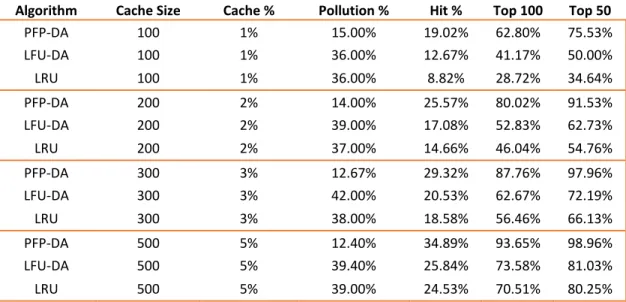
Table 2: ST with Varying Cache Size, Single Attacker at 720 Frequency ... 66
Table 3: AT with Varying Cache Size, Single Attacker, 720 Frequency - Pollution % ... 68
Table 4: AT with Varying Cache Size, Single Attacker, 720 Frequency - Hit % ... 68
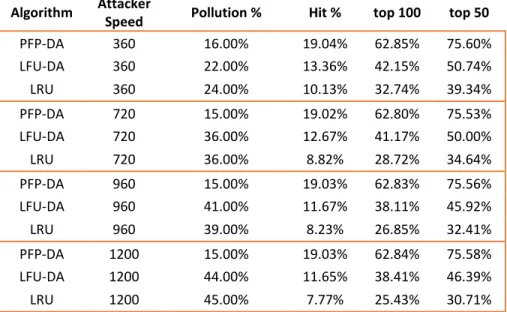
Table 5: ST with Size 100 Cache, Single Attacker with Varying Request Frequency ... 70
Table 6: AT with Size 100 Cache, Single Attacker with Varying Request Frequency - Pollution % ... 73
Table 7: AT with Size 100 Cache, Single Attacker with Varying Request Frequency - Hit % ... 74
Table 8: ST with Size 100 Cache, 720 Attack Frequency, with Varying Number of Attackers .. 76
Table 9: AT with Size 100 Cache, 720 Attack Frequency, with Varying Number of Attackers – Pollution %... 81
Table 10: AT with Size 100 Cache, 720 Attack Frequency, with Varying Number of Attackers – Hit % ... 81
Table 11: AT with Size 100 Cache, Varying Attack Frequency, with 3 Attackers – Pollution % 84 Table 12: AT with Size 100 Cache, Varying Attack Frequency, with 3 Attackers – Hit % ... 85
Table 13: Early Results of Varying β Value ... 90
Table 14: PFP- β with single attacker, cache size of 100, beta of 0.05, varying attack frequency91 Table 15: Two attackers, frequency of 720, cache size of 100, varying beta value ... 92
Table 16: Two attackers, frequency of 720, β value of 0.1, varying cache size ... 92
Table 17: Attacker frequency of 720, β value of 0.1, cache size of 100, varying number of attackers ... 93
ix
LIST OF FIGURES
Figure 1: Format of FIND packet in DONA ... 17
Figure 2: Format of Interest and Data Packets in NDN ... 22
Figure 3: Forwarding in NDN (Adapted from [11]) ... 23
Figure 4: Normalizing Popularity Contributions in PFP ... 38
Figure 5: UML Class Diagram of the FaceContentFrequency and ContentFrequency Classes ... 44
Figure 6: UML Class Diagram of the PopularityPolicy class ... 50
Figure 7: UML Domain-Level Class Diagram of App hierarchy ... 57
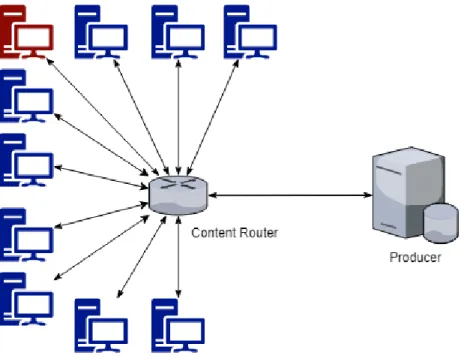
Figure 8: Simple Topology with Single Router and Ten Consumers ... 63
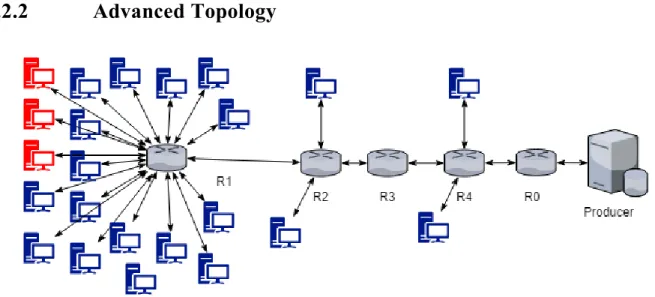
Figure 9: Advanced Topology with Five Routers, Twenty-Three Consumers, and a Producer ... 64
Figure 10: ST with 100 Cache Size, Single Attacker, Varying Attacker Request Frequency Pollution %... 71
Figure 11: ST with 100 Cache Size, Single Attacker, Varying Attacker Request Frequency Overall Hit % ... 72
Figure 12: ST with 100 Cache Size, Single Attacker, Varying Attacker Request Frequency Top 50 Items Hit % ... 72
Figure 13: ST with 100 Cache Size, 720 Attacker Frequency, Varying Number of Attackers Pollution %... 77
Figure 14: ST with 100 Cache Size, 720 Attacker Frequency, Varying Number of Attackers Hit % ... 78
Figure 15: ST with 100 Cache Size, 720 Attacker Frequency, Varying Number of Attackers Top 50 Hit % ... 78
Figure 16: Per-Item Hit Rate, Zero Attackers, Simple Topology ... 80
Figure 17: AT with 100 Cache Size, 720 Attacker Frequency, Varying Number of Attackers Pollution %... 82
Figure 18: AT with 100 Cache Size, 720 Attacker Frequency, Varying Number of Attackers Overall Hit % ... 83
Figure 19: AT with 100 Cache Size, 720 Attacker Frequency, Varying Number of Attackers Top 50 Hit % ... 83
Figure 20: AT with Size 100 Cache, Varying Attack Frequency, with 3 Attackers – Pollution % ... 85
Figure 21: AT with Size 100 Cache, Varying Attack Frequency, with 3 Attackers – Hit % ... 86
Figure 22: AT with Size 100 Cache, Varying Attack Frequency, with 3 Attackers – Top 50 Hit % ... 86
x
LIST OF EQUATIONS
Equation 1: Contribution from a Face ... 39
Equation 2: Overall Popularity, P(C) of a Content Object, C ... 39
Equation 3: Logical Quota of Cache Capacity ... 41
Equation 4: Cache Pollution Ratio For Two Attacker Scenario ... 42
Equation 5: LFU-DA Key Value Calculation ... 54
xi
LIST OF ALGORITHMS
Algorithm 1: Popularity Manager's Get Overall Popularity Pseudocode ... 45
Algorithm 2: Popularity Manager's Record Interest Stats Pseudocode ... 47
Algorithm 3: Popularity Manager's Record Hit and Miss Info Pseudocode ... 48
xii
LIST OF THEOREMS
xiii ABSTRACT
Information-centric networks (ICNs) are a category of network architectures that focus on content, rather than hosts, to more effectively support the needs of today’s users. One major
feature of such networks is in-network storage, which is realized by the presence of content storage routers throughout the network. These content storage routers cache popular content object chunks close to the consumers who request them in order to reduce latency for those end users and to decrease overall network congestion.
Because of their prominence, network storage devices such as content storage routers will undoubtedly be major targets for malicious users. Two primary goals of attackers are to increase cache pollution and decrease hit rate by legitimate users. This would effectively reduce or eliminate the advantages of having in-network storage. Therefore, it is crucial to defend against these types of attacks.
In this thesis, we study a specific ICN architecture called Named Data Networking (NDN) and simulate several attack scenarios on different network topologies to ascertain the effectiveness of different cache replacement algorithms, such as LRU and LFU (specifically, LFU-DA.) We apply our new per-face popularity with dynamic aging (PFP-DA) scheme to the content storage routers in the network and measure both cache pollution percentages as well as hit rate experienced by legitimate consumers.
xiv
The current solutions in the literature that relate to reducing the effects of cache pollution largely focus on detection of attacker behavior. Since this behavior is very unpredictable, it is not guaranteed that any detection mechanisms will work well if the attackers employ smart attacks. Furthermore, current solutions do not consider the effects of a particularly aggressive attack against any single or small set of faces (interfaces.)
Therefore, we have developed three related algorithms, namely PFP, PFP-DA, and Parameterized PFP-DA. PFP ensures that interests that ingress over any given face do not overwhelm the calculated popularity of a content object chunk. PFP normalizes the ranks on all faces and uses the collective contributions of these faces to determine the overall popularity, which in turn determines what content stays in the cache and what is evicted. PFP-DA adds recency to the original PFP algorithm and ensures that content object chunks do not remain in the cache longer than their true, current popularity dictates. Finally, we explore PFP-β, a parameterized version of
PFP-DA, in which a β parameter is provided that causes the popularity calculations to take on
Zipf-like characteristics, which in turn reduces the numeric distance between top rated items, and lower rated items, favoring items with multi-face contribution over those with single-face contributions and those with contributions over very few faces.
We explore how the PFP-based schemes can reduce impact of contributions over any given face or small number of faces on an NDN content storage router. This in turn, reduces the impact that even some of the most aggressive attackers can have when they overwhelm one or a few faces, by normalizing the contributions across all contributing faces for a given content object chunk.
During attack scenarios, we conclude that PFP-DA performs better than both LRU and LFU-DA in terms of resisting the effects of cache pollution and maintaining strong hit rates. We also demonstrate that PFP-DA performs better even when no attacks are being leveraged against
xv
the content store. This opens the door for further research both within and outside of ICN-based architectures as a means to enhance security and overall performance.
1
Chapter 1
Introduction
1.1
Background and Motivation
1.1.1
Challenges of the Current Internet
The architecture of the current Internet is host-based, depending heavily on location, which is enabled through use of Internet Protocol (IP) addresses. The usage and needs of the Internet of today is quite different from its inception. When the Internet was originally designed and implemented, its usage was largely for disseminating research data and sharing expensive resources, not content [1]. Security was an afterthought, as the need was far less in the earliest years of its existence. Today, users of the Internet are increasingly mobile and more interested in content, regardless of what server or source the desired content comes from.
On-demand content such as movies and television shows through popular content providers such as Netflix [2] and YouTube [3] is expected to be delivered in a timely, streaming manner. Since the Internet was not designed for such enormous amounts of content and performance, overlay networks and other technologies were created to overcome some of the inherent problems with the Internet. Content-delivery networks are one of these types of networks.
In North America alone, real-time entertainment is still a dominant player in downloads, accounting for 71.02% of all related fixed Internet traffic and 38.29% of all
download-2
related mobile Internet traffic during peak hours [4]. Content delivery (or distribution) networks (CDNs) are an application-layer solution to the limitations of the underlying Internet architecture. These CDNs provide redundant copies of data and services in geographically dispersed locations so that the content can be closer to the users that use them. The goal, of course, is to increase performance and availability. One excellent pioneering example of content delivery networks is the Akamai network [1]. This CDN was developed in the late 1990s and early 2000s to help organizations overcome the obstacles that are present in the fundamental Internet. Other CDNs such as Amazon CloudFront CDN [5] exist and provide similar services to companies and organizations for a fee.
However, despite all the changes of Internet usage over time, the fundamental architecture of the Internet itself remains the same as it was originally, namely: heavily host-centric. The application overlay solutions such as the CDN virtual networks are piling up in an attempt to meet
the demands of today’s users. As a result, many researchers have suggested that the Internet needs a fundamental re-design, such that it is information-centric rather than host-centric.
1.1.2
Information-Centric Networking
Information-centric networking (ICN) is one broad category of Future Internet Architectures (FIAs) that was promoted and funded by the National Science Foundation’s Future
Internet Architecture Project [6] that provides an alternative to the current host-centric paradigm. This new paradigm considers content (rather than hosts) as first-class citizens and the primary focus of the architecture. An ICN is aware of content and works to deliver the requested content to the user in an efficient manner, with full awareness of the underlying network, built-in security, privacy, and mobility in many ICN architectures, and most importantly to this research, in-network caching.
3
Several specific ICN architectures have been proposed. These include the Data-Oriented Network Architecture, or DONA [7], the Network of Information, or NetInf [8], Content-Centric Networking, or CCN [9], Named Data Networking, or NDN [10], [11], MobilityFirst [12], [13], and PSIRP/PURSUIT [14], [15]. Arguably the most popular among these is NDN [11], which is the specific ICN architecture considered in this work.
With the focus of this research being on in-network caching and related topics, it is important to briefly discuss the enabling technologies here. In-network caching takes place in so-called content storage routers throughout the network, which seek to accomplish what CDNs do, but without application layer overhead. Thus, in comparison to the typical content custodians (e.g., CDN servers, origin servers) that cache content at the application layer, content in ICN is cached throughout the network in the content storage routers. In-network caching is a very important characteristic of many of the different ICN architectures and is intended to perform much of what CDNs do, but at the network layer. More details on ICNs are discussed in Chapter 3.
1.2 Problem Statement and Methodology Overview
There are many interesting and unique challenges in information-centric networking related to security, including those related to privacy, access control, denial of service, content poisoning, and many others, but of the security issues being researched, cache pollution attacks remain largely unexplored [16]. This type of attack and the mitigation or prevention of its effects will undoubtedly become a topic of greater interest as the in-network caching mechanisms are researched further and built [17]. As a result, this work explores the effects of cache pollution attacks, and how they might be mitigated.
4
In ICN, a cache pollution attack is one in which an attacker seeks to decrease the effectiveness of in-network caches by causing the content storage routers to cache unpopular content objects, thus rendering the caches ineffectual. While some researchers consider cache pollution attacks to be a subset of denial of service (DoS) attacks, many others tend to categorize them separately. A few notable examples exist of research intending on reducing the effects of cache pollution attacks in ICN and will be explored in more detail in the literature review in Chapter 2.
However, none of the current research efforts, nor state-of-the-art approaches provide special protection against very aggressive attackers that overwhelm one or a few faces. This research is focused on providing protection against the ill-effects of cache pollution attacks in both single attacker scenarios and multiple attacker scenarios.
Methodologically, some key statistics drive the assessment of algorithms in this work. These include cache pollution percentage and hit ratio.
Cache pollution percentage is the percent of the cache of a content storage router that contains content objects that were requested by the attacker. For effective measurement (and related to the typical approach used by attackers), there should be little to no overlap between the content objects requested by legitimate consumers and those requested by attackers. Regular consumers in any given area tend to request the same popular content objects frequently, and less popular objects less frequently. From the study of Web caching, we know that sets of consumers generally request the more popular contents in a Zipf-like distribution [18], [19]. Attackers, on the other hand, will request content objects that are far less popular in order to replace actually popular content in the cache with their own.
5
Hit ratio is a measurement of the number of hits on a cache in a given storage router versus the total number of interest messages that have arrived at that same router. A hit occurs when an Interest message arrives for a content object, and that content object is cached in the router’s cache.
A miss occurs when an interest message arrives for a content object, and the data is not in the content store (cache.) For purposes of research, it is meaningful to only measure the hits and misses of legitimate users, and not include those experienced by attackers.
For a content storage router’s cache to be effective, it is crucial that hit percentages be as
high as possible, and to minimize cache pollution percentages. This research is largely focused on improving these two metrics under various conditions, in a named-data network (NDN) simulation environment.
It should be noted that it is possible that one (or more) of the current approaches (e.g., CacheShield) could be used in tandem with our PFP-DA scheme, so the research done toward this thesis need not be considered completely at odds with current approaches, but as potentially being complementary to them, and being complemented by them. PFP-DA is used to mitigate the effects of cache pollution, and improve cache robustness, while schemes such as CacheShield are primarily involved in the detection of attackers. Thus, applying different approaches to improve the overall performance is possible, and these technologies need not be treated as mutually exclusive or adversarial to one another.
1.3
Contributions
The primary contributions of this work are as follows:
We have designed and constructed a new approach to cache replacement algorithms based
6
normalizes the contributions from consumers on any given face, such that the overall impact any one face can have on the popularity of a given content object is no greater than the overall impact of the aggregate contributions on any other face.
We have revised the original PFP approach with a dynamic aging aspect, resulting in the PFP-DA scheme, which is more scalable and more efficient, and ensures that no particularly popular content object remains in the cache longer than its lifetime should allow. Thus, in addition to the normalized frequency aspects of the PFP algorithm, a recency characteristic is added as well. To enable PFP-DA, modifications to the ndnSIM [20] simulator itself were necessary. This includes introduction of a data manager class (PopMan), modification of the forwarding plane, and modification of consumer types, such as enabling ConsumerCbr to behave as an attacker with the appropriate parameters.
The results from our tests discussed in detail later in this thesis indicate a clear advantage of PFP-DA over LRU and LFU-DA cache replacement algorithms. The advantages are measured by comparing pollution percentages, which we wish to minimize, and hit rates (hit percentages), which we wish to maximize. PFP-DA shows a level of resilience against the effects of cache pollution attacks that the current algorithms do not, as well as an overall improvement over LRU and LFU-DA even in scenarios where no attacker is active.
1.4
Thesis Organization
The rest of this thesis is organized as follows:
Chapter 2 is a literature review of the current topics of interest to Information Centric Networking (ICN), its goals, and some of the popular ICN architectures in the literature. It also
7
discusses the role of caching and the need to prevent cache pollution from having significant impact on content storage routers in ICN networks, in more detail.
Chapter 3 discusses the per-face popularity (PFP) and its modified counterpart, per-face popularity with dynamic aging (PFP-DA) and how content objects are maintained and removed
from a content storage router’s cache. Related equations and analysis of the scheme are presented
as well. Furthermore, the chapter highlights some of the important data structures and algorithms related to the PFP schemes, modifications made to the simulator itself, and how the replacement policy works.
In Chapter 4, the simulation environment is discussed further, and simulation scenarios are defined. The two primary topologies used for the collected data, a simple and more advanced topology, are presented. Finally, Chapter 4 ends with the results of the experiments that were performed and how the results of PFP-DA compare with the popular LRU and LFU-DA cache replacement algorithms.
Chapter 5 considers how slight modifications of the PFP-DA popularity calculations can move us toward zero or at least far more negligible cache pollution. This is done by a small change to the actual overall popularity calculations, using a special β value to reduce the differences
between the contributions for subsequent rankings for a given content object.
Finally, Chapter 6 covers conclusions made, and the opportunities for future research to further improve the performance and effectiveness of PFP-DA.
8
Chapter 2
Literature Review
2.1 Information Centric Networking
The current architecture of the Internet was originally developed in a very different world. The Internet was designed for sharing expensive resources, between cooperating, trustworthy, and relatively few hosts. The organizations that shared these resources primarily consisted of academic and governmental entities. In addition to sharing these expensive resources, the ability to add new individuals to the network easily, and even connect new networks to the Internet were primary goals.
While the Internet has made possible incredible technologies, communication, and interconnectivity, the architecture itself is showing its age. The primary usage of the Internet has changed dramatically since its inception. The primary goals of its users are no longer the sharing of expensive resources and easy addition of networks and individual devices in a trustworthy environment (although these are certainly supported); rather, users of today’s Internet are
interested in massive content upload and download, mobility, security, privacy, and other such features that were never even considerations of the early Internet architects.
Because of the growing focus on content, rather than on hosts, many researchers in information-centric networks (ICN) have suggested that there be a clean slate redesign of the Internet architecture itself. This new architectural paradigm (ICN) focuses on the information, and
9
the requesters of the information (typically consisting of consumers, also called subscribers) instead of focusing on hosts or locations, and the providers of the information (consisting of publishers, producers, or other content custodians.)
In the current host-centric architecture, if a user wishes to acquire some content, the user
must know not only the content or service, but also that content or service’s location, often in the
form of a URL (or URI.) But the current needs of Internet users are not naturally satisfied by the network. It is obvious that users can retrieve content in today’s Internet from a variety of locations (such as CDNs, described earlier.) However, the “black boxing” or obfuscation of the location
and complexity of content retrieval is handled by application-level solutions and patches rather than consisting of first-class solutions provided by the network-layer itself. This structure does not take advantage of network layer optimizations.
Thus, information-centric networking fundamentally changes the way information is found and delivered, in terms of how the information is associated with the location at which it is stored. ICN decouples the information from the location(s) at which it is stored. Because this is so incredibly different, the clean-slate approach is seen as the best approach to the future Internet. Any other approaches to a Future Internet would take the form of application-layer patches on top of the fundamentally aged Internet with its inadequate protocols. This is already done extensively by many overlay networks.
There are multiple challenges in information-centric network research, including naming, name resolution, data routing, mobility, security, efficient data delivery, and many others [17].
10
2.1.1 Fundamental Design Considerations in ICN Architectures
When designing a new architecture, especially one for something as large as the Internet, it becomes more and more important to determine fundamental design goals. While different ICN architectures may focus on different sets of design goals, many of the more important ones will be discussed here.
Naming
Because the content in an information-centric network is the focus (rather than hosts), a way by which we identify that content becomes crucial. The process of providing such identifiers for content defines an architecture’s naming scheme. Naming is a large challenge in an ICN,
because instead of just providing “names” (IP addresses, for example) for devices within a
network, an effective ICN architecture must develop a scheme that is both efficient and effective to distinguish between different information objects (data, content, services, etc.) The namespace, which is the number of available names, must be enormous in such an architecture. In [21] the authors estimate the namespace must be between 1013 and 1015.
A primary consideration regarding naming is whether the content object name will be flat or hierarchical. A flat name is one that is not hierarchically or otherwise linked to other names. However, one benefit of flat names is that they can be made to be more easily self-certifying. This reduces or removes the need for a third-party authentication source, increasing efficiency and could also reduce network traffic overall. A hierarchical name, on the other hand, is a name that is related to other names or entities and classified in a hierarchy. An example of a human-readable hierarchical name would be a URI/URL-like name, such as umdearborn/audio/bachconcerto.m4a. However, it is important to note that hierarchical names need not necessarily be human-readable.
11 Name Resolution and Data Routing
Because they are related (often coupled tightly in some architectures), the topics of name resolution and data routing should be discussed together. Name resolution is the process by which a name is resolved to a location (or locations.) Although in an information-centric network, the application layer does not generally need to know the location of a requested content item, the network itself does. At some point, content must be located and transmitted back to the user, or if the content cannot be found, the user must be informed of this fact. In other words the content name must be matched to a content source.
Data routing is the process of producing a path through which the data travels from the producer or content custodian (provider of information) and the consumer or subscriber (requester of information.) How the name is resolved can dramatically affect how the data is routed.
There are two primary approaches in which the name resolution and data routing characteristics of an ICN architecture are associated with one another. One of these ways is a
coupled approach. In a coupled approach, a request for information is sent to the publisher of the content or a content storage source containing the requested content (typically through multiple hops across various routers.) Then, when the publisher responds with the content itself, the content travels the same path as the initial request, just in reverse order.
In a decoupled approach, on the other hand, the name resolution service doesn’t determine
the route between subscriber and publisher in a manner which causes the data to travel the reverse path of the request.
Mobility
In the early Internet, devices and systems were relatively fixed. They didn’t move very
12
be a high priority requirement of any architecture that will ultimately replace the current Internet architecture. In fact, the traffic generated by mobile devices is expected to surpass the traffic generated of PC traffic by 2021, with smartphones alone accounting for 33% of total Internet traffic, and PCs to account for only 25% [22]. The addressing scheme of the Internet reflects the fact that it was designed in consideration of fixed hosts, not mobile hosts.
Although mobile nodes can typically easily switch networks, changing their IP addresses in the process, this type of approach does not provide continuous connectivity during periods of mobility. This is an increasingly desirable feature.
Mobile IP ( [23]) is not a very efficient solution. It is not a fundamental part of IP, but rather a patch. Worse than this, it creates so-called triangular routing in which packets have to be sent from the content source to a home agent, and then to the mobile device. Similar situations occur when the mobile device generates data, the data may have to be transferred to a home network agent first and then to the requesting entity. This is obviously very inefficient.
The ICN approach to mobility is built upon the publish/subscribe communication model ( [24].) Entities offering information or providing a service publish advertisements for the information to the network. Entities that desire particular information subscribe to the information. A special entity called a broker is responsible for matching the subscriptions with publications. As the authors of [25] note, this is different than a traditional understanding of publish/subscribe. In such a traditional scheme, the publishing function involves transmitting the data to the end users/subscribers. In ICN, publishing just involves advertisement of availability of content.
It may not be clear why this aids in mobility for network entities. A fundamental decoupling occurs between the subscribers and the publishers, both in terms of space (physical location) and time (when the content is requested.) The publishers in such a model take a more
13
passive roll, and the subscribers have more control. The network causes the publishers and subscribers to be relatively agnostic of one another.
Security
Another high priority consideration in ICN architectures is that of security [17] , [26]. The host-based Internet that we use today was originally developed in an environment that depended
on trust. Trustworthy individuals sharing research and data across the early Internet didn’t have
to worry as much about issues of confidentiality and integrity of data or origin authenticity. The Internet was relatively small and made up of individuals and entities that could trust one another. It was also designed in such a way that any traffic injected into it, with the right information in packets, will get forwarded. This design lends itself to denial of service (DoS) attacks and other problems.
The requirements of the early Internet are quite different from the requirements we have today. Security is of utmost importance. The security protocols and mechanisms that exist today are primarily just patches that attempt to fill the gaps in security of the underlying network design. ICN architectures are largely focused on subscriber-oriented data transmission. In other words, there is no data flow unless the data is requested. This is an underlying network characteristic that makes it much more difficult to perpetrate certain malicious attacks. Furthermore, ICN architectures that use self-certifying names can aid the filtering of junk or malicious data.
14
2.1.2 Popular ICN Architectures
Although ICN can be viewed as a set of goals and principles, many different solutions have been proposed to accomplish these goals. In this section, we discuss a few of the most popular ICN architectures.
Data-Oriented Network Architecture (DONA)
The Data-Oriented Network Architecture (DONA) was originally proposed in [7] and is one of the first fully defined ICN architectures. The naming scheme in DONA is flat instead of hierarchical. This means that unlike other naming schemes, such as URLs, which have a hierarchical structure (e.g. umdearborn.edu/courses/somecourse), DONA assigns names that are truly flat and are not related to their location. The information in DONA can move about the network, change networks, change content servers, and it will still keep the same name. This strongly achieves the desired ICN goal of having decoupled location and information name.
In DONA, the names are dependent upon principals. A principal is essentially a trusted entity that uses a public key cryptographic system and has the ability to authorize hosts to publish (provide) data or services. A name in DONA is made up of a cryptographic hash (called P) of the
principal’s public key, and a label (called L), chosen by the principal for the named information. The principal is also responsible for ensuring that the label is unique within its affected authorization. Thus, a particular named item in DONA takes the form P:L.
When a client retrieves data, this means that the client will receive a triplet of the form
<data section, principal’s public key, principal’s signature> and possibly other related metadata.
This format of the data allows the clients to immediately determine the integrity of the data they receive.
15
In other words, when a client requests data with the name P:L, it receives the aforementioned triplet (<Data, Pk, Sig>), and can use the public key to ensure that it hashes correctly to P. This helps to ensure the origin integrity (authenticity) of the data. Further, the key can be used to ensure that it did in fact generate the signature for the particular data in the triplet. This provides data integrity, to ensure that the data was not tampered with between its publisher and the subscriber (origin and destination.) Due to these characteristics of the named data triplet in DONA, the names are considered to be self-certifying. In other words, no additional parties are needed to perform verification on the received data.
The recipient of the data can simply apply the aforementioned checks and determine immediately if the data is genuinely what was requested, and that the provider of the data is authorized/approved by the principal. As an additional note, another interesting aspect of names in DONA is that, while primarily focused on information and services, the names could apply to essentially any entity.
The flat names in DONA would not be very user-readable. So that brings up many challenges and issues, such as how users will remember these long and difficult names. The answer to that particular question is that users will not be expected to remember the full names, but will, similarly to URLs in a DNS system, directly interact with a user-friendly name associated to each content (service, etc.) item. One major difference however, between DNS and DONA, is that the names in DONA will not be attached to a particular location. Furthermore, DONA does not provide a reverse-lookup mechanism.
DONA is built around the goal of providing close-by copies of requested information and reducing and recovering from failures. In every autonomous system (AS) in DONA, there will be at least one logical Resolution Handler (RH.) These network entities will provide a DNS-like
16
service to the DONA system. The RHs themselves are organized in a hierarchical fashion. When one RH is above another on the hierarchy, it is said that the higher RH is the parent of the RH lower in the hierarchy.
To accomplish name resolution, DONA uses two message packets, FIND and REGISTER. When a publisher/provider wishes to offer some data or service, it issues a REGISTER(P:L), where P:L is the name based on the scheme described earlier. Each RH maintains a registration table that has information in it about next hop (to the next RH) and distance to the available copy (or copies) of the information being requested through a FIND(P:L) message.
The REGISTER messages must be authenticated by an RH. The RH issues a challenge to
the client, and it must be able to sign with the principal P’s private key (proving that it is the
principal), or provide a certificate or other proof of having been authenticated by the principal. It is important to note that REGISTER messages can expire, since they have a TTL (time to live.) Additionally, a publisher/provider of content can issue an UNREGISTER message to indicate that they are no longer providing a particular piece of content.
The technique used by Resolution Handlers is LPM (longest prefix match.) Thus, if the registration table of a particular RH contains an entry for P:* (any data under the hash of principal P), then that is considered a match (on P.) However, if the RH has P:L as an entry in its registration table, it obviously serves the information with the name P:L (or forwards the FIND to the next hop), since this is the longest prefix match. If neither P:* nor P:L are found in a registration table, then that RH is said to not have information on the data item being searched for. If the data item is not found, then the RH forwards the FIND to its parent.
17
Additionally, the special form FIND(*:L) indicates that the subscriber is willing to accept information with a matching label from any publisher/provider. The format of a FIND packet is as follows, replicated from the original work of the authors of [7]:
IP header
Type Name(P:L) – 40 bytes Next Header Type
Transport Protocol Header
Figure 1: Format of FIND packet in DONA
The FIND messages continue to be forwarded up the RH hierarchy until they find a match, or until the message reaches a Tier-1 Autonomous System. At this point, if the P:L is not found, then a not-found error is generated and sent back to the issuer of the FIND message.
Also, RHs are not involved in the transport of the data resulting from a FIND message back to the requester. The actual data transfer can be handled by standard IP network routing and forwarding protocols.
Caching can also be done in DONA using the Resolution Handlers. The RHs decide what information objects to cache. Once they do so, they take an incoming FIND request and replace the source (the subscriber) IP address with its own to ensure that after the FIND request is forwarded, the content requested will definitely be sent back to the RH. The RH will know to forward the data further to the original subscriber, but the rest of the network will think that the RH is the original subscriber. This is an appropriate approach, especially for the decoupled approach with DONA. Note that DONA can be either coupled or decoupled. With the source replacement technique in FIND messages, the information requested is guaranteed to be delivered through the requesting RH to be cached. Then if subsequent requests for the information are made, the RH can deliver the information instead of moving the request (FIND) up the RH hierarchy.
18
Mobility is naturally supported since it is a subscriber-driven architecture. Mobile entities simply issue a FIND message from whatever their current location is, and the Resolution Handler infrastructure provides them with the closest copy of the information. Even mobile publishers are supported. They would simply have to unregister content from one network location and re-register in another. There is overhead with this process, but it is straightforward and clean. As noted earlier, security is also supported within the naming choice of DONA. The flat names are self-certifying.
Network of Information (NetInf)
The ICN architecture, Network of Information, known also as NetInf [8] describes information (content) as Information Objects (IOs), which are the center of the architecture, relegating hosts to a secondary position. The actual bit and byte level of the content is referred to as Data Objects (DOs), which are of less concern or interest to the user than are the IOs. However it is important to note that DOs can be further broken down into chunks. It is a significant feature of NetInf that there is a decoupling not only between host and content, but also between data object and information object. An IO can be viewed as an aggregation of data objects. The data objects, depending on the situation and type, could be swapped out, whereas the IO identifier would remain (i.e., persistent identifier.) The authors in [8] do not give full implementation details, but rather desirable characteristics and directions for development of a Network of Information (NetInf.)
NetInf and related research expands upon the notions of content as a centralized citizen in the network from [10] and the importance of audio/visual, web, and e-mail and further promotes the importance of real-time streaming, VoIP, and other live, time-sensitive technologies.
19
Information Objects contain metadata, which can be used to determine if a particular IO satisfies subscriber interest, or if it is (and how it is) related to other information objects. Metadata can take many forms, such as the use of RDF (Resource Description Framework) tags, which are already popular in Semantic Web technology.
Security is a very important topic and fundamental NetInf primitive requirement [27]. The flat names in NetInf are self-certifying and are designed such that they enable both data integrity and origin/owner integrity (identification and authentication.) The content identifiers (IDs) persist even when the owner or location may change.
The name resolution in NetInf is used to resolve the content name to a location (or locations) at a high-conceptual level as the familiar host-based DNS works. However, it should be noted that DNS requires a hierarchical namespace, so a flat namespace cannot use such a system exactly like DNS.
NetInf distinguishes between global resolution which works at a global scale, much like the current host-based Internet does, and local resolution, which allows for resolving and locating local content available in near proximity or local scope (e.g., in the same building or locale), and in intermittent scenarios (e.g., mobile ad-hoc networks.)
DHTs (distributed hash tables) are one of the most popular approaches to performing the name resolution. DHTs are quite effective, especially in terms of local resolution. However, the authors note that scalability becomes an issue largely due to the nature of autonomous systems (ASs.) The authors note a preference for flat names due to their ability to be self-certifying, but also realize the desirable characteristics of a hierarchical system in that names can be aggregated.
20
Therefore, an effective name resolution (NR) system would provide a trade-off between scalability and name persistence.
NetInf utilizes a multilevel distributed hash table (MDHT) approach [28]. Regular DHTs are typically quite good for intra-AS name resolution but can experience problems due to the notoriously poor cooperation between various autonomous systems [8]. This MDHT system allows multiple DHT areas (scopes) to exist. The content is registered at three levels, from most local to more global: Access Node (AN), Point of Presence (POP), and finally Autonomous System (AS.) For example, an access node (AN) DHT exists and can run its own DHT algorithm, so intra-area routing is done using this algorithm. When performing inter-area communication, a node must be found that can communicate with a higher level. For example, an AN that can communicate with a POP node, or a POP node that can communicate with an AS node. It should be noted that the content itself is registered at all three levels (AN, POP, and AS.)
If content is not found at the AS level in a particular autonomous system, then another level entity, known as the Resolution Exchange (REX) system attempts to find the content. The REX system itself is distributed among the top-level ASes.
The authors indicate that they are involved and encourage research in name-based alternative implementations. This is due to research indicating that costs of communication in dynamic networks cannot grow more slowly than linearly [29], [30].
Content-Centric Networking/Named Data Networking
Content-centric networking (CCN) [9], [10] is another one of the very few full-fledged, early information-centric networking architectures. The goals of CCN are very similar to those of
21
DONA and other ICN architectures. The original CCN researchers sought to develop a scalable, secure, and high-performance network architecture based upon named data.
Building upon the earliest CCN architecture, named data networking (NDN) extends on
Jacobson’s work and is one of five initiatives funded by the National Science Foundation under its
Future Internet Architecture Program (see [11]).
Taking a different approach to naming than DONA, NDN uses a hierarchical naming scheme, where names can be like URLs. For example, the name of a given audio clip of a lecture in computer science produced by a professor at University of Michigan – Dearborn might take the form umdearborn/content/cis/audio/lec1cis427.mpg. Although this looks like a URL, this type of name is not the same as a name interpreted by DNS. In fact, it need not even be human-readable. The reason that NDN researchers have chosen a hierarchical naming scheme is because they see it as being beneficial to aggregation.
Technically, in named data networking, the content or service publishers can choose the naming scheme for specific applications since a precise naming architecture is not clearly defined in NDN. This leaves a very large namespace available to publishers of content to choose from. It is likely that if NDN is more fully adopted and implemented that publishers will have standards or conventions, but NDN itself puts very few hard requirements on the name structure itself.
NDN uses longest-prefix matching to resolve name requests. It even allows for the possibility of request content that hasn’t been produced yet (some content is produced on the fly.)
The publisher would create the name deterministically within the context of its naming scheme and then send the information back to the requester.
The authors in [11] suggest that this can be done either by using a deterministic algorithm that would allow both producer and consumer to arrive at the same name, or by using Interest
22
selectors along with the longest prefix matching to retrieve the desired data. The authors suggest that a simple set of selectors can be used along with partially known names to retrieve the data.
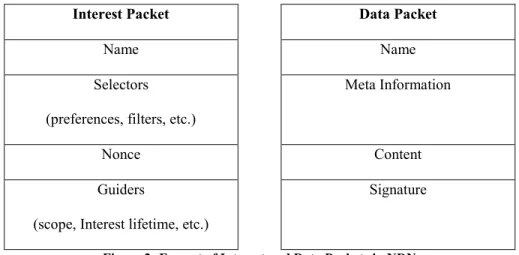
In NDN, there are two kinds of messages: Interest messages and Data messages. Interest messages are used by subscribers to indicate their interest in a particular piece of content. In response, a provider (publisher) of the content responds with a stream of Data messages.
The format of the Interest and Data messages is as follows:
Interest Packet Data Packet
Name Name
Selectors (preferences, filters, etc.)
Meta Information
Nonce Content
Guiders
(scope, Interest lifetime, etc.)
Signature
Figure 2: Format of Interest and Data Packets in NDN
Notice that both the Interest and Data packets contain the name of the information being requested, or delivered, respectively. All messages are forwarded by Content Routers (CRs.) These special routers maintain three data structures that are crucial to routing within the NDN architecture:
• FIB (Forwarding Information Base)
• PIT (Pending Interest Table)
23
Figure 3: Forwarding in NDN (Adapted from [11])
Forwarding can be visualized as seen in Figure 3, with an X indicating a miss on a particular data structure, and a ✓indicating a hit. The forwarding information base (FIB) is like a forwarding table in traditional host-based IP networks. However, the FIB maps the content names to output interfaces used to forward Interest messages. The FIB has name-prefix entries and can map a name to multiple output interfaces. To populate the FIB, routers advertise name prefixes (e.g., umdearborn.edu) so that the network will know that the CR has that particular content object.
As the name suggests, the pending interest table (PIT) maintains entries for Interest messages that have been forwarded but have not yet been satisfied. The name of the data being requested as well as the incoming and outgoing interfaces are all recorded in the PIT. When an Interest message arrives, the content router’s content store (CS) is checked to see if the data exists.
If it does, the data is returned on the incoming interface.
The content store (CS) is where a router will cache data that it determines might be popular or was requested recently, might be requested frequently, etc. If the data is not found in the content store, the next check is the PIT. If it is found in the PIT, which as I noted lists all the pending
Interests, the PIT records only the incoming interface for that information that is being requested. Why is the Interest message not forwarded on? Because the pending Interest indicates that when
24
(or if) the data is found, a Data message containing the information will find its way back to the content router. Then, the Data will be forwarded on all the incoming interfaces, because these all indicate requests for the same content. Forwarding the Interest message further would have been a waste of resources.
If neither the CS nor the PIT contain the data that is being requested, then that means that the Interest is a fresh request, and must be forwarded, so the incoming and outgoing faces are recorded in the PIT until the request is satisfied.
The Data message follows the path back (similarly to the way a path is taken in a symmetric routing protocol), and the Interest entries in the PIT that have no other outstanding incoming interfaces are removed from the PIT after the forwarding of the Data on the incoming face has been performed.
Like in DONA, mobility is supported naturally in NDN. Instead of FIND messages, the mobile subscriber simply issues new Interest messages from its current location. If an Interest were generated in one network, just before entering a second network, the first CR common to both networks would suppress the Interest packets from going any further through the network. This is essentially the same case as if the mobile node in network B having moved from network A were simply a completely different node making a request for the same content. Note that an attempted delivery of data will occur to the original location as well as the new location of the mobile node. If a publisher moves, the forwarding information bases (FIBs) that point to that publisher must be updated. Thus, the publisher must advertise the name prefixes that it can handle. In terms of security, NDN does support human-readable names being associated with the actual information object names. All Data messages include signatures based on the name and other information that can be used to identify and certify the signer or certification authority. Thus,
25
all nodes, including mobile, static, individual, group, or even content routers can verify that the name and packet are legitimate and belong together.
MobilityFirst
MobilityFirst [12], [13] is an information-centric Future Internet Architecture project that focuses on security (specifically, trustworthiness) and as the name suggests, mobility, as its central design goals. The fundamental support of mobility in the architecture means that mobile devices, information, services, and other network entities must be able to seamlessly transition between various networks. The recognition of the traditional IP architecture as being fragile when dealing with mobile and wireless networks and the ever-growing number of mobile computing devices were fundamental inspiration for the MobilityFirst project.
Names in MobilityFirst are GUIDs (globally unique identifiers.) These GUIDs are assigned by a GNS (global naming service.) Names are used to identify a multitude of different entities, known as principals in MobilityFirst such as interfaces, devices, services, human users, content, or another collection of GUIDs. The GUIDs are self-certifying, flat, 160-bit strings. The names can be one-way hashes of information fragments or entire information objects, one-way hashes of public keys, or other entities. The self-certification property of the globally unique identifiers means that any principal can authenticate other principals without using a third-party certification authority.
One strength of MobilityFirst in terms of naming, is its ability to support both named data-based information and service delivery as well as traditional host-to-host communication (however, this is done by GUIDs, not directly by anything like an IP address.) Further, besides a GUID, it is possible (and useful) for principals to be assigned a human-readable name. The GNS (Global Naming Service) can translate the human-readable names into globally unique IDs.
26
It is also important to note that MobilityFirst uses NAs (network addresses.) These network addresses essentially correspond to autonomous systems (ASes), but can also be used for a more fine-grained network such as a subnet, or larger entities such as data centers or Internet service providers (ISPs.)
The Global Name Resolution Service (GNRS) is the service that translates the GUIDs into network addresses. As with most of the ICNs, we identify a requester of content or service as the subscriber, and the provider of the content or service as the publisher. When a publisher wants to offer some sort of content or service, it asks the GNS (global naming service) for a GUID and then registers its network address, along with its name (GUID) with the GNRS.
When a subscriber requests some content or a service, it makes use of a GET message by sending it to its local CR (Content Router.) The GET message contains the GUID of the requested content or service, as well as the GUID of the subscriber. Since the content router (CR) forwards
the GET message if it doesn’t have the requested content or service to other CRs or other network
entities. Before it can do this, however, it must request the GNRS for a route.
It is interesting to note that the data routing is a hybrid approach, using both IP routing and name-based routing. The GNRS is responsible for mapping addresses to GUIDs, so that traditional IP routing can be used to forward the packets. But the initial request for information, and all end host/end node communication is done by requesting a name. So, the end host interaction with the network and content is based almost exclusively on interacting with names (GUIDs) rather than addresses. The GNRS takes care of the mapping process.
The name resolution and data routing processes are decoupled. This is due to the fact that the GET and content messages/fragments are routed based on their own destination GUIDs. The
27
path that the GET message took need not be the path that the delivery of the data or service takes on the way to the requester/subscriber.
As the name suggests, mobility is a high priority in MobilityFirst. The GNRS is primarily responsible for handling host mobility within the network. Security is also supported based on the GUIDs being mapped to human-readable names. This is quite similar to the way that the name-information object mapping occurs in NDN.
PSIRP/PURSUIT
As the name suggests, PURSUIT uses a Publish/Subscribe paradigm instead of a Send/Receive paradigm. The authors identify three participants in PURSUIT: publishers, subscribers, and a network of brokers. Publishers are the entities which produce, own and/or are responsible for distributing content. Subscribers are the entities interested in the content – they are essentially, the consumers of the content. The Information Brokers in the network are responsible for matching publishers with subscribers, for routing the content, and for initiating the movement of data through the network so that subscribers receive the published content. In PURSUIT, the specific broker that is involved in the matching process between publisher and subscriber is called the rendezvous point or just RV. Also, this point may be referred to as a
rendezvous node, or RN. This allows for effective decoupling of space/time constraints between the subscriber and publisher.
In terms of naming, the fundamental PSIRP architecture (upon which PURSUIT builds) uses flat names, but organizes these identifiers into scopes, allowing for some aggregation into hierarchical structures. Scopes can be physical structures (e.g., campus network, corporate network) or logical structures (e.g., Facebook friends, Twitter followers.) The identifiers are like those used in DONA, in that there is a Sid (Scope identifier) and a Rid (Rendezvous identifier)
28
used to uniquely identify an item. This binary identification is common in DONA-like naming schemes (e.g., P:L). PSIRP is a clean-slate approach to the Internet. In other words, it aims to replace the current Internet architecture without relying on current protocols.
There are three foundational functions that are executed in PURSUIT: rendezvous function, topology and routing function, and forwarding function. The rendezvous function
matches subscribers’ interests with specific content from publishers. The so-called topology and routing module monitors the network topology and constructs and updates the routing tables, effectively creating delivery paths for the content. And of course, the forwarding module is responsible for forwarding information on the appropriate interfaces based on the paths established by the routing function. Routers are also responsible, in many cases, for caching popular content within a domain.
2.2 Review of Security and Privacy in Information-Centric
Networks
While this paper focuses on cache pollution attacks, which will be covered later, other security and privacy issues in ICNs are noteworthy and will be discussed here. The authors of [17] provide a more comprehensive discussion of many different security, privacy, and access control issues that are of importance in ICN. I will only cover a few topics here.
2.2.1 Denial of Service Attacks
Denial of Service (DoS) and Distributed Denial of Service (DDoS) form a pattern of attack in which an attacker wishes to reduce the availability of resources. DoS attacks focus on flooding a network or a specific server with requests in order to make it difficult or impossible for legitimate users to access the assets in which they are interested.
29
Some researchers categorize interest flooding, content poisoning, cache pollution and other attacks as DDoS techniques [31]. Interest flooding consists of an attacker sending interests into the network for content that is unlikely to be cached in in-network storage devices. This is in order to reduce the ability of these in-network storage devices to handle the interests, causing packet drop and network congestion. In NDN, the attack is largely focused on filling the PITs with the
attacker’s interests. If the content being requested is fake (valid prefix, invalid suffix), then the
producers will simply disregard the requests, but the intermediate Pending Interest Tables are left with the pending interests until they are purged due to expiration.
The categories of countermeasure used against various DoS attacks in ICNs include rate limiting on faces, monitoring of PIT size growth, statistical modeling approaches to detect abnormal traffic patterns, and other detection mechanisms designed to punish attackers.
2.2.2 Content Poisoning Attacks
As discussed earlier, some researchers consider content poisoning to be a subset of DoS attacks. However, it is worth treating separately. Content poisoning attacks seek to fill in-network storage devices with invalid or malicious content. This type of attack requires that an attacker control at least one intermediate router so that it can inject invalid content into the network. The content has a valid name, but fake or malicious content or a fake signature. Some ICN architectures are more resilient to this type of attack than others, especially those architectures that use self-certifying names.
A DNS cache poisoning attack occurs when an attacker inserts bad data into a DNS server’s
cache so that they can control server responses for those names. Interest and data packets in NDN are routed directly, and not converted to addresses, so it would seem the problem is solved.
30
However, this is incorrect. The authors of [32] note that NDN cache poisoning can be achieved using a combination of route hijacking and content poisoning. If carefully planned, an attacker can position themselves in a network to answer interests with invalid (and often, quite large) content.
In terms of countermeasures, many approaches exist. Digital signing and verification of each packet is one especially popular approach. For example, SCID (self-certifying interest/data packet) [32] are one such solution. These types of signatures allow the consumers to immediately determine if content was poisoned or not.
Another approach is exclusion-based feedback [33]. This approach takes advantage of a feature in NDN called selectors. If a client independently determines content with certain data to be invalid or poisoned, it can exclude this content and report to the network storage device (content storage router) that it excluded that content. The content storage router can then use these exclusions, collected from all consumers on all faces, to reduce the rank of a content object. Although a potentially effective approach, malicious consumers could send false exclusion data to the router to reduce the rank of normal content.
2.2.3 Privacy
Privacy is an area of discussion that has been largely untouched in ICN architectures [26]. Many architectures naturally leak content and location information, names, payloads, signatures, and other such information. To truly introduce privacy into ICN-based architectures would require introduction of primitives into the network layer with no overlays.
If an overlay was used, this would cause leakage of current IP problems into ICN – duct-taping a fundamental problem that should be solved and optimized at the network layer. However,
31
the authors of [26] argue that an upper-layer service might be required to provide privacy. They even suggest that trying to provide privacy in a name-based architecture like NDN is a fool’s
errand.
The authors of [34] cover privacy as it relates to caching. They suggest that much information can be gleaned simply by an attacker requesting content from a content storage router. If the content was cached, then the attacker can assume that someone with which the attacker shares a face must have requested the content also. This simple type of attack would be classified as a timing attack.
They go further in establishing mitigation for two types of traffic: interactive (such as streaming communication) and content distribution. One of the tactics involves artificial delay. This too comes with problems and has a potential of reducing cache effectiveness. Other approaches such as random cache to create an anonymity set of content. This too comes with trade-offs, and efficiency considerations.
Few papers exist on privacy in ICN. Therefore, privacy remains largely an open issue in ICN-based architectures.
2.3 Caching and Current Approaches to Mitigating Cache Pollution
Effects
In a normal situation within ICN, content storage routers (an enabling technology for in-network caching) should cache the most popular content objects. These cached items typically are requested following a Zipf-like distribution [18]. The goal of caching the most popular items is of
32
course to reduce the latency and network load associated with requests and data transfers for specific content objects.
The goal then, of an attacker leveraging a cache pollution attack against an information-centric network is typically to reduce the effectiveness of the cache by pushing popular contents out. An attacker could do this in many situations by simply requesting less popular content
frequently (often with far more frequency than legitimate consumers’ typical request frequency.)
So, the goals of an attacker in a more granular view is to increase link utilization and to decrease cache hits (and likewise, increase cache misses.)
2.3.1 Cache Pollution
Cache pollution is frequently divided int
![Figure 3: Forwarding in NDN (Adapted from [11])](https://thumb-us.123doks.com/thumbv2/123dok_us/763982.2596637/39.918.148.785.114.314/figure-forwarding-in-ndn-adapted-from.webp)