theRepository at St. Cloud State
Culminating Projects in Information Assurance Department of Information Systems
5-2018
Security Threats Classification in Blockchains
Jamal Hayat MosakheilSt. Cloud State University, [email protected]
Follow this and additional works at:https://repository.stcloudstate.edu/msia_etds
This Starred Paper is brought to you for free and open access by the Department of Information Systems at theRepository at St. Cloud State. It has been accepted for inclusion in Culminating Projects in Information Assurance by an authorized administrator of theRepository at St. Cloud State. For more information, please [email protected].
Recommended Citation
Mosakheil, Jamal Hayat, "Security Threats Classification in Blockchains" (2018).Culminating Projects in Information Assurance. 48.
Security Threats Classification in Blockchains
by
Jamal Hayat Mosakheil
A Starred Paper
Submitted to the Graduate Faculty of St. Cloud State University
in Partial Fulfillment of the Requirements for the Degree
Master of Science in Information Assurance
May, 2018
Starred Paper Committee: Abdullah Abu Hussein, Chairperson
Susantha Herath Tirthankar Ghosh
Abstract
Blockchain, the foundation of Bitcoin, has become one of the most popular technologies to create and manage digital transactions recently. It serves as an immutable ledger which allows transactions take place in a decentralized manner. This expeditiously evolving technology has the potential to lead to a shift in thinking about digital transactions in multiple sectors including, Internet of Things, healthcare, energy, supply chain, manufacturing, cybersecurity and
principally financial services. However, this emerging technology is still in its infancy. Despite the huge opportunities blockchain offers, it suffers from challenges and limitation such as scalability, security, and privacy, compliance, and governance issues that have not yet been thoroughly explored and addressed. Although there are some studies on the security and privacy issues of the blockchain, they lack a systematic examination of the security of blockchain systems. This research conducted a systematic survey of the security threats to the blockchain systems and reviewed the existing vulnerabilities in the Blockchain. These vulnerabilities lead to the execution of the various security threats to the normal functionality of the Blockchain
platforms. Moreover, the study provides a case-study for each attack by examining the popular blockchain systems and also reviews possible countermeasures which could be used in the development of various blockchain systems. Furthermore, this study developed taxonomies that classified the security threats and attacks based on the blockchain abstract layers, blockchain primary processes and primary business users. This would assist the developers and businesses to be attentive of the existing threats in different areas of the blockchain-based platforms and plan accordingly to mitigate risk. Finally, summarized the critical open challenges, and suggest future research directions.
Acknowledgements
“Research is what I’m doing when I don’t know what I’m doing.” - Braun
I would like to express my sincere gratitude to my advisor Dr. Abdullah Abu Hussein for the continuous support of my Starred paper related research, for his patience, motivation, and immense knowledge. His guidance helped me in all the time of research and writing of this research paper. I could not have imagined having a better advisor who helped me not only in this research study but also mentor and guides me in my personal life.
Besides my advisor, I would like to thank the rest of my Starred paper committee: Dr. Susantha Herath, Dr. Tirthankar Ghosh, for their insightful comments and encouragement, but also for the hard question which incented me to expand my research from various
perspective. Thank you, Professor Herath, for your academic advising, support and guidance during my master’s degree at St. Cloud State University. I would like to thank you again, Professor Ghosh, for offering me the practical knowledge about the Information Assurance.
I would like to thank the Fulbright program to sponsor my study at St. Cloud State University. Last but not the least, I would like to thank my family: my parents, and my brothers and sister for supporting me spiritually, mentally throughput writing this research paper and in my life in general.
Table of Contents Page List of Tables ... 6 List of Figures ... 7 Chapter I. Introduction ... 8 Problem Statement ... 10
Nature and Significance of the Problem ... 11
Objective of the Study ... 12
Study Questions ... 13
Limitations of the Study ... 13
Definition of Terms ... 13
Summary ... 15
II. Background and Review of Literature ... 16
Blockchain Overview ... 16
Key Characteristics of Blockchain ... 18
Application of Blockchain ... 20
Blockchain Architecture ... 29
Types of Blockchain ... 32
Consensus Algorithms ... 34
Literature Review Related to Problem ... 38
Chapter Page
Summary ... 41
III. Methodology ... 42
Design of the Study ... 42
Data Collection ... 43
Tools and Techniques ... 43
Summary ... 44
IV. Data Presentation and Analysis ... 45
Blockchain Technical Challenges and Advances ... 45
Security Threats to Blockchain Systems ... 52
Double-spending Security Threats ... 54
Mining Pools Security Threats ... 65
Blockchain Network Security Threats ... 74
Wallet Security Threats ... 89
Smart Contract Security Threats ... 94
Data Analyzed: Security Threats Classified Taxonomies ... 102
Summary ... 122
V. Results, Conclusion, and Recommendations ... 123
Results ... 123
Future Research Directions ... 123
Conclusion ... 126
List of Tables
Table Page
1. Taxonomy of Blockchain Security Threats ... 53
2. Taxonomuy of Vulnerabilities in Ethereum Smart Contracts ... 95
3. Taxonomy of Security Threats ffecting Blockchain Abstract Layers ... 104
4. Classification of Blockchain Platforms ... 114
5. Blockchaqin Processes in Blackchain Platform ... 115
6. Taxonomy of Security Threats Affecting Blockchain Processes ... 118
7. Overview of Actors in Blockchain Platforms ... 119
List of Figures
Figure Page
1. How blockchain works simplified ... 26
2. Bitcoin blockchain architecture ... 29
3. Block structure ... 30
4. Merkel tree in blockchain’s block ... 32
5. Double-spending attack simplified ... 54
6. Bitcoin network hashrats distribution across the world, tile March 10, 2018 ... 67
7. Selfish mining attach with private chain simplified ... 69
8. Selfish mining with one private block simplified ... 69
9. Partition routing attack simplified ... 82
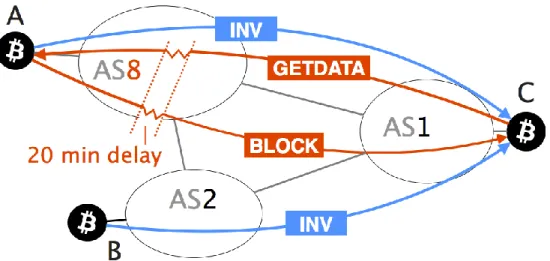
10. Delay routing attack simplified ... ` 83
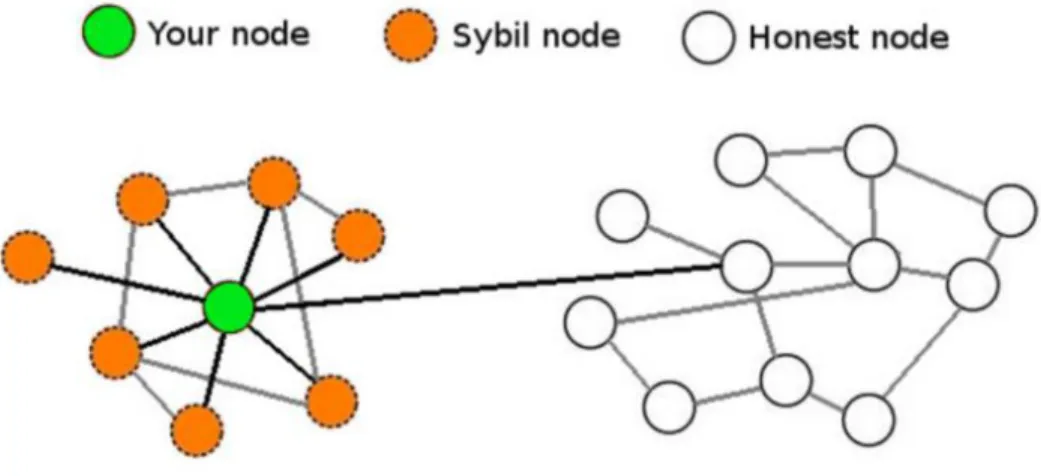
11. Sybil attack on honest node of Bitcoin network ... 86
12. Bitcom’s P2P network incoming and outgoing connection ... 88
Chapter I: Introduction
A Blockchain is a distributed, decentralized ledger or database that facilitate the process of recording transaction (digital events) in the business network (Swan, 2015). In other words, A Blockchain is a distributed, transactional database that is shared across all the nodes participating in the network. Each transaction in the public ledger is verified by consensus of a majority of the participants in the network. Once the transaction is verified in the block and added to the
blockchain, it is nearly impossible to erase or mutate the records. Bitcoin is the first implementation of Blockchain, introduced in 2009 (Nakamoto, n.d.). Bitcoin is a
cryptographically secure electronic payment system, or cryptocurrency, that uses peer-to-peer (P2P) technology, and it operates without any trusted third-party authority such as a bank, or any other centralized institutes. The owner of Bitcoin can use it anywhere, at any time without involving any centralized authority. Since the introduction of Bitcoin, Blockchain has shown promising application prospects and attracted a lot of attention from both academia and industry. The reason for interest in the Blockchain is its features that provide security, anonymity, and data integrity, without any third-party involvement in the transaction control.
Blockchain technique has been applied in many other disciplines, including Internet of Things, healthcare, supply chain, software engineering, cybersecurity and so on. With the introduction of smart contracts, blockchain marks the start of blockchain 2.0 era. A smart contract is a computer program that directly controls the transfer of assets between parties under the specific conditions. A smart contract not only defines rules and penalties around an
agreement in the same way as a traditional contract does, but it can also automatically enforce those obligations. Ethereum is a next generation smart contract and decentralized application
platform, leveraging the blockchain, that introduced the smart contract (Buterin, 2014). Ethereum is now the most widely used smart contract platform.
Since blockchain technology has already attracted many industries, specifically the FinTech (Financial Technology) industry, but there are some core challenges still creates huge concerns such as security, privacy, scalability, compliance, and governance.
According to CoinCapMarket site, there are currently 1560 Blockchain based projects operating and providing various services. These platforms offer services including, financial services, smart economy, IoT, green energy, online education, social media, audit, cloud computing, engineering, healthcare, cybersecurity and many others. With the market
capitalization of 117 billion dollars (April 7, 2018) Bitcoin is the top cryptocurrency, which is a distinct target of adversaries. Ethereum is the second largest used blockchain platform which provides smart contracts. Most of the existing blockchains platforms are either based on the Bitcoin or Ethereum blockchain protocols.
Why are hackers increasingly focusing on blockchain based platforms? From the business perspective, there are four attack surfaces in the blockchain platforms. (1) Most the existing blockchain platforms provide digital currencies (cryptocurrencies) for monetary purposes to charge their services. For instance, Sia-blockchain based decentralize storage platform, requires individuals to pay in Sia coin to rent the storage. Furthermore, to buy digital currency (suppose Sia coins) digital currency exchanges are used. (2) Cryptocurrency exchanges are businesses that allow customers to trade cryptocurrencies for other assets, such as
conventional fiat money, or other digital currencies. (3) Moreover, some of the proof-of-work based-blockchain platforms such as Bitcoin, Ethereum and others, need mining to authenticate
transactions and release new coins, as there is no central authority like Bank to take care of these functions. (4) To access coins, users need their private keys. Private keys are stored in wallets, and the wallet provides the services of holding users’ private keys and also create transactions (on user’s behalf) in the blockchain systems. As we can see, the above four areas of blockchain platforms (cryptocurrency, exchanges, mining, and wallet) involve interaction with money, and it encourages adversaries to perform various high-profit hacks and theft. Although blockchain is considered as a tamper-proof ledger, still, different security and privacy threats involve in blockchain platforms, which makes financial services industry wondering whether blockchain technology can be made secure enough from criminals.
Problem Statement
Since the launch of Bitcoin in 2009, there are almost 1560 blockchain-based platforms on the market. These blockchain-based platforms serve either directly as an electronic payment system (Bitcoin) or use digital currency for financial purposes to charge their services (Ethereum). The use of digital currency (cryptocurrency) by almost every public blockchain platforms has grown the economy of cryptocurrencies at an enormous rate, and it’s now worth about $259 billions of dollars. The market capitalization for Bitcoin itself now worth about $117 billion dollars. This exponential growth in the market value of cryptocurrencies motivates adversaries to exploit the weakness in these platforms for profit, and researchers to discover new vulnerabilities in the systems, propose countermeasures, and predict upcoming trends.
Various attacks including double-spending, transaction malleability, Sybil attack, attacks on Blockchain network, attacks on mining pools, bugs in smart contracts and in wallets software create huge security and privacy concerns in the market. The research (Luu & Velner, n.d.),
discovered that among 19,366 exiting Ethereum smart contracts, 8,833 of them are vulnerable, including the DAO bug which led to a 60 million US dollar loss in June 60. Hacker exploits a recursive calling vulnerability in DAO.
Mt. Gox, a Bitcoin exchange based in Tokyo, Japan, reported losses of USD 4.6 million due to hack (transaction mutability in Bitcoin) in April 2013 (Park & Park, 2017). Mt. Gox, which had already suffered losses due to hacking, again reported losses of 470 million dollars’ worth Bitcoin due to hacking in February 2014 and subsequently filed for bankruptcy. Bitfinex a Hong-Kong-based bitcoin exchange reporting losses of USD 65 million due to hacking in
August 2015 (Park & Park, 2017). Recently on January 26, 2018, Japan-based Coincheck, one of the largest cryptocurrency exchange in Japan, was hacked and loss of USD 534 million worth XEM, the native cryptocurrency of NEM (Asia, 2018). According to the Imperva Incapsula, a cloud-based service provider, report (Q3 2017 Global DDoS Threat Landscape), more than 73% of all bitcoin sites using the Imperva services were attacked in the third quarter of 2017 (“Global DDoS Threat Landscape | Q3 2017 | Incapsula,” n.d.).
Nature and Significance of the Problem
Although there are some studies on the security and privacy issues of the blockchain, they lack a systematic examination of the security of blockchain systems. This research
conducted a systematic survey of the security threats to the blockchain systems and surveyed the related attacks. It also provides a case-study for each attack by examining the popular blockchain systems and also reviews possible countermeasures which could be used in the development of various blockchain systems. Finally, this study classifies each of the security threats and its attack vectors based on the blockchain abstract layers, blockchain primary processes and primary
targets (business perspective). This systematic study would help the blockchain developers and researchers, and businesses in understanding the nature of the various security threats. For instance, the security threats that could affect the different layers of the blockchain systems or blockchain processes, and finally the targeted business users.
Objective of the Study
The primary objective of this study is to review the existing vulnerabilities in the
Blockchain and how the current vulnerabilities lead to the execution of various security threats to the normal functionality of the Blockchain-based platforms.
• In order to understand the problem significantly, this study discussed in details the various components of the blockchain, essential characteristics, types of blockchains, applications, architecture, abstract layers, primary processes, and consensus
mechanisms.
• The study discussed the existing technical challenges and limitations in the blockchain systems, particularly the scalabilities challenges and reviewed some advancements.
• Studying scalability issue helped in analyzing the tradeoff between security and scalability.
• Furthermore, conducted a systematic survey that covered the security aspects of the blockchain. It included to study the various security attacks and provided case-study and
• Developed taxonomies that classify the security threats and attacks in corresponding to affected blockchain layers, processes, and business users,
• Finally, summarized the critical open challenges, and suggest future research directions.
Study Questions
1. What are the existing vulnerabilities in the Blockchain?
2. How the existing vulnerabilities lead to the execution of various security threats? 3. What are the attack vectors for the security threats?
4. Which abstract layer(s) of the blockchain are targeted or affected by certain attacks? 5. Which blockchain primary process(es) are targeted or affected by certain attacks? 6. From business perspective who are the primary target of the certain attacks? Limitations of the Study
This study mainly focuses on the security aspects of both Blockchain 1.0, and Blockchain 2.0. It did not provide insights on the privacy and anonymity aspect of the blockchain systems. There are various privacy-related threats to the existing blockchain systems notably Bitcoin Definition of Terms
Blockchain terminologies (“Comprehensive Blockchain Glossary,” n.d.).
• Blockchain: A blockchain is a shared ledger where transactions are permanently recorded by appending blocks.
• Block: Blocks are packages of data that carry permanently recorded data on the blockchain. A collection of transactions gathered into a block that can then be hashed and added to the blockchain.
• Bitcoin: Bitcoin is the first decentralized, open source cryptocurrency that runs on a global peer to peer network. It is the first application of blockchain.
• Cryptocurrency. Also called digital currency, or tokens, are representations of digital assets.
• Central Ledger. A ledger maintained by a central agency.
• Distributed Ledger: Ledgers in which data is stored across a network of
decentralized nodes. A distributed ledger does not have to have its own currency and may be permissioned and private.
• Address: Cryptocurrency addresses are used to send or receive transactions on the network.
• Mining: Mining is the act of validating blockchain transactions. The necessity of validation warrants an incentive for the miners, usually in the form of coins. It is also called block reward.
• Difficulty: This refers to how easily a data block of transaction information can be mined successfully.
• Fork: Forks create an alternative version of the blockchain, leaving two blockchains to run simultaneously on different parts of the network.
• Node: A copy of the ledger operated by a participant of the blockchain network.
• Consensus: Consensus achieved when all participants of the network agree on the validity of the transactions, ensuring that the ledger are exact copies of each other.
Principles of Information Security, 5th edition, defined following terminologies as:
• Vulnerability: Weakness or fault that can lead to an exposure.
• Threat: Generic term for objects, people, other entity that represent a constant danger to an asset (via attacks).
• Threat agent: Specific object, person who pose a potential danger (by carrying out an attack). DDoS attack is a threat; if a hacker carries out a DDoS attack, he is a threat agent.
• Vector: How the attack was carried out, e.g., malicious email attachment.
• Exposure: A successful attack.
• Incident: Any attack, or all attacks using vulnerability X, etc.
• Risk: Probability that “something bad” happens times expected damage to the organization.
Summary
In this chapter, the introduction to the blockchain has been described, including the problem statement which is the reviewing the existing vulnerabilities in the blockchain and how they lead to various security threats. Furthermore, the significant of the problem, objective of the study, research questions and how this study is designed and conducted are discussed.
Chapter II: Background and Review of Literature
This chapter discussed the concept of the blockchain including the key characteristics, applications, types of blockchain, how blockchain works, and consensus mechanisms.
Furthermore, the chapter discussed the efforts that have been put so far various researchers study and addressed the security and privacy aspects of the blockchain
Blockchain Overview
Blockchain definitions: Different perspectives. Blockchain is a public electronic ledger, similar to the relational database, that can be openly shared among the different users and that creates an unchangeable record of their transactions, each one time-stamped and linked to the previous one (Mearian, 2018). Each digital record or transaction in the thread is called a block, and it allows either an open or specific set of users to participate in the digital ledger. Blockchain can only be updated by consensus between the participants in the network, and when new data is entered, it can never be changed or erased which provides high data integrity in the blockchain. The blockchain contains a verifiable record of each and every transaction ever made in the system.
Bitcoin is the first application of Blockchain and the Bitcoin based Blockchain is a public ledger system that maintain the integrity of transaction. Satoshi Nakamoto the founder of Bitcoin defines Bitcoin as a peer-to-peer electronic cash that allows online payments to be sent directly from one party to another without going through a financial institute (Nakamoto, n.d.).
According to Don and Alex Tapscott “The blockchain is an incorruptible digital ledger of economic transactions that can be programmed to record not just financial transactions but
virtually everything of value.” Virtually anything of value can be tangible assets like cash, car, house or intangible such as copyrights, patents, or branding.
From network perspective, Blockchain is distributed file system where participants keep copies of the file and agree on the changes by consensus. The file is composed of blocks and each block includes a set of transactions plus main data that includes, timestamp and a
cryptographic signature (hash) of the previous block, hash of the current block, and some other information. The hash of the previous block ties the current block to the previous block and also the subsequent blocks will require the hash of the current block, so these all block are chained together. If anything in the block is modified, one could compute its hash and will find a different value as the stated one and will not accept the block. Thus, including the previous block’s hash in the current block integrates the entire system history into the current block.
The blockchain is commonly used for data storage. The data could be financial transactions, which are recorded in the digital ledger and it is replicated across a number of systems in almost real-time. The blockchain (digital ledger) usually exists over a peer-to-peer network and uses cryptography and digital signatures to prove identity, authenticity and enforce read/write access rights. The digital ledger can be written by the certain participants and can be read by a broader audience. Each block in the blockchain is cryptographically linked with the previous block which makes it hard to change the historical records or at least make it easy to detect when someone is trying to tamper (Zheng, Xie, Dai, Chen, & Wang, 2017).
The key characteristics of Blockchain technology are, decentralization, immutability, anonymity, persistency and auditability. Blockchain technology is an integrated multi-field infrastructure, that contains cryptography, mathematics, Algorithm and economical model,
peer-to-peer networks and using distributed consensus algorithms to solve the traditional database synchronization problem (Zheng et al., 2017).
Key Characteristics of Blockchain
Digital. All the information on blockchain is digitized, eliminating the need of manual documentation.
Distributed. Transactions are grouped into blocks for processing and standard network protocol ensures every node (participant) receives every transaction in near real-time and applies the same rules. Blockchain is designed to be distribute and synchronized across the networks, which makes it ideal for multi-organizational business networks such as supply chain or financial associations. It also encourages organizations to come out from behind their firewalls and share data (Pattison, 2017).
Decentralization. All participants (nodes) have own copy of all data in the system and no need for a central authority. This helps to obtain no single point of vulnerability or failure. In conventional centralized transaction system, each transaction needs to be validated through a central authority (e.g., bank) which requires some service fees, time and performance bottlenecks at the central servers. However, there is no central authority in the blockchain network, and no middle man/authority service fees is required, and also make the transaction faster. Consensus algorithms used to maintain data consistency in decentralized, distributed network (Zheng et al., 2017).
Immutability. Data is immutable in the blockchain. Once the participants agreed on a transaction and recorded, it is nearly impossible to delete or rollback transactions once they are included in the blockchain. If someone try to subsequently record another transaction about that
asset to change its state, but s/he cannot hide the original transaction. This gives the idea of provenance of assets, which means that for any asset you can tell where it is, where it has been and what has happened throughout its life (Pattison, 2017).
Consensus. There are standard algorithm/mechanism used to ensure all nodes agree on the integrity of transaction data in the system, replacing the need for a trusted third party. Before one can execute a transaction, there must be an agreement between all the participants that the transaction is valid. This process is known as “consensus” and it helps keep inaccurate or fraudulent transactions out of the blockchain. Blocks that includes invalid transactions could be revealed immediately.
Anonymity. Each user can interact with the blockchain with a generated address, which does not reveal the real identity of the user, but participants can see the transaction (Zheng et al., 2017). It is arguable the bitcoin blockchain cannot guarantee the perfect privacy preservation due to its intrinsic constraints but there are some other alternative blockchain protocols that claims for providing highest privacy.
Traceable. Every transaction added to a public or private blockchain is digitally signed and timestamped, which means that organization can trace back to a specific time for each transaction and identify the corresponding party (through their public address) on the blockchain (Swan, 2015). So, every block is immutably and verifiably linked to the previous block. A full history can always be reconstructed right back to the beginning (the genesis block). For example, Bitcoin blockchain stores data about user balances based on the Unspent Transaction Output (UTX-O) model. If any transaction has to refer to some previous unspent transaction, once the current unspent transaction is recorded into the blockchain, the state of that unspent transaction
will be switched to spent (Vyas & Lunagaria, 2014). Therefore, it is easy to verify and trace the transaction.
Smart Contracts. Blockchain provides the functionality of smart contracts, or scripts that automatically execute when certain conditions are met. For instance, users of Ethereum– Ether (alt-cryptocurrency) exchange must meet the pre-defined conditions that prove someone owns the cryptocurrency and have authority to send the money they claim to own. It is also possible to develop smart contracts that require more than one set of inputs to trigger a transaction (Mearian, 2018). For example, real estate transactions require sign offs between buyers, sellers and their financial institutions.
Application of Blockchain
Besides cryptocurrencies blockchain has many other applications. In financial services, blockchain can be used for asset management, insurance, cross-border payments. Blockchain can be used to facilitate distributed cloud storage. Blockchain has compelling use cases in the
Internet of Things (IoT); encrypting the smart appliances on blockchain protects individual ownership and enables transferability. Blockchain can provide a robust solution for supply chain sensors. Blockchain can store, manages, protects, identify and transfers smart information for supply chain sensors.
Smart Contracts are digital code which is embedded with an if-this-then-that (IFTTT) code, which gives them self-execution (Buterin, 2014). Smart contract is one of the profound features of the blockchain. Blockchain not only waives the need for third parties but also ensures that all ledger participants know the contract details and the contractual terms implement
financial derivation, insurance premiums, property law, crowdfunding agreements and others (Ream, Chu, & Schatsky, 2016). Healthcare can use blockchain smart contract to store and encrypt the personal health records with a private key which grant access only to specific individuals. The same strategy could be used to ensure that research is conducted through HIPAA laws securely and confidentially (Srinivasan, 2017). Besides there, blockchain can be used for other general healthcare management, such as supervising drugs, testing results, managing healthcare supplies, and regulation compliance.
Blockchain provides solutions to the critical problems of ownership rights, royalty distribution, and transparency in the music industry. Blockchain can be used for digital voting, digital identity such as passport, and other certificates and many others.
Blockchain in Cybersecurity.
Protecting data integrity. Preventing data manipulation and maintaining data
consistency, and integrity is vital in information systems. Many techniques used for to maintain data integrity are data encryption, data digesting (hash comparison), and digital signature. However, the blockchain built-in features, immutability and traceability, provide organizations with a mean to ensure data integrity (Swan, 2015). The combination of sequential hashing and cryptography with the decentralized structure offers blockchain its most robust features called immutability. It helps protect data integrity and identify any data tampering with it in contrast to a standard database.
Keyless Signature Structure (KSI), a blockchain project led by a startup called
GuardTime, aims to replace key-based (PKI) data authentication (Buldas, Kroonmaa, & Laanoja, 2013). KSI stores hashes of original data and files on the blockchain and verify other copies by
running hashing algorithms and comparing the results with the stored copy in the blockchain (Dickson, 2017). If any manipulation may happen to the data, it will be quickly discovered because the original hash exists on many of nodes where blockchain is running.
Non-repudiation. Since every transaction added to a blockchain is digitally signed and
timestamped, which means that organization can trace back to a specific time for each
transaction and identify the corresponding party (through their public address) on the blockchain. This feature relates to an important information security property called non-repudiation, which is the assurance that someone cannot duplicate the authenticity of their signature on a file or the authorship a transaction that they originated [1]. So, this feature help organization to trace and detect any tamper attempts or fraudulent transactions.
Protecting identities. Public Key Infrastructure (PKI) is the most commonly used identity
protection technique used to secure emails, websites and other forms of communication. But most of PKI implementations rely on centralized, trusted third party Certificate Authorities (CA) to issue, revoke, and store key pairs for every participant, and hackers can compromise them to spoof user identities and crack encrypted communications. Publishing keys on blockchain eliminates the risk relating to false key propagation and identity theft. Moreover, there are various projects are ongoing to eliminate that need for issuing certificates by central authorities. These advances made blockchain more robust in terms of authentication and elimination of any possibility of being a single point of failure. For example, the CertCoin (Fromknecht &
Yakoubov, n.d.) project developed at MIT, is one of the first implementations of blockchain-based PKI. CertCoin aims to removes the Central Authorities altogether and uses the blockchain
as a distributed ledger of domains and their associated public keys (Dickson, 2017). CertCoin provides a public and auditable PKI that also does not have a single point of failure.
Preventing distributed denial of service attacks. Distributed Denial of Service Attacks
(DDoS) is one of the most common types of attacks, can also cause the most disruption to
internet services and hence blockchain enabled solutions. The traditional Domain Name Services (DNS) system relies on DNS caching and due to this the 21st October 2016 DDoS attack on DNS servers which provides DNS services for major websites such as Twitter, Netflix, PayPal, and other services (Woolf, 2016). The October 2016 DDoS attack on DNS cut off access to these websites for several hours which shows another failure of centralized infrastructure. The
decentralization and peer-to-peer characteristics of the technology make it harder to disrupt than the conventional distributed application architecture (such as client-server), yet they are also subject to DDoS attack and adequate protection are required both at the network level and application level.
Blockchain has a solution for this problem. Blockchain-based DNS approach improves security by removing the single target that attackers can attack to compromise the entire system. Nebulis is a project that is exploring the concept of a distributed DNS system that is near to impossible to fail under an access of requests. Nebulis uses the Ethereum blockchain and Interplanetary Filesystem (IPFS), a distributed alternative to HTTP, to register and resolve domain names (Dickson, 2017). As the current DNS system highly relies on caching and DNS cache is always the high target of the hackers. So, by using the blockchain approach, it can provide a solution to the single point of failure.
Besides there, blockchain can be used for identity protection or identity security,
traditional Endpoint protection, transaction and communication infrastructure security, protection from compromised nodes or server failure and security from malicious insiders.
Eliminating human factor from authentication. Businesses can authenticate devices and
users without the need for a password or other multi-factor authentications with the help of blockchain. This eliminates human intervention from the process of authentication, thereby avoiding it from becoming a potential attack vector. The current password-based authentication in the centralized architecture is still a huge problem. Usually, organization invest in security and standard but still if employees and customers use passwords that are easy to steal or crack, then these all efforts are ineffective. Blockchain offers strong authentication and resolving single point of attack at the same time (Eskandari, Clark, Barrera, & Stobert, 2015). Blockchain can be used in an organization to provide a distributed public key infrastructure for authenticating devices and users. This security system can provide each device with a specific SSL certificate instead of a password. Also, management of certificate data is carried out on the blockchain, and this makes it virtually impossible for attackers to utilize face certificates. With the help of blockchain, a security system used in an organization can leverage a distributed public key infrastructure for authenticating devices and users. This security system provides each device with a specific SSL certificate instead of a password. Management of certificate data is carried out on the blockchain and this makes it virtually impossible for attackers to utilize fake
certificates. REMME a blockchain based project, authenticate users and devices without the need for a password, and provides SSL certificate to each device instead of password (“REMME Technical Paper,” 2017).
Secured decentralized storage. Blockchain can be used to build a decentralized,
distributed storage and blockchain users can maintain their data on their computer in their network. This will assure that chain will not collapse. For example, if a hacker attempts to tamper with a block, the entire system (digital ledger) examines every data block to locate the one that differs from the test, it easily can reject the block from the chain and recognize it as fraudulent. As blockchain is decentralized, everyone in the blockchain network is responsible for verifying the data that is shared and maintained to ensure data cannot be altered. This approach facilitates more robust and secure storage as compare the current centralized storage. Some of the blockchain based decentralized projects are Sia (Vorick & Champine, n.d.), and Storj (Wilkinson et al., n.d.).
How blockchain works? The blockchain is a database or a ledger that provides a way for information to be recorded and shared by a community. In this community, each member keeps his or her copy of the information, and all members must validate any updates collectively. It's distributed in nature, meaning that there is no central server holding the entire database or chain, but instead, the participating nodes have a copy of the ledger. The new records are appended to the ledger.
Typically, from record perspective, blockchain consists of two types of elements (Banafa, 2017). Transactions are the actions created by participants in the blockchain network. Blocks record these transactions and make sure they are in right sequence and have not been tampered. Blocks also record the timestamp when the transactions were added. Each block has one or more than one transactions.
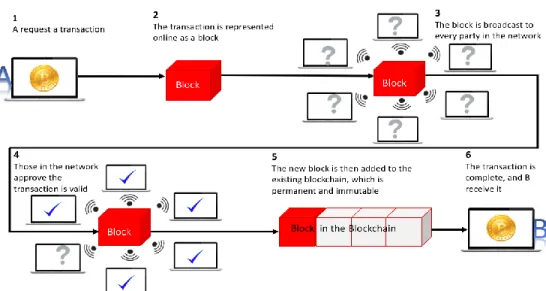
Let us suppose A wants to send money to B. First, a block is created online and
represents the transaction. Then this block is broadcasted to every participant in the blockchain network and set of participants approves the transaction and validates it. Once the block is validated, it is added to the chain which provides a permanent, non-reputable and transparent record of the transaction. Finally, B receives the money from A. The above steps are shown clarified in Figure 1.
Figure 1: How blockchain works simplified.
Following are the detailed processes involved in the blockchain network (Piscini, Guastella, Rozman, & Nassim, 2016).
Following are the detailed processes involved in the blockchain network (Piscini et al., 2016).
Transaction. Two parties want to exchange data, and this could be money, ship a
product, contracts, medical records, customer details, or any other asset (tangible and intangible) that can be described in digital form. This transaction (record) is sent to everyone in the system, or in other words, all the participants get notification of the new transaction (Piscini et al., 2016).
There are two types of transactions in the Bitcoin. One is the standard transaction, created by the users which include coin. Another special type of transaction is called Coinbase
transaction, or Generation transaction, which is created by the miner to award himself. In fact, it is the reward that miner gets for successful mining a block. The current block reward is 12.5 Bitcoins per block, and the reward halves every 210,000 blocks, or roughly every four years (“Bitcoin Block Reward Halving Countdown,” n.d.). In case of Bitcoin, only the UXTO
(Unspent Transaction Output Set) is stored in the memory and the remaining data is stored on the disk (“Weaknesses–Bitcoin Wiki,” n.d.). Once a client wants to process a transaction, before fetching transaction inputs from disk to memory, the client checks that all the inputs are unspent.
Verification. Depending on the blockchain network's parameters, the transaction is either
verified immediately or placed in a queue of pending transactions (Piscini et al., 2016). In this case, the nodes (computers) in the network determine if the transaction is valid or not based on a set of rules of the network, upon which participants in the network were agreed.
Structure. Block contains the transaction or set of transactions, and each block is
identified by a 256-bit hash valued, created by message digest algorithm agree upon by the network. In most cases, SHA256 message digest algorithm is used. Typically, a block contains a header, a pointer to previous block hash, and a group of transactions.
Validation. Blocks must be validated before added to the blockchain. The most popular
consensus algorithm based on which blocks are validated is Proof-of-Work (PoW), in which the solution to a mathematical puzzle derived from the block's header by miners.
Mining. Miners use Proof-of-Work or other consensus algorithms to solve the
mining consists of finding an input to a cryptograhic hash function which hashes below or equal to a fixed target value. It is brute force because at every iteration the content to be hashed is slightly changed in the hope to find a valid hash. In case of Bitcoin, a mining program essentially performs the following simplified code:
While(nonce <max):
If sha256(sha256(block+nonce)) < target: return nonce
nonce +=1
The task is to find a nonce which is included in the bitcoin block header, and hashes below a certain value.
In case of Ethereum a simplified example could be:
nonce=random int
While hashimoto(block,nonce)*difficulty> threshold increment nonce
return nonce
Where difficulty is a dynamically adusts parameter defined originally in gensis block. If the above code, find the nonce and return it - “return nonce” that is the solution for the puzzle.
The chain. When a block is validated, the miner who solved the mathematical puzzle is
rewarded, and then the validated block is broadcasted to the network (Piscini et al., 2016). After validation, the block is added to the majority chain, and by this, the action is completed (if it is money, then it is received to person B from A, as shown in the Figure 4 example).
If a malicious miner tries to submit an altered block to the chain, the hash function of that block and the hash function of all the following blocks will change, and other nodes would detect the changes and reject the block from the majority chain.
Blockchain Architecture
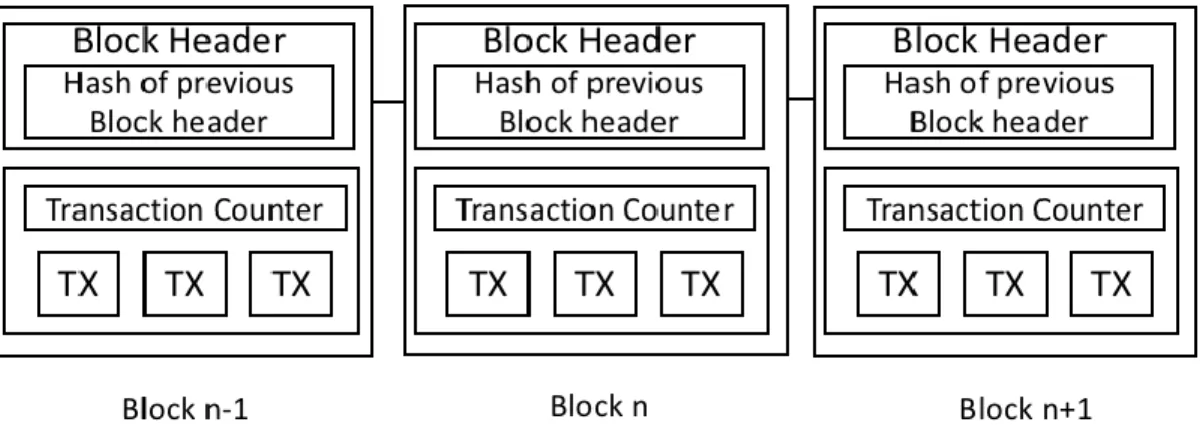
The blockchain is a sequence of blocks, which holds a complete list of transactions records or a log of all transactions like conventional public ledger (Zheng et al., 2017). Figure 2 below illustrates an example of a blockchain. Each block contains block header, parent block hash (hash of the previous block), and list of transactions logs. The first block in blockchain is called genesis block which has no parent block.
Figure 2: Bitcoin blockchain architecture
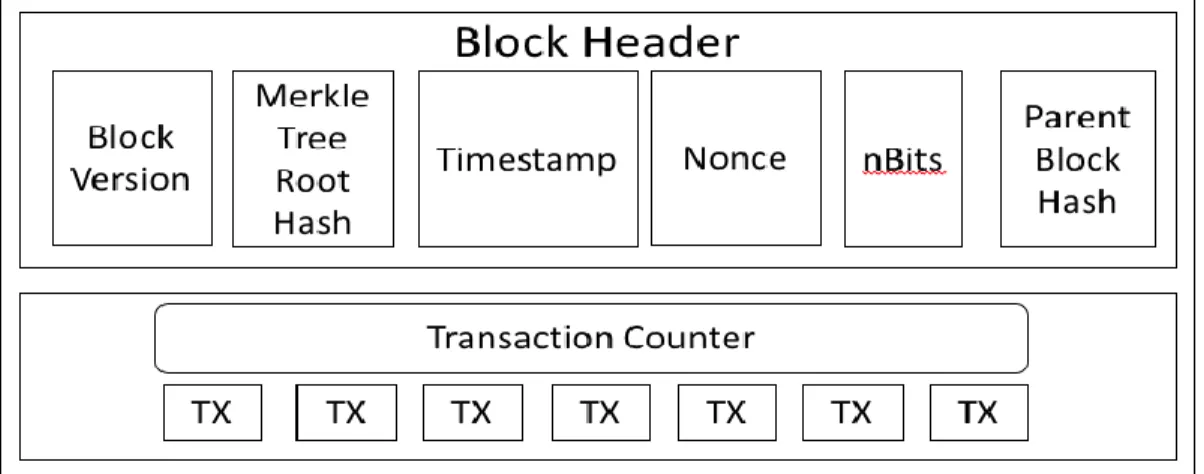
Transactions data is permanently recorded in files called blocks. Each block contains block header and a record of some or all recent transactions, and a reference to the previous block. Each block consists of the block header and block body as shown in Figure 3 (Zheng et al., 2017).
Block header. There are six elements in a block header.
Block Version. It is 4 bytes in size that indicates the block version number, that is, it
upgraded then it specifies a new version. Parent block hash. It's a 256-bit hash of the previous block header, and it is 32 bytes in size, and it's updated when a new block comes into the blockchain.
Merkle tree root hash. A 256-bit hash bashed on all the transactions in the block, and it
is updated when a transaction is accepted, and it's 32 bytes in size.
nBits. It is 4 bytes in size, and it's a target threshold of a valid block hash, in other words,
it is the answer to a difficult-to-solve mathematical puzzle that solved by miners to validate the block and the answer to the puzzle is unique to each block it is the answer to a difficult-to-solve mathematical puzzle that solved by miners to validate the block and the answer to the puzzle is unique to each block.
Timestamp. Current time as seconds in the universal time since January 1, 1970.
Timestamp updated every few seconds, and it takes 4 bytes in size of block header.
Nonce. It is a 4 bytes field, and it starts with 0 and increment for each hash calculations.
Cryptographic components.
Digital signature. The typical digital signature algorithm used in Blockchain is the
elliptic curve digital signature algorithm (ECDSA) (Zheng et al., 2017). Each user who
participate in Blockchain network owns a pair of public and private key. The private key is kept confidential and used to sign the transactions and the signed transactions are broadcasted to the whole Blockchain network. The digital signature process involves two steps: signing phase and verification phase (Zheng et al., 2017). For instance, a user Alice wants to send a transaction or message to another user Bob. (1) In the signing phase Alice encrypts her data with her private key and sends to Bob the encrypted result and original data. (2) In the verification phase, Bob verify the value with Alice’s public key and check if the data has been tempered or not.
Cryptographic hash function. A hash function is a mathematical process that takes input
data of any size and preform an operation and returns output of a fixed size. Blockchain uses SHA256 message digest algorithm for generating Hash values. Data on the Blockchain is hashed in each block and if the block is changed or tempered, the hashed valued would be different and everyone in the network could detect that something had changed. Because the hashed value of the previous block is used to calculate the hashed value of the current block creating this link between the blocks and this makes Blockchain tamper-resilience linked-list.
Merkle tree. Merkle tree is a data structure and it is used in Blockchain to contain a
summary of all the transactions in the block, which maintain the integrity of the transactions in the block. In fact, Merkle tree contains cryptographic hashes of the transactions. The most common and simple form of Merkle tree is the binary Merkle tree, where a bucket always
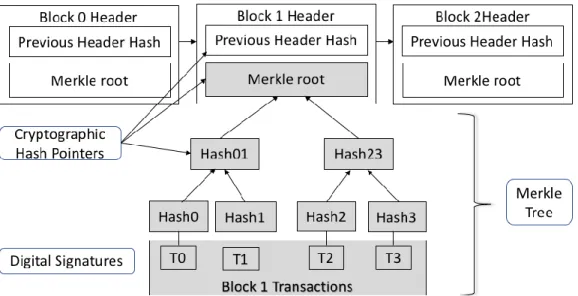
fingerprint of the entire set of transactions, and provides a very efficient process to verify whether a transaction is included in a block or not (Antonopoulos, 2015). A Merkle tree is created by recursively hashing pairs of nodes until there is only one hash, called the root, or Merkle root. A Merkle tree is constructed bottom-up fashion. For instance, in the below Figure 4, there are four transactions, T0, T1, T2, and T3 and the hashes of each transactions forms the leaves of the Merkle tree called Hash0, Hash1, Hash2, and Hash3. First, hash of two adjacent
transactions for example, Hash0 and Hash1is calculated and stored in the parent node Hash01,
and the same is done for the Hash2 and Hash3 and their hash is stored in their parent nodes Hash23. This process continues until there is only one node left at the top which is called root (Antonopoulos, 2015). The final hash is 32-byte hash that is stored in the block header which summarizes all the data in the four transactions.
Figure 4. Merkel tree in blockchain’s block. Types of Blockchain
Public blockchain. A public blockchain as its name suggest is the blockchain of public, i.e., anyone can participate in reading, writing and auditing the blockchain without permission. Public blockchain is open and transparent hence anyone can review the transaction at a given point of time. As no one is in charge in public blockchain so the consensus mechanisms such as Proof-of-Work (PoW) and Proof-of-Stack(PoS), and many others are used for decisions making.
Bitcoin, Ethereum, Litecoin and many others are example of public blockchain. Anyone can download the code and start running a public node on their local device, validating
transactions in the network, thus participating in the consensus process- the process for determining what blocks get added to the chain and what is the current state (“Blockchains & Distributed Ledger Technologies,” n.d.). Anyone can send transactions across the world and expect to see them included in the blockchain once verified and validated. Transactions are transparent in public blockchain, but anonymous or pseudonymous.
Private blockchain. In private blockchain the write permissions are kept centralized to one organization. Read permissions may be public or restricted to an arbitrary extent. Private blockchains are a way of taking advantage of blockchain by setting up groups and participants who can verify transactions internally. This create the risk of security breaches like a centralized system, as opposed to public blockchain secured by game theoretic incentive mechanisms (“Blockchains & Distributed Ledger Technologies,” n.d.). Private blockchain has its own use case, particularly, when it comes to scalability and state compliance of data privacy rule and other regulatory issues. MONAX, MultiChain are the examples of private blockchain.
Consortium or federated blockchain. Consortium is sometime considered as third type
blockchain removes the individual autonomy which is responsible for bringing changes in the blockchain as in private blockchain. In consortium or federated blockchains operate under the control of a group of institutions. As opposed to public blockchains, consortium blockchain does not allow everyone to participate in the process of verifying transactions. A pre-selected set of nodes controls the consensus process; for instance, a consortium of ten financial institutions, each of which operates a node and of which seven must sign every block for the block to be valid (Seco, n.d.). The right to read the blockchain may be public or restricted to the participants. Banks usually use consortium blockchain and are faster and scalable and provides more transaction privacy. R3 (banks), EWF (Energy), and B3i (Insurance) are examples of the federated blockchain.
Consensus Algorithms
The purpose of a consensus algorithm is that everyone accepts and supports the decision, understand the reasons for making it, and shares collective responsibility for its consequences. The consensus is one of the fundamental problems of distributed computing. In blockchain, how to reach consensus among the untrusted nodes is a transformation of the Byzantine Generals (BG) problem. In BG problem, a group of generals who command Byzantine army and circle the city. The communication between the generals was by messenger. The problem was some
generals prefer to attack while other refuse. To make the attack successful, the generals must agree upon a common battle plan, and all generals have to strike at the same time otherwise the attack may be failed. There is also a possibility that some generals may be traitors who will try to distract the loyal generals. The problem is to find a mechanism to ensures that all generals will reach an agreement and even if the communication is only verbal messages, this problem is
solvable if more than two-thirds of the generals are loyal and agree upon the deal (Lamport, Shostak, & Pease, 1982). In blockchain, as there is no central node to control or monitor the distributed digital ledger, so the same problem raised but there must be some consensus
mechanisms to solve this problem. Various consensus algorithms are used to bring consensus in the blockchain systems.
PoW - Proof of Work. Bitcoin network uses Proof of Work (PoW) consensus mechanism (Nakamoto, n.d.). Bitcoin blockchain is a decentralized network, and it does not require authorization from any trusted third party to process the transactions. The nodes work with each other in a collaborative environment and develop the blockchain without relying on any central authority. However, some nodes may behave maliciously and act against the
common goal. Thus, Bitcoin blockchain runs a fault tolerance consensus mechanism called PoW to assures that all nodes agree on the new entries (blocks) added to the bitcoin blockchain. PoW happens through miners trying to solve extremely difficult mathematic puzzles and finding a solution is basically a guessing game but checking if a solution is correct is easy. In PoW, each node of the network is calculating a hash value of the block header (Gervais et al., 2016). The block header contains a nonce and miners would change the nonce frequently to get a different hash value, and the consensus requires that the calculated value must be equal to or smaller than a particular given value. When one node finds a given value, it will broadcast the block to other nodes, and all other nodes in the network must mutually confirm the correctness of the hash value. Once the block is validated, other miners would append this new block to their
blockchains. Nodes that calculate the hash values are called miners, and the PoW procedure is called mining in the Bitcoin blockchain (Gervais et al., 2016).
In Bitcoin blockchain, once the new transactions happen, they are broadcasted to all nodes in the network. Each node collects new transactions into a block and starts works on finding a problematic proof-of-work for its block. Once a node detects a proof-of-work, it broadcasts the block to all nodes. Other nodes in the network accept this new block only if all transactions in it are valid and not already spent. Nodes express their acceptance of the new block by working on creating the next block in the chain, using the hash of the accepted block as the previous has. Nodes in the network always consider the most extended chain to be the valid one and will keep working on extending it (Xu et al., 2017).
In the decentralized network, the valid blocks might be generated simultaneously when multiple nodes find the suitable nonce nearly at the same time. Due to which a new branch will be created. But it is unlikely that two competing forks will generate next block simultaneously (Gervais et al., 2016). In PoW based consensus algorithm, the participants require no
authentication to join the network, which makes the Bitcoin consensus mechanism makes it extremely scalable regarding supporting thousands of network nodes. However, PoW based consensus is vulnerable to 51% attacks, in which an adversary has control over 51% of the hash-rate in the network. Hence it can write its blocks or fork the blockchain that at a later point converges with the main blockchain. Fifty-one percent of attacks can further leverage the miner to carried out other types of attacks such as double-spending, eclipse, and denial of service (Xu et al., 2017). The PoW based consensus algorithm wastes a lot of energy in hash computations during the mining process, but, it also facilitates high scalability regarding nodes participating in the network and operates entirely in a decentralized manner. To mitigate the waste of resources, some PoW protocols in which works could have some side-applications have been designed. For
example, the Primecoin is a new type of PoW based on searching for prime numbers (King, 2013).
PoS–Proof of Stack. Proof of Stack (PoS) is the most common energy-saving alternative to Proof of Work algorithm. In PoS, instead of investing in computing power in a race to mine blocks, a 'validator' invests in the coins of the system, i.e., the validators in PoS have to prove the ownership of the amount of the currency. It is believed that people with more coins will less likely attack the network. There is no coin creation (mining) exists in the PoS. Instead, all the coins created from day one, and validators (stakeholders) are paid strictly in transaction fees. In PoS, the validator is chosen to develop next block based on the number of coins (stake) has in the system. Once the validator creates a block, that block still needs to be committed to the blockchain, and various PoS systems handle this differently. In Tendermint, every node in the network has to sign off on a block until a majority vote is reached, while in other PoS systems, a random group of participants is chosen to sign the block to commit the blockchain (Vasin, 2014).
There are some problems existed with PoS. Suppose if a validator creates two blocks for the same set of transactions and claim two sets of transactions fees, and also a signer signed both of those blocks. This is called the 'nothing-at-stake' problem, i.e., a participant with nothing to lose has no reason not to misbehave (Vasin, 2014). One proposed solution to this problem is to require a validator to lock their currency in a type of virtual vault, and those coins will severe if the validator tries to double sign or fork the network. The selection of validator based on the account balance is considered unfair because the single richest person is bound to be dominant in the network. Different solutions are proposed to tackle this problem. Peercoin chooses validator based on the coin's age and more extensive set of coins (King & Nadal, 2012). Blackcoin uses
randomization to predict the next generator and uses a formula that looks for the lowest hash value in combination with the size of the stake (Vasin, 2014). Compare to PoW, PoS saves more energy and is more efficient. However, as the mining cost is nearly zero, attacks might come as a consequence.
PoA–Proof-of-Authority. In PoA consensus mechanism, transaction and blocks are validated by approved accounts, known as validators. The process of the validation is automated by running software and does not require validators to be continually monitoring their nodes. However, the validator nodes have to keep running and uncompromised. Any one of the
validators can approve the non-consecutive block in the PoA-based system, which minimized the risk. Three main rules must be fulfilled for a validator (“Proof-of-authority,” 2018). (1) The identity of the validator must be verified correctly, (2) Eligibility must be challenging to obtain, (3) There must be a complete unity in the checks and procedures for establishing authority.
The PoW-based system uses a mining mechanism to generate and validate a block. The PoS-based system uses an algorithm that selects participants with the highest stakes as validators. The PoA-based system uses identity as the only verification of the authority to validate, and there is no mining process to verify the work.
Literature Review Related to Problem
This section briefly reviews the related studies about the problem. Some studies provide a survey about the security and privacy issues on the Blockchain. The authors Conti et al. (Conti, E, Lal, & Ruj, 2017) provided a comprehensive survey on security and privacy issues in Bitcoin. This paper studied the security and privacy works in details but it only focusses the Bitcoin not the blockchain in general. Lin et al. (Lin & Liao, 2017) provide a survey of blockchain security
issues and challenges. This paper presents a general overview about blockchain, how blockchain works, its characteristics, some of the Blockchain’s application and briefly studies some security problems in Blockchain such as 51% attack, and Fork problems. “Introduction to Security and Privacy on the Blockchain” (Halpin & Piekarska, 2017) paper is based on the IEEE Privacy and Security on the blockchain Workshop (IEEE S&B). They presented peer-reviewed papers that are collected from academia and industry to analyze problems ranging from deploying newer cryptographic primitives on Bitcoin to enabling use-cases like privacy-preserving file storage. This paper mainly focuses on the issues that discussed in the workshop.
Vyas and Lunagaria (2014) state the security concerns and issues for Bitcoin. This paper focuses on Bitcoin protocol and discusses some of the attacks on Bitcoin such as majority attack (51 % attack), Double-spending attack, Timejacking attack, and selfish mining attack. Wüst (2016) completed a master's thesis on Security of Blockchain. In fact, this thesis provides an in-depth study of Proof of Work (PoW) consensus algorithm of Bitcoin. This study provides a quantitative framework based on Markov Decision Processes (MDP) to analyze the security of different PoW Blockchain instances with various parameters against selfish mining and double-spending attacks.
Yli-Huumo, Ko, Choi, Park, and Smolande (2016) state a systematic review on finding out "Where is current research on Blockchain technology?". The objective of this study was to understand the current research topics, challenges and future directions regarding blockchain technology from the technical perspective. This research report studied different papers that discuss various technical challenges of Blockchain Technology. For instance, Blockchain's scalability issues wasted resources and also presents some papers that were dedicated to security
and privacy issues of Blockchain. Though this research report discusses the security and privacy aspect of the blockchain more in general and provides the report based on the 14 papers that were covered in the scope of this report. However, this research provides a roadmap for technical challenges of Blockchain that should be researched.
Literature Reviews Related to Methodology
To best of our knowledge, this is the first state-of-arts that discussed the security issues in the both Blockchain 1.0 and Blockchain 2.0. The paper (Atzei, Bartoletti, & Cimoli, 2016) provides a survey on the Ethereum smart contracts and discusses 12 types of vulnerabilities on the Ethereum smart contract. Xu et al. (2017) state a taxonomy of Blockchain-based systems for architecture design. This paper classifies and compares blockchains and blockchain-based systems to assist with design and assessment of their impact on software architecture. This taxonomy discusses the architectural characteristics of blockchain and the effect of their principle design decision, and it does not provide insight on security and privacy issues of Blockchain. Lloyd's London presents a report called “Emerging Risk Report 2015” (Beecroft, 2015) and this report discussed different risk factors specifically in Bitcoin. Lloyd's report studies risk in various domain of Bitcoin such as operational risks, technological risks, market risks and a minor report on security risks in Bitcoin. Cambridge Centre for Alternative Finance conducted a global blockchain benchmarking Study (Hileman & Rauchs, 2017). This
benchmarking study discusses the state of the blockchain ecosystem from the finance perspective and very slight attention to the privacy factors of Blockchain.
The Gervais et al. (2016) paper introduced a novel quantitative framework to analyze the security and performance implications of various consensus and network parameters of Proof of
Work (PoW) blockchains. This paper formulates adversarial strategies for double-spending and selfish mining while taking into account real-world constraints such as network propagation, different block sizes, block generation intervals, information propagation mechanism, and the impact of eclipse attack.
Apostolaki, Zohar, and Vanbever (2017) discuss the Bitcoin's Hijacking. This paper provides a taxonomy of routing attacks and their impact on Bitcoin, considering both small-scale attacks, targeting individual nodes, and large-scale attacks, targeting the network as a whole. The paper discusses two general network attacks, partitioning attack and delay the attack.
Wan, Lo, Xia, and Cai (2017) discuss bug characteristics in blockchain systems. This paper performs an empirical study on bug characteristics in eight representatives open source blockchain systems. First, the article manually examines 1,108 bug reports to understand the nature of the reported bugs and then leverage card sorting to label the bug reports and get ten bug categories in blockchain systems. This paper further investigates the frequency distribution of bug categories across projects and programming languages, and finally, study the relationship between bug categories and bug fixing time.
Summary
This chapter summaries the basic concept of the blockchain, its features, applications, types of blockchain, consensus mechanism. Finally, the chapter included the literatures reviews based on the problem and methodology.
Chapter III: Methodology
This study followed the qualitative research methods which involves surveys and case studies. In this chapter, the classification methods and its underlying technologies and concepts required for the taxonomies are presented.
Design of the Study
The study used qualitative research method, because it concentrates on collecting and analyzing data and gain greater insight and knowledge by reproducing or recognizing the problem. The qualitative research method involves survey and case study. To better under understand the security threats problem in the blockchain (both blockchain 1.0, 2.0), the study presented a systematic survey. The systematic survey reviews the existing vulnerabilities in the blockchain, and examines how these vulnerabilities lead to the execution of various security threats. Moreover, the study provided a case-study for each attack by examining the popular blockchain systems and also reviews possible countermeasures which could be used in the development of various blockchain systems. In order to recognize specifically the targets for each threat, taxonomies are developed. The taxonomies classified the each of the examined security threats in term of affected abstract layers of blockchain, affected primary processes of the blockchain and finally the business users.
Since in the qualitative research, the data are analyzed by themes from descriptions by informants and keep that in mind, the study developed taxonomies and classify the threats (Mcleod, 2008).
Moreover, this work also provided a comprehensive study about the blockchain concept, its characteristics, the underlying technologies to better recognize the problem. It also surveyed
the existing technical challenges in the blockchain such as scalabilities, usability and some government and compliance concerns. Though the government and compliance was not in the scope of this study, but provided a brief insight about the current standards and government issues.
Data Collection
The data collected and analyzed in this study was from various relevant papers that are extracted from scientific databases. The relevant research included journal papers, conference papers, technical and white papers and used some academic blogs for obtaining up to date statistics to evaluate the objective of the problem discussed in this study.
Tools and Techniques
There is no specific tool used in addressing the problem, but the study used the taxonomy as a technique to evaluate and classify the security threats and attacks in the different domains of the blockchain. The three taxonomies as first based on the abstract layers of the blockchain, the primary technical processes in the blockchain and finally the primary targets (users) involves in the blockchain platforms from the business perspective.
Taxonomy #1. This taxonomy is based on the abstract layers of the blockchain. The abstract layer considers in this taxonomy are: Network layer, Consensus layer, Data model layer, Execution layer. The taxonomy based on the abstract layers is formed by studying the nature of each of the existing vulnerabilities that lead to the security threats and attacks, and which abstract layer can be affect by each attack.
Taxonomy #2. This taxonomy is designed in considering the primary processes of the blockchain platforms. By examining each of the security threats and how it can affect the four
primary processes. The four common processes in the blockchain platforms are: Network discovery, Transaction creations, Mining or Block generation and Block validation.
Taxonomy #3. The taxonomy considered the primary target of the business users corresponding to each attack. The actors involved in the blockchain platforms are: User, Merchant, Miner, Mining pool, Cryptocurrency Exchanges, and Blockchain network. Summary
In this chapter, the approach to the study has been presented. In particular, the study follows a systematic survey the existing vulnerabilities in the blockchain and the related security threats and attacks. Furthermore, using the finding of the systematic survey, the security threats and attacks are classified in term of affected abstract layers, processes and business users.