Semantic Interpretation of User Queries for
Question Answering on Interlinked Data
Dissertation
zur
Erlangung des Doktorgrades (Dr. rer. nat.)
der
Mathematisch-Naturwissenschaftlichen Fakultät
der
Rheinischen Friedrich-Wilhelms-Universität Bonn
vorgelegt von
Saeedeh Shekarpour
aus
Fasa, Iran
1. Gutachter: Prof. Dr. Sören Auer 2. Gutachterin: Prof. Dr. Stefan Wrobel Tag der Promotion: 7th January 2015 Erscheinungsjahr: 2015
Acknowledgements
I would like to express my gratitude to the many people who supported me through this thesis. First special thanks to my supervisor Prof. Dr. Sören Auer who always provided support throughout my research, I have been very lucky to have a supervisor who cared so much about my work, and who responded to my questions so quickly. His positive outlook and confidence in my research inspired me and gave me confidence.
I am grateful to the colleagues and the friends from AKSW research group especially those who made a direct contribution to the work like Prof. Dr. Sören Auer, Dr. Axel C. Ngonga Ngoma and Dr. Jens Lehman who discussed things over, read, wrote, offered comments, and assisted in the editing and proofreading.
My completion of this thesis could not have been accomplished without the support of my dear friends; special thanks to my first friend in Leipzig, Amrapali Zaveri for all her help, care and patience in getting things done. My Iranian friends who relieved my homesickness with their companionship, affection and encouragement.
Finally, I would like to thank my family, especially my mother, for their generous support, care, many sacrifices and love. Your encouragement when the times got rough are much appreciated and duly noted. This dissertation is dedicated to them.
Publications
This thesis is based on the following journal and conference publications, in which I have been an author or a contributor:
Journal Publications, peer-reviewed
• In Press: Saeedeh Shekarpour, Edgard Marx, Axel-Cyrille Ngonga Ngomo, and Sören Auer, “SINA: Semantic Interpretation of User Queries for Question Answering on Interlinked Data”,
Journal of Web Semantics Science, Services and Agents on the World Wide Web, 2014.
• Published: Saeedeh Shekarpour, Sören Auer, Axel-Cyrille Ngonga Ngomo, Daniel Gerber, Sebastian Hellmann, and Claus Stadler, “Generating SPARQL queries Using Templates”,Web Intelligence and Agent Systems Journal11.3 (2013) pp. 283–295.
• Published:Edgard Marx, Tommaso Soru, Saeedeh Shekarpour, Sören Auer, Axel-Cyrille Ngonga Ngomo, and Karin Breitman, “Towards an Efficient RDF Dataset Slicing”, Int. J. Semantic Computing7.4 (2013) p. 455.
• Published: Sebastian Tramp, Philipp Frischmuth, Timofey Ermilov, Saeedeh Shekarpour, and Sören Auer, “An architecture of a distributed semantic social network”,Semantic Web5.1 (2014) pp. 77–95.
Conference Publications, peer-reviewed
• Submitted: Saeedeh Shekarpour and Sören Auer, “Query Reformulation on RDF Knowledge Bases using Hidden Markov Models”,Submitted to the Eighth International Conference on Web Search and Web Data Mining, WSDM 2015, 2015.
• Published: Saeedeh Shekarpour, Axel-Cyrille Ngonga Ngomo, and Sören Auer, “Question Answering on Interlinked Data”,22nd International World Wide Web Conference, WWW ’13, Rio de Janeiro, Brazil, May 13-17, 2013, 2013 pp. 1145–1156.
• Published: Saeedeh Shekarpour, Konrad Höffner, Jens Lehmann, and Sören Auer, “Keyword Query Expansion on Linked Data Using Linguistic and Semantic Features”,2013 IEEE Seventh International Conference on Semantic Computing, Irvine, CA, USA, September 16-18, 2013, 2013 pp. 191–197.
• Published:Edgard Marx, Saeedeh Shekarpour, Sören Auer, and Axel-Cyrille Ngonga Ngomo, “Large-scale RDF Dataset Slicing”,2013 IEEE Seventh International Conference on Semantic
Joint International Conference, JIST 2012, Nara, Japan, December 2-4, 2012. Proceedings, Springer, 2012 pp. 159–174.
• Published: Saeedeh Shekarpour, Sören Auer, Axel-Cyrille Ngonga Ngomo, Daniel Gerber, Sebastian Hellmann, and Claus Stadler, “Keyword-Driven SPARQL Query Generation Leveraging Background Knowledge”,Proceedings of the 2011 IEEE/WIC/ACM International Conference on Web Intelligence, WI 2011, Campus Scientifique de la Doua, Lyon, France, August 22-27, 2011,
2011 pp. 203–210.
Workshop and Doctoral Consutiom Publications, peer-reviewed
• Published:Saeedeh Shekarpour, Axel-Cyrille Ngonga Ngomo, and Sören Auer, “Query Segmen-tation and Resource Disambiguation Leveraging Background Knowledge”,Proceedings of WoLE Workshop, 2012.
• Published:Saeedeh Shekarpour, “DC Proposal: Automatically Transforming Keyword Queries to SPARQL on Large-Scale Knowledge Bases”,The Semantic Web - ISWC 2011 - 10th International Semantic Web Conference, Bonn, Germany, October 23-27, 2011, Proceedings, Part II, Springer, 2011 pp. 357–364.
Abstract
The Web of Data contains a wealth of knowledge belonging to a large number of domains. Retrieving data from such precious interlinked knowledge bases is an issue. By taking the structure of data into account, it is expected that upcoming generation of search engines is approaching to question answering systems, which directly answer user questions. But developing a question answering over these interlinked data sources is still challenging because of two inherent characteristics: First, different datasets employ heterogeneous schemas and each one may only contain a part of the answer for a certain question. Second, constructing a federated formal query across different datasets requires exploiting links between these datasets on both the schema and instance levels. In this respect, several challenges such as resource disambiguation, vocabulary mismatch, inference, link traversal are raised. In this dissertation, we address these challenges in order to build a question answering system for Linked Data. We present our question answering system Sina, which transforms user-supplied queries (i.e. either natural language queries or keyword queries) into conjunctive SPARQL queries over a set of interlinked data sources. The contributions of this work are as follows:
1. A novel approach for determining the most suitable resources for a user-supplied query from different datasets (disambiguation approach). We employed a Hidden Markov Model, whose parameters were bootstrapped with different distribution functions.
2. A novel method for constructing federated formal queries using the disambiguated resources and leveraging the linking structure of the underlying datasets. This approach essentially relies on a combination of domain and range inference as well as a link traversal method for constructing a connected graph, which ultimately renders a corresponding SPARQL query.
3. Regarding the problem of vocabulary mismatch, our contribution is divided into two parts, First, we introduce a number of new query expansion features based on semantic and linguistic inferencing over Linked Data. We evaluate the effectiveness of each feature individually as well as their combinations, employing Support Vector Machines and Decision Trees. Second, we propose a novel method for automatic query expansion, which employs a Hidden Markov Model to obtain the optimal tuples of derived words.
4. We provide two benchmarks for two different tasks to the community of question answering systems. The first one is used for the task of question answering on interlinked datasets (i.e. federated queries over Linked Data). The second one is used for the vocabulary mismatch task. We evaluate the accuracy of our approach using measures like mean reciprocal rank, precision, recall, and F-measure on three interlinked life-science datasets as well as DBpedia. The results of our accuracy evaluation demonstrate the effectiveness of our approach. Moreover, we study the runtime of our approach in its sequential as well as parallel implementations and draw conclusions on the scalability of our approach on Linked Data.
Contents
1 Introduction 1
1.1 Motivation . . . 2
1.1.1 Objective of a Question Answering System on Linked Data . . . 2
1.1.2 Influence of a Question Answering System on Society . . . 2
1.1.3 Existing Question Answering Systems . . . 6
1.1.4 Existing Search Engines on Linked Data . . . 7
1.2 Problem . . . 8 1.3 Challenges . . . 8 1.3.1 Query Segmentation . . . 10 1.3.2 Resource Disambiguation . . . 10 1.3.3 Query Expansion . . . 10 1.3.4 Query Cleaning . . . 10
1.3.5 Formal Query Construction . . . 11
1.3.6 Data Fusion on Linked Data . . . 11
1.4 Approach and Contribution . . . 11
1.4.1 Query Segmentation and Resource Disambiguation . . . 13
1.4.2 Query Expansion . . . 15
1.4.3 Formal Query Construction . . . 16
1.4.4 Data Fusion on Linked Data . . . 20
1.4.5 Benchmark Creation . . . 20
1.4.6 RDF Data Slicing . . . 21
1.5 Conclusion and Future Work . . . 21
2 Generating SPARQL Queries Using Templates 25 2.1 Introduction . . . 25
2.2 Approach . . . 27
2.2.1 Preliminaries . . . 27
2.2.2 Terminology and Definitions . . . 28
2.2.3 Overview . . . 29
2.2.4 Mapping Keywords to IRIs . . . 29
2.3 Graph Pattern Templates . . . 31
2.4 SPARQL Query Generation . . . 32
2.5 Evaluation . . . 33
2.5.1 Accuracy Metrics . . . 34
2.6 Related Work . . . 38
2.7 Conclusion and Future Work . . . 40
3 SINA: Semantic Interpretation of User Queries for Question Answering on Interlinked Data 43 3.1 Introduction . . . 43
3.2 Overview . . . 44
3.3 Problem and Preliminaries . . . 45
3.3.1 Resource Disambiguation . . . 47
3.3.2 Construction of Conjunctive Queries . . . 48
3.4 Resource Disambiguation using Hidden Markov Models . . . 49
3.4.1 Bootstrapping the Model Parameters . . . 50
3.4.2 Evaluation of Bootstrapping . . . 52
3.5 Query Graph Construction . . . 54
3.5.1 Formal Considerations . . . 54
3.5.2 Approach . . . 55
3.6 Evaluation . . . 57
3.6.1 Accuracy Benchmark over Interlinked Knowledge Bases . . . 58
3.6.2 Accuracy Benchmark over DBpedia . . . 59
3.6.3 Runtime Benchmark . . . 60
3.7 Related Work . . . 61
3.8 Discussion and Conclusion . . . 62
4 Keyword Query Expansion on Linked Data Using Linguistic and Semantic Features 67 4.1 Introduction . . . 67
4.2 Approach . . . 68
4.2.1 Extracting and Preprocessing of Data using Semantic and Linguistic Features . 68 4.2.2 Feature Selection and Feature Weighting . . . 70
4.2.3 Setting the Classifier Threshold . . . 71
4.3 Experiment and Result . . . 72
4.3.1 Experimental Setup . . . 72
4.3.2 Results . . . 72
4.4 Related Work . . . 74
4.4.1 Design Choices for Query Expansion . . . 74
4.4.2 Semantic Search and Question Answering Engines . . . 76
4.5 Conclusions . . . 77
5 Query Reformulation on RDF Knowledge Bases using Hidden Markov Models 79 5.1 Introduction . . . 79
5.2 Problem and Preliminaries . . . 80
5.3 Reformulating Query Using Hidden Markov Model . . . 81
5.3.1 Bootstrapping the Model Parameters . . . 82
5.4 Evaluation . . . 84
5.5 Related Work . . . 87
5.5.2 Query Expansion on Semantic Web . . . 87 5.6 Conclusion . . . 88
A Keyword-Driven Resource Disambiguation over RDF Knowledge Bases 91
B Towards an Efficient RDF Dataset Slicing 109
CHAPTER
1
Introduction
Given the ever-increasing amount of information being published on the Web, organizing and in-tegrating this information, data and knowledge is a major challenge. The Semantic Web initiative responds to this challenge by introducing standards such as the Resource Description Framework (RDF)1, RDF-Schema2 and OWL3 for publishing information in machine-readable formats. The heart of the technologies behind Semantic Web is the RDF, which is a standard for describing Web resources. A resource can be any thing (either physical or conceptual). For example, a resource can be a Web site, a person, a device or anything else. The RDF data model expresses statements about Web resources in the form of subject-predicate-object (triple). The subject denotes a resource; the predicate expresses a property of subject or a relationship between the subject and the object; the object is either a resource or literal. For example, the statement “Jack knows Alice” in RDF denotes the relationship “knowing” between the two resources “Jack” and “Alice”. For identifying resources, RDF uses Uniform Resource Identifiers (URIs)4and Internationalized Resource Identifier (IRIs)5. The rationale behind is that the names of resources must be universally unique.
RDF is used by Semantic Web tools and frameworks to publish structured data whose meaning is described in RDF Schema (RDFS) or the Web Ontology Language (OWL). In addition to the publishing of structured data, RDF allows the interlinking and merging of data across the Web [13, 14]. As a result of the Semantic Web vision and, more importantly publishing large amounts of structured data on the Web, the concept of the Web of Data emerged. The Web of Data refers to the set of knowledge bases published according to the Linked Data principles6, i.e. a set of best practices for publishing and connecting structured data on the Web [15, 16].
Since its creation in 2007, the Linked Data Web has been growing at an astounding rate. Currently, LOD Cloud reports publishing more than 31 Billion triples7. The sheer amount of data contained therein poses an important challenge as tohow to query this amount of knowledge. In other words, it is increasingly difficult for end users to find the information they are looking for on this enormous Web of Data.
1http://www.w3.org/TR/rdf11-concepts/ 2http://www.w3.org/TR/rdf-schema/ 3http://www.w3.org/TR/owl-ref/
4A URI is a string of characters used as unique identifier for a Web resource. 5A generalization of URIs enabling the use of international character sets. 6http://www.w3.org/DesignIssues/LinkedData.html
Moreover, by taking into account the structure of data on the Web of Data, it is expected that search approaches directly provide answers to queries. Traditional information retrieval approaches are not applicable here because they cannot exploit the internal structure of data due to their use of bag-of-words semantics. Although traditional search services likeGooglehave extended their functionality to provide direct answers to simple queries which match certain templates, e.g.,“Capital of Spain”, yet, they lack the ability to answer complex queries or consolidate information from different resources (i.e. integration of, and reasoning on, data on the Web.). These limitations are due to the inherently unstructured nature of information in the Web of Documents. Thus, we need to investigate new search approaches relying on the structure of data for retrieving information. With this consideration, retrieval of information is more semantic-oriented leading to a more intelligent Web. We should note that a main obstacle to the realization of this approach lies in the sheer size of the Data Web, which requires efficient and scalable retrieval approaches.
1.1 Motivation
1.1.1 Objective of a Question Answering System on Linked Data
SPARQL8 is an RDF query language, which enables the retrieval of data from RDF knowledge bases. SPARQL queries permit to express unambiguously which entities and relations are relevant to be retrieved. In order to express information needs in terms of SPARQL queries, non-expert users have to (a) understand the SPARQL concepts, (b) understand the SPARQL syntax (in absence of a visual query builder) and (c) know what information structures (i.e. schemas) are actually available. In other words, for a common user, textual query (either natural language or keyword-based) is a more convenient way of retrieving information.
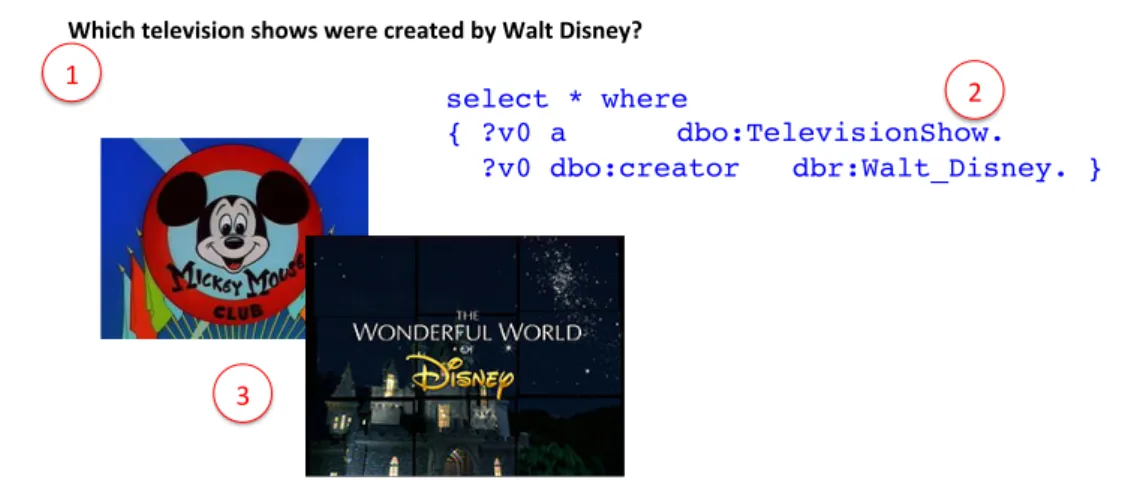
To enable common users to access the Data Web, it becomes necessary tosimplify the access to the Web of Databy providing search interfaces that resemble the search interfaces commonly used on the document-based Web. Figure 1.1 envisions three phases of such search engines on the Web of Data: (a) first, a user inserts a textual query, (b) then, it is transformed to a SPARQL query and (c) finally, the SPARQL query is run and desired entities are retrieved. These entities are the actual resources that the user desires.
1.1.2 Influence of a Question Answering System on Society
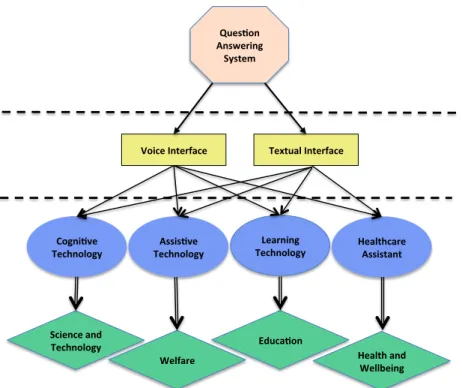
Advancing question answering can positively influence society in many ways, especially when, in addition to textual interfaces, voice interfaces are provided. Voice interfaces are more accessible for people with disabilities (e.g. vision impaired) or in situations in which typing is inconvenient (e.g. when driving a car). In the following, we discuss the influence of question answering systems on four important sectors of society: (i) science and technology, (ii) welfare, (iii) education, (iv) health and wellbeing (as shown in Figure 1.2. As the proof of applicability, we exemplify the influence of two recent technologies i.e. Google Glass and IBM Watson. Google Glass, developed by Google, is a optical head-mounted display with an integrated computer. It has a voice interface that allows users to interact with Internet services via natural language voice commands. Watson, developed by IBM, is an intelligent computer system which is able to answer natural language questions. Watson was build on the IBM’s DeepQA software technology which generates hypotheses, gathers massive evidence, and analyzes data [17]. IBM intends to market the DeepQA software to large corporations for various applications.
1.1 Motivation Which%television%shows%were%created%by%Walt%Disney?%
!
AKSW!group!+!Ques/on!Answering!on! Interlinked!Data!(published!in!www2013)! select * where ! { ?v0 a ! !dbo:TelevisionShow.! ?v0 dbo:creator dbr:Walt_Disney. }! 1! 2! 3! 1!Figure 1.1: A bird’s-eye view of the envisioned semantic search engine on the Web of Data: (a) an input textual query (b) the equivalent SPARQL query and (c) the retrieved entities after running the SPARQL query.
Science and technology
The amount of structured as well as unstructured data is growing enormously. We need advanced technologies to help us make sense of this data and make better decisions. Question answering is the area which harnesses the right information to act upon and make us more aware of existing knowledge. A question answering system can be integrated in various applications and devices like web and mobile applications, GPS systems etc. Thus, completely new categories of science and ubiquitous technology become possible. “Cognitive computing systems” is one of the emerging fields which models human brain, reasons, senses9. IBM defines a cognitive computing system as “a system which learns and interacts naturally with people to extend what either humans or machine could do on their own. They help human experts make better decisions by penetrating the complexity of Big Data.” Watson is a cognitive technology which processes information more like a human than a computer by understanding natural language, generating hypotheses based on evidence and learning as it goes.
IBM aims to market the Watson technology in the healthcare, finance, marketing and service domains. For instance, regarding finances, IBM states that: “the challenges the financial services industry faces are complex. On the one hand, regulatory measures as well as social and governmental pressure for financial institutions to be more inclusive, have increased; On the other hand, customers whom the industry serves, are more empowered, demanding and sophisticated than ever before.” With Watson IBM, in particular, aims to support three areas of finance: (a) increasing customer satisfaction and attracting new capital using personalised advice as well as wealth advisor, (b) financial analysis and (c) risk management.
Welfare
It is necessary that information on the Web is accessible and usable to all users regardless of their capabilities. Question answering systems as an emerging assistive technology10provide simpler access to information especially when equipped with a voice interface. Thus, a question answering system will benefit people with different capabilities like children, elderly people, disabled or vision impaired people in particular. Since these groups of people are interested in minimum interactions with an application,
9http://www.research.ibm.com/cognitive-computing
10Basically, assistive technology is referring to a device, piece of equipment or product devised to increase functional capabilities
Cogni&ve)
Technology) Technology)Assis&ve)
Learning)
Technology) Healthcare)Assistant) Voice)Interface) Textual)Interface) Ques&on) Answering) System) Science)and) Technology) Welfare) Educa&on) Health)and) Wellbeing)
Figure 1.2: Influence of a question answering system on society.
question answering systems help them by reducing the complexity of interacting with an application via automatic access to information.
There is only little research on the accessibility of interfaces of web search engines. Oppenheim was one of the pioneers who challenged the accessibility of web search engine interfaces for vision impaired and blind users [18]. Yang proposed a specialized search engine for blind users [19]. This search engine is constructed with an accessible interface and some improved functions for blind users (i.e., searching assistance functions and specialized design). In September 2013, Google offered alternative access modes11, such as the Chrome browser which supports assistive technologies including screen readers and magnifiers. This browser offers people with low vision a number of tools, including full-page zoom and high-contrast colour.
One of the recent technologies which is capable of helping blind and impaired vision people is Google Glass technology. The OpenGlass Project12is a project employing Google Glass technology to develop applications enabling blind and visually impaired users to identify objects and environments via established crowdsourcing technologies. The VisionAware13portal of the American Foundation for the Blind describes two OpenGlass applications which have been developed so far as follows:
1. TheQuestion-Answer applicationenables blind and visually impaired users to use Google Glass to take a picture with a question attached, which is related to the context of the picture. Then this question is submitted to Twitter14or Amazon’s Mechanical Turk platform15where sighted respondents answer. Finally, the answer is read aloud to the user through the speaker of the Google
11http://www.google.com/accessibility/products/ 12http://www.openshades.com/
13http://www.visionaware.org/ 14https://twitter.com/
1.1 Motivation
Glass headset.
2. TheMemento applicationautomatically recites notes when the blind or visually impaired user faces, or looks at, a recognizable scene. To use Memento, sighted users must first record descriptions or commentary about environmental features or a room setup. When a blind or visually impaired person using Google Glass approaches the same spot, Google Glass will recognize the feature or scene and read back the pre-recorded commentary.
Such examples show that assistive technology based on question answering enables completely new opportunities to compensate for disabilities or varying capabilities.
Education
Leveraging recent question answering and assistive technologies (i.e. also IBM Watson and Google Glass) opens new opportunities in education. For instance, these technologies assist learners as well as researchers with finding information faster; or they support integrating data from different data sources which will help teachers as well as researchers to make better decisions. In the following, we mention different possibilities of using these two recent technologies in education.
Watson helps researchers to find information faster. IBM says16: “The Economist estimates companies spent $603 billion on research and development in 2012. That is a lot of information to wade through. The IBM Watson Discovery Advisor is a research assistant that helps researchers collect information and synthesize insights to stay updated on recent findings and share information with colleagues. New York Genome Center17plans to use the IBM Watson cognitive computing system to analyze the genomic data of patients diagnosed with a highly aggressive and malignant brain cancer, and to more rapidly deliver personalized, life-saving treatment to patients of this disease.”
Google Glass, as a portable technology, has the potential to bring new possibilities to teachers and students. Foradian18, a provider of enterprise software solutions for education institutions, reports the use cases of Google Glass as follows:
1. “Google Search is phenomenal, and the Glass will allow the student as well as teacher to stay connected to an interactive environment featuring online tools all the time. This could pave way to a leap into the future of educational system. Teachers as well as students canrefer to topics related to their studieson the go. No fiddling through phones in the middle of the lecture; all you have to do is speak and voila, your search is done.
2. Teachers could use Google glass coupled with facial recognition totake attendance and could be used to generate Student Information System. Just by looking at the student you will get access to his/her student records with details of academic and non-academic performance, attendance etc. Creating students reports, schedules and class timings for students is only the tip of the iceberg.”
Health and wellbeing
There is a vast amount of biomedical data (either structured or unstructured) which has been published19 so far. A question answering system over such data can help researchers, doctors and ordinary people
16http://www.ibm.com/smarterplanet/us/en/ibmwatson/work.html 17http://www.nygenome.org/
18http://foradian.com/
19Regarding structured format, RDF biomedical datasets are available at:http://download.bio2rdf.org/release/3/
gain recent biomedical knowledge; for example about drugs, diseases etc. Researchers can leverage a question answering system on biomedical data to update their knowledge about the recent findings in their own field or related fields and thus make interesting discoveries. A question answering system helps doctors in diagnosing and treatment phases [20, 21] like AskHermes20[22]. Previously, crowdsourcing was one of the first attempts to assist ordinary people in order to find answers for their questions related to health and wellbeing such asCreateHealth.io21. Nowadays, a question answering system empowers ordinary peoples to directly access information. In the following, we present the use cases of Watson as well as Google Glass in the field of healthcare.
Healthcare is the first real use case of Watson. IBM declares22: “In health care, Watson and Watson-like technologies are now assisting doctors at Memorial Sloan Kettering23in diagnosing patients by providing a variety of possible causes for a set of symptoms. Watson can help doctors narrow down the options and pick the best treatments for their patients. The doctor still does most of the thinking, but Watson is there to make sense of the data and help make the process faster and more accurate.”
Several proofs of concept for Google Glass have been proposed in healthcare. In July 2013, Lucien Engelen initiated research on the usability of Google Glass in the health care field24. This research was carried out in operating rooms, ambulances, a trauma helicopter, general practice, and home care as well as the use in public transportation for visually or physically impaired25. Research contained making pictures, videos streaming to other locations dictating operative log, having students watch the procedures and tele-consultation through Hangout. On June 20, 2013, Rafael J. Grossmann, a Venezuelan surgeon practicing in the USA, was the first surgeon to ever demonstrate the use of Google Glass during a live surgical procedure26.
In conclusion, question answering technology is increasingly penetrating various domains of society and technology. However, most systems currently available mainly use unstructured and semi-structured content or fixed, predefined structured data
1.1.3 Existing Question Answering Systems
In the following, we present a number of well-known question answering systems running on structured or unstructured data.
1. IBM Watson27is a question answering system developed by IBM. In 2011 it answered Jeopardy questions and outperformed former human winners. Watson uses a corpus containing more than 200 million pages of unstructured information as well as semi-structured data like Wikipedia and DBpedia. Watson applies advanced natural language processing, information retrieval, knowledge representation, automated reasoning, and machine learning technologies to analyze the natural language input query and find the answer in the corpus.
2. START28 was initiated by the InfoLab Group at the MIT in 1993. Up to now, this system can answer millions of English questions about places, movies, people, dictionary definitions. START
20http://www.askhermes.org/index2.html 21http://createhealth.io/
22http://www.ibm.com/smarterplanet/us/en/ibmwatson/work.html
23Memorial Sloan Kettering Cancer Center is a cancer treatment and research institution founded in 1884 as the New York
Cancer Hospital.
24http://exponential.singularityu.org/medicine/
25Recent findings at:http://brengkenniscentrum.nl/blog/2013/12/een-nieuw-perspectief-google-glass/ 26http://www.forbes.com/fdc/welcome_mjx.shtml
27http://www.ibm.com/smarterplanet/us/en/ibmwatson/ 28http://start.csail.mit.edu/index.php
1.1 Motivation
receives natural language queries, then parses them in order to create parse trees, then it matches the created trees against its knowledge base and provides the appropriate information to the user. 3. Ephyra29is a modular framework for open domain question answering. Similar to other question answering systems, Ephyra retrieves answers for a given natural language question. It uses the whole of the Web as the underlying corpus.
4. WolframAlpha30is a question answering system which was developed by Wolfram research group and released in 2009. It is a computational knowledge engine or answer engine run on a curated structured datasets31. It answers factual queries (i.e. phrased natural-language fact-based questions) directly by computing the answer from different sources.
5. PowerAqua32is a multi-ontology-based question answering system running on Linked Data sources. It receives a natural language query as input and then returns answers drawn from the relevant distributed resources on the Semantic Web. PowerAqua is not restricted to a single ontology and therefore supports various domains.
6. TBSL33is a template-based question answering system on a single Linked Data knowledge base (i.e. DBpedia). It parses an input natural language question and then produces a SPARQL template reflecting the internal structure of the question.
1.1.4 Existing Search Engines on Linked Data
In the following, we present existing search services, which have been launched on the Linked Data so far.
1. Sindice34is a document-oriented index on Web of Data. Sindice collects RDF documents from the Semantic Web and indexes them on resource URIs, Inverse Functional Properties (IFPs) and keywords. This index allows applications to automatically locate documents containing semantic resources via an API. Furthermore, Sindice offers a user interface through which human users can retrieve these documents based on keywords, URIs, or IFPs.
2. Sigma35is established on top of Sindice which gives a very visual and interactive access to theWeb of Dataas a whole. Sigma is an entity-based retrieval service which employs large scale Semantic Web indexing, logic reasoning, data aggregation heuristics, ad-hoc ontology consolidation, external services and responsive user interaction to create entity descriptions. Sigma offers both a service and an end user application to access the Web of Data as an integrated information space. 3. Watson36is a search service indexing ontologies as well as semantic documents. Watson collects
the available semantic content on the Web and then analyzes it to extract useful metadata and indexes. Watson enables user to query semantic data using either keyword interface or API.
29http://www.ephyra.info/ 30http://www.wolframalpha.com/
31Curated datasets are checked for quality either by a scientist or an expert in an associated field 32http://poweraqua.open.ac.uk:8080/poweraqualinked/jsp/index.jsp
33http://autosparql-tbsl.dl-learner.org/ 34http://sindice.com/
35http://sig.ma/
1.2 Problem
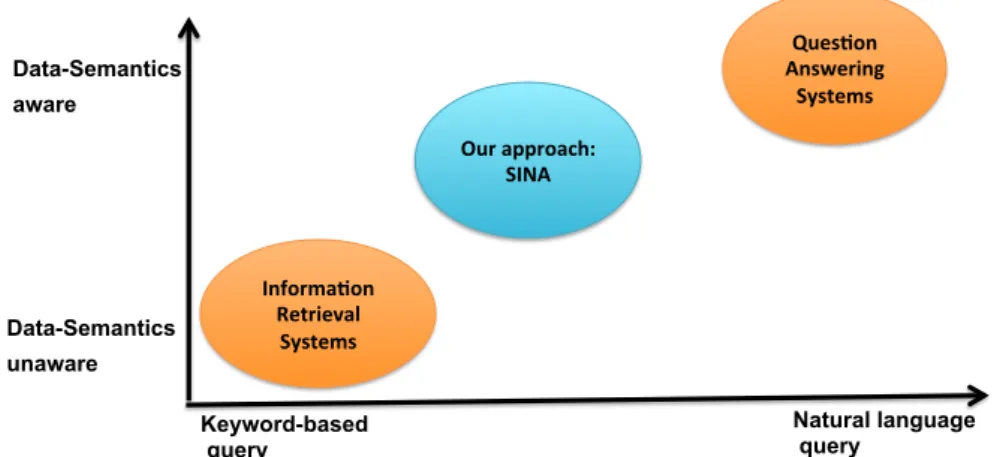
While various search approaches differ in their details, they can all be positioned on the following spectrum: On one end of the spectrum are simple keyword search systems that rely on traditional information retrieval approaches to retrieve resources that bear a label similar to the “the user’s input”. We dub such approaches asdata-semantics-unaware keyword searchsince they do not take the semantics explicated by the data into consideration. The main advantage of such approaches is that they scale well as they can make use of the results of decades of research carried out in the field of information retrieval. On the other end of the spectrum, we findquestion answering systems, which assume a natural-language query as input and convert this query into a full-fledged SPARQL query. These systems rely on natural-language processing tools such as Part of Speech (POS) tagging and dependency parsers to detect the relations between the elements of the query. The detected relations are then mapped to SPARQL constructs. The basic idea behind our work is to devise adata-semantics-aware keyword search
approach, which stands in the middle of the spectrum as shown in Figure 1.3 Our approach, which is calledSINA, aims to achieve maximal flexibility by being able to generate SPARQL queries from both natural-language queries and keyword queries. Several challenges need to be addressed to devise such an approach. In the following sections, we introduce these challenges.Comparison of Search Approaches
Data-Semantics unaware Data-Semantics aware Keyword-based query Natural language query Ques%on( Answering( Systems( Informa%on( Retrieval( Systems( Our(approach:( SINA( 1" Figure 1.3: Comparison of search approaches.
1.3 Challenges
We aim to realize a search engine for the Data Web, which is as easy to use as search engines for the Document Web, but allows to create complex queries and returns comprehensive structured query results. In order to achieve this goal, a number of challenges are raised:
• Query Segmentation
• Resource Disambiguation
1.3 Challenges
• Query Cleaning
• Formal Query Construction
• Data Fusion on Linked Data
In the rest of this section, we briefly describe each challenge. In order to obtain a better insight on these challenges, we use a few running examples throughout the discussion. Before presenting them, we introduce the datasets employed in this dissertation. We employed four different knowledge bases: first isDBpedia[23] as an individual knowledge base. DBpedia is a large knowledge base extracted from Wikipedia. Additionally, we used three interlinked knowledge bases i.e., Drugbank, Siderand
Diseasomewhich have been published in RDF. Sider37contains information about drugs and their side
effects. Diseasome [24]38contains information about diseases and genes associated with these diseases.
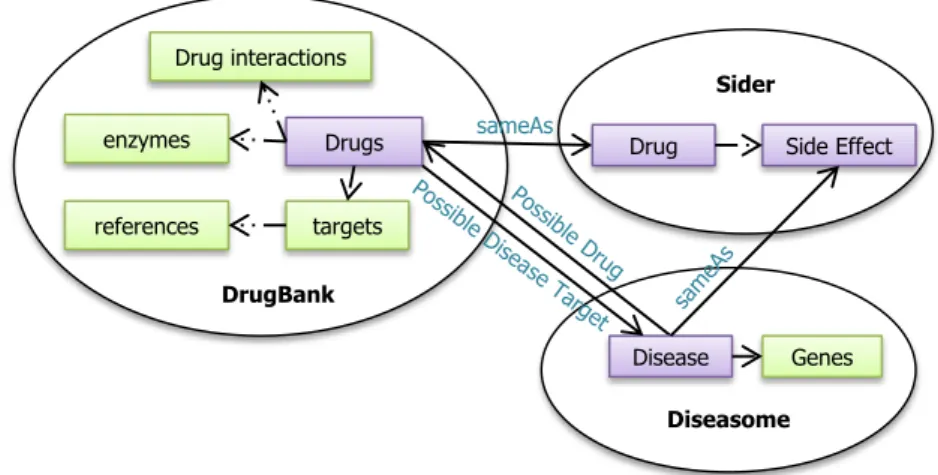
Drugbank [25]39is a comprehensive knowledge base containing information about drugs, drug target (i.e. protein) information, interactions and enzymes. As can be seen in Figure 1.4 the classes representing drugs in Drugbank and Sider are linked usingowl:sameAsand diseases from Diseasome are linked to drugs in Drugbank usingDiseasome:possible-DrugandDrugbank:possible-Disease-target
properties. Also, the diseases and side effects between Sider and Diseasome are linked using the
owl:sameAsproperty.
Diseasome Sider
Drugs sameAs
Disease
Drug Side Effect
Genes enzymes
Drug interactions
references targets DrugBank
Figure 1.4: Schema interlinking between three datasets: DrugBank, Sider and Diseasome.
We use two query examples throughout our discussion in order to clarify better. Assume that the input queries are as follows:
Example 1.1 What are the side effects of drugs used for Tuberculosis?
Example 1.2 Who produced films starring Natalie Portman? 37http://sideeffects.embl.de/
38http://diseasome.kobic.re.kr/ 39http://www.drugbank.ca/
1.3.1 Query Segmentation
Query segmentation is the process of identifying theright segments of data itemsthat occur in the keyword queries. Regarding example 1, the input query‘What is the side effects of drugs used for Tuberculosis?’is transformed to the 4-keyword tuple(side, effect, drug, Tuberculosis). This tuple can be segmented into (‘side effect drug’,‘Tuberculosis’) or (‘side effect’,‘drug’,‘Tuberculosis’). Similarly, the query of example 2 can be segmented to (‘produce’,‘film star’,‘Natalie’,‘Portman’) or (‘produce’,
‘film’,‘star’,‘Natalie Portman’). Note that in both cases, the second segmentation is more likely to lead to a query that contains the results intended by the user.
1.3.2 Resource Disambiguation
In addition to detecting the right segments for a given input query, we also have to map each of these segments to a suitable resource in the underlying knowledge base. This step is dubbedentity disambiguation and is of increasing importance since the size of knowledge bases and the hetero-geneity of schemas on the Linked Data Web grows steadily. With respect to example 1, the seg-ment ‘Tuberculosis’ is ambiguous when querying both Sider and Diseasome because it may refer to the resource diseasome:Tuberculosis describing the disease Tuberculosis or to the resource
sider:Tuberculosisbeing the side effect caused by some drugs. Regarding the example 2, the seg-ment‘film’is ambiguous because it may refer to the classdbo:Film(the class of all movies in DBpedia) or to the propertiesdbo:filmordbp:film(which relates festivals and the films shown during these festivals). In fact in this step, we aim to map the input keywords to a suitable set of entity identifiers, i.e. resourcesR={r1,r2, . . . ,rm}. Note that several adjacent keywords can be mapped to a single resource,
i.e.m≤n. Thus, for each segment, a suitable resource has to be determined. 1.3.3 Query Expansion
Automatic query expansion is a long-standing research topic in information retrieval. It is a way of reformulating the input query in order to overcome the vocabulary mismatch problem. In case of a vocabulary mismatch, schema-aware search systems are unable to retrieve data. For instance, consider the input queryaltitude of Everest. The keywordaltitude, should be matched to the keywordelevation, because the relevant property resource has the labelelevationand notaltitude. Therefore, query expansion can be a crucial step in question answering or keyword search pipeline. A naive way for automatic query expansion adds words derived from linguistic resources. In this regard, expansions aresynonyms,
hyponymsandhypernymsof the input keywords. In practice, this naive approach fails because of high retrieval cost and substantially decreasing precision. Regarding Linked Data, a research question arising here is whether interlinked data and vocabularies provide features, which can be taken into account for query expansion and how effective those new semantic features are in comparison to traditional linguistic ones.
1.3.4 Query Cleaning
The input query might contain some keywords, which semantically are either not related to the rest of the keywords or extra (i.e. does not have any matched resource in the corresponding SPARQL query). Since user usually is looking for information semantically closely related to each other, these unrelated keywords (i.e. noise) should be cleaned. An example is the question“Through which countries does the Yenisei river flow?”The keywordflowis not a stop word but does not have any matched resource in the
1.4 Approach and Contribution
corresponding SPARQL query of the benchmark (our benchmark contains a couple of natural language queries and their equivalent SPARQL query); and therefore should be ignored.
1.3.5 Formal Query Construction
Once the resources are detected, adequate formal queries (i.e. SPARQL queries) have to be generated. In order to generate a formal query (here: a conjunctive query), a connected subgraphG0=(V0,E0) of the knowledge base graphG=(V,E), called thequery graph, has to be determined. The intuition behind constructing such a query graph is that it has to fully cover the set of mapped resourcesR={r1, . . . ,rm}.
In linked data, mapped resourcesri may belong to different graphsGi. Thus, the query construction
algorithm must be able to traverse the links between datasets at both schema and instance levels. With respect to the example 1, after applying disambiguation on the identified resources, we would obtain the following resources from different datasets:
sider:sideEffect,diseasome:possibleDrug,diseasome:1154. The appropriate conjunctive query contains the following triple patterns which the second triple pattern bridges between the Drugbank and Sider datasets.:
1. diseasome:1154 diseasome:possibleDrug ?v1 .
2. ?v1 owl:sameAs ?v2 .
3. ?v2 sider:sideEffect ?v3 .
1.3.6 Data Fusion on Linked Data
We aim at an approach for question answering over a set of interlinked data sources. In this respect, new challenges are raised that we have to deal with. A first challenge is that information for answering a certain question can be spread among different datasets employing heterogeneous schemas. This makes the mapping of the input keywords to data more challenging when compared to querying a single dataset. An example is the query: “side effect and enzymes of drugs used for ASTHMA”. The answer to that query can only be obtained by joining data from Sider (side effects) and Drugbank (enzymes, drugs). The second challenge is constructing a formal query from the matched resources across different datasets which have to exploit links between the different datasets on the schema and instance levels. An example is the query: “side effects of drugs used for Tuberculosis”. Tuberculosis is defined in Diseasome, drugs for curing Tuberculosis are described in Drugbank, while we find their side effects in Sider.
1.4 Approach and Contribution
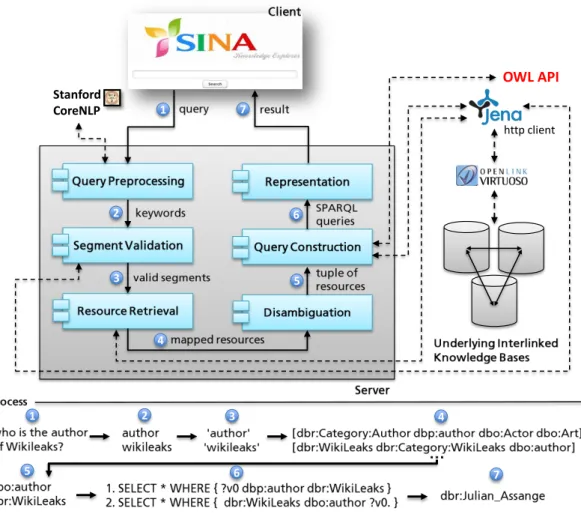
To the best of our knowledge, our approach is the first approach for answering questions on interlinked datasets by constructing a federated SPARQL query. Our approach led to the implementation of the Sina search engine. Sinais a Java based web application, which is available online. We deployed two demo instances, one employing DBpedia as background knowledge40and the second one operating on three interlinked life-science datasets41. Sinahas a simple interface similar to common search engines. All the steps are carried out automatically by Sinaand the user does not have to interact with the system during the search process. Figure 1.5 illustrates the high-level architecture of Sina, which comprises of six main components. Each component consumes the output of the previous component.
The challenges, which our approach has addressed so far, are as follows:
40 http://sina.aksw.org/
OWL API http client Stanford CoreNLP 2 3 4 5 6 7 1 2 3 4 5 6 7 1
Figure 1.5: Architecture of the Sinasearch engine.
• Query Segmentation (QS)
• Resource Disambiguation (RD)
• Query Expansion (QE)
• Formal Query Construction (FQC)
• Data Fusion on Linked Data (DF on LD)
• Benchmark Creation
In addition to the contribution in the above challenges, we took part in the RDF Data Slicing (RDF DS) project. Table 1.1 corresponds each challenge to the list of publications which address it. Furthermore, Table 1.2 presents an overview of the structure of this dissertation. Each chapter is dedicated to one of our publications, which addresses one or more challenges. Appendix A provides one of our papers [9] comprising a more experimental study on the approach employed for query segmentation and resource disambiguation. The article associated with our contribution in theRDF Data Slicing projects are included in Appendix B. In the rest of this chapter, we briefly point out the methodology employed for
1.4 Approach and Contribution
each challenge as well as the research questions used for the evaluation and the achievements. In order to gain a full insight, we refer you to the associated chapters and publications.
Challenges Publications
Query Segmentation [1, 6, 9, 11]
Resource Disambiguation [1, 6, 9, 11]
Query Expansion [5, 7]
Formal Query Construction [1, 2, 6, 10]
Data Fusion on Linked Data [1, 6]
RDF Data Slicing [3, 8]
Table 1.1: List of the challenges and the publications addressing them.
1.4.1 Query Segmentation and Resource Disambiguation
As shown in Table 1.2, our contribution on this part can be found in chapter 3 or in our publications [1, 6, 9, 11]. We shortly describe the main attributes of the proposed model.
Methodology:To tackle this challenge, we propose an automatic query segmentation and resource disambiguation approach leveraging background knowledge. We employ a Hidden Markov Model (HMM) to obtain the optimal input query segmentation and disambiguation of possible matches in a single step. In fact, query segmentation and resource disambiguation are mutually tightly interwoven. Before running this model, we carry out two preprocessing functions as follows:
1. The segment validation which groups keywords to form segments. This function validates the grouped segments with respect to the available resources in the underlying knowledge base(s). Recognizing segments are based on a naive approach (we compare this approach with a gready fashion in [9, 11]).
2. Theresource retrievalfunction obtains relevant resources from the underlying knowledge bases. The retrieval is based on the string matching between valid segments and therdfs:labelof resources. Furthermore, more resources are inferred from lightweightowl:sameAsreasoning. In this model, the input n-tuple of keywords is considered as the sequence of observations. The state space is populated with states which a valid segment can be observed. Background knowledge (i.e. semantic relatedness of two resources) is used for parameter estimation. The semantic relatedness is defined in terms of two parameters: the distance between the two resources and the popularity of each
Chapters QS&RD FQC QE DF on LD RDF DS
Template Inference Semantic Features Query Reformulation
Chapter 2 [2] - 4 - - - - -Chapter 3 [1] 4 - 4 - - 4 -Chapter 4 [7] - - - 4 - - -Chapter 5 [5] - - - - 4 - -Appendix A [9] 4 - - - -Appendix B [3] - - - 4
Table 1.2: Overview of the thesis structure: chapters along with their corresponding publication & the addressed challenges.
of the resources. The distance between two resources is the path length between those resources. The popularity of a resource is simply the connectivity degree (sum of both in and out degree) of the resource with other resources available in the state space. We use the HITS algorithm for transforming these two values to hub and authority values [1, 6].
Natural language processing (NLP) techniques are commonly used for text segmentation. We also developed a technique which is a combination of named entity and multi-word unit recognition services as well as POS-tagging for segmenting the input-query. Named entity, multi-word unit recognition and POS-tagging fail in the case of an incomplete sentences (e.g. for keyword-based queries), we show that our statistical approach is robust with respect to query expression variance (see Appendix A).
Evaluation: We rely onbootstrapping, a technique used to estimate an unknown probability dis-tribution function. We test different bootstrapping methods for the HMM parameters using various distributions (Normal, Zipf, Uniform) as well as an algorithm based on Hyperlink-Induced Topic Search (HITS). The goal of ultimate evaluation was to determine effectiveness and efficiency the resource disambiguation. We measured the effectiveness of our resource disambiguation approach using theMean Reciprocal Rank(MRR).
Results:Our proposed functions for HMM parameters produce the best results for both segmentation and disambiguation. As the output, this model can provide a ranked list of all paths generating the observation sequence with the corresponding probability. The following example shows a sample of the output.
Example 1.3 Let us consider the query: What are the side effects of drugs used for Tuberculosis?. The validated segments are:‘side effect’, ‘drug’ and ‘Tuberculosis’. After the retrieval and pruning process, the state space contains the re-sources listed in Table 1.3. By running theViterbi algorithmwith the associated probabilities, we obtain a ranked list of the chosen resources that the sequence{side effect, drug, Tubercu-losis}is observable through them. In the following, we show the top-4 most likely paths along with their associated probability.
1. 0.0033: Sider:sideEffect, Diseasome:possibleDrug, Diseasome:1154. 2. 0.0017: Sider:sideEffect, Diseasome:possibleDrug, Sider:C0041296. 3. 6.0257E-4: Sider:sideEffect, Sider:drugs, Diseasome 1154. 4. 4.0805E-4: Sider:sideEffect, Drugbank:Offer, Diseasome:1154.
Segment Resources Label Type
side effect 1. Sider:sideEffect side effect property
2. Sider:side_effects side effect class
drug
1. Drugbank:drugs drug class
2. Drug bank:offer drug class
3. Sider:drugs drug class
4. Diseasome:possibleDrug possible drug property
Tuberculosis 1. Diseasome:1154 tuberculosis instance
2. Sider:C0041296 tuberculosis instance
1.4 Approach and Contribution
1.4.2 Query Expansion
Our research and contribution in this field is divided in two parts. First, we introduce a number of new query expansion features based on semantic and linguistic inferencing over Linked Open Data. We evaluate the effectiveness of each feature individually as well as their combinations employing several machine learning approaches. Second, we propose a method for automatic query expansion. We employ a Hidden Markov Model(HMM) to obtain the optimal tuple of words. In the following, we shortly describe each part. The first part is presented in chapter 4 and the second part is presented in chapter 5.
Keyword Query Expansion on Linked Data Using Linguistic and Semantic Features
The idea here is that automatic query expansion methods can use the graph structure of RDF and follow interlinks between datasets.
Methodology:We introduce several semantic features for query expansion. In addition to linguistic features (i.e. synonyms, hyponyms, hypernyms), the semantic features are defined as the following semantic relations:
• sameAs: deriving resources having the same identity as the input resource usingowl:sameAs.
• seeAlso:deriving resources that provide more information about the input resource usingrdfs:seeAlso.
• class/property equivalence:deriving classes or properties providing related descriptions for the input resource usingowl:equivalentClassandowl:equivalentProperty.
• superclass/-property:deriving all super classes/properties of the input resource by following the rdfs:subClassOf or
rdfs:subPropertyOf property paths originating from the input resource.
• subclass/-property:deriving all sub resources of the input resourceriby following therdfs:subClassOf
or
rdfs:subPropertyOf property paths ending with the input resource.
• broader concepts: deriving broader concepts related to the input resourceri using the SKOS
vocabulary propertiesskos:broaderandskos:broadMatch.
• narrower concepts:deriving narrower concepts related to the input resourceriusingskos:narrower
andskos:narrowMatch.
• related concepts: deriving related concepts to the input resource ri using skos:closeMatch,
skos:mappingRelationandskos:exactMatch.
Evaluation:When applying expansion methods, there is a risk of yielding a large set of irrelevant words, which can have a negative impact on further processing steps. For this reason, we measure the effectiveness of all linguistic as well as semantic features individually in order to decide which of those are effective in query expansion. In order to do that we employ two kinds of classifiers (i.e.,Support Vector Machine (SVM)andDecision Tree). The second goal of our experimental study is how well a linear weighted combination of features can predict the relevant words? We do this by using machine learning methods to generate a linear combination of linguistic and semantic query expansion features with the aim of maximizing theF1-score and efficiency on different benchmark datasets.
Results:Interestingly, the setting with only semantic features result in an accuracy at least as high as the setting with only linguistic features. This observation is an important finding that semantic features
appear to be competitive with linguistic features. Our results allow developers of new search engines to integrateautomatic query expansionwith good results without spending much time on its design. This is important, since query expansion is usually not considered in isolation, but rather as one step in a pipeline for question answering or keyword search systems.
Query Reformulation on RDF Knowledge Bases using Hidden Markov Models
Methodology:In order to address the vocabulary mismatch problem, we introduce a novel method for automatic query expansion with respect to background knowledge. We define the concept of triple-based co-occurrence of words in RDF knowledge bases. Our method uses a Hidden Markov Model to determine the most suitable derived words from linguistic resources. We test different bootstrapping methods for the HMM parameters using various distributions as well as an algorithm based onHyperlink-Induced Topic Search(HITS).
Evaluation:We analyze the effect of this approach for both queries requiring expansion and those which do not. The goal of our evaluation is to determine: (1) How effective is our method with regard to a correct reformulation of queries which have vocabulary mismatch problem? (2) How robust is the method for queries which do not have vocabulary mismatch problem?
Results: Our experimental study shows the feasibility and high accuracy of the method. This implementation can provide a ranked list of all paths generating the observation sequence with the corresponding probability.
Example 1.4 Let us consider the input query:altitude of Everest. The observation list is shown in the first column of Table 1.4. After constructing and pruning the state space, it contains the words listed in the second column of Table 1.4 (only a subset of state space is presented). By running theViterbi algorithm, we have a ranked list of the chosen words that the sequencealtitude of Everestis observable through. In the following, we show the top-4 most likely paths along with their associated probability.
0.02451: altitude, Everest. 0.01681: elevation, Everest. 0.01145: length, Everest. 0.01145: height, Everest.
Observation States Origin Type
Everest Everest original keyword
altitude
altitude original keyword
elevation synonym
height synonym
ceiling hyponym
level hyponym
distance hypernym
altitude Everest altitude Everest original keyword
Table 1.4: A subset of the state space along with the origin type, list of all observations for the given query altitude Everest.
1.4.3 Formal Query Construction
We propose two methods for generating formal queries. In the first method presented in chapter 2, we use a set of predefined templates. This method is restricted to work only for a limited number of input
1.4 Approach and Contribution
keywords. In the second method presented in chapter 3, we do not have any predefined template and instead we dynamically generate templates using inference over the type of the identified resources. Thus, we do not have any limitation on the number of input keywords. In the following, we shortly present these two methods.
Generating SPARQL Queries using Templates
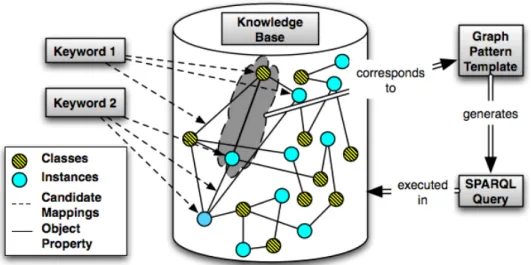
Figure 2.2 shows an overview of our approach. Our approach firstly retrieves relevant IRIs related to each user-supplied keyword from the underlying knowledge base and secondly injects them to a series of graph pattern templates for constructing formal queries. To find these relevant IRIs, two steps as (1) mapping keywords to IRIs and (2) ranking and selecting IRIs are carried out.
Figure 1.6: Overview of the proposed method.
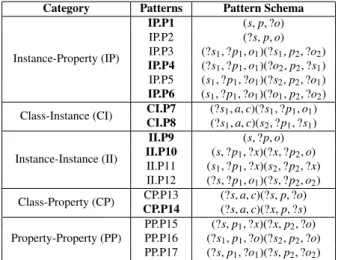
Methodology: We propose a novel approach for generating SPARQL queries usinggraph pattern templates. We define the concept of graph pattern template as a set of triple patterns containing placeholders and variables. As an example, (s1,?p1,?o1)(?o1,p2,?o2) is a graph pattern template that
contains two triple pattern templates. Symbols preceded by question marks denote variables while symbols without question marks are placeholders (e.g. s1 andp2are placeholders). Placeholders are
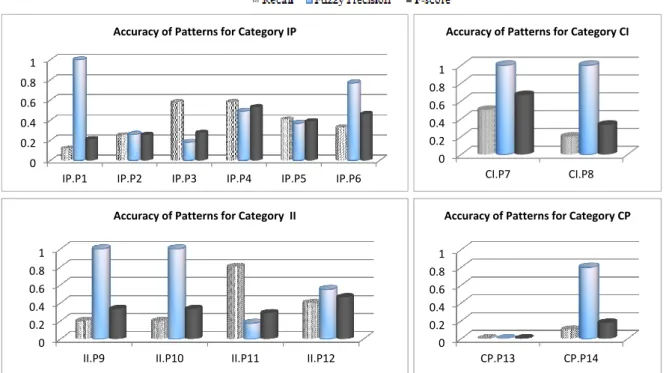
replaced by IRIs associated with the input keywords. A placeholder can stand either for a property (when occurring in the predicate position), an instance (when occurring at subject or object position) or a class (when occurring at the object position). The SPARQL queries generated with our approach are a restricted kind of SPARQL queries, since they use onlybasic graph patterns. We analysed 1,000 distinct queries from the query log of the public DBpedia endpoint42and learned that the number of IRIs is usually larger than the number of triple patterns occurring in the query. As a consequence of this finding we decided to assume graph patterns for generating SPARQL queries for two user-supplied keywords to consist of either one or two triple patterns. Therefore, this assumption leads to 17 possible graph pattern templates. We perform an accuracy study on all combinatorial possible graph pattern templates. This study showed that a filtered set of patterns limit the search space (thus leading to more efficiency) without reducing the accuracy of our approach significantly. Consequently, we only consider these patterns during the SPARQL-query generation process.
Example 1.5 After applying the mapping and ranking functions to the user queryisland of germany, we obtain two IRIs, i.e.http://dbpedia.org/ontology/Islandwith the
42The DBpedia SPARQL endpoint is available at: http://dbpedia.org/sparql/and the query log excerpt at: ftp:
typeclassandhttp://dbpedia.org/resource/Germanywith the typeinstance. The possible graph pattern templates for these two IRIs are:
1. (?island, a, dbo:Island), (?island, ?p, dbr:Germany) 2. (?island, a, dbo:Island), (dbr:Germany, ?p, ?island)
Our method would generate the following two queries:
1. SELECT * WHERE { ?island a dbo:Island . ?island ?p dbr:Germany . } 2. SELECT * WHERE { ?island a dbo:Island . dbr:Germany ?p ?island . }
Evaluation:We introduce two new accuracy metrics used for evaluation. Since the user’s intention in keyword-based search is ambiguous, judging the correctness of the retrieved answers is a challenging task. Therefore, we introduce theCorrectness Rate (CR) as a measure for the preference of certain RDF terms. This metric allows a user to rate the correctness of each individual answer based on its own perception. Furthermore, we introducefuzzy precisionmetric (FP), which measures the overall correctness of a template’s corresponding answers with respect to a set of keyword queriesQ.
This experiment was done in the following three levels:
1. Accuracy evaluation of possible graph pattern templates: In this study we aim at selecting those templates that lead to a high accuracy
2. Application evaluation: we evaluated the approach based on the three metrics, i.e. fuzzy precision, recall and f-score.
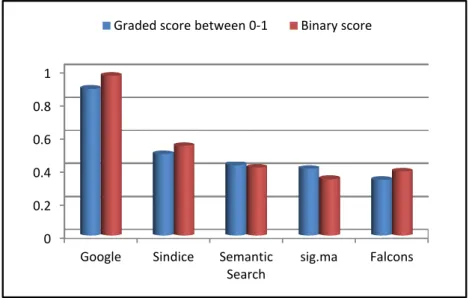
3. Comparative study based on relevance feedback: We compared our approach with a traditional Web search engine (Google) and three Semantic Web search engines (Sindice, Sig.ma and Falcon). Results: Since the approach is based on simple operations, it can generate and execute SPARQL queries very efficiently. Another advantage of this approach is that it is completely agnostic of the underlying knowledge base as well as its ontology schema. We implemented it as a Java Web application which is publicly available at: http://lod-query.aksw.org. The whole query interpretation and processing is performed typically on average in 15 seconds (while first results are already obtained after one second) when using DBpedia as knowledge base. We currently use DBpedia as background knowledge, but the approach is easily transferable to the whole Web of Data.
Generation of SPARQL Queries using Inference
Here, the goal is to construct a conjunctive queries (i.e. SPARQL queries) for a given set of resource identifiers. We address automatic construction of conjunctive queries without using any predefined templates.
Methodology:The core of SPARQL queries isbasic graph patterns, which can be viewed as a query graphQG. We define relevance probability for triple patterns. We aim at constructing QGwith the highest relevance probability. As a result of these considerations, we devise an algorithm that minimizes the number of both free variables and triple patterns in a query graph.
Forward Chaining:One of the prerequisites of our approach is the inference of implicit knowledge on the types of resources as well as domain and range information of the properties. To construct possible query graphs, we generate in a first step anincomplete query graph IQGsuch that the vertices are either
1.4 Approach and Contribution
equal or subset of the vertices (resp. edges) of the final query graph. In fact, an incomplete query graph (IQG) contains a set of disjoint sub-graphs, i.e. there is no vertex or edge in common between the sub-graphs. For the second step, we use an extension of the minimum spanning tree method that takes subgraphs (and not sets of nodes) as input and generates a minimal spanning graph as output. Since in the second step, the minimum spanning tree does not add any extra intermediate node (except nodes connected byowl:sameAslinks), it eliminates both the need of keeping an index over the neighborhood of nodes, and of using exploration for finding paths between nodes.
Example 1.6 We look at the query: What is the side effects of drugs used for Tuberculosis?. Assume the resource disambiguation process has identified the fol-lowing resources:
1. diseasome:possibleDrug (type property) Domain={diseasome:disease}, Range={drugbank:drugs}
2. diseasome:1154 (type instance)
Type={diseasome:disease}
3. sider:sideEffect (type property)
Domain={sider:drug}, Range={sider:sideeffect}
After running the IQGs generation, we will have two disjoint graphs shown in Figure 1.7. Then we connect these two disjoint graphs depicted in Figure 1.8 and thier corresponding SPARQL queries are as follows:
The corresponding SPARQL queries are as follows:
1. SELECT * WHERE { diseasome:1154 diseasome:possibleDrug ?v0 . ?v1 sider:sideEffect ?v2 . diseasome:1154 owl:SameAs ?v2 . } 2. SELECT * WHERE { diseasome:1154 diseasome:possibleDrug ?v0 . ?v1 sider:sideEffect ?v2 . ?v0 owl:SameAs ?v1 . } 1154$ possibleDrug$ ?v0$ Graph$1$ ?v1$ sideEffect$ ?v2$ Graph$2$
Figure 1.7:IQGfor the Example 14.
Evaluation:The goal of our evaluation was to determine effectiveness and efficiency of the query construction with respect to accuracy and runtime. we measured the accuracy of the query construction in terms of precision and recall. The results of the experimental study show high accuracy on our benchmarks. In addition, in other to speedup runtime, we implement parallelization.
Results:The output of this algorithm is a set of graph templates. Each graph template represents a comprehensive set of query graphs, which are isomorphic regarding edges.
1154$ possibleDrug$ ?v0$ Template$1$ ?v1$ ?v2$ sideEffect$ Owl:SameAs+ 1154$ possibleDrug$ ?v0$ ?v1$ sideEffect$Owl:SameAs+ ?v2$ Template$2$
Figure 1.8: Generated query graph templates.
1.4.4 Data Fusion on Linked Data
The main challenges associated with data fusion on Linked Data are 1. How to disambiguate resources retrieved from different datasets, and 2. How to generate a federated formal query using resources from different datasets. This part of work has been published in [1, 6].
Methodology:Regarding the first challenge, our approach resembles a horizontal search, where query segments derived from an input query are matched against all available datasets. Then, we extend the Hidden Markov Model approach for disambiguating resources from different datasets. As an example of this extension, we mention the extension of the state space with reasoning. It includes resources inferred from lightweightowl:sameAsreasoning. Consequently, for extending the state space, for each state representing a resourcexwe just include states for all resourcesy, which are in anowl:sameAsrelation withx. With respect to the second challenge, we construct a formal query (expressed in SPARQL) using the disambiguated matches by traversing links in the underlying datasets. By taking links between the matched resources (includingowl:sameAslinks) into account we obtain theminimum spanning graph
covering all matches in the different datasets.
Example 1.7 Let us consider the input query: Which are the drugs whose side effects are associated with the gene TRPM6?. According to our approach, the following federated SPARQL query (on two datasets, i.e. Diseasome and sider) is generated.
SELECT ?v2 WHERE {
?v0 diseasome:associatedGene diseasome:TRPM6 .
?v0 owl:sameAs ?v1 .
?v2 sider:sideEffect ?v1 . }
Evaluation: The goal of our evaluation was to determine effectiveness and efficiency of (1) the resource disambiguation and (2) the query construction on interlinked datasets with respect to accuracy and runtime. We measure the effectiveness of our resource disambiguation approach using theMean Reciprocal Rank(MRR) and the accuracy of the query construction in terms of precision and recall. Our underlying knowledge base is life-science benchmark. We study the runtime in its mono-core and parallel implementations and draw preliminary conclusions on the scalability of keyword search on Linked Data.
Results:The result of evaluation shows the effectiveness as well as scalability of this approach. We are able to answer queries on distributed sources. The output is a federated query connecting resources from different datasets.
1.4.5 Benchmark Creation
A significant contribution of this thesis is providing two benchmarks to the community of question answering systems. We developed two benchmarks for two different tasks. First one is used for federated queries over Linked Data task. The second one is used for query expansion task.
1.5 Conclusion and Future Work
Since there was no benchmark for federated queries over Linked Data, we created a benchmark consisting of 25 queries (natural language queries and their equivalent SPARQL queries) on the three interlinked datasets Drugbank, Sider and Diseasome43[1, 6]. Currently, our created benchmark as an standard benchmark is contributed in QALD-444campaign. QALD-4 is the fourth in a series of evaluation campaigns on multilingual question answering over linked data.
Moreover, since there is no benchmark for query expansion tasks over Linked Data we created one benchmark dataset [7]. This benchmark contains 37 keyword queries obtained from theQALD-1
andQALD-2 benchmarks45. TheQALD-1 andQALD-2benchmarks are essentially tailored towards comparing question answering systems based on natural language queries. We extracted all those keywords contained in the natural language queries requiring expansion for matching to the target knowledge base resource. An example is the keywordswifeandhusbandwhich should be matched to
dbpedia-owl:spouse. 1.4.6 RDF Data Slicing
Motivation:An increasing amount of structured data is being published on the Web as Linked Open Data (LOD). Yet, consuming and using Linked Open Data within an organization is still a substantial challenge because many of the LOD datasets are quite large. In this work, we focus on the selection and extraction processes. Selection comprises the definition and specification of a relevant fragment of a dataset, which is envisioned to be used internally by a consuming organization. Extraction processes the dataset dump and extracts the relevant fragment.
Methodology:We devise a fragment of SPARQL dubbed SliceSPARQL, which enables the selection of well-defined slices of datasets fulfilling typical information needs. SliceSPARQL supports graph patterns for which each connected subgraph pattern involves a maximum of one variable or IRI in its join conditions. This restriction guarantees the efficient processing of the query against a sequential dataset dump stream [3, 8].
Evaluation:The goal of our evaluation was to determine: 1. How efficient is the slicing approach for various queries? 2. How does the slicing scale for datasets of different size? 3. How does our approach compare to the traditional approach (i.e. loading complete dumps into the triple store and extracting by querying).
Results:As a result, our evaluation shows that dataset slices can be generated an order of magnitude faster than by using the conventional approach of loading the whole dataset into a triple store and retrieving the slice by executing the query against the SPARQL endpoint of triple stores.
1.5 Conclusion and Future Work
Massive amount of structured data, which are distributed and interlinked has been published on Linked Data. Yet, retrieving data from such precious interlinked knowledge bases is a challenge. Thus, a new generation of search approaches is demanding to enable common users to easily but more semantically retrieve knowledge. The aim of this thesis was to research and address challenges in the way of a semantic search system on Linked Data. Such a system lies on a simple interface (i.e. textual query) similar to traditional search engines, but it takes the structure of data into account, therefore, retrieval of data is more semantic-oriented. During our research, we tackled a number of existing challenges (i.e. query
43The benchmark queries are available athttp://wiki.aksw.org/Projects/lodquery 44http://greententacle.techfak.uni-bielefeld.de/~cunger/qald/
segmentation and disambiguation, query expansion, formal query construction and data fusion on Linked Data). We summarize our contributions as follows:
1. A novel approach for determining the most suitable resources for a user-supplied query from different datasets (disambiguation approach). We employed a Hidden Markov Model, whose parameters were bootstrapped with different distribution functions.
2. A novel method for constructing federated formal queries using the disambiguated resources and leveraging the linking structure of the underlying datasets. This approach essentially relies on a combination of domain and range inference as well as a link traversal method for constructing a connected graph, which ultimately renders a corresponding SPARQL query.
3. Regarding the problem of vocabulary mismatch, our contribution is divided into two parts: First, we introduce a number of new query expansion features based on semantic and linguistic inferencing over Linked Data. We evaluate the effectiveness of each feature individually as well as their combinations, employing Support Vector Machines and Decision Trees. Second, we propose a novel method for automatic query expansion, which employs a Hidden Markov Model to obtain the optimal tuples of derived words.
4. We provide two benchmarks for two different tasks to the community of question answering systems. The first one is used for